Agenda
 What is energy?
 Types of energy.
 Why to conserve energy?
 What can we do?
 Energy conservation in industries.
 Energy conservation in India.
What is energy?
 Energy is defined the ability or capacity to do work.
 Energy lights our cities, powers our vehicles and runs
machinery in factories. It warms and cools our homes,
cooks our food, plays our music and gives us pictures
on television.
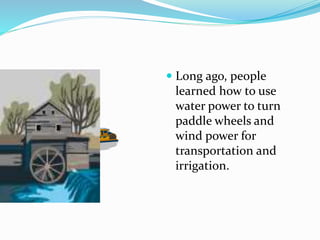
 Long ago, people
learned how to use
water power to turn
paddle wheels and
wind power for
transportation and
irrigation.
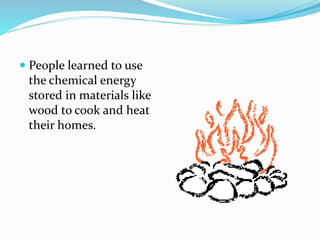
 People learned to use
the chemical energy
stored in materials like
wood to cook and heat
their homes.
 But machines and
technologies
introduced during the
Industrial Revolution
of the late 18th century
required the use of
other energy resources,
especially fossil fuels.
Types of Energy
 Renewable energy : It is the energy obtained from
sources that are essentially inexhaustible such as sun
and wind.
 Non-renewable energy: It is the energy that comes
from the ground and is not replaced in a relatively
short amount of time.
Non-renewable energy examples
 Thermal power plants using fossil fuels such as coal,
petroleum oil or natural gas.
 Nuclear power plant
Renewable Energy
 A renewable energy system converts the energy found
in sunlight, wind, falling water, sea waves, geo-thermal
heat or biomass into a form, we can use such as heat or
electricity.
Renewable Energy Examples
 Solar energy
 Wind energy
 Hydro power
 Biomass
 Geo-thermal
 Tidal energy
 Wave energy
 Ocean Thermal Energy Conversion (OTEC)
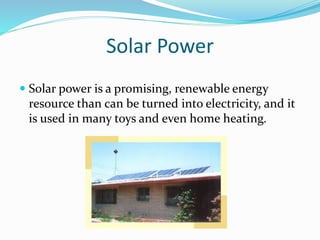
Solar Power
 Solar power is a promising, renewable energy
resource than can be turned into electricity, and it
is used in many toys and even home heating.
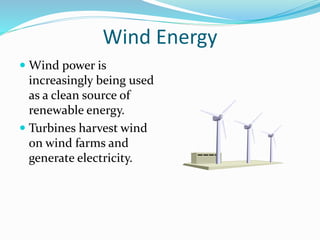
Wind Energy
 Wind power is
increasingly being used
as a clean source of
renewable energy.
 Turbines harvest wind
on wind farms and
generate electricity.
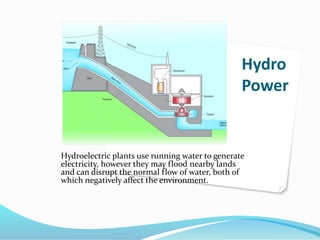
Hydro
Power
Hydroelectric plants use running water to generate
electricity, however they may flood nearby lands
and can disrupt the normal flow of water, both of
which negatively affect the environment.
Geothermal Power
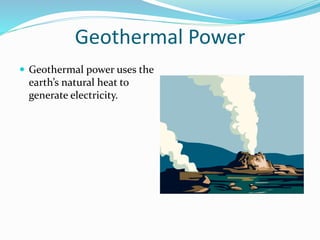
 Geothermal power uses the
earth’s natural heat to
generate electricity.
Tidal
Power
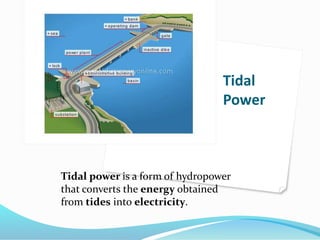
Tidal power is a form of hydropower
that converts the energy obtained
from tides into electricity.
OTEC
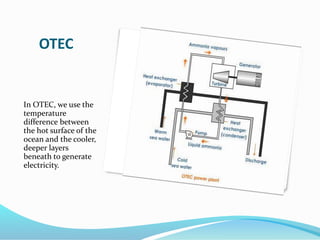
In OTEC, we use the
temperature
difference between
the hot surface of the
ocean and the cooler,
deeper layers
beneath to generate
electricity.
ENERGY MANAGEMENT & ITS OBJECTIVES
 “Energy Management is the judicious and effective use of
energy to maximize profits (minimizing costs) and
enhance competitive positions”. The objective of energy
management is to achieve and maintain optimum energy
procurement and utilization throughout the organization
and
 To minimize energy cost/waste without affecting
production and quality.
 To minimize environmental effect.
……
 There are four vital requirements for a successful energy
management. Any successful energy management
programme within an organization needs the total support
of top management.
 The other important requirements are a well charted
strategy plan, an effective monitoring system and adequate
technical ability for analyzing and implementing energy
saving options
Energy Conservation
 Energy conservation is the practice of decreasing the
quantity of energy use for the same quality and
quantity of Output.
 It may be achieved through efficient use, in which case
energy use is decreased while achieving a similar
outcome.
 Energy conservation also includes prevention of
misuse of energy.
Why to Conserve Energy …..
 To make up the gap between demand and supply, new
power plants have to be installed, which requires capital
and time.
 To meet the growing demand, it has been assessed that
additional generating capacity of 1 lakh MW has to be
added by 2017 requiring an investment of Rs. 8,00,000
crore approximately.
 An alternative is Energy Conservation.
 Energy Conservation measures can reduce power demand
and prune building up of additional generating capacity to
the extent it can be conserved.
Why to Conserve Energy …..
 We have limited resources of fossil fuels available on
Earth. 60% resources are consumed so far.
 We need a sustainable growth and save the resources
for future generations.
 Energy conservation is one way to achieve this.
 Our electricity bill becomes less.
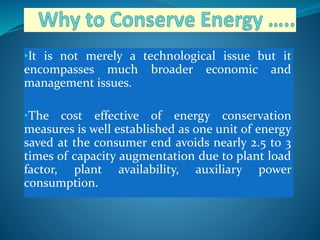
•It is not merely a technological issue but it
encompasses much broader economic and
management issues.
•The cost effective of energy conservation
measures is well established as one unit of energy
saved at the consumer end avoids nearly 2.5 to 3
times of capacity augmentation due to plant load
factor, plant availability, auxiliary power
consumption.
Why to Conserve Energy …..
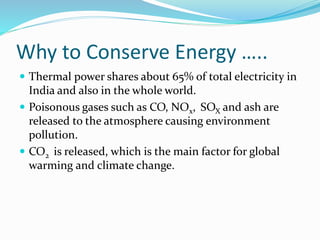
 Thermal power shares about 65% of total electricity in
India and also in the whole world.
 Poisonous gases such as CO, NOx, SOX and ash are
released to the atmosphere causing environment
pollution.
 CO2 is released, which is the main factor for global
warming and climate change.
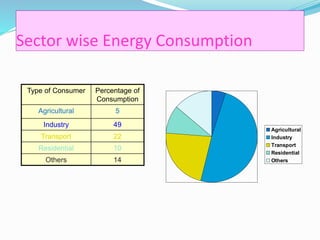
Sector wise Energy Consumption
Type of Consumer Percentage of
Consumption
Agricultural 5
Industry 49
Transport 22
Residential 10
Others 14
Agricultural
Industry
Transport
Residential
Others
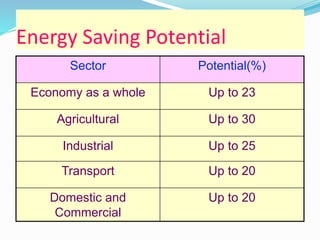
Energy Saving Potential
Sector Potential(%)
Economy as a whole Up to 23
Agricultural Up to 30
Industrial Up to 25
Transport Up to 20
Domestic and
Commercial
Up to 20
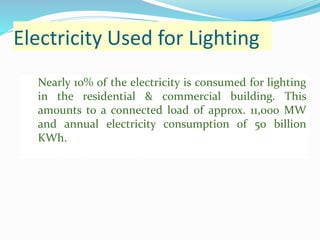
Electricity Used for Lighting
Nearly 10% of the electricity is consumed for lighting
in the residential & commercial building. This
amounts to a connected load of approx. 11,000 MW
and annual electricity consumption of 50 billion
KWh.
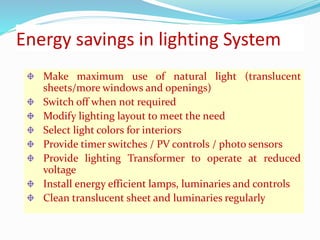
Energy savings in lighting System
Make maximum use of natural light (translucent
sheets/more windows and openings)
Switch off when not required
Modify lighting layout to meet the need
Select light colors for interiors
Provide timer switches / PV controls / photo sensors
Provide lighting Transformer to operate at reduced
voltage
Install energy efficient lamps, luminaries and controls
Clean translucent sheet and luminaries regularly
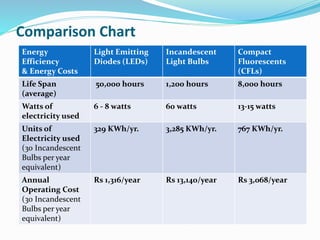
Comparison Chart
LED Light, Incandescent Light & CFL
Energy
Efficiency
& Energy Costs
Light Emitting
Diodes (LEDs)
Incandescent
Light Bulbs
Compact
Fluorescents
(CFLs)
Life Span
(average)
50,000 hours 1,200 hours 8,000 hours
Watts of
electricity used
6 - 8 watts 60 watts 13-15 watts
Units of
Electricity used
(30 Incandescent
Bulbs per year
equivalent)
329 KWh/yr. 3,285 KWh/yr. 767 KWh/yr.
Annual
Operating Cost
(30 Incandescent
Bulbs per year
equivalent)
Rs 1,316/year Rs 13,140/year Rs 3,068/year
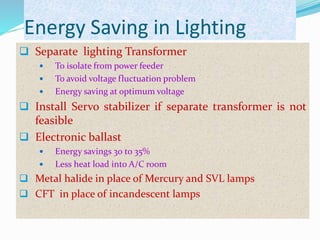
Energy Saving in Lighting
 Separate lighting Transformer
 To isolate from power feeder
 To avoid voltage fluctuation problem
 Energy saving at optimum voltage
 Install Servo stabilizer if separate transformer is not
feasible
 Electronic ballast
 Energy savings 30 to 35%
 Less heat load into A/C room
 Metal halide in place of Mercury and SVL lamps
 CFT in place of incandescent lamps
Energy Saving in Fan
 Fans are used extensively in summer months. Use of
high efficiency fan motor and use of electronic
regulator (in place of conventional resistance
regulator) can lead to about 20% saving in energy. The
fans with aerodynamic designs and improved
impellers consume about 20% less energy but are 30%
costlier as compared to conventional fans.
Energy Conservation in Industries
Energy saving potential in different industrial
equipments:
 Boiler
 Compressor
 Furnace
 Diesel Generating Set
 Motor
 Pump
 Refrigeration
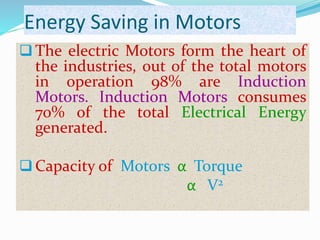
Energy Saving in Motors
 The electric Motors form the heart of
the industries, out of the total motors
in operation 98% are Induction
Motors. Induction Motors consumes
70% of the total Electrical Energy
generated.
 Capacity of Motors α Torque
α V2
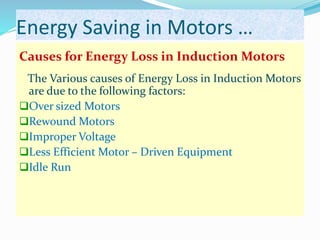
Energy Saving in Motors …
Causes for Energy Loss in Induction Motors
The Various causes of Energy Loss in Induction Motors
are due to the following factors:
Over sized Motors
Rewound Motors
Improper Voltage
Less Efficient Motor – Driven Equipment
Idle Run
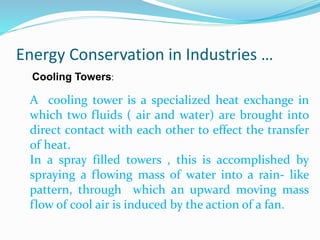
Energy Conservation in Industries …
Cooling Towers:
A cooling tower is a specialized heat exchange in
which two fluids ( air and water) are brought into
direct contact with each other to effect the transfer
of heat.
In a spray filled towers , this is accomplished by
spraying a flowing mass of water into a rain- like
pattern, through which an upward moving mass
flow of cool air is induced by the action of a fan.
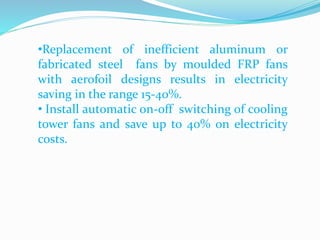
•Replacement of inefficient aluminum or
fabricated steel fans by moulded FRP fans
with aerofoil designs results in electricity
saving in the range 15-40%.
• Install automatic on-off switching of cooling
tower fans and save up to 40% on electricity
costs.
Energy Conservation in Industries …
Refrigeration and Air-conditioning
Refrigeration is the process of removing heat at
low temperature level and rejecting it at a
relatively higher temperature level.
The items required for the make-up of a
complete refrigeration and air-conditioning
system are refrigerating equipment fans, pumps,
cooling towers, filter, air-handling units, and
ducting. Depending upon the process, all or
some of the items mentioned may be required.
•Close doors and windows while running the air
condition. Don’t use a window fan while the air
conditioner is on, but do use a ceiling fan .
•Use of double doors, automatic door closers,
air curtains, double glaze windows, polyester
sun films etc. reduces heat ingress and air –
conditioning load of building.
Energy Conservation in Industries …
• Maintain condensers for proper heat
exchange. A 5c decrease in evaporator
temperature increases the specific power
consumption by 15%.
• The compressor of the central air
conditioner should be located in cool, shaded
place outside.
Energy Conservation in Industries …
• Specific power consumption of compressors
should be measured at regular intervals. The most
efficient compressors to be used for continuous
duty and other on standby.
• The duct system should be properly sealed. This
could save 10 percent to 15 percent of the
electricity into air conditioner
Energy Conservation in Industries …
Lighting
•Clean the lamps and fixtures regularly .
Illumination levels fall by 20-30% due to
collection of dust.
• Use of 36W tube light instead of 40 W tube
light saves electricity by 8 to 10%
•Use of sodium vapour lamps for area lighting in
place of mercury vapour lamps saves electricity
up to 40%.
Energy Conservation in Industries …
Diesel Generating Set :
DG sets
Depending on the type of industry and the
magnitude of the connected load, DG sets are
employed in various mode s like:
The standby mode to meet a part or full
requirement of the plant in case of power failures.
The peak-load mode to meet the requirement
during peak demand, thereby reducing the
maximum demand.
Energy Conservation in Industries …
• Maintain Diesel engines regularly.
• A poorly maintained injection pump increases
fuel consumption by 4gm/kWh .
• Blocked filters increases fuel consumption by
2kg/kWh.
• Measure fuel consumption per KWH of electricity
generated regularly. Take corrective action in case
this shows a rising trend.
Energy Audit
o Auditors inspect, analyze and evaluate the energy
consumption. They assess how much energy the
industry uses and pinpoints the opportunities for
energy savings.
o Accurate measurement of energy consumed is
necessary for energy audit to arrive at energy
conservation measures.
What we can do
In our everyday lives, we can also work to conserve
energy.
 Insulating, turning off lights and only using appliances
like dishwashers when they are full are just some of the
ways people can limit energy use in their homes.
 Turn off all electronic devices that are not in use. Not
only turn them off but try to remember to unplug them.
You will be surprised how much you will save with this
simple step!
 Also, car-pooling, bicycling, and taking public
transportation are effective energy-saving ideas.
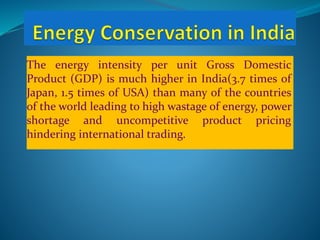
The energy intensity per unit Gross Domestic
Product (GDP) is much higher in India(3.7 times of
Japan, 1.5 times of USA) than many of the countries
of the world leading to high wastage of energy, power
shortage and uncompetitive product pricing
hindering international trading.
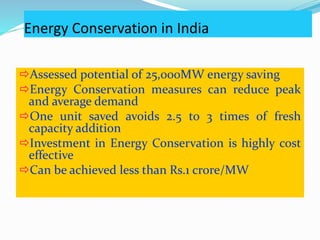
Energy Conservation in India
Assessed potential of 25,000MW energy saving
Energy Conservation measures can reduce peak
and average demand
One unit saved avoids 2.5 to 3 times of fresh
capacity addition
Investment in Energy Conservation is highly cost
effective
Can be achieved less than Rs.1 crore/MW
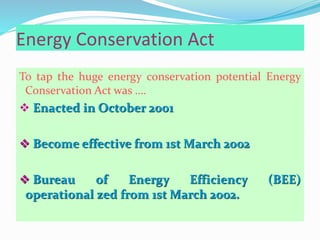
Energy Conservation Act
To tap the huge energy conservation potential Energy
Conservation Act was ….
 Enacted in October 2001
 Become effective from 1st March 2002
 Bureau of Energy Efficiency (BEE)
operational zed from 1st March 2002.
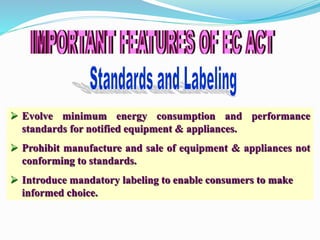
 Evolve minimum energy consumption and performance
standards for notified equipment & appliances.
 Prohibit manufacture and sale of equipment & appliances not
conforming to standards.
 Introduce mandatory labeling to enable consumers to make
informed choice.
What are Standards and Labels?
STANDARDS
Energy efficiency standards are sets of procedures and
regulations that prescribe the energy performance of
manufactured products, sometimes prohibiting the sale of
products less energy-efficient than the minimum standard.
LABELS
Energy efficiency labels are informative labels affixed to
manufactured products indicating a product’s energy
performance in order to provide consumers with the data
necessary for making informed purchases.
Important Roles include:
 Implementation of provisions of Energy Conservation Act
 Quick coordination
 Policy research
 Promotion of energy efficiency
 Development of new financial instruments
 Awareness creation.
Energy Conservation Day
India is observing 14th
December as “Energy
Conservation Day” to create
awareness among people.
Thank You

Energy_Conservation_PPT.pptx

  • 1.
    Agenda  What isenergy?  Types of energy.  Why to conserve energy?  What can we do?  Energy conservation in industries.  Energy conservation in India.
  • 2.
    What is energy? Energy is defined the ability or capacity to do work.  Energy lights our cities, powers our vehicles and runs machinery in factories. It warms and cools our homes, cooks our food, plays our music and gives us pictures on television.
  • 3.
     Long ago,people learned how to use water power to turn paddle wheels and wind power for transportation and irrigation.
  • 4.
     People learnedto use the chemical energy stored in materials like wood to cook and heat their homes.
  • 5.
     But machinesand technologies introduced during the Industrial Revolution of the late 18th century required the use of other energy resources, especially fossil fuels.
  • 6.
    Types of Energy Renewable energy : It is the energy obtained from sources that are essentially inexhaustible such as sun and wind.  Non-renewable energy: It is the energy that comes from the ground and is not replaced in a relatively short amount of time.
  • 7.
    Non-renewable energy examples Thermal power plants using fossil fuels such as coal, petroleum oil or natural gas.  Nuclear power plant
  • 8.
    Renewable Energy  Arenewable energy system converts the energy found in sunlight, wind, falling water, sea waves, geo-thermal heat or biomass into a form, we can use such as heat or electricity.
  • 9.
    Renewable Energy Examples Solar energy  Wind energy  Hydro power  Biomass  Geo-thermal  Tidal energy  Wave energy  Ocean Thermal Energy Conversion (OTEC)
  • 10.
    Solar Power  Solarpower is a promising, renewable energy resource than can be turned into electricity, and it is used in many toys and even home heating.
  • 11.
    Wind Energy  Windpower is increasingly being used as a clean source of renewable energy.  Turbines harvest wind on wind farms and generate electricity.
  • 12.
    Hydro Power Hydroelectric plants userunning water to generate electricity, however they may flood nearby lands and can disrupt the normal flow of water, both of which negatively affect the environment.
  • 13.
    Geothermal Power  Geothermalpower uses the earth’s natural heat to generate electricity.
  • 14.
    Tidal Power Tidal power isa form of hydropower that converts the energy obtained from tides into electricity.
  • 15.
    OTEC In OTEC, weuse the temperature difference between the hot surface of the ocean and the cooler, deeper layers beneath to generate electricity.
  • 16.
    ENERGY MANAGEMENT &ITS OBJECTIVES  “Energy Management is the judicious and effective use of energy to maximize profits (minimizing costs) and enhance competitive positions”. The objective of energy management is to achieve and maintain optimum energy procurement and utilization throughout the organization and  To minimize energy cost/waste without affecting production and quality.  To minimize environmental effect.
  • 17.
    ……  There arefour vital requirements for a successful energy management. Any successful energy management programme within an organization needs the total support of top management.  The other important requirements are a well charted strategy plan, an effective monitoring system and adequate technical ability for analyzing and implementing energy saving options
  • 18.
    Energy Conservation  Energyconservation is the practice of decreasing the quantity of energy use for the same quality and quantity of Output.  It may be achieved through efficient use, in which case energy use is decreased while achieving a similar outcome.  Energy conservation also includes prevention of misuse of energy.
  • 19.
    Why to ConserveEnergy …..  To make up the gap between demand and supply, new power plants have to be installed, which requires capital and time.  To meet the growing demand, it has been assessed that additional generating capacity of 1 lakh MW has to be added by 2017 requiring an investment of Rs. 8,00,000 crore approximately.  An alternative is Energy Conservation.  Energy Conservation measures can reduce power demand and prune building up of additional generating capacity to the extent it can be conserved.
  • 20.
    Why to ConserveEnergy …..  We have limited resources of fossil fuels available on Earth. 60% resources are consumed so far.  We need a sustainable growth and save the resources for future generations.  Energy conservation is one way to achieve this.  Our electricity bill becomes less.
  • 21.
    •It is notmerely a technological issue but it encompasses much broader economic and management issues. •The cost effective of energy conservation measures is well established as one unit of energy saved at the consumer end avoids nearly 2.5 to 3 times of capacity augmentation due to plant load factor, plant availability, auxiliary power consumption.
  • 22.
    Why to ConserveEnergy …..  Thermal power shares about 65% of total electricity in India and also in the whole world.  Poisonous gases such as CO, NOx, SOX and ash are released to the atmosphere causing environment pollution.  CO2 is released, which is the main factor for global warming and climate change.
  • 23.
    Sector wise EnergyConsumption Type of Consumer Percentage of Consumption Agricultural 5 Industry 49 Transport 22 Residential 10 Others 14 Agricultural Industry Transport Residential Others
  • 24.
    Energy Saving Potential SectorPotential(%) Economy as a whole Up to 23 Agricultural Up to 30 Industrial Up to 25 Transport Up to 20 Domestic and Commercial Up to 20
  • 25.
    Electricity Used forLighting Nearly 10% of the electricity is consumed for lighting in the residential & commercial building. This amounts to a connected load of approx. 11,000 MW and annual electricity consumption of 50 billion KWh.
  • 26.
    Energy savings inlighting System Make maximum use of natural light (translucent sheets/more windows and openings) Switch off when not required Modify lighting layout to meet the need Select light colors for interiors Provide timer switches / PV controls / photo sensors Provide lighting Transformer to operate at reduced voltage Install energy efficient lamps, luminaries and controls Clean translucent sheet and luminaries regularly
  • 27.
    Comparison Chart LED Light,Incandescent Light & CFL Energy Efficiency & Energy Costs Light Emitting Diodes (LEDs) Incandescent Light Bulbs Compact Fluorescents (CFLs) Life Span (average) 50,000 hours 1,200 hours 8,000 hours Watts of electricity used 6 - 8 watts 60 watts 13-15 watts Units of Electricity used (30 Incandescent Bulbs per year equivalent) 329 KWh/yr. 3,285 KWh/yr. 767 KWh/yr. Annual Operating Cost (30 Incandescent Bulbs per year equivalent) Rs 1,316/year Rs 13,140/year Rs 3,068/year
  • 28.
    Energy Saving inLighting  Separate lighting Transformer  To isolate from power feeder  To avoid voltage fluctuation problem  Energy saving at optimum voltage  Install Servo stabilizer if separate transformer is not feasible  Electronic ballast  Energy savings 30 to 35%  Less heat load into A/C room  Metal halide in place of Mercury and SVL lamps  CFT in place of incandescent lamps
  • 29.
    Energy Saving inFan  Fans are used extensively in summer months. Use of high efficiency fan motor and use of electronic regulator (in place of conventional resistance regulator) can lead to about 20% saving in energy. The fans with aerodynamic designs and improved impellers consume about 20% less energy but are 30% costlier as compared to conventional fans.
  • 30.
    Energy Conservation inIndustries Energy saving potential in different industrial equipments:  Boiler  Compressor  Furnace  Diesel Generating Set  Motor  Pump  Refrigeration
  • 31.
    Energy Saving inMotors  The electric Motors form the heart of the industries, out of the total motors in operation 98% are Induction Motors. Induction Motors consumes 70% of the total Electrical Energy generated.  Capacity of Motors α Torque α V2
  • 32.
    Energy Saving inMotors … Causes for Energy Loss in Induction Motors The Various causes of Energy Loss in Induction Motors are due to the following factors: Over sized Motors Rewound Motors Improper Voltage Less Efficient Motor – Driven Equipment Idle Run
  • 33.
    Energy Conservation inIndustries … Cooling Towers: A cooling tower is a specialized heat exchange in which two fluids ( air and water) are brought into direct contact with each other to effect the transfer of heat. In a spray filled towers , this is accomplished by spraying a flowing mass of water into a rain- like pattern, through which an upward moving mass flow of cool air is induced by the action of a fan.
  • 34.
    •Replacement of inefficientaluminum or fabricated steel fans by moulded FRP fans with aerofoil designs results in electricity saving in the range 15-40%. • Install automatic on-off switching of cooling tower fans and save up to 40% on electricity costs.
  • 35.
    Energy Conservation inIndustries … Refrigeration and Air-conditioning Refrigeration is the process of removing heat at low temperature level and rejecting it at a relatively higher temperature level. The items required for the make-up of a complete refrigeration and air-conditioning system are refrigerating equipment fans, pumps, cooling towers, filter, air-handling units, and ducting. Depending upon the process, all or some of the items mentioned may be required.
  • 36.
    •Close doors andwindows while running the air condition. Don’t use a window fan while the air conditioner is on, but do use a ceiling fan . •Use of double doors, automatic door closers, air curtains, double glaze windows, polyester sun films etc. reduces heat ingress and air – conditioning load of building.
  • 37.
    Energy Conservation inIndustries … • Maintain condensers for proper heat exchange. A 5c decrease in evaporator temperature increases the specific power consumption by 15%. • The compressor of the central air conditioner should be located in cool, shaded place outside.
  • 38.
    Energy Conservation inIndustries … • Specific power consumption of compressors should be measured at regular intervals. The most efficient compressors to be used for continuous duty and other on standby. • The duct system should be properly sealed. This could save 10 percent to 15 percent of the electricity into air conditioner
  • 39.
    Energy Conservation inIndustries … Lighting •Clean the lamps and fixtures regularly . Illumination levels fall by 20-30% due to collection of dust. • Use of 36W tube light instead of 40 W tube light saves electricity by 8 to 10% •Use of sodium vapour lamps for area lighting in place of mercury vapour lamps saves electricity up to 40%.
  • 40.
    Energy Conservation inIndustries … Diesel Generating Set : DG sets Depending on the type of industry and the magnitude of the connected load, DG sets are employed in various mode s like: The standby mode to meet a part or full requirement of the plant in case of power failures. The peak-load mode to meet the requirement during peak demand, thereby reducing the maximum demand.
  • 41.
    Energy Conservation inIndustries … • Maintain Diesel engines regularly. • A poorly maintained injection pump increases fuel consumption by 4gm/kWh . • Blocked filters increases fuel consumption by 2kg/kWh. • Measure fuel consumption per KWH of electricity generated regularly. Take corrective action in case this shows a rising trend.
  • 42.
    Energy Audit o Auditorsinspect, analyze and evaluate the energy consumption. They assess how much energy the industry uses and pinpoints the opportunities for energy savings. o Accurate measurement of energy consumed is necessary for energy audit to arrive at energy conservation measures.
  • 43.
    What we cando In our everyday lives, we can also work to conserve energy.  Insulating, turning off lights and only using appliances like dishwashers when they are full are just some of the ways people can limit energy use in their homes.  Turn off all electronic devices that are not in use. Not only turn them off but try to remember to unplug them. You will be surprised how much you will save with this simple step!  Also, car-pooling, bicycling, and taking public transportation are effective energy-saving ideas.
  • 44.
    The energy intensityper unit Gross Domestic Product (GDP) is much higher in India(3.7 times of Japan, 1.5 times of USA) than many of the countries of the world leading to high wastage of energy, power shortage and uncompetitive product pricing hindering international trading.
  • 45.
    Energy Conservation inIndia Assessed potential of 25,000MW energy saving Energy Conservation measures can reduce peak and average demand One unit saved avoids 2.5 to 3 times of fresh capacity addition Investment in Energy Conservation is highly cost effective Can be achieved less than Rs.1 crore/MW
  • 46.
    Energy Conservation Act Totap the huge energy conservation potential Energy Conservation Act was ….  Enacted in October 2001  Become effective from 1st March 2002  Bureau of Energy Efficiency (BEE) operational zed from 1st March 2002.
  • 47.
     Evolve minimumenergy consumption and performance standards for notified equipment & appliances.  Prohibit manufacture and sale of equipment & appliances not conforming to standards.  Introduce mandatory labeling to enable consumers to make informed choice.
  • 48.
    What are Standardsand Labels? STANDARDS Energy efficiency standards are sets of procedures and regulations that prescribe the energy performance of manufactured products, sometimes prohibiting the sale of products less energy-efficient than the minimum standard. LABELS Energy efficiency labels are informative labels affixed to manufactured products indicating a product’s energy performance in order to provide consumers with the data necessary for making informed purchases.
  • 49.
    Important Roles include: Implementation of provisions of Energy Conservation Act  Quick coordination  Policy research  Promotion of energy efficiency  Development of new financial instruments  Awareness creation.
  • 50.
    Energy Conservation Day Indiais observing 14th December as “Energy Conservation Day” to create awareness among people.
  • 51.