DR. HARRIS N SUHARJONO FRCOG
SENIOR CONSULTANT & HEAD
DEPARTMENT OF O& G
SARAWAK GENERAL HOSPITAL
Sarawak
VTE Risk Assessment Program:
Antenatal & Postnatal
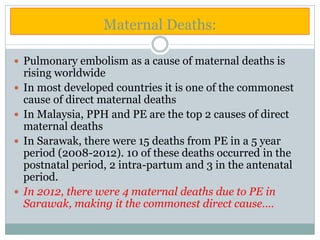
Maternal Deaths:
 Pulmonary embolism as a cause of maternal deaths is
rising worldwide
 In most developed countries it is one of the commonest
cause of direct maternal deaths
 In Malaysia, PPH and PE are the top 2 causes of direct
maternal deaths
 In Sarawak, there were 15 deaths from PE in a 5 year
period (2008-2012). 10 of these deaths occurred in the
postnatal period, 2 intra-partum and 3 in the antenatal
period.
 In 2012, there were 4 maternal deaths due to PE in
Sarawak, making it the commonest direct cause….
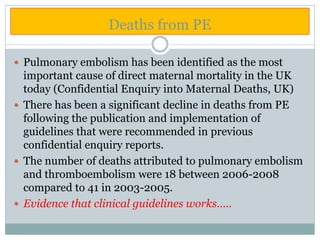
Deaths from PE
 Pulmonary embolism has been identified as the most
important cause of direct maternal mortality in the UK
today (Confidential Enquiry into Maternal Deaths, UK)
 There has been a significant decline in deaths from PE
following the publication and implementation of
guidelines that were recommended in previous
confidential enquiry reports.
 The number of deaths attributed to pulmonary embolism
and thromboembolism were 18 between 2006-2008
compared to 41 in 2003-2005.
 Evidence that clinical guidelines works…..
Venous Thromboembolism (VTE)
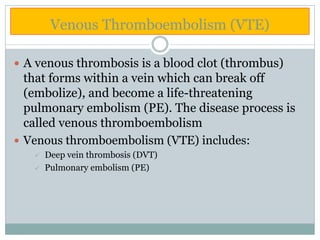
 A venous thrombosis is a blood clot (thrombus)
that forms within a vein which can break off
(embolize), and become a life-threatening
pulmonary embolism (PE). The disease process is
called venous thromboembolism
 Venous thromboembolism (VTE) includes:
 Deep vein thrombosis (DVT)
 Pulmonary embolism (PE)
Pulmonary Embolism (PE)
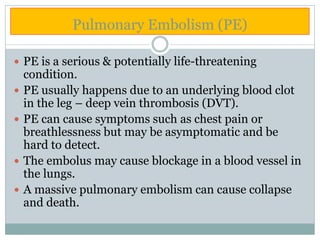
 PE is a serious & potentially life-threatening
condition.
 PE usually happens due to an underlying blood clot
in the leg – deep vein thrombosis (DVT).
 PE can cause symptoms such as chest pain or
breathlessness but may be asymptomatic and be
hard to detect.
 The embolus may cause blockage in a blood vessel in
the lungs.
 A massive pulmonary embolism can cause collapse
and death.
Signs and Symptoms of DVT
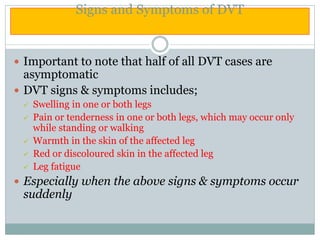
 Important to note that half of all DVT cases are
asymptomatic
 DVT signs & symptoms includes;
 Swelling in one or both legs
 Pain or tenderness in one or both legs, which may occur only
while standing or walking
 Warmth in the skin of the affected leg
 Red or discoloured skin in the affected leg
 Leg fatigue
 Especially when the above signs & symptoms occur
suddenly
Sings & Symptoms of PE
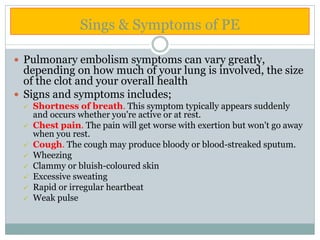
 Pulmonary embolism symptoms can vary greatly,
depending on how much of your lung is involved, the size
of the clot and your overall health
 Signs and symptoms includes;
 Shortness of breath. This symptom typically appears suddenly
and occurs whether you're active or at rest.
 Chest pain. The pain will get worse with exertion but won't go away
when you rest.
 Cough. The cough may produce bloody or blood-streaked sputum.
 Wheezing
 Clammy or bluish-coloured skin
 Excessive sweating
 Rapid or irregular heartbeat
 Weak pulse
‘Thombophilia’
 Thrombophilia is a condition where the blood clots
more easily than normal.
 Up to 50% of people who have an episode of
thrombosis like DVT or PE may have this condition.
 Check or ask for documented history of;
1. Protein C deficiency
2. Protein S deficiency
3. Antiphospholipid syndrome
4. Factor V Leiden
5. Dysfibrinogenaemia
6. Antithrombin deficiency
Increased risk of VTE in pregnancy
1. Pregnancy is a hypercoagulable state
2. Increase in factor VIII, IX, X, fibrinogen
3. Decreased in fibrinolytic activity, anti-thrombin
and protein S fall
4. Venous stasis in pregnancy
5. Pregnancy increases risk of VTE 6 folds (from first
trimester till 6 weeks post-partum)
6. Caesarean sections further increases the risk
approximately by 10-20 folds
“Thromboembolism remains a
significant but preventable
cause of maternal death”
Strategy to reduce risk of VTE in pregnancy
 Identifying & modifying risk factors in women
planning to embark on pregnancy – PPC Clinic
 To reduce BMI below 30kg/m2
 Stop smoking
 History of VTE?
 Limit number of pregnancies
 Optimizing chronic medical illnesses
 Effective and appropriate contraception
 Improve awareness: e.g. Making patient information
leaflets/brochures available
Strategy to reduce risk of VTE in pregnancy
 Screening for VTE risk among antenatal and postnatal
women;
 Common VTE Risk Assessment form
 Checklist for VTE for nurses to use during home visits
 System put in place in to manage appropriately those at
risk;
 Simple guidelines for medical officers/nurses to follow
 Practical management flowcharts
 Making heparin & LMWH available in all hospitals
“Risk scoring of antenatal and
postnatal women for VTE is
probably the most effective way
of identifying who is at
significant risk and needed
intervention or treatment with
thromboprophylaxis”
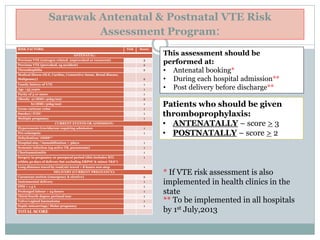
Sarawak Antenatal & Postnatal VTE Risk
Assessment Program:
RISK FACTORS: Tick Score
ANTENATAL:
Previous VTE (estrogen related, unprovoked or recurrent) 3
Previous VTE (provoked, eg accident) 2
Thrombophilia 2
Medical illness (SLE, Cardiac, Connective tissue, Renal disease,
Malignancy) 2
Family history of VTE 1
Age >35 years 1
Parity of 5 or more 1
Obesity a) (BMI>40kg/m2) 2
b) (BMI>30kg/m2) 1
Gross varicose veins 1
Smoker/ IVDU 1
Multiple pregnancy 1
CURRENT EVENTS OR ADMISSION:
Hyperemesis Gravidarum requiring admission 1
Pre-eclampsia 1
Dehydration/ OHSS**
Hospital stay / immobilization > 3days 1
Systemic infection (eg active TB, pneumonia) 1
Chorioamnionitis 1
Surgery in pregnancy or puerperal period (this includes BTL
within 42 days of delivery but excluding ERPOC & minor T&S*)
1
Long distance travel by road/air travel > 8 hours non stop 1
DELIVERY (CURRENT PREGNANCY):
Caesarean section (emergency & elective) 2
Instrumental delivery 1
PPH > 1.5 L 1
Prolonged labour > 24 hours 1
Third/fourth degree perineal tear 1
Vulvo/vaginal haematoma 1
Septic miscarriage/ Molar pregnancy 1
TOTAL SCORE
This assessment should be
performed at:
• Antenatal booking*
• During each hospital admission**
• Post delivery before discharge**
Patients who should be given
thromboprophylaxis:
• ANTENATALLY – score > 3
• POSTNATALLY – score > 2
* If VTE risk assessment is also
implemented in health clinics in the
state
** To be implemented in all hospitals
by 1st July,2013
When to assess?
 At this moment in time, the VTE risk assessment in the
state will only be carried out in hospitals
 When antenatal or postnatal patients are being admitted
to the hospital for any indications (includes those
admitted to other departments)
 Reassessment required if other complications developed
during the hospital stay or need to stay longer than 3
days
 Those considered at risk upon discharge (e.g. surgery) in
the antenatal period, may also need thromboprophylaxis
 Post delivery before discharge to assess if she needs
thromboprophylaxis
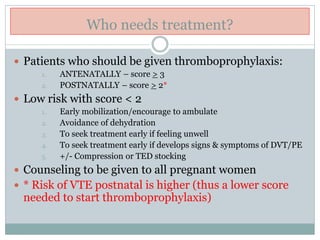
Who needs treatment?
 Patients who should be given thromboprophylaxis:
1. ANTENATALLY – score > 3
2. POSTNATALLY – score > 2*
 Low risk with score < 2
1. Early mobilization/encourage to ambulate
2. Avoidance of dehydration
3. To seek treatment early if feeling unwell
4. To seek treatment early if develops signs & symptoms of DVT/PE
5. +/- Compression or TED stocking
 Counseling to be given to all pregnant women
 * Risk of VTE postnatal is higher (thus a lower score
needed to start thromboprophylaxis)
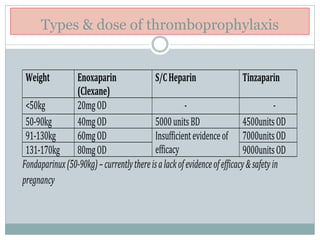
Types & dose of thromboprophylaxis
Weight Enoxaparin
(Clexane)
S/CHeparin Tinzaparin
<50kg 20mgOD - -
50-90kg 40mgOD 5000unitsBD 4500unitsOD
91-130kg 60mgOD Insufficientevidenceof
efficacy
7000unitsOD
131-170kg 80mgOD 9000unitsOD
Fondaparinux(50-90kg)–currentlythereisalackofevidenceofefficacy&safetyin
pregnancy
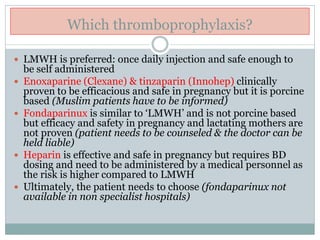
Which thromboprophylaxis?
 LMWH is preferred: once daily injection and safe enough to
be self administered
 Enoxaparine (Clexane) & tinzaparin (Innohep) clinically
proven to be efficacious and safe in pregnancy but it is porcine
based (Muslim patients have to be informed)
 Fondaparinux is similar to ‘LMWH’ and is not porcine based
but efficacy and safety in pregnancy and lactating mothers are
not proven (patient needs to be counseled & the doctor can be
held liable)
 Heparin is effective and safe in pregnancy but requires BD
dosing and need to be administered by a medical personnel as
the risk is higher compared to LMWH
 Ultimately, the patient needs to choose (fondaparinux not
available in non specialist hospitals)
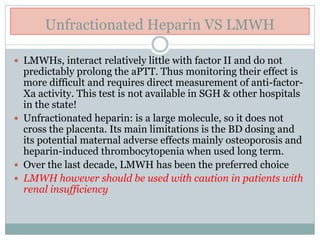
Unfractionated Heparin VS LMWH
 LMWHs, interact relatively little with factor II and do not
predictably prolong the aPTT. Thus monitoring their effect is
more difficult and requires direct measurement of anti-factor-
Xa activity. This test is not available in SGH & other hospitals
in the state!
 Unfractionated heparin: is a large molecule, so it does not
cross the placenta. Its main limitations is the BD dosing and
its potential maternal adverse effects mainly osteoporosis and
heparin-induced thrombocytopenia when used long term.
 Over the last decade, LMWH has been the preferred choice
 LMWH however should be used with caution in patients with
renal insufficiency
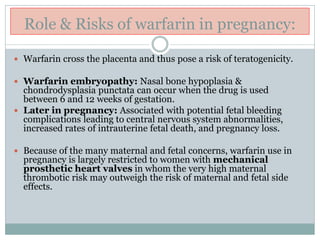
Role & Risks of warfarin in pregnancy:
 Warfarin cross the placenta and thus pose a risk of teratogenicity.
 Warfarin embryopathy: Nasal bone hypoplasia &
chondrodysplasia punctata can occur when the drug is used
between 6 and 12 weeks of gestation.
 Later in pregnancy: Associated with potential fetal bleeding
complications leading to central nervous system abnormalities,
increased rates of intrauterine fetal death, and pregnancy loss.
 Because of the many maternal and fetal concerns, warfarin use in
pregnancy is largely restricted to women with mechanical
prosthetic heart valves in whom the very high maternal
thrombotic risk may outweigh the risk of maternal and fetal side
effects.
How long to treat?
 Depends on how high is the risk
 Depends if the risk is modifiable
 Those with previous VTE, thrombophilia or a combination
of antenatal non modifiable factors that adds up to a score
of > 3, would require thromboprophylaxis throughout
pregnancy & up to 42 days post delivery
 Those who develops transient or temporary conditions that
increases the risk temporarily (e.g. admission > 3 days,
surgery, hyperemesis gravidarum) only needs short term
treatment
 Those that had LSCS or surgery during pregnancy requires
7 days of treatment or longer if indicated
 When in doubt, consult an O&G specialist
How to start thromboprophylaxis?
 Confirm VTE risk score
 Counsel patient appropriately:
 Why she needs it & how long?
 Types: heparin or LMWH
 How to self administer (injection)
 How to keep the LMWH
 Possible side effects
 Follow-up plan
 Thromboprophylaxis can be started by medical officers in non
specialist hospitals
 Heparin should only be administered by medical personnel as
an inpatient or outpatient
 When in doubt, consult an O&G specialist or your buddy
specialist
Patients who refused thromboprophylaxis
 Counseling play an important role (consider
further counseling by FMS or O&G specialist)
 Consult an O&G specialist or buddy specialist
 Upon failure to convince patient;
 Use appropriate compression stockings or ‘venaflow’ where
available (inpatient)
 Reinforce advise on ambulation, avoidance of dehydration
& seeking early treatment if unwell
 Teach patient to identify signs & symptoms of DVT & PE
 Arrange regular clinic and home visits
When to stop & restart LMWH for
labour/epidural/spinal/surgery ?
 Stop LMWH about 24 hours before elective surgery
 Stop LMWH when a patient goes into active labour or
expected to go into active labour and restart the next day
after delivery if she does not have PPH
 Decision to restart LMWH after surgery depends on;
 If haemostasis safely secured
 The risk of bleeding associated with the procedure
 Restart 24 hours after surgery or the next day, in cases of
massive PPH may delay by a day or two.
 Stop 12 hours before spinal/epidural and restart about 12 -
24 hours after catheter has been removed
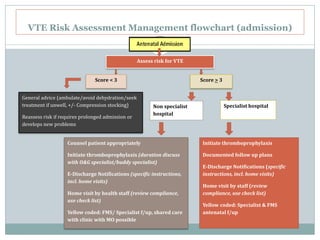
VTE Risk Assessment Management flowchart (admission)
Assess risk for VTE
Score < 3 Score > 3
General advice (ambulate/avoid dehydration/seek
treatment if unwell, +/- Compression stocking)
Reassess risk if requires prolonged admission or
develops new problems
Non specialist
hospital
Specialist hospital
Counsel patient appropriately
Initiate thromboprophylaxis (duration discuss
with O&G specialist/buddy specialist)
E-Discharge Notifications (specific instructions,
incl. home visits)
Home visit by health staff (review compliance,
use check list)
Yellow coded: FMS/ Specialist f/up, shared care
with clinic with MO possible
Initiate thromboprophylaxis
Documented follow up plans
E-Discharge Notifications (specific
instructions, incl. home visits)
Home visit by staff (review
compliance, use check list)
Yellow coded: Specialist & FMS
antenatal f/up
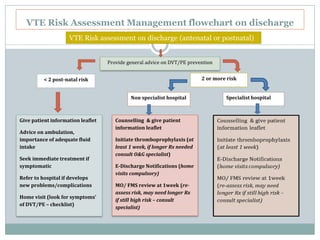
VTE Risk Assessment Management flowchart on discharge
Provide general advice on DVT/PE prevention
< 2 post-natal risk 2 or more risk
Give patient information leaflet
Advice on ambulation,
importance of adequate fluid
intake
Seek immediate treatment if
symptomatic
Refer to hospital if develops
new problems/complications
Home visit (look for symptoms’
of DVT/PE – checklist)
Non specialist hospital Specialist hospital
Counselling & give patient
information leaflet
Initiate thromboprophylaxis (at
least 1 week, if longer Rx needed
consult O&G specialist)
E-Discharge Notifications (home
visits compulsory)
MO/ FMS review at 1week (re-
assess risk, may need longer Rx
if still high risk – consult
specialist)
VTE Risk assessment on discharge (antenatal or postnatal)
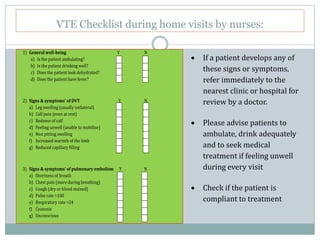
VTE Checklist during home visits by nurses:
1) General well-being Y N
a) Is the patient ambulating?
b) Is the patient drinking well?
c) Does the patient look dehydrated?
d) Does the patient have fever?
2) Signs & symptoms’ of DVT Y N
a) Leg swelling (usually unilateral)
b) Calf pain (even at rest)
c) Redness of calf
d) Feeling unwell (unable to mobilize)
e) Non pitting swelling
f) Increased warmth of the limb
g) Reduced capillary filling
3) Signs & symptoms’ of pulmonary embolism Y N
a) Shortness of breath
b) Chest pain (more during breathing)
c) Cough (dry or blood stained)
d) Pulse rate >100
e) Respiratory rate >24
f) Cyanosis
g) Unconscious
 If a patient develops any of
these signs or symptoms,
refer immediately to the
nearest clinic or hospital for
review by a doctor.
 Please advise patients to
ambulate, drink adequately
and to seek medical
treatment if feeling unwell
during every visit
 Check if the patient is
compliant to treatment
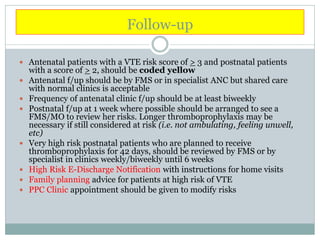
Follow-up
 Antenatal patients with a VTE risk score of > 3 and postnatal patients
with a score of > 2, should be coded yellow
 Antenatal f/up should be by FMS or in specialist ANC but shared care
with normal clinics is acceptable
 Frequency of antenatal clinic f/up should be at least biweekly
 Postnatal f/up at 1 week where possible should be arranged to see a
FMS/MO to review her risks. Longer thromboprophylaxis may be
necessary if still considered at risk (i.e. not ambulating, feeling unwell,
etc)
 Very high risk postnatal patients who are planned to receive
thromboprophylaxis for 42 days, should be reviewed by FMS or by
specialist in clinics weekly/biweekly until 6 weeks
 High Risk E-Discharge Notification with instructions for home visits
 Family planning advice for patients at high risk of VTE
 PPC Clinic appointment should be given to modify risks
This lecture along with the VTE Risk Assessment form and other
relevant forms will be uploaded onto the O&G@SGH Resource
website

Vte risk assessment program presentation 2.ppt

  • 1.
    DR. HARRIS NSUHARJONO FRCOG SENIOR CONSULTANT & HEAD DEPARTMENT OF O& G SARAWAK GENERAL HOSPITAL Sarawak VTE Risk Assessment Program: Antenatal & Postnatal
  • 2.
    Maternal Deaths:  Pulmonaryembolism as a cause of maternal deaths is rising worldwide  In most developed countries it is one of the commonest cause of direct maternal deaths  In Malaysia, PPH and PE are the top 2 causes of direct maternal deaths  In Sarawak, there were 15 deaths from PE in a 5 year period (2008-2012). 10 of these deaths occurred in the postnatal period, 2 intra-partum and 3 in the antenatal period.  In 2012, there were 4 maternal deaths due to PE in Sarawak, making it the commonest direct cause….
  • 3.
    Deaths from PE Pulmonary embolism has been identified as the most important cause of direct maternal mortality in the UK today (Confidential Enquiry into Maternal Deaths, UK)  There has been a significant decline in deaths from PE following the publication and implementation of guidelines that were recommended in previous confidential enquiry reports.  The number of deaths attributed to pulmonary embolism and thromboembolism were 18 between 2006-2008 compared to 41 in 2003-2005.  Evidence that clinical guidelines works…..
  • 4.
    Venous Thromboembolism (VTE) A venous thrombosis is a blood clot (thrombus) that forms within a vein which can break off (embolize), and become a life-threatening pulmonary embolism (PE). The disease process is called venous thromboembolism  Venous thromboembolism (VTE) includes:  Deep vein thrombosis (DVT)  Pulmonary embolism (PE)
  • 5.
    Pulmonary Embolism (PE) PE is a serious & potentially life-threatening condition.  PE usually happens due to an underlying blood clot in the leg – deep vein thrombosis (DVT).  PE can cause symptoms such as chest pain or breathlessness but may be asymptomatic and be hard to detect.  The embolus may cause blockage in a blood vessel in the lungs.  A massive pulmonary embolism can cause collapse and death.
  • 6.
    Signs and Symptomsof DVT  Important to note that half of all DVT cases are asymptomatic  DVT signs & symptoms includes;  Swelling in one or both legs  Pain or tenderness in one or both legs, which may occur only while standing or walking  Warmth in the skin of the affected leg  Red or discoloured skin in the affected leg  Leg fatigue  Especially when the above signs & symptoms occur suddenly
  • 7.
    Sings & Symptomsof PE  Pulmonary embolism symptoms can vary greatly, depending on how much of your lung is involved, the size of the clot and your overall health  Signs and symptoms includes;  Shortness of breath. This symptom typically appears suddenly and occurs whether you're active or at rest.  Chest pain. The pain will get worse with exertion but won't go away when you rest.  Cough. The cough may produce bloody or blood-streaked sputum.  Wheezing  Clammy or bluish-coloured skin  Excessive sweating  Rapid or irregular heartbeat  Weak pulse
  • 8.
    ‘Thombophilia’  Thrombophilia isa condition where the blood clots more easily than normal.  Up to 50% of people who have an episode of thrombosis like DVT or PE may have this condition.  Check or ask for documented history of; 1. Protein C deficiency 2. Protein S deficiency 3. Antiphospholipid syndrome 4. Factor V Leiden 5. Dysfibrinogenaemia 6. Antithrombin deficiency
  • 9.
    Increased risk ofVTE in pregnancy 1. Pregnancy is a hypercoagulable state 2. Increase in factor VIII, IX, X, fibrinogen 3. Decreased in fibrinolytic activity, anti-thrombin and protein S fall 4. Venous stasis in pregnancy 5. Pregnancy increases risk of VTE 6 folds (from first trimester till 6 weeks post-partum) 6. Caesarean sections further increases the risk approximately by 10-20 folds
  • 10.
    “Thromboembolism remains a significantbut preventable cause of maternal death”
  • 11.
    Strategy to reducerisk of VTE in pregnancy  Identifying & modifying risk factors in women planning to embark on pregnancy – PPC Clinic  To reduce BMI below 30kg/m2  Stop smoking  History of VTE?  Limit number of pregnancies  Optimizing chronic medical illnesses  Effective and appropriate contraception  Improve awareness: e.g. Making patient information leaflets/brochures available
  • 12.
    Strategy to reducerisk of VTE in pregnancy  Screening for VTE risk among antenatal and postnatal women;  Common VTE Risk Assessment form  Checklist for VTE for nurses to use during home visits  System put in place in to manage appropriately those at risk;  Simple guidelines for medical officers/nurses to follow  Practical management flowcharts  Making heparin & LMWH available in all hospitals
  • 13.
    “Risk scoring ofantenatal and postnatal women for VTE is probably the most effective way of identifying who is at significant risk and needed intervention or treatment with thromboprophylaxis”
  • 14.
    Sarawak Antenatal &Postnatal VTE Risk Assessment Program: RISK FACTORS: Tick Score ANTENATAL: Previous VTE (estrogen related, unprovoked or recurrent) 3 Previous VTE (provoked, eg accident) 2 Thrombophilia 2 Medical illness (SLE, Cardiac, Connective tissue, Renal disease, Malignancy) 2 Family history of VTE 1 Age >35 years 1 Parity of 5 or more 1 Obesity a) (BMI>40kg/m2) 2 b) (BMI>30kg/m2) 1 Gross varicose veins 1 Smoker/ IVDU 1 Multiple pregnancy 1 CURRENT EVENTS OR ADMISSION: Hyperemesis Gravidarum requiring admission 1 Pre-eclampsia 1 Dehydration/ OHSS** Hospital stay / immobilization > 3days 1 Systemic infection (eg active TB, pneumonia) 1 Chorioamnionitis 1 Surgery in pregnancy or puerperal period (this includes BTL within 42 days of delivery but excluding ERPOC & minor T&S*) 1 Long distance travel by road/air travel > 8 hours non stop 1 DELIVERY (CURRENT PREGNANCY): Caesarean section (emergency & elective) 2 Instrumental delivery 1 PPH > 1.5 L 1 Prolonged labour > 24 hours 1 Third/fourth degree perineal tear 1 Vulvo/vaginal haematoma 1 Septic miscarriage/ Molar pregnancy 1 TOTAL SCORE This assessment should be performed at: • Antenatal booking* • During each hospital admission** • Post delivery before discharge** Patients who should be given thromboprophylaxis: • ANTENATALLY – score > 3 • POSTNATALLY – score > 2 * If VTE risk assessment is also implemented in health clinics in the state ** To be implemented in all hospitals by 1st July,2013
  • 15.
    When to assess? At this moment in time, the VTE risk assessment in the state will only be carried out in hospitals  When antenatal or postnatal patients are being admitted to the hospital for any indications (includes those admitted to other departments)  Reassessment required if other complications developed during the hospital stay or need to stay longer than 3 days  Those considered at risk upon discharge (e.g. surgery) in the antenatal period, may also need thromboprophylaxis  Post delivery before discharge to assess if she needs thromboprophylaxis
  • 16.
    Who needs treatment? Patients who should be given thromboprophylaxis: 1. ANTENATALLY – score > 3 2. POSTNATALLY – score > 2*  Low risk with score < 2 1. Early mobilization/encourage to ambulate 2. Avoidance of dehydration 3. To seek treatment early if feeling unwell 4. To seek treatment early if develops signs & symptoms of DVT/PE 5. +/- Compression or TED stocking  Counseling to be given to all pregnant women  * Risk of VTE postnatal is higher (thus a lower score needed to start thromboprophylaxis)
  • 17.
    Types & doseof thromboprophylaxis Weight Enoxaparin (Clexane) S/CHeparin Tinzaparin <50kg 20mgOD - - 50-90kg 40mgOD 5000unitsBD 4500unitsOD 91-130kg 60mgOD Insufficientevidenceof efficacy 7000unitsOD 131-170kg 80mgOD 9000unitsOD Fondaparinux(50-90kg)–currentlythereisalackofevidenceofefficacy&safetyin pregnancy
  • 18.
    Which thromboprophylaxis?  LMWHis preferred: once daily injection and safe enough to be self administered  Enoxaparine (Clexane) & tinzaparin (Innohep) clinically proven to be efficacious and safe in pregnancy but it is porcine based (Muslim patients have to be informed)  Fondaparinux is similar to ‘LMWH’ and is not porcine based but efficacy and safety in pregnancy and lactating mothers are not proven (patient needs to be counseled & the doctor can be held liable)  Heparin is effective and safe in pregnancy but requires BD dosing and need to be administered by a medical personnel as the risk is higher compared to LMWH  Ultimately, the patient needs to choose (fondaparinux not available in non specialist hospitals)
  • 19.
    Unfractionated Heparin VSLMWH  LMWHs, interact relatively little with factor II and do not predictably prolong the aPTT. Thus monitoring their effect is more difficult and requires direct measurement of anti-factor- Xa activity. This test is not available in SGH & other hospitals in the state!  Unfractionated heparin: is a large molecule, so it does not cross the placenta. Its main limitations is the BD dosing and its potential maternal adverse effects mainly osteoporosis and heparin-induced thrombocytopenia when used long term.  Over the last decade, LMWH has been the preferred choice  LMWH however should be used with caution in patients with renal insufficiency
  • 20.
    Role & Risksof warfarin in pregnancy:  Warfarin cross the placenta and thus pose a risk of teratogenicity.  Warfarin embryopathy: Nasal bone hypoplasia & chondrodysplasia punctata can occur when the drug is used between 6 and 12 weeks of gestation.  Later in pregnancy: Associated with potential fetal bleeding complications leading to central nervous system abnormalities, increased rates of intrauterine fetal death, and pregnancy loss.  Because of the many maternal and fetal concerns, warfarin use in pregnancy is largely restricted to women with mechanical prosthetic heart valves in whom the very high maternal thrombotic risk may outweigh the risk of maternal and fetal side effects.
  • 21.
    How long totreat?  Depends on how high is the risk  Depends if the risk is modifiable  Those with previous VTE, thrombophilia or a combination of antenatal non modifiable factors that adds up to a score of > 3, would require thromboprophylaxis throughout pregnancy & up to 42 days post delivery  Those who develops transient or temporary conditions that increases the risk temporarily (e.g. admission > 3 days, surgery, hyperemesis gravidarum) only needs short term treatment  Those that had LSCS or surgery during pregnancy requires 7 days of treatment or longer if indicated  When in doubt, consult an O&G specialist
  • 22.
    How to startthromboprophylaxis?  Confirm VTE risk score  Counsel patient appropriately:  Why she needs it & how long?  Types: heparin or LMWH  How to self administer (injection)  How to keep the LMWH  Possible side effects  Follow-up plan  Thromboprophylaxis can be started by medical officers in non specialist hospitals  Heparin should only be administered by medical personnel as an inpatient or outpatient  When in doubt, consult an O&G specialist or your buddy specialist
  • 23.
    Patients who refusedthromboprophylaxis  Counseling play an important role (consider further counseling by FMS or O&G specialist)  Consult an O&G specialist or buddy specialist  Upon failure to convince patient;  Use appropriate compression stockings or ‘venaflow’ where available (inpatient)  Reinforce advise on ambulation, avoidance of dehydration & seeking early treatment if unwell  Teach patient to identify signs & symptoms of DVT & PE  Arrange regular clinic and home visits
  • 24.
    When to stop& restart LMWH for labour/epidural/spinal/surgery ?  Stop LMWH about 24 hours before elective surgery  Stop LMWH when a patient goes into active labour or expected to go into active labour and restart the next day after delivery if she does not have PPH  Decision to restart LMWH after surgery depends on;  If haemostasis safely secured  The risk of bleeding associated with the procedure  Restart 24 hours after surgery or the next day, in cases of massive PPH may delay by a day or two.  Stop 12 hours before spinal/epidural and restart about 12 - 24 hours after catheter has been removed
  • 25.
    VTE Risk AssessmentManagement flowchart (admission) Assess risk for VTE Score < 3 Score > 3 General advice (ambulate/avoid dehydration/seek treatment if unwell, +/- Compression stocking) Reassess risk if requires prolonged admission or develops new problems Non specialist hospital Specialist hospital Counsel patient appropriately Initiate thromboprophylaxis (duration discuss with O&G specialist/buddy specialist) E-Discharge Notifications (specific instructions, incl. home visits) Home visit by health staff (review compliance, use check list) Yellow coded: FMS/ Specialist f/up, shared care with clinic with MO possible Initiate thromboprophylaxis Documented follow up plans E-Discharge Notifications (specific instructions, incl. home visits) Home visit by staff (review compliance, use check list) Yellow coded: Specialist & FMS antenatal f/up
  • 26.
    VTE Risk AssessmentManagement flowchart on discharge Provide general advice on DVT/PE prevention < 2 post-natal risk 2 or more risk Give patient information leaflet Advice on ambulation, importance of adequate fluid intake Seek immediate treatment if symptomatic Refer to hospital if develops new problems/complications Home visit (look for symptoms’ of DVT/PE – checklist) Non specialist hospital Specialist hospital Counselling & give patient information leaflet Initiate thromboprophylaxis (at least 1 week, if longer Rx needed consult O&G specialist) E-Discharge Notifications (home visits compulsory) MO/ FMS review at 1week (re- assess risk, may need longer Rx if still high risk – consult specialist) VTE Risk assessment on discharge (antenatal or postnatal)
  • 27.
    VTE Checklist duringhome visits by nurses: 1) General well-being Y N a) Is the patient ambulating? b) Is the patient drinking well? c) Does the patient look dehydrated? d) Does the patient have fever? 2) Signs & symptoms’ of DVT Y N a) Leg swelling (usually unilateral) b) Calf pain (even at rest) c) Redness of calf d) Feeling unwell (unable to mobilize) e) Non pitting swelling f) Increased warmth of the limb g) Reduced capillary filling 3) Signs & symptoms’ of pulmonary embolism Y N a) Shortness of breath b) Chest pain (more during breathing) c) Cough (dry or blood stained) d) Pulse rate >100 e) Respiratory rate >24 f) Cyanosis g) Unconscious  If a patient develops any of these signs or symptoms, refer immediately to the nearest clinic or hospital for review by a doctor.  Please advise patients to ambulate, drink adequately and to seek medical treatment if feeling unwell during every visit  Check if the patient is compliant to treatment
  • 28.
    Follow-up  Antenatal patientswith a VTE risk score of > 3 and postnatal patients with a score of > 2, should be coded yellow  Antenatal f/up should be by FMS or in specialist ANC but shared care with normal clinics is acceptable  Frequency of antenatal clinic f/up should be at least biweekly  Postnatal f/up at 1 week where possible should be arranged to see a FMS/MO to review her risks. Longer thromboprophylaxis may be necessary if still considered at risk (i.e. not ambulating, feeling unwell, etc)  Very high risk postnatal patients who are planned to receive thromboprophylaxis for 42 days, should be reviewed by FMS or by specialist in clinics weekly/biweekly until 6 weeks  High Risk E-Discharge Notification with instructions for home visits  Family planning advice for patients at high risk of VTE  PPC Clinic appointment should be given to modify risks
  • 29.
    This lecture alongwith the VTE Risk Assessment form and other relevant forms will be uploaded onto the O&G@SGH Resource website