Introduction
The human body has two major control mechanism – the nervous systemand the
endocrine system. Whilethe nervous systemcan control and communicate
rapidly with other systems, theendocrine system controls and communicates
with the help of chemical messengers and is a much slower system. However, the
effects of endocrine systemmay be prolonged and sustained.
Prostaglandins
Prostaglandins area family of lipid compounds found in various tissues and are
involved in a wide rangeof body responses including endocrine response,
inflammation, muscle contraction and haemostasis.
ENDOCRINOLOGY
Study of endocrine glands
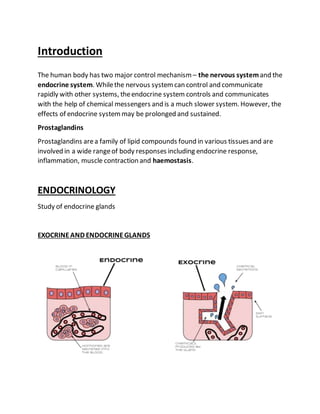
EXOCRINEAND ENDOCRINEGLANDS
Glands:
 Glands are specialized group of cells or organs that secrete chemical
substances.
 An organ that makes one or more substances such as sweat, tears, saliva or
milk
 Exocrine gland releases the substances into a duct or opening to the inside
or outsideof the body.
 The endocrine glands are also called as the ductless glands and they secrete
chemical substances into the bloodstreamor tissue of the body.
HARMONES: “To Excite” or “To Arouse”
 History: The hormones termwas firstused by Ernest Henry Starling in 1905
in his firstlecture delivered to the Royal Society.
 Starling along with Bayliss had discovered one of the first hormonecalled
“secretin”in 1902.
Definition:
 A messengermoleculethathelpstocoordinatethe actionofvarioustissues
made in one part of the body and transportedvia. the bloodstreamtothe
tissues andorgans elsewhereinthe body.
 Produced in very small quantities and biologically very active.
 Hormones affect our body functions fromgrowth, sexual development and
mood to how well we sleep, manage stress and how well our body breaks
down food. When they are in proper balance, hormonehelps the body
thrive.
 Sometimes hormonelevels are too high or too low which is called
hormonal imbalance. Itcan occur anytime regardless of one’s age and
causeserious health problems requiring ongoing medical management.
CHEMICAL STRUCTUREAND SYNTHESIS OF HORMONES
Hormones can be classified based on their origin or by their chemical structure
three general class of hormones exist:
1) Proteins and polypeptides: including hormone secreted by the anterior and
posterior pituitary gland, the pancreas (insulin and glucagon), the
parathyroid gland (parathyroid hormone) and stress.
2) Steroids: Secreted by adrenal cortex (cortisoland aldosterone) the ovaries
(oestrogen and progesterone, the testes (testosterone) and the placenta
(oestrogen is progesterone).
3) Derivatives: of the amino acid tyrosinesecreted by the thyroid (thyroxine
and tri-iodothyronine) and the adrenal medullae (epinephrine and
norepinephrine).
THE ENDOCRINE SYSTEM
 Endocrine glands are ductless glands.
 They release their secretion directly into blood which is then transported to
specific target organs to initiate a particular metabolic change.
 The endocrine glands secrete chemicals called hormones.
 Hormones arenon-nutrient chemicals which act as intercellular messengers
and are produced in trace amount.
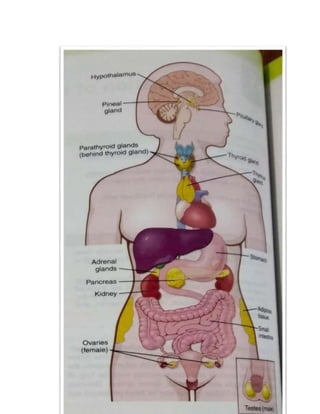
Human Endocrine System
 The endocrine glands and hormoneproducing tissues/cells are located in
different parts of the body.
 Gastrointestinaltract, kidney, liver and heart also producesmall quantity of
hormones to control and coordinate the function of respective organs.
 In Cephalic region
 Hypothalamus
 Pituitary
 Pineal
 In Thoracic region
 Thyroid gland
 Parathyroid
 Upper side of heart – Thymus
 In Abdominalregion:
 Attached stomach – Pancreas
 Abovekidney – Adrenal
 In Pelvic region:
 In males – Testes
 In females – ovaries
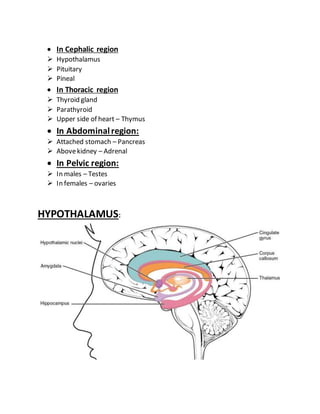
HYPOTHALAMUS:
 The endocrine and nervous systems workseven closely together.
 The brain continuously sends instructions to the endocrine systemand
in return receives feedback fromthe endocrineglands.
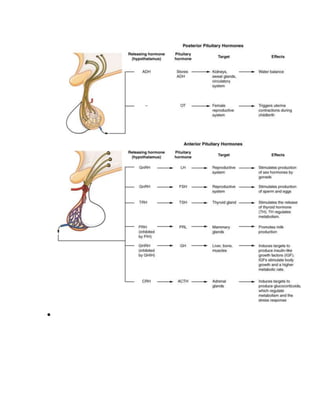
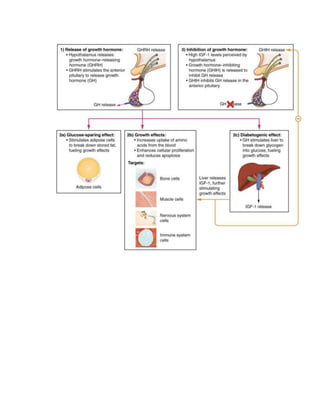
 HORMONES RELEASING/ INHIBITING BY HYPOTHALAMUS
a) Releasing hormones (GHRH)
b) Inhibiting hormones (somatostatin)

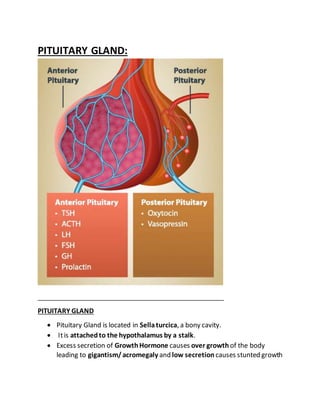
PITUITARY GLAND:
PITUITARY GLAND
 Pituitary Gland is located in Sellaturcica, a bony cavity.
 Itis attachedto the hypothalamus by a stalk.
 Excess secretion of GrowthHormone causes over growth of the body
leading to gigantism/acromegaly and low secretion causes stunted growth
called dwarfism, Diabetes Insipidus STAD(urineproduction 10 times
increase).
 Prolactin stimulates growth of mammary gland and productionof milk.
 TSH stimulates production and release of thyroidhormone.
 LH and FSH stimulate activity of the gonads.
 In male, LH stimulates synthesis and secretion of androgen hormone from
testis.
 In female, LH induces ovulationof fully mature ovum fromovary.
 Oxytocin helps in contractionof uterus during childbirthand milk ejection
frommammary glands.
 Vasopressin stimulates absorptionof water and electrolyte inkidney.
 MSH acts on the melanocytes andregulates skinpigmentation.
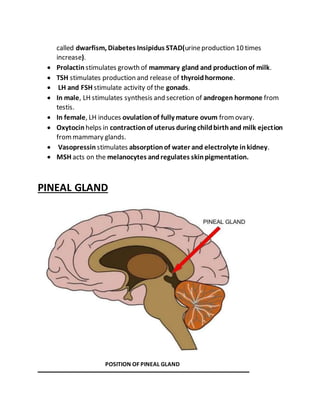
PINEAL GLAND
POSITION OF PINEAL GLAND
 The pineal Gland- located on dorsal side of forebrain and release
melatoninhormone that helps to regulate diurnal rhythmof body like
sleeps wake cycle andbody temperature.
 Modern scientific literature, till recently considered pineal to be a vestigial
organ, a remnant of “the third eye” but without any significant functions.
 The situation changed rapidly after a group of dermatologists, led by
AB LERNER successfully isolated a substancefrombovine pineal extracts in
1958.
 They called the substancemelatonin becauseit lightened the skin colour of
frog & fish. Later they also elucidated the chemical structureof melatonin.
 In 1990, SA.RIVKEES &COLLEAGUES, the latest advances in pineal research
has been the purification of the melatonin receptor fromthe Lizardbrain.
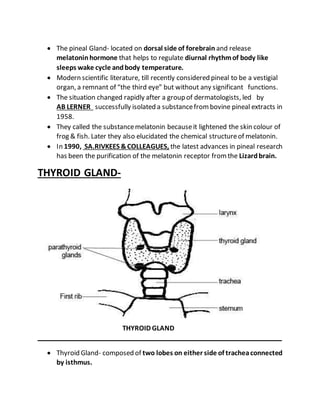
THYROID GLAND-
 Thyroid Gland- composed of two lobes on either side of tracheaconnected
by isthmus.
THYROID GLAND
 Thyroid gland is made of follicles andstromal tissues:
 Iodine is essential for synthesis of thyroid hormones.
 Deficiency of iodine leads to hypothyroidism(Goitre). During pregnancy,
hypothyroidismmay causestuntedgrowthof baby and mental
retardation.
 Thyroid hormones (T3 & T4).
 T3- Triiodothyronine, T4- Tetraiodothyronine
 Regulate the basal metabolic rate.
 They support the process of redblood cell formation.
 They control the metabolismof carbohydrates, proteins andfats.
 Thyrocalcitoninhormone regulates blood calcium levels.
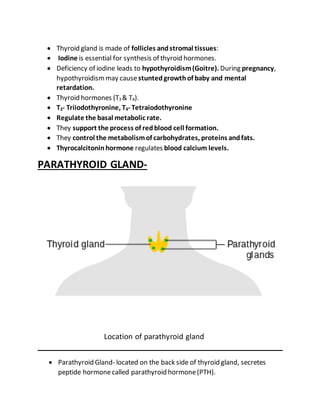
PARATHYROID GLAND-
 Parathyroid Gland- located on the back side of thyroid gland, secretes
peptide hormonecalled parathyroid hormone(PTH).
Location of parathyroid gland
 PTH regulates the calcium ion concentration in the blood.
 Italso helps in reabsorption of calcium from renal tubules and digestive
tracts.
THYMUS GLAND-
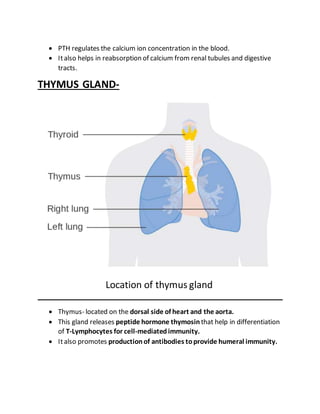
 Thymus- located on the dorsal side of heart and the aorta.
 This gland releases peptide hormone thymosin that help in differentiation
of T-Lymphocytes for cell-mediatedimmunity.
 Italso promotes productionof antibodies toprovide humeral immunity.
Location of thymus gland
ADRENAL GLAND-
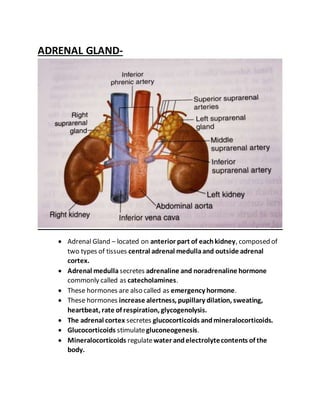
 Adrenal Gland – located on anterior part of eachkidney, composed of
two types of tissues central adrenal medullaand outside adrenal
cortex.
 Adrenal medulla secretes adrenaline and noradrenaline hormone
commonly called as catecholamines.
 These hormones are also called as emergency hormone.
 These hormones increase alertness, pupillary dilation, sweating,
heartbeat, rate of respiration, glycogenolysis.
 The adrenal cortex secretes glucocorticoids andmineralocorticoids.
 Glucocorticoids stimulategluconeogenesis.
 Mineralocorticoids regulatewater andelectrolytecontents of the
body.
PANCREAS-
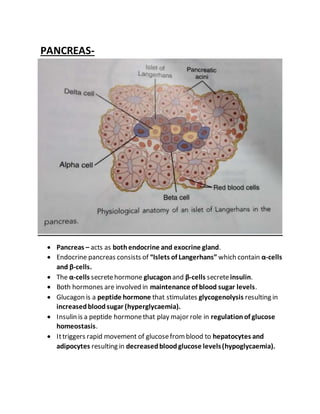
 Pancreas – acts as bothendocrine and exocrine gland.
 Endocrine pancreas consists of “Islets of Langerhans” which contain α-cells
and β-cells.
 The α-cells secretehormone glucagon and β-cells secreteinsulin.
 Both hormones are involved in maintenance of blood sugar levels.
 Glucagon is a peptide hormone that stimulates glycogenolysis resulting in
increasedbloodsugar (hyperglycaemia).
 Insulin is a peptide hormonethat play major role in regulationof glucose
homeostasis.
 Ittriggers rapid movement of glucosefromblood to hepatocytes and
adipocytes resulting in decreasedbloodglucose levels(hypoglycaemia).
TESTIS-
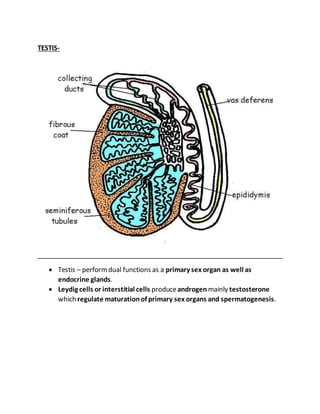
 Testis – performdual functions as a primary sex organ as well as
endocrine glands.
 Leydig cells or interstitial cells produceandrogen mainly testosterone
which regulate maturationof primary sex organs and spermatogenesis.
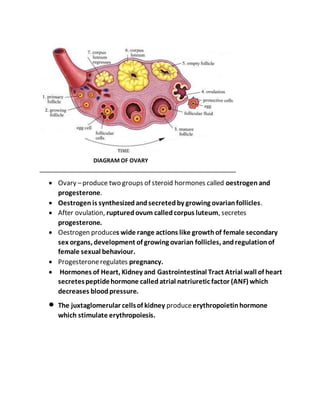
 Ovary –produce two groups of steroid hormones called oestrogen and
progesterone.
 Oestrogen is synthesizedandsecretedby growing ovarianfollicles.
 After ovulation, rupturedovum calledcorpus luteum, secretes
progesterone.
 Oestrogen produces wide range actions like growthof female secondary
sex organs, development of growing ovarian follicles, andregulationof
female sexual behaviour.
 Progesteroneregulates pregnancy.
 Hormones of Heart, Kidney and Gastrointestinal Tract Atrial wall of heart
secretespeptidehormone calledatrial natriuretic factor (ANF) which
decreases bloodpressure.
 The juxtaglomerular cellsof kidney produceerythropoietinhormone
which stimulate erythropoiesis.
DIAGRAM OF OVARY
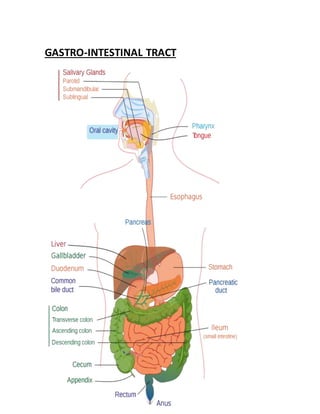
GASTRO-INTESTINAL TRACT
 Gastro-intestinaltract secrete four major peptide hormones:
1. Gastrin stimulates the secretionof hydrochloric acidand pepsinogen.
2. Secretin acts on the exocrine pancreas and stimulates secretionof water
and bicarbonate ions.
3. Cholecystokinin(CCK) stimulates the secretionof pancreatic enzymes and
bile juice
4.Gastric inhibitory peptide(GIP) inhibits gastric secretionandmotility.
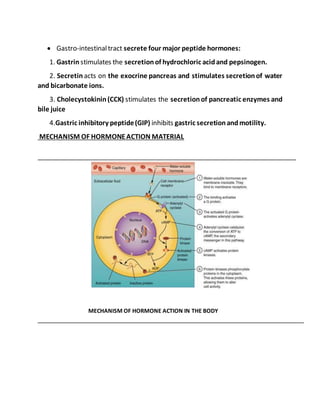
MECHANISM OF HORMONEACTION MATERIAL
MECHANISM OF HORMONE ACTION IN THE BODY

endocrine system

  • 1.
    Introduction The human bodyhas two major control mechanism – the nervous systemand the endocrine system. Whilethe nervous systemcan control and communicate rapidly with other systems, theendocrine system controls and communicates with the help of chemical messengers and is a much slower system. However, the effects of endocrine systemmay be prolonged and sustained. Prostaglandins Prostaglandins area family of lipid compounds found in various tissues and are involved in a wide rangeof body responses including endocrine response, inflammation, muscle contraction and haemostasis. ENDOCRINOLOGY Study of endocrine glands EXOCRINEAND ENDOCRINEGLANDS
  • 2.
    Glands:  Glands arespecialized group of cells or organs that secrete chemical substances.  An organ that makes one or more substances such as sweat, tears, saliva or milk  Exocrine gland releases the substances into a duct or opening to the inside or outsideof the body.  The endocrine glands are also called as the ductless glands and they secrete chemical substances into the bloodstreamor tissue of the body. HARMONES: “To Excite” or “To Arouse”  History: The hormones termwas firstused by Ernest Henry Starling in 1905 in his firstlecture delivered to the Royal Society.  Starling along with Bayliss had discovered one of the first hormonecalled “secretin”in 1902. Definition:  A messengermoleculethathelpstocoordinatethe actionofvarioustissues made in one part of the body and transportedvia. the bloodstreamtothe tissues andorgans elsewhereinthe body.  Produced in very small quantities and biologically very active.  Hormones affect our body functions fromgrowth, sexual development and mood to how well we sleep, manage stress and how well our body breaks down food. When they are in proper balance, hormonehelps the body thrive.  Sometimes hormonelevels are too high or too low which is called hormonal imbalance. Itcan occur anytime regardless of one’s age and causeserious health problems requiring ongoing medical management. CHEMICAL STRUCTUREAND SYNTHESIS OF HORMONES Hormones can be classified based on their origin or by their chemical structure
  • 3.
    three general classof hormones exist: 1) Proteins and polypeptides: including hormone secreted by the anterior and posterior pituitary gland, the pancreas (insulin and glucagon), the parathyroid gland (parathyroid hormone) and stress. 2) Steroids: Secreted by adrenal cortex (cortisoland aldosterone) the ovaries (oestrogen and progesterone, the testes (testosterone) and the placenta (oestrogen is progesterone). 3) Derivatives: of the amino acid tyrosinesecreted by the thyroid (thyroxine and tri-iodothyronine) and the adrenal medullae (epinephrine and norepinephrine). THE ENDOCRINE SYSTEM  Endocrine glands are ductless glands.  They release their secretion directly into blood which is then transported to specific target organs to initiate a particular metabolic change.  The endocrine glands secrete chemicals called hormones.  Hormones arenon-nutrient chemicals which act as intercellular messengers and are produced in trace amount. Human Endocrine System  The endocrine glands and hormoneproducing tissues/cells are located in different parts of the body.
  • 4.
     Gastrointestinaltract, kidney,liver and heart also producesmall quantity of hormones to control and coordinate the function of respective organs.
  • 6.
     In Cephalicregion  Hypothalamus  Pituitary  Pineal  In Thoracic region  Thyroid gland  Parathyroid  Upper side of heart – Thymus  In Abdominalregion:  Attached stomach – Pancreas  Abovekidney – Adrenal  In Pelvic region:  In males – Testes  In females – ovaries HYPOTHALAMUS:
  • 7.
     The endocrineand nervous systems workseven closely together.  The brain continuously sends instructions to the endocrine systemand in return receives feedback fromthe endocrineglands.  HORMONES RELEASING/ INHIBITING BY HYPOTHALAMUS a) Releasing hormones (GHRH) b) Inhibiting hormones (somatostatin)
  • 8.
  • 10.
    PITUITARY GLAND: PITUITARY GLAND Pituitary Gland is located in Sellaturcica, a bony cavity.  Itis attachedto the hypothalamus by a stalk.  Excess secretion of GrowthHormone causes over growth of the body leading to gigantism/acromegaly and low secretion causes stunted growth
  • 11.
    called dwarfism, DiabetesInsipidus STAD(urineproduction 10 times increase).  Prolactin stimulates growth of mammary gland and productionof milk.  TSH stimulates production and release of thyroidhormone.  LH and FSH stimulate activity of the gonads.  In male, LH stimulates synthesis and secretion of androgen hormone from testis.  In female, LH induces ovulationof fully mature ovum fromovary.  Oxytocin helps in contractionof uterus during childbirthand milk ejection frommammary glands.  Vasopressin stimulates absorptionof water and electrolyte inkidney.  MSH acts on the melanocytes andregulates skinpigmentation. PINEAL GLAND POSITION OF PINEAL GLAND
  • 12.
     The pinealGland- located on dorsal side of forebrain and release melatoninhormone that helps to regulate diurnal rhythmof body like sleeps wake cycle andbody temperature.  Modern scientific literature, till recently considered pineal to be a vestigial organ, a remnant of “the third eye” but without any significant functions.  The situation changed rapidly after a group of dermatologists, led by AB LERNER successfully isolated a substancefrombovine pineal extracts in 1958.  They called the substancemelatonin becauseit lightened the skin colour of frog & fish. Later they also elucidated the chemical structureof melatonin.  In 1990, SA.RIVKEES &COLLEAGUES, the latest advances in pineal research has been the purification of the melatonin receptor fromthe Lizardbrain. THYROID GLAND-  Thyroid Gland- composed of two lobes on either side of tracheaconnected by isthmus. THYROID GLAND
  • 13.
     Thyroid glandis made of follicles andstromal tissues:  Iodine is essential for synthesis of thyroid hormones.  Deficiency of iodine leads to hypothyroidism(Goitre). During pregnancy, hypothyroidismmay causestuntedgrowthof baby and mental retardation.  Thyroid hormones (T3 & T4).  T3- Triiodothyronine, T4- Tetraiodothyronine  Regulate the basal metabolic rate.  They support the process of redblood cell formation.  They control the metabolismof carbohydrates, proteins andfats.  Thyrocalcitoninhormone regulates blood calcium levels. PARATHYROID GLAND-  Parathyroid Gland- located on the back side of thyroid gland, secretes peptide hormonecalled parathyroid hormone(PTH). Location of parathyroid gland
  • 14.
     PTH regulatesthe calcium ion concentration in the blood.  Italso helps in reabsorption of calcium from renal tubules and digestive tracts. THYMUS GLAND-  Thymus- located on the dorsal side of heart and the aorta.  This gland releases peptide hormone thymosin that help in differentiation of T-Lymphocytes for cell-mediatedimmunity.  Italso promotes productionof antibodies toprovide humeral immunity. Location of thymus gland
  • 15.
    ADRENAL GLAND-  AdrenalGland – located on anterior part of eachkidney, composed of two types of tissues central adrenal medullaand outside adrenal cortex.  Adrenal medulla secretes adrenaline and noradrenaline hormone commonly called as catecholamines.  These hormones are also called as emergency hormone.  These hormones increase alertness, pupillary dilation, sweating, heartbeat, rate of respiration, glycogenolysis.  The adrenal cortex secretes glucocorticoids andmineralocorticoids.  Glucocorticoids stimulategluconeogenesis.  Mineralocorticoids regulatewater andelectrolytecontents of the body.
  • 16.
    PANCREAS-  Pancreas –acts as bothendocrine and exocrine gland.  Endocrine pancreas consists of “Islets of Langerhans” which contain α-cells and β-cells.  The α-cells secretehormone glucagon and β-cells secreteinsulin.  Both hormones are involved in maintenance of blood sugar levels.  Glucagon is a peptide hormone that stimulates glycogenolysis resulting in increasedbloodsugar (hyperglycaemia).  Insulin is a peptide hormonethat play major role in regulationof glucose homeostasis.  Ittriggers rapid movement of glucosefromblood to hepatocytes and adipocytes resulting in decreasedbloodglucose levels(hypoglycaemia).
  • 17.
    TESTIS-  Testis –performdual functions as a primary sex organ as well as endocrine glands.  Leydig cells or interstitial cells produceandrogen mainly testosterone which regulate maturationof primary sex organs and spermatogenesis.
  • 18.
     Ovary –producetwo groups of steroid hormones called oestrogen and progesterone.  Oestrogen is synthesizedandsecretedby growing ovarianfollicles.  After ovulation, rupturedovum calledcorpus luteum, secretes progesterone.  Oestrogen produces wide range actions like growthof female secondary sex organs, development of growing ovarian follicles, andregulationof female sexual behaviour.  Progesteroneregulates pregnancy.  Hormones of Heart, Kidney and Gastrointestinal Tract Atrial wall of heart secretespeptidehormone calledatrial natriuretic factor (ANF) which decreases bloodpressure.  The juxtaglomerular cellsof kidney produceerythropoietinhormone which stimulate erythropoiesis. DIAGRAM OF OVARY
  • 19.
  • 20.
     Gastro-intestinaltract secretefour major peptide hormones: 1. Gastrin stimulates the secretionof hydrochloric acidand pepsinogen. 2. Secretin acts on the exocrine pancreas and stimulates secretionof water and bicarbonate ions. 3. Cholecystokinin(CCK) stimulates the secretionof pancreatic enzymes and bile juice 4.Gastric inhibitory peptide(GIP) inhibits gastric secretionandmotility. MECHANISM OF HORMONEACTION MATERIAL MECHANISM OF HORMONE ACTION IN THE BODY