ENDOCRINE SYSTEM
CONTENTS
ENDOCRINE
SYSTEM
The endocrine system is one of the body’s main system for communicating,
controlling and coordinating the body’s work.
The endocrine system help maintain and control the following:
Body energy levels
Reproduction
Growth and development
Internal balance of body systems, called homeostasis
Responses to surroundings, stress and injury
The endocrine system accomplishes these tasks via a network of glands and organs
that produce, store, and secrete certain types of hormones.
The foundations of the endocrine system are the hormones and glands. As the
body's chemical messengers, hormones transfer information and instructions from
one set of cells to another. Although many different hormones circulate throughout
the bloodstream, each one affects only the cells that are genetically programmed to
receive and respond to its message.
HORMONES
• Special chemicals that move into body fluid
after they are made by one cell or a group of
cells.
• Different types of hormones cause different
effects on other cells or tissues of the body.
GLAND
A group of cells that produces and
secretes, or gives off, chemicals.
Some types of glands release their
secretions in specific areas.
For instance,
•Exocrine glands, such as the sweat and salivary
glands, release secretions in the skin or inside
of the mouth.
•Endocrine glands, on the other hand, release
more than 20 major hormones directly into the
bloodstream where they can be transported to
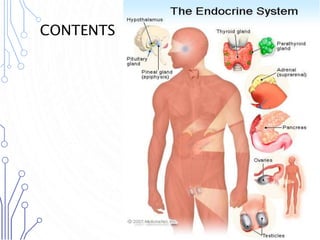
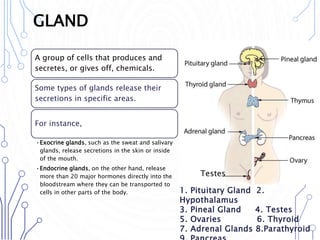
cells in other parts of the body. 1. Pituitary Gland 2.
Hypothalamus
3. Pineal Gland 4. Testes
5. Ovaries 6. Thyroid
7. Adrenal Glands 8.Parathyroid
Testes
PITUITARY GLAND
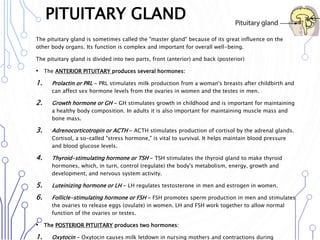
The pituitary gland is sometimes called the "master gland" because of its great influence on the
other body organs. Its function is complex and important for overall well-being.
The pituitary gland is divided into two parts, front (anterior) and back (posterior)
• The ANTERIOR PITUITARY produces several hormones:
1. Prolactin or PRL - PRL stimulates milk production from a woman's breasts after childbirth and
can affect sex hormone levels from the ovaries in women and the testes in men.
2. Growth hormone or GH - GH stimulates growth in childhood and is important for maintaining
a healthy body composition. In adults it is also important for maintaining muscle mass and
bone mass.
3. Adrenocorticotropin or ACTH - ACTH stimulates production of cortisol by the adrenal glands.
Cortisol, a so-called "stress hormone," is vital to survival. It helps maintain blood pressure
and blood glucose levels.
4. Thyroid-stimulating hormone or TSH - TSH stimulates the thyroid gland to make thyroid
hormones, which, in turn, control (regulate) the body's metabolism, energy, growth and
development, and nervous system activity.
5. Luteinizing hormone or LH - LH regulates testosterone in men and estrogen in women.
6. Follicle-stimulating hormone or FSH - FSH promotes sperm production in men and stimulates
the ovaries to release eggs (ovulate) in women. LH and FSH work together to allow normal
function of the ovaries or testes.
• The POSTERIOR PITUITARY produces two hormones:
1. Oxytocin - Oxytocin causes milk letdown in nursing mothers and contractions during
HYPOTHALAMUS
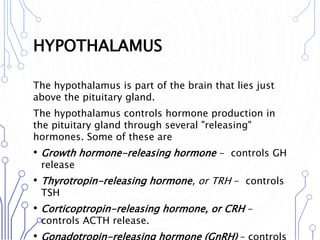
The hypothalamus is part of the brain that lies just
above the pituitary gland.
The hypothalamus controls hormone production in
the pituitary gland through several "releasing"
hormones. Some of these are
• Growth hormone-releasing hormone - controls GH
release
• Thyrotropin-releasing hormone, or TRH - controls
TSH
• Corticoptropin-releasing hormone, or CRH -
controls ACTH release.
PINEAL GLAND
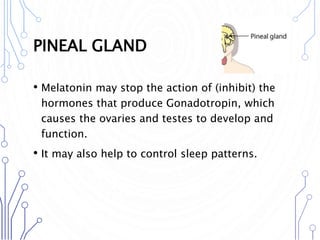
• Melatonin may stop the action of (inhibit) the
hormones that produce Gonadotropin, which
causes the ovaries and testes to develop and
function.
• It may also help to control sleep patterns.
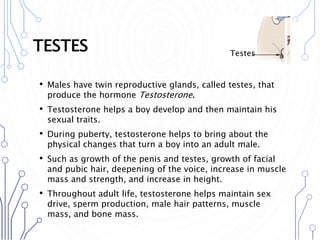
TESTES
• Males have twin reproductive glands, called testes, that
produce the hormone Testosterone.
• Testosterone helps a boy develop and then maintain his
sexual traits.
• During puberty, testosterone helps to bring about the
physical changes that turn a boy into an adult male.
• Such as growth of the penis and testes, growth of facial
and pubic hair, deepening of the voice, increase in muscle
mass and strength, and increase in height.
• Throughout adult life, testosterone helps maintain sex
drive, sperm production, male hair patterns, muscle
mass, and bone mass.
Testes
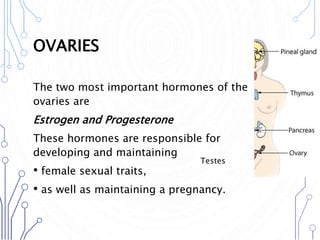
OVARIES
The two most important hormones of the
ovaries are
Estrogen and Progesterone
These hormones are responsible for
developing and maintaining
• female sexual traits,
• as well as maintaining a pregnancy.
Testes
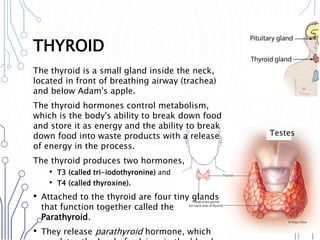
THYROID
The thyroid is a small gland inside the neck,
located in front of breathing airway (trachea)
and below Adam's apple.
The thyroid hormones control metabolism,
which is the body's ability to break down food
and store it as energy and the ability to break
down food into waste products with a release
of energy in the process.
The thyroid produces two hormones,
• T3 (called tri-iodothyronine) and
• T4 (called thyroxine).
• Attached to the thyroid are four tiny glands
that function together called the
Parathyroid.
• They release parathyroid hormone, which
Testes
ADRENAL GLANDS
Each adrenal gland is actually two endocrine organs.
The outer portion is called the adrenal cortex.
The inner portion is called the adrenal medulla.
The adrenal cortex produces
•Glucocorticoids (such as cortisol) - that help the body control
•blood sugar, increase the burning of protein and fat, and
•respond to stressors like fever, major illness, and injury.
•Mineralcorticoids (such as aldosterone) - control blood volume and help to regulate blood pressure by retaining sodium and
water.
The adrenal medulla produces
•Epinephrine (adrenaline) - which increases the
•heart rate,
•opens airways to improve oxygen intake, and
•increases blood flow to muscles, usually when a person is scared, excited, or under stress.
PANCREAS
• The pancreas is a large gland that helps the
body to maintain healthy blood sugar (glucose)
levels.
• The pancreas secretes
• Insulin - hormone that helps glucose move from the
blood into the cells where it is used for energy.
• Glucagon - when the blood sugar is low. Glucagon
signals the liver to release glucose, stored in the
liver as glycogen, into the bloodstream.

ENDOCRINE SYSTEM.pptx

  • 1.
  • 2.
  • 3.
    ENDOCRINE SYSTEM The endocrine systemis one of the body’s main system for communicating, controlling and coordinating the body’s work. The endocrine system help maintain and control the following: Body energy levels Reproduction Growth and development Internal balance of body systems, called homeostasis Responses to surroundings, stress and injury The endocrine system accomplishes these tasks via a network of glands and organs that produce, store, and secrete certain types of hormones. The foundations of the endocrine system are the hormones and glands. As the body's chemical messengers, hormones transfer information and instructions from one set of cells to another. Although many different hormones circulate throughout the bloodstream, each one affects only the cells that are genetically programmed to receive and respond to its message.
  • 4.
    HORMONES • Special chemicalsthat move into body fluid after they are made by one cell or a group of cells. • Different types of hormones cause different effects on other cells or tissues of the body.
  • 5.
    GLAND A group ofcells that produces and secretes, or gives off, chemicals. Some types of glands release their secretions in specific areas. For instance, •Exocrine glands, such as the sweat and salivary glands, release secretions in the skin or inside of the mouth. •Endocrine glands, on the other hand, release more than 20 major hormones directly into the bloodstream where they can be transported to cells in other parts of the body. 1. Pituitary Gland 2. Hypothalamus 3. Pineal Gland 4. Testes 5. Ovaries 6. Thyroid 7. Adrenal Glands 8.Parathyroid Testes
  • 6.
    PITUITARY GLAND The pituitarygland is sometimes called the "master gland" because of its great influence on the other body organs. Its function is complex and important for overall well-being. The pituitary gland is divided into two parts, front (anterior) and back (posterior) • The ANTERIOR PITUITARY produces several hormones: 1. Prolactin or PRL - PRL stimulates milk production from a woman's breasts after childbirth and can affect sex hormone levels from the ovaries in women and the testes in men. 2. Growth hormone or GH - GH stimulates growth in childhood and is important for maintaining a healthy body composition. In adults it is also important for maintaining muscle mass and bone mass. 3. Adrenocorticotropin or ACTH - ACTH stimulates production of cortisol by the adrenal glands. Cortisol, a so-called "stress hormone," is vital to survival. It helps maintain blood pressure and blood glucose levels. 4. Thyroid-stimulating hormone or TSH - TSH stimulates the thyroid gland to make thyroid hormones, which, in turn, control (regulate) the body's metabolism, energy, growth and development, and nervous system activity. 5. Luteinizing hormone or LH - LH regulates testosterone in men and estrogen in women. 6. Follicle-stimulating hormone or FSH - FSH promotes sperm production in men and stimulates the ovaries to release eggs (ovulate) in women. LH and FSH work together to allow normal function of the ovaries or testes. • The POSTERIOR PITUITARY produces two hormones: 1. Oxytocin - Oxytocin causes milk letdown in nursing mothers and contractions during
  • 7.
    HYPOTHALAMUS The hypothalamus ispart of the brain that lies just above the pituitary gland. The hypothalamus controls hormone production in the pituitary gland through several "releasing" hormones. Some of these are • Growth hormone-releasing hormone - controls GH release • Thyrotropin-releasing hormone, or TRH - controls TSH • Corticoptropin-releasing hormone, or CRH - controls ACTH release.
  • 8.
    PINEAL GLAND • Melatoninmay stop the action of (inhibit) the hormones that produce Gonadotropin, which causes the ovaries and testes to develop and function. • It may also help to control sleep patterns.
  • 9.
    TESTES • Males havetwin reproductive glands, called testes, that produce the hormone Testosterone. • Testosterone helps a boy develop and then maintain his sexual traits. • During puberty, testosterone helps to bring about the physical changes that turn a boy into an adult male. • Such as growth of the penis and testes, growth of facial and pubic hair, deepening of the voice, increase in muscle mass and strength, and increase in height. • Throughout adult life, testosterone helps maintain sex drive, sperm production, male hair patterns, muscle mass, and bone mass. Testes
  • 10.
    OVARIES The two mostimportant hormones of the ovaries are Estrogen and Progesterone These hormones are responsible for developing and maintaining • female sexual traits, • as well as maintaining a pregnancy. Testes
  • 11.
    THYROID The thyroid isa small gland inside the neck, located in front of breathing airway (trachea) and below Adam's apple. The thyroid hormones control metabolism, which is the body's ability to break down food and store it as energy and the ability to break down food into waste products with a release of energy in the process. The thyroid produces two hormones, • T3 (called tri-iodothyronine) and • T4 (called thyroxine). • Attached to the thyroid are four tiny glands that function together called the Parathyroid. • They release parathyroid hormone, which Testes
  • 12.
    ADRENAL GLANDS Each adrenalgland is actually two endocrine organs. The outer portion is called the adrenal cortex. The inner portion is called the adrenal medulla. The adrenal cortex produces •Glucocorticoids (such as cortisol) - that help the body control •blood sugar, increase the burning of protein and fat, and •respond to stressors like fever, major illness, and injury. •Mineralcorticoids (such as aldosterone) - control blood volume and help to regulate blood pressure by retaining sodium and water. The adrenal medulla produces •Epinephrine (adrenaline) - which increases the •heart rate, •opens airways to improve oxygen intake, and •increases blood flow to muscles, usually when a person is scared, excited, or under stress.
  • 13.
    PANCREAS • The pancreasis a large gland that helps the body to maintain healthy blood sugar (glucose) levels. • The pancreas secretes • Insulin - hormone that helps glucose move from the blood into the cells where it is used for energy. • Glucagon - when the blood sugar is low. Glucagon signals the liver to release glucose, stored in the liver as glycogen, into the bloodstream.