www.hi-dentfinishingschool.blogspot.com
Case Study J.F. is a 50 year-old married homemaker with a genetic autoimmune deficiency; she has suffered from recurrent bacterial endocarditis. The most recent episodes were a Staphylococcus aureus infection of the mitral valve 16 months ago and a  Streptococcus mutans  infection of the aortic valve 1 month ago. During this latter hospitalization, an ECG showed moderate aortic stenosis, moderate aortic insufficiency, chronic valvular vegetations, and moderate left atrial enlargement. Two years ago J..F. received an 18-month course of TPN for malnutrition caused by idiopathic, relentless N/V. she has also had CAD for several years, and 2 years ago suffered an acute anterior wall MI. In addition, she has a history of chronic joint pain. Now, after being home for only a week, J.F. has been readmitted to your floor with endocarditis, N/V, and renal failure.  Since yesterday she has been vomiting and retching constantly; she also has had chills, fever, fatigue, joint pain, and headache.  As you go through the admission process with her, you note that she wears glasses and has a dental bridge.  She is immediately started on TPN at 125 ml/hr and on penicillin 2 million units IV q4h, to be continued for 4 weeks.  Other medications are furosemide 80 mg PO qd, amlodipine 5 mg PO qd, K-Dur 40 mEq PO qd (dose adjusted according to laboratory results), metoprolol 25 mg PO bid, and prochlorperazine (Compazine) 2.5 to 5 mg IVP prn for N/V.  Admission VS are 152/48 (supine) and 100/40 (sitting), 116, 22, 37.9 degrees Celsius.  When you assess her, you find a grade II/VI holosystolic murmur and a grade III/VI diastolic murmur; 2+ pitting tibial edema but no peripheral cyanosis; clear lungs; orientation x3 but drowsy; soft abdomen with slight left upper quadrant (LUQ) tenderness; hematuria; and multiple petechiae on skin of arms, legs, and chest.
What is going on? Significance of orthostatic hypotension, wide pulse pressure and tachycardia? Decreased cardiac output, aortic insufficiency Significance of abdominal tenderness, hematuria, joint pain, and petechia? Indicates embolization.
Endocarditis Infection of the endocardial surface of the heart. The endocardium is contiguous with the valves and therefore inflammation from infective endocarditis (IE) affects cardiac valves. Two types: Sub acute Acute
Etiology Staphylococcus aureus;  MRSA Streptococcus viridans Bartonella quintana Enteroc0cci Fungi- Candida Albicans Viruses
Staphylococcus aureus Bacteremia A study was conducted trying to identify the leading risk factors for S. aureus infective endocarditis.  The risk factors identified were:  Presence of a valvular prosthesis, persistent fever, and persistent bacteremia MRSA and preexisiting valvular disorder were not associated with  S. aureus  infective endocarditis (SAIE). However, MRSA can increase the mortality rate of SAIE. (Hill et al., 2007)
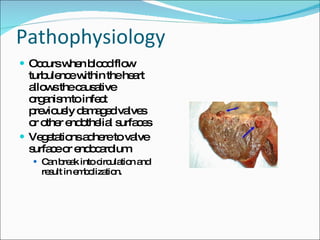
Pathophysiology Occurs when blood flow turbulence within the heart allows the causative organism to infect previously damaged valves or other endothelial surfaces Vegetations adhere to valve surface or endocardium Can break into circulation and result in embolization.
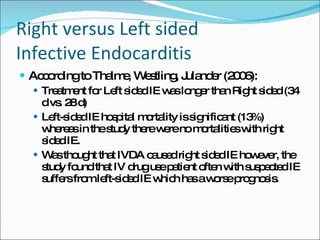
Right versus Left sided  Infective Endocarditis According to Thalme, Westling, Julander (2006):  Treatment for Left sided IE was longer than Right sided (34 d vs. 28 d) Left-sided IE hospital mortality is significant (13%) whereas in the study there were no mortalities with right sided IE. Was thought that IVDA caused right sided IE however, the study found that IV drug use patient often with suspected IE suffers from left-sided IE which has a worse prognosis.
Risk Factors for Endocarditis Prior endocarditis Prosthetic valves Acquired valve disease Cardiac lesions Rheumatic Heart Disease Congenital Heart Disease Pacemakers IV Drug Abuse (IVDA) Nosocomial bacteremia Intravascular devices (PICCs, pulmonary artery catheter Cardiac catheters
Pacemakers and Endocarditis In an article titled:  Pacemaker Endocarditis:  Clinical Features and Management of 60 consecutive cases “ This study shows that a majority of patients from an endocarditis during the first year after implantation of a pacemaker.” (Massoure, 2007) “ Antibiotic prophylaxis should be recommended at the time of pacemaker implantation as most infections occur within the first year after implantation.” (Massoure, 2007)
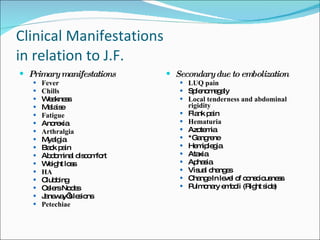
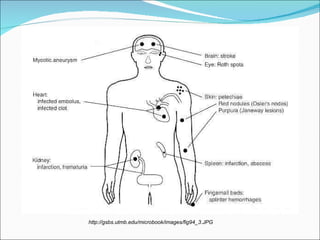
Clinical Manifestations  in relation to J.F. Primary manifestations Fever   Chills   Weakness Malaise Fatigue   Anorexia Arthralgia   Myalgia Back pain Abdominal discomfort Weight loss HA  Clubbing Oslers Nodes Janeway’s lesions  Petechiae  Secondary due to embolization LUQ pain   Splenomegaly Local tenderness and abdominal rigidity   Flank pain Hematuria   Azotemia  *Gangrene Hemiplegia Ataxia Aphasia Visual changes Change In level of consciousness Pulmonary emboli (Right side)
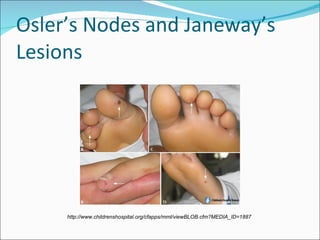
Osler’s Nodes and Janeway’s Lesions http://www.childrenshospital.org/cfapps/mml/viewBLOB.cfm?MEDIA_ID=1887
http://gsbs.utmb.edu/microbook/images/fig94_3.JPG
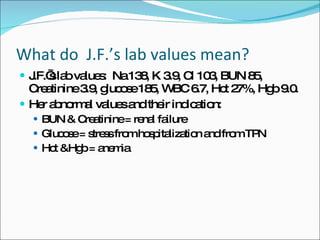
What do  J.F.’s lab values mean? J.F.’s lab values:  Na 138, K 3.9, Cl 103, BUN 85, Creatinine 3.9, glucose 185, WBC 6.7, Hct 27%, Hgb 9.0. Her abnormal values and their indication: BUN & Creatinine = renal failure Glucose = stress from hospitalization and from TPN Hct &Hgb = anemia
Diagnostic Studies Blood culture H&P Echocardiography ECG CXR Cardiac catheterization
Nursing Diagnoses  Decreased cardiac output  related   to  valvular insufficiency  as evidenced by  heart murmurs, peripheral edema, and tachycardia. Risk for imbalanced nutrition  related to  nausea and vomiting, use of TPN, and prior history of malnutrition
Decreased cardiac output  related   to  valvular insufficiency  as evidenced by  heart murmurs, peripheral edema, and tachycardia. Maintains adequate tissue and organ perfusion throughout length of stay Assess heart rate and blood pressure to assess for manifestations of decreased cardiac output Assess skin color and temperature.  Cold, clammy skin is secondary to compensatory increase in sympathetic nervous system stimulation and low cardiac output and desaturation.   Elevate head of bed  to reduce O2 demand Monitor intake and output hourly  Monitor lab values closely  to detect any irregular values . Maintains normal cardiac output throughout length of stay and at home Administer stool softeners as needed.  Straining for a bowel movement further  impairs  cardiac output.   Promote bed rest/activity limitaiton to decrease cardiac workland and O2 demand Administer antiobiotics prescribed to fight underlying cause of impaired cardiac function Collaborate with home health nurse to set up IV therapy for patient at home. Home health will have technical knowledge of IV maintenance.
Risk for imbalanced nutrition  related to  nausea and vomiting, use of TPN, and prior history of malnutrition Patient weighs within 10% of ideal body weight. Monitor recorded intake for nutritional content and calories to  evaluate nutritional status Encourage exercise as tolerated.  Metabolism and utilization of nutrients are enhanced by activity. Weigh patient weekly.  During aggressive nutritional support, patient can gain up to 0.5 pound/day. Maintains lab values within normal limits Monitor laboratory values that indicate nutritional well-being/deterioration Patient will be free of signs of malnutrition while in the hospital. Monitor for signs of malnutrition such as: brittle hair, bruises, dry skin, pale skin and conjunctiva, smooth red tongue. Watch for signs of infection  because pts who are malnourished are at an increased risk for infection.
Treatment for IE Antibiotic prophylaxis – used for high risk patients before they undergo certain procedures such as :  dental, GI, and GU procedures or who are undergoing drainage/removal of infected tissue, renal dialysis, or have ventriculoatrial shunts for hydrocephalus Long-term antibiotic – regimens dependent on organism that it is eradicating.  Penicillin is a common antibiotic used unless there are allergies.  The regimen can take weeks to complete. Acetaminophen, ibuprofen, fluid and rest are recommended to treat the fever that accompanies IE
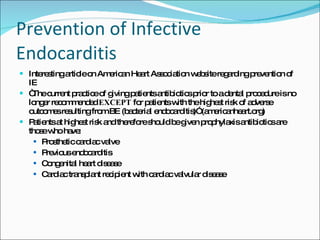
Prevention of Infective Endocarditis Interesting article on American Heart Association website regarding prevention of IE “ The current practice of giving patients antibiotics prior to a dental procedure is no longer recommended  EXCEPT  for patients with the highest risk of adverse outcomes resulting from BE (bacterial endocarditis)” (americanheart.org) Patients at highest risk and therefore should be given prophylaxis antibiotics are those who have: Prosthetic cardiac valve Previous endocarditis Congenital heart disease Cardiac transplant recipient with cardiac valvular disease
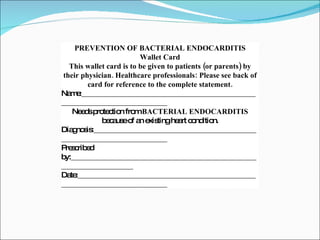
PREVENTION OF BACTERIAL ENDOCARDITIS Wallet Card This wallet card is to be given to patients (or parents) by their physician. Healthcare professionals: Please see back of card for reference to the complete statement. Name:__________________________________________________________________________ Needs protection from  BACTERIAL ENDOCARDITIS  because of an existing heart condition. Diagnosis:_______________________________________________________________________ Prescribed by:____________________________________________________________________ Date:___________________________________________________________________________
References American Heart Association. (2008).  Endocarditis Prophylaxis Information .  Retrieved September 28, 2008, from http://www.americanheart.org/presenter.jhtml?identifier=11086 Hill, E.E., Vanderschueren, S., Verhaegen, J., Herugers, P., Claus, P., Herreods, M.C. and et al.  (2007).  Risk factors for Infective Endocarditis and outcome of patients with Staphylococcus aureus Bacteremia.  Mayo Clinic Proc., 82(10), 1163-1169. Massoure, P., Reuter, S., Lafitte, S., Laborderie, J., Bordachard, P., Clementy, J., et al. (2007). Pacemaker endocarditis: clinical features and management of 60 consecutive cases.  Pacing & Clinical Electrophysiology ,  30 (1), 12-19.  Thalme, A., Westling, K., Julander, I. (2007).  In-hospital and long-term mortality in infective endocarditis in injecting drug users compared to non-drug users:  A retrospective study of 192 episodes.  Scandinavian Journal of Infectious Diseases, 39, 197-204. Lewis, S.L., Heitkemper, M.M., Dirksen, S.R., O’Brien, P.G., and Bucher, L. (2007).  Medical-Surgical Nursing  ( 7 th  ed.).  St. Louis: Mosby Elsevier. Ackley, B.J. & Ladwig, G.B.  Nursing Diagnosis Handbook:  a guide to planning care ( 7 th  ed.).  St. Louis:  Mosby Elsevier. Huether, S.E. & McCance, K.L. (2004).  Understanding Pathophysiology  (3 rd  ed.)  St. Louis:  Mosby Elsevier. . Deglin, J.H. & Vallerand, A.H. (2007).  Davis’s Durg Guide for Nurses  (10 th  ed.).  Philadelphia:  F.A. Davis Company

Endocarditis

  • 1.
  • 2.
    Case Study J.F.is a 50 year-old married homemaker with a genetic autoimmune deficiency; she has suffered from recurrent bacterial endocarditis. The most recent episodes were a Staphylococcus aureus infection of the mitral valve 16 months ago and a Streptococcus mutans infection of the aortic valve 1 month ago. During this latter hospitalization, an ECG showed moderate aortic stenosis, moderate aortic insufficiency, chronic valvular vegetations, and moderate left atrial enlargement. Two years ago J..F. received an 18-month course of TPN for malnutrition caused by idiopathic, relentless N/V. she has also had CAD for several years, and 2 years ago suffered an acute anterior wall MI. In addition, she has a history of chronic joint pain. Now, after being home for only a week, J.F. has been readmitted to your floor with endocarditis, N/V, and renal failure. Since yesterday she has been vomiting and retching constantly; she also has had chills, fever, fatigue, joint pain, and headache. As you go through the admission process with her, you note that she wears glasses and has a dental bridge. She is immediately started on TPN at 125 ml/hr and on penicillin 2 million units IV q4h, to be continued for 4 weeks. Other medications are furosemide 80 mg PO qd, amlodipine 5 mg PO qd, K-Dur 40 mEq PO qd (dose adjusted according to laboratory results), metoprolol 25 mg PO bid, and prochlorperazine (Compazine) 2.5 to 5 mg IVP prn for N/V. Admission VS are 152/48 (supine) and 100/40 (sitting), 116, 22, 37.9 degrees Celsius. When you assess her, you find a grade II/VI holosystolic murmur and a grade III/VI diastolic murmur; 2+ pitting tibial edema but no peripheral cyanosis; clear lungs; orientation x3 but drowsy; soft abdomen with slight left upper quadrant (LUQ) tenderness; hematuria; and multiple petechiae on skin of arms, legs, and chest.
  • 3.
    What is goingon? Significance of orthostatic hypotension, wide pulse pressure and tachycardia? Decreased cardiac output, aortic insufficiency Significance of abdominal tenderness, hematuria, joint pain, and petechia? Indicates embolization.
  • 4.
    Endocarditis Infection ofthe endocardial surface of the heart. The endocardium is contiguous with the valves and therefore inflammation from infective endocarditis (IE) affects cardiac valves. Two types: Sub acute Acute
  • 5.
    Etiology Staphylococcus aureus; MRSA Streptococcus viridans Bartonella quintana Enteroc0cci Fungi- Candida Albicans Viruses
  • 6.
    Staphylococcus aureus BacteremiaA study was conducted trying to identify the leading risk factors for S. aureus infective endocarditis. The risk factors identified were: Presence of a valvular prosthesis, persistent fever, and persistent bacteremia MRSA and preexisiting valvular disorder were not associated with S. aureus infective endocarditis (SAIE). However, MRSA can increase the mortality rate of SAIE. (Hill et al., 2007)
  • 7.
    Pathophysiology Occurs whenblood flow turbulence within the heart allows the causative organism to infect previously damaged valves or other endothelial surfaces Vegetations adhere to valve surface or endocardium Can break into circulation and result in embolization.
  • 8.
    Right versus Leftsided Infective Endocarditis According to Thalme, Westling, Julander (2006): Treatment for Left sided IE was longer than Right sided (34 d vs. 28 d) Left-sided IE hospital mortality is significant (13%) whereas in the study there were no mortalities with right sided IE. Was thought that IVDA caused right sided IE however, the study found that IV drug use patient often with suspected IE suffers from left-sided IE which has a worse prognosis.
  • 9.
    Risk Factors forEndocarditis Prior endocarditis Prosthetic valves Acquired valve disease Cardiac lesions Rheumatic Heart Disease Congenital Heart Disease Pacemakers IV Drug Abuse (IVDA) Nosocomial bacteremia Intravascular devices (PICCs, pulmonary artery catheter Cardiac catheters
  • 10.
    Pacemakers and EndocarditisIn an article titled: Pacemaker Endocarditis: Clinical Features and Management of 60 consecutive cases “ This study shows that a majority of patients from an endocarditis during the first year after implantation of a pacemaker.” (Massoure, 2007) “ Antibiotic prophylaxis should be recommended at the time of pacemaker implantation as most infections occur within the first year after implantation.” (Massoure, 2007)
  • 11.
    Clinical Manifestations in relation to J.F. Primary manifestations Fever Chills Weakness Malaise Fatigue Anorexia Arthralgia Myalgia Back pain Abdominal discomfort Weight loss HA Clubbing Oslers Nodes Janeway’s lesions Petechiae Secondary due to embolization LUQ pain Splenomegaly Local tenderness and abdominal rigidity Flank pain Hematuria Azotemia *Gangrene Hemiplegia Ataxia Aphasia Visual changes Change In level of consciousness Pulmonary emboli (Right side)
  • 12.
    Osler’s Nodes andJaneway’s Lesions http://www.childrenshospital.org/cfapps/mml/viewBLOB.cfm?MEDIA_ID=1887
  • 13.
  • 14.
    What do J.F.’s lab values mean? J.F.’s lab values: Na 138, K 3.9, Cl 103, BUN 85, Creatinine 3.9, glucose 185, WBC 6.7, Hct 27%, Hgb 9.0. Her abnormal values and their indication: BUN & Creatinine = renal failure Glucose = stress from hospitalization and from TPN Hct &Hgb = anemia
  • 15.
    Diagnostic Studies Bloodculture H&P Echocardiography ECG CXR Cardiac catheterization
  • 16.
    Nursing Diagnoses Decreased cardiac output related to valvular insufficiency as evidenced by heart murmurs, peripheral edema, and tachycardia. Risk for imbalanced nutrition related to nausea and vomiting, use of TPN, and prior history of malnutrition
  • 17.
    Decreased cardiac output related to valvular insufficiency as evidenced by heart murmurs, peripheral edema, and tachycardia. Maintains adequate tissue and organ perfusion throughout length of stay Assess heart rate and blood pressure to assess for manifestations of decreased cardiac output Assess skin color and temperature. Cold, clammy skin is secondary to compensatory increase in sympathetic nervous system stimulation and low cardiac output and desaturation. Elevate head of bed to reduce O2 demand Monitor intake and output hourly Monitor lab values closely to detect any irregular values . Maintains normal cardiac output throughout length of stay and at home Administer stool softeners as needed. Straining for a bowel movement further impairs cardiac output. Promote bed rest/activity limitaiton to decrease cardiac workland and O2 demand Administer antiobiotics prescribed to fight underlying cause of impaired cardiac function Collaborate with home health nurse to set up IV therapy for patient at home. Home health will have technical knowledge of IV maintenance.
  • 18.
    Risk for imbalancednutrition related to nausea and vomiting, use of TPN, and prior history of malnutrition Patient weighs within 10% of ideal body weight. Monitor recorded intake for nutritional content and calories to evaluate nutritional status Encourage exercise as tolerated. Metabolism and utilization of nutrients are enhanced by activity. Weigh patient weekly. During aggressive nutritional support, patient can gain up to 0.5 pound/day. Maintains lab values within normal limits Monitor laboratory values that indicate nutritional well-being/deterioration Patient will be free of signs of malnutrition while in the hospital. Monitor for signs of malnutrition such as: brittle hair, bruises, dry skin, pale skin and conjunctiva, smooth red tongue. Watch for signs of infection because pts who are malnourished are at an increased risk for infection.
  • 19.
    Treatment for IEAntibiotic prophylaxis – used for high risk patients before they undergo certain procedures such as : dental, GI, and GU procedures or who are undergoing drainage/removal of infected tissue, renal dialysis, or have ventriculoatrial shunts for hydrocephalus Long-term antibiotic – regimens dependent on organism that it is eradicating. Penicillin is a common antibiotic used unless there are allergies. The regimen can take weeks to complete. Acetaminophen, ibuprofen, fluid and rest are recommended to treat the fever that accompanies IE
  • 20.
    Prevention of InfectiveEndocarditis Interesting article on American Heart Association website regarding prevention of IE “ The current practice of giving patients antibiotics prior to a dental procedure is no longer recommended EXCEPT for patients with the highest risk of adverse outcomes resulting from BE (bacterial endocarditis)” (americanheart.org) Patients at highest risk and therefore should be given prophylaxis antibiotics are those who have: Prosthetic cardiac valve Previous endocarditis Congenital heart disease Cardiac transplant recipient with cardiac valvular disease
  • 21.
    PREVENTION OF BACTERIALENDOCARDITIS Wallet Card This wallet card is to be given to patients (or parents) by their physician. Healthcare professionals: Please see back of card for reference to the complete statement. Name:__________________________________________________________________________ Needs protection from BACTERIAL ENDOCARDITIS because of an existing heart condition. Diagnosis:_______________________________________________________________________ Prescribed by:____________________________________________________________________ Date:___________________________________________________________________________
  • 22.
    References American HeartAssociation. (2008). Endocarditis Prophylaxis Information . Retrieved September 28, 2008, from http://www.americanheart.org/presenter.jhtml?identifier=11086 Hill, E.E., Vanderschueren, S., Verhaegen, J., Herugers, P., Claus, P., Herreods, M.C. and et al. (2007). Risk factors for Infective Endocarditis and outcome of patients with Staphylococcus aureus Bacteremia. Mayo Clinic Proc., 82(10), 1163-1169. Massoure, P., Reuter, S., Lafitte, S., Laborderie, J., Bordachard, P., Clementy, J., et al. (2007). Pacemaker endocarditis: clinical features and management of 60 consecutive cases. Pacing & Clinical Electrophysiology , 30 (1), 12-19. Thalme, A., Westling, K., Julander, I. (2007). In-hospital and long-term mortality in infective endocarditis in injecting drug users compared to non-drug users: A retrospective study of 192 episodes. Scandinavian Journal of Infectious Diseases, 39, 197-204. Lewis, S.L., Heitkemper, M.M., Dirksen, S.R., O’Brien, P.G., and Bucher, L. (2007). Medical-Surgical Nursing ( 7 th ed.). St. Louis: Mosby Elsevier. Ackley, B.J. & Ladwig, G.B. Nursing Diagnosis Handbook: a guide to planning care ( 7 th ed.). St. Louis: Mosby Elsevier. Huether, S.E. & McCance, K.L. (2004). Understanding Pathophysiology (3 rd ed.) St. Louis: Mosby Elsevier. . Deglin, J.H. & Vallerand, A.H. (2007). Davis’s Durg Guide for Nurses (10 th ed.). Philadelphia: F.A. Davis Company

Editor's Notes

  • #4 Discuss how heart is tachy due to trying to compensate for decrease cardiac out put and aortic insufficiency Embolization – left sided IE embolization abd. Tenderness = possible splenomegaly hematuria = kidney joint pain = joint petechia = limbs
  • #5 Subacute - pt. has preexisiting valve disease, has a clincal cause that may extend over months Acute – pt. with healthy valves and presents as a rapidly progressive illness
  • #8 Explain Vegetation Explain Left side vs. right side vegetation
  • #12 Mention #4 in case study – diagnostic criteria for IE = anemia, fever, and cardiac murmurs and explain cause murmur = valve insufficiency, aortic stenosis fever = infection spreading systematically from heart anemia = of chronic disease – inflammatory process release cytokines that causes inc. uptake and retention of iron within macrophage that leads to diversion of iron from circulation into storage sites.
  • #15 Can mention that BUN occurs due to infection