Enabling numerical Simulations in
semantic 3D City Models using CityGML
13th South East Asian Survey Congress, Singapore
Arne Schilling Stefan Trometer
virtualcitySYSTEMS GmbH CADFEM GmbH
Berlin, Germany Grafing, Germany
Arne Schilling, virtualcitySYSTEMS , SEASC 20152
 Geoportal Solutions
 What is Urban Simulation?
 Challenge
 Project 1 – Urban Air Flow
 Project 2 – Urban Blast Simulation
 Discussion
Outline
3 Arne Schilling, virtualcitySYSTEMS , SEASC 2015
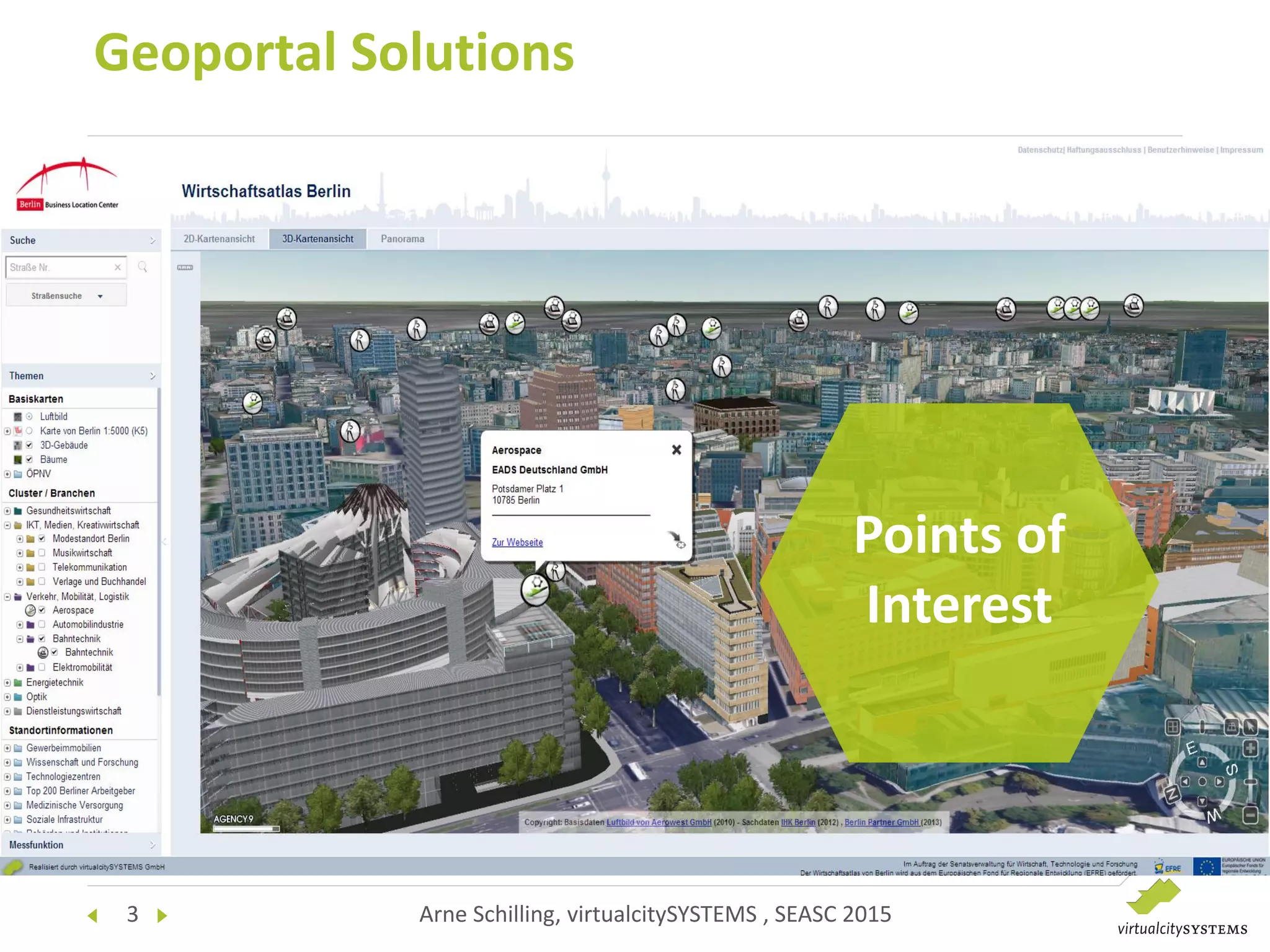
Geoportal Solutions
Points of
Interest
4 Arne Schilling, virtualcitySYSTEMS , SEASC 2015
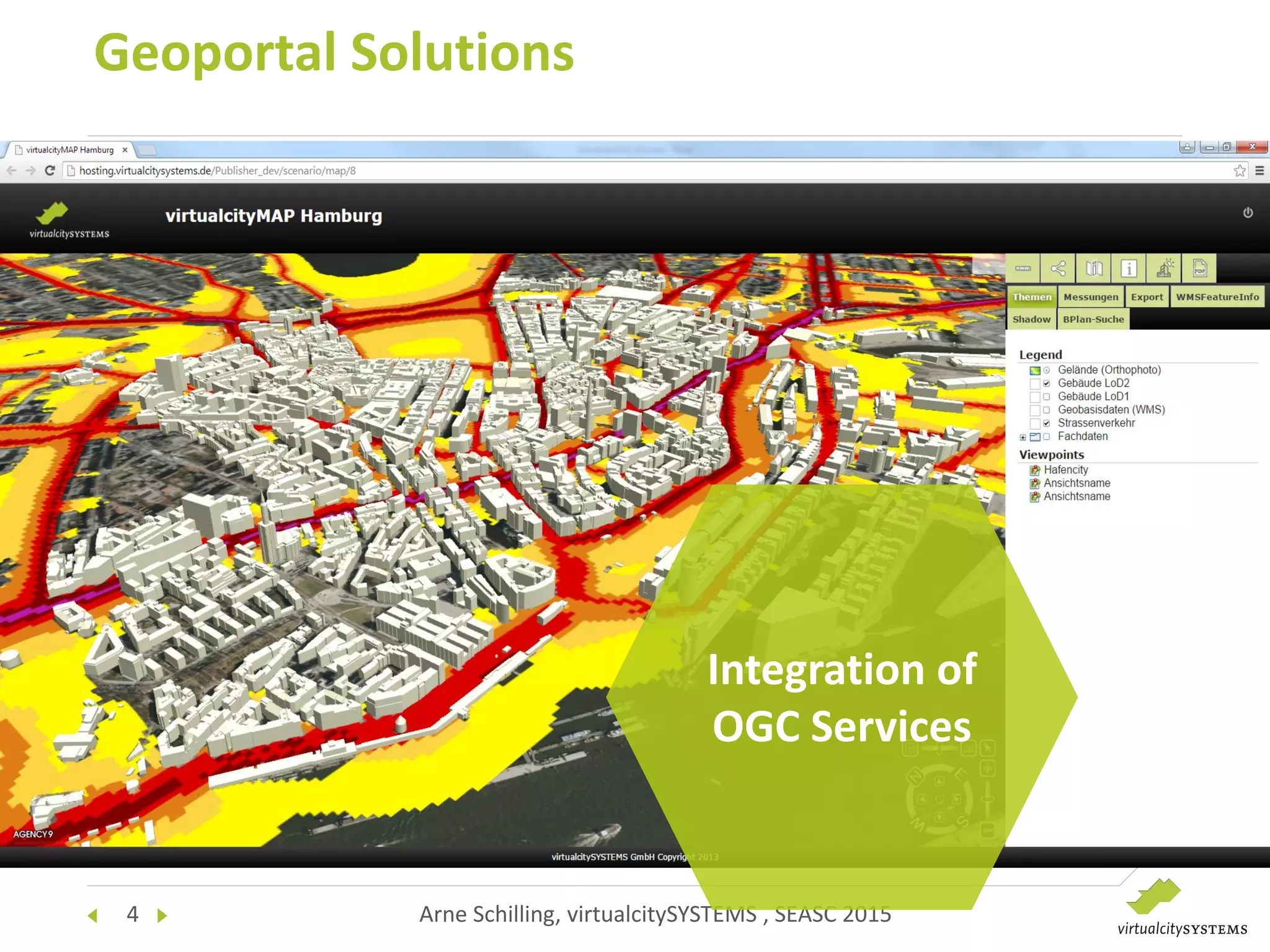
Geoportal Solutions
Integration of
OGC Services
5 Arne Schilling, virtualcitySYSTEMS , SEASC 2015
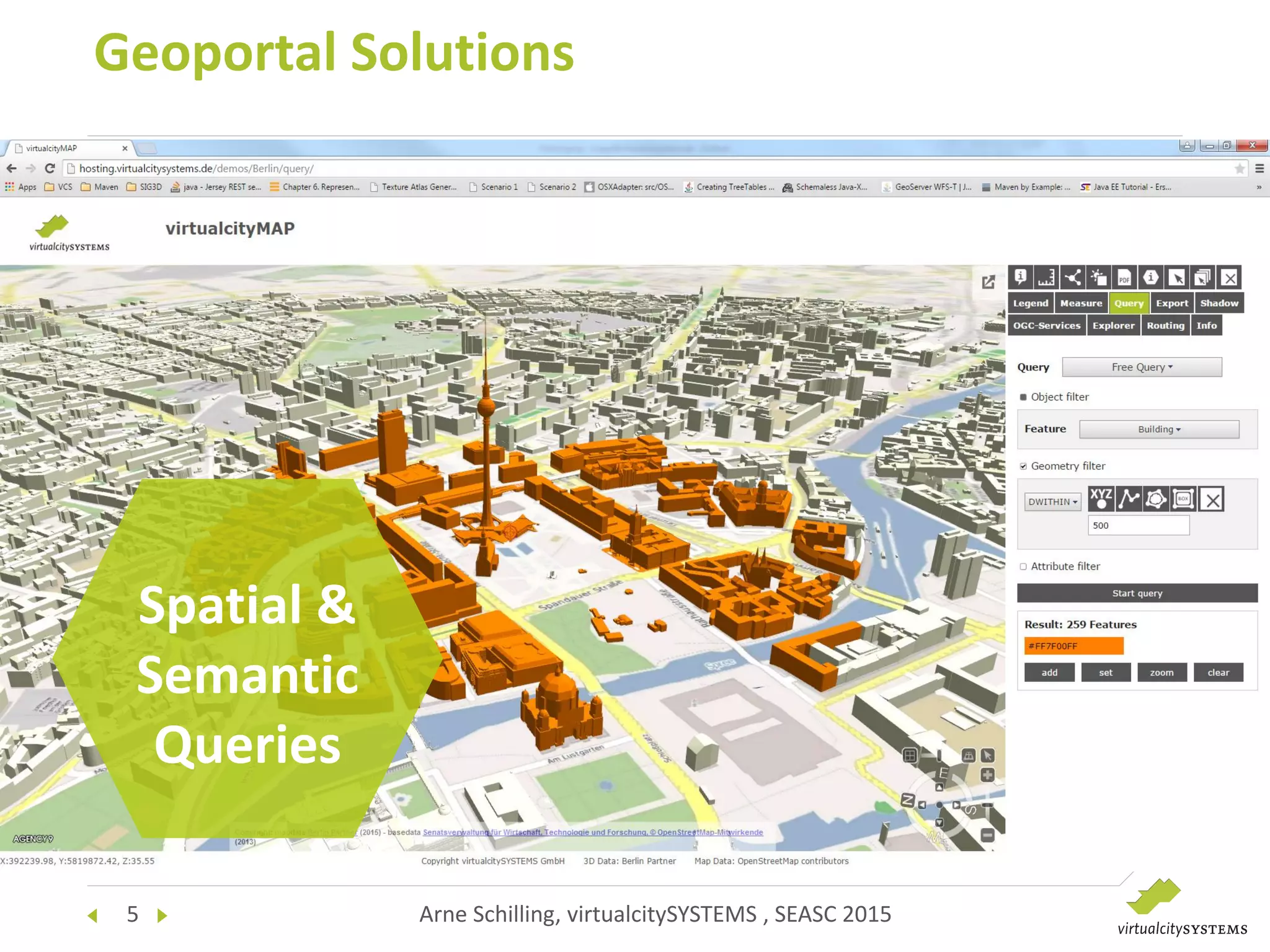
Geoportal Solutions
Spatial &
Semantic
Queries
6 Arne Schilling, virtualcitySYSTEMS , SEASC 2015
What is Urban Simulation?
Simulation of physical phenomena in urban environments using virtual mockups /
3D city models
7 Arne Schilling, virtualcitySYSTEMS , SEASC 2015
What is Urban Simulation?
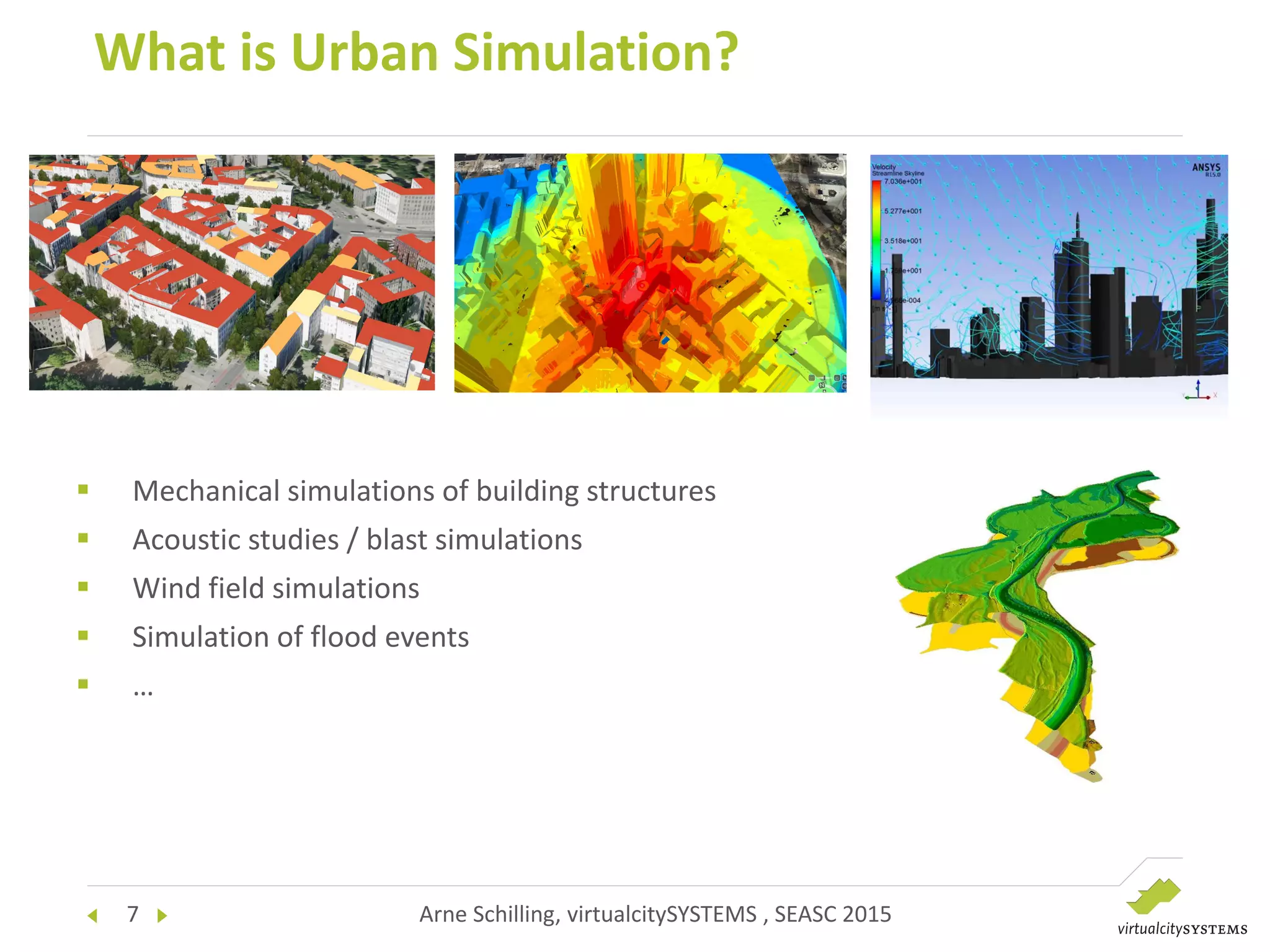
 Mechanical simulations of building structures
 Acoustic studies / blast simulations
 Wind field simulations
 Simulation of flood events
 …
8 Arne Schilling, virtualcitySYSTEMS , SEASC 2015
 GIS is not designed for performing complex physical computations
• Strengths of GIS are data management, spatial analysis and visualization
• 3D city models are created using remote sensing and automatic feature
extraction methods, not using CAD software
Challenge
9 Arne Schilling, virtualcitySYSTEMS , SEASC 2015
Challenge
 GIS is not designed for performing complex physical computations
• Strengths of GIS are data management, spatial analysis and visualization
• 3D city models are created using remote sensing and automatic feature
extraction methods, not using CAD software
 Physical simulations are frequently done in product design
• Using Computer Aided Design (CAD) and Computer Aided Engineering (CAE)
software such as ANSYS
• Based on the Finite Element approach -> Numerical Simulation
10 Arne Schilling, virtualcitySYSTEMS , SEASC 2015
Challenge
 GIS is not designed for performing complex physical computations
• Strengths of GIS are data management, spatial analysis and visualization
• 3D city models are created using remote sensing and automatic feature
extraction methods, not using CAD software
 Physical simulations are frequently done in product design
• Using Computer Aided Design (CAD) and Computer Aided Engineering (CAE)
software such as ANSYS
• Based on the Finite Element approach -> Numerical Simulation
 Technological gap between GIS and CAE Worlds
• CityGML cannot be loaded by CAE software (e.g. ANSYS). Geometrical
representations are very different -> we need conversion tools
• Requirements on data quality are different
• Simulation results are mostly stored in proprietary formats
11 Arne Schilling, virtualcitySYSTEMS , SEASC 2015
Challenge
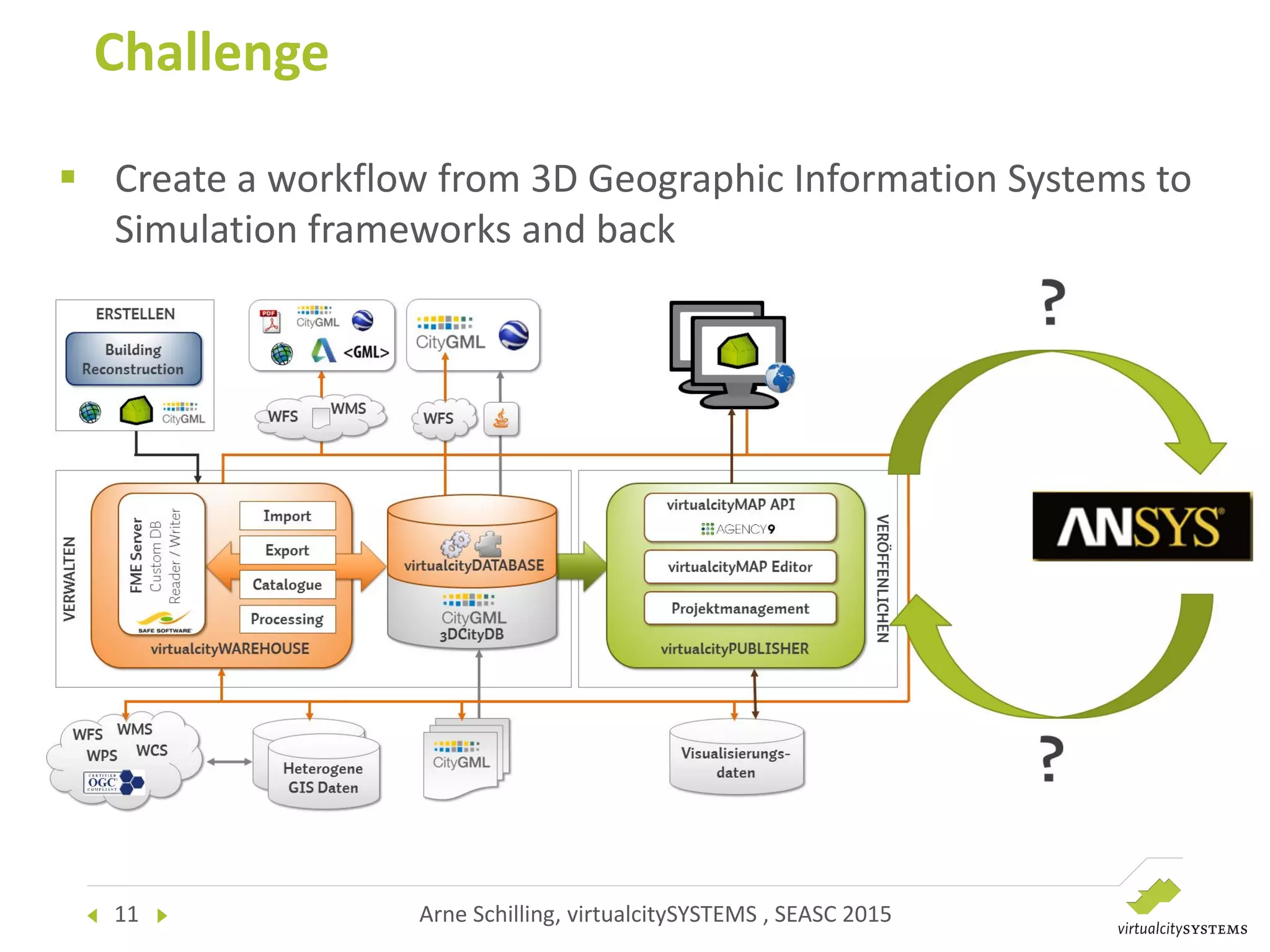
 Create a workflow from 3D Geographic Information Systems to
Simulation frameworks and back
12 Arne Schilling, virtualcitySYSTEMS , SEASC 2015
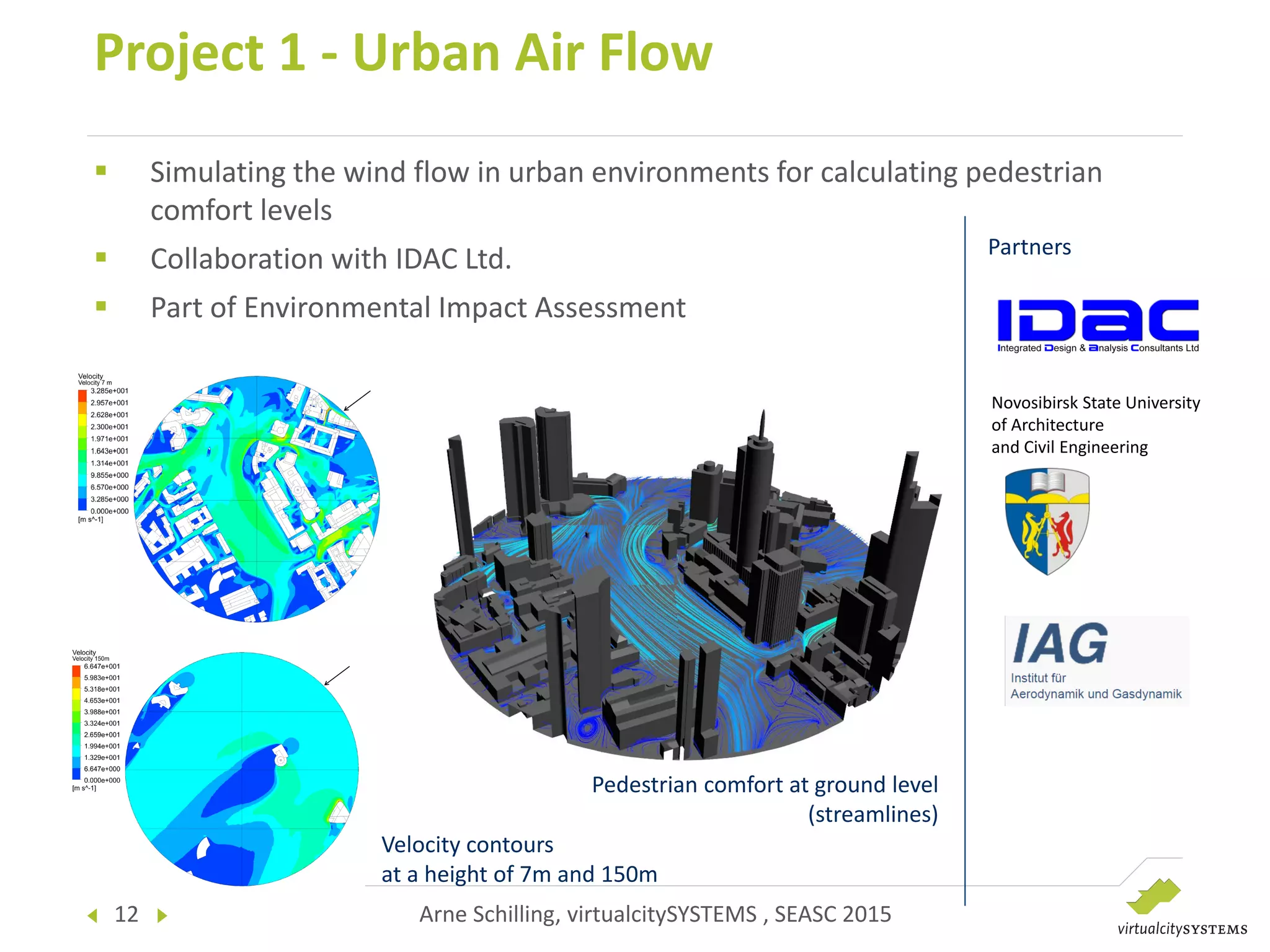
 Simulating the wind flow in urban environments for calculating pedestrian
comfort levels
 Collaboration with IDAC Ltd.
 Part of Environmental Impact Assessment
Project 1 - Urban Air Flow
Partners
Pedestrian comfort at ground level
(streamlines)
Velocity contours
at a height of 7m and 150m
Novosibirsk State University
of Architecture
and Civil Engineering
13 Arne Schilling, virtualcitySYSTEMS , SEASC 2015
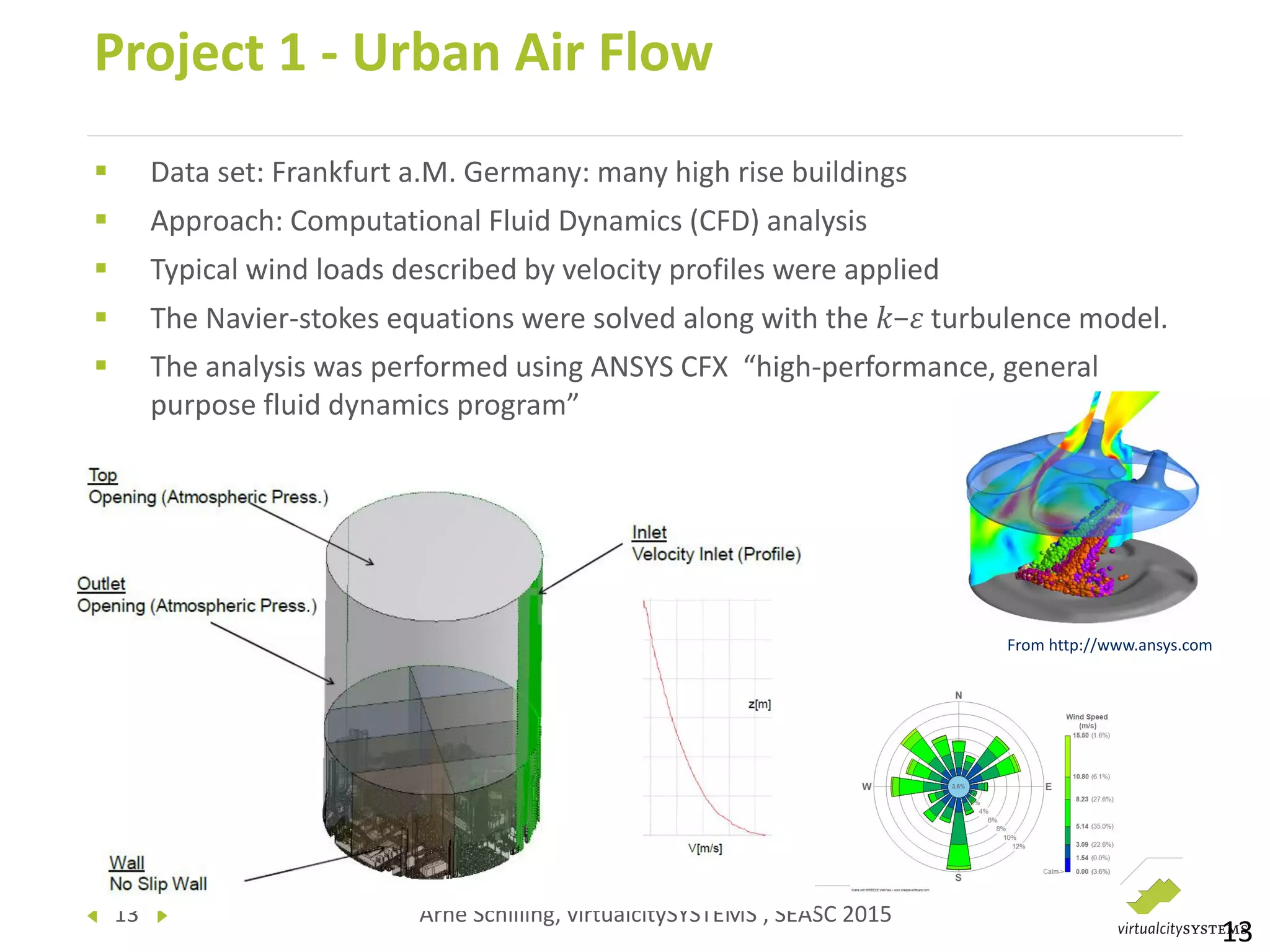
 Data set: Frankfurt a.M. Germany: many high rise buildings
 Approach: Computational Fluid Dynamics (CFD) analysis
 Typical wind loads described by velocity profiles were applied
 The Navier-stokes equations were solved along with the 𝑘−𝜀 turbulence model.
 The analysis was performed using ANSYS CFX “high-performance, general
purpose fluid dynamics program”
Project 1 - Urban Air Flow
13
From http://www.ansys.com
14 Arne Schilling, virtualcitySYSTEMS , SEASC 2015
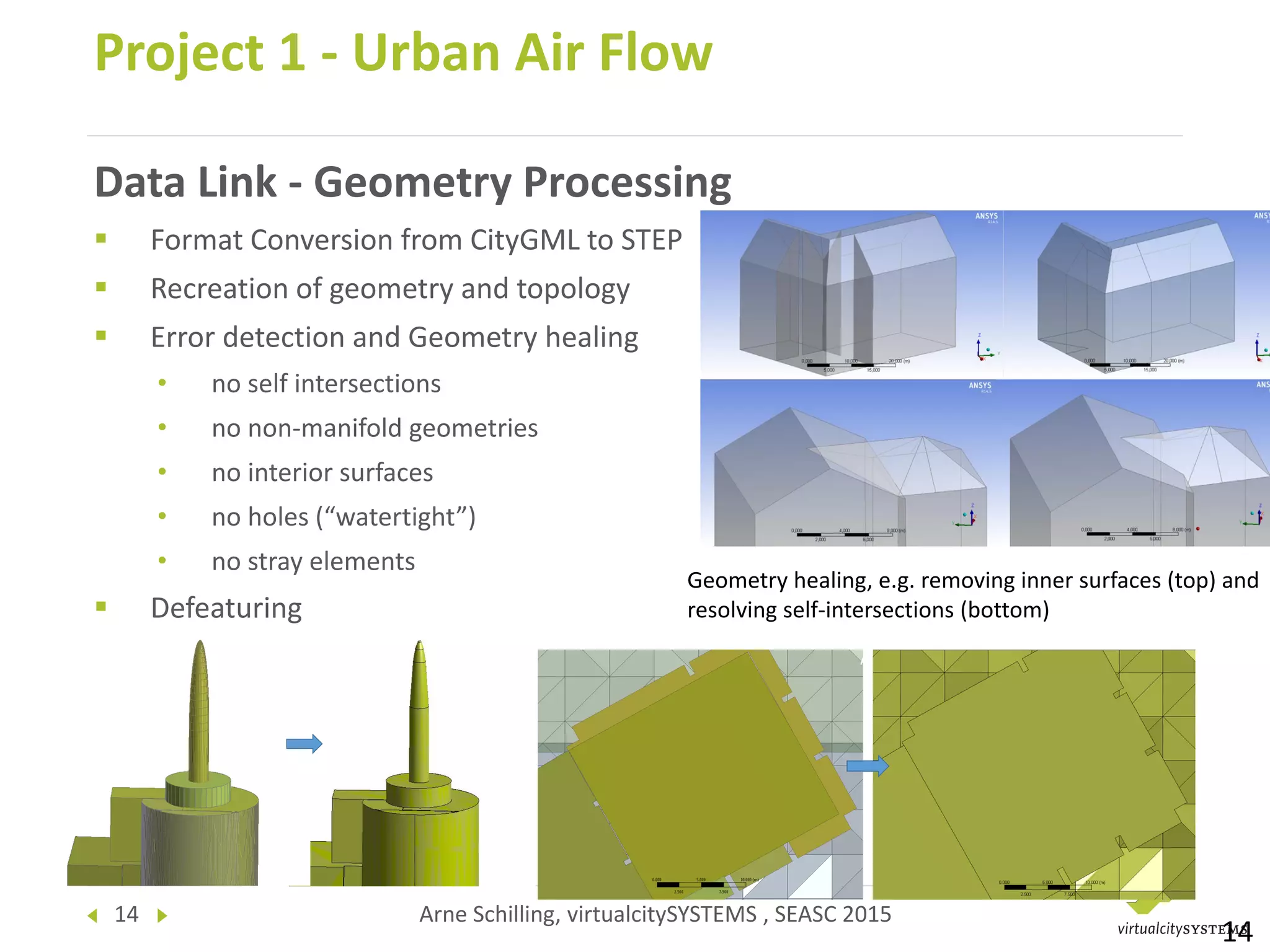
Data Link - Geometry Processing
 Format Conversion from CityGML to STEP
 Recreation of geometry and topology
 Error detection and Geometry healing
• no self intersections
• no non-manifold geometries
• no interior surfaces
• no holes (“watertight”)
• no stray elements
 Defeaturing
Project 1 - Urban Air Flow
14
Geometry healing, e.g. removing inner surfaces (top) and
resolving self-intersections (bottom)
15 Arne Schilling, virtualcitySYSTEMS , SEASC 2015
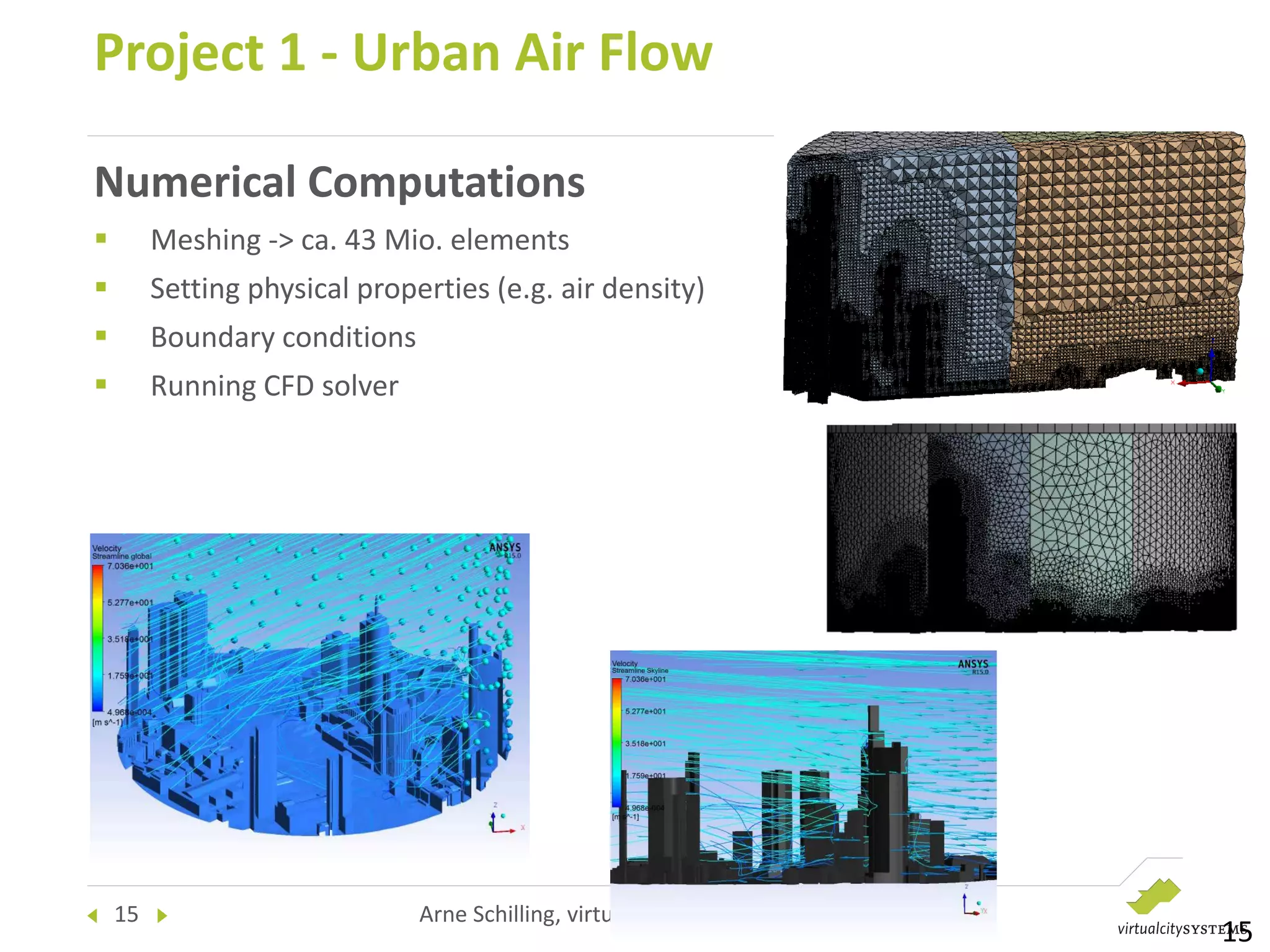
Numerical Computations
 Meshing -> ca. 43 Mio. elements
 Setting physical properties (e.g. air density)
 Boundary conditions
 Running CFD solver
Project 1 - Urban Air Flow
15
16 Arne Schilling, virtualcitySYSTEMS , SEASC 2015
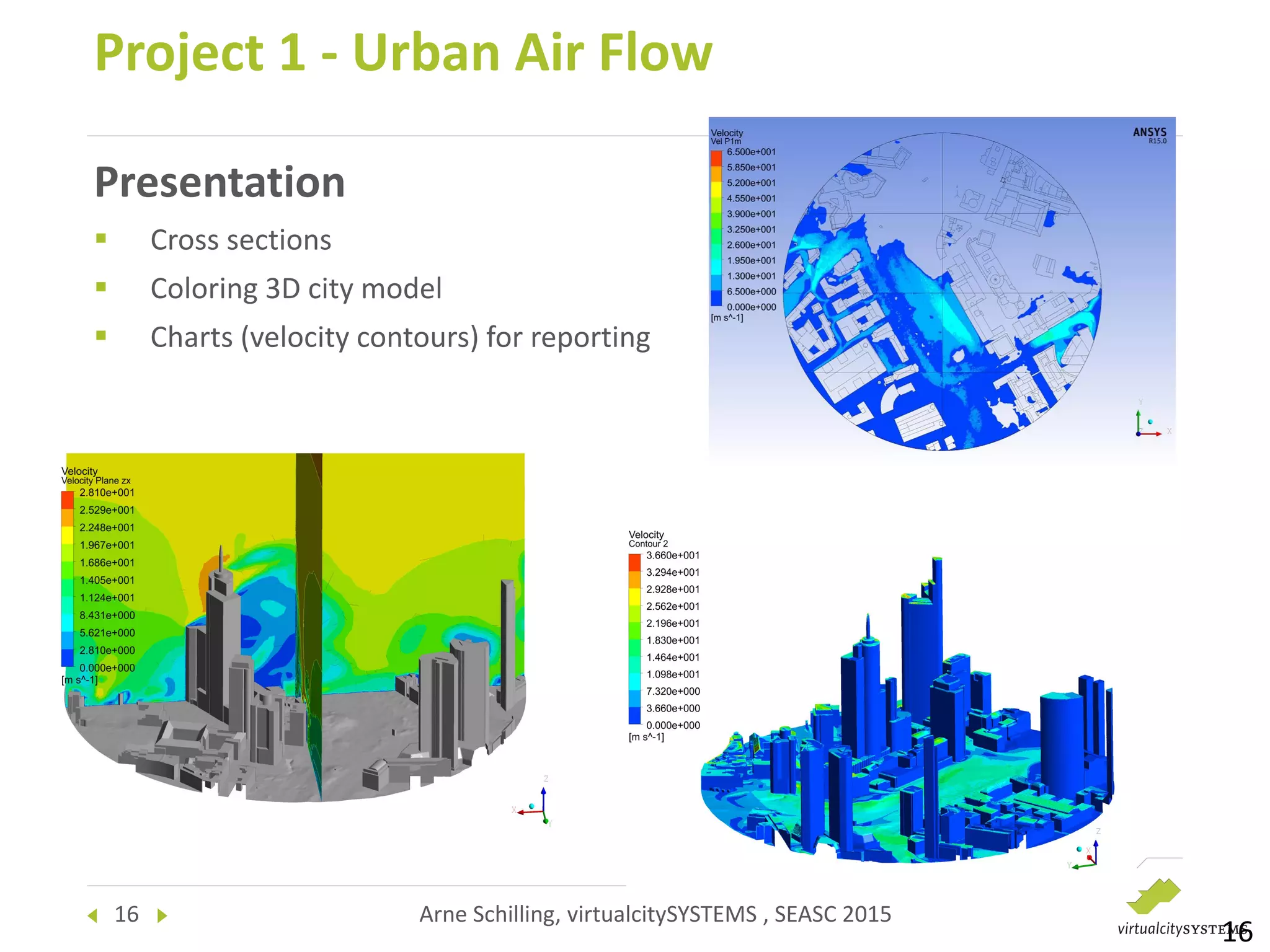
Presentation
 Cross sections
 Coloring 3D city model
 Charts (velocity contours) for reporting
Project 1 - Urban Air Flow
16
17 Arne Schilling, virtualcitySYSTEMS , SEASC 2015
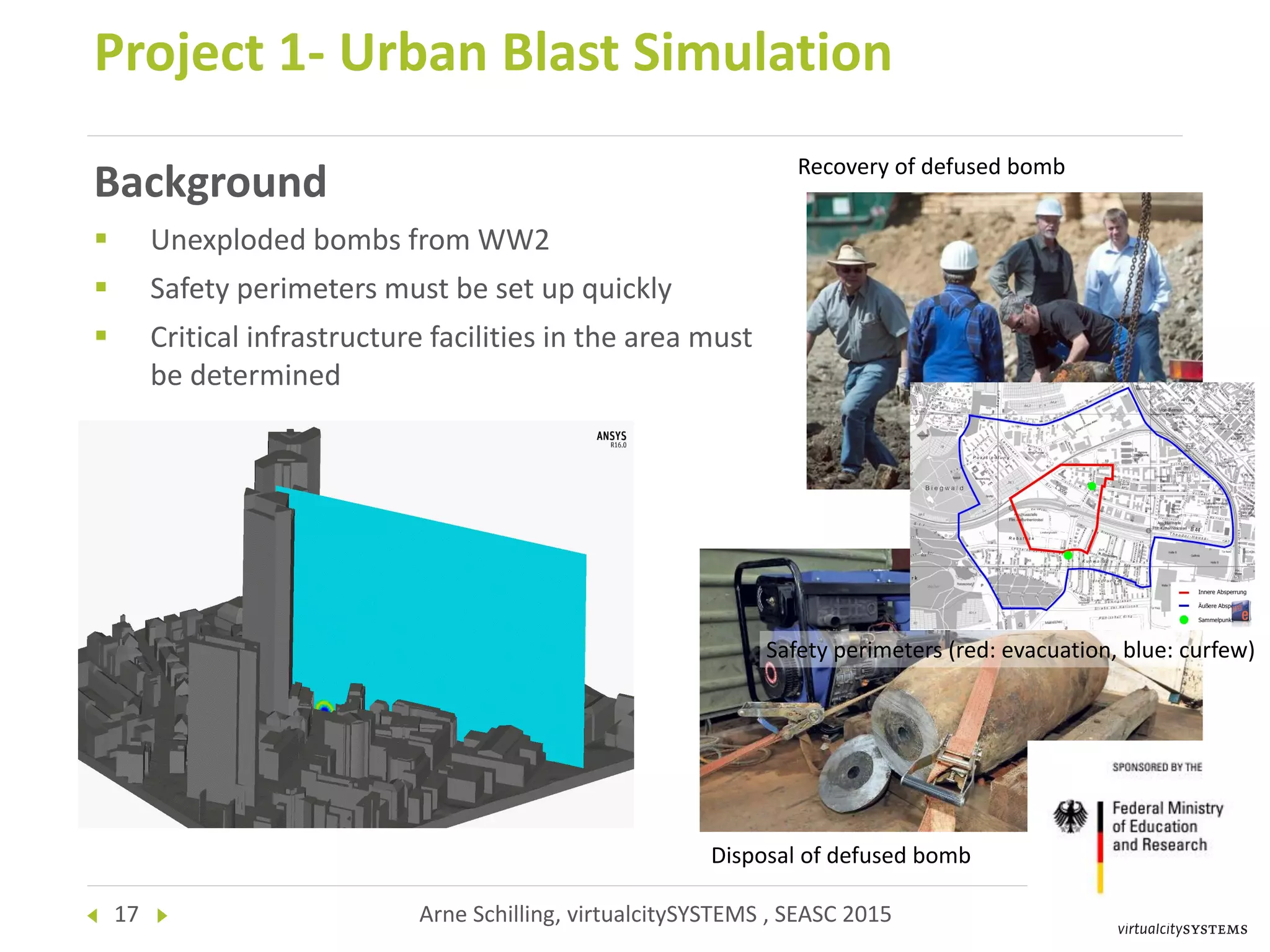
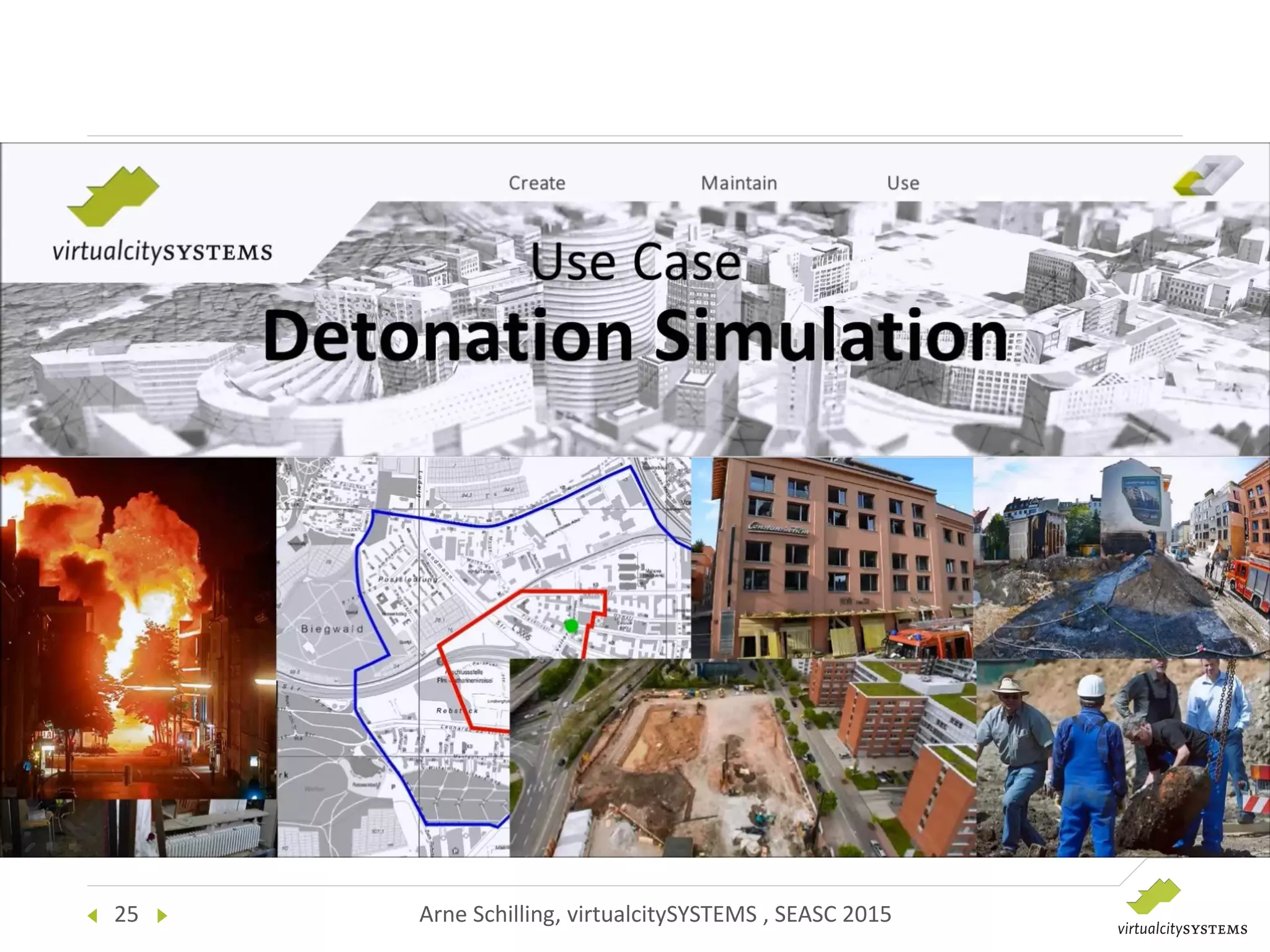
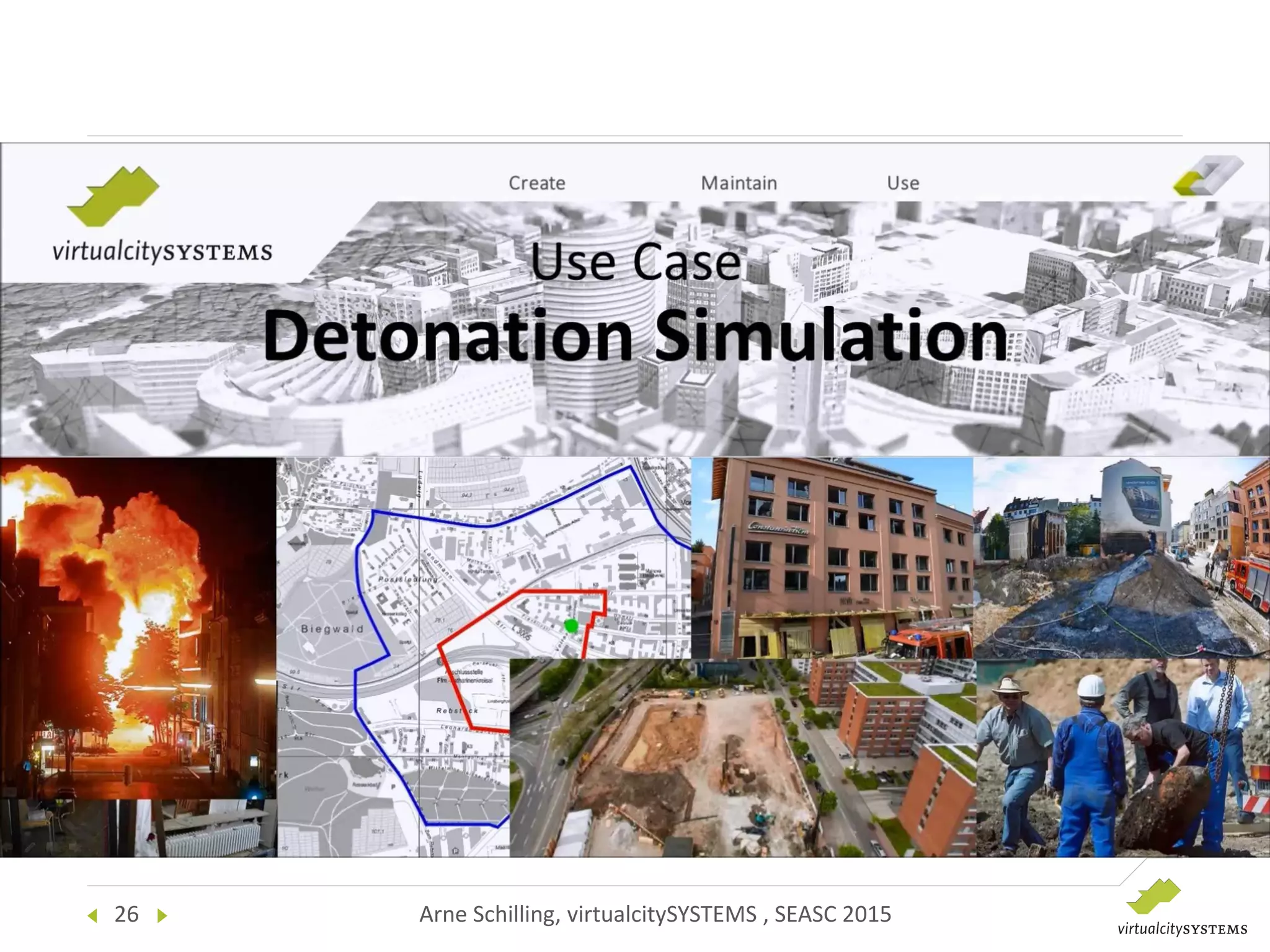
Background
 Unexploded bombs from WW2
 Safety perimeters must be set up quickly
 Critical infrastructure facilities in the area must
be determined
Project 1- Urban Blast Simulation
Safety perimeters (red: evacuation, blue: curfew)
Recovery of defused bomb
Disposal of defused bomb
18 Arne Schilling, virtualcitySYSTEMS , SEASC 2015
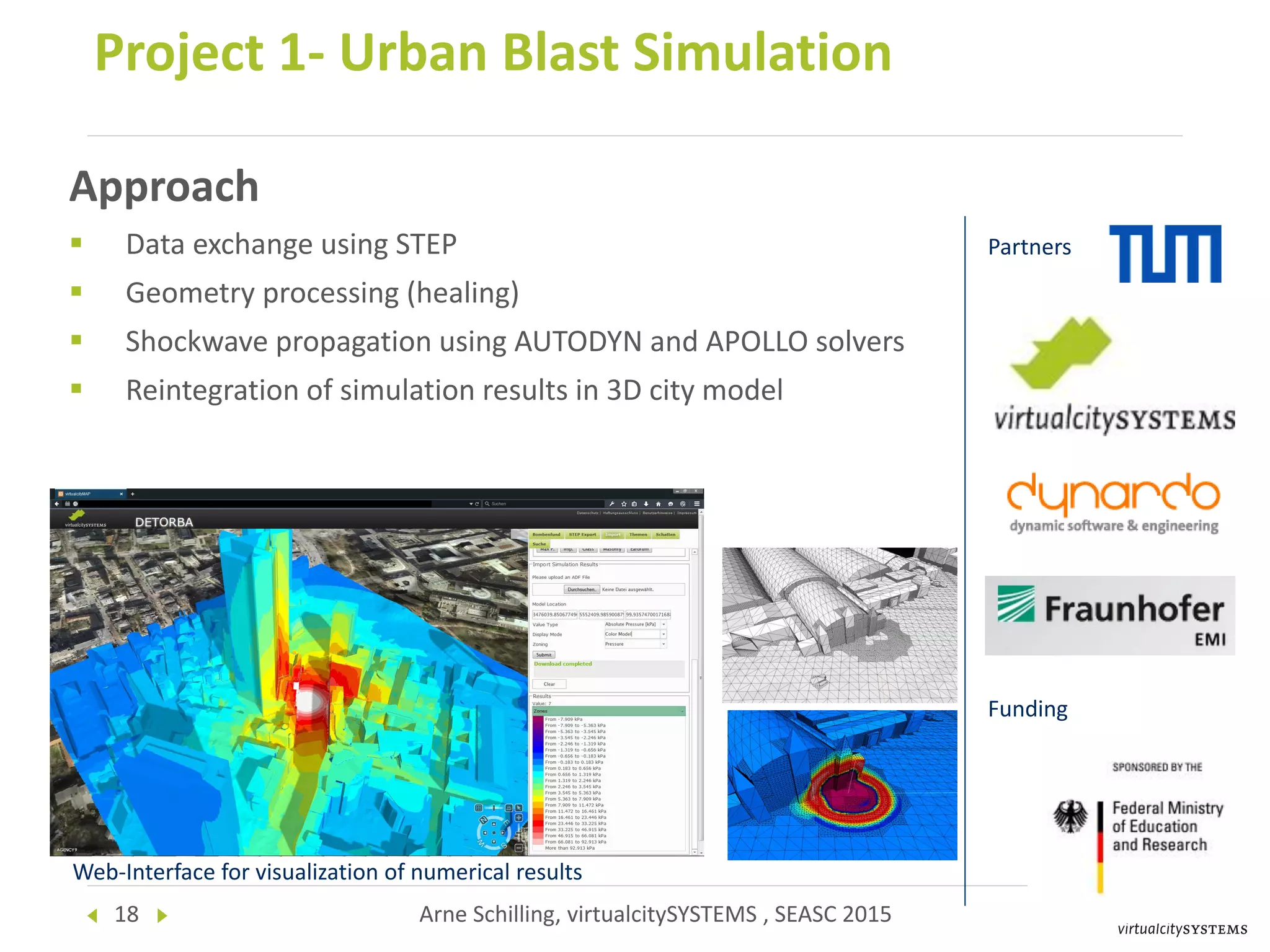
Approach
 Data exchange using STEP
 Geometry processing (healing)
 Shockwave propagation using AUTODYN and APOLLO solvers
 Reintegration of simulation results in 3D city model
Project 1- Urban Blast Simulation
Partners
Funding
Web-Interface for visualization of numerical results
19 Arne Schilling, virtualcitySYSTEMS , SEASC 2015
Project 1- Urban Blast Simulation
Partners
Funding
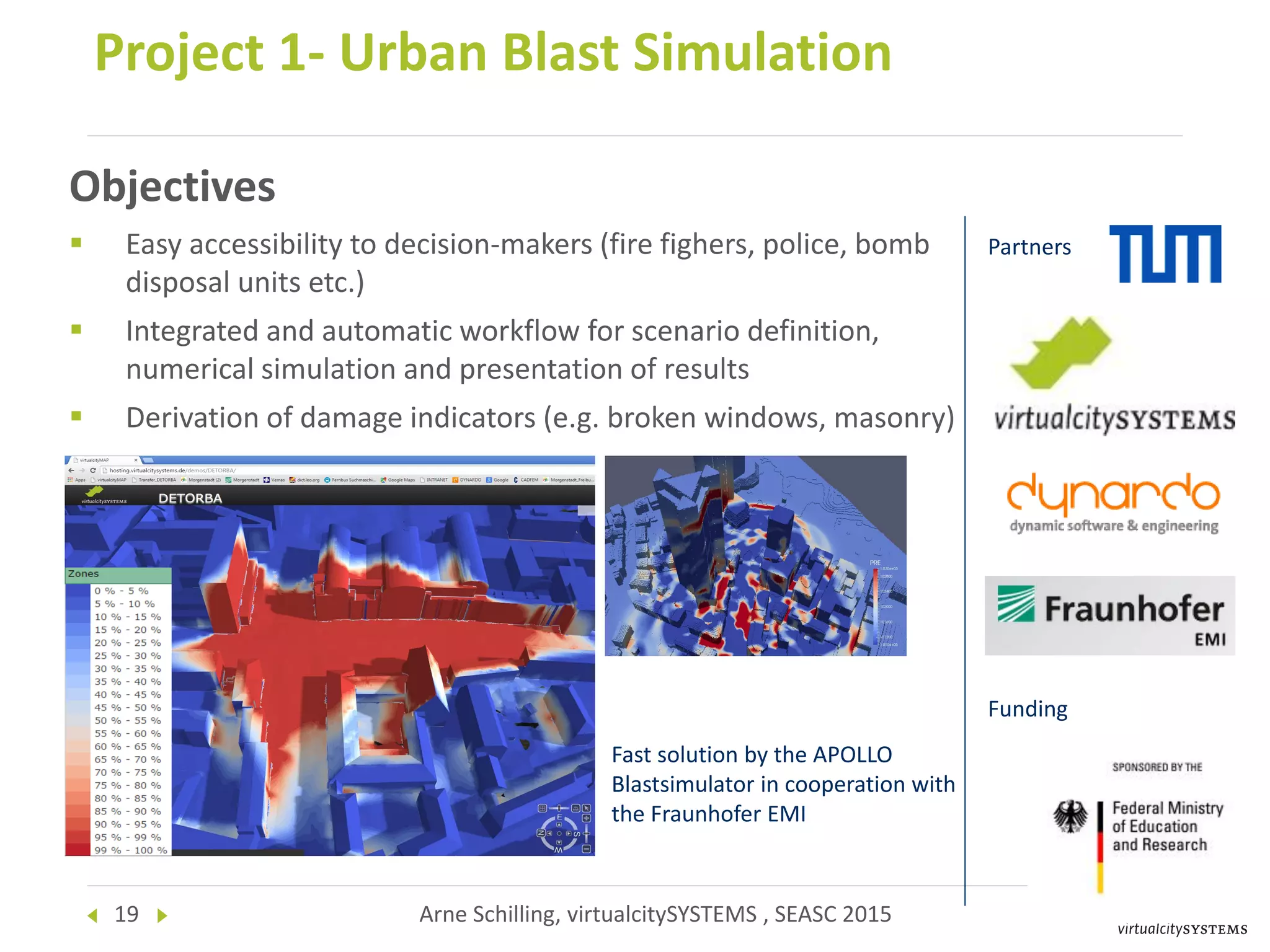
Fast solution by the APOLLO
Blastsimulator in cooperation with
the Fraunhofer EMI
Objectives
 Easy accessibility to decision-makers (fire fighers, police, bomb
disposal units etc.)
 Integrated and automatic workflow for scenario definition,
numerical simulation and presentation of results
 Derivation of damage indicators (e.g. broken windows, masonry)
20 Arne Schilling, virtualcitySYSTEMS , SEASC 2015
Project 1- Urban Blast Simulation
Partners
Funding
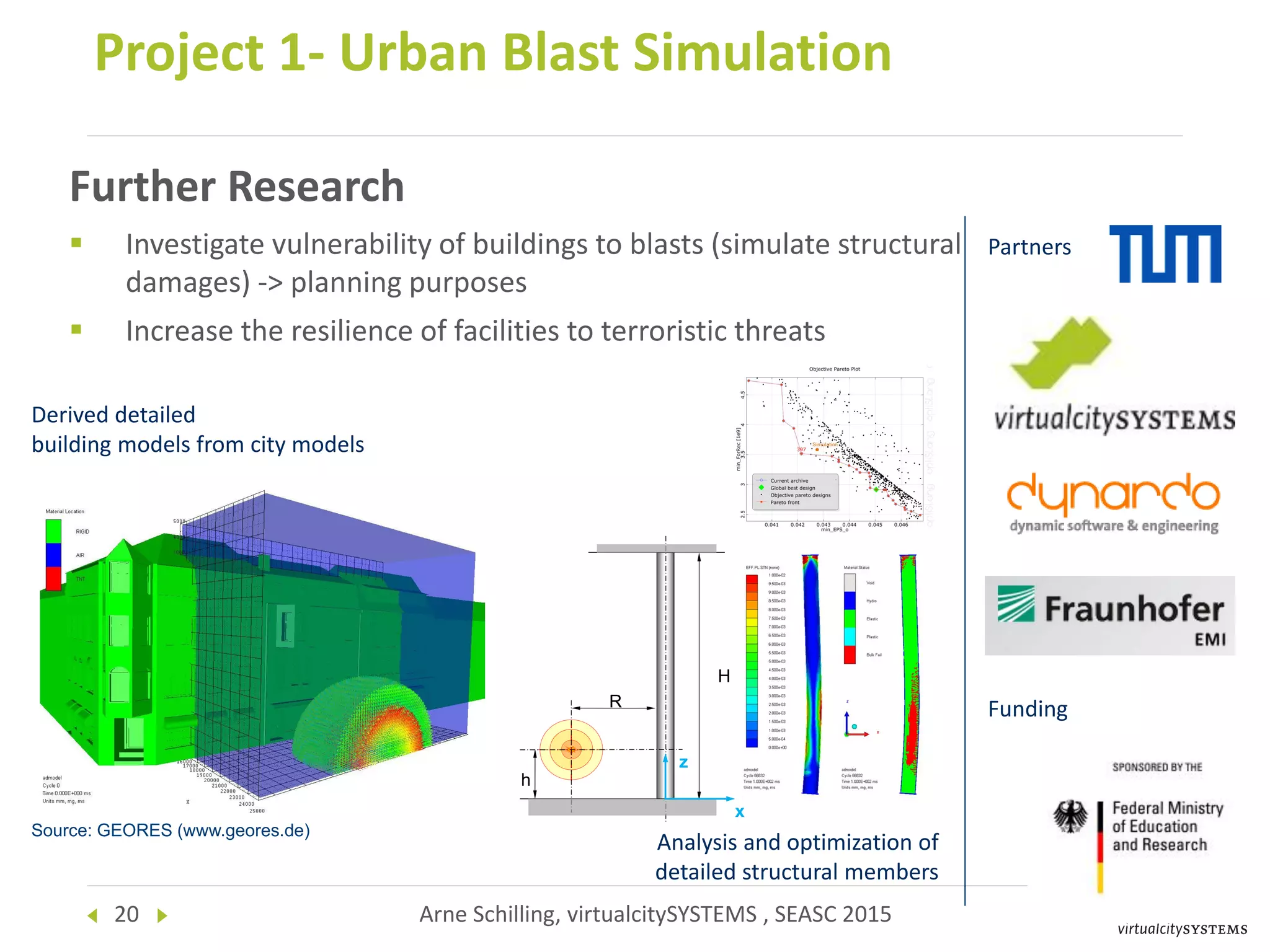
Derived detailed
building models from city models
Analysis and optimization of
detailed structural members
H
h
R
x
z
Source: GEORES (www.geores.de)
Further Research
 Investigate vulnerability of buildings to blasts (simulate structural
damages) -> planning purposes
 Increase the resilience of facilities to terroristic threats
21 Arne Schilling, virtualcitySYSTEMS , SEASC 2015
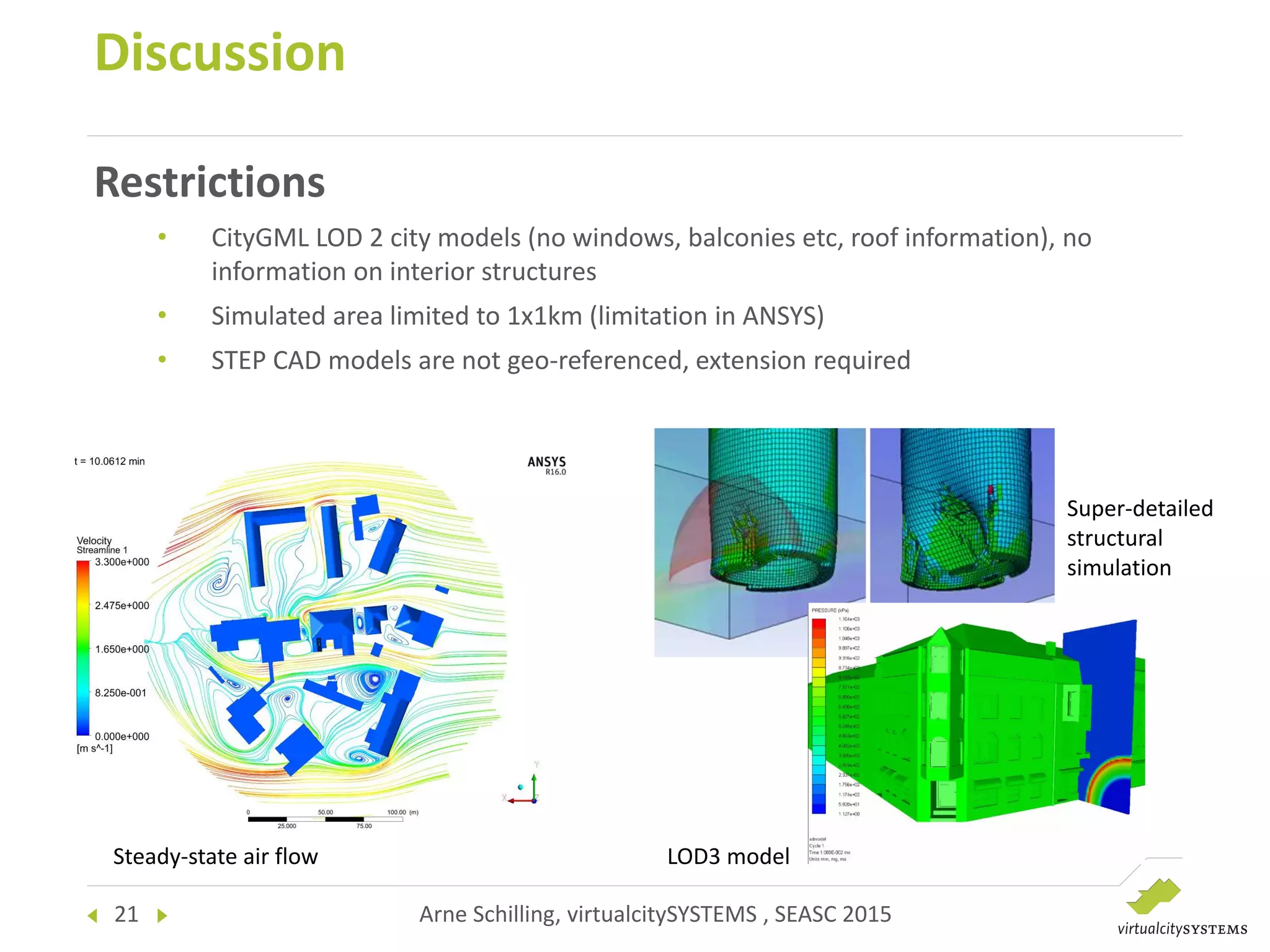
Restrictions
• CityGML LOD 2 city models (no windows, balconies etc, roof information), no
information on interior structures
• Simulated area limited to 1x1km (limitation in ANSYS)
• STEP CAD models are not geo-referenced, extension required
Discussion
Steady-state air flow LOD3 model
Super-detailed
structural
simulation
22 Arne Schilling, virtualcitySYSTEMS , SEASC 2015
Discussion
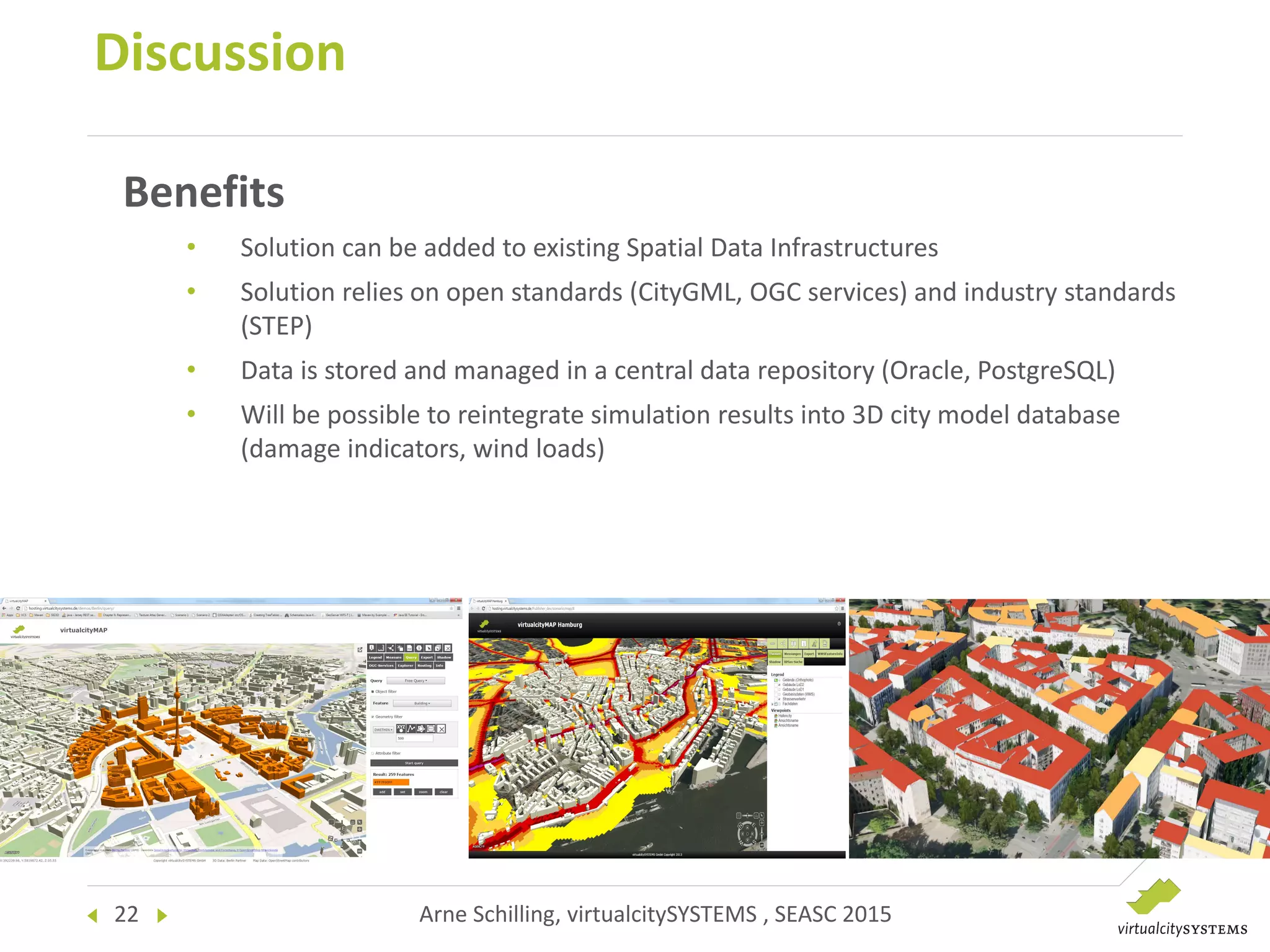
Benefits
• Solution can be added to existing Spatial Data Infrastructures
• Solution relies on open standards (CityGML, OGC services) and industry standards
(STEP)
• Data is stored and managed in a central data repository (Oracle, PostgreSQL)
• Will be possible to reintegrate simulation results into 3D city model database
(damage indicators, wind loads)
23 Arne Schilling, virtualcitySYSTEMS , SEASC 2015
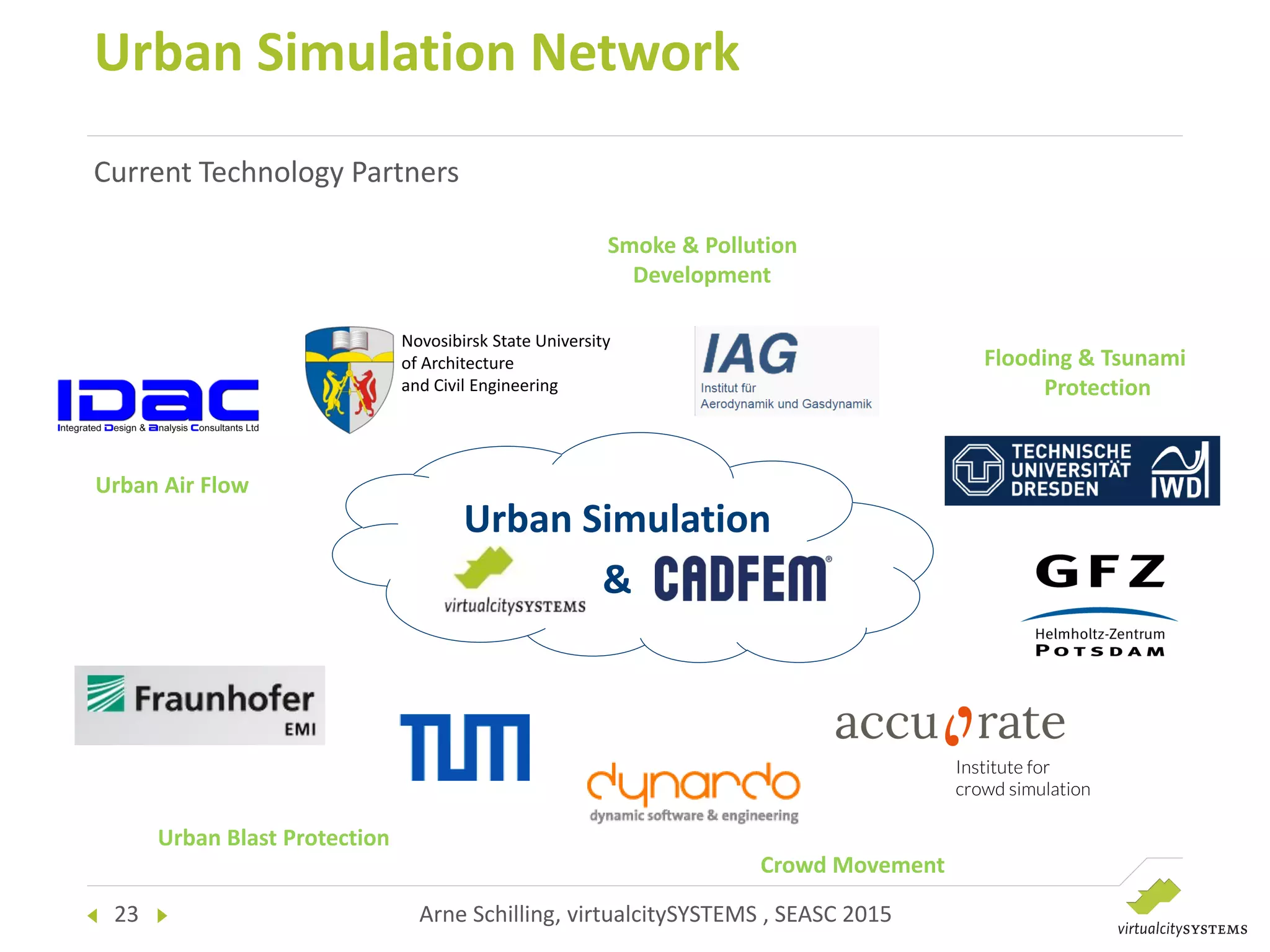
Current Technology Partners
Urban Simulation Network
Urban Simulation
&
Urban Blast Protection
Flooding & Tsunami
Protection
Urban Air Flow
Smoke & Pollution
Development
Crowd Movement
Novosibirsk State University
of Architecture
and Civil Engineering
24 Arne Schilling, virtualcitySYSTEMS , SEASC 2015
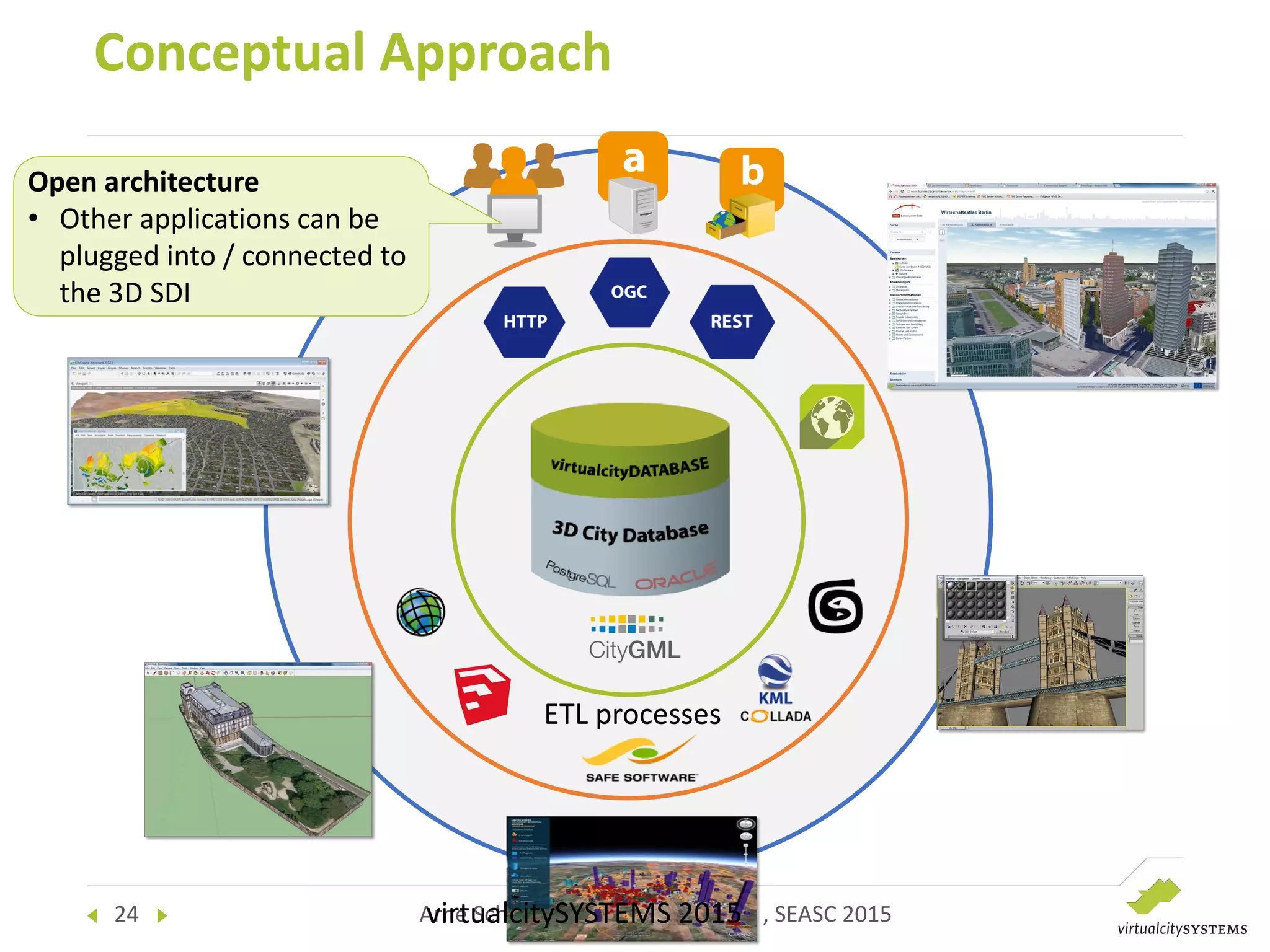
Conceptual Approach
ETL processes
Open architecture
• Other applications can be
plugged into / connected to
the 3D SDI
virtualcitySYSTEMS 2015
25 Arne Schilling, virtualcitySYSTEMS , SEASC 2015
26 Arne Schilling, virtualcitySYSTEMS , SEASC 2015
Thank You
Arne Schilling Stefan Trometer
virtualcitySYSTEMS GmbH CADFEM GmbH
aschilling@virtualcitysystems.de strometer@cadfem.de
http://www.virtualcitysystems.de http://www.cadfem.de

Enabling numerical Simulations in semantic 3D City Models using CityGML

  • 1.
    Enabling numerical Simulationsin semantic 3D City Models using CityGML 13th South East Asian Survey Congress, Singapore Arne Schilling Stefan Trometer virtualcitySYSTEMS GmbH CADFEM GmbH Berlin, Germany Grafing, Germany
  • 2.
    Arne Schilling, virtualcitySYSTEMS, SEASC 20152  Geoportal Solutions  What is Urban Simulation?  Challenge  Project 1 – Urban Air Flow  Project 2 – Urban Blast Simulation  Discussion Outline
  • 3.
    3 Arne Schilling,virtualcitySYSTEMS , SEASC 2015 Geoportal Solutions Points of Interest
  • 4.
    4 Arne Schilling,virtualcitySYSTEMS , SEASC 2015 Geoportal Solutions Integration of OGC Services
  • 5.
    5 Arne Schilling,virtualcitySYSTEMS , SEASC 2015 Geoportal Solutions Spatial & Semantic Queries
  • 6.
    6 Arne Schilling,virtualcitySYSTEMS , SEASC 2015 What is Urban Simulation? Simulation of physical phenomena in urban environments using virtual mockups / 3D city models
  • 7.
    7 Arne Schilling,virtualcitySYSTEMS , SEASC 2015 What is Urban Simulation?  Mechanical simulations of building structures  Acoustic studies / blast simulations  Wind field simulations  Simulation of flood events  …
  • 8.
    8 Arne Schilling,virtualcitySYSTEMS , SEASC 2015  GIS is not designed for performing complex physical computations • Strengths of GIS are data management, spatial analysis and visualization • 3D city models are created using remote sensing and automatic feature extraction methods, not using CAD software Challenge
  • 9.
    9 Arne Schilling,virtualcitySYSTEMS , SEASC 2015 Challenge  GIS is not designed for performing complex physical computations • Strengths of GIS are data management, spatial analysis and visualization • 3D city models are created using remote sensing and automatic feature extraction methods, not using CAD software  Physical simulations are frequently done in product design • Using Computer Aided Design (CAD) and Computer Aided Engineering (CAE) software such as ANSYS • Based on the Finite Element approach -> Numerical Simulation
  • 10.
    10 Arne Schilling,virtualcitySYSTEMS , SEASC 2015 Challenge  GIS is not designed for performing complex physical computations • Strengths of GIS are data management, spatial analysis and visualization • 3D city models are created using remote sensing and automatic feature extraction methods, not using CAD software  Physical simulations are frequently done in product design • Using Computer Aided Design (CAD) and Computer Aided Engineering (CAE) software such as ANSYS • Based on the Finite Element approach -> Numerical Simulation  Technological gap between GIS and CAE Worlds • CityGML cannot be loaded by CAE software (e.g. ANSYS). Geometrical representations are very different -> we need conversion tools • Requirements on data quality are different • Simulation results are mostly stored in proprietary formats
  • 11.
    11 Arne Schilling,virtualcitySYSTEMS , SEASC 2015 Challenge  Create a workflow from 3D Geographic Information Systems to Simulation frameworks and back
  • 12.
    12 Arne Schilling,virtualcitySYSTEMS , SEASC 2015  Simulating the wind flow in urban environments for calculating pedestrian comfort levels  Collaboration with IDAC Ltd.  Part of Environmental Impact Assessment Project 1 - Urban Air Flow Partners Pedestrian comfort at ground level (streamlines) Velocity contours at a height of 7m and 150m Novosibirsk State University of Architecture and Civil Engineering
  • 13.
    13 Arne Schilling,virtualcitySYSTEMS , SEASC 2015  Data set: Frankfurt a.M. Germany: many high rise buildings  Approach: Computational Fluid Dynamics (CFD) analysis  Typical wind loads described by velocity profiles were applied  The Navier-stokes equations were solved along with the 𝑘−𝜀 turbulence model.  The analysis was performed using ANSYS CFX “high-performance, general purpose fluid dynamics program” Project 1 - Urban Air Flow 13 From http://www.ansys.com
  • 14.
    14 Arne Schilling,virtualcitySYSTEMS , SEASC 2015 Data Link - Geometry Processing  Format Conversion from CityGML to STEP  Recreation of geometry and topology  Error detection and Geometry healing • no self intersections • no non-manifold geometries • no interior surfaces • no holes (“watertight”) • no stray elements  Defeaturing Project 1 - Urban Air Flow 14 Geometry healing, e.g. removing inner surfaces (top) and resolving self-intersections (bottom)
  • 15.
    15 Arne Schilling,virtualcitySYSTEMS , SEASC 2015 Numerical Computations  Meshing -> ca. 43 Mio. elements  Setting physical properties (e.g. air density)  Boundary conditions  Running CFD solver Project 1 - Urban Air Flow 15
  • 16.
    16 Arne Schilling,virtualcitySYSTEMS , SEASC 2015 Presentation  Cross sections  Coloring 3D city model  Charts (velocity contours) for reporting Project 1 - Urban Air Flow 16
  • 17.
    17 Arne Schilling,virtualcitySYSTEMS , SEASC 2015 Background  Unexploded bombs from WW2  Safety perimeters must be set up quickly  Critical infrastructure facilities in the area must be determined Project 1- Urban Blast Simulation Safety perimeters (red: evacuation, blue: curfew) Recovery of defused bomb Disposal of defused bomb
  • 18.
    18 Arne Schilling,virtualcitySYSTEMS , SEASC 2015 Approach  Data exchange using STEP  Geometry processing (healing)  Shockwave propagation using AUTODYN and APOLLO solvers  Reintegration of simulation results in 3D city model Project 1- Urban Blast Simulation Partners Funding Web-Interface for visualization of numerical results
  • 19.
    19 Arne Schilling,virtualcitySYSTEMS , SEASC 2015 Project 1- Urban Blast Simulation Partners Funding Fast solution by the APOLLO Blastsimulator in cooperation with the Fraunhofer EMI Objectives  Easy accessibility to decision-makers (fire fighers, police, bomb disposal units etc.)  Integrated and automatic workflow for scenario definition, numerical simulation and presentation of results  Derivation of damage indicators (e.g. broken windows, masonry)
  • 20.
    20 Arne Schilling,virtualcitySYSTEMS , SEASC 2015 Project 1- Urban Blast Simulation Partners Funding Derived detailed building models from city models Analysis and optimization of detailed structural members H h R x z Source: GEORES (www.geores.de) Further Research  Investigate vulnerability of buildings to blasts (simulate structural damages) -> planning purposes  Increase the resilience of facilities to terroristic threats
  • 21.
    21 Arne Schilling,virtualcitySYSTEMS , SEASC 2015 Restrictions • CityGML LOD 2 city models (no windows, balconies etc, roof information), no information on interior structures • Simulated area limited to 1x1km (limitation in ANSYS) • STEP CAD models are not geo-referenced, extension required Discussion Steady-state air flow LOD3 model Super-detailed structural simulation
  • 22.
    22 Arne Schilling,virtualcitySYSTEMS , SEASC 2015 Discussion Benefits • Solution can be added to existing Spatial Data Infrastructures • Solution relies on open standards (CityGML, OGC services) and industry standards (STEP) • Data is stored and managed in a central data repository (Oracle, PostgreSQL) • Will be possible to reintegrate simulation results into 3D city model database (damage indicators, wind loads)
  • 23.
    23 Arne Schilling,virtualcitySYSTEMS , SEASC 2015 Current Technology Partners Urban Simulation Network Urban Simulation & Urban Blast Protection Flooding & Tsunami Protection Urban Air Flow Smoke & Pollution Development Crowd Movement Novosibirsk State University of Architecture and Civil Engineering
  • 24.
    24 Arne Schilling,virtualcitySYSTEMS , SEASC 2015 Conceptual Approach ETL processes Open architecture • Other applications can be plugged into / connected to the 3D SDI virtualcitySYSTEMS 2015
  • 25.
    25 Arne Schilling,virtualcitySYSTEMS , SEASC 2015
  • 26.
    26 Arne Schilling,virtualcitySYSTEMS , SEASC 2015
  • 27.
    Thank You Arne SchillingStefan Trometer virtualcitySYSTEMS GmbH CADFEM GmbH aschilling@virtualcitysystems.de strometer@cadfem.de http://www.virtualcitysystems.de http://www.cadfem.de