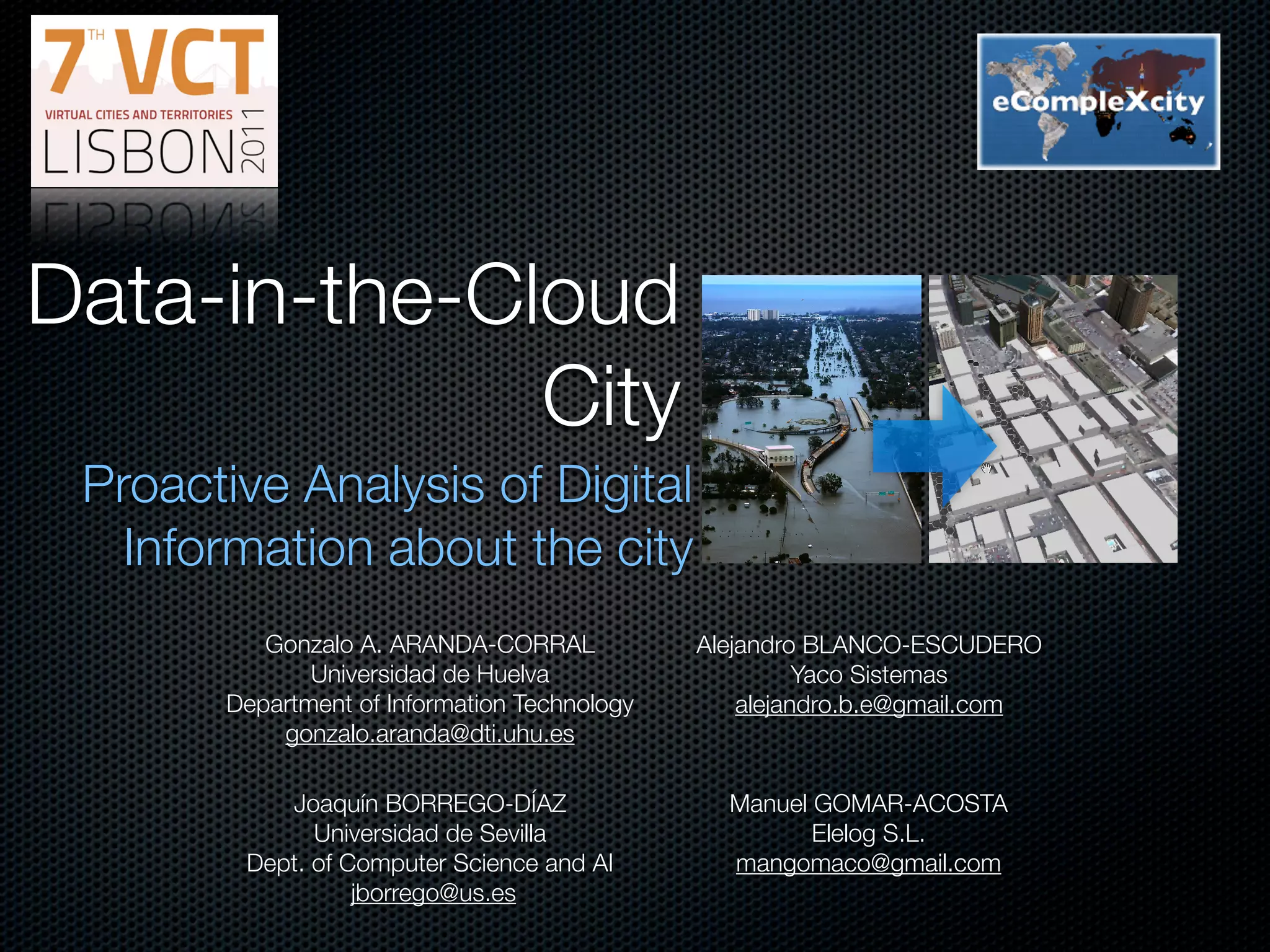
Data-in-the-Cloud
              City
 Proactive Analysis of Digital
   Information about the city                                  !            !


          Gonzalo A. ARANDA-CORRAL            Alejandro BLANCO-ESCUDERO
              Universidad de Huelva                     Yaco Sistemas
       Department of Information Technology       alejandro.b.e@gmail.com
           gonzalo.aranda@dti.uhu.es

           Joaquín BORREGO-DÍAZ                 Manuel GOMAR-ACOSTA
              Universidad de Sevilla                   Elelog S.L.
        Dept. of Computer Science and AI        mangomaco@gmail.com
                  jborrego@us.es
Index

Motivation & Goals
Data in the WWW and associated services
Simulating extreme dynamics
Multiagent Arch
Results
Conclusions and Future Work
Motivation (I): Context


    eCompleXcity

Emergent concepts in complex systems. Applications
to Urban environments and Cultural Complexity
Excellence Project. Junta de Andalucía. Spain
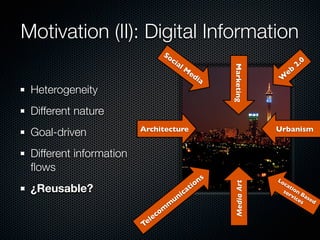
Motivation (II): Digital Information
                              So
                                 c   ia                                 0
                                       lM                             2.


                                                   Marketing
                                         ed                      eb
                                              ia                W
 Heterogeneity
 Different nature
                         Architecture                          Urbanism
 Goal-driven
 Different information
 flows
                                         ns                    Lo
                                      tio


                                                   Media Art
                                                                  c
 ¿Reusable?                        ic
                                     a
                                                                  at
                                                                 se ion B
                                                                   rv
                                 un                                  ice ase
                                                                        s    d
                                m
                             com
                           le
                         Te
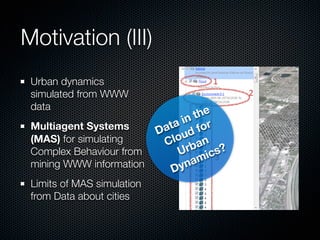
Motivation (III)
 Urban dynamics
 simulated from WWW
 data
                                      he
                                   nt r
 Multiagent Systems             a i fo
                              at d
                            D
 (MAS) for simulating         C lou an
 Complex Behaviour from          U rb cs?
 mining WWW information            na mi
                                Dy
 Limits of MAS simulation
 from Data about cities
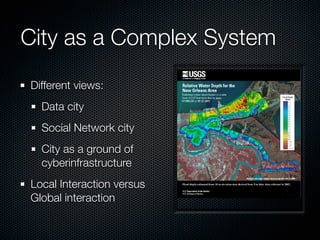
City as a Complex System
Different views:
  Data city
  Social Network city
  City as a ground of
  cyberinfrastructure
Local Interaction versus
Global interaction         !
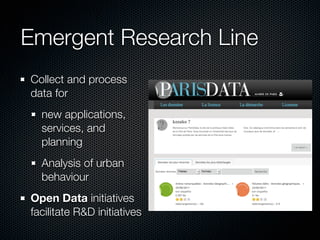
Emergent Research Line
Collect and process
data for
  new applications,
  services, and
  planning
  Analysis of urban
  behaviour
Open Data initiatives
facilitate R&D initiatives
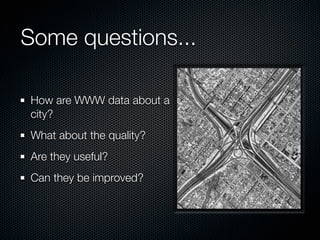
Some questions...

How are WWW data about a
city?
What about the quality?
Are they useful?
Can they be improved?
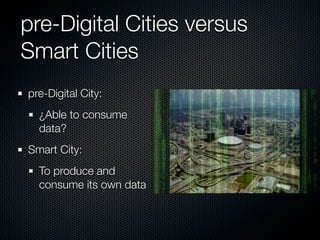
pre-Digital Cities versus
Smart Cities
pre-Digital City:
  ¿Able to consume
  data?
Smart City:
  To produce and
  consume its own data
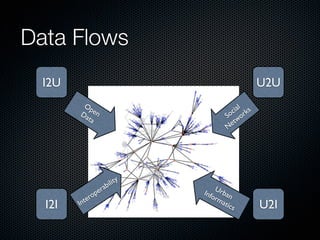
Data Flows
  I2U                                              U2U
         Op
                                          ial ks
        Da en                           oc or
                                       S w
          ta
                                       N et


                         y
                     ilit
                  rab            U
                             Info rban
               pe
            ero                  rm
  I2I   Int                         atic
                                         s         U2I
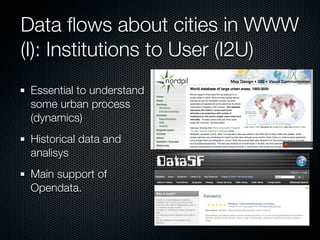
Data flows about cities in WWW
(I): Institutions to User (I2U)
 Essential to understand
 some urban process
 (dynamics)
 Historical data and
 analisys
 Main support of
 Opendata.
Data flows about cities in
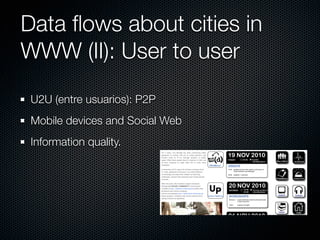
WWW (II): User to user
 U2U (entre usuarios): P2P
 Mobile devices and Social Web
 Information quality.
Data flows about cities in
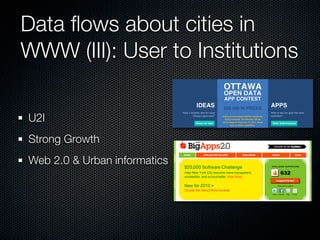
WWW (III): User to Institutions

U2I
Strong Growth
Web 2.0 & Urban informatics
Data flows about cities in WWW
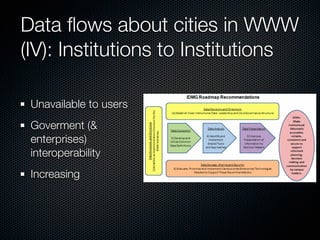
(IV): Institutions to Institutions

 Unavailable to users
 Goverment (&
 enterprises)
 interoperability
 Increasing
Different data sources for
MAS simulation
 Extreme Urban dynamics     Explore every WWW
                            information about both
   Urban evolution under
                            the city and the event
   exceptional
   circunstances            Data comsumption by
                            MAS
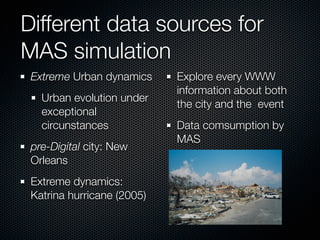
 pre-Digital city: New
 Orleans
 Extreme dynamics:
 Katrina hurricane (2005)
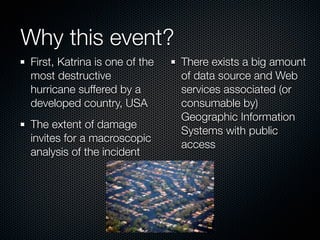
Why this event?
First, Katrina is one of the   There exists a big amount
most destructive               of data source and Web
hurricane suffered by a        services associated (or
developed country, USA         consumable by)
                               Geographic Information
The extent of damage
                               Systems with public
invites for a macroscopic
                               access
analysis of the incident
Bounding the scope
In order to evaluate the     In some cases a
quality, accessibility and   reparation of defficent
usefulness of I2U            data is necessary
It considers only I2U        Mainly, data from global
accessible by WWW,           information systems (or
Internet or deep Internet    U.S. Agencies)
( that is, accessible via
                               more specific data may
search forms)
                               limit the reusability.
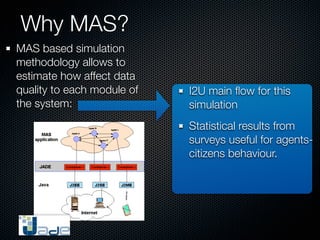
Why MAS?
MAS based simulation
methodology allows to
estimate how affect data
quality to each module of   I2U main flow for this
the system:                 simulation
                            Statistical results from
                            surveys useful for agents-
                            citizens behaviour.
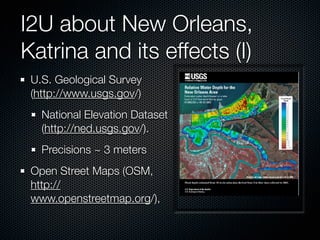
I2U about New Orleans,
Katrina and its effects (I)
 U.S. Geological Survey
 (http://www.usgs.gov/)
   National Elevation Dataset
   (http://ned.usgs.gov/).
   Precisions ~ 3 meters
 Open Street Maps (OSM,
 http://
                                !
 www.openstreetmap.org/),
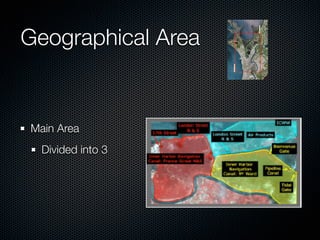
Geographical Area
                    !


Main Area
  Divided into 3


                        !
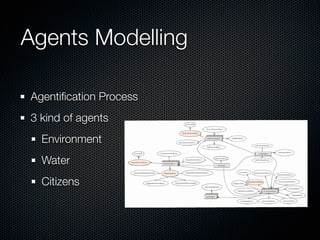
Agents Modelling

Agentification Process
3 kind of agents
  Environment
  Water
  Citizens
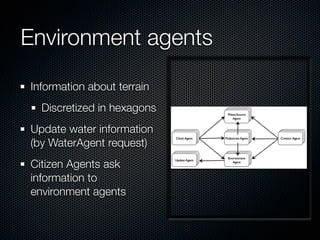
Environment agents

Information about terrain
  Discretized in hexagons
Update water information
(by WaterAgent request)
Citizen Agents ask
information to
environment agents
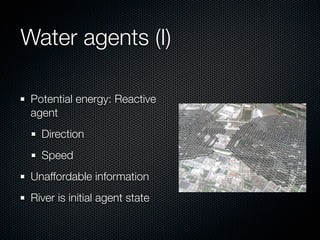
Water agents (I)

 Potential energy: Reactive
 agent
   Direction
   Speed
 Unaffordable information
 River is initial agent state
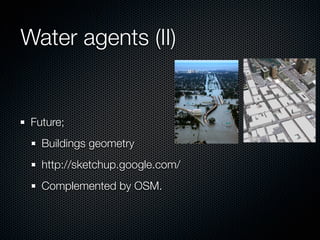
Water agents (II)


 Future;
   Buildings geometry            !   !


   http://sketchup.google.com/
   Complemented by OSM.
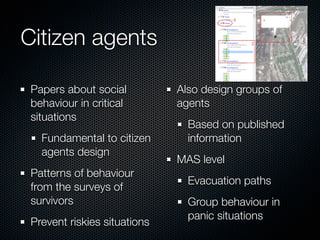
Citizen agents

 Papers about social          Also design groups of
 behaviour in critical        agents
 situations
                                Based on published
   Fundamental to citizen       information
   agents design
                              MAS level
 Patterns of behaviour
                                Evacuation paths
 from the surveys of
 survivors                      Group behaviour in
                                panic situations
 Prevent riskies situations
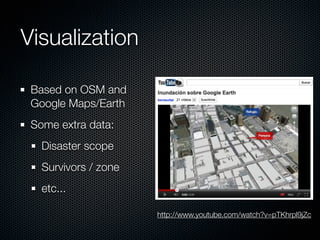
Visualization

 Based on OSM and
 Google Maps/Earth
 Some extra data:
   Disaster scope
   Survivors / zone
   etc...

                      http://www.youtube.com/watch?v=pTKhrpl9jZc
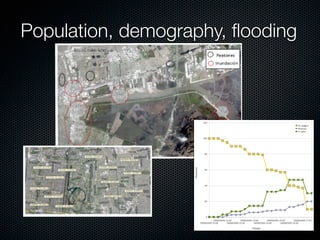
Population, demography, flooding
Conclusions

I2U information flows is used, in this work, to simulate
urban phenomena
Simulation needs digital information from cities and its
own feedback
Previous and exhaustive information analysis and
clasification its fundamental to start any kind of urban
cloud computing
Future Work

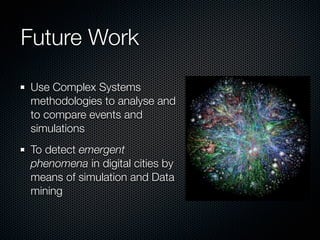
Use Complex Systems
methodologies to analyse and
to compare events and
simulations
To detect emergent
phenomena in digital cities by
means of simulation and Data
mining
Data-in-the-Cloud
              City
 Proactive Analysis of Digital
   Information about the city            !   !


             Thanks for your attention

Data-in-the-Cloud City

  • 1.
    Data-in-the-Cloud City Proactive Analysis of Digital Information about the city ! ! Gonzalo A. ARANDA-CORRAL Alejandro BLANCO-ESCUDERO Universidad de Huelva Yaco Sistemas Department of Information Technology alejandro.b.e@gmail.com gonzalo.aranda@dti.uhu.es Joaquín BORREGO-DÍAZ Manuel GOMAR-ACOSTA Universidad de Sevilla Elelog S.L. Dept. of Computer Science and AI mangomaco@gmail.com jborrego@us.es
  • 2.
    Index Motivation & Goals Datain the WWW and associated services Simulating extreme dynamics Multiagent Arch Results Conclusions and Future Work
  • 3.
    Motivation (I): Context eCompleXcity Emergent concepts in complex systems. Applications to Urban environments and Cultural Complexity Excellence Project. Junta de Andalucía. Spain
  • 4.
    Motivation (II): DigitalInformation So c ia 0 lM 2. Marketing ed eb ia W Heterogeneity Different nature Architecture Urbanism Goal-driven Different information flows ns Lo tio Media Art c ¿Reusable? ic a at se ion B rv un ice ase s d m com le Te
  • 5.
    Motivation (III) Urbandynamics simulated from WWW data he nt r Multiagent Systems a i fo at d D (MAS) for simulating C lou an Complex Behaviour from U rb cs? mining WWW information na mi Dy Limits of MAS simulation from Data about cities
  • 6.
    City as aComplex System Different views: Data city Social Network city City as a ground of cyberinfrastructure Local Interaction versus Global interaction !
  • 7.
    Emergent Research Line Collectand process data for new applications, services, and planning Analysis of urban behaviour Open Data initiatives facilitate R&D initiatives
  • 8.
    Some questions... How areWWW data about a city? What about the quality? Are they useful? Can they be improved?
  • 9.
    pre-Digital Cities versus SmartCities pre-Digital City: ¿Able to consume data? Smart City: To produce and consume its own data
  • 10.
    Data Flows I2U U2U Op ial ks Da en oc or S w ta N et y ilit rab U Info rban pe ero rm I2I Int atic s U2I
  • 11.
    Data flows aboutcities in WWW (I): Institutions to User (I2U) Essential to understand some urban process (dynamics) Historical data and analisys Main support of Opendata.
  • 12.
    Data flows aboutcities in WWW (II): User to user U2U (entre usuarios): P2P Mobile devices and Social Web Information quality.
  • 13.
    Data flows aboutcities in WWW (III): User to Institutions U2I Strong Growth Web 2.0 & Urban informatics
  • 14.
    Data flows aboutcities in WWW (IV): Institutions to Institutions Unavailable to users Goverment (& enterprises) interoperability Increasing
  • 15.
    Different data sourcesfor MAS simulation Extreme Urban dynamics Explore every WWW information about both Urban evolution under the city and the event exceptional circunstances Data comsumption by MAS pre-Digital city: New Orleans Extreme dynamics: Katrina hurricane (2005)
  • 16.
    Why this event? First,Katrina is one of the There exists a big amount most destructive of data source and Web hurricane suffered by a services associated (or developed country, USA consumable by) Geographic Information The extent of damage Systems with public invites for a macroscopic access analysis of the incident
  • 17.
    Bounding the scope Inorder to evaluate the In some cases a quality, accessibility and reparation of defficent usefulness of I2U data is necessary It considers only I2U Mainly, data from global accessible by WWW, information systems (or Internet or deep Internet U.S. Agencies) ( that is, accessible via more specific data may search forms) limit the reusability.
  • 18.
    Why MAS? MAS basedsimulation methodology allows to estimate how affect data quality to each module of I2U main flow for this the system: simulation Statistical results from surveys useful for agents- citizens behaviour.
  • 19.
    I2U about NewOrleans, Katrina and its effects (I) U.S. Geological Survey (http://www.usgs.gov/) National Elevation Dataset (http://ned.usgs.gov/). Precisions ~ 3 meters Open Street Maps (OSM, http:// ! www.openstreetmap.org/),
  • 20.
    Geographical Area ! Main Area Divided into 3 !
  • 21.
    Agents Modelling Agentification Process 3kind of agents Environment Water Citizens
  • 22.
    Environment agents Information aboutterrain Discretized in hexagons Update water information (by WaterAgent request) Citizen Agents ask information to environment agents
  • 23.
    Water agents (I) Potential energy: Reactive agent Direction Speed Unaffordable information River is initial agent state
  • 24.
    Water agents (II) Future; Buildings geometry ! ! http://sketchup.google.com/ Complemented by OSM.
  • 25.
    Citizen agents Papersabout social Also design groups of behaviour in critical agents situations Based on published Fundamental to citizen information agents design MAS level Patterns of behaviour Evacuation paths from the surveys of survivors Group behaviour in panic situations Prevent riskies situations
  • 26.
    Visualization Based onOSM and Google Maps/Earth Some extra data: Disaster scope Survivors / zone etc... http://www.youtube.com/watch?v=pTKhrpl9jZc
  • 27.
  • 28.
    Conclusions I2U information flowsis used, in this work, to simulate urban phenomena Simulation needs digital information from cities and its own feedback Previous and exhaustive information analysis and clasification its fundamental to start any kind of urban cloud computing
  • 29.
    Future Work Use ComplexSystems methodologies to analyse and to compare events and simulations To detect emergent phenomena in digital cities by means of simulation and Data mining
  • 30.
    Data-in-the-Cloud City Proactive Analysis of Digital Information about the city ! ! Thanks for your attention