Introduction to Esri CityEngine
What is CityEngine ? 3D Cities Models
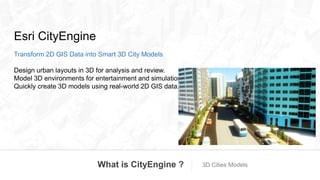
Esri CityEngine
Transform 2D GIS Data into Smart 3D City Models
Design urban layouts in 3D for analysis and review.
Model 3D environments for entertainment and simulation.
Quickly create 3D models using real-world 2D GIS data.
What is CityEngine ? 3D Cities Models
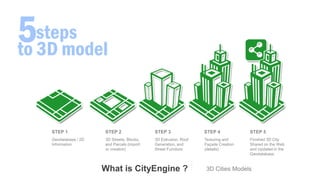
STEP 1
Geodatabase / 2D
Information
STEP 2
3D Streets, Blocks,
and Parcels (import
or creation)
STEP 3
3D Extrusion, Roof
Generation, and
Street Furniture
STEP 4
Texturing and
Façade Creation
(details)
STEP 5
Finished 3D City
Shared on the Web
and Updated in the
Geodatabase
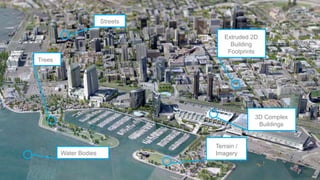
Trees
Water Bodies
Extruded 2D
Building
Footprints
3D Complex
Buildings
Terrain /
Imagery
Streets
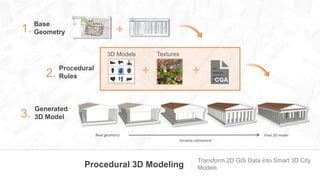
Procedural 3D Modeling
Transform 2D GIS Data into Smart 3D City
Models
Base geometry Final 3D model
Iterative refinement
+
+
CGA
3D Models Textures
+
Generated
3D Model
1.
2.
3.
Base
Geometry
Procedural
Rules
File Type Support Input / Output Files
Input File
DAE (Collada)
DXF (AutoCAD)
GDB, Shp (ArcMap)
KML, KMZ (Google Earth)
OBJ (3d Max, SketchUp)
OSM (OpenStreet Map)
Terrain
Texture
3WS
Output File
Python
KML
CityEngine WebScene
DAE
OBJ
Autodesk FBX
E-On Software Vue
Pixar Renderman
GDB
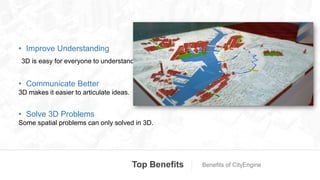
Top Benefits Benefits of CityEngine
• Improve Understanding
3D is easy for everyone to understand.
• Communicate Better
3D makes it easier to articulate ideas.
• Solve 3D Problems
Some spatial problems can only solved in 3D.
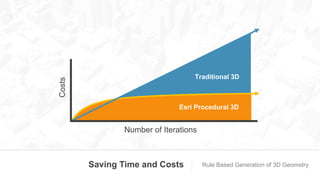
Saving Time and Costs Rule Based Generation of 3D Geometry
Traditional 3D
Esri Procedural 3D
Number of Iterations
Costs
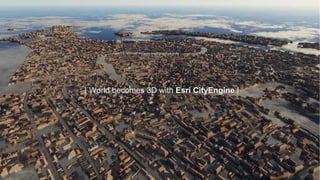
| World becomes 3D with Esri CityEngine |
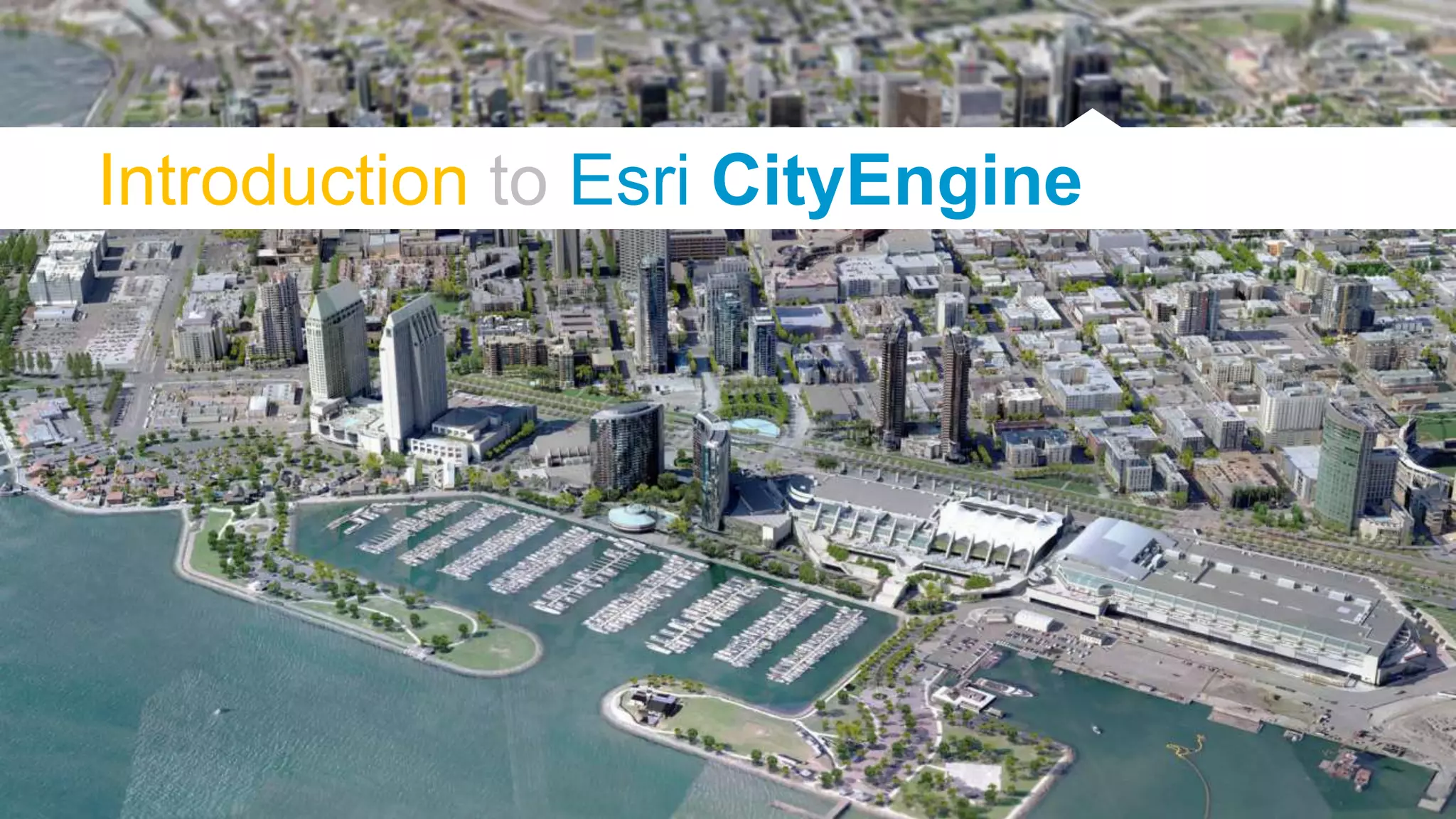
Introduction to Esri CityEngine

Introduction to Esri CityEngine

  • 1.
  • 2.
    What is CityEngine? 3D Cities Models Esri CityEngine Transform 2D GIS Data into Smart 3D City Models Design urban layouts in 3D for analysis and review. Model 3D environments for entertainment and simulation. Quickly create 3D models using real-world 2D GIS data.
  • 3.
    What is CityEngine? 3D Cities Models STEP 1 Geodatabase / 2D Information STEP 2 3D Streets, Blocks, and Parcels (import or creation) STEP 3 3D Extrusion, Roof Generation, and Street Furniture STEP 4 Texturing and Façade Creation (details) STEP 5 Finished 3D City Shared on the Web and Updated in the Geodatabase
  • 4.
    Trees Water Bodies Extruded 2D Building Footprints 3DComplex Buildings Terrain / Imagery Streets
  • 5.
    Procedural 3D Modeling Transform2D GIS Data into Smart 3D City Models Base geometry Final 3D model Iterative refinement + + CGA 3D Models Textures + Generated 3D Model 1. 2. 3. Base Geometry Procedural Rules
  • 6.
    File Type SupportInput / Output Files Input File DAE (Collada) DXF (AutoCAD) GDB, Shp (ArcMap) KML, KMZ (Google Earth) OBJ (3d Max, SketchUp) OSM (OpenStreet Map) Terrain Texture 3WS Output File Python KML CityEngine WebScene DAE OBJ Autodesk FBX E-On Software Vue Pixar Renderman GDB
  • 7.
    Top Benefits Benefitsof CityEngine • Improve Understanding 3D is easy for everyone to understand. • Communicate Better 3D makes it easier to articulate ideas. • Solve 3D Problems Some spatial problems can only solved in 3D.
  • 8.
    Saving Time andCosts Rule Based Generation of 3D Geometry Traditional 3D Esri Procedural 3D Number of Iterations Costs
  • 9.
    | World becomes3D with Esri CityEngine |

Editor's Notes

  • #5 …. In the past creating a 3D cityscape was an expensive and manual process. And as your city grows and changes, these hand built models are quickly out of date. We see that clients will come to expect a real-time 3D feedback loop –------ 3D modeling to support a charrette style design process We can now rapidly accelerate this modeling process and make use of this 3D content like never before.
  • #6 In summary, procedural modeling can be explained in 3 steps. First to bring in your base geometry, either from GIS or CAD…. When using GIS we can take advantage of the shape data to further automate the modeling. Then you apply a rule…. This is the combination of existing 3D models and textures together with a simple scripted framework called CGA – Computer Generated Architecture These generated models can get iteratively more complex… from a basic form to something that better resembles the Parthenon in complexity.
  • #9 So the big question…. Is efficiency critical to your 3D pipeline? When you compare Esri’s procedural 3D to traditional modeling.. in 3DS or Sketchup You can see that if many iterations are needed, its much more efficient to use a rule based …parametric modeling software. Particularly with large models requiring high detail. With traditional 3D modeling its pretty much equal output to equal input. Ultimately its about saving costs and to do some of the work we have seen here today, you might need a fairly large team working in 3DS to accomplish some of the same tasks.. 