TEACHING PROGRAMME
An introduction to the use of cob and lime based mortars
Brannams Campus, Barnstaple, Devon.
ANINTRODUCTIONTOTHEUSEOFCOBANDLIMEBASEDMORTARS
SKILLS TARGETED
Working with cob – preparation – mixing – laying and sculpting by hand and a float – laying and working with feet and
tools. Using a sharp spade for paring and wooden mallets for shaping.
Applying lime based mortars to various backgrounds.
Laying stone using lime mortar.
Use of lime wash.
PRE-CONDITIONS
MATERIALS NEEDED:
COB : SAND, CEMENT, LINTELS, SHUTTERING, STRAW, CLAY SOIL.
PLASTERING : LIME MORTAR, HORSE HAIR, 100MM X 50MM FRAME WORK, LATHS.
STONE WORK : LIME MORTAR, STONE.
LIME WASH.
TOOLS:
OVEN AND BENCH BASE WORK : BRICK LAYING TROWELS, LEVELS, TAPE MEASURES.
OVEN AND BENCH COB WORK - TARPAULIN, FORK, SHOVEL, PARING TOOL, TAMPING POLE, PROTECTIVE GLOVES, FLOAT, WATER SPRAYING
BOTTLE, SPONGE.
PLASTERING : PLASTERING TROWELS, FLOATS, COMBS.
STONE WORK : BRICK LAYING TROWELS, PROFILES, STRING LINES, CHURN BRUSHES, LUMP HAMMER.
LIME WASH : BRUSHES.
BASE TO BE BUILT:
A blockwork platform for the cob oven to be built on top of with opening underneath that could be used for fire wood
and storage.
BASE TO BE BUILT BY BRICK WORK STUDENTS WITH A MEMBER OF STAFF AS PART OF ADDITIONAL LEARNING ACTIVITY
FEATURES OF THE OCCUPATIONAL ACTIVITY
Traditional low impact building method and material. Buildings are usually made from materials excavated onsite, and
harvested nearby. These activities cover most of the techniques of working with cob, but unlike a practice wall, have
an end product which will be utilized by the supported learning students in the college.
The use of lime products is enjoying a recent resergence as customers begin to realise that the correct materials, used
in the correct manner will improve the performance of their property and preserve older buildings allowing them to
breath as they were designed.
SUMMARIZED PROGRAMME
Activity Teaching methods Duration
Set out site for cob oven Practical direction given when needed by
demonstration and explanation.
Use of Pythagoras’s theory to set out the
base square.
2 hours
Pizza Oven - Build a block work base of three sides of
440mm x 225mm x 100mm blocks, 2.5 blocks x 2.5
blocks and 10 courses high (on their flat).
A mortar mix of 4-1 consistency to be
prepared by the students.
Block base built by students – monitor
progress and give direction where needed.
4 hours
Bed on concrete lintels and lay on 1 course of bricks to
form shuttering edge
The block-work platform with be topped with concrete
lintels 900 x 140 x 100mm.
6 x Lintels to be placed on top of block base and
shuttered up to give a solid base.
The lintels will be fixed to blocks using the same
mortar mix of 4-1.
Screed/concrete on top a polished finish added.
Mix and level concrete to top of brick and float finish
Mortar mix of 3-1 or 4-1 will be used for the screed
top. This will be placed on top of the lintels and then
finished with a plastering trowel. This will ensure the
high quality polished finish required for the bottom of
the pizza oven.
Make sure lifting is done appropriately,
taking weight of lintels into account.
Lay on one course of bricks and prepare
mortar and fix lintels and blocks under
direction.
The mortar mix will be mixed for the
screed.
Explain the application and method needed
for polished screed top.
Apply concrete.
Demonstrate the technique for finishing to
give a polished finish – participants to
complete the task.
4 hours
Render the outside face of the blocks. Demonstrate rendering and participants to
complete.
2 hours
Make up slatted door for the opening (fuel store).
A pair of wooden doors made to enclose the space
underneath. 300mm x 800mm with a wooden latch.
Show the drawings and monitor and
support the fabrication of the doors.
2 hours
Brick arch for cob oven entrance. Explain and demonstrate the use of a brick
arch former.
Participants to build brick arch for entrance
to oven under direction.
1 hour
Make mould/form for the cob oven
Brick and stone dome shape to be built – finishing with
damp sand and lime so the shape will hold and stay
firm.
Explain the process of making the mould
and build with participants.
1 hour
Mix cob ready for cob oven
1 mix cob with straw and sand
2 mix in cob with feet
Spread the tarpaulin on the ground and
bring the cob down from the trailer with a
wheel barrow with participants.
Fork the cob onto the tarpaulin. Explain the
mixing process.
Demonstrate how to mix the cob with their
feet.
Demonstrate how the tarpaulin can be
pulled to roll the cob to aid the missing
process.
30 minutes
For Pizza oven :
Cob is hand applied over a sand and lime sculpted
mould
1. Lay on the cob mixture.
2. Compact the cob as much as possible with
hands to ensure a compacted bed with as few
air pockets as possible with consistently mixed
straw content.
3. As the sides dry up, beat the cob back.
4. As the cob is to remain unrendered, the cob is
smoothed by hand with water to produce a
finer level of protection against the weather.
5. Once finished, the lime, sand and materials
used for the internal mould are removed.
Explain and demonstrate process as the
stages are worked through, allowing
participants to gain as much experience
and knowledge as possible.
2 hours
Lime plastering :
Lime mortar is applied to 2 different backgrounds,
Lath and harled block work.
1. Lath: Haired mortar is applied using a
plastering trowel or wooden float and pressed
through the laths to create ‘hooks’ which hold
the plaster coat in place when it has dried.
2. Block work: Unhaired mortar is applied to a
keyed (harled) background with a plastering
trowel or wooden float. When the mortar has
dry sufficiently the coat can be floated and
sponged or combed for another coat on top.
Explain and demonstrate process as the
stages are worked through, allowing
participants to gain as much experience
and knowledge as possible.
30 minutes
Stonework :
Profiles are set up with string lines attached to create
the outline of a wall.
1. Lime mortar used to create a bed and stones
laid to the lines to create an upright and flat
faced stone wall with even joints.
2. When mortar has dried sufficiently a brush is
used to finish the joint.
Explain and demonstrate process as the
stages are worked through, allowing
participants to gain as much experience
and knowledge as possible.
1 hour
Lime wash :
Various colours of lime wash used on a dry
background to demonstrate colour build up.
1. 1 apply lime wash with a large emulsion brush.
2. 2 re-coat when dry.
Explain and demonstrate process as the
stages are worked through, allowing
participants to gain as much experience
and knowledge as possible.
30 minutes
COST AND TRAINING SUPPORT
INFORMATION AND REGISTRATION

educational program cob, lime and straw

  • 1.
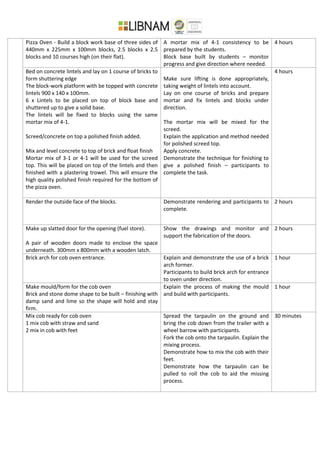
    TEACHING PROGRAMME An introductionto the use of cob and lime based mortars Brannams Campus, Barnstaple, Devon. ANINTRODUCTIONTOTHEUSEOFCOBANDLIMEBASEDMORTARS SKILLS TARGETED Working with cob – preparation – mixing – laying and sculpting by hand and a float – laying and working with feet and tools. Using a sharp spade for paring and wooden mallets for shaping. Applying lime based mortars to various backgrounds. Laying stone using lime mortar. Use of lime wash. PRE-CONDITIONS MATERIALS NEEDED: COB : SAND, CEMENT, LINTELS, SHUTTERING, STRAW, CLAY SOIL. PLASTERING : LIME MORTAR, HORSE HAIR, 100MM X 50MM FRAME WORK, LATHS. STONE WORK : LIME MORTAR, STONE. LIME WASH. TOOLS: OVEN AND BENCH BASE WORK : BRICK LAYING TROWELS, LEVELS, TAPE MEASURES. OVEN AND BENCH COB WORK - TARPAULIN, FORK, SHOVEL, PARING TOOL, TAMPING POLE, PROTECTIVE GLOVES, FLOAT, WATER SPRAYING BOTTLE, SPONGE. PLASTERING : PLASTERING TROWELS, FLOATS, COMBS. STONE WORK : BRICK LAYING TROWELS, PROFILES, STRING LINES, CHURN BRUSHES, LUMP HAMMER. LIME WASH : BRUSHES. BASE TO BE BUILT: A blockwork platform for the cob oven to be built on top of with opening underneath that could be used for fire wood and storage. BASE TO BE BUILT BY BRICK WORK STUDENTS WITH A MEMBER OF STAFF AS PART OF ADDITIONAL LEARNING ACTIVITY FEATURES OF THE OCCUPATIONAL ACTIVITY Traditional low impact building method and material. Buildings are usually made from materials excavated onsite, and harvested nearby. These activities cover most of the techniques of working with cob, but unlike a practice wall, have an end product which will be utilized by the supported learning students in the college. The use of lime products is enjoying a recent resergence as customers begin to realise that the correct materials, used in the correct manner will improve the performance of their property and preserve older buildings allowing them to breath as they were designed. SUMMARIZED PROGRAMME Activity Teaching methods Duration Set out site for cob oven Practical direction given when needed by demonstration and explanation. Use of Pythagoras’s theory to set out the base square. 2 hours
  • 2.
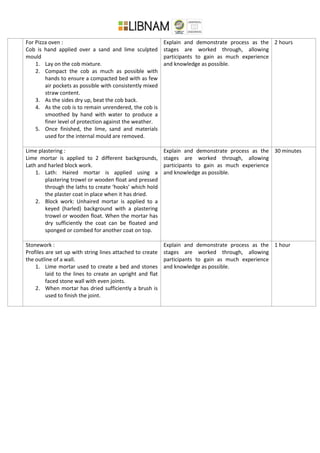
    Pizza Oven -Build a block work base of three sides of 440mm x 225mm x 100mm blocks, 2.5 blocks x 2.5 blocks and 10 courses high (on their flat). A mortar mix of 4-1 consistency to be prepared by the students. Block base built by students – monitor progress and give direction where needed. 4 hours Bed on concrete lintels and lay on 1 course of bricks to form shuttering edge The block-work platform with be topped with concrete lintels 900 x 140 x 100mm. 6 x Lintels to be placed on top of block base and shuttered up to give a solid base. The lintels will be fixed to blocks using the same mortar mix of 4-1. Screed/concrete on top a polished finish added. Mix and level concrete to top of brick and float finish Mortar mix of 3-1 or 4-1 will be used for the screed top. This will be placed on top of the lintels and then finished with a plastering trowel. This will ensure the high quality polished finish required for the bottom of the pizza oven. Make sure lifting is done appropriately, taking weight of lintels into account. Lay on one course of bricks and prepare mortar and fix lintels and blocks under direction. The mortar mix will be mixed for the screed. Explain the application and method needed for polished screed top. Apply concrete. Demonstrate the technique for finishing to give a polished finish – participants to complete the task. 4 hours Render the outside face of the blocks. Demonstrate rendering and participants to complete. 2 hours Make up slatted door for the opening (fuel store). A pair of wooden doors made to enclose the space underneath. 300mm x 800mm with a wooden latch. Show the drawings and monitor and support the fabrication of the doors. 2 hours Brick arch for cob oven entrance. Explain and demonstrate the use of a brick arch former. Participants to build brick arch for entrance to oven under direction. 1 hour Make mould/form for the cob oven Brick and stone dome shape to be built – finishing with damp sand and lime so the shape will hold and stay firm. Explain the process of making the mould and build with participants. 1 hour Mix cob ready for cob oven 1 mix cob with straw and sand 2 mix in cob with feet Spread the tarpaulin on the ground and bring the cob down from the trailer with a wheel barrow with participants. Fork the cob onto the tarpaulin. Explain the mixing process. Demonstrate how to mix the cob with their feet. Demonstrate how the tarpaulin can be pulled to roll the cob to aid the missing process. 30 minutes
  • 3.
    For Pizza oven: Cob is hand applied over a sand and lime sculpted mould 1. Lay on the cob mixture. 2. Compact the cob as much as possible with hands to ensure a compacted bed with as few air pockets as possible with consistently mixed straw content. 3. As the sides dry up, beat the cob back. 4. As the cob is to remain unrendered, the cob is smoothed by hand with water to produce a finer level of protection against the weather. 5. Once finished, the lime, sand and materials used for the internal mould are removed. Explain and demonstrate process as the stages are worked through, allowing participants to gain as much experience and knowledge as possible. 2 hours Lime plastering : Lime mortar is applied to 2 different backgrounds, Lath and harled block work. 1. Lath: Haired mortar is applied using a plastering trowel or wooden float and pressed through the laths to create ‘hooks’ which hold the plaster coat in place when it has dried. 2. Block work: Unhaired mortar is applied to a keyed (harled) background with a plastering trowel or wooden float. When the mortar has dry sufficiently the coat can be floated and sponged or combed for another coat on top. Explain and demonstrate process as the stages are worked through, allowing participants to gain as much experience and knowledge as possible. 30 minutes Stonework : Profiles are set up with string lines attached to create the outline of a wall. 1. Lime mortar used to create a bed and stones laid to the lines to create an upright and flat faced stone wall with even joints. 2. When mortar has dried sufficiently a brush is used to finish the joint. Explain and demonstrate process as the stages are worked through, allowing participants to gain as much experience and knowledge as possible. 1 hour
  • 4.
    Lime wash : Variouscolours of lime wash used on a dry background to demonstrate colour build up. 1. 1 apply lime wash with a large emulsion brush. 2. 2 re-coat when dry. Explain and demonstrate process as the stages are worked through, allowing participants to gain as much experience and knowledge as possible. 30 minutes COST AND TRAINING SUPPORT INFORMATION AND REGISTRATION