Putting the “Value” back in Evaluations:Reflecting Together on Mission & Goals
Why bother anyway?Because feedback really matters!                           It can be: Positive = Reinforcement - results in further improvementNegative = Punishment - might result in improvementNone = Extinction & is least motivating response you can give. When there is no feedback, the bad get worse, the mediocre move towards bad & the good get mediocre. The total group performance gradually moves downwards. So it is up to us to find ways to infuse more meaningful feedback into the organization.
What we know about success:Three key reasons for success of first born child:Expectations are higher & clearer		Given more responsibility & at an earlier ageGiven more feedback, attention, encouragementWe can use these insights to achieve success for group & individuals in other situations.Have high expectations for group as whole as well as for individuals. A “we can do it” attitude.Give more responsibility to each individual. Make each feel essential to the organization’s success.Give more feedback: positive or negative. Not giving feedback is leaving people uncertain & insecure.
Bureaucratic approaches are:Molded by case law & fear of law suits and thus attempt to eliminate human judgment even by those paid to make such judgments, i.e., managers.
While forms & processes are often enlightened by some of the best in human resource management theory, the practice continues to be overshadowed by fear of reprisal for actually telling someone the truth.
Time consuming, brain-deadening & depressing operations for all concerned.
They are more about complying with bureaucratic “cover our butts” thinking than about actual quality assurance for the organization.
What are your experiences with such approaches? We can get better results by:Being focused on our core goals in the here and nowEngaging the individuals in policy & leadership roles including those on the front lines of daily workDoing it differently from year to yearNaming it something elseInfusing the process with energy & optimism as well as humorFollowing through from the beginning to the end of a project.Being less rigid (yikes, in a library?) & more human
Being focused on our goalsWe might review our strategic plan, our mission, our current goals, and current imperatives or pressures – all or one of these.We should think in terms not so much of “physical projects” as basic organizational & individual growth and improved performance. Some possible topics that come to mind:Improving how we work together in meetingsImproving our customer service responsesLearning how to be more flexible in our learning stylesImproving efficiency & processes: one a day for 40 days!
Ask the following questionsHow are we doing/how have we done?
What needs to happen next? Think in terms of organizational culture, values, personal growth. The big picture. Prioritize & select a few key ideas to explore.
What will it take to make that happen (resources)?
What has to change?
How do we as a group accomplish this?
How might I as an individual contribute to accomplishing this?
How will we judge results?
What are the implications for the organization & individuals for positive or negative results? In other words, what are the rewards or consequences of success or failure?Narrowing the discussionWe cannot talk about or work on everything at once.Need to focus on one “next goal” or focus pointFocus must reflect real growth/change but be realistic Incremental steps may be necessary but you have to change (no change is a move towards extinction/death)Deciding to do nothing is still a decision – a negative oneDon’t belabor it so that the process is painfulTrustees might narrow the options then staff can identify the actions/changes to implement in day-to-day ops
Involving all: board & staffInitial review of mission, goals, strategic plan, or current pressures might be done by board.

Putting Value Back in Evaluations - Mary Bushing

  • 1.
    Putting the “Value”back in Evaluations:Reflecting Together on Mission & Goals
  • 2.
    Why bother anyway?Becausefeedback really matters! It can be: Positive = Reinforcement - results in further improvementNegative = Punishment - might result in improvementNone = Extinction & is least motivating response you can give. When there is no feedback, the bad get worse, the mediocre move towards bad & the good get mediocre. The total group performance gradually moves downwards. So it is up to us to find ways to infuse more meaningful feedback into the organization.
  • 3.
    What we knowabout success:Three key reasons for success of first born child:Expectations are higher & clearer Given more responsibility & at an earlier ageGiven more feedback, attention, encouragementWe can use these insights to achieve success for group & individuals in other situations.Have high expectations for group as whole as well as for individuals. A “we can do it” attitude.Give more responsibility to each individual. Make each feel essential to the organization’s success.Give more feedback: positive or negative. Not giving feedback is leaving people uncertain & insecure.
  • 4.
    Bureaucratic approaches are:Moldedby case law & fear of law suits and thus attempt to eliminate human judgment even by those paid to make such judgments, i.e., managers.
  • 5.
    While forms &processes are often enlightened by some of the best in human resource management theory, the practice continues to be overshadowed by fear of reprisal for actually telling someone the truth.
  • 6.
    Time consuming, brain-deadening& depressing operations for all concerned.
  • 7.
    They are moreabout complying with bureaucratic “cover our butts” thinking than about actual quality assurance for the organization.
  • 8.
    What are yourexperiences with such approaches? We can get better results by:Being focused on our core goals in the here and nowEngaging the individuals in policy & leadership roles including those on the front lines of daily workDoing it differently from year to yearNaming it something elseInfusing the process with energy & optimism as well as humorFollowing through from the beginning to the end of a project.Being less rigid (yikes, in a library?) & more human
  • 9.
    Being focused onour goalsWe might review our strategic plan, our mission, our current goals, and current imperatives or pressures – all or one of these.We should think in terms not so much of “physical projects” as basic organizational & individual growth and improved performance. Some possible topics that come to mind:Improving how we work together in meetingsImproving our customer service responsesLearning how to be more flexible in our learning stylesImproving efficiency & processes: one a day for 40 days!
  • 10.
    Ask the followingquestionsHow are we doing/how have we done?
  • 11.
    What needs tohappen next? Think in terms of organizational culture, values, personal growth. The big picture. Prioritize & select a few key ideas to explore.
  • 12.
    What will ittake to make that happen (resources)?
  • 13.
  • 14.
    How do weas a group accomplish this?
  • 15.
    How might Ias an individual contribute to accomplishing this?
  • 16.
    How will wejudge results?
  • 17.
    What are theimplications for the organization & individuals for positive or negative results? In other words, what are the rewards or consequences of success or failure?Narrowing the discussionWe cannot talk about or work on everything at once.Need to focus on one “next goal” or focus pointFocus must reflect real growth/change but be realistic Incremental steps may be necessary but you have to change (no change is a move towards extinction/death)Deciding to do nothing is still a decision – a negative oneDon’t belabor it so that the process is painfulTrustees might narrow the options then staff can identify the actions/changes to implement in day-to-day ops
  • 18.
    Involving all: board& staffInitial review of mission, goals, strategic plan, or current pressures might be done by board.
  • 19.
    They might identifywhat are the top few issues to explore (but not the solutions).
  • 20.
    Staff & boardcan be involved in ranking or prioritizing those issues or even adding to or clarifying them.
  • 21.
    Then it istime to explore the “how” and the “what” of the one to tackle including what will success look like.
  • 22.
    The goal orproject needs to be clear.
  • 23.
    Individuals need tocommit to what they will contribute (individual coaching may be involved to get the focus for some).
  • 24.
    Everyone needs tohave a meaningful role.Doing it differentlyThis is not a bureaucratic approach so you can do it differently each time & call it whatever you want!To get the ball rolling, you might do any one of these or something else: Have a half day “retreat” for all concerned
  • 25.
    Have the boarddo their thing & then the staff does theirs
  • 26.
    You do a“staff-up” approach
  • 27.
    Hold small &focused community focus groups to identify what most needs improving or . . . ?
  • 28.
    Take anonymous suggestionsfrom individual staff or board members to begin
  • 29.
    Or . .. ? Key concepts to rememberIt is important to keep it interesting & compact so that you have results & can celebrate as an organization & reward contributions & efforts while also giving feedback about improvement without those blasted forms! Make the process serious in terms of content but fun in terms of atmosphere. It should be about individual contributions to the whole and about the advancement of the organization. How often? Whenever it makes sense. A couple a year, one every two years, whatever fits your situation. Most people thieve on projects. They can focus on one big thing better than many little things.
  • 30.
    Naming it!The “project”might be stated as a slogan, a clear idea, a concept, a specific goal. Whatever fits the situation.It can be a 4 month thing, a 12 month thing . . . Whatever length of time is appropriate to set for “this” to be accomplished or fulfilled.It can be an “in house” project or one that gets publicity.Sample titles:“Learning to learn better” an initiative for staff & board“Allen Library’s Effective Meetings Mission”“Making internal customers happy”“Forty work efficiencies in 40 days!”
  • 31.
    Infusing some fun& energyThe attitude of the leader makes all the difference!
  • 32.
    Follow-through says moreabout relevance than any rhetoric.
  • 33.
    Fun does notmean silliness or time wasting. Remember those among you who are “serious” & more likely to get energy from inside not outside of themselves. Decisiveness goes a long way towards being compelling but don’t “dictate” the answers either
  • 34.
    Optimism about thegoal, the plan & the ability of the organization & the individuals to be successful is the leaders job for today and throughout the project.
  • 35.
  • 36.
    When this initiativeis over declare it over!!!Being less rigid!Take a deep breathe. Relax.
  • 37.
    Be creative anduse common sense.
  • 38.
    So what ifno one has ever done anything like this – we could try it anyway.
  • 39.
    Bounce ideas offof someone outside the organization (who understands a bit about people & organizations)
  • 40.
  • 41.
    Briefly identify theweak points, the worst case issues of your plan at each step.
  • 42.
    Do it! Doingsomething is always better than doing nothing!
  • 43.
    If nothing else,you’ll learn something about what works and what doesn’t!Following through Near end of period for project, communicate even more.
  • 44.
    Set up reviewof success for org, work groups, & individuals. Some aspects of review/evaluation might be shared with all or only big picture. Depends.
  • 45.
  • 46.
    Identify what, ifanything, still needs to be done & make that another project or deal with it some way but do not just sweep it under the rug!
  • 47.
    Give out patson the back, real rewards, memos in files, or whatever is appropriate to acknowledge success, progress, growth.
  • 48.
    Give coaching, specificgoals for improvement, or memos in files to those whose efforts did not measure up.
  • 49.
    Remember that nofeedback is a move towards extinction of effort!When winding up the project:Everyone should be informed of the performance of the group in terms of reaching the goal/fulfilling the purpose.An individual’s contributions should be evaluated by themselves and by their supervisor.This is not about blame but about putting what we do into the context of what we hope to accomplish.While we must do the review (measure success, difference, improvements, or shortcomings & do something about it on organizational & individual levels) we don’t have to immediately get on the next effort. The idea is continuous improvement but give yourselves a break!
  • 50.
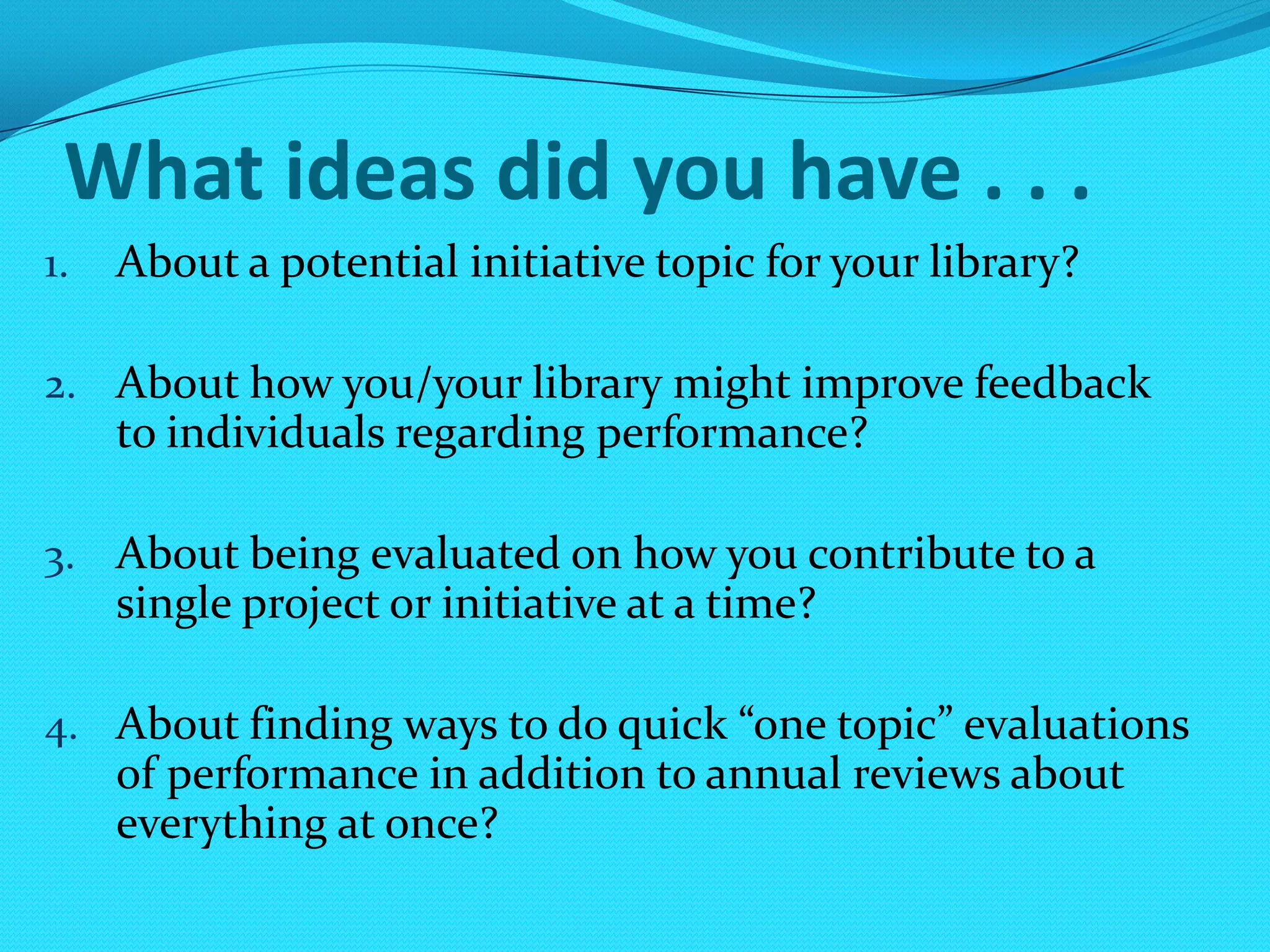
    What ideas didyou have . . .About a potential initiative topic for your library?About how you/your library might improve feedback to individuals regarding performance?About being evaluated on how you contribute to a single project or initiative at a time?About finding ways to do quick “one topic” evaluations of performance in addition to annual reviews about everything at once?
  • 51.
    Thanks for sharing. . . Dr. Mary C. BushingLibrary Consultant & EducatorBozeman, MT 59715marying@msn.com406-587-4742