Employers Internship Toolkit
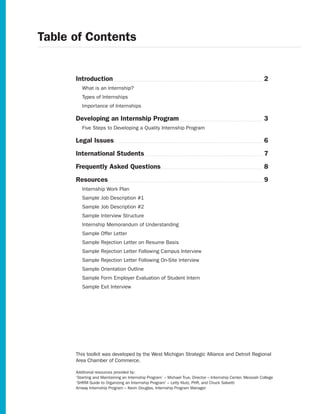
Table of Contents


      Introduction                                                                                             2
         What is an Internship?
         Types of Internships
         Importance of Internships

      Developing an Internship Program                                                                         3
         Five Steps to Developing a Quality Internship Program

      Legal Issues                                                                                             6
      International Students                                                                                   7
      Frequently Asked Questions                                                                               8
      Resources                                                                                                9
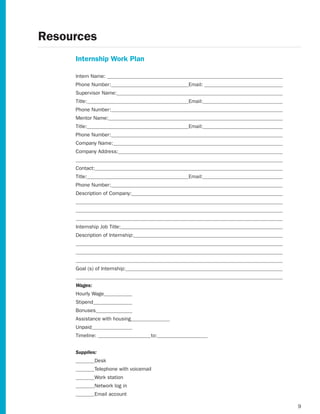
         Internship Work Plan
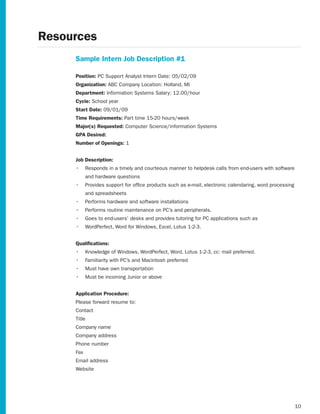
         Sample Job Description #1
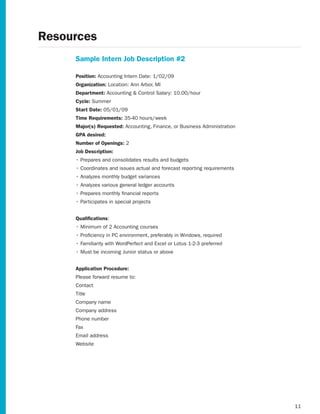
         Sample Job Description #2
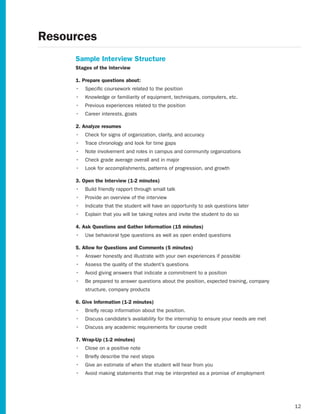
         Sample Interview Structure
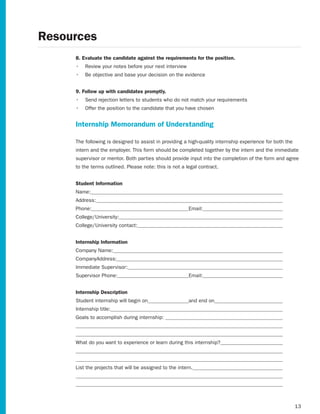
         Internship Memorandum of Understanding
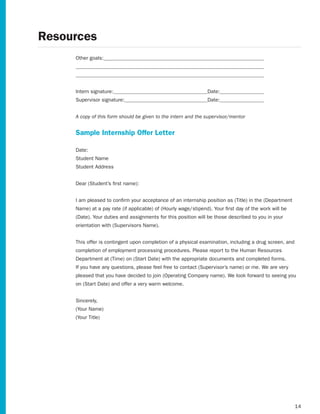
         Sample Offer Letter
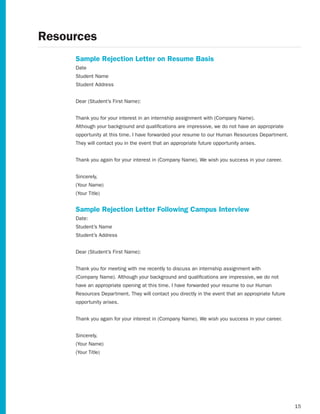
         Sample Rejection Letter on Resume Basis
         Sample Rejection Letter Following Campus Interview
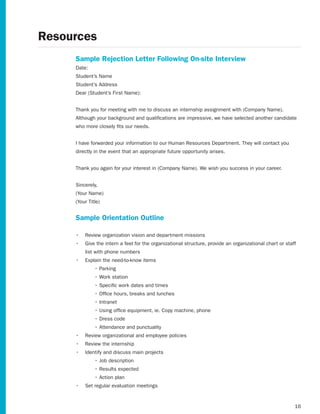
         Sample Rejection Letter Following On-Site Interview
         Sample Orientation Outline
         Sample Form Employer Evaluation of Student Intern
         Sample Exit Interview


      This toolkit was developed by the West Michigan Strategic Alliance and Detroit Regional
      Area Chamber of Commerce.

      Additional resources provided by:
      ‘Starting and Maintaining an Internship Program’ – Michael True, Director – Internship Center, Messiah College
      ‘SHRM Guide to Organizing an Internship Program’ – Letty Klutz, PHR, and Chuck Salvetti
      Amway Internship Program – Kevin Douglas, Internship Program Manager
Introduction
      The Employers Internship Toolkit is designed to assist your organization in the development of a
      successful internship program. This toolkit will give you information and templates designed to
      help you create internships that meet the needs of your organization.

      What is an Internship?
      An internship is any carefully monitored work or service experience in which a student has
      intentional learning goals and reflects actively on what he/she is learning throughout the
      experience. Internship circumstances vary widely. Common characteristics include:
      •	 Typical	durations	of	three	to	nine	months
      •	 Part-time	or	full-time	commitments
      •	 Paid	or	unpaid	opportunities
      •	 Connection	to	an	educational	program	with	academic	credit,	or	not	connected	to	earning	credit

      Types of Internship Programs
      Internship: A one-time curriculum-related work assignment, which may be paid or unpaid
      depending on the employer and what is required of the student for the position. Most internships
      offer a stipend and/or academic credit.

      Cooperative Education (Co-Op): Experienced based learning through paid employment in
      practical, curriculum related work assignments that can be tailored to a student schedule:
      •	 Students	may	attend	classes	and	work
      •	 Students	may	attend	school	full-time	one	semester,	then	work	full-time	the	next	semester,	
          alternating periods of work and school until their college program is completed

      Summer Employment: Paid work experience however, this type of position may or may not be directly
      related to the student’s curriculum and may or may not be integrated into the academic program.


      Importance of Internship Programs
      Benefits for Employers from an Internship Program
      •	 An	inexpensive	recruiting	tool	and	an	opportunity	to	train	future	employees.	
      •	 The	opportunity	to	evaluate	prospective	employees	while	they	are	working	for	the	organization	
          can reduce significant costs in finding new talent;
      •	 Interns	bring	current	technology	and	ideas	from	the	classroom	to	the	workplace	and	therefore	
          increase an organization’s intellectual capital;
      •	 Interns	can	be	another	source	for	the	recruitment	of	diverse	employees	into	your	workforce;
      •	 An	internship	program	can	supply	an	easily	accessible	source	of	highly	motivated	pre-
          professionals;
      •	 Interns	provide	an	opportunity	for	mid-level	staff	to	manage.


                                                                                                         2
Developing an Internship Program
      Five-Steps to Developing a Quality Internship Program
      Step   1:   Set Goals and Policies for the Internship Program
      Step   2:   Write a Plan for the Internship Opportunity
      Step   3:   Recruit a Qualified Intern
      Step   4:   Manage the Intern
      Step   5:   Conduct Exit Interviews and Follow-up

      Step 1: Set Goals and Policies for the Internship Program
      What is the main goal for your company’s internship program?
      •	 Look	at	current	business	activities	and	consider	what	ongoing	work	you	would	like	to	expand	
          or projects you would like to initiate or complete.
      •	 Consider	projects	that	are	beneficial	to	your	organization	and	provide	challenging	learning	
          experiences for students.
      •	 Examine	your	company’s	recruiting	needs	(i.e.	employees	retiring	or	departments	that	are	
          expecting growth).

      Who will supervise and mentor the intern?
      •	 A	supervisor	should	be	selected	because	he/she	likes	to	teach	or	train	and	has	the	resources	
          to do it. The supervisor will help the intern keep their project on time and on budget.
      •	 The	mentor	may	be	a	department	head,	project	leader,	long-time	employee	or	acting	supervisor	
          who is knowledgeable on the project where the intern will work and can provide some
          orientation and wisdom to the student.

      Will you pay the intern?
      •	 Internship	opportunities	can	be	paid	or	unpaid.	Determine	ahead	of	time	if	you	will
          be able to compensate your intern. This could be in the form of an hourly wage or a stipend
          (see	InterninMichigan.com)

      Step 2: Write a Plan for the Internship Opportunity
      •	 Identify	goals,	timelines,	workspace	and	a	general	description	of	the	project,	which	will	become	
          your work plan, so that everyone understands the purpose and expectations involved. There is
          an outline to help you create this work planalong with examples of completed job descriptions
          under Resources – pages 11-13.
      •	 After	the	work	plan	has	been	established,	create	a	job	description	for	the	position.

      Can you involve the intern in experiences beyond the actual work of the internship?
          Yes, this could include training programs, social events and opportunities to network with
          executives. Best practices for social events include encouraging interns to network among
          themselves to share their experiences. Invite your intern to company sponsored events. Some
          companies host an end of the program experience, such as participation in a golf outing or a
          lunch/reception with upper management.


                                                                                                         3
Developing an Internship Program
      Step 3: Recruit a Qualified Intern
      Log on and register at InternInMichigan.com:
      •	 Dashboard:
          Welcome to Intern In Michigan.
      •	 Profile:
          Enter company and contact information. The information entered here is used to pre-populate
          all the job postings that you create. You can also allow candidates to view your information
          directly.
      •	 Internships:
          Use the information from the plan you developed in Step 2 to create a new internship.
      •	 Search:
          You can load a previously saved search or you can click the “start new search”
          button.
      •	 Get	Smart:
          Videos and best practices to assist in the design of your internship program.
      •	 Lifestyle:
          Information on cities around the State of Michigan.
      •	 Feedback:
          Give feedback on InternInMichigan.com.

          Begin searching three to four months before you expect a student to start working:
          You will increase your chances of finding the best person for the job, the longer you accept
          applications.

      Choose interns just as carefully as you choose permanent employees:
          On average, up to 45% of the students are offered full-time employment upon graduation
          from college. Once you have determined your top candidates, arrange an interview in a
          timely	manner	(best	practices:	3-5	days).	A	sample	interview	structure	can	be	found	under	
          Resources – page 14.

      Extend an offer to the intern of your choice:
          You will find examples of a Memorandum of Understanding and an Offer Letter under
          Resources – page 15-16. Notify candidates who were interviewed, but not chosen for the
          position: There are sample rejection letters under Resources – pages 17-19.

      Notify candidates who were interviewed, but not chosen for the position:
          There are sample rejection letters under Resources – pages 17-19.


                                                                                                         4
Developing an Internship Program
      Step 4: Manage the Intern
          Getting started on the right foot is important. This will lay a good foundation for
          the intern’s experience. Using the work plan you have developed for the internship
          opportunity, set up an orientation for your new intern. A sample orientation
          outline is included under Resources – page 20.

      Give your intern the resources he or she needs to do the job:
          A proper workstation, telephone with voicemail, computer and email account is
          vital to your interns’ success. Point out the supply room and introduce any
          appropriate personnel.

      Monitor the intern’s progress:
      •	 Make	sure	you	are	aware	of	what’s	happening	with	their	daily	tasks.
      •	 Keep	in	mind	this	could	be	a	first	work	experience	for	this	person.	When	work	is	assigned	
          make sure it is given with detailed explanation. A few extra minutes of explanation will pay off
          later when the intern produces good work independently.
      •	 Help	your	intern	set	goals	for	completion	of	various	tasks,	including	daily,	weekly	and	monthly	
          goals. This will help establish a solid work ethic for the intern.

      Evaluate the intern’s progress periodically and give feedback:
      •	 Evaluations	are	important	for	the	success	of	your	interns’	experience.	Evaluation	processes	
          differ and yours might be a formal written review given at the halfway point and at the end of
          the program, or it may be delivered over an occasional lunch with the intern.
      •	 Educational	institutions	may	require	onsite	visits	on	conference	calls	during	the	internship	to	
          facilitate the evaluation process for grading purposes. The student intern should be able to
          share with you what is expected and a representative from the school will probably contact
          you if this is a requirement for credit.

      Step 5: Conduct Exit Interviews and Follow-up
      Proving the value of your internship program will require hard evidence that your organization
      is getting a return on its investment:
      •	 Use	the	evaluation	forms	found	under	Resources	–	pages	21-23	for	both	interns	and	
          employers to evaluate each other.
      •	 Conduct	an	exit	interview	to	determine	if	interns	are	leaving	the	organization	having	had	a	
          good experience. This provides valuable feedback to upper management for future
          program planning.

      In addition to qualitative measures, a number of quantitative measures can be developed:
      •	 Common	measures	may	include	the	number	of	interns	that	become	full-time	employees,	
          the number of requests for interns in the company and growing numbers of qualified intern
          applicants.
      •	 In	order	to	successfully	measure	your	program	outcome,	you	should	return	to	the	stated	
          program goals and address those outcomes.

                                                                                                           5
Legal Issues
      Do you have to pay interns?	The	U.S.	Fair	Labor	Standards	Act	(FLSA),	which	applies	to	all	
      companies that have at least two employees directly engaged in interstate commerce and annual
      sales of at least $500,000.00, severely restricts an employer’s ability to use unpaid interns or
      trainees. It does not limit an employer’s ability to hire paid interns.


      You do not have to pay interns who qualify as learners or trainees. The U.S. Department of Labor
      has outlined six criteria for determining trainee status:
          1. Interns cannot displace regular employees
          2. Interns	are	not	guaranteed	a	job	at	the	end	of	the	internship	(though	you	may	decide	to	
               hire them at the conclusion of the experience)
          3. Interns are not entitled to wages during the internship
          4. Interns must receive training from your organization, even if it somewhat impedes the work
          5. Interns must get hands-on experience with equipment and processes used in your industry
          6. Interns’ training must primarily benefit them, not the organization


      Workers’ and Unemployment Compensation - Workers compensation boards have found that
      interns contribute enough to a company to make them employees. It is wise to cover interns under
      your workers’ compensation policy even though you are not required to do so. Student interns are
      not generally eligible for unemployment compensation at the end of the internship.


      Keep in Mind - Even if a student is working through a school program for which he or she is being
      “paid” in college credits, the student still has the right, under the FLSA, to be paid unless the
      employer is not deriving any immediate advantage by using him/her.


      The	employer	should	identify	the	specific	terms	and	condition	of	employment	(e.g.,	dates	of
      employment as an intern, including the date the internship will end; compensation; organizational
      and/or reporting relationships; principal duties; tasks or responsibilities; working conditions;
      confidentiality; any other expectations of the employer), and should discuss these with the
      prospective intern, so that there is no misunderstanding regarding the relationship. Also, it may
      make sense to document such a discussion with a written agreement. This should be made in
      consultation with the educational institution.


      If an intern is harassed at your organization and you don’t do anything about it, your organization
      opens itself to the risk of lawsuits. Take time to advise your interns of appropriate workplace
      behavior, the organization’s harassment policy and the complaint procedure.


                                                                                                            6
International Students
      The most common visa types employers see on college campuses, when recruiting international
      undergraduate or graduate students for either full-time or internship positions are the F-1
      and J-1 visas.


      An F-1 visa is granted to a person coming to the United States to attend a college, university,
      seminary, conservatory, academic high school, elementary school or other academic institution or
      language training program approved by the U.S. Attorney General for study by foreign students.
      The visa holder plans to return home after completing studies. This is the most common
      nonimmigrant visa for an international student attending undergraduate and graduate school.
      Students are granted F-1 status until the completion of the academic program and 12 months of
      postprogram practical training. The purpose of the F-1 visa is to provide an opportunity for study in
      the United States. Anything outside of study, including employment, is an exception to the visa.
      Authorization for employment is strictly limited to certain situations.


      •	 The student holding F-1 status for a full academic year and in good academic standing
          may work off campus. Such work authorization is granted when the student has sustained
          unforeseen economic hardship. Also, the student may not work for more than 20 hours per
          week when school is in session, but may work full-time during holidays and vacations, including
          breaks between terms, provided the student intends to register for the next school term.


      •	 Curricular Practical Training: An F-1 student may perform curricular practical training prior to
          the completion of the educational program as part of his or her educational experience. The
          INS defines this type of training as “alternate work/study, internship, cooperative education,”
          or any other type of required internship or practicum that is offered by sponsoring employers
          through agreements with the school.


      •	 Post-Completion Practical Training: This is temporary employment directly related to the
          student’s major area of study that takes place after the student completes a full course of
          study. Authorization for this training may be granted for a maximum of 12 months of full-time
          or part time work. Those on a student visa can only gain authorization once for this type of
          training.


      The above information is adapted from a web article by Rochelle Kaplan, General Counsel for the
      National	Association	of	Colleges	and	Employers	(NACE).	Reprinted	with	permission	of	the
      National Association of Colleges and Employers, copyright holder. For more information on these
      and other legal issues related to hiring, see NACEWeb at www.naceweb.org.


      Also see the website of the U.S. Citizenship and Immigration Services:
      http://uscis.gov/graphics/lawsregs/index.htm
      Title	8	of	the	Code	of	Federal	Regulations,	Section	214.2	(f)


                                                                                                            7
Frequently Asked Questions
      Q: What level of compensation is typical for an internship?
      A: In planning to allocate resources for your internship program, compensation may be a
      consideration. An hourly wage can vary depending upon experience; typically the hourly wage
      for an intern ranges from $8.00 to $20.00 per hour. If you are unable to budget an hourly wage,
      consider offering a monthly or semester based stipend to the student.

      Q: Is my organization responsible for providing insurance or benefits to the intern?
      A: No, normally only full-time employees are eligible for benefits provided by the employer. Interns
      are short-term employees and are therefore ineligible.

      Q: Do interns work 40 hour work weeks? Do they typically work five days a week?
      A: Internships are flexible; students often plan their internship schedules around their class
      schedules on campus. A part-time internship can involve anywhere between 10 and 30 hours per
      week. Once you identify an intern candidate you will need to discuss his/her availability and agree
      on a schedule that will work for both parties. Students enrolled in a school with a co-op program
      may be able to work 40 hours a week for a semester.

      Q: When do internships typically begin? How long do they last?
      A: Internships usually follow the starting and ending dates of the academic semester. They can
      take	place	during	summer	breaks	(typically	May	-	August),	during	the	fall	(September	-	December)	
      or	the	spring	(January	-	April).	An	internship	is	generally	between	three	to	nine	months	and	can	
      begin in summer, fall or spring.

      Q: When should I start looking for an intern if I want them to start work in the summer?
      A: Typically internship descriptions are posted at least two-months prior to the proposed start date
      to allow for a one-month window for candidates to submit applications.

      Q: How does a student obtain academic credit for internship experience?
      A: Credit requirements for internships vary by school. It is the student’s responsibility to manage this.

      Q: What if my intern does not work out? Are there rules for terminating interns the same way as
      there are for full or part-time positions?
      A: In most cases, interns are treated as employees and therefore the same laws apply. It is
      advised that you consult with your Human Resources department and/or seek legal counsel for
      further information and specific Department of Labor requirements.

      Q: I like my intern and would like to extend the internship, how do I go about this?
      A: This is at your discretion and you may continue an internship and/or extend an offer for future
      full-time employment once the internship has been completed.

      Q: Can full-time employment be offered after the internship program has been completed?
      A: Yes, if your organization and the intern can come to an agreement about full-time employment
      that is the ultimate win for Intern In Michigan and for our state!

                                                                                                                  8
Resources
     Internship Work Plan

     Intern Name:
     Phone Number:                          Email:
     Supervisor Name:
     Title:                                 Email:
     Phone Number:
     Mentor Name:
     Title:                                 Email:
     Phone Number:
     Company Name:
     Company Address:


     Contact:
     Title:                                 Email:
     Phone Number:
     Description of Company:


     Internship Job Title:
     Description of Internship:


     Goal	(s)	of	Internship:


     Wages:
     Hourly Wage
     Stipend
     Bonuses
     Assistance with housing
     Unpaid
     Timeline:                        to:


     Supplies:
               Desk
               Telephone with voicemail
               Work station
               Network log in
               Email account

                                                     9
Resources
     Sample Intern Job Description #1

     Position: PC Support Analyst Intern Date: 05/02/09
     Organization: ABC Company Location: Holland, MI
     Department: Information Systems Salary: 12.00/hour
     Cycle: School year
     Start Date: 09/01/09
     Time Requirements: Part time 15-20 hours/week
     Major(s) Requested: Computer Science/information Systems
     GPA Desired:
     Number of Openings: 1


     Job Description:
     •	 Responds in a timely and courteous manner to helpdesk calls from end-users with software
           and hardware questions
     •	 Provides support for office products such as e-mail, electronic calendaring, word processing
           and spreadsheets
     •	 Performs hardware and software installations
     •	 Performs routine maintenance on PC’s and peripherals.
     •	 Goes to end-users’ desks and provides tutoring for PC applications such as
     •	 WordPerfect, Word for Windows, Excel, Lotus 1-2-3.


     Qualifications:
     •	 Knowledge of Windows, WordPerfect, Word, Lotus 1-2-3, cc: mail preferred.
     •	 Familiarity with PC’s and Macintosh preferred
     •	 Must have own transportation
     •	 Must be incoming Junior or above


     Application Procedure:
     Please forward resume to:
     Contact
     Title
     Company name
     Company address
     Phone number
     Fax
     Email address
     Website


                                                                                                       10
Resources
     Sample Intern Job Description #2

     Position: Accounting Intern Date: 1/02/09
     Organization: Location: Ann Arbor, MI
     Department: Accounting & Control Salary: 10.00/hour
     Cycle: Summer
     Start Date: 05/01/09
     Time Requirements: 35-40 hours/week
     Major(s) Requested: Accounting, Finance, or Business Administration
     GPA desired:
     Number of Openings: 2
     Job Description:
     •	Prepares	and	consolidates	results	and	budgets
     •	Coordinates	and	issues	actual	and	forecast	reporting	requirements
     •	Analyzes	monthly	budget	variances
     •	Analyzes	various	general	ledger	accounts
     •	Prepares	monthly	financial	reports
     •	Participates	in	special	projects


     Qualifications:
     •	Minimum	of	2	Accounting	courses
     •	Proficiency	in	PC	environment,	preferably	in	Windows,	required
     •	Familiarity	with	WordPerfect	and	Excel	or	Lotus	1-2-3	preferred
     •	Must	be	incoming	Junior	status	or	above


     Application Procedure:
     Please forward resume to:
     Contact
     Title
     Company name
     Company address
     Phone number
     Fax
     Email address
     Website


                                                                           11
Resources
     Sample Interview Structure
     Stages of the Interview

     1. Prepare questions about:
     •	 Specific coursework related to the position
     •	 Knowledge or familiarity of equipment, techniques, computers, etc.
     •	 Previous experiences related to the position
     •	 Career interests, goals

     2. Analyze resumes
     •	 Check for signs of organization, clarity, and accuracy
     •	 Trace chronology and look for time gaps
     •	 Note involvement and roles in campus and community organizations
     •	 Check grade average overall and in major
     •	 Look for accomplishments, patterns of progression, and growth

     3. Open the Interview (1-2 minutes)
     •	 Build friendly rapport through small talk
     •	 Provide an overview of the interview
     •	 Indicate that the student will have an opportunity to ask questions later
     •	 Explain that you will be taking notes and invite the student to do so

     4. Ask Questions and Gather Information (15 minutes)
     •	 Use behavioral type questions as well as open ended questions

     5. Allow for Questions and Comments (5 minutes)
     •	 Answer honestly and illustrate with your own experiences if possible
     •	 Assess the quality of the student’s questions
     •	 Avoid giving answers that indicate a commitment to a position
     •	 Be prepared to answer questions about the position, expected training, company
         structure, company products

     6. Give Information (1-2 minutes)
     •	 Briefly recap information about the position.
     •	 Discuss candidate’s availability for the internship to ensure your needs are met
     •	 Discuss any academic requirements for course credit

     7. Wrap-Up (1-2 minutes)
     •	 Close on a positive note
     •	 Briefly describe the next steps
     •	 Give an estimate of when the student will hear from you
     •	 Avoid making statements that may be interpreted as a promise of employment


                                                                                           12
Resources
     8. Evaluate the candidate against the requirements for the position.
     •	 Review your notes before your next interview
     •	 Be objective and base your decision on the evidence


     9. Follow up with candidates promptly.
     •	 Send rejection letters to students who do not match your requirements
     •	 Offer the position to the candidate that you have chosen


     Internship Memorandum of Understanding

     The following is designed to assist in providing a high-quality internship experience for both the
     intern and the employer. This form should be completed together by the intern and the immediate
     supervisor or mentor. Both parties should provide input into the completion of the form and agree
     to the terms outlined. Please note: this is not a legal contract.


     Student Information
     Name:
     Address:
     Phone:                                              Email:
     College/University:
     College/University contact:


     Internship Information
     Company Name:
     CompanyAddress:
     Immediate Supervisor:
     Supervisor Phone:                                   Email:


     Internship Description
     Student internship will begin on                    and end on
     Internship title:
     Goals to accomplish during internship:


     What do you want to experience or learn during this internship?


     List the projects that will be assigned to the intern.


                                                                                                          13
Resources
     Other goals:


     Intern signature:                                          Date:
     Supervisor signature:                                      Date:


     A copy of this form should be given to the intern and the supervisor/mentor


     Sample Internship Offer Letter

     Date:
     Student Name
     Student Address


     Dear	(Student’s	first	name):


     I	am	pleased	to	confirm	your	acceptance	of	an	internship	position	as	(Title)	in	the	(Department
     Name)	at	a	pay	rate	(if	applicable)	of	(Hourly	wage/stipend).	Your	first	day	of	the	work	will	be
     (Date).	Your	duties	and	assignments	for	this	position	will	be	those	described	to	you	in	your
     orientation	with	(Supervisors	Name).


     This offer is contingent upon completion of a physical examination, including a drug screen, and
     completion of employment processing procedures. Please report to the Human Resources
     Department	at	(Time)	on	(Start	Date)	with	the	appropriate	documents	and	completed	forms.
     If	you	have	any	questions,	please	feel	free	to	contact	(Supervisor’s	name)	or	me.	We	are	very
     pleased	that	you	have	decided	to	join	(Operating	Company	name).	We	look	forward	to	seeing	you
     on	(Start	Date)	and	offer	a	very	warm	welcome.


     Sincerely,
     (Your	Name)
     (Your	Title)


                                                                                                        14
Resources
     Sample Rejection Letter on Resume Basis
     Date
     Student Name
     Student Address


     Dear	(Student’s	First	Name):


     Thank	you	for	your	interest	in	an	internship	assignment	with	(Company	Name).
     Although your background and qualifications are impressive, we do not have an appropriate
     opportunity at this time. I have forwarded your resume to our Human Resources Department.
     They will contact you in the event that an appropriate future opportunity arises.


     Thank	you	again	for	your	interest	in	(Company	Name).	We	wish	you	success	in	your	career.


     Sincerely,
     (Your	Name)
     (Your	Title)


     Sample Rejection Letter Following Campus Interview
     Date:
     Student’s Name
     Student’s Address


     Dear	(Student’s	First	Name):


     Thank you for meeting with me recently to discuss an internship assignment with
     (Company	Name).	Although	your	background	and	qualifications	are	impressive,	we	do	not	
     have an appropriate opening at this time. I have forwarded your resume to our Human
     Resources Department. They will contact you directly in the event that an appropriate future
     opportunity arises.


     Thank	you	again	for	your	interest	in	(Company	Name).	We	wish	you	success	in	your	career.


     Sincerely,
     (Your	Name)
     (Your	Title)


                                                                                                    15
Resources
     Sample Rejection Letter Following On-site Interview
     Date:
     Student’s Name
     Student’s Address
     Dear	(Student’s	First	Name):


     Thank	you	for	meeting	with	me	to	discuss	an	internship	assignment	with	(Company	Name).	
     Although your background and qualifications are impressive, we have selected another candidate
     who more closely fits our needs.


     I have forwarded your information to our Human Resources Department. They will contact you
     directly in the event that an appropriate future opportunity arises.


     Thank	you	again	for	your	interest	in	(Company	Name).	We	wish	you	success	in	your	career.


     Sincerely,
     (Your	Name)
     (Your	Title)


     Sample Orientation Outline

     •	 Review organization vision and department missions
     •	 Give the intern a feel for the organizational structure, provide an organizational chart or staff
         list with phone numbers
     •	 Explain the need-to-know items
     	        •	Parking
     	        •	Work	station
     	        •	Specific	work	dates	and	times
     	        •	Office	hours,	breaks	and	lunches
     	        •	Intranet
     	        •	Using	office	equipment,	ie.	Copy	machine,	phone
     	        •	Dress	code
     	        •	Attendance	and	punctuality
     •	 Review organizational and employee policies
     •	 Review the internship
     •	 Identify and discuss main projects
     	        •	Job	description
     	        •	Results	expected
     	        •	Action	plan
     •	 Set regular evaluation meetings


                                                                                                        16
Resources
     •	 Inform the intern of departmental or staff meetings he/she is expected to attend, and provide
         time during those meetings for the interns to report progress on his/her project
     •	 Identify a back-up supervisor or support person who can answer the intern’s questions if his/
         her regular supervisor is unavailable
     •	 Ensure that your intern understands his/her responsibilities
     Provide a tour of the facility, introduction to staff


     Sample Form Employer Evaluation of Student Intern

     Student:                                                   Date:
     Dates of Internship:
     1. How well was the intern prepared for this internship?
     2. Can you suggest instructional areas which would benefit this intern?
     3. Please provide examples in which the intern applied good judgment and had a technical
         competence for the assigned tasks.
     4. How would you rate the intern’s sense of responsibility toward his or her assignments?
     5. Please provide some examples in which the intern worked quickly, thoroughly and efficiently.
     6. What are the intern’s strengths and weaknesses when interacting with others?
     7. What are the intern’s strengths and weaknesses when it comes to leadership?
     8. Discuss areas where the intern has made significant improvement.
     9. What are the intern’s strengths and weaknesses in oral and written communication?
     10. Would you recommend this intern for future employment? Why or why not?
     11. Are there other areas involving the internship program or the intern that you wish
         to comment on?


     Sample Exit Interview

     Schedule in advance to give the student opportunity to prepare thoughts and questions.
     Avoid scheduling on the student’s last day on the job so that there is time to take care of any
     action items that come up.


     Exit Interview Steps
     1. Explain the purpose of the exit interview
     2. Encourage the student to be as candid as possible
     3. Explain that you will be taking notes
     4. Begin with less sensitive questions to put the student at ease
     5. Gradually move into areas of greater sensitivity
     6. Ask the student if he/she has any remaining questions or suggestions for improving
         the internship program
     7. Conclude by thanking the student for his/her time and honesty


                                                                                                       17
Resources
     Exit Interview Summary
     Name:                                           Date:
     Department:                                     Supervisor:


     Company property returned:
     Keys
     Badge
     Other


     1. How similar was your actual assignment to your expectations?
     2. How	would	you	rate	(company	name)	as	a	place	to	work?
     3. How well did your experience provide information about your chosen field?
     4. What was the best part of your intern experience?
     5. What was the worst part of your intern experience?
     6. Would	you	recommend	(company	name)	to	other	students	for	an	internship	assignment?
         Why or why not?
     7. What suggestions do you have for improving the internship program?
     8. Include any other comments you would like to write down.


     Contact
     West Michigan                         Southeast Michigan
     Cindy Brown, Project Manager          Britany Affolter-Caine, Ph.D.
     Internship Initiative                 Director, Intern In Michigan
     West Michigan Strategic Alliance      Detroit Regional Chamber
     951 Wealthy Street SE                 One Woodward Avenue, Suite
     Grand Rapids, MI 49506-1214           #1900
     616.871-2452 Direct                   Detroit, MI 48226
     616.356.6060 Main                     Rev: 10/29/2009 25
     616.818.9080 Cellular                 313.596.0331 Direct
     cbrown@wm-alliance.org                313.580.1588 Cellular
     www.wm-alliance.org                   bcaine@detroitchamber.com
                                           www.detroitchamber.com


                                                                                             18

Employer Internship Toolkit

  • 1.
  • 2.
    Table of Contents Introduction 2 What is an Internship? Types of Internships Importance of Internships Developing an Internship Program 3 Five Steps to Developing a Quality Internship Program Legal Issues 6 International Students 7 Frequently Asked Questions 8 Resources 9 Internship Work Plan Sample Job Description #1 Sample Job Description #2 Sample Interview Structure Internship Memorandum of Understanding Sample Offer Letter Sample Rejection Letter on Resume Basis Sample Rejection Letter Following Campus Interview Sample Rejection Letter Following On-Site Interview Sample Orientation Outline Sample Form Employer Evaluation of Student Intern Sample Exit Interview This toolkit was developed by the West Michigan Strategic Alliance and Detroit Regional Area Chamber of Commerce. Additional resources provided by: ‘Starting and Maintaining an Internship Program’ – Michael True, Director – Internship Center, Messiah College ‘SHRM Guide to Organizing an Internship Program’ – Letty Klutz, PHR, and Chuck Salvetti Amway Internship Program – Kevin Douglas, Internship Program Manager
  • 3.
    Introduction The Employers Internship Toolkit is designed to assist your organization in the development of a successful internship program. This toolkit will give you information and templates designed to help you create internships that meet the needs of your organization. What is an Internship? An internship is any carefully monitored work or service experience in which a student has intentional learning goals and reflects actively on what he/she is learning throughout the experience. Internship circumstances vary widely. Common characteristics include: • Typical durations of three to nine months • Part-time or full-time commitments • Paid or unpaid opportunities • Connection to an educational program with academic credit, or not connected to earning credit Types of Internship Programs Internship: A one-time curriculum-related work assignment, which may be paid or unpaid depending on the employer and what is required of the student for the position. Most internships offer a stipend and/or academic credit. Cooperative Education (Co-Op): Experienced based learning through paid employment in practical, curriculum related work assignments that can be tailored to a student schedule: • Students may attend classes and work • Students may attend school full-time one semester, then work full-time the next semester, alternating periods of work and school until their college program is completed Summer Employment: Paid work experience however, this type of position may or may not be directly related to the student’s curriculum and may or may not be integrated into the academic program. Importance of Internship Programs Benefits for Employers from an Internship Program • An inexpensive recruiting tool and an opportunity to train future employees. • The opportunity to evaluate prospective employees while they are working for the organization can reduce significant costs in finding new talent; • Interns bring current technology and ideas from the classroom to the workplace and therefore increase an organization’s intellectual capital; • Interns can be another source for the recruitment of diverse employees into your workforce; • An internship program can supply an easily accessible source of highly motivated pre- professionals; • Interns provide an opportunity for mid-level staff to manage. 2
  • 4.
    Developing an InternshipProgram Five-Steps to Developing a Quality Internship Program Step 1: Set Goals and Policies for the Internship Program Step 2: Write a Plan for the Internship Opportunity Step 3: Recruit a Qualified Intern Step 4: Manage the Intern Step 5: Conduct Exit Interviews and Follow-up Step 1: Set Goals and Policies for the Internship Program What is the main goal for your company’s internship program? • Look at current business activities and consider what ongoing work you would like to expand or projects you would like to initiate or complete. • Consider projects that are beneficial to your organization and provide challenging learning experiences for students. • Examine your company’s recruiting needs (i.e. employees retiring or departments that are expecting growth). Who will supervise and mentor the intern? • A supervisor should be selected because he/she likes to teach or train and has the resources to do it. The supervisor will help the intern keep their project on time and on budget. • The mentor may be a department head, project leader, long-time employee or acting supervisor who is knowledgeable on the project where the intern will work and can provide some orientation and wisdom to the student. Will you pay the intern? • Internship opportunities can be paid or unpaid. Determine ahead of time if you will be able to compensate your intern. This could be in the form of an hourly wage or a stipend (see InterninMichigan.com) Step 2: Write a Plan for the Internship Opportunity • Identify goals, timelines, workspace and a general description of the project, which will become your work plan, so that everyone understands the purpose and expectations involved. There is an outline to help you create this work planalong with examples of completed job descriptions under Resources – pages 11-13. • After the work plan has been established, create a job description for the position. Can you involve the intern in experiences beyond the actual work of the internship? Yes, this could include training programs, social events and opportunities to network with executives. Best practices for social events include encouraging interns to network among themselves to share their experiences. Invite your intern to company sponsored events. Some companies host an end of the program experience, such as participation in a golf outing or a lunch/reception with upper management. 3
  • 5.
    Developing an InternshipProgram Step 3: Recruit a Qualified Intern Log on and register at InternInMichigan.com: • Dashboard: Welcome to Intern In Michigan. • Profile: Enter company and contact information. The information entered here is used to pre-populate all the job postings that you create. You can also allow candidates to view your information directly. • Internships: Use the information from the plan you developed in Step 2 to create a new internship. • Search: You can load a previously saved search or you can click the “start new search” button. • Get Smart: Videos and best practices to assist in the design of your internship program. • Lifestyle: Information on cities around the State of Michigan. • Feedback: Give feedback on InternInMichigan.com. Begin searching three to four months before you expect a student to start working: You will increase your chances of finding the best person for the job, the longer you accept applications. Choose interns just as carefully as you choose permanent employees: On average, up to 45% of the students are offered full-time employment upon graduation from college. Once you have determined your top candidates, arrange an interview in a timely manner (best practices: 3-5 days). A sample interview structure can be found under Resources – page 14. Extend an offer to the intern of your choice: You will find examples of a Memorandum of Understanding and an Offer Letter under Resources – page 15-16. Notify candidates who were interviewed, but not chosen for the position: There are sample rejection letters under Resources – pages 17-19. Notify candidates who were interviewed, but not chosen for the position: There are sample rejection letters under Resources – pages 17-19. 4
  • 6.
    Developing an InternshipProgram Step 4: Manage the Intern Getting started on the right foot is important. This will lay a good foundation for the intern’s experience. Using the work plan you have developed for the internship opportunity, set up an orientation for your new intern. A sample orientation outline is included under Resources – page 20. Give your intern the resources he or she needs to do the job: A proper workstation, telephone with voicemail, computer and email account is vital to your interns’ success. Point out the supply room and introduce any appropriate personnel. Monitor the intern’s progress: • Make sure you are aware of what’s happening with their daily tasks. • Keep in mind this could be a first work experience for this person. When work is assigned make sure it is given with detailed explanation. A few extra minutes of explanation will pay off later when the intern produces good work independently. • Help your intern set goals for completion of various tasks, including daily, weekly and monthly goals. This will help establish a solid work ethic for the intern. Evaluate the intern’s progress periodically and give feedback: • Evaluations are important for the success of your interns’ experience. Evaluation processes differ and yours might be a formal written review given at the halfway point and at the end of the program, or it may be delivered over an occasional lunch with the intern. • Educational institutions may require onsite visits on conference calls during the internship to facilitate the evaluation process for grading purposes. The student intern should be able to share with you what is expected and a representative from the school will probably contact you if this is a requirement for credit. Step 5: Conduct Exit Interviews and Follow-up Proving the value of your internship program will require hard evidence that your organization is getting a return on its investment: • Use the evaluation forms found under Resources – pages 21-23 for both interns and employers to evaluate each other. • Conduct an exit interview to determine if interns are leaving the organization having had a good experience. This provides valuable feedback to upper management for future program planning. In addition to qualitative measures, a number of quantitative measures can be developed: • Common measures may include the number of interns that become full-time employees, the number of requests for interns in the company and growing numbers of qualified intern applicants. • In order to successfully measure your program outcome, you should return to the stated program goals and address those outcomes. 5
  • 7.
    Legal Issues Do you have to pay interns? The U.S. Fair Labor Standards Act (FLSA), which applies to all companies that have at least two employees directly engaged in interstate commerce and annual sales of at least $500,000.00, severely restricts an employer’s ability to use unpaid interns or trainees. It does not limit an employer’s ability to hire paid interns. You do not have to pay interns who qualify as learners or trainees. The U.S. Department of Labor has outlined six criteria for determining trainee status: 1. Interns cannot displace regular employees 2. Interns are not guaranteed a job at the end of the internship (though you may decide to hire them at the conclusion of the experience) 3. Interns are not entitled to wages during the internship 4. Interns must receive training from your organization, even if it somewhat impedes the work 5. Interns must get hands-on experience with equipment and processes used in your industry 6. Interns’ training must primarily benefit them, not the organization Workers’ and Unemployment Compensation - Workers compensation boards have found that interns contribute enough to a company to make them employees. It is wise to cover interns under your workers’ compensation policy even though you are not required to do so. Student interns are not generally eligible for unemployment compensation at the end of the internship. Keep in Mind - Even if a student is working through a school program for which he or she is being “paid” in college credits, the student still has the right, under the FLSA, to be paid unless the employer is not deriving any immediate advantage by using him/her. The employer should identify the specific terms and condition of employment (e.g., dates of employment as an intern, including the date the internship will end; compensation; organizational and/or reporting relationships; principal duties; tasks or responsibilities; working conditions; confidentiality; any other expectations of the employer), and should discuss these with the prospective intern, so that there is no misunderstanding regarding the relationship. Also, it may make sense to document such a discussion with a written agreement. This should be made in consultation with the educational institution. If an intern is harassed at your organization and you don’t do anything about it, your organization opens itself to the risk of lawsuits. Take time to advise your interns of appropriate workplace behavior, the organization’s harassment policy and the complaint procedure. 6
  • 8.
    International Students The most common visa types employers see on college campuses, when recruiting international undergraduate or graduate students for either full-time or internship positions are the F-1 and J-1 visas. An F-1 visa is granted to a person coming to the United States to attend a college, university, seminary, conservatory, academic high school, elementary school or other academic institution or language training program approved by the U.S. Attorney General for study by foreign students. The visa holder plans to return home after completing studies. This is the most common nonimmigrant visa for an international student attending undergraduate and graduate school. Students are granted F-1 status until the completion of the academic program and 12 months of postprogram practical training. The purpose of the F-1 visa is to provide an opportunity for study in the United States. Anything outside of study, including employment, is an exception to the visa. Authorization for employment is strictly limited to certain situations. • The student holding F-1 status for a full academic year and in good academic standing may work off campus. Such work authorization is granted when the student has sustained unforeseen economic hardship. Also, the student may not work for more than 20 hours per week when school is in session, but may work full-time during holidays and vacations, including breaks between terms, provided the student intends to register for the next school term. • Curricular Practical Training: An F-1 student may perform curricular practical training prior to the completion of the educational program as part of his or her educational experience. The INS defines this type of training as “alternate work/study, internship, cooperative education,” or any other type of required internship or practicum that is offered by sponsoring employers through agreements with the school. • Post-Completion Practical Training: This is temporary employment directly related to the student’s major area of study that takes place after the student completes a full course of study. Authorization for this training may be granted for a maximum of 12 months of full-time or part time work. Those on a student visa can only gain authorization once for this type of training. The above information is adapted from a web article by Rochelle Kaplan, General Counsel for the National Association of Colleges and Employers (NACE). Reprinted with permission of the National Association of Colleges and Employers, copyright holder. For more information on these and other legal issues related to hiring, see NACEWeb at www.naceweb.org. Also see the website of the U.S. Citizenship and Immigration Services: http://uscis.gov/graphics/lawsregs/index.htm Title 8 of the Code of Federal Regulations, Section 214.2 (f) 7
  • 9.
    Frequently Asked Questions Q: What level of compensation is typical for an internship? A: In planning to allocate resources for your internship program, compensation may be a consideration. An hourly wage can vary depending upon experience; typically the hourly wage for an intern ranges from $8.00 to $20.00 per hour. If you are unable to budget an hourly wage, consider offering a monthly or semester based stipend to the student. Q: Is my organization responsible for providing insurance or benefits to the intern? A: No, normally only full-time employees are eligible for benefits provided by the employer. Interns are short-term employees and are therefore ineligible. Q: Do interns work 40 hour work weeks? Do they typically work five days a week? A: Internships are flexible; students often plan their internship schedules around their class schedules on campus. A part-time internship can involve anywhere between 10 and 30 hours per week. Once you identify an intern candidate you will need to discuss his/her availability and agree on a schedule that will work for both parties. Students enrolled in a school with a co-op program may be able to work 40 hours a week for a semester. Q: When do internships typically begin? How long do they last? A: Internships usually follow the starting and ending dates of the academic semester. They can take place during summer breaks (typically May - August), during the fall (September - December) or the spring (January - April). An internship is generally between three to nine months and can begin in summer, fall or spring. Q: When should I start looking for an intern if I want them to start work in the summer? A: Typically internship descriptions are posted at least two-months prior to the proposed start date to allow for a one-month window for candidates to submit applications. Q: How does a student obtain academic credit for internship experience? A: Credit requirements for internships vary by school. It is the student’s responsibility to manage this. Q: What if my intern does not work out? Are there rules for terminating interns the same way as there are for full or part-time positions? A: In most cases, interns are treated as employees and therefore the same laws apply. It is advised that you consult with your Human Resources department and/or seek legal counsel for further information and specific Department of Labor requirements. Q: I like my intern and would like to extend the internship, how do I go about this? A: This is at your discretion and you may continue an internship and/or extend an offer for future full-time employment once the internship has been completed. Q: Can full-time employment be offered after the internship program has been completed? A: Yes, if your organization and the intern can come to an agreement about full-time employment that is the ultimate win for Intern In Michigan and for our state! 8
  • 10.
    Resources Internship Work Plan Intern Name: Phone Number: Email: Supervisor Name: Title: Email: Phone Number: Mentor Name: Title: Email: Phone Number: Company Name: Company Address: Contact: Title: Email: Phone Number: Description of Company: Internship Job Title: Description of Internship: Goal (s) of Internship: Wages: Hourly Wage Stipend Bonuses Assistance with housing Unpaid Timeline: to: Supplies: Desk Telephone with voicemail Work station Network log in Email account 9
  • 11.
    Resources Sample Intern Job Description #1 Position: PC Support Analyst Intern Date: 05/02/09 Organization: ABC Company Location: Holland, MI Department: Information Systems Salary: 12.00/hour Cycle: School year Start Date: 09/01/09 Time Requirements: Part time 15-20 hours/week Major(s) Requested: Computer Science/information Systems GPA Desired: Number of Openings: 1 Job Description: • Responds in a timely and courteous manner to helpdesk calls from end-users with software and hardware questions • Provides support for office products such as e-mail, electronic calendaring, word processing and spreadsheets • Performs hardware and software installations • Performs routine maintenance on PC’s and peripherals. • Goes to end-users’ desks and provides tutoring for PC applications such as • WordPerfect, Word for Windows, Excel, Lotus 1-2-3. Qualifications: • Knowledge of Windows, WordPerfect, Word, Lotus 1-2-3, cc: mail preferred. • Familiarity with PC’s and Macintosh preferred • Must have own transportation • Must be incoming Junior or above Application Procedure: Please forward resume to: Contact Title Company name Company address Phone number Fax Email address Website 10
  • 12.
    Resources Sample Intern Job Description #2 Position: Accounting Intern Date: 1/02/09 Organization: Location: Ann Arbor, MI Department: Accounting & Control Salary: 10.00/hour Cycle: Summer Start Date: 05/01/09 Time Requirements: 35-40 hours/week Major(s) Requested: Accounting, Finance, or Business Administration GPA desired: Number of Openings: 2 Job Description: • Prepares and consolidates results and budgets • Coordinates and issues actual and forecast reporting requirements • Analyzes monthly budget variances • Analyzes various general ledger accounts • Prepares monthly financial reports • Participates in special projects Qualifications: • Minimum of 2 Accounting courses • Proficiency in PC environment, preferably in Windows, required • Familiarity with WordPerfect and Excel or Lotus 1-2-3 preferred • Must be incoming Junior status or above Application Procedure: Please forward resume to: Contact Title Company name Company address Phone number Fax Email address Website 11
  • 13.
    Resources Sample Interview Structure Stages of the Interview 1. Prepare questions about: • Specific coursework related to the position • Knowledge or familiarity of equipment, techniques, computers, etc. • Previous experiences related to the position • Career interests, goals 2. Analyze resumes • Check for signs of organization, clarity, and accuracy • Trace chronology and look for time gaps • Note involvement and roles in campus and community organizations • Check grade average overall and in major • Look for accomplishments, patterns of progression, and growth 3. Open the Interview (1-2 minutes) • Build friendly rapport through small talk • Provide an overview of the interview • Indicate that the student will have an opportunity to ask questions later • Explain that you will be taking notes and invite the student to do so 4. Ask Questions and Gather Information (15 minutes) • Use behavioral type questions as well as open ended questions 5. Allow for Questions and Comments (5 minutes) • Answer honestly and illustrate with your own experiences if possible • Assess the quality of the student’s questions • Avoid giving answers that indicate a commitment to a position • Be prepared to answer questions about the position, expected training, company structure, company products 6. Give Information (1-2 minutes) • Briefly recap information about the position. • Discuss candidate’s availability for the internship to ensure your needs are met • Discuss any academic requirements for course credit 7. Wrap-Up (1-2 minutes) • Close on a positive note • Briefly describe the next steps • Give an estimate of when the student will hear from you • Avoid making statements that may be interpreted as a promise of employment 12
  • 14.
    Resources 8. Evaluate the candidate against the requirements for the position. • Review your notes before your next interview • Be objective and base your decision on the evidence 9. Follow up with candidates promptly. • Send rejection letters to students who do not match your requirements • Offer the position to the candidate that you have chosen Internship Memorandum of Understanding The following is designed to assist in providing a high-quality internship experience for both the intern and the employer. This form should be completed together by the intern and the immediate supervisor or mentor. Both parties should provide input into the completion of the form and agree to the terms outlined. Please note: this is not a legal contract. Student Information Name: Address: Phone: Email: College/University: College/University contact: Internship Information Company Name: CompanyAddress: Immediate Supervisor: Supervisor Phone: Email: Internship Description Student internship will begin on and end on Internship title: Goals to accomplish during internship: What do you want to experience or learn during this internship? List the projects that will be assigned to the intern. 13
  • 15.
    Resources Other goals: Intern signature: Date: Supervisor signature: Date: A copy of this form should be given to the intern and the supervisor/mentor Sample Internship Offer Letter Date: Student Name Student Address Dear (Student’s first name): I am pleased to confirm your acceptance of an internship position as (Title) in the (Department Name) at a pay rate (if applicable) of (Hourly wage/stipend). Your first day of the work will be (Date). Your duties and assignments for this position will be those described to you in your orientation with (Supervisors Name). This offer is contingent upon completion of a physical examination, including a drug screen, and completion of employment processing procedures. Please report to the Human Resources Department at (Time) on (Start Date) with the appropriate documents and completed forms. If you have any questions, please feel free to contact (Supervisor’s name) or me. We are very pleased that you have decided to join (Operating Company name). We look forward to seeing you on (Start Date) and offer a very warm welcome. Sincerely, (Your Name) (Your Title) 14
  • 16.
    Resources Sample Rejection Letter on Resume Basis Date Student Name Student Address Dear (Student’s First Name): Thank you for your interest in an internship assignment with (Company Name). Although your background and qualifications are impressive, we do not have an appropriate opportunity at this time. I have forwarded your resume to our Human Resources Department. They will contact you in the event that an appropriate future opportunity arises. Thank you again for your interest in (Company Name). We wish you success in your career. Sincerely, (Your Name) (Your Title) Sample Rejection Letter Following Campus Interview Date: Student’s Name Student’s Address Dear (Student’s First Name): Thank you for meeting with me recently to discuss an internship assignment with (Company Name). Although your background and qualifications are impressive, we do not have an appropriate opening at this time. I have forwarded your resume to our Human Resources Department. They will contact you directly in the event that an appropriate future opportunity arises. Thank you again for your interest in (Company Name). We wish you success in your career. Sincerely, (Your Name) (Your Title) 15
  • 17.
    Resources Sample Rejection Letter Following On-site Interview Date: Student’s Name Student’s Address Dear (Student’s First Name): Thank you for meeting with me to discuss an internship assignment with (Company Name). Although your background and qualifications are impressive, we have selected another candidate who more closely fits our needs. I have forwarded your information to our Human Resources Department. They will contact you directly in the event that an appropriate future opportunity arises. Thank you again for your interest in (Company Name). We wish you success in your career. Sincerely, (Your Name) (Your Title) Sample Orientation Outline • Review organization vision and department missions • Give the intern a feel for the organizational structure, provide an organizational chart or staff list with phone numbers • Explain the need-to-know items • Parking • Work station • Specific work dates and times • Office hours, breaks and lunches • Intranet • Using office equipment, ie. Copy machine, phone • Dress code • Attendance and punctuality • Review organizational and employee policies • Review the internship • Identify and discuss main projects • Job description • Results expected • Action plan • Set regular evaluation meetings 16
  • 18.
    Resources • Inform the intern of departmental or staff meetings he/she is expected to attend, and provide time during those meetings for the interns to report progress on his/her project • Identify a back-up supervisor or support person who can answer the intern’s questions if his/ her regular supervisor is unavailable • Ensure that your intern understands his/her responsibilities Provide a tour of the facility, introduction to staff Sample Form Employer Evaluation of Student Intern Student: Date: Dates of Internship: 1. How well was the intern prepared for this internship? 2. Can you suggest instructional areas which would benefit this intern? 3. Please provide examples in which the intern applied good judgment and had a technical competence for the assigned tasks. 4. How would you rate the intern’s sense of responsibility toward his or her assignments? 5. Please provide some examples in which the intern worked quickly, thoroughly and efficiently. 6. What are the intern’s strengths and weaknesses when interacting with others? 7. What are the intern’s strengths and weaknesses when it comes to leadership? 8. Discuss areas where the intern has made significant improvement. 9. What are the intern’s strengths and weaknesses in oral and written communication? 10. Would you recommend this intern for future employment? Why or why not? 11. Are there other areas involving the internship program or the intern that you wish to comment on? Sample Exit Interview Schedule in advance to give the student opportunity to prepare thoughts and questions. Avoid scheduling on the student’s last day on the job so that there is time to take care of any action items that come up. Exit Interview Steps 1. Explain the purpose of the exit interview 2. Encourage the student to be as candid as possible 3. Explain that you will be taking notes 4. Begin with less sensitive questions to put the student at ease 5. Gradually move into areas of greater sensitivity 6. Ask the student if he/she has any remaining questions or suggestions for improving the internship program 7. Conclude by thanking the student for his/her time and honesty 17
  • 19.
    Resources Exit Interview Summary Name: Date: Department: Supervisor: Company property returned: Keys Badge Other 1. How similar was your actual assignment to your expectations? 2. How would you rate (company name) as a place to work? 3. How well did your experience provide information about your chosen field? 4. What was the best part of your intern experience? 5. What was the worst part of your intern experience? 6. Would you recommend (company name) to other students for an internship assignment? Why or why not? 7. What suggestions do you have for improving the internship program? 8. Include any other comments you would like to write down. Contact West Michigan Southeast Michigan Cindy Brown, Project Manager Britany Affolter-Caine, Ph.D. Internship Initiative Director, Intern In Michigan West Michigan Strategic Alliance Detroit Regional Chamber 951 Wealthy Street SE One Woodward Avenue, Suite Grand Rapids, MI 49506-1214 #1900 616.871-2452 Direct Detroit, MI 48226 616.356.6060 Main Rev: 10/29/2009 25 616.818.9080 Cellular 313.596.0331 Direct cbrown@wm-alliance.org 313.580.1588 Cellular www.wm-alliance.org bcaine@detroitchamber.com www.detroitchamber.com 18