CE00314-2-Further Programming Concepts in C++ Individual Assignment Page 1 of 34 
Level 2 Asia Pacific Institute of Information Technology 2014 
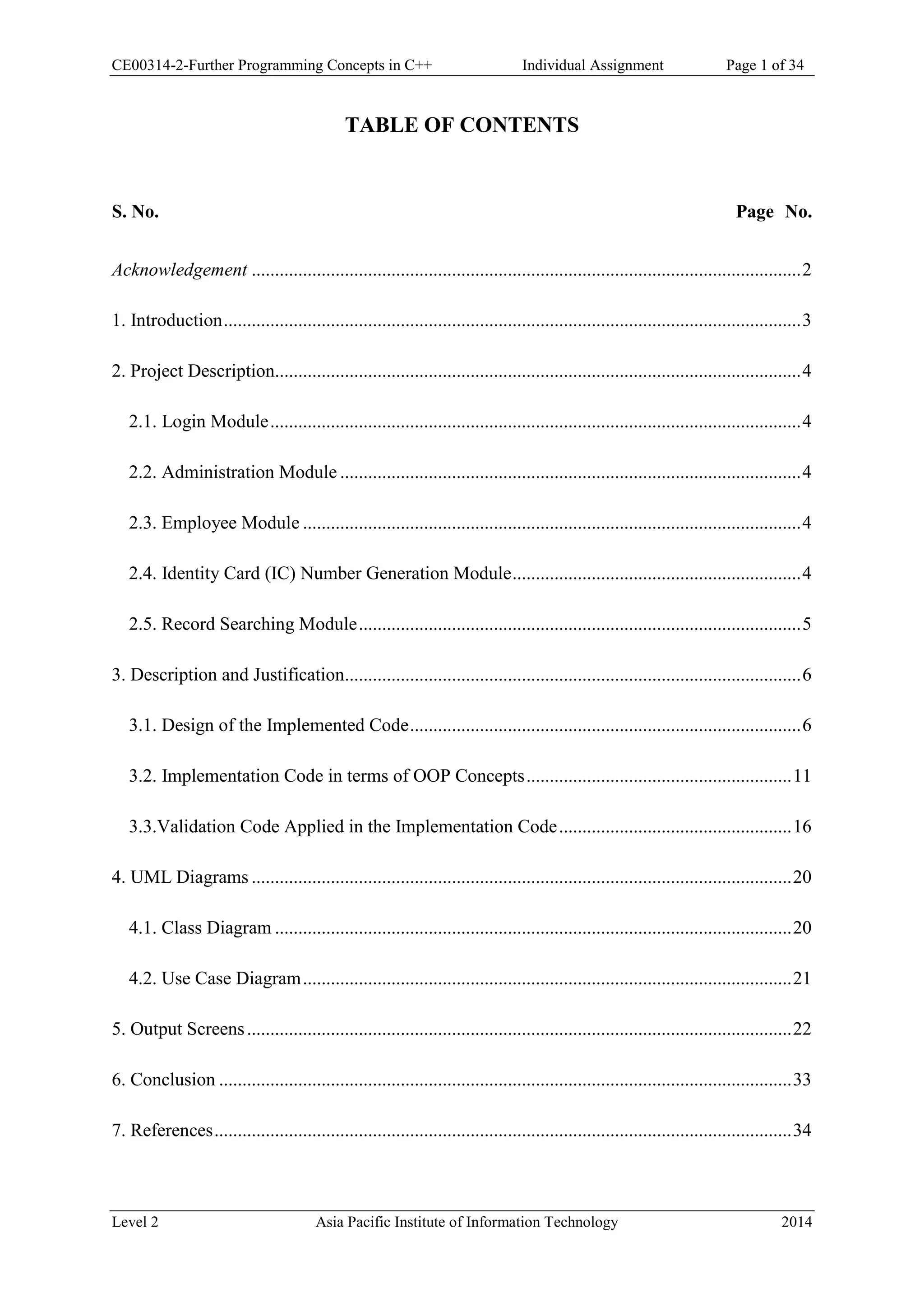
TABLE OF CONTENTS 
S. No. Page No. 
Acknowledgement ...................................................................................................................... 2 
1. Introduction ............................................................................................................................ 3 
2. Project Description................................................................................................................. 4 
2.1. Login Module .................................................................................................................. 4 
2.2. Administration Module ................................................................................................... 4 
2.3. Employee Module ........................................................................................................... 4 
2.4. Identity Card (IC) Number Generation Module .............................................................. 4 
2.5. Record Searching Module ............................................................................................... 5 
3. Description and Justification .................................................................................................. 6 
3.1. Design of the Implemented Code .................................................................................... 6 
3.2. Implementation Code in terms of OOP Concepts ......................................................... 11 
3.3.Validation Code Applied in the Implementation Code .................................................. 16 
4. UML Diagrams .................................................................................................................... 20 
4.1. Class Diagram ............................................................................................................... 20 
4.2. Use Case Diagram ......................................................................................................... 21 
5. Output Screens ..................................................................................................................... 22 
6. Conclusion ........................................................................................................................... 33 
7. References ............................................................................................................................ 34
CE00314-2-Further Programming Concepts in C++ Individual Assignment Page 2 of 34 
Level 2 Asia Pacific Institute of Information Technology 2014 
ACKNOWLEDGEMENT 
To acknowledge and thank every individual who directly or indirectly contributed to this venture personally, it would require an inordinate amount of time. I am deeply indebted to many individual, whose cooperation made this job easier. I am thankful and express my sincere gratitude to APIIT SD INDIA, Panipat for providing me an opportunity for fulfilling my most cherished desire. 
I avail this opportunity to express my gratitude to my friends and my parents for their support and encouragement throughout project. I feel it is as a great pleasure to express my deep sense of profound thank to Module Lecturer Mrs. Pradeep Kumar, who guided me at every step and also encouraged to carry out the project. 
Lastly, I would like to thank all those whose names may not have appeared here but whose contribution has not gone unnoticed. 
Jayant Kumar Gope 
Intake No.: PT1282240
CE00314-2-Further Programming Concepts in C++ Individual Assignment Page 3 of 34 
Level 2 Asia Pacific Institute of Information Technology 2014 
1. INTRODUCTION 
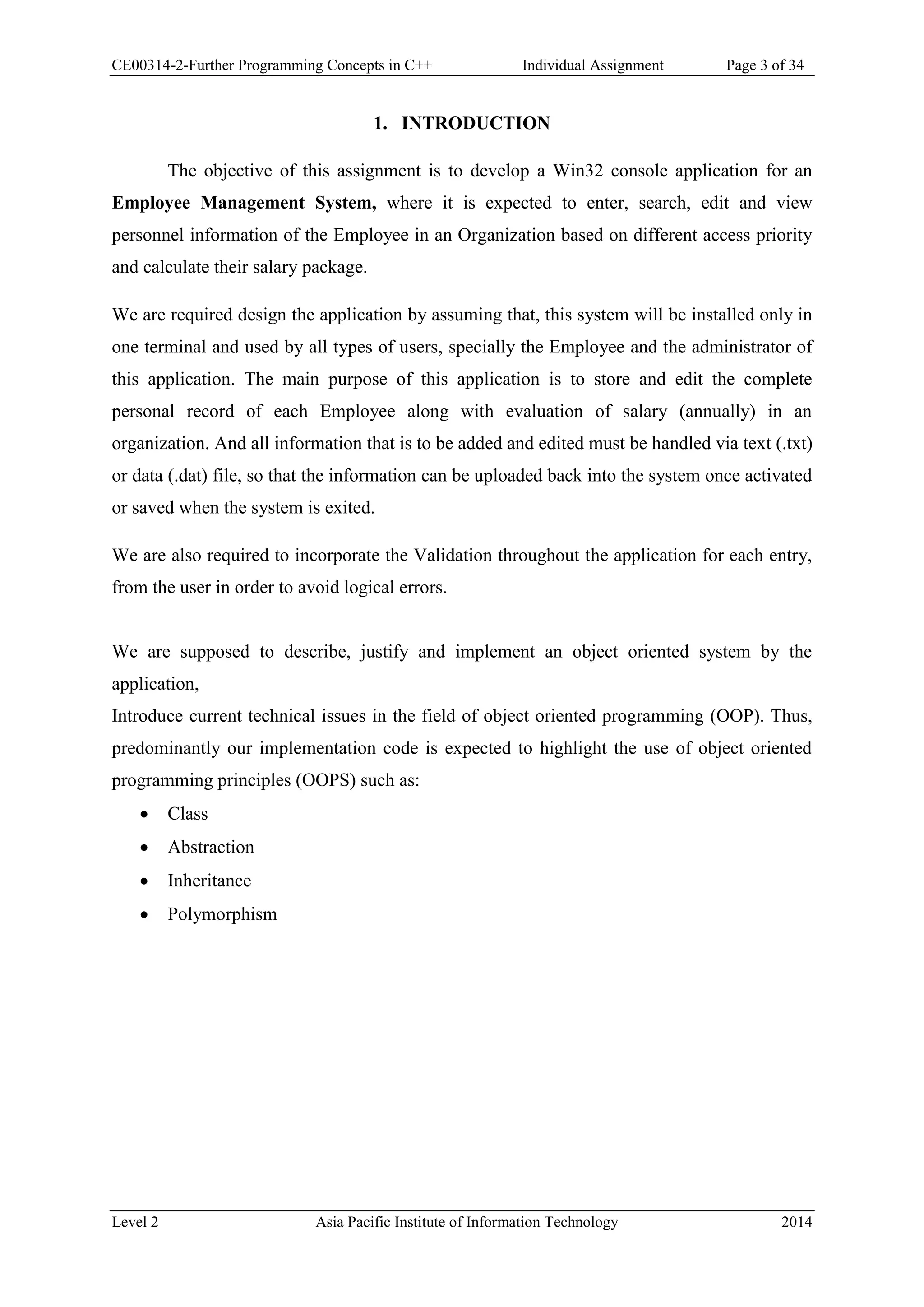
The objective of this assignment is to develop a Win32 console application for an Employee Management System, where it is expected to enter, search, edit and view personnel information of the Employee in an Organization based on different access priority and calculate their salary package. 
We are required design the application by assuming that, this system will be installed only in one terminal and used by all types of users, specially the Employee and the administrator of this application. The main purpose of this application is to store and edit the complete personal record of each Employee along with evaluation of salary (annually) in an organization. And all information that is to be added and edited must be handled via text (.txt) or data (.dat) file, so that the information can be uploaded back into the system once activated or saved when the system is exited. 
We are also required to incorporate the Validation throughout the application for each entry, from the user in order to avoid logical errors. 
We are supposed to describe, justify and implement an object oriented system by the application, 
Introduce current technical issues in the field of object oriented programming (OOP). Thus, predominantly our implementation code is expected to highlight the use of object oriented programming principles (OOPS) such as: 
 Class 
 Abstraction 
 Inheritance 
 Polymorphism
CE00314-2-Further Programming Concepts in C++ Individual Assignment Page 4 of 34 
Level 2 Asia Pacific Institute of Information Technology 2014 
2. PROJECT DESCRIPTION 
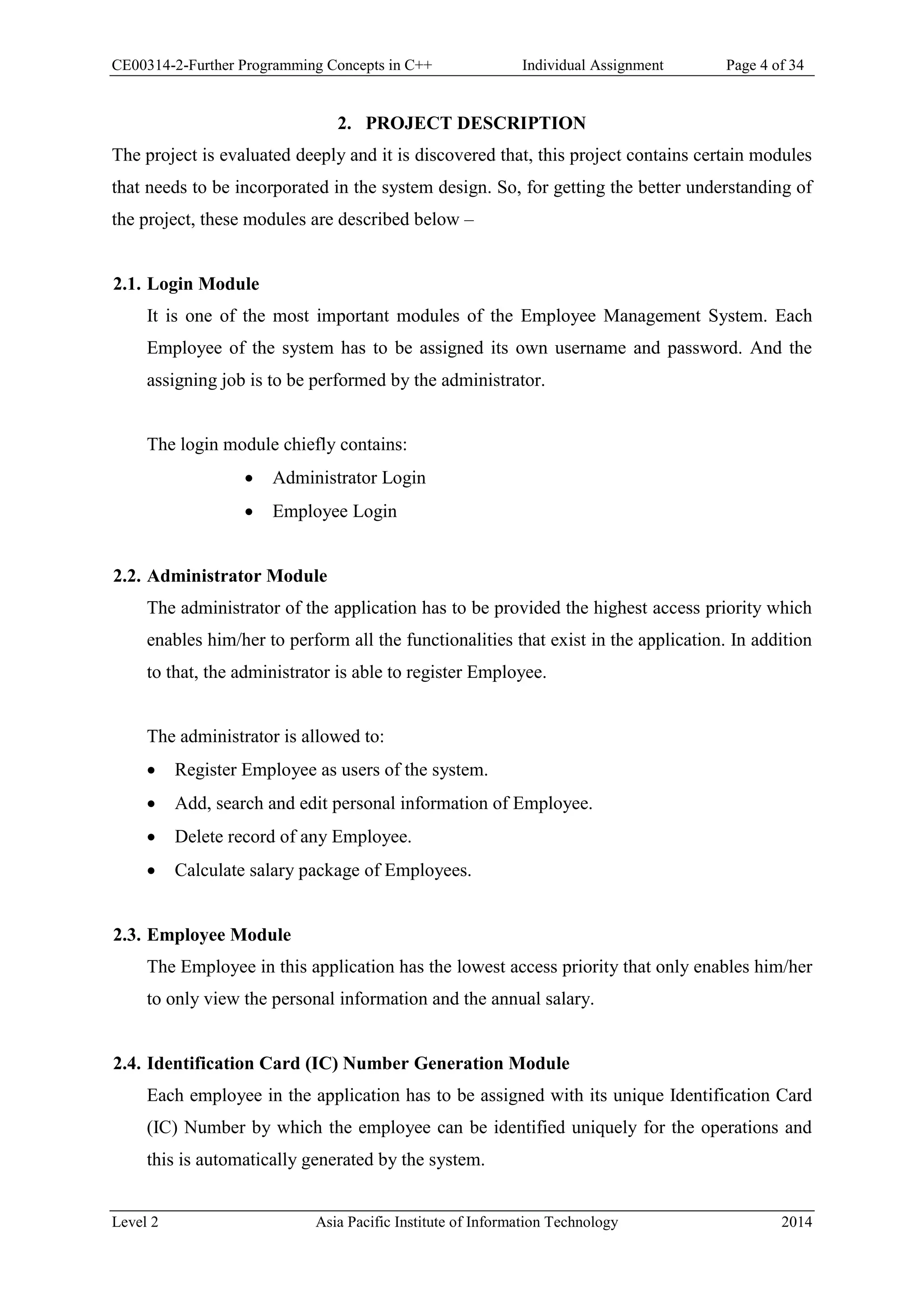
The project is evaluated deeply and it is discovered that, this project contains certain modules that needs to be incorporated in the system design. So, for getting the better understanding of the project, these modules are described below – 
2.1. Login Module 
It is one of the most important modules of the Employee Management System. Each Employee of the system has to be assigned its own username and password. And the assigning job is to be performed by the administrator. 
The login module chiefly contains: 
 Administrator Login 
 Employee Login 
2.2. Administrator Module 
The administrator of the application has to be provided the highest access priority which enables him/her to perform all the functionalities that exist in the application. In addition to that, the administrator is able to register Employee. 
The administrator is allowed to: 
 Register Employee as users of the system. 
 Add, search and edit personal information of Employee. 
 Delete record of any Employee. 
 Calculate salary package of Employees. 
2.3. Employee Module 
The Employee in this application has the lowest access priority that only enables him/her to only view the personal information and the annual salary. 
2.4. Identification Card (IC) Number Generation Module 
Each employee in the application has to be assigned with its unique Identification Card (IC) Number by which the employee can be identified uniquely for the operations and this is automatically generated by the system.
CE00314-2-Further Programming Concepts in C++ Individual Assignment Page 5 of 34 
Level 2 Asia Pacific Institute of Information Technology 2014 
2.5. Record Searching Module 
The searching of any record in the system must be done by using the following categories: 
 IC Number 
 Designation 
 Department
CE00314-2-Further Programming Concepts in C++ Individual Assignment Page 6 of 34 
Level 2 Asia Pacific Institute of Information Technology 2014 
3. DESCRIPTION AND JUSTIFICATION 
3.1. Design of The Implementation Codes 
 Description 
In this Employee Management System, it has been already stated that, administrator has the highest access priority that means he can perform each and every functionality specified in the system. The functionalities he can perform includes add employee, register employee so that employee can access the system, search, update, delete the information of employees and can calculate salary of the employees. 
And the lowest access priority is given to the employee who can only view his own profile and annual salary. 
 Justification 
As the access priorities of different users is being discussed- 
a) Administrator given the highest priority in System 
Justification - As we know that administrator of any organization has got all the privileges and rights, so we also followed the same criteria in the system and provided the administrator the highest priority amongst all users. 
b) Employees given the Least Priority 
Justification – Generally, the employee of any organization has not to do a lot with the management system, as it is made for maintaining the organization data. So, employee in the system is given the less priority than admin. 
c) Use of Functions Justification – Large programs are difficult to manage as a single list of instructions. Thus, large programs are divided into smaller parts known as functions. A function is a group of statements that together perform a task. The functions can be invoked (Called) from other parts of the program. The most important reason that we have used functions in a program because they make the program handling easier. 
void employeeAccess::viewEmployee() // Function Definition 
{ 
system("cls");
CE00314-2-Further Programming Concepts in C++ Individual Assignment Page 7 of 34 
Level 2 Asia Pacific Institute of Information Technology 2014 
cout<<"n"<<setw(54)<<right<<"---------------------------"; 
cout<<"n"<<setw(53)<<right<<" VIEW EMPLOYEE PROFILE "; 
cout<<"n"<<setw(54)<<right<<"---------------------------"; 
ifstream fin; 
fin.open("employeeDetails.txt",ios::in|ios::binary); 
if(!fin) 
cout<<"File not found"; 
else 
{ 
showHeading(); //function Call 
fin.read((char*)this,sizeof(*this)); 
while(!fin.eof()) 
{ 
showEmployeeTable(); //function callS 
fin.read((char*)this,sizeof(*this)); 
} 
} 
fin.close(); 
} 
d) Use of File Handling 
Since, we were required to store all the information that is added and edited in the text file, so that the information can be uploaded back into the system once activated or saved when the system is exited. And through file handling, operations like create, modify, delete etc can be performed thus file handling is used. 
Below given snippet is of adding an employee in the project - 
void employeeAccess::addEmployee() 
{ 
system("cls"); 
cout<<"n"<<setw(54)<<right<<"--------------------------"; 
cout<<"n"<<setw(53)<<right<<" ADD EMPLOYEE PROFILE "; 
cout<<"n"<<setw(54)<<right<<"--------------------------"; 
ifstream fin; 
employeeAccess temp; 
int id = 0; 
fin.open("employeeDetails.txt",ios::in|ios::binary); //opening file 
if(!fin) 
{ 
id = id+1; 
} 
else 
{ 
fin.read((char*)&temp, sizeof(temp)); //reading from file 
while(!fin.eof()) 
{ 
id=temp.eICNumber; 
fin.read((char*)&temp, sizeof(temp)); //reading from file 
} 
id++; 
} 
eICNumber = id; 
getEmployeeDetails();
CE00314-2-Further Programming Concepts in C++ Individual Assignment Page 8 of 34 
Level 2 Asia Pacific Institute of Information Technology 2014 
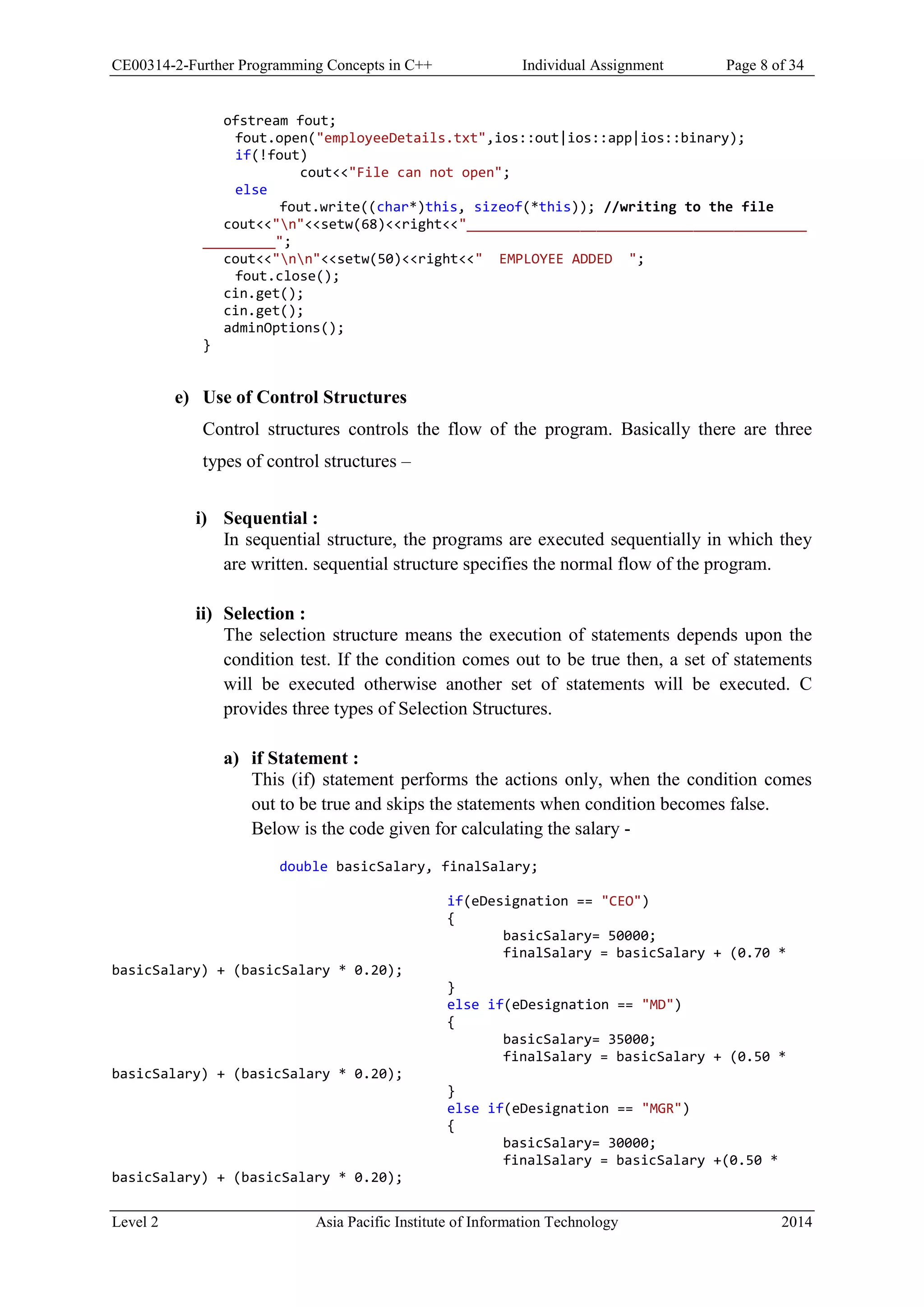
ofstream fout; 
fout.open("employeeDetails.txt",ios::out|ios::app|ios::binary); 
if(!fout) 
cout<<"File can not open"; 
else 
fout.write((char*)this, sizeof(*this)); //writing to the file 
cout<<"n"<<setw(68)<<right<<"__________________________________________ _________"; 
cout<<"nn"<<setw(50)<<right<<" EMPLOYEE ADDED "; 
fout.close(); 
cin.get(); 
cin.get(); 
adminOptions(); 
} 
e) Use of Control Structures 
Control structures controls the flow of the program. Basically there are three types of control structures – 
i) Sequential : 
In sequential structure, the programs are executed sequentially in which they are written. sequential structure specifies the normal flow of the program. 
ii) Selection : 
The selection structure means the execution of statements depends upon the condition test. If the condition comes out to be true then, a set of statements will be executed otherwise another set of statements will be executed. C provides three types of Selection Structures. 
a) if Statement : 
This (if) statement performs the actions only, when the condition comes out to be true and skips the statements when condition becomes false. 
Below is the code given for calculating the salary - 
double basicSalary, finalSalary; 
if(eDesignation == "CEO") 
{ 
basicSalary= 50000; 
finalSalary = basicSalary + (0.70 * basicSalary) + (basicSalary * 0.20); 
} 
else if(eDesignation == "MD") 
{ 
basicSalary= 35000; 
finalSalary = basicSalary + (0.50 * basicSalary) + (basicSalary * 0.20); 
} 
else if(eDesignation == "MGR") 
{ 
basicSalary= 30000; 
finalSalary = basicSalary +(0.50 * basicSalary) + (basicSalary * 0.20);
CE00314-2-Further Programming Concepts in C++ Individual Assignment Page 9 of 34 
Level 2 Asia Pacific Institute of Information Technology 2014 
} 
b) Switch Selection Structure: 
The switch selection structure allows us to make decisions from number of choices. This statement sequentially tests the values of an expression against a list of integer or character constants. And when the match found, the statements associated with that constant are executed. A snippet for Switch case 
switch(adminChoice) 
{ 
case 1: 
{ 
admin_Access.addEmployee(); 
cin.get(); 
adminOptions(); 
} 
break; 
break; 
case 2: 
{ 
admin_Access.searchEmployee(); 
cin.get(); 
adminOptions(); 
} 
break; 
case 3: 
{ 
admin_Access.viewEmployee(); 
cin.get(); 
adminOptions(); 
} 
break; 
case 4: 
{ 
admin_Access.updateEmployee(); 
cin.get(); 
adminOptions(); 
} 
break; 
case 5: 
{ 
admin_Access.deleteEmployee(); 
cin.get(); 
adminOptions(); 
} 
break; 
case 6: 
{ 
admin_Access.calculateSalary(); 
cin.get(); 
adminOptions(); 
} 
break; 
case 7: 
{
CE00314-2-Further Programming Concepts in C++ Individual Assignment Page 10 of 34 
Level 2 Asia Pacific Institute of Information Technology 2014 
cout<<"n"<<setw(68)<<right<<"_________________________________________________ __"; 
cout<<"nn"<<setw(55)<<right<<"Are you SURE want to LOGOUT"; 
cout<<"nn"<<setw(46)<<right<<"[Y/N] : "; 
char YN; 
cin>>YN; 
if(YN == 'Y' || YN=='y') 
loginMenu.loginPage(); 
else 
adminOptions(); 
} 
break; 
default: 
{ 
cout<<"n"<<setw(56)<<right<<"____________________________"; 
cout<<"nn"<<setw(48)<<right<<"INVALID CHOICE "<<adminChoice; 
cout<<"n"<<setw(56)<<right<<"____________________________"; 
cout<<"nn"<<setw(52)<<right<<"PRESS ENTER TO RENTER..."; 
cin.get(); 
cin.get(); 
adminOptions(); 
}
CE00314-2-Further Programming Concepts in C++ Individual Assignment Page 11 of 34 
Level 2 Asia Pacific Institute of Information Technology 2014 
3.2. Implementation Codes in Terms of Object Oriented Programming Concepts 
Object-oriented programming (OOP) is a programming language model organized around objects rather than "actions" and data rather than logic. Object Oriented Programming (OOP) is a programming paradigm that uses objects and can be defined as the collection of cooperating objects in which each message is capable of sending and receiving messages. 
(Margaret Rouse, 2008) 
The OOPs features that is used in the project are – 
 Abstraction 
 Encapsulation 
 Object 
 Inheritance 
 Polymorphism 
Let’s evaluate these features one by one – 
1. Abstraction 
Abstraction refers to the act of representing the essential features without including the background details or explanations. It is the concept of simplifying a real world into its essential elements. 
Justification 
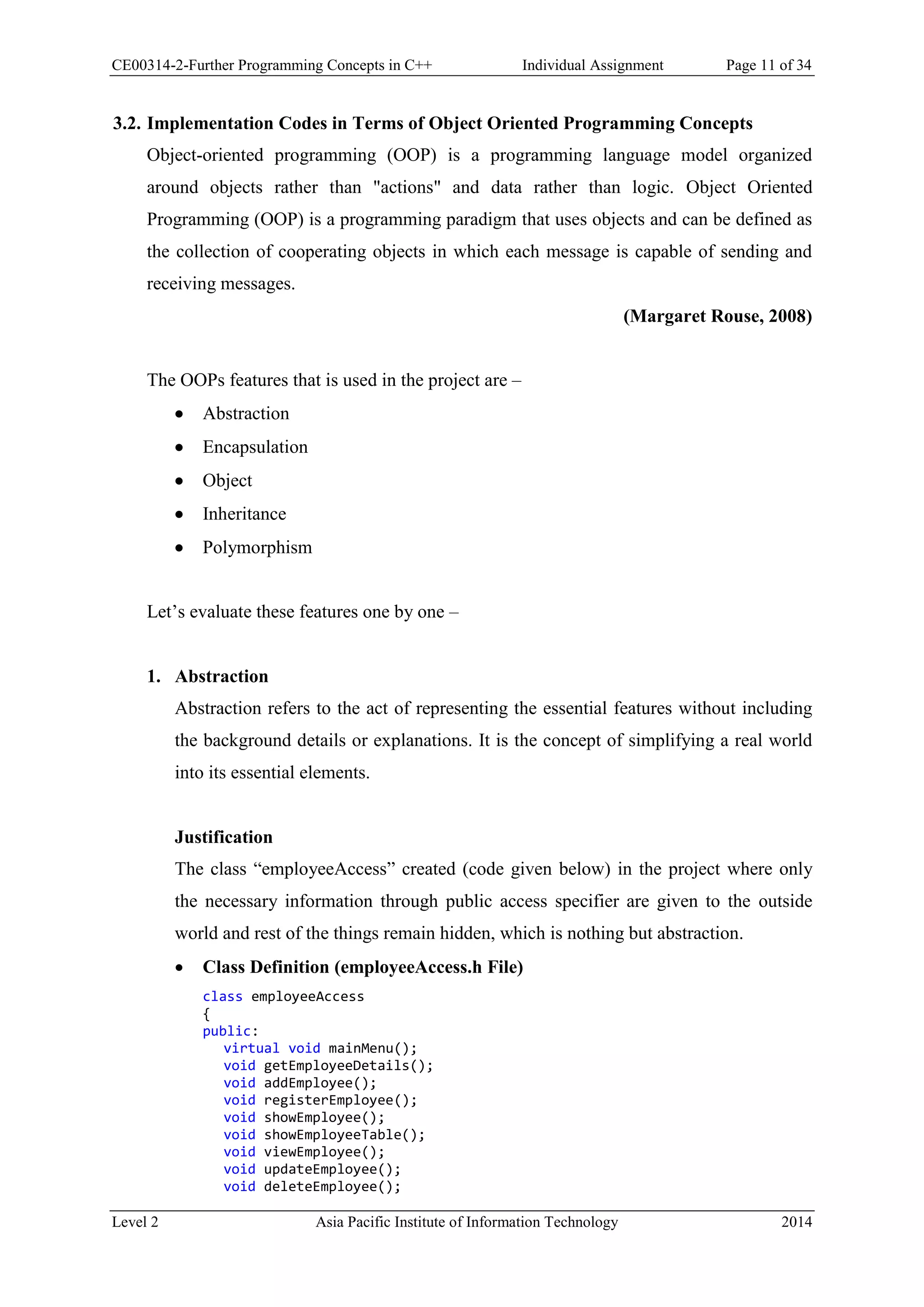
The class “employeeAccess” created (code given below) in the project where only the necessary information through public access specifier are given to the outside world and rest of the things remain hidden, which is nothing but abstraction. 
 Class Definition (employeeAccess.h File) 
class employeeAccess 
{ 
public: 
virtual void mainMenu(); 
void getEmployeeDetails(); 
void addEmployee(); 
void registerEmployee(); 
void showEmployee(); 
void showEmployeeTable(); 
void viewEmployee(); 
void updateEmployee(); 
void deleteEmployee();
CE00314-2-Further Programming Concepts in C++ Individual Assignment Page 12 of 34 
Level 2 Asia Pacific Institute of Information Technology 2014 
void searchEmployee(); 
void generateICNumber(); 
void assignUser(); 
void assignPass(); 
void employeeMenu(); 
void employeeOptions(); 
void viewEmployeeProfile(); 
void viewEmployeeSalary(); 
void calculateSalary(); 
protected: 
int eICNumber; 
private: 
int eICNumber; 
string eName, eGender, eQualification, eDesignation,eDepartment, eDateJoined, eNationality, eDOB, eMaritalStatus;// ePassword, eUsername; 
char eUsername[15], ePassword[15]; 
}; 
2. Encapsulation (Class) 
The wrapping up of data and operations / functions (that operate on the data) into a single unit (called class) is known as encapsulation. It is the way of combining both data and the functions that operate on the data under a single unit. Basic unit of encapsulation is a class. Characteristics of an object are represented in a class as Properties. Classes provide modularity and structure to the program. 
Justification 
The class “employeeAccess” (code given below) created in the project binds together the data and its associated functions under one unit that is implementing encapsulation. 
 Class Definition (employeeAccess.h File) 
class employeeAccess 
{ 
public: 
virtual void mainMenu(); 
void getEmployeeDetails(); 
void addEmployee(); 
void registerEmployee(); 
void showEmployee(); 
void showEmployeeTable(); 
void viewEmployee(); 
void updateEmployee(); 
void deleteEmployee(); 
void searchEmployee(); 
void generateICNumber(); 
void assignUser(); 
void assignPass();
CE00314-2-Further Programming Concepts in C++ Individual Assignment Page 13 of 34 
Level 2 Asia Pacific Institute of Information Technology 2014 
void employeeMenu(); 
void employeeOptions(); 
void viewEmployeeProfile(); 
void viewEmployeeSalary(); 
void calculateSalary(); 
protected: 
int eICNumber; 
private: 
int eICNumber; 
string eName, eGender, eQualification, eDesignation,eDepartment, eDateJoined, eNationality, eDOB, eMaritalStatus;// ePassword, eUsername; 
char eUsername[15], ePassword[15]; 
}; 
 Class Definition (login.h File) 
class login 
{ 
public: 
void loginPage(); 
}; 
3. Object 
An object is the real world identifiable entity with some characteristics and behavior. It is basically an instance of a class and there can be more than one instance of a class. Each instance of a class can hold its own relevant data. Memory is allocated only when an object is created. 
In programming one object requests another object to perform an action by sending a message. The object which sends the message is called as the sender whereas the object which receives the message is known as the receiver. 
Justification 
The objects instantiated in the project is – 
employeeAccess temp; //Object Creation of employeeAccess class 
int id = 0; 
fin.open("bookfile.txt",ios::in|ios::binary); 
if(!fin) 
{ 
id = id+1; 
} 
else 
{ 
fin.read((char*)&temp, sizeof(temp)); 
while(!fin.eof())
CE00314-2-Further Programming Concepts in C++ Individual Assignment Page 14 of 34 
Level 2 Asia Pacific Institute of Information Technology 2014 
{ 
id=temp.eICNumber; 
fin.read((char*)&temp, sizeof(temp)); 
} 
id++; 
} 
4. Inheritance 
Inheritance is the capability of one class of thing to inherit the capabilities or properties from another class. It is the process of forming a new class from an existing class. The existing class is called the base class or parent class or super class and the new class formed is called derived or child. And the child class can also add it additional features. 
Benefits of using inheritance – 
 It provides the reusability of the code. Once a code is written in the parent class there is no need to write the same code again in the child class. 
 Since, there is no need to write the code again and again thus helps in reducing coding efforts of the programmer and saves time. 
Types of inheritance – 
i. Based Upon Class Hierarchy 
 Single Inheritance 
 Multiple Inheritance 
 Multilevel Inheritance 
 Hybrid Inheritance 
ii. Based Upon Access Specifiers 
 Public 
 Private 
 Protected 
Justification 
Inheritance applied on code –
CE00314-2-Further Programming Concepts in C++ Individual Assignment Page 15 of 34 
Level 2 Asia Pacific Institute of Information Technology 2014 
#include "employeeAccess.h" 
class adminAccess:public employeeAccess 
{ 
}; 
Here class “adminAccess” inheriting the class “employeeAccess” (given below) 
class employeeAccess 
{ 
public: 
virtual void mainMenu(); 
void getEmployeeDetails(); 
void addEmployee(); 
void registerEmployee(); 
void showEmployee(); 
void showEmployeeTable(); 
void viewEmployee(); 
void updateEmployee(); 
void deleteEmployee(); 
void searchEmployee(); 
void generateICNumber(); 
void assignUser(); 
void assignPass(); 
void employeeMenu(); 
void employeeOptions(); 
void viewEmployeeProfile(); 
void viewEmployeeSalary(); 
void calculateSalary(); 
protected: 
int eICNumber; 
private: 
int eICNumber; 
string eName, eGender, eQualification, eDesignation,eDepartment, eDateJoined, eNationality, eDOB, eMaritalStatus;// ePassword, eUsername; 
char eUsername[15], ePassword[15]; 
}; 
5. Polymorphism 
Polymorphism is the ability for a message or data to be processed in more than one form. It is a feature of OOP which allows 2 or more methods to have the same name within a class.
CE00314-2-Further Programming Concepts in C++ Individual Assignment Page 16 of 34 
Level 2 Asia Pacific Institute of Information Technology 2014 
3.3. Validation Codes Applied into the Implementation Codes 
Validation is applied into the system for each entry from the user in order to avoid logical errors. Below are the justification provided for the following. 
1) Employee Name 
The name of an employee cannot be a alphanumeric values and also it cannot contain any special characters, and for that I have provided a validation. 
Justification Code: 
cout<<"nn"<<right<<setw(25)<<" "; 
cout<<setw(30)<<left<<"Employee Name:"; 
fflush(stdin); 
gets(eQualification); 
for (int i=0; i<20; i++) 
{ 
int b=(int)eName[i]; 
if (b>0&&b<48||b>122&&b<127||(b>57&&b<65)||(b>90&&b<97)) 
{ 
cout<<setw(68)<<right<<"___________________________________________________"; 
cout<<"nn"<<right<<setw(25)<<" "; 
cout<<setw(30)<<left<<"Name cannot contain SPECIAL CHARACTERS..."; 
cout<<"n"<<setw(68)<<right<<"_________________________________________________ __"; 
getName(); 
} 
} 
2) Password 
The password can be a combination of alphanumeric values and also can contain special characters, but it must be more than 5 characters long and for that I have provided the validation. 
Justification Code: 
void employeeAccess::getPassword() 
{ 
cout<<"nn"<<right<<setw(25)<<" "; 
cout<<setw(30)<<left<<"Create Password (> 5 char):"; 
gets(ePassword); 
if(strlen(ePassword) <6) 
{ 
cout<<setw(68)<<right<<"___________________________________________________"; 
cout<<"nn"<<right<<setw(25)<<" "; 
cout<<setw(30)<<left<<"Password is too short...try again"; 
cout<<"n"<<setw(68)<<right<<"____________________________________________"; 
getPassword(); 
} 
}
CE00314-2-Further Programming Concepts in C++ Individual Assignment Page 17 of 34 
Level 2 Asia Pacific Institute of Information Technology 2014 
3) Employee Gender 
As an input for gender, the system accepts only two alphabetic characters M (male) or F (female), for which the validation is provided. 
Justification Code: 
void employeeAccess::getGender() 
{ 
cout<<"nn"<<right<<setw(25)<<" "; 
cout<<setw(30)<<left<<"Enter Gender [M/F]:"; 
fflush(stdin); 
gets(eGender); 
if((strcmp(eGender,"M")!=0 && strcmp(eGender,"m")!=0 && strcmp(eGender,"F")!=0 && strcmp(eGender,"f")!=0)) 
{ 
cout<<setw(68)<<right<<"___________________________________________________"; 
cout<<"nn"<<right<<setw(25)<<" "; 
cout<<setw(30)<<left<<"Invalid Gender Status...Enter [M/UF]"<<eGender; 
cout<<"n"<<setw(68)<<right<<"______________________________________________"; 
getGender(); 
} 
} 
4) Employee Designation 
Since, for the input of employee designation the codes (CEO/MD/MGR/GM/AM/SPV/LBR) are specified. So, only the specified set of codes is expected as an input and for which the validation is provided. 
Justification Code: 
void employeeAccess::getDesignation() 
{ 
cout<<"nn"<<right<<setw(25)<<" "; 
cout<<setw(30)<<left<<"Employee Designation:"; 
cout<<"n"<<right<<setw(25)<<" "; 
cout<<setw(30)<<left<<"(CEO/MD/MGR/GM/AM/SPV/LBR):"; 
fflush(stdin); 
gets(eDesignation); 
if((strcmp(eDesignation,"CEO")!=0) && (strcmp(eDesignation,"MD")!=0) && (strcmp(eDesignation,"MGR")!=0)&& (strcmp(eDesignation,"GM")!=0)&& (strcmp(eDesignation,"AM")!=0) && (strcmp(eDesignation,"SPV")!=0)&& (strcmp(eDesignation,"LBR")!=0)) 
{ 
cout<<setw(68)<<right<<"________________________________________________"; 
cout<<"nn"<<right<<setw(17)<<" "; 
cout<<setw(30)<<left<<"Enter Valid Designation (CEO/MD/MGR/GM/AM/SPV/LBR)"; 
cout<<"n"<<setw(68)<<right<<"___________________________________________”; 
getDesignation(); 
} 
}
CE00314-2-Further Programming Concepts in C++ Individual Assignment Page 18 of 34 
Level 2 Asia Pacific Institute of Information Technology 2014 
5) Employee Department 
Since, for the input of employee department the codes (HR/MKT/PRO/QA) are specified. So, only the specified set of codes is expected as an input and for which the validation is provided. 
Justification Code: 
void employeeAccess::getMaritalStatus() 
{ 
cout<<"n"<<right<<setw(25)<<" "; 
cout<<setw(30)<<left<<"Employee Marital Status [M/U]:"; 
fflush(stdin); 
gets(eMaritalStatus); 
if((strcmp(eMaritalStatus,"M")!=0 && strcmp(eMaritalStatus,"m")!=0 && strcmp(eMaritalStatus,"U")!=0 && strcmp(eMaritalStatus,"u")!=0)) 
{ 
cout<<setw(68)<<right<<"___________________________________________________"; 
cout<<"nn"<<right<<setw(25)<<" "; 
cout<<setw(30)<<left<<"Invalid Marital Status...Enter [M/U]"<<eMaritalStatus; 
cout<<"n"<<setw(68)<<right<<"______________________________________________"; 
getMaritalStatus(); 
} 
} 
6) Date of Joining 
Date of joining should be in the format of “DD/MM/YYYY” and it will be numeric only. And thus for taking input as “DD/MM/YYYY” validation is provided. 
7) Date of Birth 
The validation of date of birth is same as for date of joining. 
8) Marital Status 
As an input for marital status, the system accepts only two alphabetic characters M (for married) or U (unmarried), for which the validation is provided. 
Justification Code: 
void employeeAccess::getGender() 
{ 
cout<<"nn"<<right<<setw(25)<<" "; 
cout<<setw(30)<<left<<"Enter Gender [M/F]:"; 
fflush(stdin); 
cin>>eGender; 
if(eGender != 'M' || eGender != 'm' || eGender != 'F' || eGender != 'f') 
{
CE00314-2-Further Programming Concepts in C++ Individual Assignment Page 19 of 34 
Level 2 Asia Pacific Institute of Information Technology 2014 
cout<<setw(68)<<right<<"___________________________________________________"; 
cout<<"nn"<<right<<setw(25)<<" "; 
cout<<setw(30)<<left<<"Invalid Gender...Enter [M/F]"<<eGender; 
cout<<"n"<<setw(68)<<right<<"____________________________________________"; 
getGender(); 
} 
} 
 
 

CE00314-2-Further Programming Concepts in C++ Individual Assignment Page 20 of 34 
Level 2 Asia Pacific Institute of Information Technology 2014 
4. UML DIAGRAMS 
4.1. Class Diagram
CE00314-2-Further Programming Concepts in C++ Individual Assignment Page 21 of 34 
Level 2 Asia Pacific Institute of Information Technology 2014 
4.2. Use Case Diagram 
Administrator 
View Employee 
Profile 
Update Employee 
Details 
Login 
Employee 
Search Employee 
Delete Employee 
Profile 
<<include>> 
<<include>> 
<<include>> 
Add Employee 
Profile 
<<include>> 
Calculate Salary 
Package 
<<include>> 
Employee Management System 
<<includes>> 
By IC Number 
«extends» 
«extends» By Designation 
By Department 
«extends» 
<<includes>> 
Logout 
<<include>> 
Registration 
<<include>> 
View Profile 
<<include>> 
View Salary Package 
<<include>>
CE00314-2-Further Programming Concepts in C++ Individual Assignment Page 22 of 34 
Level 2 Asia Pacific Institute of Information Technology 2014 
5. OUTPUT SCREENS 
1) Start Screen 
2) Administrator Login Screen
CE00314-2-Further Programming Concepts in C++ Individual Assignment Page 23 of 34 
Level 2 Asia Pacific Institute of Information Technology 2014 
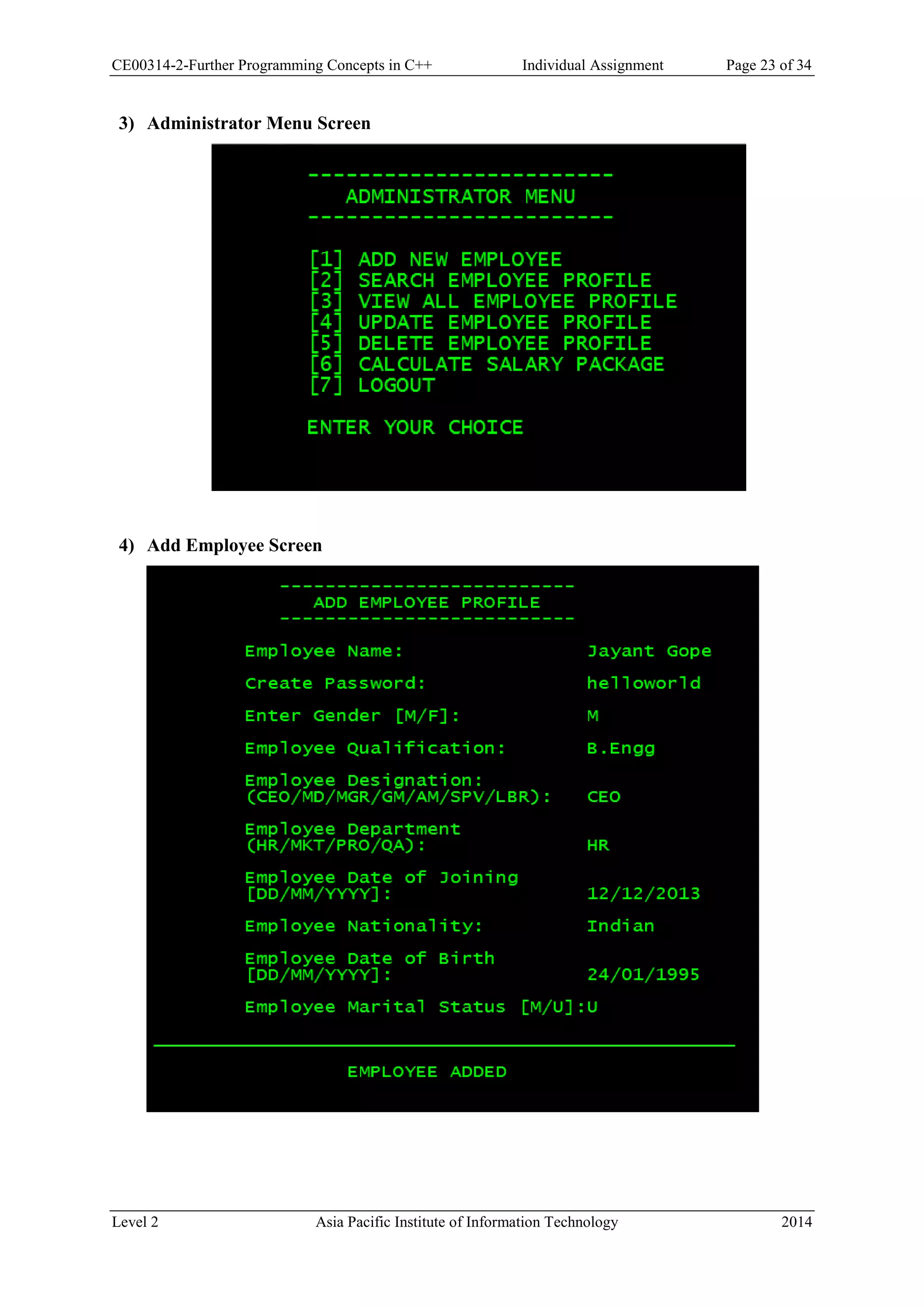
3) Administrator Menu Screen 
4) Add Employee Screen
CE00314-2-Further Programming Concepts in C++ Individual Assignment Page 24 of 34 
Level 2 Asia Pacific Institute of Information Technology 2014 
5) Search Employee Menu Screen 
6) Search Employee By IC Number Screen
CE00314-2-Further Programming Concepts in C++ Individual Assignment Page 25 of 34 
Level 2 Asia Pacific Institute of Information Technology 2014 
7) Search Employee By Designation Screen 
8) Search Employee By Department Screen
CE00314-2-Further Programming Concepts in C++ Individual Assignment Page 26 of 34 
Level 2 Asia Pacific Institute of Information Technology 2014 
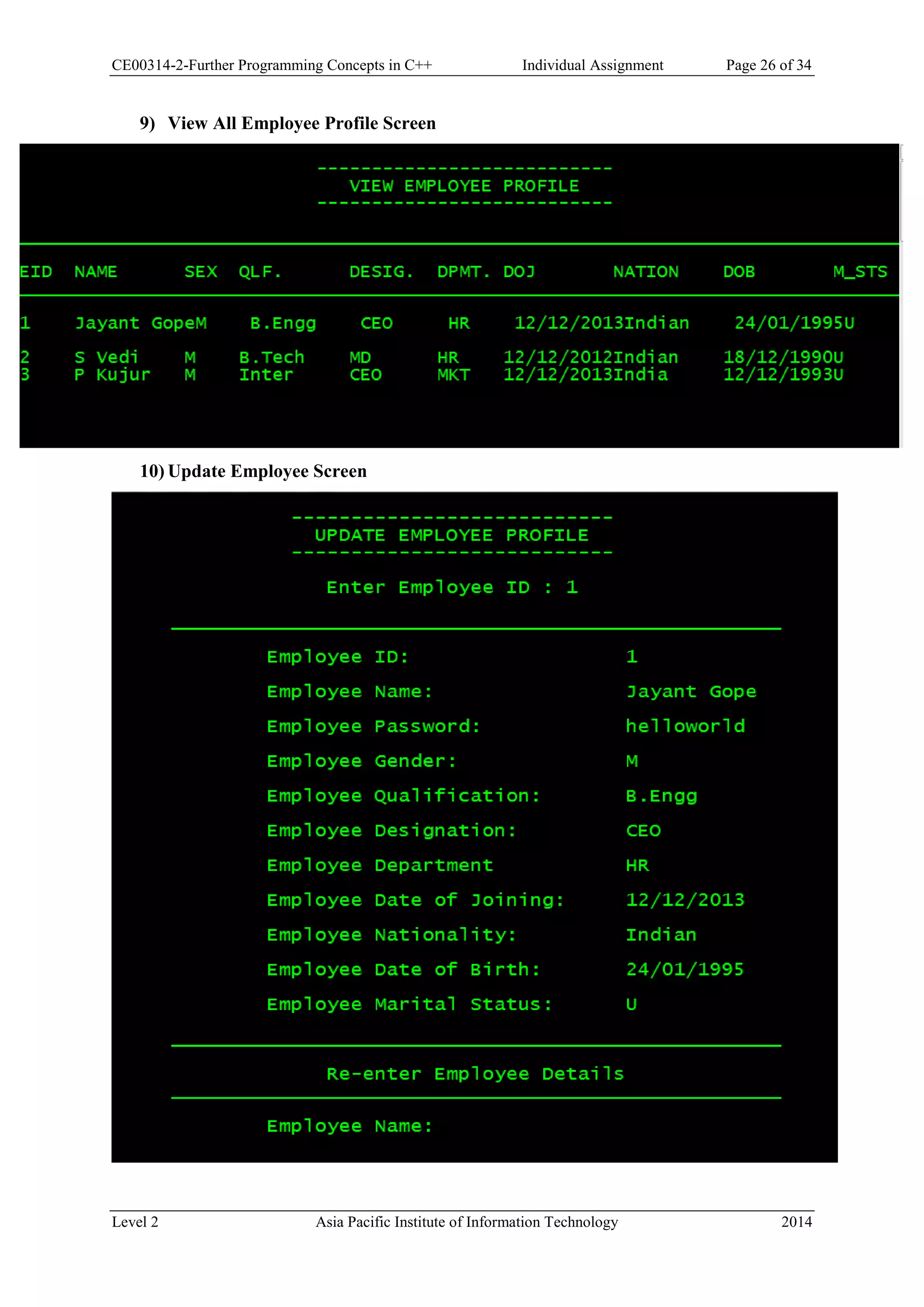
9) View All Employee Profile Screen 
10) Update Employee Screen
CE00314-2-Further Programming Concepts in C++ Individual Assignment Page 27 of 34 
Level 2 Asia Pacific Institute of Information Technology 2014 
11) Update Employee Re-Enter Details Screen
CE00314-2-Further Programming Concepts in C++ Individual Assignment Page 28 of 34 
Level 2 Asia Pacific Institute of Information Technology 2014 
12) Delete Employee Screen
CE00314-2-Further Programming Concepts in C++ Individual Assignment Page 29 of 34 
Level 2 Asia Pacific Institute of Information Technology 2014 
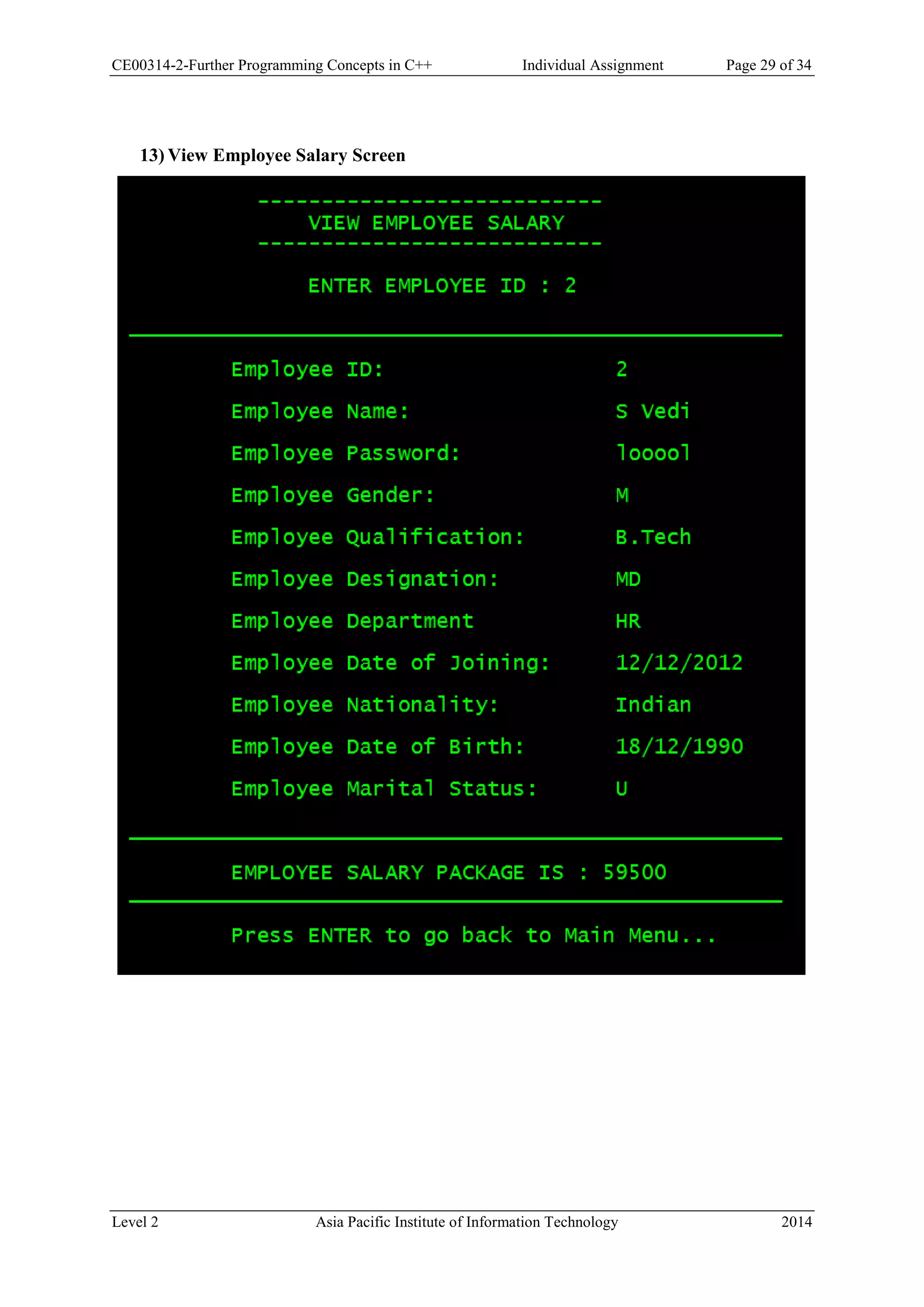
13) View Employee Salary Screen
CE00314-2-Further Programming Concepts in C++ Individual Assignment Page 30 of 34 
Level 2 Asia Pacific Institute of Information Technology 2014 
14) Admin Logout Screen 
15) Employee Login Screen
CE00314-2-Further Programming Concepts in C++ Individual Assignment Page 31 of 34 
Level 2 Asia Pacific Institute of Information Technology 2014 
16) Employee Menu Screen 
17) View Employee Salary Screen
CE00314-2-Further Programming Concepts in C++ Individual Assignment Page 32 of 34 
Level 2 Asia Pacific Institute of Information Technology 2014 
18) View Employee Profile Screen
CE00314-2-Further Programming Concepts in C++ Individual Assignment Page 33 of 34 
Level 2 Asia Pacific Institute of Information Technology 2014 
6. CONCLUSION 
It was a great experience to design and implement the Employee Management System by using an Object Oriented Programming Language C++ and to work on its documentation. While working on this project, I have learned many things especially how to apply the concepts of OOP paradigm in modelling of real world systems. 
This assignment helped me to get the better understanding to develop and derive new class structures and organise them such that they will model real world systems within computers. It also helped me in getting in the better understanding of basic programming concepts of C++ language such as loops, control structure, arrays, file handling etc. 
In this assignment, I have used almost every concepts of C++ language, I had learned. I have also provided validations throughout the system for avoiding logical errors, used excellent logic related comments with proper indentation and the OOPs concept in an excellent manner. 
After doing this assignment, I am in position to explain object oriented programming concepts and apply them to the modelling of real world systems by utilizing its offered facilities.
CE00314-2-Further Programming Concepts in C++ Individual Assignment Page 34 of 34 
Level 2 Asia Pacific Institute of Information Technology 2014 
7. REFERENCES 
1) Arora, S. 2010, Computer Science with C++, 6th ed., New Delhi, Dhanpat Rai & Co. 
2) Balaguruswamy E. 2006, Object Oriented Programming with C++, New Delhi, Tata McGraw Hill. 
3) Kanithkar Y.P. 2004, Let Us C++, 3rd ed., New Delhi, BPB Publication. 
4) Deitel P.J., & Dietel H.M. 2010, C++ How to Program, 7th ed., New Delhi, PHI Learning. 
5) Object Oriented programming Concepts in C++. 2014. Object Oriented programming Concepts in C++. [ONLINE] Available at: http://www.studytonight.com/cpp/cpp-and- oops-concepts.php. [Accessed 07 November 2014]. 
6) Java OOPs Concepts - Javatpoint. 2014. Java OOPs Concepts - Javatpoint. [ONLINE] Available at: http://www.javatpoint.com/java-oops-concepts. [Accessed 07 November 2014]. 
7) E Balagurusamy, A.E. 1994, Object oriented Programming with C++ Third Edition, McGraw-Hill, London

Employee Management System in C++

  • 1.
    CE00314-2-Further Programming Conceptsin C++ Individual Assignment Page 1 of 34 Level 2 Asia Pacific Institute of Information Technology 2014 TABLE OF CONTENTS S. No. Page No. Acknowledgement ...................................................................................................................... 2 1. Introduction ............................................................................................................................ 3 2. Project Description................................................................................................................. 4 2.1. Login Module .................................................................................................................. 4 2.2. Administration Module ................................................................................................... 4 2.3. Employee Module ........................................................................................................... 4 2.4. Identity Card (IC) Number Generation Module .............................................................. 4 2.5. Record Searching Module ............................................................................................... 5 3. Description and Justification .................................................................................................. 6 3.1. Design of the Implemented Code .................................................................................... 6 3.2. Implementation Code in terms of OOP Concepts ......................................................... 11 3.3.Validation Code Applied in the Implementation Code .................................................. 16 4. UML Diagrams .................................................................................................................... 20 4.1. Class Diagram ............................................................................................................... 20 4.2. Use Case Diagram ......................................................................................................... 21 5. Output Screens ..................................................................................................................... 22 6. Conclusion ........................................................................................................................... 33 7. References ............................................................................................................................ 34
  • 2.
    CE00314-2-Further Programming Conceptsin C++ Individual Assignment Page 2 of 34 Level 2 Asia Pacific Institute of Information Technology 2014 ACKNOWLEDGEMENT To acknowledge and thank every individual who directly or indirectly contributed to this venture personally, it would require an inordinate amount of time. I am deeply indebted to many individual, whose cooperation made this job easier. I am thankful and express my sincere gratitude to APIIT SD INDIA, Panipat for providing me an opportunity for fulfilling my most cherished desire. I avail this opportunity to express my gratitude to my friends and my parents for their support and encouragement throughout project. I feel it is as a great pleasure to express my deep sense of profound thank to Module Lecturer Mrs. Pradeep Kumar, who guided me at every step and also encouraged to carry out the project. Lastly, I would like to thank all those whose names may not have appeared here but whose contribution has not gone unnoticed. Jayant Kumar Gope Intake No.: PT1282240
  • 3.
    CE00314-2-Further Programming Conceptsin C++ Individual Assignment Page 3 of 34 Level 2 Asia Pacific Institute of Information Technology 2014 1. INTRODUCTION The objective of this assignment is to develop a Win32 console application for an Employee Management System, where it is expected to enter, search, edit and view personnel information of the Employee in an Organization based on different access priority and calculate their salary package. We are required design the application by assuming that, this system will be installed only in one terminal and used by all types of users, specially the Employee and the administrator of this application. The main purpose of this application is to store and edit the complete personal record of each Employee along with evaluation of salary (annually) in an organization. And all information that is to be added and edited must be handled via text (.txt) or data (.dat) file, so that the information can be uploaded back into the system once activated or saved when the system is exited. We are also required to incorporate the Validation throughout the application for each entry, from the user in order to avoid logical errors. We are supposed to describe, justify and implement an object oriented system by the application, Introduce current technical issues in the field of object oriented programming (OOP). Thus, predominantly our implementation code is expected to highlight the use of object oriented programming principles (OOPS) such as:  Class  Abstraction  Inheritance  Polymorphism
  • 4.
    CE00314-2-Further Programming Conceptsin C++ Individual Assignment Page 4 of 34 Level 2 Asia Pacific Institute of Information Technology 2014 2. PROJECT DESCRIPTION The project is evaluated deeply and it is discovered that, this project contains certain modules that needs to be incorporated in the system design. So, for getting the better understanding of the project, these modules are described below – 2.1. Login Module It is one of the most important modules of the Employee Management System. Each Employee of the system has to be assigned its own username and password. And the assigning job is to be performed by the administrator. The login module chiefly contains:  Administrator Login  Employee Login 2.2. Administrator Module The administrator of the application has to be provided the highest access priority which enables him/her to perform all the functionalities that exist in the application. In addition to that, the administrator is able to register Employee. The administrator is allowed to:  Register Employee as users of the system.  Add, search and edit personal information of Employee.  Delete record of any Employee.  Calculate salary package of Employees. 2.3. Employee Module The Employee in this application has the lowest access priority that only enables him/her to only view the personal information and the annual salary. 2.4. Identification Card (IC) Number Generation Module Each employee in the application has to be assigned with its unique Identification Card (IC) Number by which the employee can be identified uniquely for the operations and this is automatically generated by the system.
  • 5.
    CE00314-2-Further Programming Conceptsin C++ Individual Assignment Page 5 of 34 Level 2 Asia Pacific Institute of Information Technology 2014 2.5. Record Searching Module The searching of any record in the system must be done by using the following categories:  IC Number  Designation  Department
  • 6.
    CE00314-2-Further Programming Conceptsin C++ Individual Assignment Page 6 of 34 Level 2 Asia Pacific Institute of Information Technology 2014 3. DESCRIPTION AND JUSTIFICATION 3.1. Design of The Implementation Codes  Description In this Employee Management System, it has been already stated that, administrator has the highest access priority that means he can perform each and every functionality specified in the system. The functionalities he can perform includes add employee, register employee so that employee can access the system, search, update, delete the information of employees and can calculate salary of the employees. And the lowest access priority is given to the employee who can only view his own profile and annual salary.  Justification As the access priorities of different users is being discussed- a) Administrator given the highest priority in System Justification - As we know that administrator of any organization has got all the privileges and rights, so we also followed the same criteria in the system and provided the administrator the highest priority amongst all users. b) Employees given the Least Priority Justification – Generally, the employee of any organization has not to do a lot with the management system, as it is made for maintaining the organization data. So, employee in the system is given the less priority than admin. c) Use of Functions Justification – Large programs are difficult to manage as a single list of instructions. Thus, large programs are divided into smaller parts known as functions. A function is a group of statements that together perform a task. The functions can be invoked (Called) from other parts of the program. The most important reason that we have used functions in a program because they make the program handling easier. void employeeAccess::viewEmployee() // Function Definition { system("cls");
  • 7.
    CE00314-2-Further Programming Conceptsin C++ Individual Assignment Page 7 of 34 Level 2 Asia Pacific Institute of Information Technology 2014 cout<<"n"<<setw(54)<<right<<"---------------------------"; cout<<"n"<<setw(53)<<right<<" VIEW EMPLOYEE PROFILE "; cout<<"n"<<setw(54)<<right<<"---------------------------"; ifstream fin; fin.open("employeeDetails.txt",ios::in|ios::binary); if(!fin) cout<<"File not found"; else { showHeading(); //function Call fin.read((char*)this,sizeof(*this)); while(!fin.eof()) { showEmployeeTable(); //function callS fin.read((char*)this,sizeof(*this)); } } fin.close(); } d) Use of File Handling Since, we were required to store all the information that is added and edited in the text file, so that the information can be uploaded back into the system once activated or saved when the system is exited. And through file handling, operations like create, modify, delete etc can be performed thus file handling is used. Below given snippet is of adding an employee in the project - void employeeAccess::addEmployee() { system("cls"); cout<<"n"<<setw(54)<<right<<"--------------------------"; cout<<"n"<<setw(53)<<right<<" ADD EMPLOYEE PROFILE "; cout<<"n"<<setw(54)<<right<<"--------------------------"; ifstream fin; employeeAccess temp; int id = 0; fin.open("employeeDetails.txt",ios::in|ios::binary); //opening file if(!fin) { id = id+1; } else { fin.read((char*)&temp, sizeof(temp)); //reading from file while(!fin.eof()) { id=temp.eICNumber; fin.read((char*)&temp, sizeof(temp)); //reading from file } id++; } eICNumber = id; getEmployeeDetails();
  • 8.
    CE00314-2-Further Programming Conceptsin C++ Individual Assignment Page 8 of 34 Level 2 Asia Pacific Institute of Information Technology 2014 ofstream fout; fout.open("employeeDetails.txt",ios::out|ios::app|ios::binary); if(!fout) cout<<"File can not open"; else fout.write((char*)this, sizeof(*this)); //writing to the file cout<<"n"<<setw(68)<<right<<"__________________________________________ _________"; cout<<"nn"<<setw(50)<<right<<" EMPLOYEE ADDED "; fout.close(); cin.get(); cin.get(); adminOptions(); } e) Use of Control Structures Control structures controls the flow of the program. Basically there are three types of control structures – i) Sequential : In sequential structure, the programs are executed sequentially in which they are written. sequential structure specifies the normal flow of the program. ii) Selection : The selection structure means the execution of statements depends upon the condition test. If the condition comes out to be true then, a set of statements will be executed otherwise another set of statements will be executed. C provides three types of Selection Structures. a) if Statement : This (if) statement performs the actions only, when the condition comes out to be true and skips the statements when condition becomes false. Below is the code given for calculating the salary - double basicSalary, finalSalary; if(eDesignation == "CEO") { basicSalary= 50000; finalSalary = basicSalary + (0.70 * basicSalary) + (basicSalary * 0.20); } else if(eDesignation == "MD") { basicSalary= 35000; finalSalary = basicSalary + (0.50 * basicSalary) + (basicSalary * 0.20); } else if(eDesignation == "MGR") { basicSalary= 30000; finalSalary = basicSalary +(0.50 * basicSalary) + (basicSalary * 0.20);
  • 9.
    CE00314-2-Further Programming Conceptsin C++ Individual Assignment Page 9 of 34 Level 2 Asia Pacific Institute of Information Technology 2014 } b) Switch Selection Structure: The switch selection structure allows us to make decisions from number of choices. This statement sequentially tests the values of an expression against a list of integer or character constants. And when the match found, the statements associated with that constant are executed. A snippet for Switch case switch(adminChoice) { case 1: { admin_Access.addEmployee(); cin.get(); adminOptions(); } break; break; case 2: { admin_Access.searchEmployee(); cin.get(); adminOptions(); } break; case 3: { admin_Access.viewEmployee(); cin.get(); adminOptions(); } break; case 4: { admin_Access.updateEmployee(); cin.get(); adminOptions(); } break; case 5: { admin_Access.deleteEmployee(); cin.get(); adminOptions(); } break; case 6: { admin_Access.calculateSalary(); cin.get(); adminOptions(); } break; case 7: {
  • 10.
    CE00314-2-Further Programming Conceptsin C++ Individual Assignment Page 10 of 34 Level 2 Asia Pacific Institute of Information Technology 2014 cout<<"n"<<setw(68)<<right<<"_________________________________________________ __"; cout<<"nn"<<setw(55)<<right<<"Are you SURE want to LOGOUT"; cout<<"nn"<<setw(46)<<right<<"[Y/N] : "; char YN; cin>>YN; if(YN == 'Y' || YN=='y') loginMenu.loginPage(); else adminOptions(); } break; default: { cout<<"n"<<setw(56)<<right<<"____________________________"; cout<<"nn"<<setw(48)<<right<<"INVALID CHOICE "<<adminChoice; cout<<"n"<<setw(56)<<right<<"____________________________"; cout<<"nn"<<setw(52)<<right<<"PRESS ENTER TO RENTER..."; cin.get(); cin.get(); adminOptions(); }
  • 11.
    CE00314-2-Further Programming Conceptsin C++ Individual Assignment Page 11 of 34 Level 2 Asia Pacific Institute of Information Technology 2014 3.2. Implementation Codes in Terms of Object Oriented Programming Concepts Object-oriented programming (OOP) is a programming language model organized around objects rather than "actions" and data rather than logic. Object Oriented Programming (OOP) is a programming paradigm that uses objects and can be defined as the collection of cooperating objects in which each message is capable of sending and receiving messages. (Margaret Rouse, 2008) The OOPs features that is used in the project are –  Abstraction  Encapsulation  Object  Inheritance  Polymorphism Let’s evaluate these features one by one – 1. Abstraction Abstraction refers to the act of representing the essential features without including the background details or explanations. It is the concept of simplifying a real world into its essential elements. Justification The class “employeeAccess” created (code given below) in the project where only the necessary information through public access specifier are given to the outside world and rest of the things remain hidden, which is nothing but abstraction.  Class Definition (employeeAccess.h File) class employeeAccess { public: virtual void mainMenu(); void getEmployeeDetails(); void addEmployee(); void registerEmployee(); void showEmployee(); void showEmployeeTable(); void viewEmployee(); void updateEmployee(); void deleteEmployee();
  • 12.
    CE00314-2-Further Programming Conceptsin C++ Individual Assignment Page 12 of 34 Level 2 Asia Pacific Institute of Information Technology 2014 void searchEmployee(); void generateICNumber(); void assignUser(); void assignPass(); void employeeMenu(); void employeeOptions(); void viewEmployeeProfile(); void viewEmployeeSalary(); void calculateSalary(); protected: int eICNumber; private: int eICNumber; string eName, eGender, eQualification, eDesignation,eDepartment, eDateJoined, eNationality, eDOB, eMaritalStatus;// ePassword, eUsername; char eUsername[15], ePassword[15]; }; 2. Encapsulation (Class) The wrapping up of data and operations / functions (that operate on the data) into a single unit (called class) is known as encapsulation. It is the way of combining both data and the functions that operate on the data under a single unit. Basic unit of encapsulation is a class. Characteristics of an object are represented in a class as Properties. Classes provide modularity and structure to the program. Justification The class “employeeAccess” (code given below) created in the project binds together the data and its associated functions under one unit that is implementing encapsulation.  Class Definition (employeeAccess.h File) class employeeAccess { public: virtual void mainMenu(); void getEmployeeDetails(); void addEmployee(); void registerEmployee(); void showEmployee(); void showEmployeeTable(); void viewEmployee(); void updateEmployee(); void deleteEmployee(); void searchEmployee(); void generateICNumber(); void assignUser(); void assignPass();
  • 13.
    CE00314-2-Further Programming Conceptsin C++ Individual Assignment Page 13 of 34 Level 2 Asia Pacific Institute of Information Technology 2014 void employeeMenu(); void employeeOptions(); void viewEmployeeProfile(); void viewEmployeeSalary(); void calculateSalary(); protected: int eICNumber; private: int eICNumber; string eName, eGender, eQualification, eDesignation,eDepartment, eDateJoined, eNationality, eDOB, eMaritalStatus;// ePassword, eUsername; char eUsername[15], ePassword[15]; };  Class Definition (login.h File) class login { public: void loginPage(); }; 3. Object An object is the real world identifiable entity with some characteristics and behavior. It is basically an instance of a class and there can be more than one instance of a class. Each instance of a class can hold its own relevant data. Memory is allocated only when an object is created. In programming one object requests another object to perform an action by sending a message. The object which sends the message is called as the sender whereas the object which receives the message is known as the receiver. Justification The objects instantiated in the project is – employeeAccess temp; //Object Creation of employeeAccess class int id = 0; fin.open("bookfile.txt",ios::in|ios::binary); if(!fin) { id = id+1; } else { fin.read((char*)&temp, sizeof(temp)); while(!fin.eof())
  • 14.
    CE00314-2-Further Programming Conceptsin C++ Individual Assignment Page 14 of 34 Level 2 Asia Pacific Institute of Information Technology 2014 { id=temp.eICNumber; fin.read((char*)&temp, sizeof(temp)); } id++; } 4. Inheritance Inheritance is the capability of one class of thing to inherit the capabilities or properties from another class. It is the process of forming a new class from an existing class. The existing class is called the base class or parent class or super class and the new class formed is called derived or child. And the child class can also add it additional features. Benefits of using inheritance –  It provides the reusability of the code. Once a code is written in the parent class there is no need to write the same code again in the child class.  Since, there is no need to write the code again and again thus helps in reducing coding efforts of the programmer and saves time. Types of inheritance – i. Based Upon Class Hierarchy  Single Inheritance  Multiple Inheritance  Multilevel Inheritance  Hybrid Inheritance ii. Based Upon Access Specifiers  Public  Private  Protected Justification Inheritance applied on code –
  • 15.
    CE00314-2-Further Programming Conceptsin C++ Individual Assignment Page 15 of 34 Level 2 Asia Pacific Institute of Information Technology 2014 #include "employeeAccess.h" class adminAccess:public employeeAccess { }; Here class “adminAccess” inheriting the class “employeeAccess” (given below) class employeeAccess { public: virtual void mainMenu(); void getEmployeeDetails(); void addEmployee(); void registerEmployee(); void showEmployee(); void showEmployeeTable(); void viewEmployee(); void updateEmployee(); void deleteEmployee(); void searchEmployee(); void generateICNumber(); void assignUser(); void assignPass(); void employeeMenu(); void employeeOptions(); void viewEmployeeProfile(); void viewEmployeeSalary(); void calculateSalary(); protected: int eICNumber; private: int eICNumber; string eName, eGender, eQualification, eDesignation,eDepartment, eDateJoined, eNationality, eDOB, eMaritalStatus;// ePassword, eUsername; char eUsername[15], ePassword[15]; }; 5. Polymorphism Polymorphism is the ability for a message or data to be processed in more than one form. It is a feature of OOP which allows 2 or more methods to have the same name within a class.
  • 16.
    CE00314-2-Further Programming Conceptsin C++ Individual Assignment Page 16 of 34 Level 2 Asia Pacific Institute of Information Technology 2014 3.3. Validation Codes Applied into the Implementation Codes Validation is applied into the system for each entry from the user in order to avoid logical errors. Below are the justification provided for the following. 1) Employee Name The name of an employee cannot be a alphanumeric values and also it cannot contain any special characters, and for that I have provided a validation. Justification Code: cout<<"nn"<<right<<setw(25)<<" "; cout<<setw(30)<<left<<"Employee Name:"; fflush(stdin); gets(eQualification); for (int i=0; i<20; i++) { int b=(int)eName[i]; if (b>0&&b<48||b>122&&b<127||(b>57&&b<65)||(b>90&&b<97)) { cout<<setw(68)<<right<<"___________________________________________________"; cout<<"nn"<<right<<setw(25)<<" "; cout<<setw(30)<<left<<"Name cannot contain SPECIAL CHARACTERS..."; cout<<"n"<<setw(68)<<right<<"_________________________________________________ __"; getName(); } } 2) Password The password can be a combination of alphanumeric values and also can contain special characters, but it must be more than 5 characters long and for that I have provided the validation. Justification Code: void employeeAccess::getPassword() { cout<<"nn"<<right<<setw(25)<<" "; cout<<setw(30)<<left<<"Create Password (> 5 char):"; gets(ePassword); if(strlen(ePassword) <6) { cout<<setw(68)<<right<<"___________________________________________________"; cout<<"nn"<<right<<setw(25)<<" "; cout<<setw(30)<<left<<"Password is too short...try again"; cout<<"n"<<setw(68)<<right<<"____________________________________________"; getPassword(); } }
  • 17.
    CE00314-2-Further Programming Conceptsin C++ Individual Assignment Page 17 of 34 Level 2 Asia Pacific Institute of Information Technology 2014 3) Employee Gender As an input for gender, the system accepts only two alphabetic characters M (male) or F (female), for which the validation is provided. Justification Code: void employeeAccess::getGender() { cout<<"nn"<<right<<setw(25)<<" "; cout<<setw(30)<<left<<"Enter Gender [M/F]:"; fflush(stdin); gets(eGender); if((strcmp(eGender,"M")!=0 && strcmp(eGender,"m")!=0 && strcmp(eGender,"F")!=0 && strcmp(eGender,"f")!=0)) { cout<<setw(68)<<right<<"___________________________________________________"; cout<<"nn"<<right<<setw(25)<<" "; cout<<setw(30)<<left<<"Invalid Gender Status...Enter [M/UF]"<<eGender; cout<<"n"<<setw(68)<<right<<"______________________________________________"; getGender(); } } 4) Employee Designation Since, for the input of employee designation the codes (CEO/MD/MGR/GM/AM/SPV/LBR) are specified. So, only the specified set of codes is expected as an input and for which the validation is provided. Justification Code: void employeeAccess::getDesignation() { cout<<"nn"<<right<<setw(25)<<" "; cout<<setw(30)<<left<<"Employee Designation:"; cout<<"n"<<right<<setw(25)<<" "; cout<<setw(30)<<left<<"(CEO/MD/MGR/GM/AM/SPV/LBR):"; fflush(stdin); gets(eDesignation); if((strcmp(eDesignation,"CEO")!=0) && (strcmp(eDesignation,"MD")!=0) && (strcmp(eDesignation,"MGR")!=0)&& (strcmp(eDesignation,"GM")!=0)&& (strcmp(eDesignation,"AM")!=0) && (strcmp(eDesignation,"SPV")!=0)&& (strcmp(eDesignation,"LBR")!=0)) { cout<<setw(68)<<right<<"________________________________________________"; cout<<"nn"<<right<<setw(17)<<" "; cout<<setw(30)<<left<<"Enter Valid Designation (CEO/MD/MGR/GM/AM/SPV/LBR)"; cout<<"n"<<setw(68)<<right<<"___________________________________________”; getDesignation(); } }
  • 18.
    CE00314-2-Further Programming Conceptsin C++ Individual Assignment Page 18 of 34 Level 2 Asia Pacific Institute of Information Technology 2014 5) Employee Department Since, for the input of employee department the codes (HR/MKT/PRO/QA) are specified. So, only the specified set of codes is expected as an input and for which the validation is provided. Justification Code: void employeeAccess::getMaritalStatus() { cout<<"n"<<right<<setw(25)<<" "; cout<<setw(30)<<left<<"Employee Marital Status [M/U]:"; fflush(stdin); gets(eMaritalStatus); if((strcmp(eMaritalStatus,"M")!=0 && strcmp(eMaritalStatus,"m")!=0 && strcmp(eMaritalStatus,"U")!=0 && strcmp(eMaritalStatus,"u")!=0)) { cout<<setw(68)<<right<<"___________________________________________________"; cout<<"nn"<<right<<setw(25)<<" "; cout<<setw(30)<<left<<"Invalid Marital Status...Enter [M/U]"<<eMaritalStatus; cout<<"n"<<setw(68)<<right<<"______________________________________________"; getMaritalStatus(); } } 6) Date of Joining Date of joining should be in the format of “DD/MM/YYYY” and it will be numeric only. And thus for taking input as “DD/MM/YYYY” validation is provided. 7) Date of Birth The validation of date of birth is same as for date of joining. 8) Marital Status As an input for marital status, the system accepts only two alphabetic characters M (for married) or U (unmarried), for which the validation is provided. Justification Code: void employeeAccess::getGender() { cout<<"nn"<<right<<setw(25)<<" "; cout<<setw(30)<<left<<"Enter Gender [M/F]:"; fflush(stdin); cin>>eGender; if(eGender != 'M' || eGender != 'm' || eGender != 'F' || eGender != 'f') {
  • 19.
    CE00314-2-Further Programming Conceptsin C++ Individual Assignment Page 19 of 34 Level 2 Asia Pacific Institute of Information Technology 2014 cout<<setw(68)<<right<<"___________________________________________________"; cout<<"nn"<<right<<setw(25)<<" "; cout<<setw(30)<<left<<"Invalid Gender...Enter [M/F]"<<eGender; cout<<"n"<<setw(68)<<right<<"____________________________________________"; getGender(); } }   
  • 20.
    CE00314-2-Further Programming Conceptsin C++ Individual Assignment Page 20 of 34 Level 2 Asia Pacific Institute of Information Technology 2014 4. UML DIAGRAMS 4.1. Class Diagram
  • 21.
    CE00314-2-Further Programming Conceptsin C++ Individual Assignment Page 21 of 34 Level 2 Asia Pacific Institute of Information Technology 2014 4.2. Use Case Diagram Administrator View Employee Profile Update Employee Details Login Employee Search Employee Delete Employee Profile <<include>> <<include>> <<include>> Add Employee Profile <<include>> Calculate Salary Package <<include>> Employee Management System <<includes>> By IC Number «extends» «extends» By Designation By Department «extends» <<includes>> Logout <<include>> Registration <<include>> View Profile <<include>> View Salary Package <<include>>
  • 22.
    CE00314-2-Further Programming Conceptsin C++ Individual Assignment Page 22 of 34 Level 2 Asia Pacific Institute of Information Technology 2014 5. OUTPUT SCREENS 1) Start Screen 2) Administrator Login Screen
  • 23.
    CE00314-2-Further Programming Conceptsin C++ Individual Assignment Page 23 of 34 Level 2 Asia Pacific Institute of Information Technology 2014 3) Administrator Menu Screen 4) Add Employee Screen
  • 24.
    CE00314-2-Further Programming Conceptsin C++ Individual Assignment Page 24 of 34 Level 2 Asia Pacific Institute of Information Technology 2014 5) Search Employee Menu Screen 6) Search Employee By IC Number Screen
  • 25.
    CE00314-2-Further Programming Conceptsin C++ Individual Assignment Page 25 of 34 Level 2 Asia Pacific Institute of Information Technology 2014 7) Search Employee By Designation Screen 8) Search Employee By Department Screen
  • 26.
    CE00314-2-Further Programming Conceptsin C++ Individual Assignment Page 26 of 34 Level 2 Asia Pacific Institute of Information Technology 2014 9) View All Employee Profile Screen 10) Update Employee Screen
  • 27.
    CE00314-2-Further Programming Conceptsin C++ Individual Assignment Page 27 of 34 Level 2 Asia Pacific Institute of Information Technology 2014 11) Update Employee Re-Enter Details Screen
  • 28.
    CE00314-2-Further Programming Conceptsin C++ Individual Assignment Page 28 of 34 Level 2 Asia Pacific Institute of Information Technology 2014 12) Delete Employee Screen
  • 29.
    CE00314-2-Further Programming Conceptsin C++ Individual Assignment Page 29 of 34 Level 2 Asia Pacific Institute of Information Technology 2014 13) View Employee Salary Screen
  • 30.
    CE00314-2-Further Programming Conceptsin C++ Individual Assignment Page 30 of 34 Level 2 Asia Pacific Institute of Information Technology 2014 14) Admin Logout Screen 15) Employee Login Screen
  • 31.
    CE00314-2-Further Programming Conceptsin C++ Individual Assignment Page 31 of 34 Level 2 Asia Pacific Institute of Information Technology 2014 16) Employee Menu Screen 17) View Employee Salary Screen
  • 32.
    CE00314-2-Further Programming Conceptsin C++ Individual Assignment Page 32 of 34 Level 2 Asia Pacific Institute of Information Technology 2014 18) View Employee Profile Screen
  • 33.
    CE00314-2-Further Programming Conceptsin C++ Individual Assignment Page 33 of 34 Level 2 Asia Pacific Institute of Information Technology 2014 6. CONCLUSION It was a great experience to design and implement the Employee Management System by using an Object Oriented Programming Language C++ and to work on its documentation. While working on this project, I have learned many things especially how to apply the concepts of OOP paradigm in modelling of real world systems. This assignment helped me to get the better understanding to develop and derive new class structures and organise them such that they will model real world systems within computers. It also helped me in getting in the better understanding of basic programming concepts of C++ language such as loops, control structure, arrays, file handling etc. In this assignment, I have used almost every concepts of C++ language, I had learned. I have also provided validations throughout the system for avoiding logical errors, used excellent logic related comments with proper indentation and the OOPs concept in an excellent manner. After doing this assignment, I am in position to explain object oriented programming concepts and apply them to the modelling of real world systems by utilizing its offered facilities.
  • 34.
    CE00314-2-Further Programming Conceptsin C++ Individual Assignment Page 34 of 34 Level 2 Asia Pacific Institute of Information Technology 2014 7. REFERENCES 1) Arora, S. 2010, Computer Science with C++, 6th ed., New Delhi, Dhanpat Rai & Co. 2) Balaguruswamy E. 2006, Object Oriented Programming with C++, New Delhi, Tata McGraw Hill. 3) Kanithkar Y.P. 2004, Let Us C++, 3rd ed., New Delhi, BPB Publication. 4) Deitel P.J., & Dietel H.M. 2010, C++ How to Program, 7th ed., New Delhi, PHI Learning. 5) Object Oriented programming Concepts in C++. 2014. Object Oriented programming Concepts in C++. [ONLINE] Available at: http://www.studytonight.com/cpp/cpp-and- oops-concepts.php. [Accessed 07 November 2014]. 6) Java OOPs Concepts - Javatpoint. 2014. Java OOPs Concepts - Javatpoint. [ONLINE] Available at: http://www.javatpoint.com/java-oops-concepts. [Accessed 07 November 2014]. 7) E Balagurusamy, A.E. 1994, Object oriented Programming with C++ Third Edition, McGraw-Hill, London