

EMPLOYEE ENGAGEMENT – BEST
PRACTICE PRINCIPLES AND STRATEGIES
VOLVO GROUP SOUTHERN AFRICA
CHARLES COTTER PhD candidate, MBA, B.A (Hons), B.A
www.slideshare.net/CharlesCotter
16-17 JANUARY 2018
2-DAY, TRAINING PROGRAMME
OVERVIEW
• Defining the fundamentals of employee
engagement
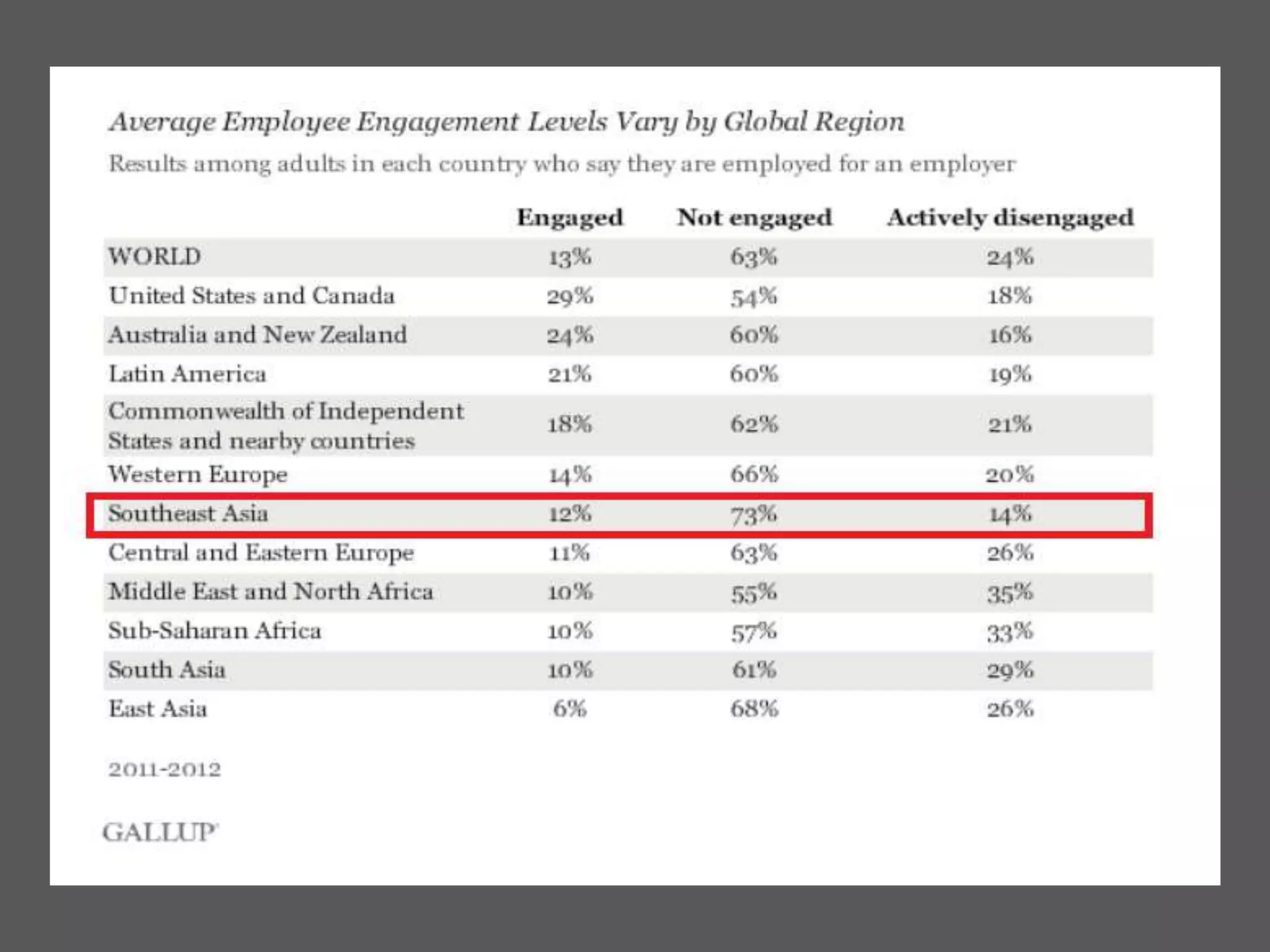
• Employee engagement statistics – globally
and locally
• Business case: The value, benefits and
importance of employee engagement
• The Employee Value Proposition (EVP),
employee voice and Stakeholder relations
and -engagement
• Implementing and applying employee
engagement strategies
• Reading article 1: Employee Engagement
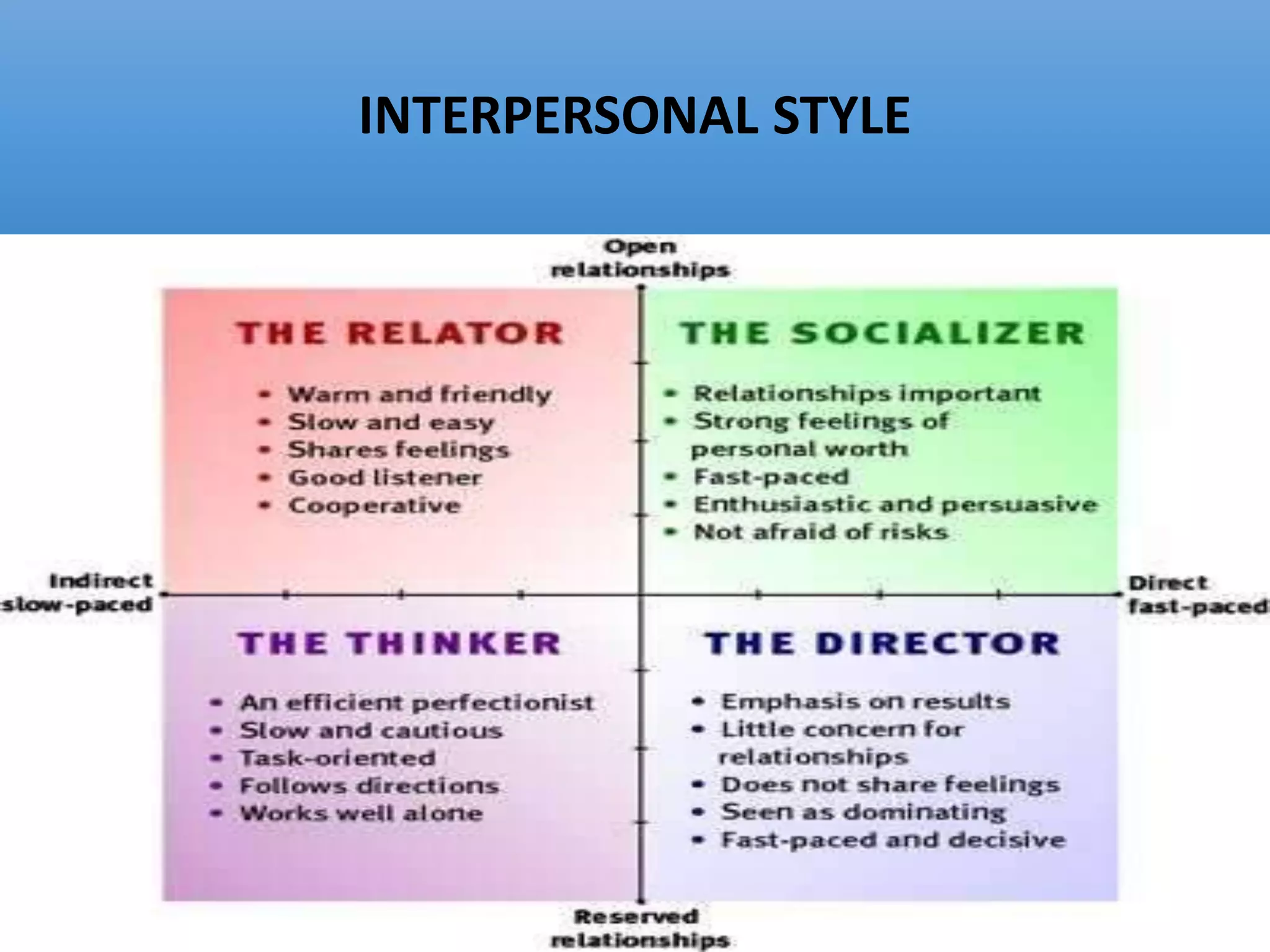
• Interpersonal Style
• Facilitating trusting, respectful relations
and transparent interpersonal
communication
• Reading article 2: Critical conversations
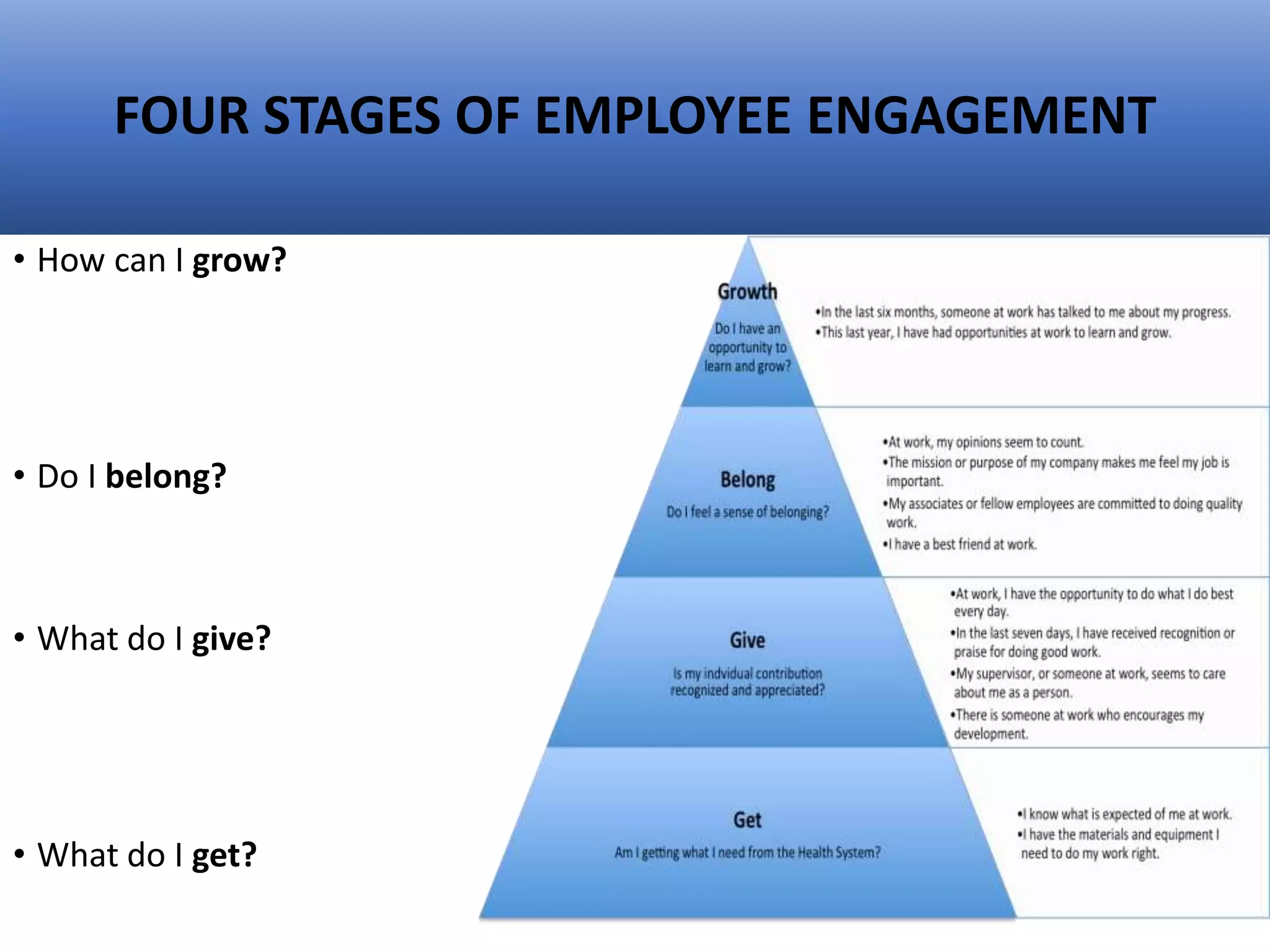
FOUR STAGES OF EMPLOYEE ENGAGEMENT
• How can I grow?
• Do I belong?
• What do I give?
• What do I get?
INTRODUCTORY ACTIVITY
• Individual Activity:
• Complete the statement by inserting one (1) word. In order to
effectively engage employees at Volvo Group S.A, I need to/to
be…………………………………….(1 word)
• Find other learners with the same word as you.
• Jot these down on the flip-chart.
• Each learner will be given the opportunity to elaborate on their own
word association.
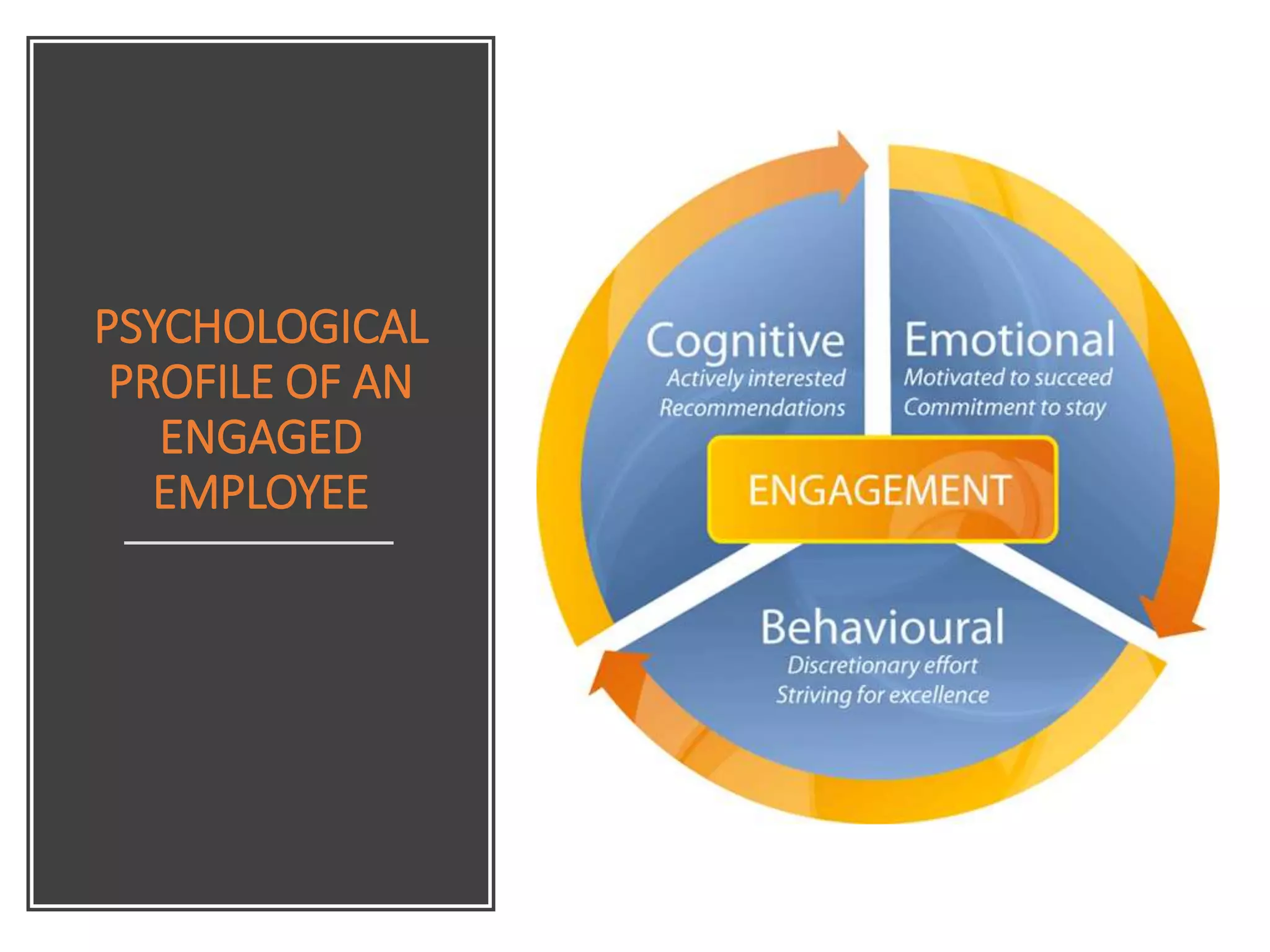
PSYCHOLOGICAL
PROFILE OF AN
ENGAGED
EMPLOYEE
COTTER’S 5 C’S OF EMPLOYEE ENGAGEMENT
• Are employees COMMITTED to the organization?
• Are employees proud to work for the organization – company/brand
ambassadors? CITIZEN
• Do employees put forth extra/discretionary effort to help the
organization and their colleagues achieve business objectives?
COMRADE
• Are employees enthusiastic and passionate about their work/jobs?
CREATOR
• Are employees CONNECTED (intellectually and emotionally) to their
work/jobs – offer value add?
#1 Role clarity and expectations
#2 Resources – materials and equipment
#3 Role optimization and opportunities
#4 Receipt of recognition and praise
#5 Managerial care and interest
#6 Encouragement of personal and
professional development
GALLUP Q12
#7 Opinions and inputs are valued
#8 Job/task significance
#9 Fellow employee commitment to
performance excellence/quality
#10 Collegial and harmonious working
relationships
#11 Managerial interest in career
progression and development
#12 Ample opportunities to learn and grow
GALLUP Q12
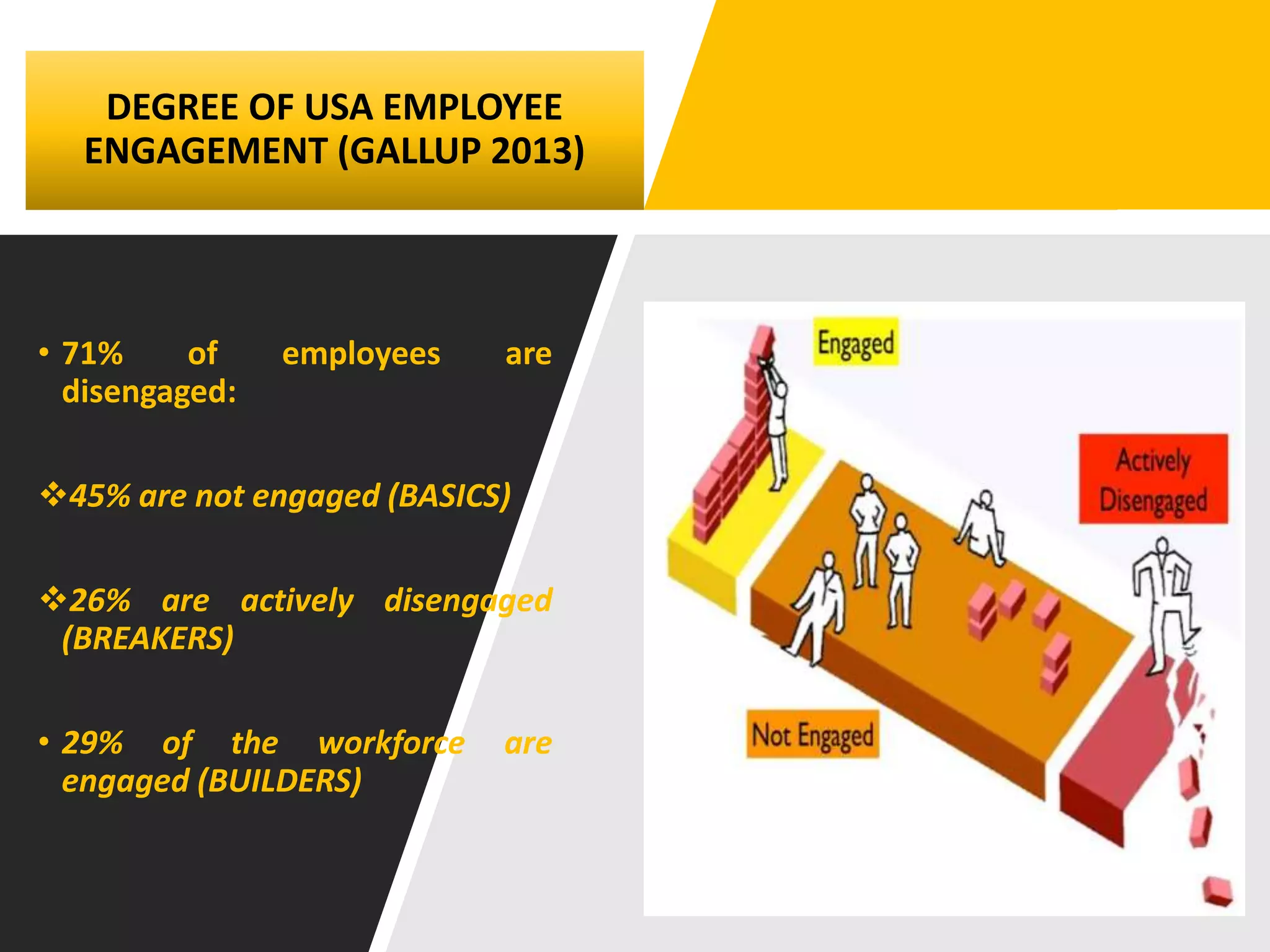
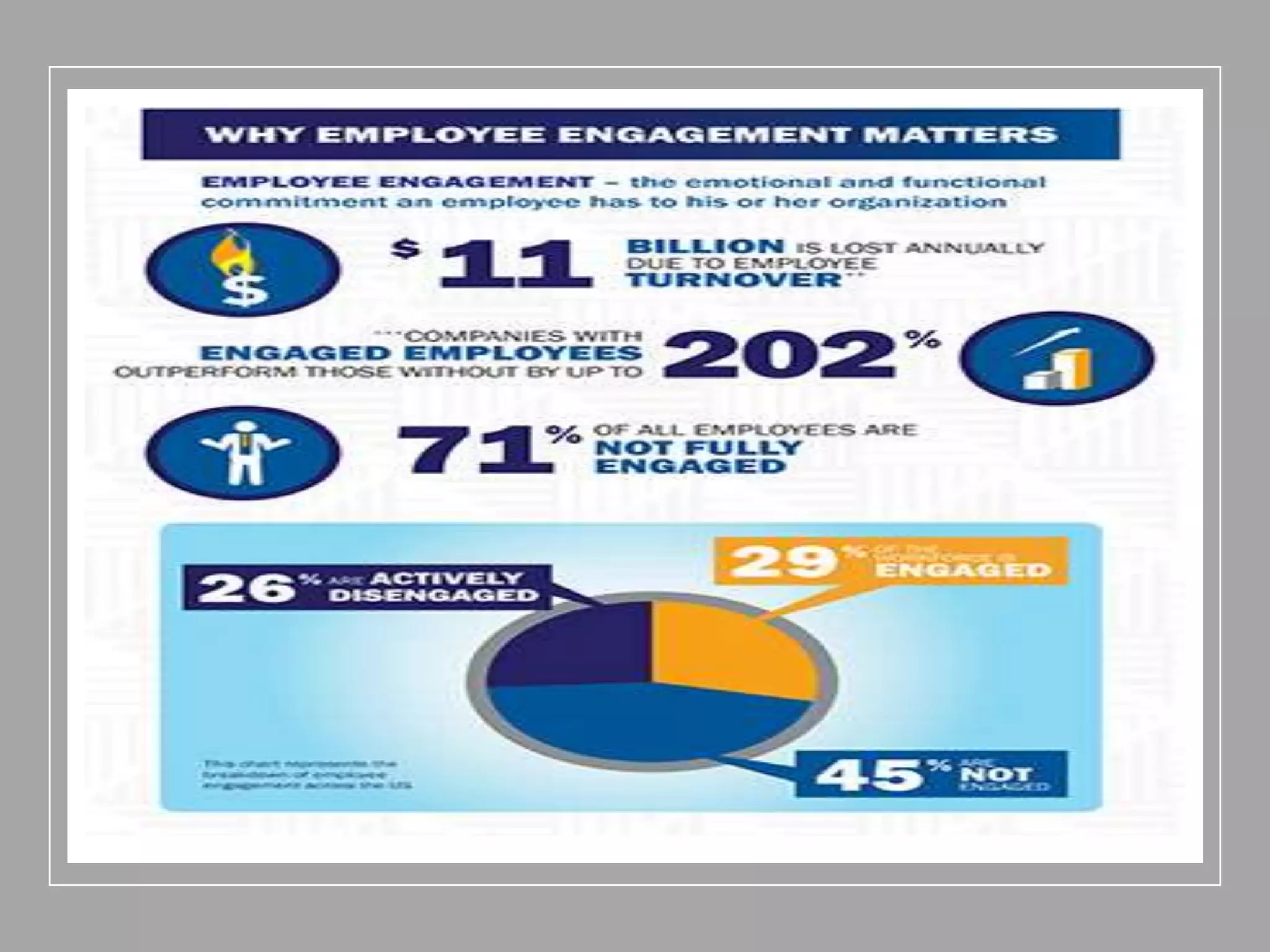
DEGREE OF USA EMPLOYEE
ENGAGEMENT (GALLUP 2013)
• 71% of employees are
disengaged:
45% are not engaged (BASICS)
26% are actively disengaged
(BREAKERS)
• 29% of the workforce are
engaged (BUILDERS)
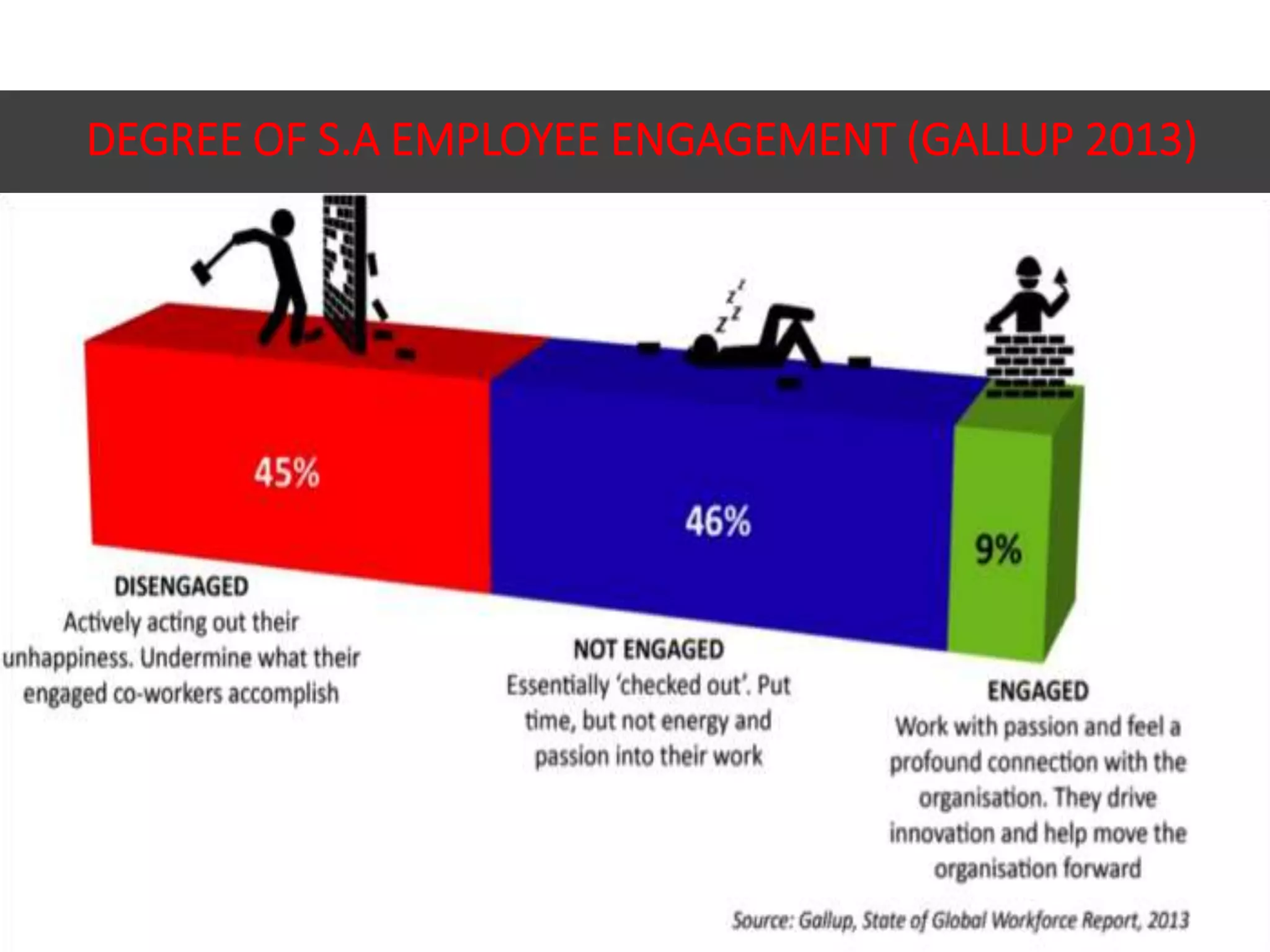
DEGREE OF S.A EMPLOYEE ENGAGEMENT (GALLUP 2013)
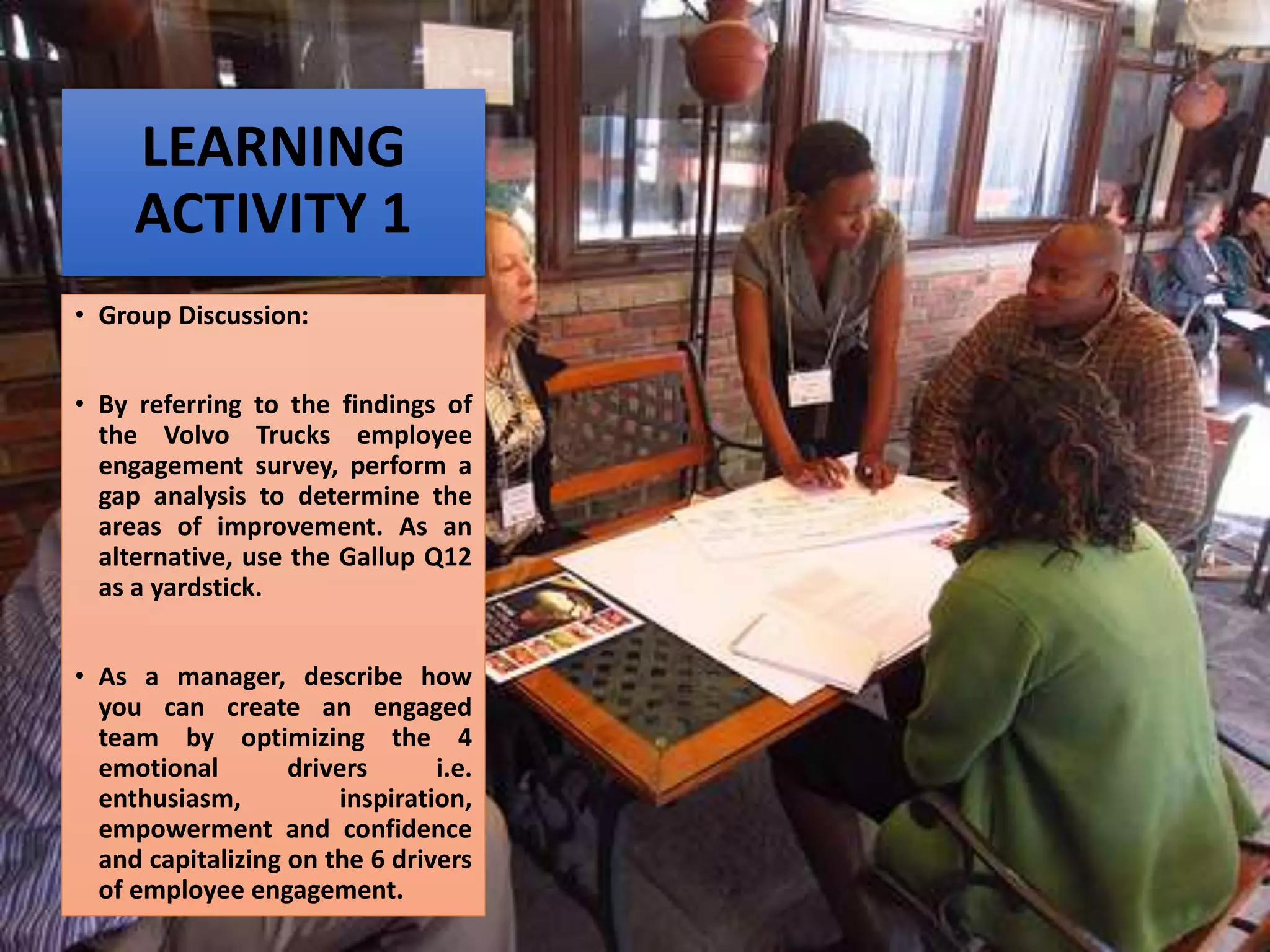
LEARNING
ACTIVITY 1
• Group Discussion:
• By referring to the findings of
the Volvo Trucks employee
engagement survey, perform a
gap analysis to determine the
areas of improvement. As an
alternative, use the Gallup Q12
as a yardstick.
• As a manager, describe how
you can create an engaged
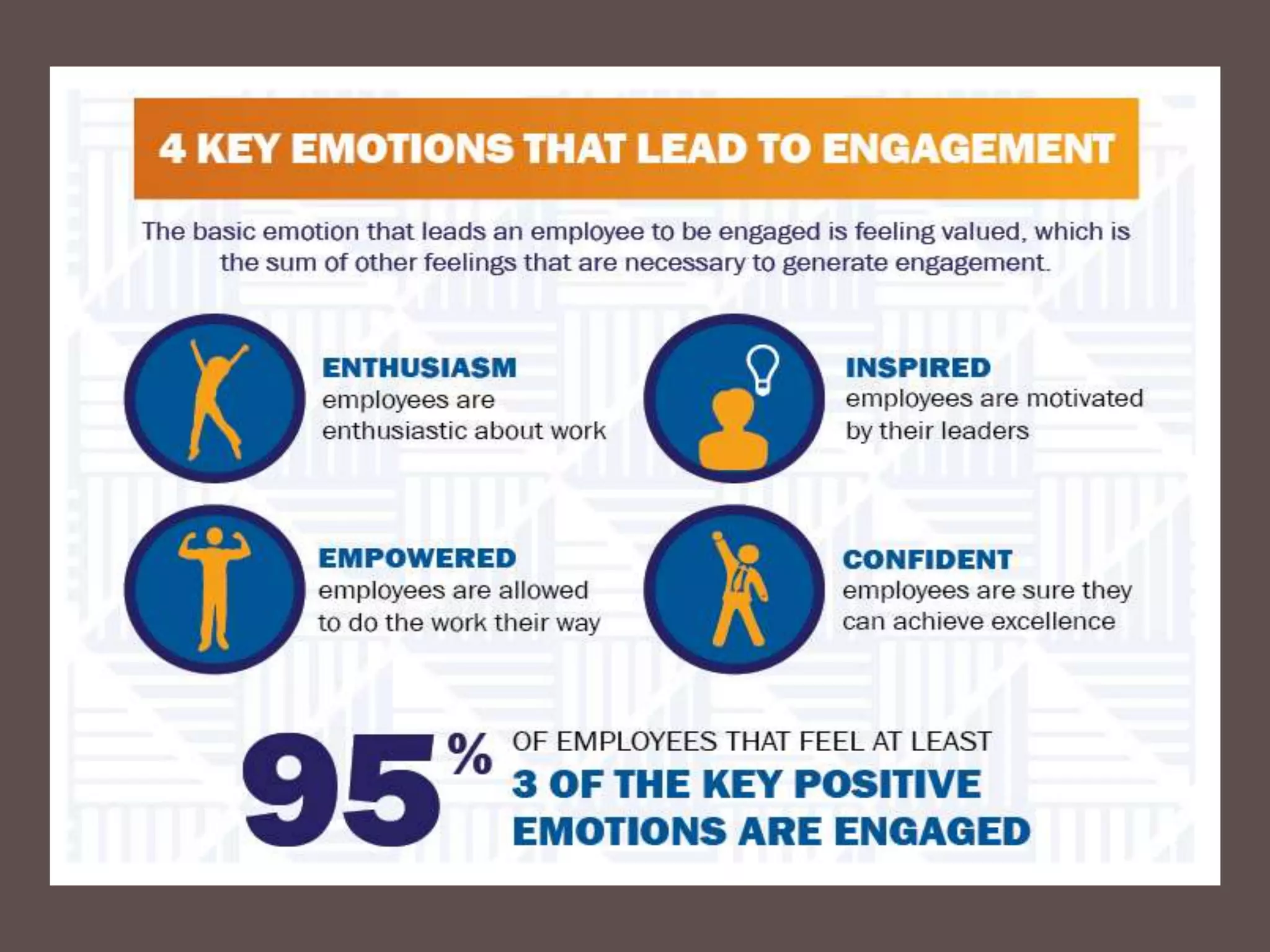
team by optimizing the 4
emotional drivers i.e.
enthusiasm, inspiration,
empowerment and confidence
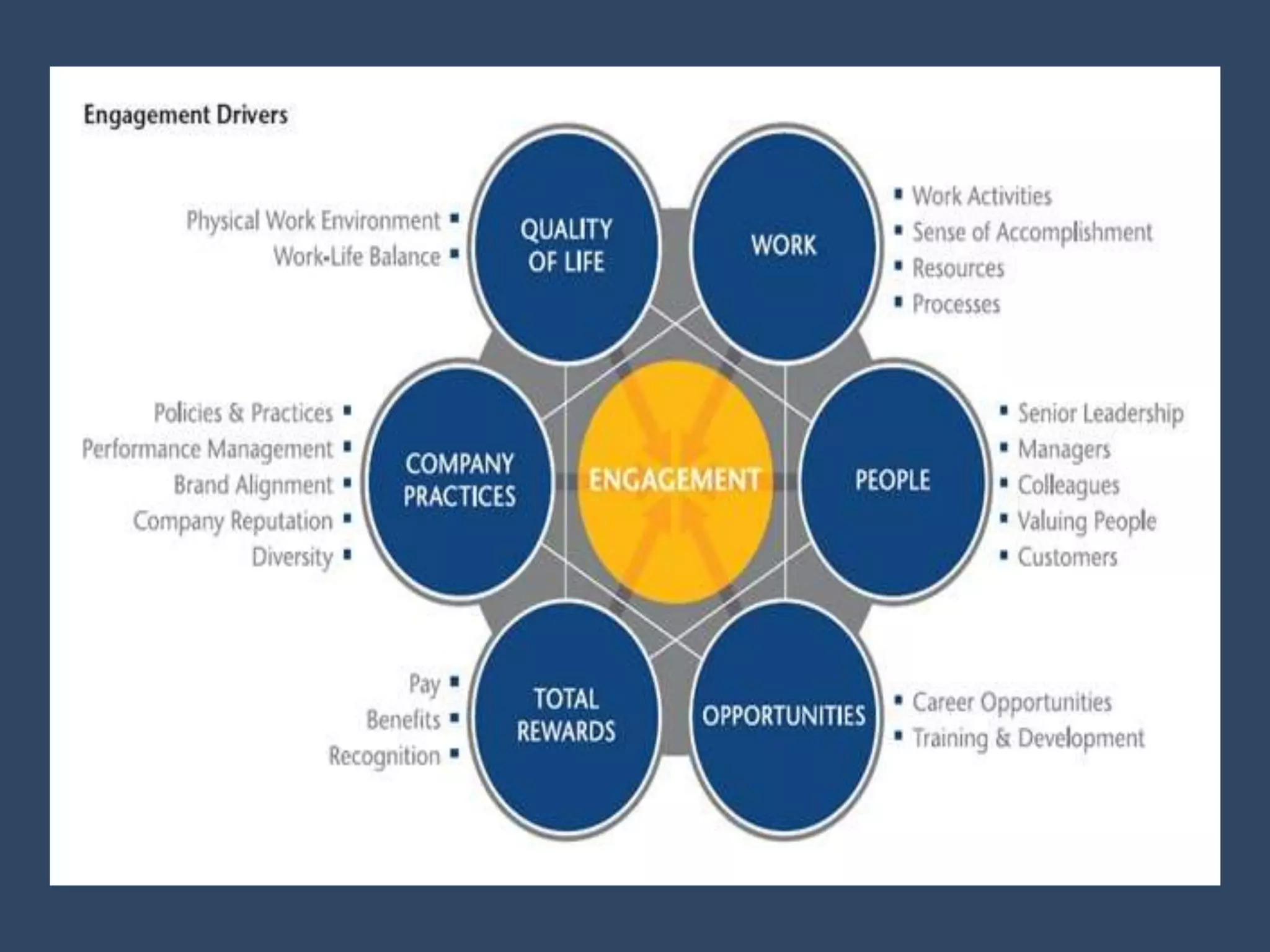
and capitalizing on the 6 drivers
of employee engagement.
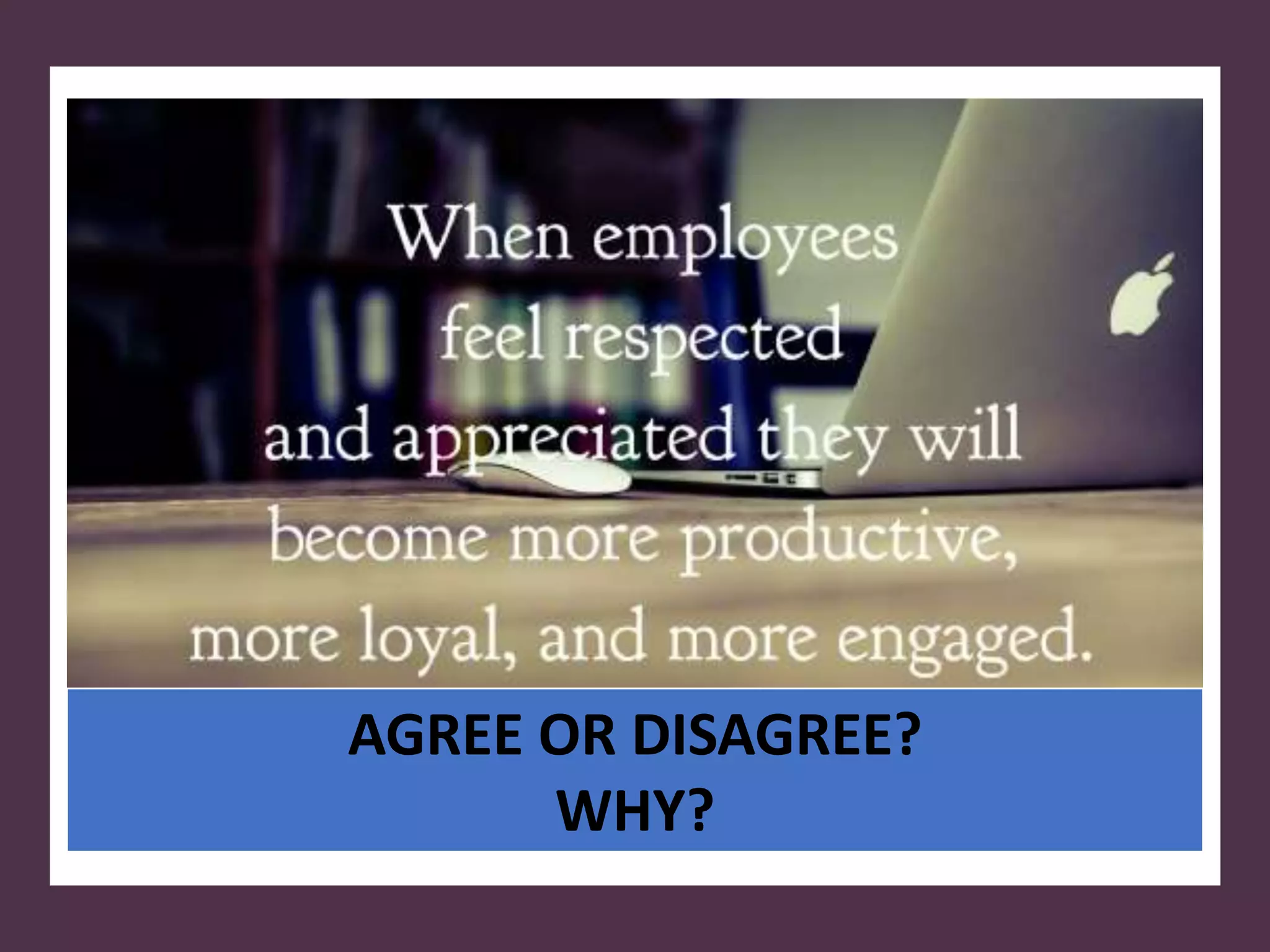
AGREE OR DISAGREE?
WHY?
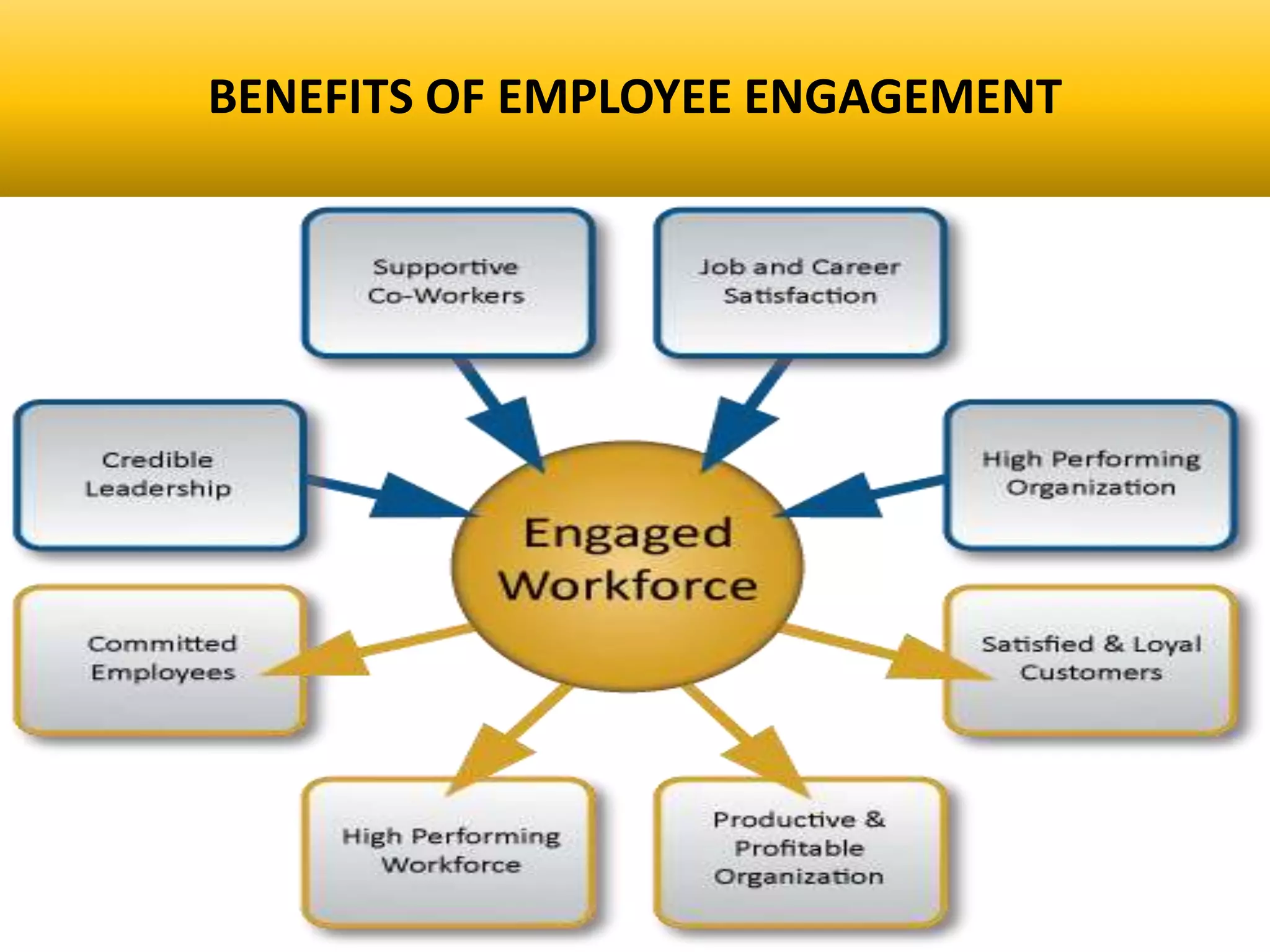
BENEFITS OF EMPLOYEE ENGAGEMENT
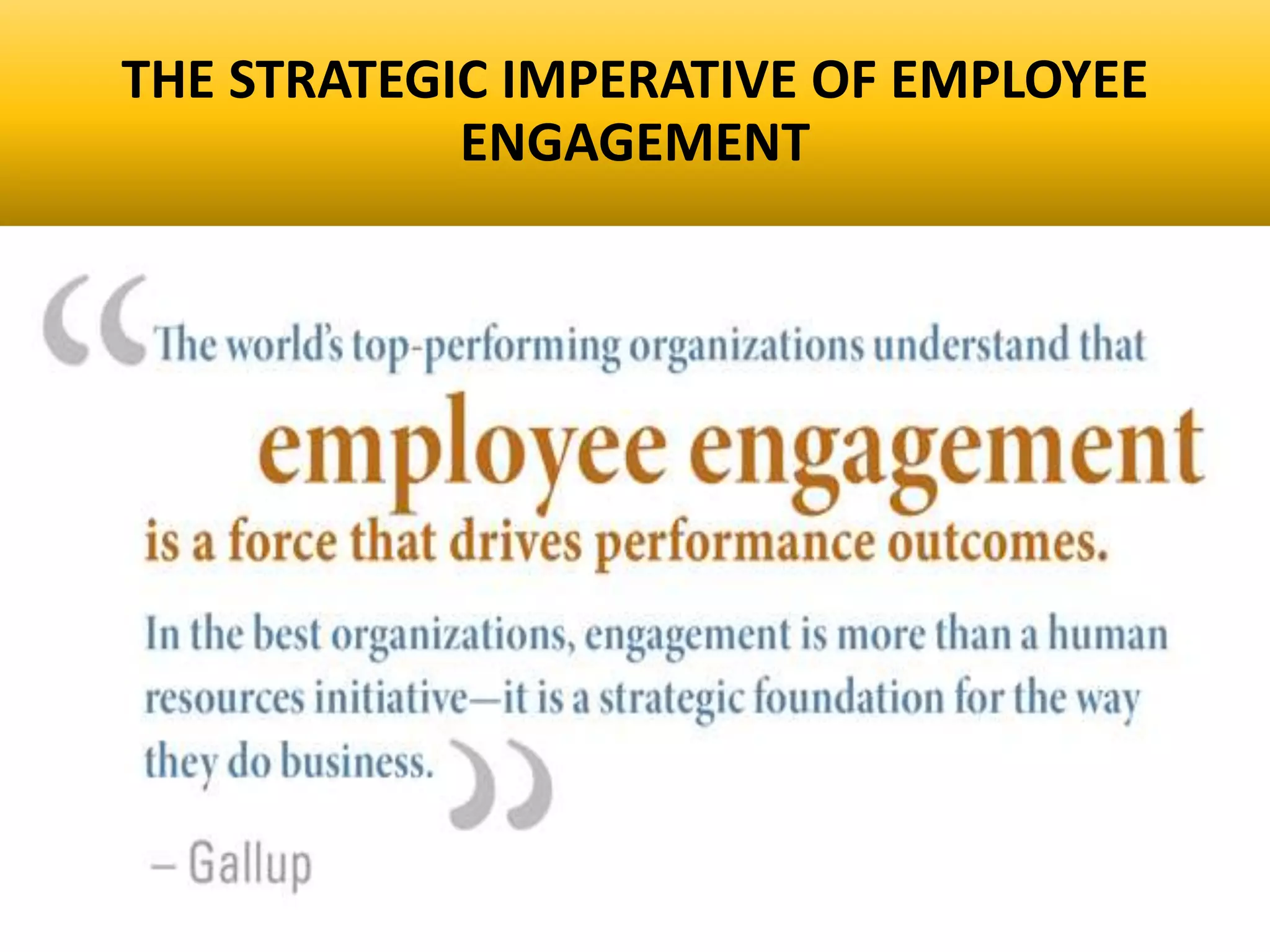
THE STRATEGIC IMPERATIVE OF EMPLOYEE
ENGAGEMENT
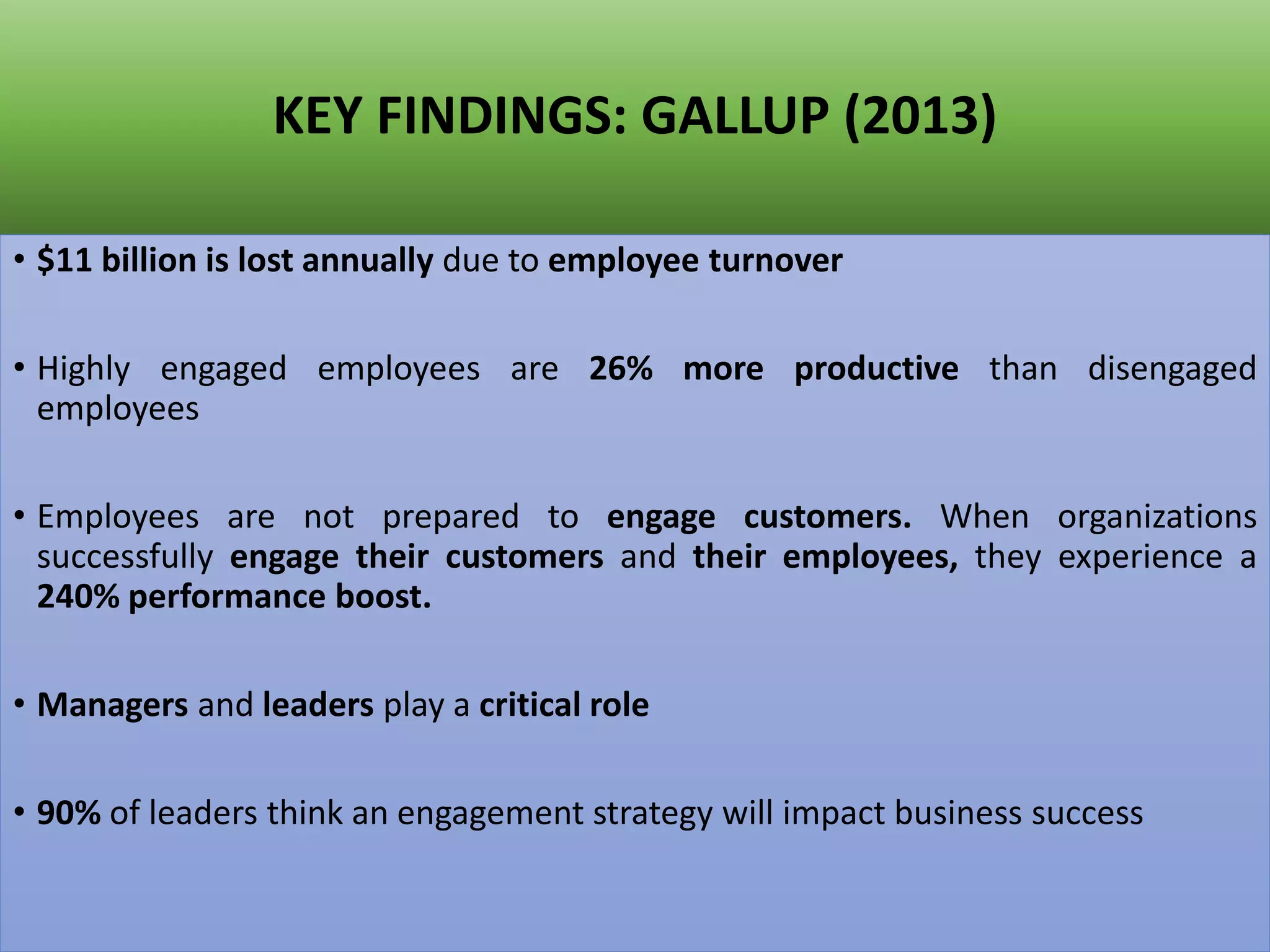
KEY FINDINGS: GALLUP (2013)
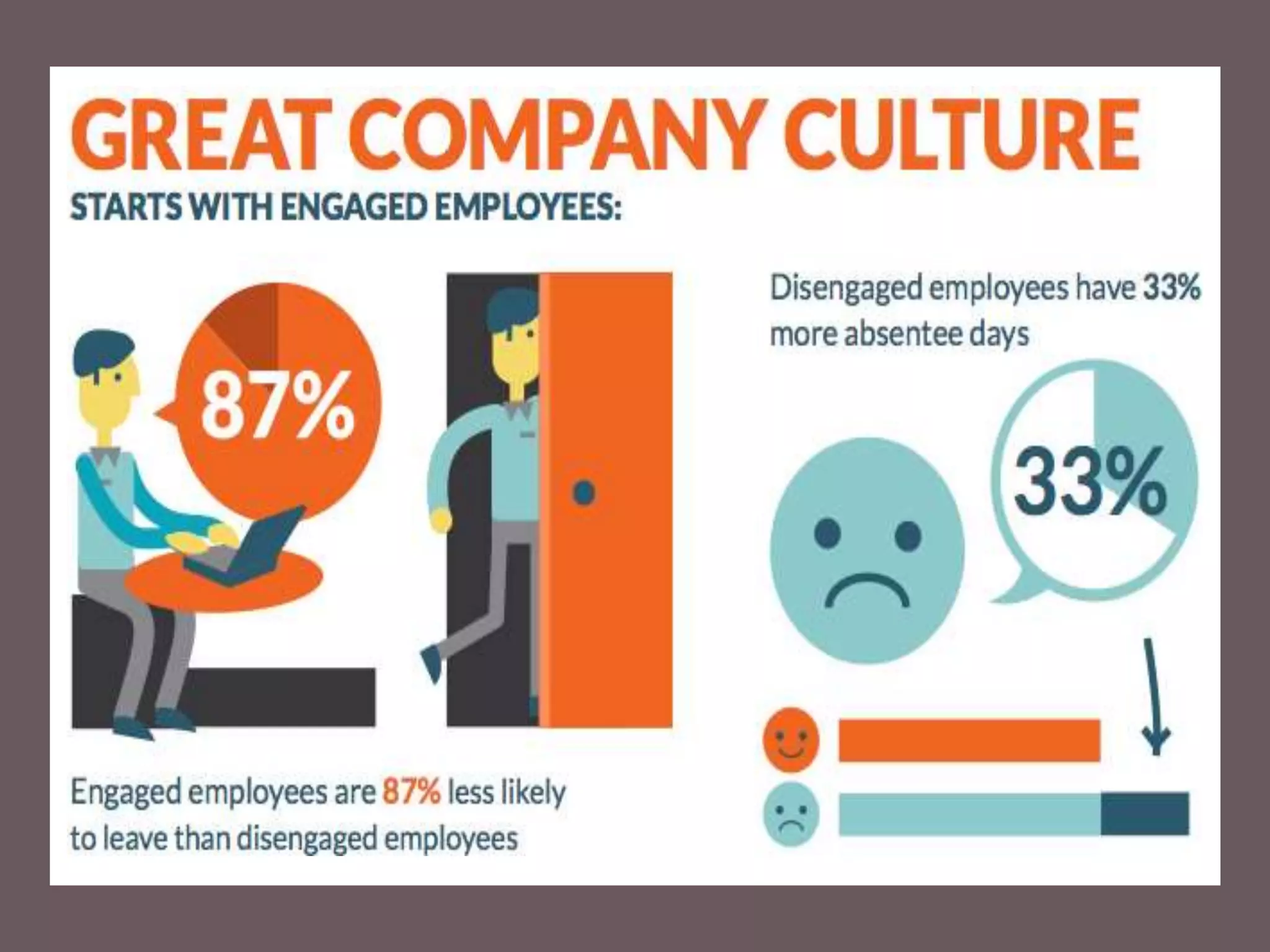
• $11 billion is lost annually due to employee turnover
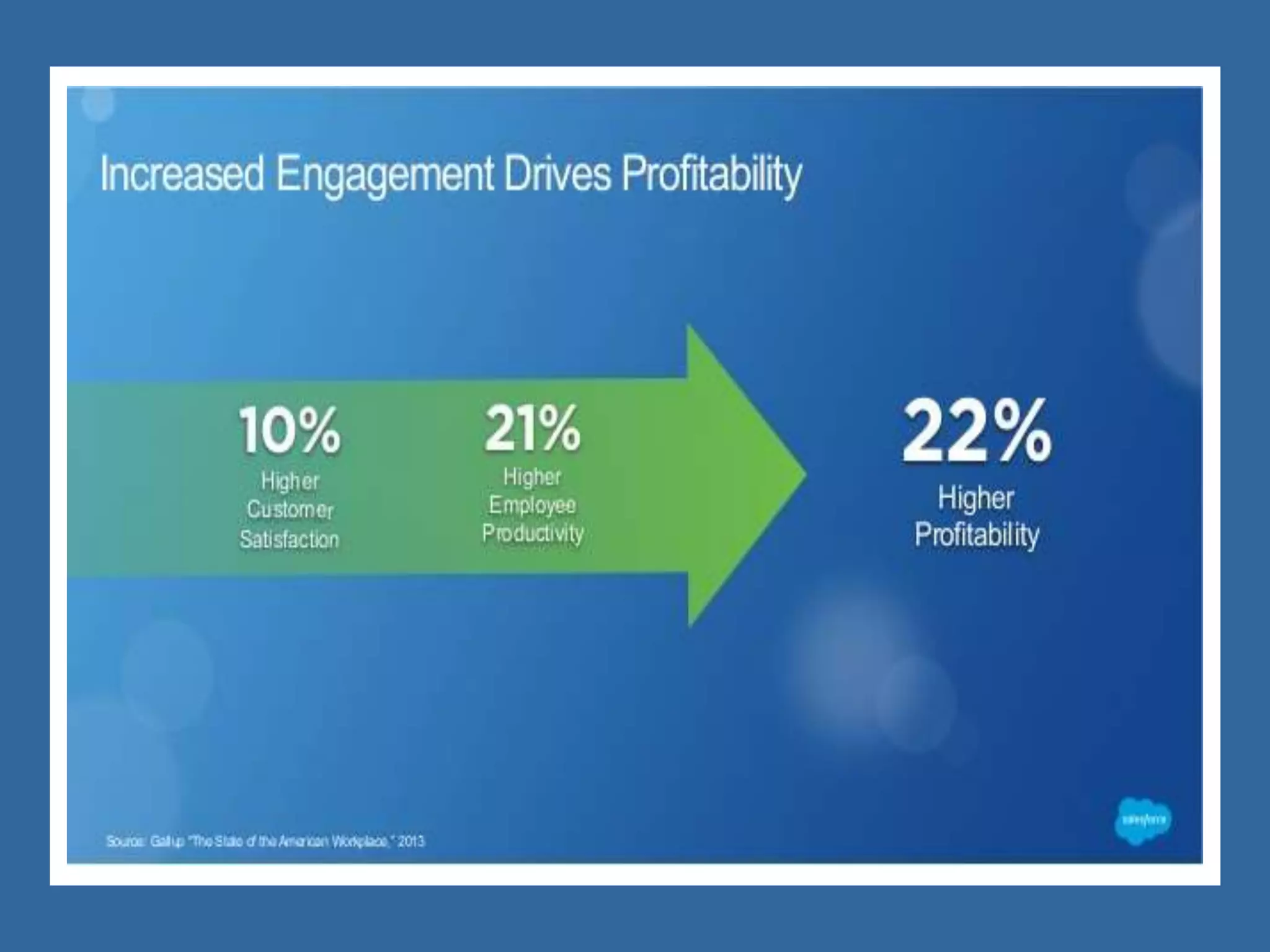
• Highly engaged employees are 26% more productive than disengaged
employees
• Employees are not prepared to engage customers. When organizations
successfully engage their customers and their employees, they experience a
240% performance boost.
• Managers and leaders play a critical role
• 90% of leaders think an engagement strategy will impact business success
KEY FINDINGS: GALLUP (2013)
• Different types of workers need different engagement strategies
• Engagement makes a difference to the bottom line - companies earned 13%
greater total returns for shareholders over a 5-year financial period
• Companies with engaged employees perform 202% better than those without
• Engagement has a greater impact on performance than corporate policies and
perks
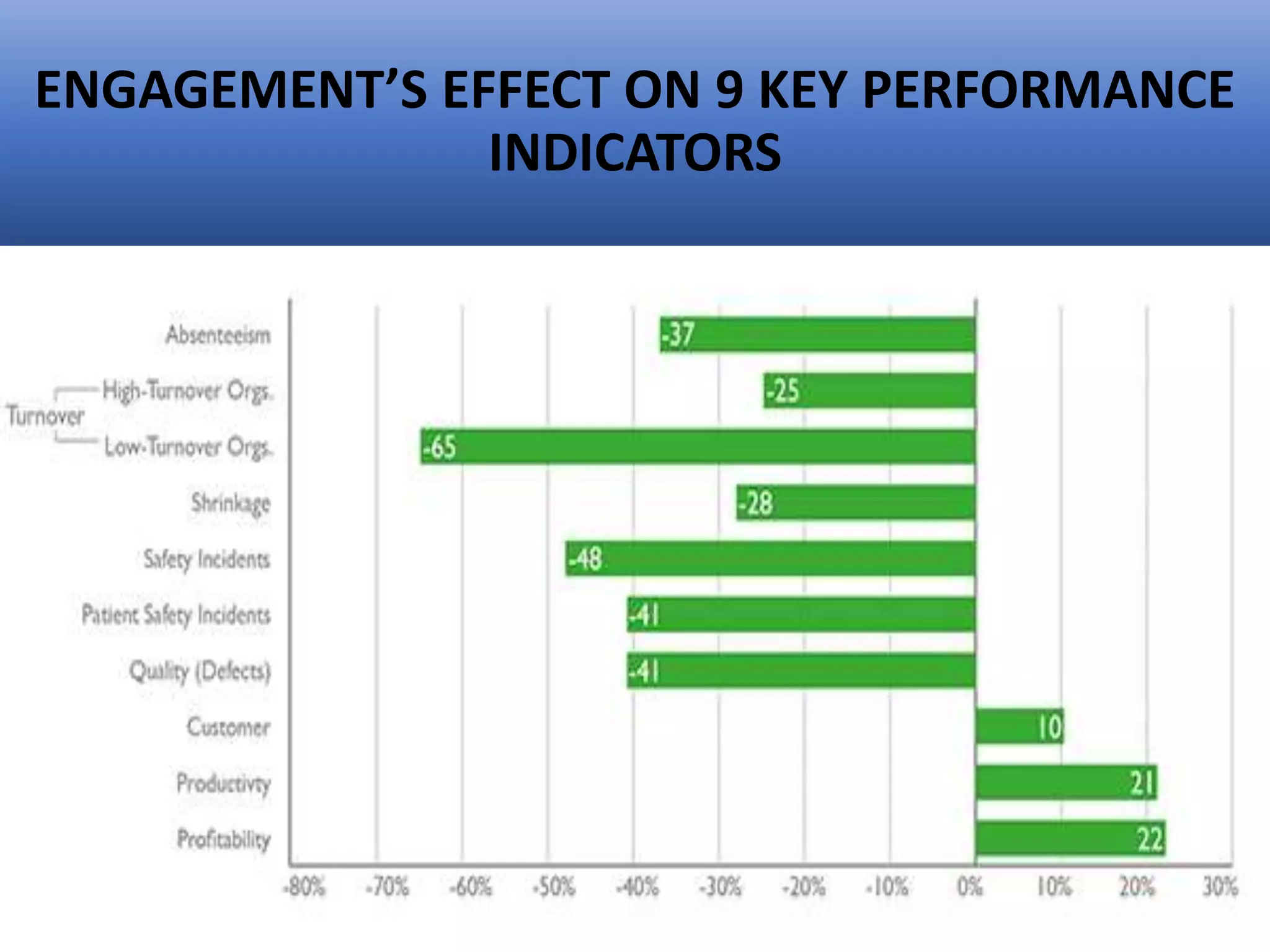
• The most compelling evidence of the benefits of an engaged workforce is the
identification of a positive impact on 9 business performance indicators.
ENGAGEMENT’S EFFECT ON 9 KEY PERFORMANCE
INDICATORS
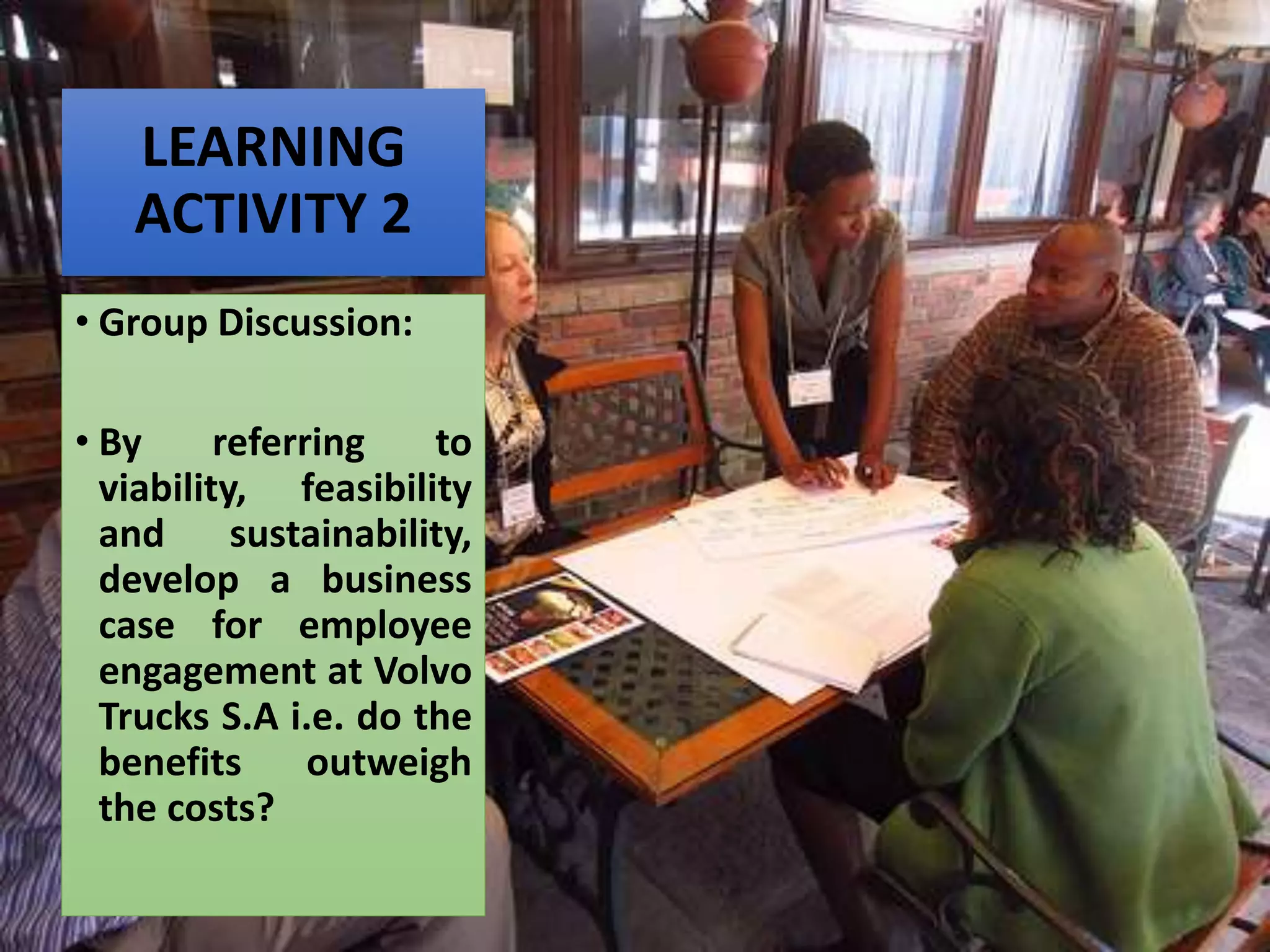
LEARNING
ACTIVITY 2
• Group Discussion:
• By referring to
viability, feasibility
and sustainability,
develop a business
case for employee
engagement at Volvo
Trucks S.A i.e. do the
benefits outweigh
the costs?
• A resourcing strategy is concerned with shaping what an organization has to offer to
people to join and stay in the organization. (Armstrong, 2011)
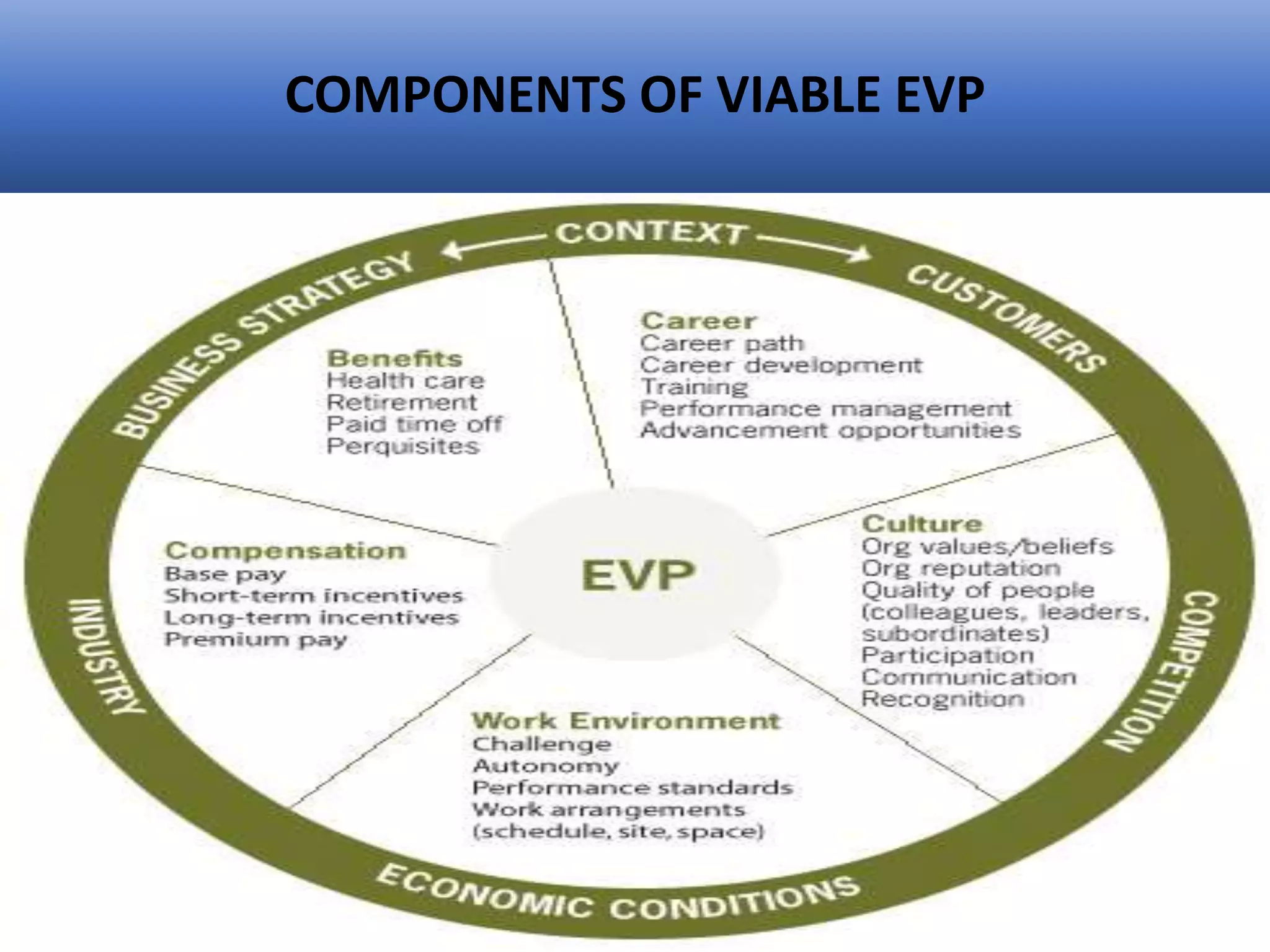
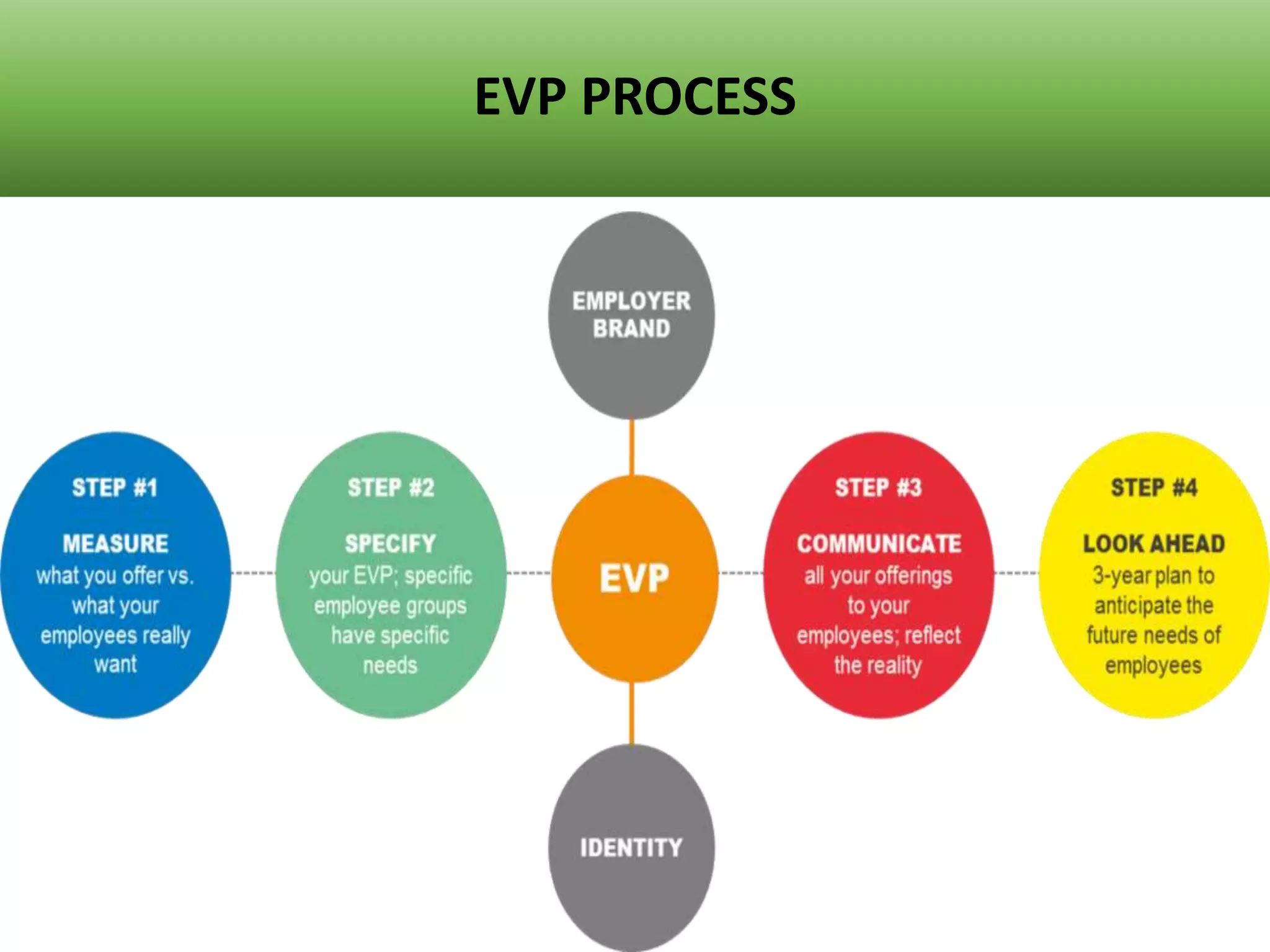
• EVP is a statement of what an organization will provide for people that they will value -
why the total work experience at their organization is superior to that at other
organizations.
• The EVP is an employee-centered approach that is aligned to existing, integrated
workforce planning strategies because it has been informed by existing employees and
the external target audience.
• Key Selling Points (KSP): Host of financial and non-financial benefits
• Non-financial benefits:
The attractiveness of the organization
Responsibility – corporate conduct, ethics and CSR/CSI
Respect – diversity and inclusiveness
Work-life balance
Opportunities for personal and professional growth
EMPLOYEE VALUE PROPOSITION (EVP)
COMPONENTS OF VIABLE EVP
EVP PROCESS
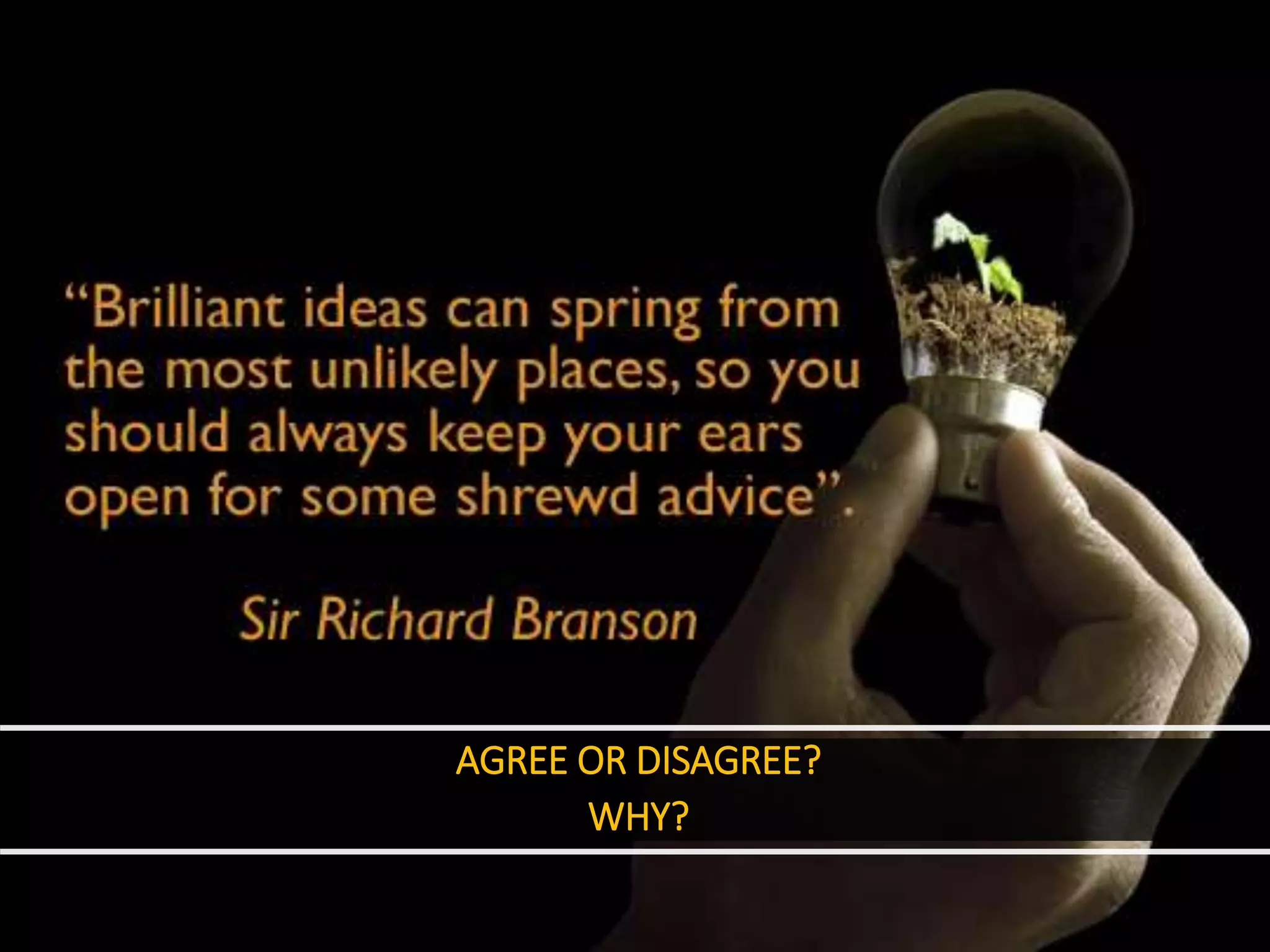
AGREE OR DISAGREE?
WHY?
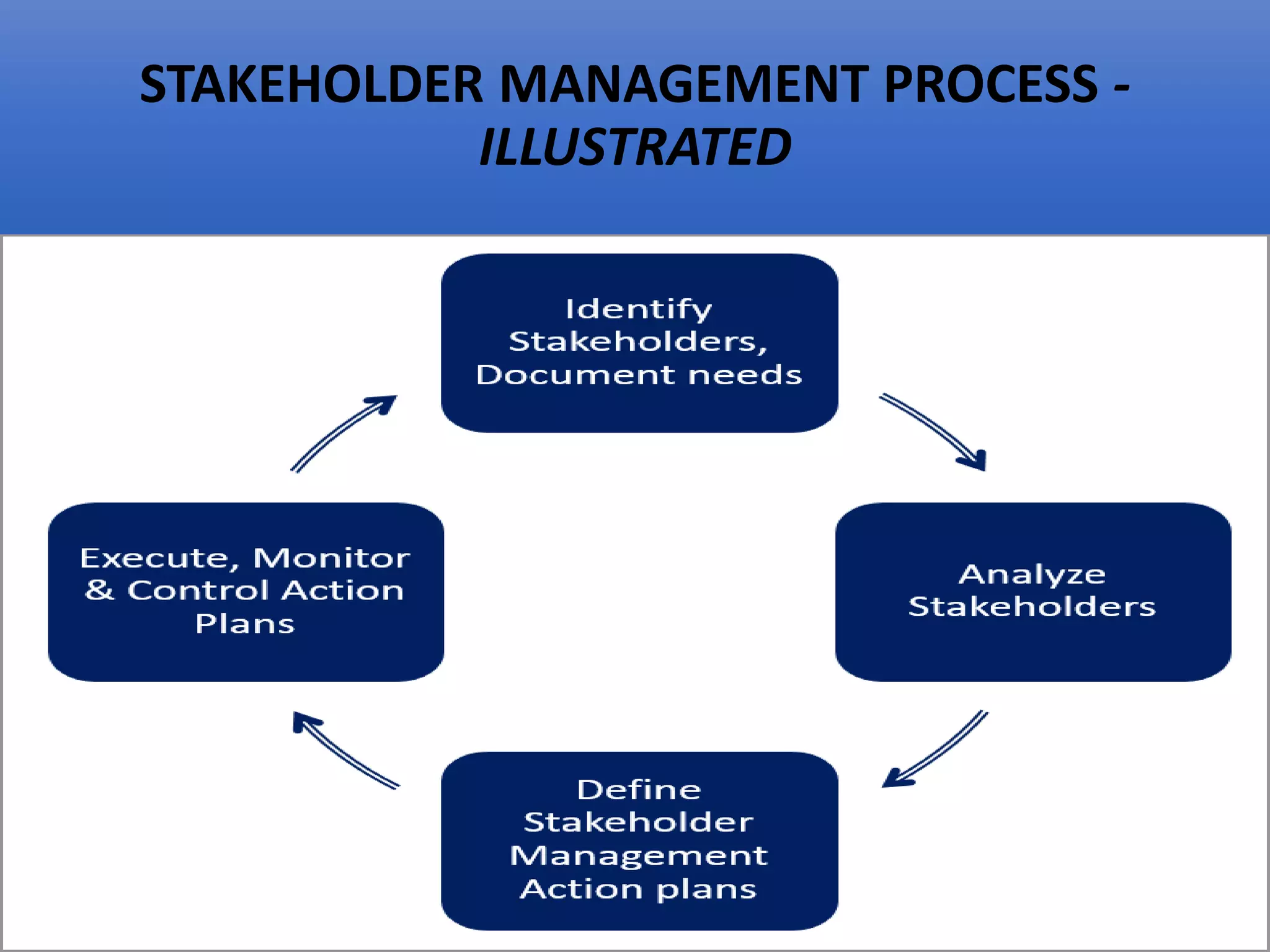
STAKEHOLDER MANAGEMENT PROCESS -
ILLUSTRATED
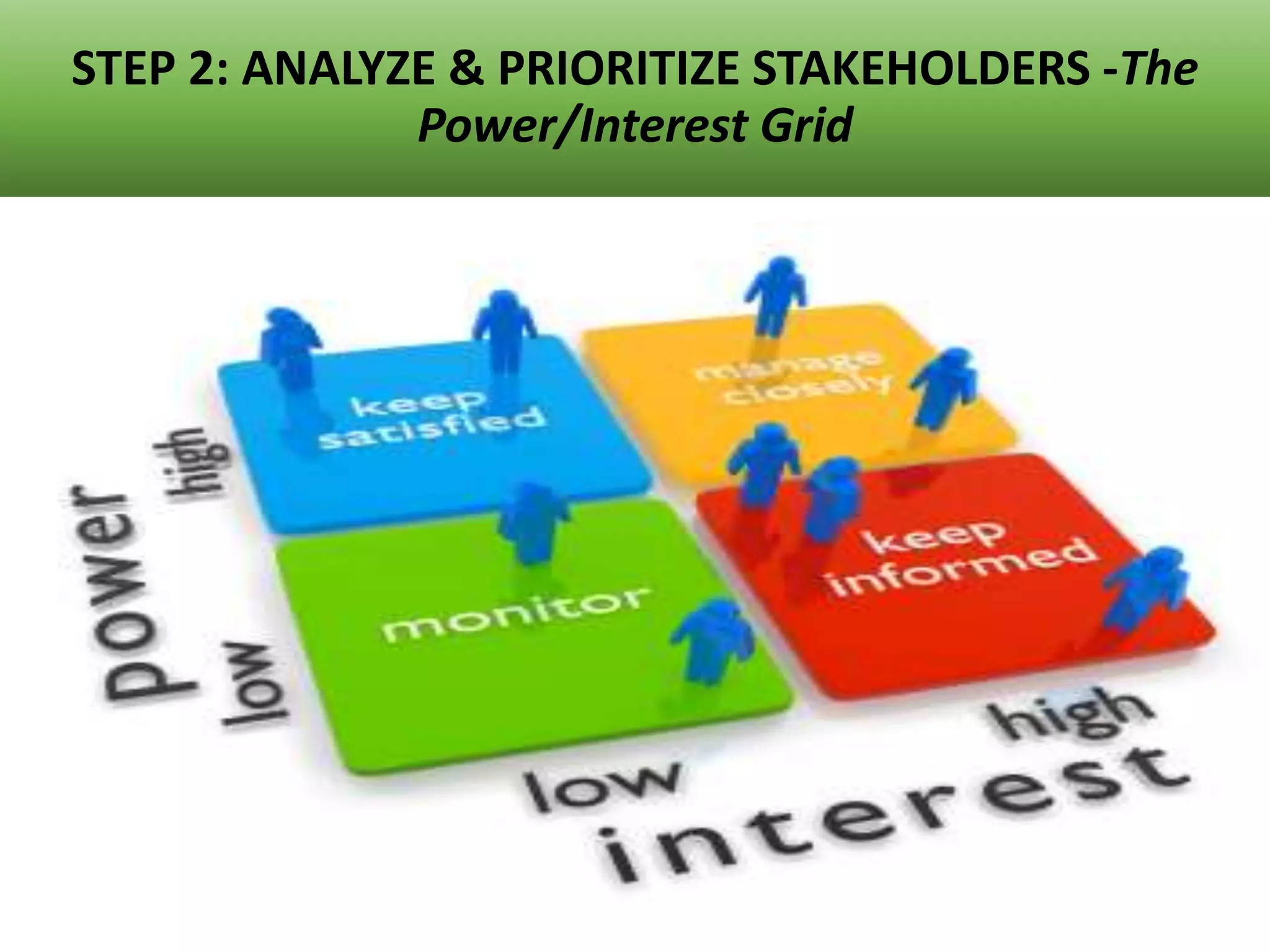
STEP 2: ANALYZE & PRIORITIZE STAKEHOLDERS -The
Power/Interest Grid
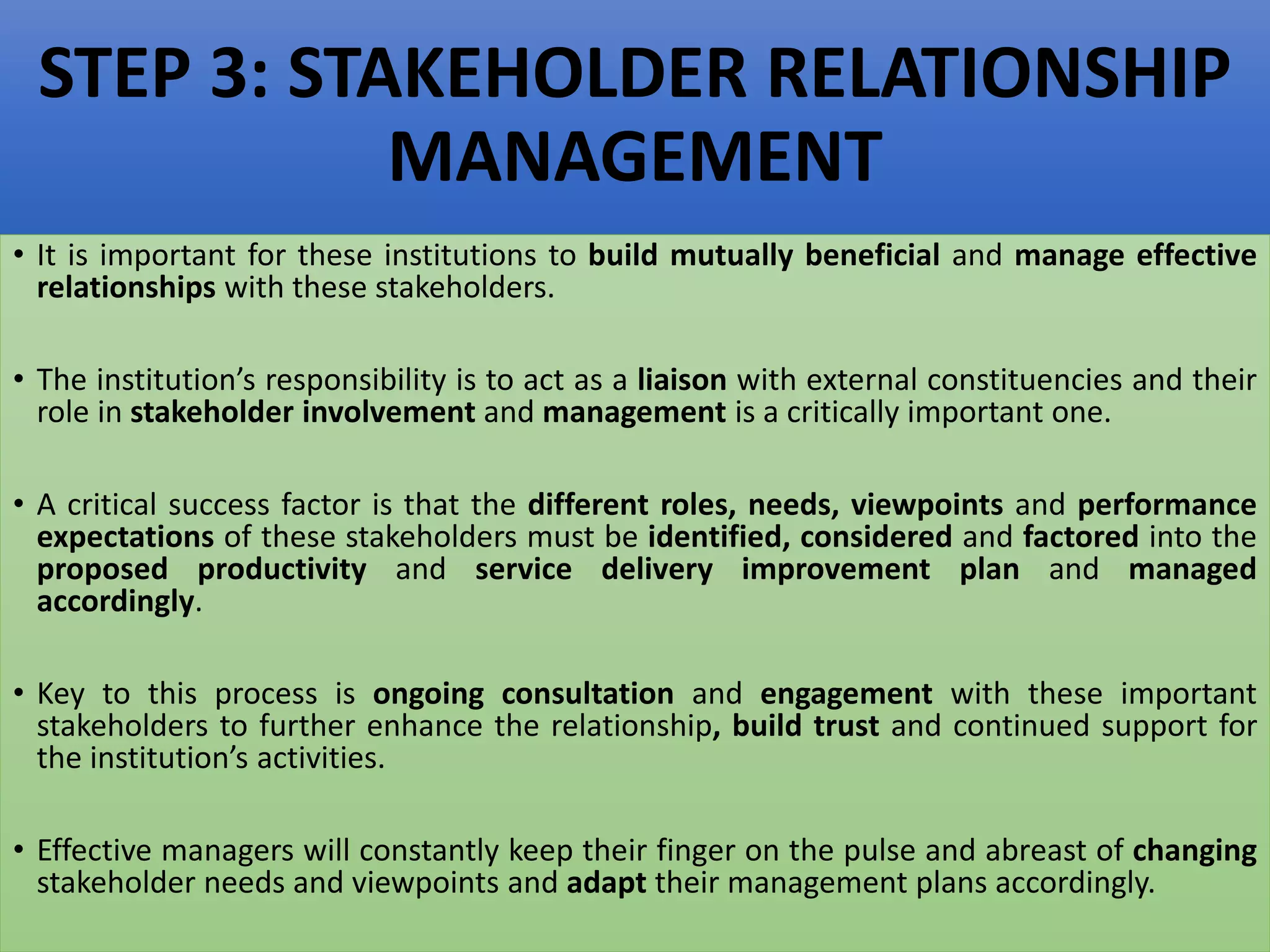
STEP 3: STAKEHOLDER RELATIONSHIP
MANAGEMENT
• It is important for these institutions to build mutually beneficial and manage effective
relationships with these stakeholders.
• The institution’s responsibility is to act as a liaison with external constituencies and their
role in stakeholder involvement and management is a critically important one.
• A critical success factor is that the different roles, needs, viewpoints and performance
expectations of these stakeholders must be identified, considered and factored into the
proposed productivity and service delivery improvement plan and managed
accordingly.
• Key to this process is ongoing consultation and engagement with these important
stakeholders to further enhance the relationship, build trust and continued support for
the institution’s activities.
• Effective managers will constantly keep their finger on the pulse and abreast of changing
stakeholder needs and viewpoints and adapt their management plans accordingly.
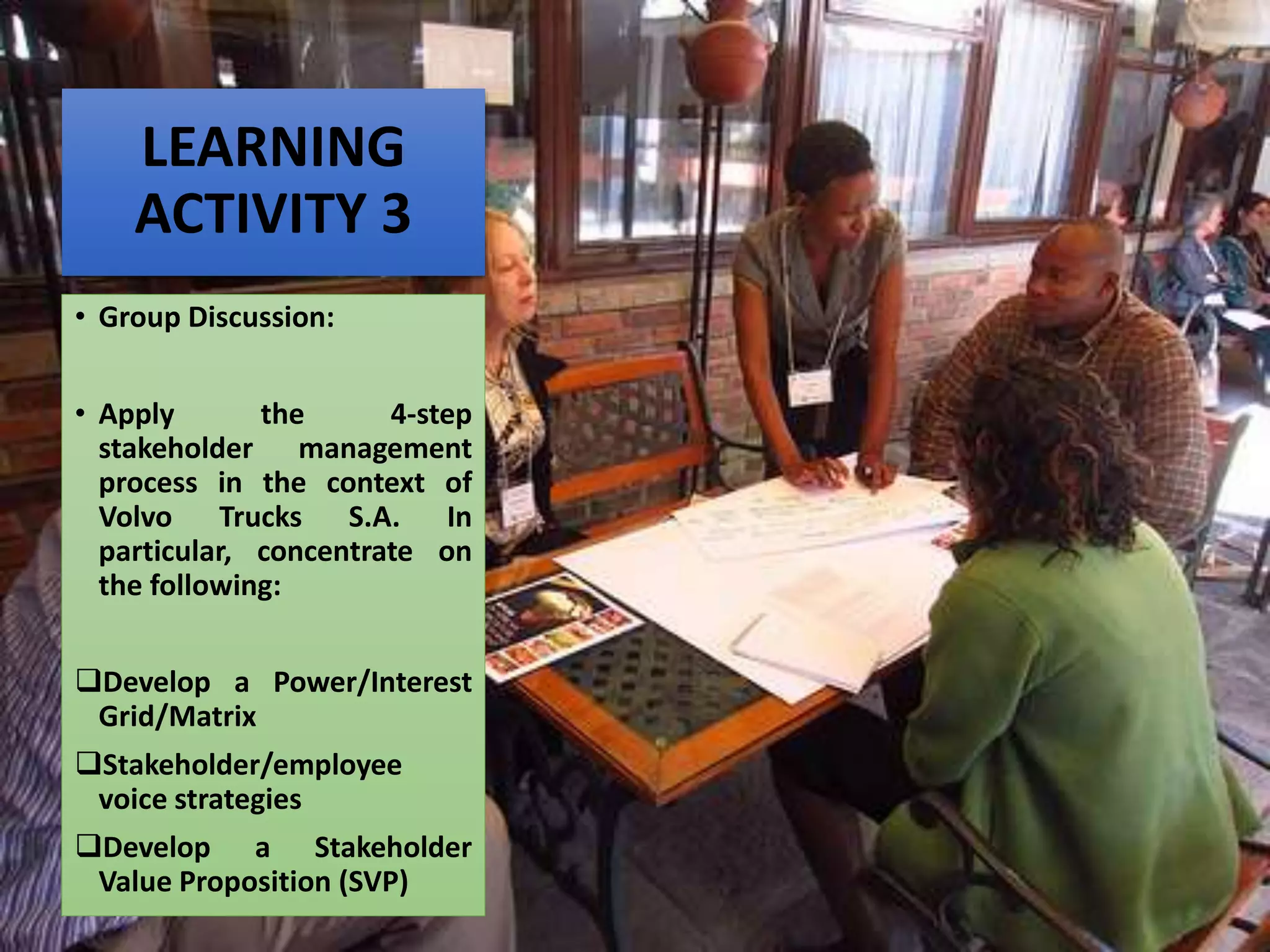
LEARNING
ACTIVITY 3
• Group Discussion:
• Apply the 4-step
stakeholder management
process in the context of
Volvo Trucks S.A. In
particular, concentrate on
the following:
Develop a Power/Interest
Grid/Matrix
Stakeholder/employee
voice strategies
Develop a Stakeholder
Value Proposition (SVP)
STRATEGIES
AGREE OR DISAGREE?
WHY?
EMPLOYEE ENGAGEMENT STRATEGIES
• Engagement with the job
Where employees are strongly engaged with the work they are actually doing, research shows
that this produces high performance, high levels of support to the team and low levels of
deviant behaviour.
While most engagement interventions seek to build organisational engagement, it might be
better to look at interventions to make work more meaningful for employees and/or to work
harder on the person/job fit.
• Engagement with the organisation
Good practice in this area requires total buy-in and visible leadership and commitment for all
levels of managers.
Many of the issues which directly impact on the engagement of employees reside with
managers and their behaviour and treatment of employees.
HR practitioners’ roles are to diagnose, support and coach management on those issues and to
review, redesign and implement HR specific programmes including learning and development,
performance management and reward management.
CIPD STRATEGIES (2013)
• “Giving employees meaningful voice: facilitating upwards feedback,
having respectful, adult to-adult conversations and responding to
employee views
• Effective communications that keep employees well informed and
reinforce the organisation’s purpose
• Role modelling: employees need to see that managers are committed
to the organisation and uphold the values of employee engagement in
how they act
• Fair and just management processes for dealing with problems and
supporting employee well-being.”
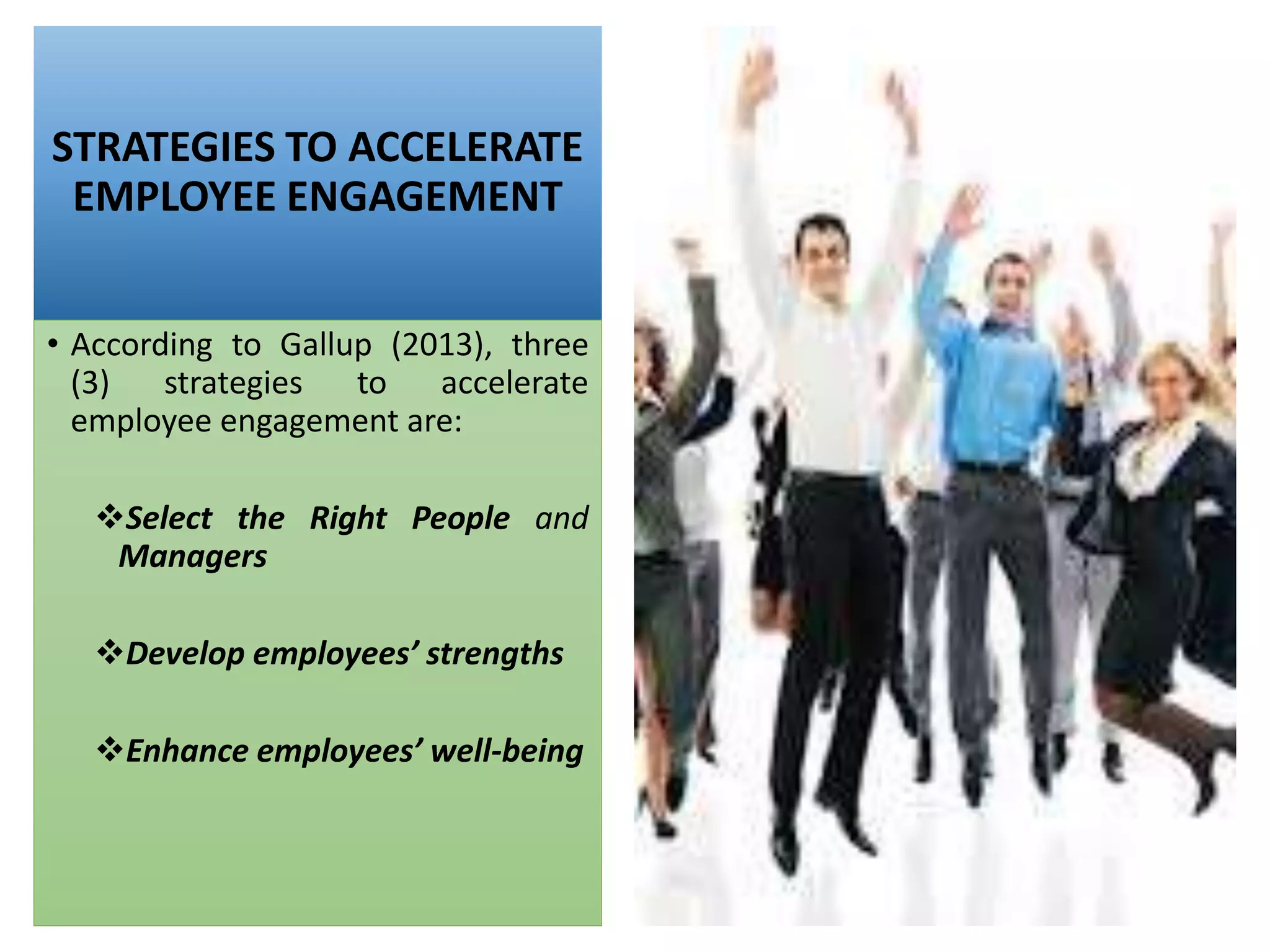
STRATEGIES TO ACCELERATE
EMPLOYEE ENGAGEMENT
• According to Gallup (2013), three
(3) strategies to accelerate
employee engagement are:
Select the Right People and
Managers
Develop employees’ strengths
Enhance employees’ well-being
SELECT THE RIGHT PEOPLE AND RIGHT MANAGERS
• Through selecting the right managers and employees for any role, companies can
strategically boost engagement.
• Great managers have great talent for supporting, positioning, empowering, and
engaging their staff.
• A few key employees stand out for their ability to foster workplace engagement.
They energize and influence others with their commitment to achieving
organizational and team objectives.
• Gallup developed the Engagement Creation Index (ECI) — an innovative tool
designed to identify and measure the talent for engaging others — to help
organizations transform their engagement dynamic by adjusting their hiring
practices. ECI captures a candidate’s ability to act as a catalyst to build engaged
work teams.
SELECT THE RIGHT PEOPLE AND RIGHT MANAGERS
• It is imperative for leaders to devise selection strategies with the goal
of accelerating employee engagement. This starts with hiring and
promoting managers based on objective selection criteria to ensure
that companies hire/promote managers with the talent to lead and
engage their workgroups.
• With each new hire or promotion, employers have the opportunity to
maximize employee engagement in the workplace.
• People want to feel supported, have a sense of belonging, and
understand the contribution they can make toward organizational
goals. Making sure that they get these things from their interactions
with managers and team members is key to driving their engagement.
STRENGTHS-BASED LEADERSHIP APPROACH TO
EMPLOYEE ENGAGEMENT
• Managers who focus on their employees’ strengths can practically eliminate
active disengagement and double the average of U.S. workers who are engaged
nationwide.
• Building employees’ strengths is a far more effective approach than trying to
improve weaknesses.
• A strengths-based management approach is the best way to improve the
employee - manager relationship.
• Increased productivity:
Gallup’s data show that simply learning their strengths makes employees 7.8% more
productive.
Teams that focus on strengths every day have 12.5% greater productivity.
STRENGTHS-BASED LEADERSHIP
APPROACH TO EMPLOYEE
ENGAGEMENT
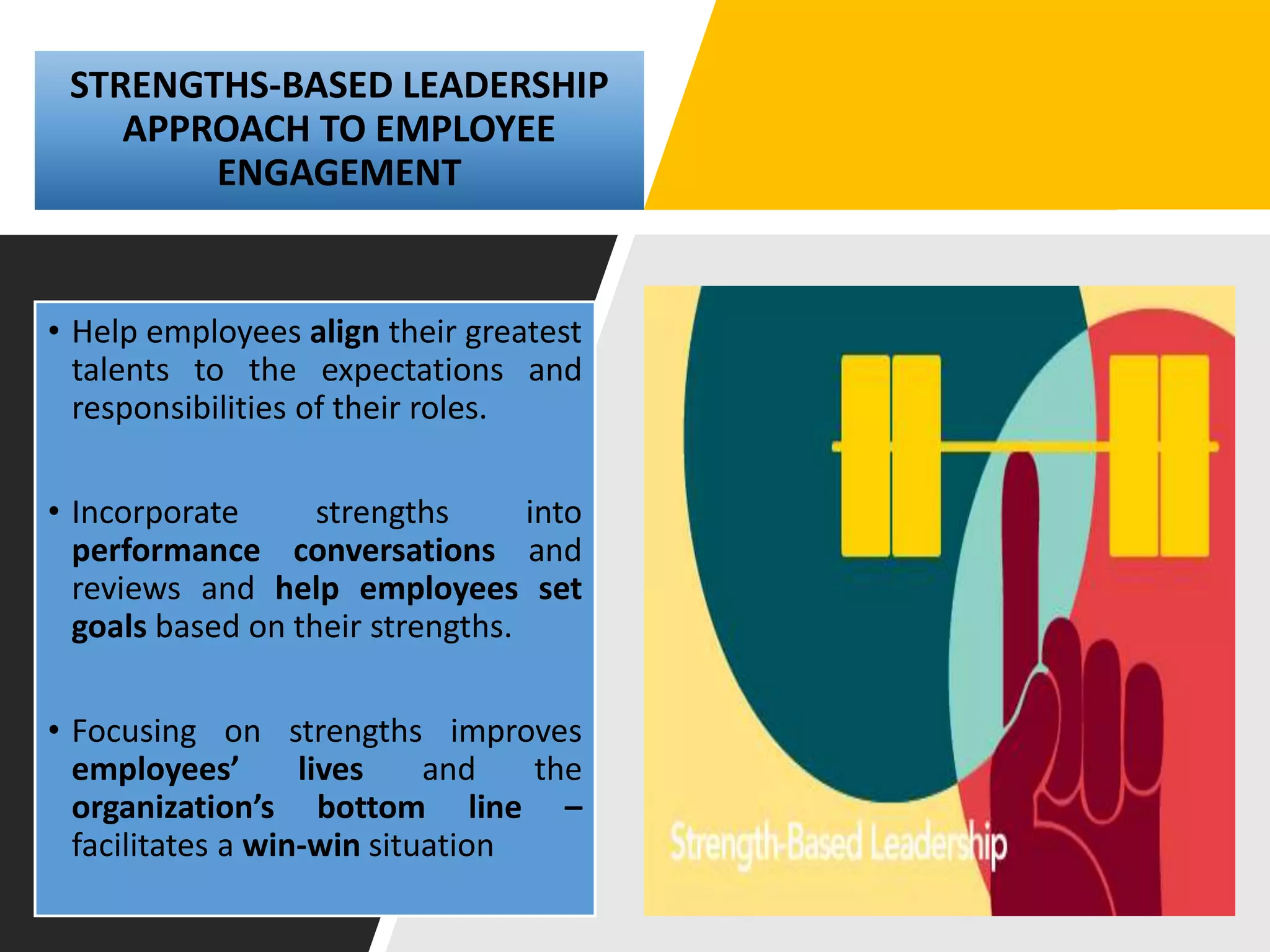
• Help employees align their greatest
talents to the expectations and
responsibilities of their roles.
• Incorporate strengths into
performance conversations and
reviews and help employees set
goals based on their strengths.
• Focusing on strengths improves
employees’ lives and the
organization’s bottom line –
facilitates a win-win situation
ENHANCE EMPLOYEES’ WELL-BEING
• Great managers know that the whole person comes to work and that each employee’s
well-being influences individual and organizational performance.
• Employees who are engaged in their jobs are generally in better health and have
healthier habits than employees who are not engaged or are actively disengaged.
• Engaged and thriving employees are resilient and agile
• Thriving employees have strong, progressive overall well-being; struggling employees
have moderate or inconsistent overall well-being; and suffering employees have well-
being that is at high risk.
• Employees who are thriving in their lives overall are more than twice as likely as those
who are struggling to be engaged in their jobs.
• Employees with high well-being have lower healthcare costs
THE MANAGER’S ROLE IN IMPROVING EMPLOYEE
ENGAGEMENT AND WELL-BEING
• Make well-being an organizational strategy — much like other organizational outcomes
• Communicate a commitment to well-being consistently in all of the programs the
company offers.
• Hold leaders accountable for well-being programs available to employees.
• Consider how to embed activities to increase well-being in individual development plans
and goals.
• Set positive defaults for making healthy choices.
In vending machines and cafeterias, ensure that healthy snacks and drinks are the most
accessible.
Offer plenty of opportunities to join physical or social activities throughout the day.
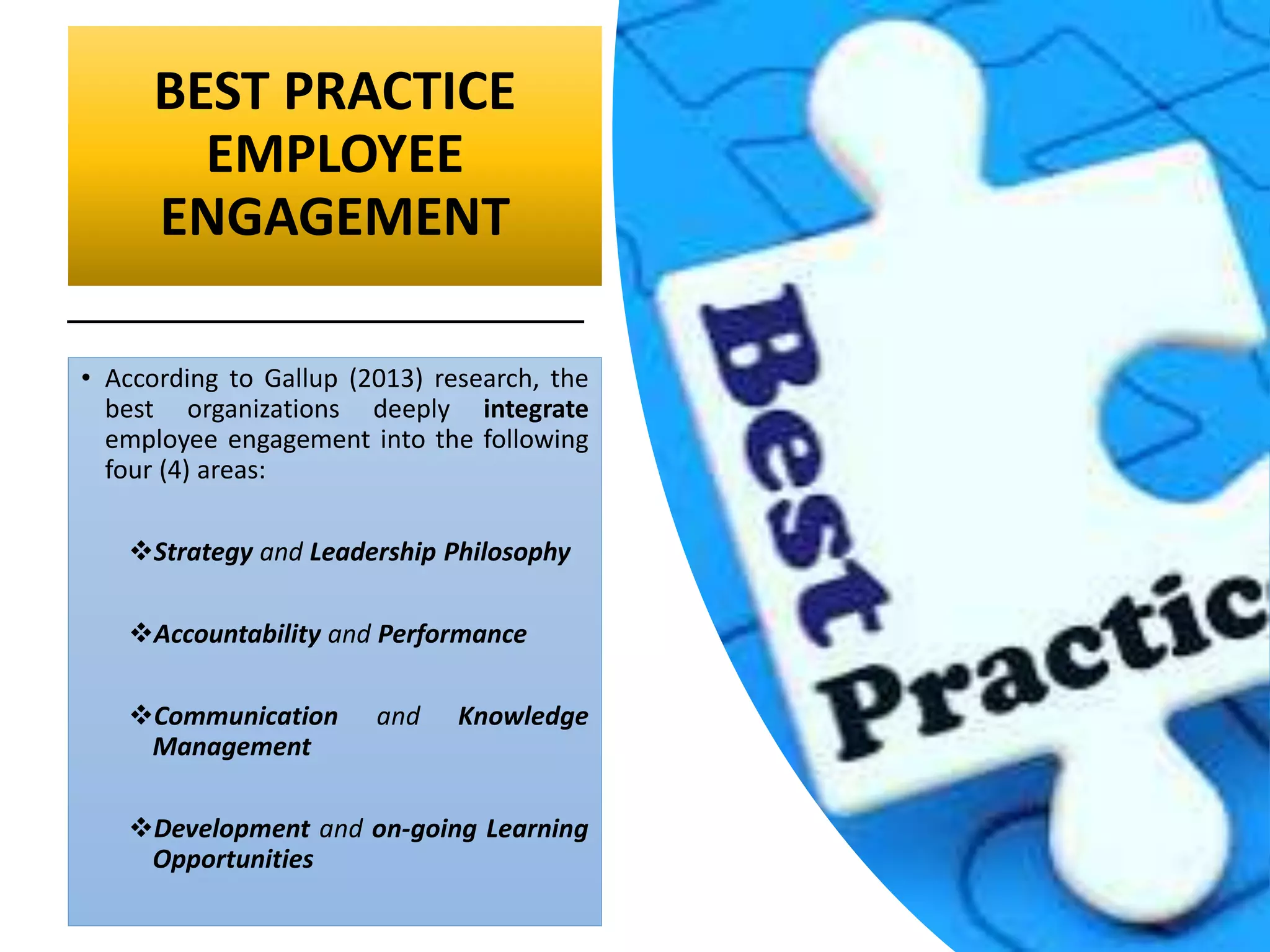
BEST PRACTICE
EMPLOYEE
ENGAGEMENT
• According to Gallup (2013) research, the
best organizations deeply integrate
employee engagement into the following
four (4) areas:
Strategy and Leadership Philosophy
Accountability and Performance
Communication and Knowledge
Management
Development and on-going Learning
Opportunities
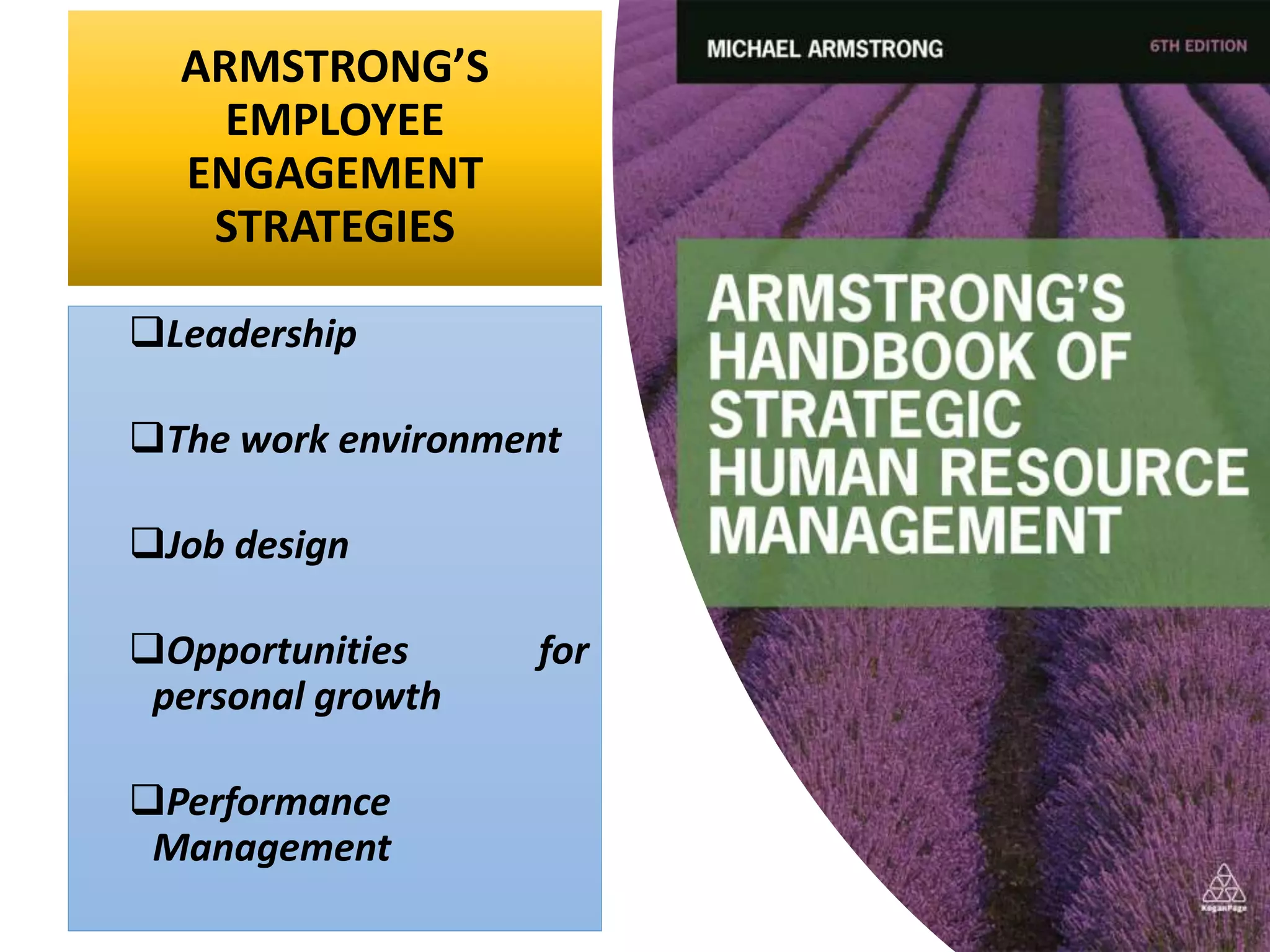
ARMSTRONG’S
EMPLOYEE
ENGAGEMENT
STRATEGIES
Leadership
The work environment
Job design
Opportunities for
personal growth
Performance
Management
TINYpulse (2014)
STRATEGIES
• Showing employee appreciation and
recognition
• Fostering a positive work culture
• Mapping professional growth plans
• Recruiting collegial, hard-working colleagues
• Hiring managers that are truly leaders
• Empowering employees with tools to succeed
• Enabling peer recognition
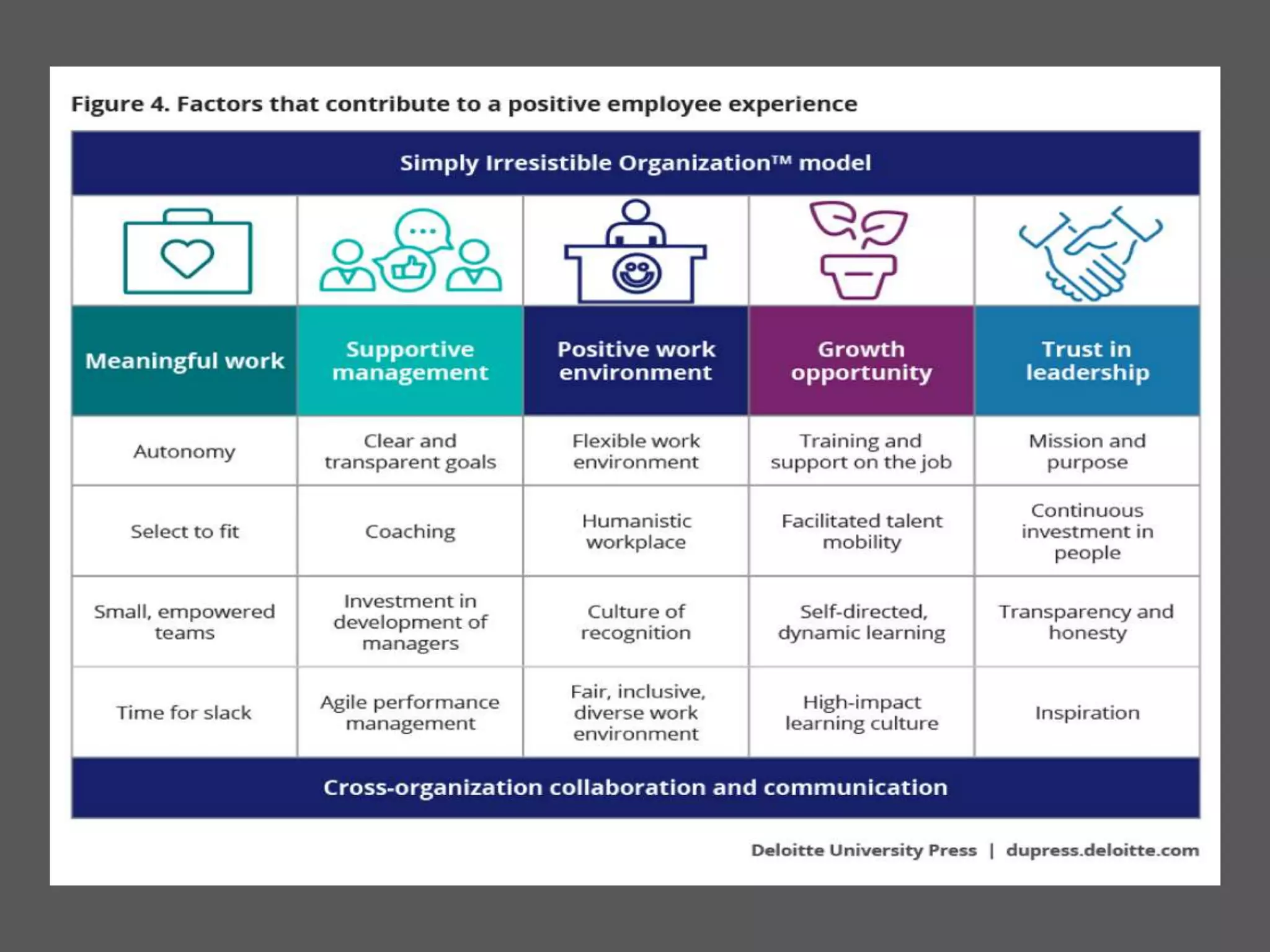
LEARNING
ACTIVITY 4
• Group Discussion:
• Critically evaluate Volvo
Trucks S.A against the 5
factors of the Deloitte
Irresistible Organization
model. Identify gaps and
recommend improvements
strategies.
• Critically review the various
expert employee
engagement strategies and
extract those that you
believe are most relevant to
Volvo Group S.A.
FIVE EMPLOYEE ENGAGEMENT IDEAS THAT MAKE A
DIFFERENCE (LIBBY TAYLOR)
• 1. Make existing employee engagement programs better by bringing them into an
online community
• 2. Embrace on-the-go lifestyles and workstyles
• 3. Figure out how to make your systems work with mobile
• 4. Give employees a longer leash
• 5. Recognize that autonomy is key
• 6. Erase the line between leaders and employees
• 7. Keep it real and make it personal. Feel something
• 8. Finally, never underestimate the power of fun
LEARNING
ACTIVITY 5
•Group Discussion:
•Review the article
and extract the
most relevant
lessons within the
Volvo Group S.A
work
environment.
INTERPERSONAL STYLE
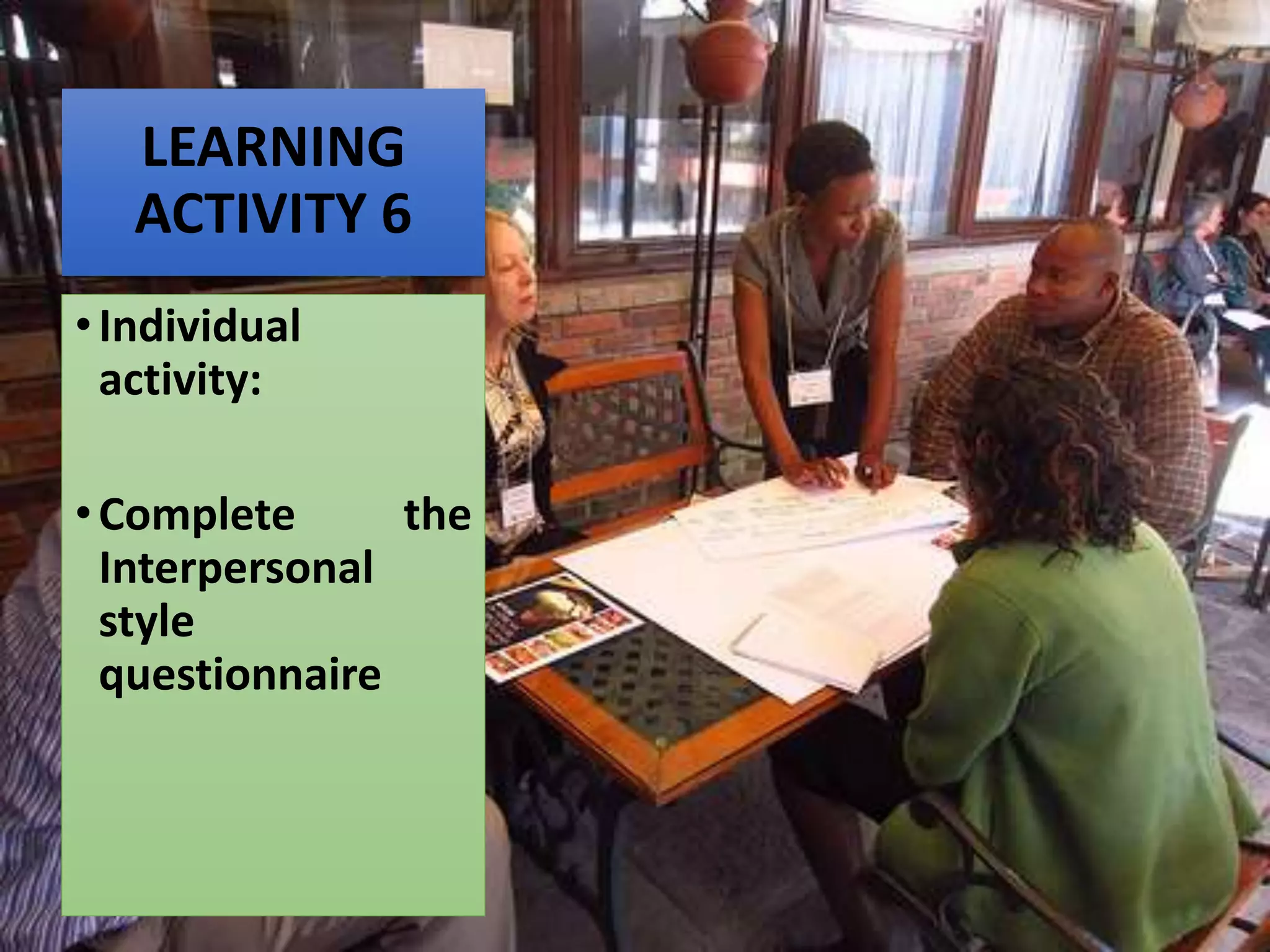
LEARNING
ACTIVITY 6
•Individual
activity:
•Complete the
Interpersonal
style
questionnaire
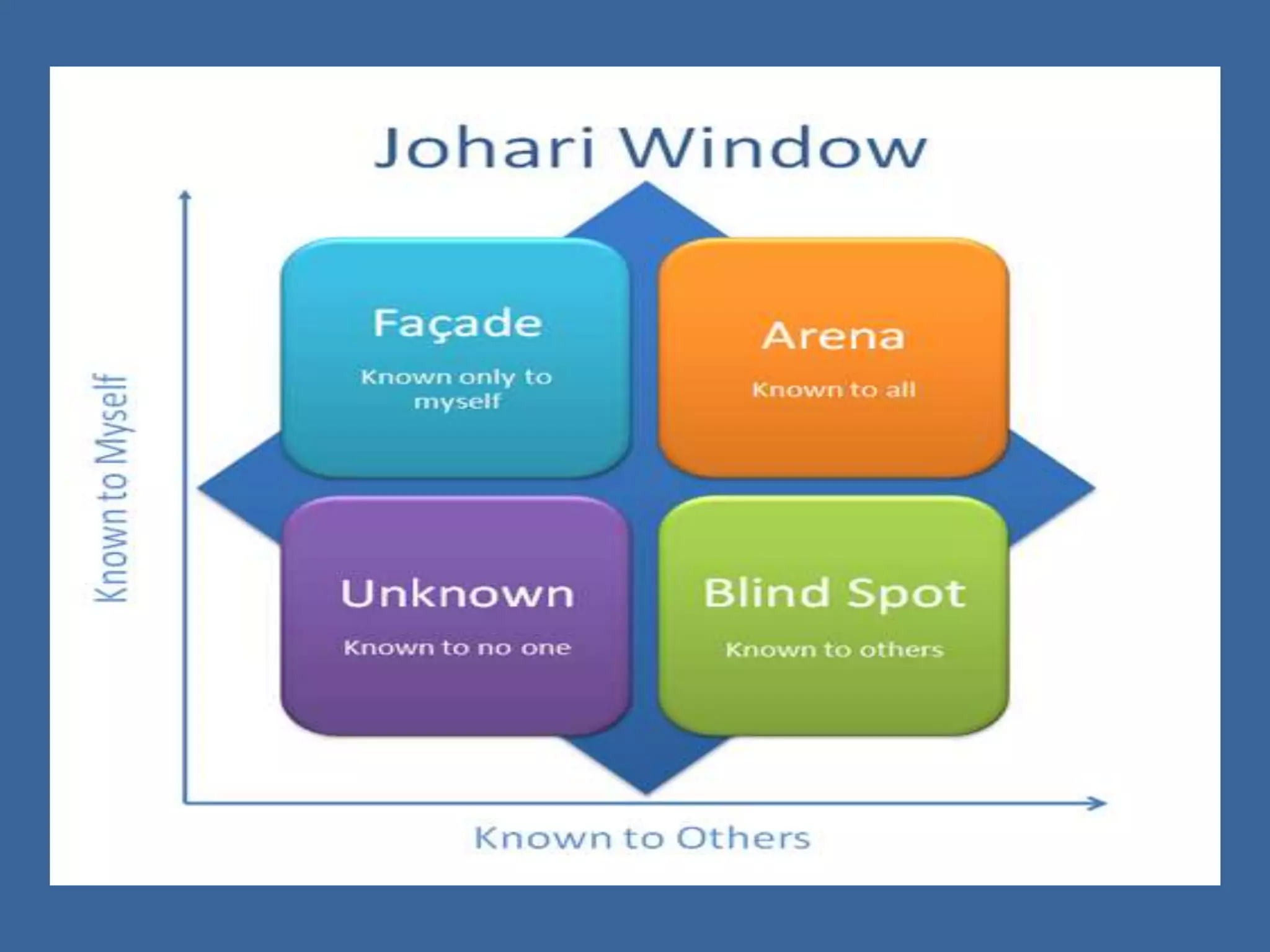
JOHARI’S WINDOW
• Managers can utilize Johari’s Window, in order to affect openness and interpersonal
trust.
• Designed to understand the communication process between people and consists of
varying degrees of information held in common between two people as well as methods
that can be used to increase the size of one’s window.
• Communication will be enhanced if the Arena is increased in size by:
Exposure of self to others
Soliciting feedback from others
• Exposure requires an open, candid and trusting approach, while feedback requires an
active solicitation of feelings, opinions and values from others.
• For these processes to be fully developed, reciprocity is required.
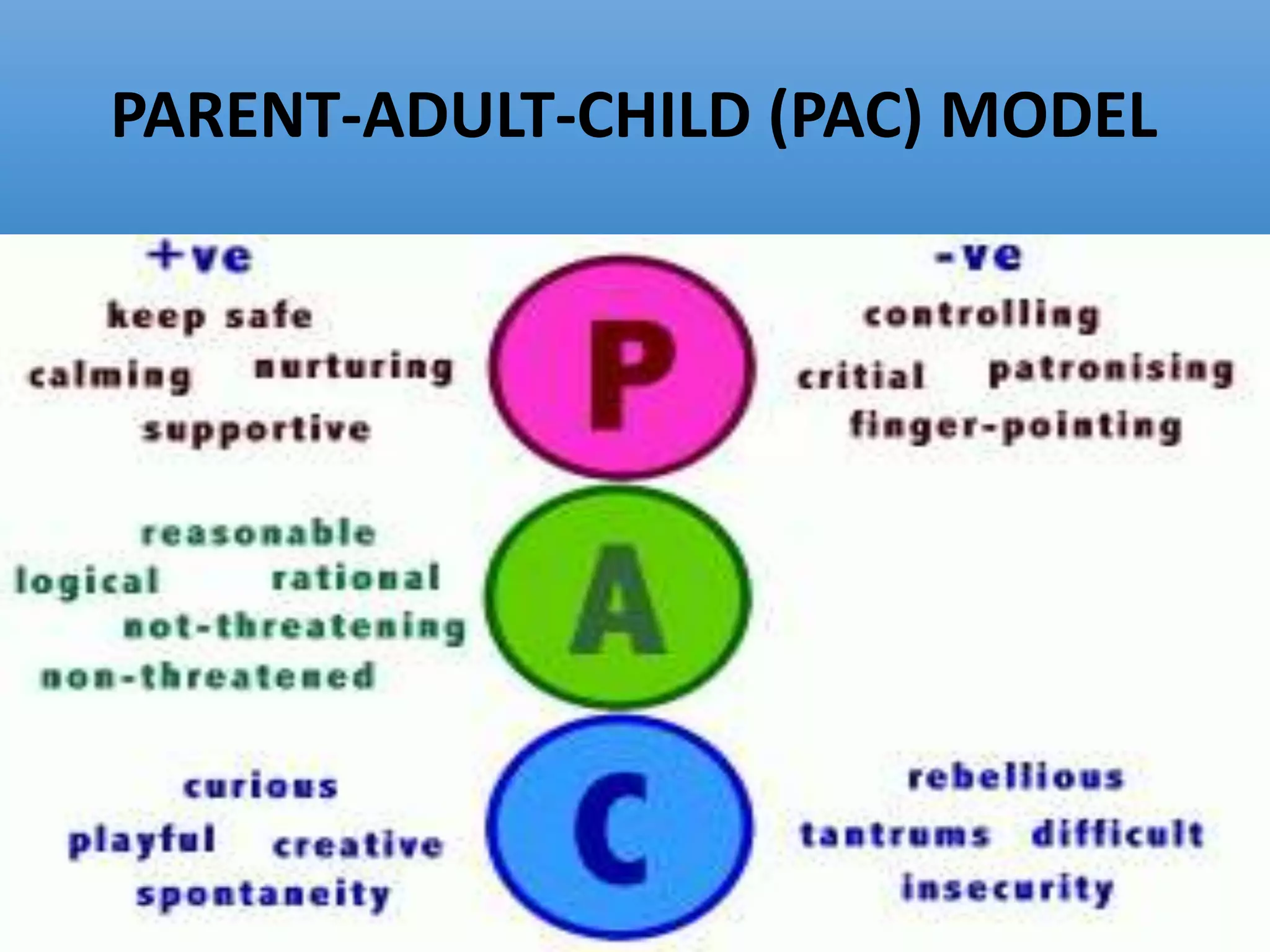
PARENT-ADULT-CHILD (PAC) MODEL
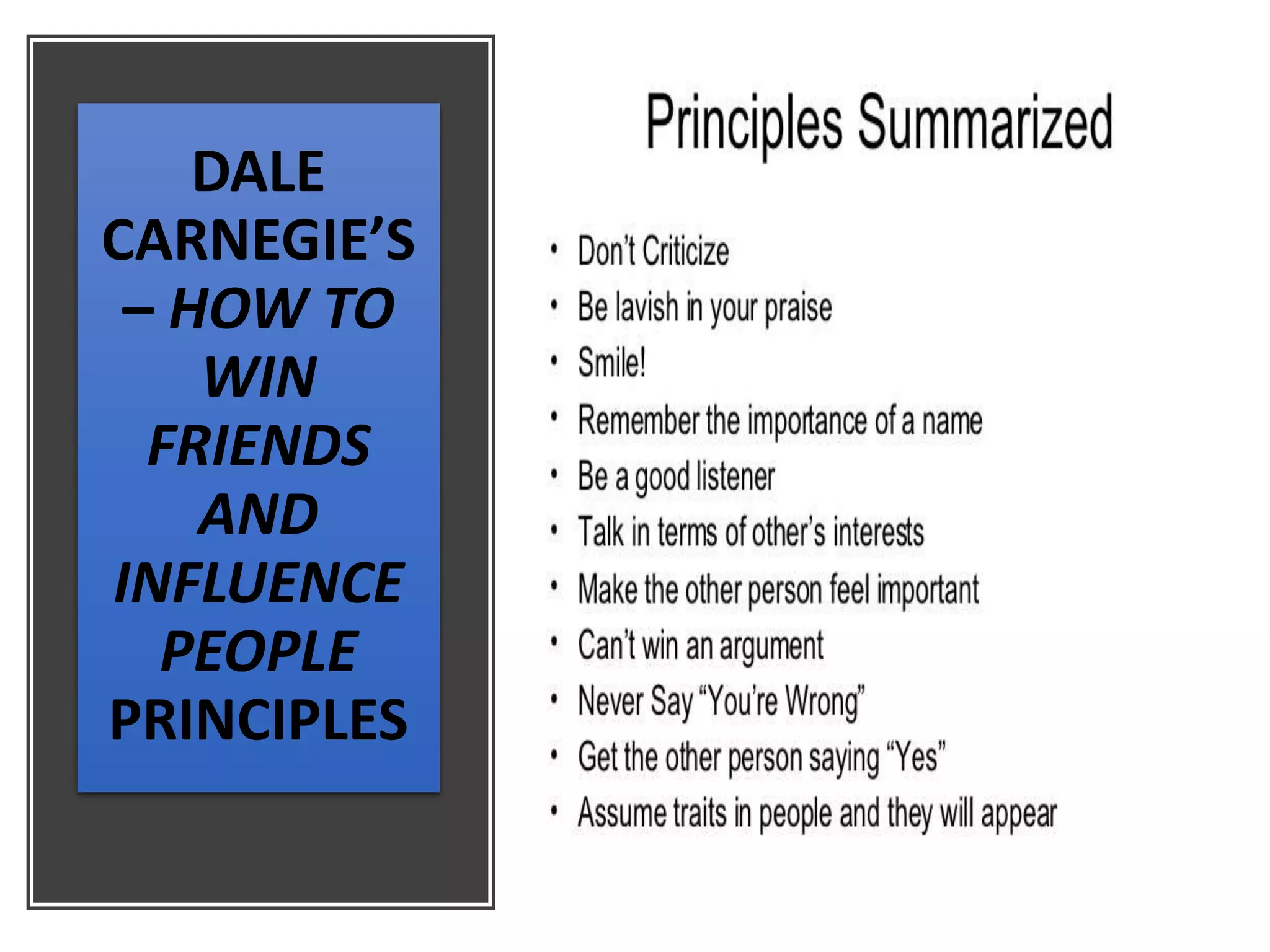
DALE
CARNEGIE’S
– HOW TO
WIN
FRIENDS
AND
INFLUENCE
PEOPLE
PRINCIPLES
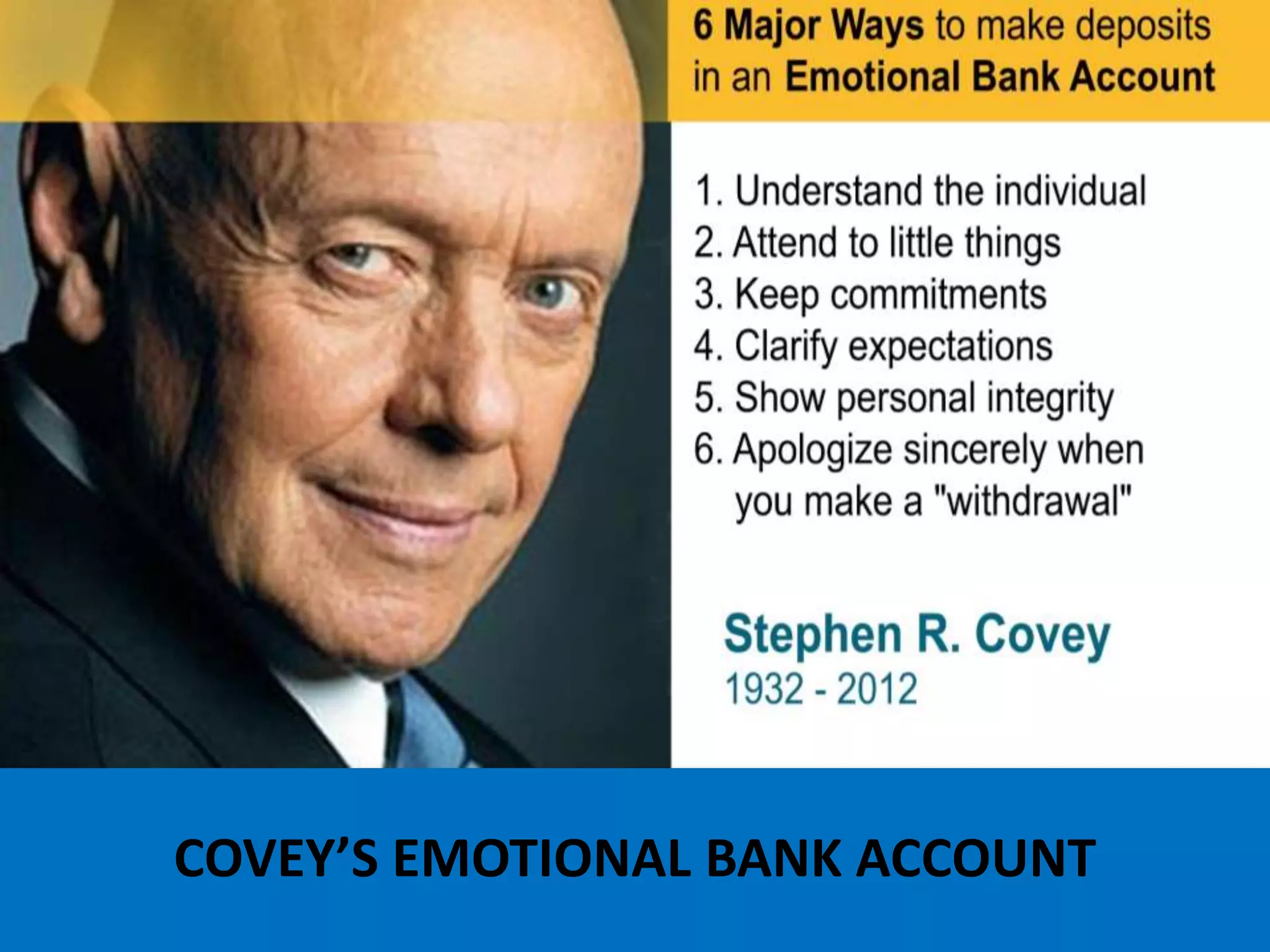
COVEY’S EMOTIONAL BANK ACCOUNT
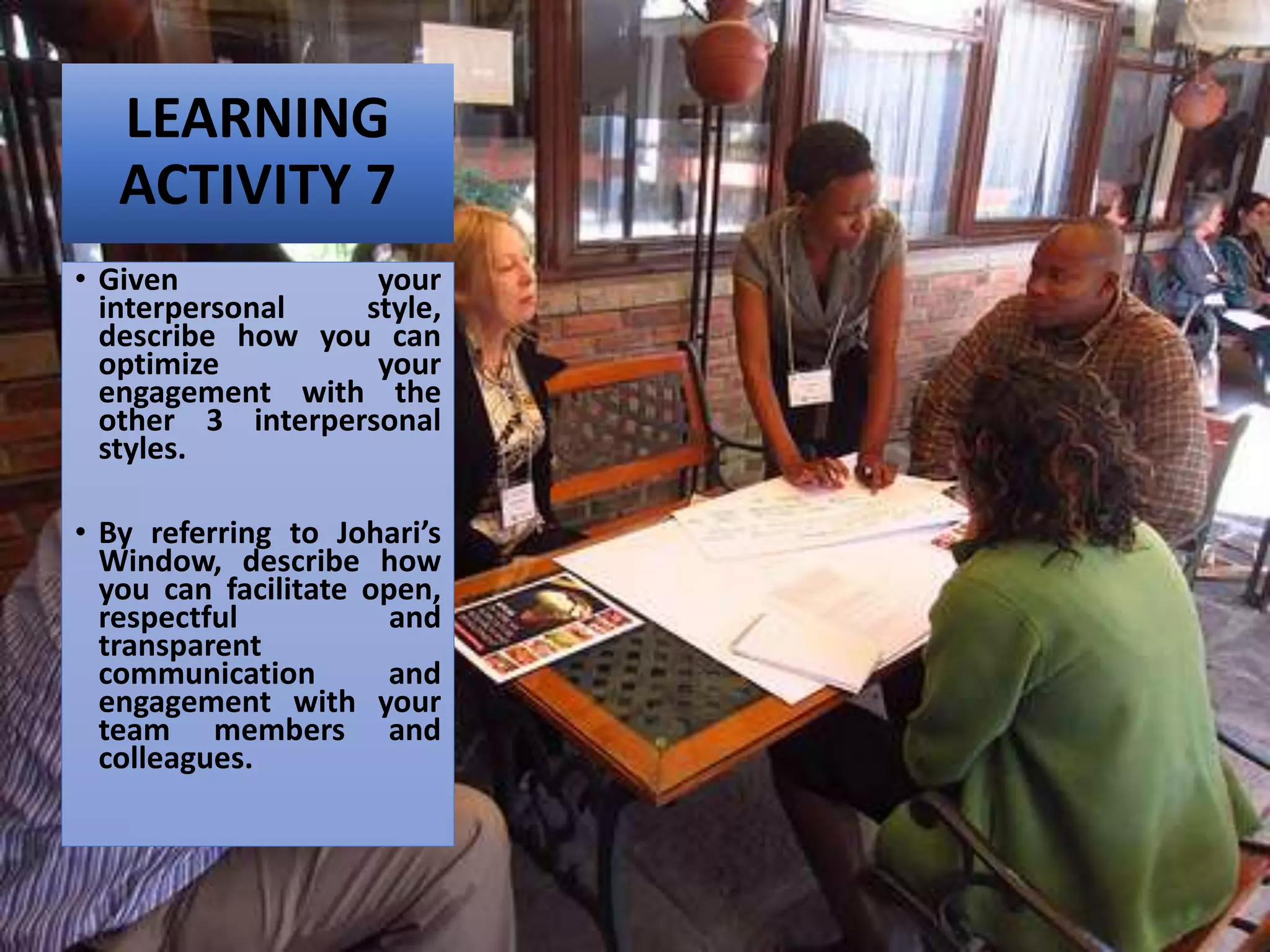
LEARNING
ACTIVITY 7
• Given your
interpersonal style,
describe how you can
optimize your
engagement with the
other 3 interpersonal
styles.
• By referring to Johari’s
Window, describe how
you can facilitate open,
respectful and
transparent
communication and
engagement with your
team members and
colleagues.
WE HAVE TO TALK: A STEP-BY-STEP CHECKLIST FOR
DIFFICULT CONVERSATIONS (Judy Ringer)
• Working on Yourself: How to Prepare for the Conversation
• Before going into the conversation, ask yourself some questions
• 4 Steps to a Successful Outcome
Step #1: Inquiry
Step #2: Acknowledgment
Step #3: Advocacy
Step #4: Problem-Solving
• Practice, Practice, Practice
• Some additional tips and suggestions
• How Do I Begin?
• Write a possible opening for your conversation
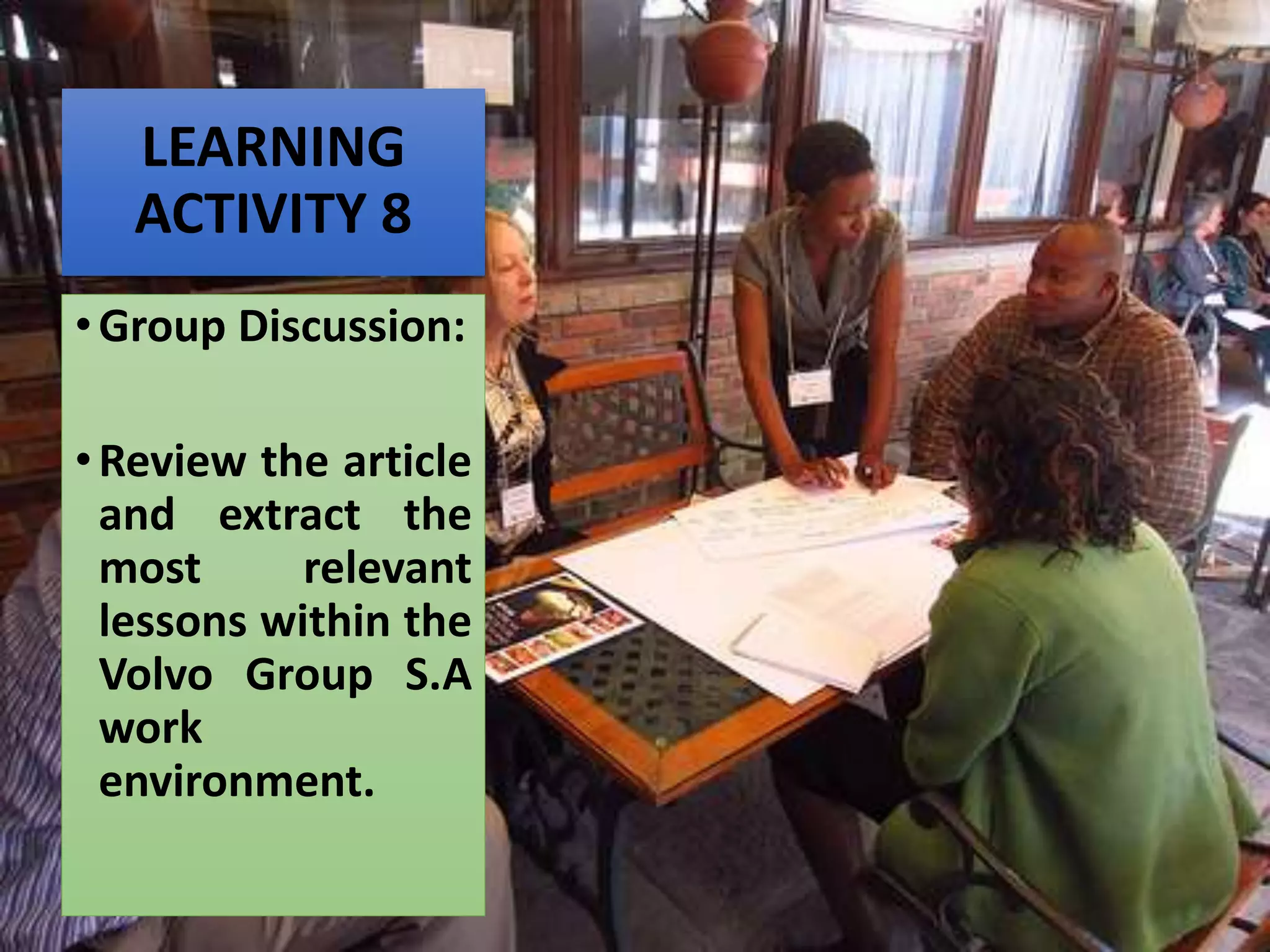
LEARNING
ACTIVITY 8
•Group Discussion:
•Review the article
and extract the
most relevant
lessons within the
Volvo Group S.A
work
environment.
CONCLUSION
• Key points
• Summary
• Questions
• Training Administration
CONTACT DETAILS
•Charles Cotter
• (+27) 84 562 9446
• charlescot@polka.co.za
• LinkedIn
• Twitter: @Charles_Cotter
• https://www.facebook.com/CharlesACotter/
• http://www.slideshare.net/CharlesCotter

Employee Engagement_Best Practice Principles and Strategies

  • 1.
    EMPLOYEE ENGAGEMENT –BEST PRACTICE PRINCIPLES AND STRATEGIES VOLVO GROUP SOUTHERN AFRICA CHARLES COTTER PhD candidate, MBA, B.A (Hons), B.A www.slideshare.net/CharlesCotter 16-17 JANUARY 2018
  • 2.
    2-DAY, TRAINING PROGRAMME OVERVIEW •Defining the fundamentals of employee engagement • Employee engagement statistics – globally and locally • Business case: The value, benefits and importance of employee engagement • The Employee Value Proposition (EVP), employee voice and Stakeholder relations and -engagement • Implementing and applying employee engagement strategies • Reading article 1: Employee Engagement • Interpersonal Style • Facilitating trusting, respectful relations and transparent interpersonal communication • Reading article 2: Critical conversations
  • 4.
    FOUR STAGES OFEMPLOYEE ENGAGEMENT • How can I grow? • Do I belong? • What do I give? • What do I get?
  • 6.
    INTRODUCTORY ACTIVITY • IndividualActivity: • Complete the statement by inserting one (1) word. In order to effectively engage employees at Volvo Group S.A, I need to/to be…………………………………….(1 word) • Find other learners with the same word as you. • Jot these down on the flip-chart. • Each learner will be given the opportunity to elaborate on their own word association.
  • 7.
  • 9.
    COTTER’S 5 C’SOF EMPLOYEE ENGAGEMENT • Are employees COMMITTED to the organization? • Are employees proud to work for the organization – company/brand ambassadors? CITIZEN • Do employees put forth extra/discretionary effort to help the organization and their colleagues achieve business objectives? COMRADE • Are employees enthusiastic and passionate about their work/jobs? CREATOR • Are employees CONNECTED (intellectually and emotionally) to their work/jobs – offer value add?
  • 10.
    #1 Role clarityand expectations #2 Resources – materials and equipment #3 Role optimization and opportunities #4 Receipt of recognition and praise #5 Managerial care and interest #6 Encouragement of personal and professional development GALLUP Q12
  • 11.
    #7 Opinions andinputs are valued #8 Job/task significance #9 Fellow employee commitment to performance excellence/quality #10 Collegial and harmonious working relationships #11 Managerial interest in career progression and development #12 Ample opportunities to learn and grow GALLUP Q12
  • 13.
    DEGREE OF USAEMPLOYEE ENGAGEMENT (GALLUP 2013) • 71% of employees are disengaged: 45% are not engaged (BASICS) 26% are actively disengaged (BREAKERS) • 29% of the workforce are engaged (BUILDERS)
  • 15.
    DEGREE OF S.AEMPLOYEE ENGAGEMENT (GALLUP 2013)
  • 16.
    LEARNING ACTIVITY 1 • GroupDiscussion: • By referring to the findings of the Volvo Trucks employee engagement survey, perform a gap analysis to determine the areas of improvement. As an alternative, use the Gallup Q12 as a yardstick. • As a manager, describe how you can create an engaged team by optimizing the 4 emotional drivers i.e. enthusiasm, inspiration, empowerment and confidence and capitalizing on the 6 drivers of employee engagement.
  • 18.
  • 20.
  • 21.
    THE STRATEGIC IMPERATIVEOF EMPLOYEE ENGAGEMENT
  • 24.
    KEY FINDINGS: GALLUP(2013) • $11 billion is lost annually due to employee turnover • Highly engaged employees are 26% more productive than disengaged employees • Employees are not prepared to engage customers. When organizations successfully engage their customers and their employees, they experience a 240% performance boost. • Managers and leaders play a critical role • 90% of leaders think an engagement strategy will impact business success
  • 25.
    KEY FINDINGS: GALLUP(2013) • Different types of workers need different engagement strategies • Engagement makes a difference to the bottom line - companies earned 13% greater total returns for shareholders over a 5-year financial period • Companies with engaged employees perform 202% better than those without • Engagement has a greater impact on performance than corporate policies and perks • The most compelling evidence of the benefits of an engaged workforce is the identification of a positive impact on 9 business performance indicators.
  • 26.
    ENGAGEMENT’S EFFECT ON9 KEY PERFORMANCE INDICATORS
  • 27.
    LEARNING ACTIVITY 2 • GroupDiscussion: • By referring to viability, feasibility and sustainability, develop a business case for employee engagement at Volvo Trucks S.A i.e. do the benefits outweigh the costs?
  • 28.
    • A resourcingstrategy is concerned with shaping what an organization has to offer to people to join and stay in the organization. (Armstrong, 2011) • EVP is a statement of what an organization will provide for people that they will value - why the total work experience at their organization is superior to that at other organizations. • The EVP is an employee-centered approach that is aligned to existing, integrated workforce planning strategies because it has been informed by existing employees and the external target audience. • Key Selling Points (KSP): Host of financial and non-financial benefits • Non-financial benefits: The attractiveness of the organization Responsibility – corporate conduct, ethics and CSR/CSI Respect – diversity and inclusiveness Work-life balance Opportunities for personal and professional growth EMPLOYEE VALUE PROPOSITION (EVP)
  • 29.
  • 30.
  • 32.
  • 34.
  • 35.
    STEP 2: ANALYZE& PRIORITIZE STAKEHOLDERS -The Power/Interest Grid
  • 36.
    STEP 3: STAKEHOLDERRELATIONSHIP MANAGEMENT • It is important for these institutions to build mutually beneficial and manage effective relationships with these stakeholders. • The institution’s responsibility is to act as a liaison with external constituencies and their role in stakeholder involvement and management is a critically important one. • A critical success factor is that the different roles, needs, viewpoints and performance expectations of these stakeholders must be identified, considered and factored into the proposed productivity and service delivery improvement plan and managed accordingly. • Key to this process is ongoing consultation and engagement with these important stakeholders to further enhance the relationship, build trust and continued support for the institution’s activities. • Effective managers will constantly keep their finger on the pulse and abreast of changing stakeholder needs and viewpoints and adapt their management plans accordingly.
  • 37.
    LEARNING ACTIVITY 3 • GroupDiscussion: • Apply the 4-step stakeholder management process in the context of Volvo Trucks S.A. In particular, concentrate on the following: Develop a Power/Interest Grid/Matrix Stakeholder/employee voice strategies Develop a Stakeholder Value Proposition (SVP)
  • 38.
  • 39.
  • 41.
    EMPLOYEE ENGAGEMENT STRATEGIES •Engagement with the job Where employees are strongly engaged with the work they are actually doing, research shows that this produces high performance, high levels of support to the team and low levels of deviant behaviour. While most engagement interventions seek to build organisational engagement, it might be better to look at interventions to make work more meaningful for employees and/or to work harder on the person/job fit. • Engagement with the organisation Good practice in this area requires total buy-in and visible leadership and commitment for all levels of managers. Many of the issues which directly impact on the engagement of employees reside with managers and their behaviour and treatment of employees. HR practitioners’ roles are to diagnose, support and coach management on those issues and to review, redesign and implement HR specific programmes including learning and development, performance management and reward management.
  • 42.
    CIPD STRATEGIES (2013) •“Giving employees meaningful voice: facilitating upwards feedback, having respectful, adult to-adult conversations and responding to employee views • Effective communications that keep employees well informed and reinforce the organisation’s purpose • Role modelling: employees need to see that managers are committed to the organisation and uphold the values of employee engagement in how they act • Fair and just management processes for dealing with problems and supporting employee well-being.”
  • 43.
    STRATEGIES TO ACCELERATE EMPLOYEEENGAGEMENT • According to Gallup (2013), three (3) strategies to accelerate employee engagement are: Select the Right People and Managers Develop employees’ strengths Enhance employees’ well-being
  • 44.
    SELECT THE RIGHTPEOPLE AND RIGHT MANAGERS • Through selecting the right managers and employees for any role, companies can strategically boost engagement. • Great managers have great talent for supporting, positioning, empowering, and engaging their staff. • A few key employees stand out for their ability to foster workplace engagement. They energize and influence others with their commitment to achieving organizational and team objectives. • Gallup developed the Engagement Creation Index (ECI) — an innovative tool designed to identify and measure the talent for engaging others — to help organizations transform their engagement dynamic by adjusting their hiring practices. ECI captures a candidate’s ability to act as a catalyst to build engaged work teams.
  • 45.
    SELECT THE RIGHTPEOPLE AND RIGHT MANAGERS • It is imperative for leaders to devise selection strategies with the goal of accelerating employee engagement. This starts with hiring and promoting managers based on objective selection criteria to ensure that companies hire/promote managers with the talent to lead and engage their workgroups. • With each new hire or promotion, employers have the opportunity to maximize employee engagement in the workplace. • People want to feel supported, have a sense of belonging, and understand the contribution they can make toward organizational goals. Making sure that they get these things from their interactions with managers and team members is key to driving their engagement.
  • 47.
    STRENGTHS-BASED LEADERSHIP APPROACHTO EMPLOYEE ENGAGEMENT • Managers who focus on their employees’ strengths can practically eliminate active disengagement and double the average of U.S. workers who are engaged nationwide. • Building employees’ strengths is a far more effective approach than trying to improve weaknesses. • A strengths-based management approach is the best way to improve the employee - manager relationship. • Increased productivity: Gallup’s data show that simply learning their strengths makes employees 7.8% more productive. Teams that focus on strengths every day have 12.5% greater productivity.
  • 48.
    STRENGTHS-BASED LEADERSHIP APPROACH TOEMPLOYEE ENGAGEMENT • Help employees align their greatest talents to the expectations and responsibilities of their roles. • Incorporate strengths into performance conversations and reviews and help employees set goals based on their strengths. • Focusing on strengths improves employees’ lives and the organization’s bottom line – facilitates a win-win situation
  • 49.
    ENHANCE EMPLOYEES’ WELL-BEING •Great managers know that the whole person comes to work and that each employee’s well-being influences individual and organizational performance. • Employees who are engaged in their jobs are generally in better health and have healthier habits than employees who are not engaged or are actively disengaged. • Engaged and thriving employees are resilient and agile • Thriving employees have strong, progressive overall well-being; struggling employees have moderate or inconsistent overall well-being; and suffering employees have well- being that is at high risk. • Employees who are thriving in their lives overall are more than twice as likely as those who are struggling to be engaged in their jobs. • Employees with high well-being have lower healthcare costs
  • 50.
    THE MANAGER’S ROLEIN IMPROVING EMPLOYEE ENGAGEMENT AND WELL-BEING • Make well-being an organizational strategy — much like other organizational outcomes • Communicate a commitment to well-being consistently in all of the programs the company offers. • Hold leaders accountable for well-being programs available to employees. • Consider how to embed activities to increase well-being in individual development plans and goals. • Set positive defaults for making healthy choices. In vending machines and cafeterias, ensure that healthy snacks and drinks are the most accessible. Offer plenty of opportunities to join physical or social activities throughout the day.
  • 51.
    BEST PRACTICE EMPLOYEE ENGAGEMENT • Accordingto Gallup (2013) research, the best organizations deeply integrate employee engagement into the following four (4) areas: Strategy and Leadership Philosophy Accountability and Performance Communication and Knowledge Management Development and on-going Learning Opportunities
  • 52.
    ARMSTRONG’S EMPLOYEE ENGAGEMENT STRATEGIES Leadership The work environment Jobdesign Opportunities for personal growth Performance Management
  • 53.
    TINYpulse (2014) STRATEGIES • Showingemployee appreciation and recognition • Fostering a positive work culture • Mapping professional growth plans • Recruiting collegial, hard-working colleagues • Hiring managers that are truly leaders • Empowering employees with tools to succeed • Enabling peer recognition
  • 54.
    LEARNING ACTIVITY 4 • GroupDiscussion: • Critically evaluate Volvo Trucks S.A against the 5 factors of the Deloitte Irresistible Organization model. Identify gaps and recommend improvements strategies. • Critically review the various expert employee engagement strategies and extract those that you believe are most relevant to Volvo Group S.A.
  • 56.
    FIVE EMPLOYEE ENGAGEMENTIDEAS THAT MAKE A DIFFERENCE (LIBBY TAYLOR) • 1. Make existing employee engagement programs better by bringing them into an online community • 2. Embrace on-the-go lifestyles and workstyles • 3. Figure out how to make your systems work with mobile • 4. Give employees a longer leash • 5. Recognize that autonomy is key • 6. Erase the line between leaders and employees • 7. Keep it real and make it personal. Feel something • 8. Finally, never underestimate the power of fun
  • 57.
    LEARNING ACTIVITY 5 •Group Discussion: •Reviewthe article and extract the most relevant lessons within the Volvo Group S.A work environment.
  • 58.
  • 59.
  • 61.
    JOHARI’S WINDOW • Managerscan utilize Johari’s Window, in order to affect openness and interpersonal trust. • Designed to understand the communication process between people and consists of varying degrees of information held in common between two people as well as methods that can be used to increase the size of one’s window. • Communication will be enhanced if the Arena is increased in size by: Exposure of self to others Soliciting feedback from others • Exposure requires an open, candid and trusting approach, while feedback requires an active solicitation of feelings, opinions and values from others. • For these processes to be fully developed, reciprocity is required.
  • 62.
  • 63.
  • 66.
  • 68.
    LEARNING ACTIVITY 7 • Givenyour interpersonal style, describe how you can optimize your engagement with the other 3 interpersonal styles. • By referring to Johari’s Window, describe how you can facilitate open, respectful and transparent communication and engagement with your team members and colleagues.
  • 71.
    WE HAVE TOTALK: A STEP-BY-STEP CHECKLIST FOR DIFFICULT CONVERSATIONS (Judy Ringer) • Working on Yourself: How to Prepare for the Conversation • Before going into the conversation, ask yourself some questions • 4 Steps to a Successful Outcome Step #1: Inquiry Step #2: Acknowledgment Step #3: Advocacy Step #4: Problem-Solving • Practice, Practice, Practice • Some additional tips and suggestions • How Do I Begin? • Write a possible opening for your conversation
  • 72.
    LEARNING ACTIVITY 8 •Group Discussion: •Reviewthe article and extract the most relevant lessons within the Volvo Group S.A work environment.
  • 73.
    CONCLUSION • Key points •Summary • Questions • Training Administration
  • 74.
    CONTACT DETAILS •Charles Cotter •(+27) 84 562 9446 • charlescot@polka.co.za • LinkedIn • Twitter: @Charles_Cotter • https://www.facebook.com/CharlesACotter/ • http://www.slideshare.net/CharlesCotter