1
www.cranfield.ac.uk/som
www.engageforsuccess.org
How to be a more engaging
performance manager
Frazer Rendell, Director, e-trinity Consulting
Chair – PM TAG and SE Region TAG
Paul Beesley, Director, Beyond Theory
EfS Steering Group and PM TAG
EFS Bristol 25th June 2019
2
Background
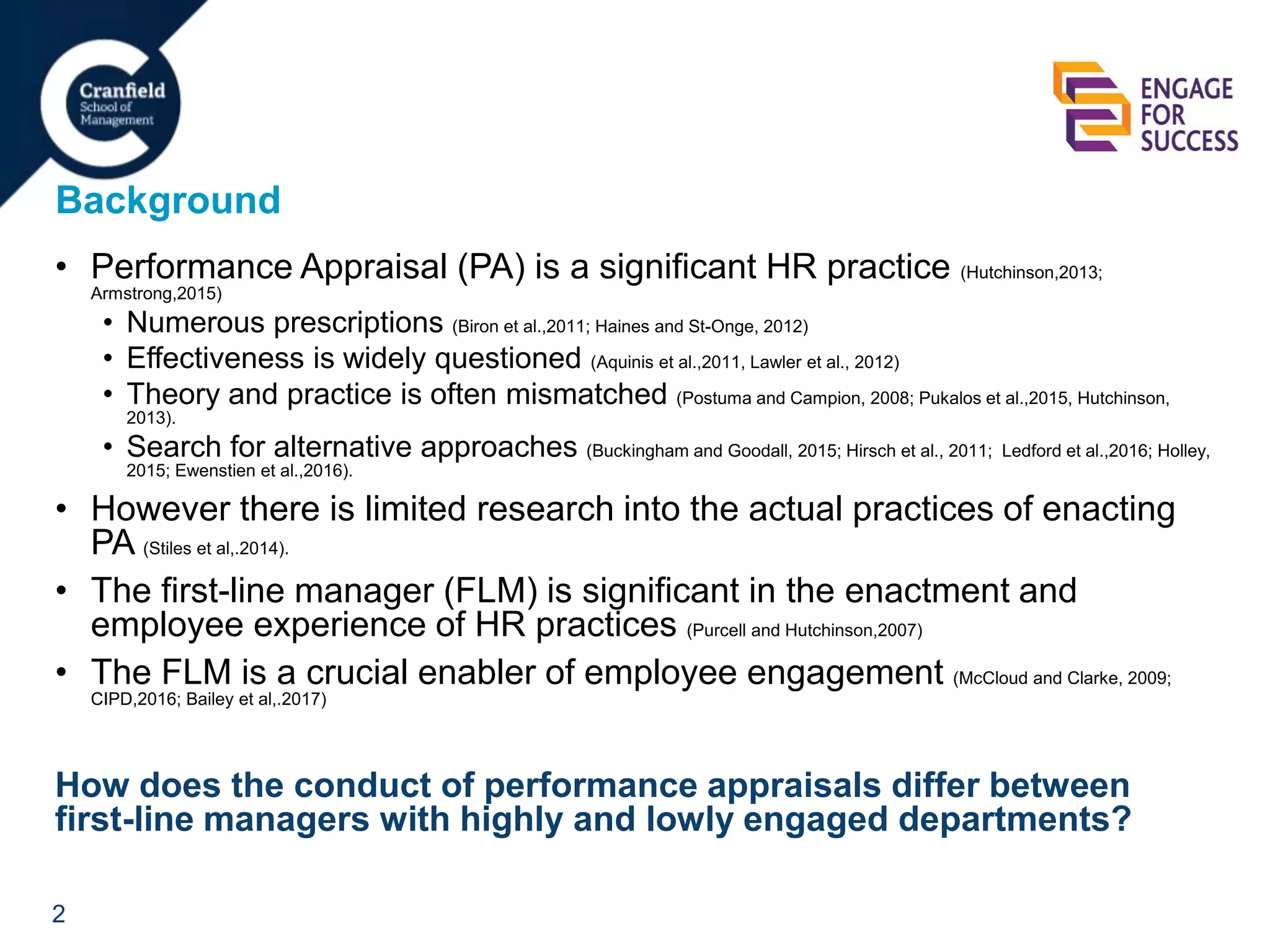
• Performance Appraisal (PA) is a significant HR practice (Hutchinson,2013;
Armstrong,2015)
• Numerous prescriptions (Biron et al.,2011; Haines and St-Onge, 2012)
• Effectiveness is widely questioned (Aquinis et al.,2011, Lawler et al., 2012)
• Theory and practice is often mismatched (Postuma and Campion, 2008; Pukalos et al.,2015, Hutchinson,
2013).
• Search for alternative approaches (Buckingham and Goodall, 2015; Hirsch et al., 2011; Ledford et al.,2016; Holley,
2015; Ewenstien et al.,2016).
• However there is limited research into the actual practices of enacting
PA (Stiles et al,.2014).
• The first-line manager (FLM) is significant in the enactment and
employee experience of HR practices (Purcell and Hutchinson,2007)
• The FLM is a crucial enabler of employee engagement (McCloud and Clarke, 2009;
CIPD,2016; Bailey et al,.2017)
How does the conduct of performance appraisals differ between
first-line managers with highly and lowly engaged departments?
3
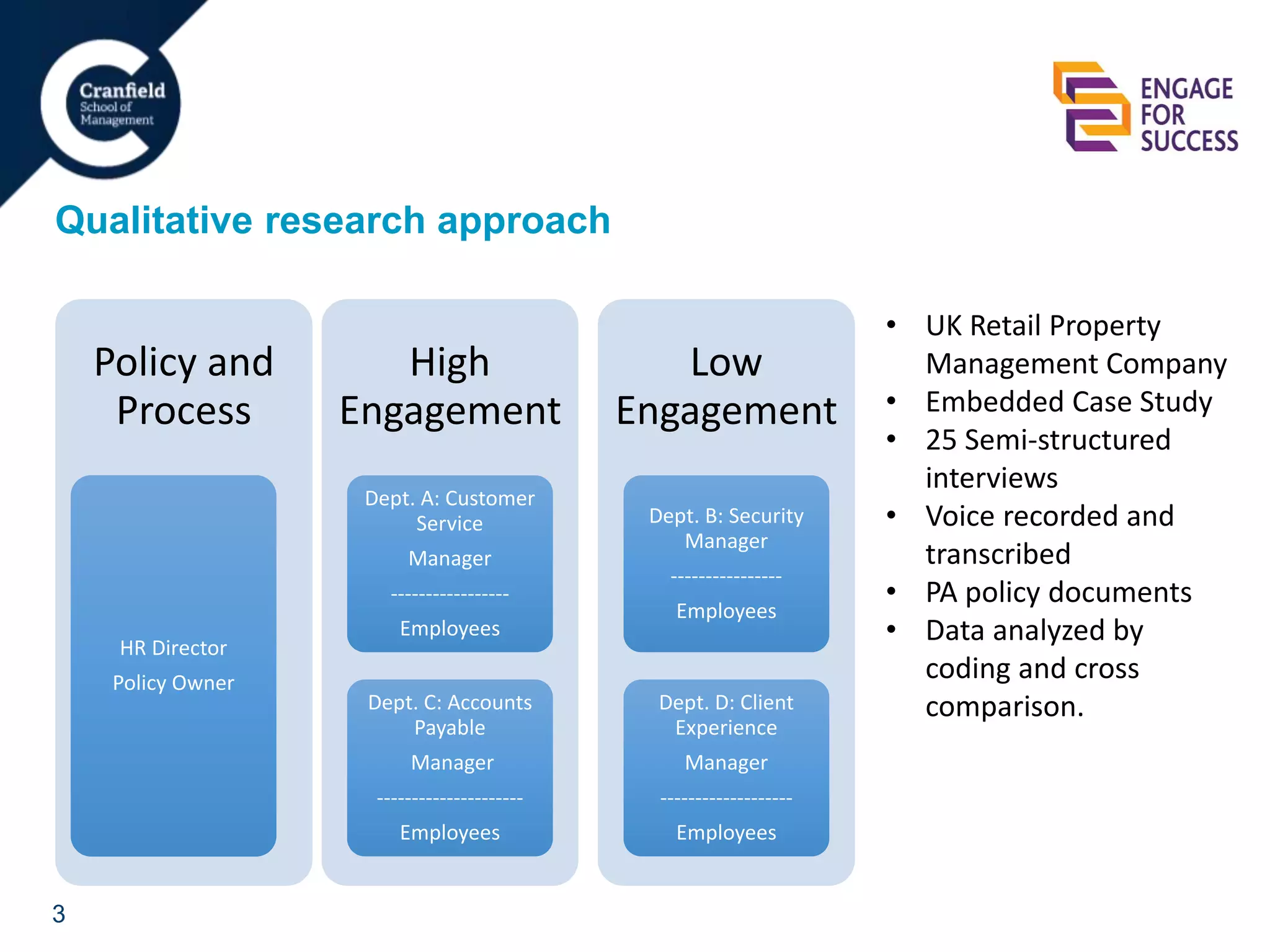
Qualitative research approach
Policy and
Process
HR Director
Policy Owner
High
Engagement
Dept. A: Customer
Service
Manager
-----------------
Employees
Dept. C: Accounts
Payable
Manager
---------------------
Employees
Low
Engagement
Dept. B: Security
Manager
----------------
Employees
Dept. D: Client
Experience
Manager
-------------------
Employees
• UK Retail Property
Management Company
• Embedded Case Study
• 25 Semi-structured
interviews
• Voice recorded and
transcribed
• PA policy documents
• Data analyzed by
coding and cross
comparison.
4
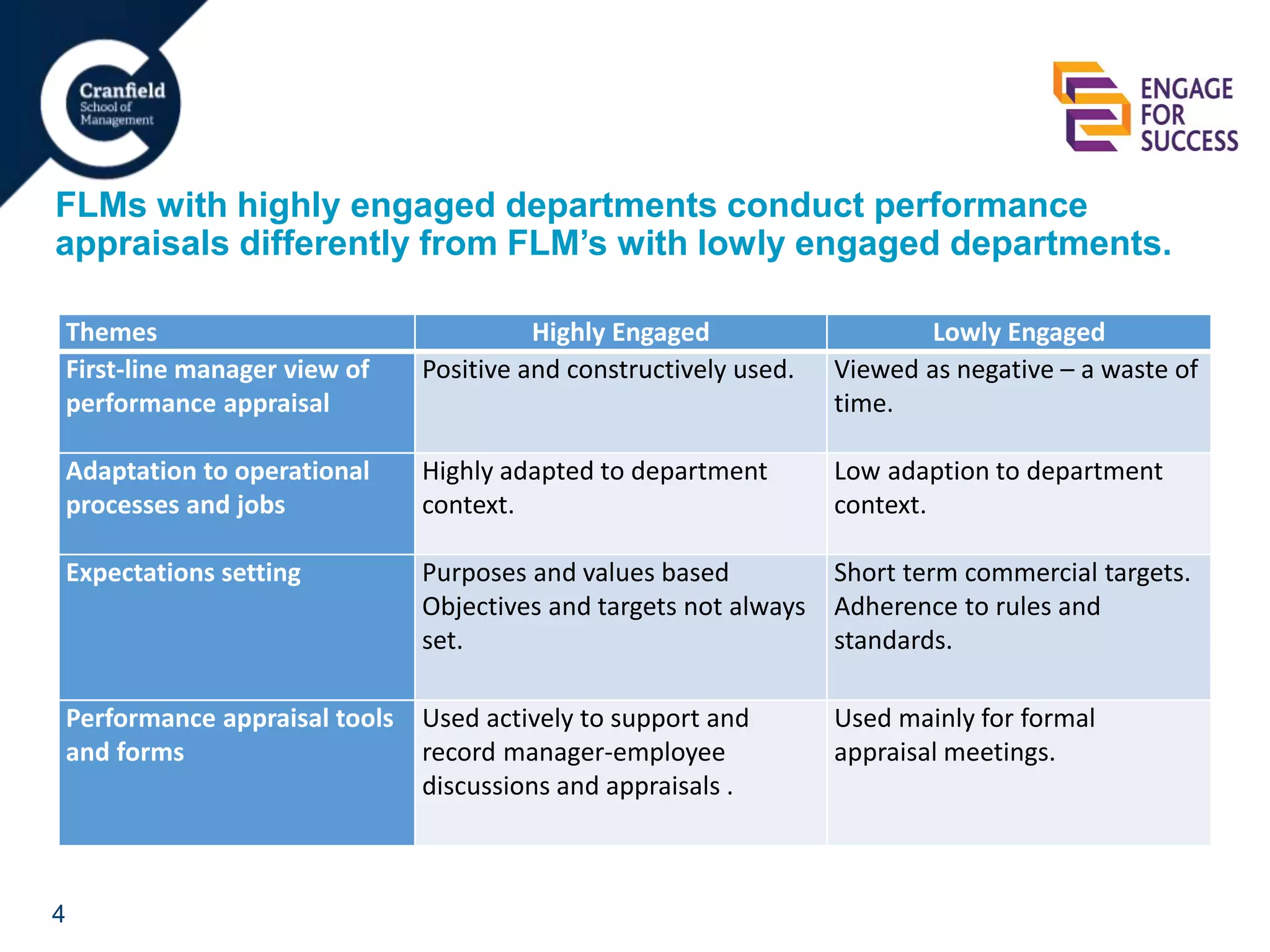
FLMs with highly engaged departments conduct performance
appraisals differently from FLM’s with lowly engaged departments.
Themes Highly Engaged Lowly Engaged
First-line manager view of
performance appraisal
Positive and constructively used. Viewed as negative – a waste of
time.
Adaptation to operational
processes and jobs
Highly adapted to department
context.
Low adaption to department
context.
Expectations setting Purposes and values based
Objectives and targets not always
set.
Short term commercial targets.
Adherence to rules and
standards.
Performance appraisal tools
and forms
Used actively to support and
record manager-employee
discussions and appraisals .
Used mainly for formal
appraisal meetings.
5
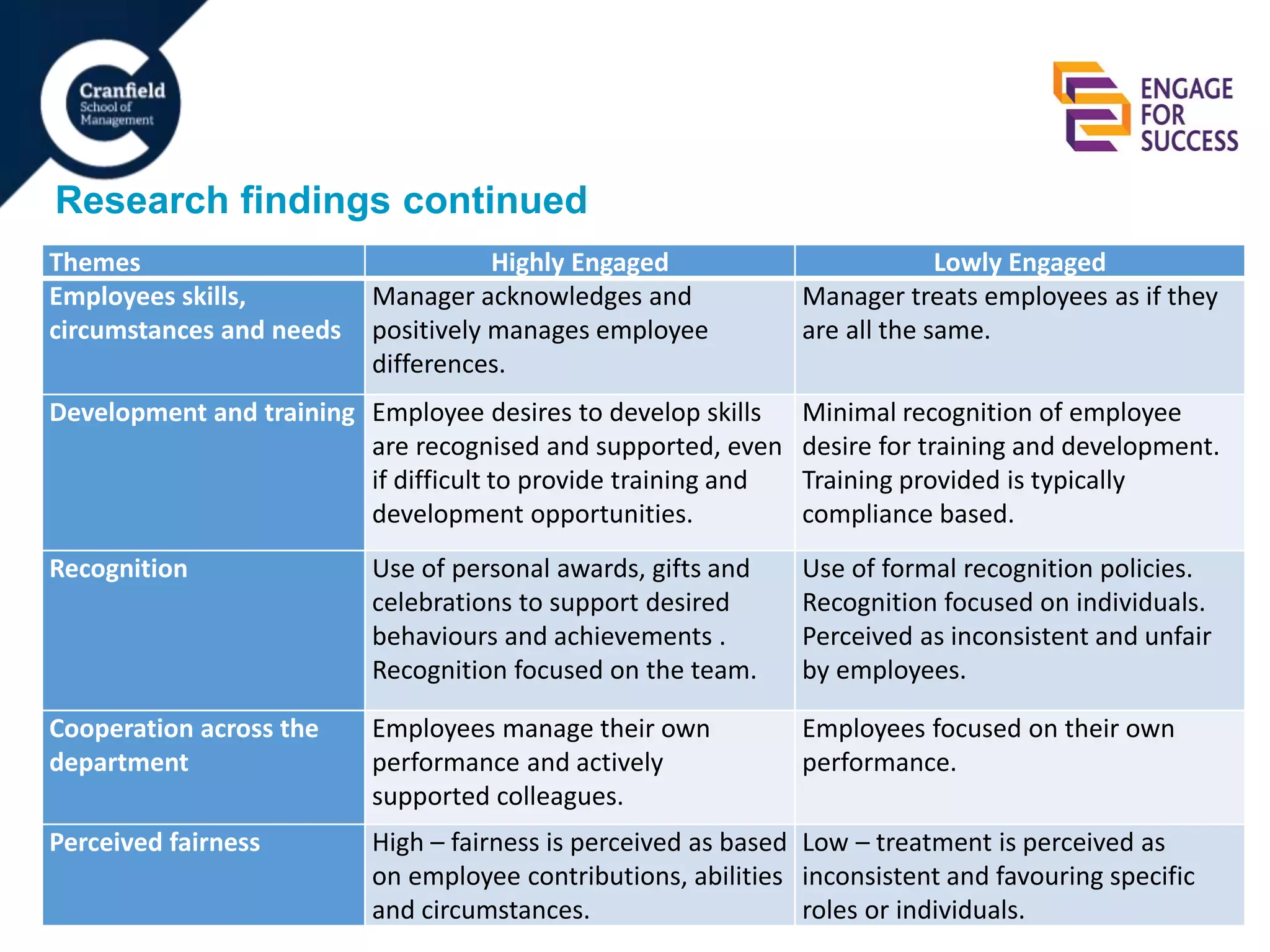
Research findings continued
Themes Highly Engaged Lowly Engaged
Employees skills,
circumstances and needs
Manager acknowledges and
positively manages employee
differences.
Manager treats employees as if they
are all the same.
Development and training Employee desires to develop skills
are recognised and supported, even
if difficult to provide training and
development opportunities.
Minimal recognition of employee
desire for training and development.
Training provided is typically
compliance based.
Recognition Use of personal awards, gifts and
celebrations to support desired
behaviours and achievements .
Recognition focused on the team.
Use of formal recognition policies.
Recognition focused on individuals.
Perceived as inconsistent and unfair
by employees.
Cooperation across the
department
Employees manage their own
performance and actively
supported colleagues.
Employees focused on their own
performance.
Perceived fairness High – fairness is perceived as based
on employee contributions, abilities
and circumstances.
Low – treatment is perceived as
inconsistent and favouring specific
roles or individuals.
6
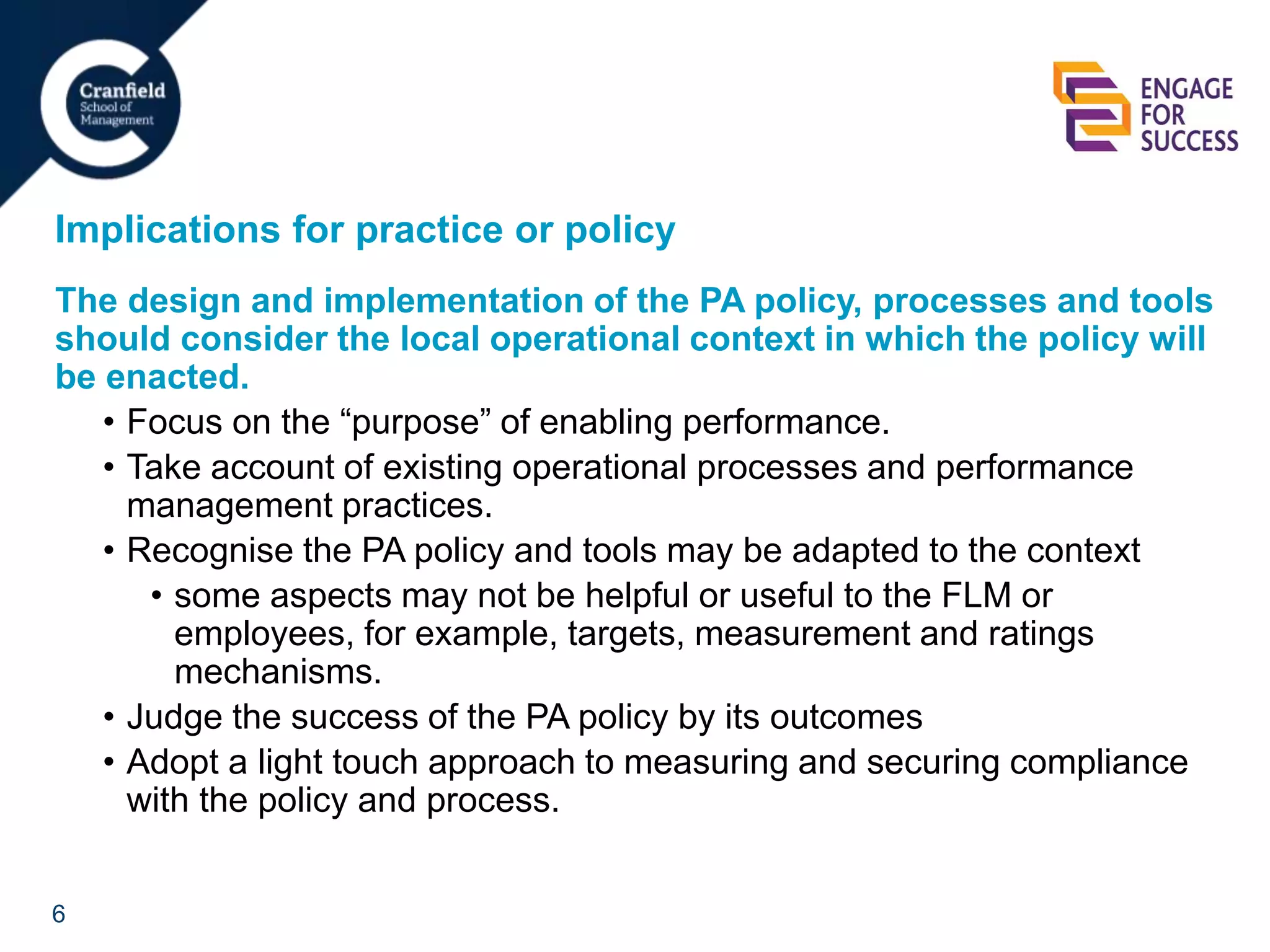
Implications for practice or policy
The design and implementation of the PA policy, processes and tools
should consider the local operational context in which the policy will
be enacted.
• Focus on the “purpose” of enabling performance.
• Take account of existing operational processes and performance
management practices.
• Recognise the PA policy and tools may be adapted to the context
• some aspects may not be helpful or useful to the FLM or
employees, for example, targets, measurement and ratings
mechanisms.
• Judge the success of the PA policy by its outcomes
• Adopt a light touch approach to measuring and securing compliance
with the policy and process.
7
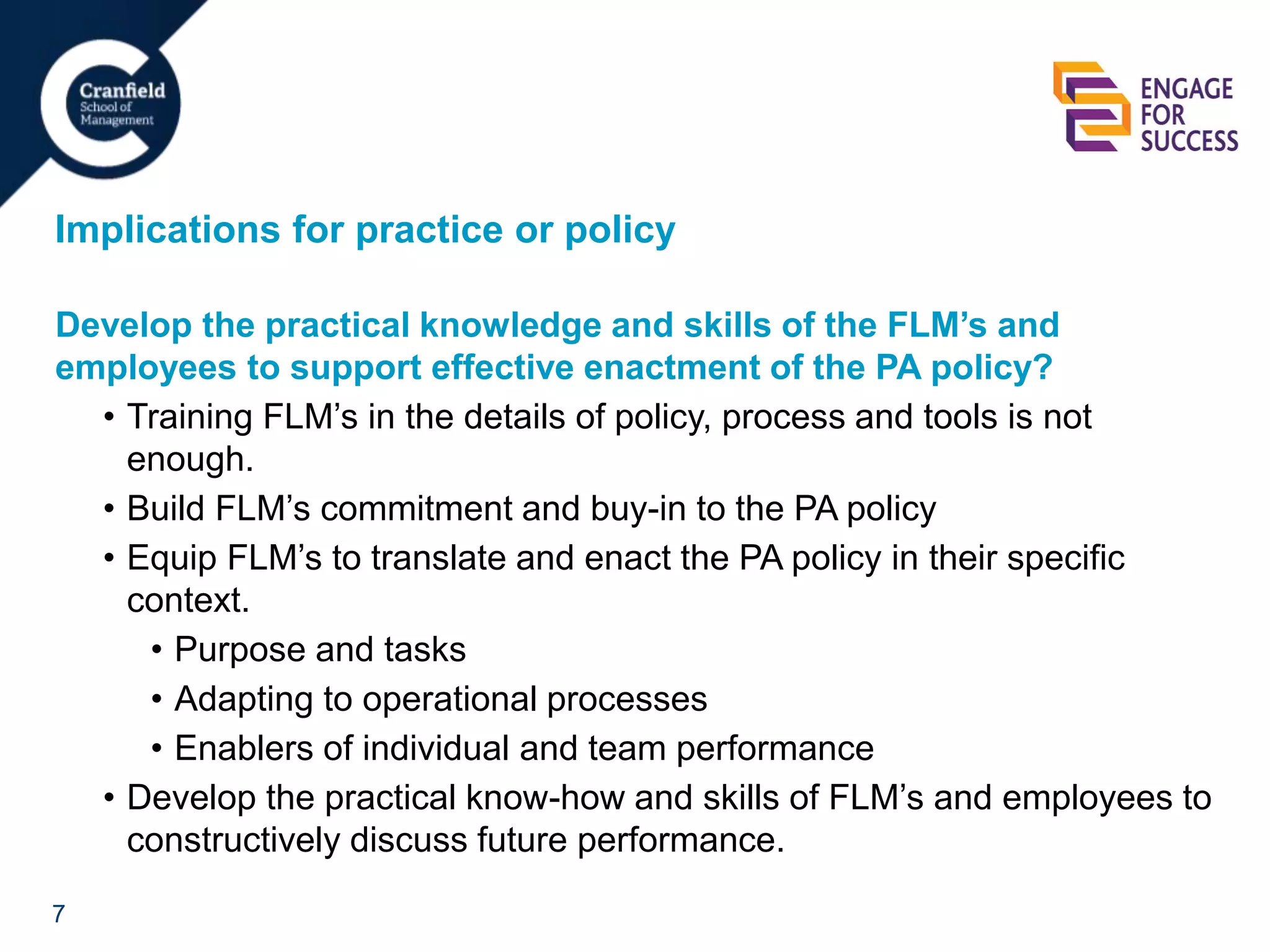
Implications for practice or policy
Develop the practical knowledge and skills of the FLM’s and
employees to support effective enactment of the PA policy?
• Training FLM’s in the details of policy, process and tools is not
enough.
• Build FLM’s commitment and buy-in to the PA policy
• Equip FLM’s to translate and enact the PA policy in their specific
context.
• Purpose and tasks
• Adapting to operational processes
• Enablers of individual and team performance
• Develop the practical know-how and skills of FLM’s and employees to
constructively discuss future performance.
8
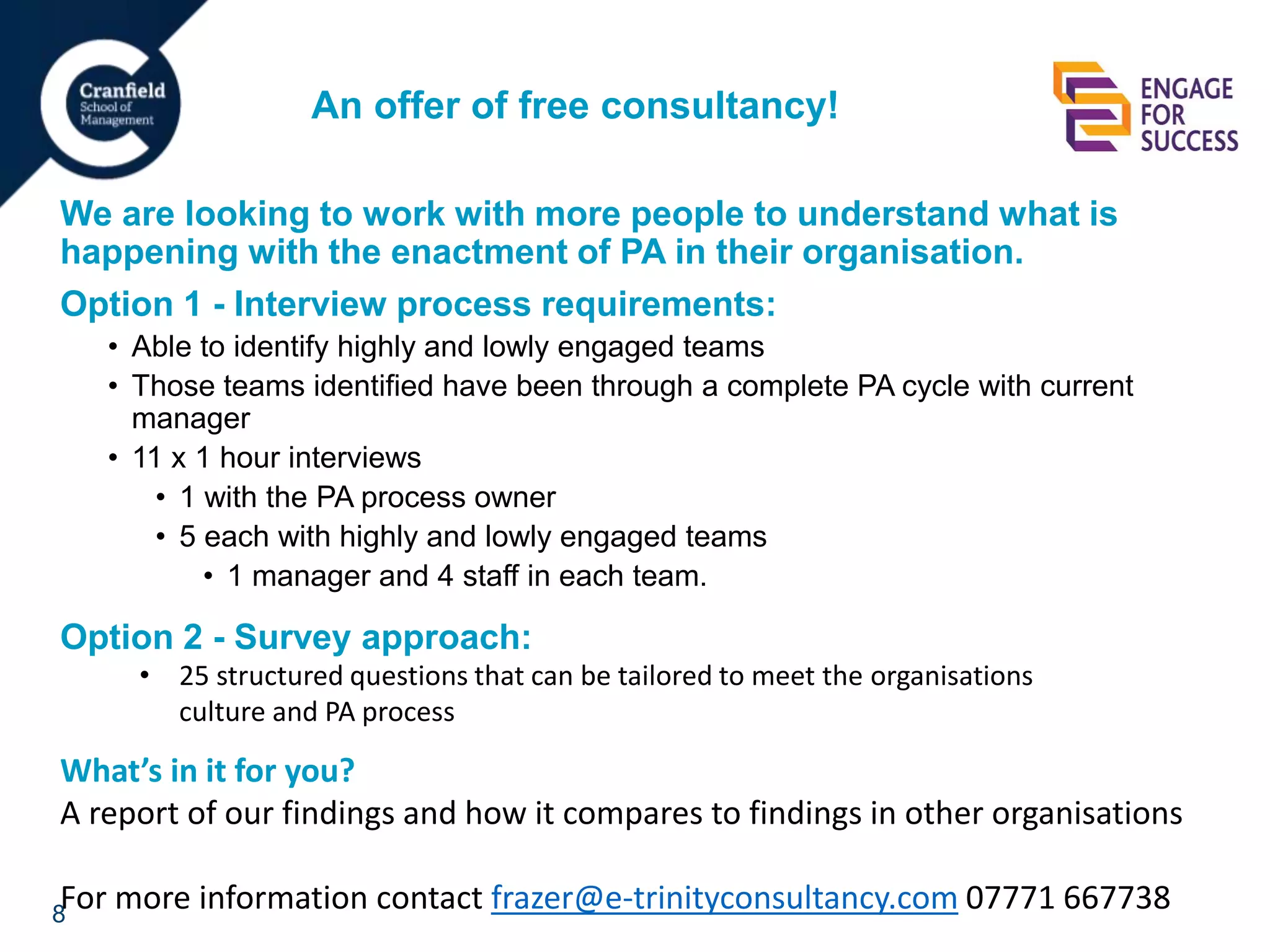
An offer of free consultancy!
We are looking to work with more people to understand what is
happening with the enactment of PA in their organisation.
Option 1 - Interview process requirements:
• Able to identify highly and lowly engaged teams
• Those teams identified have been through a complete PA cycle with current
manager
• 11 x 1 hour interviews
• 1 with the PA process owner
• 5 each with highly and lowly engaged teams
• 1 manager and 4 staff in each team.
What’s in it for you?
A report of our findings and how it compares to findings in other organisations
For more information contact frazer@e-trinityconsultancy.com 07771 667738
Option 2 - Survey approach:
• 25 structured questions that can be tailored to meet the organisations
culture and PA process
9
10
Questions we would like you to address
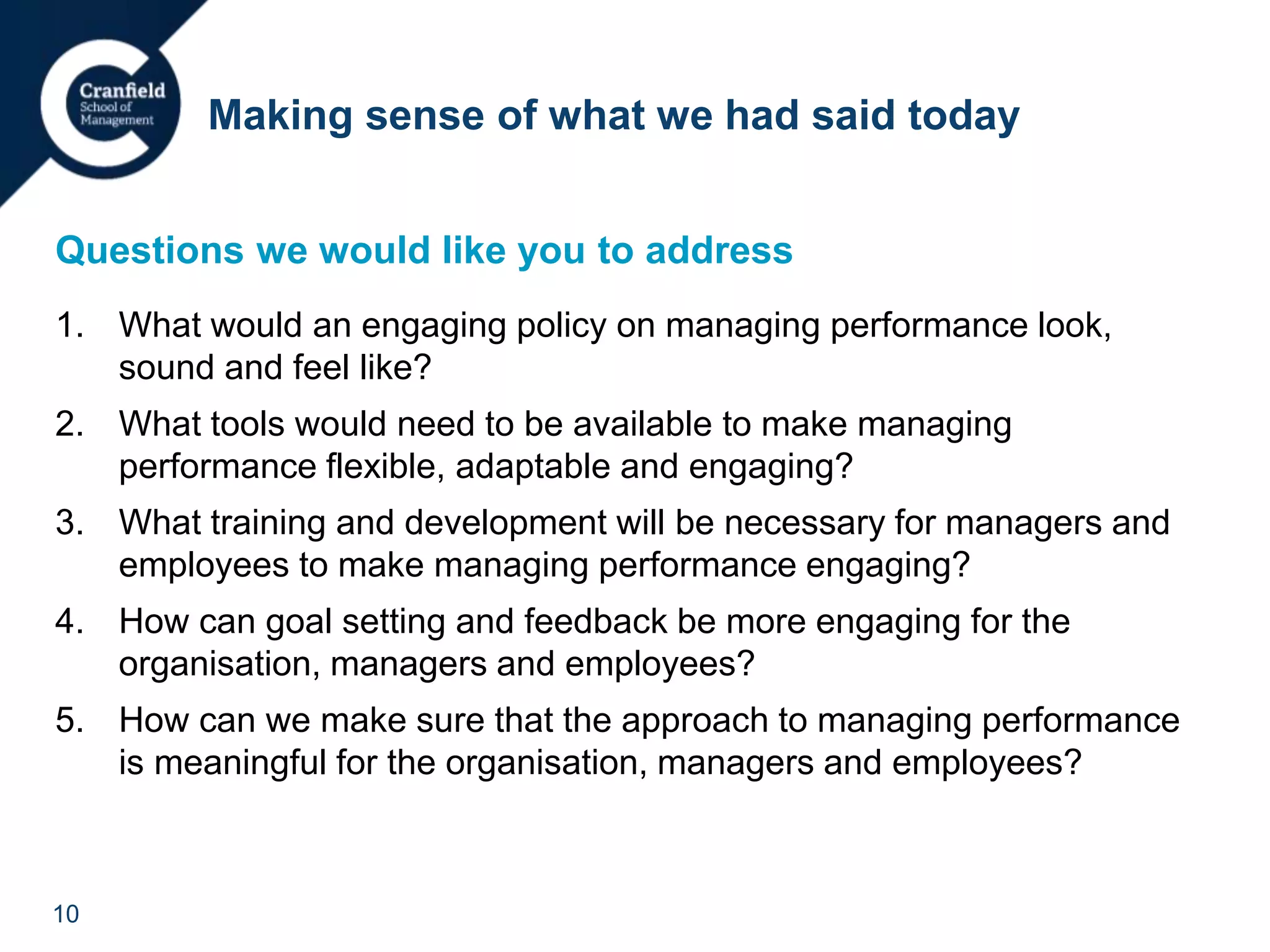
1. What would an engaging policy on managing performance look,
sound and feel like?
2. What tools would need to be available to make managing
performance flexible, adaptable and engaging?
3. What training and development will be necessary for managers and
employees to make managing performance engaging?
4. How can goal setting and feedback be more engaging for the
organisation, managers and employees?
5. How can we make sure that the approach to managing performance
is meaningful for the organisation, managers and employees?
Making sense of what we had said today
11
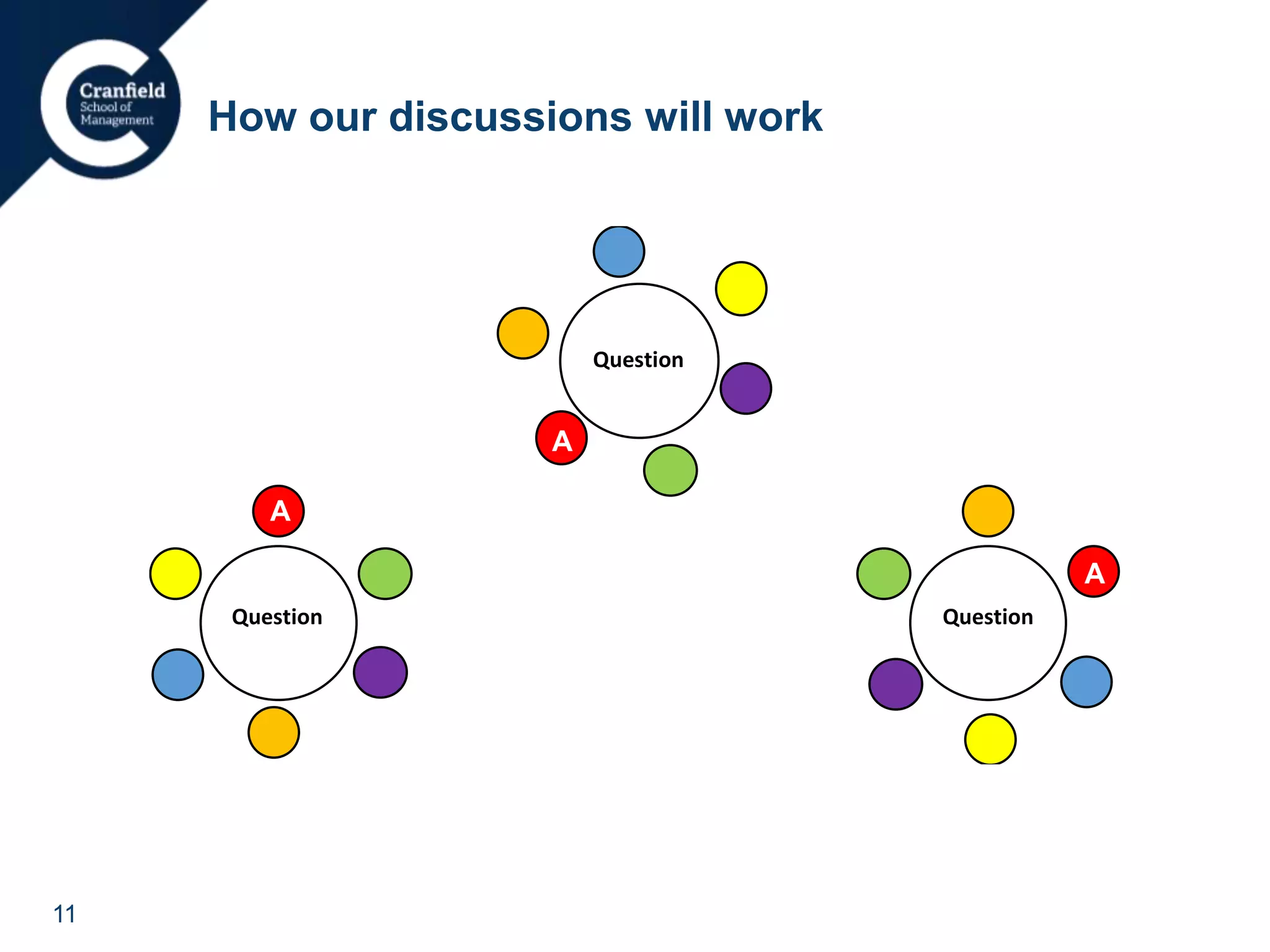
How our discussions will work
A
A
A
Question
Question
Question
12
Summary: What would an engaging policy on managing
performance look, sound and feel like?
Please provide a summary of your discussions and your (up to 5)
recommendations:
1. ________________________________________________________
2. ________________________________________________________
3. ________________________________________________________
4. ________________________________________________________
5. ________________________________________________________
13
Summary: What tools would need to be available to make
managing performance flexible, adaptable and engaging?
Please provide a summary of your discussions and your (up to 5)
recommendations:
1. ________________________________________________________
2. ________________________________________________________
3. ________________________________________________________
4. ________________________________________________________
5. ________________________________________________________
14
Summary: What training and development will be necessary for
managers and employees to make managing performance
engaging?
Please provide a summary of your discussions and your (up to 5)
recommendations:
1. ________________________________________________________
2. ________________________________________________________
3. ________________________________________________________
4. ________________________________________________________
5. ________________________________________________________
15
Summary: How can goal setting and feedback be more
engaging for the organisation, managers and employees?
Please provide a summary of your discussions and your (up to 5)
recommendations:
1. ________________________________________________________
2. ________________________________________________________
3. ________________________________________________________
4. ________________________________________________________
5. ________________________________________________________
16
Summary: How can we make sure that the approach to managing
performance is meaningful for the organisation, managers and
employees?
Please provide a summary of your discussions and your (up to 5)
recommendations:
1. ________________________________________________________
2. ________________________________________________________
3. ________________________________________________________
4. ________________________________________________________
5. ________________________________________________________
17
Please contact Engage for Success or ourselves
Frazer Rendell
For more information…
Beyond Theory Training
@BeyondTheoryUK and/or @pebeesley
Beyond Theory – business training & coaching and/or paulebeesley
Beyond_Theory
Paul Beesley
www.beyondtheory.co.uk
paul@beyondtheory.co.uk
01604 212505
www.e-trinityconsultancy.com
frazer@e-trinityconsultancy.com
0203 1310062
Beyond Theory Training
@BeyondTheoryUK and/or @pebeesley
Beyond Theory – business training & coaching and/or paulebeesley
Beyond_Theory
@frazerrendell
Frazer Rendell
18

Frazer Rendell, e-trinity Consulting - engagement and managing performance

  • 1.
    1 www.cranfield.ac.uk/som www.engageforsuccess.org How to bea more engaging performance manager Frazer Rendell, Director, e-trinity Consulting Chair – PM TAG and SE Region TAG Paul Beesley, Director, Beyond Theory EfS Steering Group and PM TAG EFS Bristol 25th June 2019
  • 2.
    2 Background • Performance Appraisal(PA) is a significant HR practice (Hutchinson,2013; Armstrong,2015) • Numerous prescriptions (Biron et al.,2011; Haines and St-Onge, 2012) • Effectiveness is widely questioned (Aquinis et al.,2011, Lawler et al., 2012) • Theory and practice is often mismatched (Postuma and Campion, 2008; Pukalos et al.,2015, Hutchinson, 2013). • Search for alternative approaches (Buckingham and Goodall, 2015; Hirsch et al., 2011; Ledford et al.,2016; Holley, 2015; Ewenstien et al.,2016). • However there is limited research into the actual practices of enacting PA (Stiles et al,.2014). • The first-line manager (FLM) is significant in the enactment and employee experience of HR practices (Purcell and Hutchinson,2007) • The FLM is a crucial enabler of employee engagement (McCloud and Clarke, 2009; CIPD,2016; Bailey et al,.2017) How does the conduct of performance appraisals differ between first-line managers with highly and lowly engaged departments?
  • 3.
    3 Qualitative research approach Policyand Process HR Director Policy Owner High Engagement Dept. A: Customer Service Manager ----------------- Employees Dept. C: Accounts Payable Manager --------------------- Employees Low Engagement Dept. B: Security Manager ---------------- Employees Dept. D: Client Experience Manager ------------------- Employees • UK Retail Property Management Company • Embedded Case Study • 25 Semi-structured interviews • Voice recorded and transcribed • PA policy documents • Data analyzed by coding and cross comparison.
  • 4.
    4 FLMs with highlyengaged departments conduct performance appraisals differently from FLM’s with lowly engaged departments. Themes Highly Engaged Lowly Engaged First-line manager view of performance appraisal Positive and constructively used. Viewed as negative – a waste of time. Adaptation to operational processes and jobs Highly adapted to department context. Low adaption to department context. Expectations setting Purposes and values based Objectives and targets not always set. Short term commercial targets. Adherence to rules and standards. Performance appraisal tools and forms Used actively to support and record manager-employee discussions and appraisals . Used mainly for formal appraisal meetings.
  • 5.
    5 Research findings continued ThemesHighly Engaged Lowly Engaged Employees skills, circumstances and needs Manager acknowledges and positively manages employee differences. Manager treats employees as if they are all the same. Development and training Employee desires to develop skills are recognised and supported, even if difficult to provide training and development opportunities. Minimal recognition of employee desire for training and development. Training provided is typically compliance based. Recognition Use of personal awards, gifts and celebrations to support desired behaviours and achievements . Recognition focused on the team. Use of formal recognition policies. Recognition focused on individuals. Perceived as inconsistent and unfair by employees. Cooperation across the department Employees manage their own performance and actively supported colleagues. Employees focused on their own performance. Perceived fairness High – fairness is perceived as based on employee contributions, abilities and circumstances. Low – treatment is perceived as inconsistent and favouring specific roles or individuals.
  • 6.
    6 Implications for practiceor policy The design and implementation of the PA policy, processes and tools should consider the local operational context in which the policy will be enacted. • Focus on the “purpose” of enabling performance. • Take account of existing operational processes and performance management practices. • Recognise the PA policy and tools may be adapted to the context • some aspects may not be helpful or useful to the FLM or employees, for example, targets, measurement and ratings mechanisms. • Judge the success of the PA policy by its outcomes • Adopt a light touch approach to measuring and securing compliance with the policy and process.
  • 7.
    7 Implications for practiceor policy Develop the practical knowledge and skills of the FLM’s and employees to support effective enactment of the PA policy? • Training FLM’s in the details of policy, process and tools is not enough. • Build FLM’s commitment and buy-in to the PA policy • Equip FLM’s to translate and enact the PA policy in their specific context. • Purpose and tasks • Adapting to operational processes • Enablers of individual and team performance • Develop the practical know-how and skills of FLM’s and employees to constructively discuss future performance.
  • 8.
    8 An offer offree consultancy! We are looking to work with more people to understand what is happening with the enactment of PA in their organisation. Option 1 - Interview process requirements: • Able to identify highly and lowly engaged teams • Those teams identified have been through a complete PA cycle with current manager • 11 x 1 hour interviews • 1 with the PA process owner • 5 each with highly and lowly engaged teams • 1 manager and 4 staff in each team. What’s in it for you? A report of our findings and how it compares to findings in other organisations For more information contact frazer@e-trinityconsultancy.com 07771 667738 Option 2 - Survey approach: • 25 structured questions that can be tailored to meet the organisations culture and PA process
  • 9.
  • 10.
    10 Questions we wouldlike you to address 1. What would an engaging policy on managing performance look, sound and feel like? 2. What tools would need to be available to make managing performance flexible, adaptable and engaging? 3. What training and development will be necessary for managers and employees to make managing performance engaging? 4. How can goal setting and feedback be more engaging for the organisation, managers and employees? 5. How can we make sure that the approach to managing performance is meaningful for the organisation, managers and employees? Making sense of what we had said today
  • 11.
    11 How our discussionswill work A A A Question Question Question
  • 12.
    12 Summary: What wouldan engaging policy on managing performance look, sound and feel like? Please provide a summary of your discussions and your (up to 5) recommendations: 1. ________________________________________________________ 2. ________________________________________________________ 3. ________________________________________________________ 4. ________________________________________________________ 5. ________________________________________________________
  • 13.
    13 Summary: What toolswould need to be available to make managing performance flexible, adaptable and engaging? Please provide a summary of your discussions and your (up to 5) recommendations: 1. ________________________________________________________ 2. ________________________________________________________ 3. ________________________________________________________ 4. ________________________________________________________ 5. ________________________________________________________
  • 14.
    14 Summary: What trainingand development will be necessary for managers and employees to make managing performance engaging? Please provide a summary of your discussions and your (up to 5) recommendations: 1. ________________________________________________________ 2. ________________________________________________________ 3. ________________________________________________________ 4. ________________________________________________________ 5. ________________________________________________________
  • 15.
    15 Summary: How cangoal setting and feedback be more engaging for the organisation, managers and employees? Please provide a summary of your discussions and your (up to 5) recommendations: 1. ________________________________________________________ 2. ________________________________________________________ 3. ________________________________________________________ 4. ________________________________________________________ 5. ________________________________________________________
  • 16.
    16 Summary: How canwe make sure that the approach to managing performance is meaningful for the organisation, managers and employees? Please provide a summary of your discussions and your (up to 5) recommendations: 1. ________________________________________________________ 2. ________________________________________________________ 3. ________________________________________________________ 4. ________________________________________________________ 5. ________________________________________________________
  • 17.
    17 Please contact Engagefor Success or ourselves Frazer Rendell For more information… Beyond Theory Training @BeyondTheoryUK and/or @pebeesley Beyond Theory – business training & coaching and/or paulebeesley Beyond_Theory Paul Beesley www.beyondtheory.co.uk paul@beyondtheory.co.uk 01604 212505 www.e-trinityconsultancy.com frazer@e-trinityconsultancy.com 0203 1310062 Beyond Theory Training @BeyondTheoryUK and/or @pebeesley Beyond Theory – business training & coaching and/or paulebeesley Beyond_Theory @frazerrendell Frazer Rendell
  • 18.