The Retention Management Efforts and It’s Effectiveness from the Viewpoint of  Malaysian Banking Industry
Slides Contents:- Introduction Study Objectives Theoretical Framework Methodology Sampling Findings Conclusions Recommendations
Retention Management (RM) Efforts being done by Employers in ensuring or making the Employees stay put in current workforce. Strategies in combating Voluntary Turnover; take away the value and organizational competitive advantage. Enhance organizational performance, reputation and profitability. Introduction
Banking Employment Overview Due to economy liberalization & globalization, government embarked on Merger & Acquisition strategy of local commercial banks in late 90s. Create chaotic employment environment; resignations, redundancies, transfers, lay-offs, VSS etc: lead to countless disappointments in the eyes of banking employees. Another merger exercises (internal) – Finance sectors of respective banks in 2004. Introduction
Banking Employment Overview Another cycle of staffing issues; employees morale were lacking as job security was diminishing. Currently being filled with younger generation; hyperactive, low EQ etc. Emergence of Islamic and Foreign banks provide more rooms to jump ship. Retention management – strategy to make the employees stay put in the current banking workforce. Introduction
To find out the various efforts being done by Malaysian banking industry in retaining their employees; 2. How effective of such efforts in combating the organizational employees’ turnover; 3. To explore the preferred resolutions that might be put into actions, as part of the retention plan or program. Study Objectives:-
The  employees’ voluntary turnover  experienced by the banking industry are being affected by  job satisfaction elements  and that requires the need to install  retention management efforts. Theoretical  Framework
Employees resign from the current workforce voluntarily. Turnover (TO) is the rate where employers gain and lose employees. TO rate could be measured for individual companies or in relative to the industry as a whole. High TO = short employees tenure. Low TO = employees remain in current workforce. Employees’ Voluntary Turnover
High TO could harm the organization. Low TO could increase organization sustainability & profitability. Functional TO; bad performers left and good performers remain – increase productivity Dysfunctional TO; good performers left and bad performers remain – damage organization reputation . Employees’ Voluntary Turnover
How one perceived his / her job is worth the offerings by the organization. Job satisfaction elements – monetary value & non-monetary support. Feel good – high commitment & involvement Feel bad – low morale & decrease enthusiasm   (develop intention to leave) Job Satisfaction
Herzberg 2 Factors Theory Employees are motivated by  internal (motivator)  rather than that are of  external (hygiene)  values to work.  Motivator - Recognition, Achievement, Work  Challenges, Growth and Development. Hygiene - Pay, Company Policies, Working  Relations  and Supervisory Skills. In developing RM, need to consider both factors the internal and external motivators. Job Satisfaction
Most recent strategy in addressing employee turnover issues. Positive efforts by organization to encourage  employees long tenure. Resignation associated with costs; the said costs could be allocated to retention plans / programs. Should consider all level of staff; negative perception among employees –  sweet talk . RM Efforts
Monetary elements is significant in inducing employees to join the organization but not the most significant element to make them to stay put. Should consider other non-monetary support; employee relation, career development, recognition, promotion. The current trend on Psychological Contract – emphasis on Flexibility. RM Efforts
Retaining key or skilled personnel; the most difficult effort as his KSAOs are being envied by other competing organization. Headhunters’ role also another challenge as they could be considered as damage agent. To ensure success of retention management exercise, it should be well communicated and supported by the management of the organization. RM Efforts
Qualitative study - structured questionnaires were distributed to Human Resource Personnel of the banks.  There were twelve (12) questions to be answered by the respective HR Personnel.  The questionnaires were about the respective banks demographic elements in terms of staff strength and turnover, job satisfaction and retention management practices. Methodology
The Distribution of Questionnaires : HR Practitioners at Banking Institutions in KL Number of Questionnaires Distributed = 7 Number of Returned Questionnaires = 5 Percentage of Returned Questionnaires = 71.43% Sampling
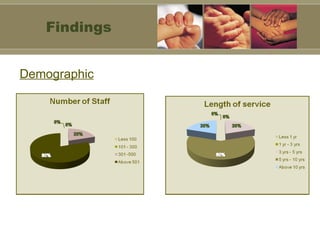
Findings Demographic
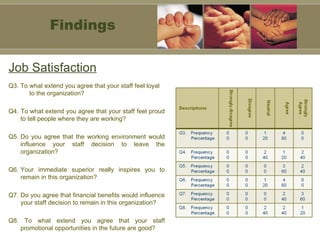
Job Satisfaction Q3. To what extend you agree that your staff feel loyal  to the organization? Q4.  To what extend you agree that your staff feel proud to tell people where they are working? Q5. Do you agree that the working environment would influence your staff decision to leave the organization? Q6. Your immediate superior really inspires you to remain in this organization? Q7. Do you agree that financial benefits would influence your staff decision to remain in this organization? Q8.  To what extend you agree that your staff promotional opportunities in the future are good? Findings
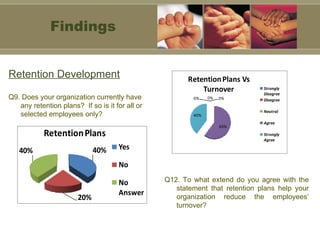
Retention Development Q9. Does your organization currently have  any retention plans?  If so is it for all or selected employees only? Q12. To what extend do you agree with the statement that retention plans help your organization reduce the employees’ turnover? Findings
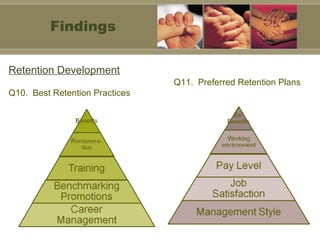
Retention Development Q10.  Best Retention Practices Q11.  Preferred Retention Plans Findings
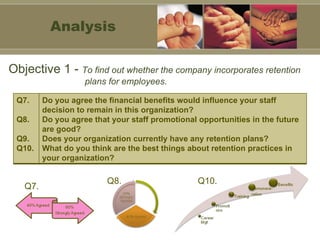
Objective 1 -  To find out whether the company incorporates retention    plans for employees. Q7. Analysis Q8. Q10. Q7. Q8. Q9. Q10. Do you agree the financial benefits would influence your staff decision to remain in this organization? Do you agree that your staff promotional opportunities in the future are good? Does your organization currently have any retention plans? What do you think are the best things about retention practices in your organization?
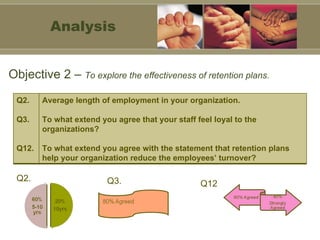
Objective 2 –  To explore the effectiveness of retention plans. Q2. Analysis Q3. Q12 Q2. Q3. Q12. Average length of employment in your organization. To what extend you agree that your staff feel loyal to the organizations? To what extend you agree with the statement that retention plans help your organization reduce the employees’ turnover?
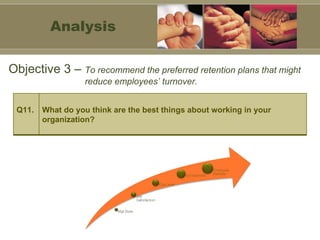
Objective 3 –  To recommend the preferred retention plans that might    reduce employees’ turnover. Analysis Q11. What do you think are the best things about working in your organization?
“ Pay the employees fairly and treat them well”. Good compensation benefits, career development, working environment, good colleagues, promotions opportunities, respect, and flexibility would help to retain the employees. Plans’ execution, fair to all.  Conclusion
Revise existing benefits - Reimbursement tuition fees, child care centre, work-life balance and retirement benefits. Invest in Human Capital -  Training & Development, career progress, internal transfer – multitasking. Management’s commitment to the retention strategy. -  Direction & retention goals progress be monitored regularly.  Should not bias. Recommendations
END OF PRESENTATION

Rm slide 2

  • 1.
    The Retention ManagementEfforts and It’s Effectiveness from the Viewpoint of Malaysian Banking Industry
  • 2.
    Slides Contents:- IntroductionStudy Objectives Theoretical Framework Methodology Sampling Findings Conclusions Recommendations
  • 3.
    Retention Management (RM)Efforts being done by Employers in ensuring or making the Employees stay put in current workforce. Strategies in combating Voluntary Turnover; take away the value and organizational competitive advantage. Enhance organizational performance, reputation and profitability. Introduction
  • 4.
    Banking Employment OverviewDue to economy liberalization & globalization, government embarked on Merger & Acquisition strategy of local commercial banks in late 90s. Create chaotic employment environment; resignations, redundancies, transfers, lay-offs, VSS etc: lead to countless disappointments in the eyes of banking employees. Another merger exercises (internal) – Finance sectors of respective banks in 2004. Introduction
  • 5.
    Banking Employment OverviewAnother cycle of staffing issues; employees morale were lacking as job security was diminishing. Currently being filled with younger generation; hyperactive, low EQ etc. Emergence of Islamic and Foreign banks provide more rooms to jump ship. Retention management – strategy to make the employees stay put in the current banking workforce. Introduction
  • 6.
    To find outthe various efforts being done by Malaysian banking industry in retaining their employees; 2. How effective of such efforts in combating the organizational employees’ turnover; 3. To explore the preferred resolutions that might be put into actions, as part of the retention plan or program. Study Objectives:-
  • 7.
    The employees’voluntary turnover experienced by the banking industry are being affected by job satisfaction elements and that requires the need to install retention management efforts. Theoretical Framework
  • 8.
    Employees resign fromthe current workforce voluntarily. Turnover (TO) is the rate where employers gain and lose employees. TO rate could be measured for individual companies or in relative to the industry as a whole. High TO = short employees tenure. Low TO = employees remain in current workforce. Employees’ Voluntary Turnover
  • 9.
    High TO couldharm the organization. Low TO could increase organization sustainability & profitability. Functional TO; bad performers left and good performers remain – increase productivity Dysfunctional TO; good performers left and bad performers remain – damage organization reputation . Employees’ Voluntary Turnover
  • 10.
    How one perceivedhis / her job is worth the offerings by the organization. Job satisfaction elements – monetary value & non-monetary support. Feel good – high commitment & involvement Feel bad – low morale & decrease enthusiasm (develop intention to leave) Job Satisfaction
  • 11.
    Herzberg 2 FactorsTheory Employees are motivated by internal (motivator) rather than that are of external (hygiene) values to work. Motivator - Recognition, Achievement, Work Challenges, Growth and Development. Hygiene - Pay, Company Policies, Working Relations and Supervisory Skills. In developing RM, need to consider both factors the internal and external motivators. Job Satisfaction
  • 12.
    Most recent strategyin addressing employee turnover issues. Positive efforts by organization to encourage employees long tenure. Resignation associated with costs; the said costs could be allocated to retention plans / programs. Should consider all level of staff; negative perception among employees – sweet talk . RM Efforts
  • 13.
    Monetary elements issignificant in inducing employees to join the organization but not the most significant element to make them to stay put. Should consider other non-monetary support; employee relation, career development, recognition, promotion. The current trend on Psychological Contract – emphasis on Flexibility. RM Efforts
  • 14.
    Retaining key orskilled personnel; the most difficult effort as his KSAOs are being envied by other competing organization. Headhunters’ role also another challenge as they could be considered as damage agent. To ensure success of retention management exercise, it should be well communicated and supported by the management of the organization. RM Efforts
  • 15.
    Qualitative study -structured questionnaires were distributed to Human Resource Personnel of the banks. There were twelve (12) questions to be answered by the respective HR Personnel. The questionnaires were about the respective banks demographic elements in terms of staff strength and turnover, job satisfaction and retention management practices. Methodology
  • 16.
    The Distribution ofQuestionnaires : HR Practitioners at Banking Institutions in KL Number of Questionnaires Distributed = 7 Number of Returned Questionnaires = 5 Percentage of Returned Questionnaires = 71.43% Sampling
  • 17.
  • 18.
    Job Satisfaction Q3.To what extend you agree that your staff feel loyal to the organization? Q4. To what extend you agree that your staff feel proud to tell people where they are working? Q5. Do you agree that the working environment would influence your staff decision to leave the organization? Q6. Your immediate superior really inspires you to remain in this organization? Q7. Do you agree that financial benefits would influence your staff decision to remain in this organization? Q8. To what extend you agree that your staff promotional opportunities in the future are good? Findings
  • 19.
    Retention Development Q9.Does your organization currently have any retention plans? If so is it for all or selected employees only? Q12. To what extend do you agree with the statement that retention plans help your organization reduce the employees’ turnover? Findings
  • 20.
    Retention Development Q10. Best Retention Practices Q11. Preferred Retention Plans Findings
  • 21.
    Objective 1 - To find out whether the company incorporates retention plans for employees. Q7. Analysis Q8. Q10. Q7. Q8. Q9. Q10. Do you agree the financial benefits would influence your staff decision to remain in this organization? Do you agree that your staff promotional opportunities in the future are good? Does your organization currently have any retention plans? What do you think are the best things about retention practices in your organization?
  • 22.
    Objective 2 – To explore the effectiveness of retention plans. Q2. Analysis Q3. Q12 Q2. Q3. Q12. Average length of employment in your organization. To what extend you agree that your staff feel loyal to the organizations? To what extend you agree with the statement that retention plans help your organization reduce the employees’ turnover?
  • 23.
    Objective 3 – To recommend the preferred retention plans that might reduce employees’ turnover. Analysis Q11. What do you think are the best things about working in your organization?
  • 24.
    “ Pay theemployees fairly and treat them well”. Good compensation benefits, career development, working environment, good colleagues, promotions opportunities, respect, and flexibility would help to retain the employees. Plans’ execution, fair to all. Conclusion
  • 25.
    Revise existing benefits- Reimbursement tuition fees, child care centre, work-life balance and retirement benefits. Invest in Human Capital - Training & Development, career progress, internal transfer – multitasking. Management’s commitment to the retention strategy. - Direction & retention goals progress be monitored regularly. Should not bias. Recommendations
  • 26.