Mrs.B.Kavitha M.Sc (N)
Professor
Aswini College Of Nursing
Thrissur
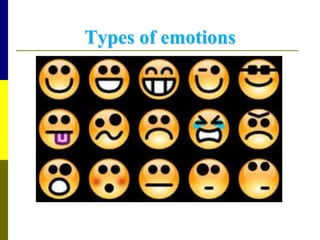
Types of emotions
 EQ vs. IQ
 EQ is emotional intelligence, which, as stated
above, is all about identifying emotions in
ourselves and others, relating to others, and
communicating about our feelings (Cherry,
2018a).
 IQ, on the other hand, is cognitive intelligence.
This is the intelligence that people are generally
most familiar with, as it is the type that is most
often referred to when the word “intelligence” is
used. It is also the type that is most often
measured through testing and estimated through
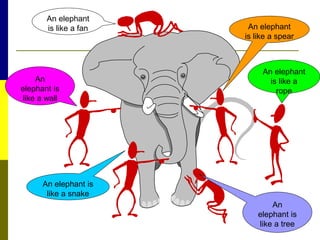
An elephant
is like a fan
An
elephant is
like a wall
An elephant
is like a spear
An
elephant is
like a tree
An elephant is
like a snake
An elephant
is like a
rope
INTRODUCTION
Nurses have distinct intellectual qualities that
they use to adapt to patient needs. Nurses are
bright, critical thinkers and assertive decision
makers. Yet, there is a quality that launches a
good nurse into a great one. It is a quality that is
sometimes hard to put a finger on. It is called
Emotional Intelligence.
What Is
Emotional
Intelligence?
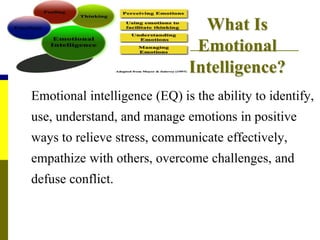
Emotional intelligence (EQ) is the ability to identify,
use, understand, and manage emotions in positive
ways to relieve stress, communicate effectively,
empathize with others, overcome challenges, and
defuse conflict.
Why Emotional Intelligence is
necessary
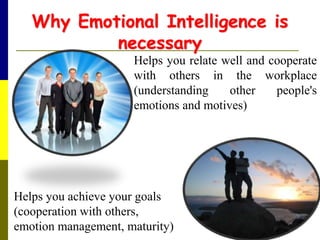
Helps you relate well and cooperate
with others in the workplace
(understanding other people's
emotions and motives)
Helps you achieve your goals
(cooperation with others,
emotion management, maturity)
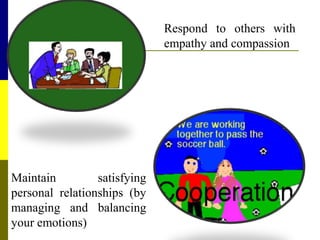
Respond to others with
empathy and compassion
Maintain satisfying
personal relationships (by
managing and balancing
your emotions)
Why Emotional Intelligence is
necessary
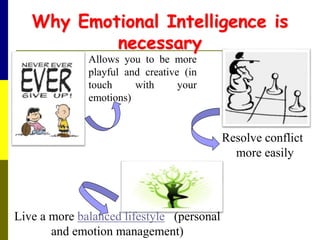
Allows you to be more
playful and creative (in
touch with your
emotions)
Resolve conflict
more easily
Live a more balanced lifestyle (personal
and emotion management)
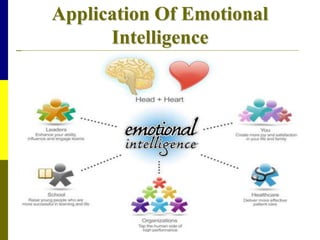
Application Of Emotional
Intelligence
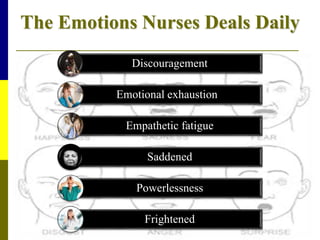
The Emotions Nurses Deals Daily
Discouragement
Emotional exhaustion
Empathetic fatigue
Saddened
Powerlessness
Frightened
Why Emotional Intelligence Is
Important For Nurses
Emotional intelligence allows nurses to
develop therapeutically relationships to meet
patients and their families and to better
manage stress
The nurse with good emotional intelligent
will have the feelings of compassion and
concern for other individual
Why Emotional Intelligence Is
Important For Nurses
The nurse with high emotional intelligent
will experience lower level of stress in their
work
Emotional intelligent nurse work in
harmony with his / her thoughts and feelings
Emotional intelligence are better
predisposed to cope with the
environmental demands
Key Areas Measured
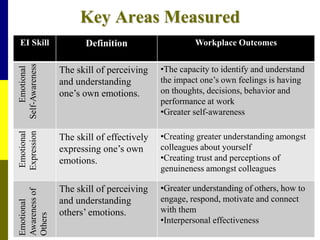
EI Skill Definition Workplace Outcomes
Emotional
Self-Awareness
The skill of perceiving
and understanding
one’s own emotions.
•The capacity to identify and understand
the impact one’s own feelings is having
on thoughts, decisions, behavior and
performance at work
•Greater self-awareness
Emotional
Expression
The skill of effectively
expressing one’s own
emotions.
•Creating greater understanding amongst
colleagues about yourself
•Creating trust and perceptions of
genuineness amongst colleagues
Emotional
Awareness
of
Others
The skill of perceiving
and understanding
others’ emotions.
•Greater understanding of others, how to
engage, respond, motivate and connect
with them
•Interpersonal effectiveness
Key Areas Measured
EI
Skill
Definition Workplace Outcomes
Emotional
Reasoning
The skill of utilizing
emotional
information in
decision-making.
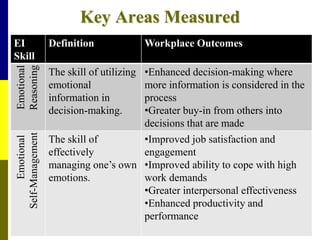
•Enhanced decision-making where
more information is considered in the
process
•Greater buy-in from others into
decisions that are made
Emotional
Self-Management
The skill of
effectively
managing one’s own
emotions.
•Improved job satisfaction and
engagement
•Improved ability to cope with high
work demands
•Greater interpersonal effectiveness
•Enhanced productivity and
performance
Key Areas Measured
EI Skill Definition Workplace Outcome
Emotional
Management
of
Others
The skill of
influencing the
moods and
emotions of
others.
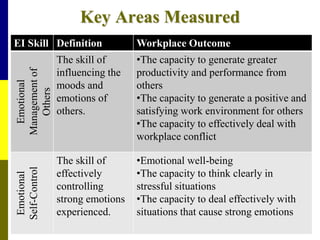
•The capacity to generate greater
productivity and performance from
others
•The capacity to generate a positive and
satisfying work environment for others
•The capacity to effectively deal with
workplace conflict
Emotional
Self-Control
The skill of
effectively
controlling
strong emotions
experienced.
•Emotional well-being
•The capacity to think clearly in
stressful situations
•The capacity to deal effectively with
situations that cause strong emotions
Application Of E.I In Nursing
Profession
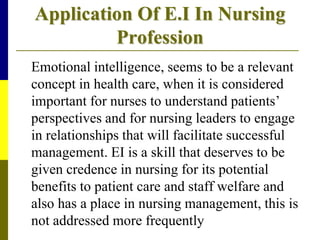
Emotional intelligence, seems to be a relevant
concept in health care, when it is considered
important for nurses to understand patients’
perspectives and for nursing leaders to engage
in relationships that will facilitate successful
management. EI is a skill that deserves to be
given credence in nursing for its potential
benefits to patient care and staff welfare and
also has a place in nursing management, this is
not addressed more frequently
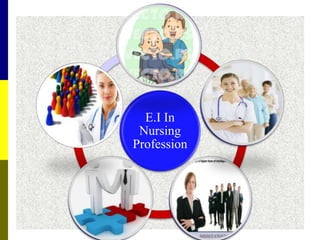
E.I In
Nursing
Profession
E.I and
patient care
E.I and job
satisfaction
Training
and health
care
curriculae
Recruitment
E.I and
leadership
E.I AND
PATIENT CARE
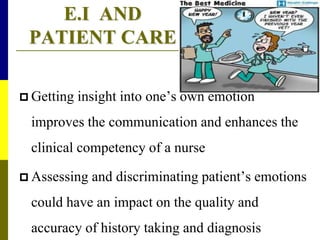
 Getting insight into one’s own emotion
improves the communication and enhances the
clinical competency of a nurse
 Assessing and discriminating patient’s emotions
could have an impact on the quality and
accuracy of history taking and diagnosis
E.I AND
PATIENT CARE
 Ability to mange and read emotions of patiets
seems to enhance patient centered care and
improve the quality of nurse patient relationship
 Simultaneously it increases the patients level of
satisfaction with care and perhaps even
concordance
Supportive Research Findings
 Anne (2004), by a literature review concludes that the
modern day demands of nursing depend on the skills of
emotional intelligence to achieve a patient centered care.
 There is no doubt that Emotional intelligence in nursing
leads to more positive attitudes, greater adaptability,
improved relationships and increased orientation towards
positive values (Kristin and Elisabeth, 2007).
Supportive Research Findings
 Linda Gerits et.al, 2004 revealed that emotional
intelligence reduces nurse burnout .
 A similar study with mental health nurses has
found that Emotional Intelligence stimulates the
search for a deeper understanding of a professional
mental health nursing identity (Kristin and
Elisabeth, 2004).
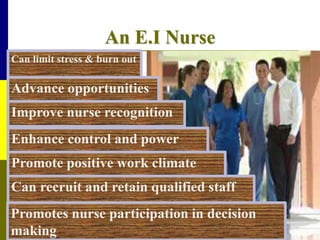
An E.I Nurse
E.I and leadership
E.I is a key leader ship skill. Nurse leaders with
emotional intelligence are in high demand today
to create a healthy workplace environment, where
people come to work not fearful and leaders are
attuned to the emotions of their staff. It's a
necessary ingredient.ANA identifies E.I as one of
nine frameworks for administrative practices
Why….
Nurse leaders, need high EQ because they represent
the organization to the public, they interact with the
highest number of people within and outside the
health care agency and they set the tone for employee
morale.And also the role of a nurse leaders , becomes
critical “In creating a supportive and positive work
environment to help nurses cope with the stress of
managing their own and others emotions concurrently”
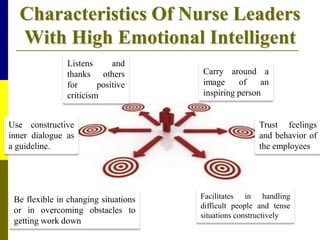
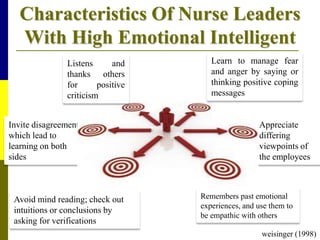
Characteristics Of Nurse Leaders
With High Emotional Intelligent
Listens and
thanks others
for positive
criticism
Carry around a
image of an
inspiring person
Be flexible in changing situations
or in overcoming obstacles to
getting work down
Facilitates in handling
difficult people and tense
situations constructively
Trust feelings
and behavior of
the employees
Use constructive
inner dialogue as
a guideline.
Appreciate
differing
viewpoints of
the employees
Invite disagreement,
which lead to
learning on both
sides
Learn to manage fear
and anger by saying or
thinking positive coping
messages
Characteristics Of Nurse Leaders
With High Emotional Intelligent
Listens and
thanks others
for positive
criticism
Avoid mind reading; check out
intuitions or conclusions by
asking for verifications
Remembers past emotional
experiences, and use them to
be empathic with others
weisinger (1998)
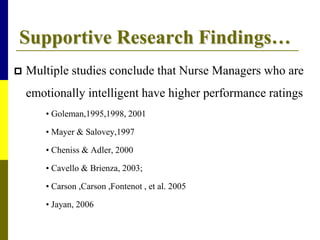
Supportive Research Findings…
 Multiple studies conclude that Nurse Managers who are
emotionally intelligent have higher performance ratings
• Goleman,1995,1998, 2001
• Mayer & Salovey,1997
• Cheniss & Adler, 2000
• Cavello & Brienza, 2003;
• Carson ,Carson ,Fontenot , et al. 2005
• Jayan, 2006
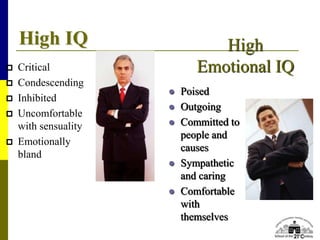
High IQ
 Critical
 Condescending
 Inhibited
 Uncomfortable
with sensuality
 Emotionally
bland
High
Emotional IQ
 Poised
 Outgoing
 Committed to
people and
causes
 Sympathetic
and caring
 Comfortable
with
themselves
Nurses should train to develop better social & emotional
competencies needed for successful & effective
performance (Freshwater & Stickley,2003)
Successful healthcare leaders are those who lead with
heart and possess what have come to be known as the
“soft skill” Kerfoot, 2000
The managers High on EQ were low on burnout implying
that they can cope up better with Stress. (Prof
NKChadha, Psychology Dept, Delhi University)
Leaders who guide with both head and heart
will create a happier, more confident and well
motivated team, taking pride in delivering the
highest standard of care and performance.
(McQuire &Kennerly, 2006)
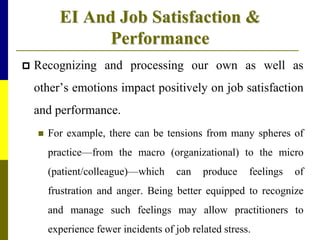
EI And Job Satisfaction &
Performance
 Recognizing and processing our own as well as
other’s emotions impact positively on job satisfaction
and performance.
 For example, there can be tensions from many spheres of
practice—from the macro (organizational) to the micro
(patient/colleague)—which can produce feelings of
frustration and anger. Being better equipped to recognize
and manage such feelings may allow practitioners to
experience fewer incidents of job related stress.
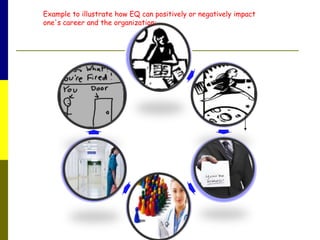
Example to illustrate how EQ can positively or negatively impact
one's career and the organization:
EI And Job Satisfaction And
Performance
 Health care practitioners who are disillusioned, over-
stressed or burned out are unlikely to be able to deliver
good quality care and communicate well with patients.
 A wider approach to this area examine the
organizational culture in which health care is delivered
and organization can operate in an emotionally
intelligent way to reduce stress and burnout.
TRAINING AND HEALTH
CARE CURRICULAE
Individuals with high E.I employed in health care
may lead to more effective management and
better functioning teams of professionals, in
addition to direct benefits for patient care.
Some models suggest competencies can be
developed with training, while other
conceptualizations describe personality
characteristics are difficult to change—with the
implication that EI cannot be significantly
influenced by training.
RECRUITMENT
 Selecting the ‘right’ person for job especially in health
care professionals is the subject of much study and
debate. What constitutes ‘right’ is complex, to certain
extent emotional intelligence helps in selecting the
‘right’ candidate
 successfully landing a job is not purely based upon a
candidate’s qualifications or IQ score. In addition to
experience, what employers want is the right
personality type, who will be able to fit comfortably in
with the team.
RECRUITMENT
 When we interview candidates, we go through a
number of active thought processes. Without realising
it, we are measuring their responses, mannerisms and
how well they put themselves across. What we are
really doing is assessing their emotional intelligence.
It’s that quality, honesty and ability to build rapport
that is so often the key to them standing out from the
other applicants – and this is the type of employee who
ultimately helps the client to improve their staff
retention and keep costs down.
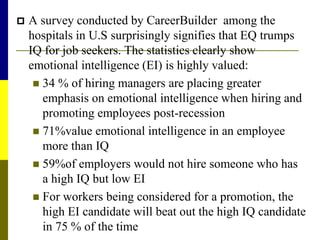
 A survey conducted by CareerBuilder among the
hospitals in U.S surprisingly signifies that EQ trumps
IQ for job seekers. The statistics clearly show
emotional intelligence (EI) is highly valued:
 34 % of hiring managers are placing greater
emphasis on emotional intelligence when hiring and
promoting employees post-recession
 71%value emotional intelligence in an employee
more than IQ
 59%of employers would not hire someone who has
a high IQ but low EI
 For workers being considered for a promotion, the
high EI candidate will beat out the high IQ candidate
in 75 % of the time
Why….
 The reason is simple
 Those with high EI excelled at staying calm under pressure,
resolving conflict effectively, behaving with empathy and
leading by example, according to respondents.
.
The Key Skills That Build Emotional
Intelligence
The key skills of emotional intelligence can be
learned by anyone, at any time.
EQ skill 1: Rapidly reduce stress in the moment
EQ Skill 2: Beat Relationship Stress With
Emotional Awareness
EQ skill 3: Nonverbal communication
EQ skill 4: Use Humor And Play To Deal With
Challenges
EQ skill 5: Resolve conflict positively
EQ skill 1: Rapidly reduce stress in
the moment
Stress busting: functioning well in the heat of
the moment- Develop your stress-busting skills by
working through the following three steps:
 Realize when you’re stressed
 Identify your stress response
 Discover the stress-busting techniques that work
for you
EQ Skill 2: Beat Relationship Stress
With Emotional Awareness
 What kind of a relationship do you have
with your emotions?
 Do you experience feelings that
flow, encountering one emotion after another
as your experiences change from moment to
moment?
 Are your emotions accompanied by physical
sensations that you experience in places like
your stomach or chest?
EQ Skill 2: Beat Relationship Stress
With Emotional Awareness
 Do you experience discrete feelings and
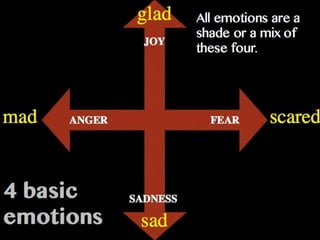
emotions, such as anger, sadness, fear, joy, each of
which is evident in subtle facial expressions?
 Can you experience intense feelings that are strong
enough to capture both your attention and that of others?
 Do you pay attention to your emotions? Do they
factor into your decision making?
 If any of these experiences are unfamiliar, your
emotions may be turned down or turned off. In order to
be emotionally healthy and emotionally intelligent, you
must reconnect to your core emotions, accept them, and
become comfortable with them.
EQ Skill 2: Beat Relationship Stress
With Emotional Awareness
Developing emotional awareness
 Emotional awareness can be learned at any time of life.
If you haven’t learned how to manage stress, it’s
important to do so first. When you can manage stress,
you’ll feel more comfortable reconnecting to strong or
unpleasant emotions and changing the way you
experience and respond to your feelings.
 You can develop your emotional awareness by learning
the mindfulness meditation in Help guide's free
Emotional Intelligence Toolkit that helps you to get in
touch with difficult emotions and manage
uncomfortable feelings.
EQ skill 3: Nonverbal communication
 Tips for improving nonverbal communication
Successful nonverbal communication depends on your
ability to manage stress, recognize your own emotions,
and understand the signals you’re sending and receiving.
When communicating:
Focus on the other person.
Make eye contact.
Pay attention to nonverbal cues
EQ skill 4: Use Humor And Play To
Deal With Challenges
 A good hearty laugh reduces stress, elevates mood, and brings
your nervous system back into balance.
 Playful communication broadens your emotional intelligence and
helps you:
 Take hardships in stride.
 Smooth over differences.
 Simultaneously relax and energize yourself.
 Become more creative.
 How to develop playful communication:
 Try setting aside regular, quality playtime. The more you
joke, play, and laugh—the easier it becomes.
 Practice by playing with animals, babies, young children,
and outgoing people who appreciate playful banter.
Emotional intelligence (EQ) skill 5:
Resolve conflict positively
 Tips for resolving conflict in a trust-building
way:
 Stay focused in the present.
 Choose your arguments.
 Forgive.
 End conflicts that can't be resolved.
Factors That Influence Nurse
Application Of Emotional Intelligence
The gender,
Age and
Health condition of patients
also influences the application of emotional
intelligence.
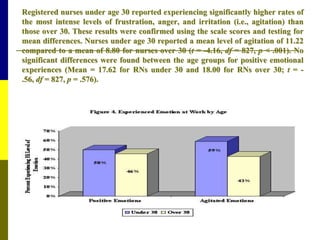
Registered nurses under age 30 reported experiencing significantly higher rates of
the most intense levels of frustration, anger, and irritation (i.e., agitation) than
those over 30. These results were confirmed using the scale scores and testing for
mean differences. Nurses under age 30 reported a mean level of agitation of 11.22
compared to a mean of 8.80 for nurses over 30 (t = -4.16, df = 827, p < .001). No
significant differences were found between the age groups for positive emotional
experiences (Mean = 17.62 for RNs under 30 and 18.00 for RNs over 30; t = -
.56, df = 827, p = .576).
 Nurses who pretended to have unfelt feelings were more
burned out than nurses who did not pretend to have
unfelt emotions. And, ...nurses who covered up their true
feelings were more burned out than nurses who did not
cover up such emotional experiences. Nurses who
covered up their true feelings were more burned out than
nurses who did not cover up such emotional
experiences.
 Increasing recognition of the emotional experiences and
demands that constitute an essential facet of the nursing
work environment is the first step to providing younger
nurses with the support they need...[to] reduce their rates
CONCLUSION
When it comes to happiness and success in
life, emotional intelligence (EQ) matters
just as much as intellectual ability (IQ).
Emotional intelligence helps you build
stronger relationships, succeed at work, and
achieve your career and personal goals.
Question & Answers
 Nurses are expected to display emotions that convey
caring, understanding, and compassion towards the
patient
Emotional Intelligence Affects:
Your Performance At Work.
Your Physical Health.
Your Mental Health.
Your Relationships.

Emotional intelligence

  • 1.
    Mrs.B.Kavitha M.Sc (N) Professor AswiniCollege Of Nursing Thrissur
  • 2.
  • 4.
     EQ vs.IQ  EQ is emotional intelligence, which, as stated above, is all about identifying emotions in ourselves and others, relating to others, and communicating about our feelings (Cherry, 2018a).  IQ, on the other hand, is cognitive intelligence. This is the intelligence that people are generally most familiar with, as it is the type that is most often referred to when the word “intelligence” is used. It is also the type that is most often measured through testing and estimated through
  • 6.
    An elephant is likea fan An elephant is like a wall An elephant is like a spear An elephant is like a tree An elephant is like a snake An elephant is like a rope
  • 7.
    INTRODUCTION Nurses have distinctintellectual qualities that they use to adapt to patient needs. Nurses are bright, critical thinkers and assertive decision makers. Yet, there is a quality that launches a good nurse into a great one. It is a quality that is sometimes hard to put a finger on. It is called Emotional Intelligence.
  • 8.
    What Is Emotional Intelligence? Emotional intelligence(EQ) is the ability to identify, use, understand, and manage emotions in positive ways to relieve stress, communicate effectively, empathize with others, overcome challenges, and defuse conflict.
  • 10.
    Why Emotional Intelligenceis necessary Helps you relate well and cooperate with others in the workplace (understanding other people's emotions and motives) Helps you achieve your goals (cooperation with others, emotion management, maturity)
  • 11.
    Respond to otherswith empathy and compassion Maintain satisfying personal relationships (by managing and balancing your emotions)
  • 12.
    Why Emotional Intelligenceis necessary Allows you to be more playful and creative (in touch with your emotions) Resolve conflict more easily Live a more balanced lifestyle (personal and emotion management)
  • 13.
  • 14.
    The Emotions NursesDeals Daily Discouragement Emotional exhaustion Empathetic fatigue Saddened Powerlessness Frightened
  • 15.
    Why Emotional IntelligenceIs Important For Nurses Emotional intelligence allows nurses to develop therapeutically relationships to meet patients and their families and to better manage stress The nurse with good emotional intelligent will have the feelings of compassion and concern for other individual
  • 16.
    Why Emotional IntelligenceIs Important For Nurses The nurse with high emotional intelligent will experience lower level of stress in their work Emotional intelligent nurse work in harmony with his / her thoughts and feelings Emotional intelligence are better predisposed to cope with the environmental demands
  • 17.
    Key Areas Measured EISkill Definition Workplace Outcomes Emotional Self-Awareness The skill of perceiving and understanding one’s own emotions. •The capacity to identify and understand the impact one’s own feelings is having on thoughts, decisions, behavior and performance at work •Greater self-awareness Emotional Expression The skill of effectively expressing one’s own emotions. •Creating greater understanding amongst colleagues about yourself •Creating trust and perceptions of genuineness amongst colleagues Emotional Awareness of Others The skill of perceiving and understanding others’ emotions. •Greater understanding of others, how to engage, respond, motivate and connect with them •Interpersonal effectiveness
  • 18.
    Key Areas Measured EI Skill DefinitionWorkplace Outcomes Emotional Reasoning The skill of utilizing emotional information in decision-making. •Enhanced decision-making where more information is considered in the process •Greater buy-in from others into decisions that are made Emotional Self-Management The skill of effectively managing one’s own emotions. •Improved job satisfaction and engagement •Improved ability to cope with high work demands •Greater interpersonal effectiveness •Enhanced productivity and performance
  • 19.
    Key Areas Measured EISkill Definition Workplace Outcome Emotional Management of Others The skill of influencing the moods and emotions of others. •The capacity to generate greater productivity and performance from others •The capacity to generate a positive and satisfying work environment for others •The capacity to effectively deal with workplace conflict Emotional Self-Control The skill of effectively controlling strong emotions experienced. •Emotional well-being •The capacity to think clearly in stressful situations •The capacity to deal effectively with situations that cause strong emotions
  • 20.
    Application Of E.IIn Nursing Profession Emotional intelligence, seems to be a relevant concept in health care, when it is considered important for nurses to understand patients’ perspectives and for nursing leaders to engage in relationships that will facilitate successful management. EI is a skill that deserves to be given credence in nursing for its potential benefits to patient care and staff welfare and also has a place in nursing management, this is not addressed more frequently
  • 21.
    E.I In Nursing Profession E.I and patientcare E.I and job satisfaction Training and health care curriculae Recruitment E.I and leadership
  • 22.
    E.I AND PATIENT CARE Getting insight into one’s own emotion improves the communication and enhances the clinical competency of a nurse  Assessing and discriminating patient’s emotions could have an impact on the quality and accuracy of history taking and diagnosis
  • 23.
    E.I AND PATIENT CARE Ability to mange and read emotions of patiets seems to enhance patient centered care and improve the quality of nurse patient relationship  Simultaneously it increases the patients level of satisfaction with care and perhaps even concordance
  • 24.
    Supportive Research Findings Anne (2004), by a literature review concludes that the modern day demands of nursing depend on the skills of emotional intelligence to achieve a patient centered care.  There is no doubt that Emotional intelligence in nursing leads to more positive attitudes, greater adaptability, improved relationships and increased orientation towards positive values (Kristin and Elisabeth, 2007).
  • 25.
    Supportive Research Findings Linda Gerits et.al, 2004 revealed that emotional intelligence reduces nurse burnout .  A similar study with mental health nurses has found that Emotional Intelligence stimulates the search for a deeper understanding of a professional mental health nursing identity (Kristin and Elisabeth, 2004).
  • 26.
  • 27.
    E.I and leadership E.Iis a key leader ship skill. Nurse leaders with emotional intelligence are in high demand today to create a healthy workplace environment, where people come to work not fearful and leaders are attuned to the emotions of their staff. It's a necessary ingredient.ANA identifies E.I as one of nine frameworks for administrative practices
  • 28.
    Why…. Nurse leaders, needhigh EQ because they represent the organization to the public, they interact with the highest number of people within and outside the health care agency and they set the tone for employee morale.And also the role of a nurse leaders , becomes critical “In creating a supportive and positive work environment to help nurses cope with the stress of managing their own and others emotions concurrently”
  • 29.
    Characteristics Of NurseLeaders With High Emotional Intelligent Listens and thanks others for positive criticism Carry around a image of an inspiring person Be flexible in changing situations or in overcoming obstacles to getting work down Facilitates in handling difficult people and tense situations constructively Trust feelings and behavior of the employees Use constructive inner dialogue as a guideline.
  • 30.
    Appreciate differing viewpoints of the employees Invitedisagreement, which lead to learning on both sides Learn to manage fear and anger by saying or thinking positive coping messages Characteristics Of Nurse Leaders With High Emotional Intelligent Listens and thanks others for positive criticism Avoid mind reading; check out intuitions or conclusions by asking for verifications Remembers past emotional experiences, and use them to be empathic with others weisinger (1998)
  • 31.
    Supportive Research Findings… Multiple studies conclude that Nurse Managers who are emotionally intelligent have higher performance ratings • Goleman,1995,1998, 2001 • Mayer & Salovey,1997 • Cheniss & Adler, 2000 • Cavello & Brienza, 2003; • Carson ,Carson ,Fontenot , et al. 2005 • Jayan, 2006
  • 32.
    High IQ  Critical Condescending  Inhibited  Uncomfortable with sensuality  Emotionally bland High Emotional IQ  Poised  Outgoing  Committed to people and causes  Sympathetic and caring  Comfortable with themselves
  • 33.
    Nurses should trainto develop better social & emotional competencies needed for successful & effective performance (Freshwater & Stickley,2003) Successful healthcare leaders are those who lead with heart and possess what have come to be known as the “soft skill” Kerfoot, 2000 The managers High on EQ were low on burnout implying that they can cope up better with Stress. (Prof NKChadha, Psychology Dept, Delhi University)
  • 34.
    Leaders who guidewith both head and heart will create a happier, more confident and well motivated team, taking pride in delivering the highest standard of care and performance. (McQuire &Kennerly, 2006)
  • 35.
    EI And JobSatisfaction & Performance  Recognizing and processing our own as well as other’s emotions impact positively on job satisfaction and performance.  For example, there can be tensions from many spheres of practice—from the macro (organizational) to the micro (patient/colleague)—which can produce feelings of frustration and anger. Being better equipped to recognize and manage such feelings may allow practitioners to experience fewer incidents of job related stress.
  • 36.
    Example to illustratehow EQ can positively or negatively impact one's career and the organization:
  • 37.
    EI And JobSatisfaction And Performance  Health care practitioners who are disillusioned, over- stressed or burned out are unlikely to be able to deliver good quality care and communicate well with patients.  A wider approach to this area examine the organizational culture in which health care is delivered and organization can operate in an emotionally intelligent way to reduce stress and burnout.
  • 38.
    TRAINING AND HEALTH CARECURRICULAE Individuals with high E.I employed in health care may lead to more effective management and better functioning teams of professionals, in addition to direct benefits for patient care. Some models suggest competencies can be developed with training, while other conceptualizations describe personality characteristics are difficult to change—with the implication that EI cannot be significantly influenced by training.
  • 39.
    RECRUITMENT  Selecting the‘right’ person for job especially in health care professionals is the subject of much study and debate. What constitutes ‘right’ is complex, to certain extent emotional intelligence helps in selecting the ‘right’ candidate  successfully landing a job is not purely based upon a candidate’s qualifications or IQ score. In addition to experience, what employers want is the right personality type, who will be able to fit comfortably in with the team.
  • 40.
    RECRUITMENT  When weinterview candidates, we go through a number of active thought processes. Without realising it, we are measuring their responses, mannerisms and how well they put themselves across. What we are really doing is assessing their emotional intelligence. It’s that quality, honesty and ability to build rapport that is so often the key to them standing out from the other applicants – and this is the type of employee who ultimately helps the client to improve their staff retention and keep costs down.
  • 41.
     A surveyconducted by CareerBuilder among the hospitals in U.S surprisingly signifies that EQ trumps IQ for job seekers. The statistics clearly show emotional intelligence (EI) is highly valued:  34 % of hiring managers are placing greater emphasis on emotional intelligence when hiring and promoting employees post-recession  71%value emotional intelligence in an employee more than IQ  59%of employers would not hire someone who has a high IQ but low EI  For workers being considered for a promotion, the high EI candidate will beat out the high IQ candidate in 75 % of the time
  • 42.
    Why….  The reasonis simple  Those with high EI excelled at staying calm under pressure, resolving conflict effectively, behaving with empathy and leading by example, according to respondents. .
  • 43.
    The Key SkillsThat Build Emotional Intelligence The key skills of emotional intelligence can be learned by anyone, at any time. EQ skill 1: Rapidly reduce stress in the moment EQ Skill 2: Beat Relationship Stress With Emotional Awareness EQ skill 3: Nonverbal communication EQ skill 4: Use Humor And Play To Deal With Challenges EQ skill 5: Resolve conflict positively
  • 44.
    EQ skill 1:Rapidly reduce stress in the moment Stress busting: functioning well in the heat of the moment- Develop your stress-busting skills by working through the following three steps:  Realize when you’re stressed  Identify your stress response  Discover the stress-busting techniques that work for you
  • 45.
    EQ Skill 2:Beat Relationship Stress With Emotional Awareness  What kind of a relationship do you have with your emotions?  Do you experience feelings that flow, encountering one emotion after another as your experiences change from moment to moment?  Are your emotions accompanied by physical sensations that you experience in places like your stomach or chest?
  • 46.
    EQ Skill 2:Beat Relationship Stress With Emotional Awareness  Do you experience discrete feelings and emotions, such as anger, sadness, fear, joy, each of which is evident in subtle facial expressions?  Can you experience intense feelings that are strong enough to capture both your attention and that of others?  Do you pay attention to your emotions? Do they factor into your decision making?  If any of these experiences are unfamiliar, your emotions may be turned down or turned off. In order to be emotionally healthy and emotionally intelligent, you must reconnect to your core emotions, accept them, and become comfortable with them.
  • 47.
    EQ Skill 2:Beat Relationship Stress With Emotional Awareness Developing emotional awareness  Emotional awareness can be learned at any time of life. If you haven’t learned how to manage stress, it’s important to do so first. When you can manage stress, you’ll feel more comfortable reconnecting to strong or unpleasant emotions and changing the way you experience and respond to your feelings.  You can develop your emotional awareness by learning the mindfulness meditation in Help guide's free Emotional Intelligence Toolkit that helps you to get in touch with difficult emotions and manage uncomfortable feelings.
  • 48.
    EQ skill 3:Nonverbal communication  Tips for improving nonverbal communication Successful nonverbal communication depends on your ability to manage stress, recognize your own emotions, and understand the signals you’re sending and receiving. When communicating: Focus on the other person. Make eye contact. Pay attention to nonverbal cues
  • 49.
    EQ skill 4:Use Humor And Play To Deal With Challenges  A good hearty laugh reduces stress, elevates mood, and brings your nervous system back into balance.  Playful communication broadens your emotional intelligence and helps you:  Take hardships in stride.  Smooth over differences.  Simultaneously relax and energize yourself.  Become more creative.  How to develop playful communication:  Try setting aside regular, quality playtime. The more you joke, play, and laugh—the easier it becomes.  Practice by playing with animals, babies, young children, and outgoing people who appreciate playful banter.
  • 50.
    Emotional intelligence (EQ)skill 5: Resolve conflict positively  Tips for resolving conflict in a trust-building way:  Stay focused in the present.  Choose your arguments.  Forgive.  End conflicts that can't be resolved.
  • 51.
    Factors That InfluenceNurse Application Of Emotional Intelligence The gender, Age and Health condition of patients also influences the application of emotional intelligence.
  • 52.
    Registered nurses underage 30 reported experiencing significantly higher rates of the most intense levels of frustration, anger, and irritation (i.e., agitation) than those over 30. These results were confirmed using the scale scores and testing for mean differences. Nurses under age 30 reported a mean level of agitation of 11.22 compared to a mean of 8.80 for nurses over 30 (t = -4.16, df = 827, p < .001). No significant differences were found between the age groups for positive emotional experiences (Mean = 17.62 for RNs under 30 and 18.00 for RNs over 30; t = - .56, df = 827, p = .576).
  • 53.
     Nurses whopretended to have unfelt feelings were more burned out than nurses who did not pretend to have unfelt emotions. And, ...nurses who covered up their true feelings were more burned out than nurses who did not cover up such emotional experiences. Nurses who covered up their true feelings were more burned out than nurses who did not cover up such emotional experiences.  Increasing recognition of the emotional experiences and demands that constitute an essential facet of the nursing work environment is the first step to providing younger nurses with the support they need...[to] reduce their rates
  • 54.
    CONCLUSION When it comesto happiness and success in life, emotional intelligence (EQ) matters just as much as intellectual ability (IQ). Emotional intelligence helps you build stronger relationships, succeed at work, and achieve your career and personal goals.
  • 55.
  • 56.
     Nurses areexpected to display emotions that convey caring, understanding, and compassion towards the patient
  • 57.
    Emotional Intelligence Affects: YourPerformance At Work. Your Physical Health. Your Mental Health. Your Relationships.