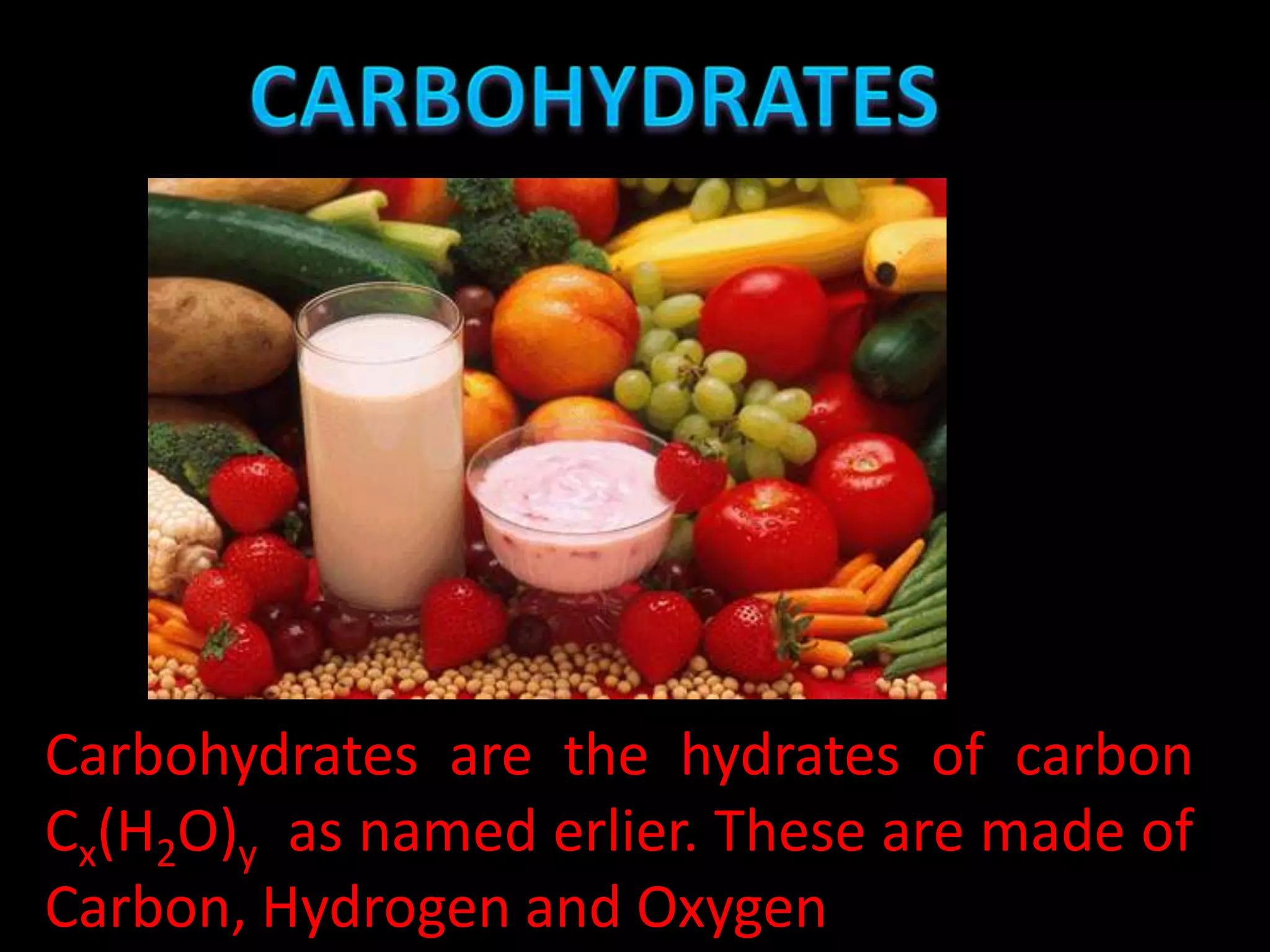

Carbohydrates are the hydrates of carbon
Cx(H2O)y as named erlier. These are made of
Carbon, Hydrogen and Oxygen
Carbohydrates are often refered as
Saccharides (Saccharum = sugar) because of
sweet taste of its simpler members.
But higher membranes are not sweet in
taste.
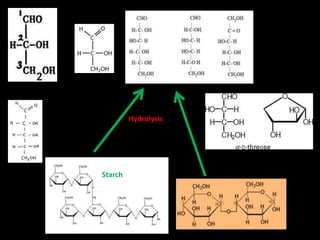
Starch
Hydrolysis
Chemically carbohydrates are defined as the
polyhydroxy aldehydes or polyhydroxy
ketones or substances which produce these
compounds on hydrolysis .
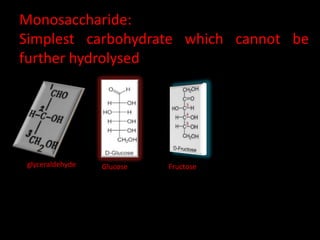
Monosaccharide:
Simplest carbohydrate which cannot be
further hydrolysed
glyceraldehyde Glucose Fructose
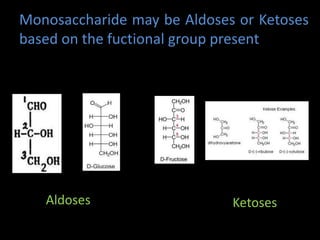
Monosaccharide may be Aldoses or Ketoses
based on the fuctional group present
Aldoses Ketoses
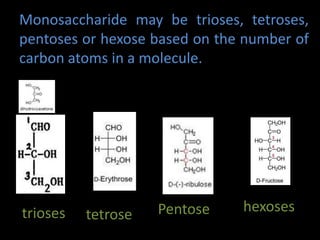
Monosaccharide may be trioses, tetroses,
pentoses or hexose based on the number of
carbon atoms in a molecule.
trioses hexoses
tetrose Pentose
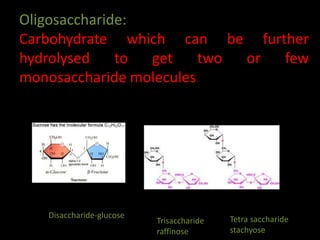
Oligosaccharide:
Carbohydrate which can be further
hydrolysed to get two or few
monosaccharide molecules
Disaccharide-glucose Tetra saccharide
stachyose
Trisaccharide
raffinose
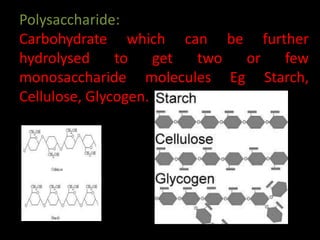
Polysaccharide:
Carbohydrate which can be further
hydrolysed to get two or few
monosaccharide molecules Eg Starch,
Cellulose, Glycogen.
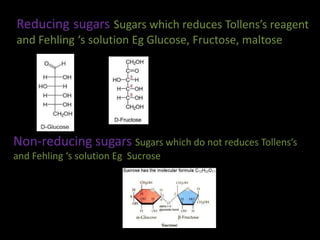
Reducing sugars Sugars which reduces Tollens’s reagent
and Fehling ‘s solution Eg Glucose, Fructose, maltose
Non-reducing sugars Sugars which do not reduces Tollens’s
and Fehling ‘s solution Eg Sucrose
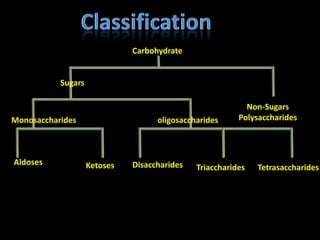
Sugars
Carbohydrate
Non-Sugars
PolysaccharidesoligosaccharidesMonosaccharides
Aldoses Ketoses Disaccharides TetrasaccharidesTriaccharides
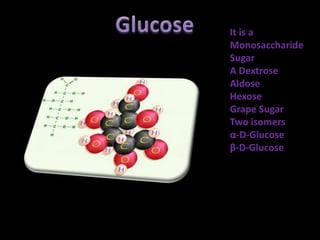
It is a
Monosaccharide
Sugar
A Dextrose
Aldose
Hexose
Grape Sugar
Two isomers
α-D-Glucose
β-D-Glucose
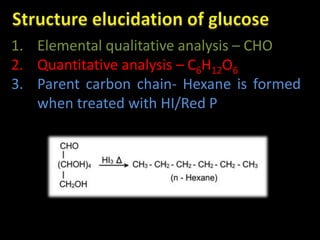
1. Elemental qualitative analysis – CHO
2. Quantitative analysis – C6H12O6
3. Parent carbon chain- Hexane is formed
when treated with HI/Red P
4. Aq. Solution is neutral so –COOH group is
absent.
One mole of glucose react with one
mole of HCN to form glucocyanohydrin.
Condenses with one mole of
hydroxylamine to give glucose oxime.
This shows that Glucose contain either
aldehydic ( -CHO) or (–C=O)ketonic
group
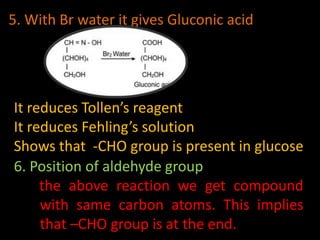
5. With Br water it gives Gluconic acid
It reduces Tollen’s reagent
It reduces Fehling’s solution
Shows that -CHO group is present in glucose
6. Position of aldehyde group
the above reaction we get compound
with same carbon atoms. This implies
that –CHO group is at the end.
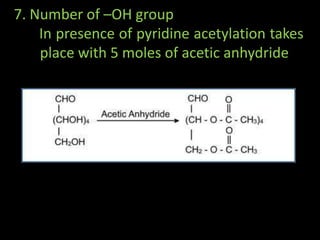
7. Number of –OH group
In presence of pyridine acetylation takes
place with 5 moles of acetic anhydride
8. Position of –OH group
If two –OH groups were on the same
carbon atom molecule becomes
unstable but Glucose is very stable
compound. Shows that 5 –OH groups
are on different carbon.
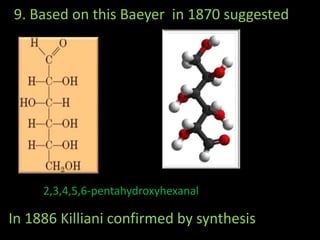
9. Based on this Baeyer in 1870 suggested
In 1886 Killiani confirmed by synthesis
2,3,4,5,6-pentahydroxyhexanal
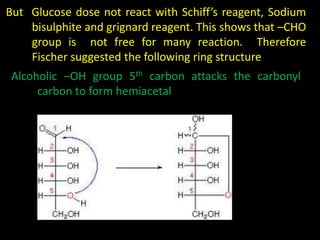
But Glucose dose not react with Schiff’s reagent, Sodium
bisulphite and grignard reagent. This shows that –CHO
group is not free for many reaction. Therefore
Fischer suggested the following ring structure
Alcoholic –OH group 5th carbon attacks the carbonyl
carbon to form hemiacetal
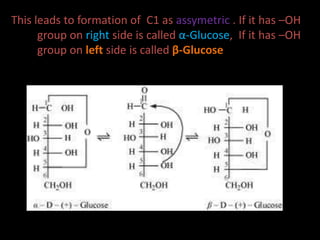
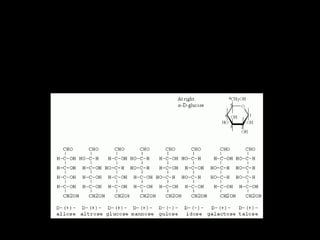
This leads to formation of C1 as assymetric . If it has –OH
group on right side is called α-Glucose, If it has –OH
group on left side is called β-Glucose
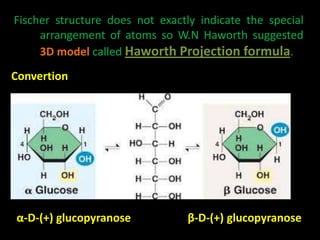
Fischer structure does not exactly indicate the special
arrangement of atoms so W.N Haworth suggested
3D model called Haworth Projection formula.
Convertion
α-D-(+) glucopyranose β-D-(+) glucopyranose
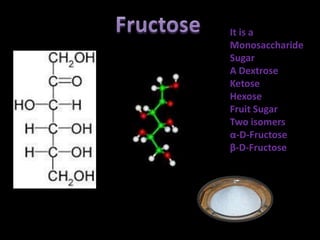
It is a
Monosaccharide
Sugar
A Dextrose
Ketose
Hexose
Fruit Sugar
Two isomers
α-D-Fructose
β-D-Fructose
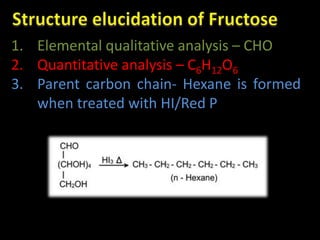
1. Elemental qualitative analysis – CHO
2. Quantitative analysis – C6H12O6
3. Parent carbon chain- Hexane is formed
when treated with HI/Red P
4. Aq. Solution is neutral so –COOH group is
absent.
One mole of fructose react with one
mole of HCN to form cyanohydrin.
Condenses with one mole of
hydroxylamine to give oxime. This
shows that fructose contain either
aldehydic ( -CHO) or (–C=O)ketonic
group
5. With HNO3 it gives tartaric acid and
Glycollic acid
It reduces Tollen’s reagent
It reduces Fehling’s solution
Shows that -CHO group is present in glucose
6. Position of ketone group
the above reaction we get compound
with different carbon atoms. This implies
that –C=O group is at the 2nd position.
7. Number of –OH group
In presence of pyridine acetylation takes
place with 5 moles of acetic anhydride
8. Position of –OH group
If two –OH groups were on the same
carbon atom molecule becomes
unstable but Glucose is very stable
compound. Shows that 5 –OH groups
are on different carbon.
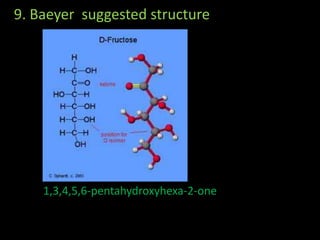
9. Baeyer suggested structure
1,3,4,5,6-pentahydroxyhexa-2-one
But Glucose dose not react with Schiff’s reagent, Sodium
bisulphite and grignard reagent. This shows that –CHO
group is not free for many reaction. Therefore
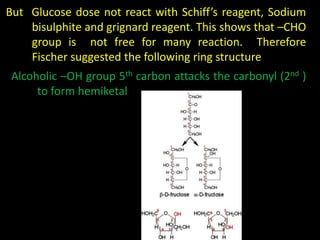
Fischer suggested the following ring structure
Alcoholic –OH group 5th carbon attacks the carbonyl (2nd )
to form hemiketal
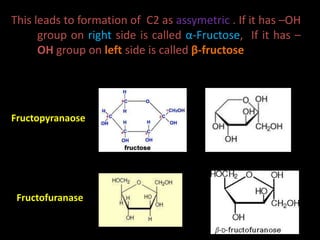
This leads to formation of C2 as assymetric . If it has –OH
group on right side is called α-Fructose, If it has –
OH group on left side is called β-fructose
Fructofuranase
Fructopyranaose
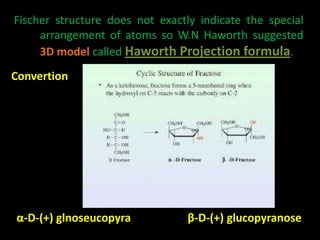
Fischer structure does not exactly indicate the special
arrangement of atoms so W.N Haworth suggested
3D model called Haworth Projection formula.
Convertion
α-D-(+) glnoseucopyra β-D-(+) glucopyranose
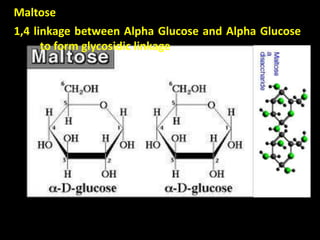
Maltose
1,4 linkage between Alpha Glucose and Alpha Glucose
to form glycosidic linkage
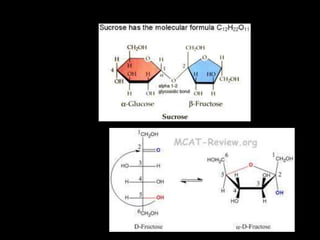
1,2 linkage between Alpha Glucopyranose and beta-
fructofuranose to form glycosidic linkage
Sucrose
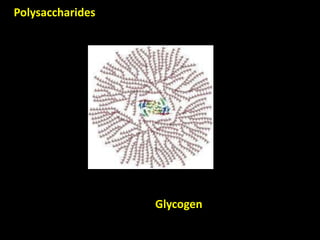
Polysaccharides
Glycogen
Carbohydrate
Carbohydrate
Carbohydrate

Carbohydrate

  • 1.
    Carbohydrates are thehydrates of carbon Cx(H2O)y as named erlier. These are made of Carbon, Hydrogen and Oxygen
  • 2.
    Carbohydrates are oftenrefered as Saccharides (Saccharum = sugar) because of sweet taste of its simpler members. But higher membranes are not sweet in taste.
  • 3.
  • 4.
    Chemically carbohydrates aredefined as the polyhydroxy aldehydes or polyhydroxy ketones or substances which produce these compounds on hydrolysis .
  • 5.
    Monosaccharide: Simplest carbohydrate whichcannot be further hydrolysed glyceraldehyde Glucose Fructose
  • 6.
    Monosaccharide may beAldoses or Ketoses based on the fuctional group present Aldoses Ketoses
  • 7.
    Monosaccharide may betrioses, tetroses, pentoses or hexose based on the number of carbon atoms in a molecule. trioses hexoses tetrose Pentose
  • 8.
    Oligosaccharide: Carbohydrate which canbe further hydrolysed to get two or few monosaccharide molecules Disaccharide-glucose Tetra saccharide stachyose Trisaccharide raffinose
  • 9.
    Polysaccharide: Carbohydrate which canbe further hydrolysed to get two or few monosaccharide molecules Eg Starch, Cellulose, Glycogen.
  • 10.
    Reducing sugars Sugarswhich reduces Tollens’s reagent and Fehling ‘s solution Eg Glucose, Fructose, maltose Non-reducing sugars Sugars which do not reduces Tollens’s and Fehling ‘s solution Eg Sucrose
  • 11.
  • 12.
    It is a Monosaccharide Sugar ADextrose Aldose Hexose Grape Sugar Two isomers α-D-Glucose β-D-Glucose
  • 13.
    1. Elemental qualitativeanalysis – CHO 2. Quantitative analysis – C6H12O6 3. Parent carbon chain- Hexane is formed when treated with HI/Red P
  • 14.
    4. Aq. Solutionis neutral so –COOH group is absent. One mole of glucose react with one mole of HCN to form glucocyanohydrin. Condenses with one mole of hydroxylamine to give glucose oxime. This shows that Glucose contain either aldehydic ( -CHO) or (–C=O)ketonic group
  • 15.
    5. With Brwater it gives Gluconic acid It reduces Tollen’s reagent It reduces Fehling’s solution Shows that -CHO group is present in glucose 6. Position of aldehyde group the above reaction we get compound with same carbon atoms. This implies that –CHO group is at the end.
  • 16.
    7. Number of–OH group In presence of pyridine acetylation takes place with 5 moles of acetic anhydride
  • 17.
    8. Position of–OH group If two –OH groups were on the same carbon atom molecule becomes unstable but Glucose is very stable compound. Shows that 5 –OH groups are on different carbon.
  • 18.
    9. Based onthis Baeyer in 1870 suggested In 1886 Killiani confirmed by synthesis 2,3,4,5,6-pentahydroxyhexanal
  • 19.
    But Glucose dosenot react with Schiff’s reagent, Sodium bisulphite and grignard reagent. This shows that –CHO group is not free for many reaction. Therefore Fischer suggested the following ring structure Alcoholic –OH group 5th carbon attacks the carbonyl carbon to form hemiacetal
  • 20.
    This leads toformation of C1 as assymetric . If it has –OH group on right side is called α-Glucose, If it has –OH group on left side is called β-Glucose
  • 21.
    Fischer structure doesnot exactly indicate the special arrangement of atoms so W.N Haworth suggested 3D model called Haworth Projection formula. Convertion α-D-(+) glucopyranose β-D-(+) glucopyranose
  • 22.
    It is a Monosaccharide Sugar ADextrose Ketose Hexose Fruit Sugar Two isomers α-D-Fructose β-D-Fructose
  • 23.
    1. Elemental qualitativeanalysis – CHO 2. Quantitative analysis – C6H12O6 3. Parent carbon chain- Hexane is formed when treated with HI/Red P
  • 24.
    4. Aq. Solutionis neutral so –COOH group is absent. One mole of fructose react with one mole of HCN to form cyanohydrin. Condenses with one mole of hydroxylamine to give oxime. This shows that fructose contain either aldehydic ( -CHO) or (–C=O)ketonic group
  • 25.
    5. With HNO3it gives tartaric acid and Glycollic acid It reduces Tollen’s reagent It reduces Fehling’s solution Shows that -CHO group is present in glucose 6. Position of ketone group the above reaction we get compound with different carbon atoms. This implies that –C=O group is at the 2nd position.
  • 26.
    7. Number of–OH group In presence of pyridine acetylation takes place with 5 moles of acetic anhydride
  • 27.
    8. Position of–OH group If two –OH groups were on the same carbon atom molecule becomes unstable but Glucose is very stable compound. Shows that 5 –OH groups are on different carbon.
  • 28.
    9. Baeyer suggestedstructure 1,3,4,5,6-pentahydroxyhexa-2-one
  • 29.
    But Glucose dosenot react with Schiff’s reagent, Sodium bisulphite and grignard reagent. This shows that –CHO group is not free for many reaction. Therefore Fischer suggested the following ring structure Alcoholic –OH group 5th carbon attacks the carbonyl (2nd ) to form hemiketal
  • 30.
    This leads toformation of C2 as assymetric . If it has –OH group on right side is called α-Fructose, If it has – OH group on left side is called β-fructose Fructofuranase Fructopyranaose
  • 31.
    Fischer structure doesnot exactly indicate the special arrangement of atoms so W.N Haworth suggested 3D model called Haworth Projection formula. Convertion α-D-(+) glnoseucopyra β-D-(+) glucopyranose
  • 32.
    Maltose 1,4 linkage betweenAlpha Glucose and Alpha Glucose to form glycosidic linkage
  • 33.
    1,2 linkage betweenAlpha Glucopyranose and beta- fructofuranose to form glycosidic linkage Sucrose
  • 34.