ALKALOIDS AND EXTRACTION
OF ALKALOIDS

A.M.MANOJ
13-503-006
LOGO
HISTORY
 “Alkaloid” -the Arabic word - “al-qali”.

 Term alkaloid -coined by messiner -German pharmacist
(1819).
 Totally more than 7000 compounds are known in only 5% of
the plant species.
 Ninety five percent of plant species are still remain to be
examined for alkaloids.
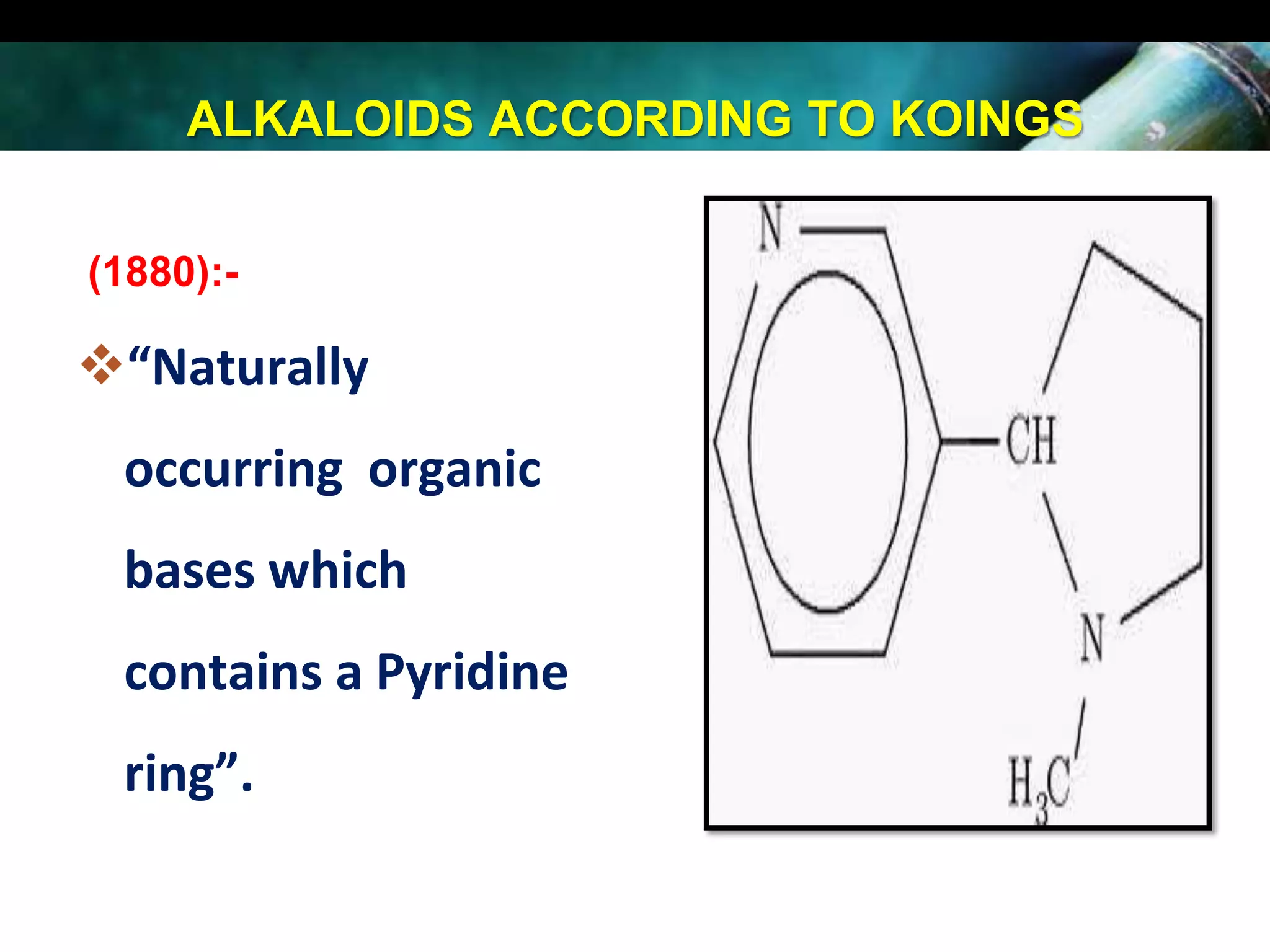
ALKALOIDS ACCORDING TO KOINGS
(1880):-

“Naturally

occurring organic
bases which

contains a Pyridine
ring”.
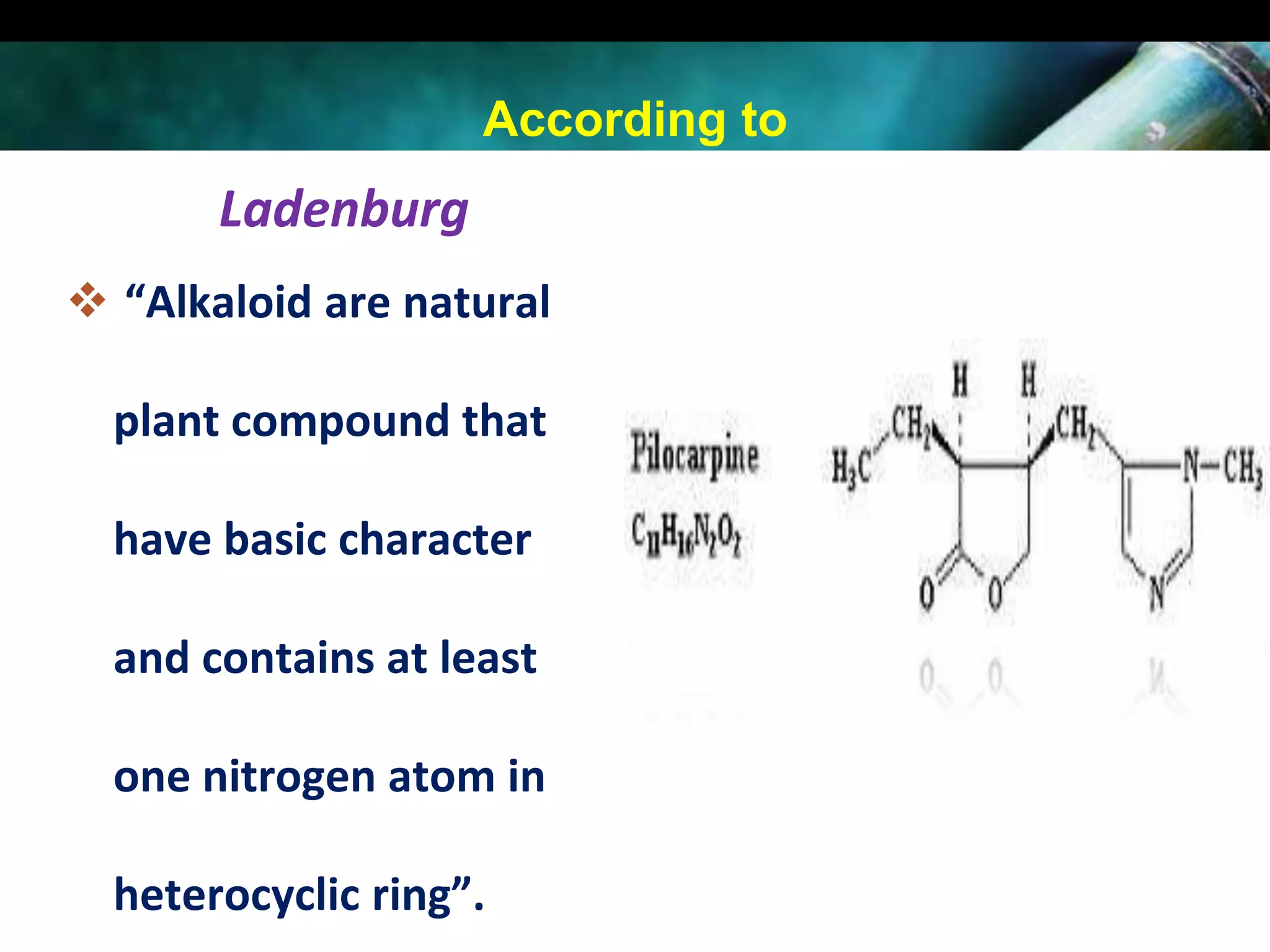
According to

Ladenburg
 “Alkaloid are natural
plant compound that
have basic character
and contains at least
one nitrogen atom in
heterocyclic ring”.
ALKALOIDS
Simply alkaloids are nothing but the basic

nitrogenous compound, contains one or more
nitrogen in heterocyclic ring system having marked
physiological action on human and animals when
use in small quantities”

”.”
STRUCTURE
Alkaloids- 12000 structures known.

 Poisons – Conine
 Narcotics – Morphine
 Stimulants – caffeine
 Medicine – Taxol
FACTS AND NEWS EVIDENCE
 1806 – Pharmacy assistant Friedrich Wilhelm Serturner
isolated morphine from poppy seeds
 Socrates died when he was forced to drink extract of hemlock
containing coniine.

 Nicotine (tobacco) is used as very potent insecticide for
fumigating green houses.
 Cleopatra used extracts containing atropine to dilate her
pupil in order to appear more attractive; atropine in low
doses dilates pupils of the eye.
GENERAL PROPERTIES OF
ALKALOIDS
PHYSICAL PROPERTY
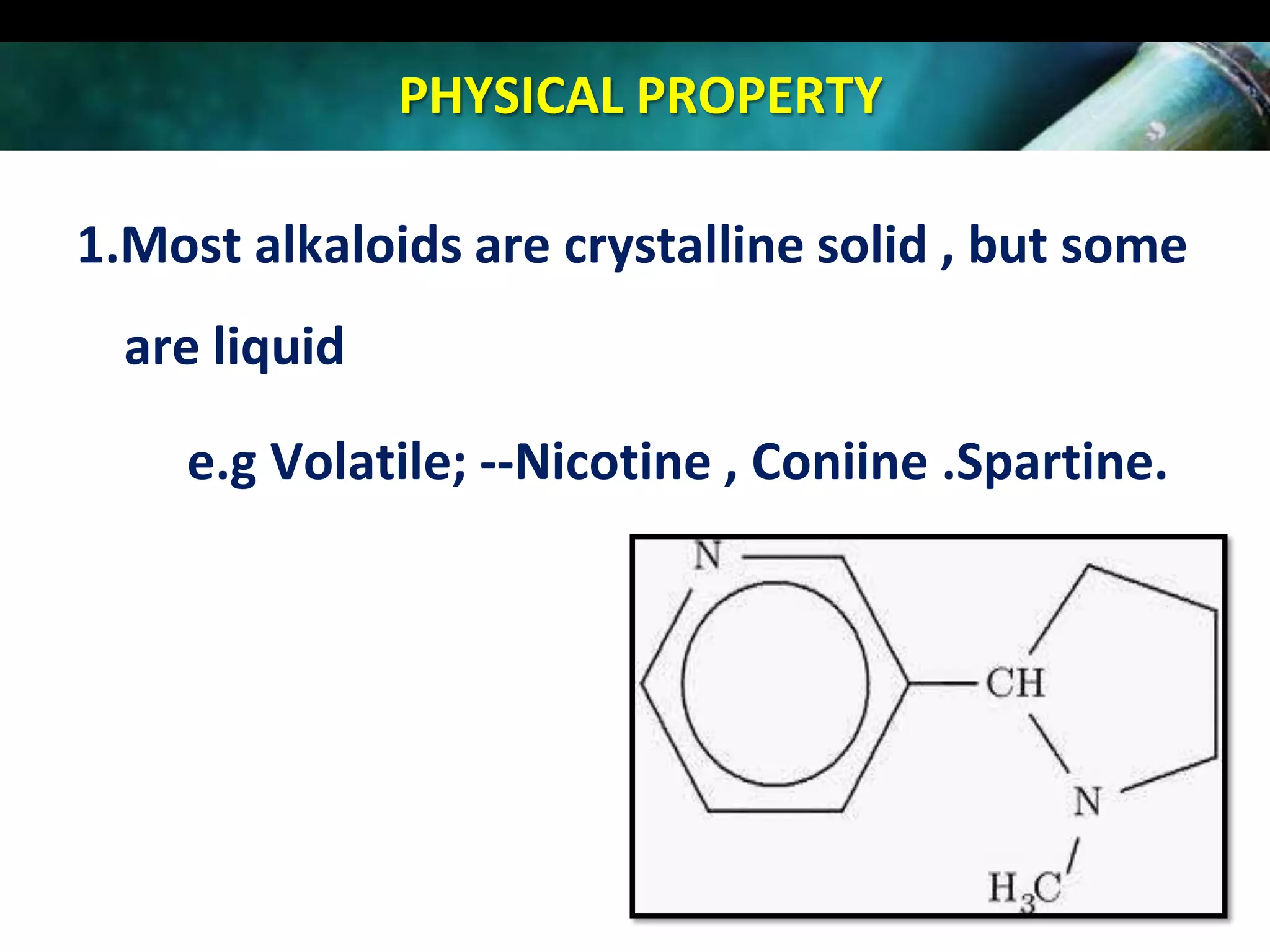
1.Most alkaloids are crystalline solid , but some

are liquid
e.g Volatile; --Nicotine , Coniine .Spartine.
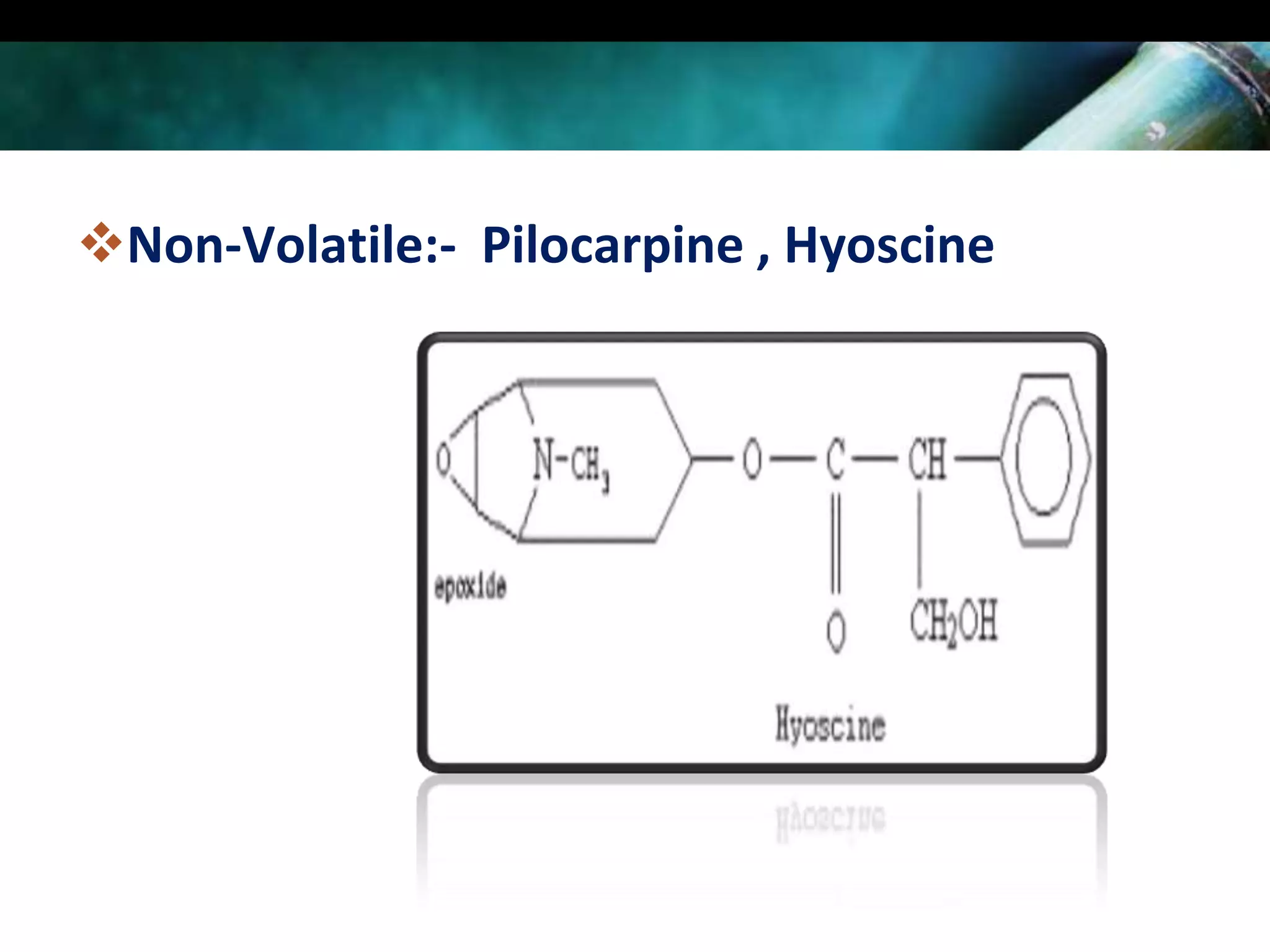
Non-Volatile:- Pilocarpine , Hyoscine
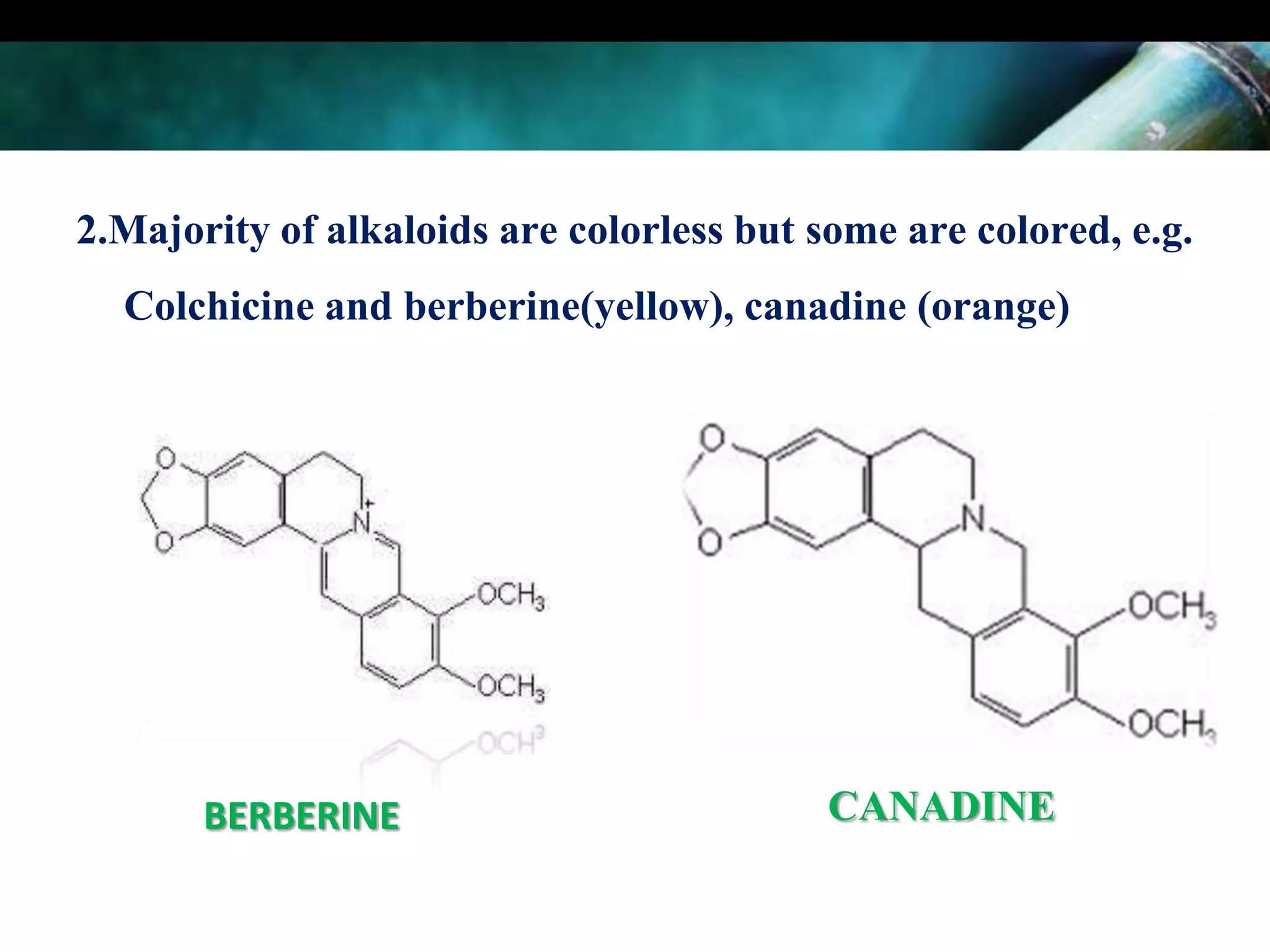
2.Majority of alkaloids are colorless but some are colored, e.g.
Colchicine and berberine(yellow), canadine (orange)

BERBERINE

CANADINE
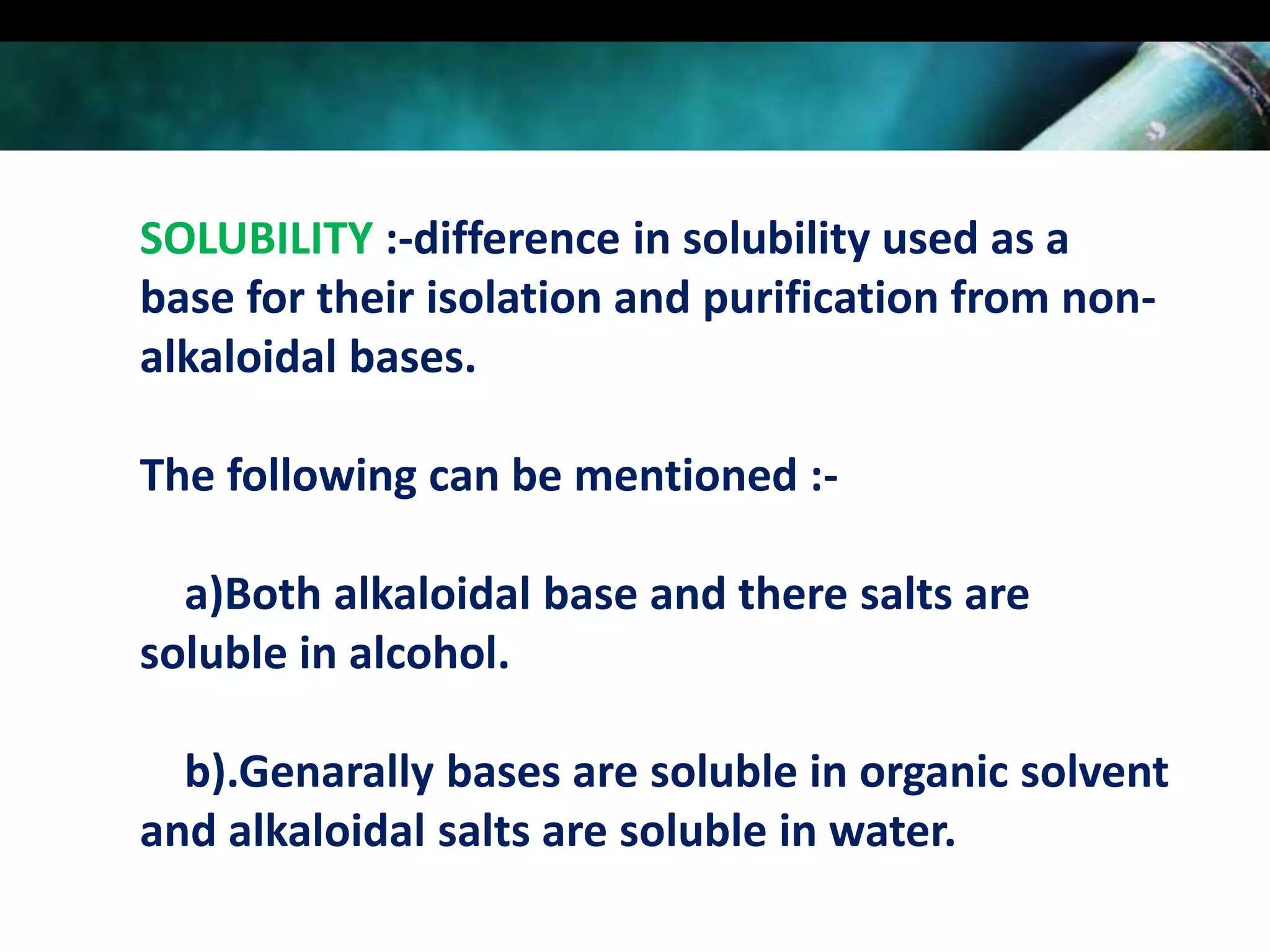
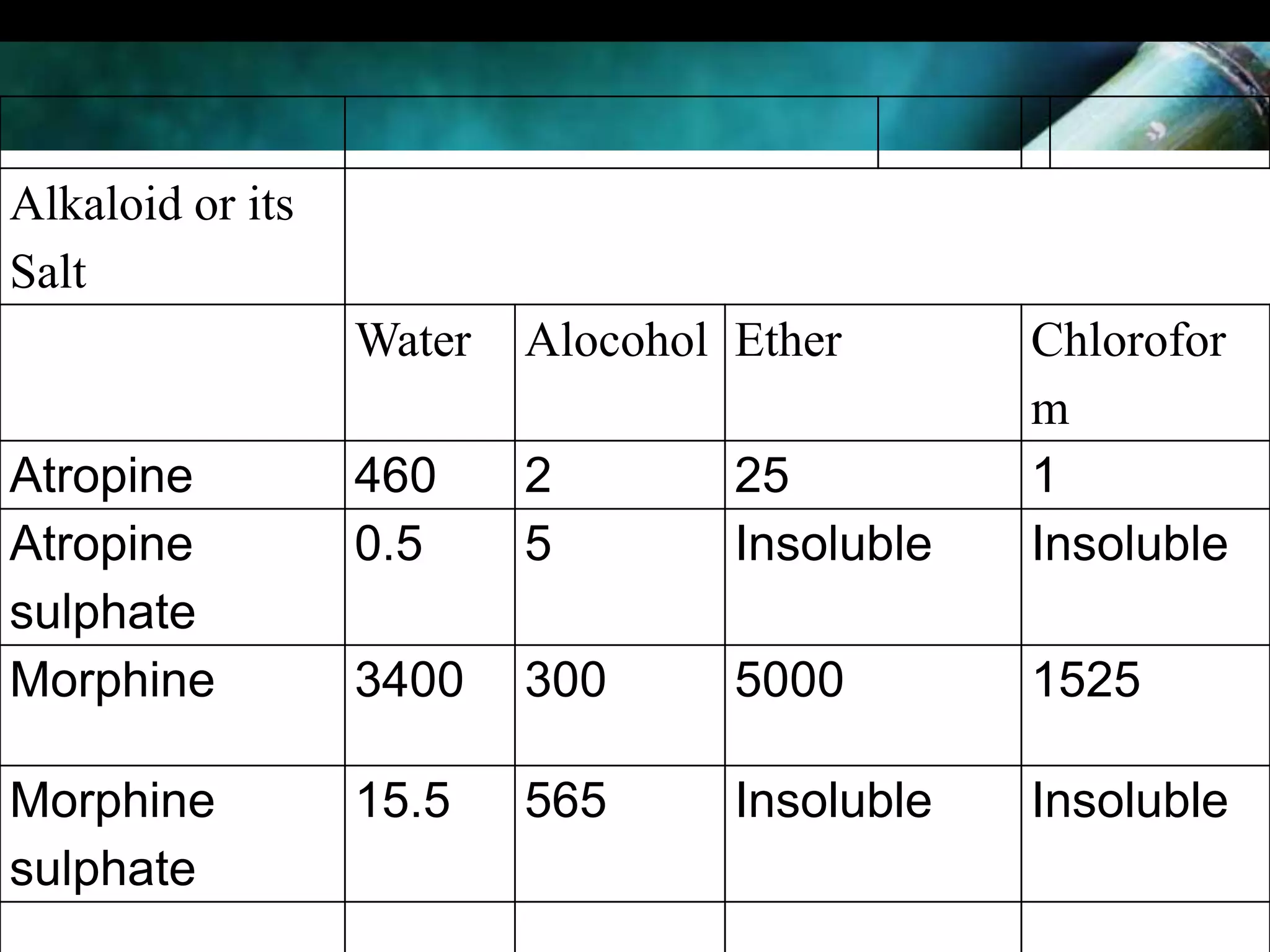
SOLUBILITY :-difference in solubility used as a
base for their isolation and purification from nonalkaloidal bases.
The following can be mentioned :a)Both alkaloidal base and there salts are
soluble in alcohol.

b).Genarally bases are soluble in organic solvent
and alkaloidal salts are soluble in water.
Alkaloid or its
Salt

Water

Alocohol Ether

Atropine
Atropine
sulphate
Morphine

460
0.5

2
5

25
Insoluble

Chlorofor
m
1
Insoluble

3400

300

5000

1525

Morphine
sulphate

15.5

565

Insoluble

Insoluble
CHEMICAL PROPERTIES
1.Salt formation :--Due to their basic character
alkaloid reacts with acid to form salt
--strong bases form salt with very weak acid.
 --weak bases forms salt with strong acid
-- very weak bases form unstable salts.e.g caffeine ,
Narcotine , piperine.
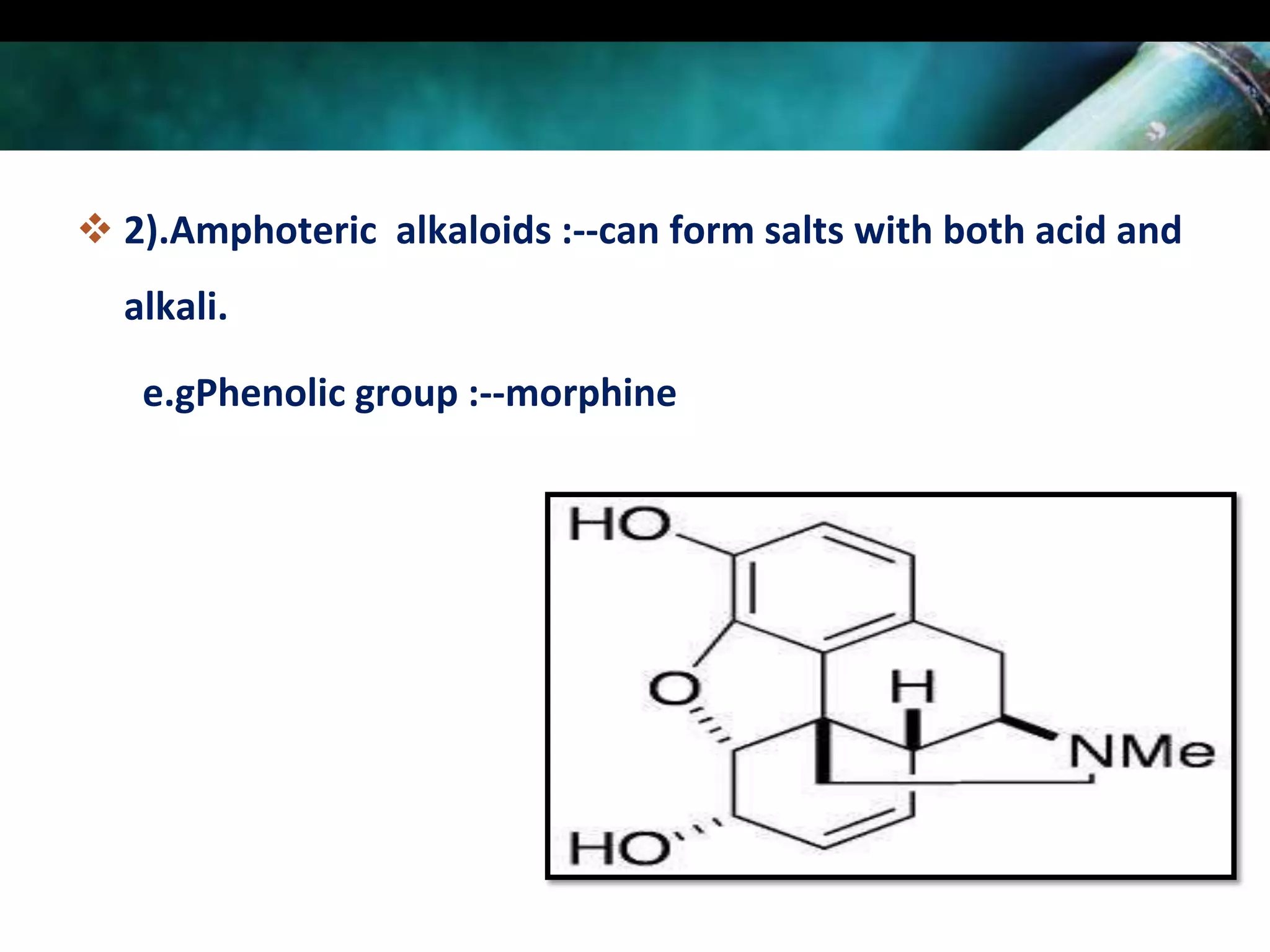
 2).Amphoteric alkaloids :--can form salts with both acid and
alkali.
e.gPhenolic group :--morphine
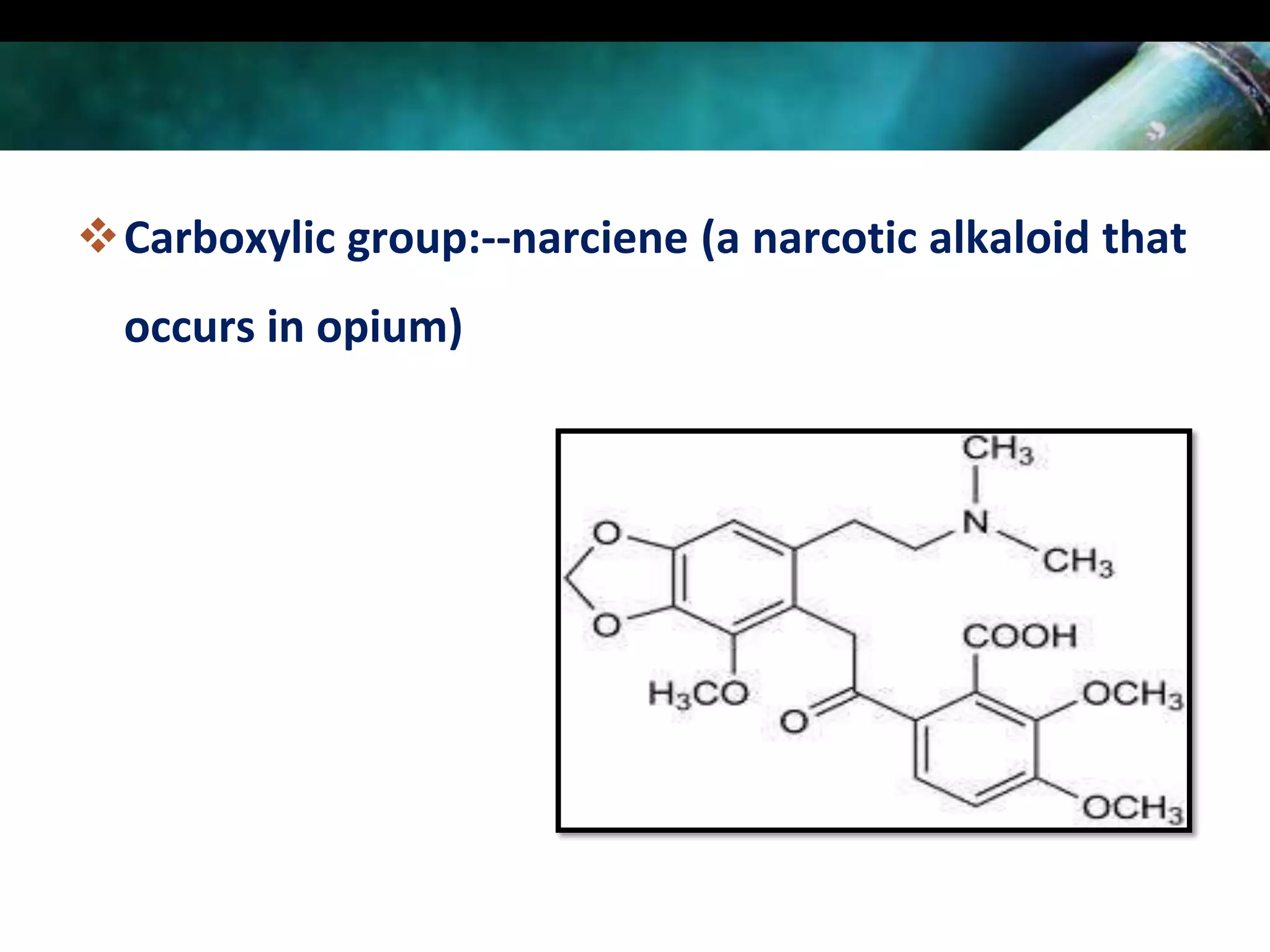
Carboxylic group:--narciene (a narcotic alkaloid that
occurs in opium)
3)Effect of heat:
Alkaloids are decomposed by heat, except strychnine and
caffeine (sublimable).
4). Effect of light and oxygen :
 Decomposed when allowed to stand at a temperature above
70o C .For long time.
 Sensitivity varies in degree with different alkaloids.
 Decomposition occur rapidly and easily when an alkaloid is in
solution than when it is in dry form.
 Most tertiary amine alkaloids are easily transformed to the
n-oxides.
EFFECT OF ALKALIS.
 Weak alkalis liberate most alkaloids from their salts e.G. Nh3
 Strong alkalis: such as aqueous naoh and KOH form salts with
phenolic alkaloids.

 Hot alkalis: results hydrolysis of ester alkaloids e.G. Atropine,
cocaine and physostigmine and cleavage of lactone ring, if
present, to produce the corresponding acid, e.G. Pilocarpine
is transformed to pilocarpic acid.
BASICITY OF ALKALOIDS :--The basicity of alkaloid is
due to presence of a lone pair of electron on
nitrogen atom.
--The basicity increased if the adjacent group is
electron releasing like alkali .
-- the basicity decreases if the adjacent group is
electron withdrawing like carbonyl and amide group.
EXTRACTION OF
ALKALOIDS
STAS-OTTO METHOD

LOGO
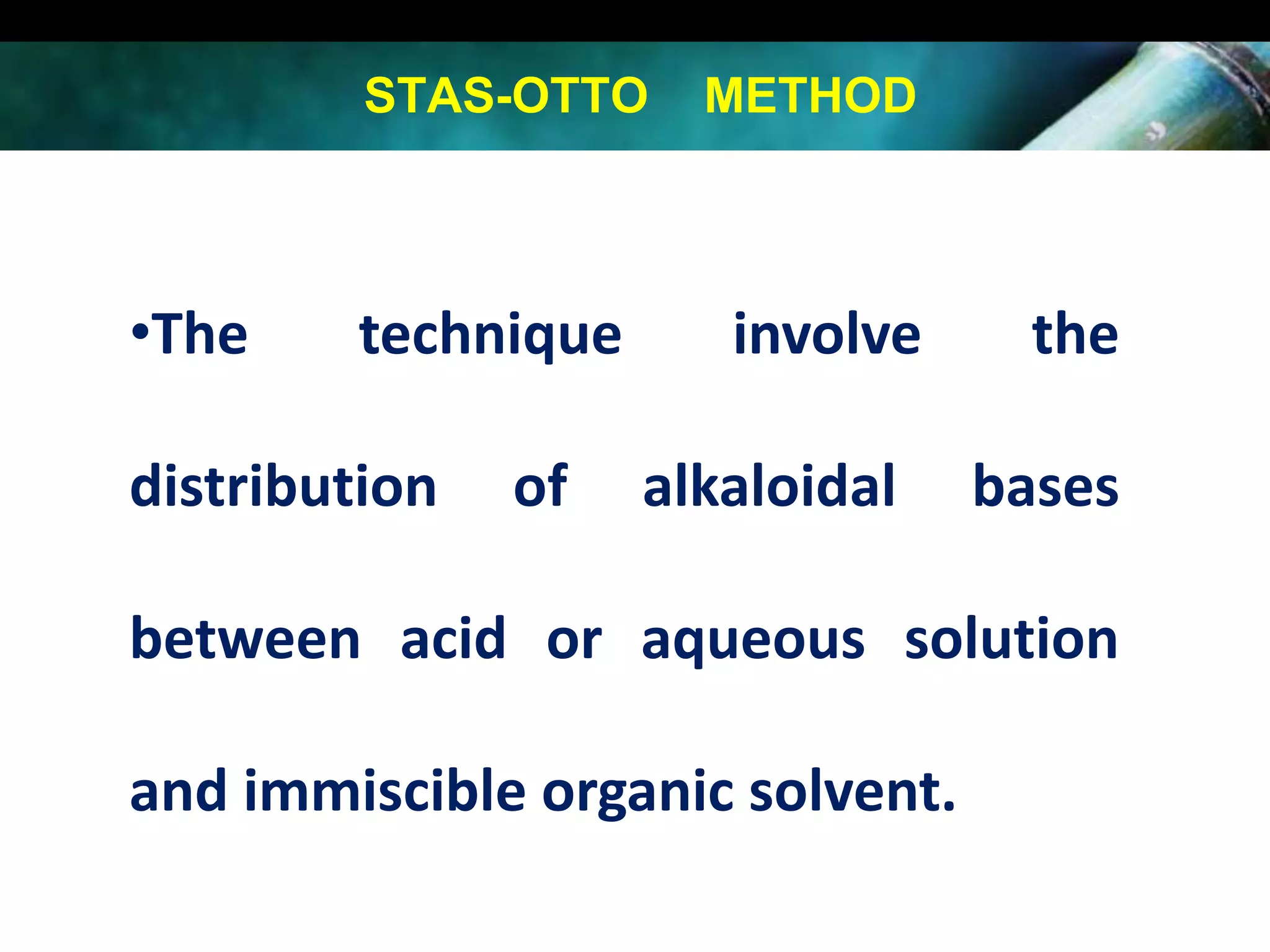
STAS-OTTO

•The

technique

distribution

of

METHOD

involve
alkaloidal

the
bases

between acid or aqueous solution

and immiscible organic solvent.
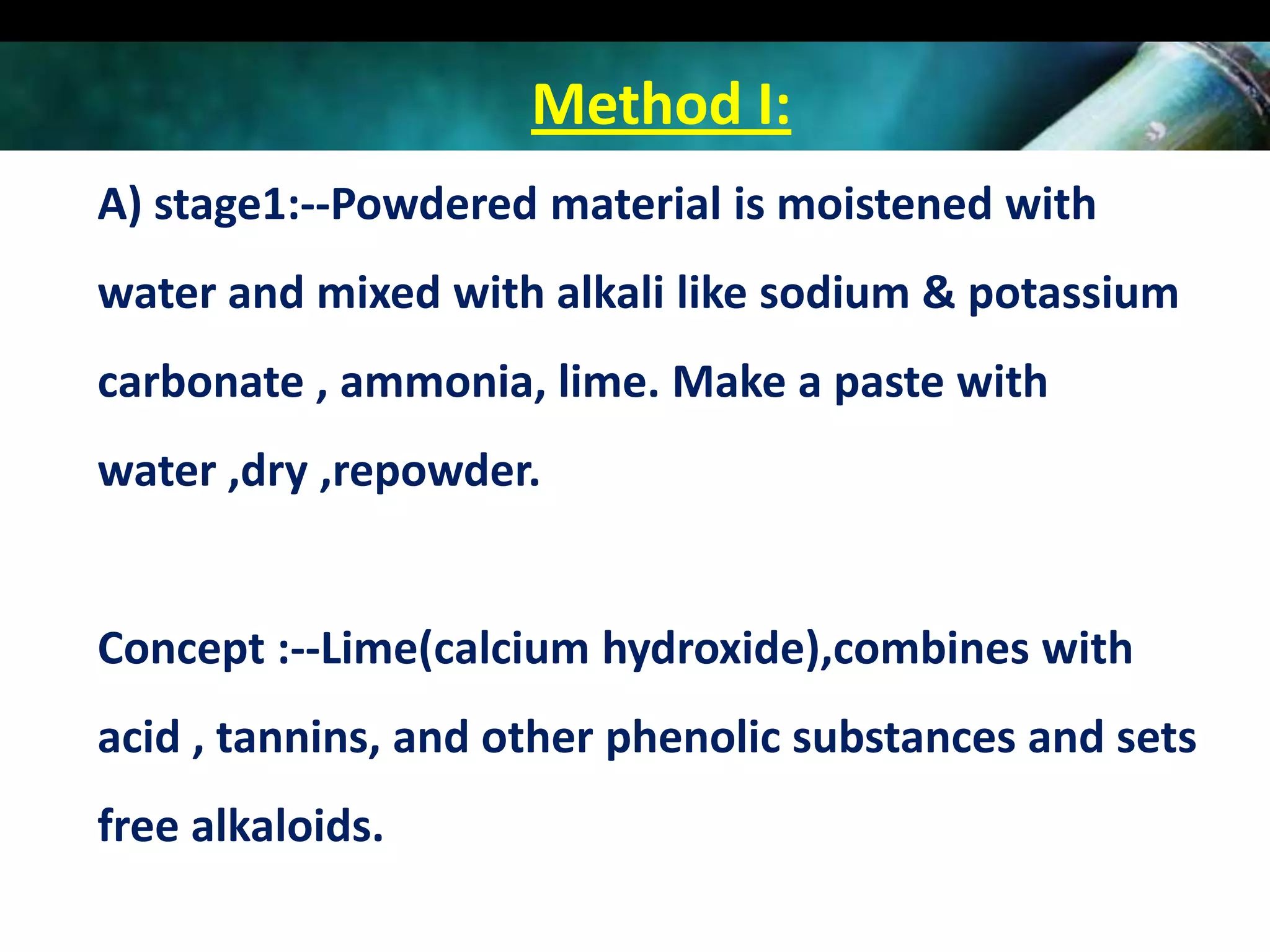
Method I:
A) stage1:--Powdered material is moistened with
water and mixed with alkali like sodium & potassium
carbonate , ammonia, lime. Make a paste with
water ,dry ,repowder.

Concept :--Lime(calcium hydroxide),combines with
acid , tannins, and other phenolic substances and sets
free alkaloids.
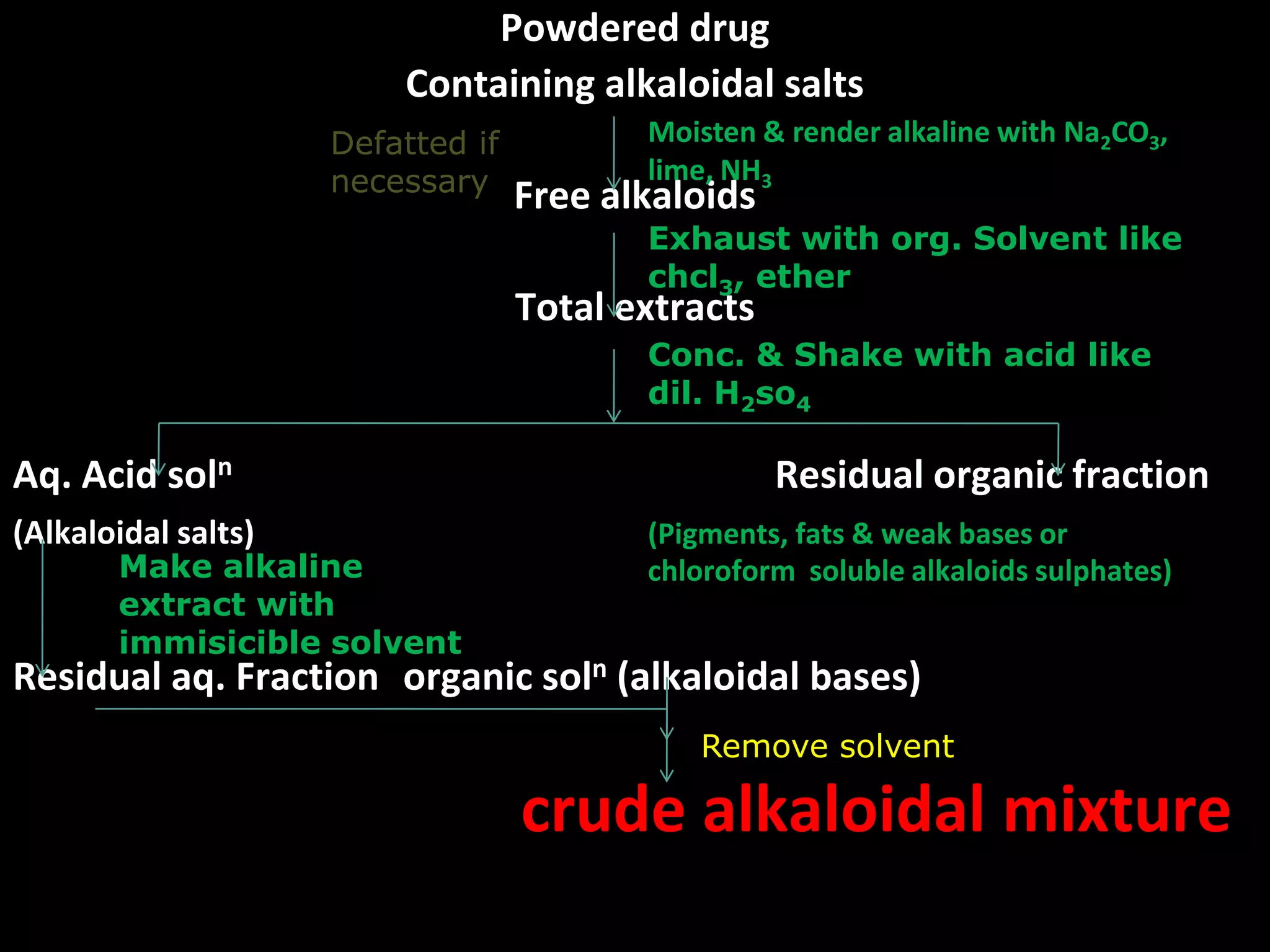
Powdered drug
Containing alkaloidal salts
Defatted if
necessary

Moisten & render alkaline with Na2CO3,
lime, NH3

Free alkaloids

Exhaust with org. Solvent like
chcl3, ether

Total extracts

Conc. & Shake with acid like
dil. H2so4

Aq. Acid soln
(Alkaloidal salts)

Make alkaline
extract with
immisicible solvent

Residual organic fraction
(Pigments, fats & weak bases or
chloroform soluble alkaloids sulphates)

Residual aq. Fraction organic soln (alkaloidal bases)
Remove solvent

crude alkaloidal mixture
LOGO
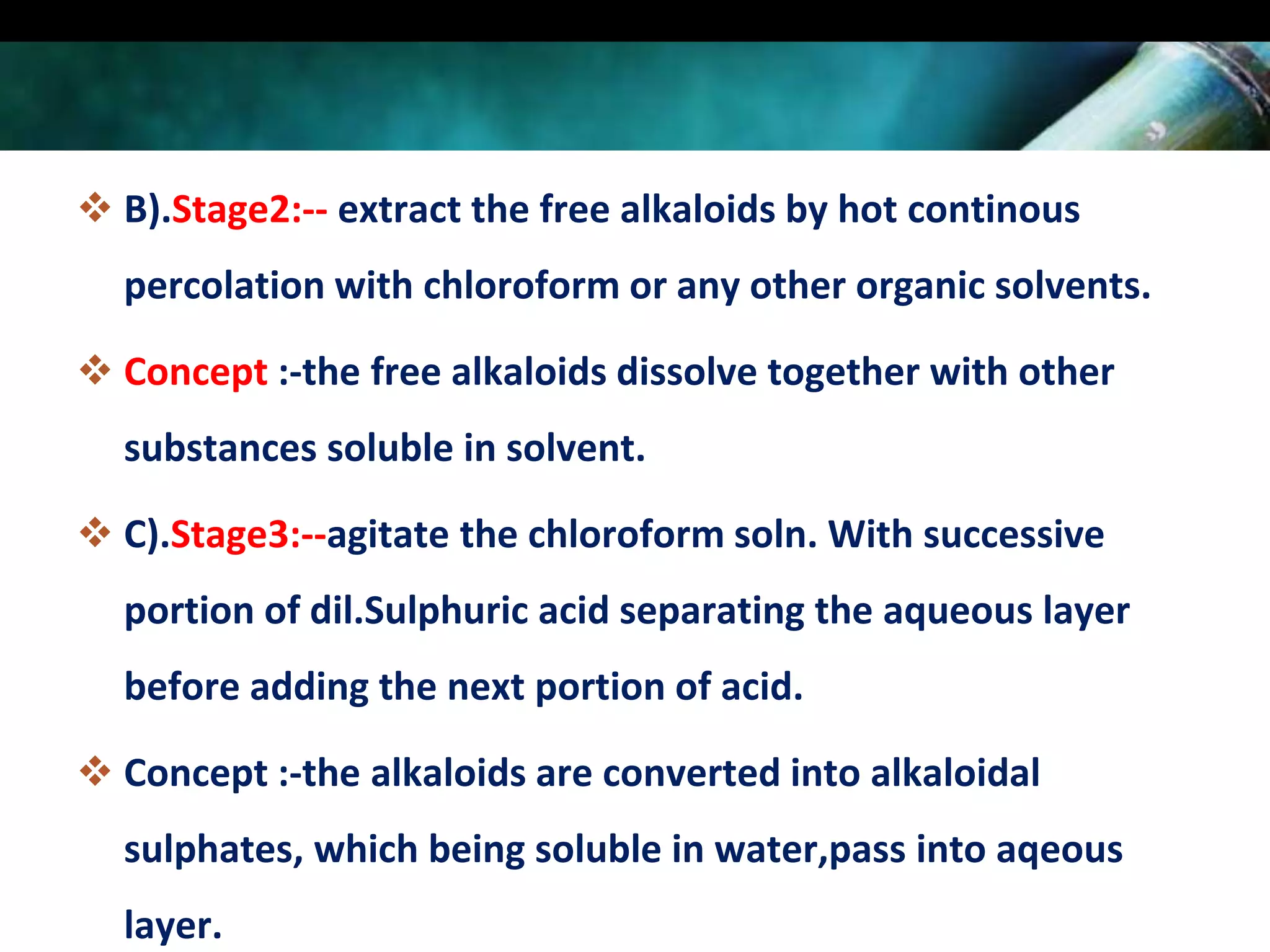
 B).Stage2:-- extract the free alkaloids by hot continous
percolation with chloroform or any other organic solvents.
 Concept :-the free alkaloids dissolve together with other
substances soluble in solvent.
 C).Stage3:--agitate the chloroform soln. With successive
portion of dil.Sulphuric acid separating the aqueous layer
before adding the next portion of acid.

 Concept :-the alkaloids are converted into alkaloidal
sulphates, which being soluble in water,pass into aqeous
layer.
D)Stage4:--Make the mixed aqueous liquid alkaline
with ammonia, collect the precipitate that forms,
wash with water and dry.
 Concept :- Ammonia decomposes the alkaloidal
sulphates forming ammonium sulphates ,soluble in
water ,and the free alkaloid which being practically

insoluble in water is precipitated.
THANK YOU

alkaloids and extraction of alkaloids

  • 1.
    ALKALOIDS AND EXTRACTION OFALKALOIDS A.M.MANOJ 13-503-006 LOGO
  • 2.
    HISTORY  “Alkaloid” -theArabic word - “al-qali”.  Term alkaloid -coined by messiner -German pharmacist (1819).  Totally more than 7000 compounds are known in only 5% of the plant species.  Ninety five percent of plant species are still remain to be examined for alkaloids.
  • 3.
    ALKALOIDS ACCORDING TOKOINGS (1880):- “Naturally occurring organic bases which contains a Pyridine ring”.
  • 4.
    According to Ladenburg  “Alkaloidare natural plant compound that have basic character and contains at least one nitrogen atom in heterocyclic ring”.
  • 5.
    ALKALOIDS Simply alkaloids arenothing but the basic nitrogenous compound, contains one or more nitrogen in heterocyclic ring system having marked physiological action on human and animals when use in small quantities” ”.”
  • 6.
    STRUCTURE Alkaloids- 12000 structuresknown.  Poisons – Conine  Narcotics – Morphine  Stimulants – caffeine  Medicine – Taxol
  • 7.
    FACTS AND NEWSEVIDENCE  1806 – Pharmacy assistant Friedrich Wilhelm Serturner isolated morphine from poppy seeds  Socrates died when he was forced to drink extract of hemlock containing coniine.  Nicotine (tobacco) is used as very potent insecticide for fumigating green houses.  Cleopatra used extracts containing atropine to dilate her pupil in order to appear more attractive; atropine in low doses dilates pupils of the eye.
  • 8.
  • 9.
    PHYSICAL PROPERTY 1.Most alkaloidsare crystalline solid , but some are liquid e.g Volatile; --Nicotine , Coniine .Spartine.
  • 10.
  • 11.
    2.Majority of alkaloidsare colorless but some are colored, e.g. Colchicine and berberine(yellow), canadine (orange) BERBERINE CANADINE
  • 12.
    SOLUBILITY :-difference insolubility used as a base for their isolation and purification from nonalkaloidal bases. The following can be mentioned :a)Both alkaloidal base and there salts are soluble in alcohol. b).Genarally bases are soluble in organic solvent and alkaloidal salts are soluble in water.
  • 13.
    Alkaloid or its Salt Water AlocoholEther Atropine Atropine sulphate Morphine 460 0.5 2 5 25 Insoluble Chlorofor m 1 Insoluble 3400 300 5000 1525 Morphine sulphate 15.5 565 Insoluble Insoluble
  • 14.
    CHEMICAL PROPERTIES 1.Salt formation:--Due to their basic character alkaloid reacts with acid to form salt --strong bases form salt with very weak acid.  --weak bases forms salt with strong acid -- very weak bases form unstable salts.e.g caffeine , Narcotine , piperine.
  • 15.
     2).Amphoteric alkaloids:--can form salts with both acid and alkali. e.gPhenolic group :--morphine
  • 16.
    Carboxylic group:--narciene (anarcotic alkaloid that occurs in opium)
  • 17.
    3)Effect of heat: Alkaloidsare decomposed by heat, except strychnine and caffeine (sublimable). 4). Effect of light and oxygen :  Decomposed when allowed to stand at a temperature above 70o C .For long time.  Sensitivity varies in degree with different alkaloids.  Decomposition occur rapidly and easily when an alkaloid is in solution than when it is in dry form.  Most tertiary amine alkaloids are easily transformed to the n-oxides.
  • 18.
    EFFECT OF ALKALIS. Weak alkalis liberate most alkaloids from their salts e.G. Nh3  Strong alkalis: such as aqueous naoh and KOH form salts with phenolic alkaloids.  Hot alkalis: results hydrolysis of ester alkaloids e.G. Atropine, cocaine and physostigmine and cleavage of lactone ring, if present, to produce the corresponding acid, e.G. Pilocarpine is transformed to pilocarpic acid.
  • 19.
    BASICITY OF ALKALOIDS:--The basicity of alkaloid is due to presence of a lone pair of electron on nitrogen atom. --The basicity increased if the adjacent group is electron releasing like alkali . -- the basicity decreases if the adjacent group is electron withdrawing like carbonyl and amide group.
  • 20.
  • 21.
  • 22.
  • 23.
    Method I: A) stage1:--Powderedmaterial is moistened with water and mixed with alkali like sodium & potassium carbonate , ammonia, lime. Make a paste with water ,dry ,repowder. Concept :--Lime(calcium hydroxide),combines with acid , tannins, and other phenolic substances and sets free alkaloids.
  • 24.
    Powdered drug Containing alkaloidalsalts Defatted if necessary Moisten & render alkaline with Na2CO3, lime, NH3 Free alkaloids Exhaust with org. Solvent like chcl3, ether Total extracts Conc. & Shake with acid like dil. H2so4 Aq. Acid soln (Alkaloidal salts) Make alkaline extract with immisicible solvent Residual organic fraction (Pigments, fats & weak bases or chloroform soluble alkaloids sulphates) Residual aq. Fraction organic soln (alkaloidal bases) Remove solvent crude alkaloidal mixture LOGO
  • 25.
     B).Stage2:-- extractthe free alkaloids by hot continous percolation with chloroform or any other organic solvents.  Concept :-the free alkaloids dissolve together with other substances soluble in solvent.  C).Stage3:--agitate the chloroform soln. With successive portion of dil.Sulphuric acid separating the aqueous layer before adding the next portion of acid.  Concept :-the alkaloids are converted into alkaloidal sulphates, which being soluble in water,pass into aqeous layer.
  • 26.
    D)Stage4:--Make the mixedaqueous liquid alkaline with ammonia, collect the precipitate that forms, wash with water and dry.  Concept :- Ammonia decomposes the alkaloidal sulphates forming ammonium sulphates ,soluble in water ,and the free alkaloid which being practically insoluble in water is precipitated.
  • 27.