Downloaded 17 times
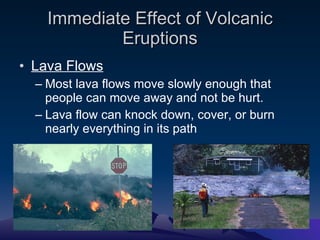


Volcanic eruptions can have immediate and long-term effects on the surrounding land, air, and water. Immediate effects include lava flows, volcanic ash, mudflows, pyroclastic flows, landslides, and steam explosions. Long-term effects involve continued mudflows over time, crater collapse, hardened lava forming new rock layers, and ash helping to build new landscapes. Eruptions release gases like sulfur dioxide and carbon dioxide into the air, and can produce acid rain by releasing acids. They also affect water by creating hot springs, geysers, fumaroles, and deep sea vents.


![volcanos report presentation [Autosaved].ppt](https://cdn.slidesharecdn.com/ss_thumbnails/volcanosreportpresentationautosaved-241026211012-6bfbdfd5-thumbnail.jpg?width=640&height=640&fit=bounds)


![Light sources and interactions 3.3 3.4[2]](https://cdn.slidesharecdn.com/ss_thumbnails/lightsourcesandinteractions3-3-3-42-120306084647-phpapp02-thumbnail.jpg?width=640&height=640&fit=bounds)


![Waves and sound_study_guide[1]](https://cdn.slidesharecdn.com/ss_thumbnails/wavesandsoundstudyguide1-120223181758-phpapp02-thumbnail.jpg?width=640&height=640&fit=bounds)

![Electromagnetic%20 spectrum[1]](https://cdn.slidesharecdn.com/ss_thumbnails/electromagnetic20spectrum1-120228041945-phpapp01-thumbnail.jpg?width=640&height=640&fit=bounds)


