Cornelius Puschmann
           School of Library and Information Science,
                Humboldt University of Berlin /
        Humboldt Institute for Internet and Society (HIIG)


     A Tale of Two Platforms:
Emerging communicative patterns
 in two scientific blog networks

Nuffield/Oxford Internet Institute Social Networks Seminar Series
                   Nuffield College, Oxford
                     11th February 2013


                                                  photos by http://www.flickr.com/people/7455207@N05/
This talk


The context of my research


                 Framing the issue:
                 How can we describe new forms
                 of scholarly communication online?


Tracing the evolution of two scholary blog platforms
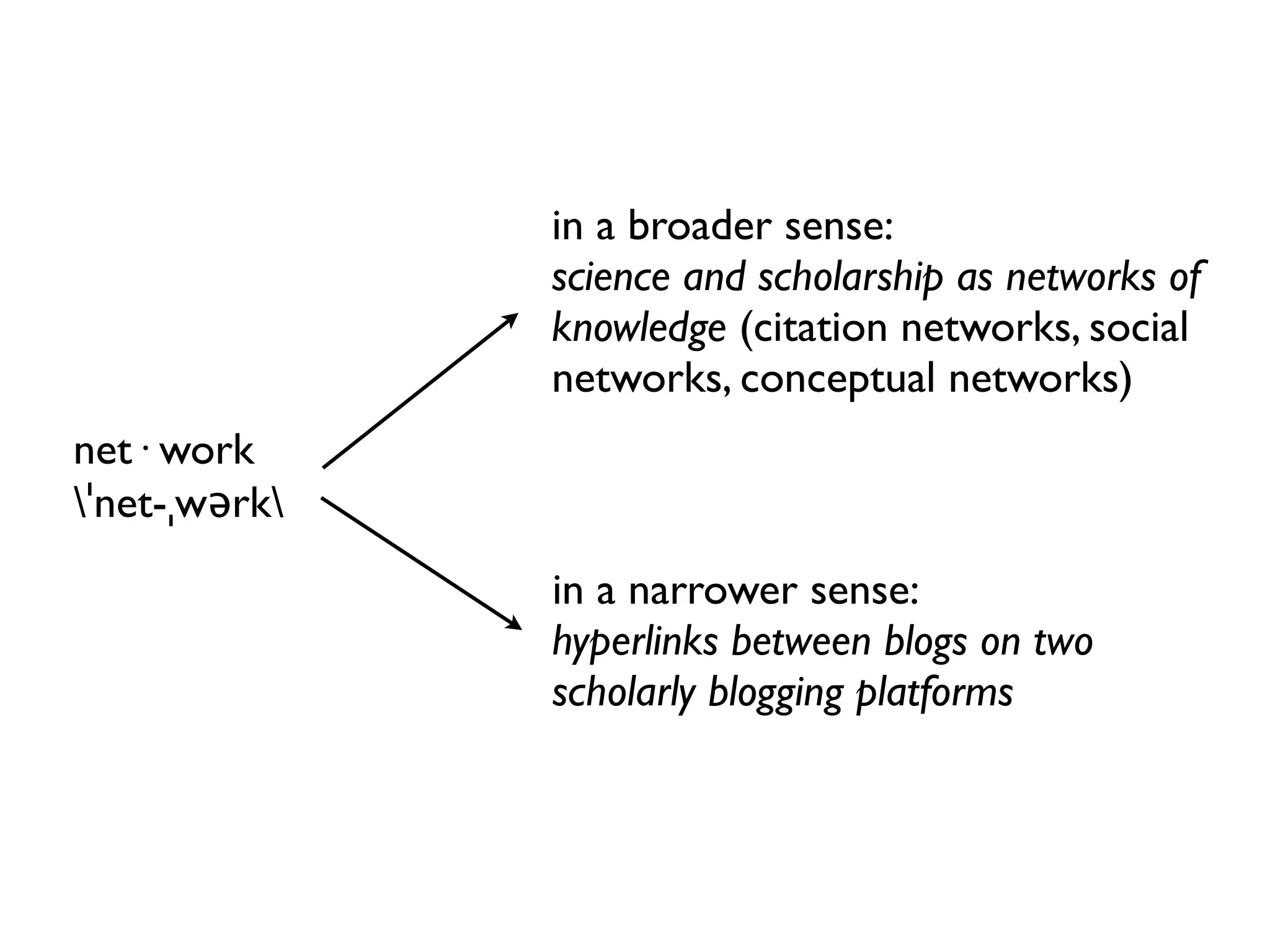
in a broader sense:
               science and scholarship as networks of
               knowledge (citation networks, social
               networks, conceptual networks)
net· work
ˈnet-ˌwərk
               in a narrower sense:
               hyperlinks between blogs on two
               scholarly blogging platforms
Prior and related research

•   Junior Researchers Group „Science and the
    Internet“ (University of Düsseldorf, 2010-2012)

•   Networking, visibility, information: a study of digital
    genres of scholarly communication and the
    motives of their users (DFG grant, Humboldt
    University Berlin, 3/2012-2/2015)

•   Open Science project (Alexander von Humboldt
    Institute for Internet and Society, 2011-)

•   Oxford e-Social Science Project (OeSS,
    2005-2012)
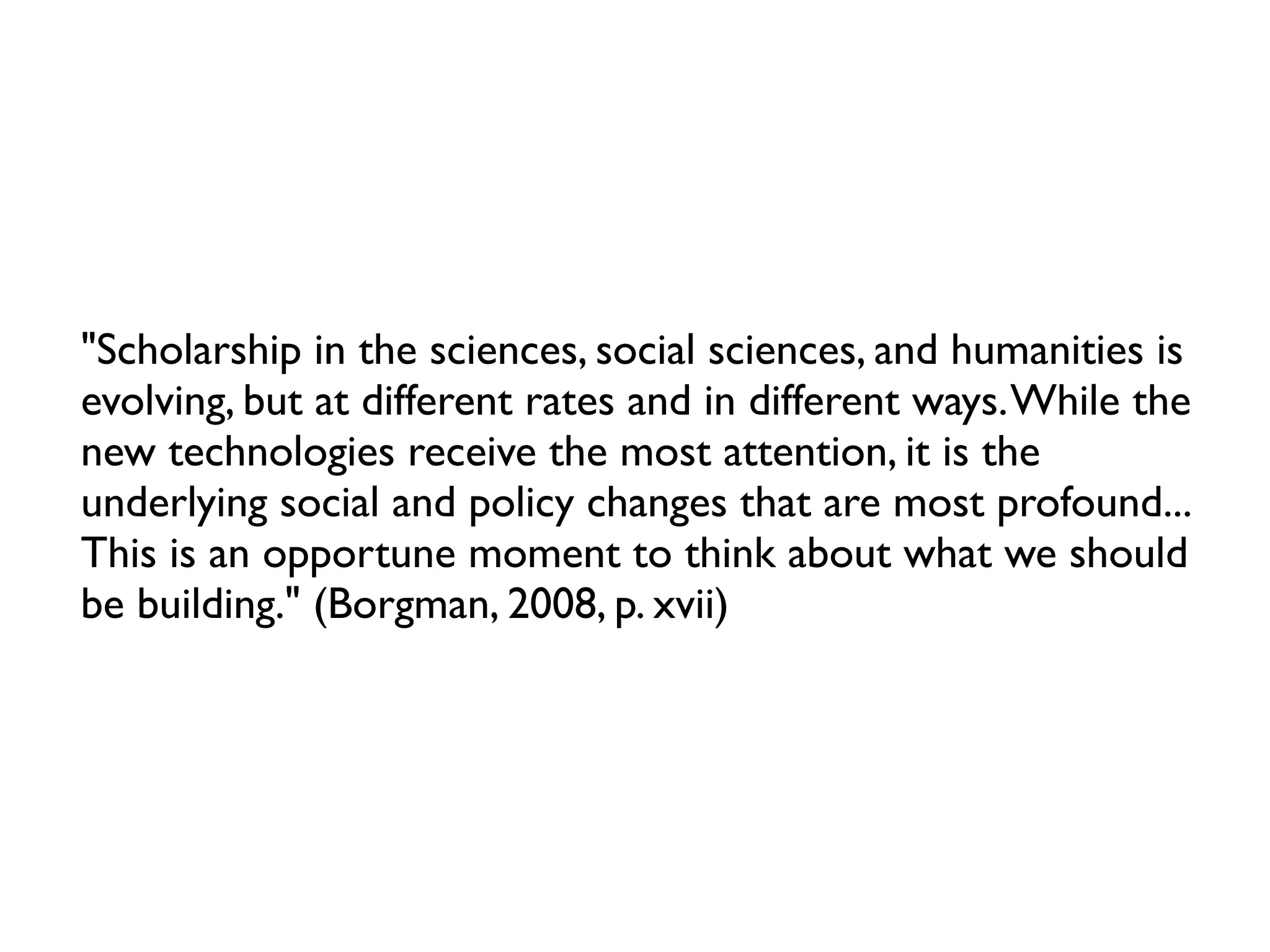
"Scholarship in the sciences, social sciences, and humanities is
evolving, but at different rates and in different ways. While the
new technologies receive the most attention, it is the
underlying social and policy changes that are most profound...
This is an opportune moment to think about what we should
be building." (Borgman, 2008, p. xvii)
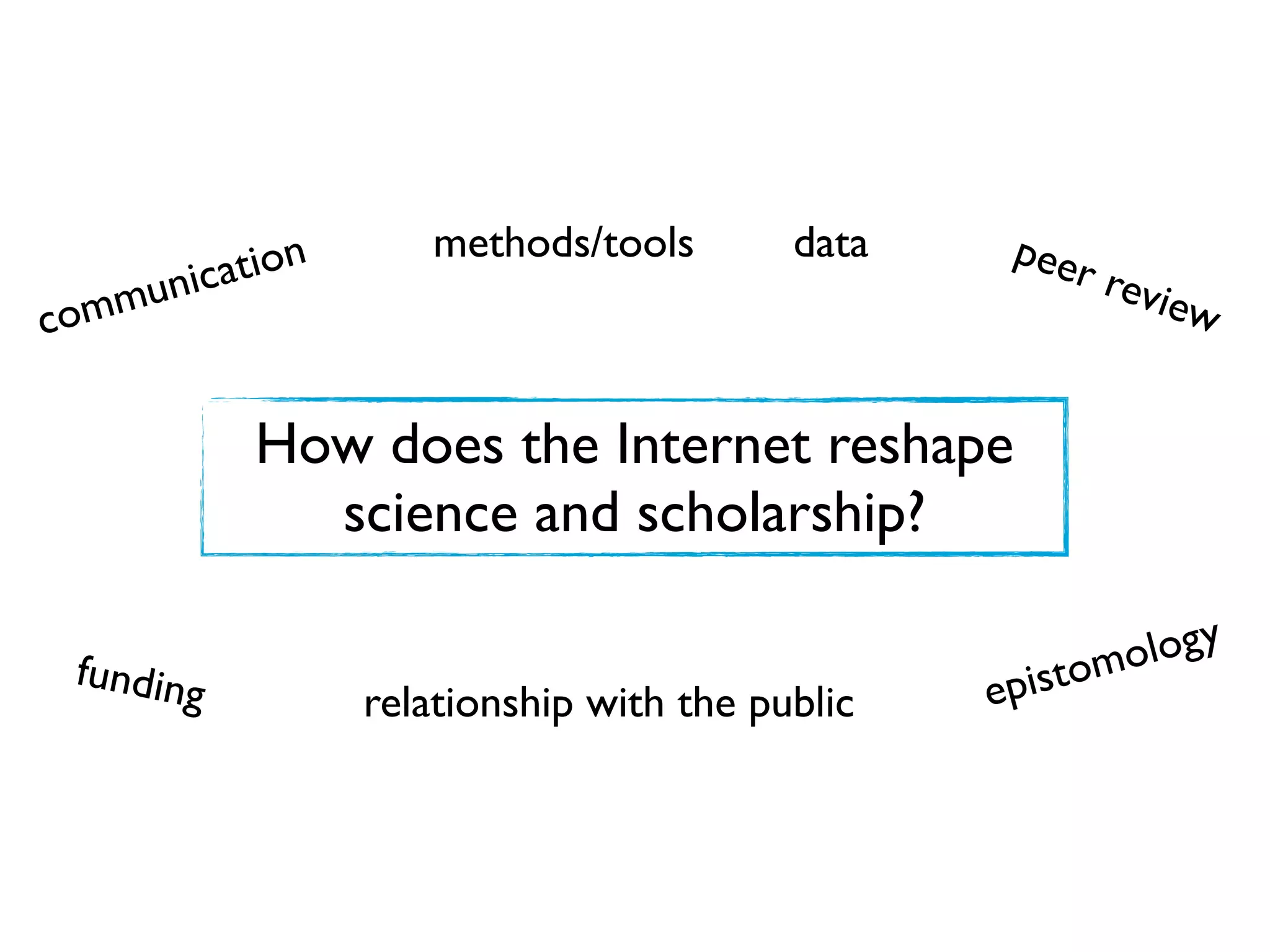
methods/tools        data    peer
       ication                                          revi
com mun                                                      ew


           How does the Internet reshape
             science and scholarship?

 funding                                               mology
                 relationship with the public   e pisto
be
                                                      tw a
                                                        ee ma
                                                          n	
   te
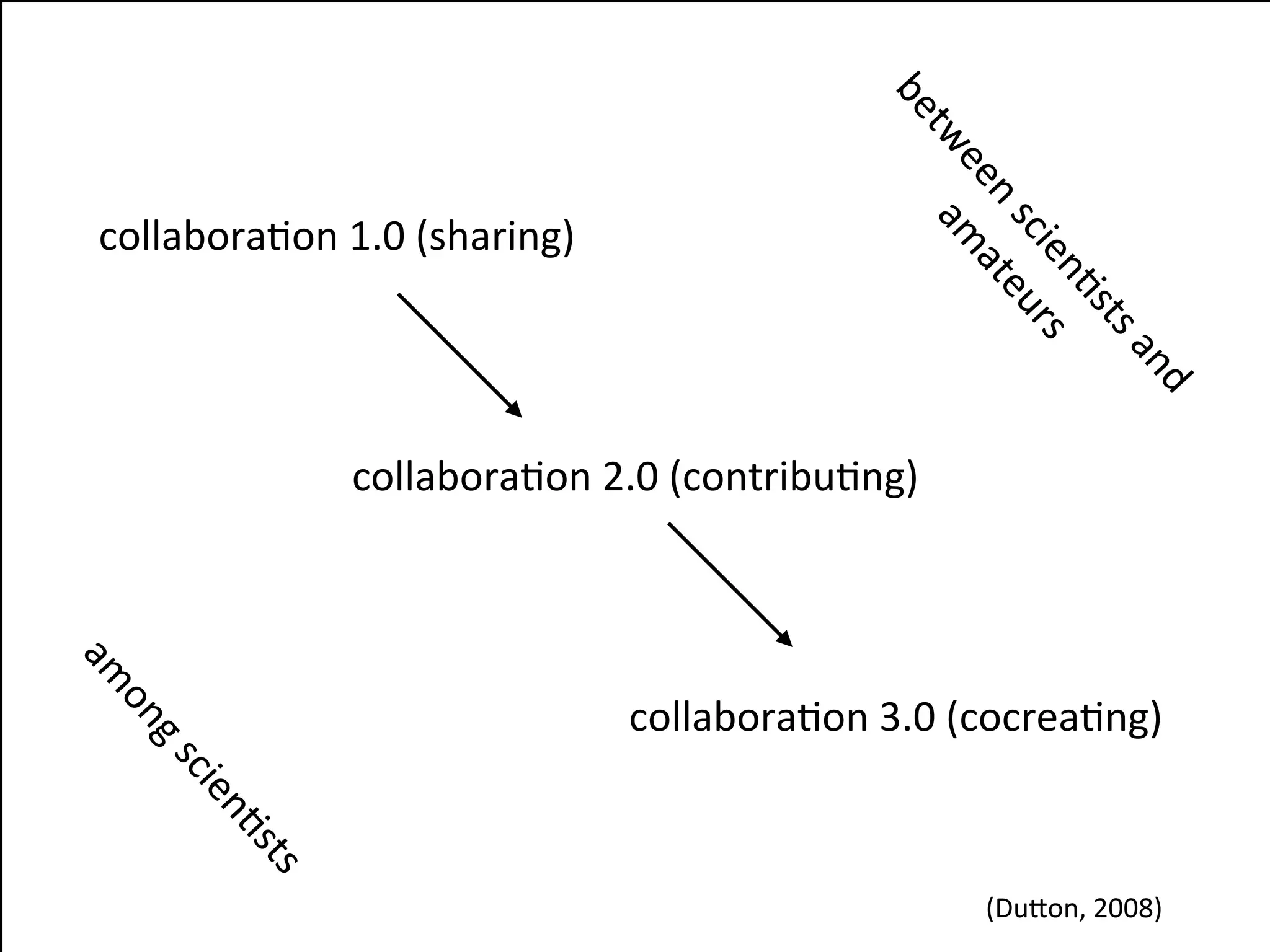
 collabora'on	
  1.0	
  (sharing)


                                                               sc u r
                                                                 ien s
                                                                    's
                                                                       ts	
  
                                                                        an
                                                                           d	
  
                  collabora'on	
  2.0	
  (contribu'ng)
am


                                    collabora'on	
  3.0	
  (cocrea'ng)
  on
   g	
  s
          cie
          's n
             ts


                                                             (Du9on,	
  2008)
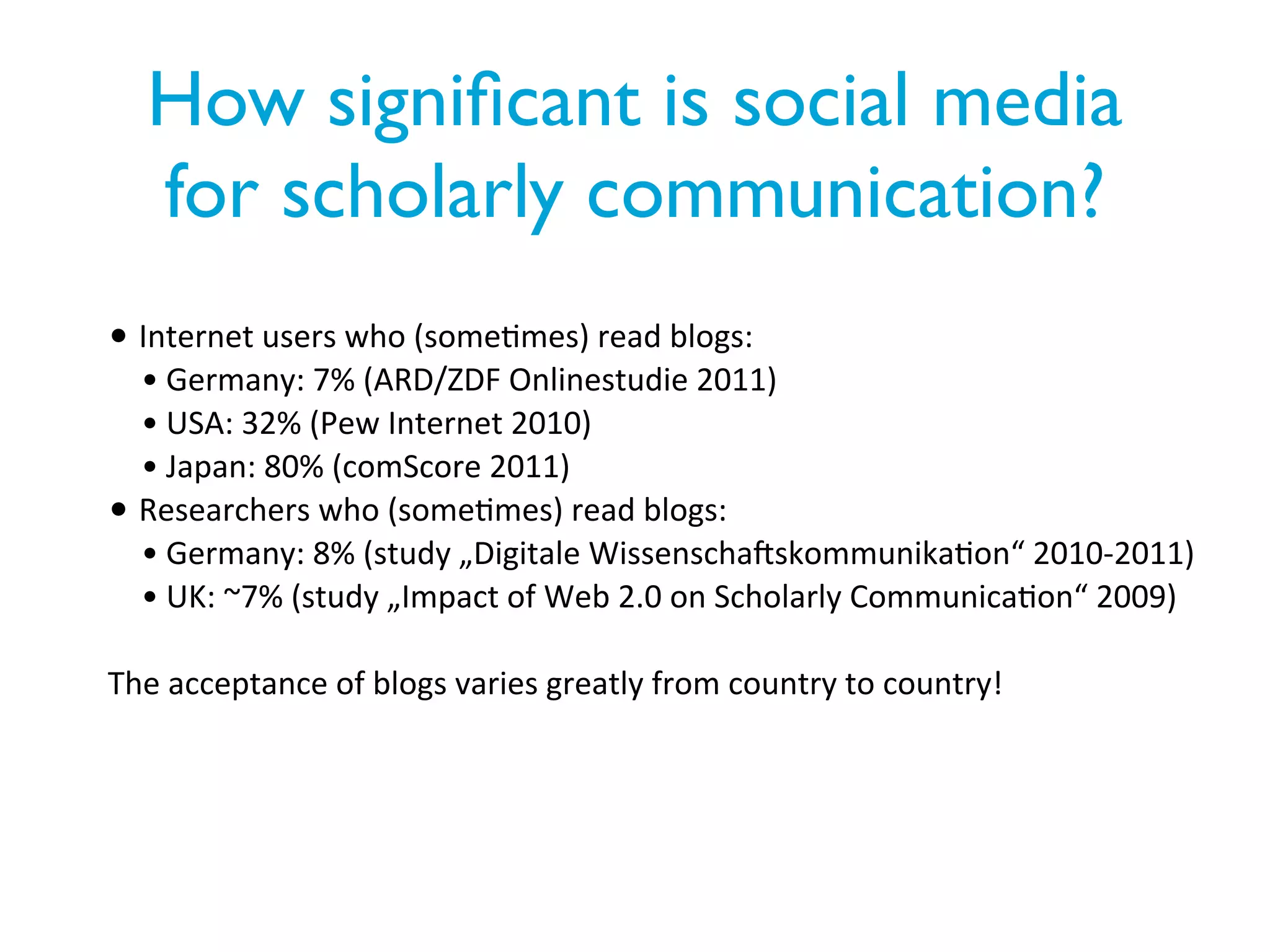
How significant is social media
   for scholarly communication?
• Internet	
  users	
  who	
  (some/mes)	
  read	
  blogs:
  • Germany:	
  7%	
  (ARD/ZDF	
  Onlinestudie	
  2011)
  • USA:	
  32%	
  (Pew	
  Internet	
  2010)
  • Japan:	
  80%	
  (comScore	
  2011)
• Researchers	
  who	
  (some/mes)	
  read	
  blogs:
  • Germany:	
  8%	
  (study	
  „Digitale	
  WissenschaPskommunika/on“	
  2010-­‐2011)
  • UK:	
  ~7%	
  (study	
  „Impact	
  of	
  Web	
  2.0	
  on	
  Scholarly	
  Communica/on“	
  2009)

The	
  acceptance	
  of	
  blogs	
  varies	
  greatly	
  from	
  country	
  to	
  country!
How significant is social media
  for scholarly communication?
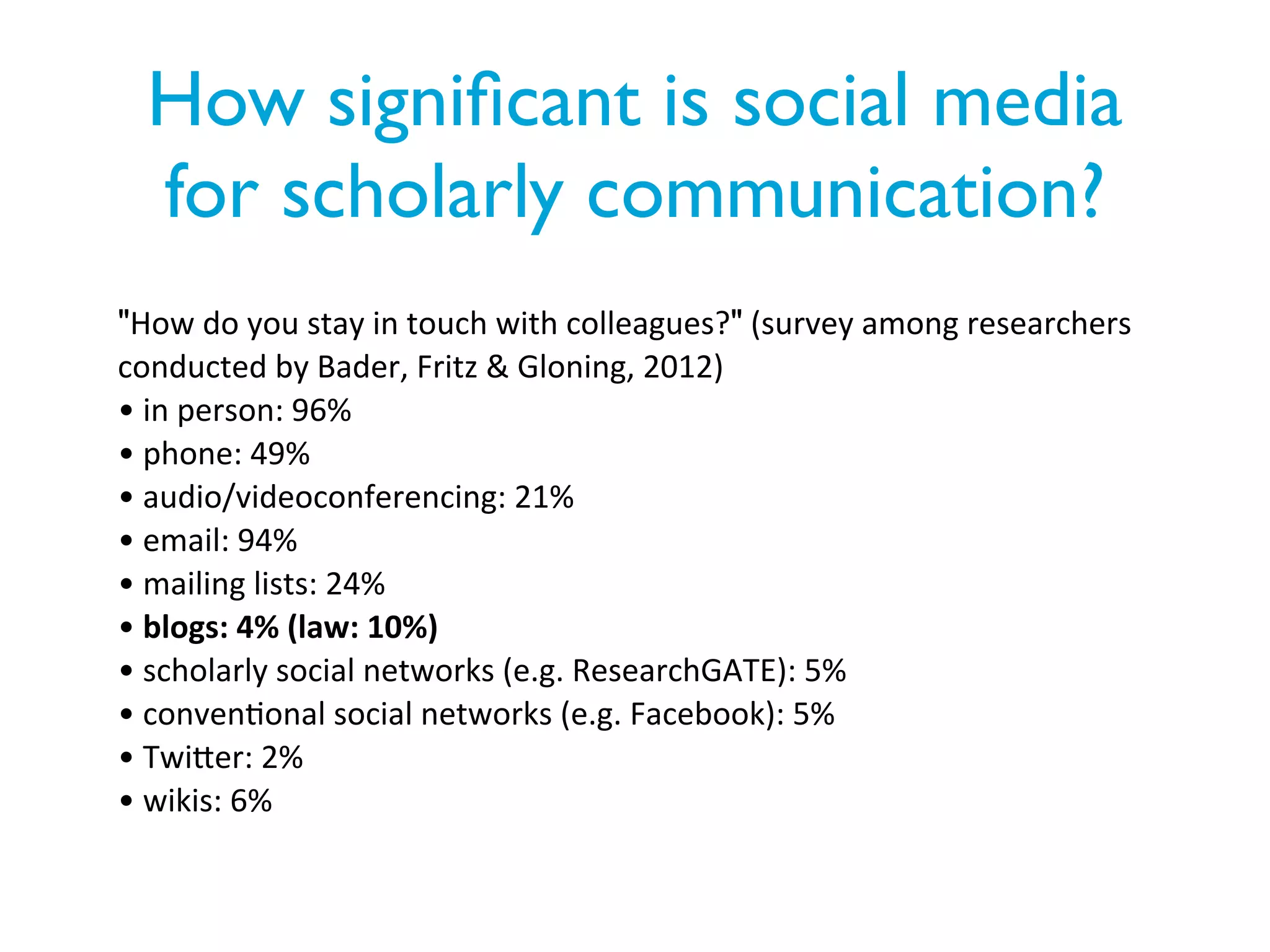
"How	
  do	
  you	
  stay	
  in	
  touch	
  with	
  colleagues?"	
  (survey	
  among	
  researchers	
  
conducted	
  by	
  Bader,	
  Fritz	
  &	
  Gloning,	
  2012)	
  
•	
  in	
  person:	
  96%
•	
  phone:	
  49%
•	
  audio/videoconferencing:	
  21%
•	
  email:	
  94%	
  
•	
  mailing	
  lists:	
  24%
•	
  blogs:	
  4%	
  (law:	
  10%)
•	
  scholarly	
  social	
  networks	
  (e.g.	
  ResearchGATE):	
  5%
•	
  conven/onal	
  social	
  networks	
  (e.g.	
  Facebook):	
  5%
•	
  Twiger:	
  2%
•	
  wikis:	
  6%
Is anything new?
      • formal scholarly communication is
        a highly resilient system
      • acceptance and use of social media
        among academics remains low
      • but: ,pockets‘ of adoption exist in
        some local and disciplinary
        scholary communities
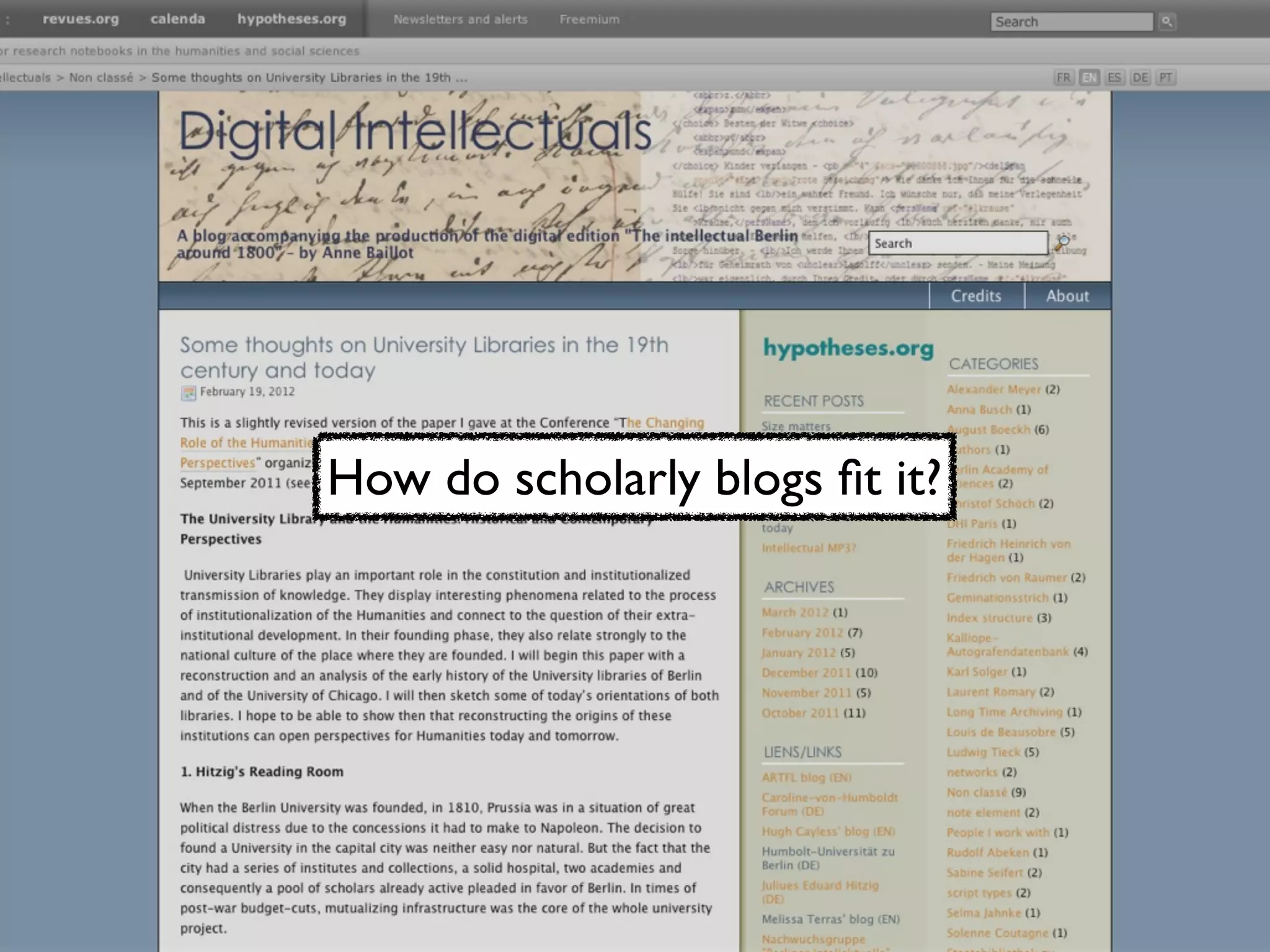
How do scholarly blogs fit it?
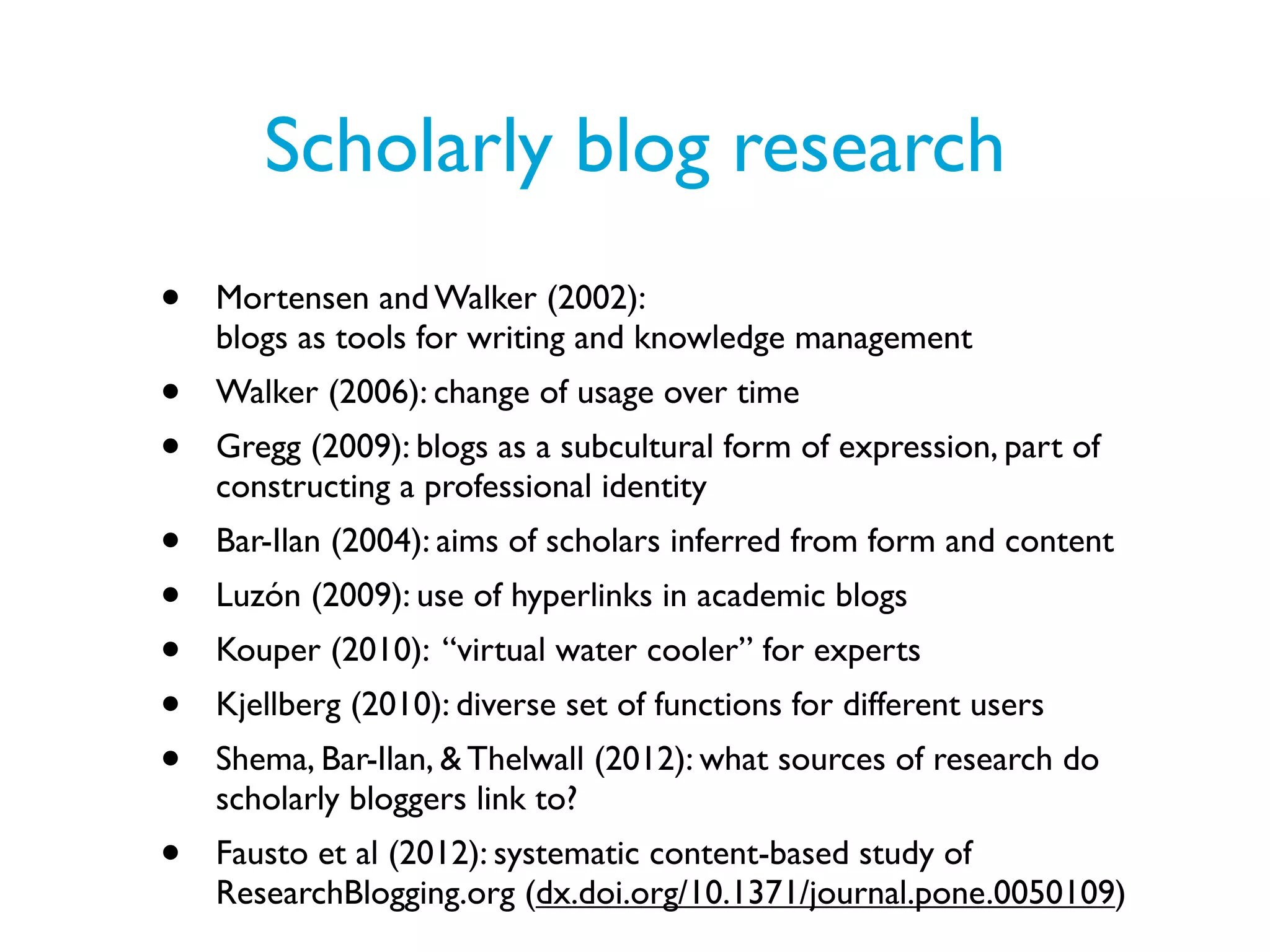
Scholarly blog research
•   Mortensen and Walker (2002):
    blogs as tools for writing and knowledge management
•   Walker (2006): change of usage over time
•   Gregg (2009): blogs as a subcultural form of expression, part of
    constructing a professional identity
•   Bar-Ilan (2004): aims of scholars inferred from form and content
•   Luzón (2009): use of hyperlinks in academic blogs
•   Kouper (2010): “virtual water cooler” for experts
•   Kjellberg (2010): diverse set of functions for different users
•   Shema, Bar-Ilan, & Thelwall (2012): what sources of research do
    scholarly bloggers link to?
•   Fausto et al (2012): systematic content-based study of
    ResearchBlogging.org (dx.doi.org/10.1371/journal.pone.0050109)
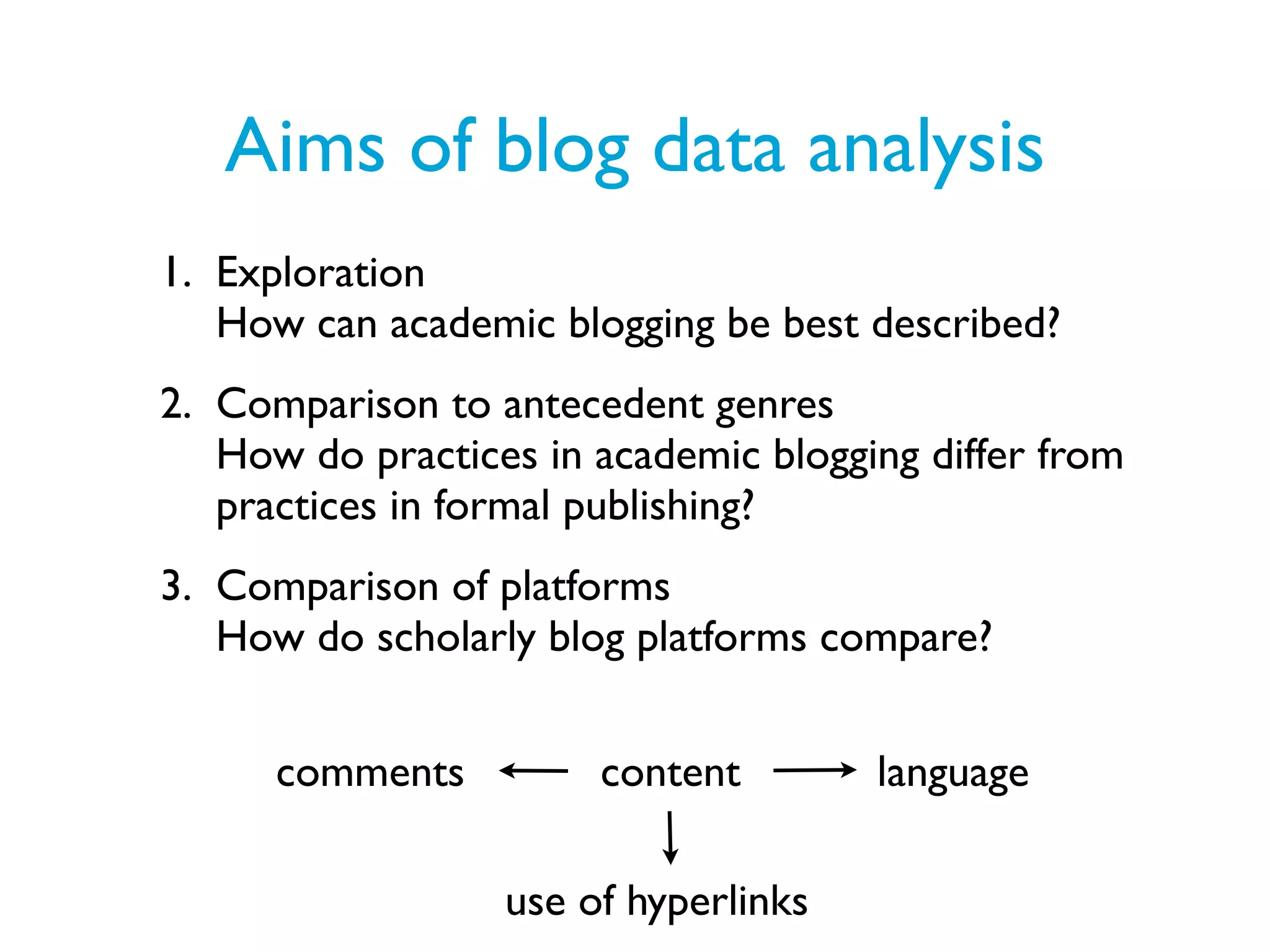
Aims of blog data analysis
1. Exploration
   How can academic blogging be best described?
2. Comparison to antecedent genres
   How do practices in academic blogging differ from
   practices in formal publishing?
3. Comparison of platforms
   How do scholarly blog platforms compare?


      comments         content        language

                  use of hyperlinks
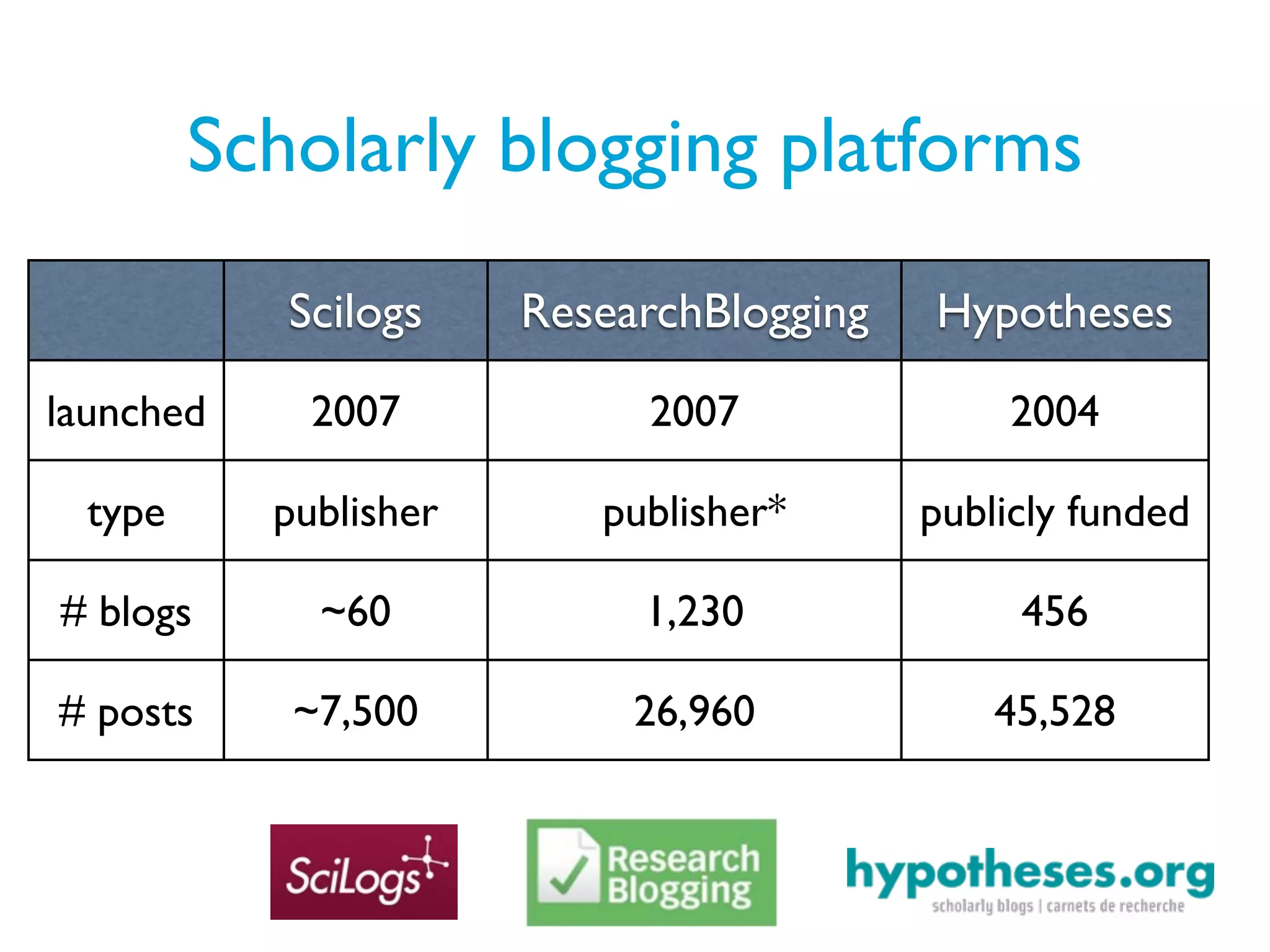
Scholarly blogging platforms
            Scilogs    ResearchBlogging   Hypotheses
launched     2007           2007               2004

  type     publisher      publisher*      publicly funded

# blogs      ~60            1,230              456

# posts     ~7,500          26,960            45,528
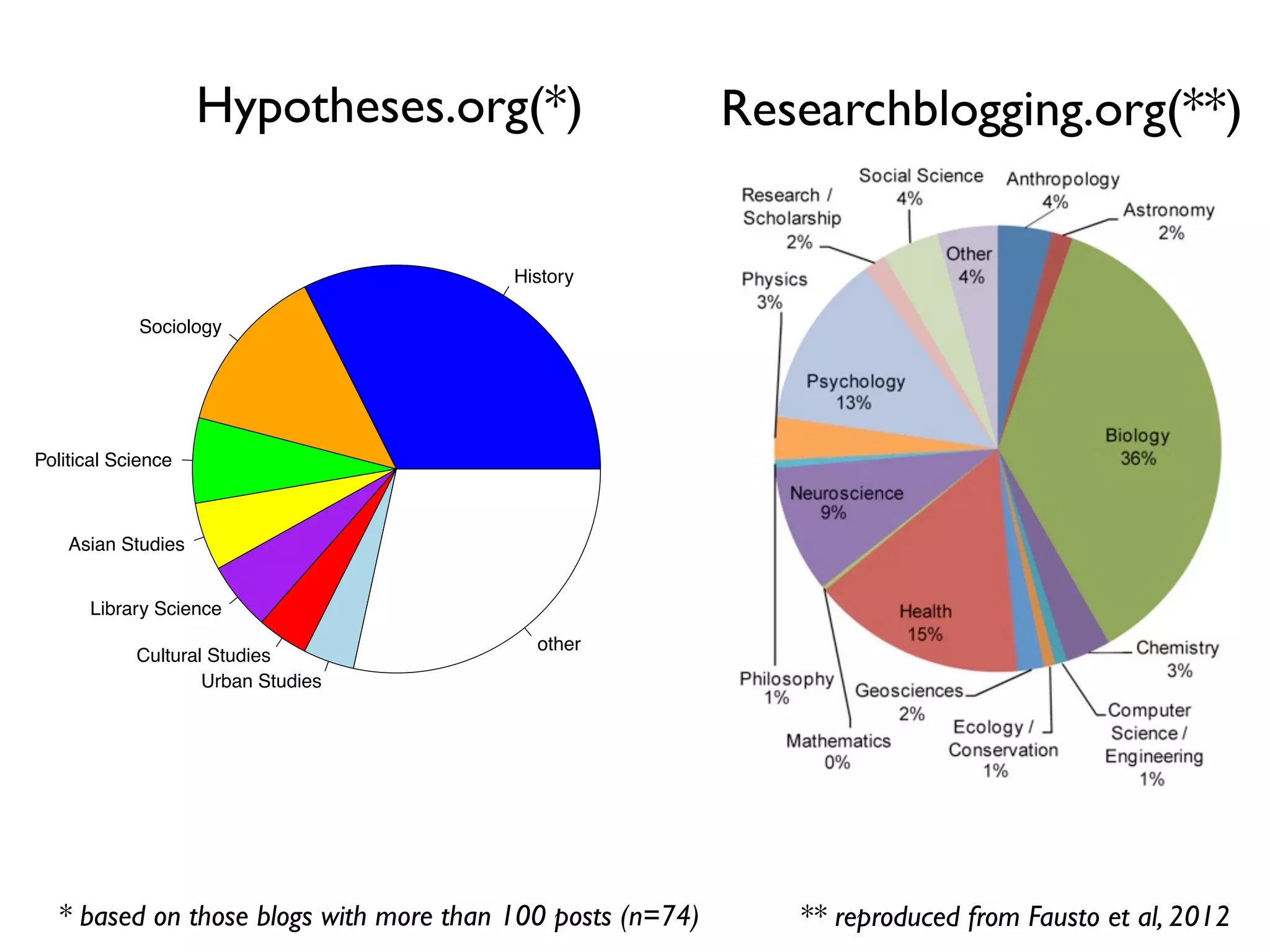
Hypotheses.org(*)                            Researchblogging.org(**)
       Hypotheses.org: disciplines of most active blogs (n=74)


                                             History

            Sociology


Political Science


    Asian Studies


      Library Science
                                               other
            Cultural Studies
                    Urban Studies


  * based on those blogs with more than 100 posts (n=74)            ** reproduced from Fausto et al, 2012
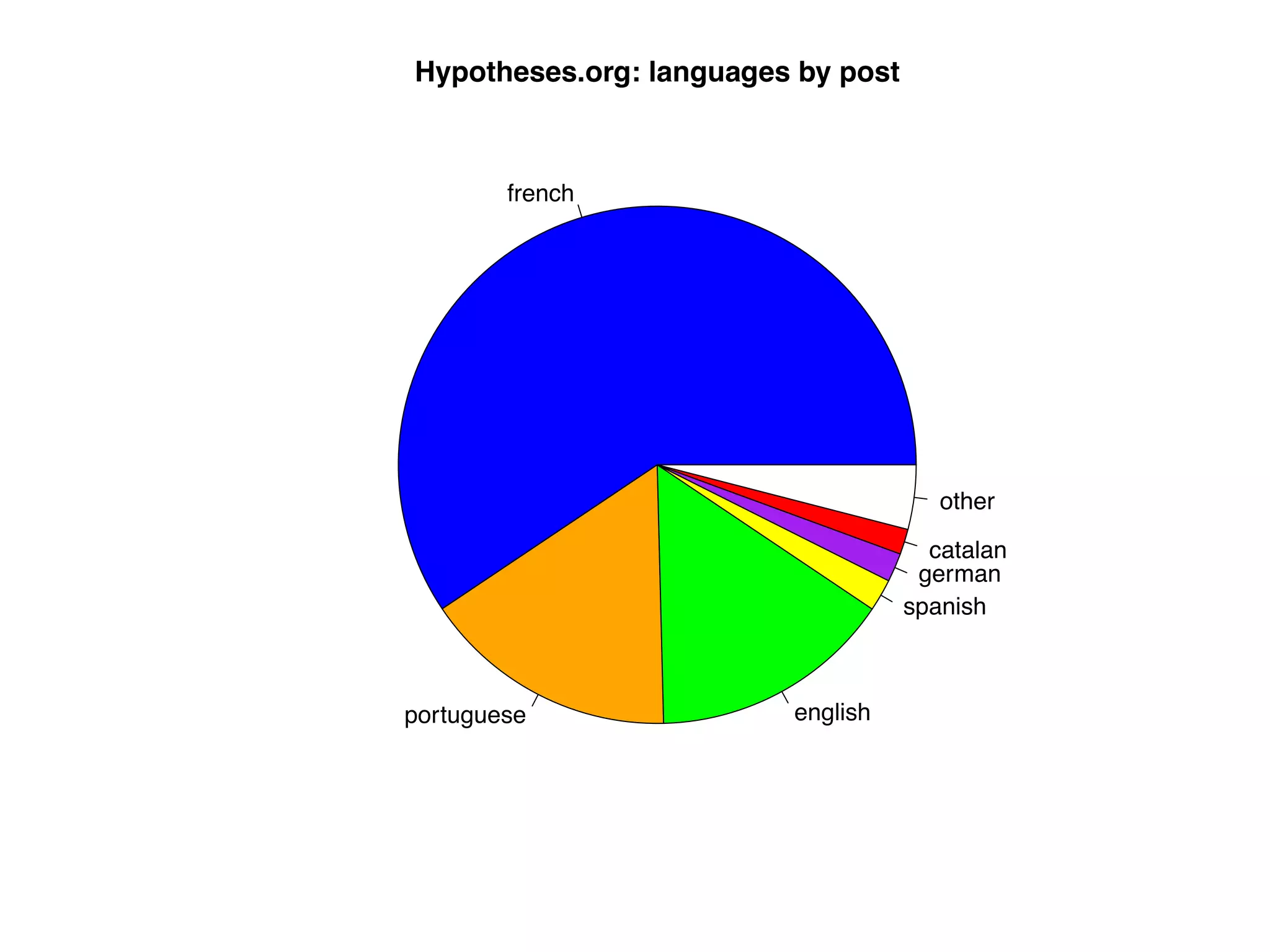
Hypotheses.org: languages by post


        french


                                       other

                                      catalan
                                     german
                                    spanish


portuguese               english
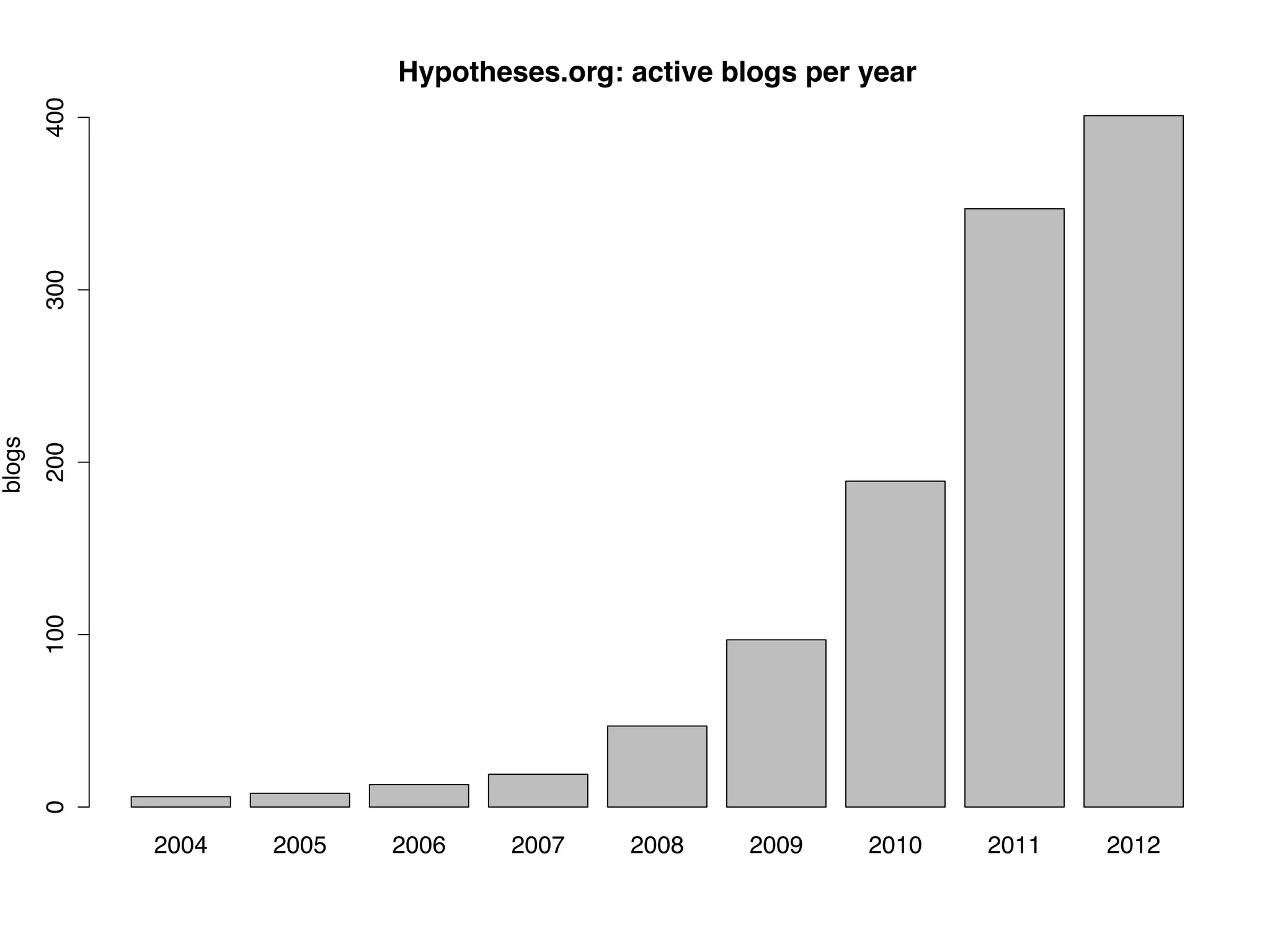
Hypotheses.org: active blogs per year
        400
        300
blogs
        200
        100
        0


              2004   2005   2006    2007    2008     2009    2010   2011   2012
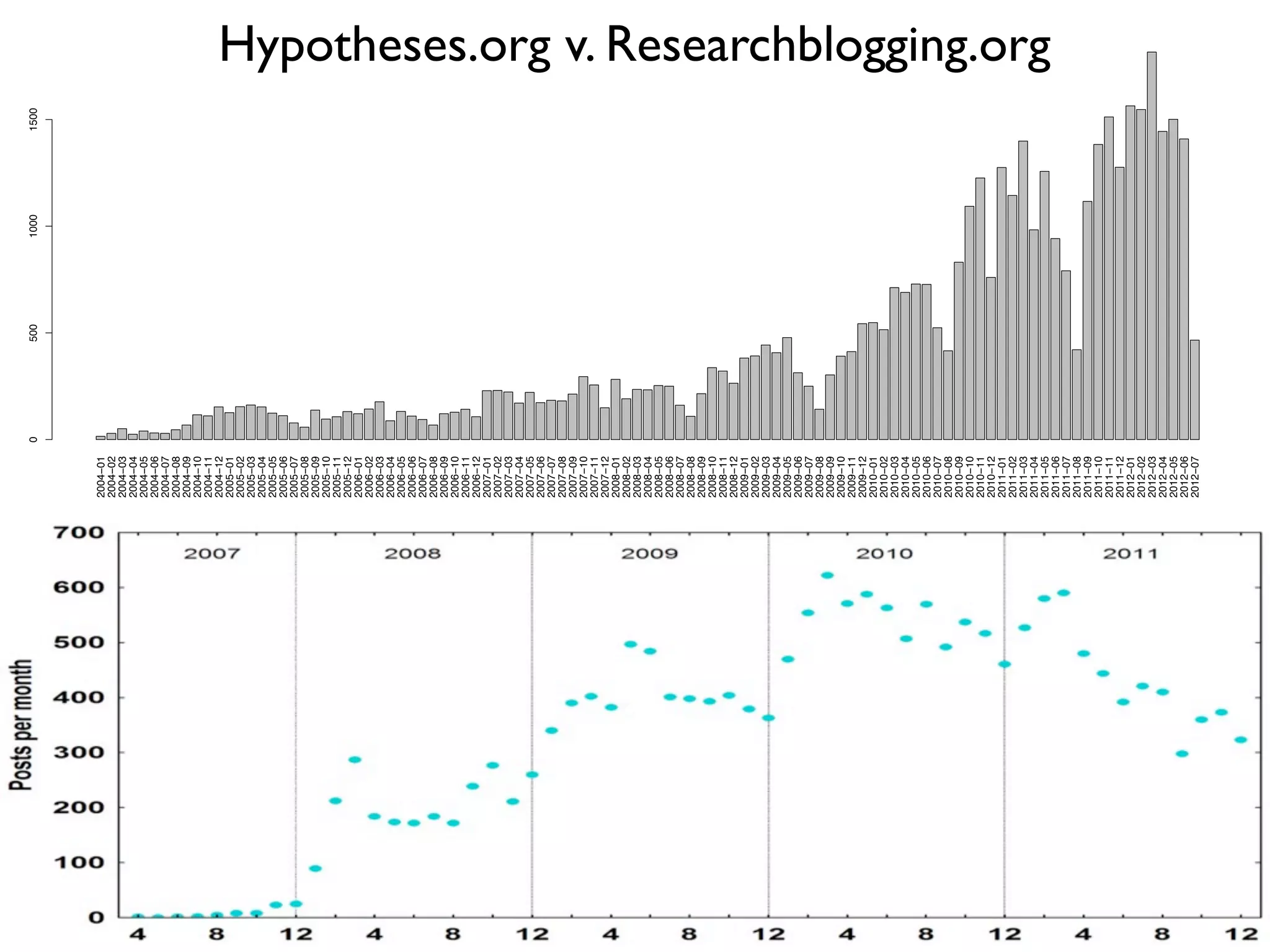
0   500   1000   1500


2004−01
2004−02
2004−03
2004−04
2004−05
2004−06
2004−07
2004−08
2004−09
2004−10
2004−11
2004−12
2005−01
2005−02
2005−03
2005−04
2005−05
2005−06
2005−07
2005−08
2005−09
2005−10
2005−11
2005−12
2006−01
2006−02
2006−03
2006−04
2006−05
2006−06
2006−07
2006−08
2006−09
2006−10
2006−11
2006−12
2007−01
2007−02
2007−03
2007−04
2007−05
2007−06
2007−07
2007−08
2007−09
2007−10
2007−11
2007−12
2008−01
2008−02
2008−03
2008−04
2008−05
2008−06
2008−07
2008−08
2008−09
2008−10
2008−11
2008−12
                                                           Posts per month starting 2004−01


2009−01
2009−02
2009−03
2009−04
2009−05
2009−06
2009−07
2009−08
2009−09
2009−10
2009−11
2009−12
2010−01
2010−02
2010−03
2010−04
2010−05
2010−06
2010−07
2010−08
2010−09
2010−10
2010−11
2010−12
2011−01
2011−02
2011−03
2011−04
                                  Hypotheses.org v. Researchblogging.org


2011−05
2011−06
2011−07
2011−08
2011−09
2011−10
2011−11
2011−12
2012−01
2012−02
2012−03
2012−04
2012−05
2012−06
2012−07
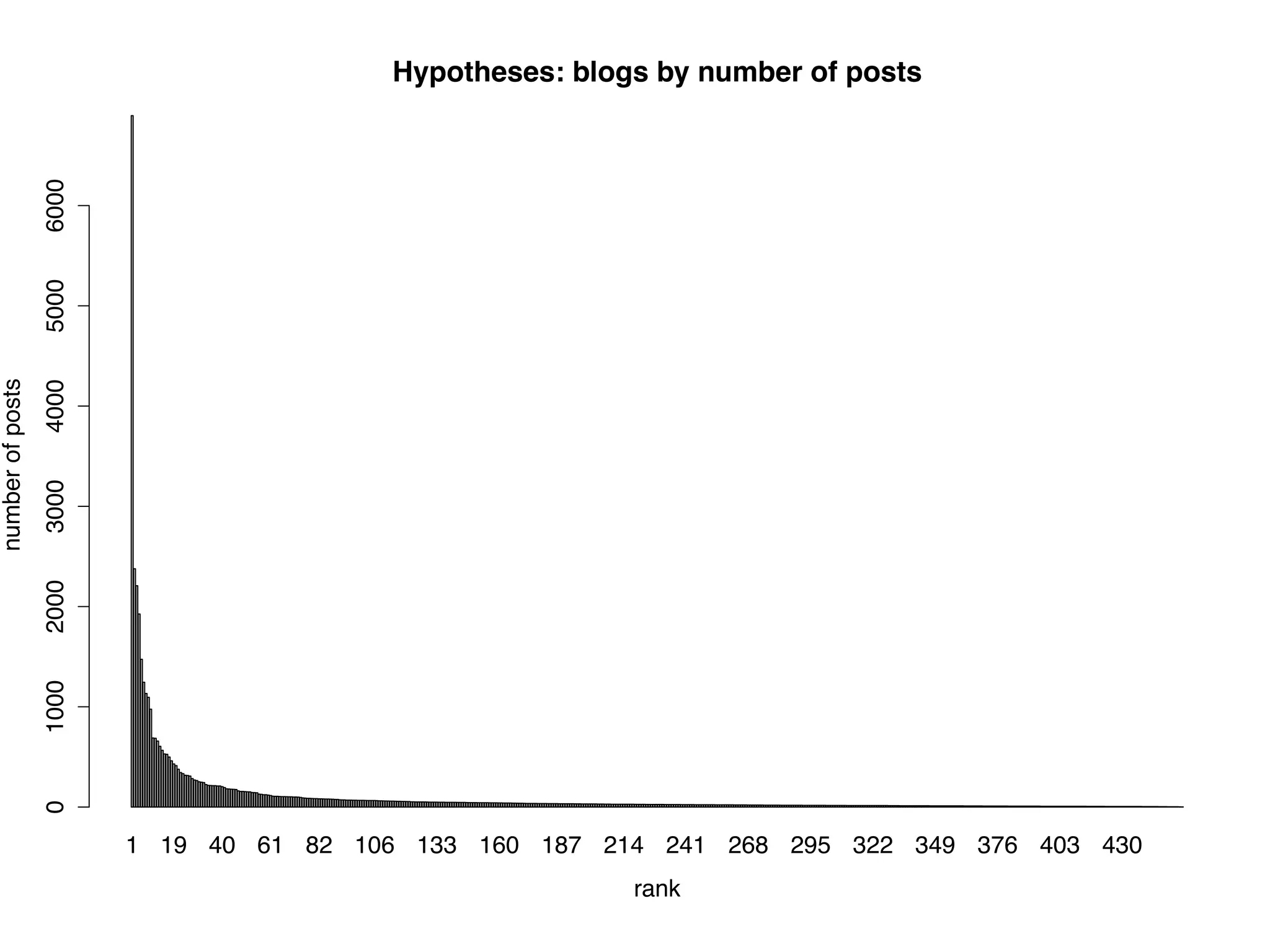
Hypotheses: blogs by number of posts
                  6000
                  5000
number of posts
                  4000
                  3000
                  2000
                  1000
                  0


                         1 19 40 61 82 106 133 160 187 214 241 268 295 322 349 376 403 430
                                                          rank
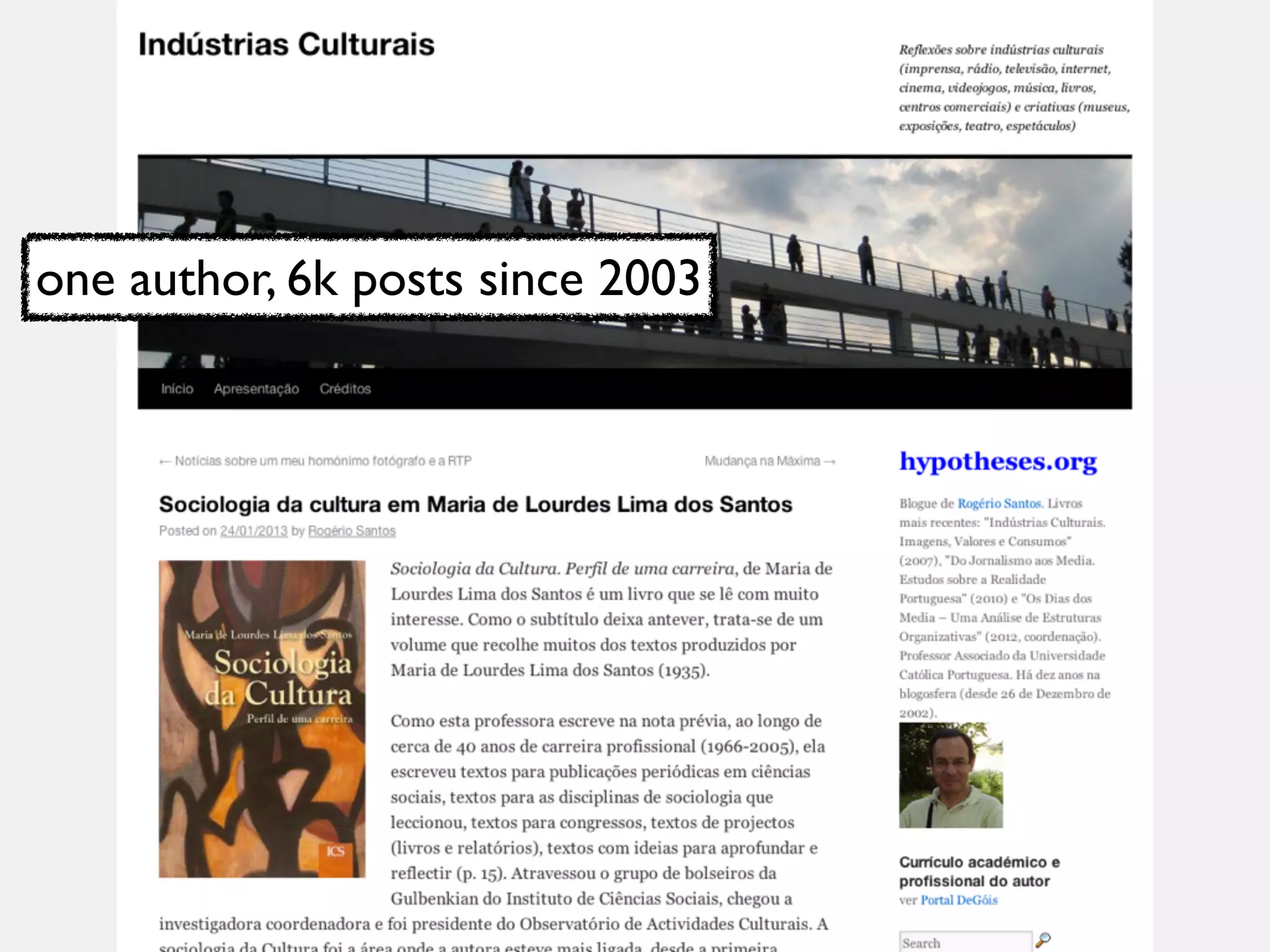
one author, 6k posts since 2003
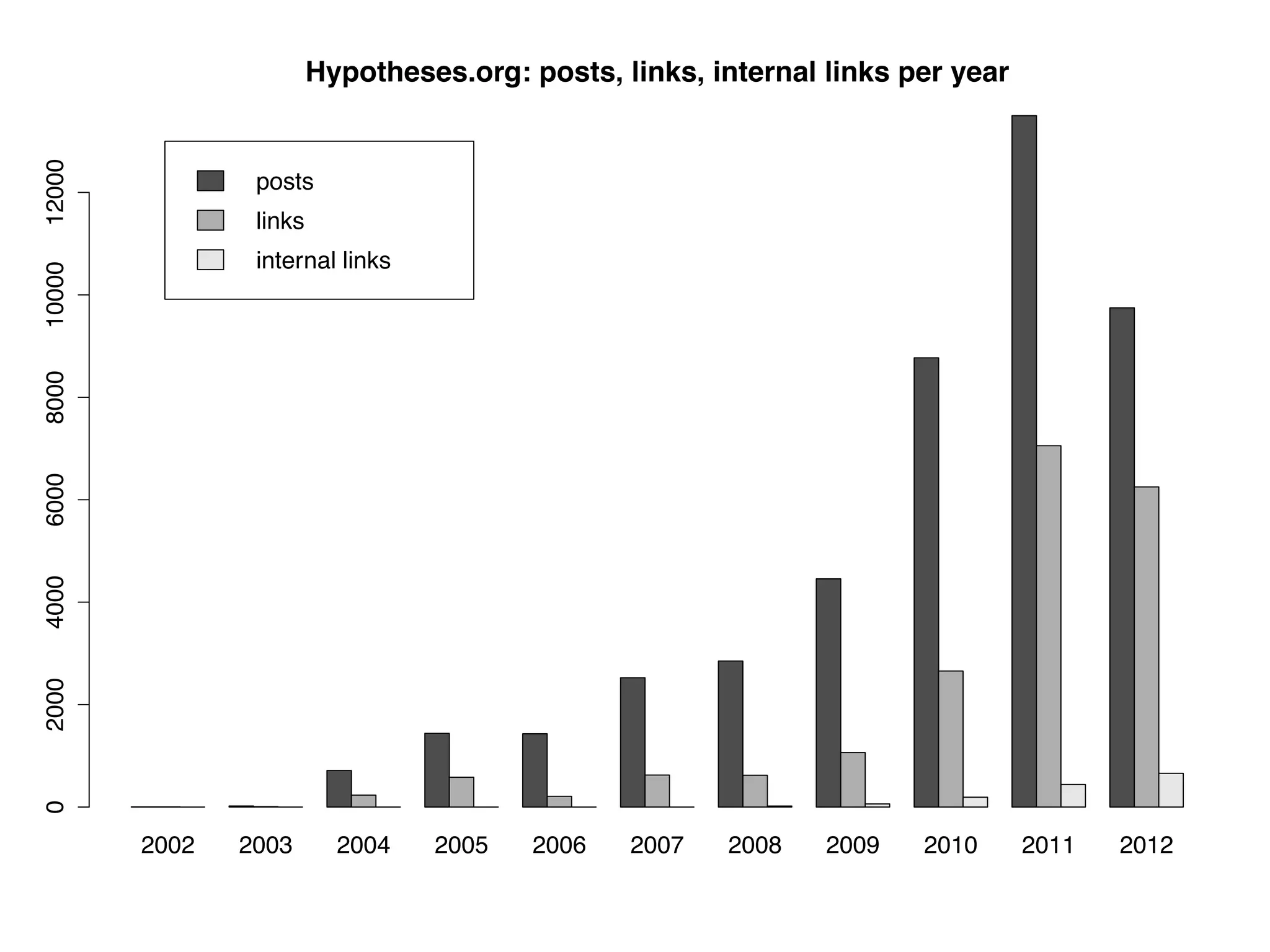
Hypotheses.org: posts, links, internal links per year
12000


                posts
                links
                internal links
10000
8000
6000
4000
2000
0


        2002   2003       2004   2005    2006   2007   2008    2009   2010      2011   2012
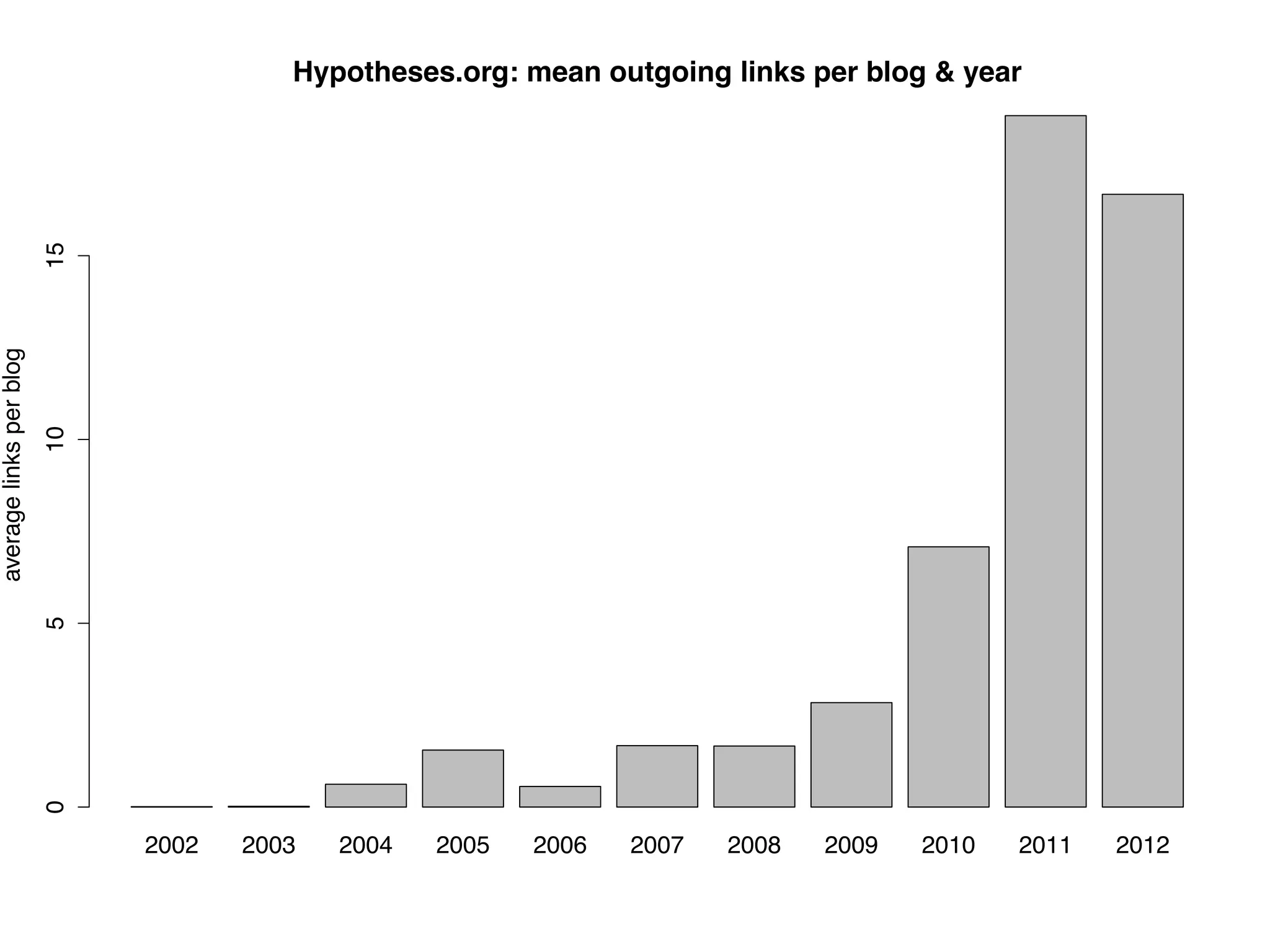
Hypotheses.org: mean outgoing links per blog & year
                         15
average links per blog
                         10
                         5
                         0


                              2002   2003   2004   2005   2006   2007   2008   2009   2010   2011   2012
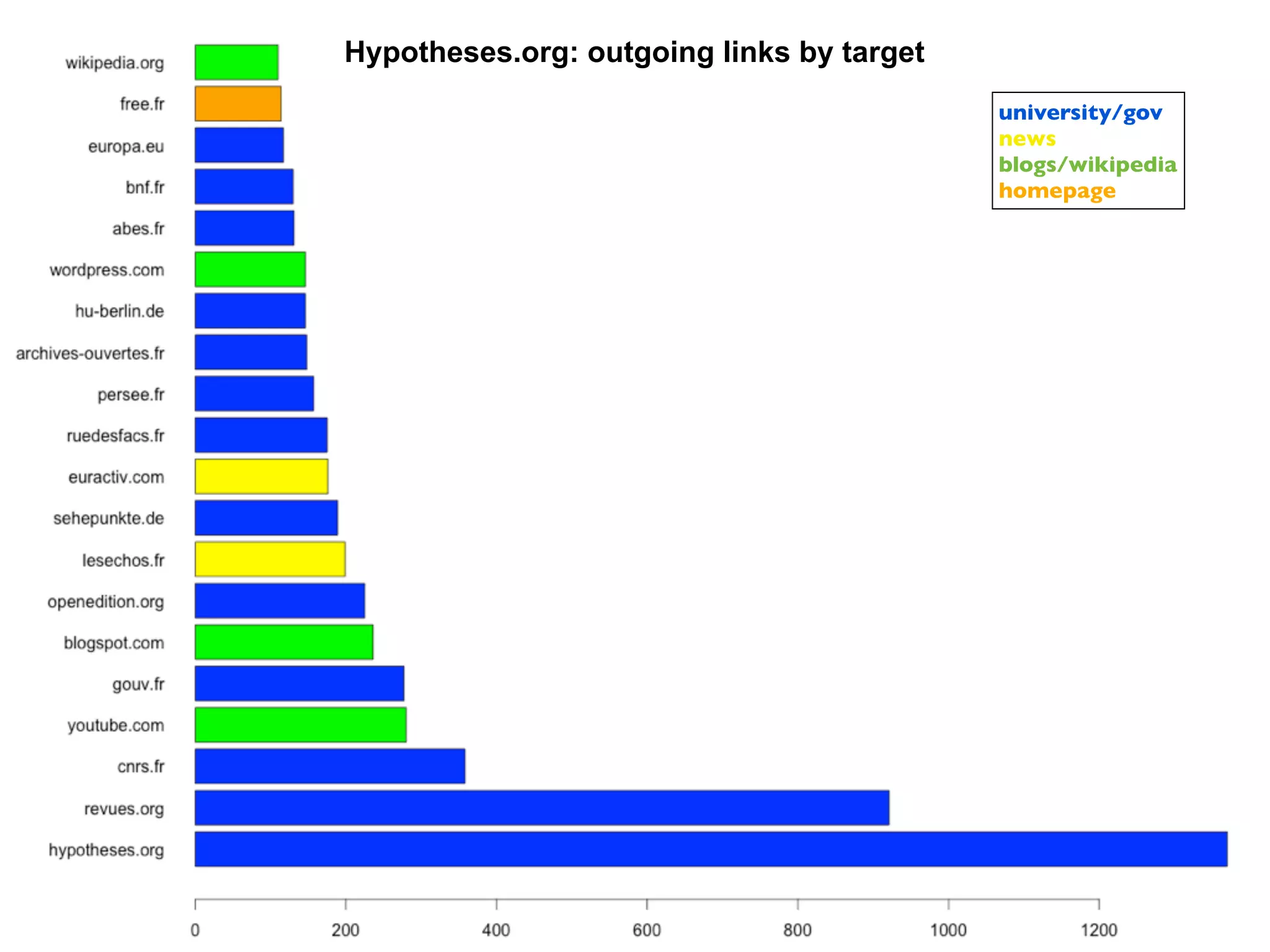
Hypotheses.org: outgoing links by target
                                           university/gov
                                           news
                                           blogs/wikipedia
                                           homepage
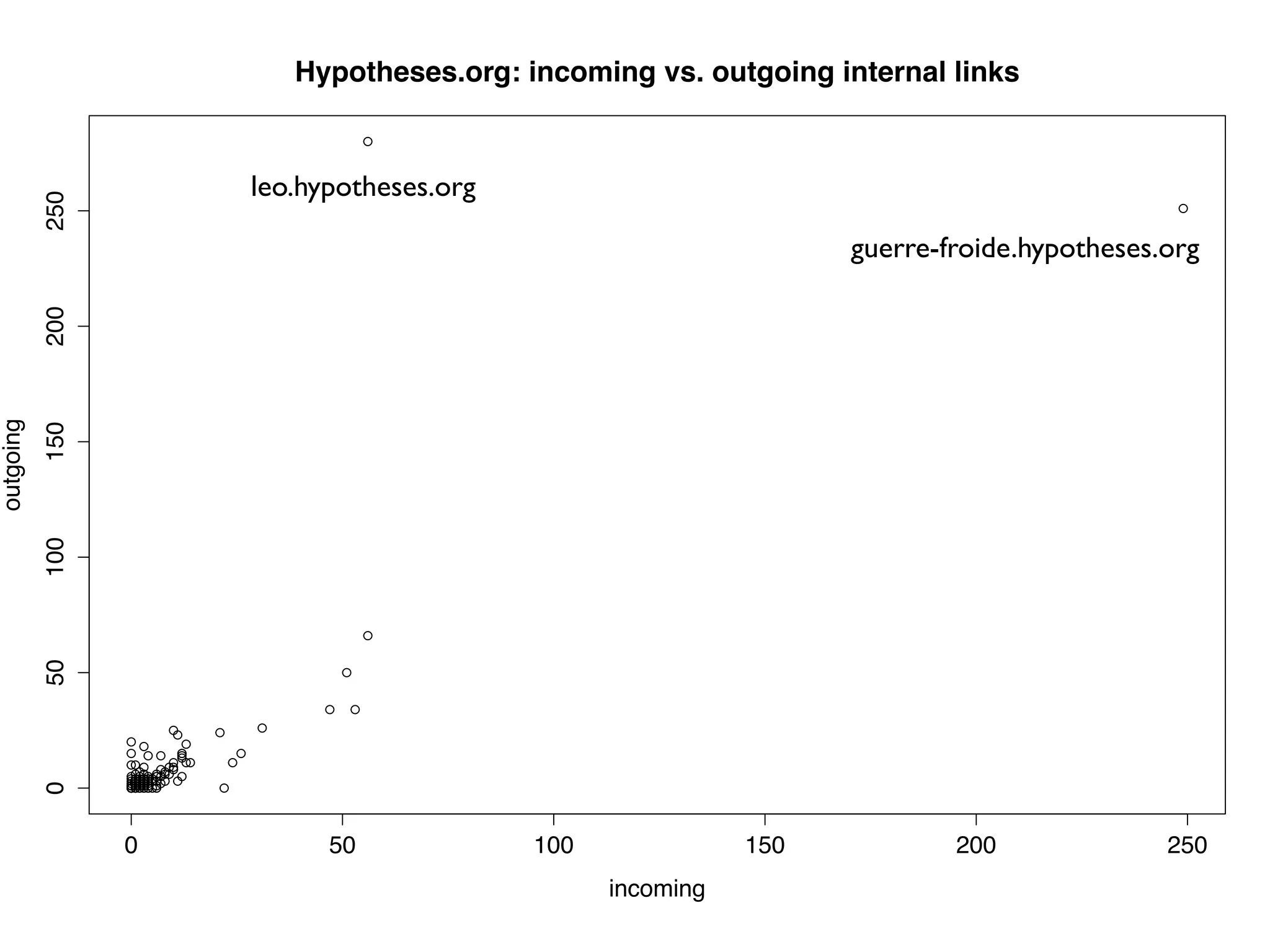
Hypotheses.org: incoming vs. outgoing internal links


                     leo.hypotheses.org
           250


                                                                 guerre-froide.hypotheses.org
           200
outgoing
           150
           100
           50
           0


                 0         50             100              150           200              250
                                                incoming
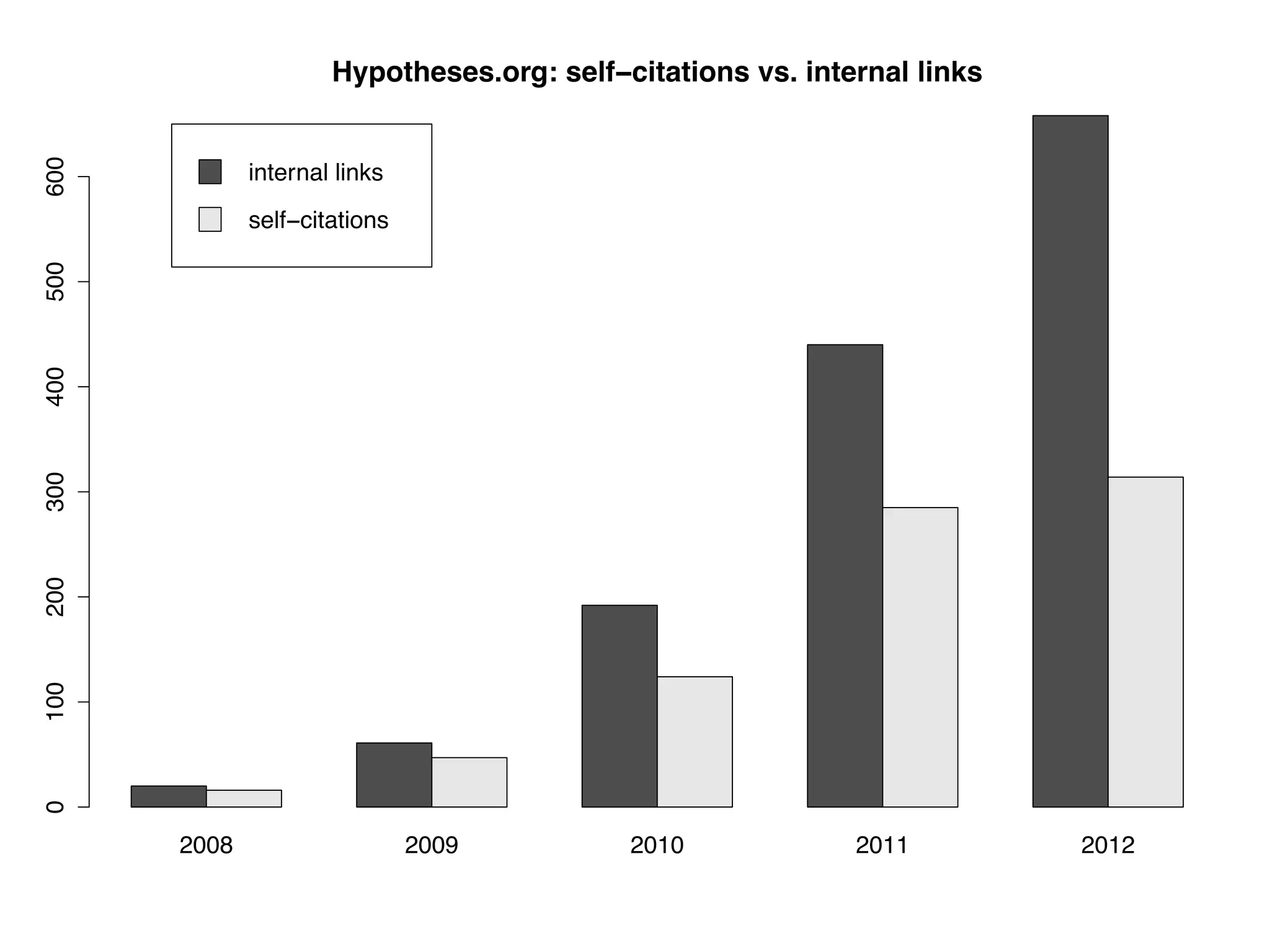
Hypotheses.org: self−citations vs. internal links
600


             internal links
             self−citations
500
400
300
200
100
0


      2008                    2009         2010             2011         2012
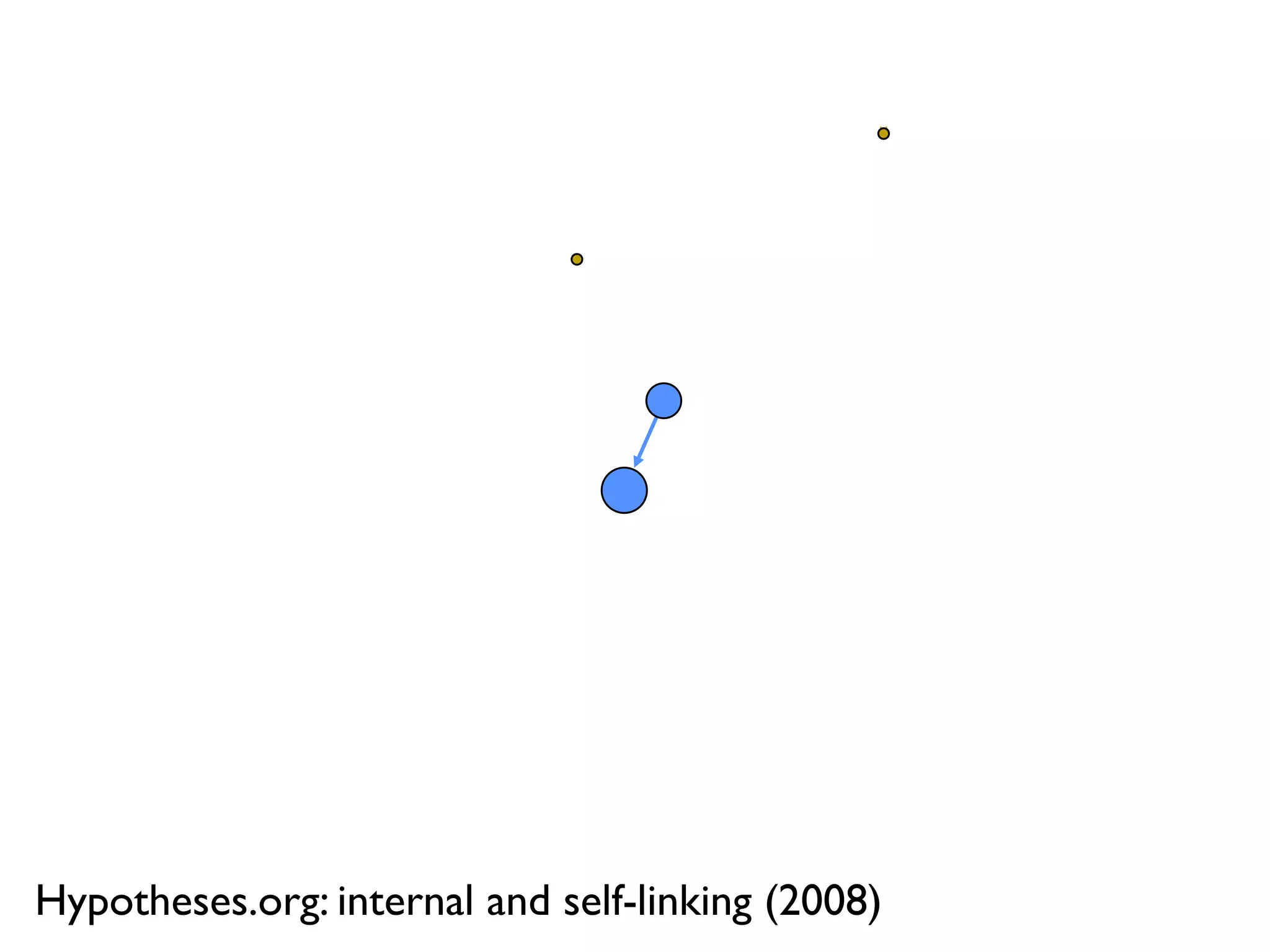
Hypotheses.org: internal and self-linking (2008)
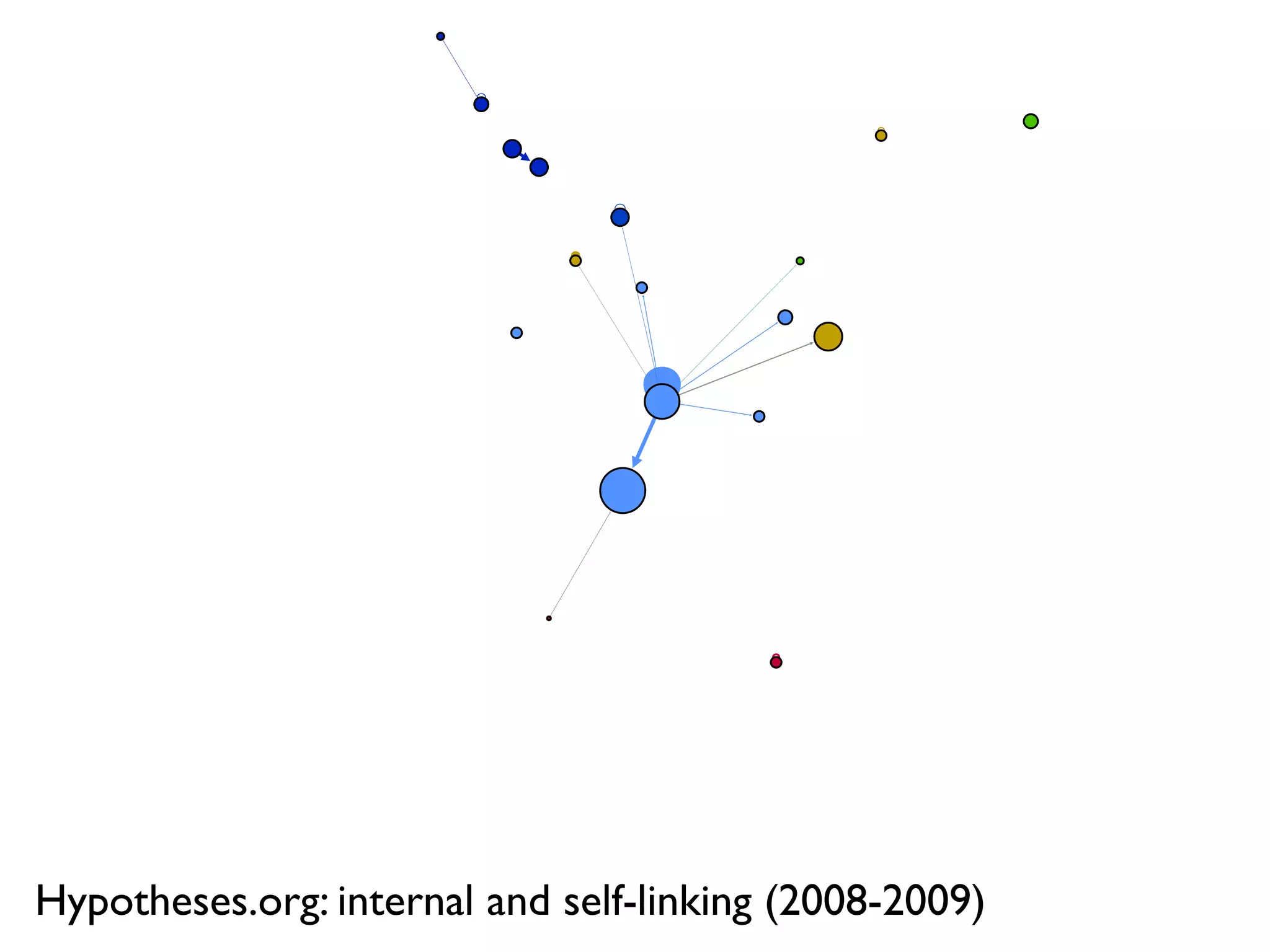
Hypotheses.org: internal and self-linking (2008-2009)
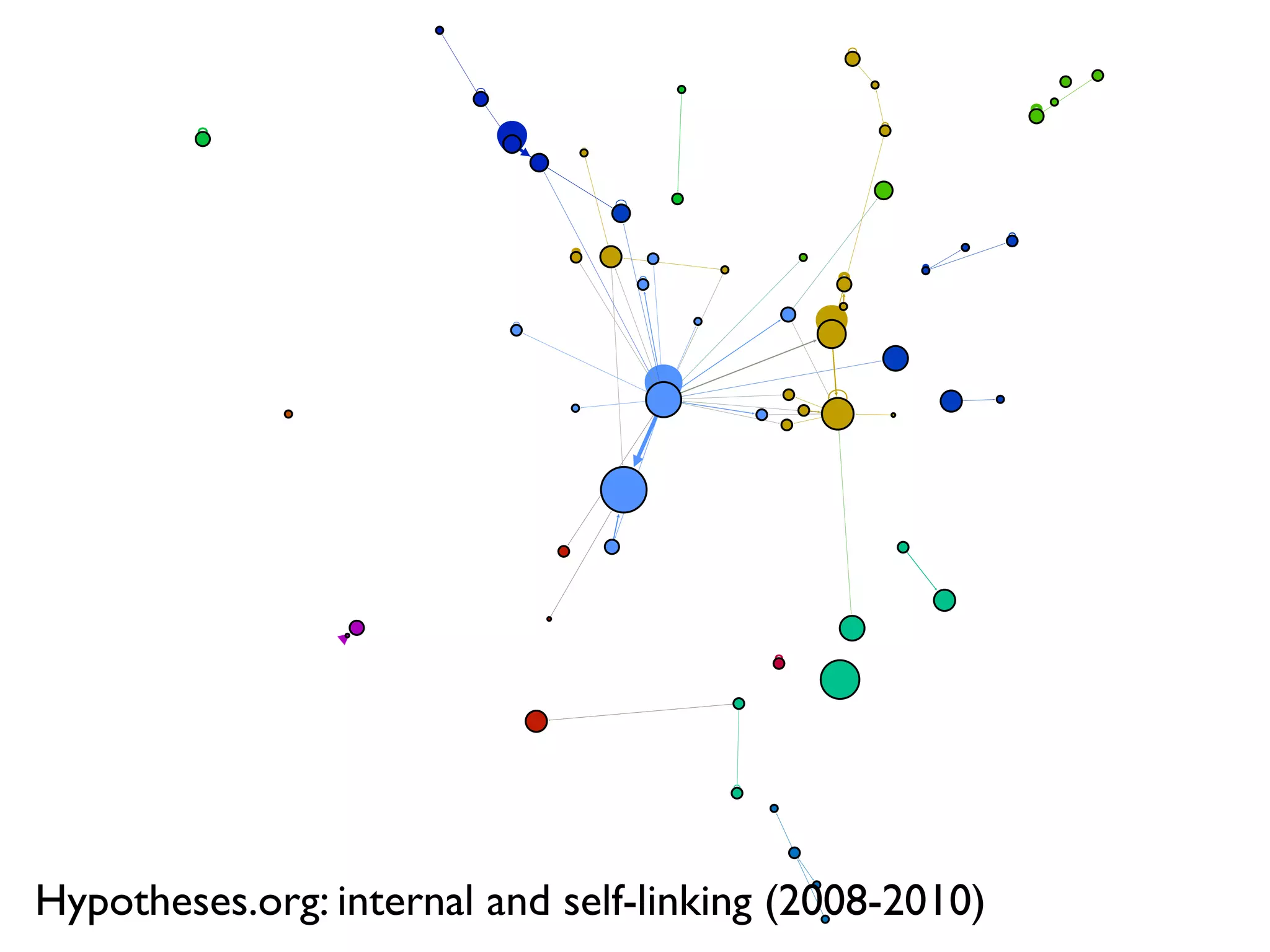
Hypotheses.org: internal and self-linking (2008-2010)
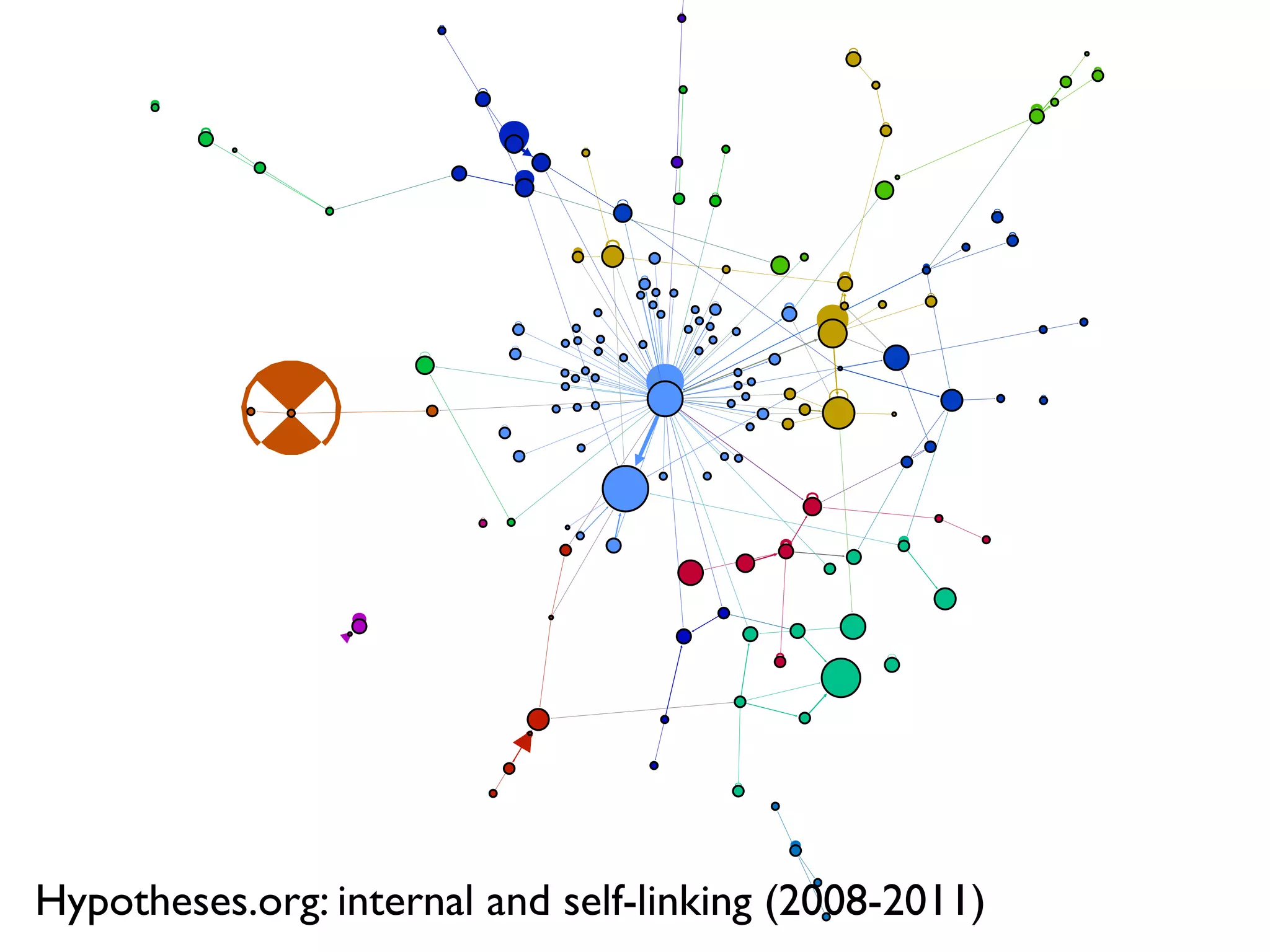
Hypotheses.org: internal and self-linking (2008-2011)
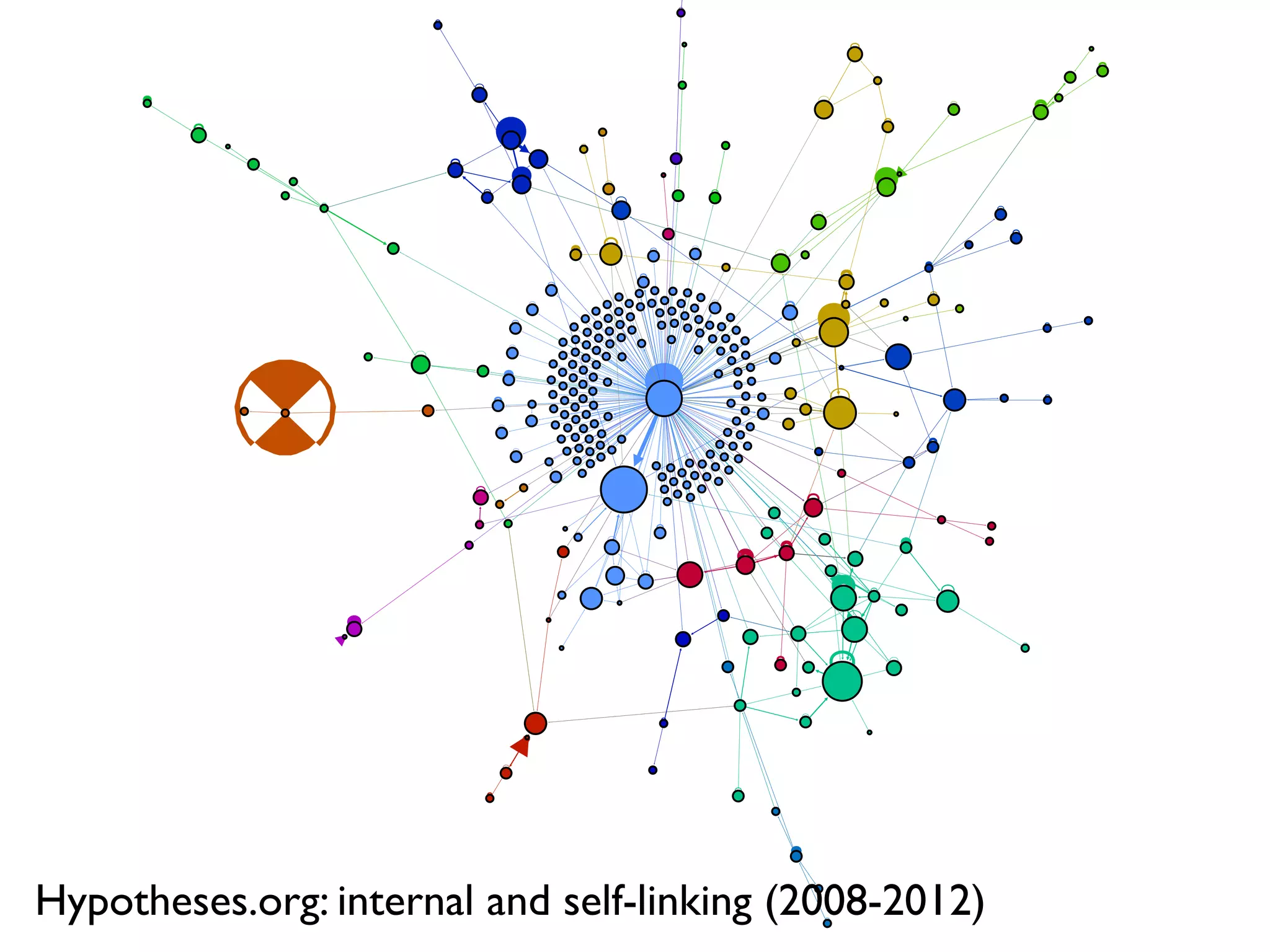
Hypotheses.org: internal and self-linking (2008-2012)
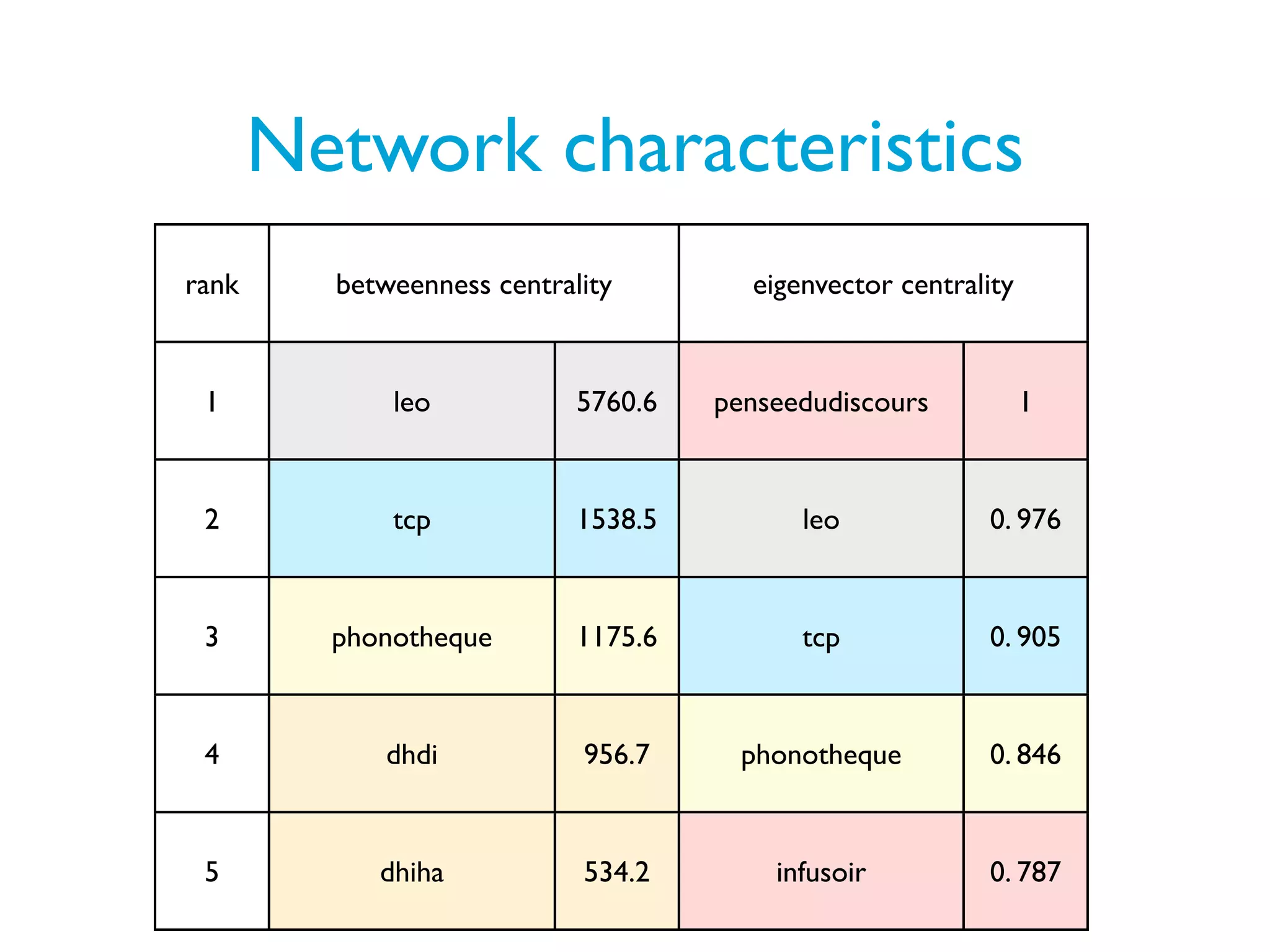
Network characteristics
rank     betweenness centrality        eigenvector centrality


 1           leo            5760.6   penseedudiscours           1


 2           tcp            1538.5         leo            0. 976


 3       phonotheque        1175.6         tcp            0. 905


 4          dhdi            956.7      phonotheque        0. 846


 5          dhiha           534.2        infusoir         0. 787
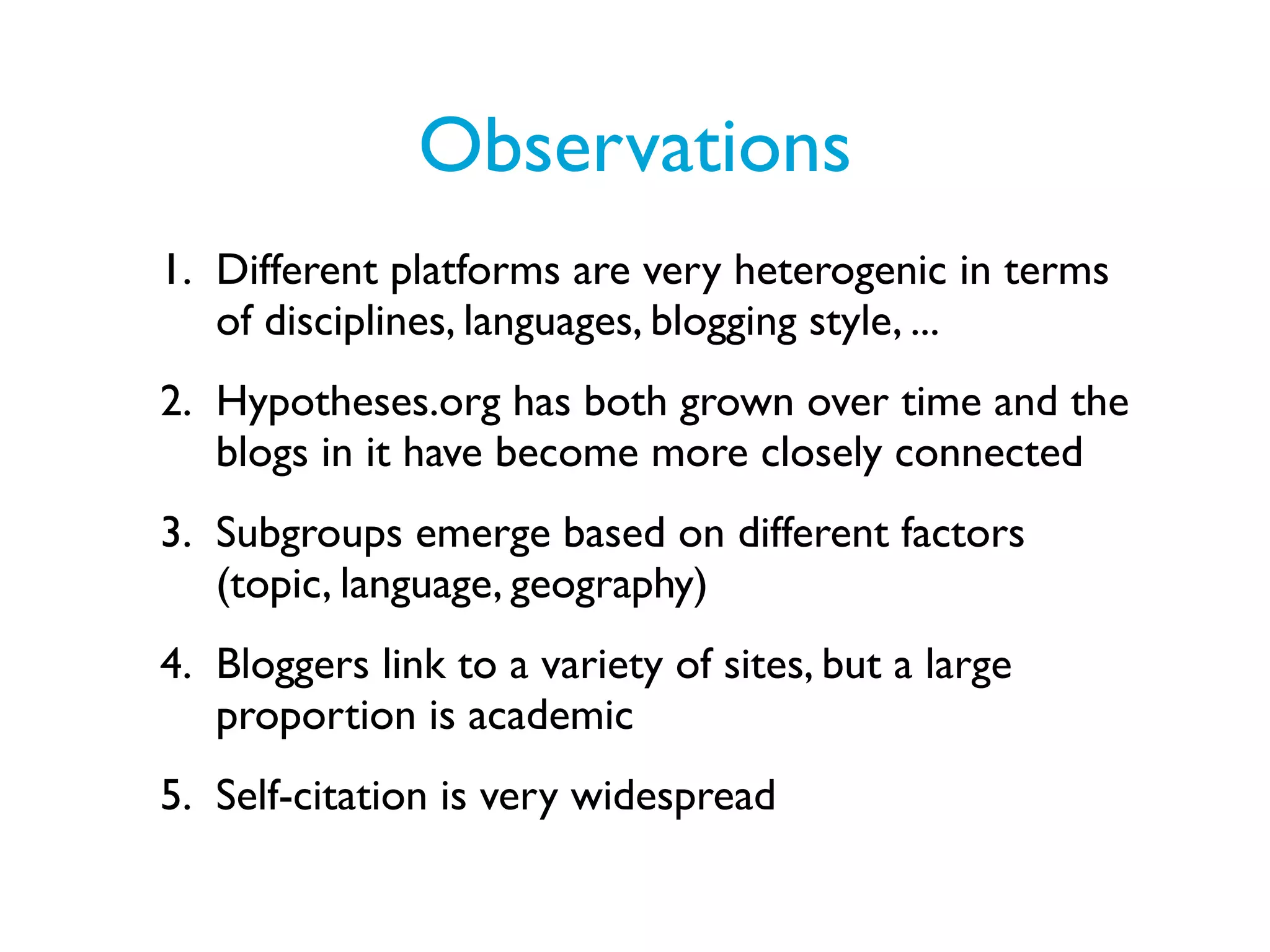
Observations
1. Different platforms are very heterogenic in terms
   of disciplines, languages, blogging style, ...
2. Hypotheses.org has both grown over time and the
   blogs in it have become more closely connected
3. Subgroups emerge based on different factors
   (topic, language, geography)
4. Bloggers link to a variety of sites, but a large
   proportion is academic
5. Self-citation is very widespread
Thank you for your attention!
Bibliography
1.   Bar-Ilan, J. (2004). An outsider’s view on topic-oriented blogging. Proceedings of the 13th international
     World Wide Web conference on Alternate track papers & posters (pp. 28–34). New York: ACM. doi:
     10.1145/1013367.1013373
2.   Fausto, S., Machado, F. a, Bento, L. F. J., Iamarino, A., Nahas, T. R., & Munger, D. S. (2012). Research blogging:
     indexing and registering the change in science 2.0. PloS one, 7(12), e50109. doi:10.1371/journal.pone.
     0050109
3.   Gregg, M. (2009). Banal Bohemia: Blogging from the Ivory Tower Hot-Desk. Convergence: The International
     Journal of Research into New Media Technologies, 15(4), 470–483. doi:10.1177/1354856509342345
4.   Kjellberg, S. (2010). I am a Blogging Researcher: Motivations for Blogging in a Scholarly Context. First
     Monday, 15(8). Retrieved from http://firstmonday.org/htbin/cgiwrap/bin/ojs/index.php/fm/article/view/
     2962/2580
5.   Kouper, I. (2010). Science blogs and public engagement with science: practices, challenges, and
     opportunities. Journal of Science Communication, 9(1), A02. Retrieved from http://jcom.sissa.it/archive/09/01/
     Jcom0901(2010)A02/
6.   Luzón, M. J. (2009). Scholarly hyperwriting: The function of links in academic weblogs. Journal of the
     American Society for Information Science and Technology, 60(1), 75–89. doi:10.1002/asi.20937
7.   Mortensen, T., & Walker, J. (2002). Blogging thoughts: personal publication as an online research tool. In A.
     Morrison (Ed.), (pp. 249–279). Oslo: InterMedia/UniPub.
8.   Shema, H., Bar-Ilan, J., & Thelwall, M. (2012). Research blogs and the discussion of scholarly information. PloS
     one, 7(5), e35869. doi:10.1371/journal.pone.0035869
9.   Walker, J. (2006). Blogging from inside the ivory tower. In A. Bruns & J. Jacobs (Eds.), Uses of Blogs (pp. 127–
     138). New York: Peter Lang Publishers.

A Tale of Two Platforms: Emerging communicative patterns in two scientific blog networks

  • 1.
    Cornelius Puschmann School of Library and Information Science, Humboldt University of Berlin / Humboldt Institute for Internet and Society (HIIG) A Tale of Two Platforms: Emerging communicative patterns in two scientific blog networks Nuffield/Oxford Internet Institute Social Networks Seminar Series Nuffield College, Oxford 11th February 2013 photos by http://www.flickr.com/people/7455207@N05/
  • 2.
    This talk The contextof my research Framing the issue: How can we describe new forms of scholarly communication online? Tracing the evolution of two scholary blog platforms
  • 3.
    in a broadersense: science and scholarship as networks of knowledge (citation networks, social networks, conceptual networks) net· work ˈnet-ˌwərk in a narrower sense: hyperlinks between blogs on two scholarly blogging platforms
  • 4.
    Prior and relatedresearch • Junior Researchers Group „Science and the Internet“ (University of Düsseldorf, 2010-2012) • Networking, visibility, information: a study of digital genres of scholarly communication and the motives of their users (DFG grant, Humboldt University Berlin, 3/2012-2/2015) • Open Science project (Alexander von Humboldt Institute for Internet and Society, 2011-) • Oxford e-Social Science Project (OeSS, 2005-2012)
  • 5.
    "Scholarship in thesciences, social sciences, and humanities is evolving, but at different rates and in different ways. While the new technologies receive the most attention, it is the underlying social and policy changes that are most profound... This is an opportune moment to think about what we should be building." (Borgman, 2008, p. xvii)
  • 6.
    methods/tools data peer ication revi com mun ew How does the Internet reshape science and scholarship? funding mology relationship with the public e pisto
  • 7.
    be tw a ee ma n   te collabora'on  1.0  (sharing) sc u r ien s 's ts   an d   collabora'on  2.0  (contribu'ng) am collabora'on  3.0  (cocrea'ng) on g  s cie 's n ts (Du9on,  2008)
  • 8.
    How significant issocial media for scholarly communication? • Internet  users  who  (some/mes)  read  blogs: • Germany:  7%  (ARD/ZDF  Onlinestudie  2011) • USA:  32%  (Pew  Internet  2010) • Japan:  80%  (comScore  2011) • Researchers  who  (some/mes)  read  blogs: • Germany:  8%  (study  „Digitale  WissenschaPskommunika/on“  2010-­‐2011) • UK:  ~7%  (study  „Impact  of  Web  2.0  on  Scholarly  Communica/on“  2009) The  acceptance  of  blogs  varies  greatly  from  country  to  country!
  • 9.
    How significant issocial media for scholarly communication? "How  do  you  stay  in  touch  with  colleagues?"  (survey  among  researchers   conducted  by  Bader,  Fritz  &  Gloning,  2012)   •  in  person:  96% •  phone:  49% •  audio/videoconferencing:  21% •  email:  94%   •  mailing  lists:  24% •  blogs:  4%  (law:  10%) •  scholarly  social  networks  (e.g.  ResearchGATE):  5% •  conven/onal  social  networks  (e.g.  Facebook):  5% •  Twiger:  2% •  wikis:  6%
  • 10.
    Is anything new? • formal scholarly communication is a highly resilient system • acceptance and use of social media among academics remains low • but: ,pockets‘ of adoption exist in some local and disciplinary scholary communities
  • 11.
    How do scholarlyblogs fit it?
  • 12.
    Scholarly blog research • Mortensen and Walker (2002): blogs as tools for writing and knowledge management • Walker (2006): change of usage over time • Gregg (2009): blogs as a subcultural form of expression, part of constructing a professional identity • Bar-Ilan (2004): aims of scholars inferred from form and content • Luzón (2009): use of hyperlinks in academic blogs • Kouper (2010): “virtual water cooler” for experts • Kjellberg (2010): diverse set of functions for different users • Shema, Bar-Ilan, & Thelwall (2012): what sources of research do scholarly bloggers link to? • Fausto et al (2012): systematic content-based study of ResearchBlogging.org (dx.doi.org/10.1371/journal.pone.0050109)
  • 13.
    Aims of blogdata analysis 1. Exploration How can academic blogging be best described? 2. Comparison to antecedent genres How do practices in academic blogging differ from practices in formal publishing? 3. Comparison of platforms How do scholarly blog platforms compare? comments content language use of hyperlinks
  • 14.
    Scholarly blogging platforms Scilogs ResearchBlogging Hypotheses launched 2007 2007 2004 type publisher publisher* publicly funded # blogs ~60 1,230 456 # posts ~7,500 26,960 45,528
  • 15.
    Hypotheses.org(*) Researchblogging.org(**) Hypotheses.org: disciplines of most active blogs (n=74) History Sociology Political Science Asian Studies Library Science other Cultural Studies Urban Studies * based on those blogs with more than 100 posts (n=74) ** reproduced from Fausto et al, 2012
  • 16.
    Hypotheses.org: languages bypost french other catalan german spanish portuguese english
  • 17.
    Hypotheses.org: active blogsper year 400 300 blogs 200 100 0 2004 2005 2006 2007 2008 2009 2010 2011 2012
  • 18.
    0 500 1000 1500 2004−01 2004−02 2004−03 2004−04 2004−05 2004−06 2004−07 2004−08 2004−09 2004−10 2004−11 2004−12 2005−01 2005−02 2005−03 2005−04 2005−05 2005−06 2005−07 2005−08 2005−09 2005−10 2005−11 2005−12 2006−01 2006−02 2006−03 2006−04 2006−05 2006−06 2006−07 2006−08 2006−09 2006−10 2006−11 2006−12 2007−01 2007−02 2007−03 2007−04 2007−05 2007−06 2007−07 2007−08 2007−09 2007−10 2007−11 2007−12 2008−01 2008−02 2008−03 2008−04 2008−05 2008−06 2008−07 2008−08 2008−09 2008−10 2008−11 2008−12 Posts per month starting 2004−01 2009−01 2009−02 2009−03 2009−04 2009−05 2009−06 2009−07 2009−08 2009−09 2009−10 2009−11 2009−12 2010−01 2010−02 2010−03 2010−04 2010−05 2010−06 2010−07 2010−08 2010−09 2010−10 2010−11 2010−12 2011−01 2011−02 2011−03 2011−04 Hypotheses.org v. Researchblogging.org 2011−05 2011−06 2011−07 2011−08 2011−09 2011−10 2011−11 2011−12 2012−01 2012−02 2012−03 2012−04 2012−05 2012−06 2012−07
  • 19.
    Hypotheses: blogs bynumber of posts 6000 5000 number of posts 4000 3000 2000 1000 0 1 19 40 61 82 106 133 160 187 214 241 268 295 322 349 376 403 430 rank
  • 20.
    one author, 6kposts since 2003
  • 21.
    Hypotheses.org: posts, links,internal links per year 12000 posts links internal links 10000 8000 6000 4000 2000 0 2002 2003 2004 2005 2006 2007 2008 2009 2010 2011 2012
  • 22.
    Hypotheses.org: mean outgoinglinks per blog & year 15 average links per blog 10 5 0 2002 2003 2004 2005 2006 2007 2008 2009 2010 2011 2012
  • 23.
    Hypotheses.org: outgoing linksby target university/gov news blogs/wikipedia homepage
  • 24.
    Hypotheses.org: incoming vs.outgoing internal links leo.hypotheses.org 250 guerre-froide.hypotheses.org 200 outgoing 150 100 50 0 0 50 100 150 200 250 incoming
  • 25.
    Hypotheses.org: self−citations vs.internal links 600 internal links self−citations 500 400 300 200 100 0 2008 2009 2010 2011 2012
  • 26.
    Hypotheses.org: internal andself-linking (2008)
  • 27.
    Hypotheses.org: internal andself-linking (2008-2009)
  • 28.
    Hypotheses.org: internal andself-linking (2008-2010)
  • 29.
    Hypotheses.org: internal andself-linking (2008-2011)
  • 30.
    Hypotheses.org: internal andself-linking (2008-2012)
  • 31.
    Network characteristics rank betweenness centrality eigenvector centrality 1 leo 5760.6 penseedudiscours 1 2 tcp 1538.5 leo 0. 976 3 phonotheque 1175.6 tcp 0. 905 4 dhdi 956.7 phonotheque 0. 846 5 dhiha 534.2 infusoir 0. 787
  • 32.
    Observations 1. Different platformsare very heterogenic in terms of disciplines, languages, blogging style, ... 2. Hypotheses.org has both grown over time and the blogs in it have become more closely connected 3. Subgroups emerge based on different factors (topic, language, geography) 4. Bloggers link to a variety of sites, but a large proportion is academic 5. Self-citation is very widespread
  • 33.
    Thank you foryour attention!
  • 34.
    Bibliography 1. Bar-Ilan, J. (2004). An outsider’s view on topic-oriented blogging. Proceedings of the 13th international World Wide Web conference on Alternate track papers & posters (pp. 28–34). New York: ACM. doi: 10.1145/1013367.1013373 2. Fausto, S., Machado, F. a, Bento, L. F. J., Iamarino, A., Nahas, T. R., & Munger, D. S. (2012). Research blogging: indexing and registering the change in science 2.0. PloS one, 7(12), e50109. doi:10.1371/journal.pone. 0050109 3. Gregg, M. (2009). Banal Bohemia: Blogging from the Ivory Tower Hot-Desk. Convergence: The International Journal of Research into New Media Technologies, 15(4), 470–483. doi:10.1177/1354856509342345 4. Kjellberg, S. (2010). I am a Blogging Researcher: Motivations for Blogging in a Scholarly Context. First Monday, 15(8). Retrieved from http://firstmonday.org/htbin/cgiwrap/bin/ojs/index.php/fm/article/view/ 2962/2580 5. Kouper, I. (2010). Science blogs and public engagement with science: practices, challenges, and opportunities. Journal of Science Communication, 9(1), A02. Retrieved from http://jcom.sissa.it/archive/09/01/ Jcom0901(2010)A02/ 6. Luzón, M. J. (2009). Scholarly hyperwriting: The function of links in academic weblogs. Journal of the American Society for Information Science and Technology, 60(1), 75–89. doi:10.1002/asi.20937 7. Mortensen, T., & Walker, J. (2002). Blogging thoughts: personal publication as an online research tool. In A. Morrison (Ed.), (pp. 249–279). Oslo: InterMedia/UniPub. 8. Shema, H., Bar-Ilan, J., & Thelwall, M. (2012). Research blogs and the discussion of scholarly information. PloS one, 7(5), e35869. doi:10.1371/journal.pone.0035869 9. Walker, J. (2006). Blogging from inside the ivory tower. In A. Bruns & J. Jacobs (Eds.), Uses of Blogs (pp. 127– 138). New York: Peter Lang Publishers.