Knowledge or Credit?
The (Un)Changing Face of Academic Publishing
 from the Philosophical Transactions to Blogging

                 Cornelius Puschmann
       School of Library and Information Science
           Humboldt-Universität zu Berlin

Social Science and Digital Research: Interdisciplinary Insights

       March 12th 2012, Oxford Internet Institute
This Talk


1. Context of this talk


         2. A glimpse at the past and present of formal scholarly communication


                          3. The scholarly blog: Jack of all trades, master of none?


                                                       4. (Policy) implications
Context
In the broader context of the Internet‘s impact on scholarship, a number
of initiatives have adressed scholarly blogs and their potential role for
academic communication:
  • Oxford e-Social Science Project (OeSS, 2005-2012)
  • MeRC project “Use and Relevance of Web 2.0 Resources for
  Researchers“ (2008-2009)
  • Research Consortium “Interactive Science“ (2009-2012, Gießen)
  • Junior Researchers Group “Science and the Internet“ (2010-2012,
  Düsseldorf)
  • my postdoc project (DFG grant): “Networking, visibility, information:
  a study of digital genres of scholarly communication and the motives of
  their users“ (2012-2015, Berlin)
The Past

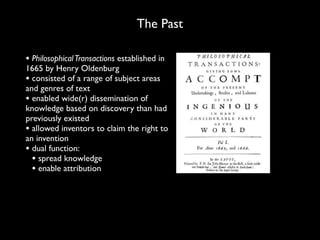
• Philosophical Transactions established in
1665 by Henry Oldenburg
• consisted of a range of subject areas
and genres of text
• enabled wide(r) dissemination of
knowledge based on discovery than had
previously existed
• allowed inventors to claim the right to
an invention
• dual function:
  • spread knowledge
  • enable attribution
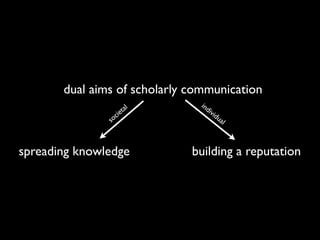
dual aims of scholarly communication
                      l        ind
                    ta            ivi
                 cie                    du
               so                         al


spreading knowledge           building a reputation
The Present
massive increase in speed and volume of output:
• ~50 mio. scholarly publications in existence
a heavily concentrated market:
• Reed Elsevier, Springer Science+Business Media and John Wiley & Sons
account for large portion of articles published globally

extreme imbalances:
• key inputs (research articles and peer review) are provided free of charge
• output it sold to intermediaries (libraries), not to end-consumers
• profit margins of up to 40%
changing environments:
• digital publishing
• open access
What happened in between?

• institutionalization and professionalization of academia
• corporate intermediaries have taken over publishing
• career success based on publications (“publish or perish“)
• computers and the Internet (duh)
• diversification of scholarly genres:
  • formal (monographs, peer-reviewed articles)
  • informal (gray literature, interpersonal communication)
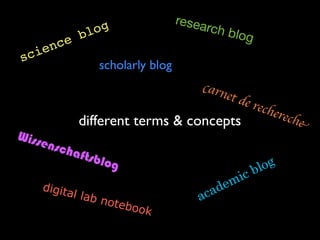
How do scholarly blogs fit in here?
resea
                  og                     rch blo
               bl                               g
       en ce
s ci
                  scholarly blog
                                        carn
                                        de r et
                                            eche
                                                rech
               different terms & concepts           e
Wiss
    ensc
        haft
             sblo
                 g
                                                    blog
                                               ic
    digita                               ad em
          l    lab n
                    otebo              ac
                         ok
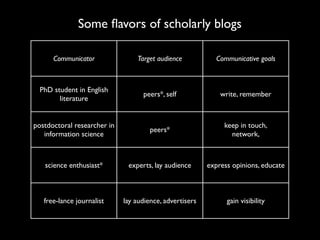
Some flavors of scholarly blogs

      Communicator               Target audience           Communicative goals


  PhD student in English
                                   peers*, self              write, remember
        literature


postdoctoral researcher in                                    keep in touch,
                                      peers*
   information science                                          network,


   science enthusiast*        experts, lay audience      express opinions, educate


   free-lance journalist     lay audience, advertisers         gain visibility
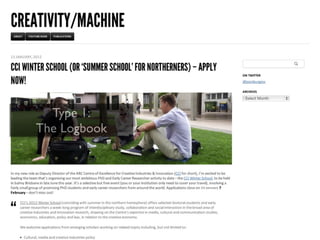
Type 1:
The Logbook
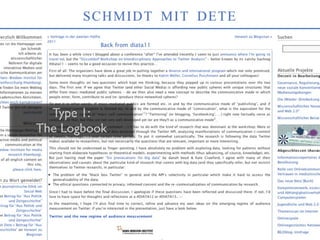
Type 1:
The Logbook
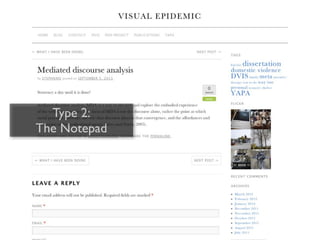
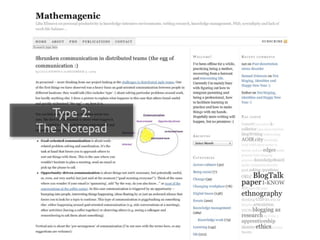
Type 2:
The Notepad
Type 2:
The Notepad
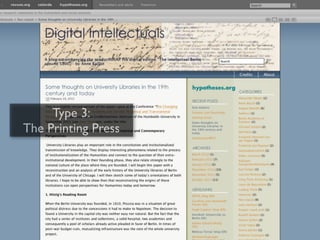
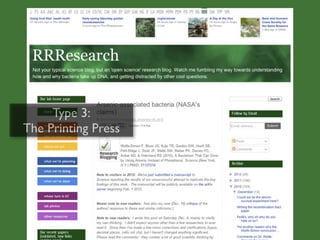
Type 3:
The Printing Press
Type 3:
The Printing Press
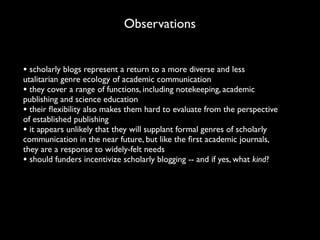
Observations


• scholarly blogs represent a return to a more diverse and less
utalitarian genre ecology of academic communication
• they cover a range of functions, including notekeeping, academic
publishing and science education
• their flexibility also makes them hard to evaluate from the perspective
of established publishing
• it appears unlikely that they will supplant formal genres of scholarly
communication in the near future, but like the first academic journals,
they are a response to widely-felt needs
• should funders incentivize scholarly blogging -- and if yes, what kind?
Thank you for your attention!

Knowledge or Credit? The (Un)changing Face of Academic Publishing from the Philosophical Transactions to Blogging

  • 1.
    Knowledge or Credit? The(Un)Changing Face of Academic Publishing from the Philosophical Transactions to Blogging Cornelius Puschmann School of Library and Information Science Humboldt-Universität zu Berlin Social Science and Digital Research: Interdisciplinary Insights March 12th 2012, Oxford Internet Institute
  • 2.
    This Talk 1. Contextof this talk 2. A glimpse at the past and present of formal scholarly communication 3. The scholarly blog: Jack of all trades, master of none? 4. (Policy) implications
  • 3.
    Context In the broadercontext of the Internet‘s impact on scholarship, a number of initiatives have adressed scholarly blogs and their potential role for academic communication: • Oxford e-Social Science Project (OeSS, 2005-2012) • MeRC project “Use and Relevance of Web 2.0 Resources for Researchers“ (2008-2009) • Research Consortium “Interactive Science“ (2009-2012, Gießen) • Junior Researchers Group “Science and the Internet“ (2010-2012, Düsseldorf) • my postdoc project (DFG grant): “Networking, visibility, information: a study of digital genres of scholarly communication and the motives of their users“ (2012-2015, Berlin)
  • 4.
    The Past • PhilosophicalTransactions established in 1665 by Henry Oldenburg • consisted of a range of subject areas and genres of text • enabled wide(r) dissemination of knowledge based on discovery than had previously existed • allowed inventors to claim the right to an invention • dual function: • spread knowledge • enable attribution
  • 5.
    dual aims ofscholarly communication l ind ta ivi cie du so al spreading knowledge building a reputation
  • 6.
    The Present massive increasein speed and volume of output: • ~50 mio. scholarly publications in existence a heavily concentrated market: • Reed Elsevier, Springer Science+Business Media and John Wiley & Sons account for large portion of articles published globally extreme imbalances: • key inputs (research articles and peer review) are provided free of charge • output it sold to intermediaries (libraries), not to end-consumers • profit margins of up to 40% changing environments: • digital publishing • open access
  • 7.
    What happened inbetween? • institutionalization and professionalization of academia • corporate intermediaries have taken over publishing • career success based on publications (“publish or perish“) • computers and the Internet (duh) • diversification of scholarly genres: • formal (monographs, peer-reviewed articles) • informal (gray literature, interpersonal communication) How do scholarly blogs fit in here?
  • 8.
    resea og rch blo bl g en ce s ci scholarly blog carn de r et eche rech different terms & concepts e Wiss ensc haft sblo g blog ic digita ad em l lab n otebo ac ok
  • 9.
    Some flavors ofscholarly blogs Communicator Target audience Communicative goals PhD student in English peers*, self write, remember literature postdoctoral researcher in keep in touch, peers* information science network, science enthusiast* experts, lay audience express opinions, educate free-lance journalist lay audience, advertisers gain visibility
  • 10.
  • 11.
  • 12.
  • 13.
  • 14.
  • 15.
  • 16.
    Observations • scholarly blogsrepresent a return to a more diverse and less utalitarian genre ecology of academic communication • they cover a range of functions, including notekeeping, academic publishing and science education • their flexibility also makes them hard to evaluate from the perspective of established publishing • it appears unlikely that they will supplant formal genres of scholarly communication in the near future, but like the first academic journals, they are a response to widely-felt needs • should funders incentivize scholarly blogging -- and if yes, what kind?
  • 17.
    Thank you foryour attention!