Cornelius Puschmann, Humboldt-Universität zu Berlin
            Jean Burgess, Queensland University of Technology
             Axel Bruns, Queensland University of Technology
            Merja Mahrt, Heinrich-Heine-Universität Düsseldorf


Data Access, Ownership and Control in Social Web Services:
               Issues for Twitter Research


                                ICA 2012
                  Track: Communication and Technology
               Session: Researching Social Media: Ethical and
                         Methodological Challenges
                           26 May 2012, Phoenix
“There are also significant questions of truth, control, and
power in Big Data studies: researchers have the tools and the
access, while social media users as a whole do not. Their data
were created in highly context-sensitive spaces, and it is entirely
possible that some users would not give permission for their
data to be used elsewhere.”
(boyd & Crawford, 2012, p.12)
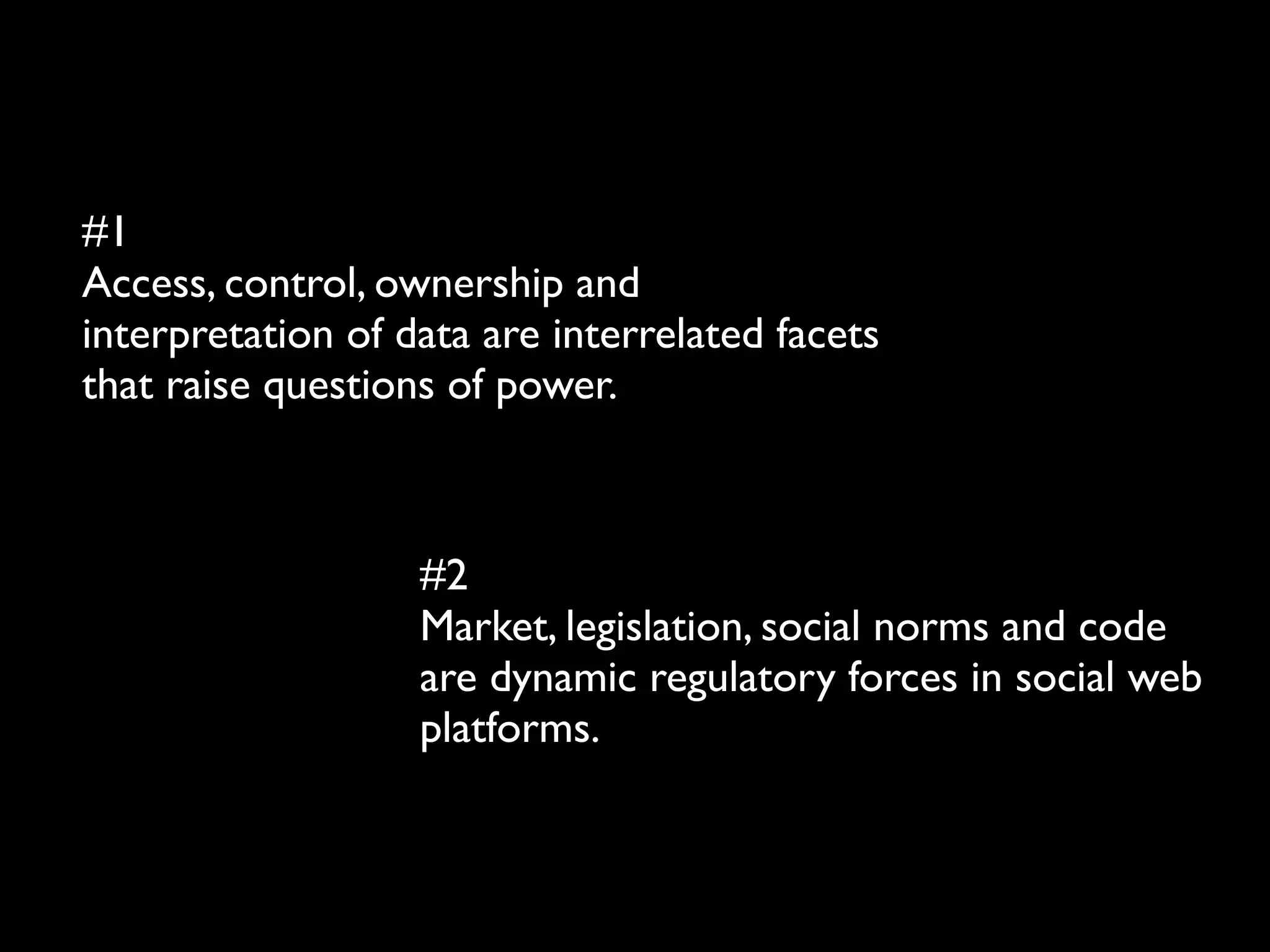
#1
Access, control, ownership and
interpretation of data are interrelated facets
that raise questions of power.


                   #2
                   Market, legislation, social norms and code
                   are dynamic regulatory forces in social web
                   platforms.
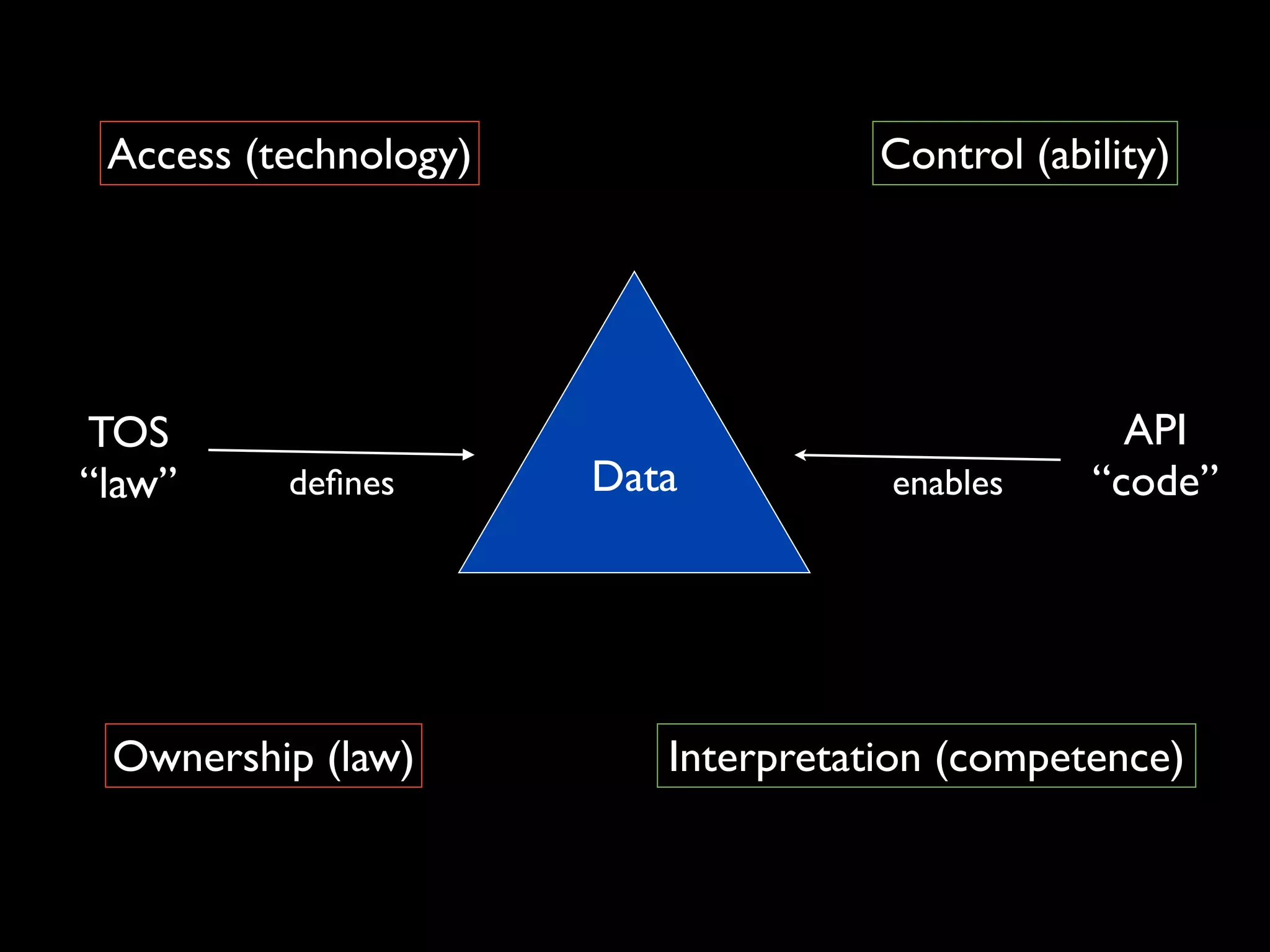
Access (technology)                 Control (ability)


TOS                                                API
“law”     defines       Data          enables     “code”


 Ownership (law)          Interpretation (competence)
• founded in 2006 by Jack Dorsey
• 140 mio active users
• 340 mio tweets per day
• source of real-time information on a breadth of issues
  from pop culture to politics
• increasingly used as a data source among researchers
  (e.g. on election prediction via Twitter: Tumasjan et al,
  2010, Jungherr et al, 2011, Gayo-Avello, 2012)
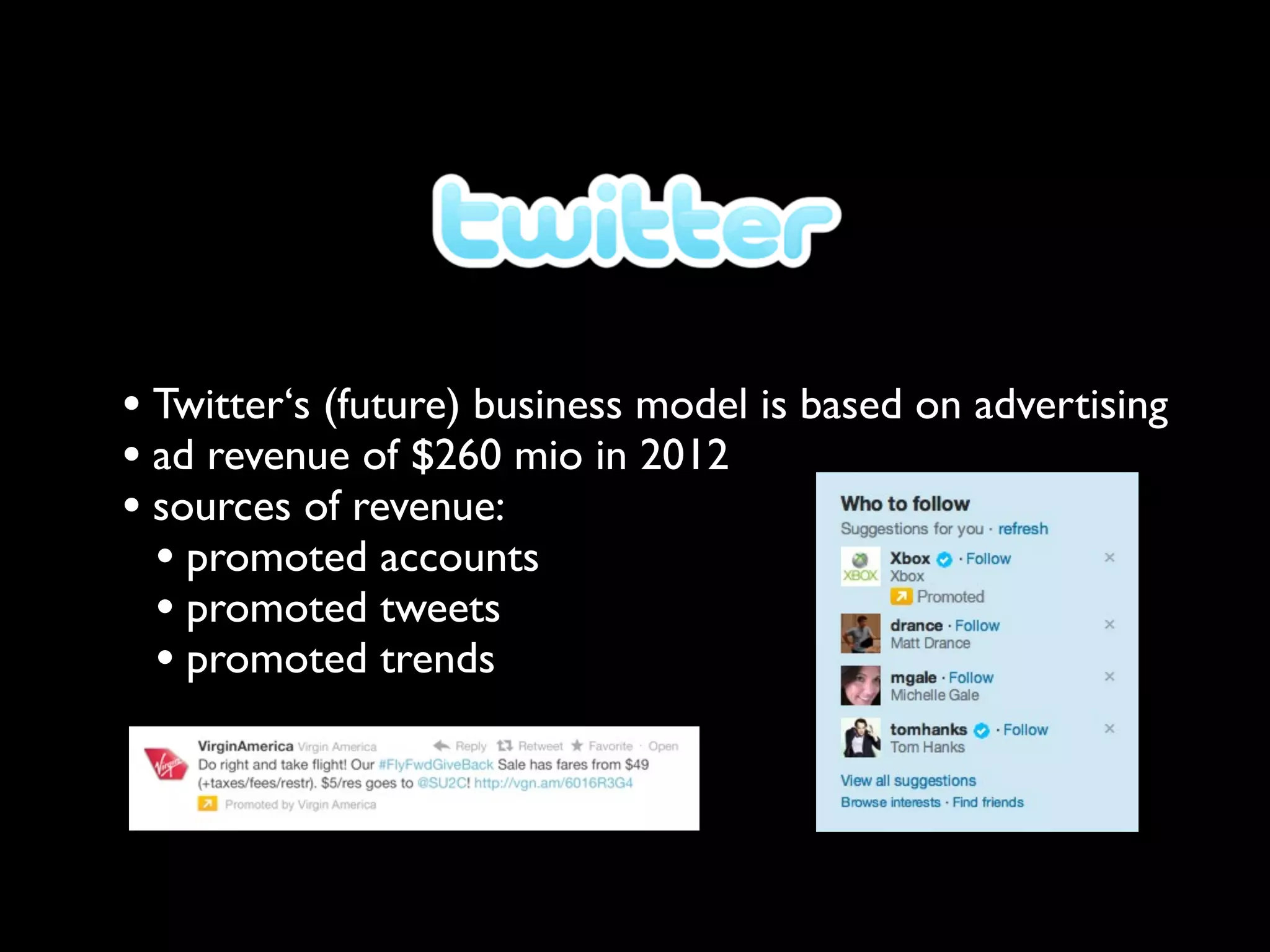
• Twitter‘s (future) business model is based on advertising
• ad revenue of $260 mio in 2012
• sources of revenue:
  • promoted accounts
  • promoted tweets
  • promoted trends
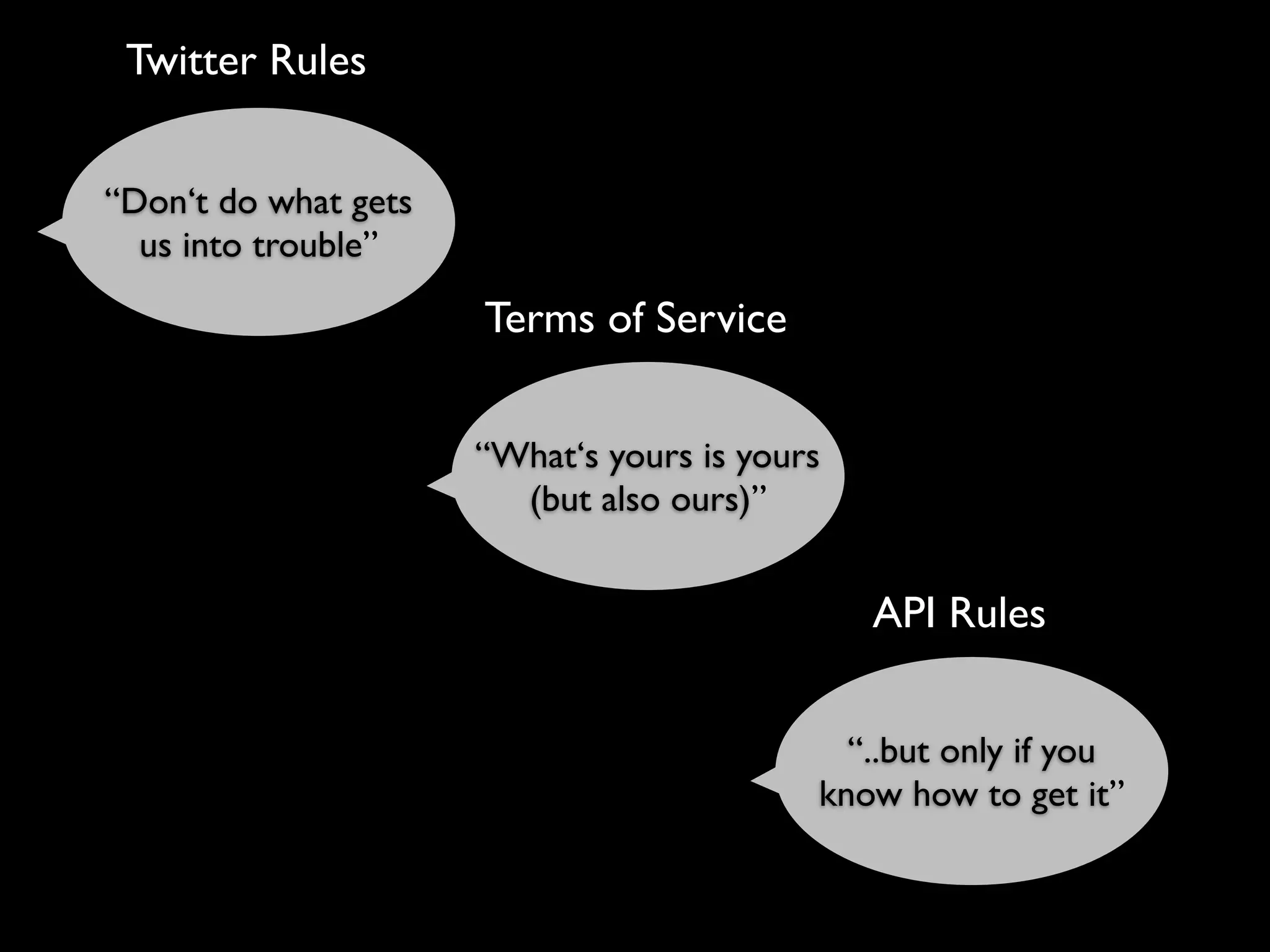
Twitter Rules


“Don‘t do what gets
  us into trouble”

                      Terms of Service


                      “What‘s yours is yours
                        (but also ours)”


                                               API Rules


                                             “..but only if you
                                           know how to get it”
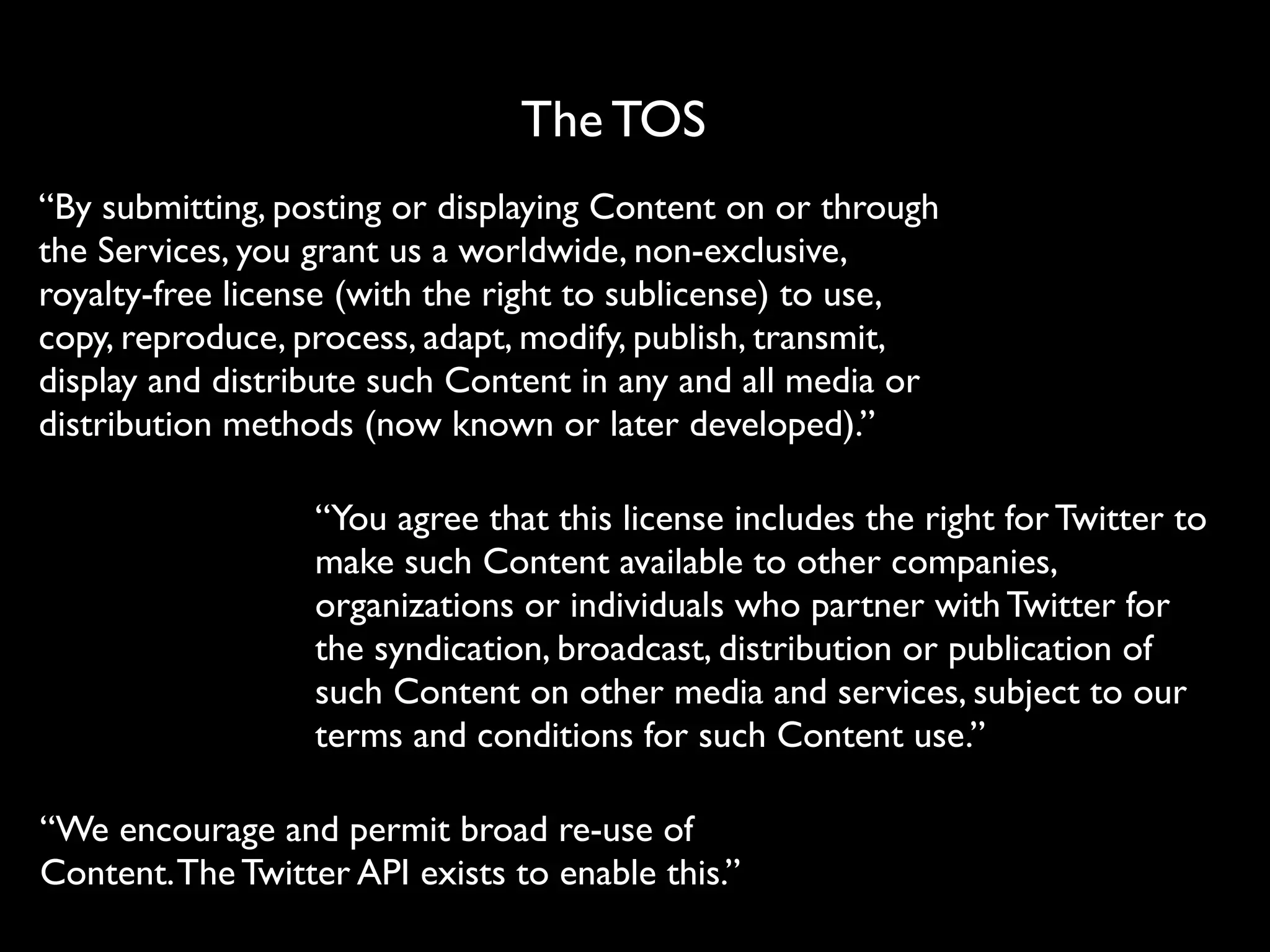
The TOS
“By submitting, posting or displaying Content on or through
the Services, you grant us a worldwide, non-exclusive,
royalty-free license (with the right to sublicense) to use,
copy, reproduce, process, adapt, modify, publish, transmit,
display and distribute such Content in any and all media or
distribution methods (now known or later developed).”

                  “You agree that this license includes the right for Twitter to
                  make such Content available to other companies,
                  organizations or individuals who partner with Twitter for
                  the syndication, broadcast, distribution or publication of
                  such Content on other media and services, subject to our
                  terms and conditions for such Content use.”

“We encourage and permit broad re-use of
Content. The Twitter API exists to enable this.”
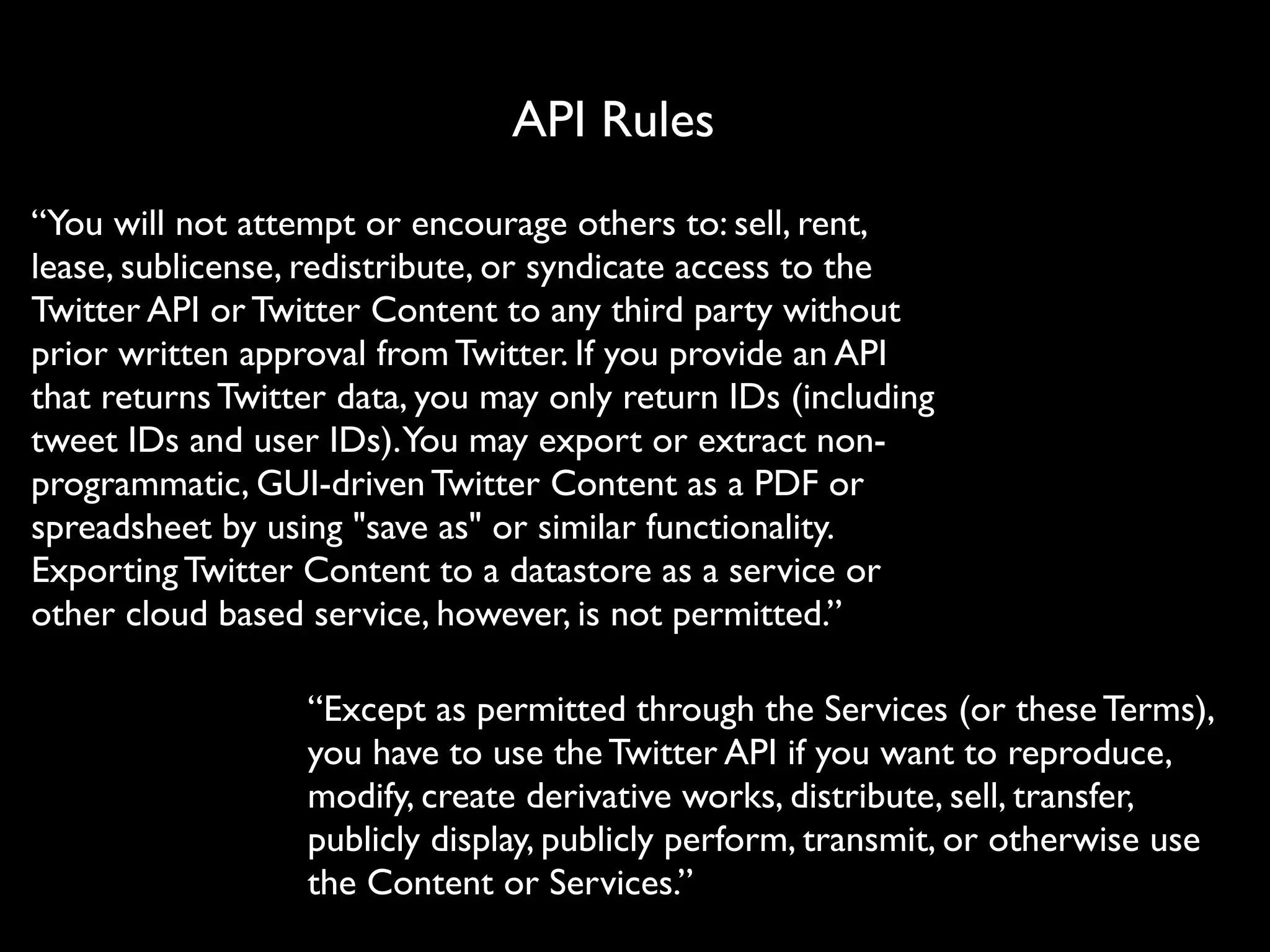
API Rules
“You will not attempt or encourage others to: sell, rent,
lease, sublicense, redistribute, or syndicate access to the
Twitter API or Twitter Content to any third party without
prior written approval from Twitter. If you provide an API
that returns Twitter data, you may only return IDs (including
tweet IDs and user IDs).You may export or extract non-
programmatic, GUI-driven Twitter Content as a PDF or
spreadsheet by using "save as" or similar functionality.
Exporting Twitter Content to a datastore as a service or
other cloud based service, however, is not permitted.”

                  “Except as permitted through the Services (or these Terms),
                  you have to use the Twitter API if you want to reproduce,
                  modify, create derivative works, distribute, sell, transfer,
                  publicly display, publicly perform, transmit, or otherwise use
                  the Content or Services.”
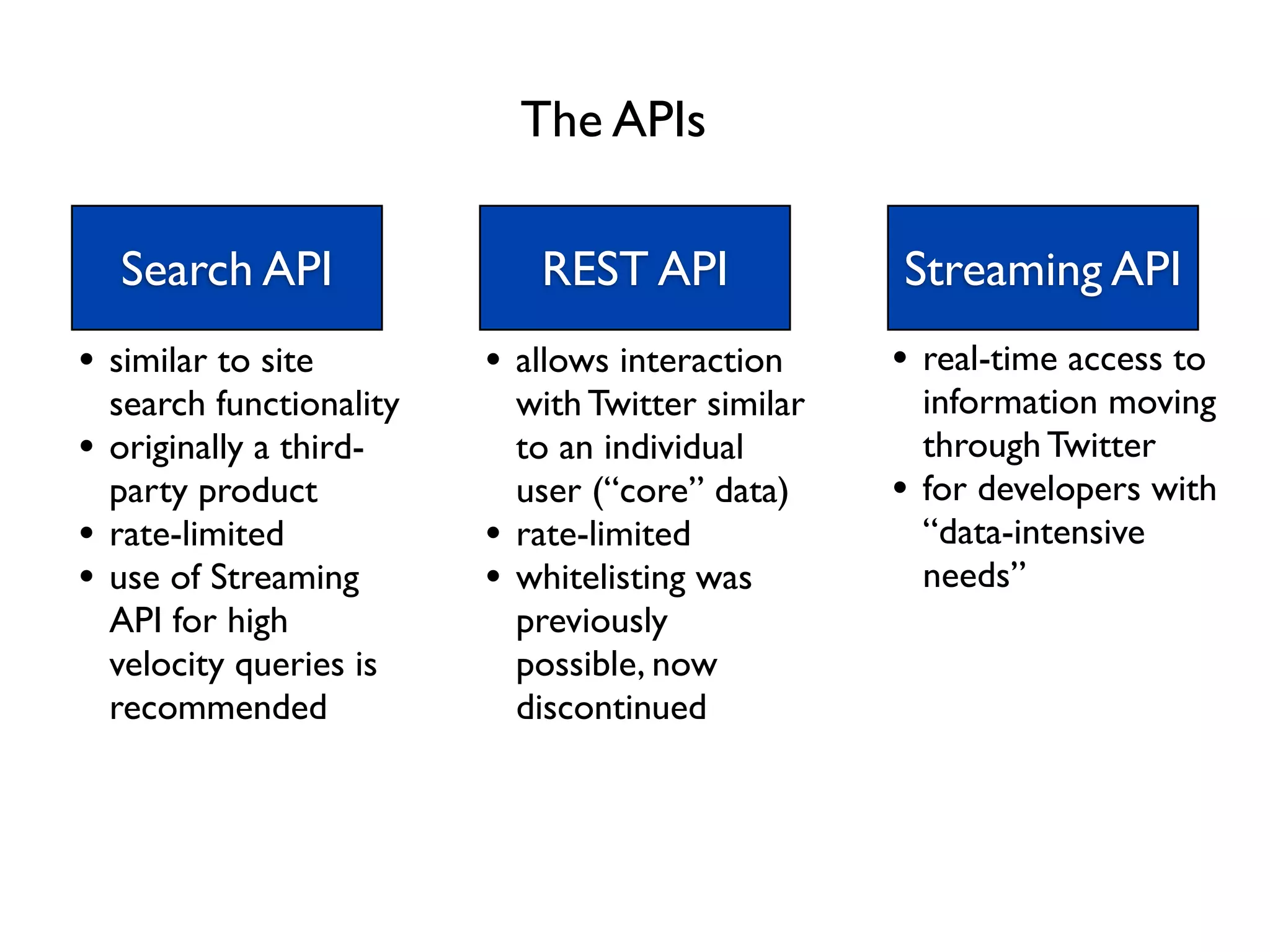
The APIs

    Search API                  REST API              Streaming API
• similar to site          • allows interaction       • real-time access to
    search functionality       with Twitter similar       information moving
•   originally a third-        to an individual           through Twitter
    party product              user (“core” data)     •   for developers with
•   rate-limited           •   rate-limited               “data-intensive
•   use of Streaming       •   whitelisting was           needs”
    API for high               previously
    velocity queries is        possible, now
    recommended                discontinued
Intermediaries of Data

• Twitter doesn‘t look to analytics as a source of revenue
• providing data is costly in terms of computing resources
• analytics are left to companies like Gnip and Datasift
• these data resellers have little to gain by catering to the
 scientific community or Twitter‘s users
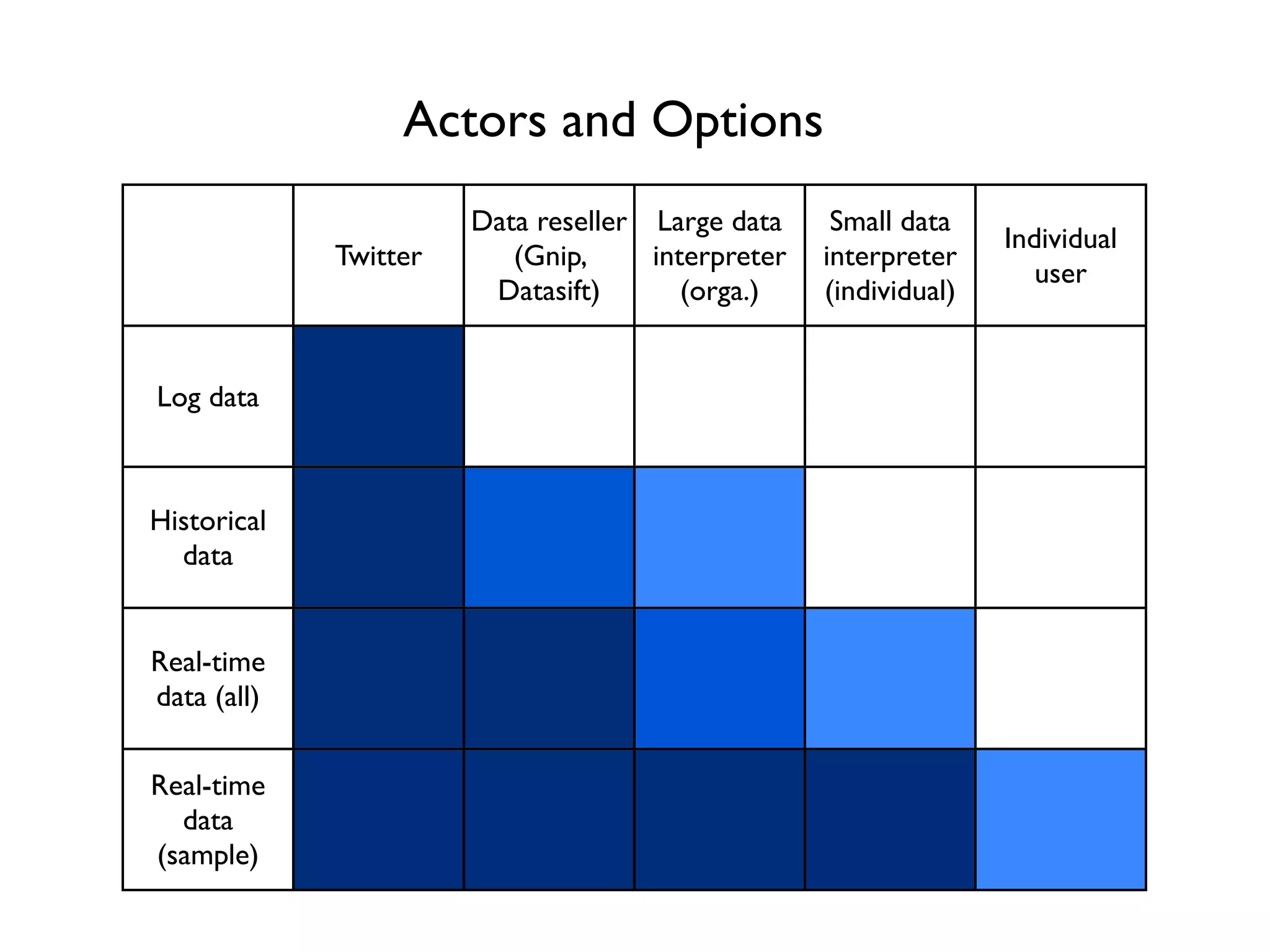
Actors and Options
                       Data reseller Large data     Small data
                                                                  Individual
             Twitter      (Gnip,     interpreter   interpreter
                                                                     user
                        Datasift)       (orga.)    (individual)


Log data


Historical
  data


Real-time
data (all)

Real-time
  data
(sample)
Conclusions
• the exact sample size and quality of any data from
  Twitter is unknown (see e.g. Gnip‘s Power Track)
• TOS and API regulate access to Twitter data for
  different actors (users, researchers) on different
  levels (access, control, ownership, interpretation)
• for users, the API is the only point of access to
  “their” data apart from the web interface
• the implicit audience for virtually all services built on
  Twitter data are companies
• both users and scholars lacking access to high-
  performance computing infrastructure are likely to
  be sidelined by the trend towards Big Twitter Data
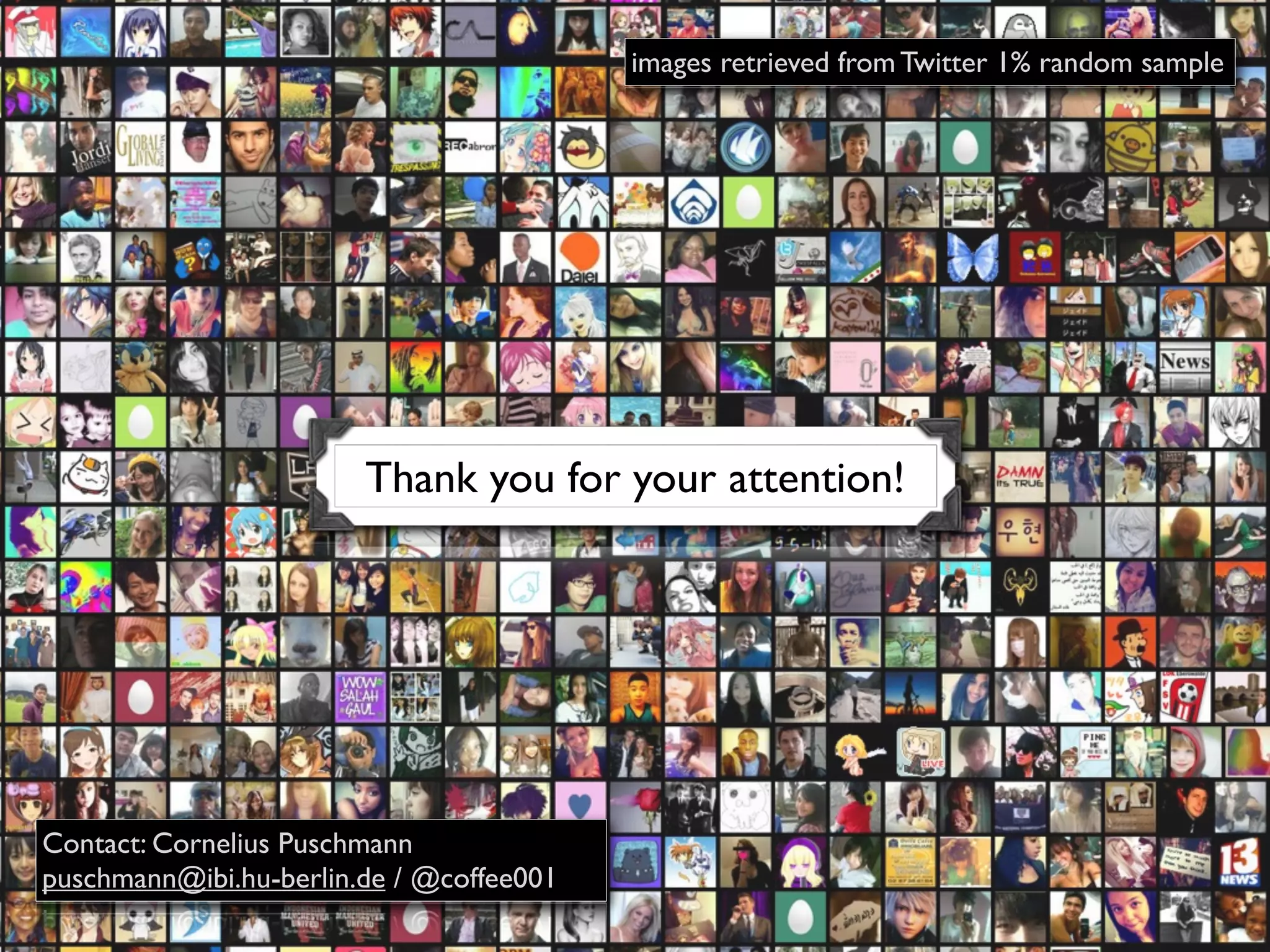
images retrieved from Twitter 1% random sample


                        Thank you for your attention!


Contact: Cornelius Puschmann
puschmann@ibi.hu-berlin.de / @coffee001

Data Access, Ownership and Control in Social Web Services: Issues for Twitter Research

  • 1.
    Cornelius Puschmann, Humboldt-Universitätzu Berlin Jean Burgess, Queensland University of Technology Axel Bruns, Queensland University of Technology Merja Mahrt, Heinrich-Heine-Universität Düsseldorf Data Access, Ownership and Control in Social Web Services: Issues for Twitter Research ICA 2012 Track: Communication and Technology Session: Researching Social Media: Ethical and Methodological Challenges 26 May 2012, Phoenix
  • 2.
    “There are alsosignificant questions of truth, control, and power in Big Data studies: researchers have the tools and the access, while social media users as a whole do not. Their data were created in highly context-sensitive spaces, and it is entirely possible that some users would not give permission for their data to be used elsewhere.” (boyd & Crawford, 2012, p.12)
  • 3.
    #1 Access, control, ownershipand interpretation of data are interrelated facets that raise questions of power. #2 Market, legislation, social norms and code are dynamic regulatory forces in social web platforms.
  • 4.
    Access (technology) Control (ability) TOS API “law” defines Data enables “code” Ownership (law) Interpretation (competence)
  • 5.
    • founded in2006 by Jack Dorsey • 140 mio active users • 340 mio tweets per day • source of real-time information on a breadth of issues from pop culture to politics • increasingly used as a data source among researchers (e.g. on election prediction via Twitter: Tumasjan et al, 2010, Jungherr et al, 2011, Gayo-Avello, 2012)
  • 6.
    • Twitter‘s (future)business model is based on advertising • ad revenue of $260 mio in 2012 • sources of revenue: • promoted accounts • promoted tweets • promoted trends
  • 7.
    Twitter Rules “Don‘t dowhat gets us into trouble” Terms of Service “What‘s yours is yours (but also ours)” API Rules “..but only if you know how to get it”
  • 8.
    The TOS “By submitting,posting or displaying Content on or through the Services, you grant us a worldwide, non-exclusive, royalty-free license (with the right to sublicense) to use, copy, reproduce, process, adapt, modify, publish, transmit, display and distribute such Content in any and all media or distribution methods (now known or later developed).” “You agree that this license includes the right for Twitter to make such Content available to other companies, organizations or individuals who partner with Twitter for the syndication, broadcast, distribution or publication of such Content on other media and services, subject to our terms and conditions for such Content use.” “We encourage and permit broad re-use of Content. The Twitter API exists to enable this.”
  • 9.
    API Rules “You willnot attempt or encourage others to: sell, rent, lease, sublicense, redistribute, or syndicate access to the Twitter API or Twitter Content to any third party without prior written approval from Twitter. If you provide an API that returns Twitter data, you may only return IDs (including tweet IDs and user IDs).You may export or extract non- programmatic, GUI-driven Twitter Content as a PDF or spreadsheet by using "save as" or similar functionality. Exporting Twitter Content to a datastore as a service or other cloud based service, however, is not permitted.” “Except as permitted through the Services (or these Terms), you have to use the Twitter API if you want to reproduce, modify, create derivative works, distribute, sell, transfer, publicly display, publicly perform, transmit, or otherwise use the Content or Services.”
  • 10.
    The APIs Search API REST API Streaming API • similar to site • allows interaction • real-time access to search functionality with Twitter similar information moving • originally a third- to an individual through Twitter party product user (“core” data) • for developers with • rate-limited • rate-limited “data-intensive • use of Streaming • whitelisting was needs” API for high previously velocity queries is possible, now recommended discontinued
  • 11.
    Intermediaries of Data •Twitter doesn‘t look to analytics as a source of revenue • providing data is costly in terms of computing resources • analytics are left to companies like Gnip and Datasift • these data resellers have little to gain by catering to the scientific community or Twitter‘s users
  • 12.
    Actors and Options Data reseller Large data Small data Individual Twitter (Gnip, interpreter interpreter user Datasift) (orga.) (individual) Log data Historical data Real-time data (all) Real-time data (sample)
  • 13.
    Conclusions • the exactsample size and quality of any data from Twitter is unknown (see e.g. Gnip‘s Power Track) • TOS and API regulate access to Twitter data for different actors (users, researchers) on different levels (access, control, ownership, interpretation) • for users, the API is the only point of access to “their” data apart from the web interface • the implicit audience for virtually all services built on Twitter data are companies • both users and scholars lacking access to high- performance computing infrastructure are likely to be sidelined by the trend towards Big Twitter Data
  • 14.
    images retrieved fromTwitter 1% random sample Thank you for your attention! Contact: Cornelius Puschmann puschmann@ibi.hu-berlin.de / @coffee001