The Pragmatics of Retweeting
A case study of academic uses of Twitter

          Dr. Cornelius Puschmann
        Humboldt-Universität zu Berlin


           Augsburg, 20.04.2012
This Talk


1. Citing and quoting across genres and media
  • How is the discourse of others reproduced?
  • What linguistic problems arise when discourse is reproduced?
  • How do genre and medium influence quoting?

2. From retweeting to quoting?             3. Theoretical implications
   • Quoting in asynchronous CMC           for CMC research
   • Form and function of retweets
   • Corpus data
   • Quoting vs. retweeting
How is the discourse of others reproduced?


•   “The relationship to another‘s words was equally complex
    and ambiguous in the Middle Ages... the boundary lines
    between someone else‘s speech and one‘s own speech
    were flexible, ambiguous, often deliberately distorted and
    confusing.“ (Bakhtin 1981, p. 69, from Moore 2011)

•   “[..] reported speech is a crucial linguistic and stylistic
    problem.“ (Jakobson 1971, p. 130, from Moore 2011)

❖ reproducing the discourse of others is a linguistically and
    technologically complex process
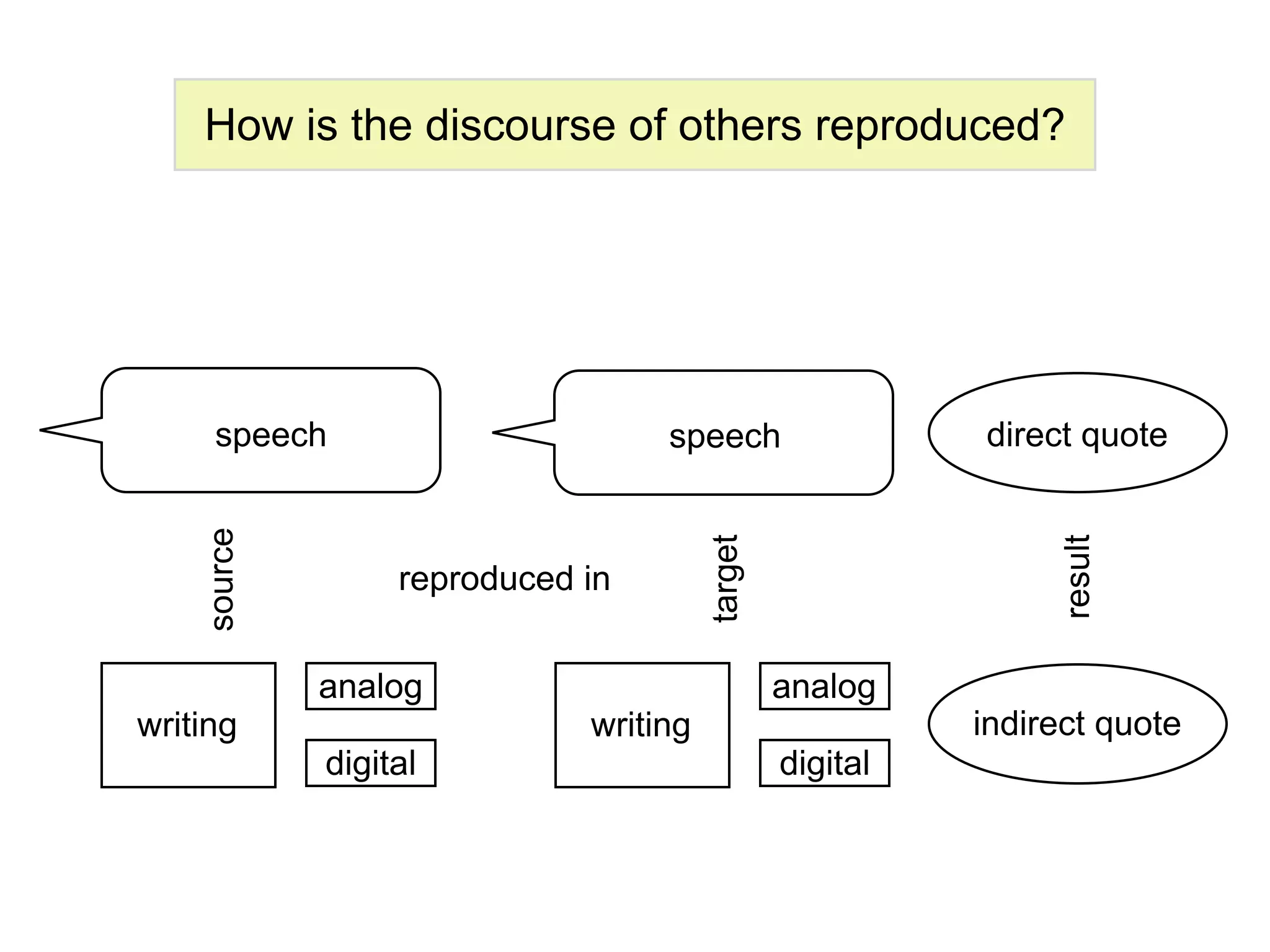
How is the discourse of others reproduced?


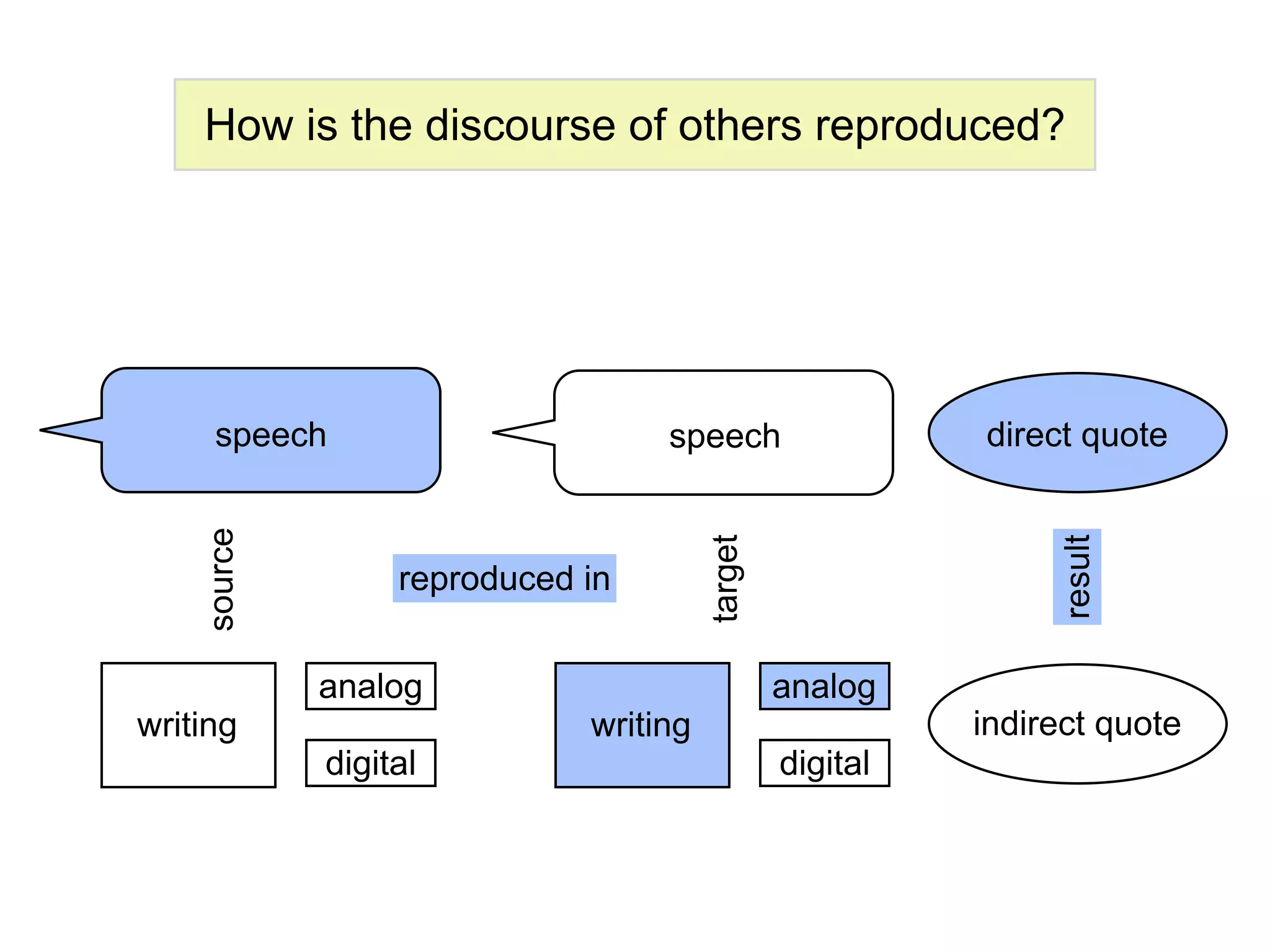
      speech                      speech                  direct quote
    source


                                       target


                                                               result
                  reproduced in


             analog                             analog
writing                      writing                      indirect quote
             digital                            digital
How is the discourse of others reproduced?


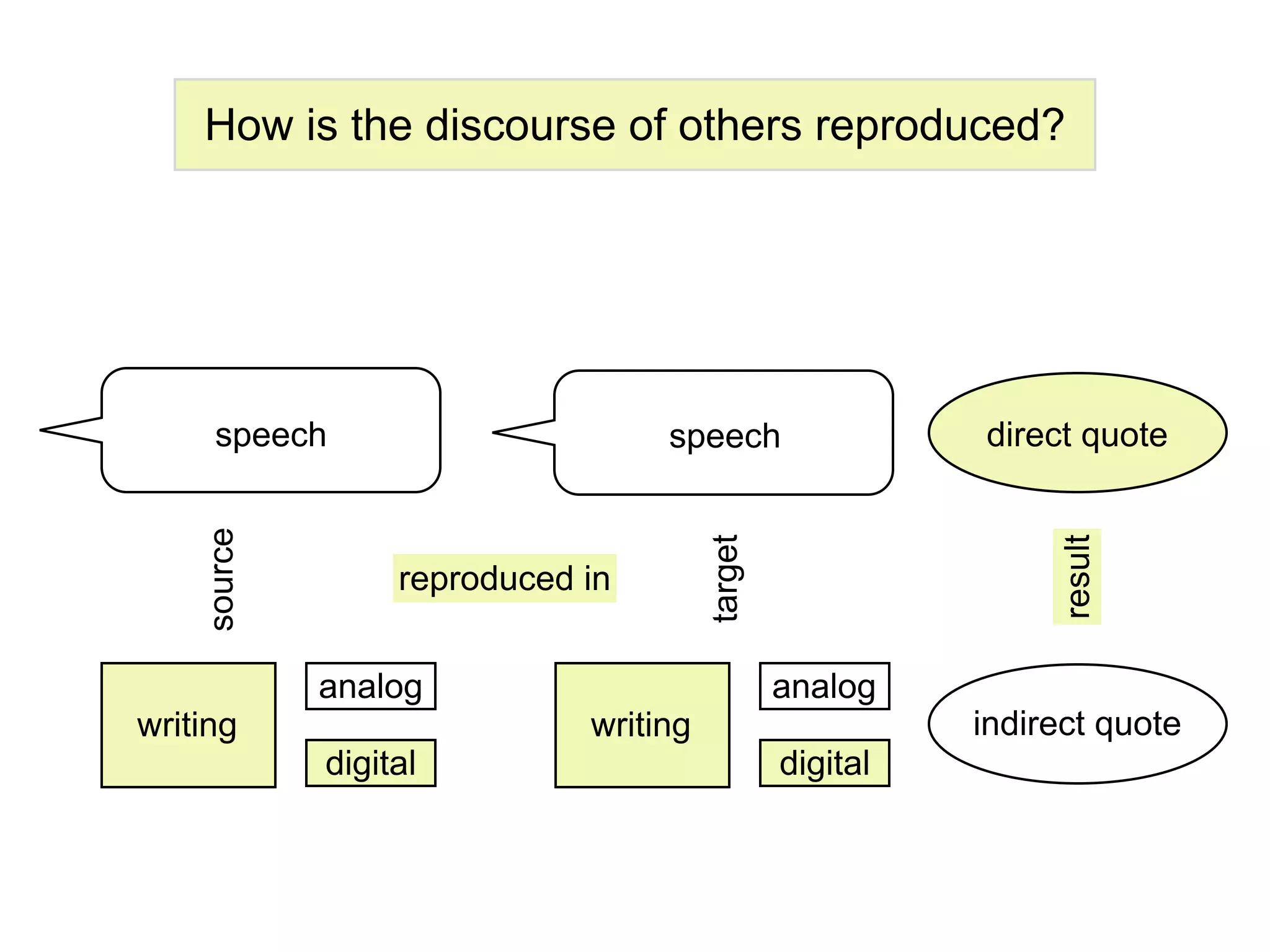
      speech                      speech                  direct quote
    source


                                       target


                                                               result
                  reproduced in


             analog                             analog
writing                      writing                      indirect quote
             digital                            digital
How is the discourse of others reproduced?


      speech                      speech                  direct quote
    source


                                       target


                                                               result
                  reproduced in


             analog                             analog
writing                      writing                      indirect quote
             digital                            digital
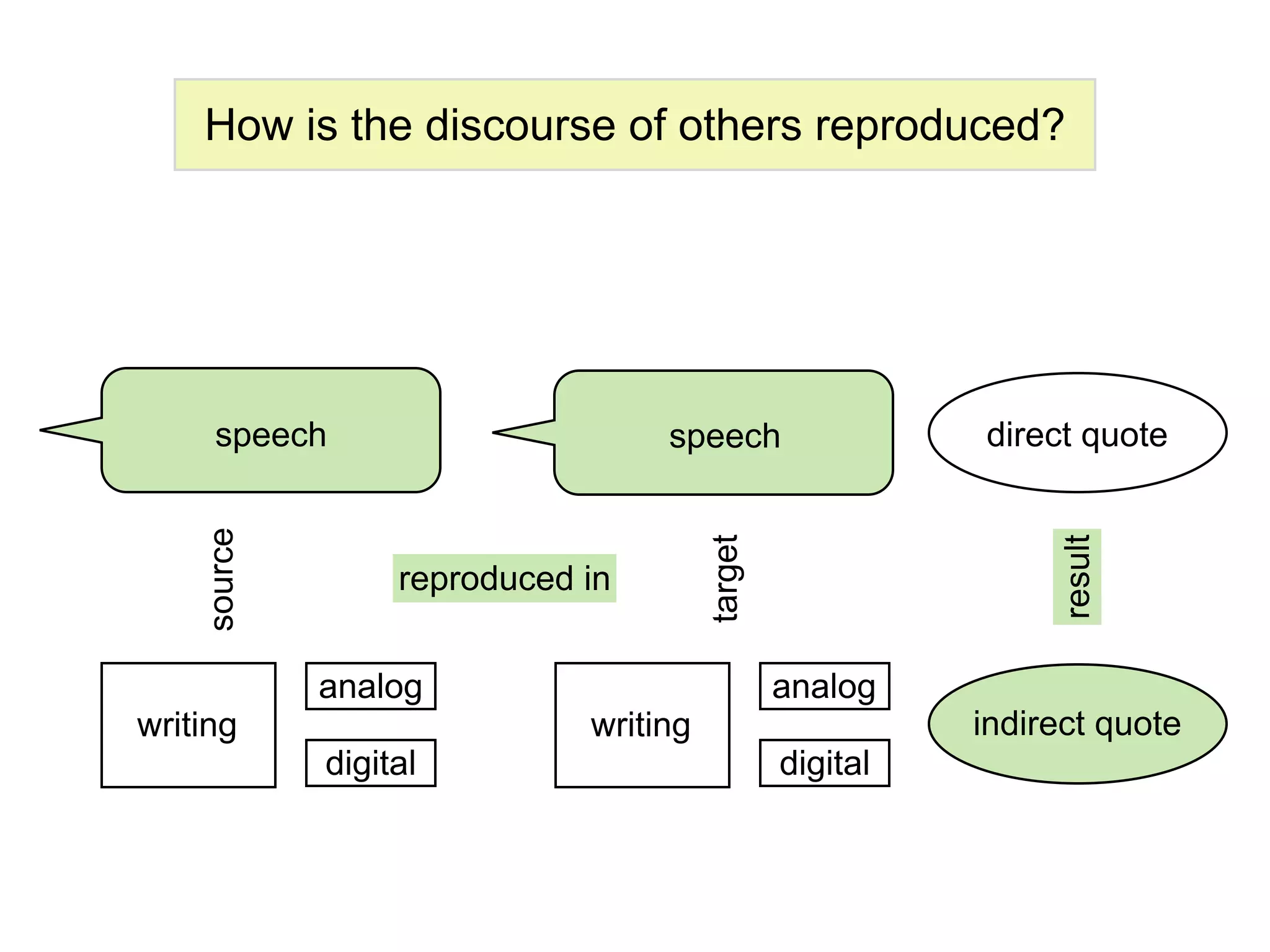
How is the discourse of others reproduced?


      speech                      speech                  direct quote
    source


                                       target


                                                               result
                  reproduced in


             analog                             analog
writing                      writing                      indirect quote
             digital                            digital
How is the discourse of others reproduced?


•   Quotatives to mark direct quotation in English:

    •   spoken: reporting verbs, be like X, be all X

    •   written: quotation marks, italics, indention, color

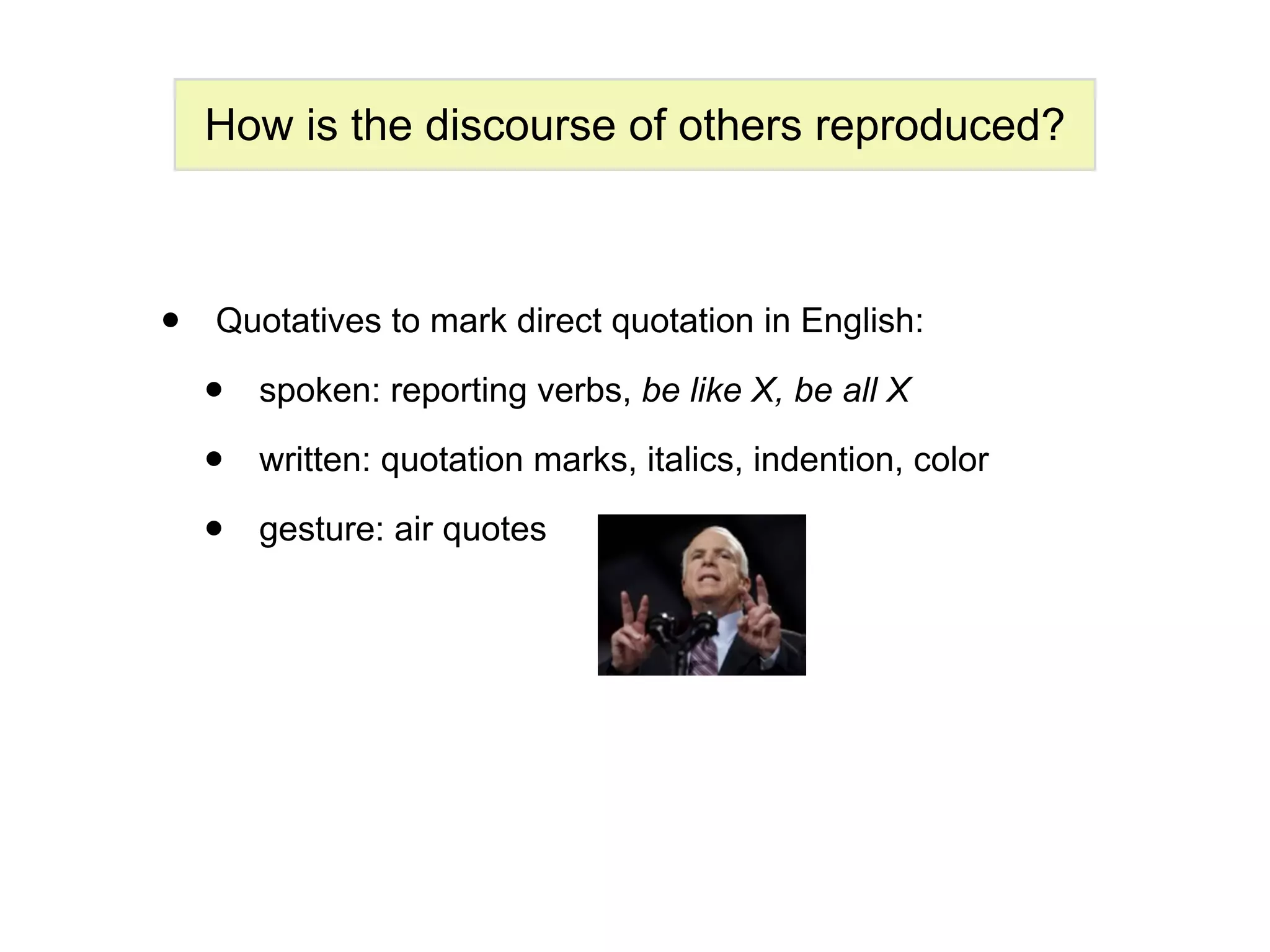
    •   gesture: air quotes
How is the discourse of others reproduced?

      direct quotation              indirect quotation
Mary said “I love you“.      Mary said [that] she loves[/loved]
                             me.

encoding of two different    harmonization of origo leads to
origos requires an           shift in
unambiguous marker           • tense
(e.g. say + quotation marks) • person
                             • pronouns
                             • spatial/temporal expressions
                             addition of (optional)
                             • complementizer
often assumed to be exact    assumed to be approximate
(+form +meaning)             (-form +meaning)
❖ use of indirect quotation over direct quotation depends on
the available technological means
How do genre and medium influence quoting?


•   Quoting in journalism:

    •   "Quotes should be faithful to the words and meaning of
        the speaker." (Clark 1995, para 1)

•   Quoting in academia:

    •   "Ethics, copyright laws, and courtesy to readers require
        authors to identify the sources of direct quotations and of
        any facts or opinions not generally known or easily
        checked." (Chicago Manual of Style, 15th edition, p. 594)

    •   "Whenever you quote or base your ideas on another
        person's work, you must document the source you
        used." (Online Citation Guide, U of California, Berkeley)
Quoting in asynchronous CMC


•   The advent of the computer has changed the practice of
    quoting and citing considerably, introducing:

    •   “copy and paste“

    •   hyperlinking

    •   interface actions for sharing content such as liking on
        Facebook, reblogging on Tumblr, retweeting on Twitter,
        etc
Quoting in asynchronous CMC


janed@ABC.bigtel.com (Jane Doe) writes:
>I can't believe how horrible Natalie looks. Has
>she put on a lot of weight?
I agree, but she has always had a somewhat round face, so if
she did put on weight, I think that would be accentuated.

"For the receiver, quoting serves to situate the response in a
discourse context [..] and thus facilitates the perception of an
extended conversation as coherent. For the sender, it
facilitates composition by allowing direct response without
having to paraphrase the original message." (Eklundh 2010,
para 3)
Quoting in asynchronous CMC


janed@ABC.bigtel.com (Jane Doe) writes:
>I can't believe how horrible Natalie looks. Has
>she put on a lot of weight?
I agree, but she has always had a somewhat round face, so if
she did put on weight, I think that would be accentuated.

"Quoting creates the illusion of adjacency in that it
incorporates and juxtaposes (portions of) two turns [..] within a
single message. When portions of previous text are
repeatedly quoted and responded to, the resulting message
can have the appearance of an extended conversational
exchange" (Herring 1999, p. 8)
Quoting in asynchronous CMC


   janed@ABC.bigtel.com (Jane Doe) writes:
   >I can't believe how horrible Natalie looks. Has
   >she put on a lot of weight?
   I agree, but she has always had a somewhat round face, so if
   she did put on weight, I think that would be accentuated.

   "Quoting creates the illusion of adjacency in that it
   incorporates and juxtaposes (portions of) two turns [..] within a
   single message. When portions of previous text are
   repeatedly quoted and responded to, the resulting message
   can have the appearance of an extended conversational
   exchange" (Herring 1999, p. 8)

❖ direct quoting in CMC creates the illusion of immediacy
Twitter


•   Twitter is a microblogging service launched in 2006

•   short messages of up to 140 characters (tweets) are posted
    through the Twitter website and various clients via a
    computer or mobile phone

•   140 million users

•   340 million tweets produced each day

•   widespread use in news, entertainment, political discourse,
    activism
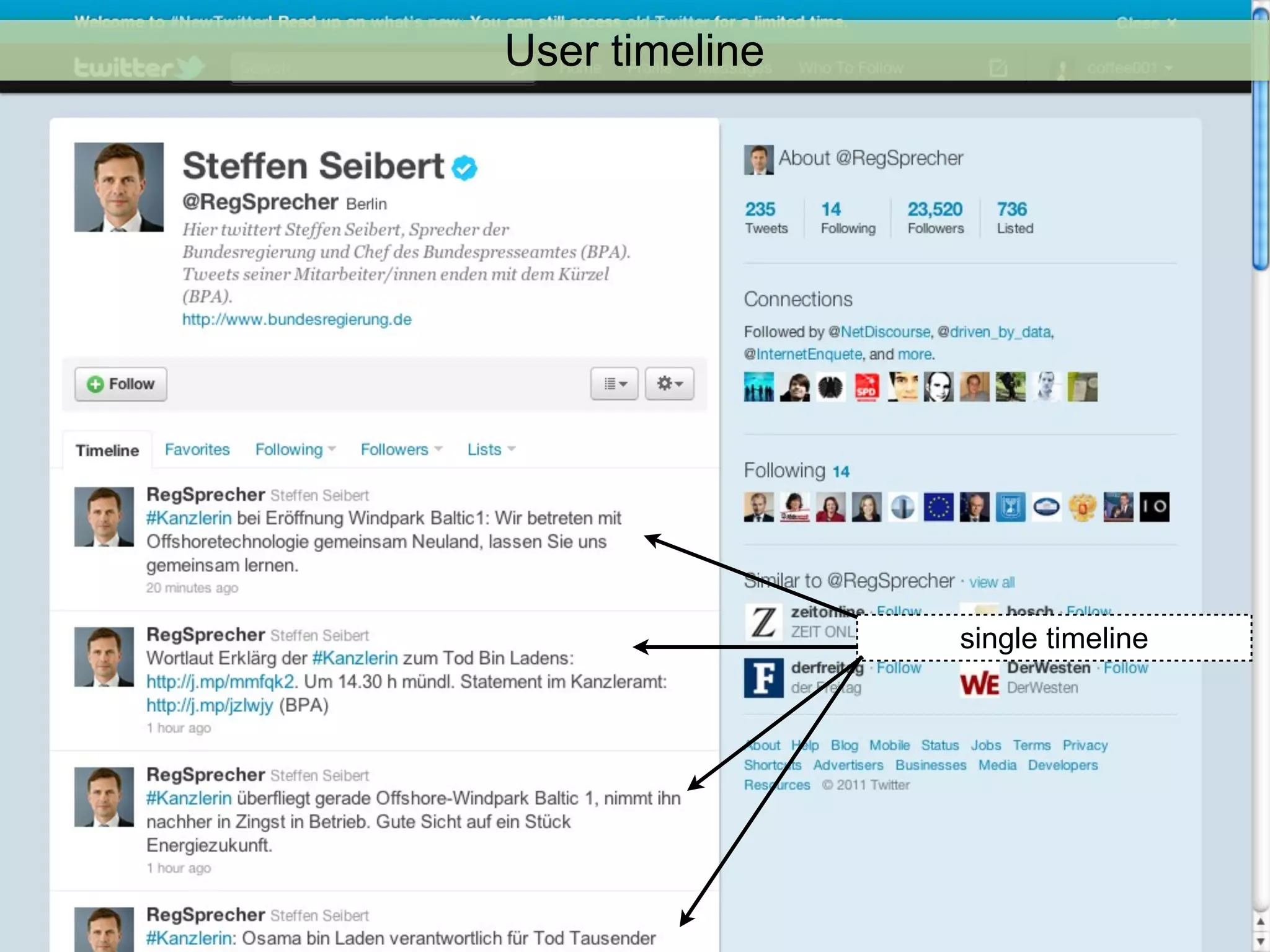
User timeline


                single timeline
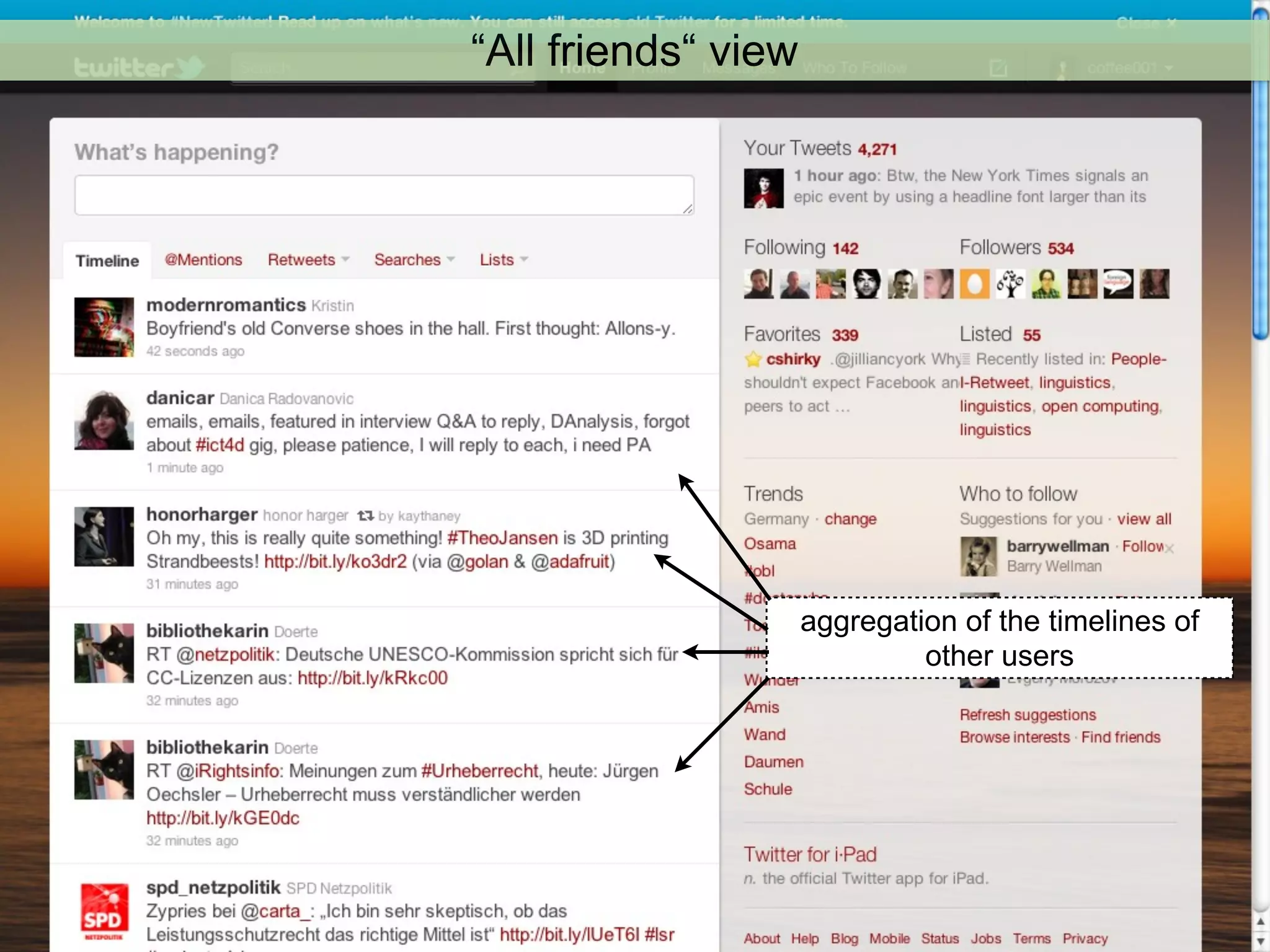
“All friends“ view


                     aggregation of the timelines of
                              other users
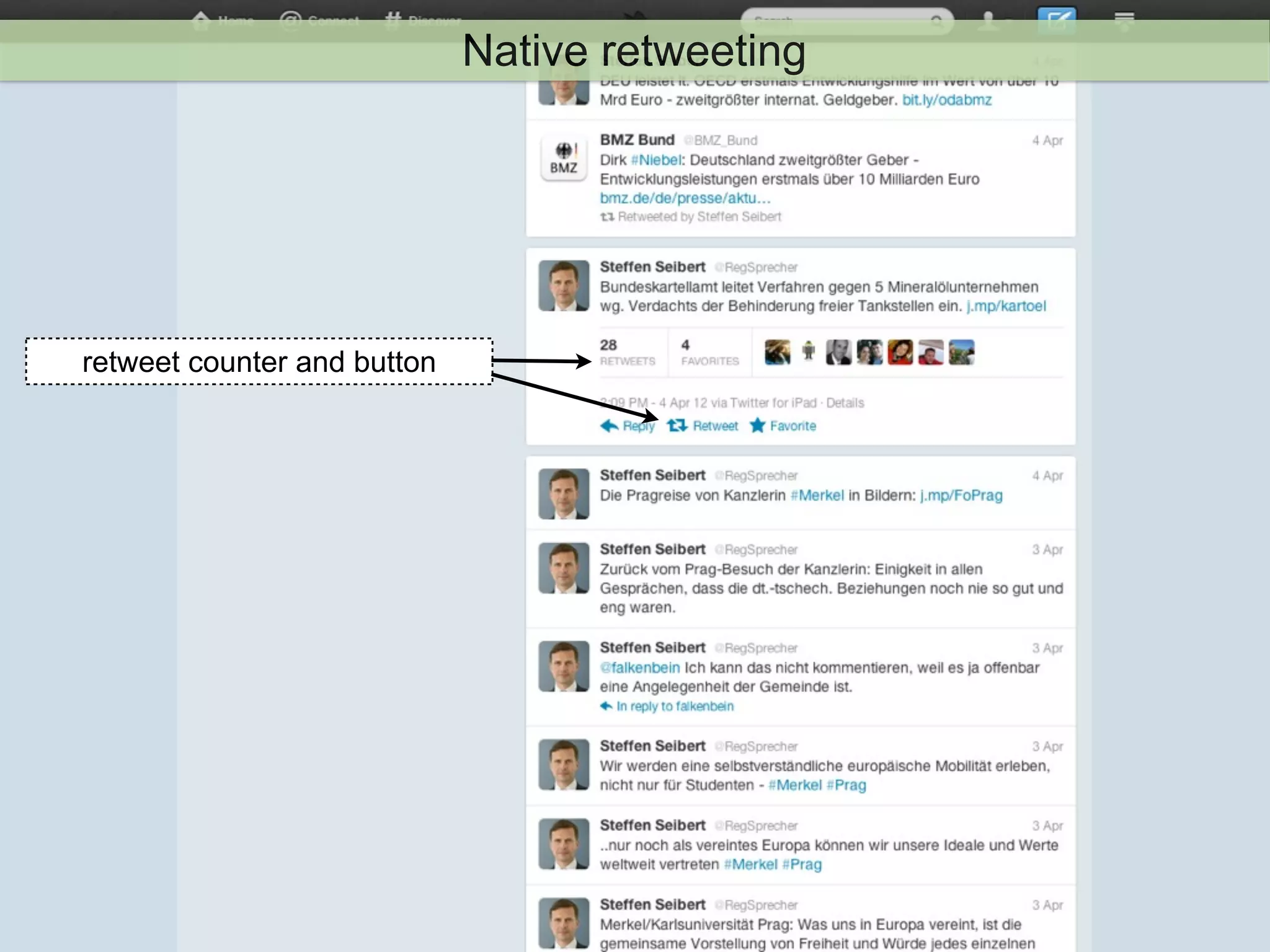
Native retweeting


retweet counter and button
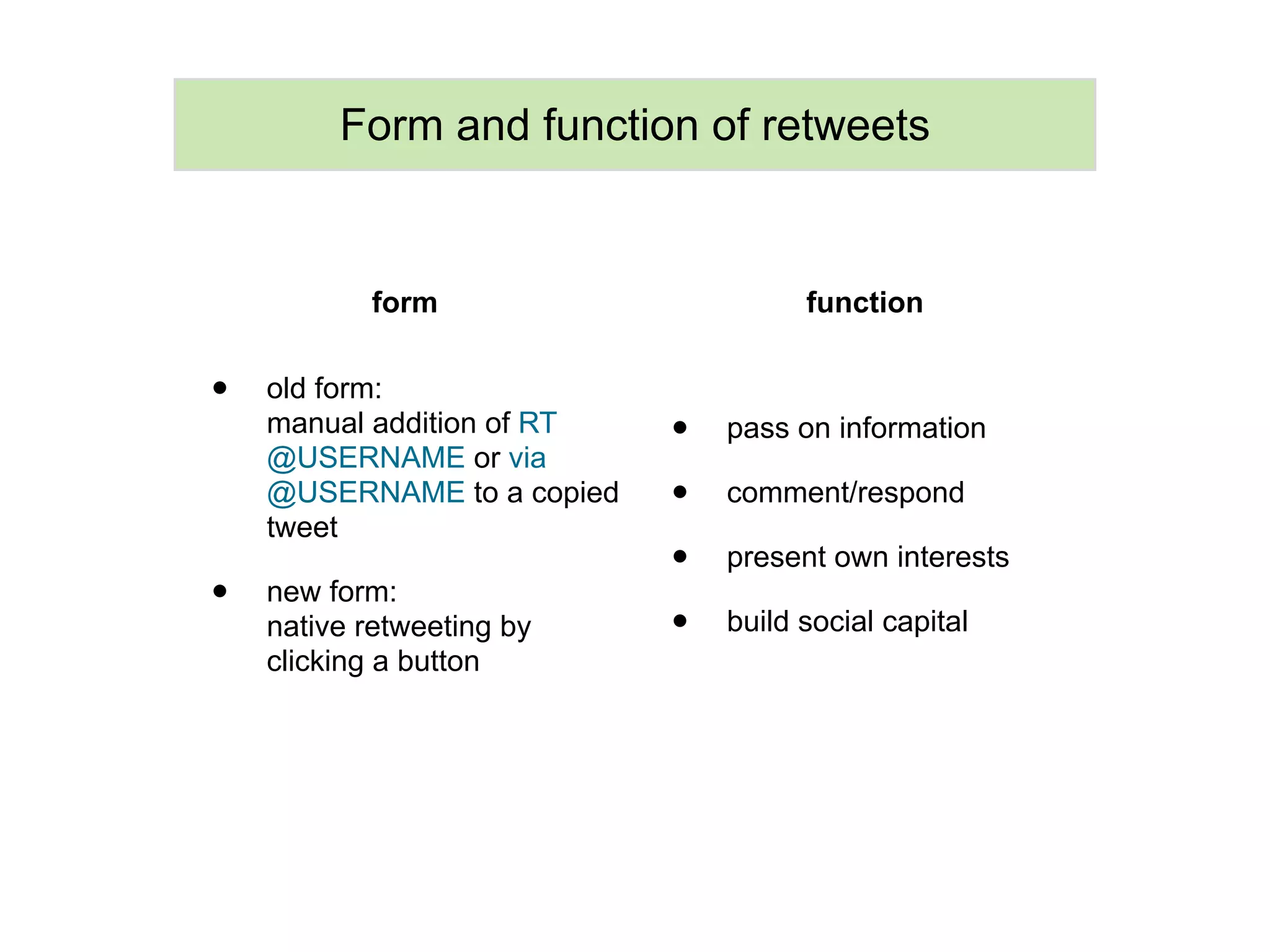
Form and function of retweets


           form                       function


•   old form:
    manual addition of RT
    @USERNAME or via
                            •   pass on information

    @USERNAME to a copied   •   comment/respond
    tweet
                            •   present own interests
•   new form:
    native retweeting by    •   build social capital
    clicking a button
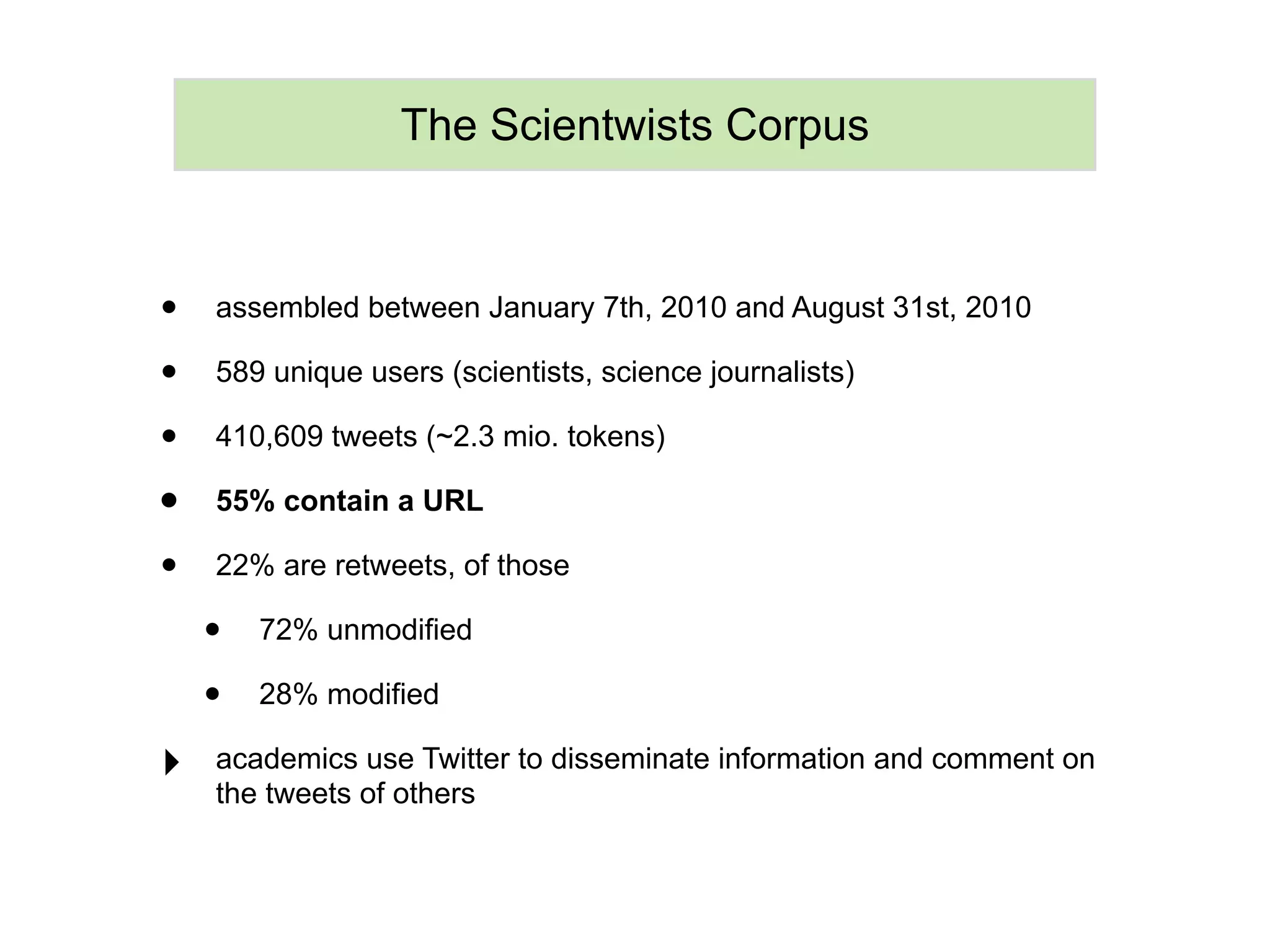
The Scientwists Corpus


•   assembled between January 7th, 2010 and August 31st, 2010

•   589 unique users (scientists, science journalists)

•   410,609 tweets (~2.3 mio. tokens)

•   55% contain a URL

•   22% are retweets, of those

    •   72% unmodified

    •   28% modified

‣   academics use Twitter to disseminate information and comment on
    the tweets of others
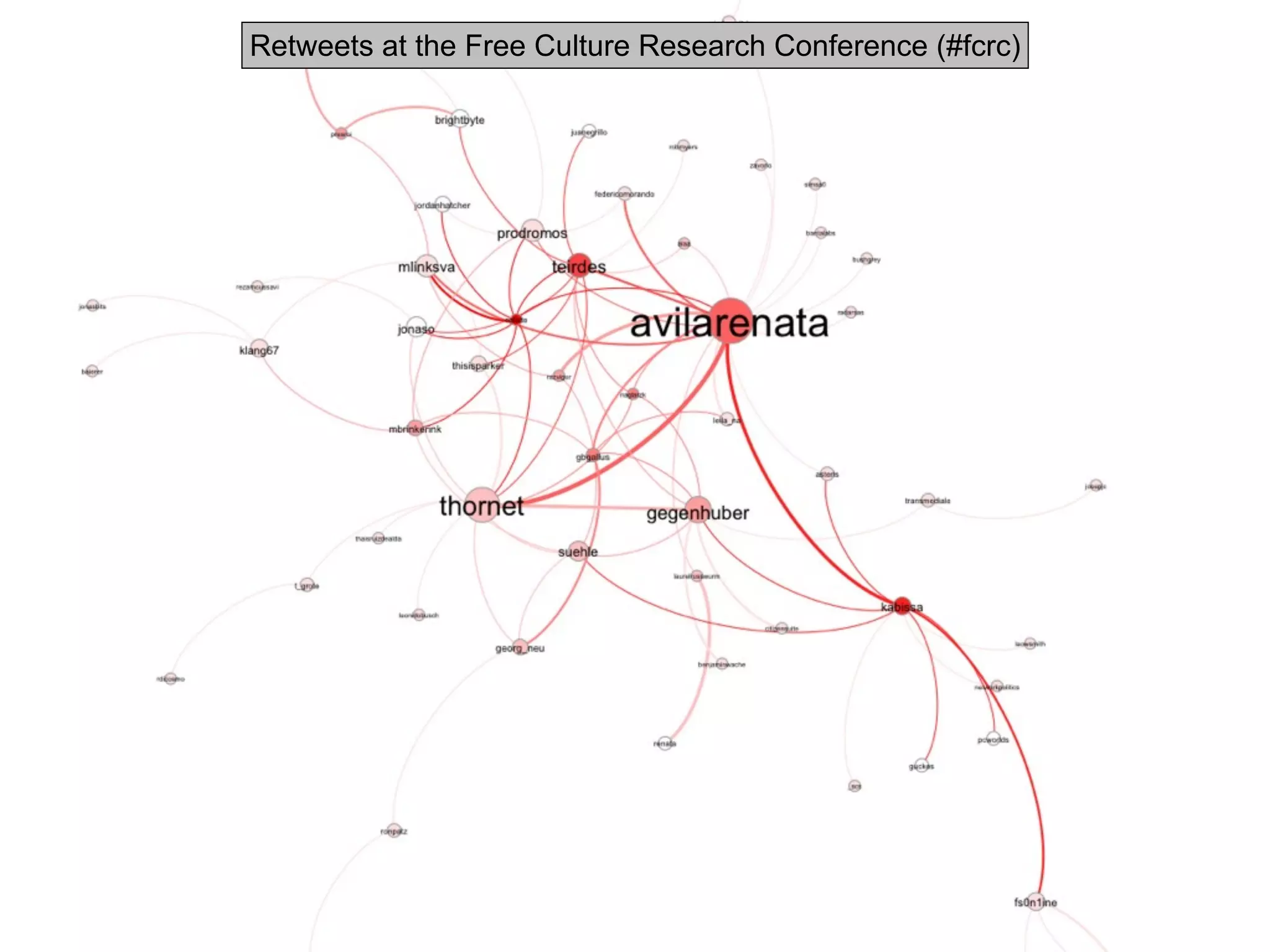
Retweets at the Free Culture Research Conference (#fcrc)
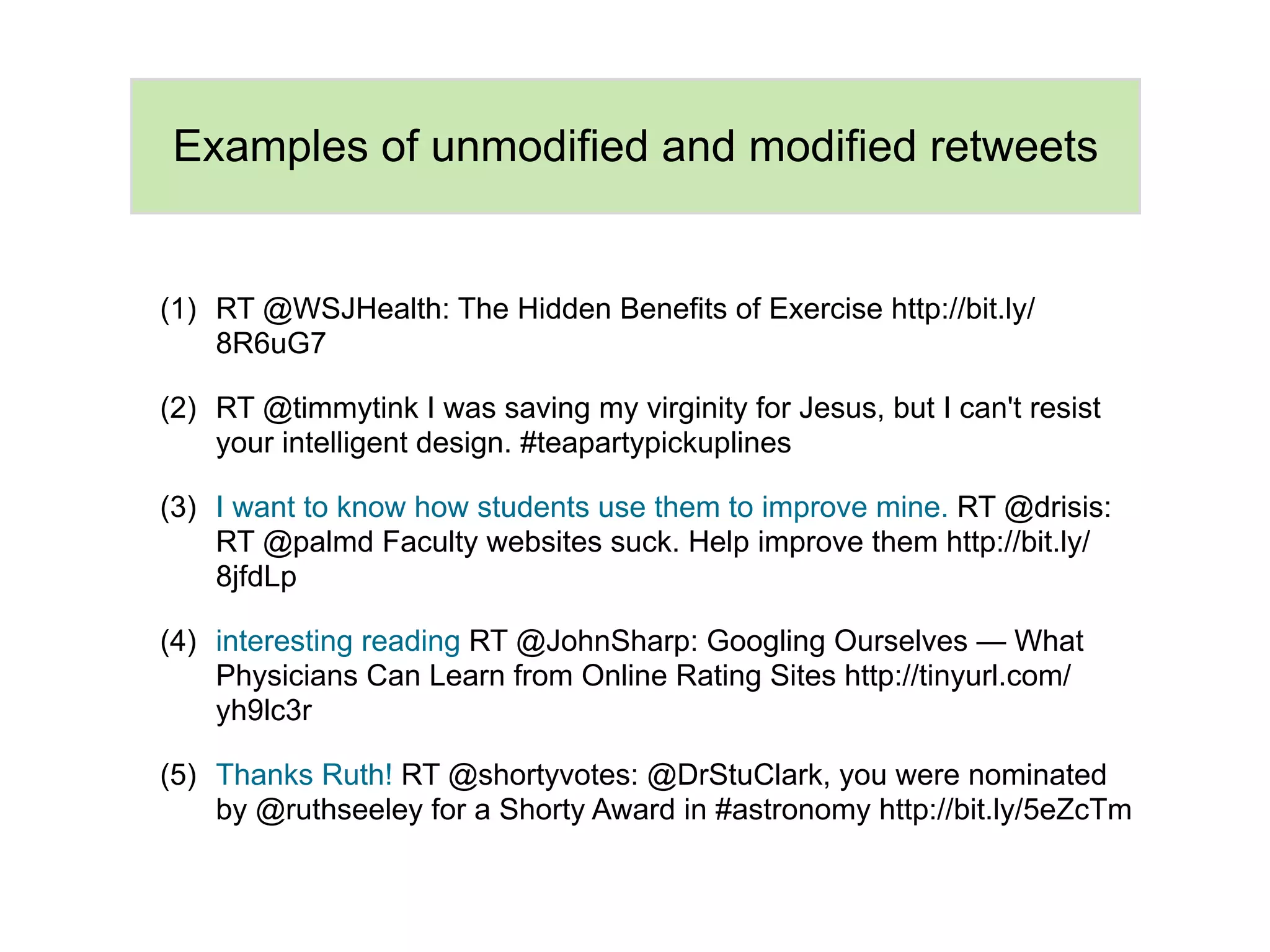
Examples of unmodified and modified retweets


(1) RT @WSJHealth: The Hidden Benefits of Exercise http://bit.ly/
    8R6uG7

(2) RT @timmytink I was saving my virginity for Jesus, but I can't resist
    your intelligent design. #teapartypickuplines

(3) I want to know how students use them to improve mine. RT @drisis:
    RT @palmd Faculty websites suck. Help improve them http://bit.ly/
    8jfdLp

(4) interesting reading RT @JohnSharp: Googling Ourselves — What
    Physicians Can Learn from Online Rating Sites http://tinyurl.com/
    yh9lc3r

(5) Thanks Ruth! RT @shortyvotes: @DrStuClark, you were nominated
    by @ruthseeley for a Shorty Award in #astronomy http://bit.ly/5eZcTm
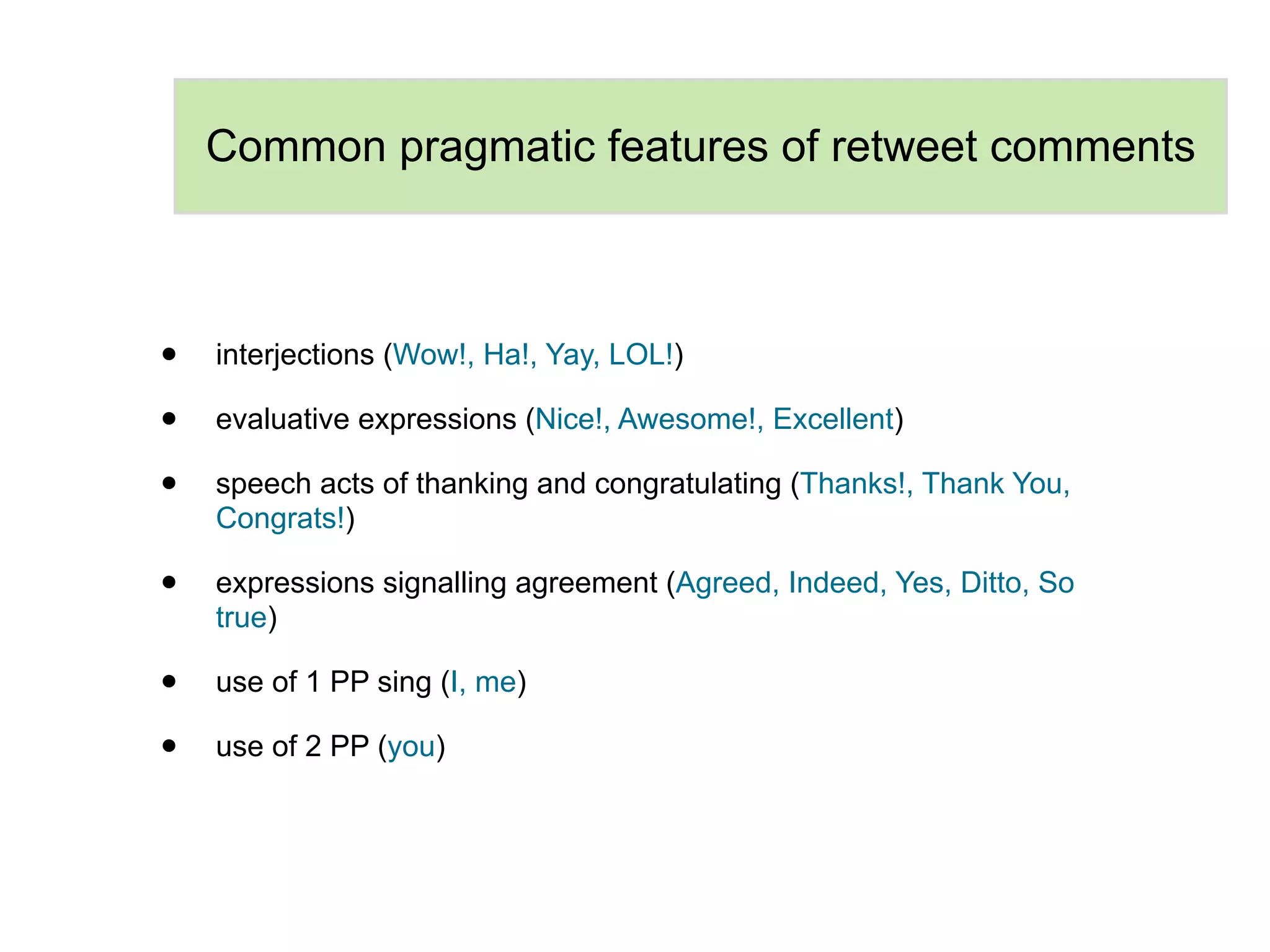
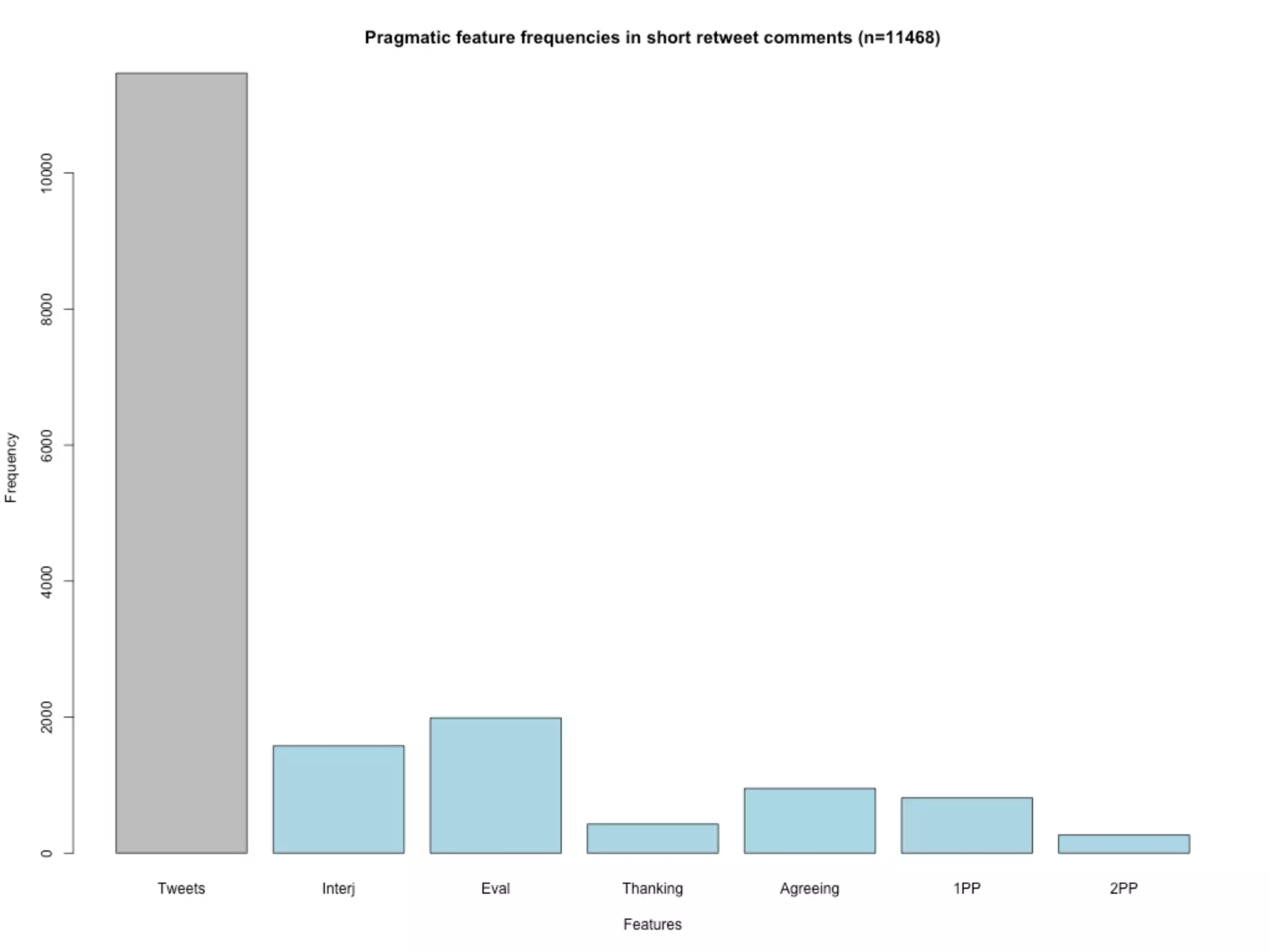
Common pragmatic features of retweet comments


•   interjections (Wow!, Ha!, Yay, LOL!)

•   evaluative expressions (Nice!, Awesome!, Excellent)

•   speech acts of thanking and congratulating (Thanks!, Thank You,
    Congrats!)

•   expressions signalling agreement (Agreed, Indeed, Yes, Ditto, So
    true)

•   use of 1 PP sing (I, me)

•   use of 2 PP (you)
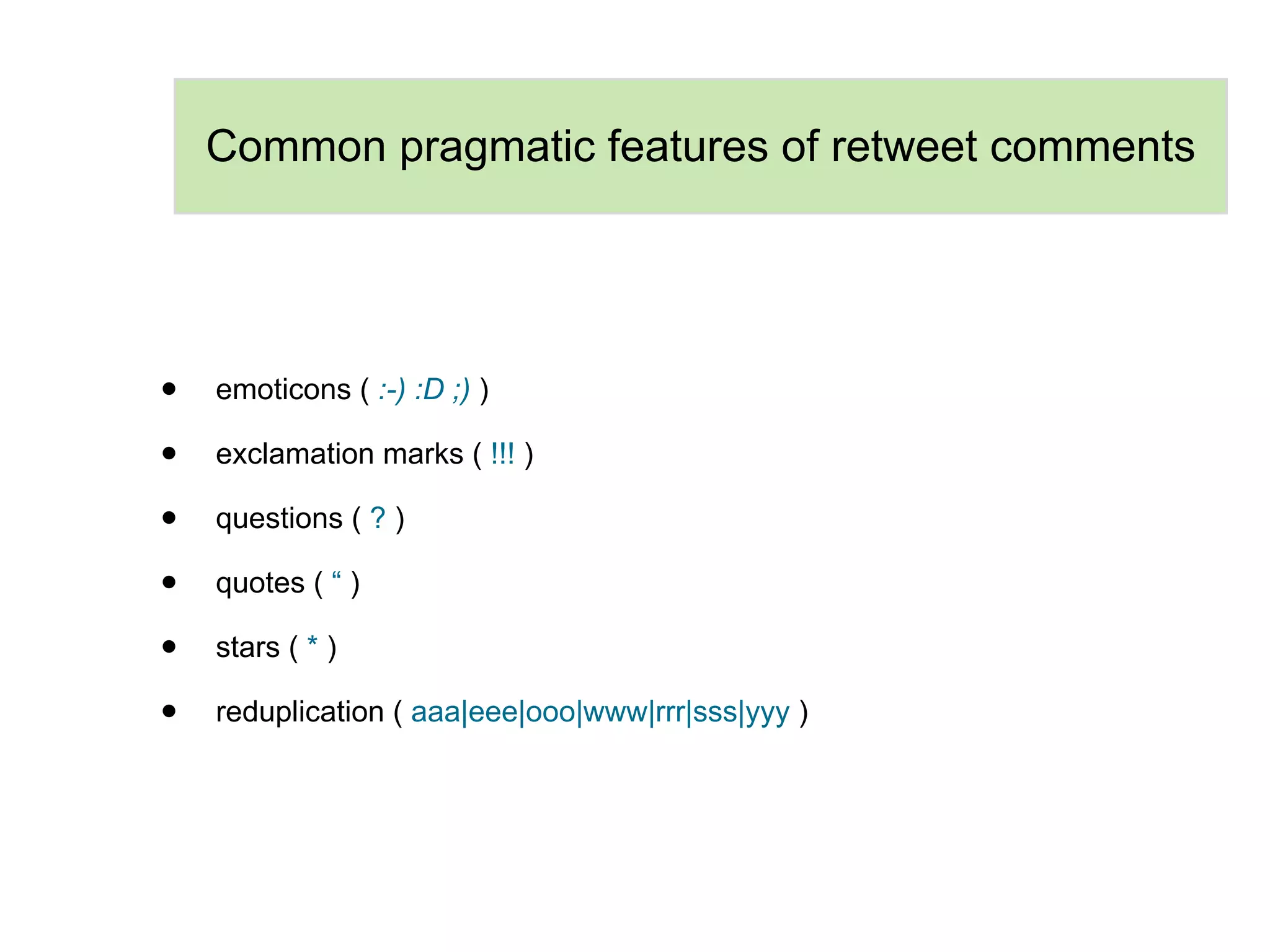
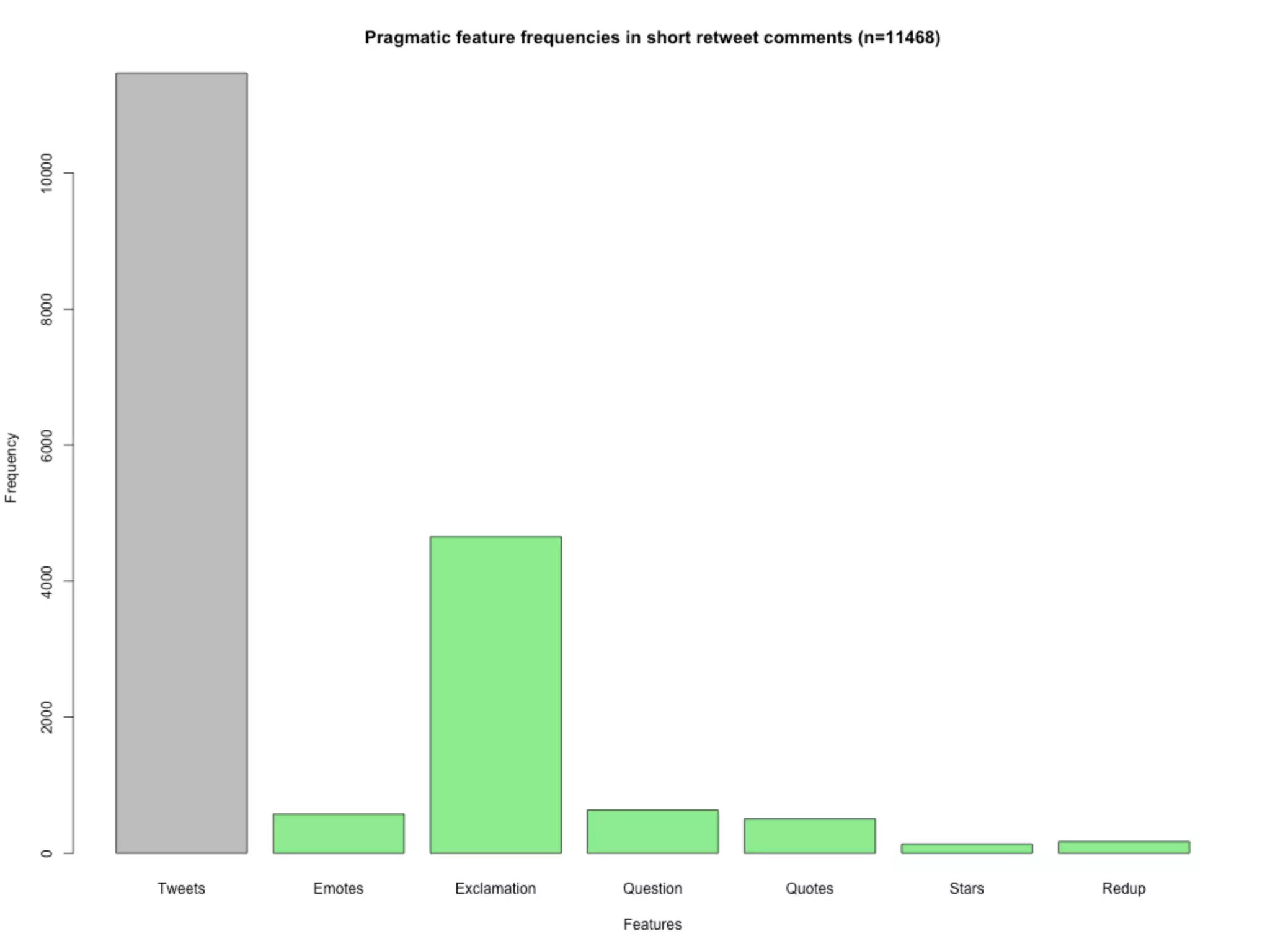
Common pragmatic features of retweet comments


•   emoticons ( :-) :D ;) )

•   exclamation marks ( !!! )

•   questions ( ? )

•   quotes ( “ )

•   stars ( * )

•   reduplication ( aaa|eee|ooo|www|rrr|sss|yyy )
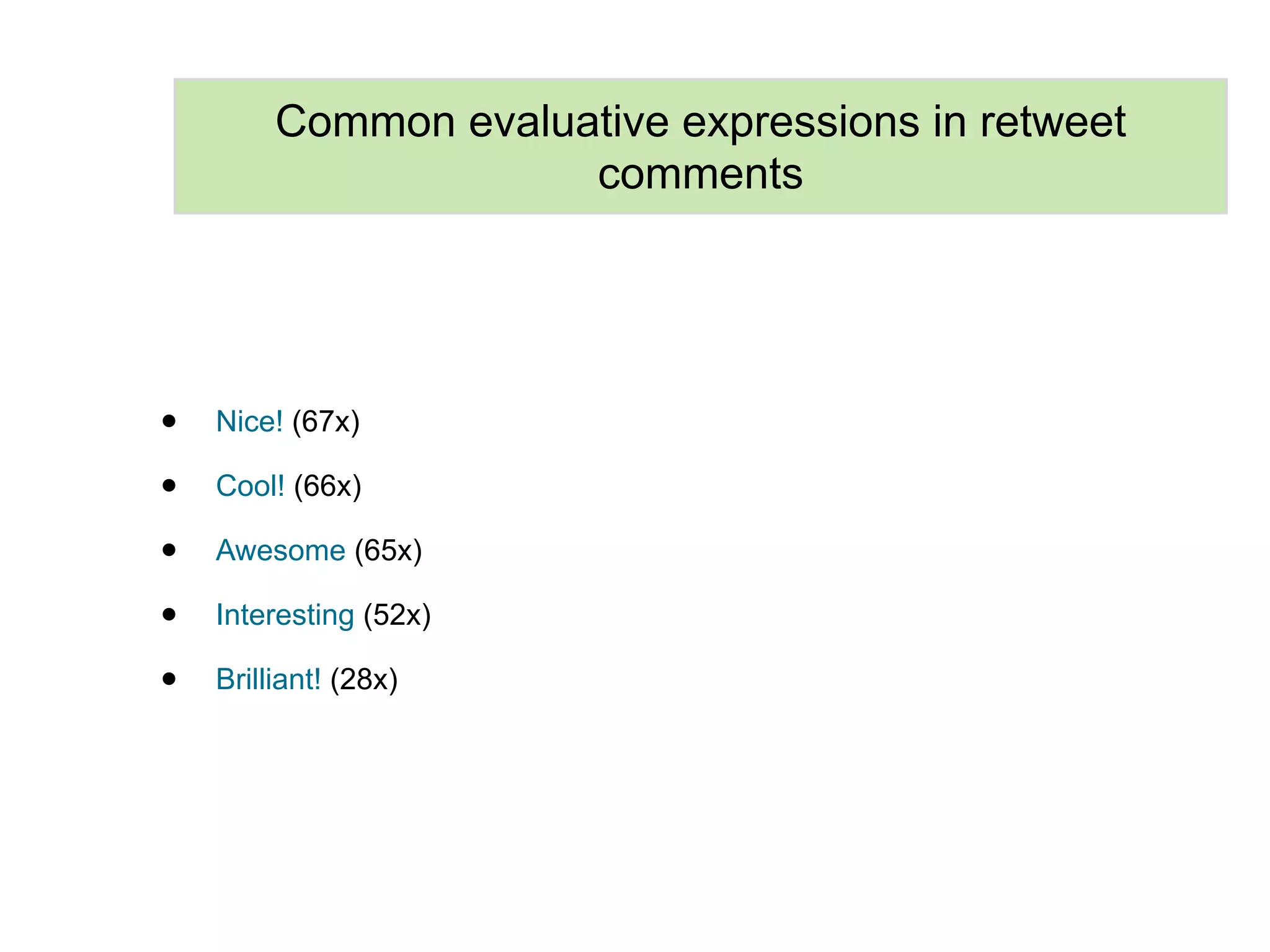
Common evaluative expressions in retweet
                      comments


•   Nice! (67x)

•   Cool! (66x)

•   Awesome (65x)

•   Interesting (52x)

•   Brilliant! (28x)
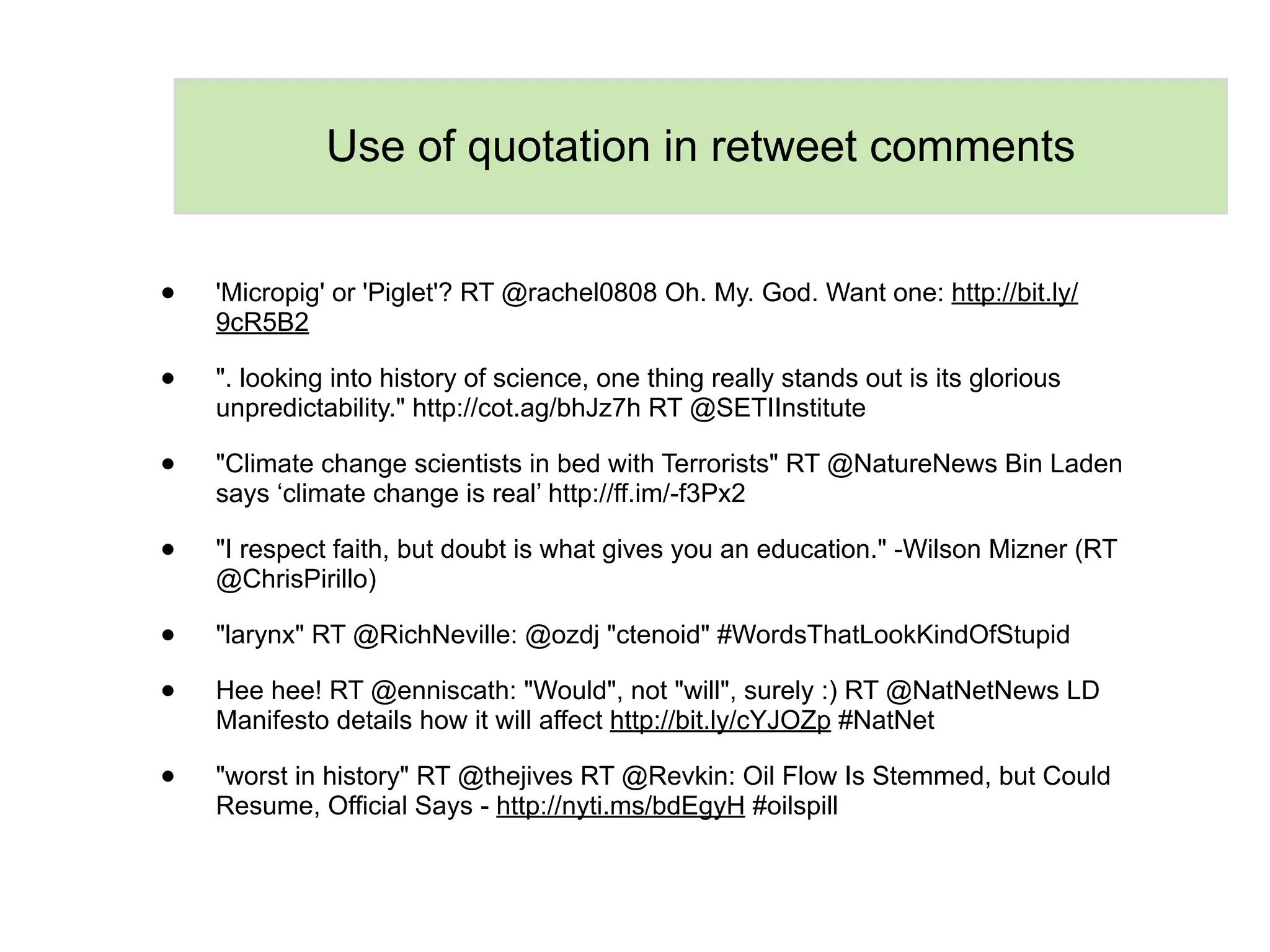
Use of quotation in retweet comments


•   'Micropig' or 'Piglet'? RT @rachel0808 Oh. My. God. Want one: http://bit.ly/
    9cR5B2

•   ". looking into history of science, one thing really stands out is its glorious
    unpredictability." http://cot.ag/bhJz7h RT @SETIInstitute

•   "Climate change scientists in bed with Terrorists" RT @NatureNews Bin Laden
    says ‘climate change is real’ http://ff.im/-f3Px2

•   "I respect faith, but doubt is what gives you an education." -Wilson Mizner (RT
    @ChrisPirillo)

•   "larynx" RT @RichNeville: @ozdj "ctenoid" #WordsThatLookKindOfStupid

•   Hee hee! RT @enniscath: "Would", not "will", surely :) RT @NatNetNews LD
    Manifesto details how it will affect http://bit.ly/cYJOZp #NatNet

•   "worst in history" RT @thejives RT @Revkin: Oil Flow Is Stemmed, but Could
    Resume, Official Says - http://nyti.ms/bdEgyH #oilspill
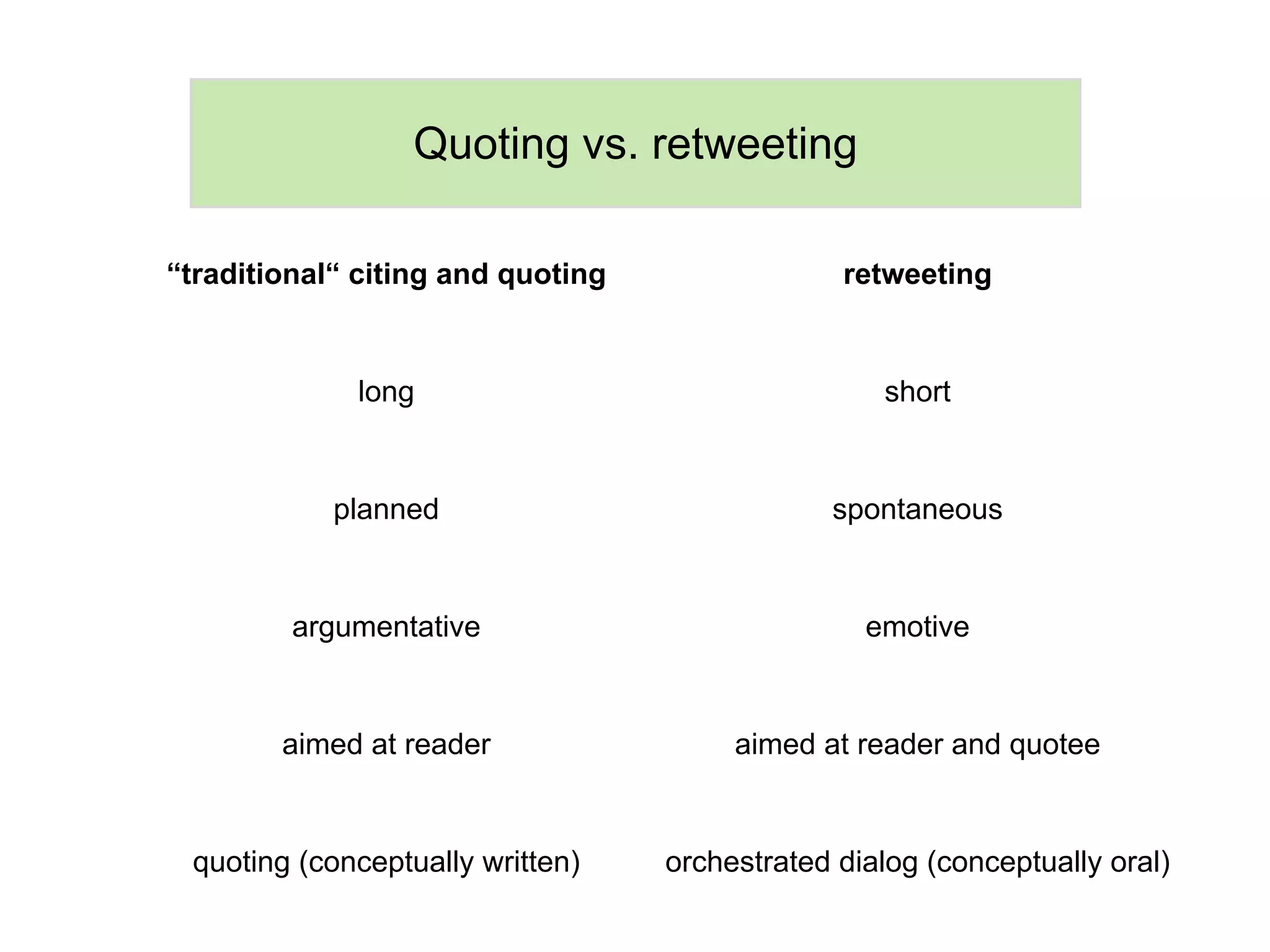
Quoting vs. retweeting

“traditional“ citing and quoting                retweeting


             long                                  short


            planned                            spontaneous


         argumentative                            emotive


        aimed at reader                 aimed at reader and quotee


 quoting (conceptually written)    orchestrated dialog (conceptually oral)
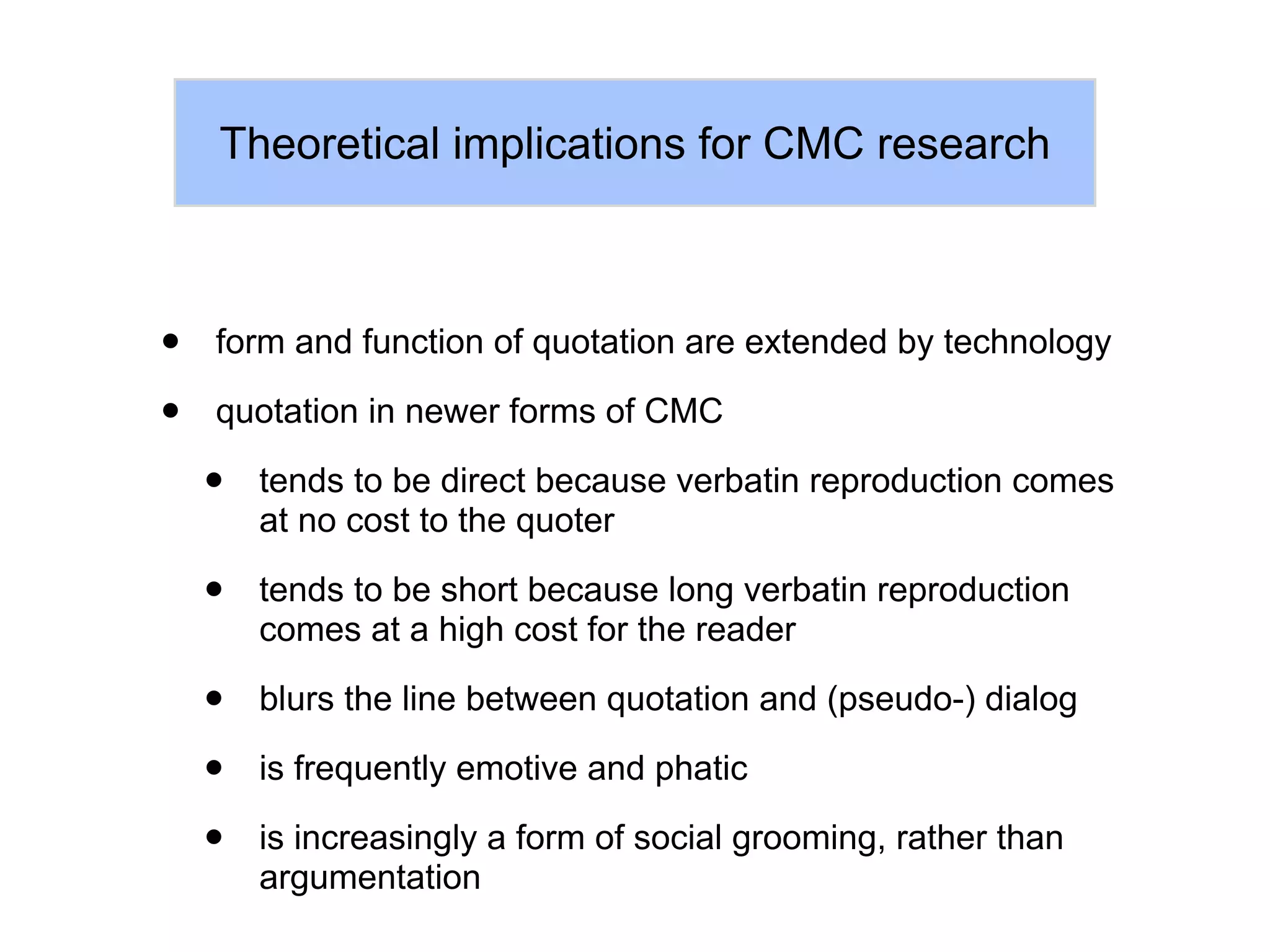
Theoretical implications for CMC research


•   form and function of quotation are extended by technology

•   quotation in newer forms of CMC

    •   tends to be direct because verbatin reproduction comes
        at no cost to the quoter

    •   tends to be short because long verbatin reproduction
        comes at a high cost for the reader

    •   blurs the line between quotation and (pseudo-) dialog

    •   is frequently emotive and phatic

    •   is increasingly a form of social grooming, rather than
        argumentation
Thank you for your attention!
References


•   Blyth, C., Recktenwald, S., & Wang, J. (1990). I'm like, "Say
    What?!": A New Quotative in American Oral Narrative.
    American Speech, 65 (3), pp. 215-227.

•   Clark, H. H., & Gerrig, R. J. (1990). Quotations as
    demonstrations. Language, 66 (4), pp. 764-805.

•   Coulmas, F. (1986). Direct and Indirect Speech. The Hague:
    Mouton de Gruyter, 1986.

•   Herring, S.C. (1999). Interactional Coherence in CMC.
    Journal of Computer-Mediated Communication, 4 (4).

•   Severinson Eklundh, K. (2010). To Quote or Not to Quote:
    Setting the Context for Computer-Mediated Dialogues.
    Language@Internet, 7, article 5.

The Pragmatics of Retweeting

  • 1.
    The Pragmatics ofRetweeting A case study of academic uses of Twitter Dr. Cornelius Puschmann Humboldt-Universität zu Berlin Augsburg, 20.04.2012
  • 2.
    This Talk 1. Citingand quoting across genres and media • How is the discourse of others reproduced? • What linguistic problems arise when discourse is reproduced? • How do genre and medium influence quoting? 2. From retweeting to quoting? 3. Theoretical implications • Quoting in asynchronous CMC for CMC research • Form and function of retweets • Corpus data • Quoting vs. retweeting
  • 3.
    How is thediscourse of others reproduced? • “The relationship to another‘s words was equally complex and ambiguous in the Middle Ages... the boundary lines between someone else‘s speech and one‘s own speech were flexible, ambiguous, often deliberately distorted and confusing.“ (Bakhtin 1981, p. 69, from Moore 2011) • “[..] reported speech is a crucial linguistic and stylistic problem.“ (Jakobson 1971, p. 130, from Moore 2011) ❖ reproducing the discourse of others is a linguistically and technologically complex process
  • 4.
    How is thediscourse of others reproduced? speech speech direct quote source target result reproduced in analog analog writing writing indirect quote digital digital
  • 5.
    How is thediscourse of others reproduced? speech speech direct quote source target result reproduced in analog analog writing writing indirect quote digital digital
  • 6.
    How is thediscourse of others reproduced? speech speech direct quote source target result reproduced in analog analog writing writing indirect quote digital digital
  • 7.
    How is thediscourse of others reproduced? speech speech direct quote source target result reproduced in analog analog writing writing indirect quote digital digital
  • 8.
    How is thediscourse of others reproduced? • Quotatives to mark direct quotation in English: • spoken: reporting verbs, be like X, be all X • written: quotation marks, italics, indention, color • gesture: air quotes
  • 9.
    How is thediscourse of others reproduced? direct quotation indirect quotation Mary said “I love you“. Mary said [that] she loves[/loved] me. encoding of two different harmonization of origo leads to origos requires an shift in unambiguous marker • tense (e.g. say + quotation marks) • person • pronouns • spatial/temporal expressions addition of (optional) • complementizer often assumed to be exact assumed to be approximate (+form +meaning) (-form +meaning) ❖ use of indirect quotation over direct quotation depends on the available technological means
  • 10.
    How do genreand medium influence quoting? • Quoting in journalism: • "Quotes should be faithful to the words and meaning of the speaker." (Clark 1995, para 1) • Quoting in academia: • "Ethics, copyright laws, and courtesy to readers require authors to identify the sources of direct quotations and of any facts or opinions not generally known or easily checked." (Chicago Manual of Style, 15th edition, p. 594) • "Whenever you quote or base your ideas on another person's work, you must document the source you used." (Online Citation Guide, U of California, Berkeley)
  • 11.
    Quoting in asynchronousCMC • The advent of the computer has changed the practice of quoting and citing considerably, introducing: • “copy and paste“ • hyperlinking • interface actions for sharing content such as liking on Facebook, reblogging on Tumblr, retweeting on Twitter, etc
  • 12.
    Quoting in asynchronousCMC janed@ABC.bigtel.com (Jane Doe) writes: >I can't believe how horrible Natalie looks. Has >she put on a lot of weight? I agree, but she has always had a somewhat round face, so if she did put on weight, I think that would be accentuated. "For the receiver, quoting serves to situate the response in a discourse context [..] and thus facilitates the perception of an extended conversation as coherent. For the sender, it facilitates composition by allowing direct response without having to paraphrase the original message." (Eklundh 2010, para 3)
  • 13.
    Quoting in asynchronousCMC janed@ABC.bigtel.com (Jane Doe) writes: >I can't believe how horrible Natalie looks. Has >she put on a lot of weight? I agree, but she has always had a somewhat round face, so if she did put on weight, I think that would be accentuated. "Quoting creates the illusion of adjacency in that it incorporates and juxtaposes (portions of) two turns [..] within a single message. When portions of previous text are repeatedly quoted and responded to, the resulting message can have the appearance of an extended conversational exchange" (Herring 1999, p. 8)
  • 14.
    Quoting in asynchronousCMC janed@ABC.bigtel.com (Jane Doe) writes: >I can't believe how horrible Natalie looks. Has >she put on a lot of weight? I agree, but she has always had a somewhat round face, so if she did put on weight, I think that would be accentuated. "Quoting creates the illusion of adjacency in that it incorporates and juxtaposes (portions of) two turns [..] within a single message. When portions of previous text are repeatedly quoted and responded to, the resulting message can have the appearance of an extended conversational exchange" (Herring 1999, p. 8) ❖ direct quoting in CMC creates the illusion of immediacy
  • 15.
    Twitter • Twitter is a microblogging service launched in 2006 • short messages of up to 140 characters (tweets) are posted through the Twitter website and various clients via a computer or mobile phone • 140 million users • 340 million tweets produced each day • widespread use in news, entertainment, political discourse, activism
  • 16.
    User timeline single timeline
  • 17.
    “All friends“ view aggregation of the timelines of other users
  • 18.
  • 19.
    Form and functionof retweets form function • old form: manual addition of RT @USERNAME or via • pass on information @USERNAME to a copied • comment/respond tweet • present own interests • new form: native retweeting by • build social capital clicking a button
  • 20.
    The Scientwists Corpus • assembled between January 7th, 2010 and August 31st, 2010 • 589 unique users (scientists, science journalists) • 410,609 tweets (~2.3 mio. tokens) • 55% contain a URL • 22% are retweets, of those • 72% unmodified • 28% modified ‣ academics use Twitter to disseminate information and comment on the tweets of others
  • 21.
    Retweets at theFree Culture Research Conference (#fcrc)
  • 22.
    Examples of unmodifiedand modified retweets (1) RT @WSJHealth: The Hidden Benefits of Exercise http://bit.ly/ 8R6uG7 (2) RT @timmytink I was saving my virginity for Jesus, but I can't resist your intelligent design. #teapartypickuplines (3) I want to know how students use them to improve mine. RT @drisis: RT @palmd Faculty websites suck. Help improve them http://bit.ly/ 8jfdLp (4) interesting reading RT @JohnSharp: Googling Ourselves — What Physicians Can Learn from Online Rating Sites http://tinyurl.com/ yh9lc3r (5) Thanks Ruth! RT @shortyvotes: @DrStuClark, you were nominated by @ruthseeley for a Shorty Award in #astronomy http://bit.ly/5eZcTm
  • 24.
    Common pragmatic featuresof retweet comments • interjections (Wow!, Ha!, Yay, LOL!) • evaluative expressions (Nice!, Awesome!, Excellent) • speech acts of thanking and congratulating (Thanks!, Thank You, Congrats!) • expressions signalling agreement (Agreed, Indeed, Yes, Ditto, So true) • use of 1 PP sing (I, me) • use of 2 PP (you)
  • 25.
    Common pragmatic featuresof retweet comments • emoticons ( :-) :D ;) ) • exclamation marks ( !!! ) • questions ( ? ) • quotes ( “ ) • stars ( * ) • reduplication ( aaa|eee|ooo|www|rrr|sss|yyy )
  • 28.
    Common evaluative expressionsin retweet comments • Nice! (67x) • Cool! (66x) • Awesome (65x) • Interesting (52x) • Brilliant! (28x)
  • 29.
    Use of quotationin retweet comments • 'Micropig' or 'Piglet'? RT @rachel0808 Oh. My. God. Want one: http://bit.ly/ 9cR5B2 • ". looking into history of science, one thing really stands out is its glorious unpredictability." http://cot.ag/bhJz7h RT @SETIInstitute • "Climate change scientists in bed with Terrorists" RT @NatureNews Bin Laden says ‘climate change is real’ http://ff.im/-f3Px2 • "I respect faith, but doubt is what gives you an education." -Wilson Mizner (RT @ChrisPirillo) • "larynx" RT @RichNeville: @ozdj "ctenoid" #WordsThatLookKindOfStupid • Hee hee! RT @enniscath: "Would", not "will", surely :) RT @NatNetNews LD Manifesto details how it will affect http://bit.ly/cYJOZp #NatNet • "worst in history" RT @thejives RT @Revkin: Oil Flow Is Stemmed, but Could Resume, Official Says - http://nyti.ms/bdEgyH #oilspill
  • 30.
    Quoting vs. retweeting “traditional“citing and quoting retweeting long short planned spontaneous argumentative emotive aimed at reader aimed at reader and quotee quoting (conceptually written) orchestrated dialog (conceptually oral)
  • 31.
    Theoretical implications forCMC research • form and function of quotation are extended by technology • quotation in newer forms of CMC • tends to be direct because verbatin reproduction comes at no cost to the quoter • tends to be short because long verbatin reproduction comes at a high cost for the reader • blurs the line between quotation and (pseudo-) dialog • is frequently emotive and phatic • is increasingly a form of social grooming, rather than argumentation
  • 32.
    Thank you foryour attention!
  • 33.
    References • Blyth, C., Recktenwald, S., & Wang, J. (1990). I'm like, "Say What?!": A New Quotative in American Oral Narrative. American Speech, 65 (3), pp. 215-227. • Clark, H. H., & Gerrig, R. J. (1990). Quotations as demonstrations. Language, 66 (4), pp. 764-805. • Coulmas, F. (1986). Direct and Indirect Speech. The Hague: Mouton de Gruyter, 1986. • Herring, S.C. (1999). Interactional Coherence in CMC. Journal of Computer-Mediated Communication, 4 (4). • Severinson Eklundh, K. (2010). To Quote or Not to Quote: Setting the Context for Computer-Mediated Dialogues. Language@Internet, 7, article 5.