Emergent
Reader
and
Emergent
Writer
C H A R A C T E R I S T I C S O F
A N E M E R G E N T R E A D E R
 Harris and Hodges(1981), refer to this period of
acquiring the specific skills and abilities that allow
reading to take place as preparedness or reading
readiness.
Marie Clay(1991) and Fountas and Pinnell(2001)
have noted five main stages of literacy development
that relate to both reading and writing.
S TA G E S O F T H E R E A D I N G
P R O C E S S
Marie Mildred Clay, DBE, FRSNZ (née Irwin; 3
January 1926 – 13 April 2007)
 was a distinguished researcher from New Zealand
known for her work in global educational literacy.
She was committed to the idea that children who
struggle to learn to read and write can be helped
with early intervention. A clinical psychologist,
she developed the Reading Recovery intervention
program in New Zealand and expanded it
worldwide.
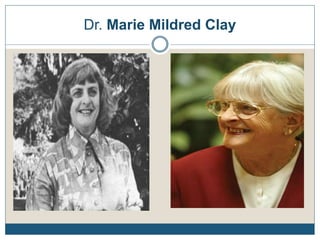
Dr. Marie Mildred Clay
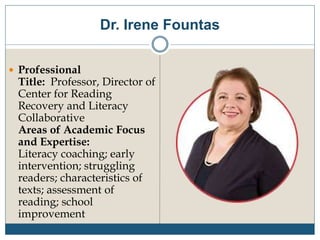
Dr. Irene Fountas
 Professional
Title: Professor, Director of
Center for Reading
Recovery and Literacy
Collaborative
Areas of Academic Focus
and Expertise:
Literacy coaching; early
intervention; struggling
readers; characteristics of
texts; assessment of
reading; school
improvement
Dr. Gay Su Pinnell
 a professor in the School of
Teaching and Learning at The
Ohio State University. She has
extensive experience in
classroom teaching and field-
based research, and in
developing comprehensive
approaches to literacy
education. She has received the
International Reading
Association’s Albert J. Harris
Award for research and the
Charles A. Dana Foundation
Award for her contributions to
the field of education. She is also
a member of the Reading Hall of
Fame.
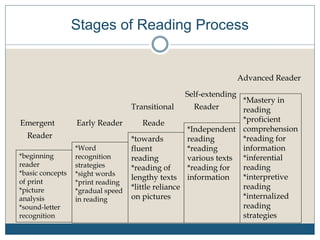
Stages of Reading Process
Advanced Reader
Self-extending
Transitional Reader
Emergent Early Reader Reade
Reader
*beginning
reader
*basic concepts
of print
*picture
analysis
*sound-letter
recognition
*Word
recognition
strategies
*sight words
*print reading
*gradual speed
in reading
*towards
fluent
reading
*reading of
lengthy texts
*little reliance
on pictures
*Independent
reading
*reading
various texts
*reading for
information
*Mastery in
reading
*proficient
comprehension
*reading for
information
*inferential
reading
*interpretive
reading
*internalized
reading
strategies
They begin to familiarize
themselves wit the concepts of
print related to directionally, one-
to-one correspondence between the
spoken and written word, and the
value of picture clues to the
meaning of a story.
Stage 1
EMERGENT READERS
They begin to develop word
recognition strategies such as
monitoring, searching,
crosschecking, and self-
correction.
Stage 2
EARLY READERS
Make the leap into fluent reading
as they are generally able to read
in meaningful phrases with
comfortable pace and appropriate
voice intonation, these readers
tend to range from 5-7 years.
Stage 3
TRANSITIONAL READERS
Readers progress into reading
independence in the fourth
developmental stage. This type of
readers are able to read more
complex texts and begin to read for
a variety of purposes. These readers
range in age from 6-9 years of age.
Stage 4
SELF-EXTENDING READERS
ARE THOSE READERS WHO HAVE
ATTAINED A LEVEL OF MASTERY WITH
READING. THEY ENJOY READING AND
USE READING AS MEANS OF GAINING
KNOWLEDGE. THEY ARE GENERALLY
OVER THE AGE OF 9.
Stage 5
ADVANCED READERS
Readiness to reading may be determined
by cognitive, oral language, perceptual,
affective and home environment factors
which vary significantly in an individual
learner.
CHARACTERISTICS OF AN EMERGENT WRITER
 Children have acquired considerable information
about writing before they enter formal instruction.
They have learned to write naturally because
(Gundlach, et.al., 1985) familiar writing situations
and real-life writing experiences are evident in the
home environment as modeled by the parents and
even by other family members.
 Their emergent writing is characterized by playful
markings to communicate something, which signals
their knowledge of the uses of written language
before learning the form.
 Dyson, 1986; Parker 1983, This develops through
constant invention and reinvention of the forms of
written language which signal the simultaneous
reconstruction of their knowledge about written
language.
 Bissex, 1980 and Read 1975, describe writing as
self-initiated and self-directed or voluntary, by
observing more skilled others and by participating
in literacy events, by exploring and learned
writing through interaction with literate others.
CHARACTERISTICS OF AN EMERGENT WRITER
 Writing is always related to reading and reading is
always connected to writing. As the child writes,
he integrates knowledge of reading with
knowledge of writing.
CHARACTERISTICS OF AN EMERGENT WRITER
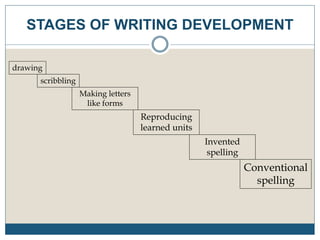
STAGES OF WRITING DEVELOPMENT
drawing
scribbling
Making letters
like forms
Reproducing
learned units
Invented
spelling
Conventional
spelling
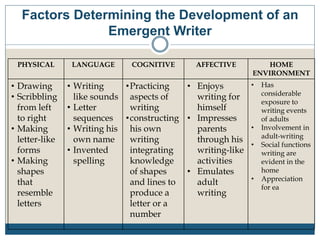
Factors Determining the Development of an
Emergent Writer
PHYSICAL LANGUAGE COGNITIVE AFFECTIVE HOME
ENVIRONMENT
• Drawing
• Scribbling
from left
to right
• Making
letter-like
forms
• Making
shapes
that
resemble
letters
• Writing
like sounds
• Letter
sequences
• Writing his
own name
• Invented
spelling
•Practicing
aspects of
writing
•constructing
his own
writing
integrating
knowledge
of shapes
and lines to
produce a
letter or a
number
• Enjoys
writing for
himself
• Impresses
parents
through his
writing-like
activities
• Emulates
adult
writing
• Has
considerable
exposure to
writing events
of adults
• Involvement in
adult-writing
• Social functions
writing are
evident in the
home
• Appreciation
for ea
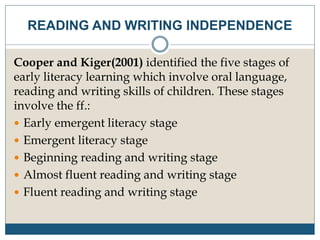
READING AND WRITING INDEPENDENCE
Cooper and Kiger(2001) identified the five stages of
early literacy learning which involve oral language,
reading and writing skills of children. These stages
involve the ff.:
 Early emergent literacy stage
 Emergent literacy stage
 Beginning reading and writing stage
 Almost fluent reading and writing stage
 Fluent reading and writing stage
Emergent Reader and Emergent Writer

Emergent Reader and Emergent Writer

  • 1.
  • 2.
    C H AR A C T E R I S T I C S O F A N E M E R G E N T R E A D E R  Harris and Hodges(1981), refer to this period of acquiring the specific skills and abilities that allow reading to take place as preparedness or reading readiness.
  • 3.
    Marie Clay(1991) andFountas and Pinnell(2001) have noted five main stages of literacy development that relate to both reading and writing. S TA G E S O F T H E R E A D I N G P R O C E S S
  • 4.
    Marie Mildred Clay,DBE, FRSNZ (née Irwin; 3 January 1926 – 13 April 2007)  was a distinguished researcher from New Zealand known for her work in global educational literacy. She was committed to the idea that children who struggle to learn to read and write can be helped with early intervention. A clinical psychologist, she developed the Reading Recovery intervention program in New Zealand and expanded it worldwide.
  • 5.
  • 6.
    Dr. Irene Fountas Professional Title: Professor, Director of Center for Reading Recovery and Literacy Collaborative Areas of Academic Focus and Expertise: Literacy coaching; early intervention; struggling readers; characteristics of texts; assessment of reading; school improvement
  • 7.
    Dr. Gay SuPinnell  a professor in the School of Teaching and Learning at The Ohio State University. She has extensive experience in classroom teaching and field- based research, and in developing comprehensive approaches to literacy education. She has received the International Reading Association’s Albert J. Harris Award for research and the Charles A. Dana Foundation Award for her contributions to the field of education. She is also a member of the Reading Hall of Fame.
  • 8.
    Stages of ReadingProcess Advanced Reader Self-extending Transitional Reader Emergent Early Reader Reade Reader *beginning reader *basic concepts of print *picture analysis *sound-letter recognition *Word recognition strategies *sight words *print reading *gradual speed in reading *towards fluent reading *reading of lengthy texts *little reliance on pictures *Independent reading *reading various texts *reading for information *Mastery in reading *proficient comprehension *reading for information *inferential reading *interpretive reading *internalized reading strategies
  • 9.
    They begin tofamiliarize themselves wit the concepts of print related to directionally, one- to-one correspondence between the spoken and written word, and the value of picture clues to the meaning of a story. Stage 1 EMERGENT READERS
  • 10.
    They begin todevelop word recognition strategies such as monitoring, searching, crosschecking, and self- correction. Stage 2 EARLY READERS
  • 11.
    Make the leapinto fluent reading as they are generally able to read in meaningful phrases with comfortable pace and appropriate voice intonation, these readers tend to range from 5-7 years. Stage 3 TRANSITIONAL READERS
  • 12.
    Readers progress intoreading independence in the fourth developmental stage. This type of readers are able to read more complex texts and begin to read for a variety of purposes. These readers range in age from 6-9 years of age. Stage 4 SELF-EXTENDING READERS
  • 13.
    ARE THOSE READERSWHO HAVE ATTAINED A LEVEL OF MASTERY WITH READING. THEY ENJOY READING AND USE READING AS MEANS OF GAINING KNOWLEDGE. THEY ARE GENERALLY OVER THE AGE OF 9. Stage 5 ADVANCED READERS
  • 14.
    Readiness to readingmay be determined by cognitive, oral language, perceptual, affective and home environment factors which vary significantly in an individual learner.
  • 15.
    CHARACTERISTICS OF ANEMERGENT WRITER  Children have acquired considerable information about writing before they enter formal instruction. They have learned to write naturally because (Gundlach, et.al., 1985) familiar writing situations and real-life writing experiences are evident in the home environment as modeled by the parents and even by other family members.  Their emergent writing is characterized by playful markings to communicate something, which signals their knowledge of the uses of written language before learning the form.
  • 16.
     Dyson, 1986;Parker 1983, This develops through constant invention and reinvention of the forms of written language which signal the simultaneous reconstruction of their knowledge about written language.  Bissex, 1980 and Read 1975, describe writing as self-initiated and self-directed or voluntary, by observing more skilled others and by participating in literacy events, by exploring and learned writing through interaction with literate others. CHARACTERISTICS OF AN EMERGENT WRITER
  • 17.
     Writing isalways related to reading and reading is always connected to writing. As the child writes, he integrates knowledge of reading with knowledge of writing. CHARACTERISTICS OF AN EMERGENT WRITER
  • 18.
    STAGES OF WRITINGDEVELOPMENT drawing scribbling Making letters like forms Reproducing learned units Invented spelling Conventional spelling
  • 19.
    Factors Determining theDevelopment of an Emergent Writer PHYSICAL LANGUAGE COGNITIVE AFFECTIVE HOME ENVIRONMENT • Drawing • Scribbling from left to right • Making letter-like forms • Making shapes that resemble letters • Writing like sounds • Letter sequences • Writing his own name • Invented spelling •Practicing aspects of writing •constructing his own writing integrating knowledge of shapes and lines to produce a letter or a number • Enjoys writing for himself • Impresses parents through his writing-like activities • Emulates adult writing • Has considerable exposure to writing events of adults • Involvement in adult-writing • Social functions writing are evident in the home • Appreciation for ea
  • 20.
    READING AND WRITINGINDEPENDENCE Cooper and Kiger(2001) identified the five stages of early literacy learning which involve oral language, reading and writing skills of children. These stages involve the ff.:  Early emergent literacy stage  Emergent literacy stage  Beginning reading and writing stage  Almost fluent reading and writing stage  Fluent reading and writing stage