Rendezvous with Ray
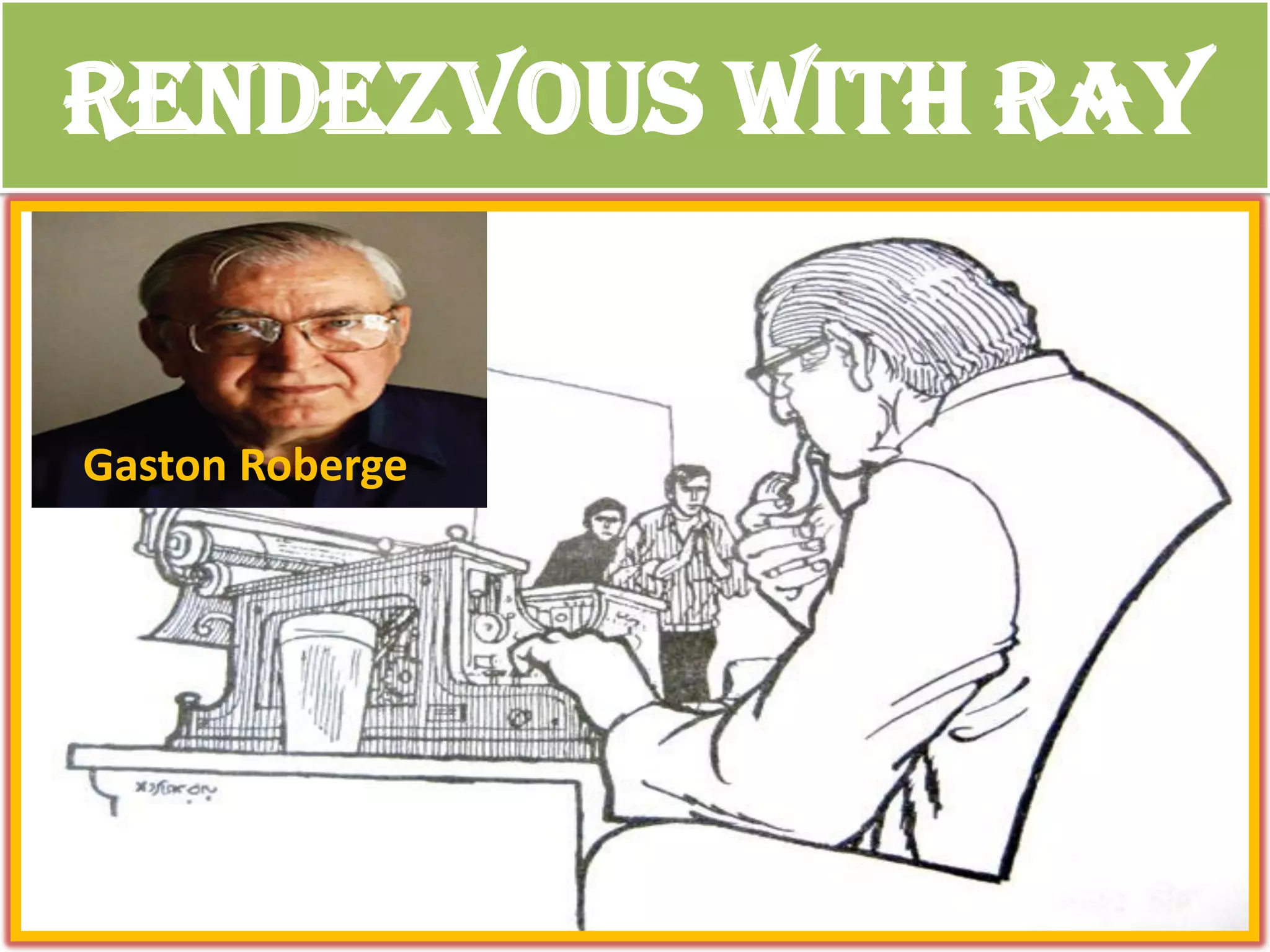
Gaston Roberge
Prepared
by
m padma lalitha sharada
GHS MALAKPET
English
Class: X Lesson: 9
APSCERT New syllabus
Under guidance
Of
Smt. C B NIRMALA
Rtd. Dy. E.O.
Nampally Manal
Hyderabad
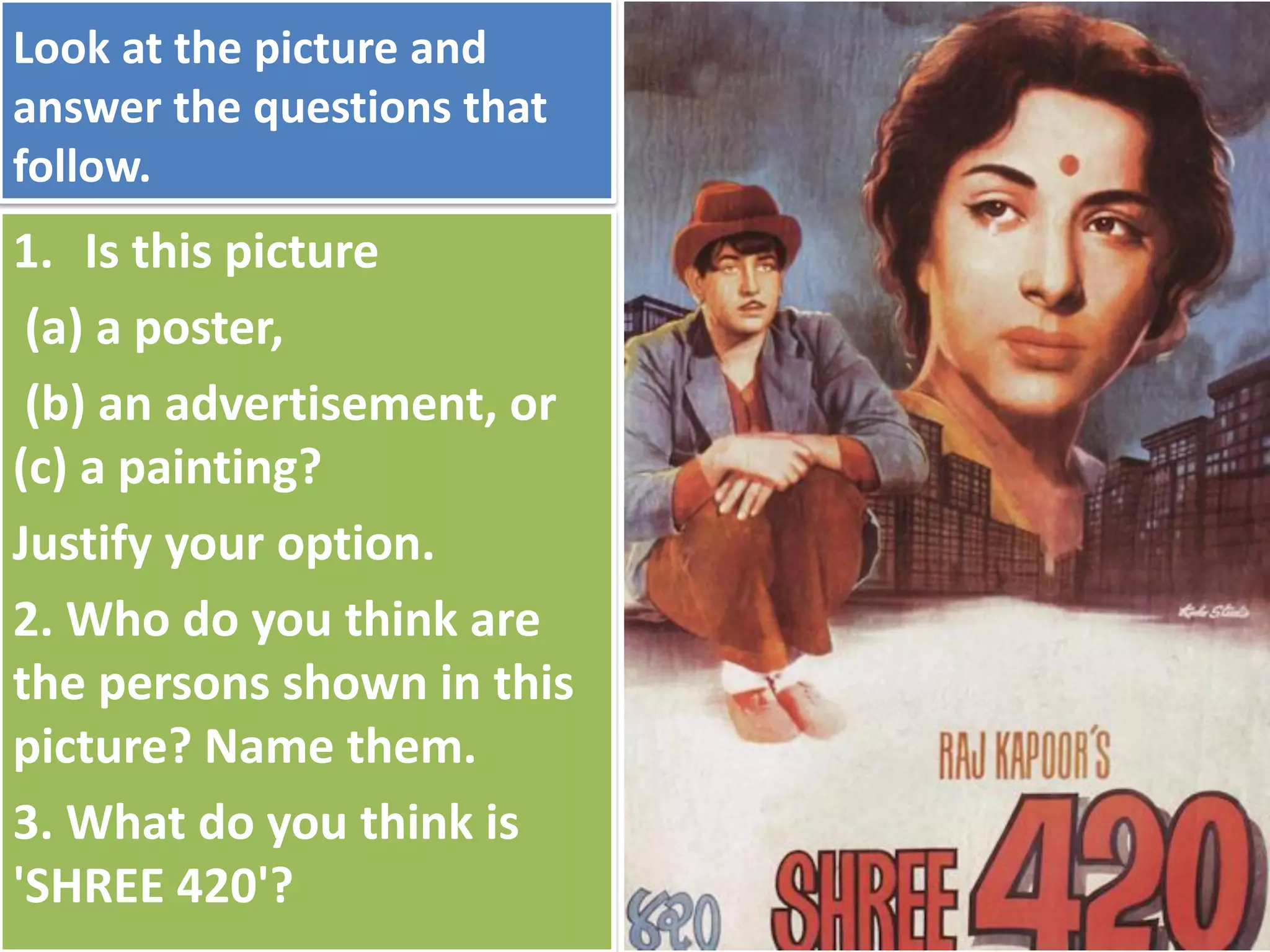
Look at the picture and
answer the questions that
follow.
1. Is this picture
(a) a poster,
(b) an advertisement, or
(c) a painting?
Justify your option.
2. Who do you think are
the persons shown in this
picture? Name them.
3. What do you think is
'SHREE 420'?
It was a unique
friendship that
developed
between a French-
Canadian priest
and one of the
world’s greatest
film directors, and
had a singular
impact on Bengali
films both
academically and
practically.
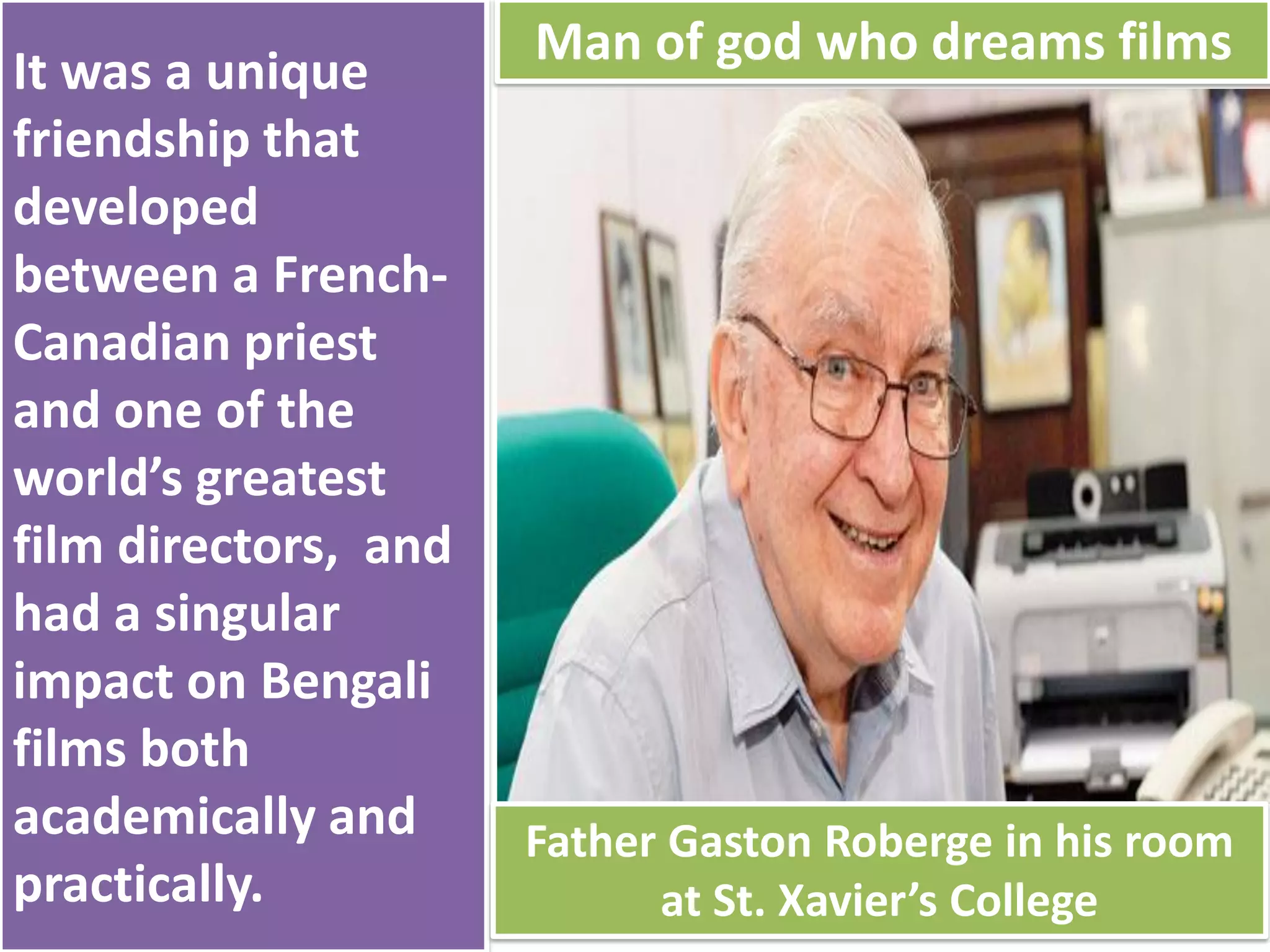
Man of god who dreams films
Father Gaston Roberge in his room
at St. Xavier’s College
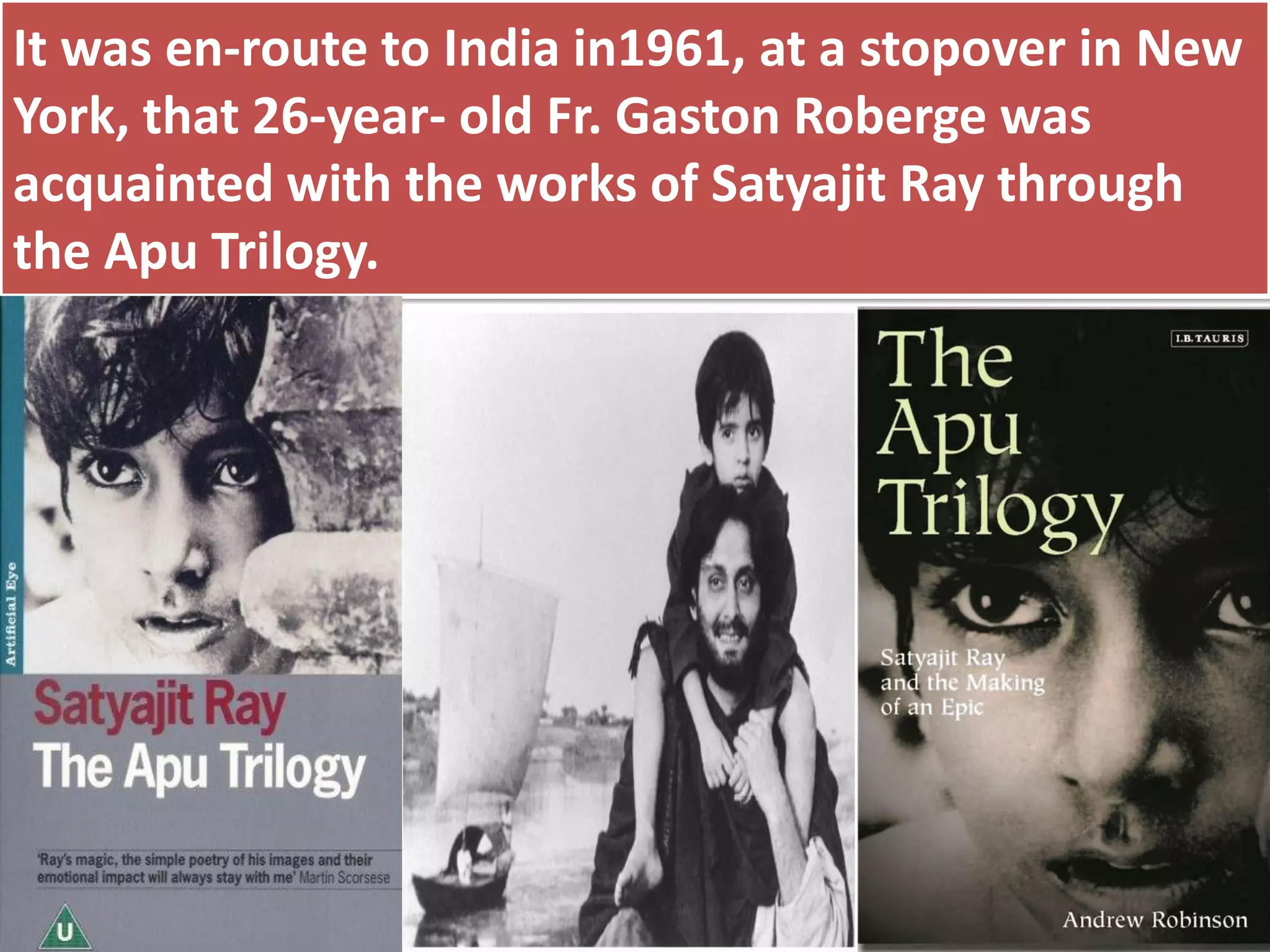
It was en-route to India in1961, at a stopover in New
York, that 26-year- old Fr. Gaston Roberge was
acquainted with the works of Satyajit Ray through
the Apu Trilogy.
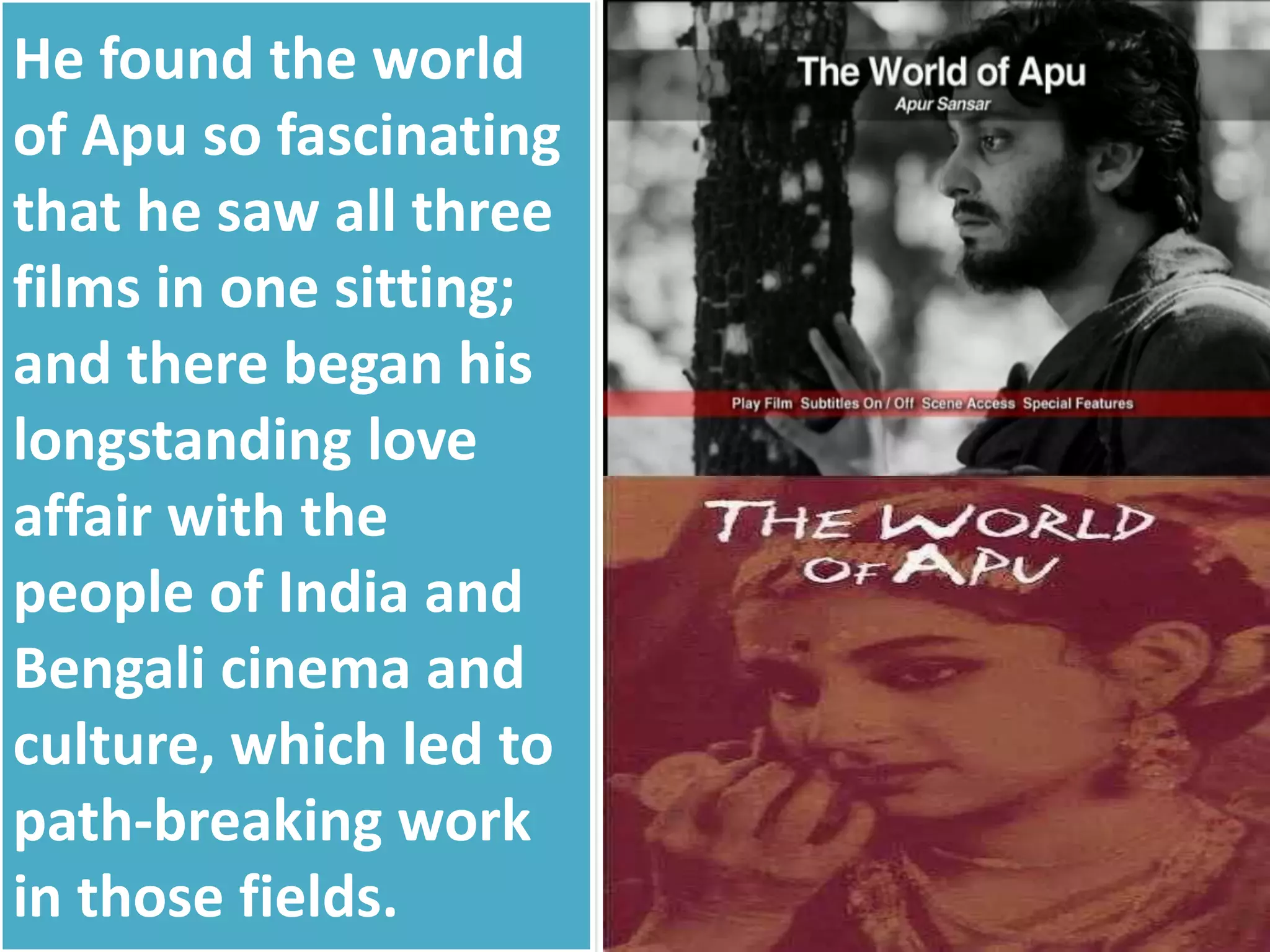
He found the world
of Apu so fascinating
that he saw all three
films in one sitting;
and there began his
longstanding love
affair with the
people of India and
Bengali cinema and
culture, which led to
path-breaking work
in those fields.
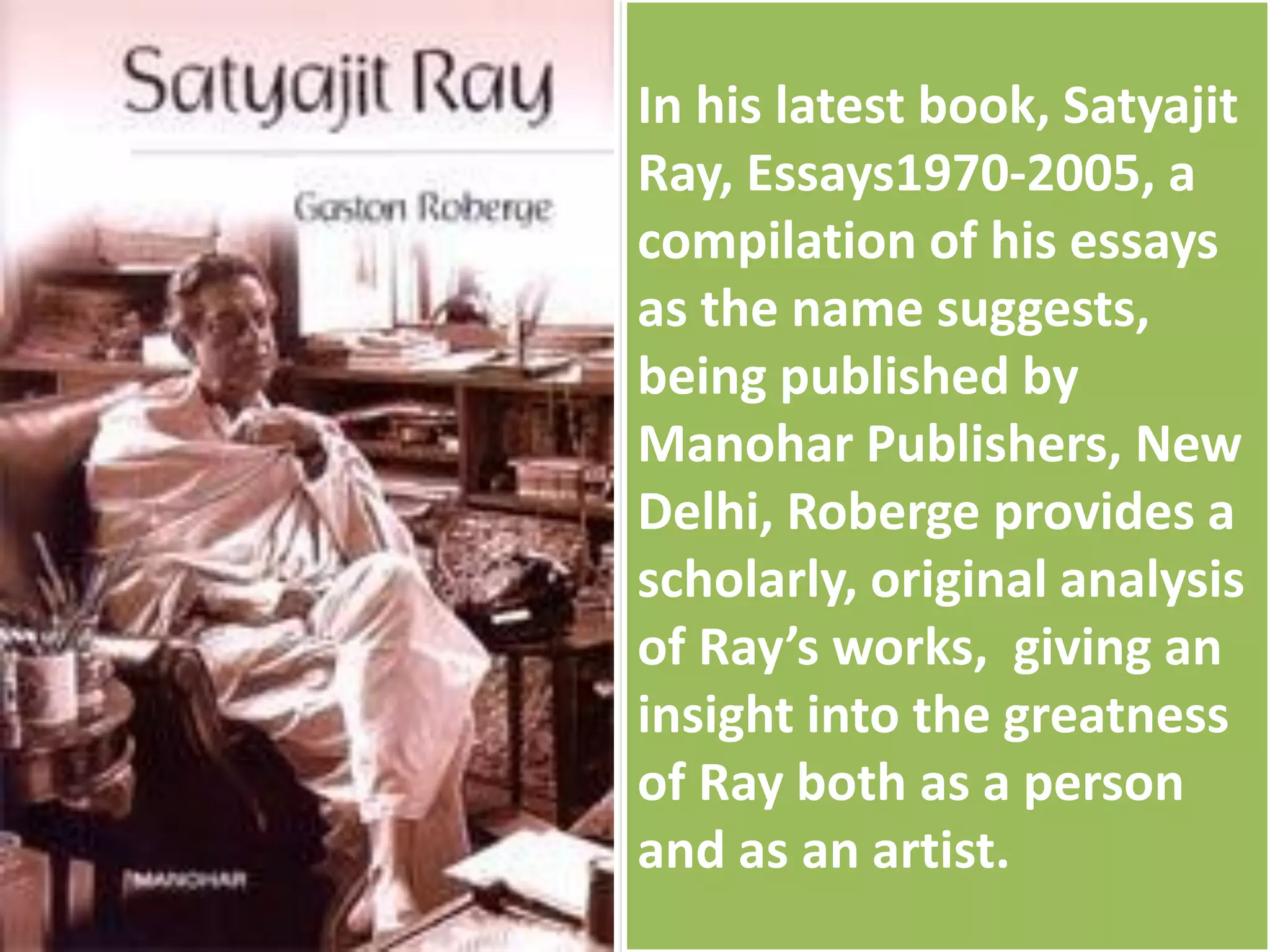
In his latest book, Satyajit
Ray, Essays1970-2005, a
compilation of his essays
as the name suggests,
being published by
Manohar Publishers, New
Delhi, Roberge provides a
scholarly, original analysis
of Ray’s works, giving an
insight into the greatness
of Ray both as a person
and as an artist.
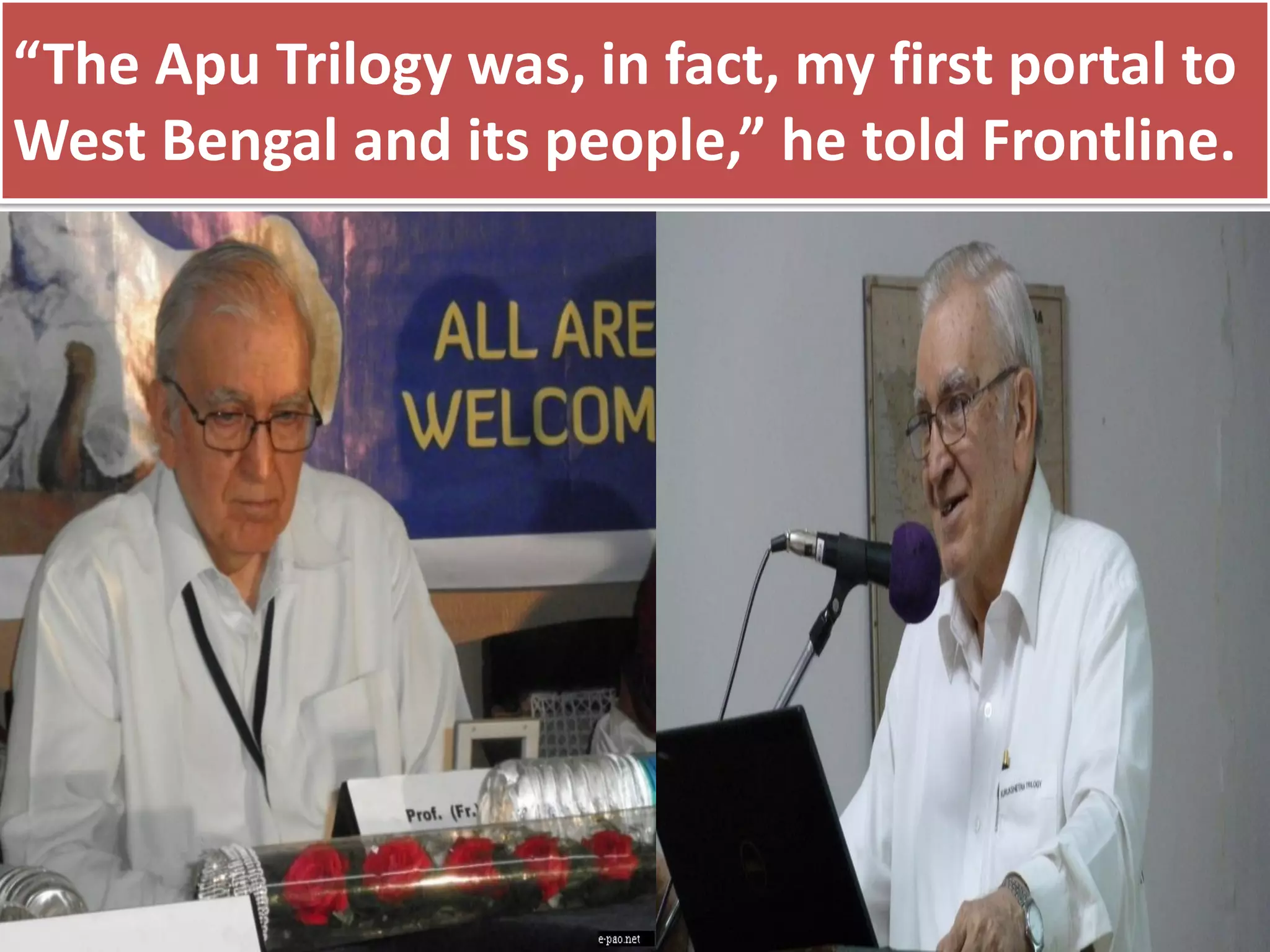
“The Apu Trilogy was, in fact, my first portal to
West Bengal and its people,” he told Frontline.
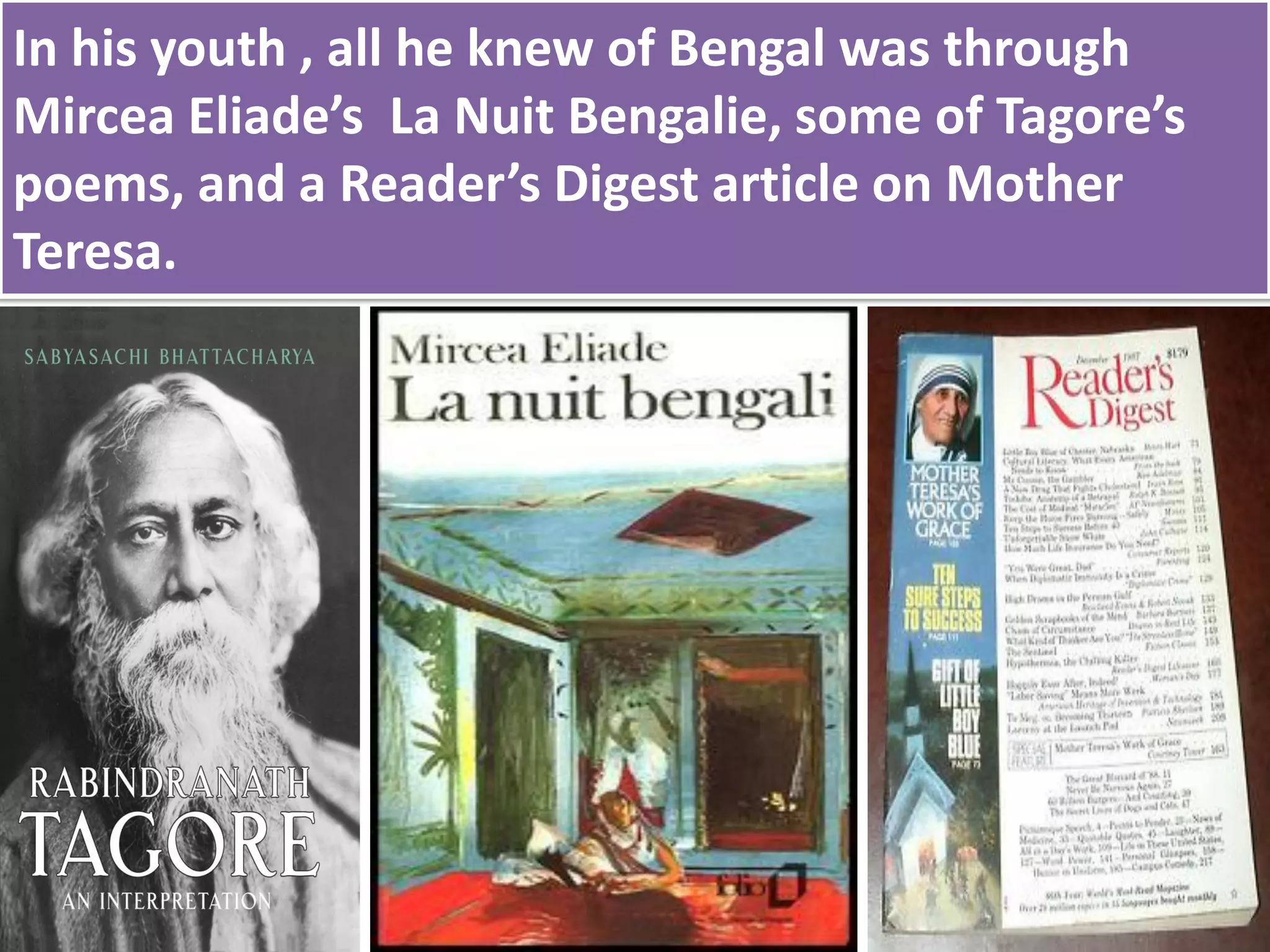
In his youth , all he knew of Bengal was through
Mircea Eliade’s La Nuit Bengalie, some of Tagore’s
poems, and a Reader’s Digest article on Mother
Teresa.
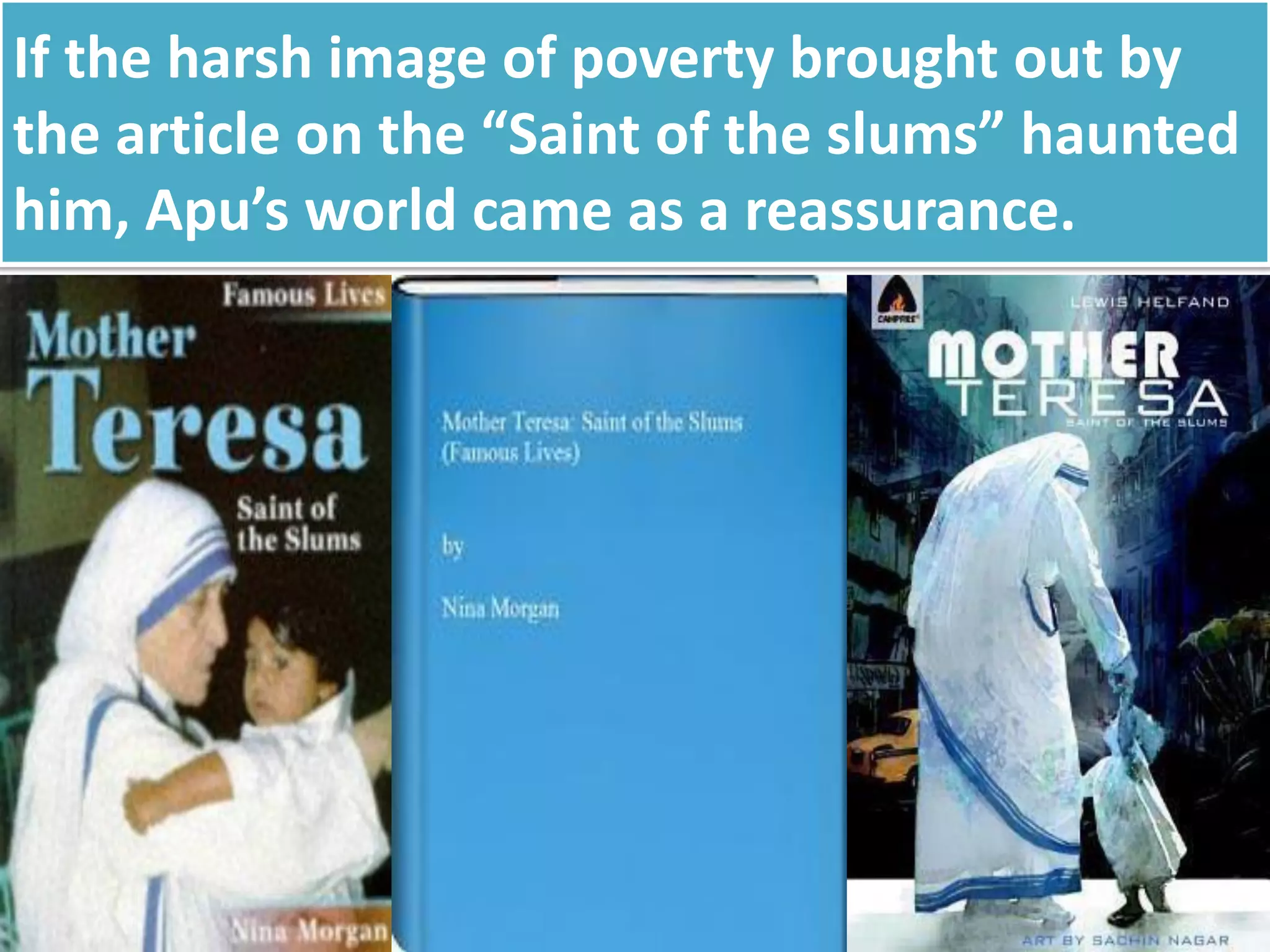
If the harsh image of poverty brought out by
the article on the “Saint of the slums” haunted
him, Apu’s world came as a reassurance.
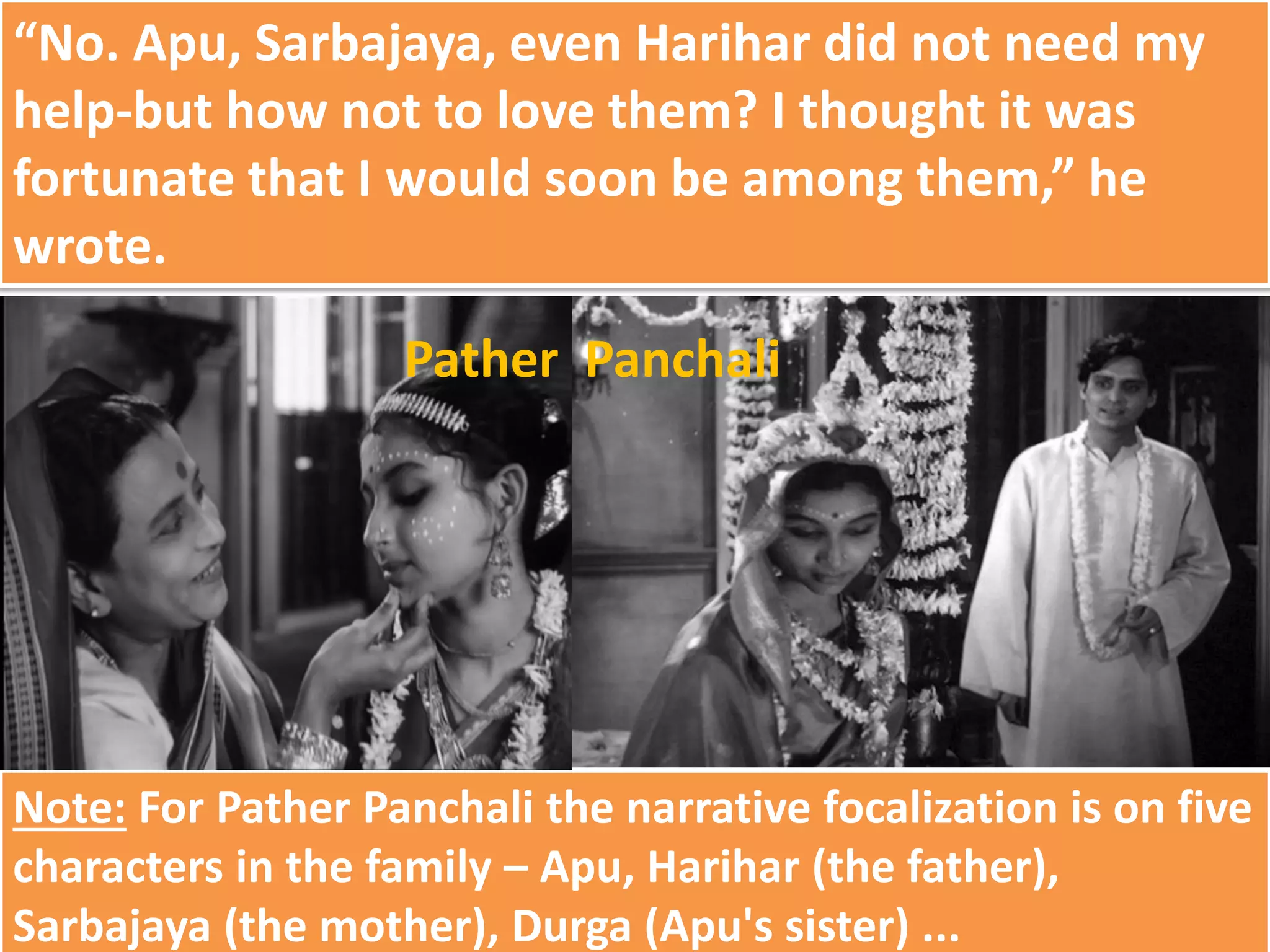
“No. Apu, Sarbajaya, even Harihar did not need my
help-but how not to love them? I thought it was
fortunate that I would soon be among them,” he
wrote.
Note: For Pather Panchali the narrative focalization is on five
characters in the family – Apu, Harihar (the father),
Sarbajaya (the mother), Durga (Apu's sister) ...
Pather Panchali
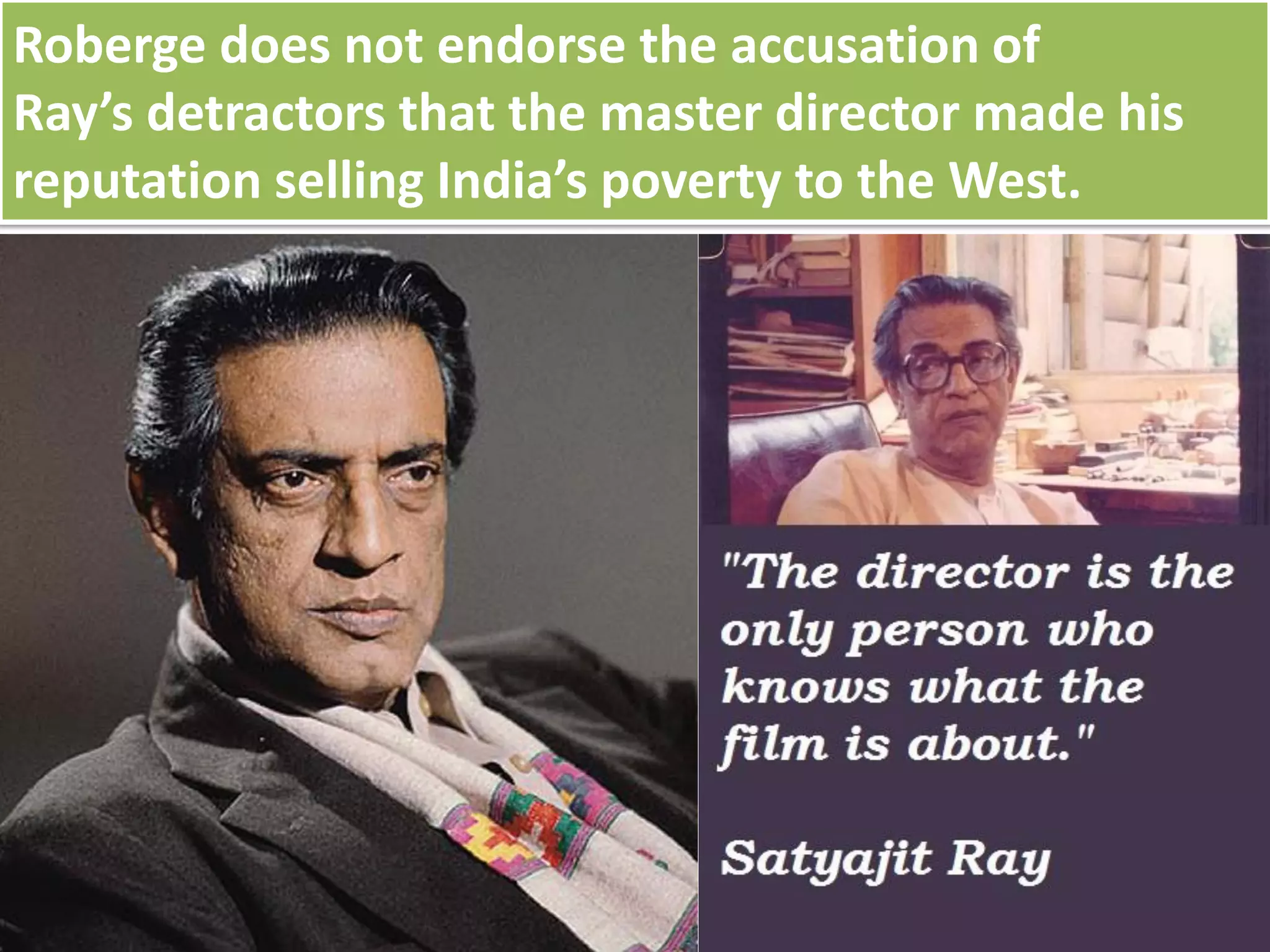
Roberge does not endorse the accusation of
Ray’s detractors that the master director made his
reputation selling India’s poverty to the West.
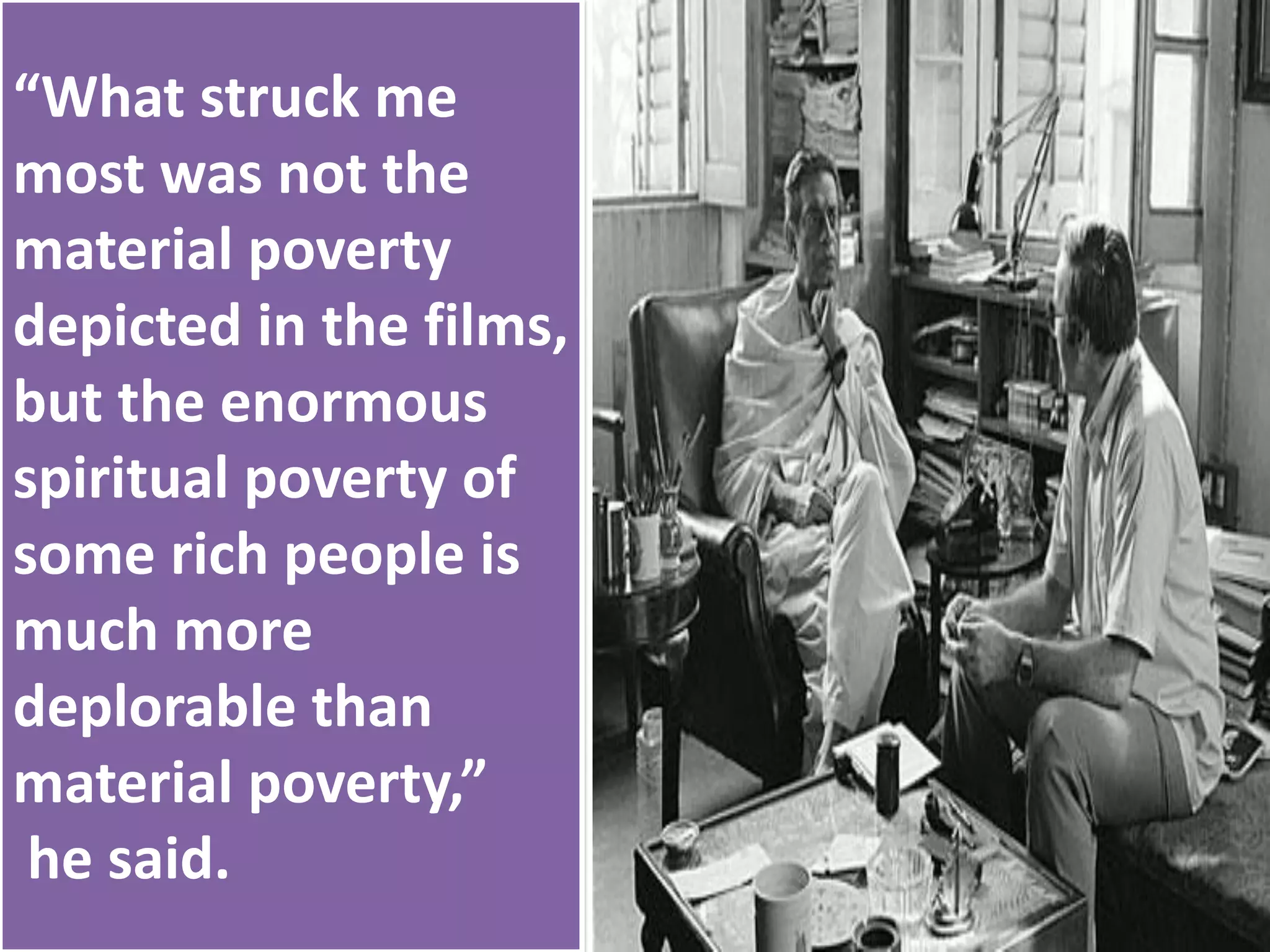
“What struck me
most was not the
material poverty
depicted in the films,
but the enormous
spiritual poverty of
some rich people is
much more
deplorable than
material poverty,”
he said.
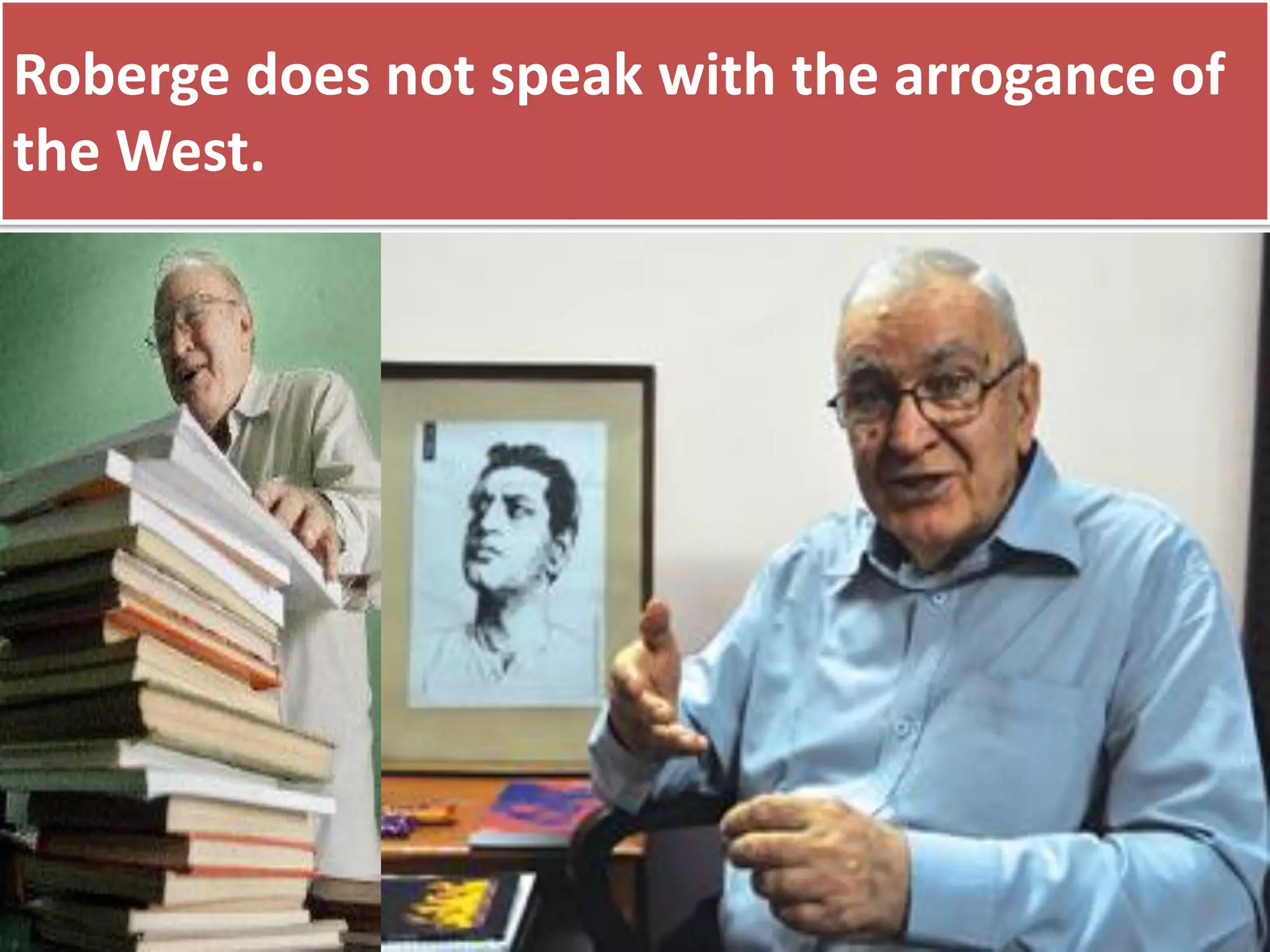
Roberge does not speak with the arrogance of
the West.
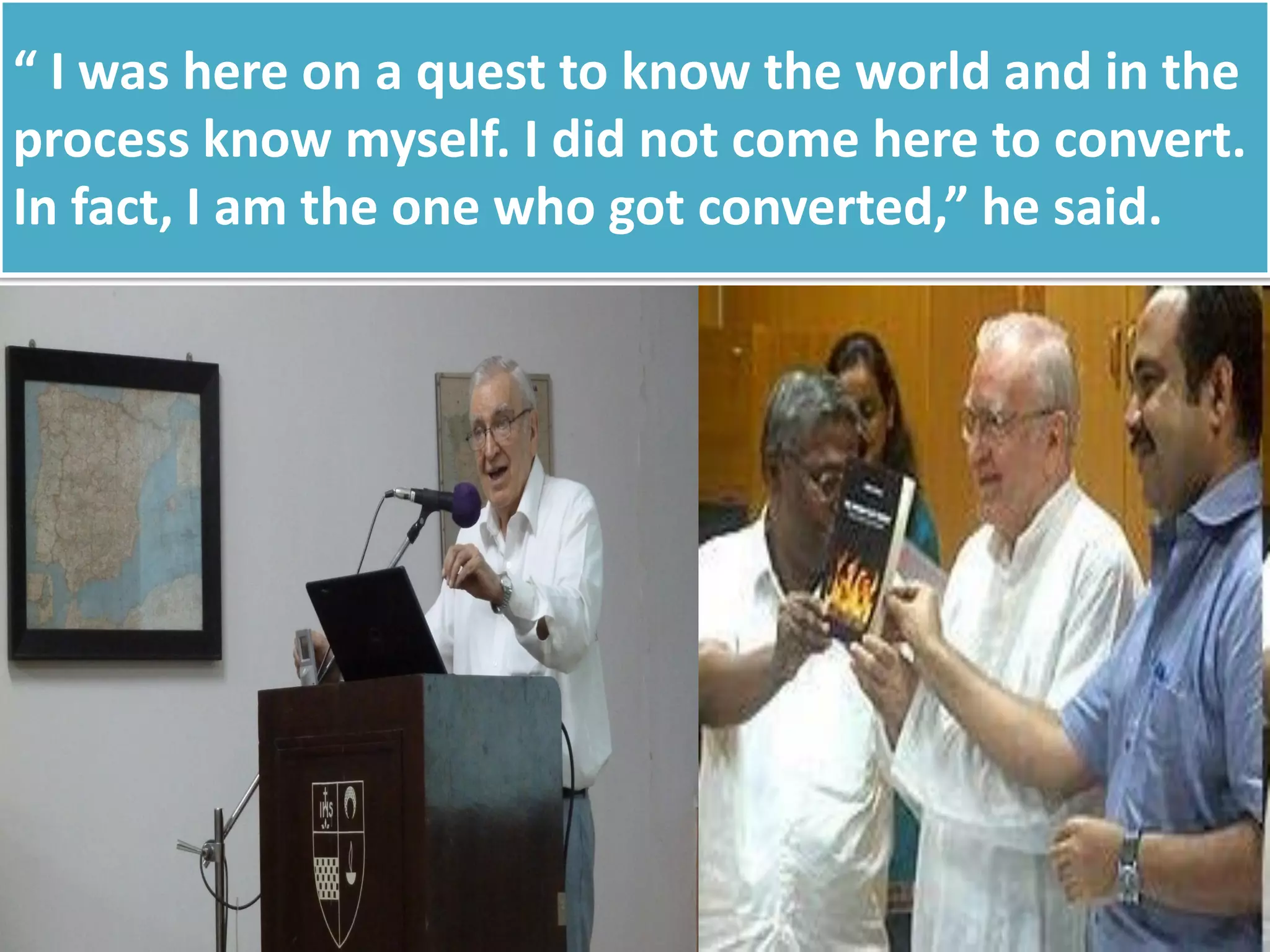
“ I was here on a quest to know the world and in the
process know myself. I did not come here to convert.
In fact, I am the one who got converted,” he said.
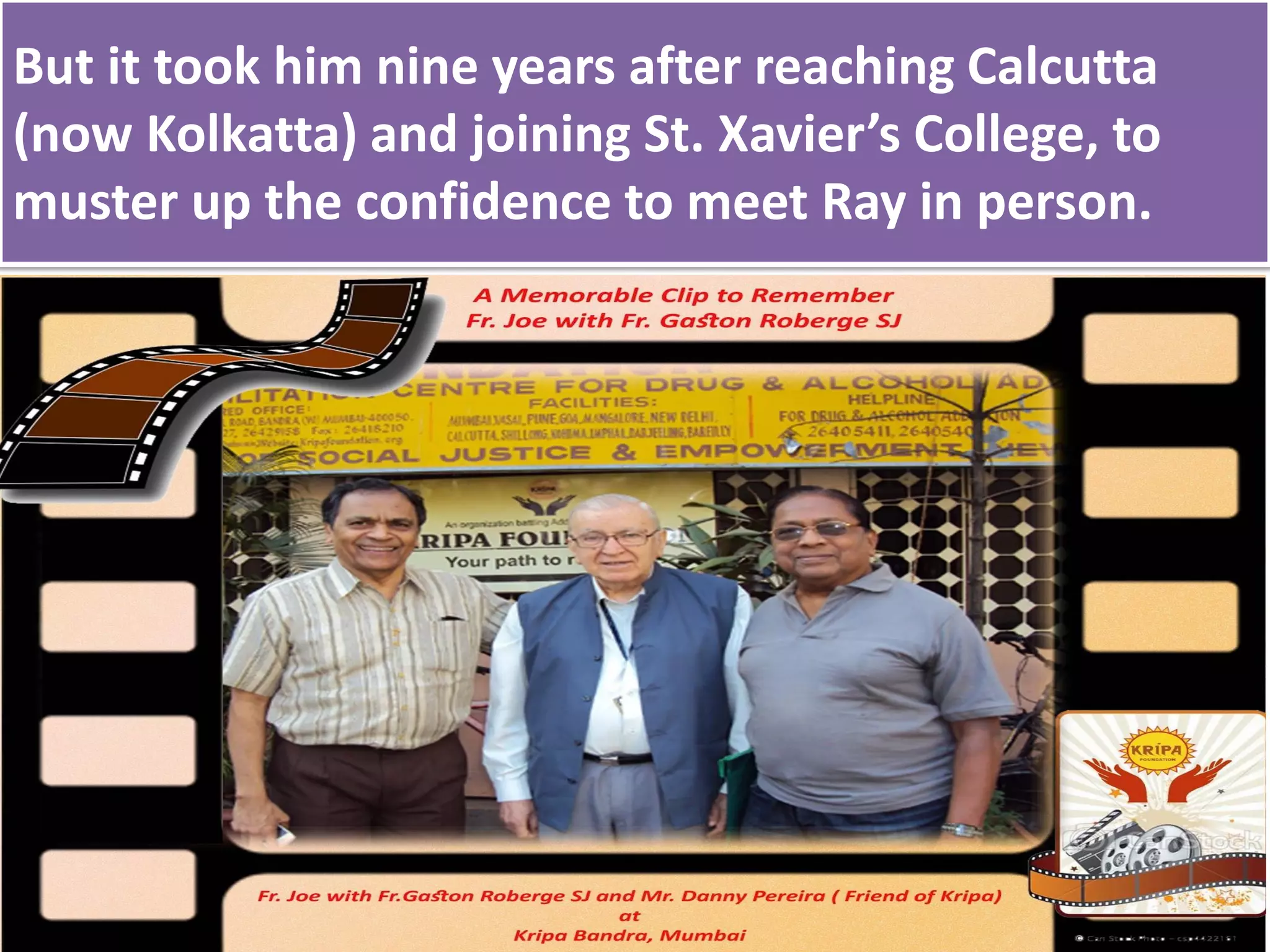
But it took him nine years after reaching Calcutta
(now Kolkatta) and joining St. Xavier’s College, to
muster up the confidence to meet Ray in person.
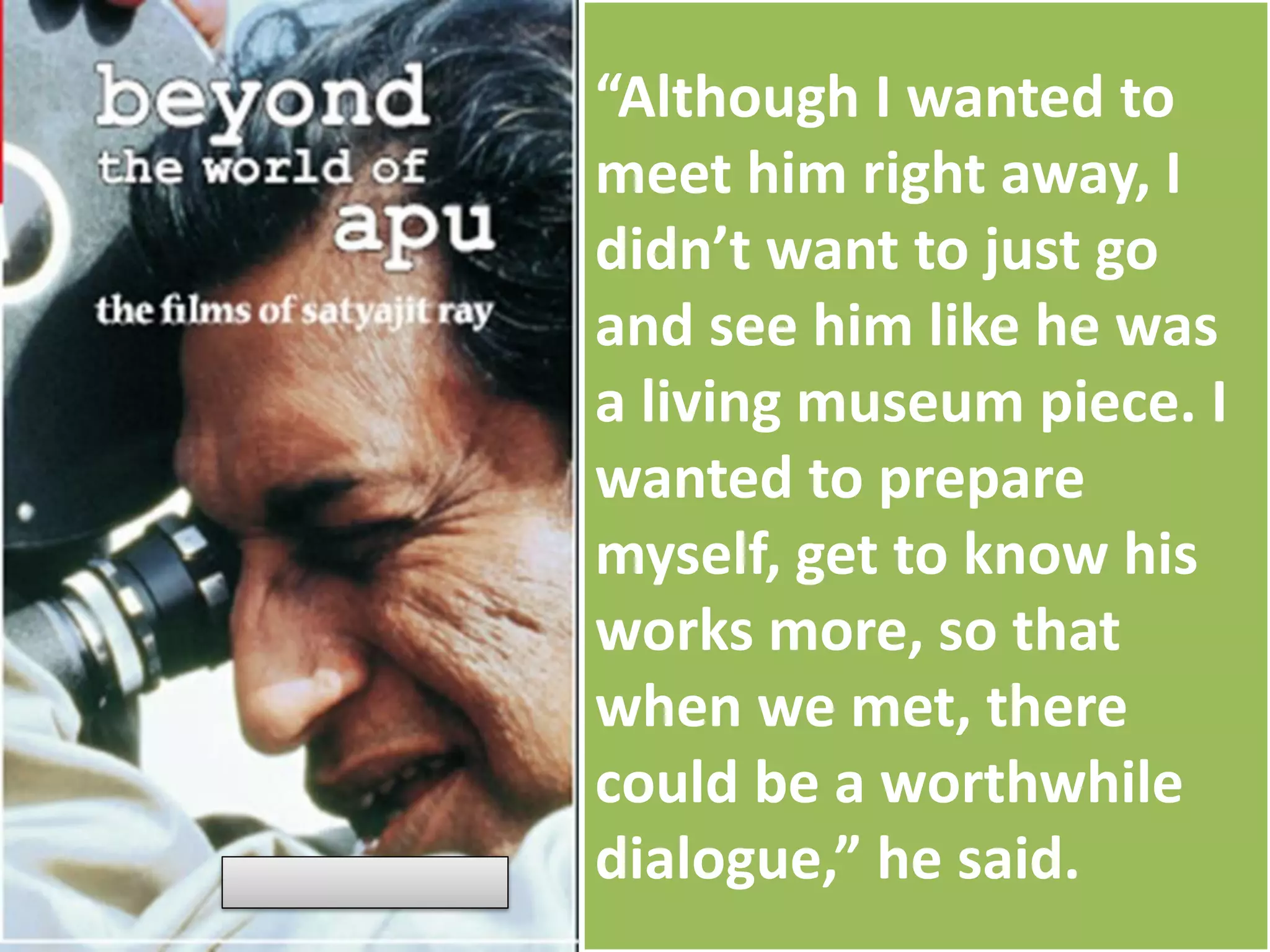
“Although I wanted to
meet him right away, I
didn’t want to just go
and see him like he was
a living museum piece. I
wanted to prepare
myself, get to know his
works more, so that
when we met, there
could be a worthwhile
dialogue,” he said.
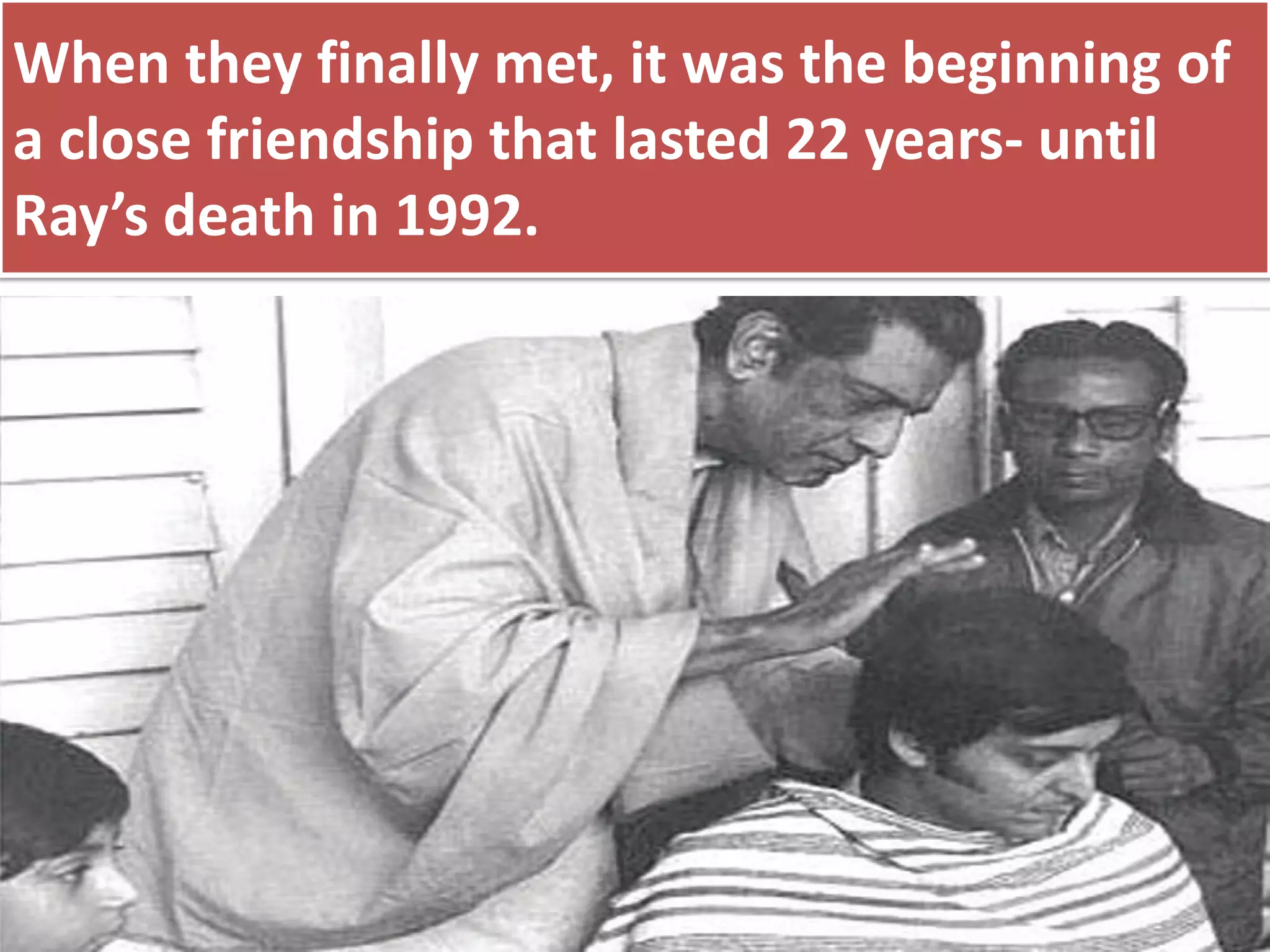
When they finally met, it was the beginning of
a close friendship that lasted 22 years- until
Ray’s death in 1992.
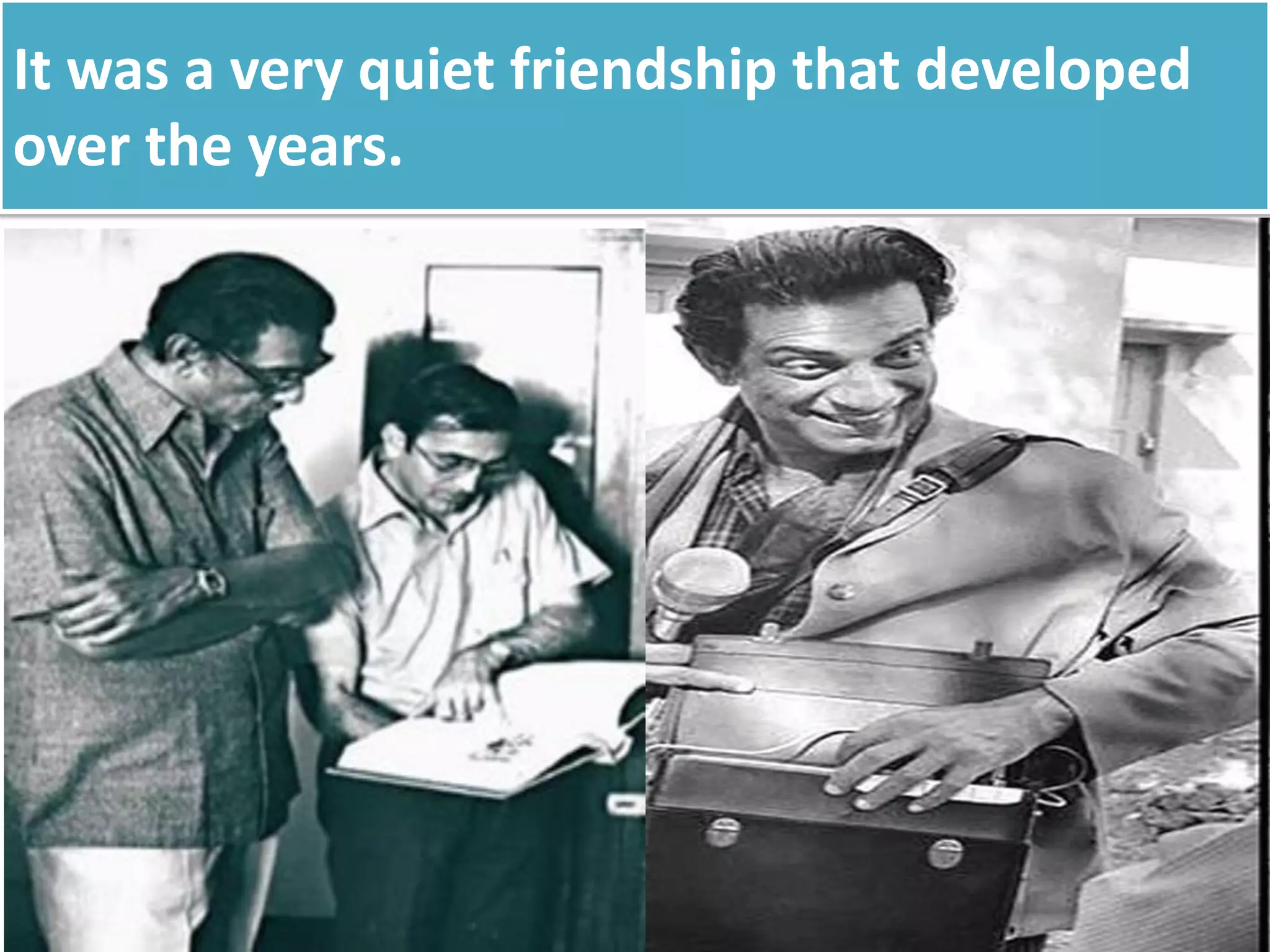
It was a very quiet friendship that developed
over the years.
Manikda [as Ray was affectionately called by his
friends] was a shy person and always very discreet
about displaying his emotions,” said Roberge.
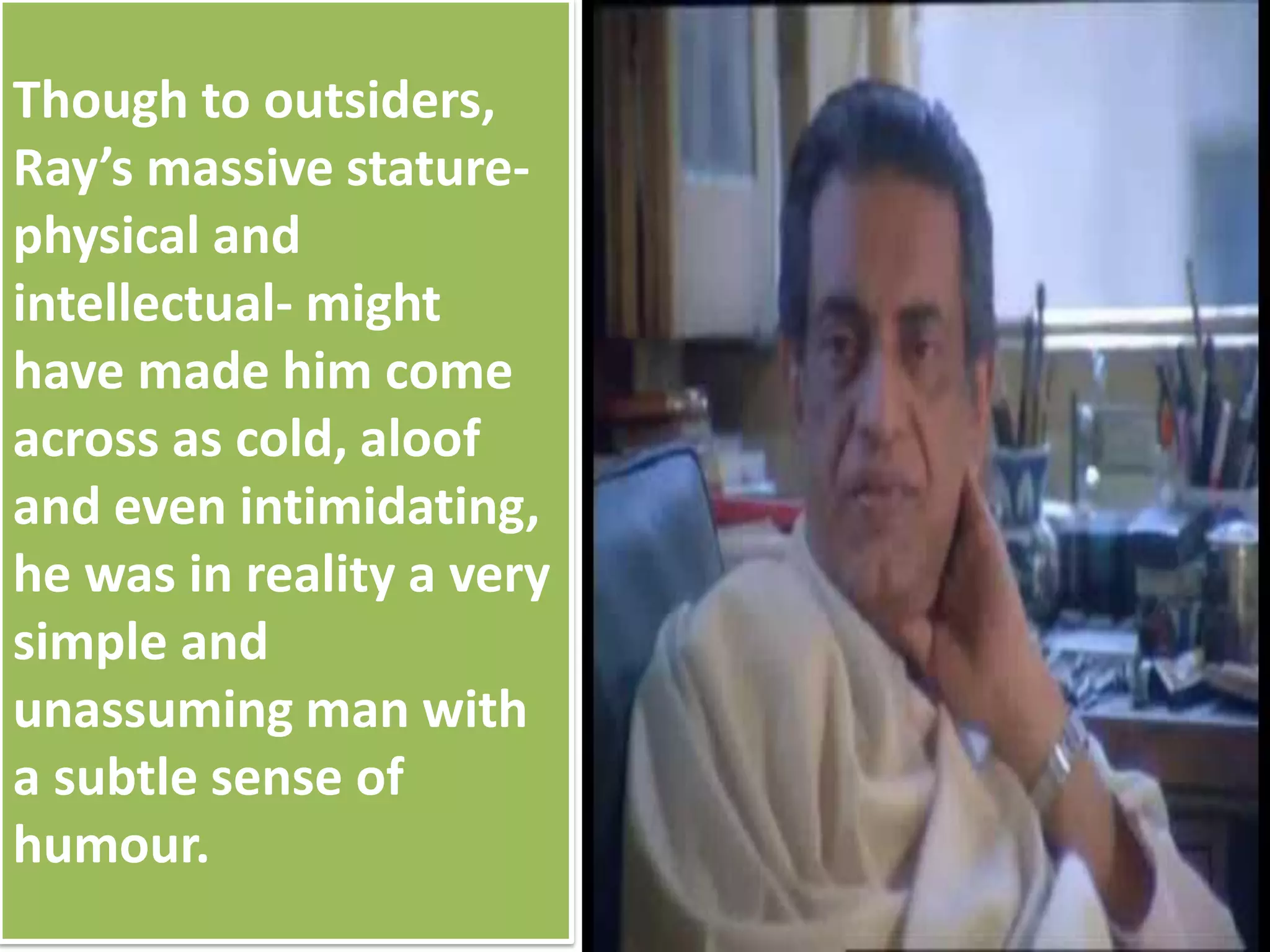
Though to outsiders,
Ray’s massive stature-
physical and
intellectual- might
have made him come
across as cold, aloof
and even intimidating,
he was in reality a very
simple and
unassuming man with
a subtle sense of
humour.
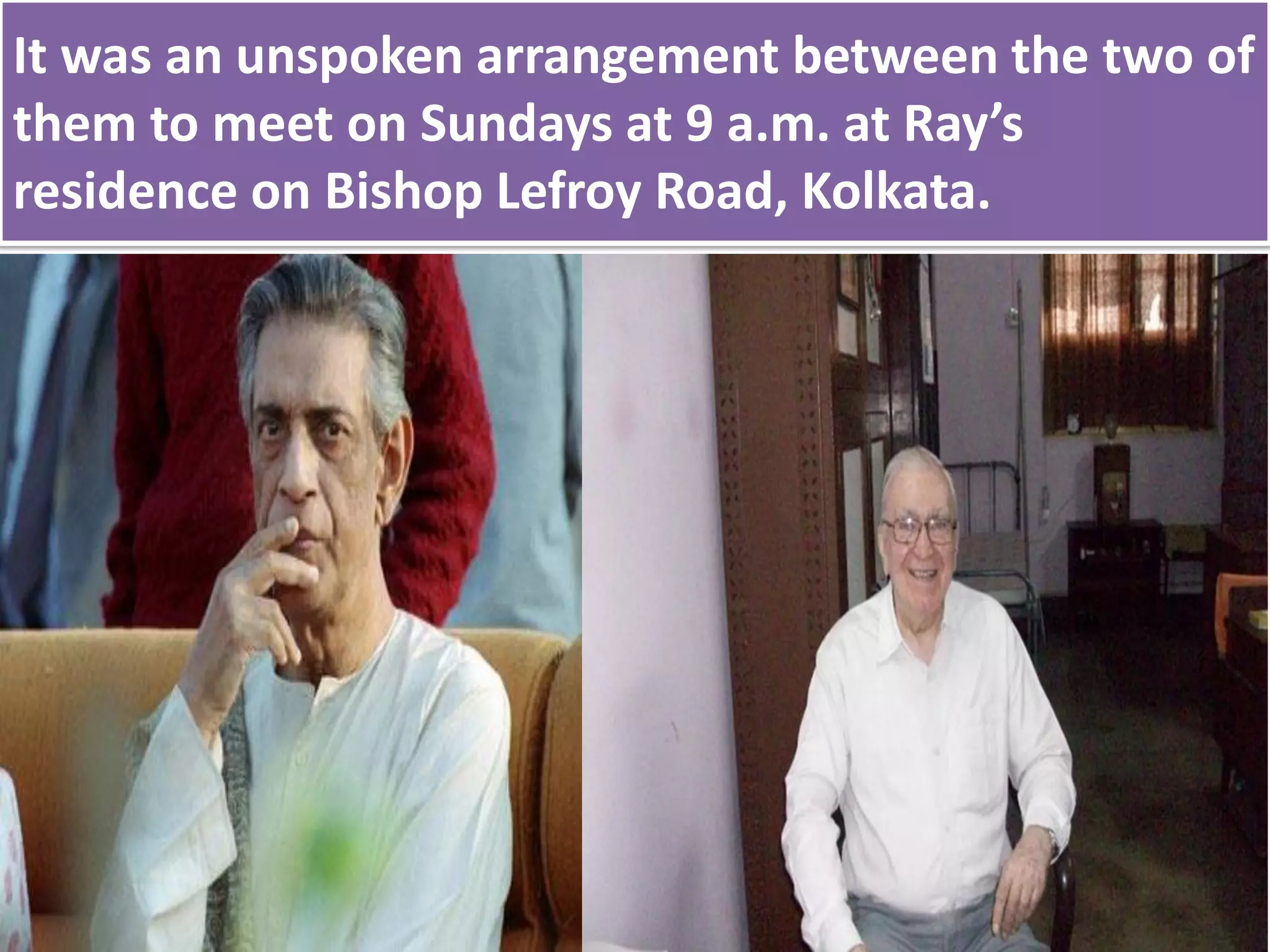
It was an unspoken arrangement between the two of
them to meet on Sundays at 9 a.m. at Ray’s
residence on Bishop Lefroy Road, Kolkata.
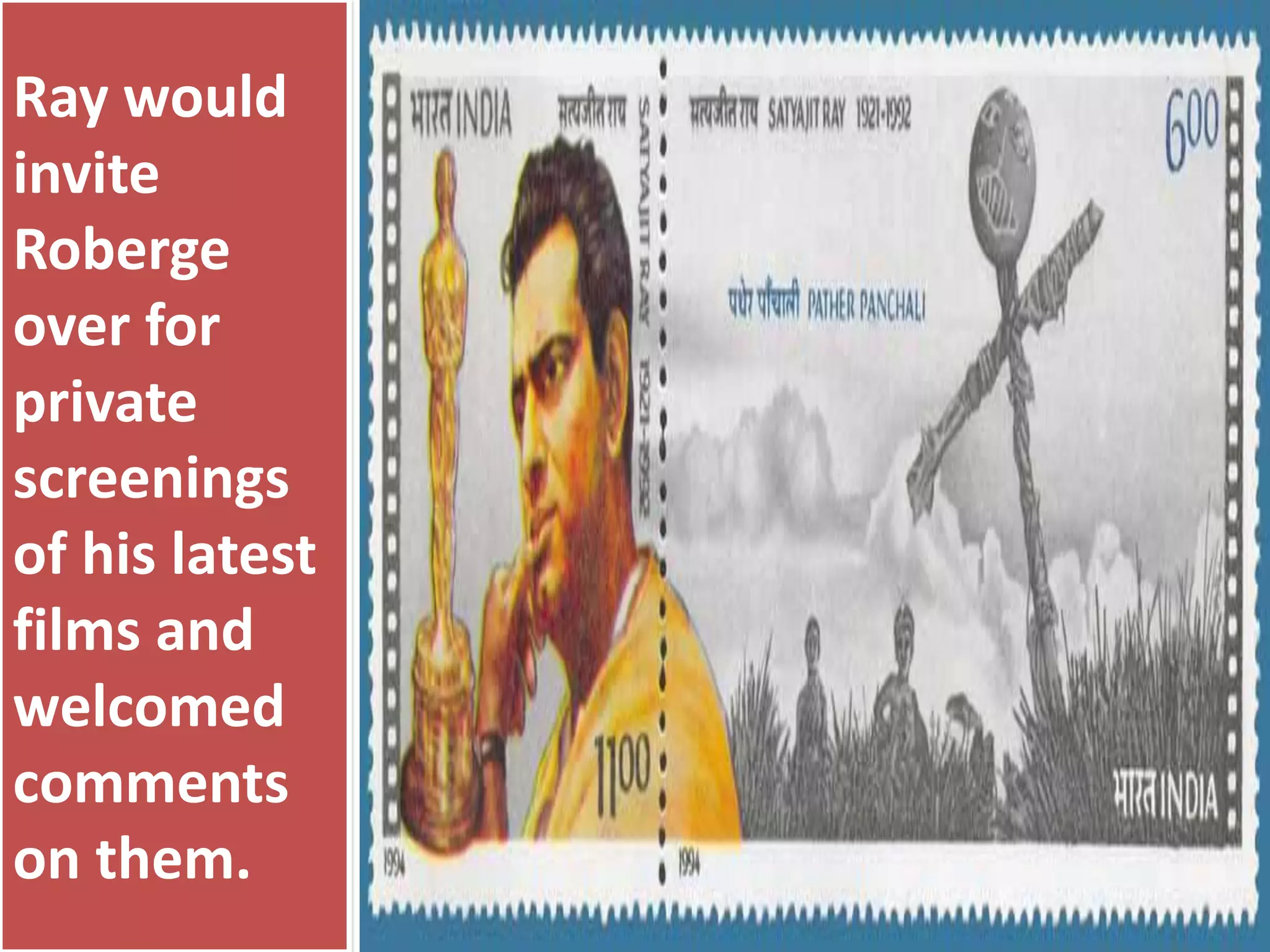
Ray would
invite
Roberge
over for
private
screenings
of his latest
films and
welcomed
comments
on them.
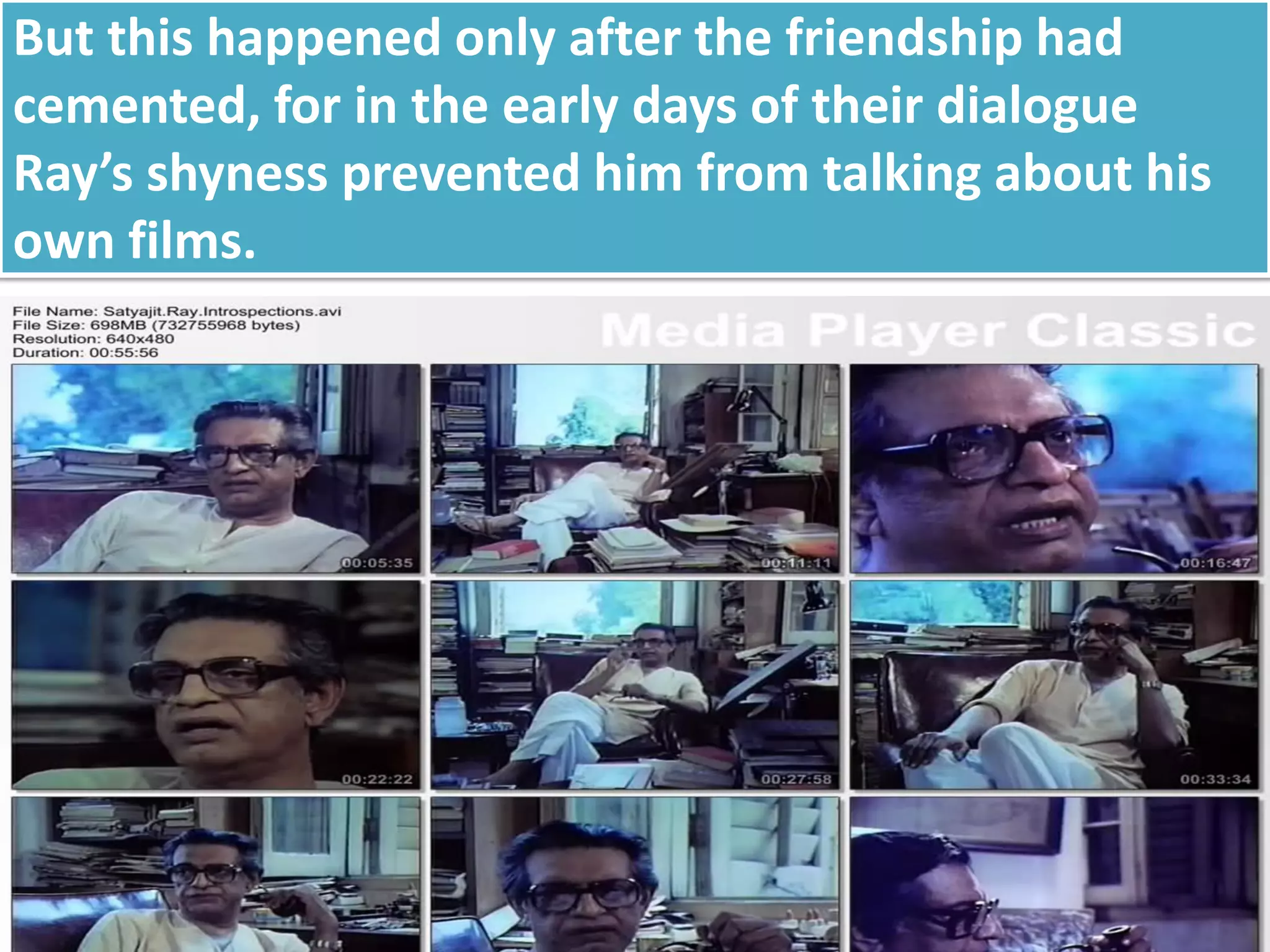
But this happened only after the friendship had
cemented, for in the early days of their dialogue
Ray’s shyness prevented him from talking about his
own films.
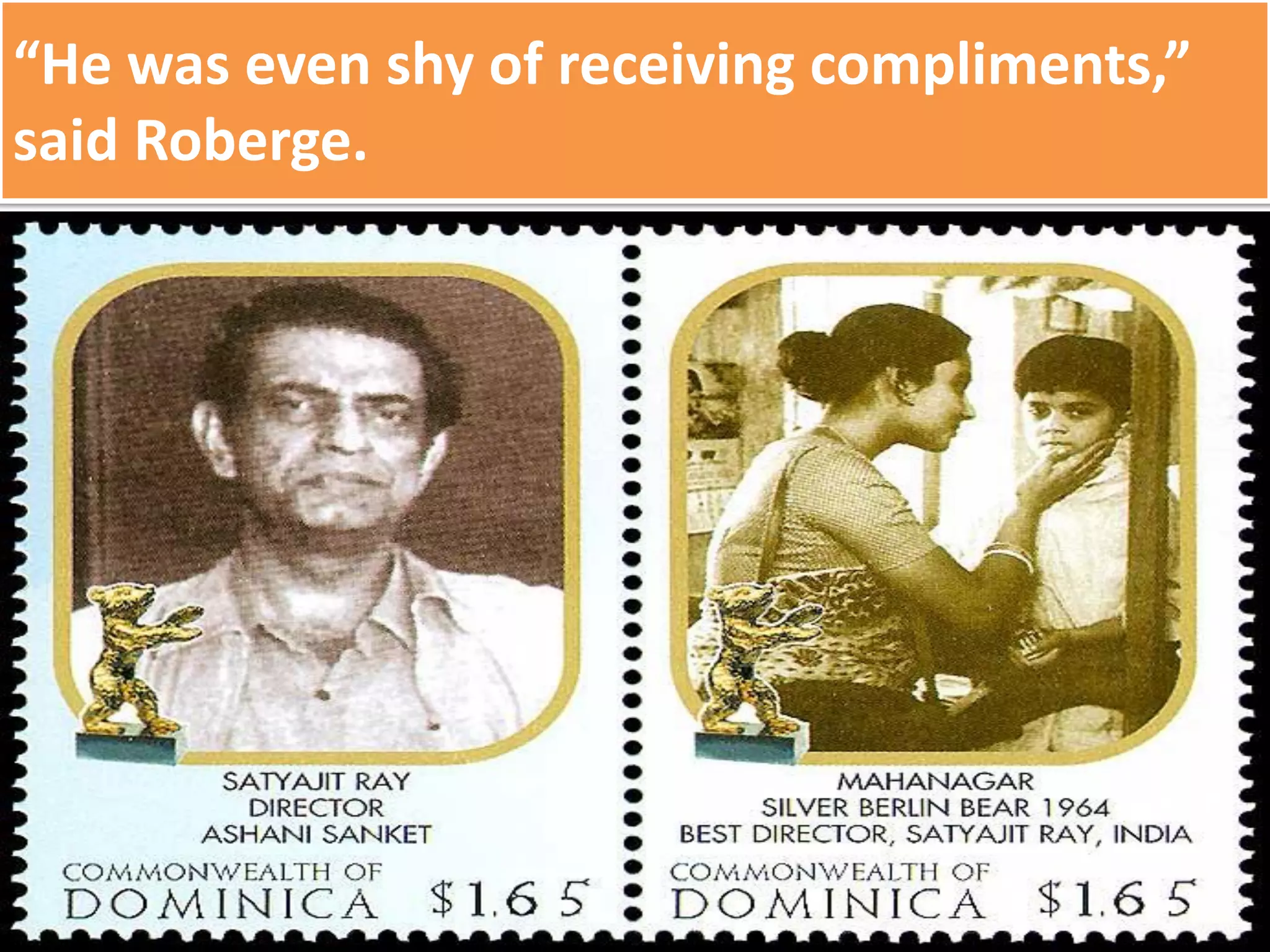
“He was even shy of receiving compliments,”
said Roberge.
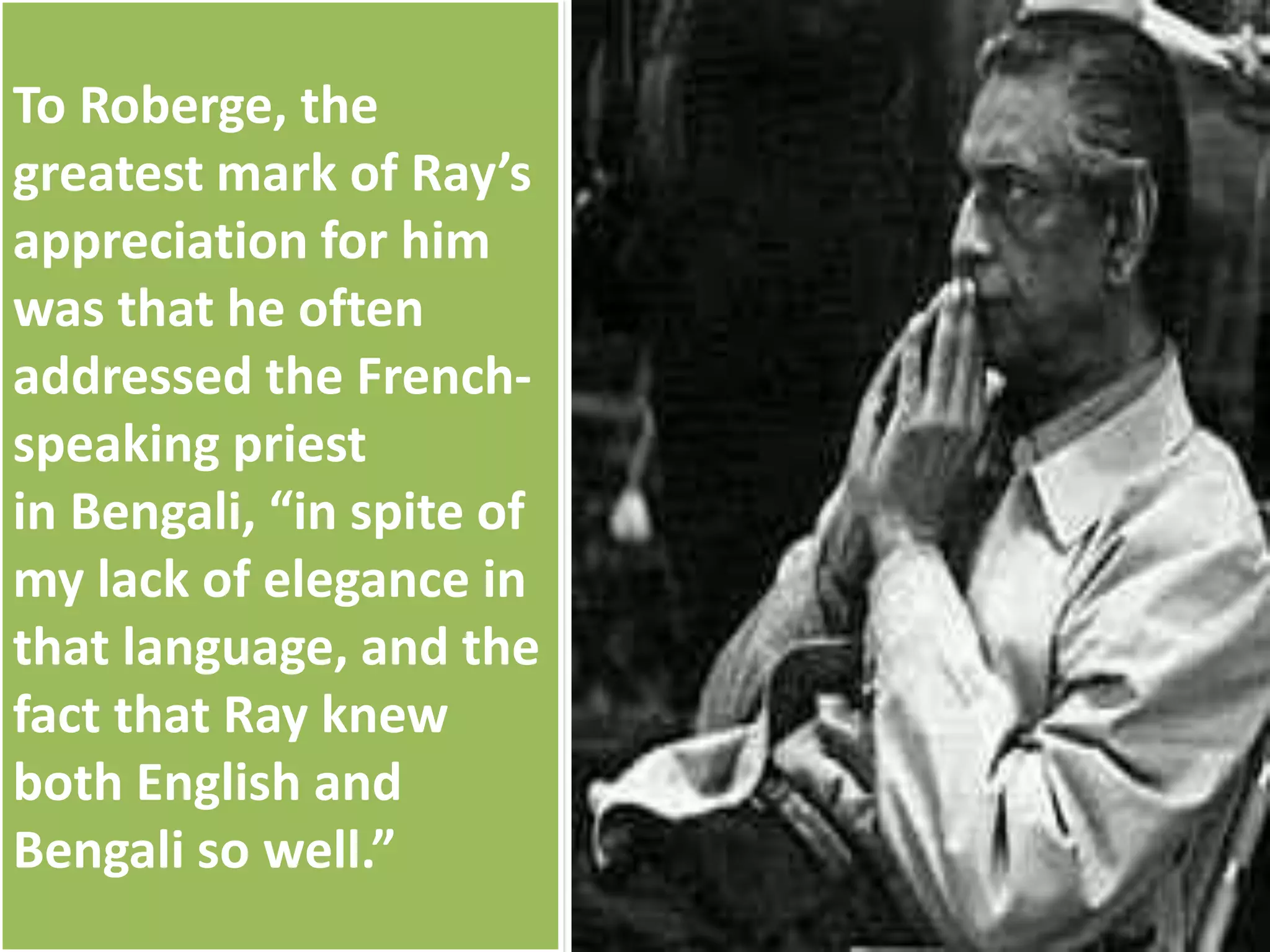
To Roberge, the
greatest mark of Ray’s
appreciation for him
was that he often
addressed the French-
speaking priest
in Bengali, “in spite of
my lack of elegance in
that language, and the
fact that Ray knew
both English and
Bengali so well.”
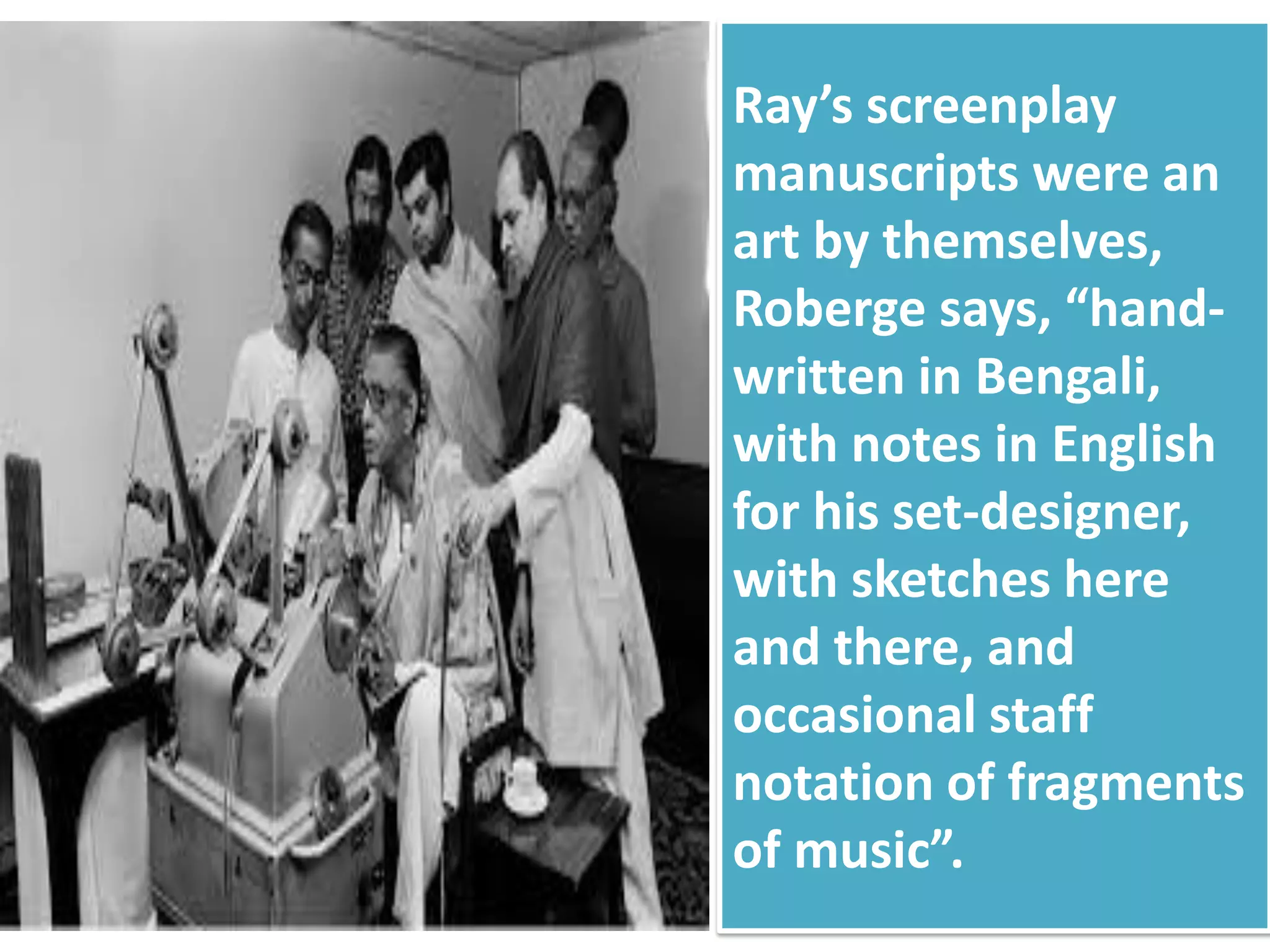
Ray’s screenplay
manuscripts were an
art by themselves,
Roberge says, “hand-
written in Bengali,
with notes in English
for his set-designer,
with sketches here
and there, and
occasional staff
notation of fragments
of music”.
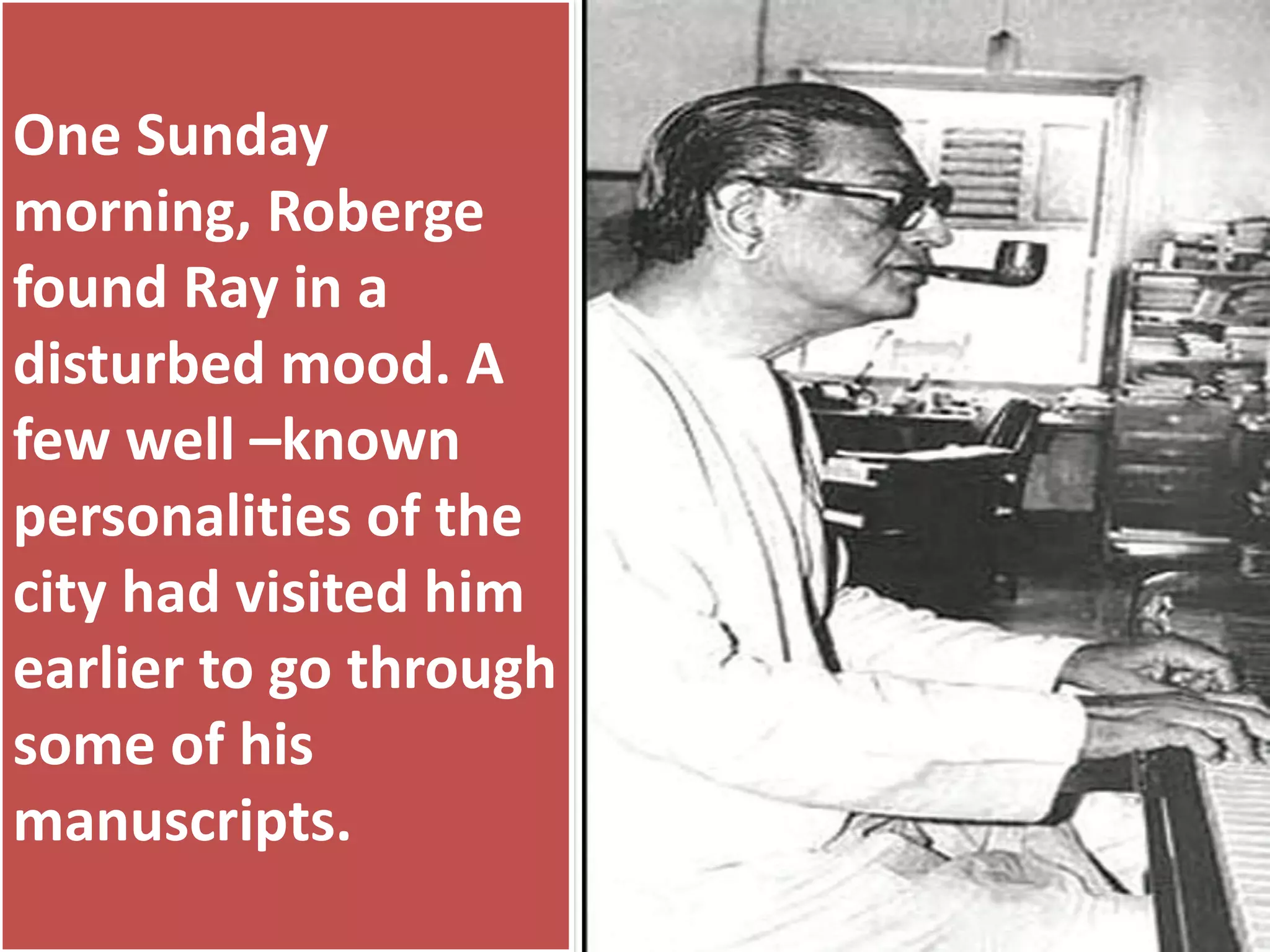
One Sunday
morning, Roberge
found Ray in a
disturbed mood. A
few well –known
personalities of the
city had visited him
earlier to go through
some of his
manuscripts.
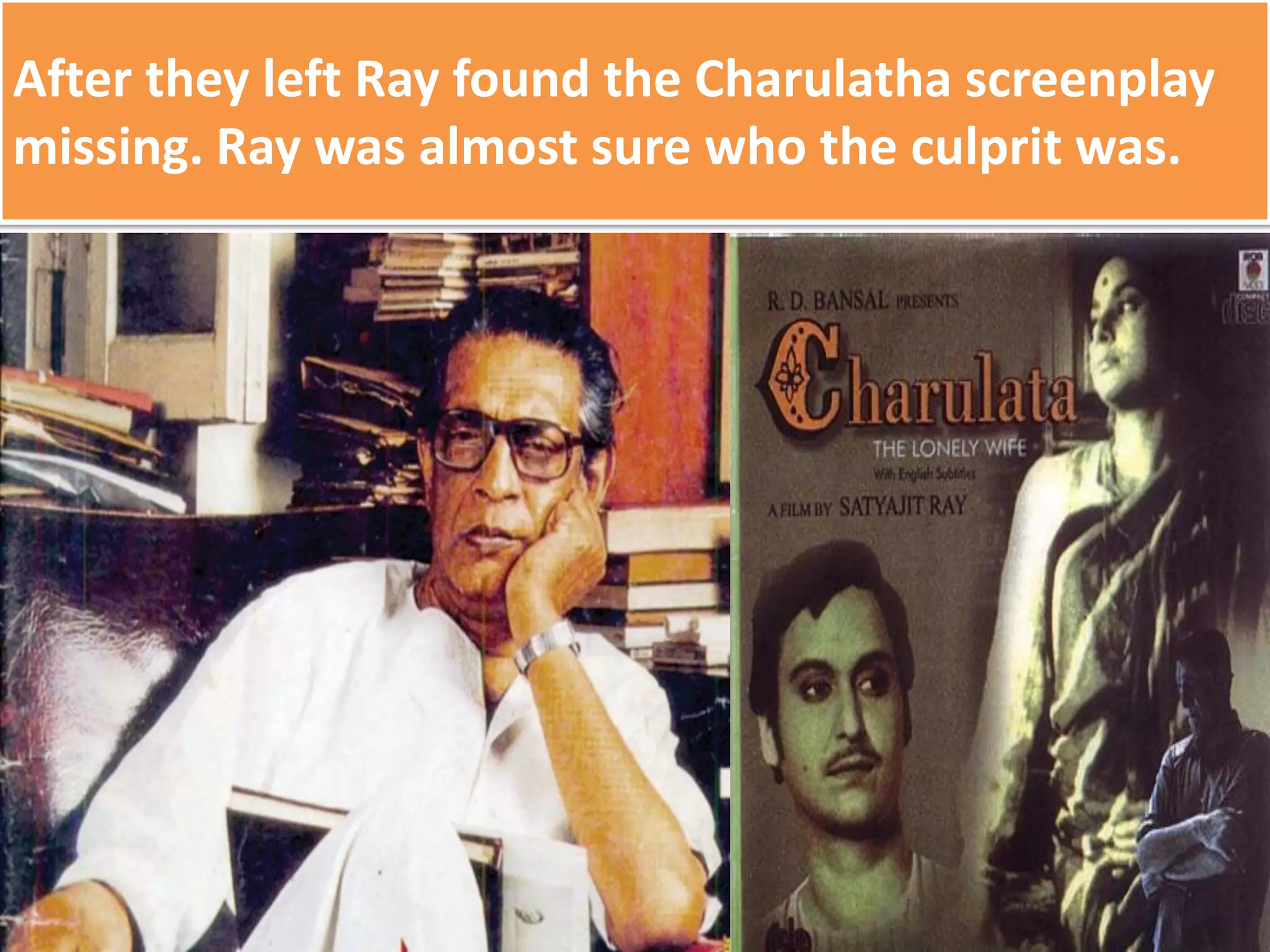
After they left Ray found the Charulatha screenplay
missing. Ray was almost sure who the culprit was.
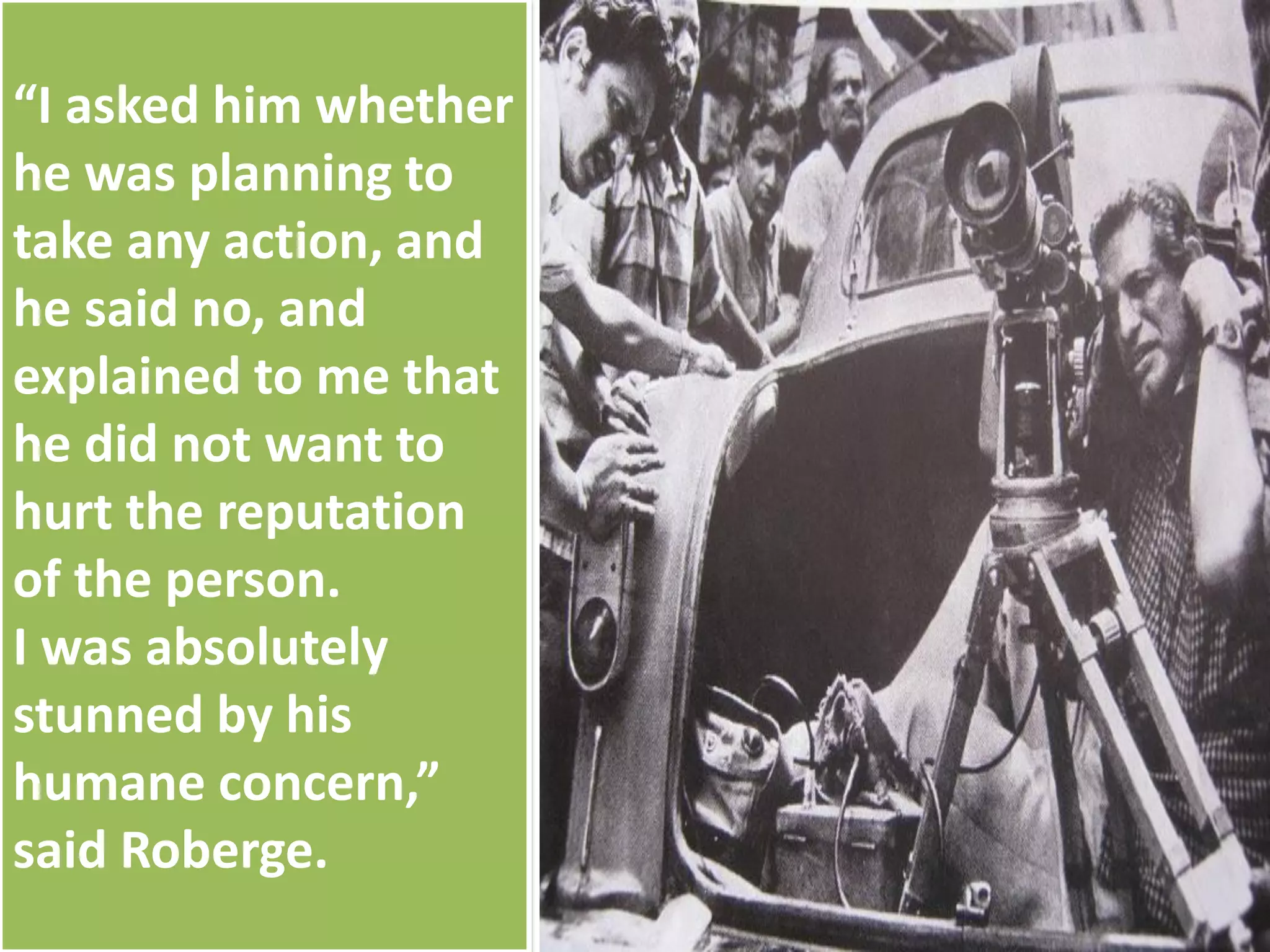
“I asked him whether
he was planning to
take any action, and
he said no, and
explained to me that
he did not want to
hurt the reputation
of the person.
I was absolutely
stunned by his
humane concern,”
said Roberge.
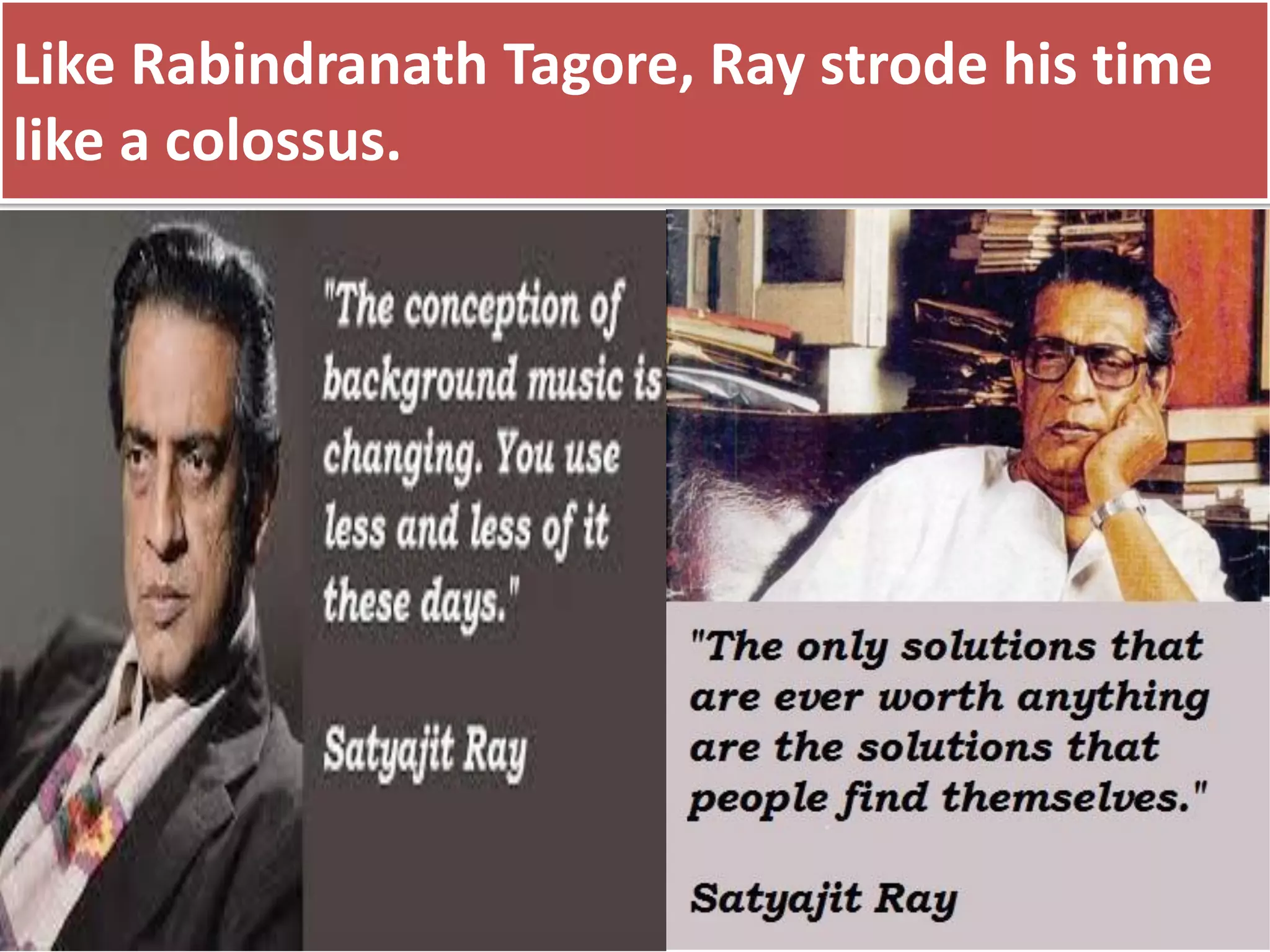
Like Rabindranath Tagore, Ray strode his time
like a colossus.
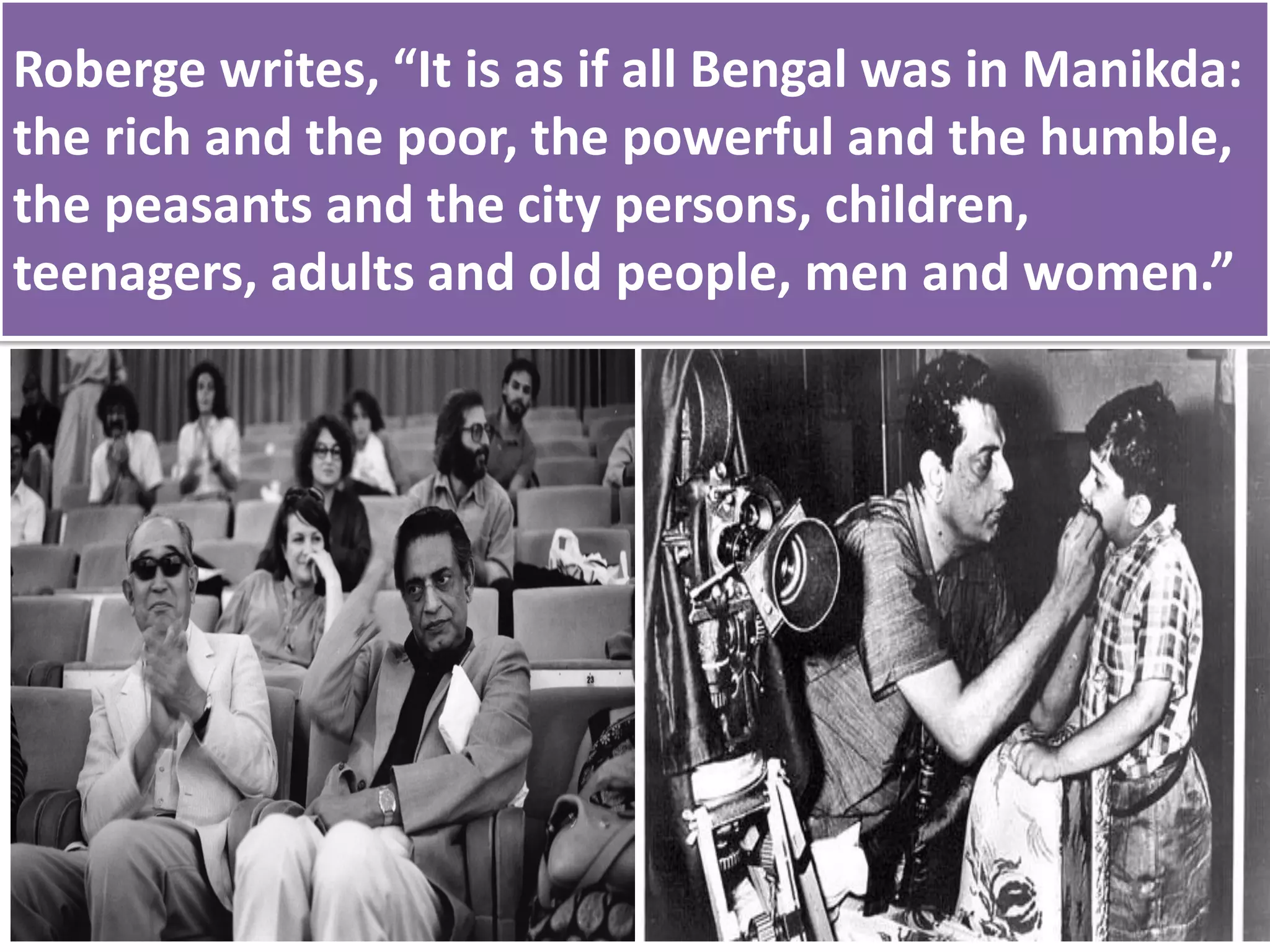
Roberge writes, “It is as if all Bengal was in Manikda:
the rich and the poor, the powerful and the humble,
the peasants and the city persons, children,
teenagers, adults and old people, men and women.”
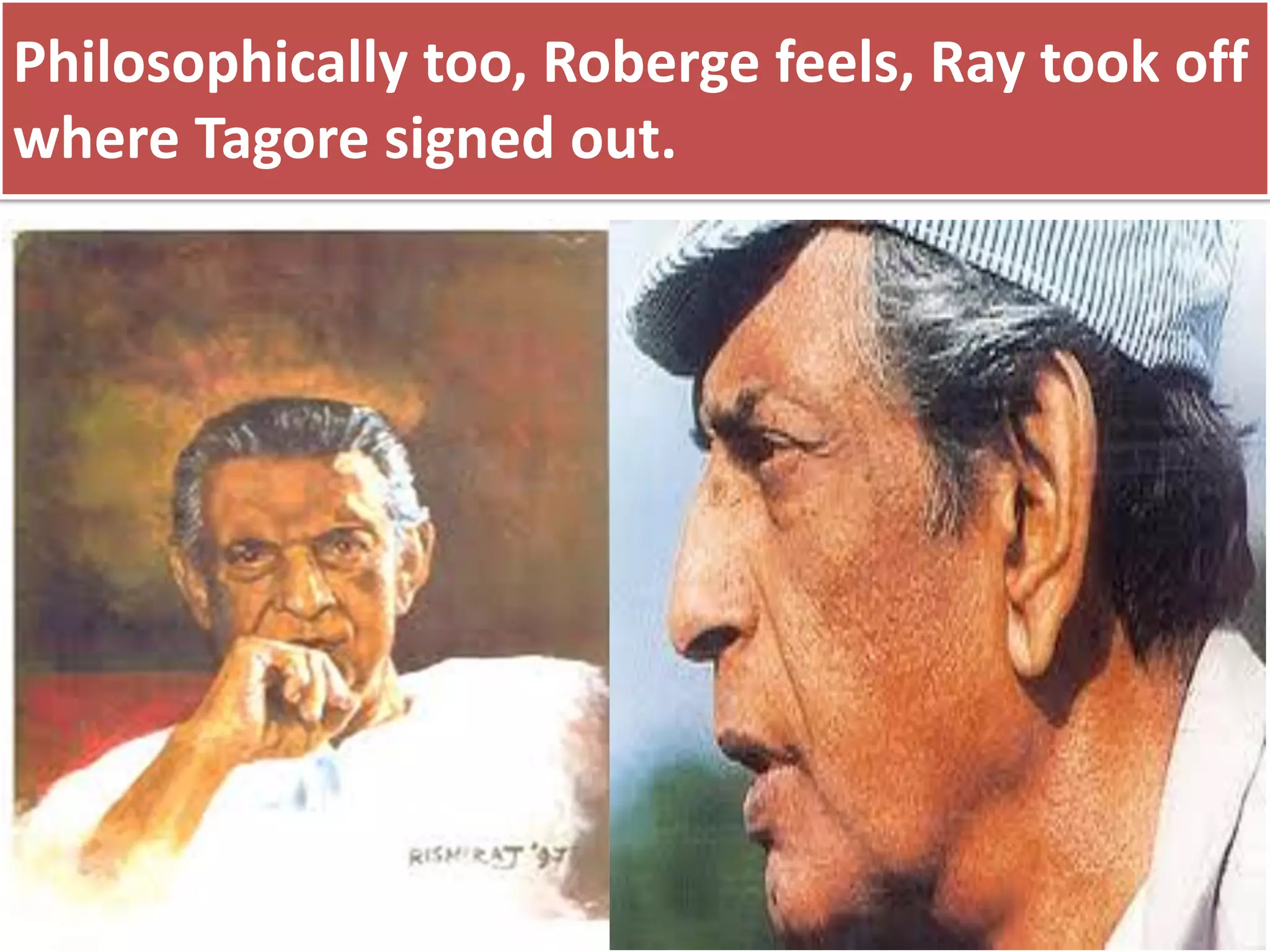
Philosophically too, Roberge feels, Ray took off
where Tagore signed out.
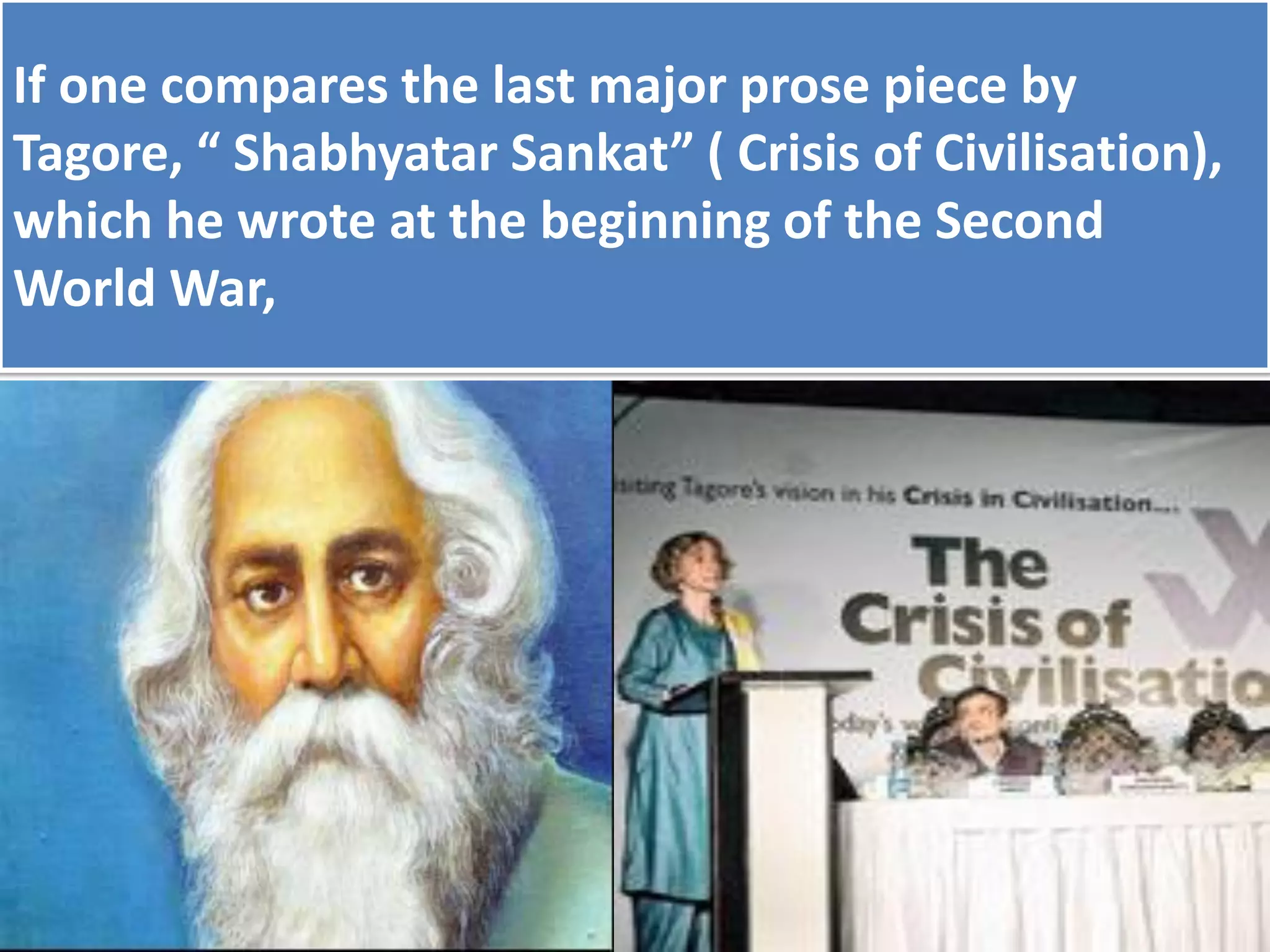
If one compares the last major prose piece by
Tagore, “ Shabhyatar Sankat” ( Crisis of Civilisation),
which he wrote at the beginning of the Second
World War,
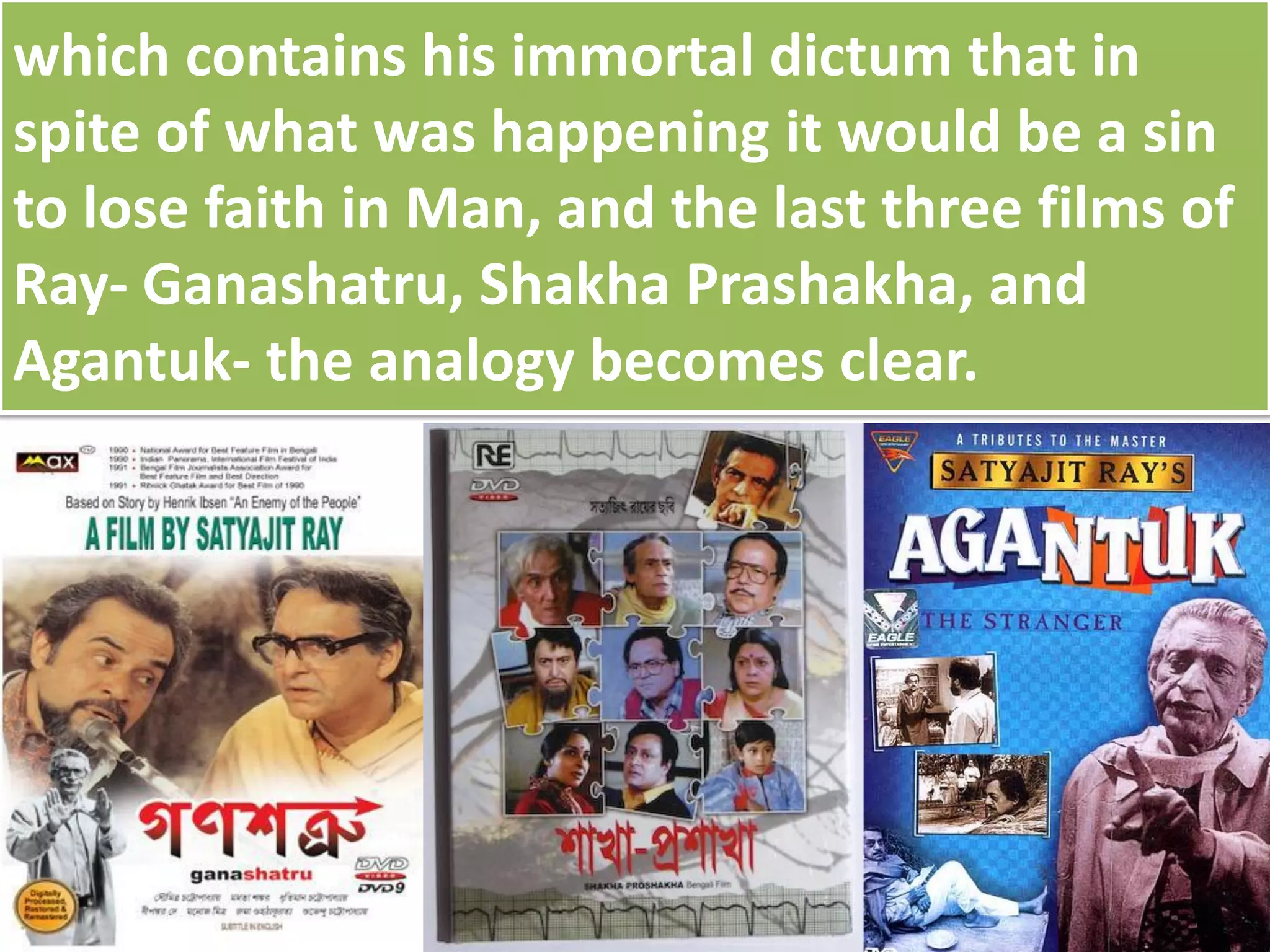
which contains his immortal dictum that in
spite of what was happening it would be a sin
to lose faith in Man, and the last three films of
Ray- Ganashatru, Shakha Prashakha, and
Agantuk- the analogy becomes clear.
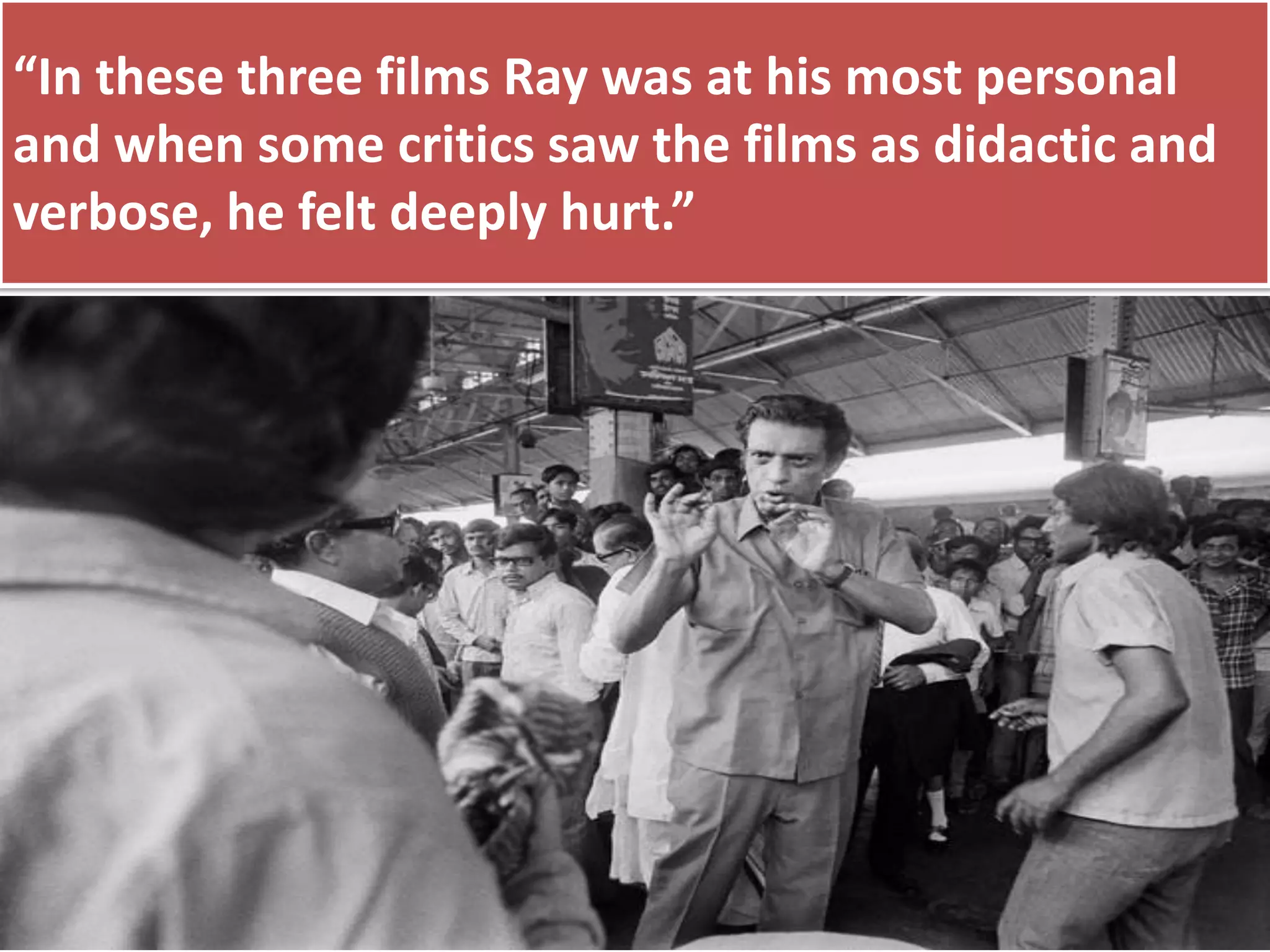
“In these three films Ray was at his most personal
and when some critics saw the films as didactic and
verbose, he felt deeply hurt.”
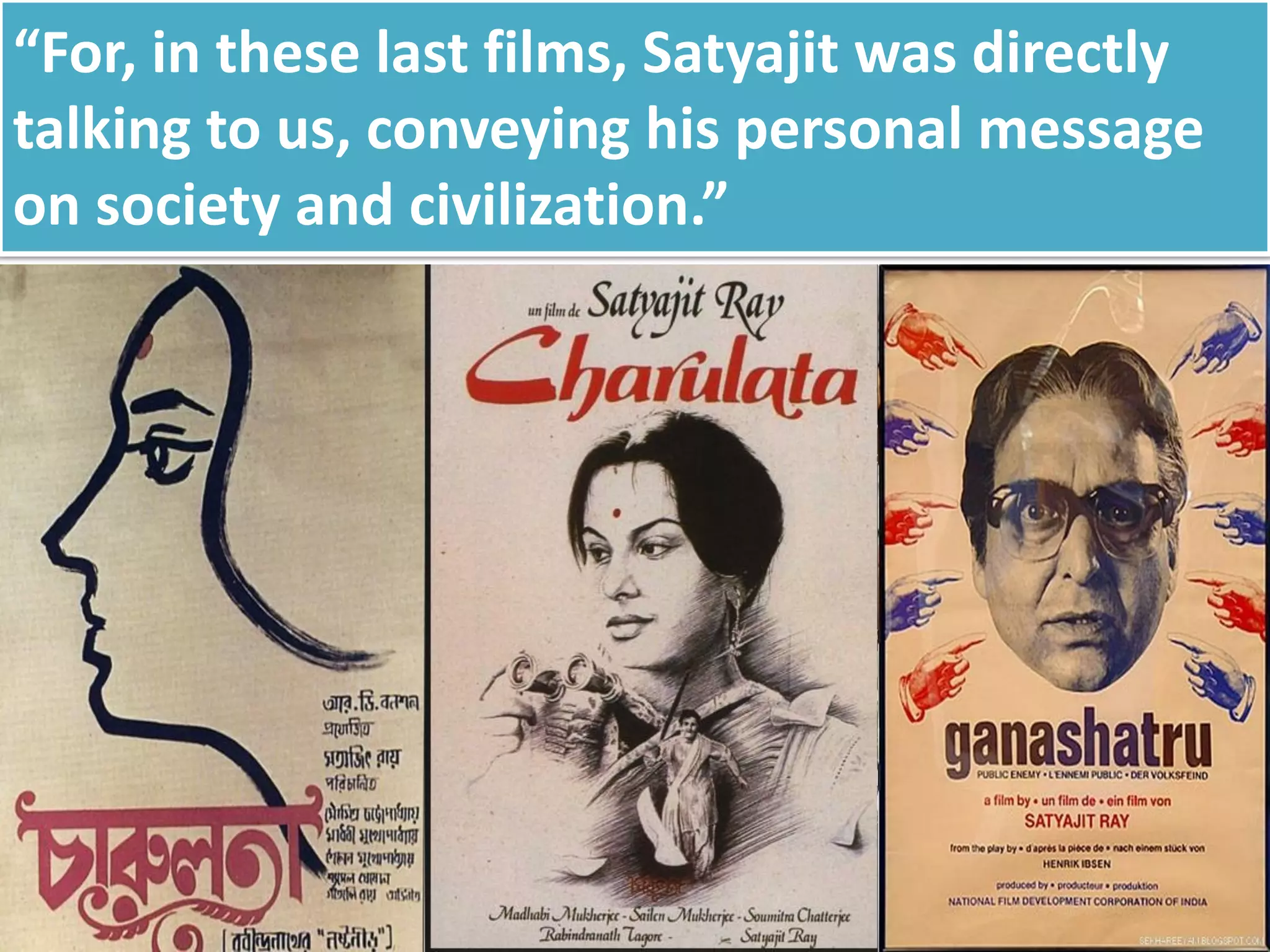
“For, in these last films, Satyajit was directly
talking to us, conveying his personal message
on society and civilization.”
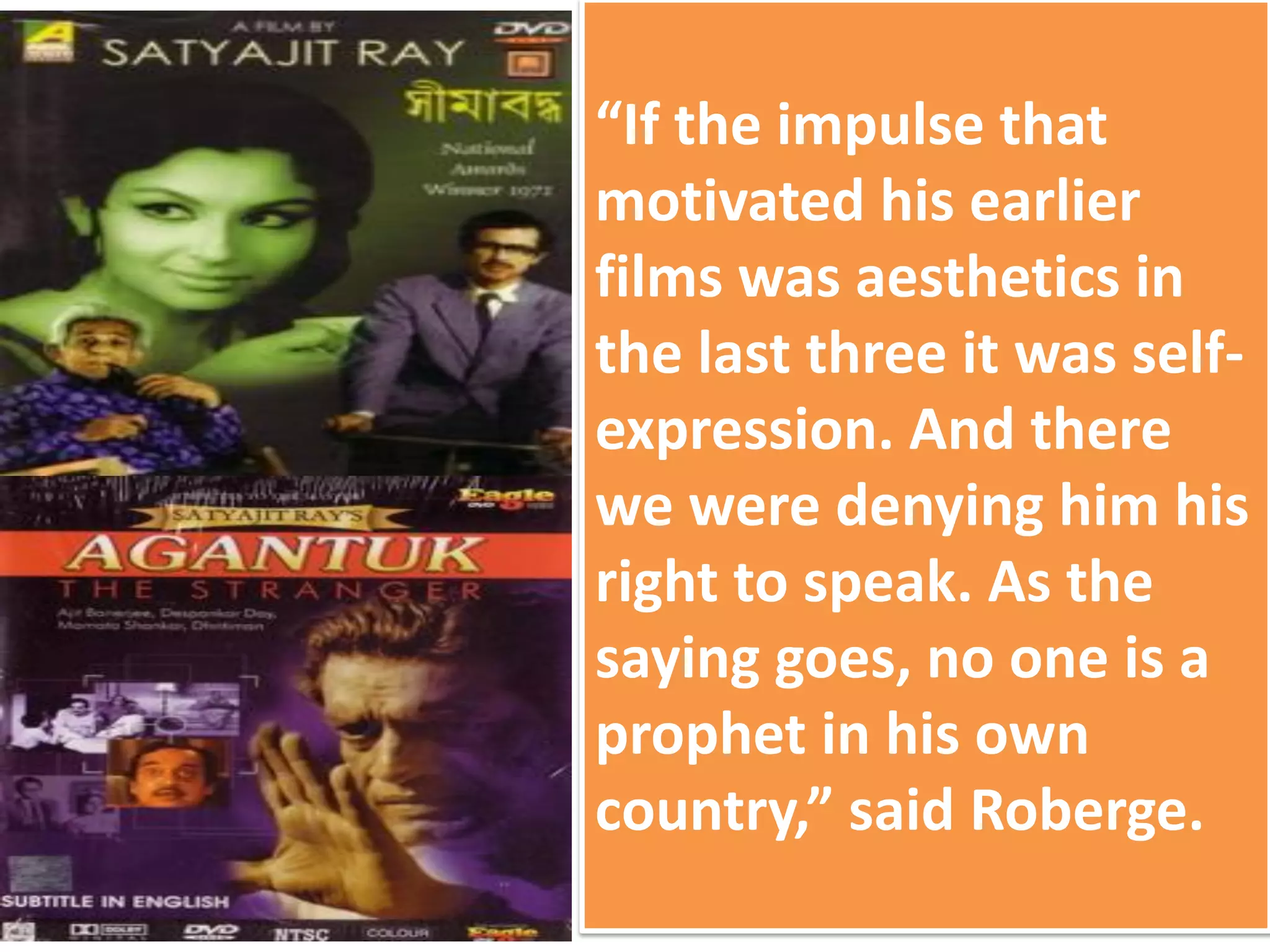
“If the impulse that
motivated his earlier
films was aesthetics in
the last three it was self-
expression. And there
we were denying him his
right to speak. As the
saying goes, no one is a
prophet in his own
country,” said Roberge.
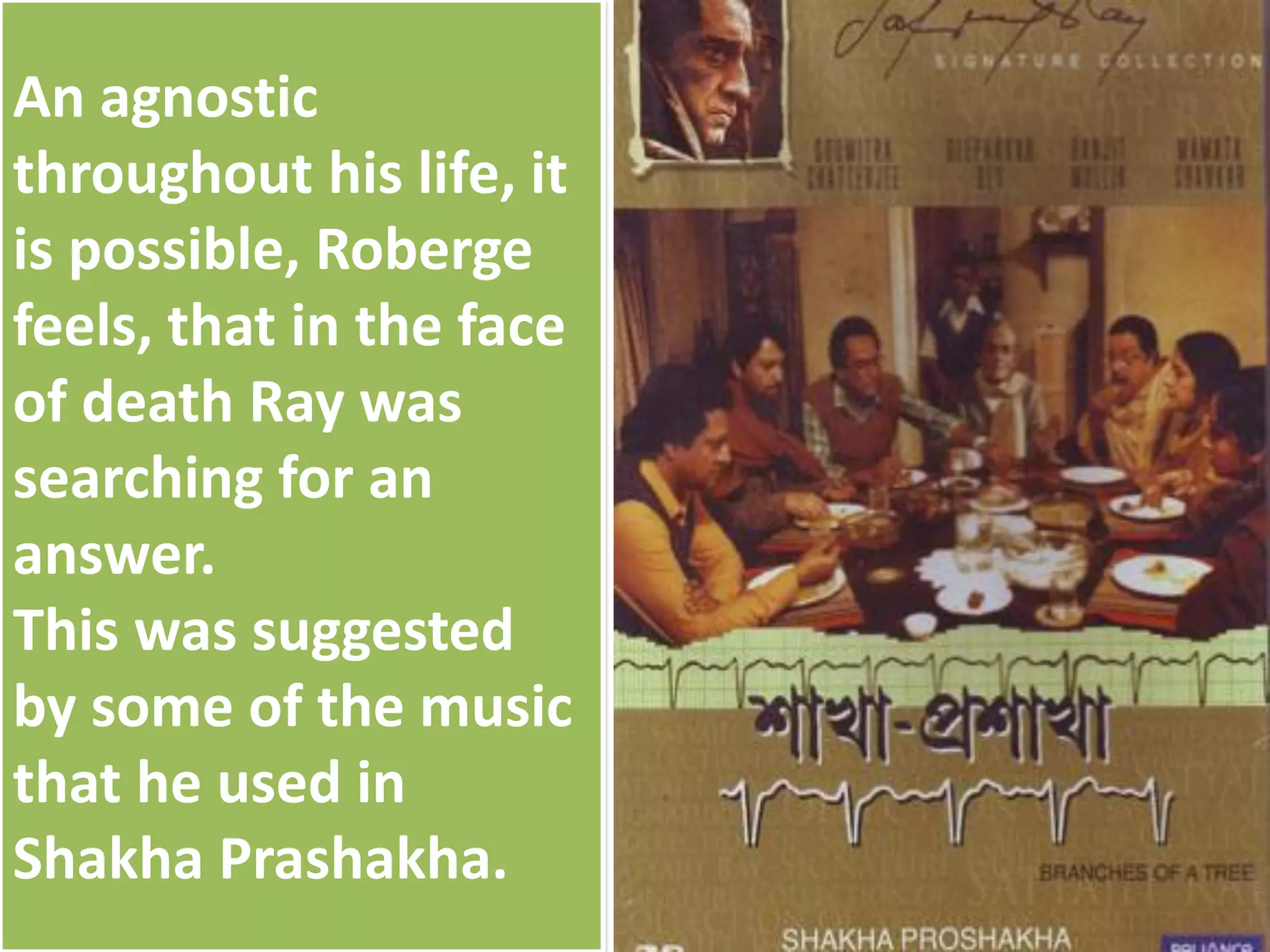
An agnostic
throughout his life, it
is possible, Roberge
feels, that in the face
of death Ray was
searching for an
answer.
This was suggested
by some of the music
that he used in
Shakha Prashakha.
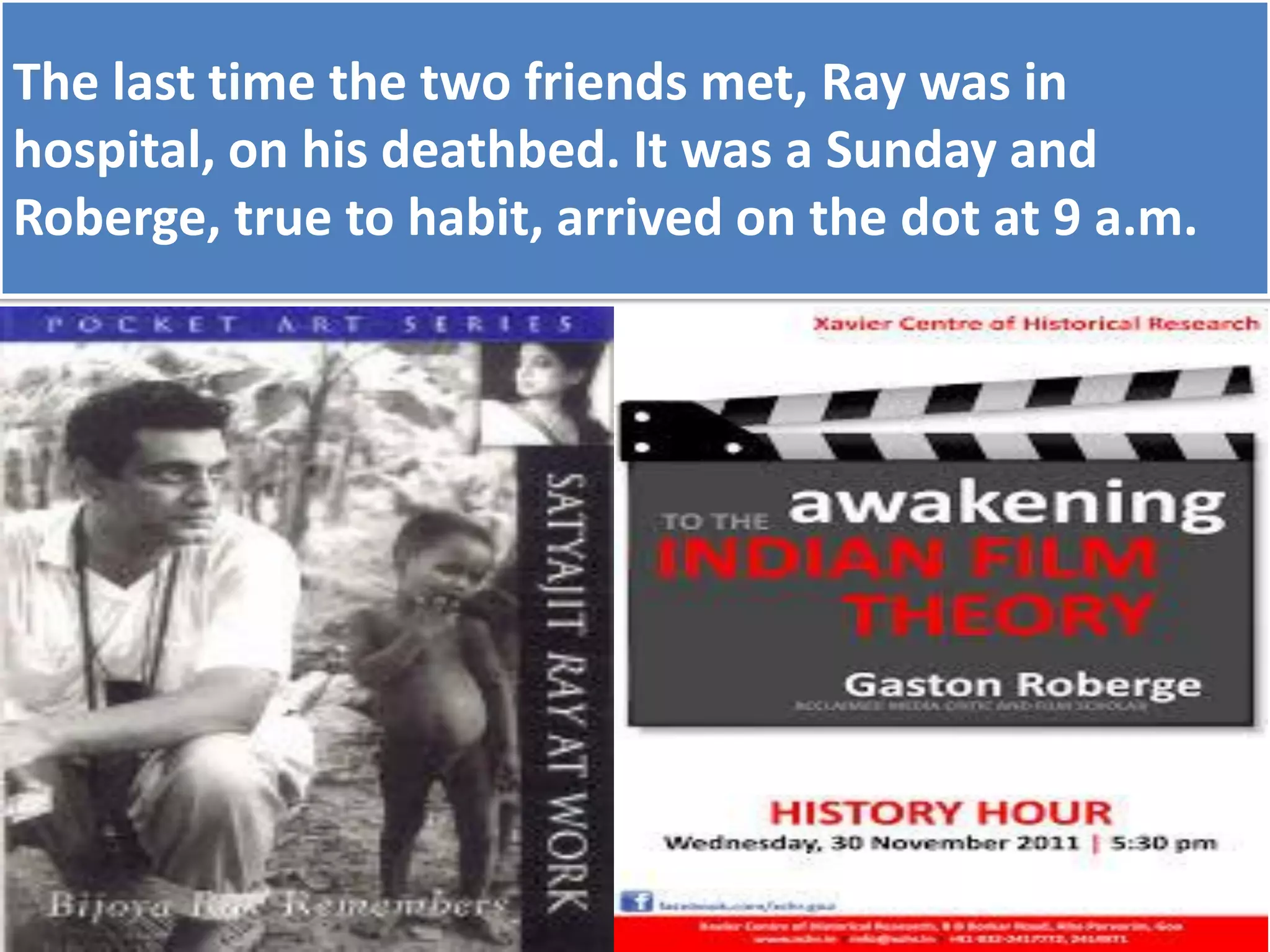
The last time the two friends met, Ray was in
hospital, on his deathbed. It was a Sunday and
Roberge, true to habit, arrived on the dot at 9 a.m.
“He had grown
so weak that he
looked frail as a
child. I did not
stay long, and as
I was leaving,
Manikda said,
‘Bhalo laglo’ [it
was nice]. Those
were his last
words to me,”
said Roberge.
One important fallout
of this friendship was
the establishment of
Chitrabani, a
communication and
film institute, the first
of its kind in West
Bengal, which Roberge
founded in 1970 and to
which Ray, as a token of
friendship, lent his
name as co-founder.
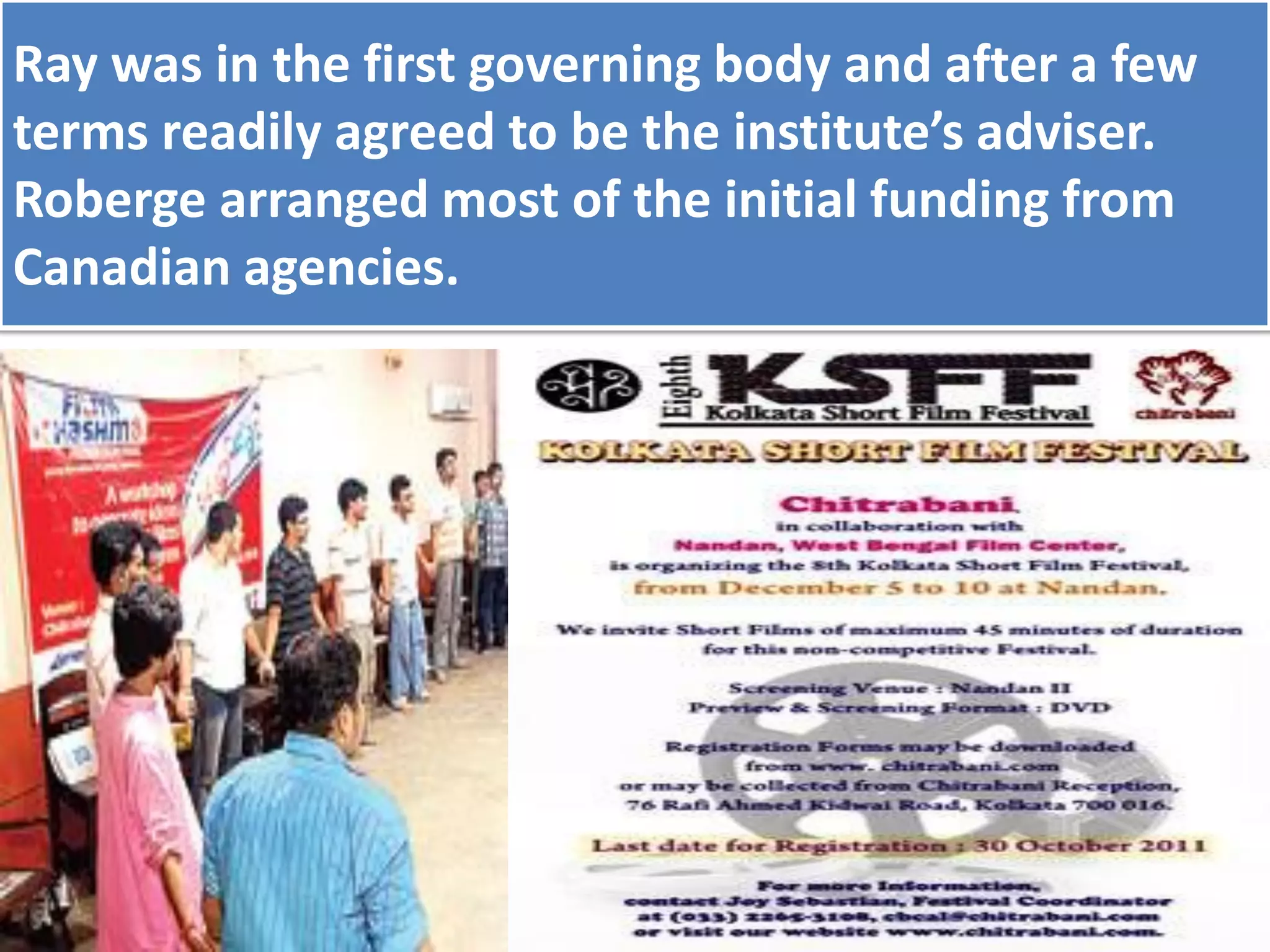
Ray was in the first governing body and after a few
terms readily agreed to be the institute’s adviser.
Roberge arranged most of the initial funding from
Canadian agencies.
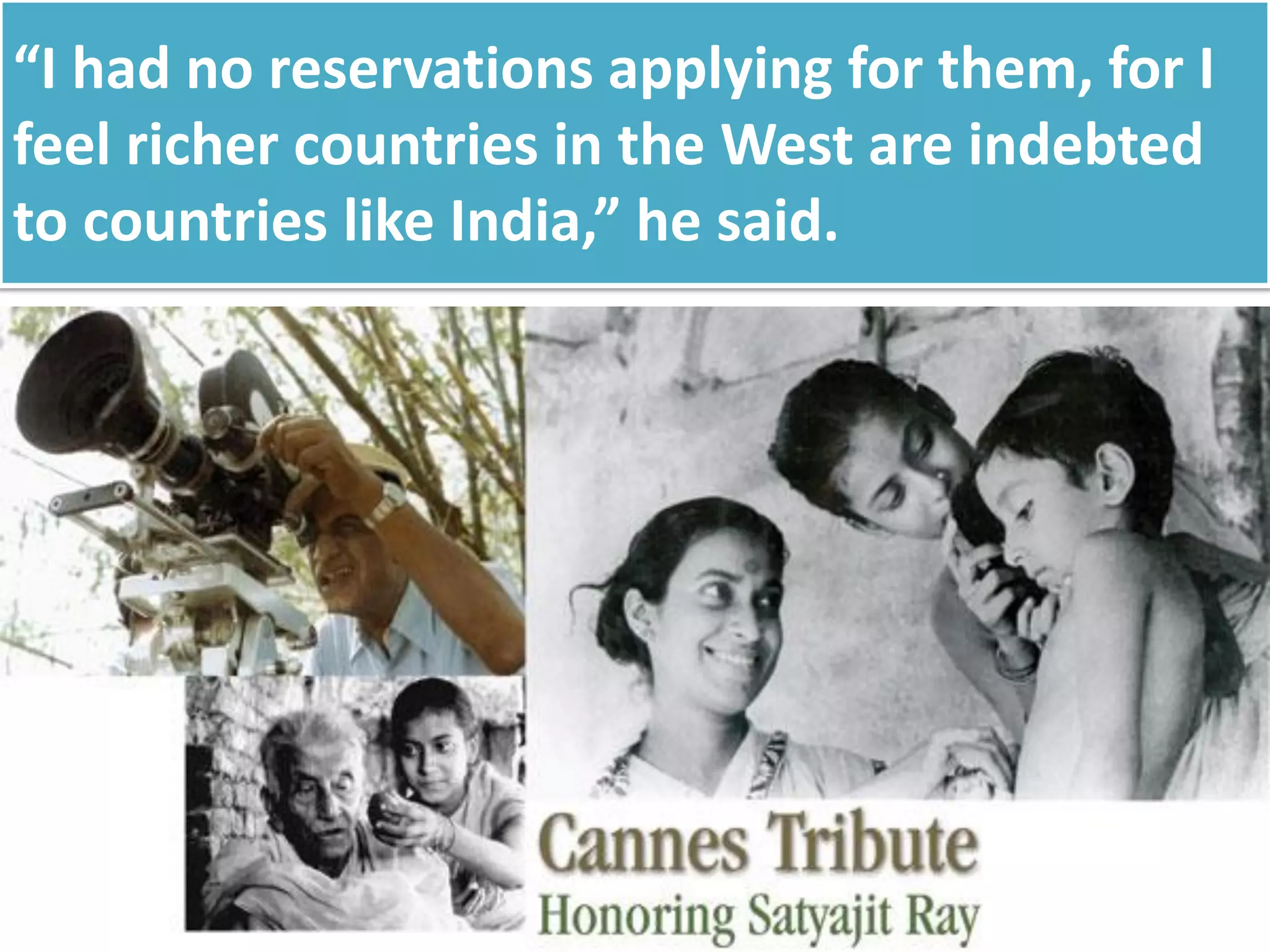
“I had no reservations applying for them, for I
feel richer countries in the West are indebted
to countries like India,” he said.
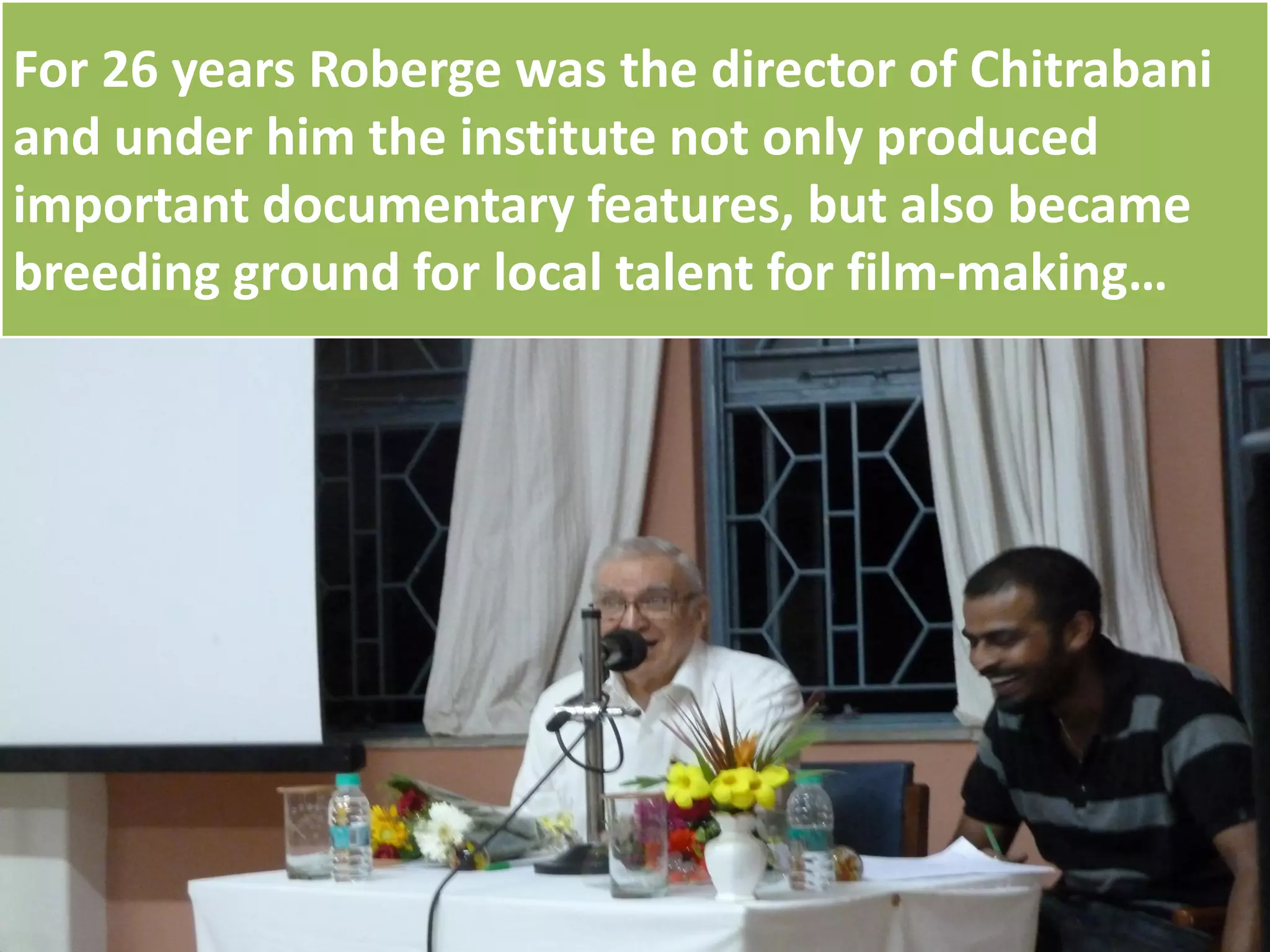
For 26 years Roberge was the director of Chitrabani
and under him the institute not only produced
important documentary features, but also became
breeding ground for local talent for film-making…
THANK YOU SMT NIRMALA MADAM
SHARADA

Rendezvous with ray

  • 1.
  • 2.
    Prepared by m padma lalithasharada GHS MALAKPET English Class: X Lesson: 9 APSCERT New syllabus Under guidance Of Smt. C B NIRMALA Rtd. Dy. E.O. Nampally Manal Hyderabad
  • 3.
    Look at thepicture and answer the questions that follow. 1. Is this picture (a) a poster, (b) an advertisement, or (c) a painting? Justify your option. 2. Who do you think are the persons shown in this picture? Name them. 3. What do you think is 'SHREE 420'?
  • 4.
    It was aunique friendship that developed between a French- Canadian priest and one of the world’s greatest film directors, and had a singular impact on Bengali films both academically and practically. Man of god who dreams films Father Gaston Roberge in his room at St. Xavier’s College
  • 5.
    It was en-routeto India in1961, at a stopover in New York, that 26-year- old Fr. Gaston Roberge was acquainted with the works of Satyajit Ray through the Apu Trilogy.
  • 6.
    He found theworld of Apu so fascinating that he saw all three films in one sitting; and there began his longstanding love affair with the people of India and Bengali cinema and culture, which led to path-breaking work in those fields.
  • 7.
    In his latestbook, Satyajit Ray, Essays1970-2005, a compilation of his essays as the name suggests, being published by Manohar Publishers, New Delhi, Roberge provides a scholarly, original analysis of Ray’s works, giving an insight into the greatness of Ray both as a person and as an artist.
  • 8.
    “The Apu Trilogywas, in fact, my first portal to West Bengal and its people,” he told Frontline.
  • 9.
    In his youth, all he knew of Bengal was through Mircea Eliade’s La Nuit Bengalie, some of Tagore’s poems, and a Reader’s Digest article on Mother Teresa.
  • 10.
    If the harshimage of poverty brought out by the article on the “Saint of the slums” haunted him, Apu’s world came as a reassurance.
  • 11.
    “No. Apu, Sarbajaya,even Harihar did not need my help-but how not to love them? I thought it was fortunate that I would soon be among them,” he wrote. Note: For Pather Panchali the narrative focalization is on five characters in the family – Apu, Harihar (the father), Sarbajaya (the mother), Durga (Apu's sister) ... Pather Panchali
  • 12.
    Roberge does notendorse the accusation of Ray’s detractors that the master director made his reputation selling India’s poverty to the West.
  • 13.
    “What struck me mostwas not the material poverty depicted in the films, but the enormous spiritual poverty of some rich people is much more deplorable than material poverty,” he said.
  • 14.
    Roberge does notspeak with the arrogance of the West.
  • 15.
    “ I washere on a quest to know the world and in the process know myself. I did not come here to convert. In fact, I am the one who got converted,” he said.
  • 16.
    But it tookhim nine years after reaching Calcutta (now Kolkatta) and joining St. Xavier’s College, to muster up the confidence to meet Ray in person.
  • 17.
    “Although I wantedto meet him right away, I didn’t want to just go and see him like he was a living museum piece. I wanted to prepare myself, get to know his works more, so that when we met, there could be a worthwhile dialogue,” he said.
  • 18.
    When they finallymet, it was the beginning of a close friendship that lasted 22 years- until Ray’s death in 1992.
  • 19.
    It was avery quiet friendship that developed over the years.
  • 20.
    Manikda [as Raywas affectionately called by his friends] was a shy person and always very discreet about displaying his emotions,” said Roberge.
  • 21.
    Though to outsiders, Ray’smassive stature- physical and intellectual- might have made him come across as cold, aloof and even intimidating, he was in reality a very simple and unassuming man with a subtle sense of humour.
  • 22.
    It was anunspoken arrangement between the two of them to meet on Sundays at 9 a.m. at Ray’s residence on Bishop Lefroy Road, Kolkata.
  • 23.
    Ray would invite Roberge over for private screenings ofhis latest films and welcomed comments on them.
  • 24.
    But this happenedonly after the friendship had cemented, for in the early days of their dialogue Ray’s shyness prevented him from talking about his own films.
  • 25.
    “He was evenshy of receiving compliments,” said Roberge.
  • 26.
    To Roberge, the greatestmark of Ray’s appreciation for him was that he often addressed the French- speaking priest in Bengali, “in spite of my lack of elegance in that language, and the fact that Ray knew both English and Bengali so well.”
  • 27.
    Ray’s screenplay manuscripts werean art by themselves, Roberge says, “hand- written in Bengali, with notes in English for his set-designer, with sketches here and there, and occasional staff notation of fragments of music”.
  • 28.
    One Sunday morning, Roberge foundRay in a disturbed mood. A few well –known personalities of the city had visited him earlier to go through some of his manuscripts.
  • 29.
    After they leftRay found the Charulatha screenplay missing. Ray was almost sure who the culprit was.
  • 30.
    “I asked himwhether he was planning to take any action, and he said no, and explained to me that he did not want to hurt the reputation of the person. I was absolutely stunned by his humane concern,” said Roberge.
  • 31.
    Like Rabindranath Tagore,Ray strode his time like a colossus.
  • 32.
    Roberge writes, “Itis as if all Bengal was in Manikda: the rich and the poor, the powerful and the humble, the peasants and the city persons, children, teenagers, adults and old people, men and women.”
  • 33.
    Philosophically too, Robergefeels, Ray took off where Tagore signed out.
  • 34.
    If one comparesthe last major prose piece by Tagore, “ Shabhyatar Sankat” ( Crisis of Civilisation), which he wrote at the beginning of the Second World War,
  • 35.
    which contains hisimmortal dictum that in spite of what was happening it would be a sin to lose faith in Man, and the last three films of Ray- Ganashatru, Shakha Prashakha, and Agantuk- the analogy becomes clear.
  • 36.
    “In these threefilms Ray was at his most personal and when some critics saw the films as didactic and verbose, he felt deeply hurt.”
  • 37.
    “For, in theselast films, Satyajit was directly talking to us, conveying his personal message on society and civilization.”
  • 38.
    “If the impulsethat motivated his earlier films was aesthetics in the last three it was self- expression. And there we were denying him his right to speak. As the saying goes, no one is a prophet in his own country,” said Roberge.
  • 39.
    An agnostic throughout hislife, it is possible, Roberge feels, that in the face of death Ray was searching for an answer. This was suggested by some of the music that he used in Shakha Prashakha.
  • 40.
    The last timethe two friends met, Ray was in hospital, on his deathbed. It was a Sunday and Roberge, true to habit, arrived on the dot at 9 a.m.
  • 41.
    “He had grown soweak that he looked frail as a child. I did not stay long, and as I was leaving, Manikda said, ‘Bhalo laglo’ [it was nice]. Those were his last words to me,” said Roberge.
  • 42.
    One important fallout ofthis friendship was the establishment of Chitrabani, a communication and film institute, the first of its kind in West Bengal, which Roberge founded in 1970 and to which Ray, as a token of friendship, lent his name as co-founder.
  • 43.
    Ray was inthe first governing body and after a few terms readily agreed to be the institute’s adviser. Roberge arranged most of the initial funding from Canadian agencies.
  • 44.
    “I had noreservations applying for them, for I feel richer countries in the West are indebted to countries like India,” he said.
  • 45.
    For 26 yearsRoberge was the director of Chitrabani and under him the institute not only produced important documentary features, but also became breeding ground for local talent for film-making…
  • 46.
    THANK YOU SMTNIRMALA MADAM SHARADA