EMERGENCY DRUGS
PRESENTED BY –
HARSHIKA S. TEMBHURNE
MSC 1ST YEAR , SCON ,
PUNE .
Introduction
•
• Emergency medicine is the medical
specialty dedicated to the diagnosis and
treatment of unforeseen illness or injury.
• Emergency drugs are those chemical
entities used in patients during life
threatening conditions so that the symptoms
can be controlled and life can be saved.
Purpose of Emergency Drugs
• • To provide initial treatment for broad spectrum of illness
• and injuries, most of which may be life threatening.
• • To control the symptoms of patient.
• • To save the life of the Patient.
• • To reach the Site of action a soon as possible
• • To normalize the vital body function.
• • To diverge the patient the from the possible risk.
Drug Dosage Calculations
• Desired dose
− Quantity of a medication that is to be administered
• Concentration
− Amount of medication that is present in vial
• Volume
− Amount of fluid medication is dissolved in
• Yield
− The amount of drug in 1 mL
Activated Charcoal (EZ-Char,
Actidose, Liqui-Char)
• Mechanism of action
− Absorbs toxic
substances from the
gastrointestinal tract
• Indications
− Most oral poisonings/
medication overdoses
• Contraindications
− Oral administration to
comatose patients
• Adverse reactions
− If aspirated, can
induce fatal form
of pneumonitis
− Bowel obstruction
• Considerations
− Mix contents well
before administration.
− Does not absorb
cyanide, lithium, iron,
lead, or arsenic
Adenosine
(Adenocard)
• Mechanism of action
− Slows conduction
through the AV node
− Can interrupt reentrant
pathways
− The drug of choice for
reentry SVT
• Indications
− Most forms of stable
narrow-complex SVT
• Contraindications
− Bronchoconstrictive or
bronchospastic lung
disease
• Adverse reactions
− Generally short
duration and mild
• Considerations
− Evaluate elderly for
signs of dehydration
Albuterol
(Proventil, Ventolin)
• Mechanism of action
− Results in smooth-
muscle relaxation in
the bronchial tree
• Indications
− Treatment of
bronchospasm in
patients with
COPD/asthma)
• Contraindications
− Hypersensitivity
reactions to albuterol
• Adverse reactions
− Often dose-related
and include
headache, fatigue,
lightheadedness,
irritability,
restlessness
• Considerations
− Pregnancy safety:
Category C
− May precipitate
angina pectoris and
dysrhythmias
Aspirin (ASA, Bayer, Ecotrin,
St. Joseph, and Others)
• Mechanism of action
− Prevents platelets
from clumping
together and forming
emboli
• Indications
− New onset chest pain
suggestive of acute
myocardial infarction
• Contraindications
− Relatively
contraindicated in
patients with active
ulcer disease or
asthma
• Adverse reactions
− Bronchospasm,
anaphylaxis,
wheezing
in allergic patients,
prolonged bleeding
• Considerations
− Pregnancy safety:
Category D
− Not recommended in
pediatric population
Atropine Sulfate
• Mechanism of action
− Increases heart rate in
life-threatening
bradydysrhythmias
• Indications
− Hemodynamically
unstable bradycardia
• Contraindications
− Tachycardia,
hypersensitivity
• Adverse reactions
− Drowsiness,
confusion, headache,
tachycardia,
palpitations
• Considerations
− Pregnancy safety:
Category C
− Moderate doses may
cause pupillary
dilation.
Bumetanide
(Bumex)
• Mechanism of action
− Inhibits the
reabsorption of
sodium and chloride in
the ascending limb of
the loop of Henle
• Indications
− Pulmonary edema,
congestive heart
failure
• Contraindications
− Hypersensitivity to
bumetanide or
sulfonamides
• Adverse reactions
− Dizziness, headache,
orthostatic
hypotension
• Considerations
− Pregnancy safety:
Category C
Calcium Gluconate
• Mechanism of action
− Counteracts the
toxicity of
hyperkalemia
• Indications
− Hyperkalemia,
hypocalcemia
• Contraindications
− Ventricular fibrillation,
digitalis toxicity,
hypercalcemia
• Adverse reactions
− Syncope, cardiac
arrest, dysrhythmia,
bradycardia
• Considerations
− Pregnancy safety:
Category C
− Do not administer by
IM or SQ
Dexamethasone Sodium
Phosphate (Decadron)
• Mechanism of action
− Suppresses acute and
chronic inflammation
• Indications
− Anaphylaxis, asthma,
spinal cord injury
• Contraindications
− Hypersensitivity, use
caution in suspected
systemic sepsis
• Adverse reactions
− Headache,
restlessness,
euphoria, psychoses
• Considerations
− Pregnancy safety:
Category C
− Protect medication
from heat. Toxicity
and side effects occur
with long-term use.
Dextrose
• Mechanism of action
− Rapidly increases
serum glucose levels
• Indications
− Hypoglycemia, altered
level of consciousness
• Contraindications
− Intracranial
hemorrhage
• Adverse reactions
− Cerebral hemorrhage
− Cerebral ischemia
− Pulmonary edema
• Considerations
− Pregnancy safety:
Category C
Diazepam
(Valium and Others)
• Mechanism of action
− Raises the seizure
threshold; induces
amnesia and sedation
• Indications
− Acute anxiety states
and agitation, acute
alcohol withdrawal
• Contraindications
− Hypersensitivity,
narrow-angle
glaucoma
• Adverse reactions
− Dizziness,
drowsiness,
confusion, headache
• Considerations
− Pregnancy safety:
Category D
− Short duration for
anticonvulsant effect
− Reduce dose by 50%
in elderly patients.
Digoxin
(Lanoxin)
• Mechanism of action
− Increases force of
myocardial contraction
• Indications
− Congestive heart
failure, reentry SVTs,
ventricular rate control
in atrial flutter and
atrial fibrillation
• Contraindications
− Ventricular fibrillation,
ventricular tachycardia,
digitalis toxicity
• Adverse reactions
− Fatigue, headache,
blurred yellow or
green vision, seizures
• Considerations
− Pregnancy safety:
Category C
− Patient receiving IV
digoxin must be on a
monitor
Diphenhydramine
(Benadryl)
• Mechanism of action
− Blocks cellular
histamine receptors
• Indications
− Symptomatic relief
of allergies, allergic
reactions, and
anaphylaxis
• Contraindications
− Asthma, glaucoma,
pregnancy,
hypertension
• Adverse reactions
− Drowsiness, sedation,
seizures
• Considerations
− Pregnancy safety:
Category B
− Not used in infants
Dobutamine Hydrochloride
(Dobutrex)
• Mechanism of action
− Increased myocardial
contractility, stroke
volume, and
increased cardiac
output
• Indications
− Cardiogenic shock,
CHF
• Contraindications
− Tachydysrhythmias,
severe hypotension
• Adverse reactions
− Headache, dyspnea,
tachycardia,
hypertension, chest
pain
• Considerations
− Pregnancy safety:
Category B
− Monitor blood
pressure closely.
Dopamine Hydrochloride
(Intropin)
• Mechanism of action
− Increases myocardial
contractility and stroke
volume
• Indications
− Cardiogenic and
septic shock,
hypotension with low
cardiac output states
• Contraindications
− Hypovolemic shock,
pheochromocytoma,
tachydysrhythmias
• Adverse reactions
− Headache, anxiety,
dyspnea,
dysrhythmias
• Considerations
− Pregnancy safety:
Category C
− Effects are dose-
dependent
Epinephrine
(Adrenalin)
• Mechanism of action
− Blocks histamine
receptors
• Indications
− Cardiac arrest,
symptomatic
bradycardia
• Contraindications
− Hypertension,
hypothermia,
pulmonary edema
• Adverse reactions
− Nervousness,
restlessness,
headache, tremor
• Considerations
− Pregnancy safety:
Category C
− May cause syncope in
asthmatic children
Epinephrine Racemic
(Micronefrin)
• Mechanism of action
− Reduces airway
resistance
• Indications
− Bronchial asthma,
prevention of
bronchospasm, croup
• Contraindications
− Hypertension,
underlying
cardiovascular
disease, epiglottitis
• Adverse reactions
− Headache, anxiety,
fear, nervousness,
respiratory weakness
• Considerations
− May cause
tachycardia and other
dysrhythmias
− Monitor vital signs.
Fosphenytoin
(Cerebyx)
• Mechanism of action
− Elevates the
excitability threshold
of the cell, reducing its
response to stimuli
• Indications
− Status epilepticus,
seizure disorder
• Contraindications
− Bradycardia, Adams-
Stokes syndrome,
second- or third-
degree AV blocks
• Adverse reactions
− Severe hypotension,
bradycardia,
dysrhythmias
• Considerations
− Pregnancy safety:
Category D
− Use with caution in
patients with hepatic
and renal impairment
and diabetic, elderly,
and debilitated
patients.
Furosemide
(Lasix)
• Mechanism of action
− Causes increased
urine output
• Indications
− CHF, pulmonary
edema, hypertensive
crisis
• Contraindications
− Hypovolemia, anuria,
hypotension
• Adverse reactions
− Dizziness, headache,
ECG changes,
weakness
• Considerations
− Pregnancy safety:
Category C
− Ototoxicity, deafness,
and projectile vomiting
can occur with rapid
administration.
Heparin Sodium
• Mechanism of action
− Affects clotting factors
IX, XI, XII, plasmin;
does not lyse existing
clots
• Indications
− Acute myocardial
infarction, prophylaxis
and treatment of
thromboembolic
disorders
• Contraindications
− Hypersensitivity,
active bleeding
• Adverse reactions
− Pain, anaphylaxis,
shock, hematuria
• Considerations
− Pregnancy safety:
Category C
− Heparin does not lyse
existing clots.
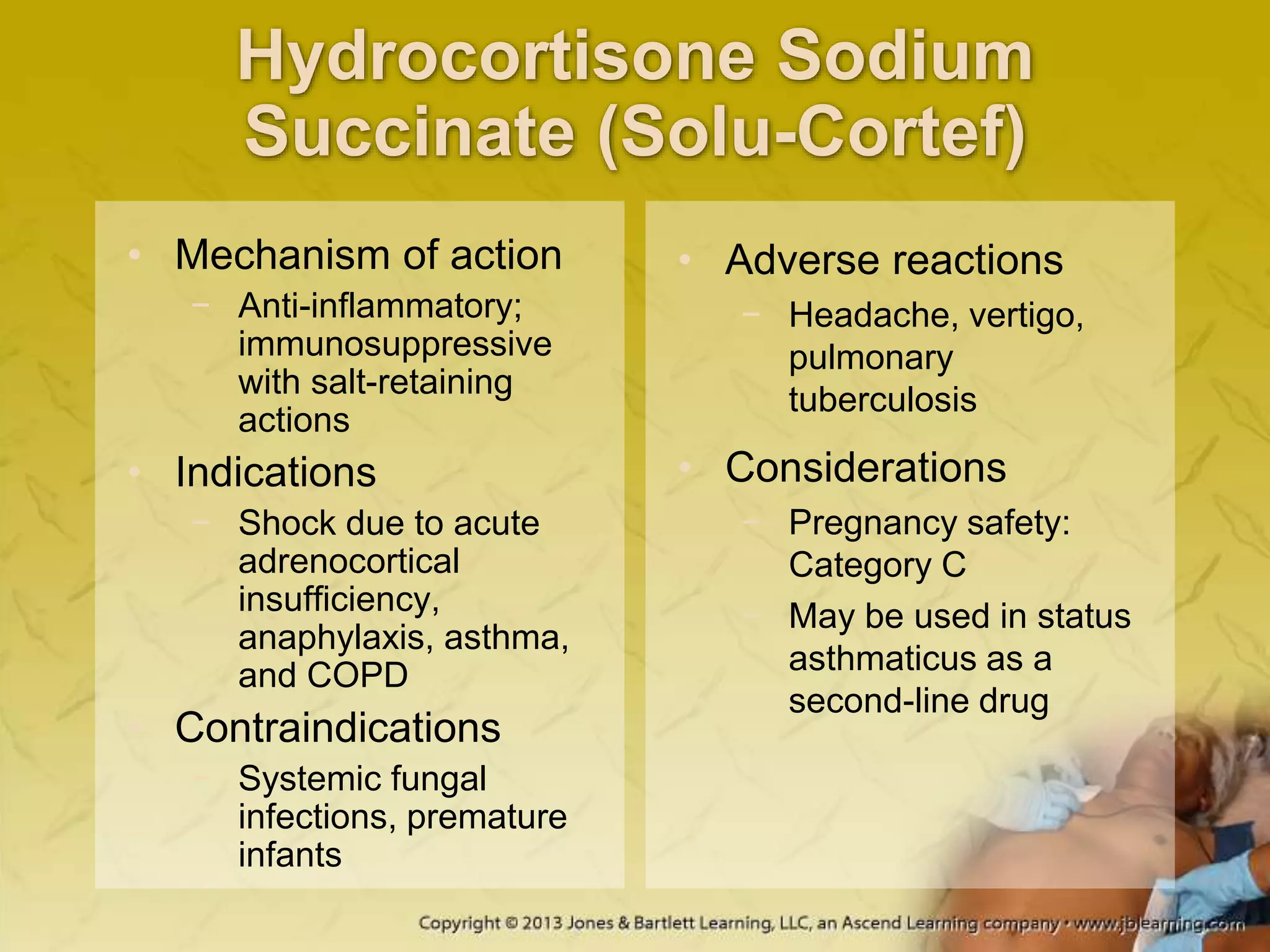
Hydrocortisone Sodium
Succinate (Solu-Cortef)
• Mechanism of action
− Anti-inflammatory;
immunosuppressive
with salt-retaining
actions
• Indications
− Shock due to acute
adrenocortical
insufficiency,
anaphylaxis, asthma,
and COPD
• Contraindications
− Systemic fungal
infections, premature
infants
• Adverse reactions
− Headache, vertigo,
pulmonary
tuberculosis
• Considerations
− Pregnancy safety:
Category C
− May be used in status
asthmaticus as a
second-line drug
Lidocaine Hydrochloride
(Xylocaine)
• Mechanism of action
− Decreases
automaticity
• Indications
− Alternative to
amiodarone in cardiac
arrest from ventricular
tachycardia
• Contraindications
− Hypersensitivity,
second- or third-
degree AV block in
the absence of an
artificial pacemaker
• Adverse reactions
− Anxiety, drowsiness,
confusion, seizures
• Considerations
− Apnea induced with
succinylcholine may
be prolonged with
high doses of
lidocaine.
− Exceedingly high
doses can result in
coma or death.
Lorazepam
(Ativan)
• Mechanism of action
− Anxiolytic,
anticonvulsant,
and sedative effect
• Indications
− Initial control of status
epilepticus or severe
recurrent seizures
• Contraindications
− Acute narrow-angle
glaucoma, coma,
shock
• Adverse reactions
− Dizziness,
drowsiness, CNS
depression, headache
• Considerations
− Pregnancy safety:
Category D
− Monitor respiratory
rate and blood
pressure during
administration.
Mannitol
(Osmitrol)
• Mechanism of action
− Decreases cerebral
edema and
intracranial pressure
• Indications
− Cerebral edema
• Contraindications
− Hypotension,
pulmonary edema,
severe dehydration,
intracranial bleeding,
CHF
• Adverse reactions
− Headache, confusion,
seizures, pulmonary
edema
• Considerations
− Pregnancy safety:
Category C
− May crystallize at low
temperatures; store at
room temperature
− Have ventilatory
support available.
Methylprednisolone Sodium
Succinate (Solu-Medrol)
• Mechanism of action
− Suppresses acute and
chronic inflammation
• Indications
− Acute spinal cord
trauma, anaphylaxis,
bronchodilator for
unresponsive asthma
• Contraindications
− Premature infants,
systemic fungal
infections
• Adverse reactions
− Depression, euphoria,
headache,
restlessness, seizure
• Considerations
− Pregnancy safety:
Category C
− Not effective if time of
spinal cord injury
greater than
8 hours
Midazolam Hydrochloride
(Versed)
• Mechanism of action
− Causes sedative,
anxiolytic, amnesic,
and hypnotic effects
• Indications
− Sedation for medical
procedures
• Contraindications
− Acute narrow-angle
glaucoma, shock,
coma, alcohol
intoxication
• Adverse reactions
− Headache,
somnolence,
respiratory depression
• Considerations
− Pregnancy safety:
Category D
− Administer
immediately prior to
intubation procedure.
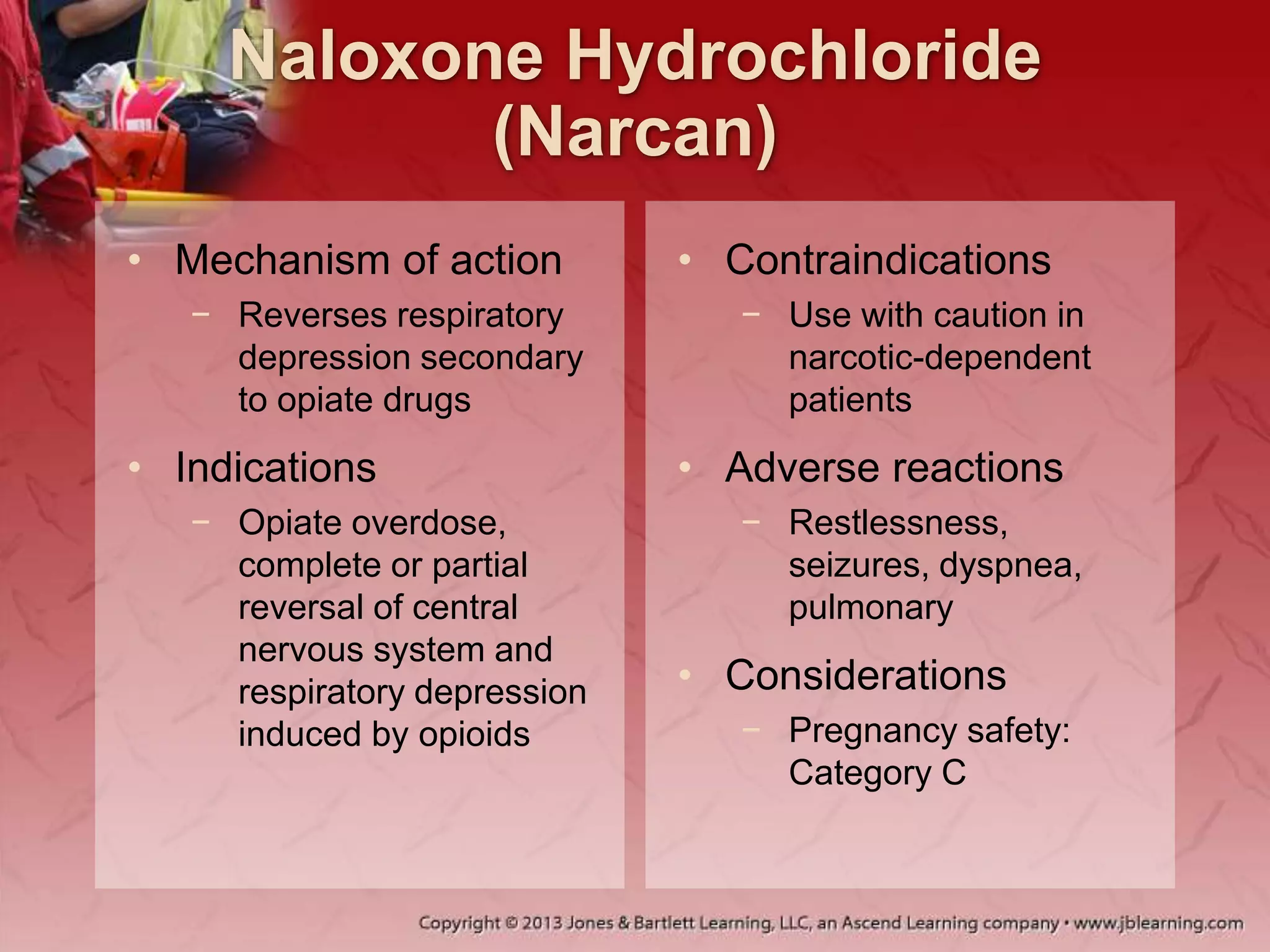
Naloxone Hydrochloride
(Narcan)
• Mechanism of action
− Reverses respiratory
depression secondary
to opiate drugs
• Indications
− Opiate overdose,
complete or partial
reversal of central
nervous system and
respiratory depression
induced by opioids
• Contraindications
− Use with caution in
narcotic-dependent
patients
• Adverse reactions
− Restlessness,
seizures, dyspnea,
pulmonary
• Considerations
− Pregnancy safety:
Category C
Nitroglycerin
(Nitrostat, Nitro-Bid, Tridil)
• Mechanism of action
− Smooth muscle
relaxant acting on
vasculature, bronchial,
uterine, intestinal
smooth muscle
• Indications
− Acute angina pectoris,
ischemic chest pain
• Contraindications
− Hypotension,
hypovolemia,
intracranial bleeding
or head injury
• Adverse reactions
− Headache, dizziness,
weakness, reflex
tachycardia
• Considerations
− Pregnancy safety:
Category C
− Hypotension more
common in the elderly
Phenytoin
(Dilantin)
• Mechanism of action
− Promotes sodium
efflux from neurons
• Indications
− Prophylaxis and
treatment of major
motor seizures
• Contraindications
− Hypersensitivity,
bradycardia
• Adverse reactions
− Ataxia, agitation,
dizziness, headache,
drowsiness
• Considerations
− Pregnancy safety:
Category D
− Carefully monitor vital
signs.
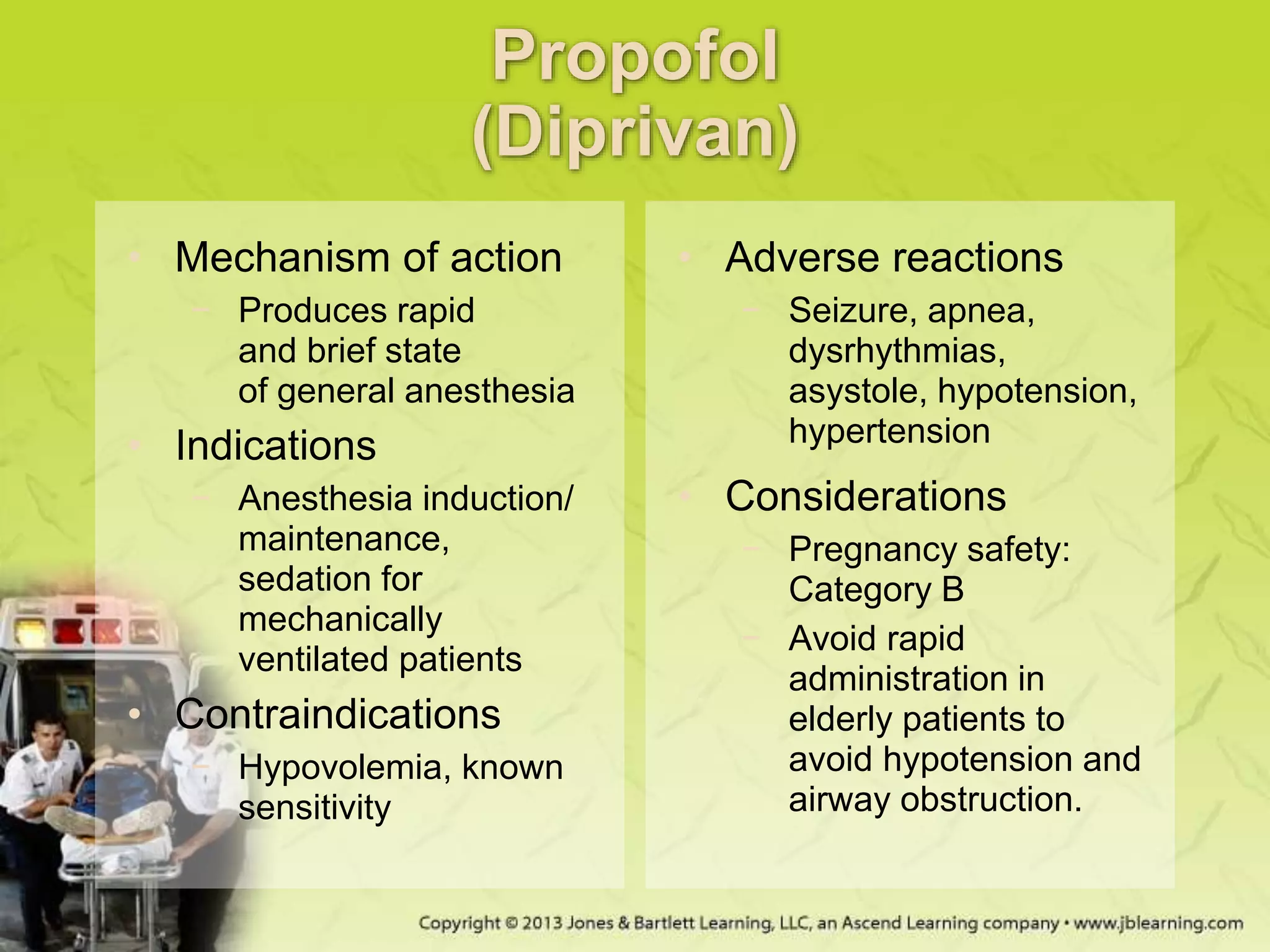
Propofol
(Diprivan)
• Mechanism of action
− Produces rapid
and brief state
of general anesthesia
• Indications
− Anesthesia induction/
maintenance,
sedation for
mechanically
ventilated patients
• Contraindications
− Hypovolemia, known
sensitivity
• Adverse reactions
− Seizure, apnea,
dysrhythmias,
asystole, hypotension,
hypertension
• Considerations
− Pregnancy safety:
Category B
− Avoid rapid
administration in
elderly patients to
avoid hypotension and
airway obstruction.
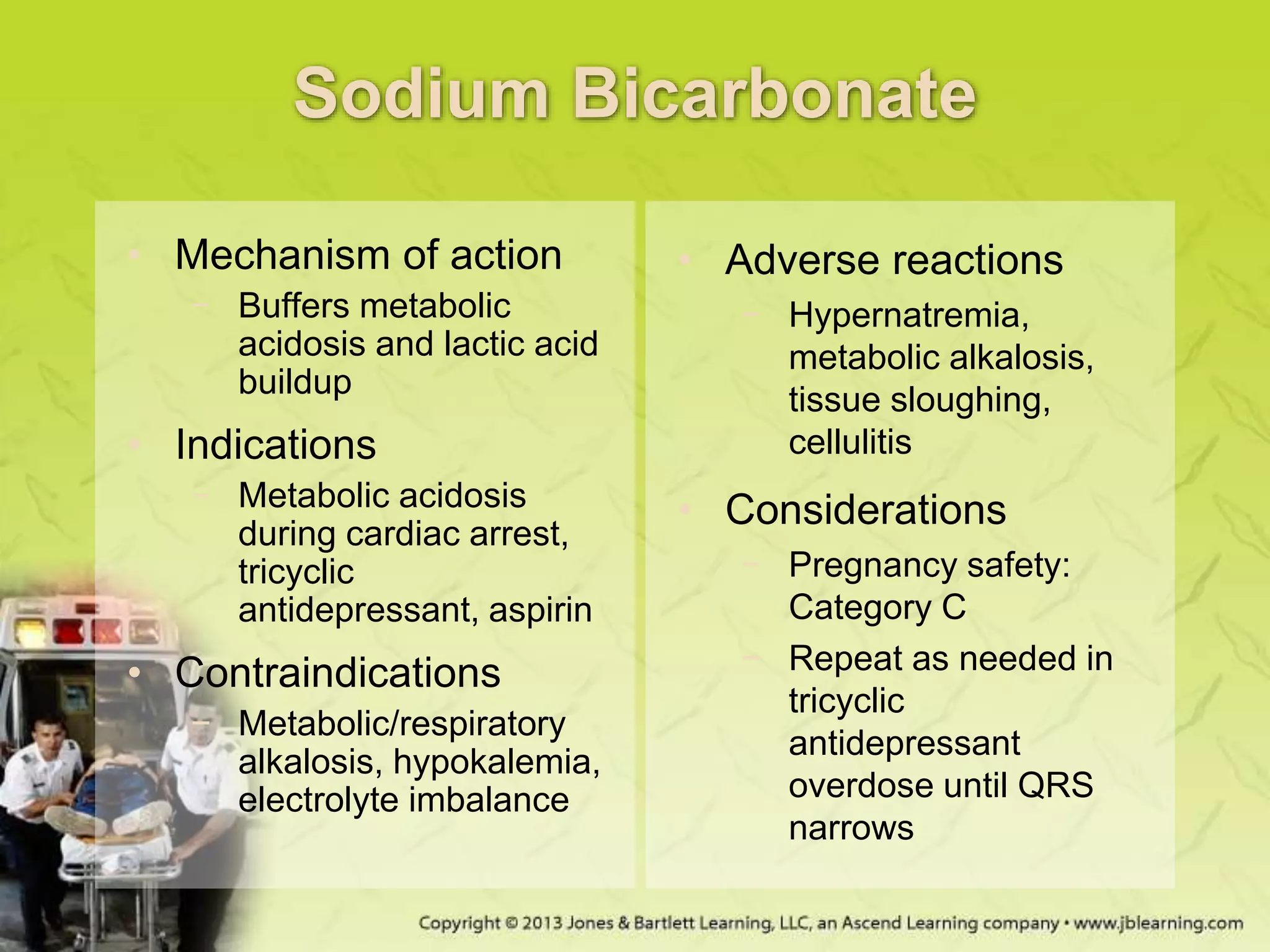
Sodium Bicarbonate
• Mechanism of action
− Buffers metabolic
acidosis and lactic acid
buildup
• Indications
− Metabolic acidosis
during cardiac arrest,
tricyclic
antidepressant, aspirin
• Contraindications
− Metabolic/respiratory
alkalosis, hypokalemia,
electrolyte imbalance
• Adverse reactions
− Hypernatremia,
metabolic alkalosis,
tissue sloughing,
cellulitis
• Considerations
− Pregnancy safety:
Category C
− Repeat as needed in
tricyclic
antidepressant
overdose until QRS
narrows
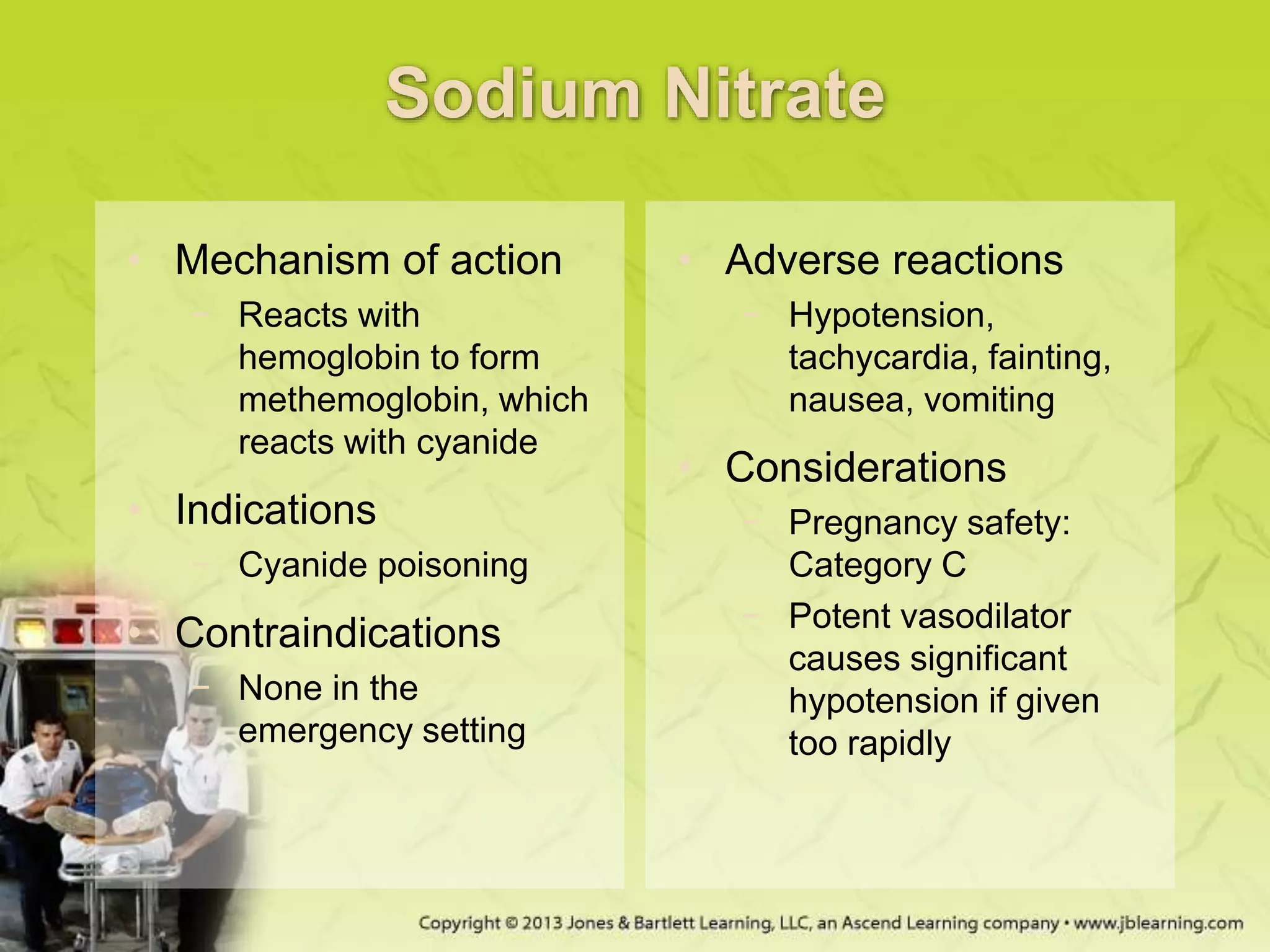
Sodium Nitrate
• Mechanism of action
− Reacts with
hemoglobin to form
methemoglobin, which
reacts with cyanide
• Indications
− Cyanide poisoning
• Contraindications
− None in the
emergency setting
• Adverse reactions
− Hypotension,
tachycardia, fainting,
nausea, vomiting
• Considerations
− Pregnancy safety:
Category C
− Potent vasodilator
causes significant
hypotension if given
too rapidly
Summary
• Paramedics are required to know the
names, class, mechanism of action,
adverse reactions and side effects,
interactions, indications, contraindications,
complications, routes of administration,
dose, and specific administration
considerations for many emergency
medications and intravenous fluids.
• Individual states have the authority to
include additional medications, which may
be taught by your local training agency.
CONCLUSION
• I conclude that because of paramedics must
make quick decisions about when to
administer medications, what medications
to administer, and when administering
certain medications would be harmful to the
patient, it is critically important they develop
a solid understanding of the information in
this chapter and stay up to date on the
latest pharmacologic information.
BIBLIOGRAPHY

emergency drugs .pptx

  • 1.
    EMERGENCY DRUGS PRESENTED BY– HARSHIKA S. TEMBHURNE MSC 1ST YEAR , SCON , PUNE .
  • 2.
    Introduction • • Emergency medicineis the medical specialty dedicated to the diagnosis and treatment of unforeseen illness or injury. • Emergency drugs are those chemical entities used in patients during life threatening conditions so that the symptoms can be controlled and life can be saved.
  • 3.
    Purpose of EmergencyDrugs • • To provide initial treatment for broad spectrum of illness • and injuries, most of which may be life threatening. • • To control the symptoms of patient. • • To save the life of the Patient. • • To reach the Site of action a soon as possible • • To normalize the vital body function. • • To diverge the patient the from the possible risk.
  • 4.
    Drug Dosage Calculations •Desired dose − Quantity of a medication that is to be administered • Concentration − Amount of medication that is present in vial • Volume − Amount of fluid medication is dissolved in • Yield − The amount of drug in 1 mL
  • 5.
    Activated Charcoal (EZ-Char, Actidose,Liqui-Char) • Mechanism of action − Absorbs toxic substances from the gastrointestinal tract • Indications − Most oral poisonings/ medication overdoses • Contraindications − Oral administration to comatose patients • Adverse reactions − If aspirated, can induce fatal form of pneumonitis − Bowel obstruction • Considerations − Mix contents well before administration. − Does not absorb cyanide, lithium, iron, lead, or arsenic
  • 6.
    Adenosine (Adenocard) • Mechanism ofaction − Slows conduction through the AV node − Can interrupt reentrant pathways − The drug of choice for reentry SVT • Indications − Most forms of stable narrow-complex SVT • Contraindications − Bronchoconstrictive or bronchospastic lung disease • Adverse reactions − Generally short duration and mild • Considerations − Evaluate elderly for signs of dehydration
  • 7.
    Albuterol (Proventil, Ventolin) • Mechanismof action − Results in smooth- muscle relaxation in the bronchial tree • Indications − Treatment of bronchospasm in patients with COPD/asthma) • Contraindications − Hypersensitivity reactions to albuterol • Adverse reactions − Often dose-related and include headache, fatigue, lightheadedness, irritability, restlessness • Considerations − Pregnancy safety: Category C − May precipitate angina pectoris and dysrhythmias
  • 8.
    Aspirin (ASA, Bayer,Ecotrin, St. Joseph, and Others) • Mechanism of action − Prevents platelets from clumping together and forming emboli • Indications − New onset chest pain suggestive of acute myocardial infarction • Contraindications − Relatively contraindicated in patients with active ulcer disease or asthma • Adverse reactions − Bronchospasm, anaphylaxis, wheezing in allergic patients, prolonged bleeding • Considerations − Pregnancy safety: Category D − Not recommended in pediatric population
  • 9.
    Atropine Sulfate • Mechanismof action − Increases heart rate in life-threatening bradydysrhythmias • Indications − Hemodynamically unstable bradycardia • Contraindications − Tachycardia, hypersensitivity • Adverse reactions − Drowsiness, confusion, headache, tachycardia, palpitations • Considerations − Pregnancy safety: Category C − Moderate doses may cause pupillary dilation.
  • 10.
    Bumetanide (Bumex) • Mechanism ofaction − Inhibits the reabsorption of sodium and chloride in the ascending limb of the loop of Henle • Indications − Pulmonary edema, congestive heart failure • Contraindications − Hypersensitivity to bumetanide or sulfonamides • Adverse reactions − Dizziness, headache, orthostatic hypotension • Considerations − Pregnancy safety: Category C
  • 11.
    Calcium Gluconate • Mechanismof action − Counteracts the toxicity of hyperkalemia • Indications − Hyperkalemia, hypocalcemia • Contraindications − Ventricular fibrillation, digitalis toxicity, hypercalcemia • Adverse reactions − Syncope, cardiac arrest, dysrhythmia, bradycardia • Considerations − Pregnancy safety: Category C − Do not administer by IM or SQ
  • 12.
    Dexamethasone Sodium Phosphate (Decadron) •Mechanism of action − Suppresses acute and chronic inflammation • Indications − Anaphylaxis, asthma, spinal cord injury • Contraindications − Hypersensitivity, use caution in suspected systemic sepsis • Adverse reactions − Headache, restlessness, euphoria, psychoses • Considerations − Pregnancy safety: Category C − Protect medication from heat. Toxicity and side effects occur with long-term use.
  • 13.
    Dextrose • Mechanism ofaction − Rapidly increases serum glucose levels • Indications − Hypoglycemia, altered level of consciousness • Contraindications − Intracranial hemorrhage • Adverse reactions − Cerebral hemorrhage − Cerebral ischemia − Pulmonary edema • Considerations − Pregnancy safety: Category C
  • 14.
    Diazepam (Valium and Others) •Mechanism of action − Raises the seizure threshold; induces amnesia and sedation • Indications − Acute anxiety states and agitation, acute alcohol withdrawal • Contraindications − Hypersensitivity, narrow-angle glaucoma • Adverse reactions − Dizziness, drowsiness, confusion, headache • Considerations − Pregnancy safety: Category D − Short duration for anticonvulsant effect − Reduce dose by 50% in elderly patients.
  • 15.
    Digoxin (Lanoxin) • Mechanism ofaction − Increases force of myocardial contraction • Indications − Congestive heart failure, reentry SVTs, ventricular rate control in atrial flutter and atrial fibrillation • Contraindications − Ventricular fibrillation, ventricular tachycardia, digitalis toxicity • Adverse reactions − Fatigue, headache, blurred yellow or green vision, seizures • Considerations − Pregnancy safety: Category C − Patient receiving IV digoxin must be on a monitor
  • 16.
    Diphenhydramine (Benadryl) • Mechanism ofaction − Blocks cellular histamine receptors • Indications − Symptomatic relief of allergies, allergic reactions, and anaphylaxis • Contraindications − Asthma, glaucoma, pregnancy, hypertension • Adverse reactions − Drowsiness, sedation, seizures • Considerations − Pregnancy safety: Category B − Not used in infants
  • 17.
    Dobutamine Hydrochloride (Dobutrex) • Mechanismof action − Increased myocardial contractility, stroke volume, and increased cardiac output • Indications − Cardiogenic shock, CHF • Contraindications − Tachydysrhythmias, severe hypotension • Adverse reactions − Headache, dyspnea, tachycardia, hypertension, chest pain • Considerations − Pregnancy safety: Category B − Monitor blood pressure closely.
  • 18.
    Dopamine Hydrochloride (Intropin) • Mechanismof action − Increases myocardial contractility and stroke volume • Indications − Cardiogenic and septic shock, hypotension with low cardiac output states • Contraindications − Hypovolemic shock, pheochromocytoma, tachydysrhythmias • Adverse reactions − Headache, anxiety, dyspnea, dysrhythmias • Considerations − Pregnancy safety: Category C − Effects are dose- dependent
  • 19.
    Epinephrine (Adrenalin) • Mechanism ofaction − Blocks histamine receptors • Indications − Cardiac arrest, symptomatic bradycardia • Contraindications − Hypertension, hypothermia, pulmonary edema • Adverse reactions − Nervousness, restlessness, headache, tremor • Considerations − Pregnancy safety: Category C − May cause syncope in asthmatic children
  • 20.
    Epinephrine Racemic (Micronefrin) • Mechanismof action − Reduces airway resistance • Indications − Bronchial asthma, prevention of bronchospasm, croup • Contraindications − Hypertension, underlying cardiovascular disease, epiglottitis • Adverse reactions − Headache, anxiety, fear, nervousness, respiratory weakness • Considerations − May cause tachycardia and other dysrhythmias − Monitor vital signs.
  • 21.
    Fosphenytoin (Cerebyx) • Mechanism ofaction − Elevates the excitability threshold of the cell, reducing its response to stimuli • Indications − Status epilepticus, seizure disorder • Contraindications − Bradycardia, Adams- Stokes syndrome, second- or third- degree AV blocks • Adverse reactions − Severe hypotension, bradycardia, dysrhythmias • Considerations − Pregnancy safety: Category D − Use with caution in patients with hepatic and renal impairment and diabetic, elderly, and debilitated patients.
  • 22.
    Furosemide (Lasix) • Mechanism ofaction − Causes increased urine output • Indications − CHF, pulmonary edema, hypertensive crisis • Contraindications − Hypovolemia, anuria, hypotension • Adverse reactions − Dizziness, headache, ECG changes, weakness • Considerations − Pregnancy safety: Category C − Ototoxicity, deafness, and projectile vomiting can occur with rapid administration.
  • 23.
    Heparin Sodium • Mechanismof action − Affects clotting factors IX, XI, XII, plasmin; does not lyse existing clots • Indications − Acute myocardial infarction, prophylaxis and treatment of thromboembolic disorders • Contraindications − Hypersensitivity, active bleeding • Adverse reactions − Pain, anaphylaxis, shock, hematuria • Considerations − Pregnancy safety: Category C − Heparin does not lyse existing clots.
  • 24.
    Hydrocortisone Sodium Succinate (Solu-Cortef) •Mechanism of action − Anti-inflammatory; immunosuppressive with salt-retaining actions • Indications − Shock due to acute adrenocortical insufficiency, anaphylaxis, asthma, and COPD • Contraindications − Systemic fungal infections, premature infants • Adverse reactions − Headache, vertigo, pulmonary tuberculosis • Considerations − Pregnancy safety: Category C − May be used in status asthmaticus as a second-line drug
  • 25.
    Lidocaine Hydrochloride (Xylocaine) • Mechanismof action − Decreases automaticity • Indications − Alternative to amiodarone in cardiac arrest from ventricular tachycardia • Contraindications − Hypersensitivity, second- or third- degree AV block in the absence of an artificial pacemaker • Adverse reactions − Anxiety, drowsiness, confusion, seizures • Considerations − Apnea induced with succinylcholine may be prolonged with high doses of lidocaine. − Exceedingly high doses can result in coma or death.
  • 26.
    Lorazepam (Ativan) • Mechanism ofaction − Anxiolytic, anticonvulsant, and sedative effect • Indications − Initial control of status epilepticus or severe recurrent seizures • Contraindications − Acute narrow-angle glaucoma, coma, shock • Adverse reactions − Dizziness, drowsiness, CNS depression, headache • Considerations − Pregnancy safety: Category D − Monitor respiratory rate and blood pressure during administration.
  • 27.
    Mannitol (Osmitrol) • Mechanism ofaction − Decreases cerebral edema and intracranial pressure • Indications − Cerebral edema • Contraindications − Hypotension, pulmonary edema, severe dehydration, intracranial bleeding, CHF • Adverse reactions − Headache, confusion, seizures, pulmonary edema • Considerations − Pregnancy safety: Category C − May crystallize at low temperatures; store at room temperature − Have ventilatory support available.
  • 28.
    Methylprednisolone Sodium Succinate (Solu-Medrol) •Mechanism of action − Suppresses acute and chronic inflammation • Indications − Acute spinal cord trauma, anaphylaxis, bronchodilator for unresponsive asthma • Contraindications − Premature infants, systemic fungal infections • Adverse reactions − Depression, euphoria, headache, restlessness, seizure • Considerations − Pregnancy safety: Category C − Not effective if time of spinal cord injury greater than 8 hours
  • 29.
    Midazolam Hydrochloride (Versed) • Mechanismof action − Causes sedative, anxiolytic, amnesic, and hypnotic effects • Indications − Sedation for medical procedures • Contraindications − Acute narrow-angle glaucoma, shock, coma, alcohol intoxication • Adverse reactions − Headache, somnolence, respiratory depression • Considerations − Pregnancy safety: Category D − Administer immediately prior to intubation procedure.
  • 30.
    Naloxone Hydrochloride (Narcan) • Mechanismof action − Reverses respiratory depression secondary to opiate drugs • Indications − Opiate overdose, complete or partial reversal of central nervous system and respiratory depression induced by opioids • Contraindications − Use with caution in narcotic-dependent patients • Adverse reactions − Restlessness, seizures, dyspnea, pulmonary • Considerations − Pregnancy safety: Category C
  • 31.
    Nitroglycerin (Nitrostat, Nitro-Bid, Tridil) •Mechanism of action − Smooth muscle relaxant acting on vasculature, bronchial, uterine, intestinal smooth muscle • Indications − Acute angina pectoris, ischemic chest pain • Contraindications − Hypotension, hypovolemia, intracranial bleeding or head injury • Adverse reactions − Headache, dizziness, weakness, reflex tachycardia • Considerations − Pregnancy safety: Category C − Hypotension more common in the elderly
  • 32.
    Phenytoin (Dilantin) • Mechanism ofaction − Promotes sodium efflux from neurons • Indications − Prophylaxis and treatment of major motor seizures • Contraindications − Hypersensitivity, bradycardia • Adverse reactions − Ataxia, agitation, dizziness, headache, drowsiness • Considerations − Pregnancy safety: Category D − Carefully monitor vital signs.
  • 33.
    Propofol (Diprivan) • Mechanism ofaction − Produces rapid and brief state of general anesthesia • Indications − Anesthesia induction/ maintenance, sedation for mechanically ventilated patients • Contraindications − Hypovolemia, known sensitivity • Adverse reactions − Seizure, apnea, dysrhythmias, asystole, hypotension, hypertension • Considerations − Pregnancy safety: Category B − Avoid rapid administration in elderly patients to avoid hypotension and airway obstruction.
  • 34.
    Sodium Bicarbonate • Mechanismof action − Buffers metabolic acidosis and lactic acid buildup • Indications − Metabolic acidosis during cardiac arrest, tricyclic antidepressant, aspirin • Contraindications − Metabolic/respiratory alkalosis, hypokalemia, electrolyte imbalance • Adverse reactions − Hypernatremia, metabolic alkalosis, tissue sloughing, cellulitis • Considerations − Pregnancy safety: Category C − Repeat as needed in tricyclic antidepressant overdose until QRS narrows
  • 35.
    Sodium Nitrate • Mechanismof action − Reacts with hemoglobin to form methemoglobin, which reacts with cyanide • Indications − Cyanide poisoning • Contraindications − None in the emergency setting • Adverse reactions − Hypotension, tachycardia, fainting, nausea, vomiting • Considerations − Pregnancy safety: Category C − Potent vasodilator causes significant hypotension if given too rapidly
  • 36.
    Summary • Paramedics arerequired to know the names, class, mechanism of action, adverse reactions and side effects, interactions, indications, contraindications, complications, routes of administration, dose, and specific administration considerations for many emergency medications and intravenous fluids. • Individual states have the authority to include additional medications, which may be taught by your local training agency.
  • 37.
    CONCLUSION • I concludethat because of paramedics must make quick decisions about when to administer medications, what medications to administer, and when administering certain medications would be harmful to the patient, it is critically important they develop a solid understanding of the information in this chapter and stay up to date on the latest pharmacologic information.
  • 38.