Embryo Transfer in Cattle
Introduction 
 Embryo Transfer is a expensive procedure, 
costing around $300 for each flush and 
approximately $270 for each calf born. Not 
including the cost of the semen. 
 Students should understand that ET is a 
complicated procedure with a fairly high 
difficulty level. 
 ET should only be performed by trained 
professionals.
Objectives 
 Explain the benefits of embryo transfer. 
 The impact that embryo transfer has on the 
livestock industry.
Reproductive Anatomy
What is an Embryo? 
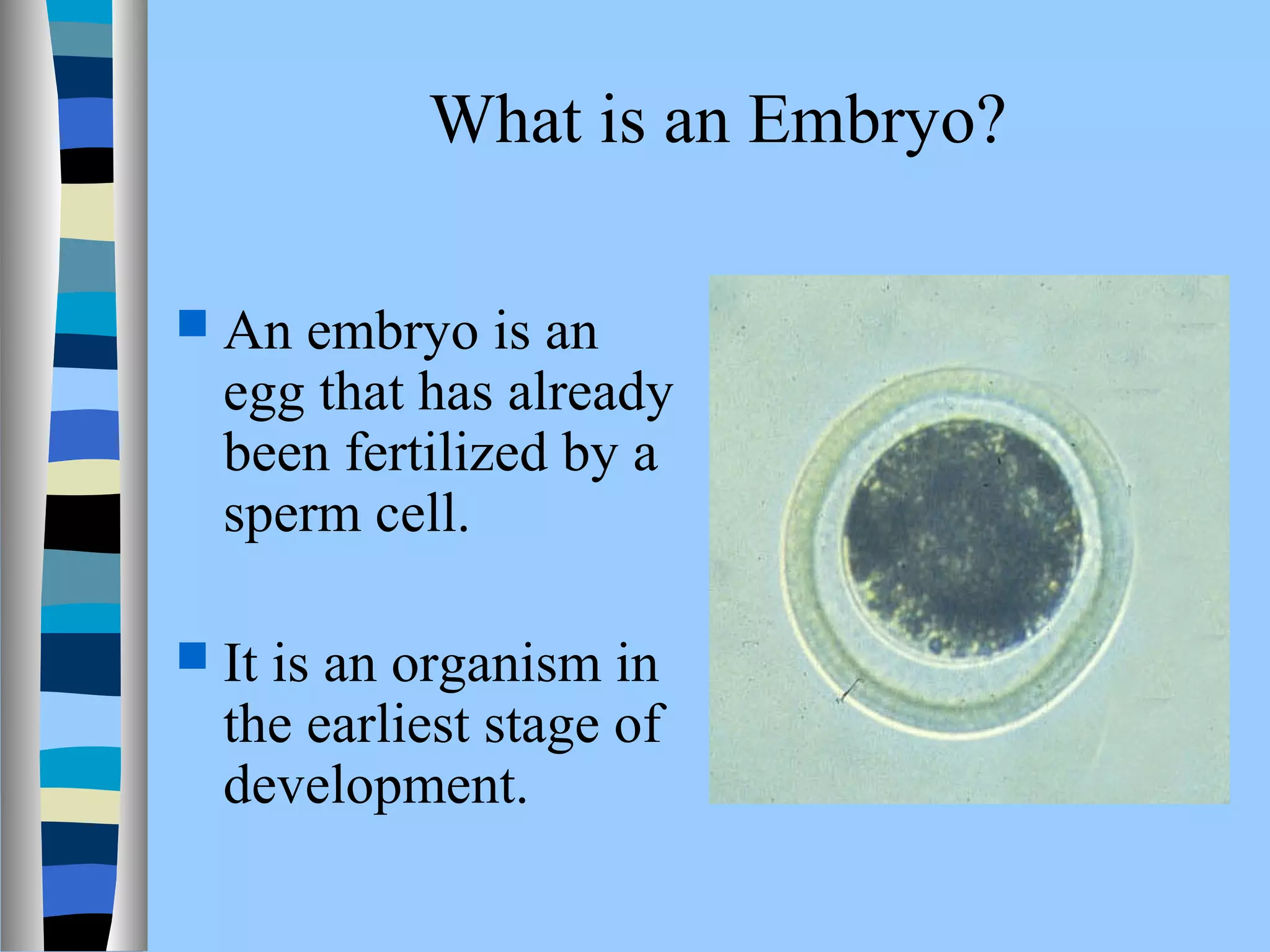
 An embryo is an 
egg that has already 
been fertilized by a 
sperm cell. 
 It is an organism in 
the earliest stage of 
development.
What is Embryo Transfer? 
 ET involves the removal of an embryo from 
a female of superior genetics and the 
placement of the embryo into the 
reproductive tract of a female of average 
genetics.
What is the Goal of Embryo 
Transfer? 
The goal of ET is to obtain the 
maximum number of genetically 
superior embryos in a minimum 
amount of time.
Benefits of Embryo Transfer 
 Traditionally, cows 
produce only one 
calf per year. ET 
allows the 
production of many 
offspring within a 
year from a single 
cow.
Benefits (continued) 
 ET can increase the genetic potential of a 
herd in a relatively short period of time. 
 ET can increase milk production in dairy 
herds. 
 ET can increase weaning weights in beef 
and dairy herds.
Benefits (continued) 
 ET allows other producers to take 
advantage of superior genetics because 
frozen embryos can be shipped almost 
anywhere. 
 ET preserves superior genetics for future 
generations due to embryo freezing.
The Process of Embryo Transfer 
 ET begins with the selection of a donor 
cow. 
 The donor cows will contribute the embryos 
to be transferred.
Donor Cows Have Superior 
Characteristics 
 High milking 
ability 
 High growth rate 
 Outstanding 
reproductive 
capacity
Recipient Cows 
 Finally, recipient cows must be selected. 
 Recipient cows serve as surrogate (foster) 
mothers to the calves, but contribute no 
genetic information. 
 For this reason, the genetic makeup of the 
recipient cow is not as important as the 
makeup of the donor cow.
Recipient Cows (continued) 
 However, the recipient cow must be able to 
maintain her pregnancy to term and produce 
an adequate milk supply for her calf.
Synchronizing the Estrous Cycle 
 Once the donor and recipient cows have 
been selected, they must be synchronized so 
they are on the same phase of their estrous 
cycle. 
 It is important to synchronize estrous cycles 
because the reproductive environments of 
the donor and recipients must be identical in 
order for the embryo to survive the transfer.
Synchronizing the Estrous Cycle 
(continued) 
 The estrous cycle is controlled by the 
production and secretion of hormones at the 
proper time during the cycle. 
 Prostaglandin (PGF2α) is the hormone used 
to synchronize the estrous cycles of the 
donor and recipient cows.
Synchronizing the Estrus Cycle 
(continued)  Prostaglandin is 
produced naturally 
by the cow. 
However, a 
synthetic version 
called Lutalyse is 
given in one or two 
injections intra 
muscular in the 
neck or hip to 
synchronize estrous 
cycles.
Preparing the Donor Cow to be 
Flushed 
 Before the donor cow is flushed, she is 
superovulated with a series of injections of 
Follicle Stimulating Hormone (FSH). 
 Ovulation is the process of releasing eggs. 
 Superovulation causes the ovary (the female 
reproductive organ) to produce many 
follicles.
Preparing the Donor Cow to be 
Flushed (continued) 
 Follicles are small blister-like structures 
that develop on the ovary containing one 
egg each. 
When the follicles ovulate, the eggs are 
released. 
 Superovulation ensures that many eggs will 
be released because there are many follicles 
present.
Breeding the Donor Cow 
When the donor shows signs of estrus (the 
time period during the estrous cycle when 
she will allow breeding), she is ready to 
be bred. 
 Some signs of estrus are riding other 
cows, clear vaginal mucus, and pacing the 
fence.
The Flush 
 Once the donor cow has been bred, the embryos 
are allowed to grow for six days. 
 During this time the embryos also travels down 
the reproductive tract from the oviduct (the site of 
fertilization) to the uterus where they can be 
flushed out. 
 On the seventh day, the embryos are ready to be 
removed. This process is called flushing.
The Flush (continued) 
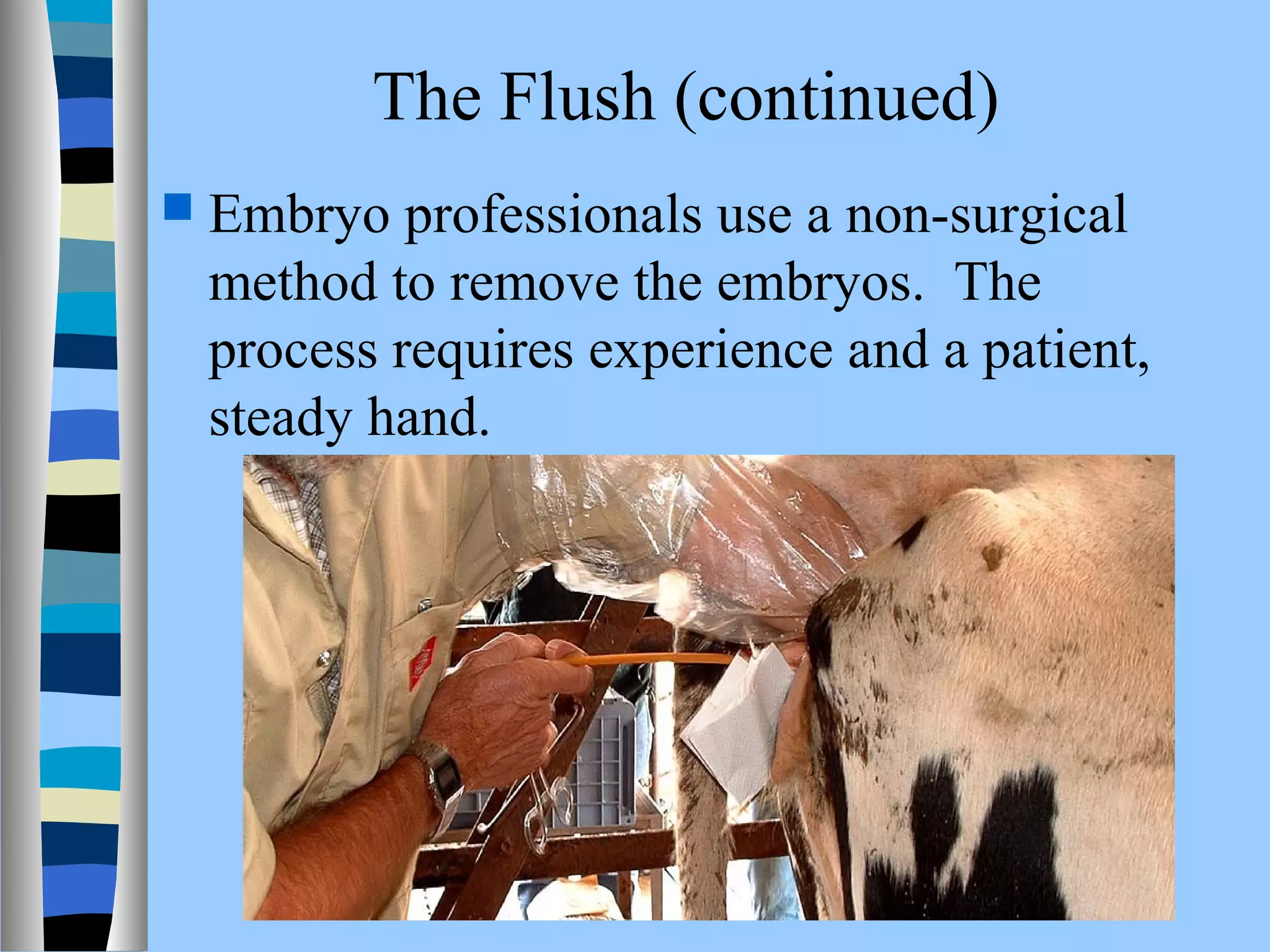
 Embryo professionals use a non-surgical 
method to remove the embryos. The 
process requires experience and a patient, 
steady hand.
The Flush (continued) 
 An injection of 
lidocaine is given 
prior to the flush to 
reduce pressure and 
stress on the donor 
cow and to make 
the flush easier for 
the ET 
professional.
The Flush (continued) 
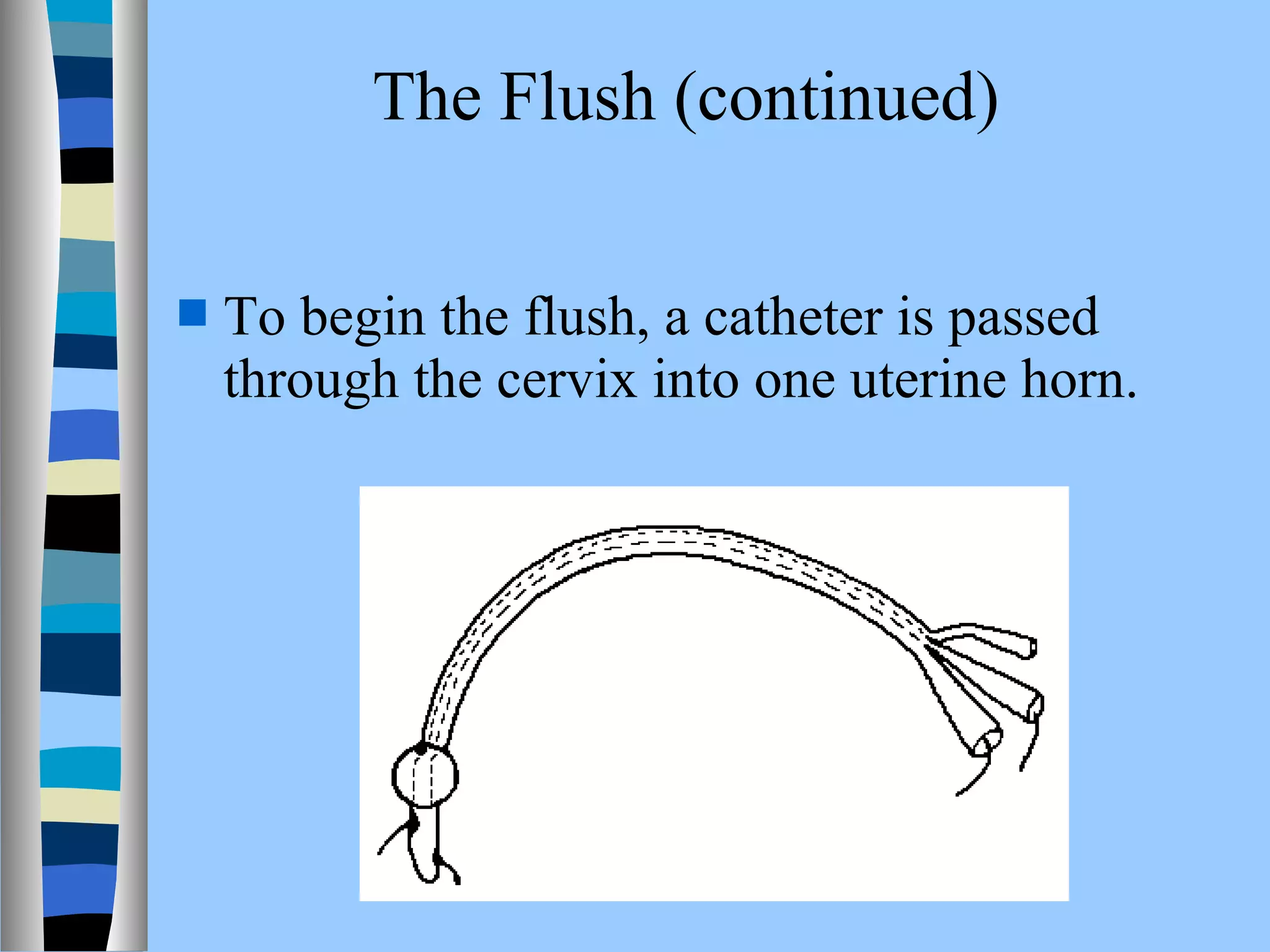
 To begin the flush, a catheter is passed 
through the cervix into one uterine horn.
The Flush (continued) 
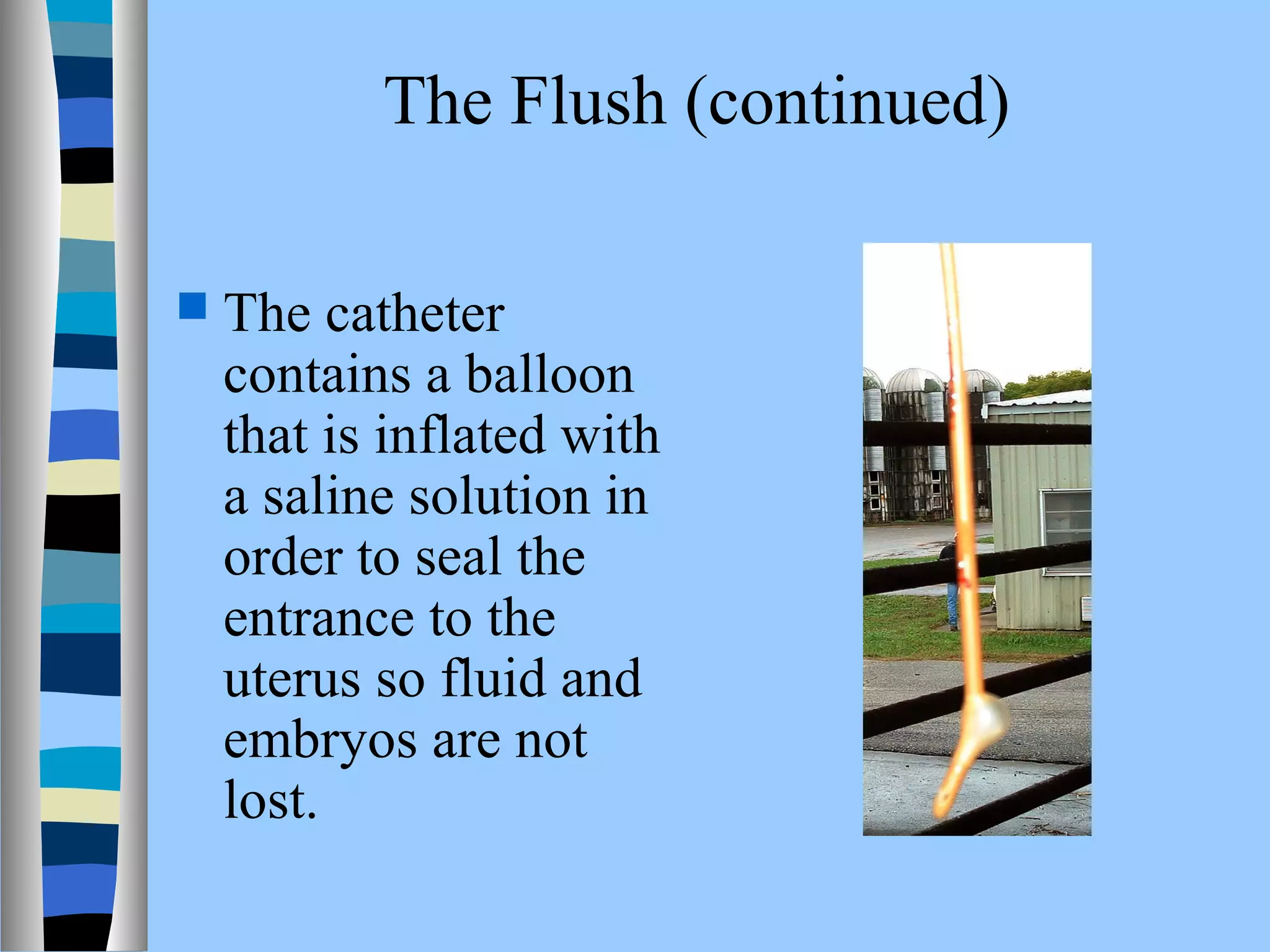
 The catheter 
contains a balloon 
that is inflated with 
a saline solution in 
order to seal the 
entrance to the 
uterus so fluid and 
embryos are not 
lost.
Removing the Embryos 
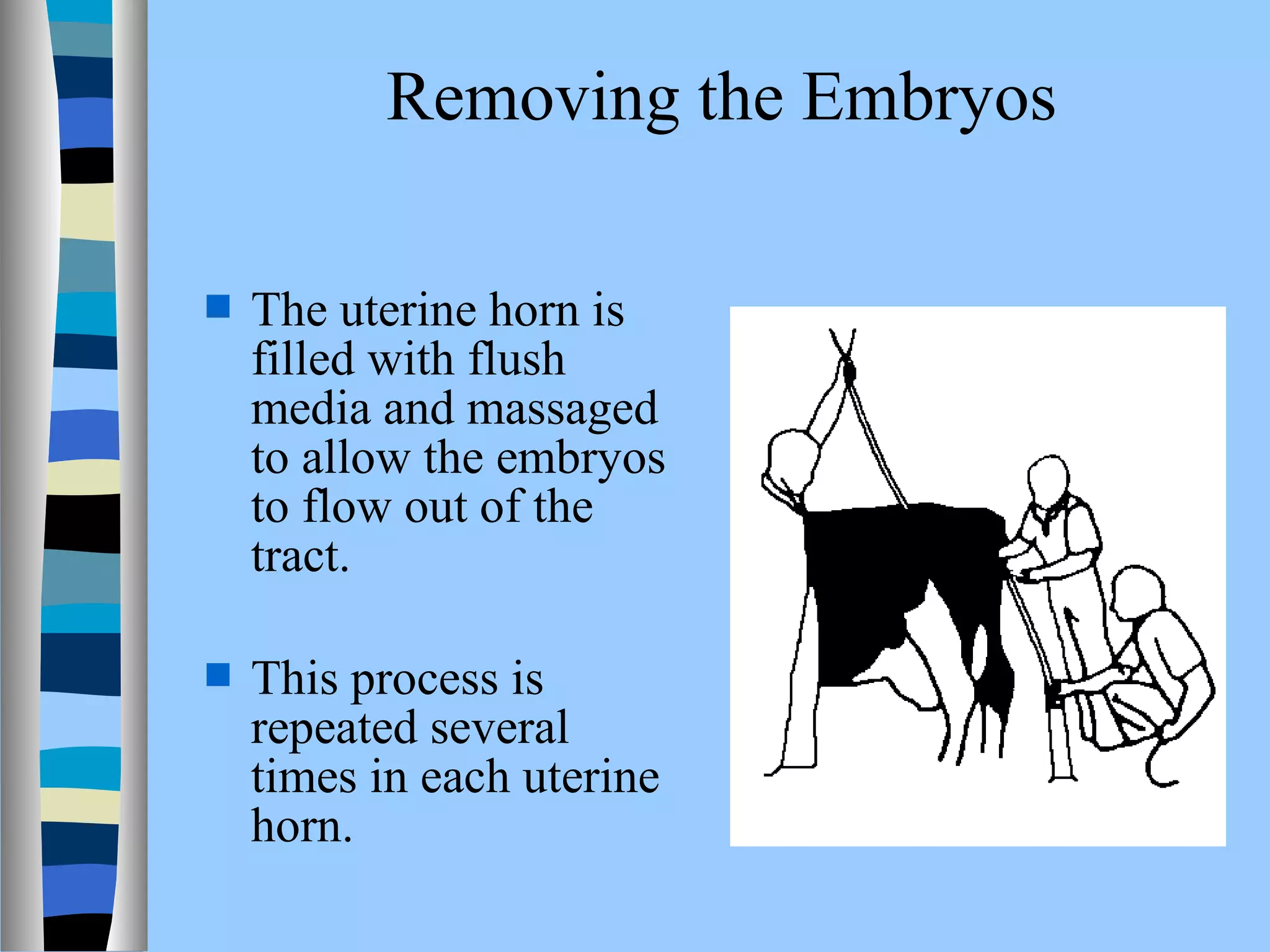
 The uterine horn is 
filled with flush 
media and massaged 
to allow the embryos 
to flow out of the 
tract. 
 This process is 
repeated several 
times in each uterine 
horn.
Collecting the Embryos 
 Embryos are carried 
out of the reproductive 
tract through plastic 
tubes and collected in a 
filter with the flush 
media. 
 The pores in the filter 
are smaller than the 
embryos so excess 
fluid drains out of the 
filter without losing the 
embryos.
Injecting Penicillin 
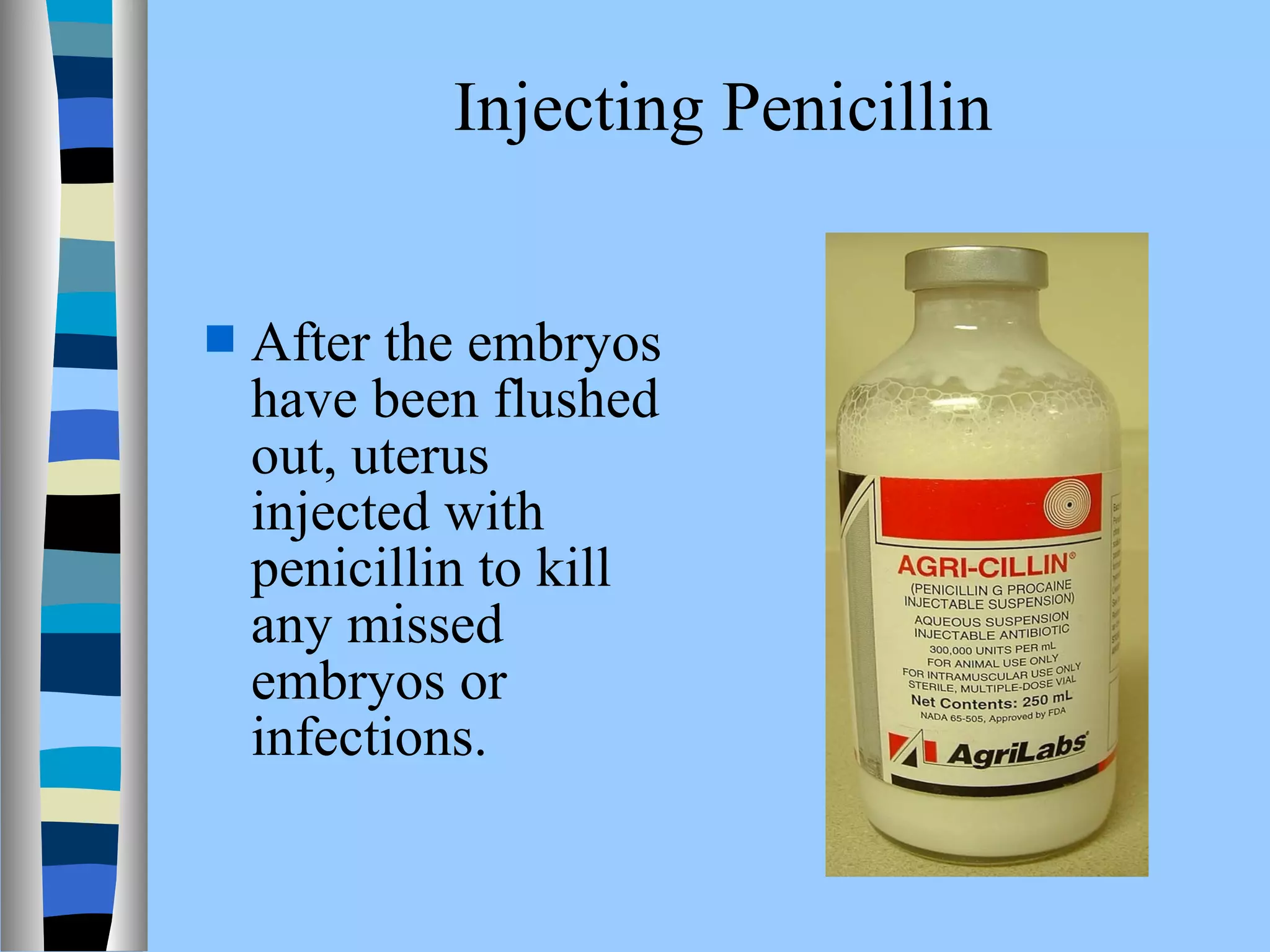
 After the embryos 
have been flushed 
out, uterus 
injected with 
penicillin to kill 
any missed 
embryos or 
infections.
Embryo Statistics 
 An average of 7-10 embryos is collected 
from each flush. 
 However, the number of embryos obtained 
from a single flush may range anywhere 
from 0-60.
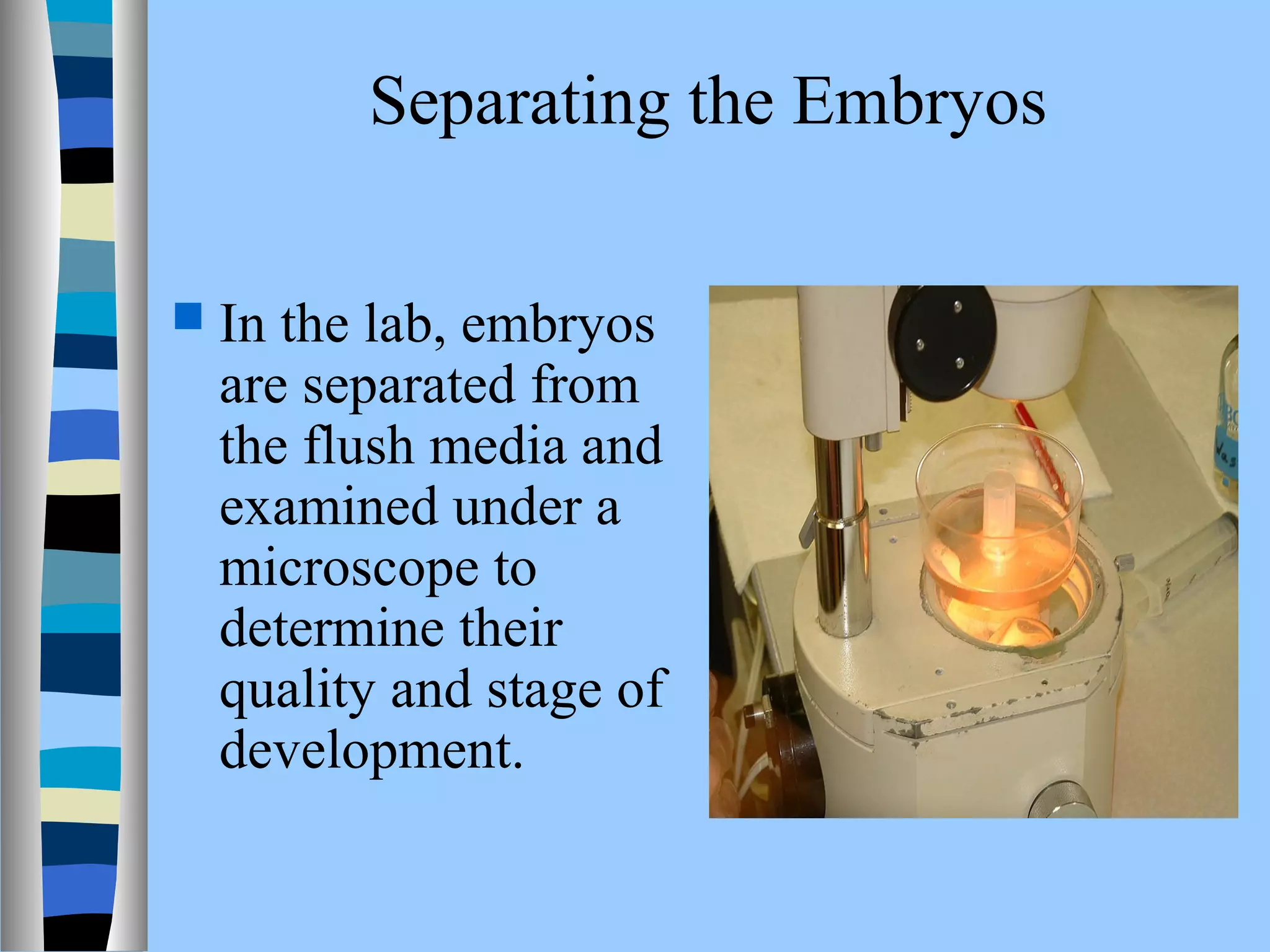
Separating the Embryos 
 In the lab, embryos 
are separated from 
the flush media and 
examined under a 
microscope to 
determine their 
quality and stage of 
development.
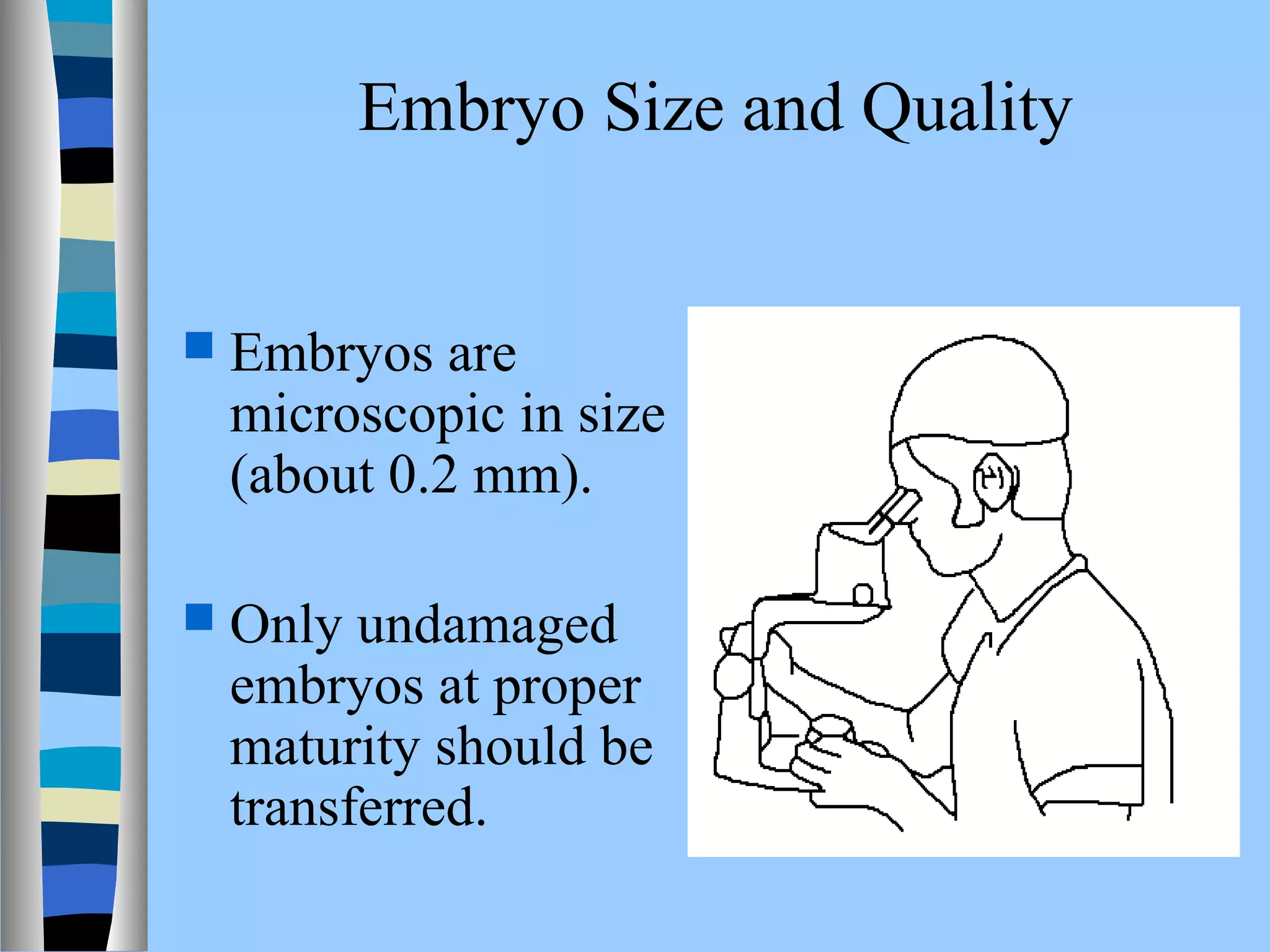
Embryo Size and Quality 
 Embryos are 
microscopic in size 
(about 0.2 mm). 
 Only undamaged 
embryos at proper 
maturity should be 
transferred.
Embryo Quality 
The embryos 
on the left 
are damaged 
and should 
not be 
transferred. 
The embryo 
on the right is 
of proper 
maturity and 
quality and 
should be 
transferred.
Transferring the Embryos 
 The embryo to be transferred is put into a 
small, plastic straw and then loaded into an 
embryo transfer gun.
Transferring the Embryos (continued) 
 The embryo is then 
inserted into either the 
left or right uterine 
horn depending on 
which ovary has a 
corpus lutuem (CL). 
 The CL is a structure 
on the ovary that 
secretes the hormone 
progesterone which is 
needed to maintain the 
pregnancy.
Transfer Immediately or Freeze 
 Embryos should be 
transferred as soon as 
possible after the flush 
(within 8 hours at 
least). 
 Embryos can also be 
frozen for later 
implantation and 
stored in liquid 
nitrogen tanks.
Benefits to Embryo Transfer 
-A single heifer or cow is able to produce multiple 
calves from the same genetic line. 
-An older superior cow is able to donate ovules for 
embryo transfer. 
-Embryos can be frozen and stored for future use.
FACTS 
-In 1987, 3.6% (5,105) of all calves 
registered were a result of embryo transfer. 
-In 2002, 25,093 calves resulting from ET 
were registered. This was 8.9% of all calves 
registered. 
-In 2007, just under 40,000 calves resulting 
from ET were registered. This accounted 
for about 11.5% of total registrations.
Disadvantages of ET 
-Increased expenses and higher breakeven costs 
for calves. 
• Requires a higher level of management. 
• Increased potential for spread of certain 
diseases. 
• Not all potential donors respond positively to 
treatment.
Summary 
 ET can be costly, so the return on the 
investment should always be greater than 
the input costs. 
 ET should only be performed using donor 
cows of superior genetics. 
 Bull selection should be based on superior 
genetics as well.
Conclusion 
 If the required conditions are met, embryo 
transfer can be a beneficial way to produce 
superior cattle.

Embryotransferincattle

  • 1.
  • 2.
    Introduction  EmbryoTransfer is a expensive procedure, costing around $300 for each flush and approximately $270 for each calf born. Not including the cost of the semen.  Students should understand that ET is a complicated procedure with a fairly high difficulty level.  ET should only be performed by trained professionals.
  • 3.
    Objectives  Explainthe benefits of embryo transfer.  The impact that embryo transfer has on the livestock industry.
  • 4.
  • 5.
    What is anEmbryo?  An embryo is an egg that has already been fertilized by a sperm cell.  It is an organism in the earliest stage of development.
  • 6.
    What is EmbryoTransfer?  ET involves the removal of an embryo from a female of superior genetics and the placement of the embryo into the reproductive tract of a female of average genetics.
  • 7.
    What is theGoal of Embryo Transfer? The goal of ET is to obtain the maximum number of genetically superior embryos in a minimum amount of time.
  • 8.
    Benefits of EmbryoTransfer  Traditionally, cows produce only one calf per year. ET allows the production of many offspring within a year from a single cow.
  • 9.
    Benefits (continued) ET can increase the genetic potential of a herd in a relatively short period of time.  ET can increase milk production in dairy herds.  ET can increase weaning weights in beef and dairy herds.
  • 10.
    Benefits (continued) ET allows other producers to take advantage of superior genetics because frozen embryos can be shipped almost anywhere.  ET preserves superior genetics for future generations due to embryo freezing.
  • 11.
    The Process ofEmbryo Transfer  ET begins with the selection of a donor cow.  The donor cows will contribute the embryos to be transferred.
  • 12.
    Donor Cows HaveSuperior Characteristics  High milking ability  High growth rate  Outstanding reproductive capacity
  • 13.
    Recipient Cows Finally, recipient cows must be selected.  Recipient cows serve as surrogate (foster) mothers to the calves, but contribute no genetic information.  For this reason, the genetic makeup of the recipient cow is not as important as the makeup of the donor cow.
  • 14.
    Recipient Cows (continued)  However, the recipient cow must be able to maintain her pregnancy to term and produce an adequate milk supply for her calf.
  • 15.
    Synchronizing the EstrousCycle  Once the donor and recipient cows have been selected, they must be synchronized so they are on the same phase of their estrous cycle.  It is important to synchronize estrous cycles because the reproductive environments of the donor and recipients must be identical in order for the embryo to survive the transfer.
  • 16.
    Synchronizing the EstrousCycle (continued)  The estrous cycle is controlled by the production and secretion of hormones at the proper time during the cycle.  Prostaglandin (PGF2α) is the hormone used to synchronize the estrous cycles of the donor and recipient cows.
  • 17.
    Synchronizing the EstrusCycle (continued)  Prostaglandin is produced naturally by the cow. However, a synthetic version called Lutalyse is given in one or two injections intra muscular in the neck or hip to synchronize estrous cycles.
  • 18.
    Preparing the DonorCow to be Flushed  Before the donor cow is flushed, she is superovulated with a series of injections of Follicle Stimulating Hormone (FSH).  Ovulation is the process of releasing eggs.  Superovulation causes the ovary (the female reproductive organ) to produce many follicles.
  • 19.
    Preparing the DonorCow to be Flushed (continued)  Follicles are small blister-like structures that develop on the ovary containing one egg each. When the follicles ovulate, the eggs are released.  Superovulation ensures that many eggs will be released because there are many follicles present.
  • 20.
    Breeding the DonorCow When the donor shows signs of estrus (the time period during the estrous cycle when she will allow breeding), she is ready to be bred.  Some signs of estrus are riding other cows, clear vaginal mucus, and pacing the fence.
  • 21.
    The Flush Once the donor cow has been bred, the embryos are allowed to grow for six days.  During this time the embryos also travels down the reproductive tract from the oviduct (the site of fertilization) to the uterus where they can be flushed out.  On the seventh day, the embryos are ready to be removed. This process is called flushing.
  • 22.
    The Flush (continued)  Embryo professionals use a non-surgical method to remove the embryos. The process requires experience and a patient, steady hand.
  • 23.
    The Flush (continued)  An injection of lidocaine is given prior to the flush to reduce pressure and stress on the donor cow and to make the flush easier for the ET professional.
  • 24.
    The Flush (continued)  To begin the flush, a catheter is passed through the cervix into one uterine horn.
  • 25.
    The Flush (continued)  The catheter contains a balloon that is inflated with a saline solution in order to seal the entrance to the uterus so fluid and embryos are not lost.
  • 26.
    Removing the Embryos  The uterine horn is filled with flush media and massaged to allow the embryos to flow out of the tract.  This process is repeated several times in each uterine horn.
  • 27.
    Collecting the Embryos  Embryos are carried out of the reproductive tract through plastic tubes and collected in a filter with the flush media.  The pores in the filter are smaller than the embryos so excess fluid drains out of the filter without losing the embryos.
  • 28.
    Injecting Penicillin After the embryos have been flushed out, uterus injected with penicillin to kill any missed embryos or infections.
  • 29.
    Embryo Statistics An average of 7-10 embryos is collected from each flush.  However, the number of embryos obtained from a single flush may range anywhere from 0-60.
  • 30.
    Separating the Embryos  In the lab, embryos are separated from the flush media and examined under a microscope to determine their quality and stage of development.
  • 31.
    Embryo Size andQuality  Embryos are microscopic in size (about 0.2 mm).  Only undamaged embryos at proper maturity should be transferred.
  • 32.
    Embryo Quality Theembryos on the left are damaged and should not be transferred. The embryo on the right is of proper maturity and quality and should be transferred.
  • 33.
    Transferring the Embryos  The embryo to be transferred is put into a small, plastic straw and then loaded into an embryo transfer gun.
  • 34.
    Transferring the Embryos(continued)  The embryo is then inserted into either the left or right uterine horn depending on which ovary has a corpus lutuem (CL).  The CL is a structure on the ovary that secretes the hormone progesterone which is needed to maintain the pregnancy.
  • 35.
    Transfer Immediately orFreeze  Embryos should be transferred as soon as possible after the flush (within 8 hours at least).  Embryos can also be frozen for later implantation and stored in liquid nitrogen tanks.
  • 36.
    Benefits to EmbryoTransfer -A single heifer or cow is able to produce multiple calves from the same genetic line. -An older superior cow is able to donate ovules for embryo transfer. -Embryos can be frozen and stored for future use.
  • 37.
    FACTS -In 1987,3.6% (5,105) of all calves registered were a result of embryo transfer. -In 2002, 25,093 calves resulting from ET were registered. This was 8.9% of all calves registered. -In 2007, just under 40,000 calves resulting from ET were registered. This accounted for about 11.5% of total registrations.
  • 38.
    Disadvantages of ET -Increased expenses and higher breakeven costs for calves. • Requires a higher level of management. • Increased potential for spread of certain diseases. • Not all potential donors respond positively to treatment.
  • 39.
    Summary  ETcan be costly, so the return on the investment should always be greater than the input costs.  ET should only be performed using donor cows of superior genetics.  Bull selection should be based on superior genetics as well.
  • 40.
    Conclusion  Ifthe required conditions are met, embryo transfer can be a beneficial way to produce superior cattle.

Editor's Notes

  • #3 Teachers should remind students that this is only a brief overview of ET. Students will not be equipped with the knowledge and experience required for ET after the completion of this slide show. Further training is necessary.
  • #5 The vagina, cervix, uterus, ovary, oviduct, and uterine horn should be pointed out to students. These structures will be discussed later in the slide show. Students should become familiar with the geographical location of each for a better understanding of ET.
  • #15 It is very important to stress to students that a recipient cow must have good milking ability. Other genetic traits aren’t as important, but the available milk supply to a newborn calf has a huge impact on the calf’s life.
  • #16 Synchronization of estrous cycles is a complicated process and this slide show only goes into minimum detail. The important thing students should understand is that the donor and recipient cows must be on the same phase of their cycles for ET to be successful.
  • #18 Lutalyse injections are given in 5cc doses, intramuscular, in the neck or hip.
  • #19 The word flush is introduced here. A flush is the process of removing embryos from the reproductive tract of the donor cow. Flushing in addressed in later slides.
  • #21 Take note of the two different spelling estrus and estrous. Estrus is the time period when the female will allow breeding. Estrous is the entire reproductive cycle from the beginning of one heat to the beginning of the next. Even though the pronunciation of both words is the same, students should be careful not to confuse the two words.
  • #24 This is an intramuscular injection given in the fatty part of the tail-head. The effects of lidocaine are seen a few minutes after the injection. When the tail is limp, you can begin the flush.
  • #25 At this point, the ET professional inserts one hand into the rectum and finds the reproductive tract. Holding the cervix in hand, he or she inserts the catheter into the vagina, passing it through the cervix and into one uterine horn. A metal rod inside the catheter steadies the catheter while it is being inserted.
  • #26 Once the catheter is in place, the balloon is inflated by pumping saline through a syringe into the balloon.
  • #29 The donor cow is exposed to infection during the flush due to all the foreign objects that are put into her reproductive tract. Penicillin will kill all infections the donor cow is exposed to as well as any embryos that were not flushed out. We do not want the donor cow to carry a calf because this defeats the purpose of ET.
  • #30 Make sure that students know that if an extremely large number of embryos are collected, there is a chance that they may not all be fertilized or in the proper condition for transfer. Careful examination under a microscope will determine this.
  • #35 The transfer begins the same way that the flush does. One hand is inserted into the rectum and locates the reproductive tract and cervix. The transfer rod is inserted through the vagina, cervix, and into the uterine horn that has the CL. The recipient cow’s ovaries are palpated before the transfer to determine which ovary has a CL.