EMBRYO TRANSFER
IN CATTLE AND ITS
APPLICATIONS
Prepared by – Reena Negi
MSc. biotechnology
2nd year
INTRODUCTION
• Embryo transfer is one stepin the process of removing one or more
embryos fromthe reproductive tract of a donor female and transferring them
to one or more recipient females. Embryos also can be producedin the
laboratoryvia techniques suchas in vitro fertilization or somaticcell cloning.
• proliferation of so calleddesirable phenotypes andproduction of artificial
inseminated (AI)bulls throughplanned matting.
• It is necessaryfor achievingsuccess in various assisted reproductive technologies,
especiallyin case of in-vitrofertilizationand animal cloning
HISTORY
• Embryotransfer wasfirst performedandrecorded by Walter Heape in 1890. He
transferred two Angorarabbit embryos intoa gestating Belgian doe.
• In 1951Wilet ,Black,Casida, Stoneand Buckner reported the first successful
ovumtransferin cattle usingsurgical techniques.
• The successful embryotransfers were reported in cattle and pigsby JimRowson
at Cambridge, England and theyalso the firstto produce a calf afterthe 11 day
blastocyst had beenfrozen prior to transfer.
• The first commercial embryotransfers were done in the early1970s. Initially,
embryos were recoveredfrom valuable donorsand transferred to recipient
animalsusing surgical procedures. It wasnot until non-surgical methods were
developedin the late 1970s, that embryotransfer grewin popularity
source-
https://citeseerx.
ist.psu.edu/view
doc/download?
doi=10.1.1.616.60
78&rep=rep1&ty
pe=pdf
PRINCIPLE
• By collecting embryos from genetically elite females and transferring the harvested embryos into females of
lesser genetic merit, it is possible to produce more calves from genetically superior females and fewer calves
from genetically less valuable females . Therefore, to achieve this goal the bovine female ovulates multiple,
matured and viable oocytes, which are capable of being fertilized in-vivo, and which can then continue to
develop into embryos
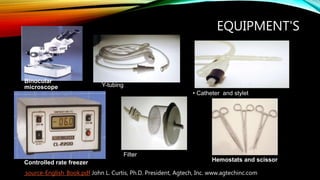
EQUIPMENT'S
Hemostats and scissor
Filter
Y-tubing
• Catheter and stylet
Binocular
microscope
Controlled rate freezer
source-English_Book.pdf John L. Curtis, Ph.D. President, Agtech, Inc. www.agtechinc.com
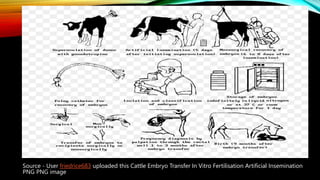
Source - User friedrice683 uploaded this Cattle Embryo Transfer In Vitro Fertilisation Artificial Insemination
PNG PNG image
SELECTION AND MANAGEMENT
OF DONOR AND RECIPIENT COW
Selection andManagement of donor cow and sires
• Genetic superiority animals that contribute to the genetic objectives of the
programme and likelihood of producing large numbers of usable embryos are the
two broad criteria for selecting donor cows for most embryo transfer programmes.
• Donors are evaluated by rectal and vaginoscopic examinations.
• Likewise, it is necessary to select fertile bulls and fertile semen which makes it
especially important to use high quality semen .
• Donors are located either on the farm under production conditions or at an
embryo transfer center , frequently under intensive management.
https://www.repro360.com.au/rep
roductivetechnologies/et
SELECTIONANDMANAGEMENT OF RECIPIENT
• Cows that are reproductively sound, that exhibit calving ease, and
that have good milking and mothering ability are recipient
prospects.
• proper plane of nutrition.
• Proper recipient herd management is critical to ET success.
Management of this herd requires fundamental understanding of
the recipient selection, nutrition, estrus synchronization, disease
management, and marketing . Personnel at the farm must have
certain skills and, above all, be extremely conscientious.
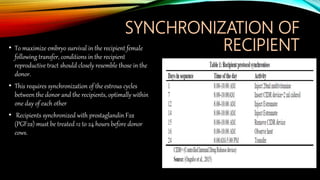
SYNCHRONIZATION OF
RECIPIENT
• To maximize embryo survival in the recipient female
following transfer, conditions in the recipient
reproductive tract should closely resemble those in the
donor.
• This requires synchronization of the estrous cycles
between the donor and the recipients, optimally within
one day of each other
• Recipients synchronized with prostaglandin F2α
(PGF2α) must be treated 12 to 24 hours before donor
cows.
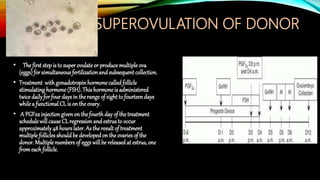
SUPEROVULATION OF DONOR
• Thefirst stepis to super ovulateor produce multiple ova
(eggs) forsimultaneousfertilization and subsequent collection.
• Treatment with gonadotropinhormonecalledfollicle
stimulatinghormone(FSH).Thishormoneis administered
twicedailyfor four daysin the range of eight to fourteendays
while a functionalCL is on the ovary.
• A PGF2αinjectiongivenon the fourthday of the treatment
schedulewillcauseCL regressionand estrus to occur
approximately48 hourslater. As theresultof treatment
multiple folliclesshouldbe developedon the ovaries of the
donor. Multiple numbers of eggswillbe released at estrus, one
fromeach follicle.
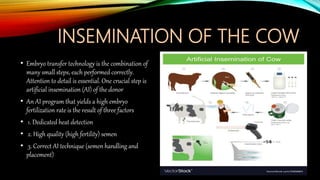
INSEMINATION OF THE COW
• Embryo transfer technology is the combination of
many small steps, each performed correctly.
Attention to detail is essential. One crucial step is
artificial insemination (AI) of the donor
• An AI program that yields a high embryo
fertilization rate is the result of three factors
• 1. Dedicated heat detection
• 2. High quality (high fertility) semen
• 3. Correct AI technique (semen handling and
placement)
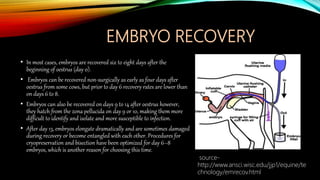
EMBRYO RECOVERY
• In most cases, embryos are recovered six to eight days after the
beginning of oestrus (day 0).
• Embryos can be recovered non-surgically as early as four days after
oestrus from some cows, but prior to day 6 recovery rates are lower than
on days 6 to 8.
• Embryos can also be recovered on days 9 to 14 after oestrus however,
they hatch from the zona pellucida on day 9 or 10, making them more
difficult to identify and isolate and more susceptible to infection.
• After day 13, embryos elongate dramatically and are sometimes damaged
during recovery or become entangled with each other. Procedures for
cryopreservation and bisection have been optimized for day 6–8
embryos, which is another reason for choosing this time.
source-
http://www.ansci.wisc.edu/jjp1/equine/te
chnology/emrecov.html
FLUSHING THE EMBRYOS
• To collect the embryos nonsurgically, a small synthetic rubber catheter is
inserted through the cervix of the donor cow, and a special medium is flushed
into and out of the uterus to harvest the embryos seven or eight days after estrus.
• When the tip of the catheter is in the body of the uterus, the cuff is slowly filled
with approximately 2 ml of normal saline. The catheter is then gently pulled so
that the cuff is seated into the internal os of the cervix.
• A Y-connector with inflow and outflow tubes is attached to the catheter.
• The fluid is sequentially added and removed by gravity. The fluid in the uterus is
agitated rectally, especially in the upper one-third of the uterine horn. The uterus
is finally filled with medium to about the size of a 40 day pregnancy. One liter of
fluid is used per donor. Many operators use a smaller volume and flush one
uterine horn at a time. Each uterine horn is filled and emptied five to ten times
with 30 to 200 ml of fluid each time, according to size of the uterus. The embryos
are flushed out with this fluid into a large graduated cylinder.
Flushing fluid
Source-
https://artofagriculture.wordpress.co
m/2015/04/28/embryo-flushing-and-
transfer/
EMBRYO HANDLING, EVALUATION AND
STORAGE
•Embryo handling
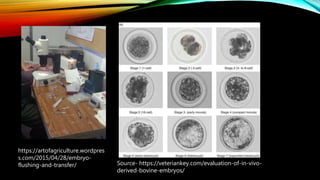
• Embryoevaluation -evaluated by morphological examination at 50 to 100 X magnification.
Generally the major criteria for quality evaluation include;
• regularity of shape of the embryo, compactness of the blastomeres (the dividing cells within the boundaries of the
embryo), variation in cell size, color and texture of the cytoplasm (the fluid within the cell wall), overall diameter of the
embryo, presence of extruded cells, thickness and regularity of the zona pellucida and presence of vesicles.
•Embryo storage
• Procedures such as ET, IVF, sex determination, and cloning depend on maintaining the viability of embryos for hours to
days outside of the reproductive tract. For many applications, the storage system must not only maintain the viability of
the embryo, but must also support continued development.
Source- https://veteriankey.com/evaluation-of-in-vivo-
derived-bovine-embryos/
https://artofagriculture.wordpres
s.com/2015/04/28/embryo-
flushing-and-transfer/
TRANSFER OF EMBRYOS
• Non-Surgical method of embryo transfer
Injection of anesthesia is given between the vertebrae of the rump to reduce rectal contractions. The embryo to be transferred is taken
into a 0.25 ml straw and then placed into the AI gun. Thee insemination gun is carefully passed through the cervix and into the uterus
corresponding to the ovary that has a corpus luteum. The embryo should be disposed as deep into the uterine horn as feasible without
using force.
Surgical method of embryo transfer
The recipient is prepared for surgery by shaving an area. The area prepared should be on the side where the corpus luteum is present. A
local anaesthetic is injected at the shaved area. The area is scrubbed with alcohol and a 2 inch incision is made with a scalpel. The uterus
and the ovaries are brought near the opening of incision by grasping the uterus with the fingers of a hand. A small incision is made in
the exposed uterine horn with a blunt needle. The embryo is drawn into a 0.25 ml straw attached to a small syringe and deposited into
the uterus. The incision is closed with a few stitches and antibiotic solution is applied into the stitch area to remove infection
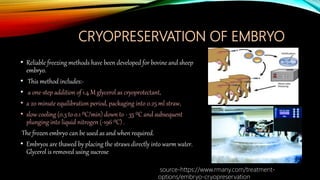
CRYOPRESERVATION OF EMBRYO
• Reliable freezing methods have been developed for bovine and sheep
embryo.
• This method includes:-
• a one-step addition of 1.4 M glycerol as cryoprotectant,
• a 20 minute equilibration period, packaging into 0.25 ml straw,
• slow cooling (0.3 to 0.1 ⁰C/min) down to - 35 ⁰C and subsequent
plunging into liquid nitrogen (-196 ⁰C) .
The frozen embryo can be used as and when required.
• Embryos are thawed by placing the straws directly into warm water.
Glycerol is removed using sucrose
source-https://www.rmany.com/treatment-
options/embryo-cryopreservation
APPLICATIONS
• GeneticImprovement
• PlannedMating
• Disease Control
• Circumvent Infertility
REFERENCES
• https://www.researchgate.net/publication/340815285
• /Users/CC/Downloads/English_Book.pdf
• https://www.researchgate.net/publication/328354440
THANK YOU

Embryo transfer in cattle and its applications

  • 1.
    EMBRYO TRANSFER IN CATTLEAND ITS APPLICATIONS Prepared by – Reena Negi MSc. biotechnology 2nd year
  • 2.
    INTRODUCTION • Embryo transferis one stepin the process of removing one or more embryos fromthe reproductive tract of a donor female and transferring them to one or more recipient females. Embryos also can be producedin the laboratoryvia techniques suchas in vitro fertilization or somaticcell cloning. • proliferation of so calleddesirable phenotypes andproduction of artificial inseminated (AI)bulls throughplanned matting. • It is necessaryfor achievingsuccess in various assisted reproductive technologies, especiallyin case of in-vitrofertilizationand animal cloning
  • 3.
    HISTORY • Embryotransfer wasfirstperformedandrecorded by Walter Heape in 1890. He transferred two Angorarabbit embryos intoa gestating Belgian doe. • In 1951Wilet ,Black,Casida, Stoneand Buckner reported the first successful ovumtransferin cattle usingsurgical techniques. • The successful embryotransfers were reported in cattle and pigsby JimRowson at Cambridge, England and theyalso the firstto produce a calf afterthe 11 day blastocyst had beenfrozen prior to transfer. • The first commercial embryotransfers were done in the early1970s. Initially, embryos were recoveredfrom valuable donorsand transferred to recipient animalsusing surgical procedures. It wasnot until non-surgical methods were developedin the late 1970s, that embryotransfer grewin popularity source- https://citeseerx. ist.psu.edu/view doc/download? doi=10.1.1.616.60 78&rep=rep1&ty pe=pdf
  • 4.
    PRINCIPLE • By collectingembryos from genetically elite females and transferring the harvested embryos into females of lesser genetic merit, it is possible to produce more calves from genetically superior females and fewer calves from genetically less valuable females . Therefore, to achieve this goal the bovine female ovulates multiple, matured and viable oocytes, which are capable of being fertilized in-vivo, and which can then continue to develop into embryos
  • 5.
    EQUIPMENT'S Hemostats and scissor Filter Y-tubing •Catheter and stylet Binocular microscope Controlled rate freezer source-English_Book.pdf John L. Curtis, Ph.D. President, Agtech, Inc. www.agtechinc.com
  • 6.
    Source - Userfriedrice683 uploaded this Cattle Embryo Transfer In Vitro Fertilisation Artificial Insemination PNG PNG image
  • 7.
    SELECTION AND MANAGEMENT OFDONOR AND RECIPIENT COW Selection andManagement of donor cow and sires • Genetic superiority animals that contribute to the genetic objectives of the programme and likelihood of producing large numbers of usable embryos are the two broad criteria for selecting donor cows for most embryo transfer programmes. • Donors are evaluated by rectal and vaginoscopic examinations. • Likewise, it is necessary to select fertile bulls and fertile semen which makes it especially important to use high quality semen . • Donors are located either on the farm under production conditions or at an embryo transfer center , frequently under intensive management. https://www.repro360.com.au/rep roductivetechnologies/et
  • 8.
    SELECTIONANDMANAGEMENT OF RECIPIENT •Cows that are reproductively sound, that exhibit calving ease, and that have good milking and mothering ability are recipient prospects. • proper plane of nutrition. • Proper recipient herd management is critical to ET success. Management of this herd requires fundamental understanding of the recipient selection, nutrition, estrus synchronization, disease management, and marketing . Personnel at the farm must have certain skills and, above all, be extremely conscientious.
  • 9.
    SYNCHRONIZATION OF RECIPIENT • Tomaximize embryo survival in the recipient female following transfer, conditions in the recipient reproductive tract should closely resemble those in the donor. • This requires synchronization of the estrous cycles between the donor and the recipients, optimally within one day of each other • Recipients synchronized with prostaglandin F2α (PGF2α) must be treated 12 to 24 hours before donor cows.
  • 10.
    SUPEROVULATION OF DONOR •Thefirst stepis to super ovulateor produce multiple ova (eggs) forsimultaneousfertilization and subsequent collection. • Treatment with gonadotropinhormonecalledfollicle stimulatinghormone(FSH).Thishormoneis administered twicedailyfor four daysin the range of eight to fourteendays while a functionalCL is on the ovary. • A PGF2αinjectiongivenon the fourthday of the treatment schedulewillcauseCL regressionand estrus to occur approximately48 hourslater. As theresultof treatment multiple folliclesshouldbe developedon the ovaries of the donor. Multiple numbers of eggswillbe released at estrus, one fromeach follicle.
  • 11.
    INSEMINATION OF THECOW • Embryo transfer technology is the combination of many small steps, each performed correctly. Attention to detail is essential. One crucial step is artificial insemination (AI) of the donor • An AI program that yields a high embryo fertilization rate is the result of three factors • 1. Dedicated heat detection • 2. High quality (high fertility) semen • 3. Correct AI technique (semen handling and placement)
  • 12.
    EMBRYO RECOVERY • Inmost cases, embryos are recovered six to eight days after the beginning of oestrus (day 0). • Embryos can be recovered non-surgically as early as four days after oestrus from some cows, but prior to day 6 recovery rates are lower than on days 6 to 8. • Embryos can also be recovered on days 9 to 14 after oestrus however, they hatch from the zona pellucida on day 9 or 10, making them more difficult to identify and isolate and more susceptible to infection. • After day 13, embryos elongate dramatically and are sometimes damaged during recovery or become entangled with each other. Procedures for cryopreservation and bisection have been optimized for day 6–8 embryos, which is another reason for choosing this time. source- http://www.ansci.wisc.edu/jjp1/equine/te chnology/emrecov.html
  • 13.
    FLUSHING THE EMBRYOS •To collect the embryos nonsurgically, a small synthetic rubber catheter is inserted through the cervix of the donor cow, and a special medium is flushed into and out of the uterus to harvest the embryos seven or eight days after estrus. • When the tip of the catheter is in the body of the uterus, the cuff is slowly filled with approximately 2 ml of normal saline. The catheter is then gently pulled so that the cuff is seated into the internal os of the cervix. • A Y-connector with inflow and outflow tubes is attached to the catheter. • The fluid is sequentially added and removed by gravity. The fluid in the uterus is agitated rectally, especially in the upper one-third of the uterine horn. The uterus is finally filled with medium to about the size of a 40 day pregnancy. One liter of fluid is used per donor. Many operators use a smaller volume and flush one uterine horn at a time. Each uterine horn is filled and emptied five to ten times with 30 to 200 ml of fluid each time, according to size of the uterus. The embryos are flushed out with this fluid into a large graduated cylinder. Flushing fluid Source- https://artofagriculture.wordpress.co m/2015/04/28/embryo-flushing-and- transfer/
  • 14.
    EMBRYO HANDLING, EVALUATIONAND STORAGE •Embryo handling • Embryoevaluation -evaluated by morphological examination at 50 to 100 X magnification. Generally the major criteria for quality evaluation include; • regularity of shape of the embryo, compactness of the blastomeres (the dividing cells within the boundaries of the embryo), variation in cell size, color and texture of the cytoplasm (the fluid within the cell wall), overall diameter of the embryo, presence of extruded cells, thickness and regularity of the zona pellucida and presence of vesicles. •Embryo storage • Procedures such as ET, IVF, sex determination, and cloning depend on maintaining the viability of embryos for hours to days outside of the reproductive tract. For many applications, the storage system must not only maintain the viability of the embryo, but must also support continued development.
  • 15.
  • 16.
    TRANSFER OF EMBRYOS •Non-Surgical method of embryo transfer Injection of anesthesia is given between the vertebrae of the rump to reduce rectal contractions. The embryo to be transferred is taken into a 0.25 ml straw and then placed into the AI gun. Thee insemination gun is carefully passed through the cervix and into the uterus corresponding to the ovary that has a corpus luteum. The embryo should be disposed as deep into the uterine horn as feasible without using force. Surgical method of embryo transfer The recipient is prepared for surgery by shaving an area. The area prepared should be on the side where the corpus luteum is present. A local anaesthetic is injected at the shaved area. The area is scrubbed with alcohol and a 2 inch incision is made with a scalpel. The uterus and the ovaries are brought near the opening of incision by grasping the uterus with the fingers of a hand. A small incision is made in the exposed uterine horn with a blunt needle. The embryo is drawn into a 0.25 ml straw attached to a small syringe and deposited into the uterus. The incision is closed with a few stitches and antibiotic solution is applied into the stitch area to remove infection
  • 17.
    CRYOPRESERVATION OF EMBRYO •Reliable freezing methods have been developed for bovine and sheep embryo. • This method includes:- • a one-step addition of 1.4 M glycerol as cryoprotectant, • a 20 minute equilibration period, packaging into 0.25 ml straw, • slow cooling (0.3 to 0.1 ⁰C/min) down to - 35 ⁰C and subsequent plunging into liquid nitrogen (-196 ⁰C) . The frozen embryo can be used as and when required. • Embryos are thawed by placing the straws directly into warm water. Glycerol is removed using sucrose source-https://www.rmany.com/treatment- options/embryo-cryopreservation
  • 18.
    APPLICATIONS • GeneticImprovement • PlannedMating •Disease Control • Circumvent Infertility
  • 19.
  • 20.