Infertility Meeting, Misurata, 26th October 2007 
NNeeww DDeevveellooppmmeennttss iinn 
RReepprroodduuccttiivvee MMeeddiicciinnee 
Prof. Dr. med. K. Diedrich 
Dept. of Obstetrics & Gynecology 
University of Schleswig-Holstein, Campus Lübeck, Germany
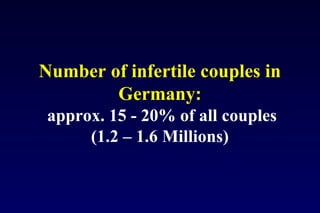
Number of infertile couples in 
Germany: 
approx. 15 - 20% of all couples 
(1.2 – 1.6 Millions)
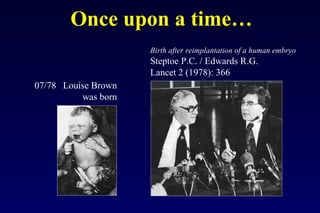
Once upon a time… 
07/78 Louise Brown 
was born 
Birth after reimplantation of a human embryo 
Steptoe P.C. / Edwards R.G. 
Lancet 2 (1978): 366
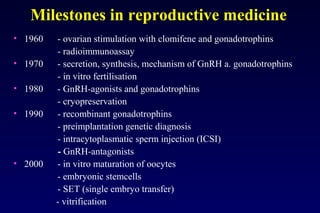
Milestones in reproductive medicine 
• 1960 - ovarian stimulation with clomifene and gonadotrophins 
- radioimmunoassay 
• 1970 - secretion, synthesis, mechanism of GnRH a. gonadotrophins 
- in vitro fertilisation 
• 1980 - GnRH-agonists and gonadotrophins 
- cryopreservation 
• 1990 - recombinant gonadotrophins 
- preimplantation genetic diagnosis 
- intracytoplasmatic sperm injection (ICSI) 
- GnRH-antagonists 
• 2000 - in vitro maturation of oocytes 
- embryonic stemcells 
- SET (single embryo transfer) 
- vitrification
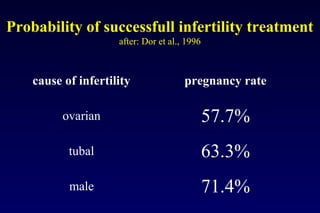
Probability of successfull infertility treatment 
after: Dor et al., 1996 
cause of infertility pregnancy rate 
ovarian 57.7% 
tubal 63.3% 
male 71.4%
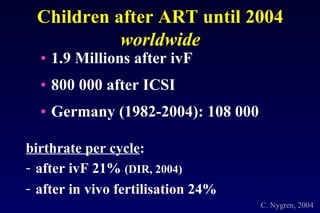
Children after ART until 2004 
worldwide 
• 1.9 Millions after ivF 
• 800 000 after ICSI 
• Germany (1982-2004): 108 000 
C. Nygren, 2004 
birthrate per cycle: 
- after ivF 21% (DIR, 2004) 
- after in vivo fertilisation 24%
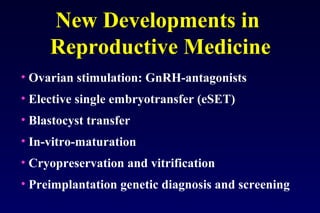
New Developments in 
Reproductive Medicine 
• Ovarian stimulation: GnRH-antagonists 
• Elective single embryotransfer (eSET) 
• Blastocyst transfer 
• In-vitro-maturation 
• Cryopreservation and vitrification 
• Preimplantation genetic diagnosis and screening
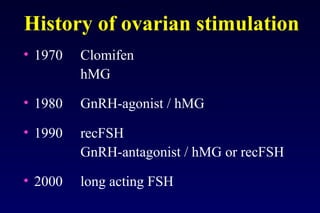
History of ovarian stimulation 
• 1970 Clomifen 
hMG 
• 1980 GnRH-agonist / hMG 
• 1990 recFSH 
GnRH-antagonist / hMG or recFSH 
• 2000 long acting FSH
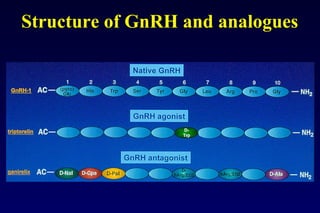
Structure of GnRH and analogues
8 
6 
4 
2 
0 
8 
6 
4 
2 
0 
LHRH-agonist: daily injection/ depot/ nasal spray 
d 6 
d -14 
Ampoules 
Gonadotropins 
Menses 
Ampoules HMG 
Menses 
Cetrorelix 
HCG 
OPU 
HCG 
OPU 
ET 
ET 
0 1 2 3 4 5 6 7 8 9 10 11 12 13 14 15 16 17 
day of cycle 
-16 -14 -12 -10 -8 -6 -4 -2 0 2 4 6 8 10 12 14 16 
17 day of cycle 
„long protocol“ 
„Lübeck 
protocol“ 
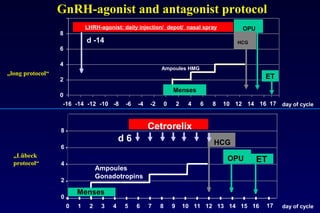
GnRH-agonist and antagonist protocol
Citation Year 0,1 0,2 0,5 1 2 5 10 
Effect Lower Upper PValue 
Albano 2000 ,829 ,444 1,547 ,556 
European 2000 ,748 ,519 1,078 ,119 
Olivennes 2000 ,799 ,336 1,901 ,612 
North American 2001 ,777 ,470 1,284 ,324 
Middle East 2001 ,973 ,604 1,568 ,910 
Akman 2001 ,760 ,177 3,263 ,712 
Hohmann 2003 ,929 ,398 2,169 ,865 
Martinez 2003 1,569 ,307 8,011 ,587 
Franco 2003 ,545 ,065 4,562 ,573 
Hwang 2004 1,105 ,347 3,526 ,866 
Sauer 2004 1,067 ,334 3,409 ,913 
Xavier 2005 ,845 ,288 2,484 ,760 
Loutradis 2005 ,704 ,271 1,827 ,469 
Malmusi 2005 1,000 ,257 3,888 1,000 
Marci 2005 10,358 ,533201,451 ,062 
Cheung 2005 1,550 ,242 9,940 ,642 
Check 2005 1,818 ,518 6,382 ,347 
Barmat 2005 ,651 ,262 1,621 ,356 
Bahceci 2005 ,839 ,436 1,613 ,598 
Badrawi 2005 ,803 ,320 2,015 ,640 
Schmidt 2005 1,000 ,181 5,533 1,000 
Lee 2005 ,696 ,229 2,114 ,522 
FixedCombined (22) ,859 ,722 1,021 ,085 
Favor agonists Favor antagonists 
Odds ratio:0.859 
p=0.085 
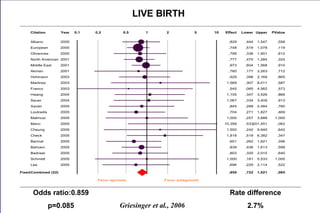
LIVE BIRTH 
Rate difference 
Griesinger et al., 2006 2.7%
Advantages of GnRH-antagonists 
- simple stimulation 
- fixed initiation of GnRH-antagonist on day 6 
- no LH supplementation 
- no increase of gonadotrophin dose at GnRH-antagonist 
initiation 
- ovulation induction for ART by dominant follicle of 
≥ 17mm 
- luteal phase supplementation is mandatory
Advantages of GnRH-antagonists 
- fits into the normal cycle 
(„the patients like it“) 
- less side effects in comparison to the long protocol: 
1. Ø cysts 
2. Ø hormonal withdrawl 
3. less OHSS 
- no significant difference in the probability 
of live birth between GnRH-agonists and 
antagonists
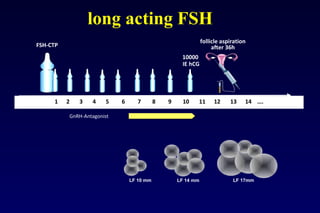
long acting FSH 
FSH-CTP 
10000 
IE hCG 
follicle aspiration 
after 36h 
1 2 3 4 5 6 7 8 9 10 11 12 13 14 …. 
GnRH-Antagonist 
LF 10 mm LF 14 mm LF 17mm
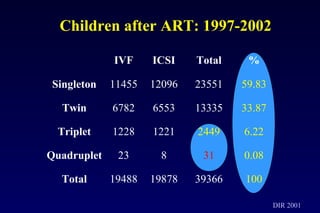
Children after ART: 1997-2002 
DIR 2001 
IVF ICSI Total % 
Singleton 11455 12096 23551 59.83 
Twin 6782 6553 13335 33.87 
Triplet 1228 1221 2449 6.22 
Quadruplet 23 8 31 0.08 
Total 19488 19878 39366 100
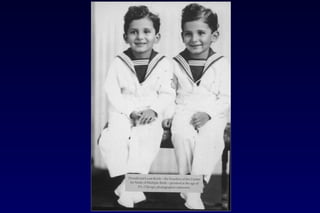
Problems of multiple pregnancies 
• pregnancy related diseases 
• prematurity 
• increase of neonatal morbidity and mortality 
• costs
Aims 
1. To avoid multiple pregnancies 
2. Improve the pregnancy and life birth rate 
Solution: Transfer of one selected embryo
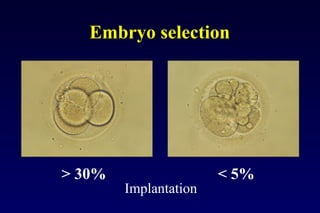
Embryo selection 
> 30% < 5% 
Implantation
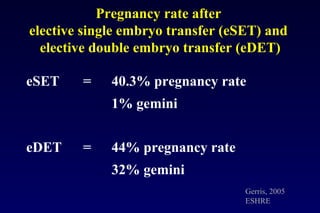
Pregnancy rate after 
elective single embryo transfer (eSET) and 
elective double embryo transfer (eDET) 
eSET = 40.3% pregnancy rate 
1% gemini 
eDET = 44% pregnancy rate 
32% gemini 
Gerris, 2005 
ESHRE
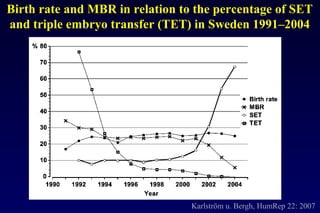
Birth rate and MBR in relation to the percentage of SET 
and triple embryo transfer (TET) in Sweden 1991–2004 
Karlström u. Bergh, HumRep 22: 2007
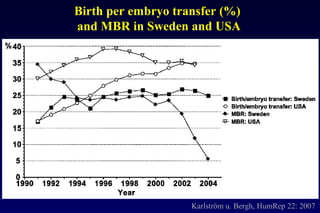
Birth per embryo transfer (%) 
and MBR in Sweden and USA 
Karlström u. Bergh, HumRep 22: 2007
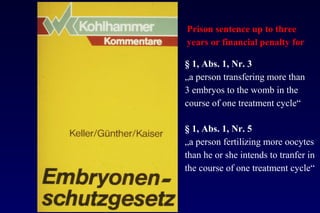
Prison sentence up to three 
years or financial penalty for 
§ 1, Abs. 1, Nr. 3 
„a person transfering more than 
3 embryos to the womb in the 
course of one treatment cycle“ 
§ 1, Abs. 1, Nr. 5 
„a person fertilizing more oocytes 
than he or she intends to tranfer in 
the course of one treatment cycle“
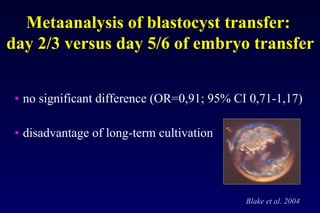
Metaanalysis of blastocyst transfer: 
day 2/3 versus day 5/6 of embryo transfer 
• no significant difference (OR=0,91; 95% CI 0,71-1,17) 
Blake et al. 2004 
• disadvantage of long-term cultivation
Preimplantation genetic screening (PGS) 
University of Brussels 
Inclusion criteria: 
• 37 yrs and older 
• prospective randomized controlled study 
• examined chromosomes: X, Y, 13, 18, 21
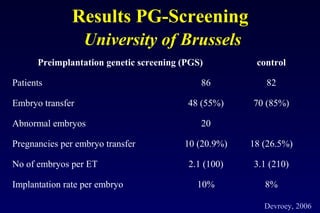
Results PG-Screening 
University of Brussels 
Preimplantation genetic screening (PGS) control 
Patients 86 82 
Embryo transfer 48 (55%) 70 (85%) 
Abnormal embryos 20 
Pregnancies per embryo transfer 10 (20.9%) 18 (26.5%) 
No of embryos per ET 2.1 (100) 3.1 (210) 
Implantation rate per embryo 10% 8% 
Devroey, 2006
Conclusion of the Brussels study: 
A positive effect of PGS on implantation and 
abortion rate of this study and others is not clearly 
documented.
Methods of cryopreservation 
slow cooling 
vitrification
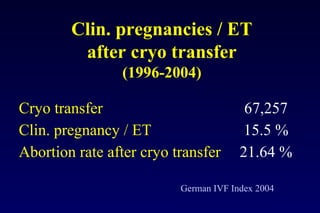
Clin. pregnancies / ET 
after cryo transfer 
(1996-2004) 
Cryo transfer 67,257 
Clin. pregnancy / ET 15.5 % 
Abortion rate after cryo transfer 21.64 % 
German IVF Index 2004
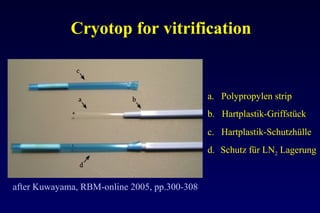
Cryotop for vitrification 
after Kuwayama, RBM-online 2005, pp.300-308 
a. Polypropylen strip 
b. Hartplastik-Griffstück 
c. Hartplastik-Schutzhülle 
d. Schutz für LN2 Lagerung
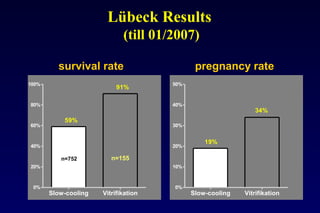
Lübeck Results 
(till 01/2007) 
survival rate pregnancy rate 
Slow-cooling Vitrifikation 
100% 
80% 
60% 
40% 
20% 
0% 
59% 
91% 
Slow-cooling Vitrifikation 
50% 
40% 
30% 
20% 
10% 
0% 
19% 
34% 
n=752 n=155
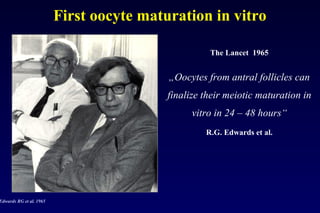
First oocyte maturation in vitro 
The Lancet 1965 
„Oocytes from antral follicles can 
finalize their meiotic maturation in 
vitro in 24 – 48 hours“ 
R.G. Edwards et al. 
Edwards RG et al. 1965
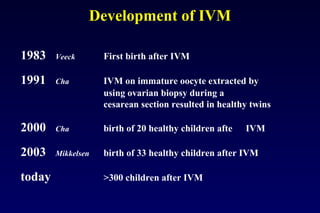
Development of IVM 
1983 Veeck First birth after IVM 
1991 Cha IVM on immature oocyte extracted by 
using ovarian biopsy during a 
cesarean section resulted in healthy twins 
2000 Cha birth of 20 healthy children afte IVM 
2003 Mikkelsen birth of 33 healthy children after IVM 
today >300 children after IVM
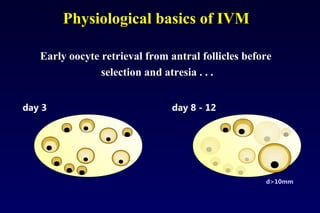
Physiological basics of IVM 
Early oocyte retrieval from antral follicles before 
selection and atresia . . . 
day 3 day 8 - 12 
d>10mm
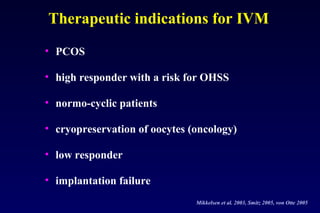
Therapeutic indications for IVM 
• PCOS 
• high responder with a risk for OHSS 
• normo-cyclic patients 
• cryopreservation of oocytes (oncology) 
• low responder 
• implantation failure 
Mikkelsen et al. 2003, Smitz 2005, von Otte 2005
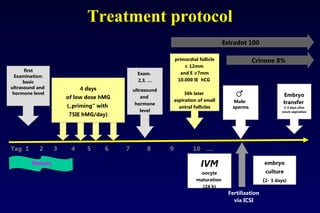
Tag 1 2 3 4 5 6 7 8 9 10 …. 
IVM 
oocyte 
maturation 
(24 h) 
first 
Examination: 
basic 
ultrasound and 
hormone level 
Embryo 
transfer 
2-3 days after 
ovum aspiration 
embryo 
culture 
(2- 3 days) 
Menses 
♂ 
Male: 
sperms 
Fertilization 
via ICSI 
4 days 
of low dose hMG 
(„priming“ with 
75IE hMG/day) 
Exam. 
2,3, … 
ultrasound 
and 
hormone 
level 
primordial follicle 
≥ 12mm 
and E ≥7mm 
10.000 IE hCG 
36h later 
aspiration of small 
antral follicles 
Estradot 100 
Crinone 8% 
Treatment protocol
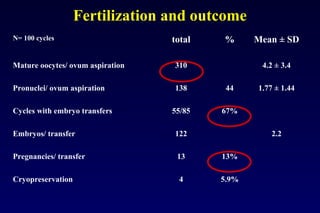
Fertilization and outcome 
N= 100 cycles total % Mean ± SD 
Mature oocytes/ ovum aspiration 310 4.2 ± 3.4 
Pronuclei/ ovum aspiration 138 44 1.77 ± 1.44 
Cycles with embryo transfers 55/85 67% 
Embryos/ transfer 122 2.2 
Pregnancies/ transfer 13 13% 
Cryopreservation 4 5.9%
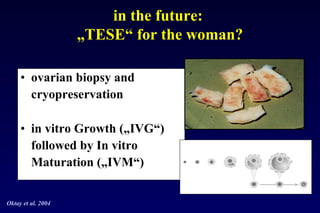
in the future: 
„TESE“ for the woman? 
• ovarian biopsy and 
cryopreservation 
• in vitro Growth („IVG“) 
followed by In vitro 
Maturation („IVM“) 
Oktay et al. 2004
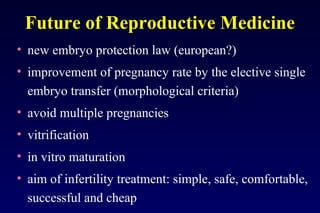
Future of Reproductive Medicine 
• new embryo protection law (european?) 
• improvement of pregnancy rate by the elective single 
embryo transfer (morphological criteria) 
• avoid multiple pregnancies 
• vitrification 
• in vitro maturation 
• aim of infertility treatment: simple, safe, comfortable, 
successful and cheap

New developments in reproductive medicine

  • 1.
    Infertility Meeting, Misurata,26th October 2007 NNeeww DDeevveellooppmmeennttss iinn RReepprroodduuccttiivvee MMeeddiicciinnee Prof. Dr. med. K. Diedrich Dept. of Obstetrics & Gynecology University of Schleswig-Holstein, Campus Lübeck, Germany
  • 3.
    Number of infertilecouples in Germany: approx. 15 - 20% of all couples (1.2 – 1.6 Millions)
  • 4.
    Once upon atime… 07/78 Louise Brown was born Birth after reimplantation of a human embryo Steptoe P.C. / Edwards R.G. Lancet 2 (1978): 366
  • 5.
    Milestones in reproductivemedicine • 1960 - ovarian stimulation with clomifene and gonadotrophins - radioimmunoassay • 1970 - secretion, synthesis, mechanism of GnRH a. gonadotrophins - in vitro fertilisation • 1980 - GnRH-agonists and gonadotrophins - cryopreservation • 1990 - recombinant gonadotrophins - preimplantation genetic diagnosis - intracytoplasmatic sperm injection (ICSI) - GnRH-antagonists • 2000 - in vitro maturation of oocytes - embryonic stemcells - SET (single embryo transfer) - vitrification
  • 6.
    Probability of successfullinfertility treatment after: Dor et al., 1996 cause of infertility pregnancy rate ovarian 57.7% tubal 63.3% male 71.4%
  • 7.
    Children after ARTuntil 2004 worldwide • 1.9 Millions after ivF • 800 000 after ICSI • Germany (1982-2004): 108 000 C. Nygren, 2004 birthrate per cycle: - after ivF 21% (DIR, 2004) - after in vivo fertilisation 24%
  • 8.
    New Developments in Reproductive Medicine • Ovarian stimulation: GnRH-antagonists • Elective single embryotransfer (eSET) • Blastocyst transfer • In-vitro-maturation • Cryopreservation and vitrification • Preimplantation genetic diagnosis and screening
  • 9.
    History of ovarianstimulation • 1970 Clomifen hMG • 1980 GnRH-agonist / hMG • 1990 recFSH GnRH-antagonist / hMG or recFSH • 2000 long acting FSH
  • 10.
    Structure of GnRHand analogues
  • 12.
    8 6 4 2 0 8 6 4 2 0 LHRH-agonist: daily injection/ depot/ nasal spray d 6 d -14 Ampoules Gonadotropins Menses Ampoules HMG Menses Cetrorelix HCG OPU HCG OPU ET ET 0 1 2 3 4 5 6 7 8 9 10 11 12 13 14 15 16 17 day of cycle -16 -14 -12 -10 -8 -6 -4 -2 0 2 4 6 8 10 12 14 16 17 day of cycle „long protocol“ „Lübeck protocol“ GnRH-agonist and antagonist protocol
  • 13.
    Citation Year 0,10,2 0,5 1 2 5 10 Effect Lower Upper PValue Albano 2000 ,829 ,444 1,547 ,556 European 2000 ,748 ,519 1,078 ,119 Olivennes 2000 ,799 ,336 1,901 ,612 North American 2001 ,777 ,470 1,284 ,324 Middle East 2001 ,973 ,604 1,568 ,910 Akman 2001 ,760 ,177 3,263 ,712 Hohmann 2003 ,929 ,398 2,169 ,865 Martinez 2003 1,569 ,307 8,011 ,587 Franco 2003 ,545 ,065 4,562 ,573 Hwang 2004 1,105 ,347 3,526 ,866 Sauer 2004 1,067 ,334 3,409 ,913 Xavier 2005 ,845 ,288 2,484 ,760 Loutradis 2005 ,704 ,271 1,827 ,469 Malmusi 2005 1,000 ,257 3,888 1,000 Marci 2005 10,358 ,533201,451 ,062 Cheung 2005 1,550 ,242 9,940 ,642 Check 2005 1,818 ,518 6,382 ,347 Barmat 2005 ,651 ,262 1,621 ,356 Bahceci 2005 ,839 ,436 1,613 ,598 Badrawi 2005 ,803 ,320 2,015 ,640 Schmidt 2005 1,000 ,181 5,533 1,000 Lee 2005 ,696 ,229 2,114 ,522 FixedCombined (22) ,859 ,722 1,021 ,085 Favor agonists Favor antagonists Odds ratio:0.859 p=0.085 LIVE BIRTH Rate difference Griesinger et al., 2006 2.7%
  • 14.
    Advantages of GnRH-antagonists - simple stimulation - fixed initiation of GnRH-antagonist on day 6 - no LH supplementation - no increase of gonadotrophin dose at GnRH-antagonist initiation - ovulation induction for ART by dominant follicle of ≥ 17mm - luteal phase supplementation is mandatory
  • 15.
    Advantages of GnRH-antagonists - fits into the normal cycle („the patients like it“) - less side effects in comparison to the long protocol: 1. Ø cysts 2. Ø hormonal withdrawl 3. less OHSS - no significant difference in the probability of live birth between GnRH-agonists and antagonists
  • 16.
    long acting FSH FSH-CTP 10000 IE hCG follicle aspiration after 36h 1 2 3 4 5 6 7 8 9 10 11 12 13 14 …. GnRH-Antagonist LF 10 mm LF 14 mm LF 17mm
  • 17.
    Children after ART:1997-2002 DIR 2001 IVF ICSI Total % Singleton 11455 12096 23551 59.83 Twin 6782 6553 13335 33.87 Triplet 1228 1221 2449 6.22 Quadruplet 23 8 31 0.08 Total 19488 19878 39366 100
  • 19.
    Problems of multiplepregnancies • pregnancy related diseases • prematurity • increase of neonatal morbidity and mortality • costs
  • 20.
    Aims 1. Toavoid multiple pregnancies 2. Improve the pregnancy and life birth rate Solution: Transfer of one selected embryo
  • 21.
    Embryo selection >30% < 5% Implantation
  • 22.
    Pregnancy rate after elective single embryo transfer (eSET) and elective double embryo transfer (eDET) eSET = 40.3% pregnancy rate 1% gemini eDET = 44% pregnancy rate 32% gemini Gerris, 2005 ESHRE
  • 23.
    Birth rate andMBR in relation to the percentage of SET and triple embryo transfer (TET) in Sweden 1991–2004 Karlström u. Bergh, HumRep 22: 2007
  • 24.
    Birth per embryotransfer (%) and MBR in Sweden and USA Karlström u. Bergh, HumRep 22: 2007
  • 25.
    Prison sentence upto three years or financial penalty for § 1, Abs. 1, Nr. 3 „a person transfering more than 3 embryos to the womb in the course of one treatment cycle“ § 1, Abs. 1, Nr. 5 „a person fertilizing more oocytes than he or she intends to tranfer in the course of one treatment cycle“
  • 26.
    Metaanalysis of blastocysttransfer: day 2/3 versus day 5/6 of embryo transfer • no significant difference (OR=0,91; 95% CI 0,71-1,17) Blake et al. 2004 • disadvantage of long-term cultivation
  • 27.
    Preimplantation genetic screening(PGS) University of Brussels Inclusion criteria: • 37 yrs and older • prospective randomized controlled study • examined chromosomes: X, Y, 13, 18, 21
  • 28.
    Results PG-Screening Universityof Brussels Preimplantation genetic screening (PGS) control Patients 86 82 Embryo transfer 48 (55%) 70 (85%) Abnormal embryos 20 Pregnancies per embryo transfer 10 (20.9%) 18 (26.5%) No of embryos per ET 2.1 (100) 3.1 (210) Implantation rate per embryo 10% 8% Devroey, 2006
  • 29.
    Conclusion of theBrussels study: A positive effect of PGS on implantation and abortion rate of this study and others is not clearly documented.
  • 30.
    Methods of cryopreservation slow cooling vitrification
  • 31.
    Clin. pregnancies /ET after cryo transfer (1996-2004) Cryo transfer 67,257 Clin. pregnancy / ET 15.5 % Abortion rate after cryo transfer 21.64 % German IVF Index 2004
  • 33.
    Cryotop for vitrification after Kuwayama, RBM-online 2005, pp.300-308 a. Polypropylen strip b. Hartplastik-Griffstück c. Hartplastik-Schutzhülle d. Schutz für LN2 Lagerung
  • 34.
    Lübeck Results (till01/2007) survival rate pregnancy rate Slow-cooling Vitrifikation 100% 80% 60% 40% 20% 0% 59% 91% Slow-cooling Vitrifikation 50% 40% 30% 20% 10% 0% 19% 34% n=752 n=155
  • 35.
    First oocyte maturationin vitro The Lancet 1965 „Oocytes from antral follicles can finalize their meiotic maturation in vitro in 24 – 48 hours“ R.G. Edwards et al. Edwards RG et al. 1965
  • 36.
    Development of IVM 1983 Veeck First birth after IVM 1991 Cha IVM on immature oocyte extracted by using ovarian biopsy during a cesarean section resulted in healthy twins 2000 Cha birth of 20 healthy children afte IVM 2003 Mikkelsen birth of 33 healthy children after IVM today >300 children after IVM
  • 37.
    Physiological basics ofIVM Early oocyte retrieval from antral follicles before selection and atresia . . . day 3 day 8 - 12 d>10mm
  • 38.
    Therapeutic indications forIVM • PCOS • high responder with a risk for OHSS • normo-cyclic patients • cryopreservation of oocytes (oncology) • low responder • implantation failure Mikkelsen et al. 2003, Smitz 2005, von Otte 2005
  • 39.
    Tag 1 23 4 5 6 7 8 9 10 …. IVM oocyte maturation (24 h) first Examination: basic ultrasound and hormone level Embryo transfer 2-3 days after ovum aspiration embryo culture (2- 3 days) Menses ♂ Male: sperms Fertilization via ICSI 4 days of low dose hMG („priming“ with 75IE hMG/day) Exam. 2,3, … ultrasound and hormone level primordial follicle ≥ 12mm and E ≥7mm 10.000 IE hCG 36h later aspiration of small antral follicles Estradot 100 Crinone 8% Treatment protocol
  • 40.
    Fertilization and outcome N= 100 cycles total % Mean ± SD Mature oocytes/ ovum aspiration 310 4.2 ± 3.4 Pronuclei/ ovum aspiration 138 44 1.77 ± 1.44 Cycles with embryo transfers 55/85 67% Embryos/ transfer 122 2.2 Pregnancies/ transfer 13 13% Cryopreservation 4 5.9%
  • 41.
    in the future: „TESE“ for the woman? • ovarian biopsy and cryopreservation • in vitro Growth („IVG“) followed by In vitro Maturation („IVM“) Oktay et al. 2004
  • 42.
    Future of ReproductiveMedicine • new embryo protection law (european?) • improvement of pregnancy rate by the elective single embryo transfer (morphological criteria) • avoid multiple pregnancies • vitrification • in vitro maturation • aim of infertility treatment: simple, safe, comfortable, successful and cheap

Editor's Notes

  • #14 * *
  • #17 Frisch punktierte, reife Eizelle in Follikelflüsigkeit, umgeben von einer aufgelockerten Granulosazellmasse, dem Cumulus oophorus, Größe der Oozyte??
  • #36 Freies VEGF im Gegensatz zu anderen Angiogenesemarkern …
  • #37 Freies VEGF im Gegensatz zu anderen Angiogenesemarkern …
  • #38 Freies VEGF im Gegensatz zu anderen Angiogenesemarkern …
  • #39 Freies VEGF im Gegensatz zu anderen Angiogenesemarkern …
  • #40 Freies VEGF im Gegensatz zu anderen Angiogenesemarkern …
  • #41 Freies VEGF im Gegensatz zu anderen Angiogenesemarkern …
  • #42 Freies VEGF im Gegensatz zu anderen Angiogenesemarkern …