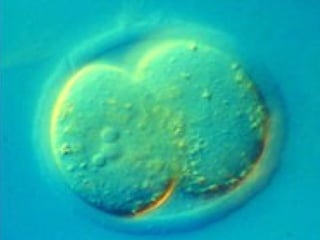
Embryo Transfer 
in Beef Cattle 
Ms. Bailes 
AGSC 336 – Advanced Animal Science
Objectives 
• Define embryo transfer 
• Explain the steps of embryo transfer 
• List the advantages of embryo transfer 
• List the disadvantages of embryo transfer
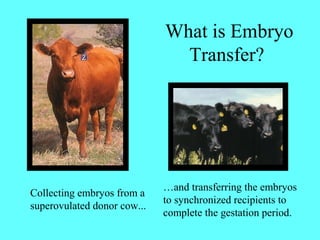
What is Embryo 
Transfer? 
Collecting embryos from a 
superovulated donor cow... 
…and transferring the embryos 
to synchronized recipients to 
complete the gestation period.
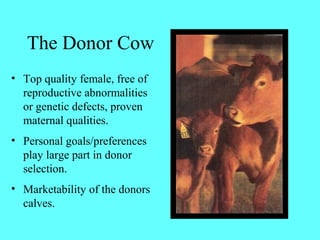
The Donor Cow 
• Top quality female, free of 
reproductive abnormalities 
or genetic defects, proven 
maternal qualities. 
• Personal goals/preferences 
play large part in donor 
selection. 
• Marketability of the donors 
calves.
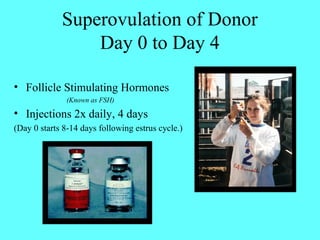
Superovulation of Donor 
Day 0 to Day 4 
• Follicle Stimulating Hormones 
(Known as FSH) 
• Injections 2x daily, 4 days 
(Day 0 starts 8-14 days following estrus cycle.)
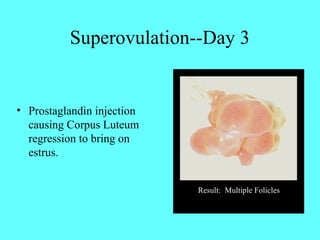
Superovulation--Day 3 
Result: Multiple Folicles 
• Prostaglandin injection 
causing Corpus Luteum 
regression to bring on 
estrus. 
Result: Multiple Folicles
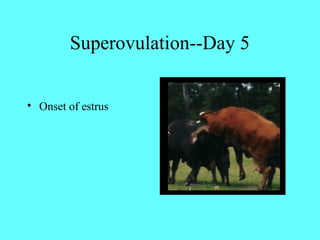
Superovulation--Day 5 
• Onset of estrus
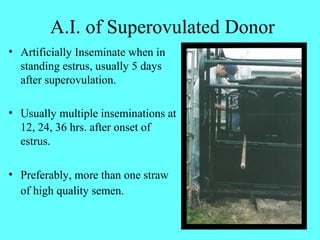
A.I. of Superovulated Donor 
• Artificially Inseminate when in 
standing estrus, usually 5 days 
after superovulation. 
• Usually multiple inseminations at 
12, 24, 36 hrs. after onset of 
estrus. 
• Preferably, more than one straw 
of high quality semen.
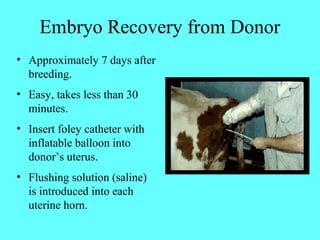
Embryo Recovery from Donor 
• Approximately 7 days after 
breeding. 
• Easy, takes less than 30 
minutes. 
• Insert foley catheter with 
inflatable balloon into 
donor’s uterus. 
• Flushing solution (saline) 
is introduced into each 
uterine horn.
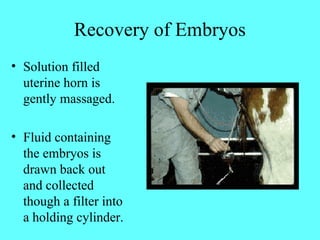
Recovery of Embryos 
• Solution filled 
uterine horn is 
gently massaged. 
• Fluid containing 
the embryos is 
drawn back out 
and collected 
though a filter into 
a holding cylinder.
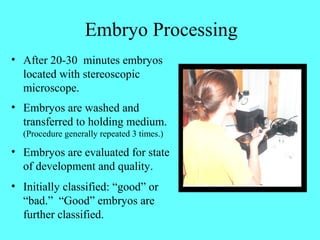
Embryo Processing 
• After 20-30 minutes embryos 
located with stereoscopic 
microscope. 
• Embryos are washed and 
transferred to holding medium. 
(Procedure generally repeated 3 times.) 
• Embryos are evaluated for state 
of development and quality. 
• Initially classified: “good” or 
“bad.” “Good” embryos are 
further classified.
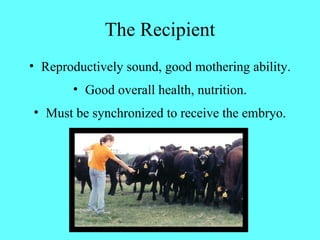
The Recipient 
• Reproductively sound, good mothering ability. 
• Good overall health, nutrition. 
• Must be synchronized to receive the embryo.
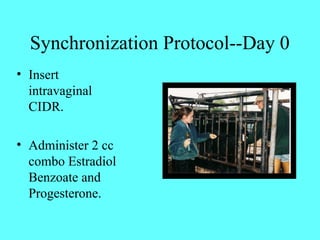
Synchronization Protocol--Day 0 
• Insert 
intravaginal 
CIDR. 
• Administer 2 cc 
combo Estradiol 
Benzoate and 
Progesterone.
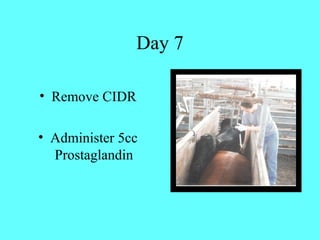
Day 7 
• Remove CIDR 
• Administer 5cc 
Prostaglandin
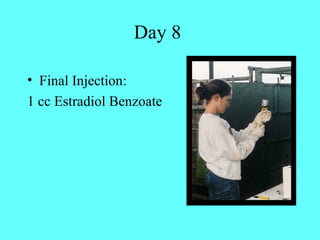
Day 8 
• Final Injection: 
1 cc Estradiol Benzoate
Day 8 through Day 10 
• Day 8 pm 
through Day 
10am: 
Observe for 
onset of estrus.
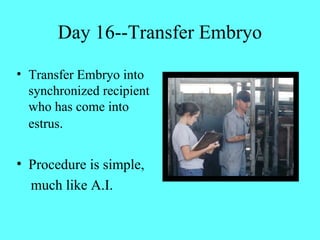
Day 16--Transfer Embryo 
• Transfer Embryo into 
synchronized recipient 
who has come into 
estrus. 
• Procedure is simple, 
much like A.I.
Activity 
• Each card has a step in the embryo transfer 
process. 
• Put yourselves in the proper order of 
embryo transfer and then explain the 
process.
Advantages of E.T. 
• Increased number of calves of genetically 
superior cows. 
• Increased marketing opportunities-- 
offspring AND embryos. 
• Ease of Import/Export. 
• Embyros can be stored indefinitely.
Disadvantages of E.T. 
• Increased expenses and higher break-even costs for 
calves. 
• Estrus detection required. 
• Synchronization of recipient with donor. 
• Specialized equipment and trained personnel. 
• More expensive and time consuming than 
traditional reproductive methods.
In Summary… 
• E.T. is not for every herd. 
• Each female born has thousands of potential 
eggs. 
• Complete the crossword puzzle which is a 
summary/review of what we learned today.
複製  Embryo-090423111342-phpapp02 (1)

複製 Embryo-090423111342-phpapp02 (1)

  • 1.
    Embryo Transfer inBeef Cattle Ms. Bailes AGSC 336 – Advanced Animal Science
  • 3.
    Objectives • Defineembryo transfer • Explain the steps of embryo transfer • List the advantages of embryo transfer • List the disadvantages of embryo transfer
  • 4.
    What is Embryo Transfer? Collecting embryos from a superovulated donor cow... …and transferring the embryos to synchronized recipients to complete the gestation period.
  • 5.
    The Donor Cow • Top quality female, free of reproductive abnormalities or genetic defects, proven maternal qualities. • Personal goals/preferences play large part in donor selection. • Marketability of the donors calves.
  • 6.
    Superovulation of Donor Day 0 to Day 4 • Follicle Stimulating Hormones (Known as FSH) • Injections 2x daily, 4 days (Day 0 starts 8-14 days following estrus cycle.)
  • 7.
    Superovulation--Day 3 Result:Multiple Folicles • Prostaglandin injection causing Corpus Luteum regression to bring on estrus. Result: Multiple Folicles
  • 8.
  • 9.
    A.I. of SuperovulatedDonor • Artificially Inseminate when in standing estrus, usually 5 days after superovulation. • Usually multiple inseminations at 12, 24, 36 hrs. after onset of estrus. • Preferably, more than one straw of high quality semen.
  • 10.
    Embryo Recovery fromDonor • Approximately 7 days after breeding. • Easy, takes less than 30 minutes. • Insert foley catheter with inflatable balloon into donor’s uterus. • Flushing solution (saline) is introduced into each uterine horn.
  • 11.
    Recovery of Embryos • Solution filled uterine horn is gently massaged. • Fluid containing the embryos is drawn back out and collected though a filter into a holding cylinder.
  • 12.
    Embryo Processing •After 20-30 minutes embryos located with stereoscopic microscope. • Embryos are washed and transferred to holding medium. (Procedure generally repeated 3 times.) • Embryos are evaluated for state of development and quality. • Initially classified: “good” or “bad.” “Good” embryos are further classified.
  • 13.
    The Recipient •Reproductively sound, good mothering ability. • Good overall health, nutrition. • Must be synchronized to receive the embryo.
  • 14.
    Synchronization Protocol--Day 0 • Insert intravaginal CIDR. • Administer 2 cc combo Estradiol Benzoate and Progesterone.
  • 15.
    Day 7 •Remove CIDR • Administer 5cc Prostaglandin
  • 16.
    Day 8 •Final Injection: 1 cc Estradiol Benzoate
  • 17.
    Day 8 throughDay 10 • Day 8 pm through Day 10am: Observe for onset of estrus.
  • 18.
    Day 16--Transfer Embryo • Transfer Embryo into synchronized recipient who has come into estrus. • Procedure is simple, much like A.I.
  • 19.
    Activity • Eachcard has a step in the embryo transfer process. • Put yourselves in the proper order of embryo transfer and then explain the process.
  • 20.
    Advantages of E.T. • Increased number of calves of genetically superior cows. • Increased marketing opportunities-- offspring AND embryos. • Ease of Import/Export. • Embyros can be stored indefinitely.
  • 21.
    Disadvantages of E.T. • Increased expenses and higher break-even costs for calves. • Estrus detection required. • Synchronization of recipient with donor. • Specialized equipment and trained personnel. • More expensive and time consuming than traditional reproductive methods.
  • 22.
    In Summary… •E.T. is not for every herd. • Each female born has thousands of potential eggs. • Complete the crossword puzzle which is a summary/review of what we learned today.