Development of the Heart
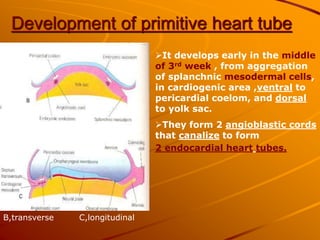
Development of primitive heart tube
It develops early in the middle
of 3rd week , from aggregation
of splanchnic mesodermal cells,
in cardiogenic area ,ventral to
pericardial coelom, and dorsal
to yolk sac.
They form 2 angioblastic cords
that canalize to form
2 endocardial heart tubes.
B,transverse C,longitudinal
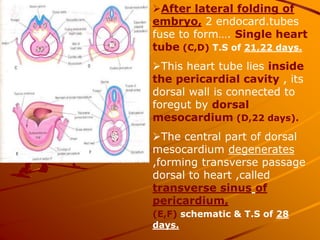
After lateral folding of
embryo, 2 endocard.tubes
fuse to form…. Single heart
tube (C,D) T.S of 21,22 days.
This heart tube lies inside
the pericardial cavity , its
dorsal wall is connected to
foregut by dorsal
mesocardium (D,22 days).
The central part of dorsal
mesocardium degenerates
,forming transverse passage
dorsal to heart ,called
transverse sinus of
pericardium,
(E,F) schematic & T.S of 28
days.
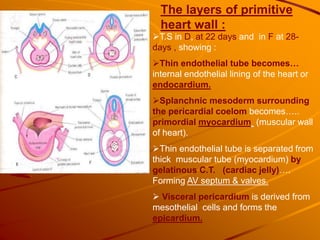
T.S in D, at 22 days and in F at 28-
days , showing :
Thin endothelial tube becomes…
internal endothelial lining of the heart or
endocardium.
Splanchnic mesoderm surrounding
the pericardial coelom becomes…..
primordial myocardium (muscular wall
of heart).
Thin endothelial tube is separated from
thick muscular tube (myocardium) by
gelatinous C.T. (cardiac jelly)….
Forming AV septum & valves.
 Visceral pericardium is derived from
mesothelial cells and forms the
epicardium.
The layers of primitive
heart wall :
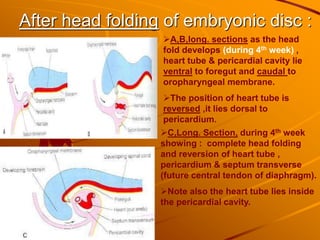
After head folding of embryonic disc :
A,B,long. sections as the head
fold develops (during 4th week) ,
heart tube & pericardial cavity lie
ventral to foregut and caudal to
oropharyngeal membrane.
The position of heart tube is
reversed ,it lies dorsal to
pericardium.
C,Long. Section, during 4th week
showing : complete head folding
and reversion of heart tube ,
pericardium & septum transverse
(future central tendon of diaphragm).
Note also the heart tube lies inside
the pericardial cavity.
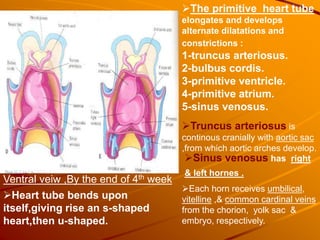
The primitive heart tube
elongates and develops
alternate dilatations and
constrictions :
1-truncus arteriosus.
2-bulbus cordis.
3-primitive ventricle.
4-primitive atrium.
5-sinus venosus.
Truncus arteriosus is
continous cranially with aortic sac
,from which aortic arches develop.
Ventral veiw ,By the end of 4th week
Heart tube bends upon
itself,giving rise an s-shaped
heart,then u-shaped.
Sinus venosus has right
& left hornes .
Each horn receives umbilical,
vitelline ,& common cardinal veins
from the chorion, yolk sac &
embryo, respectively.
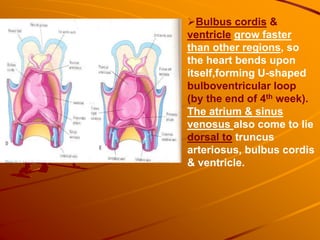
Bulbus cordis &
ventricle grow faster
than other regions, so
the heart bends upon
itself,forming U-shaped
bulboventricular loop
(by the end of 4th week).
The atrium & sinus
venosus also come to lie
dorsal to truncus
arteriosus, bulbus cordis
& ventricle.
Blood Flow through
the Primitive Heart :
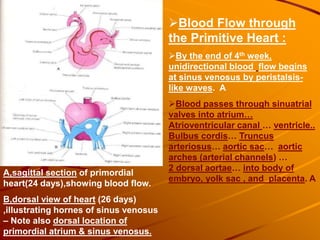
By the end of 4th week,
unidirectional blood flow begins
at sinus venosus by peristalsis-
like waves. A
Blood passes through sinuatrial
valves into atrium…
Atrioventricular canal … ventricle..
Bulbus cordis… Truncus
arteriosus… aortic sac… aortic
arches (arterial channels) …
2 dorsal aortae… into body of
embryo, yolk sac , and placenta. A
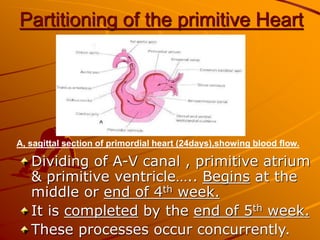
A,sagittal section of primordial
heart(24 days),showing blood flow.
B,dorsal view of heart (26 days)
,illustrating hornes of sinus venosus
– Note also dorsal location of
primordial atrium & sinus venosus.
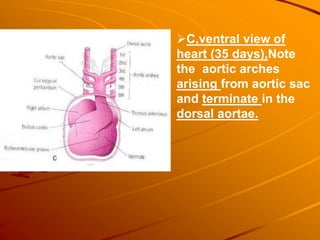
C,ventral view of
heart (35 days),Note
the aortic arches
arising from aortic sac
and terminate in the
dorsal aortae.
Partitioning of the primitive Heart
Dividing of A-V canal , primitive atrium
& primitive ventricle….. Begins at the
middle or end of 4th week.
It is completed by the end of 5th week.
These processes occur concurrently.
A, sagittal section of primordial heart (24days),showing blood flow.
Partitioning of
Atrioventricular Canal :
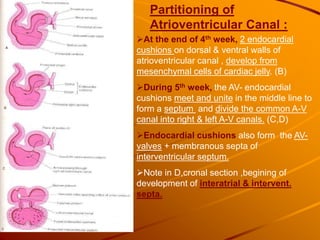
At the end of 4th week, 2 endocardial
cushions on dorsal & ventral walls of
atrioventricular canal , develop from
mesenchymal cells of cardiac jelly. (B)
During 5th week, the AV- endocardial
cushions meet and unite in the middle line to
form a septum and divide the common A-V
canal into right & left A-V canals. (C,D)
Endocardial cushions also form the AV-
valves + membranous septa of
interventricular septum.
Note in D,cronal section ,begining of
development of interatrial & intervent.
septa.
Partitioning of
primordial Atrium :
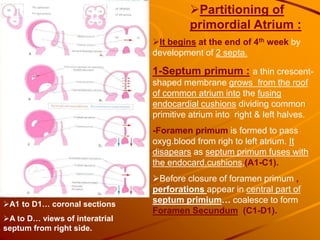
It begins at the end of 4th week by
development of 2 septa.
1-Septum primum : a thin crescent-
shaped membrane grows from the roof
of common atrium into the fusing
endocardial cushions dividing common
primitive atrium into right & left halves.
-Foramen primum is formed to pass
oxyg.blood from righ to left atrium. It
disapears as septum primum fuses with
the endocard.cushions,(A1-C1).
Before closure of foramen primum ,
perforations appear in central part of
septum primium… coalesce to form
Foramen Secundum (C1-D1).
A1 to D1… coronal sections
A to D… views of interatrial
septum from right side.
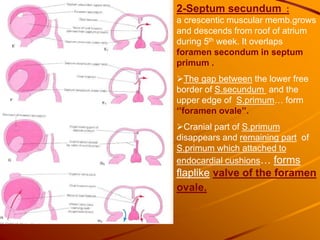
2-Septum secundum :
a crescentic muscular memb.grows
and descends from roof of atrium
during 5th week. It overlaps
foramen secondum in septum
primum .
The gap between the lower free
border of S.secundum and the
upper edge of S.primum… form
‘’foramen ovale’’.
Cranial part of S.primum
disappears and remaining part of
S.primum which attached to
endocardial cushions… forms
flaplike valve of the foramen
ovale.
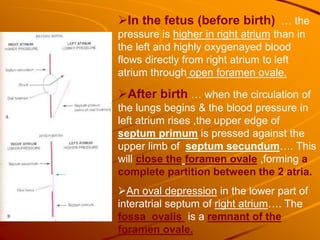
In the fetus (before birth) … the
pressure is higher in right atrium than in
the left and highly oxygenayed blood
flows directly from right atrium to left
atrium through open foramen ovale.
After birth … when the circulation of
the lungs begins & the blood pressure in
left atrium rises ,the upper edge of
septum primum is pressed against the
upper limb of septum secundum…. This
will close the foramen ovale ,forming a
complete partition between the 2 atria.
An oval depression in the lower part of
interatrial septum of right atrium…. The
fossa ovalis is a remnant of the
foramen ovale.
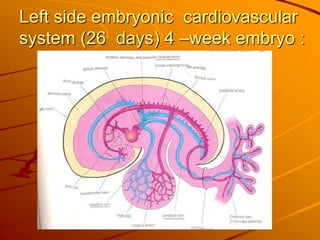
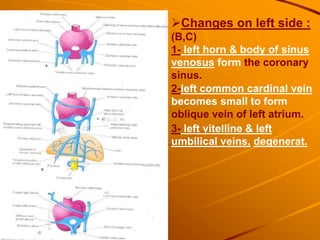
Left side embryonic cardiovascular
system (26 days) 4 –week embryo :
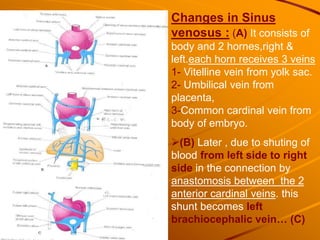
Changes in Sinus
venosus : (A) It consists of
body and 2 hornes,right &
left.each horn receives 3 veins
1- Vitelline vein from yolk sac.
2- Umbilical vein from
placenta,
3-Common cardinal vein from
body of embryo.
(B) Later , due to shuting of
blood from left side to right
side in the connection by
anastomosis between the 2
anterior cardinal veins. this
shunt becomes left
brachiocephalic vein… (C)
Changes on left side :
(B,C)
1- left horn & body of sinus
venosus form the coronary
sinus.
2-left common cardinal vein
becomes small to form
oblique vein of left atrium.
3- left vitelline & left
umbilical veins, degenerat.
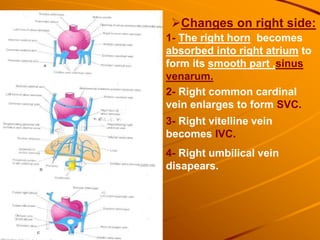
Changes on right side:
1- The right horn becomes
absorbed into right atrium to
form its smooth part ,sinus
venarum.
2- Right common cardinal
vein enlarges to form SVC.
3- Right vitelline vein
becomes IVC.
4- Right umbilical vein
disapears.
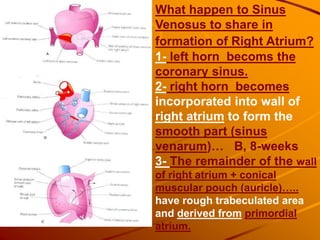
What happen to Sinus
Venosus to share in
formation of Right Atrium?
1- left horn becoms the
coronary sinus.
2- right horn becomes
incorporated into wall of
right atrium to form the
smooth part (sinus
venarum)… B, 8-weeks
3- The remainder of the wall
of right atrium + conical
muscular pouch (auricle)…..
have rough trabeculated area
and derived from primordial
atrium.
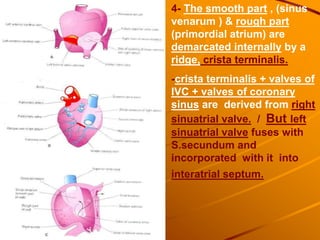
4- The smooth part , (sinus
venarum ) & rough part
(primordial atrium) are
demarcated internally by a
ridge, crista terminalis.
-crista terminalis + valves of
IVC + valves of coronary
sinus are derived from right
sinuatrial valve. / But left
sinuatrial valve fuses with
S.secundum and
incorporated with it into
interatrial septum.
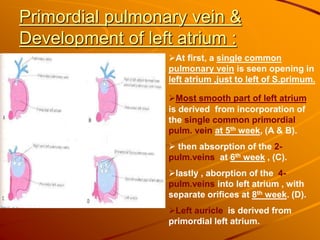
Primordial pulmonary vein &
Development of left atrium :
At first, a single common
pulmonary vein is seen opening in
left atrium ,just to left of S.primum.
Most smooth part of left atrium
is derived from incorporation of
the single common primordial
pulm. vein at 5th week, (A & B).
 then absorption of the 2-
pulm.veins at 6th week , (C).
lastly , aborption of the 4-
pulm.veins into left atrium , with
separate orifices at 8th week. (D).
Left auricle is derived from
primordial left atrium.
Embryological origin of the definitive atrium:
Right Atrium Left Atrium
1-Its rough part + auricle
from Right ½ of primitive
atrium.
2-right ½ of A-V canal.
3- Its smooth part from
Absorbed right horn of
sinus venosus.
1- Its rough part +auricle
from left ½ of primitive
atrium.
2- left ½ of A-V canal.
3- Its smooth part from
Absorbed part of
pulmonary veins.
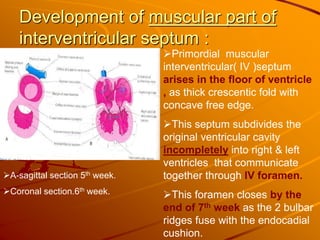
Development of muscular part of
interventricular septum :
Primordial muscular
interventricular( IV )septum
arises in the floor of ventricle
, as thick crescentic fold with
concave free edge.
This septum subdivides the
original ventricular cavity
incompletely into right & left
ventricles that communicate
together through IV foramen.
This foramen closes by the
end of 7th week as the 2 bulbar
ridges fuse with the endocadial
cushion.
A-sagittal section 5th week.
Coronal section.6th week.
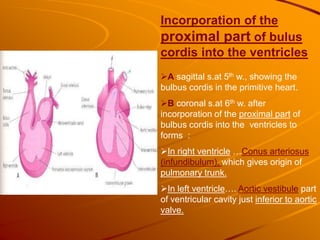
A sagittal s.at 5th w., showing the
bulbus cordis in the primitive heart.
B coronal s.at 6th w. after
incorporation of the proximal part of
bulbus cordis into the ventricles to
forms :
In right ventricle …Conus arteriosus
(infundibulum), which gives origin of
pulmonary trunk.
In left ventricle…. Aortic vestibule part
of ventricular cavity just inferior to aortic
valve.
Incorporation of the
proximal part of bulus
cordis into the ventricles
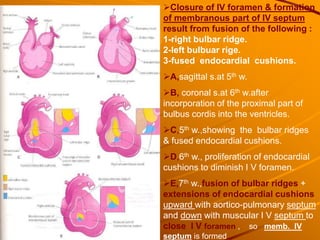
Closure of IV foramen & formation
of membranous part of IV septum
result from fusion of the following :
1-right bulbar ridge.
2-left bulbuar rige.
3-fused endocardial cushions.
A,sagittal s.at 5th w.
B, coronal s.at 6th w.after
incorporation of the proximal part of
bulbus cordis into the ventricles.
C,5th w.,showing the bulbar ridges
& fused endocardial cushions.
D,6th w., proliferation of endocardial
cushions to diminish I V foramen.
E,7th w.,fusion of bulbar ridges +
extensions of endocardial cushions
upward with aortico-pulmonary septum
and down with muscular I V septum to
close I V foramen , so memb. IV
septum is formed
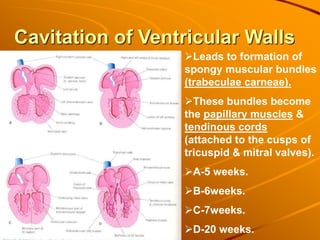
Cavitation of Ventricular Walls
Leads to formation of
spongy muscular bundles
(trabeculae carneae).
These bundles become
the papillary muscles &
tendinous cords
(attached to the cusps of
tricuspid & mitral valves).
A-5 weeks.
B-6weeks.
C-7weeks.
D-20 weeks.
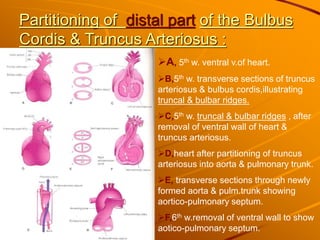
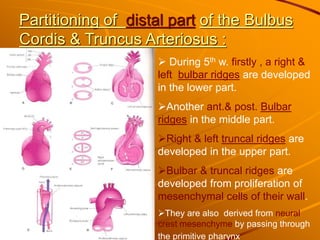
Partitioning of distal part of the Bulbus
Cordis & Truncus Arteriosus :
A, 5th w. ventral v.of heart.
B,5th w. transverse sections of truncus
arteriosus & bulbus cordis,illustrating
truncal & bulbar ridges.
C,5th w. truncal & bulbar ridges , after
removal of ventral wall of heart &
truncus arteriosus.
D,heart after partitioning of truncus
arteriosus into aorta & pulmonary trunk.
E, transverse sections through newly
formed aorta & pulm.trunk showing
aortico-pulmonary septum.
F,6th w.removal of ventral wall to show
aotico-pulmonary septum.
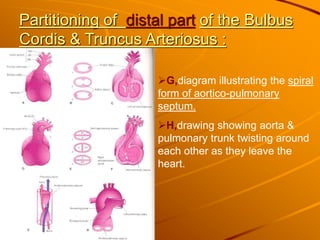
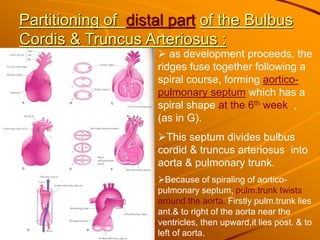
Partitioning of distal part of the Bulbus
Cordis & Truncus Arteriosus :
G,diagram illustrating the spiral
form of aortico-pulmonary
septum.
H,drawing showing aorta &
pulmonary trunk twisting around
each other as they leave the
heart.
Partitioning of distal part of the Bulbus
Cordis & Truncus Arteriosus :
 During 5th w. firstly , a right &
left bulbar ridges are developed
in the lower part.
Another ant.& post. Bulbar
ridges in the middle part.
Right & left truncal ridges are
developed in the upper part.
Bulbar & truncal ridges are
developed from proliferation of
mesenchymal cells of their wall.
They are also derived from neural
crest mesenchyme by passing through
the primitive pharynx
Partitioning of distal part of the Bulbus
Cordis & Truncus Arteriosus :
 as development proceeds, the
ridges fuse together following a
spiral course, forming aortico-
pulmonary septum which has a
spiral shape at the 6th week ,
(as in G).
This septum divides bulbus
cordid & truncus arteriosus into
aorta & pulmonary trunk.
Because of spiraling of aortico-
pulmonary septum, pulm.trunk twists
around the aorta. Firstly pulm.trunk lies
ant.& to right of the aorta near the
ventricles, then upward,it lies post. & to
left of aorta.
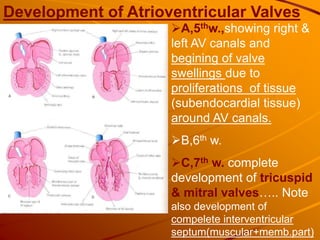
Development of Atrioventricular Valves
A,5thw.,showing right &
left AV canals and
begining of valve
swellings due to
proliferations of tissue
(subendocardial tissue)
around AV canals.
B,6th w.
C,7th w. complete
development of tricuspid
& mitral valves….. Note
also development of
compelete interventricular
septum(muscular+memb.part)
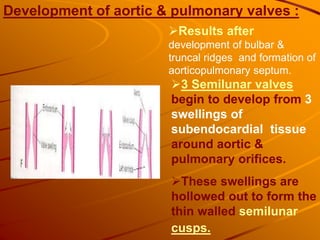
3 Semilunar valves
begin to develop from 3
swellings of
subendocardial tissue
around aortic &
pulmonary orifices.
These swellings are
hollowed out to form the
thin walled semilunar
cusps.
Results after
development of bulbar &
truncal ridges and formation of
aorticopulmonary septum.
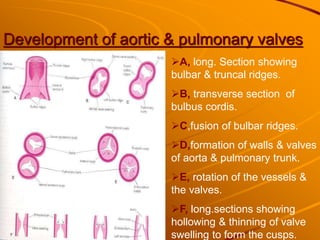
Development of aortic & pulmonary valves :
Development of aortic & pulmonary valves
A, long. Section showing
bulbar & truncal ridges.
B, transverse section of
bulbus cordis.
C,fusion of bulbar ridges.
D,formation of walls & valves
of aorta & pulmonary trunk.
E, rotation of the vessels &
the valves.
F, long.sections showing
hollowing & thinning of valve
swelling to form the cusps.
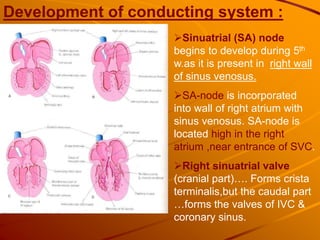
Development of conducting system :
Sinuatrial (SA) node
begins to develop during 5th
w.as it is present in right wall
of sinus venosus.
SA-node is incorporated
into wall of right atrium with
sinus venosus. SA-node is
located high in the right
atrium ,near entrance of SVC.
Right sinuatrial valve
(cranial part)…. Forms crista
terminalis,but the caudal part
…forms the valves of IVC &
coronary sinus.
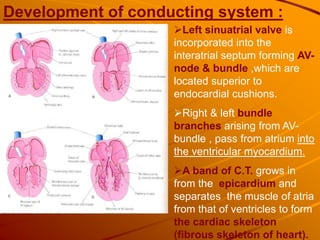
Development of conducting system :
Left sinuatrial valve is
incorporated into the
interatrial septum forming AV-
node & bundle ,which are
located superior to
endocardial cushions.
Right & left bundle
branches arising from AV-
bundle , pass from atrium into
the ventricular myocardium.
A band of C.T. grows in
from the epicardium and
separates the muscle of atria
from that of ventricles to form
the cardiac skeleton
(fibrous skeleton of heart).
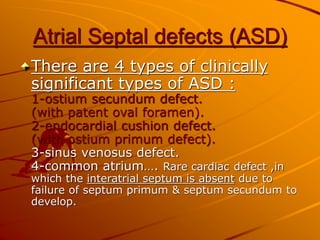
Atrial Septal defects (ASD)
There are 4 types of clinically
significant types of ASD :
1-ostium secundum defect.
(with patent oval foramen).
2-endocardial cushion defect.
(with ostium primum defect).
3-sinus venosus defect.
4-common atrium…. Rare cardiac defect ,in
which the interatrial septum is absent due to
failure of septum primum & septum secundum to
develop.
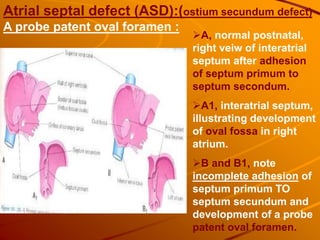
A, normal postnatal,
right veiw of interatrial
septum after adhesion
of septum primum to
septum secondum.
A1, interatrial septum,
illustrating development
of oval fossa in right
atrium.
B and B1, note
incomplete adhesion of
septum primum TO
septum secundum and
development of a probe
patent oval foramen.
Atrial septal defect (ASD):(ostium secundum defect)
A probe patent oval foramen :
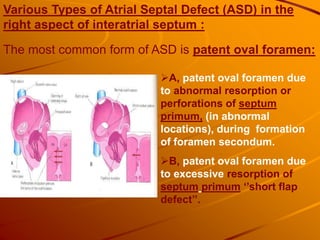
Various Types of Atrial Septal Defect (ASD) in the
right aspect of interatrial septum :
A, patent oval foramen due
to abnormal resorption or
perforations of septum
primum, (in abnormal
locations), during formation
of foramen secondum.
B, patent oval foramen due
to excessive resorption of
septum primum ‘’short flap
defect’’.
The most common form of ASD is patent oval foramen:
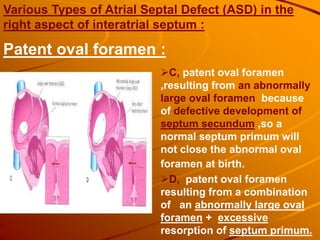
Various Types of Atrial Septal Defect (ASD) in the
right aspect of interatrial septum :
D, patent oval foramen
resulting from a combination
of an abnormally large oval
foramen + excessive
resorption of septum primum.
C, patent oval foramen
,resulting from an abnormally
large oval foramen because
of defective development of
septum secundum ,so a
normal septum primum will
not close the abnormal oval
foramen at birth.
Patent oval foramen :
Various Types of Atrial Septal Defect (ASD) in the
right aspect of interatrial septum :
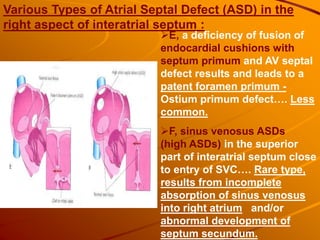
E, a deficiency of fusion of
endocardial cushions with
septum primum and AV septal
defect results and leads to a
patent foramen primum -
Ostium primum defect…. Less
common.
F, sinus venosus ASDs
(high ASDs) in the superior
part of interatrial septum close
to entry of SVC…. Rare type,
results from incomplete
absorption of sinus venosus
into right atrium and/or
abnormal development of
septum secundum.
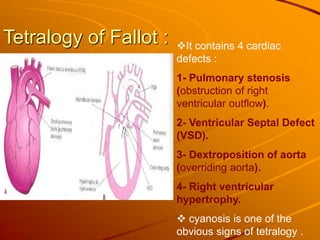
Tetralogy of Fallot : It contains 4 cardiac
defects :
1- Pulmonary stenosis
(obstruction of right
ventricular outflow).
2- Ventricular Septal Defect
(VSD).
3- Dextroposition of aorta
(overriding aorta).
4- Right ventricular
hypertrophy.
 cyanosis is one of the
obvious signs of tetralogy .
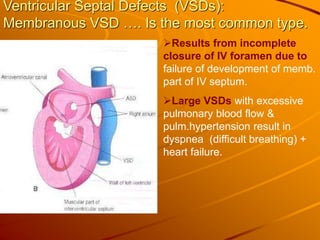
Ventricular Septal Defects (VSDs):
Membranous VSD …. Is the most common type.
Results from incomplete
closure of IV foramen due to
failure of development of memb.
part of IV septum.
Large VSDs with excessive
pulmonary blood flow &
pulm.hypertension result in
dyspnea (difficult breathing) +
heart failure.
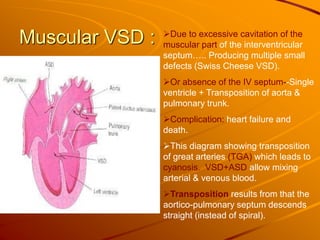
Muscular VSD : Due to excessive cavitation of the
muscular part of the interventricular
septum….. Producing multiple small
defects (Swiss Cheese VSD).
Or absence of the IV septum--Single
ventricle + Transposition of aorta &
pulmonary trunk.
Complication: heart failure and
death.
This diagram showing transposition
of great arteries (TGA) which leads to
cyanosis. VSD+ASD allow mixing
arterial & venous blood.
Transposition results from that the
aortico-pulmonary septum descends
straight (instead of spiral).
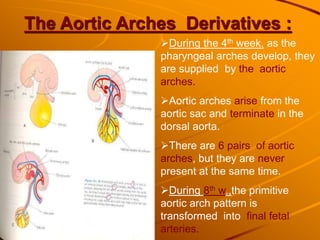
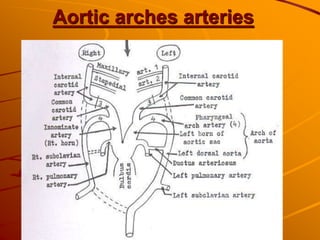
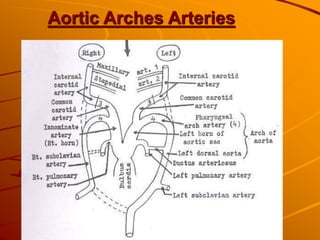
The Aortic Arches Derivatives :
During the 4th week, as the
pharyngeal arches develop, they
are supplied by the aortic
arches.
Aortic arches arise from the
aortic sac and terminate in the
dorsal aorta.
There are 6 pairs of aortic
arches, but they are never
present at the same time.
During 8th w.,the primitive
aortic arch pattern is
transformed into final fetal
arteries.
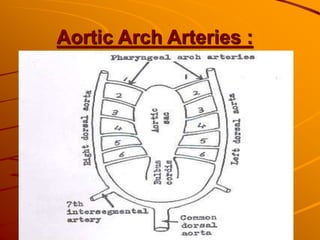
Aortic Arch Arteries :
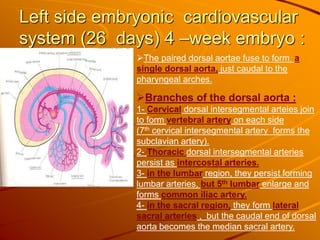
Left side embryonic cardiovascular
system (26 days) 4 –week embryo :
The paired dorsal aortae fuse to form a
single dorsal aorta, just caudal to the
pharyngeal arches.
Branches of the dorsal aorta :
1- Cervical dorsal intersegmental arteies join
to form vertebral artery on each side
(7th cervical intersegmental artery forms the
subclavian artery).
2- Thoracic dorsal intersegmental arteries
persist as intercostal arteries.
3- in the lumbar region, they persist forming
lumbar arteries, but 5th lumbar enlarge and
forms common iliac artery.
4- in the sacral region, they form lateral
sacral arteries , but the caudal end of dorsal
aorta becomes the median sacral artery.
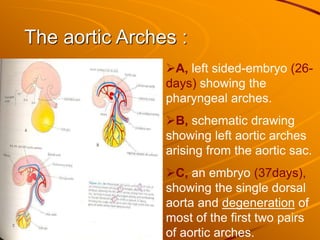
The aortic Arches :
A, left sided-embryo (26-
days) showing the
pharyngeal arches.
B, schematic drawing
showing left aortic arches
arising from the aortic sac.
C, an embryo (37days),
showing the single dorsal
aorta and degeneration of
most of the first two pairs
of aortic arches.
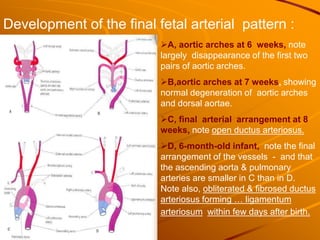
Development of the final fetal arterial pattern :
A, aortic arches at 6 weeks, note
largely disappearance of the first two
pairs of aortic arches.
B,aortic arches at 7 weeks, showing
normal degeneration of aortic arches
and dorsal aortae.
C, final arterial arrangement at 8
weeks, note open ductus arteriosus.
D, 6-month-old infant, note the final
arrangement of the vessels - and that
the ascending aorta & pulmonary
arteries are smaller in C than in D.
Note also, obliterated & fibrosed ductus
arteriosus forming … ligamentum
arteriosum within few days after birth.
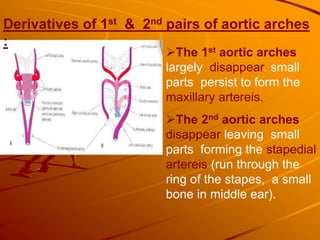
Derivatives of 1st & 2nd pairs of aortic arches
:
The 1st aortic arches
largely disappear. small
parts persist to form the
maxillary artereis.
The 2nd aortic arches
disappear leaving small
parts forming the stapedial
artereis (run through the
ring of the stapes, a small
bone in middle ear).
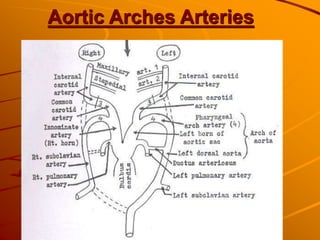
Aortic Arches Arteries
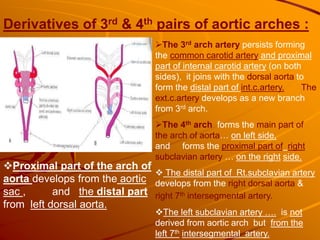
Derivatives of 3rd & 4th pairs of aortic arches :
The 3rd arch artery persists forming
the common carotid artery and proximal
part of internal carotid artery (on both
sides), it joins with the dorsal aorta to
form the distal part of int.c.artery. The
ext.c.artery develops as a new branch
from 3rd arch.
The 4th arch forms the main part of
the arch of aorta… on left side,
and forms the proximal part of right
subclavian artery … on the right side.
 The distal part of Rt.subclavian artery
develops from the right dorsal aorta &
right 7th intersegmental artery.
The left subclavian artery …. is not
derived from aortic arch but from the
left 7th intersegmental artery.
Proximal part of the arch of
aorta develops from the aortic
sac , and the distal part
from left dorsal aorta.
Aortic arches arteries
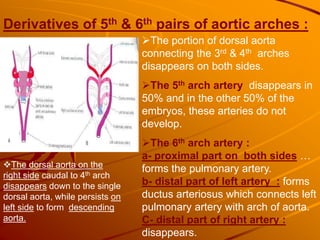
Derivatives of 5th & 6th pairs of aortic arches :
The portion of dorsal aorta
connecting the 3rd & 4th arches
disappears on both sides.
The 5th arch artery disappears in
50% and in the other 50% of the
embryos, these arteries do not
develop.
The 6th arch artery :
a- proximal part on both sides …
forms the pulmonary artery.
b- distal part of left artery : forms
ductus arteriosus which connects left
pulmonary artery with arch of aorta.
C- distal part of right artery :
disappears.
The dorsal aorta on the
right side caudal to 4th arch
disappears down to the single
dorsal aorta, while persists on
left side to form descending
aorta.
Aortic Arches Arteries
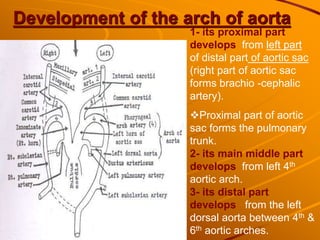
Development of the arch of aorta
1- its proximal part
develops from left part
of distal part of aortic sac
(right part of aortic sac
forms brachio -cephalic
artery).
Proximal part of aortic
sac forms the pulmonary
trunk.
2- its main middle part
develops from left 4th
aortic arch.
3- its distal part
develops from the left
dorsal aorta between 4th &
6th aortic arches.
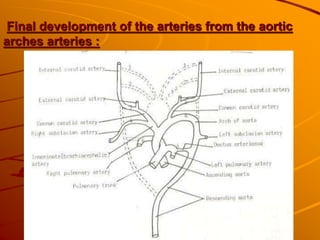
Final development of the arteries from the aortic
arches arteries :
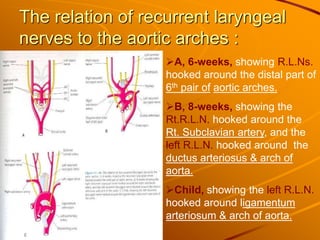
The relation of recurrent laryngeal
nerves to the aortic arches :
A, 6-weeks, showing R.L.Ns.
hooked around the distal part of
6th pair of aortic arches.
B, 8-weeks, showing the
Rt.R.L.N. hooked around the
Rt. Subclavian artery, and the
left R.L.N. hooked around the
ductus arteriosus & arch of
aorta.
Child, showing the left R.L.N.
hooked around ligamentum
arteriosum & arch of aorta.
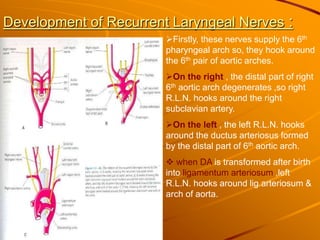
Development of Recurrent Laryngeal Nerves :
Firstly, these nerves supply the 6th
pharyngeal arch so, they hook around
the 6th pair of aortic arches.
On the right , the distal part of right
6th aortic arch degenerates ,so right
R.L.N. hooks around the right
subclavian artery.
On the left , the left R.L.N. hooks
around the ductus arteriosus formed
by the distal part of 6th aortic arch.
 when DA is transformed after birth
into ligamentum arteriosum ,left
R.L.N. hooks around lig.arteriosum &
arch of aorta.
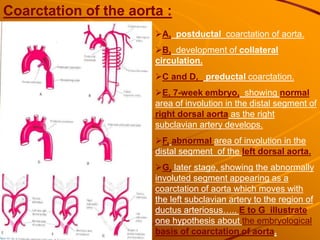
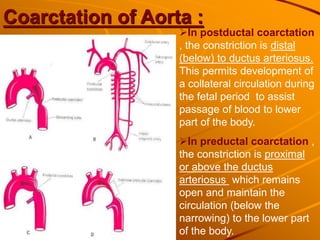
Coarctation of the aorta :
A, postductal coarctation of aorta.
B, development of collateral
circulation.
C and D, preductal coarctation.
E, 7-week embryo, showing normal
area of involution in the distal segment of
right dorsal aorta as the right
subclavian artery develops.
F, abnormal area of involution in the
distal segment of the left dorsal aorta.
G, later stage, showing the abnormally
involuted segment appearing as a
coarctation of aorta which moves with
the left subclavian artery to the region of
ductus arteriosus….. E to G illustrate
one hypothesis about the embryological
basis of coarctation of aorta.
Coarctation of Aorta :
In postductal coarctation
, the constriction is distal
(below) to ductus arteriosus.
This permits development of
a collateral circulation during
the fetal period to assist
passage of blood to lower
part of the body.
In preductal coarctation ,
the constriction is proximal
or above the ductus
arteriosus which remains
open and maintain the
circulation (below the
narrowing) to the lower part
of the body.
11 - Development of the Heart.ppt

11 - Development of the Heart.ppt

  • 1.
  • 2.
    Development of primitiveheart tube It develops early in the middle of 3rd week , from aggregation of splanchnic mesodermal cells, in cardiogenic area ,ventral to pericardial coelom, and dorsal to yolk sac. They form 2 angioblastic cords that canalize to form 2 endocardial heart tubes. B,transverse C,longitudinal
  • 3.
    After lateral foldingof embryo, 2 endocard.tubes fuse to form…. Single heart tube (C,D) T.S of 21,22 days. This heart tube lies inside the pericardial cavity , its dorsal wall is connected to foregut by dorsal mesocardium (D,22 days). The central part of dorsal mesocardium degenerates ,forming transverse passage dorsal to heart ,called transverse sinus of pericardium, (E,F) schematic & T.S of 28 days.
  • 4.
    T.S in D,at 22 days and in F at 28- days , showing : Thin endothelial tube becomes… internal endothelial lining of the heart or endocardium. Splanchnic mesoderm surrounding the pericardial coelom becomes….. primordial myocardium (muscular wall of heart). Thin endothelial tube is separated from thick muscular tube (myocardium) by gelatinous C.T. (cardiac jelly)…. Forming AV septum & valves.  Visceral pericardium is derived from mesothelial cells and forms the epicardium. The layers of primitive heart wall :
  • 5.
    After head foldingof embryonic disc : A,B,long. sections as the head fold develops (during 4th week) , heart tube & pericardial cavity lie ventral to foregut and caudal to oropharyngeal membrane. The position of heart tube is reversed ,it lies dorsal to pericardium. C,Long. Section, during 4th week showing : complete head folding and reversion of heart tube , pericardium & septum transverse (future central tendon of diaphragm). Note also the heart tube lies inside the pericardial cavity.
  • 6.
    The primitive hearttube elongates and develops alternate dilatations and constrictions : 1-truncus arteriosus. 2-bulbus cordis. 3-primitive ventricle. 4-primitive atrium. 5-sinus venosus. Truncus arteriosus is continous cranially with aortic sac ,from which aortic arches develop. Ventral veiw ,By the end of 4th week Heart tube bends upon itself,giving rise an s-shaped heart,then u-shaped. Sinus venosus has right & left hornes . Each horn receives umbilical, vitelline ,& common cardinal veins from the chorion, yolk sac & embryo, respectively.
  • 7.
    Bulbus cordis & ventriclegrow faster than other regions, so the heart bends upon itself,forming U-shaped bulboventricular loop (by the end of 4th week). The atrium & sinus venosus also come to lie dorsal to truncus arteriosus, bulbus cordis & ventricle.
  • 8.
    Blood Flow through thePrimitive Heart : By the end of 4th week, unidirectional blood flow begins at sinus venosus by peristalsis- like waves. A Blood passes through sinuatrial valves into atrium… Atrioventricular canal … ventricle.. Bulbus cordis… Truncus arteriosus… aortic sac… aortic arches (arterial channels) … 2 dorsal aortae… into body of embryo, yolk sac , and placenta. A A,sagittal section of primordial heart(24 days),showing blood flow. B,dorsal view of heart (26 days) ,illustrating hornes of sinus venosus – Note also dorsal location of primordial atrium & sinus venosus.
  • 9.
    C,ventral view of heart(35 days),Note the aortic arches arising from aortic sac and terminate in the dorsal aortae.
  • 10.
    Partitioning of theprimitive Heart Dividing of A-V canal , primitive atrium & primitive ventricle….. Begins at the middle or end of 4th week. It is completed by the end of 5th week. These processes occur concurrently. A, sagittal section of primordial heart (24days),showing blood flow.
  • 11.
    Partitioning of Atrioventricular Canal: At the end of 4th week, 2 endocardial cushions on dorsal & ventral walls of atrioventricular canal , develop from mesenchymal cells of cardiac jelly. (B) During 5th week, the AV- endocardial cushions meet and unite in the middle line to form a septum and divide the common A-V canal into right & left A-V canals. (C,D) Endocardial cushions also form the AV- valves + membranous septa of interventricular septum. Note in D,cronal section ,begining of development of interatrial & intervent. septa.
  • 12.
    Partitioning of primordial Atrium: It begins at the end of 4th week by development of 2 septa. 1-Septum primum : a thin crescent- shaped membrane grows from the roof of common atrium into the fusing endocardial cushions dividing common primitive atrium into right & left halves. -Foramen primum is formed to pass oxyg.blood from righ to left atrium. It disapears as septum primum fuses with the endocard.cushions,(A1-C1). Before closure of foramen primum , perforations appear in central part of septum primium… coalesce to form Foramen Secundum (C1-D1). A1 to D1… coronal sections A to D… views of interatrial septum from right side.
  • 13.
    2-Septum secundum : acrescentic muscular memb.grows and descends from roof of atrium during 5th week. It overlaps foramen secondum in septum primum . The gap between the lower free border of S.secundum and the upper edge of S.primum… form ‘’foramen ovale’’. Cranial part of S.primum disappears and remaining part of S.primum which attached to endocardial cushions… forms flaplike valve of the foramen ovale.
  • 14.
    In the fetus(before birth) … the pressure is higher in right atrium than in the left and highly oxygenayed blood flows directly from right atrium to left atrium through open foramen ovale. After birth … when the circulation of the lungs begins & the blood pressure in left atrium rises ,the upper edge of septum primum is pressed against the upper limb of septum secundum…. This will close the foramen ovale ,forming a complete partition between the 2 atria. An oval depression in the lower part of interatrial septum of right atrium…. The fossa ovalis is a remnant of the foramen ovale.
  • 15.
    Left side embryoniccardiovascular system (26 days) 4 –week embryo :
  • 16.
    Changes in Sinus venosus: (A) It consists of body and 2 hornes,right & left.each horn receives 3 veins 1- Vitelline vein from yolk sac. 2- Umbilical vein from placenta, 3-Common cardinal vein from body of embryo. (B) Later , due to shuting of blood from left side to right side in the connection by anastomosis between the 2 anterior cardinal veins. this shunt becomes left brachiocephalic vein… (C)
  • 17.
    Changes on leftside : (B,C) 1- left horn & body of sinus venosus form the coronary sinus. 2-left common cardinal vein becomes small to form oblique vein of left atrium. 3- left vitelline & left umbilical veins, degenerat.
  • 18.
    Changes on rightside: 1- The right horn becomes absorbed into right atrium to form its smooth part ,sinus venarum. 2- Right common cardinal vein enlarges to form SVC. 3- Right vitelline vein becomes IVC. 4- Right umbilical vein disapears.
  • 19.
    What happen toSinus Venosus to share in formation of Right Atrium? 1- left horn becoms the coronary sinus. 2- right horn becomes incorporated into wall of right atrium to form the smooth part (sinus venarum)… B, 8-weeks 3- The remainder of the wall of right atrium + conical muscular pouch (auricle)….. have rough trabeculated area and derived from primordial atrium.
  • 20.
    4- The smoothpart , (sinus venarum ) & rough part (primordial atrium) are demarcated internally by a ridge, crista terminalis. -crista terminalis + valves of IVC + valves of coronary sinus are derived from right sinuatrial valve. / But left sinuatrial valve fuses with S.secundum and incorporated with it into interatrial septum.
  • 21.
    Primordial pulmonary vein& Development of left atrium : At first, a single common pulmonary vein is seen opening in left atrium ,just to left of S.primum. Most smooth part of left atrium is derived from incorporation of the single common primordial pulm. vein at 5th week, (A & B).  then absorption of the 2- pulm.veins at 6th week , (C). lastly , aborption of the 4- pulm.veins into left atrium , with separate orifices at 8th week. (D). Left auricle is derived from primordial left atrium.
  • 22.
    Embryological origin ofthe definitive atrium: Right Atrium Left Atrium 1-Its rough part + auricle from Right ½ of primitive atrium. 2-right ½ of A-V canal. 3- Its smooth part from Absorbed right horn of sinus venosus. 1- Its rough part +auricle from left ½ of primitive atrium. 2- left ½ of A-V canal. 3- Its smooth part from Absorbed part of pulmonary veins.
  • 24.
    Development of muscularpart of interventricular septum : Primordial muscular interventricular( IV )septum arises in the floor of ventricle , as thick crescentic fold with concave free edge. This septum subdivides the original ventricular cavity incompletely into right & left ventricles that communicate together through IV foramen. This foramen closes by the end of 7th week as the 2 bulbar ridges fuse with the endocadial cushion. A-sagittal section 5th week. Coronal section.6th week.
  • 25.
    A sagittal s.at5th w., showing the bulbus cordis in the primitive heart. B coronal s.at 6th w. after incorporation of the proximal part of bulbus cordis into the ventricles to forms : In right ventricle …Conus arteriosus (infundibulum), which gives origin of pulmonary trunk. In left ventricle…. Aortic vestibule part of ventricular cavity just inferior to aortic valve. Incorporation of the proximal part of bulus cordis into the ventricles
  • 26.
    Closure of IVforamen & formation of membranous part of IV septum result from fusion of the following : 1-right bulbar ridge. 2-left bulbuar rige. 3-fused endocardial cushions. A,sagittal s.at 5th w. B, coronal s.at 6th w.after incorporation of the proximal part of bulbus cordis into the ventricles. C,5th w.,showing the bulbar ridges & fused endocardial cushions. D,6th w., proliferation of endocardial cushions to diminish I V foramen. E,7th w.,fusion of bulbar ridges + extensions of endocardial cushions upward with aortico-pulmonary septum and down with muscular I V septum to close I V foramen , so memb. IV septum is formed
  • 27.
    Cavitation of VentricularWalls Leads to formation of spongy muscular bundles (trabeculae carneae). These bundles become the papillary muscles & tendinous cords (attached to the cusps of tricuspid & mitral valves). A-5 weeks. B-6weeks. C-7weeks. D-20 weeks.
  • 28.
    Partitioning of distalpart of the Bulbus Cordis & Truncus Arteriosus : A, 5th w. ventral v.of heart. B,5th w. transverse sections of truncus arteriosus & bulbus cordis,illustrating truncal & bulbar ridges. C,5th w. truncal & bulbar ridges , after removal of ventral wall of heart & truncus arteriosus. D,heart after partitioning of truncus arteriosus into aorta & pulmonary trunk. E, transverse sections through newly formed aorta & pulm.trunk showing aortico-pulmonary septum. F,6th w.removal of ventral wall to show aotico-pulmonary septum.
  • 29.
    Partitioning of distalpart of the Bulbus Cordis & Truncus Arteriosus : G,diagram illustrating the spiral form of aortico-pulmonary septum. H,drawing showing aorta & pulmonary trunk twisting around each other as they leave the heart.
  • 30.
    Partitioning of distalpart of the Bulbus Cordis & Truncus Arteriosus :  During 5th w. firstly , a right & left bulbar ridges are developed in the lower part. Another ant.& post. Bulbar ridges in the middle part. Right & left truncal ridges are developed in the upper part. Bulbar & truncal ridges are developed from proliferation of mesenchymal cells of their wall. They are also derived from neural crest mesenchyme by passing through the primitive pharynx
  • 31.
    Partitioning of distalpart of the Bulbus Cordis & Truncus Arteriosus :  as development proceeds, the ridges fuse together following a spiral course, forming aortico- pulmonary septum which has a spiral shape at the 6th week , (as in G). This septum divides bulbus cordid & truncus arteriosus into aorta & pulmonary trunk. Because of spiraling of aortico- pulmonary septum, pulm.trunk twists around the aorta. Firstly pulm.trunk lies ant.& to right of the aorta near the ventricles, then upward,it lies post. & to left of aorta.
  • 32.
    Development of AtrioventricularValves A,5thw.,showing right & left AV canals and begining of valve swellings due to proliferations of tissue (subendocardial tissue) around AV canals. B,6th w. C,7th w. complete development of tricuspid & mitral valves….. Note also development of compelete interventricular septum(muscular+memb.part)
  • 33.
    3 Semilunar valves beginto develop from 3 swellings of subendocardial tissue around aortic & pulmonary orifices. These swellings are hollowed out to form the thin walled semilunar cusps. Results after development of bulbar & truncal ridges and formation of aorticopulmonary septum. Development of aortic & pulmonary valves :
  • 34.
    Development of aortic& pulmonary valves A, long. Section showing bulbar & truncal ridges. B, transverse section of bulbus cordis. C,fusion of bulbar ridges. D,formation of walls & valves of aorta & pulmonary trunk. E, rotation of the vessels & the valves. F, long.sections showing hollowing & thinning of valve swelling to form the cusps.
  • 35.
    Development of conductingsystem : Sinuatrial (SA) node begins to develop during 5th w.as it is present in right wall of sinus venosus. SA-node is incorporated into wall of right atrium with sinus venosus. SA-node is located high in the right atrium ,near entrance of SVC. Right sinuatrial valve (cranial part)…. Forms crista terminalis,but the caudal part …forms the valves of IVC & coronary sinus.
  • 36.
    Development of conductingsystem : Left sinuatrial valve is incorporated into the interatrial septum forming AV- node & bundle ,which are located superior to endocardial cushions. Right & left bundle branches arising from AV- bundle , pass from atrium into the ventricular myocardium. A band of C.T. grows in from the epicardium and separates the muscle of atria from that of ventricles to form the cardiac skeleton (fibrous skeleton of heart).
  • 37.
    Atrial Septal defects(ASD) There are 4 types of clinically significant types of ASD : 1-ostium secundum defect. (with patent oval foramen). 2-endocardial cushion defect. (with ostium primum defect). 3-sinus venosus defect. 4-common atrium…. Rare cardiac defect ,in which the interatrial septum is absent due to failure of septum primum & septum secundum to develop.
  • 38.
    A, normal postnatal, rightveiw of interatrial septum after adhesion of septum primum to septum secondum. A1, interatrial septum, illustrating development of oval fossa in right atrium. B and B1, note incomplete adhesion of septum primum TO septum secundum and development of a probe patent oval foramen. Atrial septal defect (ASD):(ostium secundum defect) A probe patent oval foramen :
  • 39.
    Various Types ofAtrial Septal Defect (ASD) in the right aspect of interatrial septum : A, patent oval foramen due to abnormal resorption or perforations of septum primum, (in abnormal locations), during formation of foramen secondum. B, patent oval foramen due to excessive resorption of septum primum ‘’short flap defect’’. The most common form of ASD is patent oval foramen:
  • 40.
    Various Types ofAtrial Septal Defect (ASD) in the right aspect of interatrial septum : D, patent oval foramen resulting from a combination of an abnormally large oval foramen + excessive resorption of septum primum. C, patent oval foramen ,resulting from an abnormally large oval foramen because of defective development of septum secundum ,so a normal septum primum will not close the abnormal oval foramen at birth. Patent oval foramen :
  • 41.
    Various Types ofAtrial Septal Defect (ASD) in the right aspect of interatrial septum : E, a deficiency of fusion of endocardial cushions with septum primum and AV septal defect results and leads to a patent foramen primum - Ostium primum defect…. Less common. F, sinus venosus ASDs (high ASDs) in the superior part of interatrial septum close to entry of SVC…. Rare type, results from incomplete absorption of sinus venosus into right atrium and/or abnormal development of septum secundum.
  • 42.
    Tetralogy of Fallot: It contains 4 cardiac defects : 1- Pulmonary stenosis (obstruction of right ventricular outflow). 2- Ventricular Septal Defect (VSD). 3- Dextroposition of aorta (overriding aorta). 4- Right ventricular hypertrophy.  cyanosis is one of the obvious signs of tetralogy .
  • 43.
    Ventricular Septal Defects(VSDs): Membranous VSD …. Is the most common type. Results from incomplete closure of IV foramen due to failure of development of memb. part of IV septum. Large VSDs with excessive pulmonary blood flow & pulm.hypertension result in dyspnea (difficult breathing) + heart failure.
  • 44.
    Muscular VSD :Due to excessive cavitation of the muscular part of the interventricular septum….. Producing multiple small defects (Swiss Cheese VSD). Or absence of the IV septum--Single ventricle + Transposition of aorta & pulmonary trunk. Complication: heart failure and death. This diagram showing transposition of great arteries (TGA) which leads to cyanosis. VSD+ASD allow mixing arterial & venous blood. Transposition results from that the aortico-pulmonary septum descends straight (instead of spiral).
  • 46.
    The Aortic ArchesDerivatives : During the 4th week, as the pharyngeal arches develop, they are supplied by the aortic arches. Aortic arches arise from the aortic sac and terminate in the dorsal aorta. There are 6 pairs of aortic arches, but they are never present at the same time. During 8th w.,the primitive aortic arch pattern is transformed into final fetal arteries.
  • 47.
  • 48.
    Left side embryoniccardiovascular system (26 days) 4 –week embryo : The paired dorsal aortae fuse to form a single dorsal aorta, just caudal to the pharyngeal arches. Branches of the dorsal aorta : 1- Cervical dorsal intersegmental arteies join to form vertebral artery on each side (7th cervical intersegmental artery forms the subclavian artery). 2- Thoracic dorsal intersegmental arteries persist as intercostal arteries. 3- in the lumbar region, they persist forming lumbar arteries, but 5th lumbar enlarge and forms common iliac artery. 4- in the sacral region, they form lateral sacral arteries , but the caudal end of dorsal aorta becomes the median sacral artery.
  • 49.
    The aortic Arches: A, left sided-embryo (26- days) showing the pharyngeal arches. B, schematic drawing showing left aortic arches arising from the aortic sac. C, an embryo (37days), showing the single dorsal aorta and degeneration of most of the first two pairs of aortic arches.
  • 50.
    Development of thefinal fetal arterial pattern : A, aortic arches at 6 weeks, note largely disappearance of the first two pairs of aortic arches. B,aortic arches at 7 weeks, showing normal degeneration of aortic arches and dorsal aortae. C, final arterial arrangement at 8 weeks, note open ductus arteriosus. D, 6-month-old infant, note the final arrangement of the vessels - and that the ascending aorta & pulmonary arteries are smaller in C than in D. Note also, obliterated & fibrosed ductus arteriosus forming … ligamentum arteriosum within few days after birth.
  • 51.
    Derivatives of 1st& 2nd pairs of aortic arches : The 1st aortic arches largely disappear. small parts persist to form the maxillary artereis. The 2nd aortic arches disappear leaving small parts forming the stapedial artereis (run through the ring of the stapes, a small bone in middle ear).
  • 52.
  • 53.
    Derivatives of 3rd& 4th pairs of aortic arches : The 3rd arch artery persists forming the common carotid artery and proximal part of internal carotid artery (on both sides), it joins with the dorsal aorta to form the distal part of int.c.artery. The ext.c.artery develops as a new branch from 3rd arch. The 4th arch forms the main part of the arch of aorta… on left side, and forms the proximal part of right subclavian artery … on the right side.  The distal part of Rt.subclavian artery develops from the right dorsal aorta & right 7th intersegmental artery. The left subclavian artery …. is not derived from aortic arch but from the left 7th intersegmental artery. Proximal part of the arch of aorta develops from the aortic sac , and the distal part from left dorsal aorta.
  • 54.
  • 55.
    Derivatives of 5th& 6th pairs of aortic arches : The portion of dorsal aorta connecting the 3rd & 4th arches disappears on both sides. The 5th arch artery disappears in 50% and in the other 50% of the embryos, these arteries do not develop. The 6th arch artery : a- proximal part on both sides … forms the pulmonary artery. b- distal part of left artery : forms ductus arteriosus which connects left pulmonary artery with arch of aorta. C- distal part of right artery : disappears. The dorsal aorta on the right side caudal to 4th arch disappears down to the single dorsal aorta, while persists on left side to form descending aorta.
  • 56.
  • 57.
    Development of thearch of aorta 1- its proximal part develops from left part of distal part of aortic sac (right part of aortic sac forms brachio -cephalic artery). Proximal part of aortic sac forms the pulmonary trunk. 2- its main middle part develops from left 4th aortic arch. 3- its distal part develops from the left dorsal aorta between 4th & 6th aortic arches.
  • 58.
    Final development ofthe arteries from the aortic arches arteries :
  • 59.
    The relation ofrecurrent laryngeal nerves to the aortic arches : A, 6-weeks, showing R.L.Ns. hooked around the distal part of 6th pair of aortic arches. B, 8-weeks, showing the Rt.R.L.N. hooked around the Rt. Subclavian artery, and the left R.L.N. hooked around the ductus arteriosus & arch of aorta. Child, showing the left R.L.N. hooked around ligamentum arteriosum & arch of aorta.
  • 60.
    Development of RecurrentLaryngeal Nerves : Firstly, these nerves supply the 6th pharyngeal arch so, they hook around the 6th pair of aortic arches. On the right , the distal part of right 6th aortic arch degenerates ,so right R.L.N. hooks around the right subclavian artery. On the left , the left R.L.N. hooks around the ductus arteriosus formed by the distal part of 6th aortic arch.  when DA is transformed after birth into ligamentum arteriosum ,left R.L.N. hooks around lig.arteriosum & arch of aorta.
  • 61.
    Coarctation of theaorta : A, postductal coarctation of aorta. B, development of collateral circulation. C and D, preductal coarctation. E, 7-week embryo, showing normal area of involution in the distal segment of right dorsal aorta as the right subclavian artery develops. F, abnormal area of involution in the distal segment of the left dorsal aorta. G, later stage, showing the abnormally involuted segment appearing as a coarctation of aorta which moves with the left subclavian artery to the region of ductus arteriosus….. E to G illustrate one hypothesis about the embryological basis of coarctation of aorta.
  • 62.
    Coarctation of Aorta: In postductal coarctation , the constriction is distal (below) to ductus arteriosus. This permits development of a collateral circulation during the fetal period to assist passage of blood to lower part of the body. In preductal coarctation , the constriction is proximal or above the ductus arteriosus which remains open and maintain the circulation (below the narrowing) to the lower part of the body.