Embryological Basis for
Congenital Heart Diseases
By
Dr. Ahmed
Cardiac Anomalies
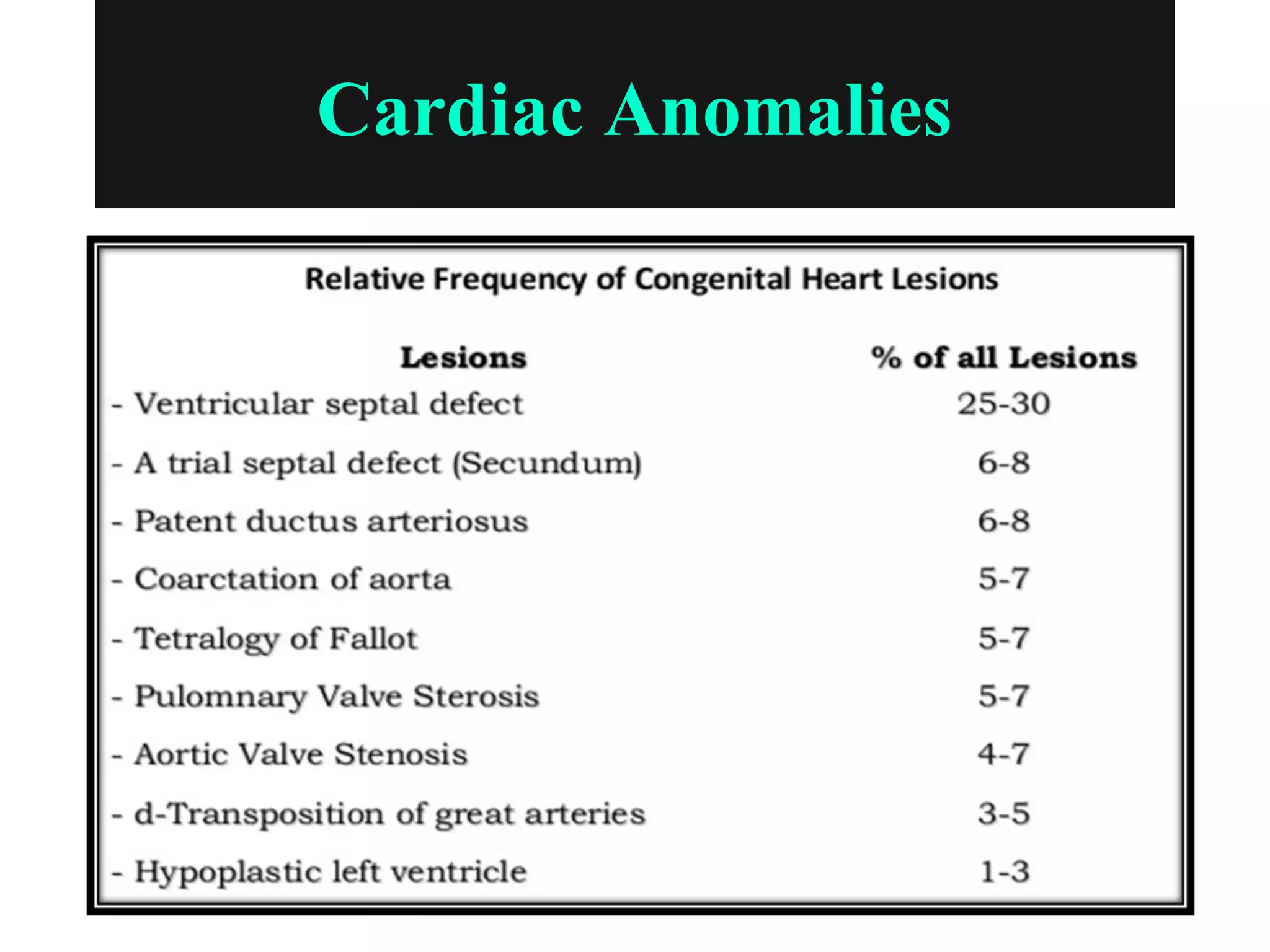
 Epidemiology
Incidence : - 8/1000 live births
- 3-4/100 still born
- 2/100 premature infants excluding PDA
- 10-25/100 abortuses
Most of congenital defects are well tolerated during fetal life
 Etiology : - Unknown in most case
- Genetic factors single gene defect : Di George(22q11)
- Chromosomal abnormality : Down syndrome(50%)
trisomy18(90%)
- Environmental factors: - Maternal diseases ( DM ),
- Infection during pregnancy (Rubella)
-Drugs(alcohol ,thalidomide)
- Obesity increases the risk of congenital heart disease
-Gender differences in type of CHD
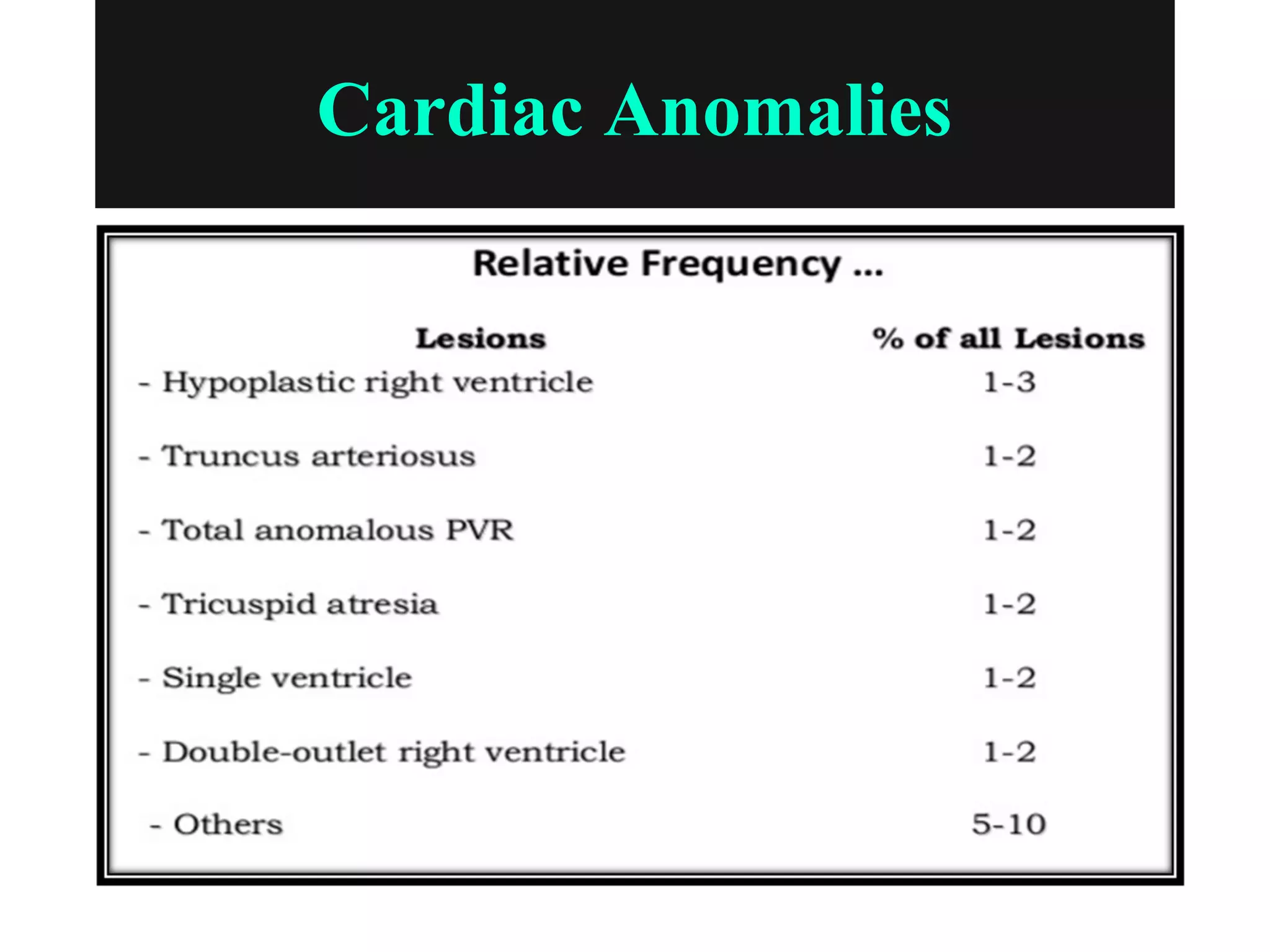
Cardiac Anomalies
Cardiac Anomalies
Cardiac Anomalies
A) Anomalies of interatrial septum(ASD)
B) Anomalies of atrioventricular canal
C) Anomalies of interventricular septum(VSD)
D) Anomalies of truncus arteriosus & aortico-pulmonary septum
E) Anomalies of position of the heart
Cardiac Anomalies
A) Anomalies of interatrial septum(ASD)
1- Probe patency of the foramen ovale
2- Premature closure of the foramen ovale
3- Common atrium (cor triloculare biventriculare
4-Ostium primum defect
5- Foramen secundum defect (most common clinically significant ASD)
Cardiac Anomalies
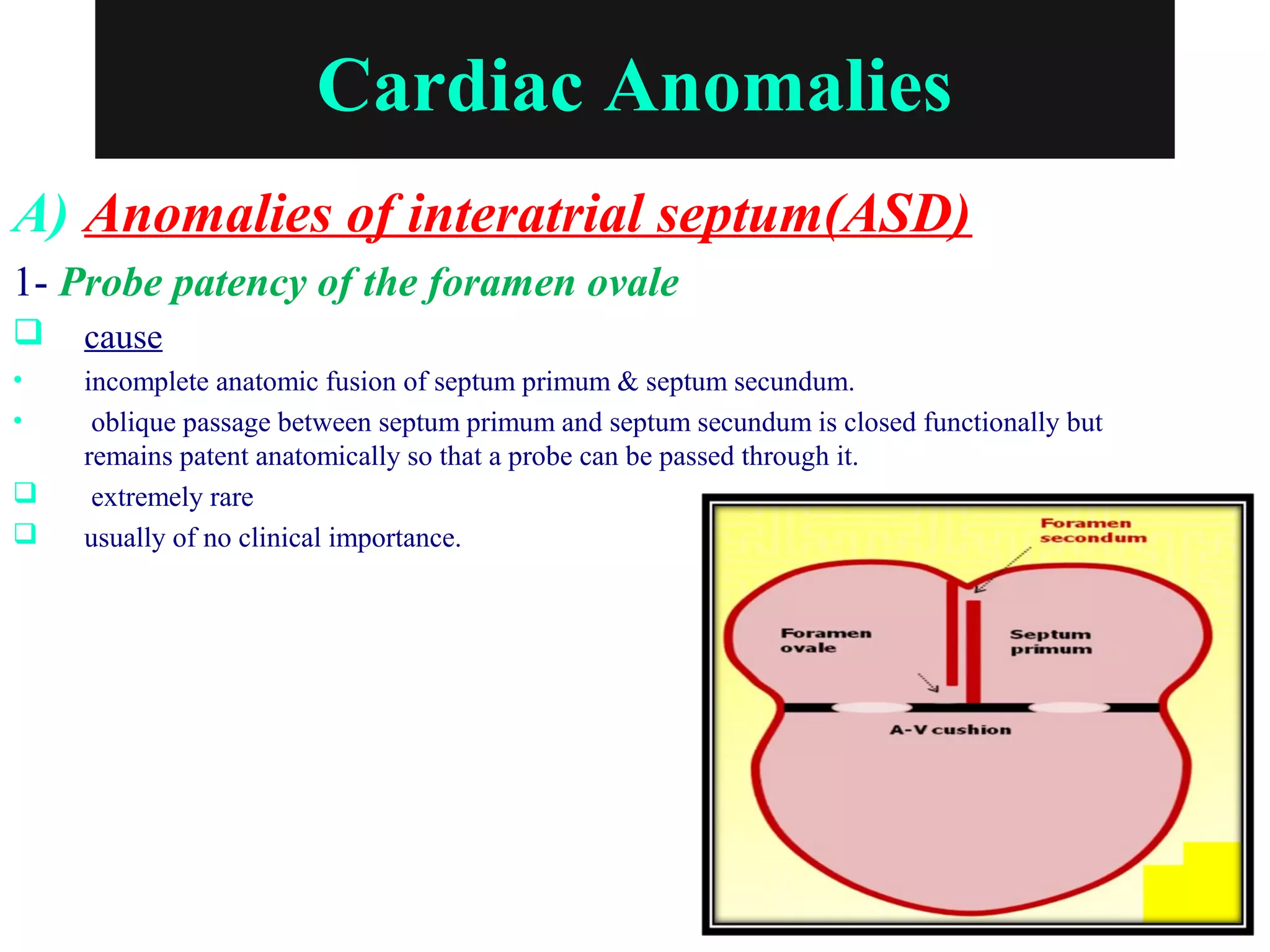
A) Anomalies of interatrial septum(ASD)
1- Probe patency of the foramen ovale
 cause
• incomplete anatomic fusion of septum primum & septum secundum.
• oblique passage between septum primum and septum secundum is closed functionally but
remains patent anatomically so that a probe can be passed through it.
 extremely rare
 usually of no clinical importance.
Cardiac Anomalies
A) Anomalies of interatrial septum(ASD)
2- Premature closure of the foramen ovale
 Cause
closure of the foramen ovale during prenatal life.
• Due to excessive development of septum secondum
• It results in hypertrophy of the right side of the heart &
underdevelopment of the left side of the heart.
 leads to death shortly after birth.
Cardiac Anomalies
A) Anomalies of interatrial septum(ASD)
3- Common atrium (cor triloculare biventriculare)
 cause
• complete failure of septum primum & septum secundum
• to develop.
• This results in a condition in which there is formation of only
one atrium
 It is the most serious congenital anomaly of the atria
 always associated with other defects of the heart
Cardiac Anomalies
A) Anomalies of interatrial septum(ASD)
4- ostium primum defect
 Cause
• persistence of foramen primum is due either to
a) failure of the septum primum to reach the endocardial cushions
b) due to defect in the endocardial cushions
Cardiac Anomalies
A) Anomalies of interatrial septum(ASD)
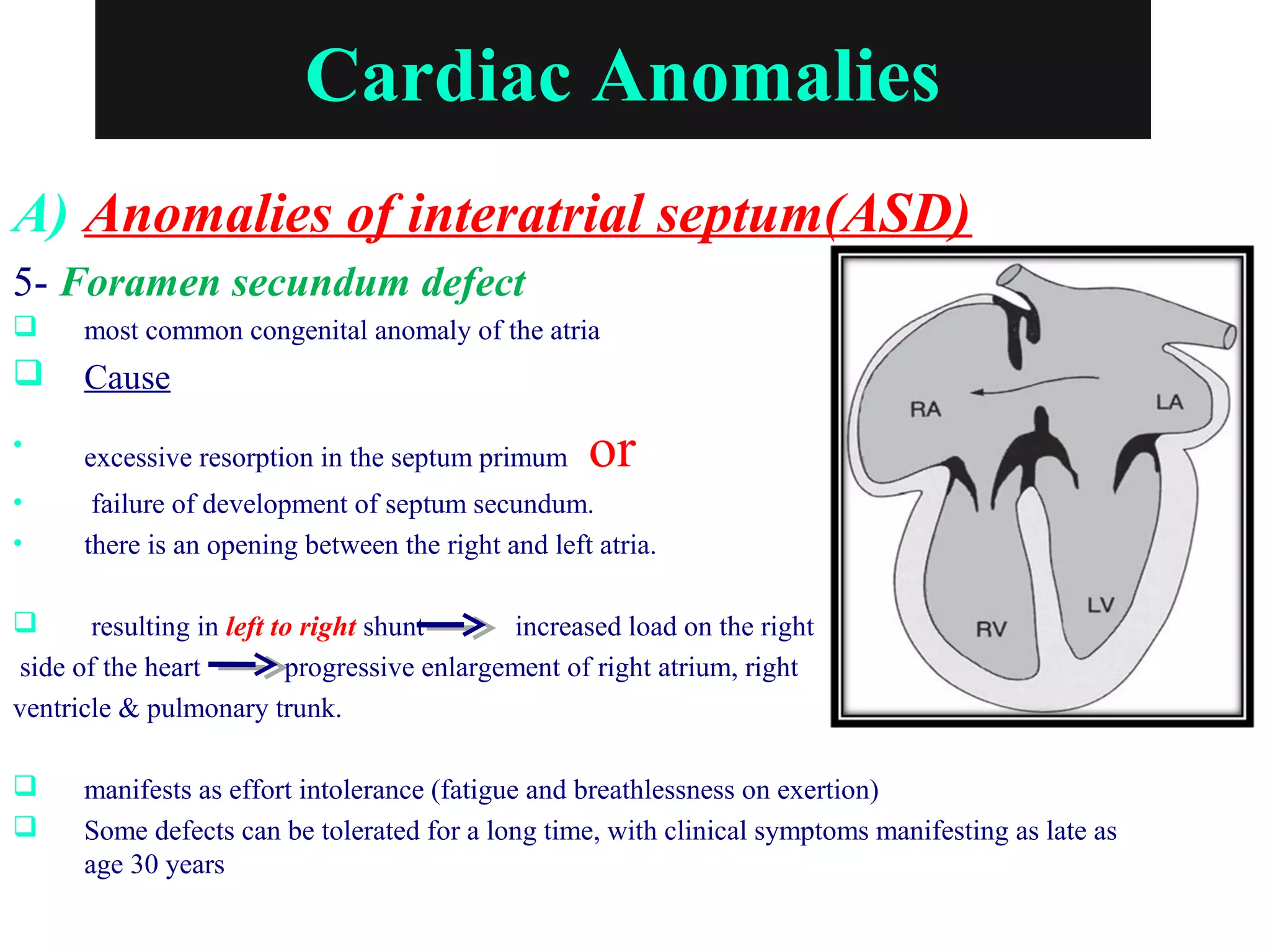
5- Foramen secundum defect
 most common congenital anomaly of the atria
 Cause
• excessive resorption in the septum primum or
• failure of development of septum secundum.
• there is an opening between the right and left atria.
 resulting in left to right shunt increased load on the right
side of the heart progressive enlargement of right atrium, right
ventricle & pulmonary trunk.
 manifests as effort intolerance (fatigue and breathlessness on exertion)
 Some defects can be tolerated for a long time, with clinical symptoms manifesting as late as
age 30 years
Cardiac Anomalies
A) Anomalies of interatrial septum(ASD)
5- Foramen secundum defect
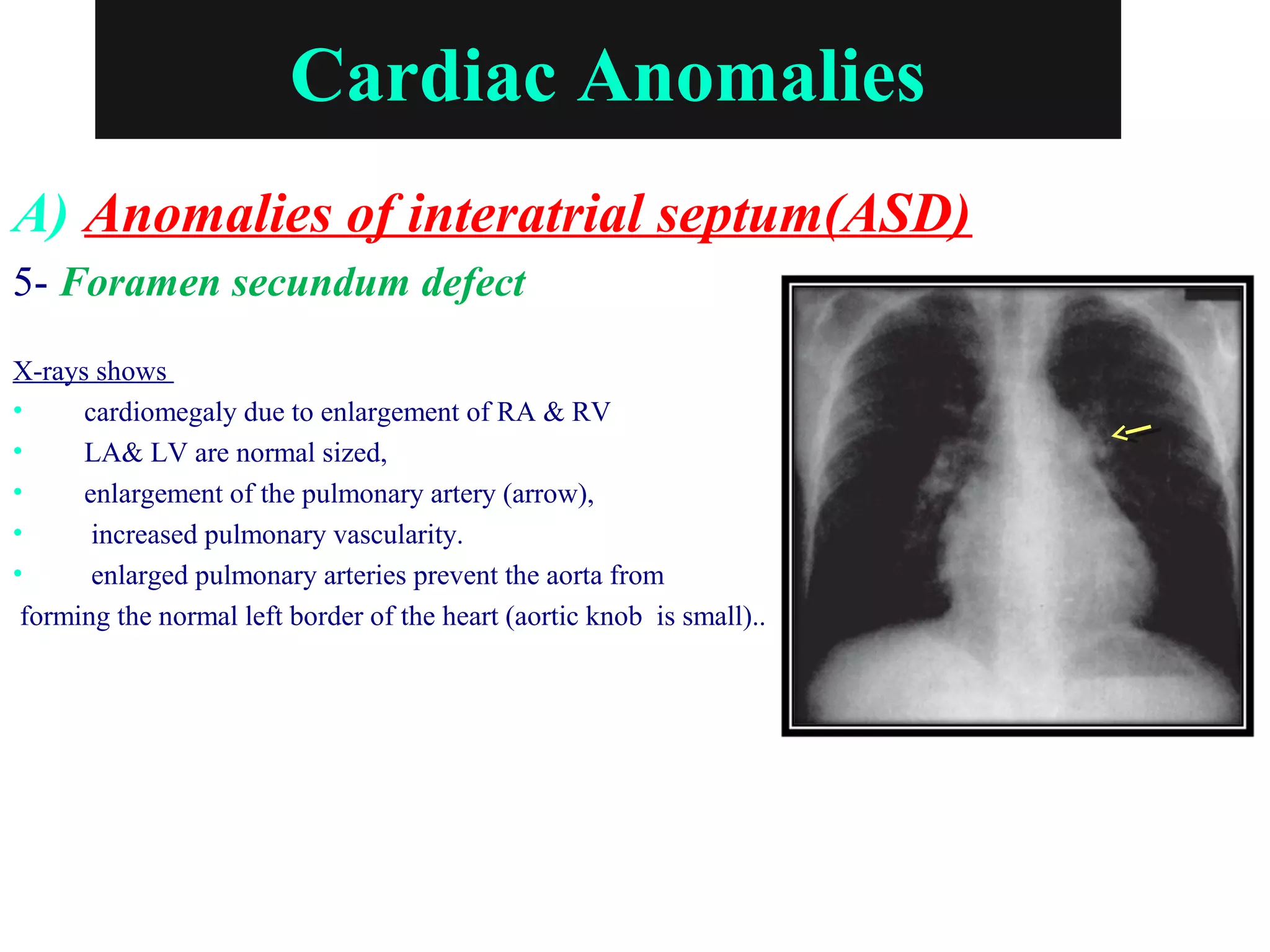
X-rays shows
• cardiomegaly due to enlargement of RA & RV
• LA& LV are normal sized,
• enlargement of the pulmonary artery (arrow),
• increased pulmonary vascularity.
• enlarged pulmonary arteries prevent the aorta from
forming the normal left border of the heart (aortic knob is small)..
Cardiac Anomalies
A) Anomalies of interatrial septum(ASD)
B) Anomalies of atrioventricular canal
C) Anomalies of interventricular septum(VSD)
D) Anomalies of truncus arteriosus & aortico-pulmonary septum
E) Anomalies of position of the heart
Cardiac Anomalies
B) Anomalies of atrioventricular canal
20-25% of cases seen in Down’s Syndrome (Trisomy 21).
1- Persistent common AV canal
2- Foramen primum defect
3- Tricuspid atresia (hypoplastic right heart
Cardiac Anomalies
B)Anomalies of atrioventricular canal
1- Persistent common AV canal
 cause
• failure of fusion of the dorsal & ventral AV cushions.
results common AV canal
• which is never partitioned into the R&L AV canals with
large hole center of the heart.
• tricuspid & bicuspid valves are represented by one valve
common to both sides of the heart.
• Accompanied with ASD &VSD as endocardial cushions
share in interaterial &interventricular septa
 Two common hemodynamic abnormalities are
a)Left–right shunting of blood from the LA to RA,
causing an enlarged RA &RV
b) Mitral valve regurgitation, causing an enlarged
LA &LV
Cardiac Anomalies
B) Anomalies of atrioventricular canal
2- Foramen primum defect
 cause
• Partial (incomplete) fusion of the dorsal & ventral AV
cushions lead to
• failure of septum primum to join with the AV septum
• results in a condition in which the foramen
primum is never closed and generally accompanied by
an abnormal mitral valve
Cardiac Anomalies
B) Anomalies of atrioventricular canal
3- Tricuspid atresia (hypoplastic right heart
 cause
• insufficient amount of AV cushion tissue available
for the formation of tricuspid valve lead to fusion of the cusps
Of tricuspid valve ( complete agenesis) so that there is
(no communication between RA& RV)
 always accompanied by
a)patent foramen ovale,
b) interventricular septum defect,
c) overdeveloped left ventricle,
d) underdeveloped right ventricle
 associated clinically with marked cyanosis
Cardiac Anomalies
A) Anomalies of interatrial septum(ASD)
B) Anomalies of atrioventricular canal
C) Anomalies of interventricular septum(VSD)
D) Anomalies of truncus arteriosus & aortico-pulmonary septum
E) Anomalies of position of the heart
Cardiac Anomalies
C) Anomalies of interventricular septum(VSD)
• It is most common congenital anomaly of the heart
• Includes :
1- Muscular VSD
2- Common ventricle (cor triloculare biatriatum
3- Membranous VSD
• Most common type of VSD
Cardiac Anomalies
C) Anomalies of interventricular septum(VSD)
1- Muscular VSD
 cause
• single or multiple perforations in the muscular IV septum
Cardiac Anomalies
C) Anomalies of interventricular septum(VSD)
2- Common ventricle (cor triloculare biatriatum
 cause
• failure of the membranous and muscular IV septa result in single ventricle
Cardiac Anomalies
C) Anomalies of interventricular septum(VSD)
- Membranous VSD
• Most common type of VSD
• occurs in about 25% of the children
• occur singly or in combination with other cardiac defects
 cause
• failure in the fusion of the right bulbar ridge, left bulbar
ridge, and AV cushions.
• It results in a condition in which an opening between
R &L V allows free flow of blood
 this defect allows left-to-right shunting of blood through
the IV foramen due to increased left ventricular pressure
 child complains of excessive fatigue on exertion
Cardiac Anomalies
Discuss the blood flow in this defect and explain the
cause of excessive fatigue on exertion
• Initially, this defect allows L -R shunting of blood, through the IV foramen due to increased left
ventricular pressure
• The child complains of excessive fatigue on exertion due to shunting of blood from left to right
• Later on, due to increased pulmonary blood flow pulmonary hypertension ..
• pulmonary hypertension causes marked proliferation of tunica intima and tunica media of pulmonary
arteries and arterioles, thus narrowing their lumen.
• Consequently, the pulmonary resistance becomes higher than the systemic resistance and leads to R–L
shunting of blood causing cyanosis
• At this stage, the condition is called Eisenmenger complex
Cardiac Anomalies
A) Anomalies of interatrial septum(ASD)
B) Anomalies of atrioventricular canal
C) Anomalies of interventricular septum(VSD)
D) Anomalies of truncus arteriosus & aortico-pulmonary septum
E) Anomalies of position of the heart
Cardiac Anomalies
D) Anomalies of truncus arteriosus & aortico-pulmonary septum
• It is most common congenital anomaly of the heart
• Includes :
1- Persistent truncus arteriosus (PTA
2- D-Transposition of the great arteries (complete
3- L-Transposition of the great vessels (corrected
4- Tetralogy of Fallot (TOF)
• TOF is the commonest congenital cyanotic heart disease.
• TOF& PTA are associated with DiGeorge syndrome (22q11).
• Transposition of the great arteries is associated with maternal diabetes
Cardiac Anomalies
D) Anomalies of aortico-pulmonary septum
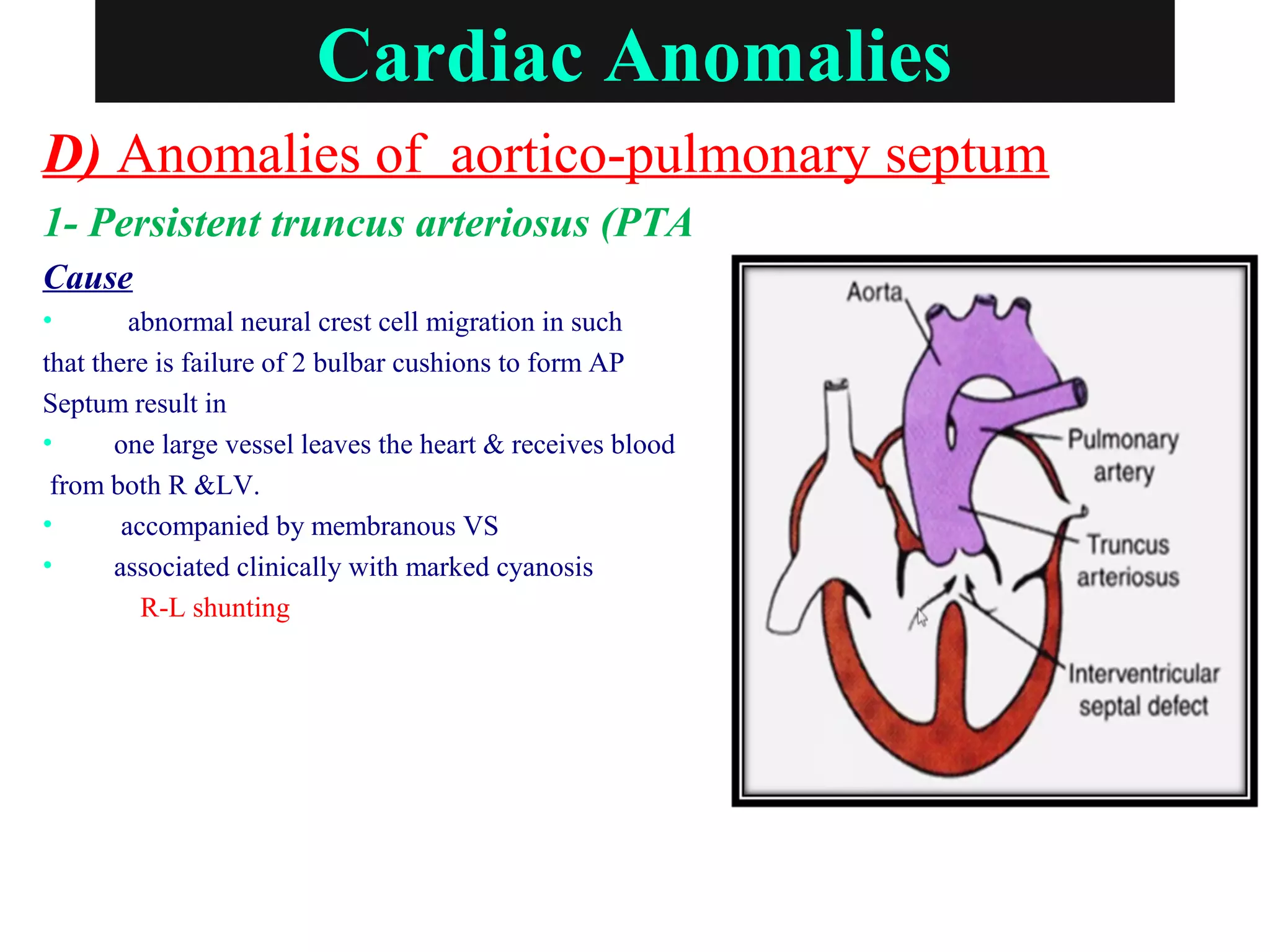
1- Persistent truncus arteriosus (PTA
Cause
• abnormal neural crest cell migration in such
that there is failure of 2 bulbar cushions to form AP
Septum result in
• one large vessel leaves the heart & receives blood
from both R &LV.
• accompanied by membranous VS
• associated clinically with marked cyanosis
R-L shunting
Cardiac Anomalies
D) Anomalies of truncus arteriosus & aortico-pulmonary septum
2- D-Transposition of the great arteries (complete
 cause
• abnormal neural crest cell migration such that there
is non spiral development of the AP septum.
• Aorta arises abnormally from RV.& pulmonary trunk arises
abnormally from LV;
• systemic and pulmonary circulations are completely
Separated from each other.
• complete transposition of the great blood vessels is incompatible
with life; if there is no PDA or atrial and ventricular septal defects .
• infant was able to survive after birth because this anomaly is often associated with
a) patent ductus arteriosus,
b) ASD, and/or VSD that allows mixing of blood between two circulations
 It is associated clinically with marked cyanosis R-L shunting
Cardiac Anomalies
D) Anomalies of truncus arteriosus & aortico-pulmonary
septum
3- L-Transposition of the great arteries (corrected
cause
• aorta and pulmonary trunk are transposed
• ventricles are “inverted” such that the anatomical RV lies on
the left side and the anatomical LV lies on the right side.
• blood flow pattern is normal
Cardiac Anomalies
D) Anomalies of truncus arteriosus & aortico-pulmonary septum
4- Tetralogy of Fallot
cause
• abnormal neural crest cell migration such that there is
anterior displacement of the AP septum lead to unequal
division to truncus arteriosus
• pulmonary trunk obtains a small diameter &aorta
obtains a large diameter.
• characterized by four classic malformations:
a) pulmonary stenosis,
b) right ventricular hypertrophy,
c) overriding aorta,
d) ventricular septal defect,
• associated clinically with marked cyanosis R-L shunting
• clinical consequences depend primarily on the severity of the pulmonary stenosis
(mnemonic PROVE)
Cardiac Anomalies
D) Anomalies of truncus arteriosus & aortico-pulmonary septum
4- Tetralogy of Fallot
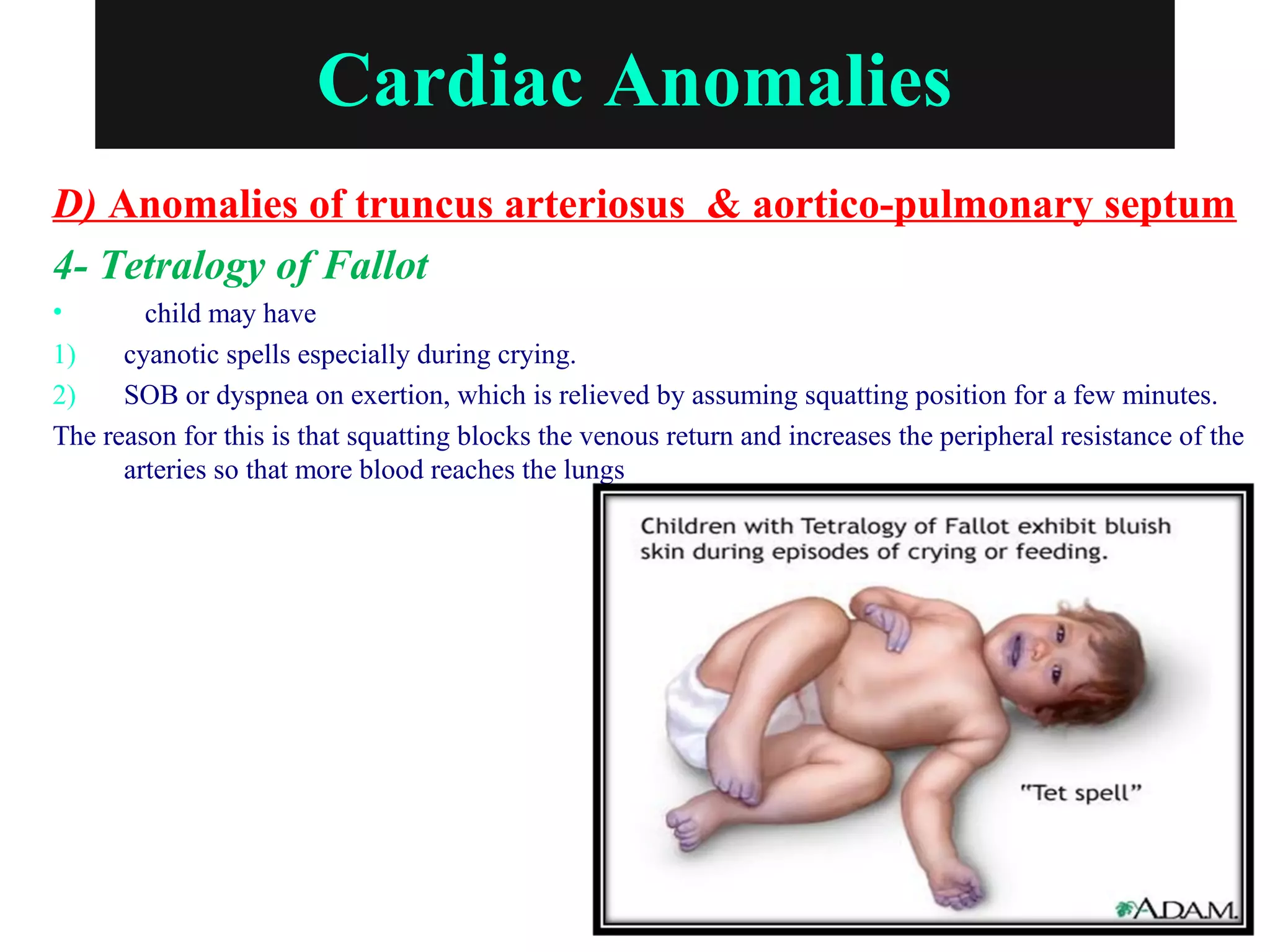
• child may have
1) cyanotic spells especially during crying.
2) SOB or dyspnea on exertion, which is relieved by assuming squatting position for a few minutes.
The reason for this is that squatting blocks the venous return and increases the peripheral resistance of the
arteries so that more blood reaches the lungs
Cardiac Anomalies
A) Anomalies of interatrial septum(ASD)
B) Anomalies of atrioventricular canal
C) Anomalies of interventricular septum(VSD)
D) Anomalies of truncus arteriosus & aortico-pulmonary septum
E) Anomalies of position of the heart
Cardiac Anomalies
C) Anomalies of position of the heart
1- Dextrocardia
• Cause
• occurs if heart tube bends to the left instead of the right, the heart is displaced to the right,
• , all the chambers of the heart and associated blood vessels are reversed as a mirror image
• associated with situs inversus (transposition of abdominal viscera).
Cardiac Anomalies
C) Anomalies of position of the heart
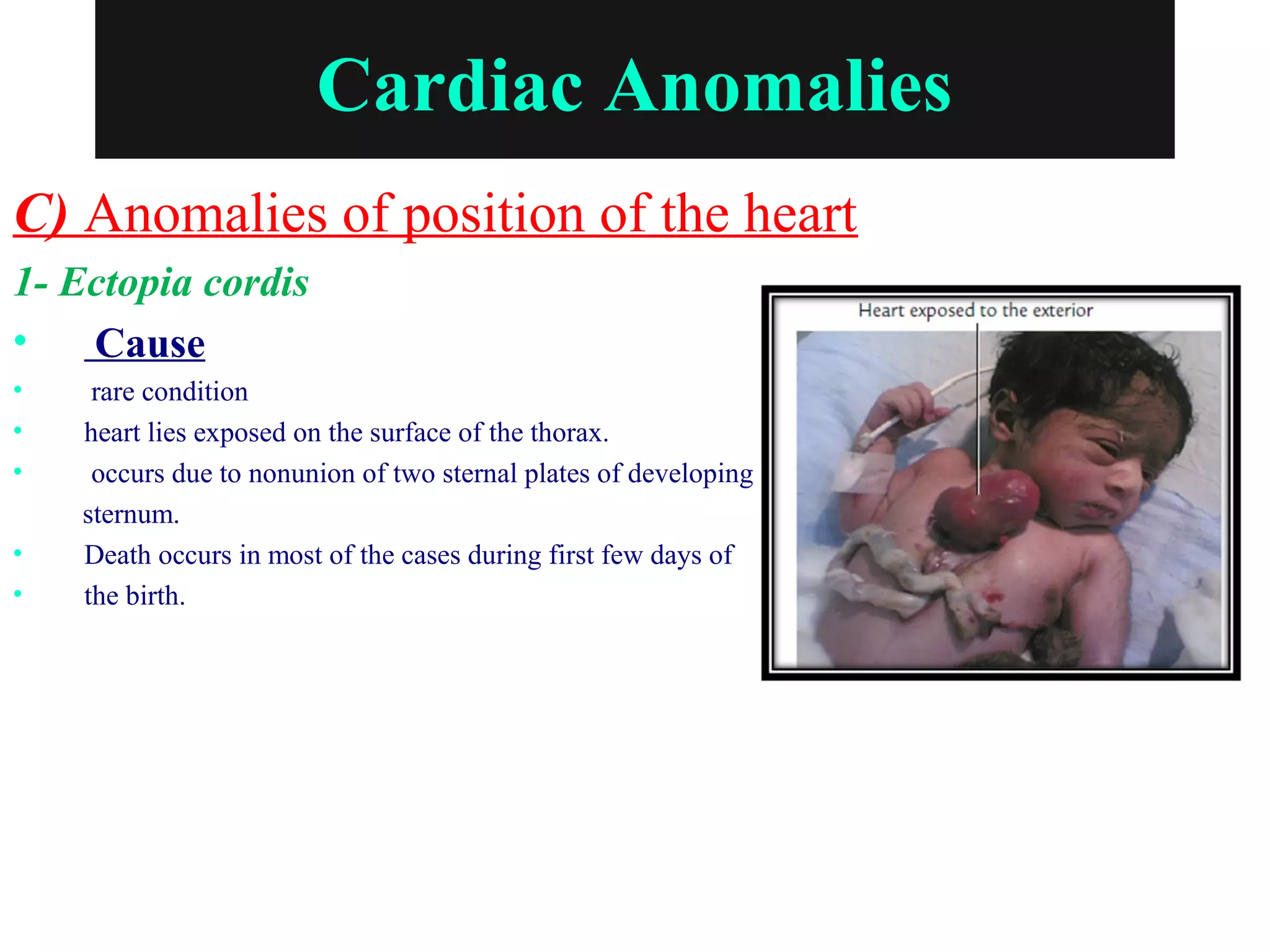
1- Ectopia cordis
• Cause
• rare condition
• heart lies exposed on the surface of the thorax.
• occurs due to nonunion of two sternal plates of developing
sternum.
• Death occurs in most of the cases during first few days of
• the birth.
L - R shunt
R - L shunt
It is important to distinguish a “blue baby” (cyanotic at birth) and a “blue kid” (late-onset cyanosis).
Cardiac Anomalies
Cardiac Anomalies
Cyanotic CHD (RCyanotic CHD (R →→L)L)
 Tetralogy of Fallot (TOF)
 Tricuspid atresia (TA)
 Total anomalous pulmonary venous
return (TAPVR)
 Truncus arteriosus
 Transposition of the great vessels
 Hypoplastic left heart syndrome
(HLH)
 Pulmonary atresia (PA) / critical PS
 Double outlet right ventricle (DORV)
Acyanotic CHD(LAcyanotic CHD(L →→R)R)
• Atrial septal defects(ASD)
• Ventricular septal defects(VSD)
• AV canal defects
• Aortic stenosis
• Coarctation of aorta
• Patent ductus arteriosus
Golden facts to remember
 Most common congenital anomaly of the heart---------------- Ventricular septal defect
 Ventricular septal defect is most common in ------------- membranous part of the IV septum
 Most significant atrial septal defect -------------------------------ostium secundum defect
 Most common congenital cyanotic heart disease-------------- Fallot’s tetralogy
 Most common positional anomaly of the heart ----------------- Dextrocardia

Embryological basis of congenital heart diseases

  • 1.
    Embryological Basis for CongenitalHeart Diseases By Dr. Ahmed
  • 2.
    Cardiac Anomalies  Epidemiology Incidence: - 8/1000 live births - 3-4/100 still born - 2/100 premature infants excluding PDA - 10-25/100 abortuses Most of congenital defects are well tolerated during fetal life  Etiology : - Unknown in most case - Genetic factors single gene defect : Di George(22q11) - Chromosomal abnormality : Down syndrome(50%) trisomy18(90%) - Environmental factors: - Maternal diseases ( DM ), - Infection during pregnancy (Rubella) -Drugs(alcohol ,thalidomide) - Obesity increases the risk of congenital heart disease -Gender differences in type of CHD
  • 3.
  • 4.
  • 5.
    Cardiac Anomalies A) Anomaliesof interatrial septum(ASD) B) Anomalies of atrioventricular canal C) Anomalies of interventricular septum(VSD) D) Anomalies of truncus arteriosus & aortico-pulmonary septum E) Anomalies of position of the heart
  • 6.
    Cardiac Anomalies A) Anomaliesof interatrial septum(ASD) 1- Probe patency of the foramen ovale 2- Premature closure of the foramen ovale 3- Common atrium (cor triloculare biventriculare 4-Ostium primum defect 5- Foramen secundum defect (most common clinically significant ASD)
  • 7.
    Cardiac Anomalies A) Anomaliesof interatrial septum(ASD) 1- Probe patency of the foramen ovale  cause • incomplete anatomic fusion of septum primum & septum secundum. • oblique passage between septum primum and septum secundum is closed functionally but remains patent anatomically so that a probe can be passed through it.  extremely rare  usually of no clinical importance.
  • 8.
    Cardiac Anomalies A) Anomaliesof interatrial septum(ASD) 2- Premature closure of the foramen ovale  Cause closure of the foramen ovale during prenatal life. • Due to excessive development of septum secondum • It results in hypertrophy of the right side of the heart & underdevelopment of the left side of the heart.  leads to death shortly after birth.
  • 9.
    Cardiac Anomalies A) Anomaliesof interatrial septum(ASD) 3- Common atrium (cor triloculare biventriculare)  cause • complete failure of septum primum & septum secundum • to develop. • This results in a condition in which there is formation of only one atrium  It is the most serious congenital anomaly of the atria  always associated with other defects of the heart
  • 10.
    Cardiac Anomalies A) Anomaliesof interatrial septum(ASD) 4- ostium primum defect  Cause • persistence of foramen primum is due either to a) failure of the septum primum to reach the endocardial cushions b) due to defect in the endocardial cushions
  • 11.
    Cardiac Anomalies A) Anomaliesof interatrial septum(ASD) 5- Foramen secundum defect  most common congenital anomaly of the atria  Cause • excessive resorption in the septum primum or • failure of development of septum secundum. • there is an opening between the right and left atria.  resulting in left to right shunt increased load on the right side of the heart progressive enlargement of right atrium, right ventricle & pulmonary trunk.  manifests as effort intolerance (fatigue and breathlessness on exertion)  Some defects can be tolerated for a long time, with clinical symptoms manifesting as late as age 30 years
  • 12.
    Cardiac Anomalies A) Anomaliesof interatrial septum(ASD) 5- Foramen secundum defect X-rays shows • cardiomegaly due to enlargement of RA & RV • LA& LV are normal sized, • enlargement of the pulmonary artery (arrow), • increased pulmonary vascularity. • enlarged pulmonary arteries prevent the aorta from forming the normal left border of the heart (aortic knob is small)..
  • 13.
    Cardiac Anomalies A) Anomaliesof interatrial septum(ASD) B) Anomalies of atrioventricular canal C) Anomalies of interventricular septum(VSD) D) Anomalies of truncus arteriosus & aortico-pulmonary septum E) Anomalies of position of the heart
  • 14.
    Cardiac Anomalies B) Anomaliesof atrioventricular canal 20-25% of cases seen in Down’s Syndrome (Trisomy 21). 1- Persistent common AV canal 2- Foramen primum defect 3- Tricuspid atresia (hypoplastic right heart
  • 15.
    Cardiac Anomalies B)Anomalies ofatrioventricular canal 1- Persistent common AV canal  cause • failure of fusion of the dorsal & ventral AV cushions. results common AV canal • which is never partitioned into the R&L AV canals with large hole center of the heart. • tricuspid & bicuspid valves are represented by one valve common to both sides of the heart. • Accompanied with ASD &VSD as endocardial cushions share in interaterial &interventricular septa  Two common hemodynamic abnormalities are a)Left–right shunting of blood from the LA to RA, causing an enlarged RA &RV b) Mitral valve regurgitation, causing an enlarged LA &LV
  • 16.
    Cardiac Anomalies B) Anomaliesof atrioventricular canal 2- Foramen primum defect  cause • Partial (incomplete) fusion of the dorsal & ventral AV cushions lead to • failure of septum primum to join with the AV septum • results in a condition in which the foramen primum is never closed and generally accompanied by an abnormal mitral valve
  • 17.
    Cardiac Anomalies B) Anomaliesof atrioventricular canal 3- Tricuspid atresia (hypoplastic right heart  cause • insufficient amount of AV cushion tissue available for the formation of tricuspid valve lead to fusion of the cusps Of tricuspid valve ( complete agenesis) so that there is (no communication between RA& RV)  always accompanied by a)patent foramen ovale, b) interventricular septum defect, c) overdeveloped left ventricle, d) underdeveloped right ventricle  associated clinically with marked cyanosis
  • 18.
    Cardiac Anomalies A) Anomaliesof interatrial septum(ASD) B) Anomalies of atrioventricular canal C) Anomalies of interventricular septum(VSD) D) Anomalies of truncus arteriosus & aortico-pulmonary septum E) Anomalies of position of the heart
  • 19.
    Cardiac Anomalies C) Anomaliesof interventricular septum(VSD) • It is most common congenital anomaly of the heart • Includes : 1- Muscular VSD 2- Common ventricle (cor triloculare biatriatum 3- Membranous VSD • Most common type of VSD
  • 20.
    Cardiac Anomalies C) Anomaliesof interventricular septum(VSD) 1- Muscular VSD  cause • single or multiple perforations in the muscular IV septum
  • 21.
    Cardiac Anomalies C) Anomaliesof interventricular septum(VSD) 2- Common ventricle (cor triloculare biatriatum  cause • failure of the membranous and muscular IV septa result in single ventricle
  • 22.
    Cardiac Anomalies C) Anomaliesof interventricular septum(VSD) - Membranous VSD • Most common type of VSD • occurs in about 25% of the children • occur singly or in combination with other cardiac defects  cause • failure in the fusion of the right bulbar ridge, left bulbar ridge, and AV cushions. • It results in a condition in which an opening between R &L V allows free flow of blood  this defect allows left-to-right shunting of blood through the IV foramen due to increased left ventricular pressure  child complains of excessive fatigue on exertion
  • 23.
    Cardiac Anomalies Discuss theblood flow in this defect and explain the cause of excessive fatigue on exertion • Initially, this defect allows L -R shunting of blood, through the IV foramen due to increased left ventricular pressure • The child complains of excessive fatigue on exertion due to shunting of blood from left to right • Later on, due to increased pulmonary blood flow pulmonary hypertension .. • pulmonary hypertension causes marked proliferation of tunica intima and tunica media of pulmonary arteries and arterioles, thus narrowing their lumen. • Consequently, the pulmonary resistance becomes higher than the systemic resistance and leads to R–L shunting of blood causing cyanosis • At this stage, the condition is called Eisenmenger complex
  • 24.
    Cardiac Anomalies A) Anomaliesof interatrial septum(ASD) B) Anomalies of atrioventricular canal C) Anomalies of interventricular septum(VSD) D) Anomalies of truncus arteriosus & aortico-pulmonary septum E) Anomalies of position of the heart
  • 25.
    Cardiac Anomalies D) Anomaliesof truncus arteriosus & aortico-pulmonary septum • It is most common congenital anomaly of the heart • Includes : 1- Persistent truncus arteriosus (PTA 2- D-Transposition of the great arteries (complete 3- L-Transposition of the great vessels (corrected 4- Tetralogy of Fallot (TOF) • TOF is the commonest congenital cyanotic heart disease. • TOF& PTA are associated with DiGeorge syndrome (22q11). • Transposition of the great arteries is associated with maternal diabetes
  • 26.
    Cardiac Anomalies D) Anomaliesof aortico-pulmonary septum 1- Persistent truncus arteriosus (PTA Cause • abnormal neural crest cell migration in such that there is failure of 2 bulbar cushions to form AP Septum result in • one large vessel leaves the heart & receives blood from both R &LV. • accompanied by membranous VS • associated clinically with marked cyanosis R-L shunting
  • 27.
    Cardiac Anomalies D) Anomaliesof truncus arteriosus & aortico-pulmonary septum 2- D-Transposition of the great arteries (complete  cause • abnormal neural crest cell migration such that there is non spiral development of the AP septum. • Aorta arises abnormally from RV.& pulmonary trunk arises abnormally from LV; • systemic and pulmonary circulations are completely Separated from each other. • complete transposition of the great blood vessels is incompatible with life; if there is no PDA or atrial and ventricular septal defects . • infant was able to survive after birth because this anomaly is often associated with a) patent ductus arteriosus, b) ASD, and/or VSD that allows mixing of blood between two circulations  It is associated clinically with marked cyanosis R-L shunting
  • 28.
    Cardiac Anomalies D) Anomaliesof truncus arteriosus & aortico-pulmonary septum 3- L-Transposition of the great arteries (corrected cause • aorta and pulmonary trunk are transposed • ventricles are “inverted” such that the anatomical RV lies on the left side and the anatomical LV lies on the right side. • blood flow pattern is normal
  • 29.
    Cardiac Anomalies D) Anomaliesof truncus arteriosus & aortico-pulmonary septum 4- Tetralogy of Fallot cause • abnormal neural crest cell migration such that there is anterior displacement of the AP septum lead to unequal division to truncus arteriosus • pulmonary trunk obtains a small diameter &aorta obtains a large diameter. • characterized by four classic malformations: a) pulmonary stenosis, b) right ventricular hypertrophy, c) overriding aorta, d) ventricular septal defect, • associated clinically with marked cyanosis R-L shunting • clinical consequences depend primarily on the severity of the pulmonary stenosis (mnemonic PROVE)
  • 30.
    Cardiac Anomalies D) Anomaliesof truncus arteriosus & aortico-pulmonary septum 4- Tetralogy of Fallot • child may have 1) cyanotic spells especially during crying. 2) SOB or dyspnea on exertion, which is relieved by assuming squatting position for a few minutes. The reason for this is that squatting blocks the venous return and increases the peripheral resistance of the arteries so that more blood reaches the lungs
  • 31.
    Cardiac Anomalies A) Anomaliesof interatrial septum(ASD) B) Anomalies of atrioventricular canal C) Anomalies of interventricular septum(VSD) D) Anomalies of truncus arteriosus & aortico-pulmonary septum E) Anomalies of position of the heart
  • 32.
    Cardiac Anomalies C) Anomaliesof position of the heart 1- Dextrocardia • Cause • occurs if heart tube bends to the left instead of the right, the heart is displaced to the right, • , all the chambers of the heart and associated blood vessels are reversed as a mirror image • associated with situs inversus (transposition of abdominal viscera).
  • 33.
    Cardiac Anomalies C) Anomaliesof position of the heart 1- Ectopia cordis • Cause • rare condition • heart lies exposed on the surface of the thorax. • occurs due to nonunion of two sternal plates of developing sternum. • Death occurs in most of the cases during first few days of • the birth.
  • 34.
    L - Rshunt R - L shunt It is important to distinguish a “blue baby” (cyanotic at birth) and a “blue kid” (late-onset cyanosis).
  • 35.
  • 36.
    Cardiac Anomalies Cyanotic CHD(RCyanotic CHD (R →→L)L)  Tetralogy of Fallot (TOF)  Tricuspid atresia (TA)  Total anomalous pulmonary venous return (TAPVR)  Truncus arteriosus  Transposition of the great vessels  Hypoplastic left heart syndrome (HLH)  Pulmonary atresia (PA) / critical PS  Double outlet right ventricle (DORV) Acyanotic CHD(LAcyanotic CHD(L →→R)R) • Atrial septal defects(ASD) • Ventricular septal defects(VSD) • AV canal defects • Aortic stenosis • Coarctation of aorta • Patent ductus arteriosus
  • 37.
    Golden facts toremember  Most common congenital anomaly of the heart---------------- Ventricular septal defect  Ventricular septal defect is most common in ------------- membranous part of the IV septum  Most significant atrial septal defect -------------------------------ostium secundum defect  Most common congenital cyanotic heart disease-------------- Fallot’s tetralogy  Most common positional anomaly of the heart ----------------- Dextrocardia