Bowel elimination
Meeting patient needs
Learning Outcomes
1. Describe the physiology of defecation.
2. Distinguish normal from abnormal characteristics
and constituents of feces.
3. Identify factors that influence fecal elimination and
patterns of defecation.
4. Identify common causes and effects of selected fecal
elimination problems.
5. Describe methods used to assess fecal elimination.
6. Identify examples of nursing diagnoses, outcomes,
and interventions for clients with elimination
problems.
7. Identify measures that maintain normal fecal
elimination patterns
Learning Outcomes
8. Describe the purpose and action of commonly used
enema solutions.
9. .Recognize when it is appropriate to delegate
assistance with fecal elimination to unlicensed
assistive personnel
10.Verbalize the steps used in:
a. Administering an enema
b. Changing a bowel diversion ostomy appliance
11.Demonstrate appropriate documentation and
reporting related to fecal elimination
Introduction
 Regular elimination of bowel waste products is
essential for normal body functioning
 Elimination patterns and habits vary among
individuals
 Excreted waste products are referred to as feces or
stool.
Anatomy and physiology of
bowel elimination
Anatomy of digestive system
Large Intestine
Large Intestine
 Ileocecal valve to anus
 Shorter longitudinal muscles of large intestine cause
pouches (haustra).
 Most waste products excreted within 48 hours of
ingestion
 Main function of colon is absorption of water and
nutrients after eating (ingestion).
 Chyme
 As much as 1500 mL moves from small to large intestine
daily but only about 100 mL of fluid is excreted.
 The rest is absorbed.
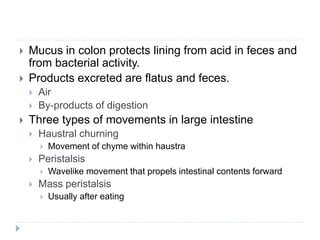
 Mucus in colon protects lining from acid in feces and
from bacterial activity.
 Products excreted are flatus and feces.
 Air
 By-products of digestion
 Three types of movements in large intestine
 Haustral churning
 Movement of chyme within haustra
 Peristalsis
 Wavelike movement that propels intestinal contents forward
 Mass peristalsis
 Usually after eating
Rectum and anal canal
 Rectum (4–6 in) and anal canal (1–2 in)
 Vertical folds with vein and artery
 If veins distended, hemorrhoids
 Internal sphincter under involuntary control
 External sphincter under voluntary control
The rectum, anal canal, and anal sphincters: A, open; B, closed.
Defecation
 Expulsion of feces assisted by contraction of the
abdominal muscles and diaphragm
 Feces move through anal canal and are expelled
through anus.
 Normal defecation is facilitated by:
 Thigh flexion
 Sitting position
Composition or characteristics of
feces / stool
Feces
 About 75% water, 25% solid materials
 Normally brown
 Stercobilin and urobilin derived from bilirubin
 Amount of gas produced per day varies per
individual
Feces
Factors affecting defecation
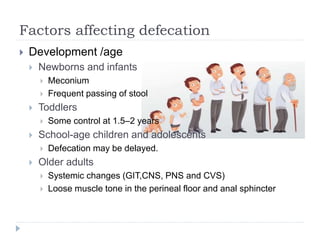
 Development /age
 Newborns and infants
 Meconium
 Frequent passing of stool
 Toddlers
 Some control at 1.5–2 years
 School-age children and adolescents
 Defecation may be delayed.
 Older adults
 Systemic changes (GIT,CNS, PNS and CVS)
 Loose muscle tone in the perineal floor and anal sphincter
Factors affecting defecation
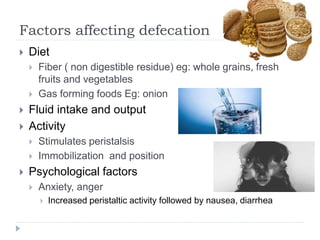
 Diet
 Fiber ( non digestible residue) eg: whole grains, fresh
fruits and vegetables
 Gas forming foods Eg: onion
 Fluid intake and output
 Activity
 Stimulates peristalsis
 Immobilization and position
 Psychological factors
 Anxiety, anger
 Increased peristaltic activity followed by nausea, diarrhea
Factors affecting defecation
 Defecation habits / personal habits
 Privacy
 When urge ignored, ultimately lost
 Busy work schedule
 Sharing bathroom facilities
 Medications
 Affect appearance, timing, quality
 Laxatives
 Diagnostic procedures
 Colonoscopy
 Endoscopy
 Anesthesia and surgery
 General anesthetics cause movements to cease, slow
 Listen to bowel sounds after surgery
Factors affecting defecation
 Pregnancy
 Pressure exerted on rectum, temporary obstruction
 Straining ……. permanent hemorrhoids
 Pathologic conditions
 Spinal cord, head injuries decrease sensory stimulation
 Poorly functioning anal sphincter
 Pain
 If discomfort experienced, suppression of urge may
follow.
 Constipation
 Narcotic analgesics
Thank you

BOWEL ELIMINATION INTRODUCTION

  • 1.
  • 2.
    Learning Outcomes 1. Describethe physiology of defecation. 2. Distinguish normal from abnormal characteristics and constituents of feces. 3. Identify factors that influence fecal elimination and patterns of defecation. 4. Identify common causes and effects of selected fecal elimination problems. 5. Describe methods used to assess fecal elimination. 6. Identify examples of nursing diagnoses, outcomes, and interventions for clients with elimination problems. 7. Identify measures that maintain normal fecal elimination patterns
  • 3.
    Learning Outcomes 8. Describethe purpose and action of commonly used enema solutions. 9. .Recognize when it is appropriate to delegate assistance with fecal elimination to unlicensed assistive personnel 10.Verbalize the steps used in: a. Administering an enema b. Changing a bowel diversion ostomy appliance 11.Demonstrate appropriate documentation and reporting related to fecal elimination
  • 4.
    Introduction  Regular eliminationof bowel waste products is essential for normal body functioning  Elimination patterns and habits vary among individuals  Excreted waste products are referred to as feces or stool.
  • 5.
    Anatomy and physiologyof bowel elimination
  • 6.
  • 7.
  • 8.
    Large Intestine  Ileocecalvalve to anus  Shorter longitudinal muscles of large intestine cause pouches (haustra).  Most waste products excreted within 48 hours of ingestion  Main function of colon is absorption of water and nutrients after eating (ingestion).  Chyme  As much as 1500 mL moves from small to large intestine daily but only about 100 mL of fluid is excreted.  The rest is absorbed.
  • 9.
     Mucus incolon protects lining from acid in feces and from bacterial activity.  Products excreted are flatus and feces.  Air  By-products of digestion  Three types of movements in large intestine  Haustral churning  Movement of chyme within haustra  Peristalsis  Wavelike movement that propels intestinal contents forward  Mass peristalsis  Usually after eating
  • 10.
    Rectum and analcanal  Rectum (4–6 in) and anal canal (1–2 in)  Vertical folds with vein and artery  If veins distended, hemorrhoids  Internal sphincter under involuntary control  External sphincter under voluntary control
  • 11.
    The rectum, analcanal, and anal sphincters: A, open; B, closed.
  • 12.
    Defecation  Expulsion offeces assisted by contraction of the abdominal muscles and diaphragm  Feces move through anal canal and are expelled through anus.  Normal defecation is facilitated by:  Thigh flexion  Sitting position
  • 13.
  • 14.
    Feces  About 75%water, 25% solid materials  Normally brown  Stercobilin and urobilin derived from bilirubin  Amount of gas produced per day varies per individual
  • 15.
  • 17.
  • 18.
    Factors affecting defecation Development /age  Newborns and infants  Meconium  Frequent passing of stool  Toddlers  Some control at 1.5–2 years  School-age children and adolescents  Defecation may be delayed.  Older adults  Systemic changes (GIT,CNS, PNS and CVS)  Loose muscle tone in the perineal floor and anal sphincter
  • 19.
    Factors affecting defecation Diet  Fiber ( non digestible residue) eg: whole grains, fresh fruits and vegetables  Gas forming foods Eg: onion  Fluid intake and output  Activity  Stimulates peristalsis  Immobilization and position  Psychological factors  Anxiety, anger  Increased peristaltic activity followed by nausea, diarrhea
  • 20.
    Factors affecting defecation Defecation habits / personal habits  Privacy  When urge ignored, ultimately lost  Busy work schedule  Sharing bathroom facilities  Medications  Affect appearance, timing, quality  Laxatives  Diagnostic procedures  Colonoscopy  Endoscopy  Anesthesia and surgery  General anesthetics cause movements to cease, slow  Listen to bowel sounds after surgery
  • 21.
    Factors affecting defecation Pregnancy  Pressure exerted on rectum, temporary obstruction  Straining ……. permanent hemorrhoids  Pathologic conditions  Spinal cord, head injuries decrease sensory stimulation  Poorly functioning anal sphincter  Pain  If discomfort experienced, suppression of urge may follow.  Constipation  Narcotic analgesics
  • 22.