Fundamental of nursingFundamental of nursing
Unit Eleven and TwelveUnit Eleven and Twelve
Objectives:Objectives:
 Describe the function of the lower intestinal tract.Describe the function of the lower intestinal tract.
 Identify the factors that influence in the fecalIdentify the factors that influence in the fecal
elimination and pattern of elimination.elimination and pattern of elimination.
 Distinguish normal from abnormalDistinguish normal from abnormal
characteristics o feces.characteristics o feces.
 Differentiate common fecal elimination problem.Differentiate common fecal elimination problem.
 Identify common causes and effect of fecalIdentify common causes and effect of fecal
elimination problems.elimination problems.
 Relate common intervention to specific fecalRelate common intervention to specific fecal
problemproblem
ContCont
 Describe essential nursing care of patient withDescribe essential nursing care of patient with
ostomies.ostomies.
 Describe the process of urination.Describe the process of urination.
 Identify factors that influence urinary elimination.Identify factors that influence urinary elimination.
 Describe diagnostic measure to assess kidneyDescribe diagnostic measure to assess kidney
function.function.
 Develop nursing diagnosis related to urinaryDevelop nursing diagnosis related to urinary
eliminationelimination
 Describe nursing intervention to maintain normalDescribe nursing intervention to maintain normal
urinary elimination.urinary elimination.
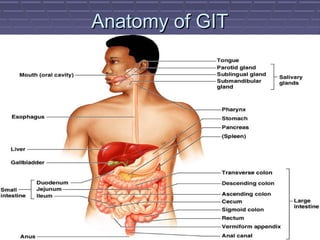
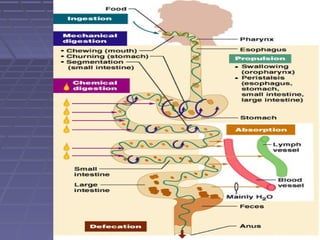
Anatomy of GITAnatomy of GIT
Physiology of defecation:Physiology of defecation:
 The large intestine extend from theThe large intestine extend from the
ileocecal valve to the anus, is a muscularileocecal valve to the anus, is a muscular
tube lined with mucous membrane.tube lined with mucous membrane.
 125 to 150 cm in length.125 to 150 cm in length.
 Function of colon:Function of colon:
 Absorption of water and nutrient.( Na,Absorption of water and nutrient.( Na,
1500ml daily).1500ml daily).
 Protection of intestinal wall. (Acid,Protection of intestinal wall. (Acid,
adherence).adherence).
 Fecal elimination.Fecal elimination.
 Flatus: is largely air and by product of digestion ofFlatus: is largely air and by product of digestion of
carbohydrate.carbohydrate.
 Defecation: is the expulsion of feces from the anusDefecation: is the expulsion of feces from the anus
and rectum. the frequency of defecation is highlyand rectum. the frequency of defecation is highly
individual vary from several time per day or three timeindividual vary from several time per day or three time
per weeks.per weeks.
 When feces move into sigmoid, the sensory nervesWhen feces move into sigmoid, the sensory nerves
are stimulated. The expulsion of feces is result fromare stimulated. The expulsion of feces is result from
relaxation of internal and external sphincter and byrelaxation of internal and external sphincter and by
contraction of abdominal muscle and diaphragmcontraction of abdominal muscle and diaphragm
which increase abdominal pressure.which increase abdominal pressure.
 Feces: normal feces are made of aboutFeces: normal feces are made of about
75% water and 25% solid material. if they75% water and 25% solid material. if they
feces propelled very quickly along thefeces propelled very quickly along the
large intestine there is not time for mostlarge intestine there is not time for most
water in the chyme to be absorbed andwater in the chyme to be absorbed and
feces will be more fluid.feces will be more fluid.
 Feces: are normally brown, chiefly due toFeces: are normally brown, chiefly due to
presence of sterocoblin and urobilin.presence of sterocoblin and urobilin.
Which are derived from bilirubin andWhich are derived from bilirubin and
another factor effect of color is bacteriaanother factor effect of color is bacteria
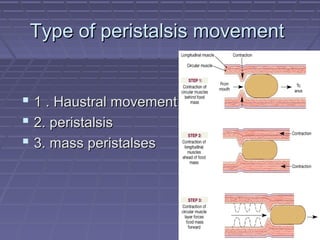
Type of peristalsis movementType of peristalsis movement
 1 . Haustral movement.1 . Haustral movement.
 2. peristalsis2. peristalsis
 3. mass peristalses3. mass peristalses
Abnormal feces:Abnormal feces:
 Clay or white color may indicate of absence ofClay or white color may indicate of absence of
bile or bile obstruction.bile or bile obstruction.
 Black, tarry stool may indicate of bleeding fromBlack, tarry stool may indicate of bleeding from
upper gastrointestinal tract or drug.upper gastrointestinal tract or drug.
 Red: may indicate of bleeding from lowerRed: may indicate of bleeding from lower
gastrointestinal tract.gastrointestinal tract.
 Pale may indicated to mal absorption.Pale may indicated to mal absorption.
 Green may indicate intestinal infection.Green may indicate intestinal infection.
 Dry, hard: dehydration decreased intestinalDry, hard: dehydration decreased intestinal
motility.motility.
 Pus: bacterial infection.Pus: bacterial infection.
Factor that effect of defecation:Factor that effect of defecation:
1.1. Development: infant, meconium is the firstDevelopment: infant, meconium is the first
fecal material passed by the newborn,fecal material passed by the newborn,
normally up to 24 hr after newborn. Its black,normally up to 24 hr after newborn. Its black,
tarry, odorless which contains mucous.tarry, odorless which contains mucous.
2.2. Infant pass stool frequently often each afterInfant pass stool frequently often each after
feeding, because intestine immature.feeding, because intestine immature.
3.3. Toddlers, school age and adult.Toddlers, school age and adult.
4.4. Diet: sufficient bulk in the diet (cellulose,Diet: sufficient bulk in the diet (cellulose,
fiber) is necessary to provide fecal bulk.fiber) is necessary to provide fecal bulk.
ContCont
5. Fluid: the reduce fluid intake may cause Harding of5. Fluid: the reduce fluid intake may cause Harding of
stool; healthy fecal elimination requires 2000 tostool; healthy fecal elimination requires 2000 to
3000ml/ day.3000ml/ day.
6. Activity: stimulate peristalsis, thus facilitating6. Activity: stimulate peristalsis, thus facilitating
movement of chyme along the colon.movement of chyme along the colon.
7. Psychological factor: some people who are anxious7. Psychological factor: some people who are anxious
or angry increased peristalsis activity andor angry increased peristalsis activity and
subsequent diarrhea and other individual maysubsequent diarrhea and other individual may
cause constipation by depress peristalsis.cause constipation by depress peristalsis.
8. Defecation habit: early bowl training may establish8. Defecation habit: early bowl training may establish
habit of the defecation.habit of the defecation.
9. medication habit9. medication habit
ContCont
10. Pain.10. Pain.
11. Pathological condition: spinal cord injury11. Pathological condition: spinal cord injury
and head injury can decrease sensoryand head injury can decrease sensory
stimulation for defecation.stimulation for defecation.
Common fecal eliminationCommon fecal elimination
problem:problem:
 constipation:constipation:
 Is defined as three bowl movement perIs defined as three bowl movement per
week, this infers the passage of small,week, this infers the passage of small,
dry, hard stool for period of time.dry, hard stool for period of time.
Characteristics for constipationCharacteristics for constipation::
 Decreased frequency of defecation.Decreased frequency of defecation.
 Hard, dry stool.Hard, dry stool.
 Straining of stool, painful defecation.Straining of stool, painful defecation.
 Report rectal fullness.Report rectal fullness.
 Abdominal pain, cramps and distention.Abdominal pain, cramps and distention.
 Use laxatives.Use laxatives.
 Decreased appetite.Decreased appetite.
 Headache.Headache.
 Causes factor contribute toCauses factor contribute to
constipation:constipation:
 Insufficient fiber intake.Insufficient fiber intake.
 Insufficient activity or mobility.Insufficient activity or mobility.
 Insufficient fluid intake.Insufficient fluid intake.
 Irregular defecation habits.Irregular defecation habits.
 Chronic use laxatives.Chronic use laxatives.
 Emotional disturbance depression or mentalEmotional disturbance depression or mental
confusion.confusion.
 Medication such as iron salts.Medication such as iron salts.
 b) Fecal impaction:b) Fecal impaction:
 Fecal impaction is a mass or collection ofFecal impaction is a mass or collection of
hardened, puttylike feces in the folds ofhardened, puttylike feces in the folds of
the rectum. Impaction result fromthe rectum. Impaction result from
prolonged retention and accumulation ofprolonged retention and accumulation of
the fecal material.the fecal material.
Sign and symptom:Sign and symptom:
 Liquid production of the feces seep.Liquid production of the feces seep.
 Generalized feeling of illness.Generalized feeling of illness.
 Rectal pain.Rectal pain.
 Abdominal distention.Abdominal distention.
 Nausea and vomiting occur.Nausea and vomiting occur.
 ) Diarrhea:) Diarrhea:
 Refers to the passage of liquid feces andRefers to the passage of liquid feces and
increased frequency of defecation. It resultincreased frequency of defecation. It result
from rapid movement of fecal contentfrom rapid movement of fecal content
through the large intestine.through the large intestine.
 Causes of diarrhea:Causes of diarrhea:
 Psychological stress ( anxiety).Psychological stress ( anxiety).
 Medication (antibiotic).Medication (antibiotic).
 Allergy of food.Allergy of food.
 Desease of the colon.Desease of the colon.
 Bowl diversion ostomies:Bowl diversion ostomies:
 Ostomy: is an opening on the abdominal wallOstomy: is an opening on the abdominal wall
for the elimination of feces or urine.for the elimination of feces or urine.
 There are many types of ostomies:There are many types of ostomies:
 Gastrostomy: is an opening through theGastrostomy: is an opening through the
abdominal wall in to the stomach.abdominal wall in to the stomach.
 Jejunostomy: is an opening throughJejunostomy: is an opening through
abdominal wall in to jejunum.abdominal wall in to jejunum.
 Ileostomy: is an opening in to the ileum.Ileostomy: is an opening in to the ileum.
 Colostomy: is an opening in the colon.Colostomy: is an opening in the colon.
 Assessment:Assessment:
 Nursing history:Nursing history:
 Defecation pattern, description of feces and anyDefecation pattern, description of feces and any
changes, fecal elimination problem, presence andchanges, fecal elimination problem, presence and
management of ostomies.management of ostomies.
 Factor effecting elimination.Factor effecting elimination.
 Physical examinationPhysical examination: inspect for color,: inspect for color,
consistency, shape a mount odor and presenceconsistency, shape a mount odor and presence
of abnormal constituteof abnormal constitute
 Diagnostic studyDiagnostic study: direct visualization: direct visualization
techniques, lapratory test, stool for occult blood.techniques, lapratory test, stool for occult blood.
 Nurses need to give client the followingNurses need to give client the following
instruction:instruction:
 Defecate in a clean bedpan.Defecate in a clean bedpan.
 Don’t contaminate the specimen ifDon’t contaminate the specimen if
possible by urine.possible by urine.
 Don’t replace the toileting paper in theDon’t replace the toileting paper in the
bedpan.bedpan.
 Notify the nurse after defecation.Notify the nurse after defecation.
 Nursing diagnosisNursing diagnosis::
 Bowl incontinence related to fecal impaction.Bowl incontinence related to fecal impaction.
 Constipation related to immobility.Constipation related to immobility.
 Risk for constipation insufficient fiber intake.Risk for constipation insufficient fiber intake.
 Diarrhea related to spoiled food.Diarrhea related to spoiled food.
 Risk for fluid volume deficit related to diarrhea.Risk for fluid volume deficit related to diarrhea.
 Risk for impaired skin integrity related toRisk for impaired skin integrity related to
colostomy.colostomy.
 Self esteem disturbances related to bowlSelf esteem disturbances related to bowl
diversion.diversion.
 Planning:Planning:
 Maintain normal bowl elimination pattern.Maintain normal bowl elimination pattern.
 Maintain normal stool consistency.Maintain normal stool consistency.
 Implementation:Implementation:
 Promote regular defecation by:Promote regular defecation by:
 PrivacyPrivacy
 Timing.Timing.
 Nutrition: high fiber dietNutrition: high fiber diet
 Increase fluid intake to 2L per day.Increase fluid intake to 2L per day.
 ExerciseExercise
 Positioning: squatting position best facilitiesPositioning: squatting position best facilities
defecation.defecation.
 Teaching about medication. AntidiarrhrealTeaching about medication. Antidiarrhreal
medication or laxative medication.medication or laxative medication.
 Administrating enema: is a solution introducedAdministrating enema: is a solution introduced
in the rectum and the large intestine.in the rectum and the large intestine.
 Decreasing flatulus by avoid gas – producingDecreasing flatulus by avoid gas – producing
food, exercise, moving in bed and ambulation.food, exercise, moving in bed and ambulation.
 Bowel training program.Bowel training program.
 ostomy management by stoma color, size andostomy management by stoma color, size and
shape, bleeding and amount and type of feces.shape, bleeding and amount and type of feces.
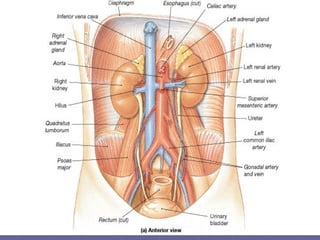
 . Kidneys:. Kidneys: the paired kidneys are situatedthe paired kidneys are situated
on either side of the spinal column, behindon either side of the spinal column, behind
the peritoneal cavity.the peritoneal cavity.
 Function of kidneys:Function of kidneys:
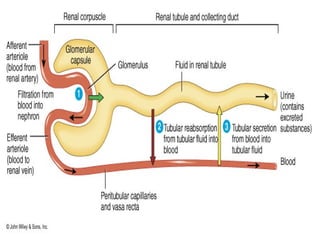
 urine formation by three process filtration,urine formation by three process filtration,
reabsorbtion and excretion.reabsorbtion and excretion.
 removes urea from bloodremoves urea from blood
 removes water and inorganic salts from bloodremoves water and inorganic salts from blood
 regulates blood acid/base by varying pH of urineregulates blood acid/base by varying pH of urine
 Production of vitamin DProduction of vitamin D
 Synthesis of erythropoietinSynthesis of erythropoietin
 b. Uretersb. Ureters::
 The Ureters are from 25 to 30 cm long in theThe Ureters are from 25 to 30 cm long in the
adult and 1.25cm in diameter.adult and 1.25cm in diameter.
 The lower end enters the bladder.The lower end enters the bladder.
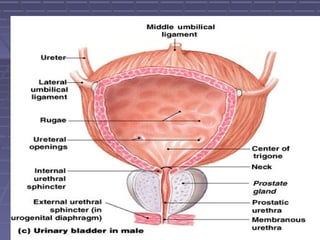
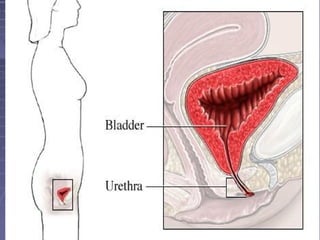
 C. BladderC. Bladder::
 Is a hollow, muscular organIs a hollow, muscular organ
 Functions as temporary reservoir urine storageFunctions as temporary reservoir urine storage
 Full bladder can contain 0.5 -1Full bladder can contain 0.5 -1
 liter of urineliter of urine
 . Urethra:. Urethra:
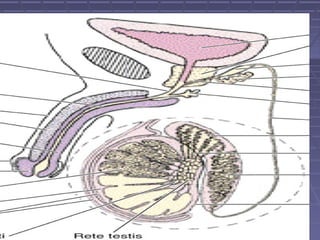
 The Male UrethraThe Male Urethra
 Extends from neck of urinary bladderExtends from neck of urinary bladder
 To tip of penis (18–20 cm)To tip of penis (18–20 cm)
 The Female UrethraThe Female Urethra
 Is very short (3–5 cm)Is very short (3–5 cm)
 Extends from bladder to vestibuleExtends from bladder to vestibule
 External urethral orifice is near anterior wall ofExternal urethral orifice is near anterior wall of
vaginavagina
 Urination:Urination:
 Micturation, voiding and urination all referMicturation, voiding and urination all refer
to the process of emptying the urinaryto the process of emptying the urinary
bladder. urine collects in the bladder untilbladder. urine collects in the bladder until
the pressure stimulates special sensorythe pressure stimulates special sensory
nerve ending in the bladder wall callednerve ending in the bladder wall called
stretch receptors.stretch receptors.
 Alteration urine production:Alteration urine production:
 Polyuria: refer to the production of abnormallyPolyuria: refer to the production of abnormally
large amount of urine by the kidneys.large amount of urine by the kidneys.
 Polydepsia: excessive fluid intake may bePolydepsia: excessive fluid intake may be
associated with diabetes.associated with diabetes.
 Diuresis: another term of production largeDiuresis: another term of production large
amount of urine.amount of urine.
 Oliquria: is low urine output less than 500ml/Oliquria: is low urine output less than 500ml/
day.day.
 Anuria: lack of urine production less than 30 ml /Anuria: lack of urine production less than 30 ml /
dayday
 Altered urinary elimination:Altered urinary elimination:
 Frequency: is the voiding more than normal with frequentFrequency: is the voiding more than normal with frequent
intervals.intervals.
 Nocturia: is voiding two or three time at night.Nocturia: is voiding two or three time at night.
 Urgency: is the feeling of person must void.Urgency: is the feeling of person must void.
 Dysuria: means voiding that is either painful or difficulty.Dysuria: means voiding that is either painful or difficulty.
 Enuresis: is defined as involuntary urination.Enuresis: is defined as involuntary urination.
 Urinary incontinence: involuntary urination. Symptom notUrinary incontinence: involuntary urination. Symptom not
a disease.a disease.
 Urine retention: accumulation of urine in the bladder andUrine retention: accumulation of urine in the bladder and
become over distendedbecome over distended
 Assessment:Assessment:
 Nursing history:Nursing history:
 Voiding pattern, description of urine forVoiding pattern, description of urine for
any changing.any changing.
 Urinary elimination problem.Urinary elimination problem.
 Presence of urinary diversion.Presence of urinary diversion.
 2. Physical assessment: inspection,2. Physical assessment: inspection,
palpation, percussion and auscultation.palpation, percussion and auscultation.
 Assessing urine:Assessing urine:
 Color: straw, transparent.Color: straw, transparent.
 Amount: 1200 – 1500ml/d.Amount: 1200 – 1500ml/d.
 Sterility: no microorganism present.Sterility: no microorganism present.
 Glucose: not present.Glucose: not present.
 Blood: not present.Blood: not present.
 Ketone bodies: not present.Ketone bodies: not present.
 Epithelial cell not present.Epithelial cell not present.
 Measuring urine output.Measuring urine output.
 Colleting urine specimen.Colleting urine specimen.
 Nursing diagnosis:Nursing diagnosis:
 Altered urinary elimination related toAltered urinary elimination related to
bladder neck obstruction.bladder neck obstruction.
 Stress incontinence related to relaxation ofStress incontinence related to relaxation of
sphenicter.sphenicter.
 Risk for infection related to urinaryRisk for infection related to urinary
retention.retention.
 Self esteem disturbances related toSelf esteem disturbances related to
urinary incontinence.urinary incontinence.
 Planning:Planning:

 Maintain normal voiding pattern.Maintain normal voiding pattern.
 Regain normal urine output.Regain normal urine output.
 Prevent infection.Prevent infection.
 InterventionIntervention::
 Maintaining normal urinary elimination:Maintaining normal urinary elimination:
 Promote fluid intake.Promote fluid intake.
 Maintain normal voiding habit.Maintain normal voiding habit.
 Assisting with toileting.Assisting with toileting.
 Preventing urinary tract infection:Preventing urinary tract infection:
 Increased fluid intake.Increased fluid intake.
 Practice frequent voiding process.Practice frequent voiding process.
 Avoid any harsh soap.Avoid any harsh soap.
 Girls should always wipe the perineal area fromGirls should always wipe the perineal area from
front to back.front to back.
Fundamental of nursing

Fundamental of nursing

  • 1.
    Fundamental of nursingFundamentalof nursing Unit Eleven and TwelveUnit Eleven and Twelve
  • 2.
    Objectives:Objectives:  Describe thefunction of the lower intestinal tract.Describe the function of the lower intestinal tract.  Identify the factors that influence in the fecalIdentify the factors that influence in the fecal elimination and pattern of elimination.elimination and pattern of elimination.  Distinguish normal from abnormalDistinguish normal from abnormal characteristics o feces.characteristics o feces.  Differentiate common fecal elimination problem.Differentiate common fecal elimination problem.  Identify common causes and effect of fecalIdentify common causes and effect of fecal elimination problems.elimination problems.  Relate common intervention to specific fecalRelate common intervention to specific fecal problemproblem
  • 3.
    ContCont  Describe essentialnursing care of patient withDescribe essential nursing care of patient with ostomies.ostomies.  Describe the process of urination.Describe the process of urination.  Identify factors that influence urinary elimination.Identify factors that influence urinary elimination.  Describe diagnostic measure to assess kidneyDescribe diagnostic measure to assess kidney function.function.  Develop nursing diagnosis related to urinaryDevelop nursing diagnosis related to urinary eliminationelimination  Describe nursing intervention to maintain normalDescribe nursing intervention to maintain normal urinary elimination.urinary elimination.
  • 4.
  • 6.
    Physiology of defecation:Physiologyof defecation:  The large intestine extend from theThe large intestine extend from the ileocecal valve to the anus, is a muscularileocecal valve to the anus, is a muscular tube lined with mucous membrane.tube lined with mucous membrane.  125 to 150 cm in length.125 to 150 cm in length.
  • 7.
     Function ofcolon:Function of colon:  Absorption of water and nutrient.( Na,Absorption of water and nutrient.( Na, 1500ml daily).1500ml daily).  Protection of intestinal wall. (Acid,Protection of intestinal wall. (Acid, adherence).adherence).  Fecal elimination.Fecal elimination.
  • 8.
     Flatus: islargely air and by product of digestion ofFlatus: is largely air and by product of digestion of carbohydrate.carbohydrate.  Defecation: is the expulsion of feces from the anusDefecation: is the expulsion of feces from the anus and rectum. the frequency of defecation is highlyand rectum. the frequency of defecation is highly individual vary from several time per day or three timeindividual vary from several time per day or three time per weeks.per weeks.  When feces move into sigmoid, the sensory nervesWhen feces move into sigmoid, the sensory nerves are stimulated. The expulsion of feces is result fromare stimulated. The expulsion of feces is result from relaxation of internal and external sphincter and byrelaxation of internal and external sphincter and by contraction of abdominal muscle and diaphragmcontraction of abdominal muscle and diaphragm which increase abdominal pressure.which increase abdominal pressure.
  • 9.
     Feces: normalfeces are made of aboutFeces: normal feces are made of about 75% water and 25% solid material. if they75% water and 25% solid material. if they feces propelled very quickly along thefeces propelled very quickly along the large intestine there is not time for mostlarge intestine there is not time for most water in the chyme to be absorbed andwater in the chyme to be absorbed and feces will be more fluid.feces will be more fluid.  Feces: are normally brown, chiefly due toFeces: are normally brown, chiefly due to presence of sterocoblin and urobilin.presence of sterocoblin and urobilin. Which are derived from bilirubin andWhich are derived from bilirubin and another factor effect of color is bacteriaanother factor effect of color is bacteria
  • 10.
    Type of peristalsismovementType of peristalsis movement  1 . Haustral movement.1 . Haustral movement.  2. peristalsis2. peristalsis  3. mass peristalses3. mass peristalses
  • 11.
    Abnormal feces:Abnormal feces: Clay or white color may indicate of absence ofClay or white color may indicate of absence of bile or bile obstruction.bile or bile obstruction.  Black, tarry stool may indicate of bleeding fromBlack, tarry stool may indicate of bleeding from upper gastrointestinal tract or drug.upper gastrointestinal tract or drug.  Red: may indicate of bleeding from lowerRed: may indicate of bleeding from lower gastrointestinal tract.gastrointestinal tract.  Pale may indicated to mal absorption.Pale may indicated to mal absorption.  Green may indicate intestinal infection.Green may indicate intestinal infection.  Dry, hard: dehydration decreased intestinalDry, hard: dehydration decreased intestinal motility.motility.  Pus: bacterial infection.Pus: bacterial infection.
  • 12.
    Factor that effectof defecation:Factor that effect of defecation: 1.1. Development: infant, meconium is the firstDevelopment: infant, meconium is the first fecal material passed by the newborn,fecal material passed by the newborn, normally up to 24 hr after newborn. Its black,normally up to 24 hr after newborn. Its black, tarry, odorless which contains mucous.tarry, odorless which contains mucous. 2.2. Infant pass stool frequently often each afterInfant pass stool frequently often each after feeding, because intestine immature.feeding, because intestine immature. 3.3. Toddlers, school age and adult.Toddlers, school age and adult. 4.4. Diet: sufficient bulk in the diet (cellulose,Diet: sufficient bulk in the diet (cellulose, fiber) is necessary to provide fecal bulk.fiber) is necessary to provide fecal bulk.
  • 13.
    ContCont 5. Fluid: thereduce fluid intake may cause Harding of5. Fluid: the reduce fluid intake may cause Harding of stool; healthy fecal elimination requires 2000 tostool; healthy fecal elimination requires 2000 to 3000ml/ day.3000ml/ day. 6. Activity: stimulate peristalsis, thus facilitating6. Activity: stimulate peristalsis, thus facilitating movement of chyme along the colon.movement of chyme along the colon. 7. Psychological factor: some people who are anxious7. Psychological factor: some people who are anxious or angry increased peristalsis activity andor angry increased peristalsis activity and subsequent diarrhea and other individual maysubsequent diarrhea and other individual may cause constipation by depress peristalsis.cause constipation by depress peristalsis. 8. Defecation habit: early bowl training may establish8. Defecation habit: early bowl training may establish habit of the defecation.habit of the defecation. 9. medication habit9. medication habit
  • 14.
    ContCont 10. Pain.10. Pain. 11.Pathological condition: spinal cord injury11. Pathological condition: spinal cord injury and head injury can decrease sensoryand head injury can decrease sensory stimulation for defecation.stimulation for defecation.
  • 15.
    Common fecal eliminationCommonfecal elimination problem:problem:  constipation:constipation:  Is defined as three bowl movement perIs defined as three bowl movement per week, this infers the passage of small,week, this infers the passage of small, dry, hard stool for period of time.dry, hard stool for period of time.
  • 16.
    Characteristics for constipationCharacteristicsfor constipation::  Decreased frequency of defecation.Decreased frequency of defecation.  Hard, dry stool.Hard, dry stool.  Straining of stool, painful defecation.Straining of stool, painful defecation.  Report rectal fullness.Report rectal fullness.  Abdominal pain, cramps and distention.Abdominal pain, cramps and distention.  Use laxatives.Use laxatives.  Decreased appetite.Decreased appetite.  Headache.Headache.
  • 17.
     Causes factorcontribute toCauses factor contribute to constipation:constipation:  Insufficient fiber intake.Insufficient fiber intake.  Insufficient activity or mobility.Insufficient activity or mobility.  Insufficient fluid intake.Insufficient fluid intake.  Irregular defecation habits.Irregular defecation habits.  Chronic use laxatives.Chronic use laxatives.  Emotional disturbance depression or mentalEmotional disturbance depression or mental confusion.confusion.  Medication such as iron salts.Medication such as iron salts.
  • 18.
     b) Fecalimpaction:b) Fecal impaction:  Fecal impaction is a mass or collection ofFecal impaction is a mass or collection of hardened, puttylike feces in the folds ofhardened, puttylike feces in the folds of the rectum. Impaction result fromthe rectum. Impaction result from prolonged retention and accumulation ofprolonged retention and accumulation of the fecal material.the fecal material.
  • 19.
    Sign and symptom:Signand symptom:  Liquid production of the feces seep.Liquid production of the feces seep.  Generalized feeling of illness.Generalized feeling of illness.  Rectal pain.Rectal pain.  Abdominal distention.Abdominal distention.  Nausea and vomiting occur.Nausea and vomiting occur.
  • 20.
     ) Diarrhea:)Diarrhea:  Refers to the passage of liquid feces andRefers to the passage of liquid feces and increased frequency of defecation. It resultincreased frequency of defecation. It result from rapid movement of fecal contentfrom rapid movement of fecal content through the large intestine.through the large intestine.
  • 21.
     Causes ofdiarrhea:Causes of diarrhea:  Psychological stress ( anxiety).Psychological stress ( anxiety).  Medication (antibiotic).Medication (antibiotic).  Allergy of food.Allergy of food.  Desease of the colon.Desease of the colon.
  • 22.
     Bowl diversionostomies:Bowl diversion ostomies:  Ostomy: is an opening on the abdominal wallOstomy: is an opening on the abdominal wall for the elimination of feces or urine.for the elimination of feces or urine.  There are many types of ostomies:There are many types of ostomies:  Gastrostomy: is an opening through theGastrostomy: is an opening through the abdominal wall in to the stomach.abdominal wall in to the stomach.  Jejunostomy: is an opening throughJejunostomy: is an opening through abdominal wall in to jejunum.abdominal wall in to jejunum.  Ileostomy: is an opening in to the ileum.Ileostomy: is an opening in to the ileum.  Colostomy: is an opening in the colon.Colostomy: is an opening in the colon.
  • 23.
     Assessment:Assessment:  Nursinghistory:Nursing history:  Defecation pattern, description of feces and anyDefecation pattern, description of feces and any changes, fecal elimination problem, presence andchanges, fecal elimination problem, presence and management of ostomies.management of ostomies.  Factor effecting elimination.Factor effecting elimination.  Physical examinationPhysical examination: inspect for color,: inspect for color, consistency, shape a mount odor and presenceconsistency, shape a mount odor and presence of abnormal constituteof abnormal constitute  Diagnostic studyDiagnostic study: direct visualization: direct visualization techniques, lapratory test, stool for occult blood.techniques, lapratory test, stool for occult blood.
  • 24.
     Nurses needto give client the followingNurses need to give client the following instruction:instruction:  Defecate in a clean bedpan.Defecate in a clean bedpan.  Don’t contaminate the specimen ifDon’t contaminate the specimen if possible by urine.possible by urine.  Don’t replace the toileting paper in theDon’t replace the toileting paper in the bedpan.bedpan.  Notify the nurse after defecation.Notify the nurse after defecation.
  • 25.
     Nursing diagnosisNursingdiagnosis::  Bowl incontinence related to fecal impaction.Bowl incontinence related to fecal impaction.  Constipation related to immobility.Constipation related to immobility.  Risk for constipation insufficient fiber intake.Risk for constipation insufficient fiber intake.  Diarrhea related to spoiled food.Diarrhea related to spoiled food.  Risk for fluid volume deficit related to diarrhea.Risk for fluid volume deficit related to diarrhea.  Risk for impaired skin integrity related toRisk for impaired skin integrity related to colostomy.colostomy.  Self esteem disturbances related to bowlSelf esteem disturbances related to bowl diversion.diversion.
  • 26.
     Planning:Planning:  Maintainnormal bowl elimination pattern.Maintain normal bowl elimination pattern.  Maintain normal stool consistency.Maintain normal stool consistency.
  • 27.
     Implementation:Implementation:  Promoteregular defecation by:Promote regular defecation by:  PrivacyPrivacy  Timing.Timing.  Nutrition: high fiber dietNutrition: high fiber diet  Increase fluid intake to 2L per day.Increase fluid intake to 2L per day.  ExerciseExercise  Positioning: squatting position best facilitiesPositioning: squatting position best facilities defecation.defecation.
  • 28.
     Teaching aboutmedication. AntidiarrhrealTeaching about medication. Antidiarrhreal medication or laxative medication.medication or laxative medication.  Administrating enema: is a solution introducedAdministrating enema: is a solution introduced in the rectum and the large intestine.in the rectum and the large intestine.  Decreasing flatulus by avoid gas – producingDecreasing flatulus by avoid gas – producing food, exercise, moving in bed and ambulation.food, exercise, moving in bed and ambulation.  Bowel training program.Bowel training program.  ostomy management by stoma color, size andostomy management by stoma color, size and shape, bleeding and amount and type of feces.shape, bleeding and amount and type of feces.
  • 30.
     . Kidneys:.Kidneys: the paired kidneys are situatedthe paired kidneys are situated on either side of the spinal column, behindon either side of the spinal column, behind the peritoneal cavity.the peritoneal cavity.  Function of kidneys:Function of kidneys:  urine formation by three process filtration,urine formation by three process filtration, reabsorbtion and excretion.reabsorbtion and excretion.  removes urea from bloodremoves urea from blood  removes water and inorganic salts from bloodremoves water and inorganic salts from blood  regulates blood acid/base by varying pH of urineregulates blood acid/base by varying pH of urine  Production of vitamin DProduction of vitamin D  Synthesis of erythropoietinSynthesis of erythropoietin
  • 32.
     b. Uretersb.Ureters::  The Ureters are from 25 to 30 cm long in theThe Ureters are from 25 to 30 cm long in the adult and 1.25cm in diameter.adult and 1.25cm in diameter.  The lower end enters the bladder.The lower end enters the bladder.  C. BladderC. Bladder::  Is a hollow, muscular organIs a hollow, muscular organ  Functions as temporary reservoir urine storageFunctions as temporary reservoir urine storage  Full bladder can contain 0.5 -1Full bladder can contain 0.5 -1  liter of urineliter of urine
  • 33.
     . Urethra:.Urethra:  The Male UrethraThe Male Urethra  Extends from neck of urinary bladderExtends from neck of urinary bladder  To tip of penis (18–20 cm)To tip of penis (18–20 cm)  The Female UrethraThe Female Urethra  Is very short (3–5 cm)Is very short (3–5 cm)  Extends from bladder to vestibuleExtends from bladder to vestibule  External urethral orifice is near anterior wall ofExternal urethral orifice is near anterior wall of vaginavagina
  • 37.
     Urination:Urination:  Micturation,voiding and urination all referMicturation, voiding and urination all refer to the process of emptying the urinaryto the process of emptying the urinary bladder. urine collects in the bladder untilbladder. urine collects in the bladder until the pressure stimulates special sensorythe pressure stimulates special sensory nerve ending in the bladder wall callednerve ending in the bladder wall called stretch receptors.stretch receptors.
  • 38.
     Alteration urineproduction:Alteration urine production:  Polyuria: refer to the production of abnormallyPolyuria: refer to the production of abnormally large amount of urine by the kidneys.large amount of urine by the kidneys.  Polydepsia: excessive fluid intake may bePolydepsia: excessive fluid intake may be associated with diabetes.associated with diabetes.  Diuresis: another term of production largeDiuresis: another term of production large amount of urine.amount of urine.  Oliquria: is low urine output less than 500ml/Oliquria: is low urine output less than 500ml/ day.day.  Anuria: lack of urine production less than 30 ml /Anuria: lack of urine production less than 30 ml / dayday
  • 39.
     Altered urinaryelimination:Altered urinary elimination:  Frequency: is the voiding more than normal with frequentFrequency: is the voiding more than normal with frequent intervals.intervals.  Nocturia: is voiding two or three time at night.Nocturia: is voiding two or three time at night.  Urgency: is the feeling of person must void.Urgency: is the feeling of person must void.  Dysuria: means voiding that is either painful or difficulty.Dysuria: means voiding that is either painful or difficulty.  Enuresis: is defined as involuntary urination.Enuresis: is defined as involuntary urination.  Urinary incontinence: involuntary urination. Symptom notUrinary incontinence: involuntary urination. Symptom not a disease.a disease.  Urine retention: accumulation of urine in the bladder andUrine retention: accumulation of urine in the bladder and become over distendedbecome over distended
  • 40.
     Assessment:Assessment:  Nursinghistory:Nursing history:  Voiding pattern, description of urine forVoiding pattern, description of urine for any changing.any changing.  Urinary elimination problem.Urinary elimination problem.  Presence of urinary diversion.Presence of urinary diversion.  2. Physical assessment: inspection,2. Physical assessment: inspection, palpation, percussion and auscultation.palpation, percussion and auscultation.
  • 41.
     Assessing urine:Assessingurine:  Color: straw, transparent.Color: straw, transparent.  Amount: 1200 – 1500ml/d.Amount: 1200 – 1500ml/d.  Sterility: no microorganism present.Sterility: no microorganism present.  Glucose: not present.Glucose: not present.  Blood: not present.Blood: not present.  Ketone bodies: not present.Ketone bodies: not present.  Epithelial cell not present.Epithelial cell not present.  Measuring urine output.Measuring urine output.  Colleting urine specimen.Colleting urine specimen.
  • 42.
     Nursing diagnosis:Nursingdiagnosis:  Altered urinary elimination related toAltered urinary elimination related to bladder neck obstruction.bladder neck obstruction.  Stress incontinence related to relaxation ofStress incontinence related to relaxation of sphenicter.sphenicter.  Risk for infection related to urinaryRisk for infection related to urinary retention.retention.  Self esteem disturbances related toSelf esteem disturbances related to urinary incontinence.urinary incontinence.
  • 43.
     Planning:Planning:   Maintainnormal voiding pattern.Maintain normal voiding pattern.  Regain normal urine output.Regain normal urine output.  Prevent infection.Prevent infection.
  • 44.
     InterventionIntervention::  Maintainingnormal urinary elimination:Maintaining normal urinary elimination:  Promote fluid intake.Promote fluid intake.  Maintain normal voiding habit.Maintain normal voiding habit.  Assisting with toileting.Assisting with toileting.  Preventing urinary tract infection:Preventing urinary tract infection:  Increased fluid intake.Increased fluid intake.  Practice frequent voiding process.Practice frequent voiding process.  Avoid any harsh soap.Avoid any harsh soap.  Girls should always wipe the perineal area fromGirls should always wipe the perineal area from front to back.front to back.