Editing grammar
Sentence :
It is a group of words expresing a
complete thought.
SENTENCE GRAMMAR describes how
sentences are organized and
structured.
sentence fragment
A sentence fragment is an incomplete sentence. A
fragment occurs when a sentence is missing either
a subject or a predicate, or when a dependent
phrase or clause is mistaken for a sentence.
A COMPLETE SENTENCE needs to contain a
SUBJECT, which is the word or words that tells
who or what the sentence is about. A subject
consists of a noun or a pronoun.
If a "sentence" is missing its subject, the main
"who" or "what" the sentence is about will be
unknown
Ex 1- Swam in the pool.
2- Skipped down the street
A complete sentence also needs to contain
a predicate, which is the word or words in a
sentence that express the action or state of
being of the subject. A predicate consists of a
verb.
If a "sentence" is missing its predicate, the
main action or being of the subject will be
unknown:
Ex: Her niece in the pool
CORRECT FORMS
Her niece swam in the pool (verb of action)
Her niece was in the pool (verb of being)
Other fragments cannot stand alone because
they contain a subordinating element:
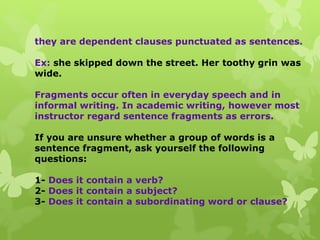
they are dependent clauses punctuated as sentences.
Ex: she skipped down the street. Her toothy grin was
wide.
Fragments occur often in everyday speech and in
informal writing. In academic writing, however most
instructor regard sentence fragments as errors.
If you are unsure whether a group of words is a
sentence fragment, ask yourself the following
questions:
1- Does it contain a verb?
2- Does it contain a subject?
3- Does it contain a subordinating word or clause?
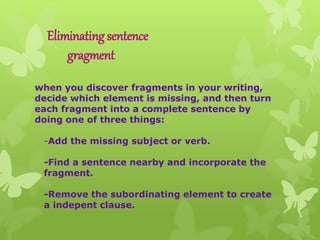
Eliminating sentence
gragment
when you discover fragments in your writing,
decide which element is missing, and then turn
each fragment into a complete sentence by
doing one of three things:
-Add the missing subject or verb.
-Find a sentence nearby and incorporate the
fragment.
-Remove the subordinating element to create
a indepent clause.
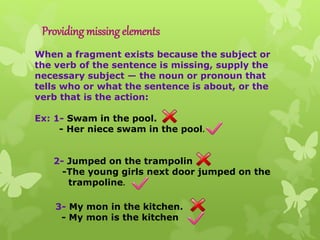
Providing missing elements
When a fragment exists because the subject or
the verb of the sentence is missing, supply the
necessary subject — the noun or pronoun that
tells who or what the sentence is about, or the
verb that is the action:
Ex: 1- Swam in the pool.
- Her niece swam in the pool.
2- Jumped on the trampolin
-The young girls next door jumped on the
trampoline.
3- My mon in the kitchen.
- My mon is the kitchen
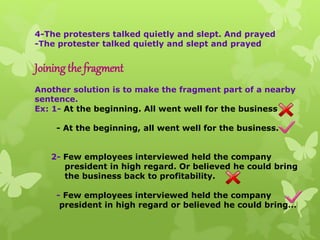
4-The protesters talked quietly and slept. And prayed
-The protester talked quietly and slept and prayed
Joining the fragment
Another solution is to make the fragment part of a nearby
sentence.
Ex: 1- At the beginning. All went well for the business
- At the beginning, all went well for the business.
2- Few employees interviewed held the company
president in high regard. Or believed he could bring
the business back to profitability.
- Few employees interviewed held the company
president in high regard or believed he could bring…
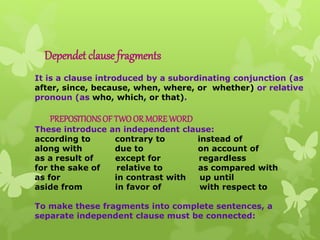
Dependet clause fragments
It is a clause introduced by a subordinating conjunction (as
after, since, because, when, where, or whether) or relative
pronoun (as who, which, or that).
PREPOSITIONSOF TWOOR MOREWORD
These introduce an independent clause:
according to contrary to instead of
along with due to on account of
as a result of except for regardless
for the sake of relative to as compared with
as for in contrast with up until
aside from in favor of with respect to
To make these fragments into complete sentences, a
separate independent clause must be connected:
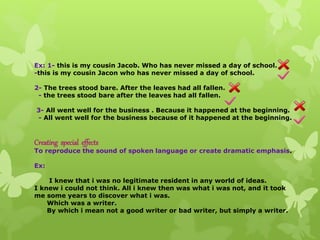
Ex: 1- this is my cousin Jacob. Who has never missed a day of school.
-this is my cousin Jacon who has never missed a day of school.
2- The trees stood bare. After the leaves had all fallen.
- the trees stood bare after the leaves had all fallen.
3- All went well for the business . Because it happened at the beginning.
- All went well for the business because of it happened at the beginning.
Creating special effects
To reproduce the sound of spoken language or create dramatic emphasis.
Ex:
I knew that i was no legitimate resident in any world of ideas.
I knew i could not think. All i knew then was what i was not, and it took
me some years to discover what i was.
Which was a writer.
By which i mean not a good writer or bad writer, but simply a writer.
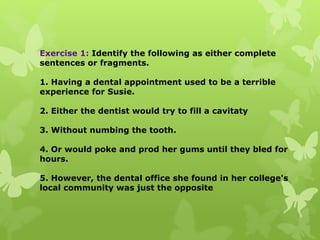
Exercise 1: Identify the following as either complete
sentences or fragments.
1. Having a dental appointment used to be a terrible
experience for Susie.
2. Either the dentist would try to fill a cavitaty
3. Without numbing the tooth.
4. Or would poke and prod her gums until they bled for
hours.
5. However, the dental office she found in her college's
local community was just the opposite
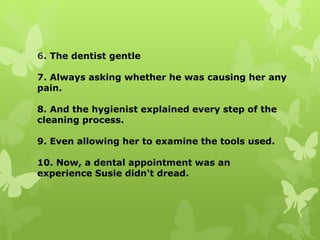
6. The dentist gentle
7. Always asking whether he was causing her any
pain.
8. And the hygienist explained every step of the
cleaning process.
9. Even allowing her to examine the tools used.
10. Now, a dental appointment was an
experience Susie didn't dread.
Eliana lopez

Eliana lopez

  • 1.
  • 2.
    Sentence : It isa group of words expresing a complete thought. SENTENCE GRAMMAR describes how sentences are organized and structured.
  • 3.
    sentence fragment A sentencefragment is an incomplete sentence. A fragment occurs when a sentence is missing either a subject or a predicate, or when a dependent phrase or clause is mistaken for a sentence. A COMPLETE SENTENCE needs to contain a SUBJECT, which is the word or words that tells who or what the sentence is about. A subject consists of a noun or a pronoun. If a "sentence" is missing its subject, the main "who" or "what" the sentence is about will be unknown Ex 1- Swam in the pool. 2- Skipped down the street
  • 4.
    A complete sentencealso needs to contain a predicate, which is the word or words in a sentence that express the action or state of being of the subject. A predicate consists of a verb. If a "sentence" is missing its predicate, the main action or being of the subject will be unknown: Ex: Her niece in the pool CORRECT FORMS Her niece swam in the pool (verb of action) Her niece was in the pool (verb of being) Other fragments cannot stand alone because they contain a subordinating element:
  • 5.
    they are dependentclauses punctuated as sentences. Ex: she skipped down the street. Her toothy grin was wide. Fragments occur often in everyday speech and in informal writing. In academic writing, however most instructor regard sentence fragments as errors. If you are unsure whether a group of words is a sentence fragment, ask yourself the following questions: 1- Does it contain a verb? 2- Does it contain a subject? 3- Does it contain a subordinating word or clause?
  • 6.
    Eliminating sentence gragment when youdiscover fragments in your writing, decide which element is missing, and then turn each fragment into a complete sentence by doing one of three things: -Add the missing subject or verb. -Find a sentence nearby and incorporate the fragment. -Remove the subordinating element to create a indepent clause.
  • 7.
    Providing missing elements Whena fragment exists because the subject or the verb of the sentence is missing, supply the necessary subject — the noun or pronoun that tells who or what the sentence is about, or the verb that is the action: Ex: 1- Swam in the pool. - Her niece swam in the pool. 2- Jumped on the trampolin -The young girls next door jumped on the trampoline. 3- My mon in the kitchen. - My mon is the kitchen
  • 8.
    4-The protesters talkedquietly and slept. And prayed -The protester talked quietly and slept and prayed Joining the fragment Another solution is to make the fragment part of a nearby sentence. Ex: 1- At the beginning. All went well for the business - At the beginning, all went well for the business. 2- Few employees interviewed held the company president in high regard. Or believed he could bring the business back to profitability. - Few employees interviewed held the company president in high regard or believed he could bring…
  • 9.
    Dependet clause fragments Itis a clause introduced by a subordinating conjunction (as after, since, because, when, where, or whether) or relative pronoun (as who, which, or that). PREPOSITIONSOF TWOOR MOREWORD These introduce an independent clause: according to contrary to instead of along with due to on account of as a result of except for regardless for the sake of relative to as compared with as for in contrast with up until aside from in favor of with respect to To make these fragments into complete sentences, a separate independent clause must be connected:
  • 10.
    Ex: 1- thisis my cousin Jacob. Who has never missed a day of school. -this is my cousin Jacon who has never missed a day of school. 2- The trees stood bare. After the leaves had all fallen. - the trees stood bare after the leaves had all fallen. 3- All went well for the business . Because it happened at the beginning. - All went well for the business because of it happened at the beginning. Creating special effects To reproduce the sound of spoken language or create dramatic emphasis. Ex: I knew that i was no legitimate resident in any world of ideas. I knew i could not think. All i knew then was what i was not, and it took me some years to discover what i was. Which was a writer. By which i mean not a good writer or bad writer, but simply a writer.
  • 11.
    Exercise 1: Identifythe following as either complete sentences or fragments. 1. Having a dental appointment used to be a terrible experience for Susie. 2. Either the dentist would try to fill a cavitaty 3. Without numbing the tooth. 4. Or would poke and prod her gums until they bled for hours. 5. However, the dental office she found in her college's local community was just the opposite
  • 12.
    6. The dentistgentle 7. Always asking whether he was causing her any pain. 8. And the hygienist explained every step of the cleaning process. 9. Even allowing her to examine the tools used. 10. Now, a dental appointment was an experience Susie didn't dread.