WELCOME
Prepared by
MD Rafiqul Islam
ID :1501171
BANGLADESH AGRICULTURAL UNIVERSITY
Discussions
• Characteristic biological feature
• Habitat
• Feeds & feeding
• Reproduction
• Health issues
• Health management
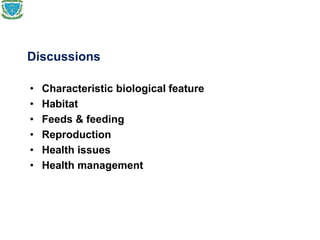
CROCODILE
Biological characteristics
Order : Crocodilia
• Size : 5 -17 ft
• Cold blooded.
• Have 4 chambered heart & functional diaphragm.
• Short limb with webbed feet , large and flattened mouth.
• Acute senses and very good night vision.
• No sweat gland. Release heat through mouth.
• Move by ‘‘belly run” and ‘‘high walk”.
• 80 sharp teeth with strong jaw.
• Life span : 35-40 years.
Habitat
• Widely distributed .
-Bangladesh, India, Nepal , Australia, Brazil, South &
Central America etc.
• Thrive in warm regions to regulate body temperature.
• Mainly semi aquatic and live in lowland, humid tropics
like lake, river, swamps etc.
- Marsh crocodile
- Estuarine crocodile
• As they have salt gland on tongue, they can live in
brackish water.
Feeds and feeding
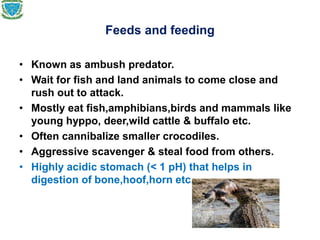
• Known as ambush predator.
• Wait for fish and land animals to come close and
rush out to attack.
• Mostly eat fish,amphibians,birds and mammals like
young hyppo, deer,wild cattle & buffalo etc.
• Often cannibalize smaller crocodiles.
• Aggressive scavenger & steal food from others.
• Highly acidic stomach (< 1 pH) that helps in
digestion of bone,hoof,horn etc.
Reproduction
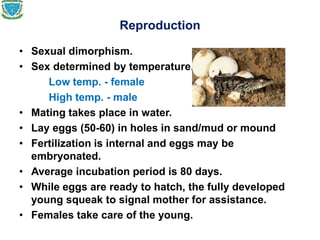
• Sexual dimorphism.
• Sex determined by temperature.
Low temp. - female
High temp. - male
• Mating takes place in water.
• Lay eggs (50-60) in holes in sand/mud or mound
• Fertilization is internal and eggs may be
embryonated.
• Average incubation period is 80 days.
• While eggs are ready to hatch, the fully developed
young squeak to signal mother for assistance.
• Females take care of the young.
Health issues
• Wound
• Abscess
• Anorexia
• Ulcer
• Stomatitis
• Enteritis
• Wart
• Tuberculosis
• Crocodile pox
• Deep mycoses
• Amoebiasis and parasitic infestation
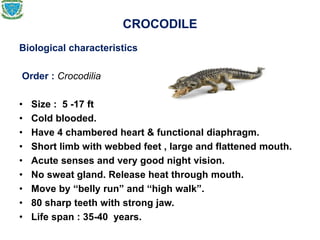
Python
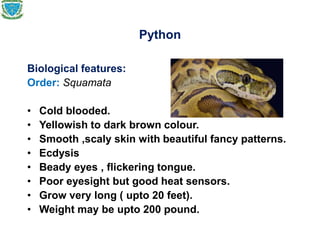
Biological features:
Order: Squamata
• Cold blooded.
• Yellowish to dark brown colour.
• Smooth ,scaly skin with beautiful fancy patterns.
• Ecdysis
• Beady eyes , flickering tongue.
• Poor eyesight but good heat sensors.
• Grow very long ( upto 20 feet).
• Weight may be upto 200 pound.
Habitat
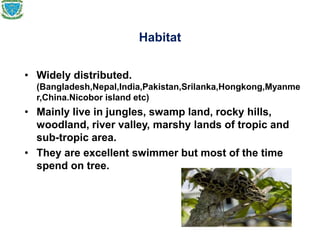
• Widely distributed.
(Bangladesh,Nepal,India,Pakistan,Srilanka,Hongkong,Myanme
r,China.Nicobor island etc)
• Mainly live in jungles, swamp land, rocky hills,
woodland, river valley, marshy lands of tropic and
sub-tropic area.
• They are excellent swimmer but most of the time
spend on tree.
Feeds and feeding
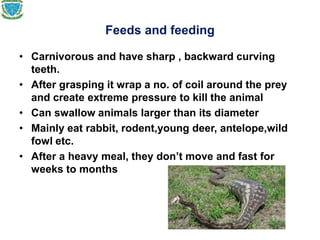
• Carnivorous and have sharp , backward curving
teeth.
• After grasping it wrap a no. of coil around the prey
and create extreme pressure to kill the animal
• Can swallow animals larger than its diameter
• Mainly eat rabbit, rodent,young deer, antelope,wild
fowl etc.
• After a heavy meal, they don’t move and fast for
weeks to months
Reproduction
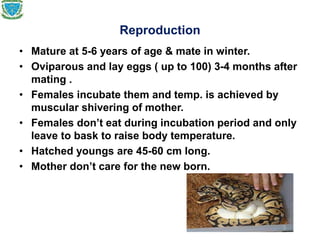
• Mature at 5-6 years of age & mate in winter.
• Oviparous and lay eggs ( up to 100) 3-4 months after
mating .
• Females incubate them and temp. is achieved by
muscular shivering of mother.
• Females don’t eat during incubation period and only
leave to bask to raise body temperature.
• Hatched youngs are 45-60 cm long.
• Mother don’t care for the new born.
Health problems
• Disecdysis
• Anorexia
• Dermatitis
• Stomatitis
• Corneal opacity
• Wound
• Abscess
• Enteritis
• Ulceration of shell
• Blister disease
• Protozoal and parasitic infection
Management
• Proper husbandry is the most important factor.
• Animal welfare.
• Naturalistic habitat or enclosure.
• Hiding place.
• Favourable temperature (PBT), light and humidity.
• Proper nutrition.
• Exercise and opportunity to exhibit natural behaviors ,
presence of partner or opposite sex.
• Stress free condition.
• Prompt disease or abnormality identification and
taking appropriate measures.
References
• Animal Husbandry and Veterinary Science
-Prof. Dr M.A. Samad
• Zoo management,education and introduction and feeding
- Dr Ziaur Rahman Selim
• www.basicbiology.net
• www.crocodilian.com
• www.science.jrank.orgoduction

Crocodile

  • 1.
    WELCOME Prepared by MD RafiqulIslam ID :1501171 BANGLADESH AGRICULTURAL UNIVERSITY
  • 2.
    Discussions • Characteristic biologicalfeature • Habitat • Feeds & feeding • Reproduction • Health issues • Health management
  • 3.
    CROCODILE Biological characteristics Order :Crocodilia • Size : 5 -17 ft • Cold blooded. • Have 4 chambered heart & functional diaphragm. • Short limb with webbed feet , large and flattened mouth. • Acute senses and very good night vision. • No sweat gland. Release heat through mouth. • Move by ‘‘belly run” and ‘‘high walk”. • 80 sharp teeth with strong jaw. • Life span : 35-40 years.
  • 4.
    Habitat • Widely distributed. -Bangladesh, India, Nepal , Australia, Brazil, South & Central America etc. • Thrive in warm regions to regulate body temperature. • Mainly semi aquatic and live in lowland, humid tropics like lake, river, swamps etc. - Marsh crocodile - Estuarine crocodile • As they have salt gland on tongue, they can live in brackish water.
  • 5.
    Feeds and feeding •Known as ambush predator. • Wait for fish and land animals to come close and rush out to attack. • Mostly eat fish,amphibians,birds and mammals like young hyppo, deer,wild cattle & buffalo etc. • Often cannibalize smaller crocodiles. • Aggressive scavenger & steal food from others. • Highly acidic stomach (< 1 pH) that helps in digestion of bone,hoof,horn etc.
  • 6.
    Reproduction • Sexual dimorphism. •Sex determined by temperature. Low temp. - female High temp. - male • Mating takes place in water. • Lay eggs (50-60) in holes in sand/mud or mound • Fertilization is internal and eggs may be embryonated. • Average incubation period is 80 days. • While eggs are ready to hatch, the fully developed young squeak to signal mother for assistance. • Females take care of the young.
  • 7.
    Health issues • Wound •Abscess • Anorexia • Ulcer • Stomatitis • Enteritis • Wart • Tuberculosis • Crocodile pox • Deep mycoses • Amoebiasis and parasitic infestation
  • 8.
    Python Biological features: Order: Squamata •Cold blooded. • Yellowish to dark brown colour. • Smooth ,scaly skin with beautiful fancy patterns. • Ecdysis • Beady eyes , flickering tongue. • Poor eyesight but good heat sensors. • Grow very long ( upto 20 feet). • Weight may be upto 200 pound.
  • 9.
    Habitat • Widely distributed. (Bangladesh,Nepal,India,Pakistan,Srilanka,Hongkong,Myanme r,China.Nicoborisland etc) • Mainly live in jungles, swamp land, rocky hills, woodland, river valley, marshy lands of tropic and sub-tropic area. • They are excellent swimmer but most of the time spend on tree.
  • 10.
    Feeds and feeding •Carnivorous and have sharp , backward curving teeth. • After grasping it wrap a no. of coil around the prey and create extreme pressure to kill the animal • Can swallow animals larger than its diameter • Mainly eat rabbit, rodent,young deer, antelope,wild fowl etc. • After a heavy meal, they don’t move and fast for weeks to months
  • 11.
    Reproduction • Mature at5-6 years of age & mate in winter. • Oviparous and lay eggs ( up to 100) 3-4 months after mating . • Females incubate them and temp. is achieved by muscular shivering of mother. • Females don’t eat during incubation period and only leave to bask to raise body temperature. • Hatched youngs are 45-60 cm long. • Mother don’t care for the new born.
  • 12.
    Health problems • Disecdysis •Anorexia • Dermatitis • Stomatitis • Corneal opacity • Wound • Abscess • Enteritis • Ulceration of shell • Blister disease • Protozoal and parasitic infection
  • 13.
    Management • Proper husbandryis the most important factor. • Animal welfare. • Naturalistic habitat or enclosure. • Hiding place. • Favourable temperature (PBT), light and humidity. • Proper nutrition. • Exercise and opportunity to exhibit natural behaviors , presence of partner or opposite sex. • Stress free condition. • Prompt disease or abnormality identification and taking appropriate measures.
  • 14.
    References • Animal Husbandryand Veterinary Science -Prof. Dr M.A. Samad • Zoo management,education and introduction and feeding - Dr Ziaur Rahman Selim • www.basicbiology.net • www.crocodilian.com • www.science.jrank.orgoduction