MARKET RESEARCH SKILLS:
CONDUCTING SURVEY (TUTORIAL)
MKT4303
GATHERING DATA
(PRIMARY DATA: SURVEY > QUESTIONNAIRE)
• Surveys requiring respondents to complete a
questionnaire are a popular way of collecting
information for all sorts of purposes. You may
have received various ‘market research’
questionnaires through the post or been sent a
questionnaire after you bought something or
made use of a service.
• The main strength of questionnaires is that
they allow you to identify and describe the
extent of variation in answers on particular
topics and to look for relationships between
positions on one set of questions and positions
on another.
MARKETING RESEARCH
PROCESS:
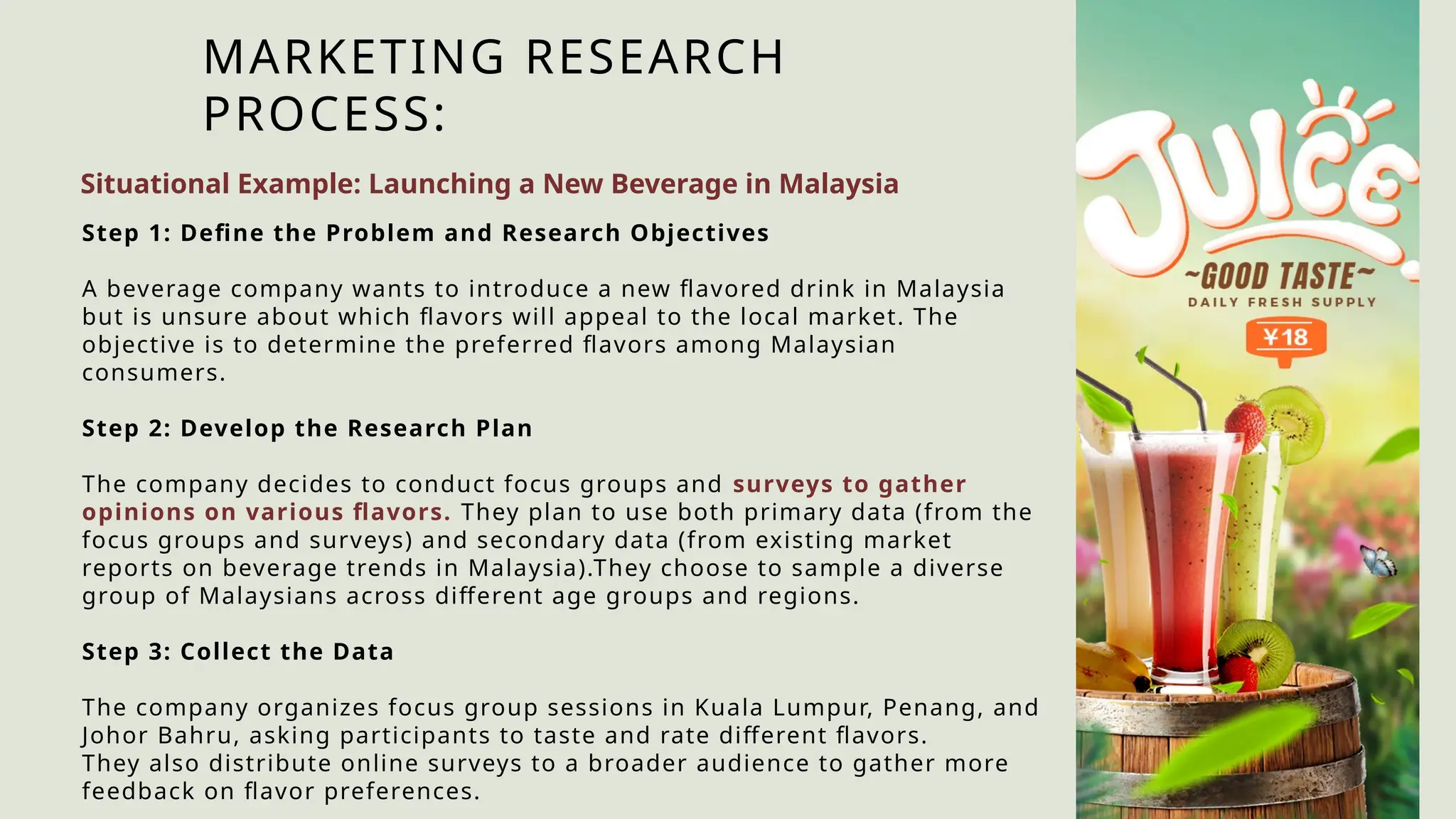
Situational Example: Launching a New Beverage in Malaysia
Step 1: Define the Problem and Research Objectives
A beverage company wants to introduce a new flavored drink in Malaysia
but is unsure about which flavors will appeal to the local market. The
objective is to determine the preferred flavors among Malaysian
consumers.
Step 2: Develop the Research Plan
The company decides to conduct focus groups and surveys to gather
opinions on various flavors. They plan to use both primary data (from the
focus groups and surveys) and secondary data (from existing market
reports on beverage trends in Malaysia).They choose to sample a diverse
group of Malaysians across different age groups and regions.
Step 3: Collect the Data
The company organizes focus group sessions in Kuala Lumpur, Penang, and
Johor Bahru, asking participants to taste and rate different flavors.
They also distribute online surveys to a broader audience to gather more
feedback on flavor preferences.
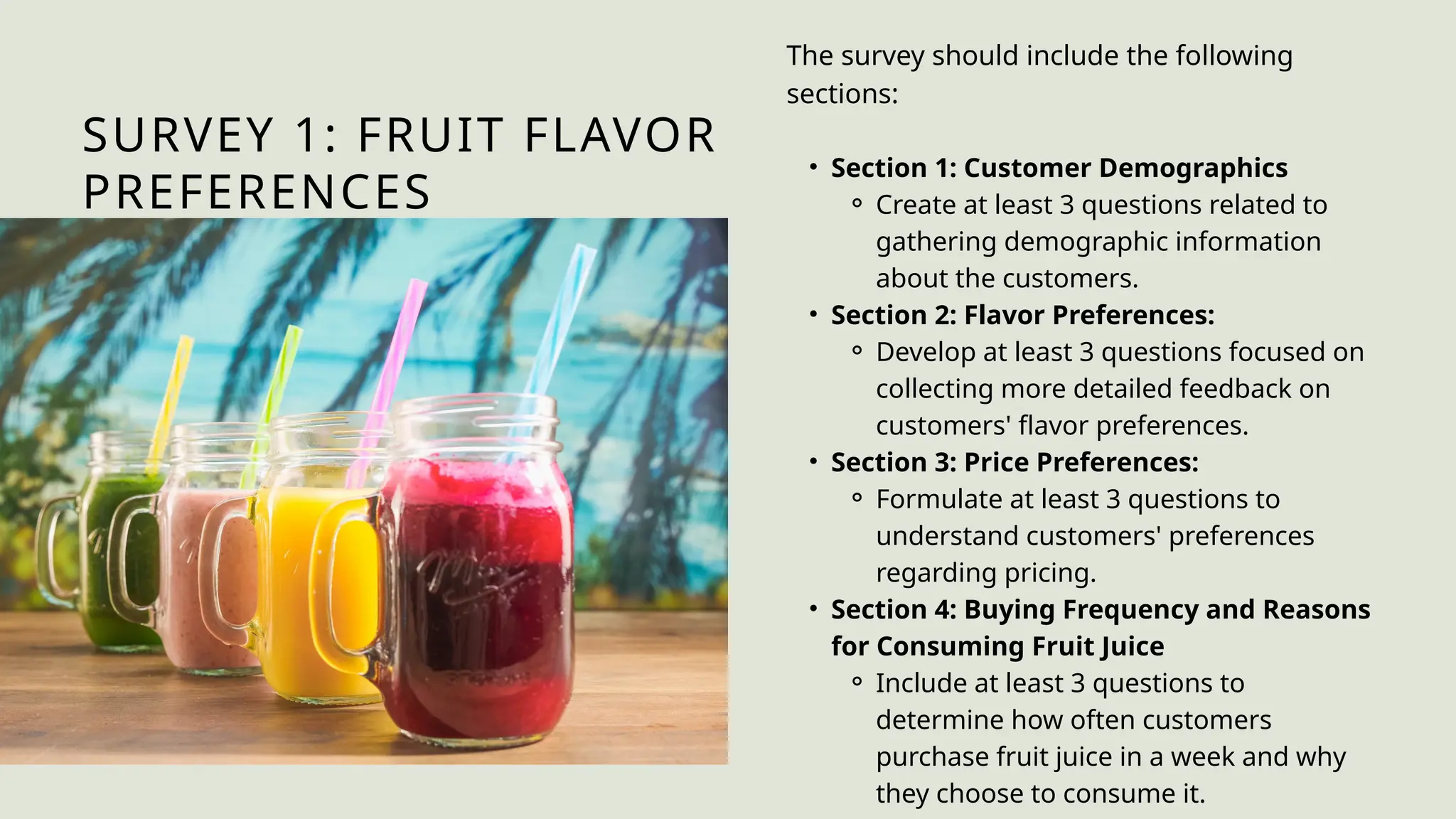
SURVEY 1: FRUIT FLAVOR
PREFERENCES
The survey should include the following
sections:
• Section 1: Customer Demographics
⚬ Create at least 3 questions related to
gathering demographic information
about the customers.
• Section 2: Flavor Preferences:
⚬ Develop at least 3 questions focused on
collecting more detailed feedback on
customers' flavor preferences.
• Section 3: Price Preferences:
⚬ Formulate at least 3 questions to
understand customers' preferences
regarding pricing.
• Section 4: Buying Frequency and Reasons
for Consuming Fruit Juice
⚬ Include at least 3 questions to
determine how often customers
purchase fruit juice in a week and why
they choose to consume it.
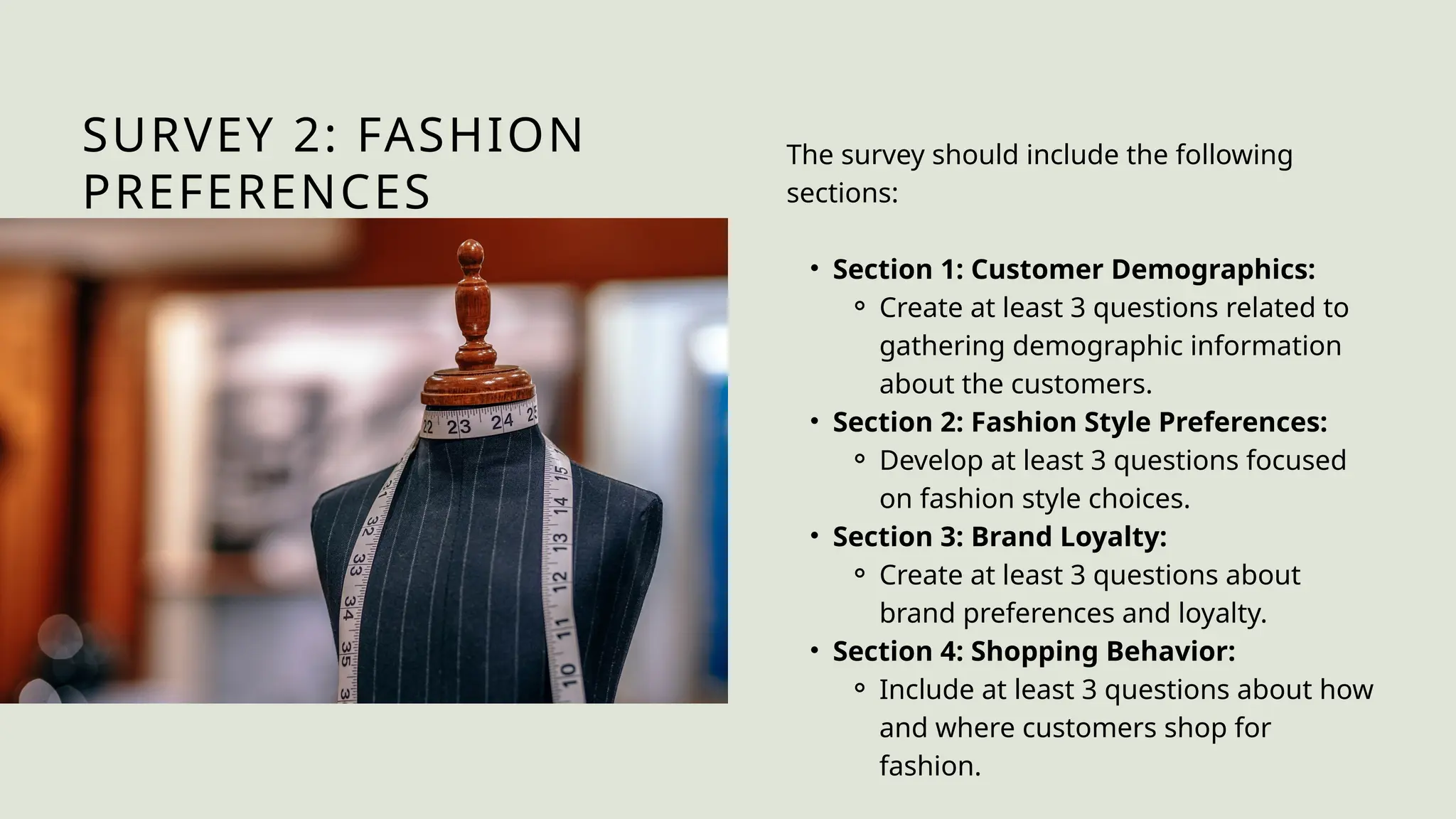
SURVEY 2: FASHION
PREFERENCES
The survey should include the following
sections:
• Section 1: Customer Demographics:
⚬ Create at least 3 questions related to
gathering demographic information
about the customers.
• Section 2: Fashion Style Preferences:
⚬ Develop at least 3 questions focused
on fashion style choices.
• Section 3: Brand Loyalty:
⚬ Create at least 3 questions about
brand preferences and loyalty.
• Section 4: Shopping Behavior:
⚬ Include at least 3 questions about how
and where customers shop for
fashion.
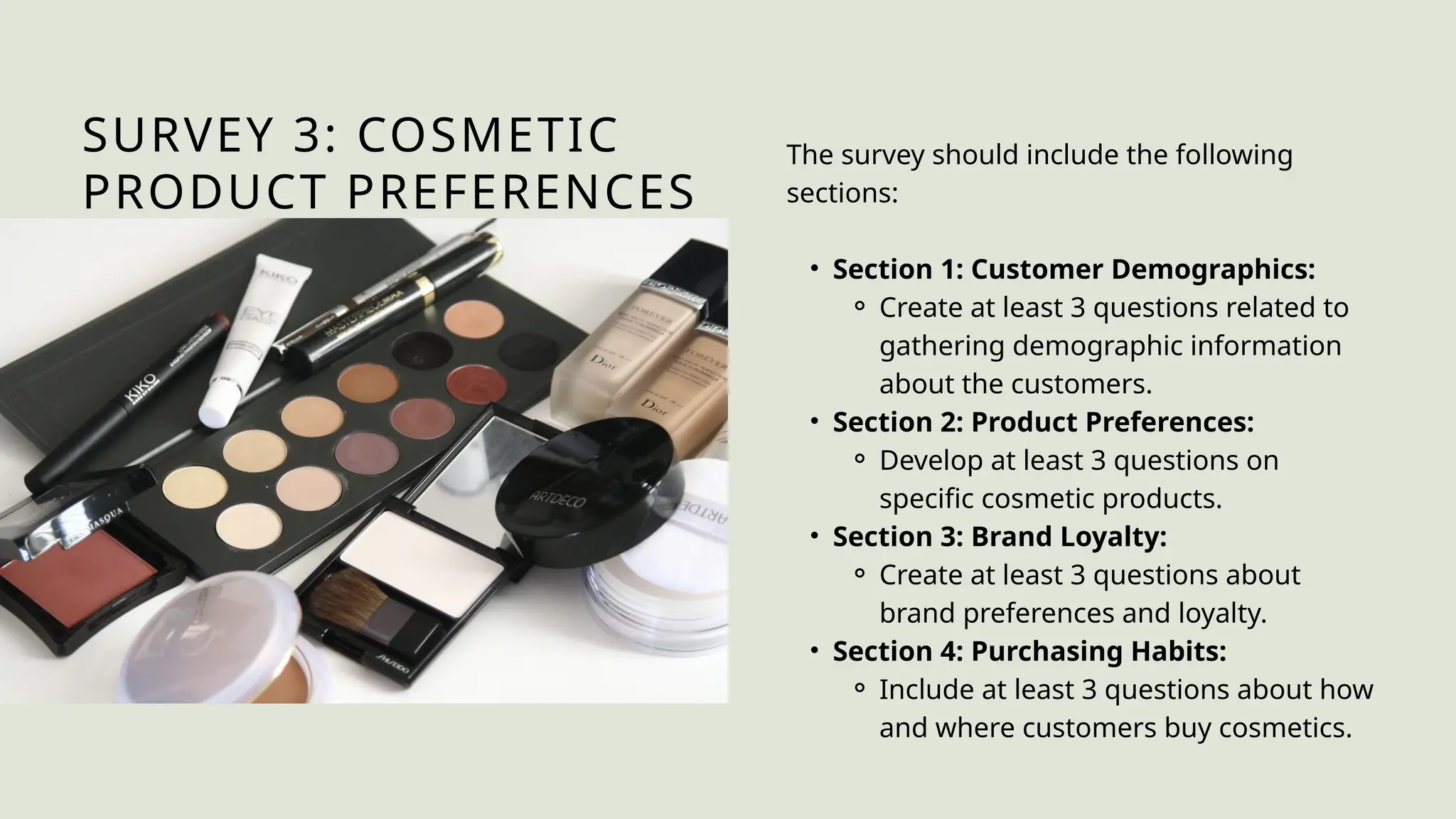
SURVEY 3: COSMETIC
PRODUCT PREFERENCES
The survey should include the following
sections:
• Section 1: Customer Demographics:
⚬ Create at least 3 questions related to
gathering demographic information
about the customers.
• Section 2: Product Preferences:
⚬ Develop at least 3 questions on
specific cosmetic products.
• Section 3: Brand Loyalty:
⚬ Create at least 3 questions about
brand preferences and loyalty.
• Section 4: Purchasing Habits:
⚬ Include at least 3 questions about how
and where customers buy cosmetics.
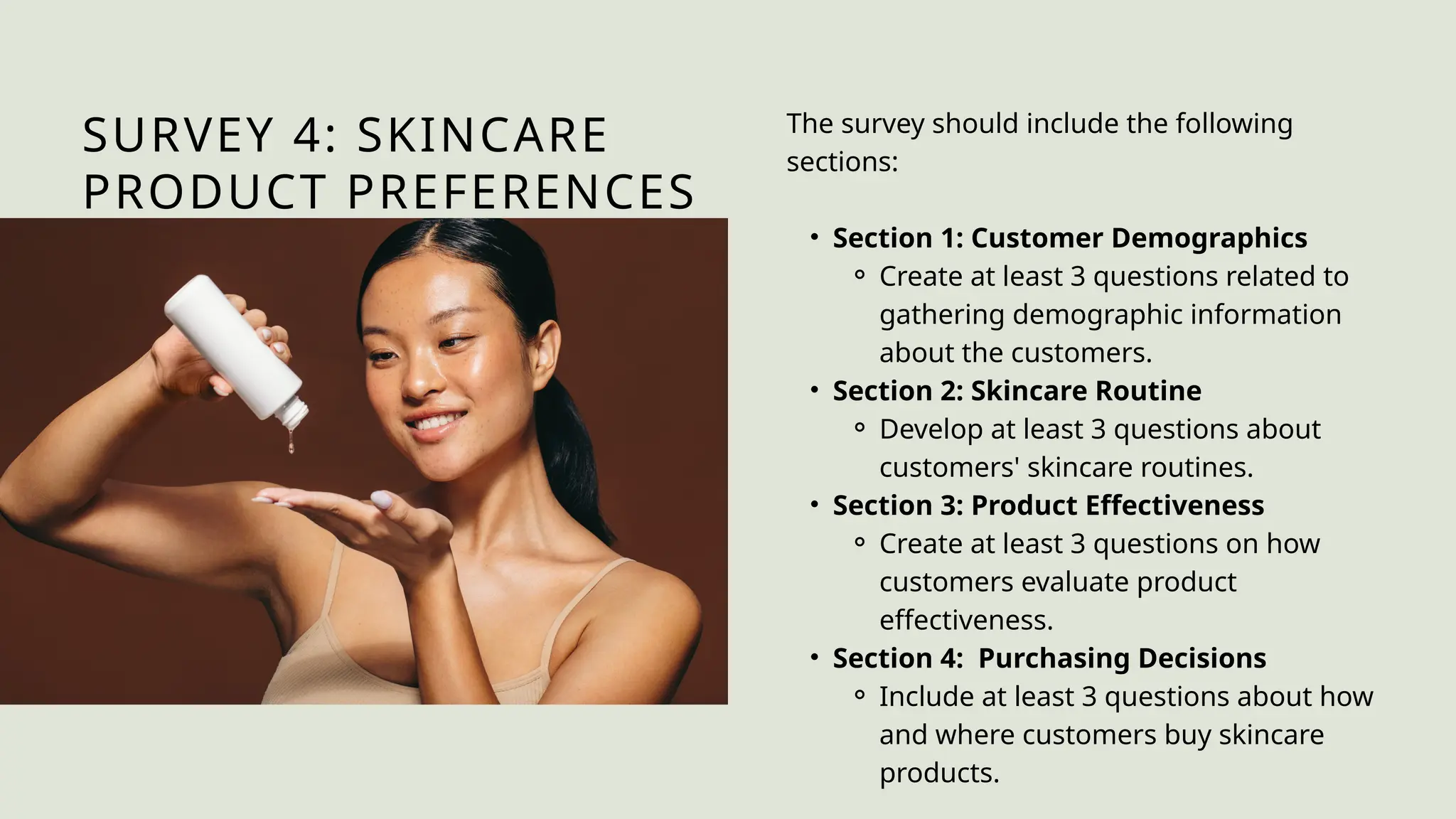
SURVEY 4: SKINCARE
PRODUCT PREFERENCES
The survey should include the following
sections:
• Section 1: Customer Demographics
⚬ Create at least 3 questions related to
gathering demographic information
about the customers.
• Section 2: Skincare Routine
⚬ Develop at least 3 questions about
customers' skincare routines.
• Section 3: Product Effectiveness
⚬ Create at least 3 questions on how
customers evaluate product
effectiveness.
• Section 4: Purchasing Decisions
⚬ Include at least 3 questions about how
and where customers buy skincare
products.
SURVEY 5: ELECTRONIC
PRODUCT PREFERENCES
The survey should include the following
sections:
• Section 1: Customer Demographics
⚬ Develop at least 3 questions about
how customers use electronic devices.
• Section 2: Device Usage
⚬ Develop at least 3 questions about
how customers use electronic devices.
• Section 3: Brand Preferences
⚬ Create at least 3 questions about
brand loyalty and preferences.
• Section 4: Purchasing Habits
⚬ Include at least 3 questions about how
and where customers buy electronic
devices.
GATHERING DATA
(PRIMARY DATA: SURVEY > QUESTIONNAIRE)
In groups of 4-5 members, you will randomly choose one survey topic (either F&B,
Fashion, Cosmetics, Skincare, or Electronics) and create a survey form.
Students are expected to:
• Utilize Google Forms and explore its various features.
• Once the survey is completed, post the link in the group’s WhatsApp chat (one link per
group) for your classmates to participate.
• After finishing the exercise, discuss and present the survey results in class, and share
your insights on the advantages of using survey forms in market research.
*INDIVIDUAL TASK: Share your thoughts on the benefits of using survey forms in the
context of market research (include the survey form link) in Canvas under Week 7 -
Activity Discussion Board.

Week 7 - Data Collection (Tutorial) .pptx

  • 1.
    MARKET RESEARCH SKILLS: CONDUCTINGSURVEY (TUTORIAL) MKT4303
  • 2.
    GATHERING DATA (PRIMARY DATA:SURVEY > QUESTIONNAIRE) • Surveys requiring respondents to complete a questionnaire are a popular way of collecting information for all sorts of purposes. You may have received various ‘market research’ questionnaires through the post or been sent a questionnaire after you bought something or made use of a service. • The main strength of questionnaires is that they allow you to identify and describe the extent of variation in answers on particular topics and to look for relationships between positions on one set of questions and positions on another.
  • 3.
    MARKETING RESEARCH PROCESS: Situational Example:Launching a New Beverage in Malaysia Step 1: Define the Problem and Research Objectives A beverage company wants to introduce a new flavored drink in Malaysia but is unsure about which flavors will appeal to the local market. The objective is to determine the preferred flavors among Malaysian consumers. Step 2: Develop the Research Plan The company decides to conduct focus groups and surveys to gather opinions on various flavors. They plan to use both primary data (from the focus groups and surveys) and secondary data (from existing market reports on beverage trends in Malaysia).They choose to sample a diverse group of Malaysians across different age groups and regions. Step 3: Collect the Data The company organizes focus group sessions in Kuala Lumpur, Penang, and Johor Bahru, asking participants to taste and rate different flavors. They also distribute online surveys to a broader audience to gather more feedback on flavor preferences.
  • 4.
    SURVEY 1: FRUITFLAVOR PREFERENCES The survey should include the following sections: • Section 1: Customer Demographics ⚬ Create at least 3 questions related to gathering demographic information about the customers. • Section 2: Flavor Preferences: ⚬ Develop at least 3 questions focused on collecting more detailed feedback on customers' flavor preferences. • Section 3: Price Preferences: ⚬ Formulate at least 3 questions to understand customers' preferences regarding pricing. • Section 4: Buying Frequency and Reasons for Consuming Fruit Juice ⚬ Include at least 3 questions to determine how often customers purchase fruit juice in a week and why they choose to consume it.
  • 5.
    SURVEY 2: FASHION PREFERENCES Thesurvey should include the following sections: • Section 1: Customer Demographics: ⚬ Create at least 3 questions related to gathering demographic information about the customers. • Section 2: Fashion Style Preferences: ⚬ Develop at least 3 questions focused on fashion style choices. • Section 3: Brand Loyalty: ⚬ Create at least 3 questions about brand preferences and loyalty. • Section 4: Shopping Behavior: ⚬ Include at least 3 questions about how and where customers shop for fashion.
  • 6.
    SURVEY 3: COSMETIC PRODUCTPREFERENCES The survey should include the following sections: • Section 1: Customer Demographics: ⚬ Create at least 3 questions related to gathering demographic information about the customers. • Section 2: Product Preferences: ⚬ Develop at least 3 questions on specific cosmetic products. • Section 3: Brand Loyalty: ⚬ Create at least 3 questions about brand preferences and loyalty. • Section 4: Purchasing Habits: ⚬ Include at least 3 questions about how and where customers buy cosmetics.
  • 7.
    SURVEY 4: SKINCARE PRODUCTPREFERENCES The survey should include the following sections: • Section 1: Customer Demographics ⚬ Create at least 3 questions related to gathering demographic information about the customers. • Section 2: Skincare Routine ⚬ Develop at least 3 questions about customers' skincare routines. • Section 3: Product Effectiveness ⚬ Create at least 3 questions on how customers evaluate product effectiveness. • Section 4: Purchasing Decisions ⚬ Include at least 3 questions about how and where customers buy skincare products.
  • 8.
    SURVEY 5: ELECTRONIC PRODUCTPREFERENCES The survey should include the following sections: • Section 1: Customer Demographics ⚬ Develop at least 3 questions about how customers use electronic devices. • Section 2: Device Usage ⚬ Develop at least 3 questions about how customers use electronic devices. • Section 3: Brand Preferences ⚬ Create at least 3 questions about brand loyalty and preferences. • Section 4: Purchasing Habits ⚬ Include at least 3 questions about how and where customers buy electronic devices.
  • 9.
    GATHERING DATA (PRIMARY DATA:SURVEY > QUESTIONNAIRE) In groups of 4-5 members, you will randomly choose one survey topic (either F&B, Fashion, Cosmetics, Skincare, or Electronics) and create a survey form. Students are expected to: • Utilize Google Forms and explore its various features. • Once the survey is completed, post the link in the group’s WhatsApp chat (one link per group) for your classmates to participate. • After finishing the exercise, discuss and present the survey results in class, and share your insights on the advantages of using survey forms in market research. *INDIVIDUAL TASK: Share your thoughts on the benefits of using survey forms in the context of market research (include the survey form link) in Canvas under Week 7 - Activity Discussion Board.

Editor's Notes