Chapter 8
Event Coordination
(Logistic and Staging)

E-mail: tpavit@hotmail.com
    081-082-
  . 081-082-7273
                             1
Objectives
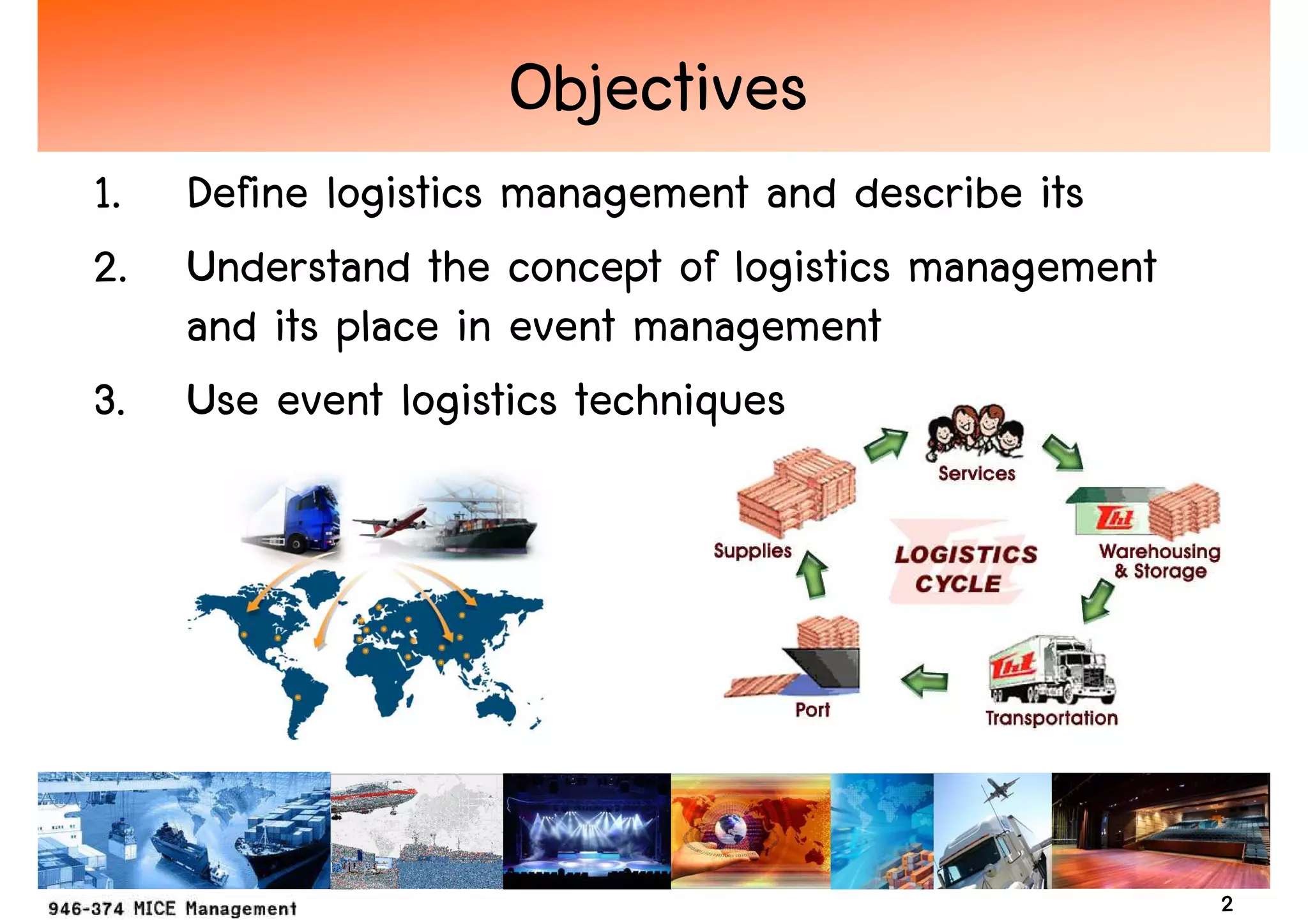
1. Define logistics management and describe its
2. Understand the concept of logistics management
   and its place in event management
3. Use event logistics techniques


                                                    2
Outlines
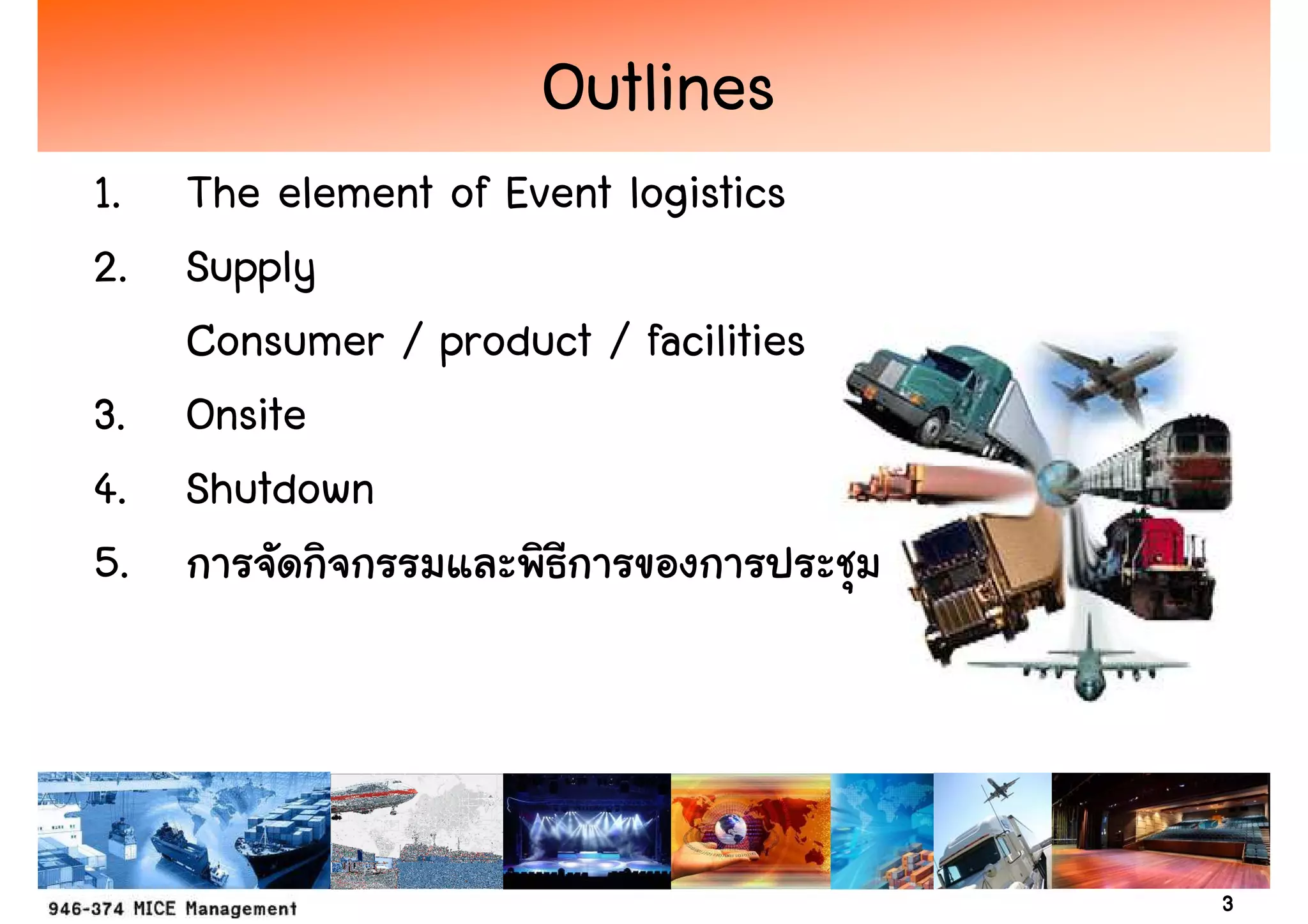
1. The element of Event logistics
2. Supply
   Consumer / product / facilities
3. Onsite
4. Shutdown
5.


                                     3
Logistics

            4
Logistics
• Logistics is the management of the flow of goods,
  information and other resources in a repair cycle between
  the point of origin and the point of consumption in order to
  meet the requirements of customers. Logistics involves the
  integration of information, transportation, inventory,
  warehousing, material handling, and packaging, and
  occasionally security.
• Logistics is a channel of the supply chain which adds the
  value of time and place utility. Today the complexity of
  production logistics can be modeled, analyzed, visualized
  and optimized by plant simulation software.


                                                                 5
Logistics
• Logistics to events is the management of event that
  divided into supply, setting up, and running the
  event on site, and the shutdown process of the
  event.
• The planning, implementing and control of the flow
  and storage of products, and the related information
  from production to the point of consumption,
  according to consumer requirements.


                                                         6
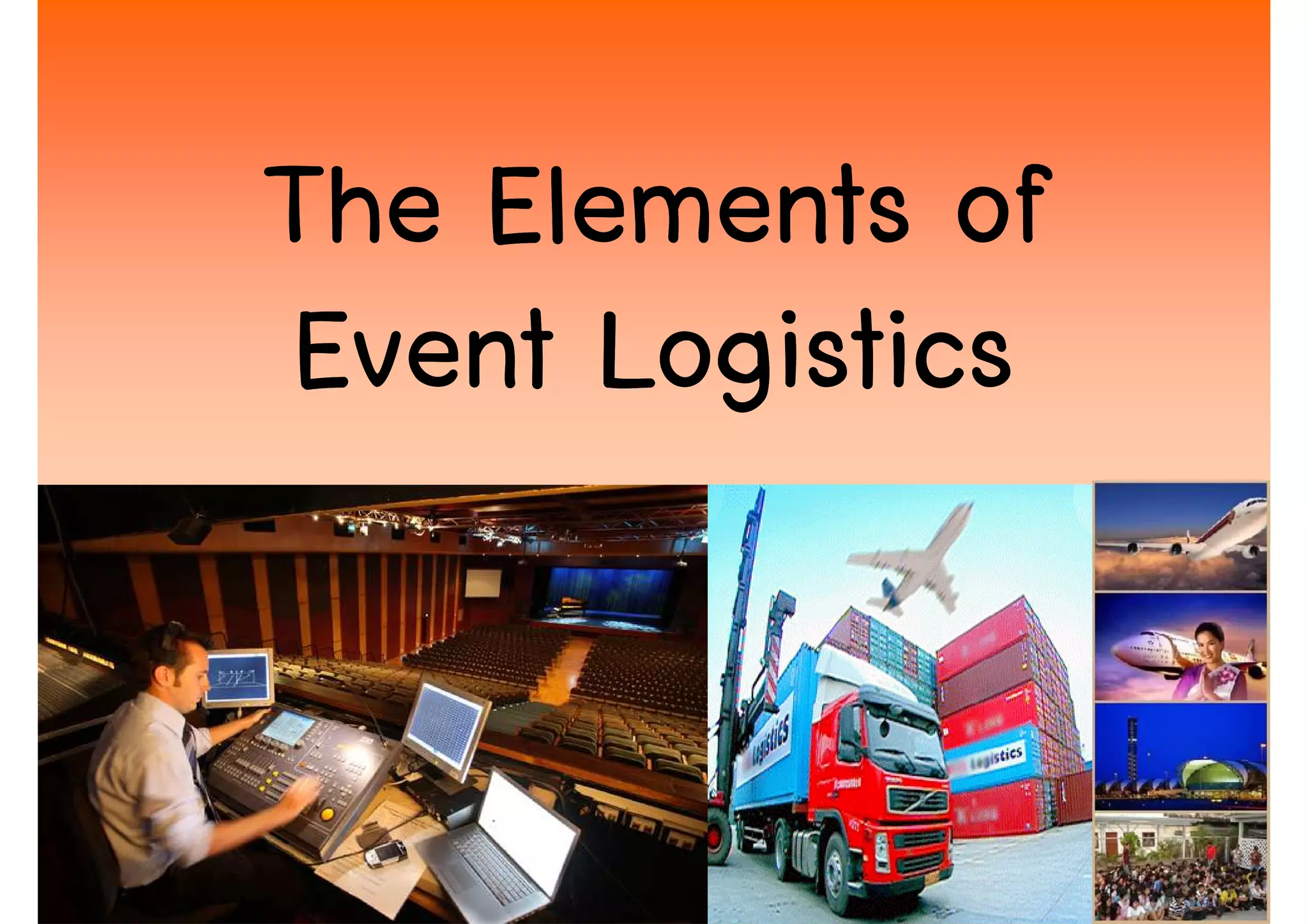
The Elements of
Event Logistics


                  7
The Elements of Event Logistics
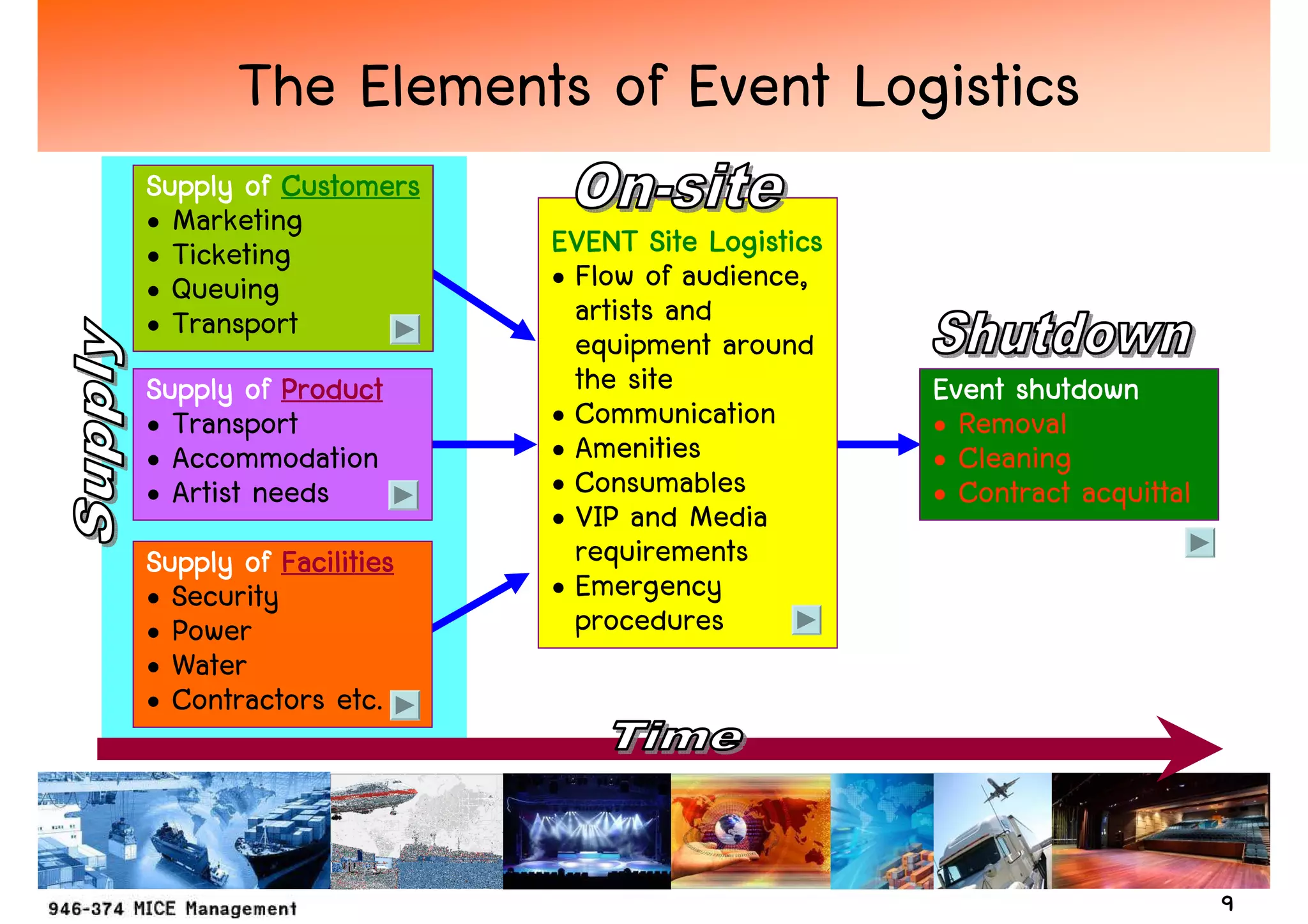
• Whereas most logistics theory concerns the supply
  of products to customers, event logistics includes
  the efficient supply of the customer to the product,
  and the supply of facilities to and from the event
  site.


                                                         8
The Elements of Event Logistics
Supply of Customers
• Marketing
• Ticketing            EVENT Site Logistics
• Queuing              • Flow of audience,
• Transport              artists and
                         equipment around
Supply of Product        the site             Event shutdown
• Transport            • Communication        • Removal
• Accommodation        • Amenities            • Cleaning
• Artist needs         • Consumables          • Contract acquittal
                       • VIP and Media
Supply of Facilities     requirements
• Security             • Emergency
• Power                  procedures
• Water
• Contractors etc.


                                                                     9
The Elements of Event Logistics
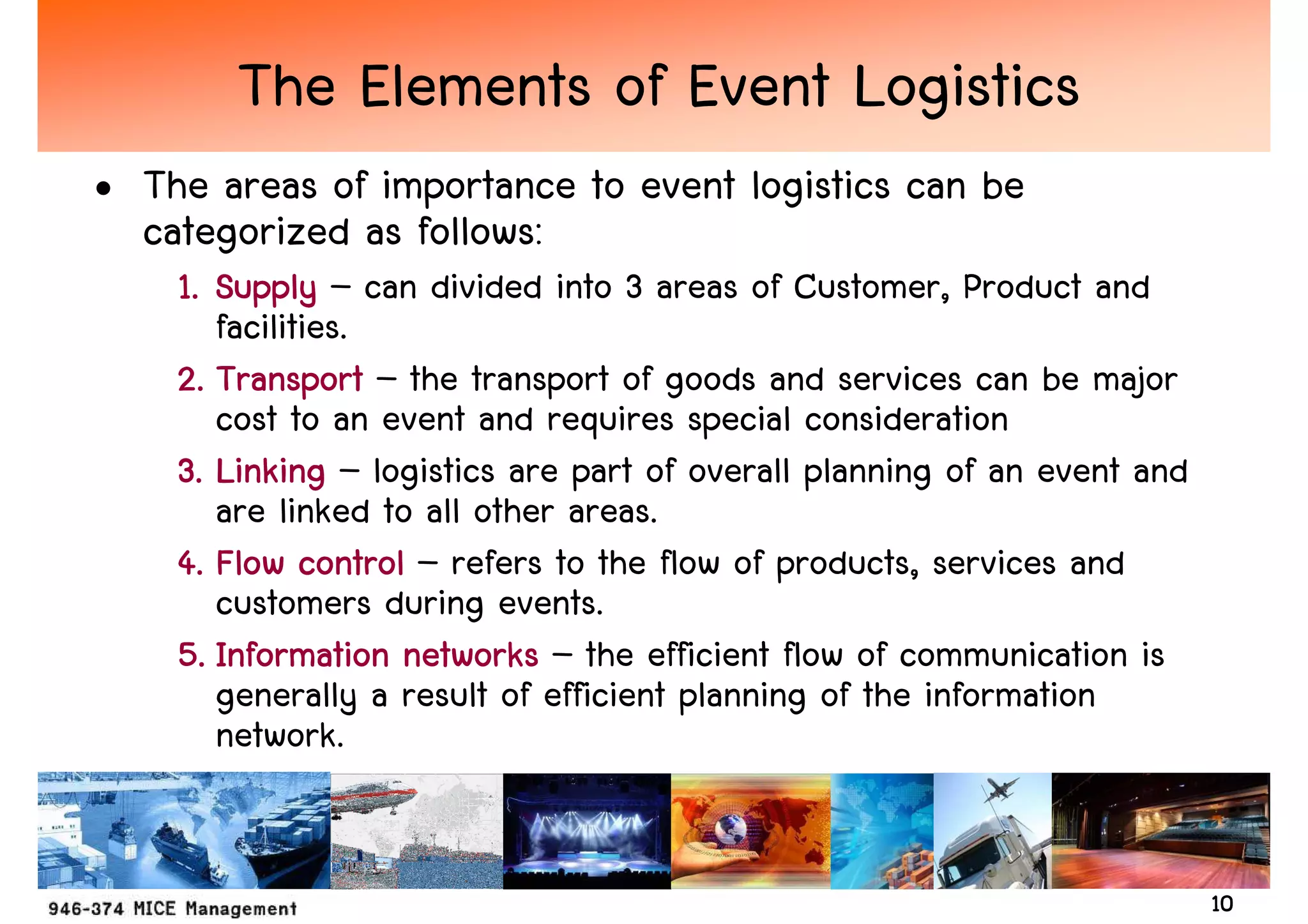
• The areas of importance to event logistics can be
  categorized as follows:
    1. Supply – can divided into 3 areas of Customer, Product and
       facilities.
    2. Transport – the transport of goods and services can be major
       cost to an event and requires special consideration
    3. Linking – logistics are part of overall planning of an event and
       are linked to all other areas.
    4. Flow control – refers to the flow of products, services and
       customers during events.
    5. Information networks – the efficient flow of communication is
       generally a result of efficient planning of the information
       network.


                                                                          10
The Elements of Event Logistics
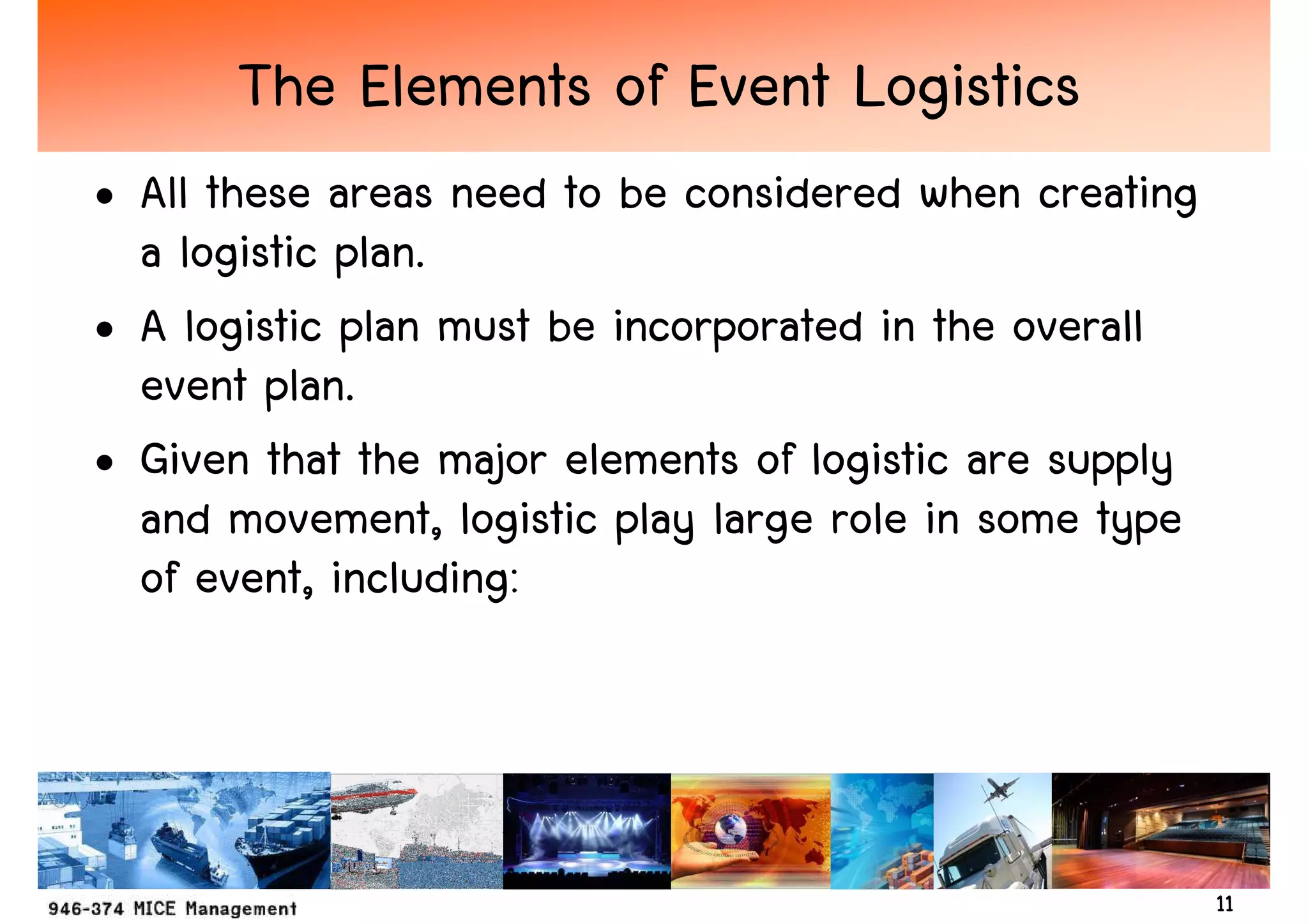
• All these areas need to be considered when creating
  a logistic plan.
• A logistic plan must be incorporated in the overall
  event plan.
• Given that the major elements of logistic are supply
  and movement, logistic play large role in some type
  of event, including:


                                                         11
The Elements of Event Logistics
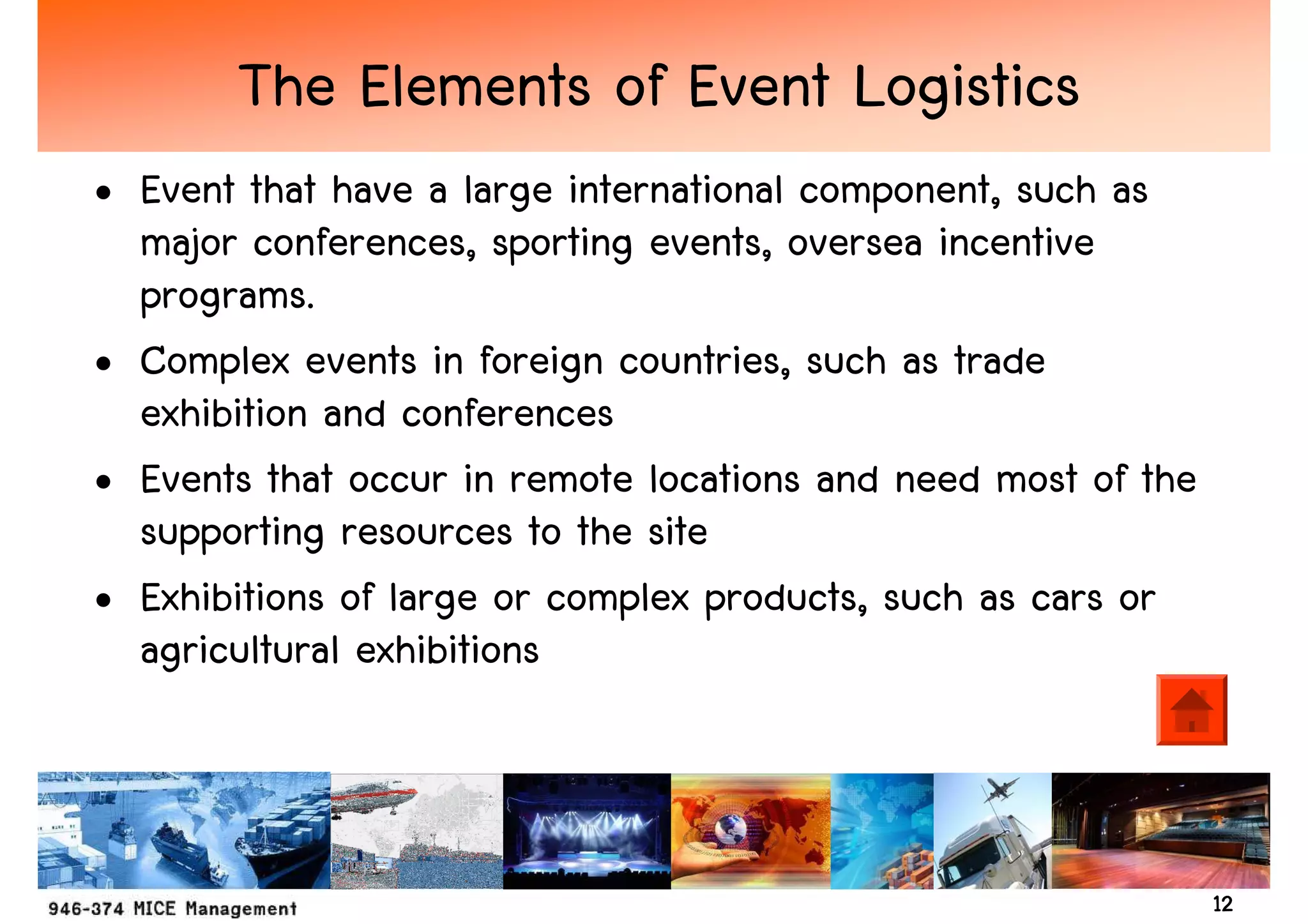
• Event that have a large international component, such as
  major conferences, sporting events, oversea incentive
  programs.
• Complex events in foreign countries, such as trade
  exhibition and conferences
• Events that occur in remote locations and need most of the
  supporting resources to the site
• Exhibitions of large or complex products, such as cars or
  agricultural exhibitions


                                                               12
Supply of Customers


                      13
Supply of Customers
• The customer of an event are those who pay for it.
• The customers have expectations, which include
  logistical aspects, that have to be met for a
  successful outcome.
• The way in which the event is promoted will
  particularly influence their expectations


                                                       14
Supply of Customers
1. Links with marketing and promotion
2. Ticketing (Distribution, collection and security)
3. Queuing (tickets, parking, entrance, seating, food
   and toilets)
4. Customer transports (timing of arrival, public or
   private transport)


                                                        15
Supply of Product


                    16
Supply of Product – Product portfolio
• Most events have a variety of products and services
  – a product portfolio – that help to create the event
  experience for the customer.
• The individual logistics requirements of the various
  products need to be integrated into a logistics plan.
• LARGE EVENTS = >200 performing groups
• SMALL EVENTS = Speaker and Video material.


                                                          17
Supply of Product – Product portfolio
1. Transport (carnet and customs clearance)
    • Carnet is a license issued by Customs that allows the
      movement of goods across an international border.
2. Accommodation
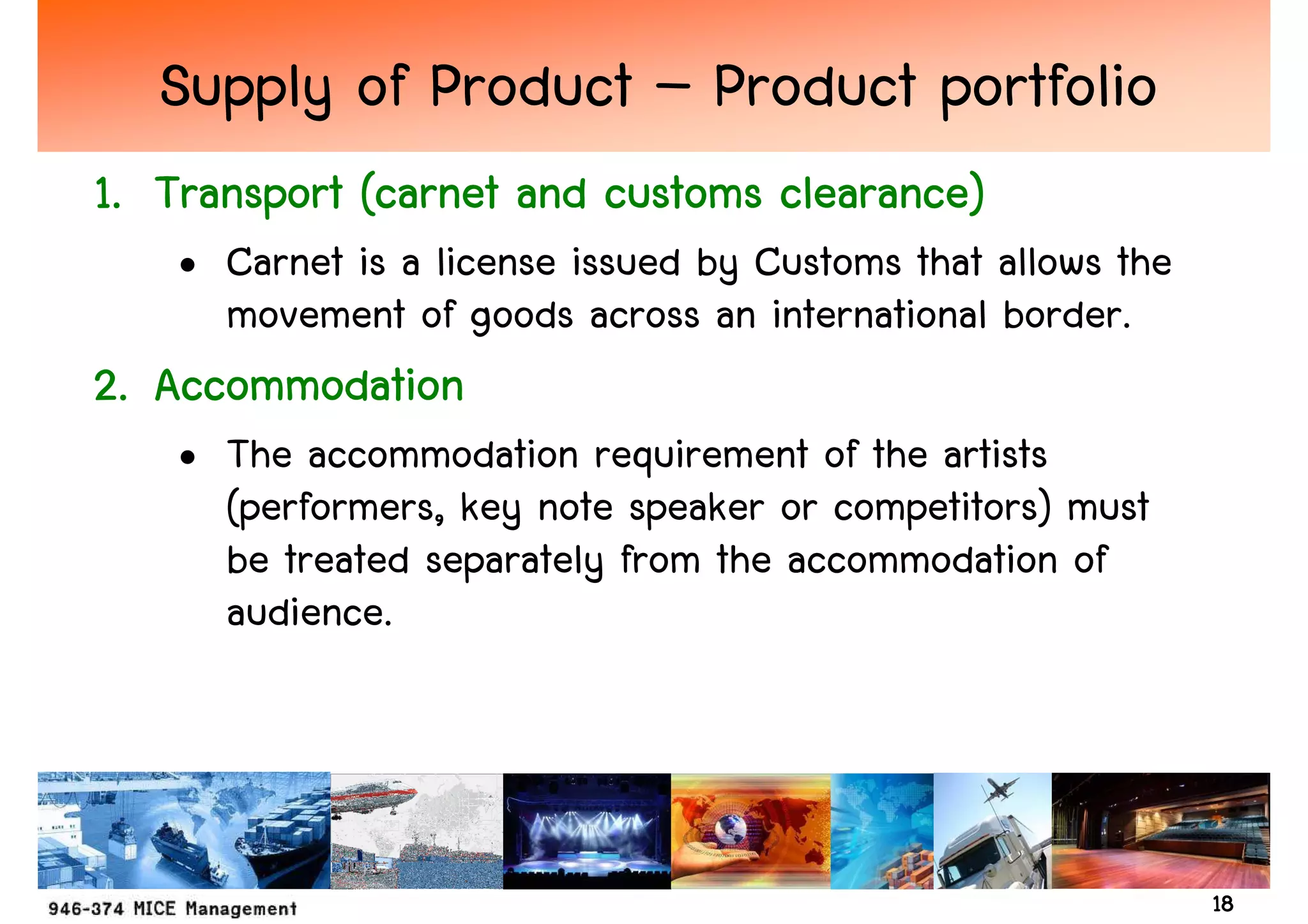
    • The accommodation requirement of the artists
      (performers, key note speaker or competitors) must
      be treated separately from the accommodation of
      audience.


                                                              18
Supply of Product – Product portfolio
   Artists’
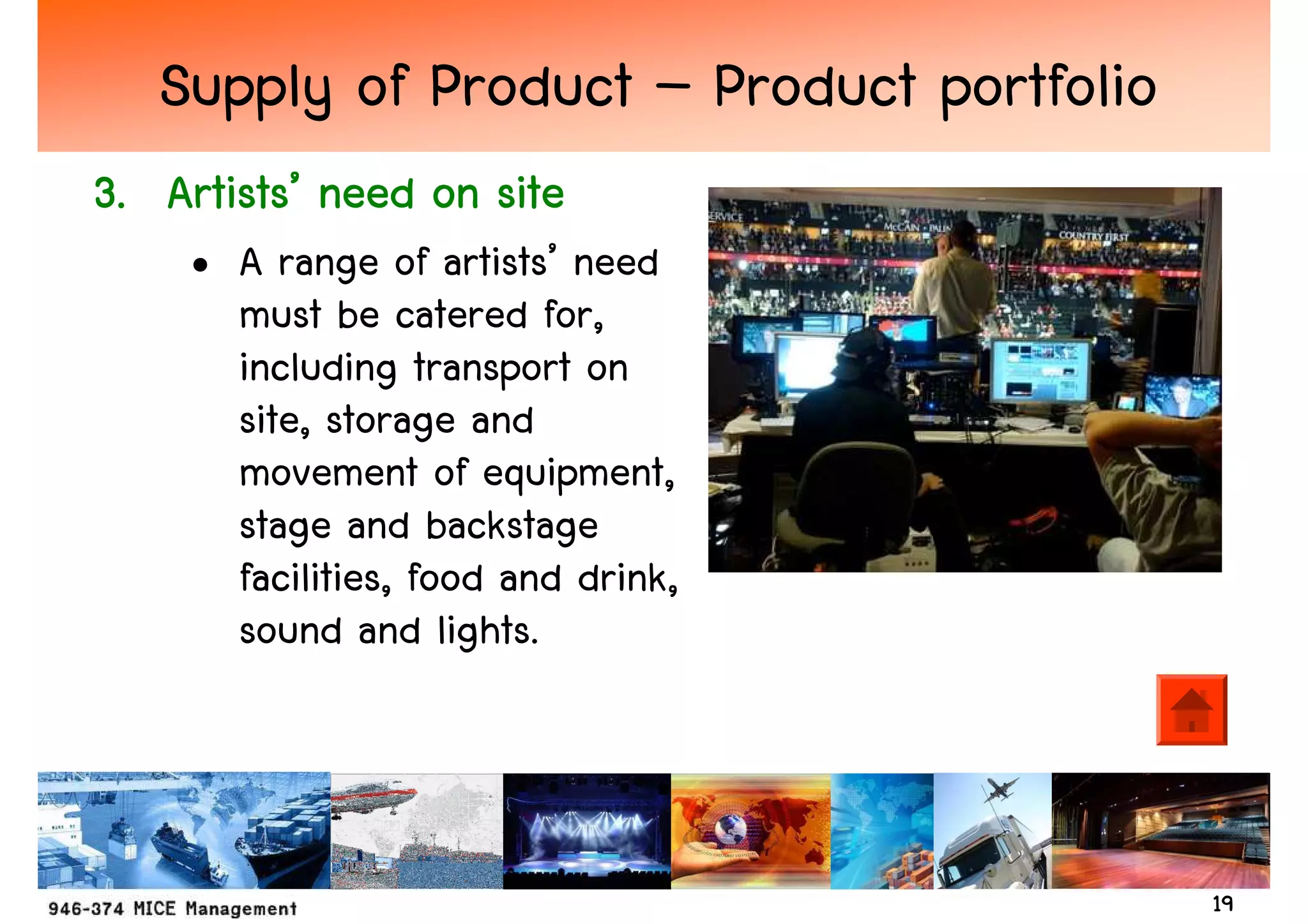
3. Artists’ need on site
    • A range of artists’ need
      must be catered for,
      including transport on
      site, storage and
      movement of equipment,
      stage and backstage
      facilities, food and drink,
      sound and lights.


                                           19
Supply of Facilities


                       20
Supply of Facilities
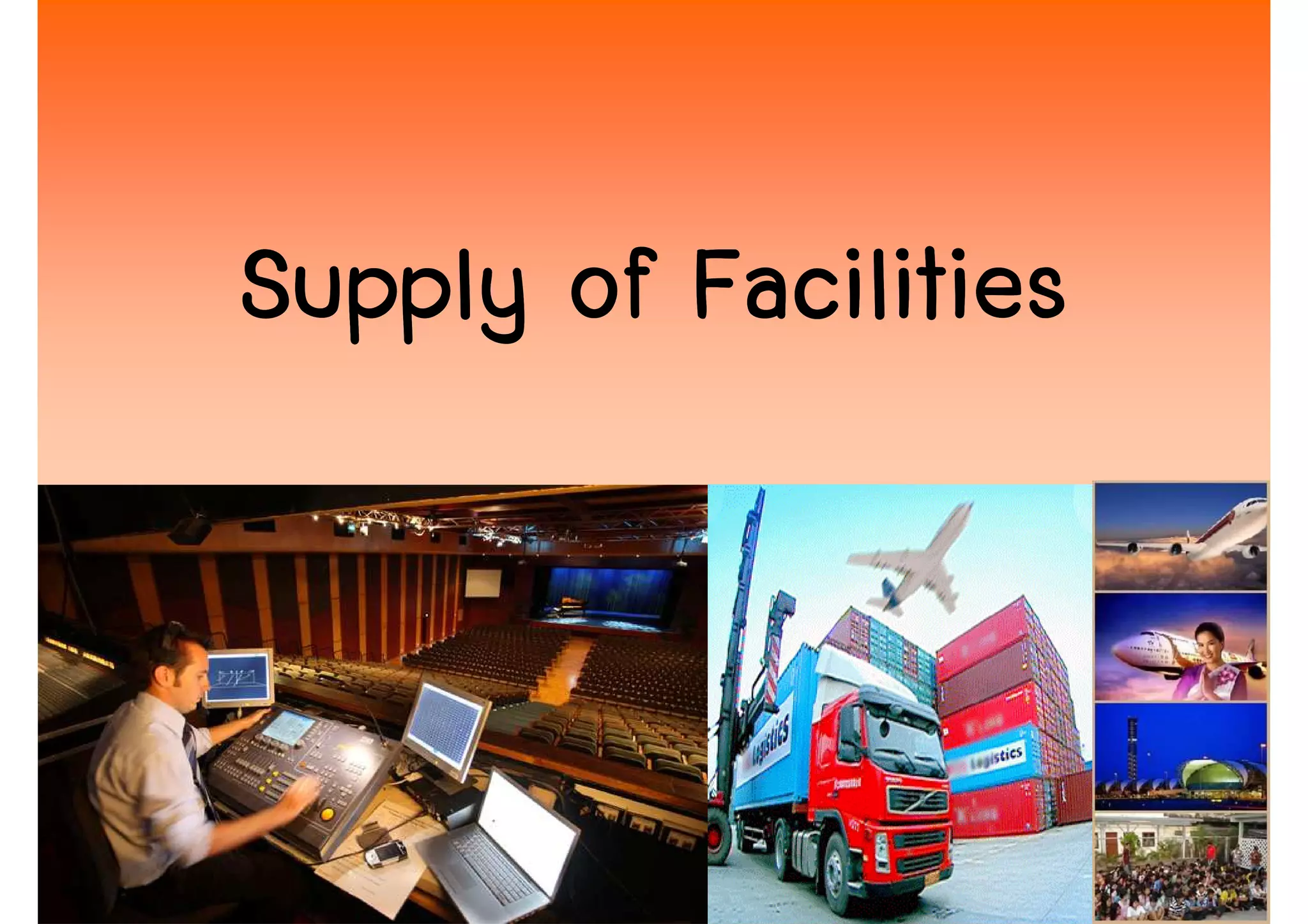
• The supply of the infrastructure to an event site
  introduces many of the concepts of business
  logistics.
• The storage of consumables (F&B) and equipment,
  and the maintenance of equipment become
  particularly significant
• For small event taking place over on evening, the
  venue supplies most of facilities.
• The catering, toilets and power can all be part of
  the hiring of the venue.


                                                       21
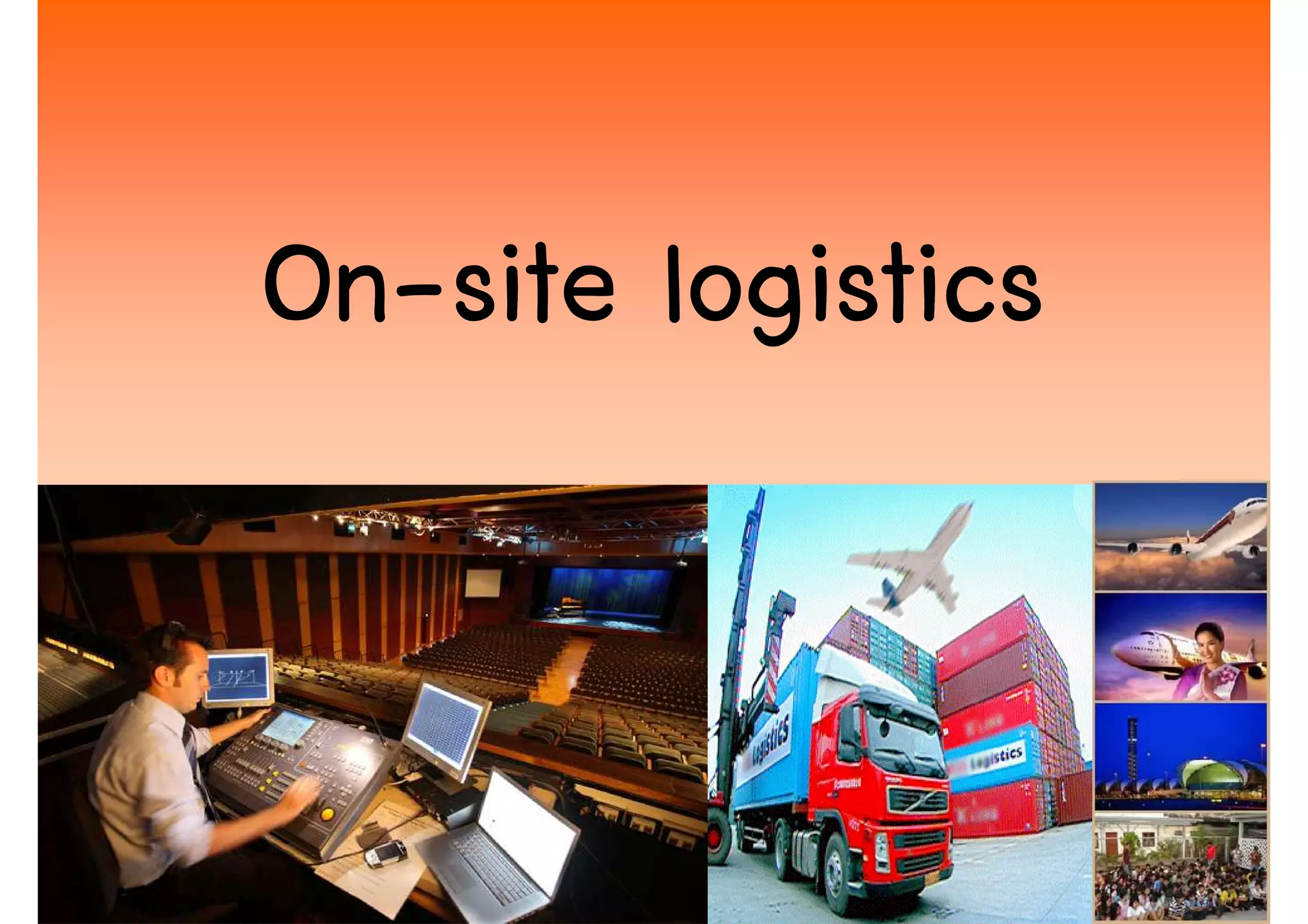
On-
On-site logistics


                    22
On-site logistics
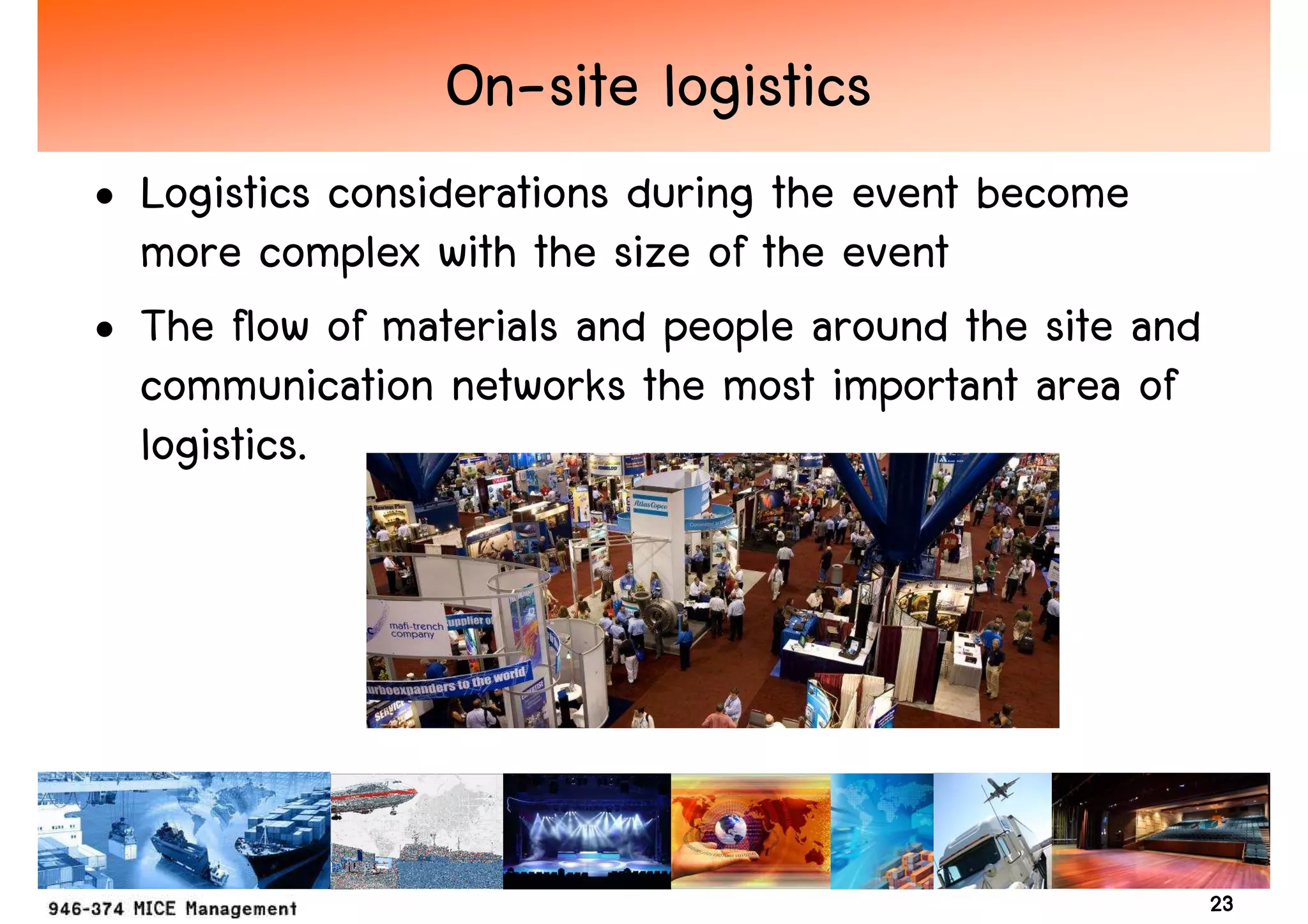
• Logistics considerations during the event become
  more complex with the size of the event
• The flow of materials and people around the site and
  communication networks the most important area of
  logistics.


                                                         23
On-site logistics
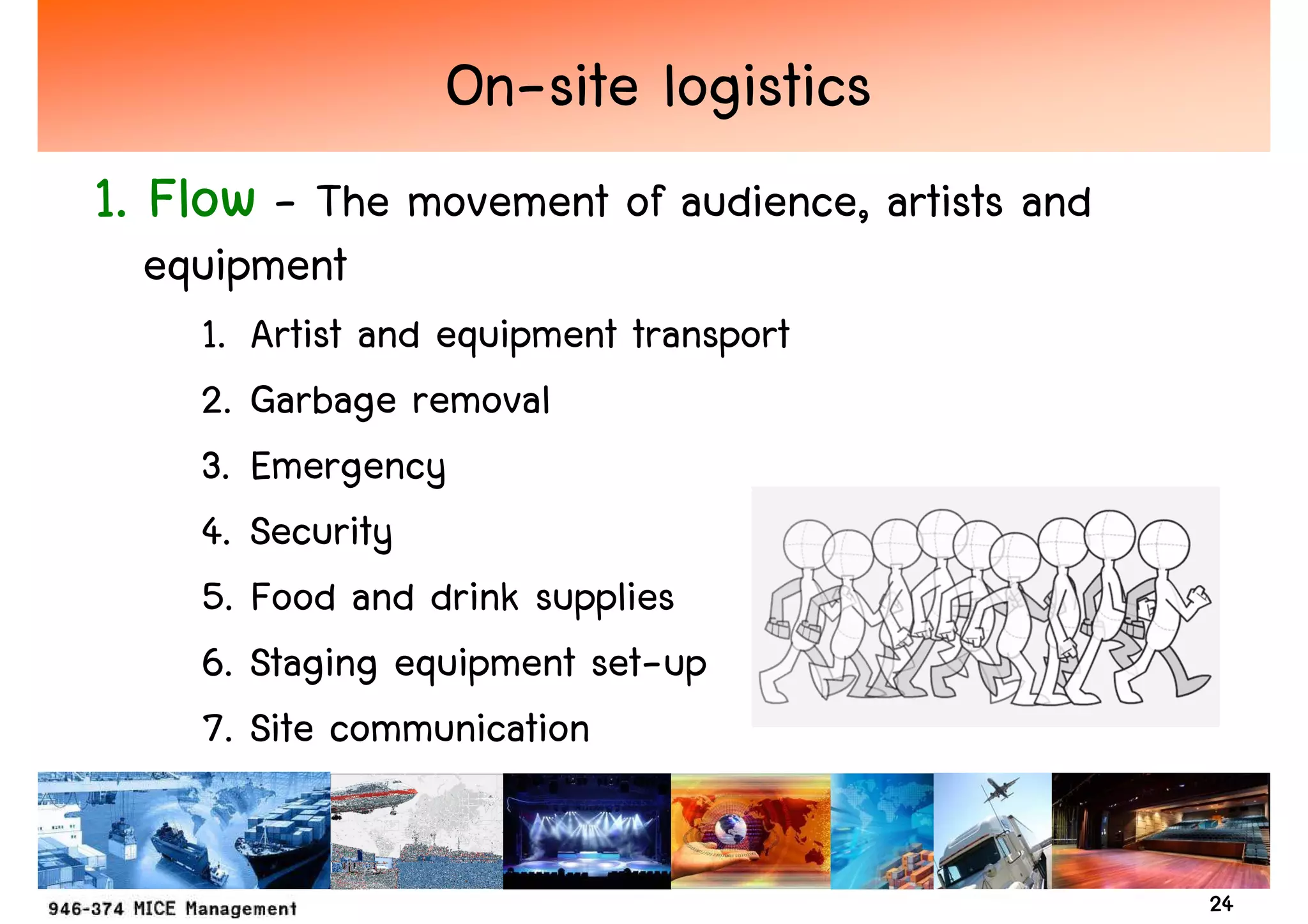
1. Flow - The movement of audience, artists and
  equipment
     1.   Artist and equipment transport
     2.   Garbage removal
     3.   Emergency
     4.   Security
     5.   Food and drink supplies
     6.   Staging equipment set-up
     7.   Site communication


                                                  24
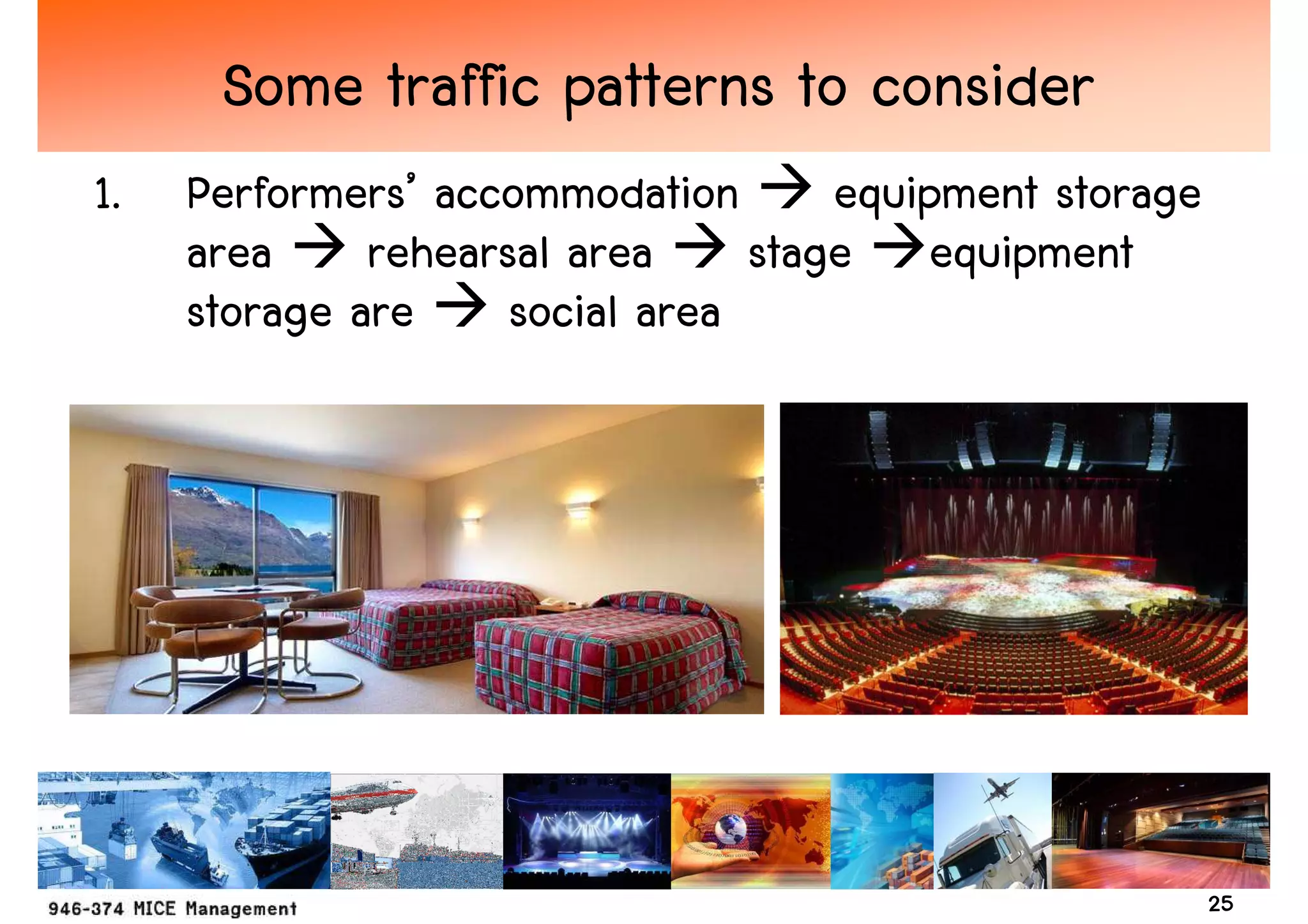
Some traffic patterns to consider
1.   Performers’ accommodation       equipment storage
     area     rehearsal area     stage equipment
     storage are     social area


                                                         25
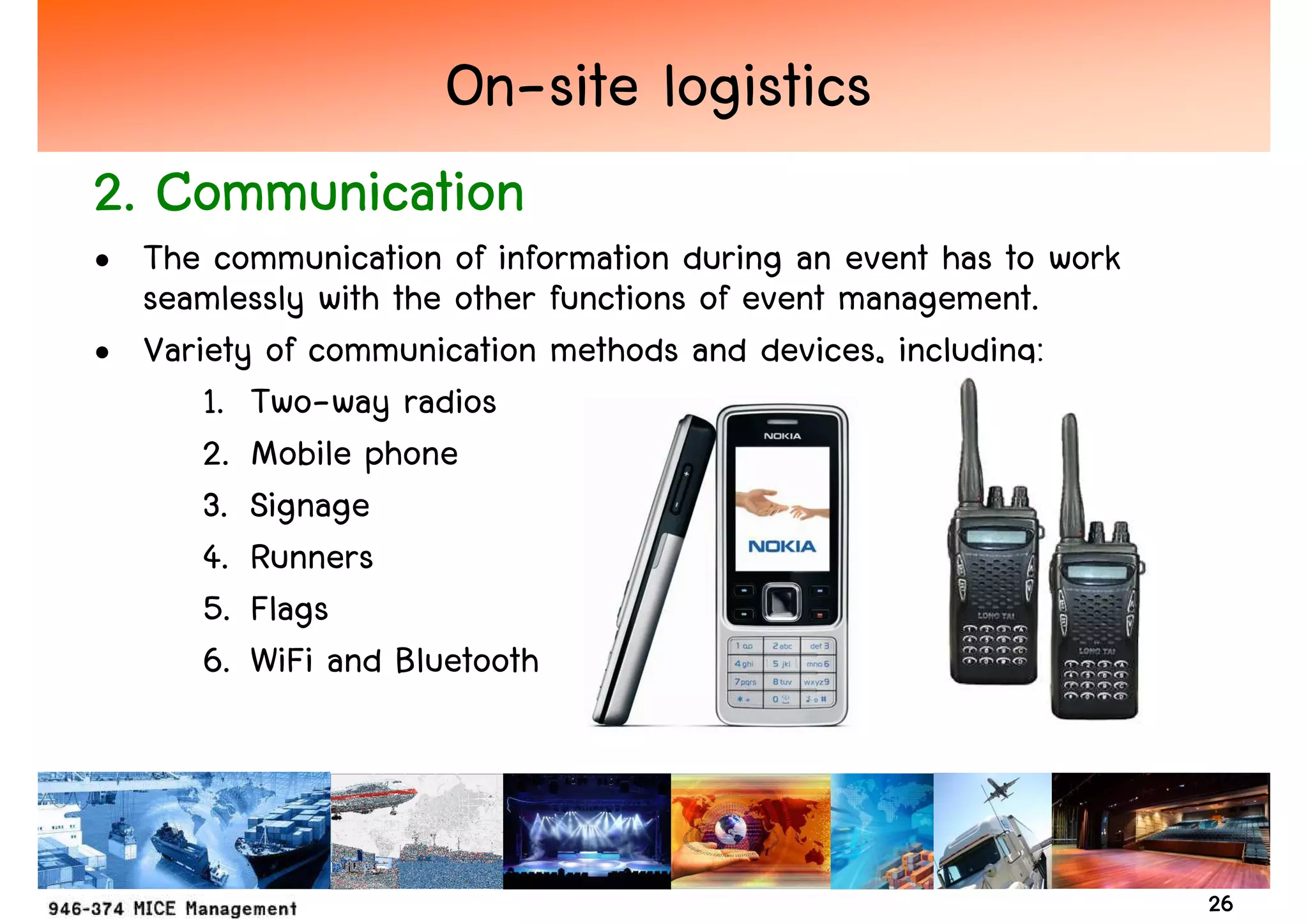
On-site logistics
2. Communication
• The communication of information during an event has to work
  seamlessly with the other functions of event management.
• Variety of communication methods and devices, including:
      1. Two-way radios
      2. Mobile phone
      3. Signage
      4. Runners
      5. Flags
      6. WiFi and Bluetooth


                                                                 26
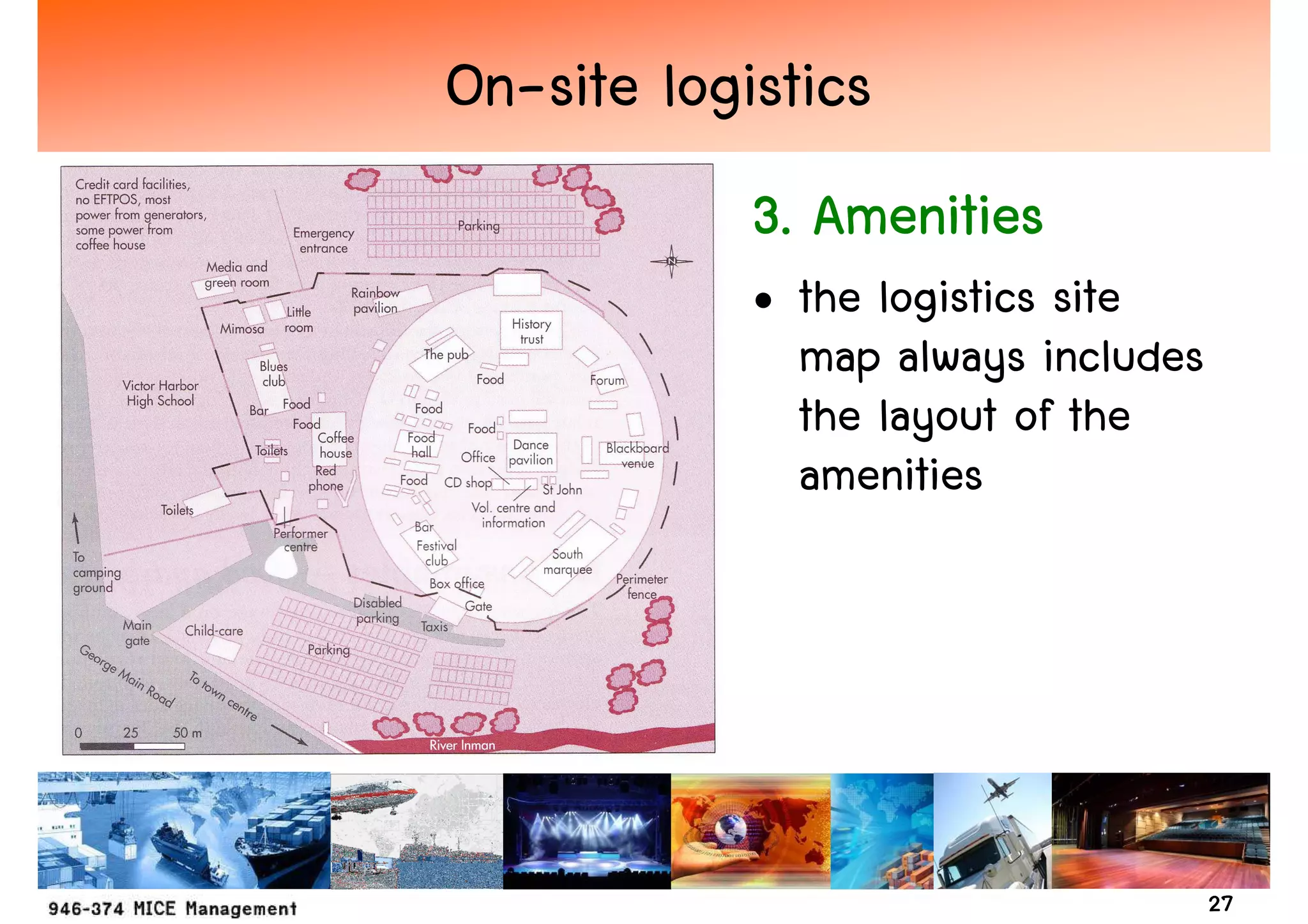
On-site logistics
            3. Amenities
            • the logistics site
              map always includes
              the layout of the
              amenities


                                    27
On-site logistics
4. Consumables – Food and Beverage
 The logistic aspects of food and beverage on a
 large, multi-venue site primarily concern storage
 and distribution
5. VIP and Media requirements
6. Emergency procedures


                                                     28
Shutdown


           29
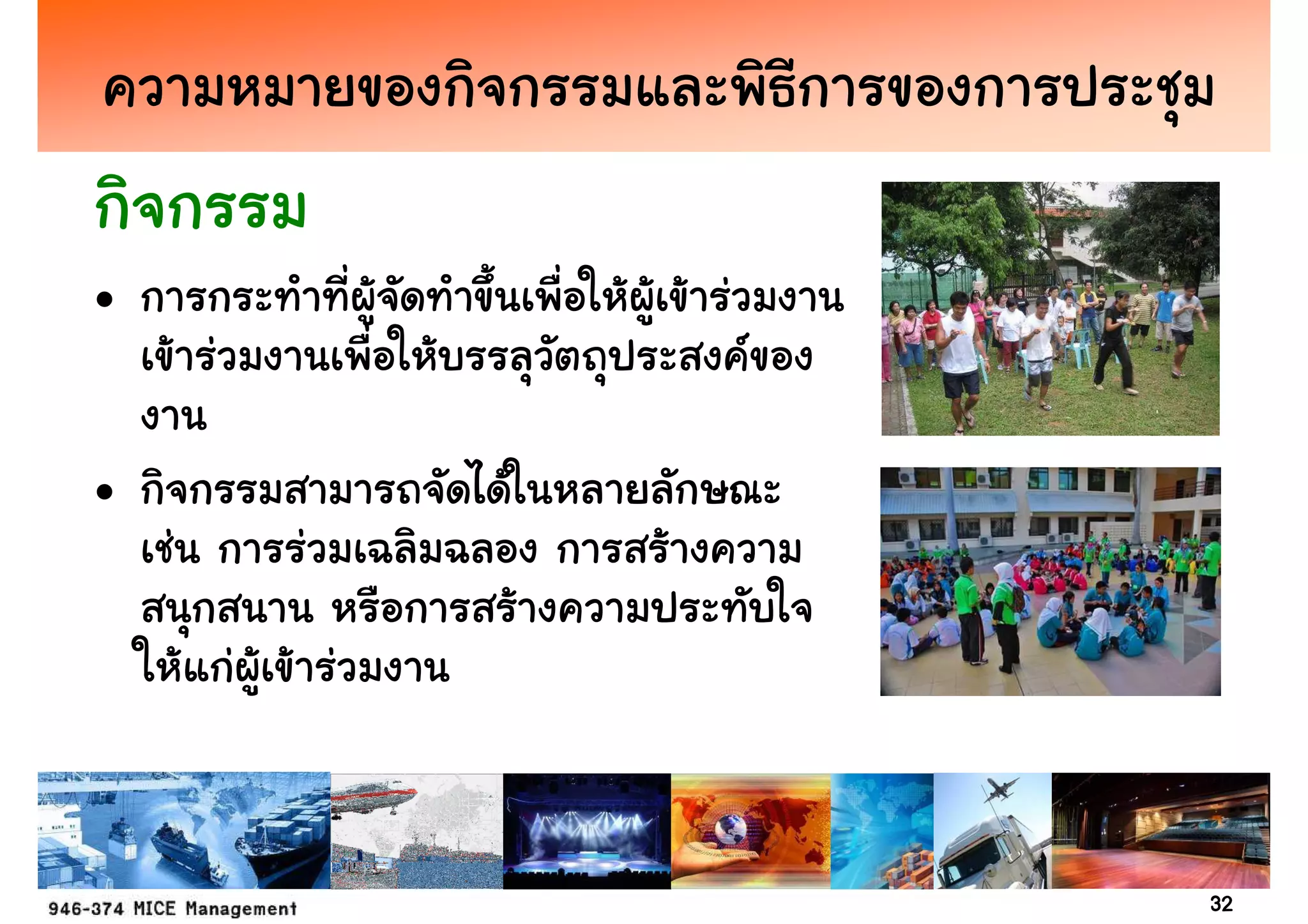
Shutdown
• Shutdown or tare down
  can run quickly and
  smoothly.
• All the subcontractors
  know exactly how to get
  their equipment out, and
  where they are placed
  in the order of removal


                                30
31
•


•


    32
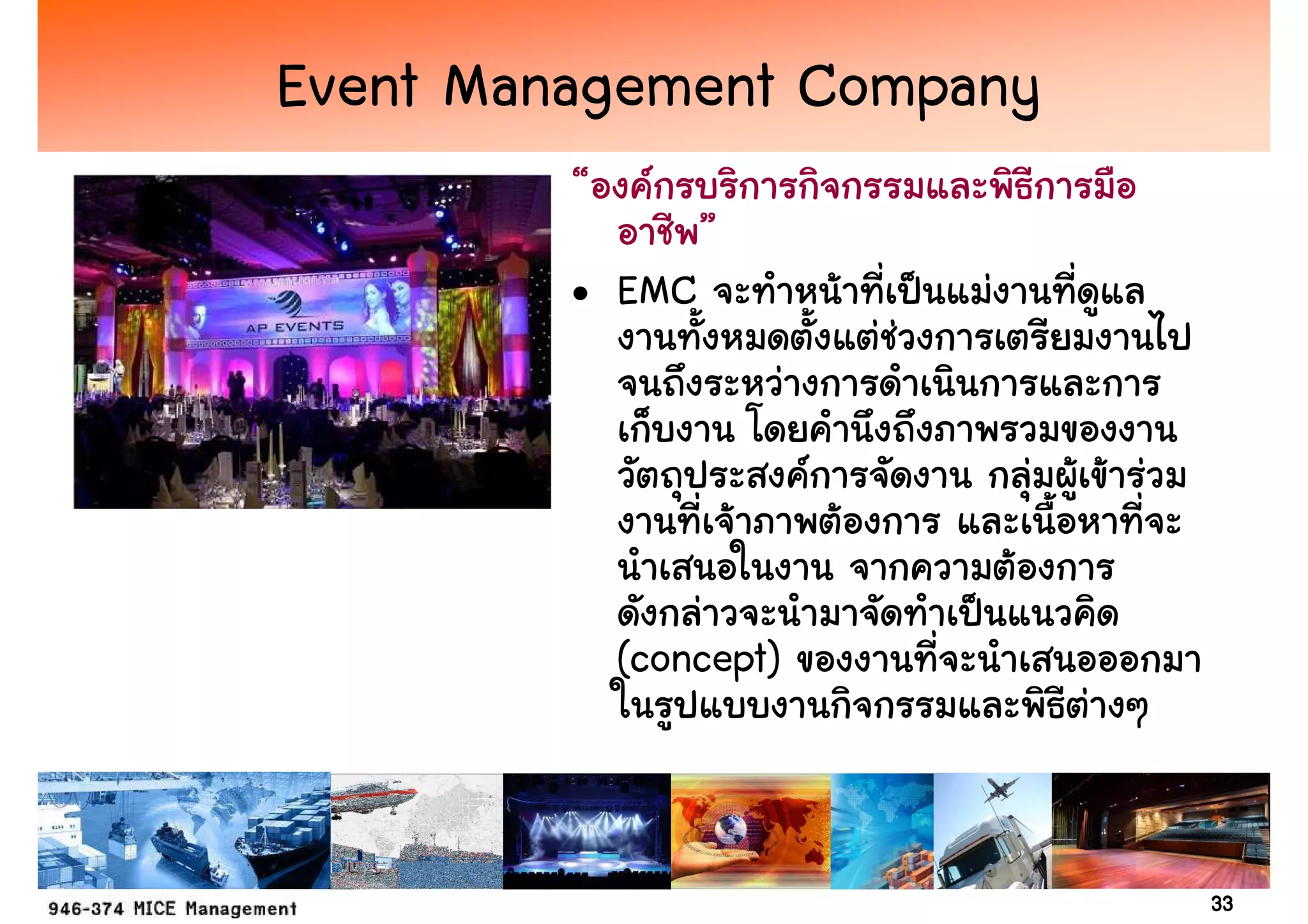
Event Management Company
         “
                 ”
         • EMC


             (concept)


                           33
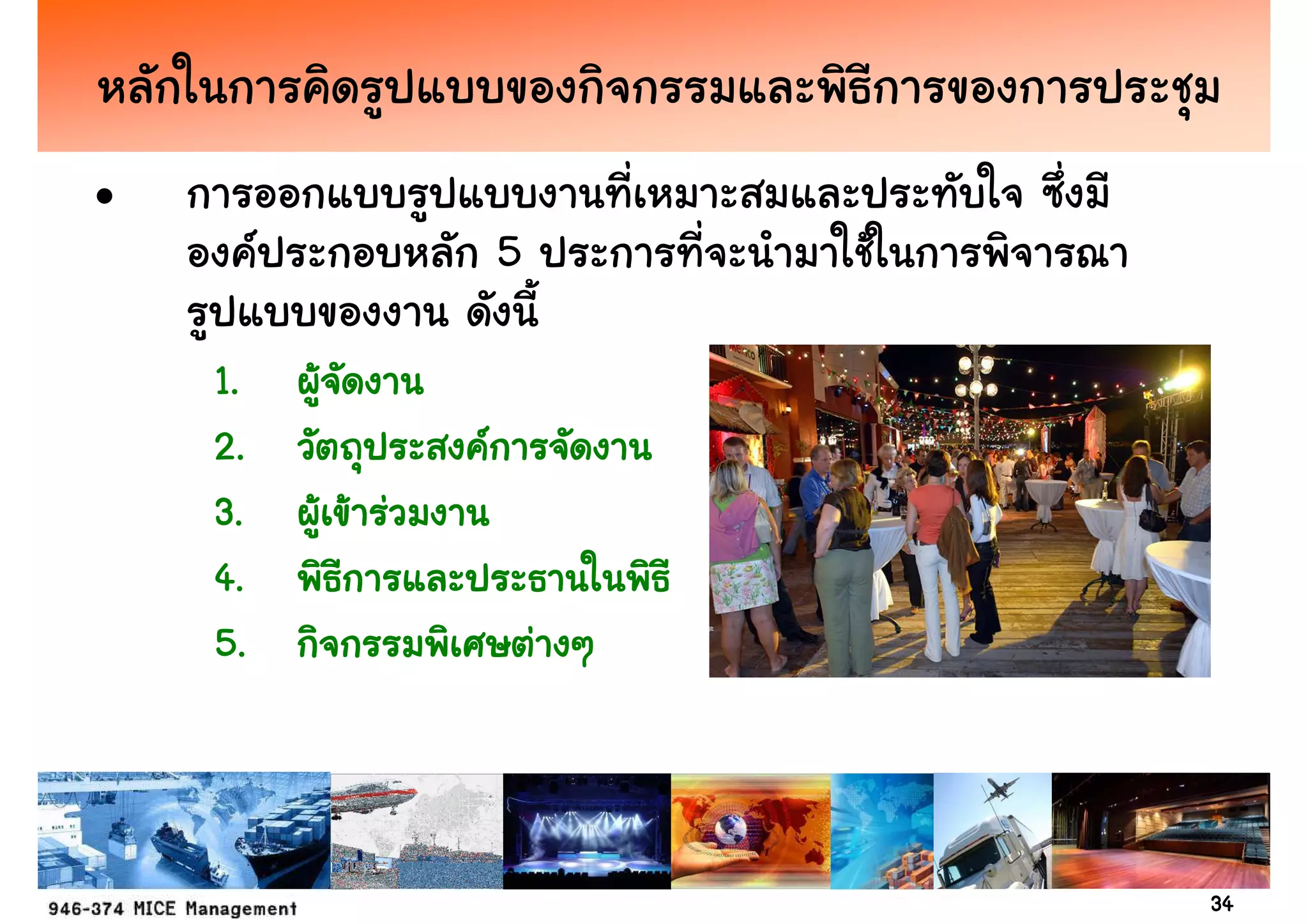
•
         5

    1.
    2.
    3.
    4.
    5.


             34
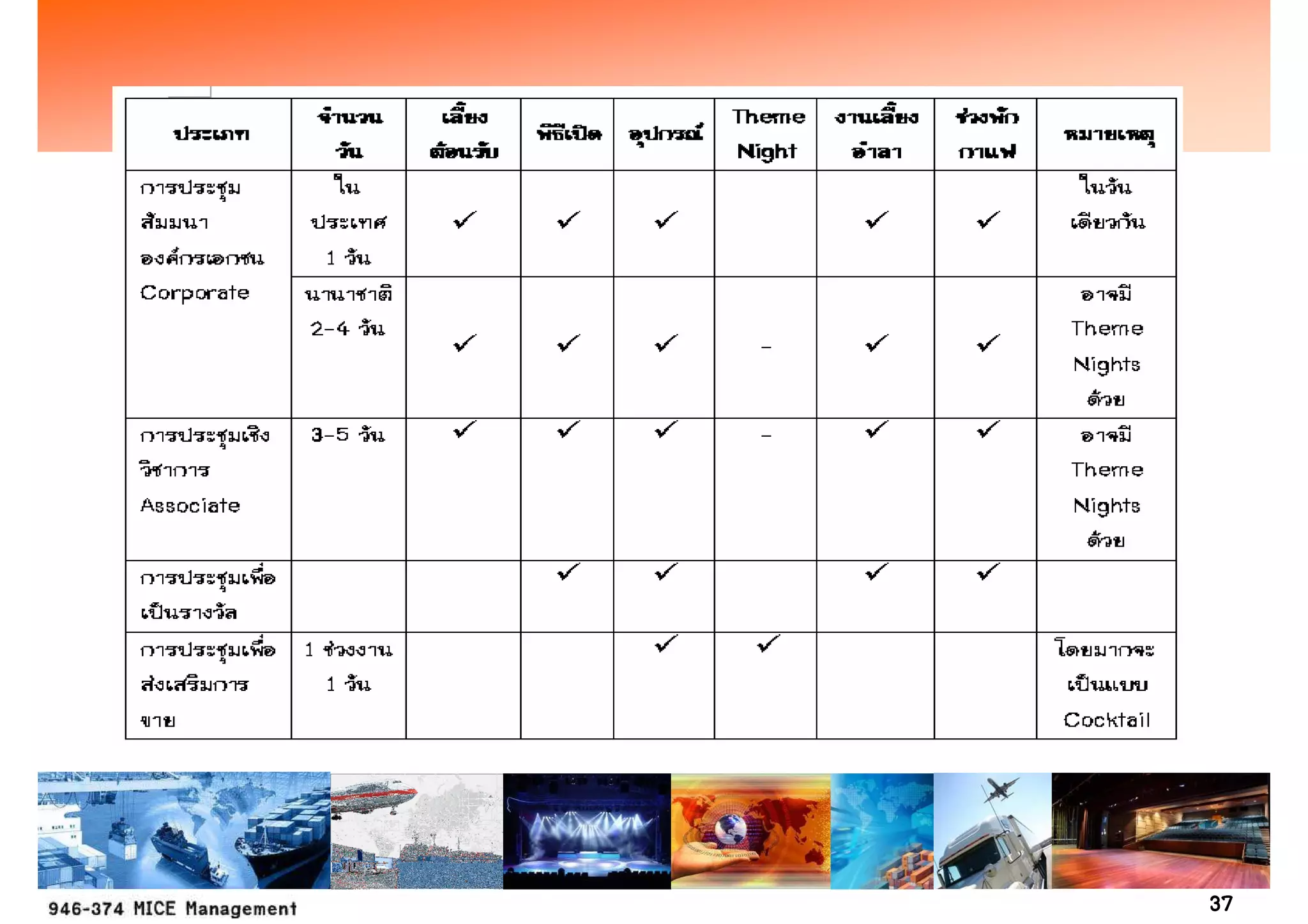
(Types of Event)
1.
   (Corporate Meeting /Convention : Domestic/International)
2.                   (Scientific Convention)
3.                      (Incentive Convention/Motivation
   Convention)
                                                 (Dealers
   Convention     Sales Convention)
4.                           (Promotional Events)
                   (Product       Sales Convention)


                                                              35
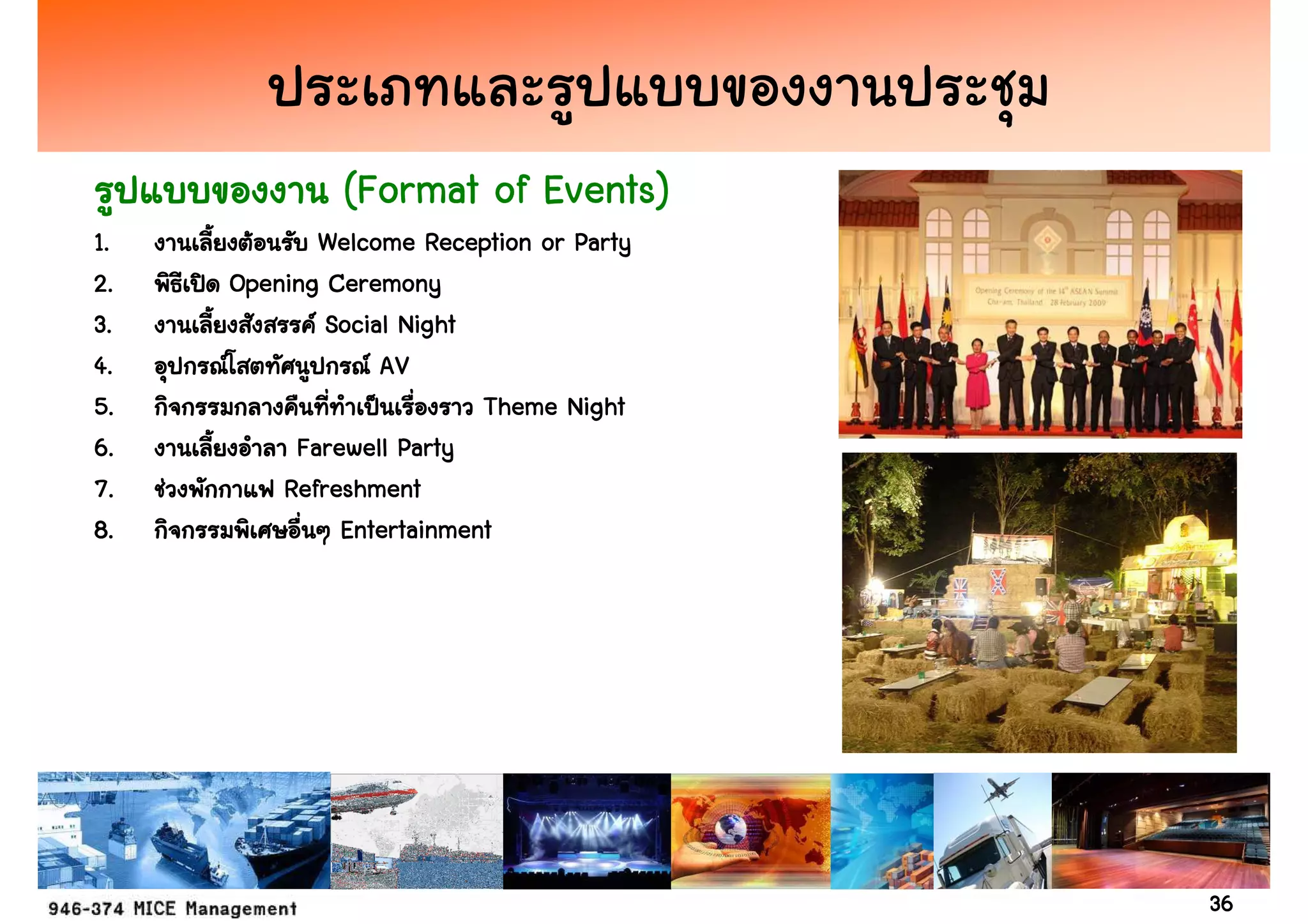
(Format of Events)
1.          Welcome Reception or Party
2.   Opening Ceremony
3.           Social Night
4.                AV
5.                        Theme Night
6.        Farewell Party
7.       Refreshment
8.            Entertainment


                                         36
37
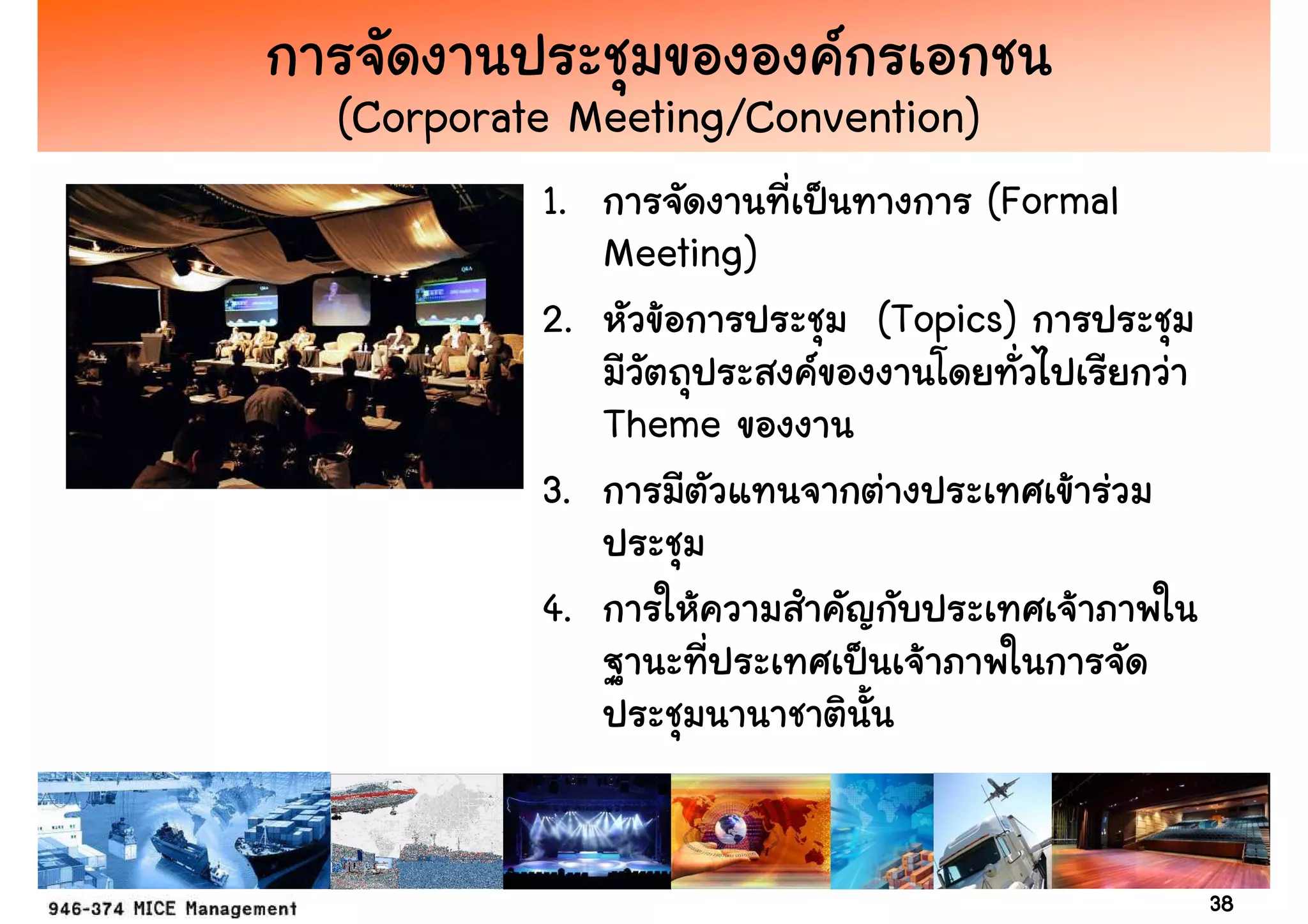
(Corporate Meeting/Convention)
         1.                      (Formal
              Meeting)
         2.              (Topics)
              Theme
         3.

         4.


                                           38
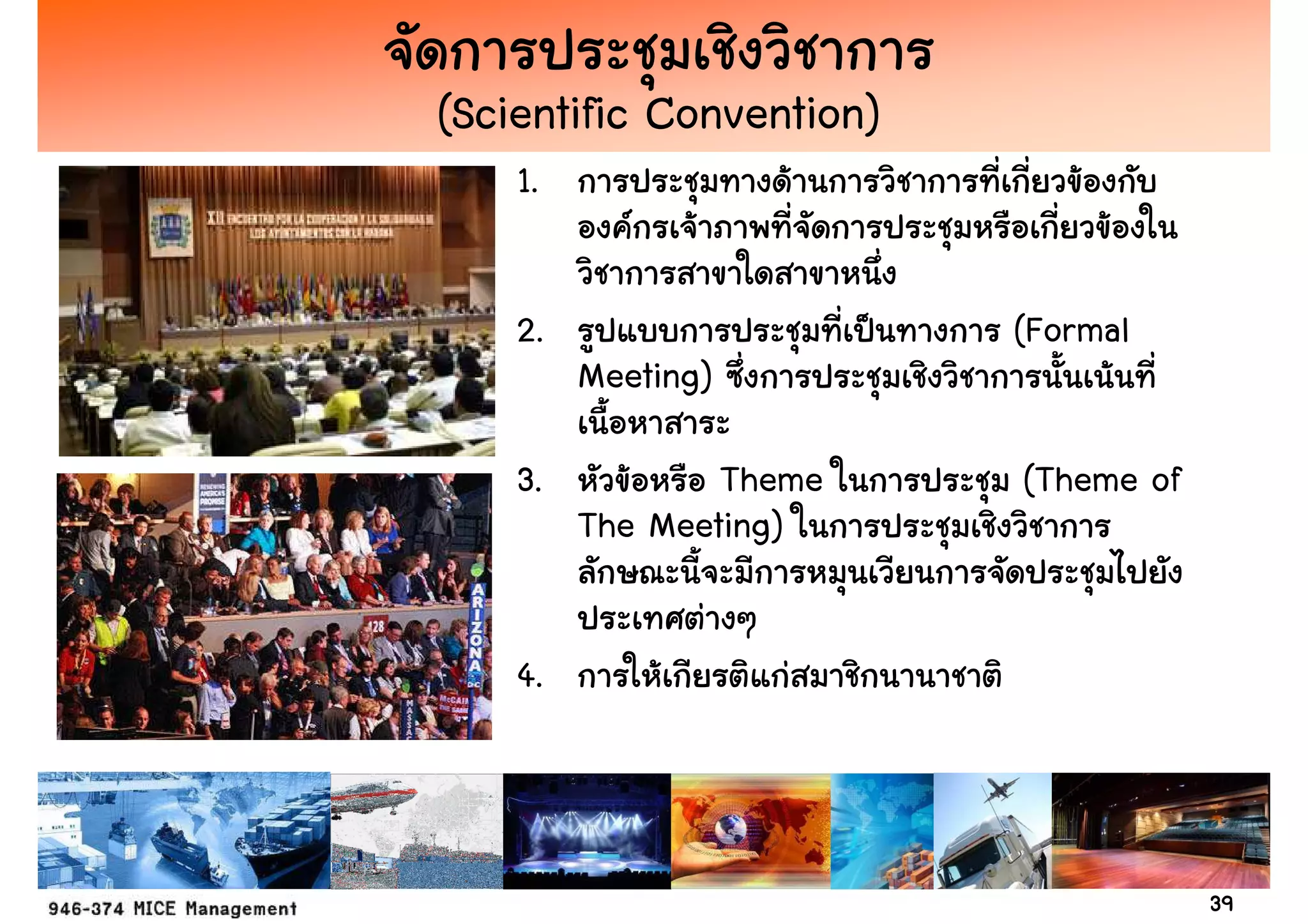
(Scientific Convention)
    1.


    2.                    (Formal
         Meeting)

    3.           Theme    (Theme of
         The Meeting)


    4.


                                      39
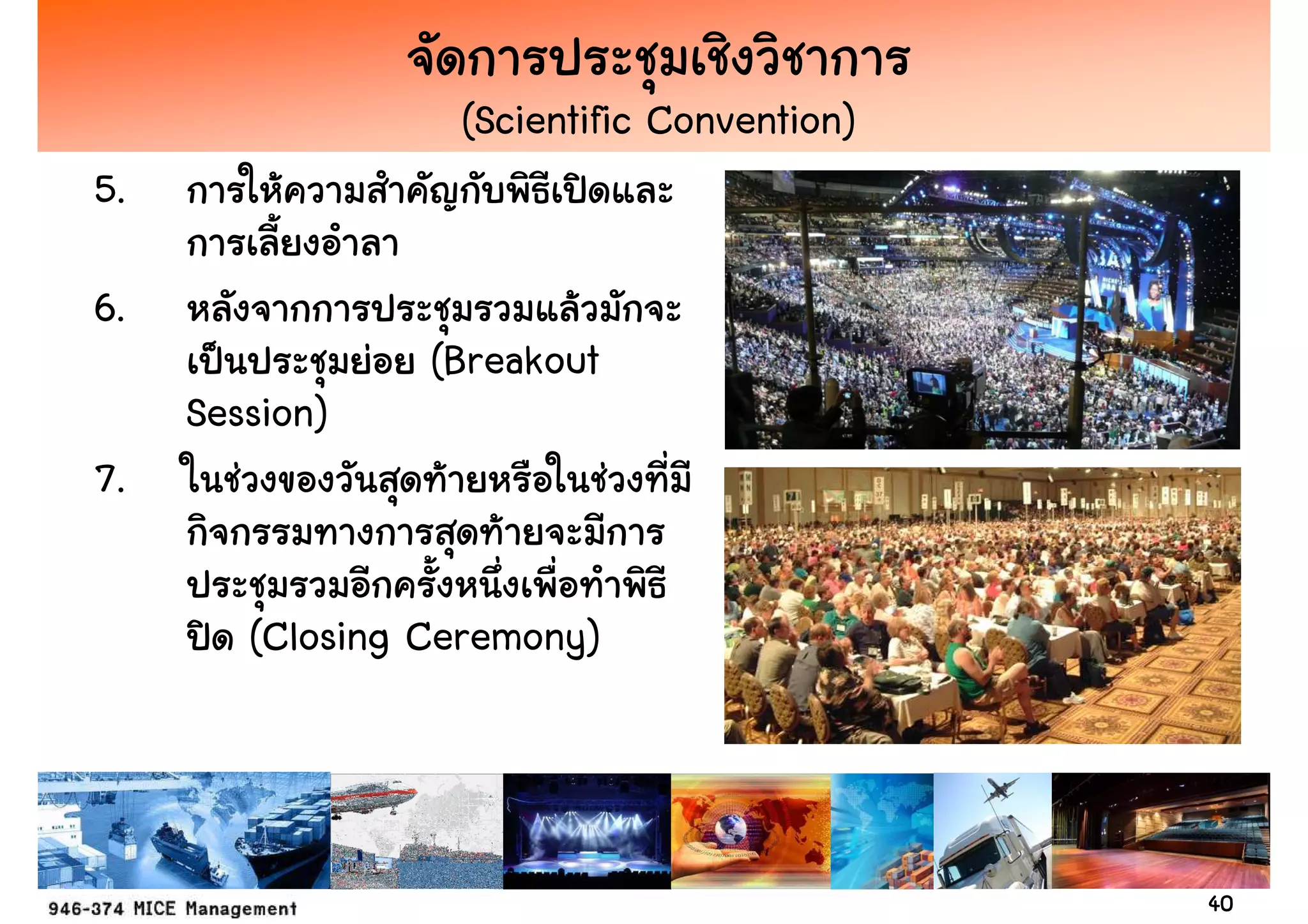
(Scientific Convention)
5.

6.
                 (Breakout
     Session)
7.

        (Closing Ceremony)


                                            40
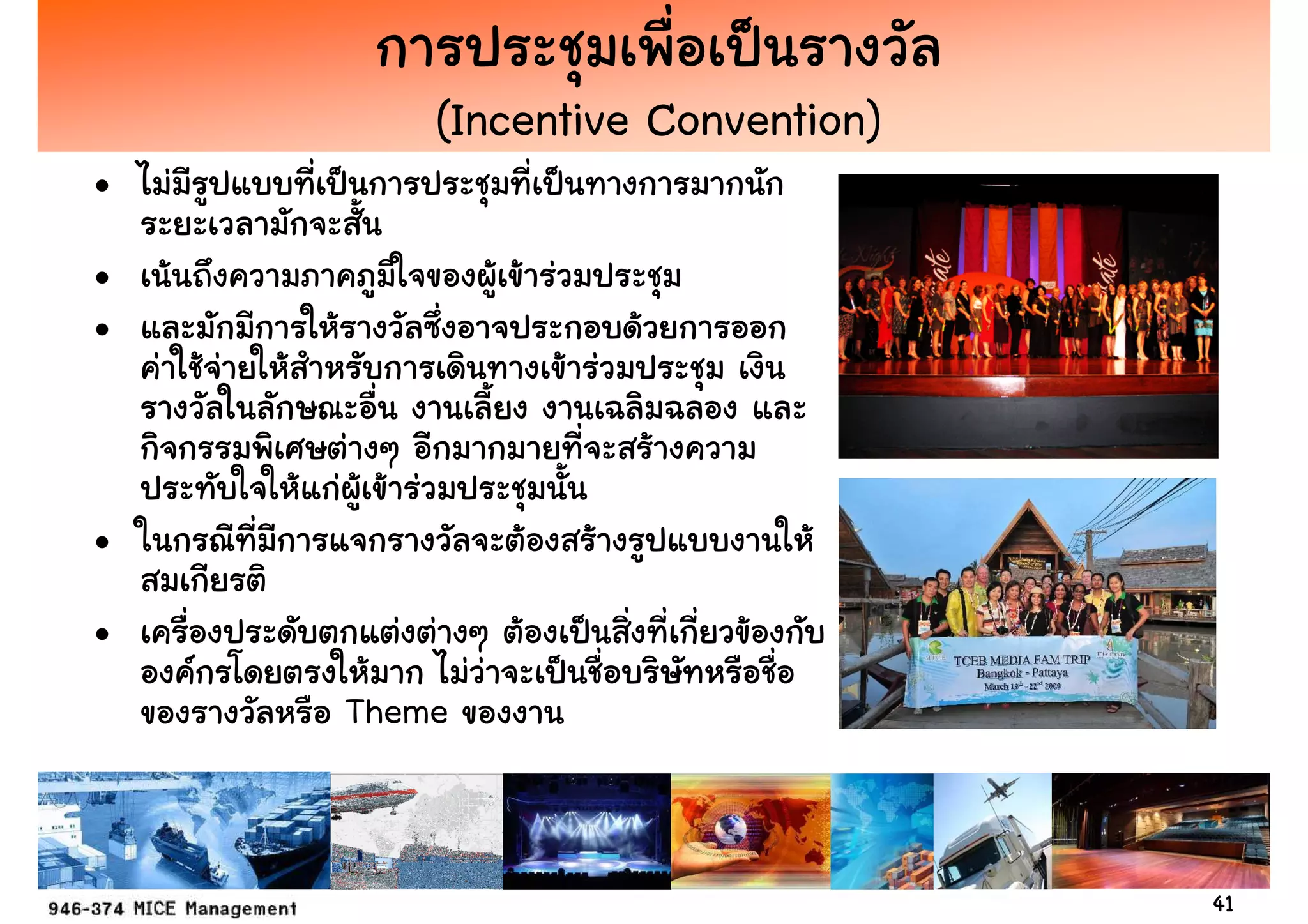
(Incentive Convention)
•
•
•


•
•
    Theme


                                 41
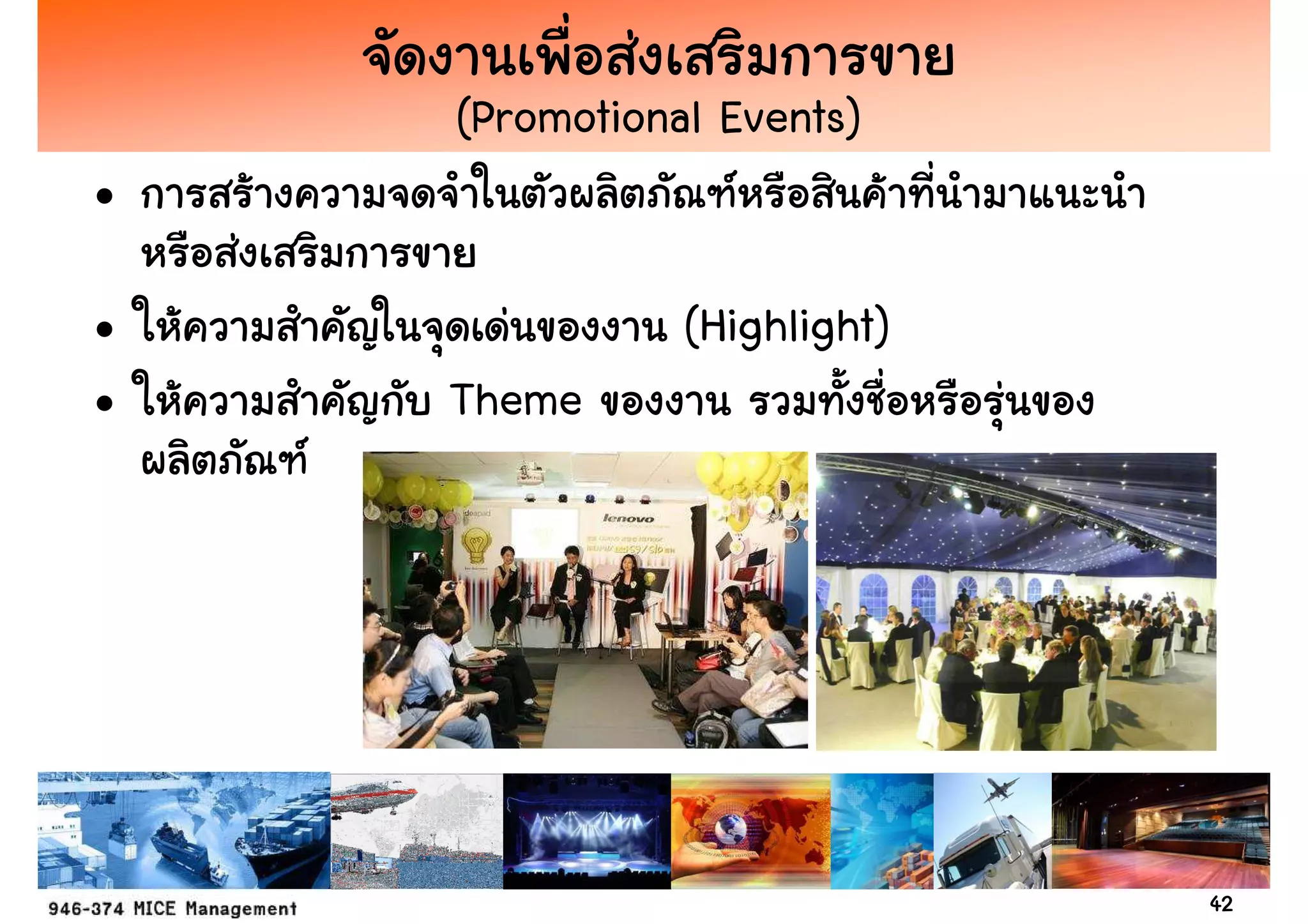
(Promotional Events)
•

•              (Highlight)
•   Theme


                             42
Question and Answer


                      43

Chapter 8 event coordination (logistics and staging)

  • 1.
    Chapter 8 Event Coordination (Logisticand Staging) E-mail: tpavit@hotmail.com 081-082- . 081-082-7273 1
  • 2.
    Objectives 1. Define logisticsmanagement and describe its 2. Understand the concept of logistics management and its place in event management 3. Use event logistics techniques 2
  • 3.
    Outlines 1. The elementof Event logistics 2. Supply Consumer / product / facilities 3. Onsite 4. Shutdown 5. 3
  • 4.
  • 5.
    Logistics • Logistics isthe management of the flow of goods, information and other resources in a repair cycle between the point of origin and the point of consumption in order to meet the requirements of customers. Logistics involves the integration of information, transportation, inventory, warehousing, material handling, and packaging, and occasionally security. • Logistics is a channel of the supply chain which adds the value of time and place utility. Today the complexity of production logistics can be modeled, analyzed, visualized and optimized by plant simulation software. 5
  • 6.
    Logistics • Logistics toevents is the management of event that divided into supply, setting up, and running the event on site, and the shutdown process of the event. • The planning, implementing and control of the flow and storage of products, and the related information from production to the point of consumption, according to consumer requirements. 6
  • 7.
  • 8.
    The Elements ofEvent Logistics • Whereas most logistics theory concerns the supply of products to customers, event logistics includes the efficient supply of the customer to the product, and the supply of facilities to and from the event site. 8
  • 9.
    The Elements ofEvent Logistics Supply of Customers • Marketing • Ticketing EVENT Site Logistics • Queuing • Flow of audience, • Transport artists and equipment around Supply of Product the site Event shutdown • Transport • Communication • Removal • Accommodation • Amenities • Cleaning • Artist needs • Consumables • Contract acquittal • VIP and Media Supply of Facilities requirements • Security • Emergency • Power procedures • Water • Contractors etc. 9
  • 10.
    The Elements ofEvent Logistics • The areas of importance to event logistics can be categorized as follows: 1. Supply – can divided into 3 areas of Customer, Product and facilities. 2. Transport – the transport of goods and services can be major cost to an event and requires special consideration 3. Linking – logistics are part of overall planning of an event and are linked to all other areas. 4. Flow control – refers to the flow of products, services and customers during events. 5. Information networks – the efficient flow of communication is generally a result of efficient planning of the information network. 10
  • 11.
    The Elements ofEvent Logistics • All these areas need to be considered when creating a logistic plan. • A logistic plan must be incorporated in the overall event plan. • Given that the major elements of logistic are supply and movement, logistic play large role in some type of event, including: 11
  • 12.
    The Elements ofEvent Logistics • Event that have a large international component, such as major conferences, sporting events, oversea incentive programs. • Complex events in foreign countries, such as trade exhibition and conferences • Events that occur in remote locations and need most of the supporting resources to the site • Exhibitions of large or complex products, such as cars or agricultural exhibitions 12
  • 13.
  • 14.
    Supply of Customers •The customer of an event are those who pay for it. • The customers have expectations, which include logistical aspects, that have to be met for a successful outcome. • The way in which the event is promoted will particularly influence their expectations 14
  • 15.
    Supply of Customers 1.Links with marketing and promotion 2. Ticketing (Distribution, collection and security) 3. Queuing (tickets, parking, entrance, seating, food and toilets) 4. Customer transports (timing of arrival, public or private transport) 15
  • 16.
  • 17.
    Supply of Product– Product portfolio • Most events have a variety of products and services – a product portfolio – that help to create the event experience for the customer. • The individual logistics requirements of the various products need to be integrated into a logistics plan. • LARGE EVENTS = >200 performing groups • SMALL EVENTS = Speaker and Video material. 17
  • 18.
    Supply of Product– Product portfolio 1. Transport (carnet and customs clearance) • Carnet is a license issued by Customs that allows the movement of goods across an international border. 2. Accommodation • The accommodation requirement of the artists (performers, key note speaker or competitors) must be treated separately from the accommodation of audience. 18
  • 19.
    Supply of Product– Product portfolio Artists’ 3. Artists’ need on site • A range of artists’ need must be catered for, including transport on site, storage and movement of equipment, stage and backstage facilities, food and drink, sound and lights. 19
  • 20.
  • 21.
    Supply of Facilities •The supply of the infrastructure to an event site introduces many of the concepts of business logistics. • The storage of consumables (F&B) and equipment, and the maintenance of equipment become particularly significant • For small event taking place over on evening, the venue supplies most of facilities. • The catering, toilets and power can all be part of the hiring of the venue. 21
  • 22.
  • 23.
    On-site logistics • Logisticsconsiderations during the event become more complex with the size of the event • The flow of materials and people around the site and communication networks the most important area of logistics. 23
  • 24.
    On-site logistics 1. Flow- The movement of audience, artists and equipment 1. Artist and equipment transport 2. Garbage removal 3. Emergency 4. Security 5. Food and drink supplies 6. Staging equipment set-up 7. Site communication 24
  • 25.
    Some traffic patternsto consider 1. Performers’ accommodation equipment storage area rehearsal area stage equipment storage are social area 25
  • 26.
    On-site logistics 2. Communication •The communication of information during an event has to work seamlessly with the other functions of event management. • Variety of communication methods and devices, including: 1. Two-way radios 2. Mobile phone 3. Signage 4. Runners 5. Flags 6. WiFi and Bluetooth 26
  • 27.
    On-site logistics 3. Amenities • the logistics site map always includes the layout of the amenities 27
  • 28.
    On-site logistics 4. Consumables– Food and Beverage The logistic aspects of food and beverage on a large, multi-venue site primarily concern storage and distribution 5. VIP and Media requirements 6. Emergency procedures 28
  • 29.
  • 30.
    Shutdown • Shutdown ortare down can run quickly and smoothly. • All the subcontractors know exactly how to get their equipment out, and where they are placed in the order of removal 30
  • 31.
  • 32.
  • 33.
    Event Management Company “ ” • EMC (concept) 33
  • 34.
    5 1. 2. 3. 4. 5. 34
  • 35.
    (Types of Event) 1. (Corporate Meeting /Convention : Domestic/International) 2. (Scientific Convention) 3. (Incentive Convention/Motivation Convention) (Dealers Convention Sales Convention) 4. (Promotional Events) (Product Sales Convention) 35
  • 36.
    (Format of Events) 1. Welcome Reception or Party 2. Opening Ceremony 3. Social Night 4. AV 5. Theme Night 6. Farewell Party 7. Refreshment 8. Entertainment 36
  • 37.
  • 38.
    (Corporate Meeting/Convention) 1. (Formal Meeting) 2. (Topics) Theme 3. 4. 38
  • 39.
    (Scientific Convention) 1. 2. (Formal Meeting) 3. Theme (Theme of The Meeting) 4. 39
  • 40.
    (Scientific Convention) 5. 6. (Breakout Session) 7. (Closing Ceremony) 40
  • 41.
  • 42.
    (Promotional Events) • • (Highlight) • Theme 42
  • 43.