12
Mg
Magnesium
° Kinetic Molecular Theory
30
Zn
Zinc
Elements and
Compound
The learners shall learn that there are specific
processes for planning, conducting, and recording
scientific
investigations
CONTENT
STANDARD
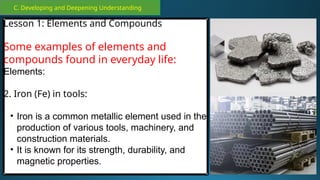
Describe the Particle Model of Matter as “All matter
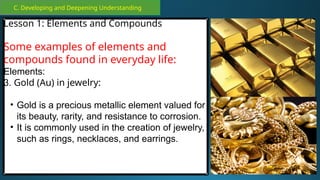
is made up of tiny particles with each pure substance
having its own kind of particles.”; and
LEARNING COMPETENCY
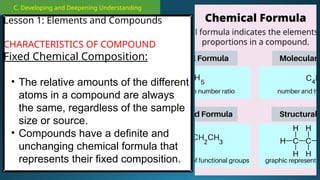
The learners…
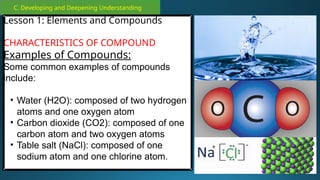
Describe that particles are constantly in motion, have
spaces between them, attract each other, and move
faster as the temperature increases (or with the addition
of heat);
LEARNING COMPETENCY
At the end of the session, 80 percent of the Students are able to :
1.Define the term "pure substance" and the key principles of the Kinetic
Molecular Theory.
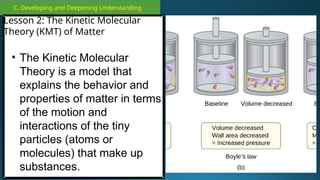
2.Develop an appreciation for the Kinetic Molecular Theory and its ability to
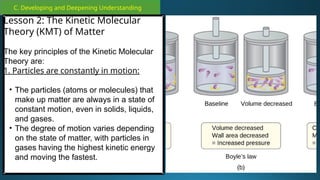
explain the behavior of pure substances by having reflection questions.
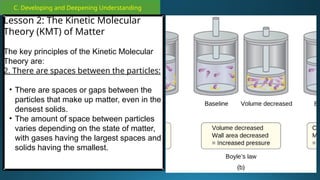
3.Conduct hands-on activities and experiments to observe and illustrate the
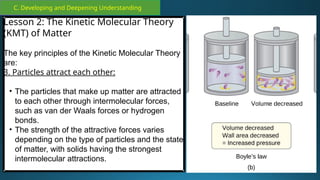
principles of the Kinetic Molecular Theory and its application to pure
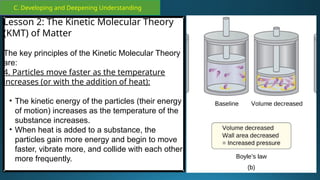
substances.
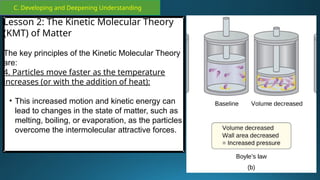
LEARNING
OBJECTIVES
I. Activating Prior Knowledge
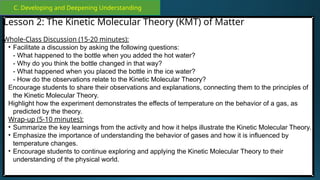
Instructions:
1.Begin the lesson by asking students, "What do you already know
about the different states of matter?“
2.Encourage students to share their ideas and observations about the
states of matter (solid, liquid, gas).
3.Ask students to describe the properties of each state of matter,
such as:
Solids: shape, volume, compressibility
Liquids: shape, volume, compressibility
Gases: shape, volume, compressibility
4. Record the students' responses on the board or a projector,
creating a visual reference.
5. Prompt students to share any experiences or experiments they've
had that demonstrate the differences between the states of matter.
I. Activating Prior Knowledge
"What do you
already know
about the
different states of
I. Activating Prior Knowledge
Share your
thoughts
B. Establishing Purpose of the Lesson
At the end of 45 minutes session, 80 percent of the
Students are able to :
1.Define the term "pure substance" and the key
principles of the Kinetic Molecular Theory.
2.Develop an appreciation for the Kinetic Molecular
Theory and its ability to explain the behavior of pure
substances by having reflection questions.
3.Conduct hands-on activities and experiments to
observe and illustrate the principles of the Kinetic
Molecular Theory and its application to pure
substances.
B. Establishing Purpose of the Lesson
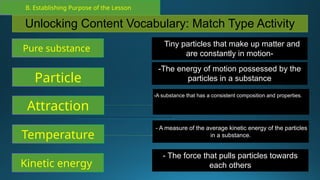
Unlocking Content Vocabulary: Match Type Activity
Particle
Attraction
Temperature
Kinetic energy
-The energy of motion possessed by the
particles in a substance
-A substance that has a consistent composition and properties. of
the container it is in, with particles that can move freely past each
other.
- A measure of the average kinetic energy of the particles
in a substance.
- The force that pulls particles towards
each others
Pure substance
-Tiny particles that make up matter and
are constantly in motion-
C. Developing and Deepening Understanding
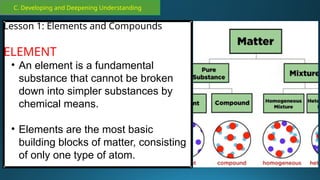
Lesson 1: Elements and Compounds
ELEMENT
• An element is a fundamental
substance that cannot be broken
down into simpler substances by
chemical means.
• Elements are the most basic
building blocks of matter, consisting
of only one type of atom.
C. Developing and Deepening Understanding
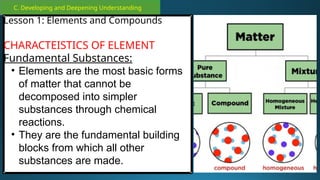
Lesson 1: Elements and Compounds
CHARACTEISTICS OF ELEMENT
Fundamental Substances:
• Elements are the most basic forms
of matter that cannot be
decomposed into simpler
substances through chemical
reactions.
• They are the fundamental building
blocks from which all other
substances are made.
C. Developing and Deepening Understanding
Lesson 1: Elements and Compounds
CHARACTEISTICS OF ELEMENT
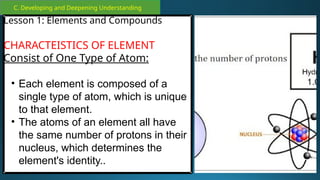
Consist of One Type of Atom:
• Each element is composed of a
single type of atom, which is unique
to that element.
• The atoms of an element all have
the same number of protons in their
nucleus, which determines the
element's identity..
C. Developing and Deepening Understanding
Lesson 1: Elements and Compounds
CHARACTEISTICS OF ELEMENT
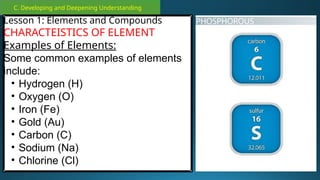
Examples of Elements:
Some common examples of elements
include:
• Hydrogen (H)
• Oxygen (O)
• Iron (Fe)
• Gold (Au)
• Carbon (C)
• Sodium (Na)
• Chlorine (Cl)
C. Developing and Deepening Understanding
Lesson 1: Elements and Compounds
CHARACTEISTICS OF ELEMENT
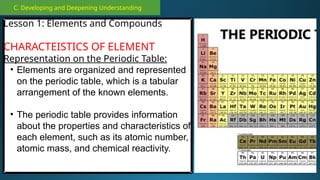
Representation on the Periodic Table:
• Elements are organized and represented
on the periodic table, which is a tabular
arrangement of the known elements.
• The periodic table provides information
about the properties and characteristics of
each element, such as its atomic number,
atomic mass, and chemical reactivity.
C. Developing and Deepening Understanding
Lesson 1: Elements and Compounds
Some examples of elements and
compounds found in everyday life:
Elements:
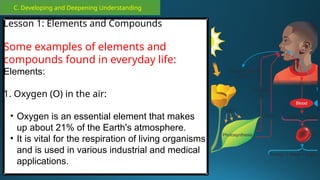
1. Oxygen (O) in the air:
• Oxygen is an essential element that makes
up about 21% of the Earth's atmosphere.
• It is vital for the respiration of living organisms
and is used in various industrial and medical
applications.
C. Developing and Deepening Understanding
Lesson 1: Elements and Compounds
Some examples of elements and
compounds found in everyday life:
Elements:
2. Iron (Fe) in tools:
• Iron is a common metallic element used in the
production of various tools, machinery, and
construction materials.
• It is known for its strength, durability, and
magnetic properties.
C. Developing and Deepening Understanding
Lesson 1: Elements and Compounds
Some examples of elements and
compounds found in everyday life:
Elements:
3. Gold (Au) in jewelry:
• Gold is a precious metallic element valued for
its beauty, rarity, and resistance to corrosion.
• It is commonly used in the creation of jewelry,
such as rings, necklaces, and earrings.
C. Developing and Deepening Understanding
Lesson 1: Elements and Compounds
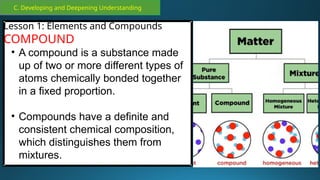
COMPOUND
• A compound is a substance made
up of two or more different types of
atoms chemically bonded together
in a fixed proportion.
• Compounds have a definite and
consistent chemical composition,
which distinguishes them from
mixtures.
C. Developing and Deepening Understanding
Lesson 1: Elements and Compounds
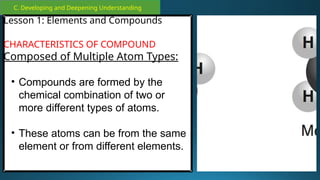
CHARACTERISTICS OF COMPOUND
Composed of Multiple Atom Types:
• Compounds are formed by the
chemical combination of two or
more different types of atoms.
• These atoms can be from the same
element or from different elements.
C. Developing and Deepening Understanding
Lesson 1: Elements and Compounds
CHARACTERISTICS OF COMPOUND
Fixed Chemical Composition:
• The relative amounts of the different
atoms in a compound are always
the same, regardless of the sample
size or source.
• Compounds have a definite and
unchanging chemical formula that
represents their fixed composition.
C. Developing and Deepening Understanding
Lesson 1: Elements and Compounds
CHARACTERISTICS OF COMPOUND
Examples of Compounds:
Some common examples of compounds
include:
• Water (H2O): composed of two hydrogen
atoms and one oxygen atom
• Carbon dioxide (CO2): composed of one
carbon atom and two oxygen atoms
• Table salt (NaCl): composed of one
sodium atom and one chlorine atom.
C. Developing and Deepening Understanding
Lesson 1: Elements and Compounds
Differences between Elements and
Compounds:
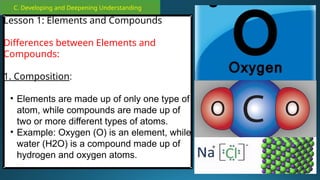
1. Composition:
• Elements are made up of only one type of
atom, while compounds are made up of
two or more different types of atoms.
• Example: Oxygen (O) is an element, while
water (H2O) is a compound made up of
hydrogen and oxygen atoms.
C. Developing and Deepening Understanding
Lesson 1: Elements and Compounds
Differences between Elements and
Compounds:
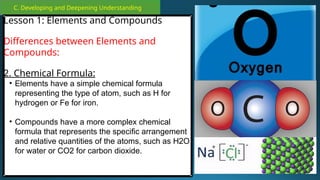
2. Chemical Formula:
• Elements have a simple chemical formula
representing the type of atom, such as H for
hydrogen or Fe for iron.
• Compounds have a more complex chemical
formula that represents the specific arrangement
and relative quantities of the atoms, such as H2O
for water or CO2 for carbon dioxide.
C. Developing and Deepening Understanding
Lesson 1: Elements and Compounds
Differences between Elements and
Compounds:
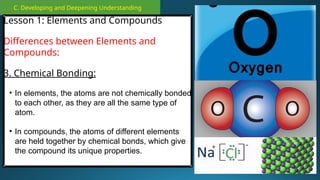
3. Chemical Bonding:
• In elements, the atoms are not chemically bonded
to each other, as they are all the same type of
atom.
• In compounds, the atoms of different elements
are held together by chemical bonds, which give
the compound its unique properties.
C. Developing and Deepening Understanding
Lesson 1: Elements and Compounds
Differences between Elements and
Compounds:
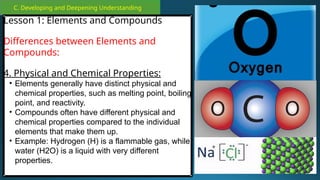
4. Physical and Chemical Properties:
• Elements generally have distinct physical and
chemical properties, such as melting point, boiling
point, and reactivity.
• Compounds often have different physical and
chemical properties compared to the individual
elements that make them up.
• Example: Hydrogen (H) is a flammable gas, while
water (H2O) is a liquid with very different
properties.
C. Developing and Deepening Understanding
Lesson 1: Elements and Compounds
Lesson Activity: Think-Pair-Share
Identifying Elements and Compounds
Objective: Students will be able to distinguish between elements and
compounds, and provide examples of each.
Materials:
• List of various substances (e.g., water, iron, carbon dioxide, oxygen,
table salt, gold)
• Whiteboard or chart paper
C. Developing and Deepening Understanding
Lesson 1: Elements and Compounds
Lesson Activity: Think-Pair-Share
Identifying Elements and Compounds
Instructions:
Think (5-7 minutes):
• Distribute the list of substances to the students.
• Instruct them to individually review the list and identify which items are elements and which are
compounds.
• Ask them to write down their reasoning for their classifications.
Pair (10-12 minutes):
• Divide the students into pairs or small groups.
• Have them discuss their individual classifications and the reasons behind them.
• Encourage the pairs to challenge each other's thinking and reach a consensus on the classification
of each substance.
C. Developing and Deepening Understanding
Lesson 1: Elements and Compounds
Lesson Activity: Think-Pair-Share
Identifying Elements and Compounds
Share (15-20 minutes):
• Invite the pairs to share their classifications and reasoning with the whole class.
• As each pair presents, write the substances they identified as elements and compounds on the
whiteboard or chart paper.
• Facilitate a discussion, allowing other students to ask questions or provide additional insights.
• Clarify any misconceptions or misunderstandings that arise during the discussion.
Wrap-up (5-7 minutes):
• Summarize the key differences between elements and compounds, referring to the examples
discussed.
• Emphasize the importance of understanding the characteristics of elements and compounds and
how they differ.
• Encourage students to continue exploring and identifying elements and compounds in their everyday
lives.
C. Developing and Deepening Understanding
Lesson 2: The Kinetic Molecular
Theory (KMT) of Matter
• The Kinetic Molecular
Theory is a model that
explains the behavior and
properties of matter in terms
of the motion and
interactions of the tiny
particles (atoms or
molecules) that make up
substances.
C. Developing and Deepening Understanding
Lesson 2: The Kinetic Molecular
Theory (KMT) of Matter
The key principles of the Kinetic Molecular
Theory are:
1. Particles are constantly in motion:
• The particles (atoms or molecules) that
make up matter are always in a state of
constant motion, even in solids, liquids,
and gases.
• The degree of motion varies depending
on the state of matter, with particles in
gases having the highest kinetic energy
and moving the fastest.
C. Developing and Deepening Understanding
Lesson 2: The Kinetic Molecular
Theory (KMT) of Matter
The key principles of the Kinetic Molecular
Theory are:
2. There are spaces between the particles:
• There are spaces or gaps between the
particles that make up matter, even in the
densest solids.
• The amount of space between particles
varies depending on the state of matter,
with gases having the largest spaces and
solids having the smallest.
C. Developing and Deepening Understanding
Lesson 2: The Kinetic Molecular Theory
(KMT) of Matter
The key principles of the Kinetic Molecular Theory
are:
3. Particles attract each other:
• The particles that make up matter are attracted
to each other through intermolecular forces,
such as van der Waals forces or hydrogen
bonds.
• The strength of the attractive forces varies
depending on the type of particles and the state
of matter, with solids having the strongest
intermolecular attractions.
C. Developing and Deepening Understanding
Lesson 2: The Kinetic Molecular Theory
(KMT) of Matter
The key principles of the Kinetic Molecular Theory
are:
4. Particles move faster as the temperature
increases (or with the addition of heat):
• The kinetic energy of the particles (their energy
of motion) increases as the temperature of the
substance increases.
• When heat is added to a substance, the
particles gain more energy and begin to move
faster, vibrate more, and collide with each other
more frequently.
C. Developing and Deepening Understanding
Lesson 2: The Kinetic Molecular Theory
(KMT) of Matter
The key principles of the Kinetic Molecular Theory
are:
4. Particles move faster as the temperature
increases (or with the addition of heat):
• This increased motion and kinetic energy can
lead to changes in the state of matter, such as
melting, boiling, or evaporation, as the particles
overcome the intermolecular attractive forces.
C. Developing and Deepening Understanding
Lesson 2: The Kinetic Molecular Theory (KMT) of Matter
Activity: Observing the Expansion of Gases
Objective: Students will observe the behavior of a gas and how it is
affected by changes in temperature, relating their observations to the
principles of the Kinetic Molecular Theory.
Materials:
• Empty plastic bottle with a cap
• Hot water
• Ice water
C. Developing and Deepening Understanding
Lesson 2: The Kinetic Molecular Theory (KMT) of Matter
Introduction (5-10 minutes):
• Begin by reminding students of the key principles of the Kinetic Molecular Theory,
particularly the idea that particles move faster as temperature increases.
• Explain that they will be conducting an experiment to observe the behavior of a gas
and how it is affected by changes in temperature.
Experiment (20-25 minutes):
• Divide the students into pairs or small groups and distribute the materials.
• Instruct the students to follow these steps:
• Fill the plastic bottle about halfway with hot water and quickly cap it.
• Observe the bottle and note any changes in its appearance or behavior.
• Carefully remove the cap and place the bottle in the ice water.
• Observe the bottle again and note any changes.
C. Developing and Deepening Understanding
Lesson 2: The Kinetic Molecular Theory (KMT) of Matter
Whole-Class Discussion (15-20 minutes):
• Facilitate a discussion by asking the following questions:
- What happened to the bottle when you added the hot water?
- Why do you think the bottle changed in that way?
- What happened when you placed the bottle in the ice water?
- How do the observations relate to the Kinetic Molecular Theory?
Encourage students to share their observations and explanations, connecting them to the principles of
the Kinetic Molecular Theory.
Highlight how the experiment demonstrates the effects of temperature on the behavior of a gas, as
predicted by the theory.
Wrap-up (5-10 minutes):
• Summarize the key learnings from the activity and how it helps illustrate the Kinetic Molecular Theory.
• Emphasize the importance of understanding the behavior of gases and how it is influenced by
temperature changes.
• Encourage students to continue exploring and applying the Kinetic Molecular Theory to their
understanding of the physical world.
D. MAKING GENERALIZATION
1.Learners’ Takeaways
• Describe the key difference between an element and a
compound in terms of their composition and particles.
• How do particles behave in terms of their motion,
spacing, and the relationship between temperature
and particle speed as described by the KMT?
D. MAKING GENERALIZATION
1.Reflection on Learning
Ask students the question:
• How can the Kinetic Molecular Theory be used to
explain the changes in the state of a substance, such
as the melting of ice or the boiling of water?"
E. EVALUATING LEARNING
__________1. An unknown white substance is heated
and produced white smoke and black solid. What
do you think is this substance?
a) a mixture
a.an element
b.a compound
d) a diatomic molecule
E. EVALUATING LEARNING
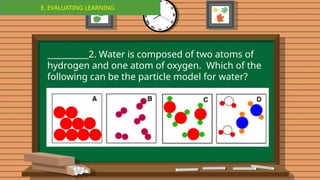
__________2. Water is composed of two atoms of
hydrogen and one atom of oxygen. Which of the
following can be the particle model for water?
E. EVALUATING LEARNING
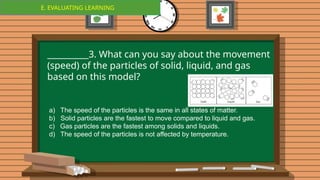
__________3. What can you say about the movement
(speed) of the particles of solid, liquid, and gas
based on this model?
a) The speed of the particles is the same in all states of matter.
b) Solid particles are the fastest to move compared to liquid and gas.
c) Gas particles are the fastest among solids and liquids.
d) The speed of the particles is not affected by temperature.
E. EVALUATING LEARNING
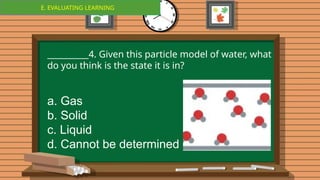
__________4. Given this particle model of water, what
do you think is the state it is in?
a. Gas
b. Solid
c. Liquid
d. Cannot be determined
E. EVALUATING LEARNING
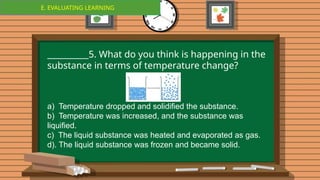
__________5. What do you think is happening in the
substance in terms of temperature change?
a) Temperature dropped and solidified the substance.
b) Temperature was increased, and the substance was
liquified.
c) The liquid substance was heated and evaporated as gas.
d). The liquid substance was frozen and became solid.
E. EVALUATING LEARNING
__________6. How did the Kinetic Molecular Theory
describe the particles of a solid?
a) Only vibrating in place.
b) Completely still and packed together.
c) Constantly moving with large spaces between
them.
d) Constantly moving with very small spaces
between them.
E. EVALUATING LEARNING
__________7. What is the movement of the particles
in a gas?
a) Not moving at all.
b) Moving very slowly and tightly packed together.
c) Moving rapidly with large spaces between them.
d) Moving very slowly with large spaces between
them.
E. EVALUATING LEARNING
__________8. Which has a direct relationship with
temperature?
a) Size of its particles.
b) Shape of its particles.
c) Type of intermolecular forces present.
d) Average kinetic energy (speed) of its particles.
E. EVALUATING LEARNING
__________9. In the "Personal Space" mini-activity,
how did the space between students
change as they went from solid to liquid to gas?
a) It decreased slightly.
b) It remained the same.
c) It increased significantly.
d) It completely disappeared.
E. EVALUATING LEARNING
__________10. The "Particle Dance Party" mini-
activity demonstrated the relationship
between temperature and particle motion
according to KMT. As the music
got faster, the particles (students) moved:
a) Faster.
b) Slower.
c) The same.
d) Erratically.
E. EVALUATING LEARNING
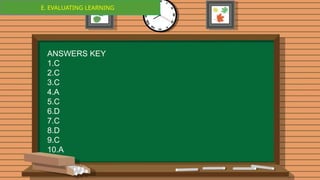
ANSWERS KEY
1.C
2.C
3.C
4.A
5.C
6.D
7.C
8.D
9.C
10.A
References:
• SCIENCE 7 LESSON EXEMPLAR
Textbooks:
• Chemistry: The Central Science by Theodore L. Brown, H. Eugene LeMay, and Bruce E. Bursten
• Chemistry by Raymond Chang and Kenneth A. Goldsby
• Physical Science by Tillery, Enger, and Ross
Online Resources:
• "Kinetic Molecular Theory" from Khan Academy (https://www.khanacademy.org/science/chemistry/states-and-properties-of-matter/kinetic-molecular-theory/
a/kinetic-molecular-theory)
• "States of Matter and Intermolecular Forces" from Crash Course Chemistry (https://www.youtube.com/watch?v=RaoEz6HaM0M)
• "Pure Substances and Mixtures" from the Royal Society of Chemistry (https://edu.rsc.org/resources/pure-substances-and-mixtures/1268.article)
• Scientific Articles:
• "The Kinetic Molecular Theory of Gases" by John Dalton (1803)
• "The Molecular Theory of Gases" by James Clerk Maxwell (1860)
• "The Kinetic Theory of Gases" by Ludwig Boltzmann (1872)
• Educational Websites:
• "Kintic Molecular Theory" from the PhET Interactive Simulations (https://phet.colorado.edu/en/simulation/legacy/gas-properties)
• "Pure Substances and Mixtures" from the American Chemical Society (https://www.acs.org/content/acs/en/education/resources/highschool/chemmatters/
past-issues/archive-2015-2016/pure-substances-and-mixtures.html)
• "States of Matter" from the Science Learning Hub (https://www.sciencelearn.org.nz/resources/2572-states-of-matter)

Elements and Compound Grade 7 Science .pptx

  • 1.
    12 Mg Magnesium ° Kinetic MolecularTheory 30 Zn Zinc Elements and Compound
  • 2.
    The learners shalllearn that there are specific processes for planning, conducting, and recording scientific investigations CONTENT STANDARD Describe the Particle Model of Matter as “All matter is made up of tiny particles with each pure substance having its own kind of particles.”; and LEARNING COMPETENCY The learners… Describe that particles are constantly in motion, have spaces between them, attract each other, and move faster as the temperature increases (or with the addition of heat); LEARNING COMPETENCY
  • 3.
    At the endof the session, 80 percent of the Students are able to : 1.Define the term "pure substance" and the key principles of the Kinetic Molecular Theory. 2.Develop an appreciation for the Kinetic Molecular Theory and its ability to explain the behavior of pure substances by having reflection questions. 3.Conduct hands-on activities and experiments to observe and illustrate the principles of the Kinetic Molecular Theory and its application to pure substances. LEARNING OBJECTIVES
  • 4.
    I. Activating PriorKnowledge Instructions: 1.Begin the lesson by asking students, "What do you already know about the different states of matter?“ 2.Encourage students to share their ideas and observations about the states of matter (solid, liquid, gas). 3.Ask students to describe the properties of each state of matter, such as: Solids: shape, volume, compressibility Liquids: shape, volume, compressibility Gases: shape, volume, compressibility 4. Record the students' responses on the board or a projector, creating a visual reference. 5. Prompt students to share any experiences or experiments they've had that demonstrate the differences between the states of matter.
  • 5.
    I. Activating PriorKnowledge "What do you already know about the different states of
  • 6.
    I. Activating PriorKnowledge Share your thoughts
  • 7.
    B. Establishing Purposeof the Lesson At the end of 45 minutes session, 80 percent of the Students are able to : 1.Define the term "pure substance" and the key principles of the Kinetic Molecular Theory. 2.Develop an appreciation for the Kinetic Molecular Theory and its ability to explain the behavior of pure substances by having reflection questions. 3.Conduct hands-on activities and experiments to observe and illustrate the principles of the Kinetic Molecular Theory and its application to pure substances.
  • 8.
    B. Establishing Purposeof the Lesson Unlocking Content Vocabulary: Match Type Activity Particle Attraction Temperature Kinetic energy -The energy of motion possessed by the particles in a substance -A substance that has a consistent composition and properties. of the container it is in, with particles that can move freely past each other. - A measure of the average kinetic energy of the particles in a substance. - The force that pulls particles towards each others Pure substance -Tiny particles that make up matter and are constantly in motion-
  • 9.
    C. Developing andDeepening Understanding Lesson 1: Elements and Compounds ELEMENT • An element is a fundamental substance that cannot be broken down into simpler substances by chemical means. • Elements are the most basic building blocks of matter, consisting of only one type of atom.
  • 10.
    C. Developing andDeepening Understanding Lesson 1: Elements and Compounds CHARACTEISTICS OF ELEMENT Fundamental Substances: • Elements are the most basic forms of matter that cannot be decomposed into simpler substances through chemical reactions. • They are the fundamental building blocks from which all other substances are made.
  • 11.
    C. Developing andDeepening Understanding Lesson 1: Elements and Compounds CHARACTEISTICS OF ELEMENT Consist of One Type of Atom: • Each element is composed of a single type of atom, which is unique to that element. • The atoms of an element all have the same number of protons in their nucleus, which determines the element's identity..
  • 12.
    C. Developing andDeepening Understanding Lesson 1: Elements and Compounds CHARACTEISTICS OF ELEMENT Examples of Elements: Some common examples of elements include: • Hydrogen (H) • Oxygen (O) • Iron (Fe) • Gold (Au) • Carbon (C) • Sodium (Na) • Chlorine (Cl)
  • 13.
    C. Developing andDeepening Understanding Lesson 1: Elements and Compounds CHARACTEISTICS OF ELEMENT Representation on the Periodic Table: • Elements are organized and represented on the periodic table, which is a tabular arrangement of the known elements. • The periodic table provides information about the properties and characteristics of each element, such as its atomic number, atomic mass, and chemical reactivity.
  • 14.
    C. Developing andDeepening Understanding Lesson 1: Elements and Compounds Some examples of elements and compounds found in everyday life: Elements: 1. Oxygen (O) in the air: • Oxygen is an essential element that makes up about 21% of the Earth's atmosphere. • It is vital for the respiration of living organisms and is used in various industrial and medical applications.
  • 15.
    C. Developing andDeepening Understanding Lesson 1: Elements and Compounds Some examples of elements and compounds found in everyday life: Elements: 2. Iron (Fe) in tools: • Iron is a common metallic element used in the production of various tools, machinery, and construction materials. • It is known for its strength, durability, and magnetic properties.
  • 16.
    C. Developing andDeepening Understanding Lesson 1: Elements and Compounds Some examples of elements and compounds found in everyday life: Elements: 3. Gold (Au) in jewelry: • Gold is a precious metallic element valued for its beauty, rarity, and resistance to corrosion. • It is commonly used in the creation of jewelry, such as rings, necklaces, and earrings.
  • 17.
    C. Developing andDeepening Understanding Lesson 1: Elements and Compounds COMPOUND • A compound is a substance made up of two or more different types of atoms chemically bonded together in a fixed proportion. • Compounds have a definite and consistent chemical composition, which distinguishes them from mixtures.
  • 18.
    C. Developing andDeepening Understanding Lesson 1: Elements and Compounds CHARACTERISTICS OF COMPOUND Composed of Multiple Atom Types: • Compounds are formed by the chemical combination of two or more different types of atoms. • These atoms can be from the same element or from different elements.
  • 19.
    C. Developing andDeepening Understanding Lesson 1: Elements and Compounds CHARACTERISTICS OF COMPOUND Fixed Chemical Composition: • The relative amounts of the different atoms in a compound are always the same, regardless of the sample size or source. • Compounds have a definite and unchanging chemical formula that represents their fixed composition.
  • 20.
    C. Developing andDeepening Understanding Lesson 1: Elements and Compounds CHARACTERISTICS OF COMPOUND Examples of Compounds: Some common examples of compounds include: • Water (H2O): composed of two hydrogen atoms and one oxygen atom • Carbon dioxide (CO2): composed of one carbon atom and two oxygen atoms • Table salt (NaCl): composed of one sodium atom and one chlorine atom.
  • 21.
    C. Developing andDeepening Understanding Lesson 1: Elements and Compounds Differences between Elements and Compounds: 1. Composition: • Elements are made up of only one type of atom, while compounds are made up of two or more different types of atoms. • Example: Oxygen (O) is an element, while water (H2O) is a compound made up of hydrogen and oxygen atoms.
  • 22.
    C. Developing andDeepening Understanding Lesson 1: Elements and Compounds Differences between Elements and Compounds: 2. Chemical Formula: • Elements have a simple chemical formula representing the type of atom, such as H for hydrogen or Fe for iron. • Compounds have a more complex chemical formula that represents the specific arrangement and relative quantities of the atoms, such as H2O for water or CO2 for carbon dioxide.
  • 23.
    C. Developing andDeepening Understanding Lesson 1: Elements and Compounds Differences between Elements and Compounds: 3. Chemical Bonding: • In elements, the atoms are not chemically bonded to each other, as they are all the same type of atom. • In compounds, the atoms of different elements are held together by chemical bonds, which give the compound its unique properties.
  • 24.
    C. Developing andDeepening Understanding Lesson 1: Elements and Compounds Differences between Elements and Compounds: 4. Physical and Chemical Properties: • Elements generally have distinct physical and chemical properties, such as melting point, boiling point, and reactivity. • Compounds often have different physical and chemical properties compared to the individual elements that make them up. • Example: Hydrogen (H) is a flammable gas, while water (H2O) is a liquid with very different properties.
  • 25.
    C. Developing andDeepening Understanding Lesson 1: Elements and Compounds Lesson Activity: Think-Pair-Share Identifying Elements and Compounds Objective: Students will be able to distinguish between elements and compounds, and provide examples of each. Materials: • List of various substances (e.g., water, iron, carbon dioxide, oxygen, table salt, gold) • Whiteboard or chart paper
  • 26.
    C. Developing andDeepening Understanding Lesson 1: Elements and Compounds Lesson Activity: Think-Pair-Share Identifying Elements and Compounds Instructions: Think (5-7 minutes): • Distribute the list of substances to the students. • Instruct them to individually review the list and identify which items are elements and which are compounds. • Ask them to write down their reasoning for their classifications. Pair (10-12 minutes): • Divide the students into pairs or small groups. • Have them discuss their individual classifications and the reasons behind them. • Encourage the pairs to challenge each other's thinking and reach a consensus on the classification of each substance.
  • 27.
    C. Developing andDeepening Understanding Lesson 1: Elements and Compounds Lesson Activity: Think-Pair-Share Identifying Elements and Compounds Share (15-20 minutes): • Invite the pairs to share their classifications and reasoning with the whole class. • As each pair presents, write the substances they identified as elements and compounds on the whiteboard or chart paper. • Facilitate a discussion, allowing other students to ask questions or provide additional insights. • Clarify any misconceptions or misunderstandings that arise during the discussion. Wrap-up (5-7 minutes): • Summarize the key differences between elements and compounds, referring to the examples discussed. • Emphasize the importance of understanding the characteristics of elements and compounds and how they differ. • Encourage students to continue exploring and identifying elements and compounds in their everyday lives.
  • 28.
    C. Developing andDeepening Understanding Lesson 2: The Kinetic Molecular Theory (KMT) of Matter • The Kinetic Molecular Theory is a model that explains the behavior and properties of matter in terms of the motion and interactions of the tiny particles (atoms or molecules) that make up substances.
  • 29.
    C. Developing andDeepening Understanding Lesson 2: The Kinetic Molecular Theory (KMT) of Matter The key principles of the Kinetic Molecular Theory are: 1. Particles are constantly in motion: • The particles (atoms or molecules) that make up matter are always in a state of constant motion, even in solids, liquids, and gases. • The degree of motion varies depending on the state of matter, with particles in gases having the highest kinetic energy and moving the fastest.
  • 30.
    C. Developing andDeepening Understanding Lesson 2: The Kinetic Molecular Theory (KMT) of Matter The key principles of the Kinetic Molecular Theory are: 2. There are spaces between the particles: • There are spaces or gaps between the particles that make up matter, even in the densest solids. • The amount of space between particles varies depending on the state of matter, with gases having the largest spaces and solids having the smallest.
  • 31.
    C. Developing andDeepening Understanding Lesson 2: The Kinetic Molecular Theory (KMT) of Matter The key principles of the Kinetic Molecular Theory are: 3. Particles attract each other: • The particles that make up matter are attracted to each other through intermolecular forces, such as van der Waals forces or hydrogen bonds. • The strength of the attractive forces varies depending on the type of particles and the state of matter, with solids having the strongest intermolecular attractions.
  • 32.
    C. Developing andDeepening Understanding Lesson 2: The Kinetic Molecular Theory (KMT) of Matter The key principles of the Kinetic Molecular Theory are: 4. Particles move faster as the temperature increases (or with the addition of heat): • The kinetic energy of the particles (their energy of motion) increases as the temperature of the substance increases. • When heat is added to a substance, the particles gain more energy and begin to move faster, vibrate more, and collide with each other more frequently.
  • 33.
    C. Developing andDeepening Understanding Lesson 2: The Kinetic Molecular Theory (KMT) of Matter The key principles of the Kinetic Molecular Theory are: 4. Particles move faster as the temperature increases (or with the addition of heat): • This increased motion and kinetic energy can lead to changes in the state of matter, such as melting, boiling, or evaporation, as the particles overcome the intermolecular attractive forces.
  • 34.
    C. Developing andDeepening Understanding Lesson 2: The Kinetic Molecular Theory (KMT) of Matter Activity: Observing the Expansion of Gases Objective: Students will observe the behavior of a gas and how it is affected by changes in temperature, relating their observations to the principles of the Kinetic Molecular Theory. Materials: • Empty plastic bottle with a cap • Hot water • Ice water
  • 35.
    C. Developing andDeepening Understanding Lesson 2: The Kinetic Molecular Theory (KMT) of Matter Introduction (5-10 minutes): • Begin by reminding students of the key principles of the Kinetic Molecular Theory, particularly the idea that particles move faster as temperature increases. • Explain that they will be conducting an experiment to observe the behavior of a gas and how it is affected by changes in temperature. Experiment (20-25 minutes): • Divide the students into pairs or small groups and distribute the materials. • Instruct the students to follow these steps: • Fill the plastic bottle about halfway with hot water and quickly cap it. • Observe the bottle and note any changes in its appearance or behavior. • Carefully remove the cap and place the bottle in the ice water. • Observe the bottle again and note any changes.
  • 36.
    C. Developing andDeepening Understanding Lesson 2: The Kinetic Molecular Theory (KMT) of Matter Whole-Class Discussion (15-20 minutes): • Facilitate a discussion by asking the following questions: - What happened to the bottle when you added the hot water? - Why do you think the bottle changed in that way? - What happened when you placed the bottle in the ice water? - How do the observations relate to the Kinetic Molecular Theory? Encourage students to share their observations and explanations, connecting them to the principles of the Kinetic Molecular Theory. Highlight how the experiment demonstrates the effects of temperature on the behavior of a gas, as predicted by the theory. Wrap-up (5-10 minutes): • Summarize the key learnings from the activity and how it helps illustrate the Kinetic Molecular Theory. • Emphasize the importance of understanding the behavior of gases and how it is influenced by temperature changes. • Encourage students to continue exploring and applying the Kinetic Molecular Theory to their understanding of the physical world.
  • 37.
    D. MAKING GENERALIZATION 1.Learners’Takeaways • Describe the key difference between an element and a compound in terms of their composition and particles. • How do particles behave in terms of their motion, spacing, and the relationship between temperature and particle speed as described by the KMT?
  • 38.
    D. MAKING GENERALIZATION 1.Reflectionon Learning Ask students the question: • How can the Kinetic Molecular Theory be used to explain the changes in the state of a substance, such as the melting of ice or the boiling of water?"
  • 39.
    E. EVALUATING LEARNING E.EVALUATING LEARNING __________1. An unknown white substance is heated and produced white smoke and black solid. What do you think is this substance? a) a mixture a.an element b.a compound d) a diatomic molecule
  • 40.
    E. EVALUATING LEARNING E.EVALUATING LEARNING __________2. Water is composed of two atoms of hydrogen and one atom of oxygen. Which of the following can be the particle model for water?
  • 41.
    E. EVALUATING LEARNING E.EVALUATING LEARNING __________3. What can you say about the movement (speed) of the particles of solid, liquid, and gas based on this model? a) The speed of the particles is the same in all states of matter. b) Solid particles are the fastest to move compared to liquid and gas. c) Gas particles are the fastest among solids and liquids. d) The speed of the particles is not affected by temperature.
  • 42.
    E. EVALUATING LEARNING E.EVALUATING LEARNING __________4. Given this particle model of water, what do you think is the state it is in? a. Gas b. Solid c. Liquid d. Cannot be determined
  • 43.
    E. EVALUATING LEARNING E.EVALUATING LEARNING __________5. What do you think is happening in the substance in terms of temperature change? a) Temperature dropped and solidified the substance. b) Temperature was increased, and the substance was liquified. c) The liquid substance was heated and evaporated as gas. d). The liquid substance was frozen and became solid.
  • 44.
    E. EVALUATING LEARNING E.EVALUATING LEARNING __________6. How did the Kinetic Molecular Theory describe the particles of a solid? a) Only vibrating in place. b) Completely still and packed together. c) Constantly moving with large spaces between them. d) Constantly moving with very small spaces between them.
  • 45.
    E. EVALUATING LEARNING E.EVALUATING LEARNING __________7. What is the movement of the particles in a gas? a) Not moving at all. b) Moving very slowly and tightly packed together. c) Moving rapidly with large spaces between them. d) Moving very slowly with large spaces between them.
  • 46.
    E. EVALUATING LEARNING E.EVALUATING LEARNING __________8. Which has a direct relationship with temperature? a) Size of its particles. b) Shape of its particles. c) Type of intermolecular forces present. d) Average kinetic energy (speed) of its particles.
  • 47.
    E. EVALUATING LEARNING E.EVALUATING LEARNING __________9. In the "Personal Space" mini-activity, how did the space between students change as they went from solid to liquid to gas? a) It decreased slightly. b) It remained the same. c) It increased significantly. d) It completely disappeared.
  • 48.
    E. EVALUATING LEARNING E.EVALUATING LEARNING __________10. The "Particle Dance Party" mini- activity demonstrated the relationship between temperature and particle motion according to KMT. As the music got faster, the particles (students) moved: a) Faster. b) Slower. c) The same. d) Erratically.
  • 49.
    E. EVALUATING LEARNING E.EVALUATING LEARNING ANSWERS KEY 1.C 2.C 3.C 4.A 5.C 6.D 7.C 8.D 9.C 10.A
  • 50.
    References: • SCIENCE 7LESSON EXEMPLAR Textbooks: • Chemistry: The Central Science by Theodore L. Brown, H. Eugene LeMay, and Bruce E. Bursten • Chemistry by Raymond Chang and Kenneth A. Goldsby • Physical Science by Tillery, Enger, and Ross Online Resources: • "Kinetic Molecular Theory" from Khan Academy (https://www.khanacademy.org/science/chemistry/states-and-properties-of-matter/kinetic-molecular-theory/ a/kinetic-molecular-theory) • "States of Matter and Intermolecular Forces" from Crash Course Chemistry (https://www.youtube.com/watch?v=RaoEz6HaM0M) • "Pure Substances and Mixtures" from the Royal Society of Chemistry (https://edu.rsc.org/resources/pure-substances-and-mixtures/1268.article) • Scientific Articles: • "The Kinetic Molecular Theory of Gases" by John Dalton (1803) • "The Molecular Theory of Gases" by James Clerk Maxwell (1860) • "The Kinetic Theory of Gases" by Ludwig Boltzmann (1872) • Educational Websites: • "Kintic Molecular Theory" from the PhET Interactive Simulations (https://phet.colorado.edu/en/simulation/legacy/gas-properties) • "Pure Substances and Mixtures" from the American Chemical Society (https://www.acs.org/content/acs/en/education/resources/highschool/chemmatters/ past-issues/archive-2015-2016/pure-substances-and-mixtures.html) • "States of Matter" from the Science Learning Hub (https://www.sciencelearn.org.nz/resources/2572-states-of-matter)