1
Prof. V. K. Bairagi
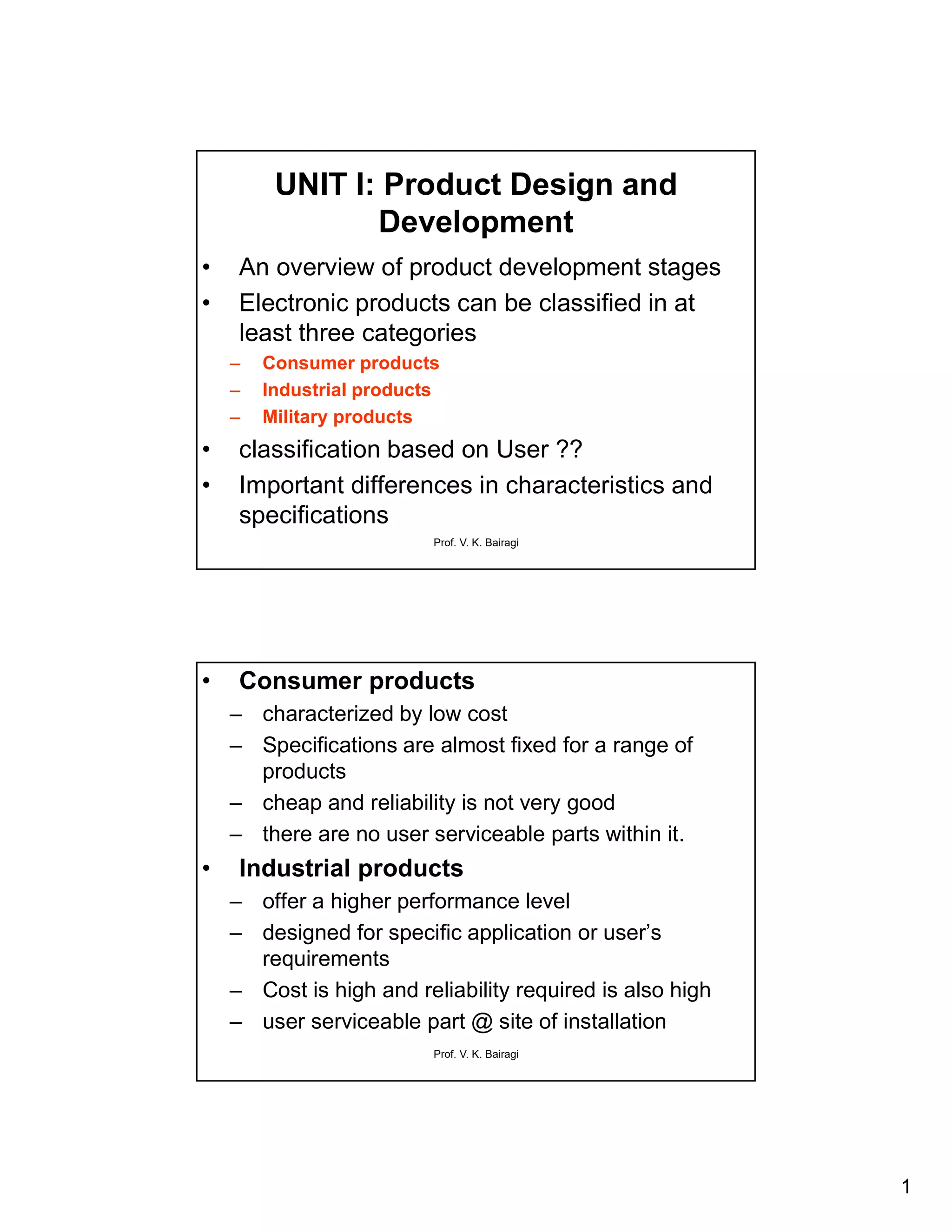
UNIT I: Product Design and
Development
• An overview of product development stages
• Electronic products can be classified in at
least three categories
– Consumer products
– Industrial products
– Military products
• classification based on User ??
• Important differences in characteristics and
specifications
Prof. V. K. Bairagi
• Consumer products
– characterized by low cost
– Specifications are almost fixed for a range of
products
– cheap and reliability is not very good
– there are no user serviceable parts within it.
• Industrial products
– offer a higher performance level
– designed for specific application or user’s
requirements
– Cost is high and reliability required is also high
– user serviceable part @ site of installation
2
Prof. V. K. Bairagi
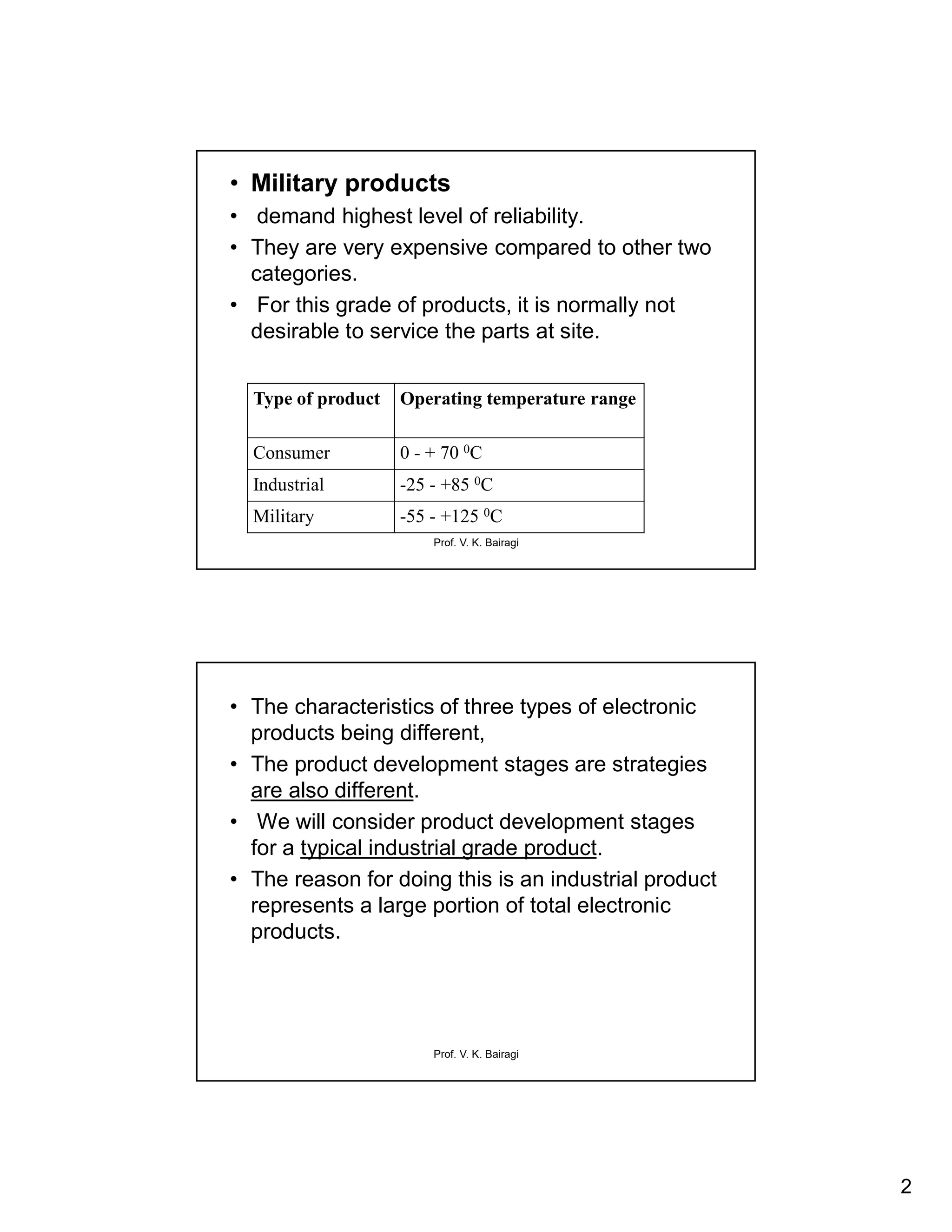
• Military products
• demand highest level of reliability.
• They are very expensive compared to other two
categories.
• For this grade of products, it is normally not
desirable to service the parts at site.
Type of product Operating temperature range
Consumer 0 - + 70 0C
Industrial -25 - +85 0C
Military -55 - +125 0C
Prof. V. K. Bairagi
• The characteristics of three types of electronic
products being different,
• The product development stages are strategies
are also different.
• We will consider product development stages
for a typical industrial grade product.
• The reason for doing this is an industrial product
represents a large portion of total electronic
products.
3
Prof. V. K. Bairagi
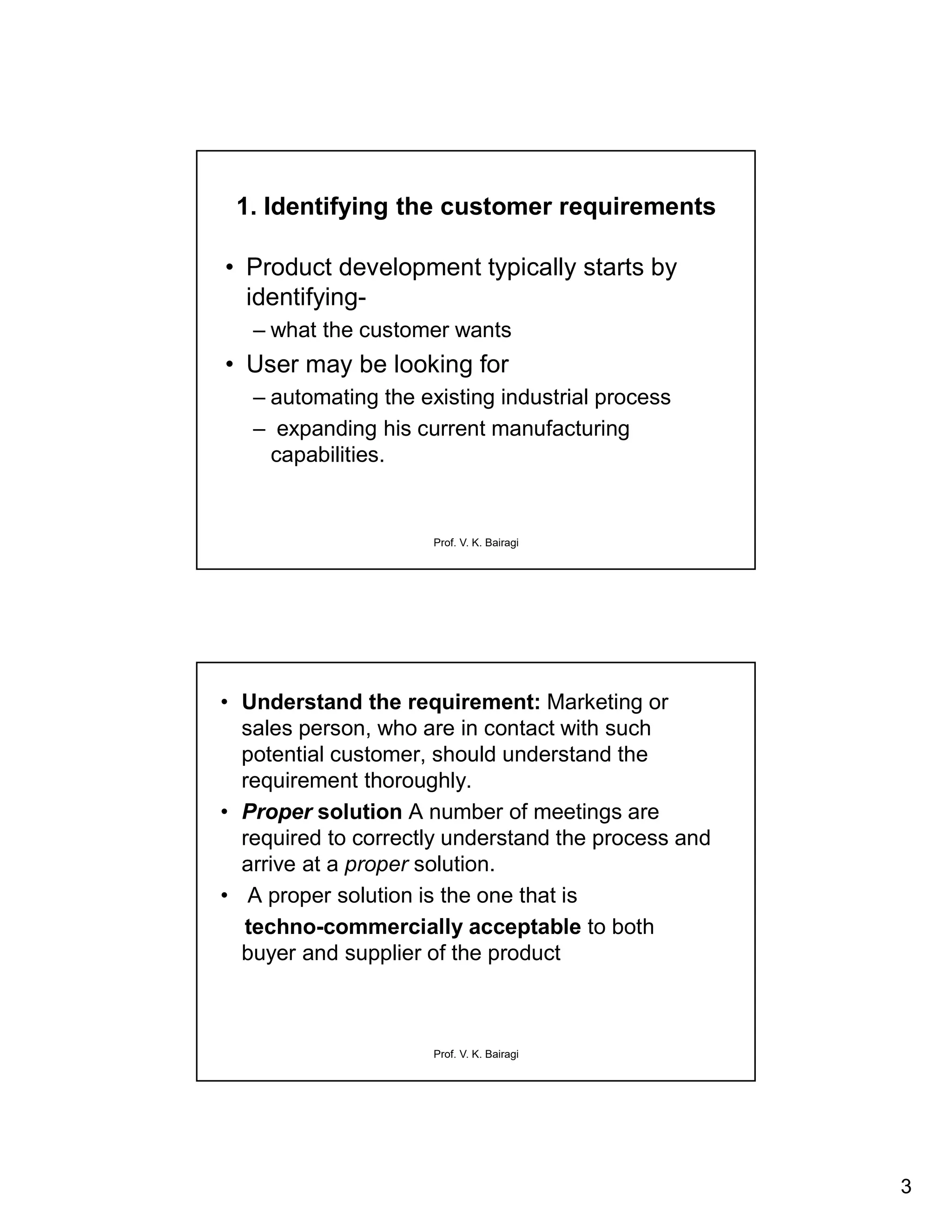
1. Identifying the customer requirements
• Product development typically starts by
identifying-
– what the customer wants
• User may be looking for
– automating the existing industrial process
– expanding his current manufacturing
capabilities.
Prof. V. K. Bairagi
• Understand the requirement: Marketing or
sales person, who are in contact with such
potential customer, should understand the
requirement thoroughly.
• Proper solution A number of meetings are
required to correctly understand the process and
arrive at a proper solution.
• A proper solution is the one that is
techno-commercially acceptable to both
buyer and supplier of the product
4
Prof. V. K. Bairagi
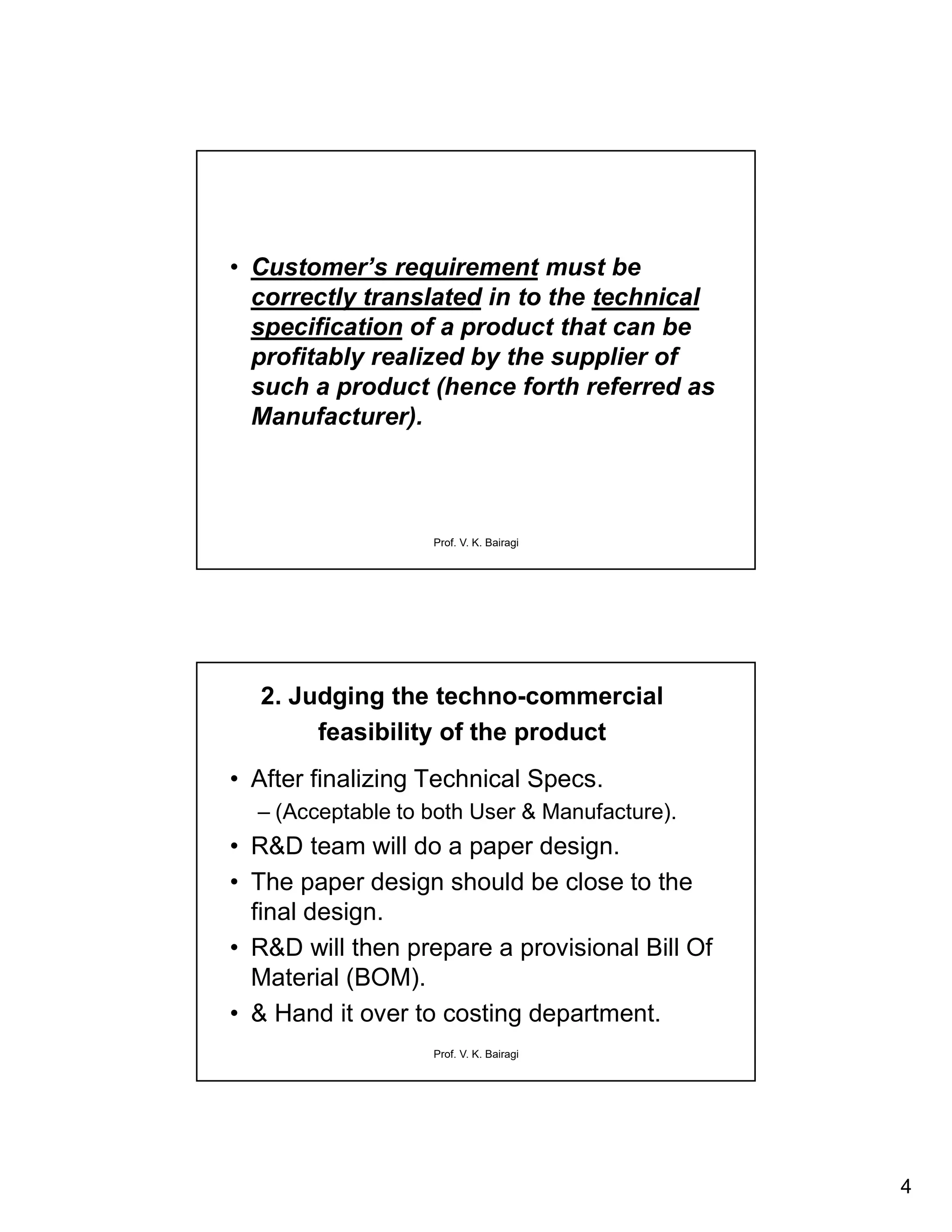
• Customer’s requirement must be
correctly translated in to the technical
specification of a product that can be
profitably realized by the supplier of
such a product (hence forth referred as
Manufacturer).
Prof. V. K. Bairagi
2. Judging the techno-commercial
feasibility of the product
• After finalizing Technical Specs.
– (Acceptable to both User & Manufacture).
• R&D team will do a paper design.
• The paper design should be close to the
final design.
• R&D will then prepare a provisional Bill Of
Material (BOM).
• & Hand it over to costing department.
5
Prof. V. K. Bairagi
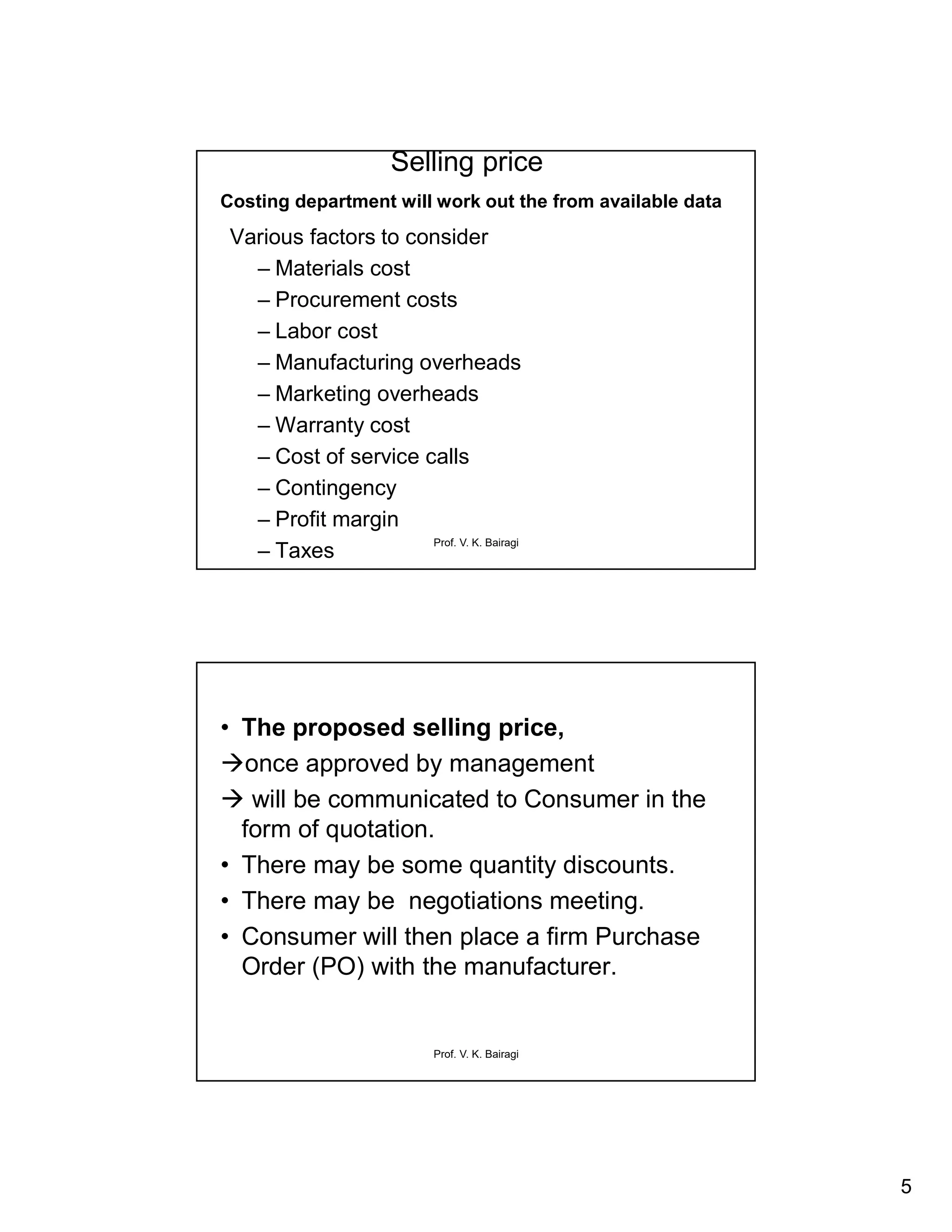
Selling price
Costing department will work out the from available data
Various factors to consider
– Materials cost
– Procurement costs
– Labor cost
– Manufacturing overheads
– Marketing overheads
– Warranty cost
– Cost of service calls
– Contingency
– Profit margin
– Taxes
Prof. V. K. Bairagi
• The proposed selling price,
once approved by management
 will be communicated to Consumer in the
form of quotation.
• There may be some quantity discounts.
• There may be negotiations meeting.
• Consumer will then place a firm Purchase
Order (PO) with the manufacturer.
6
Prof. V. K. Bairagi
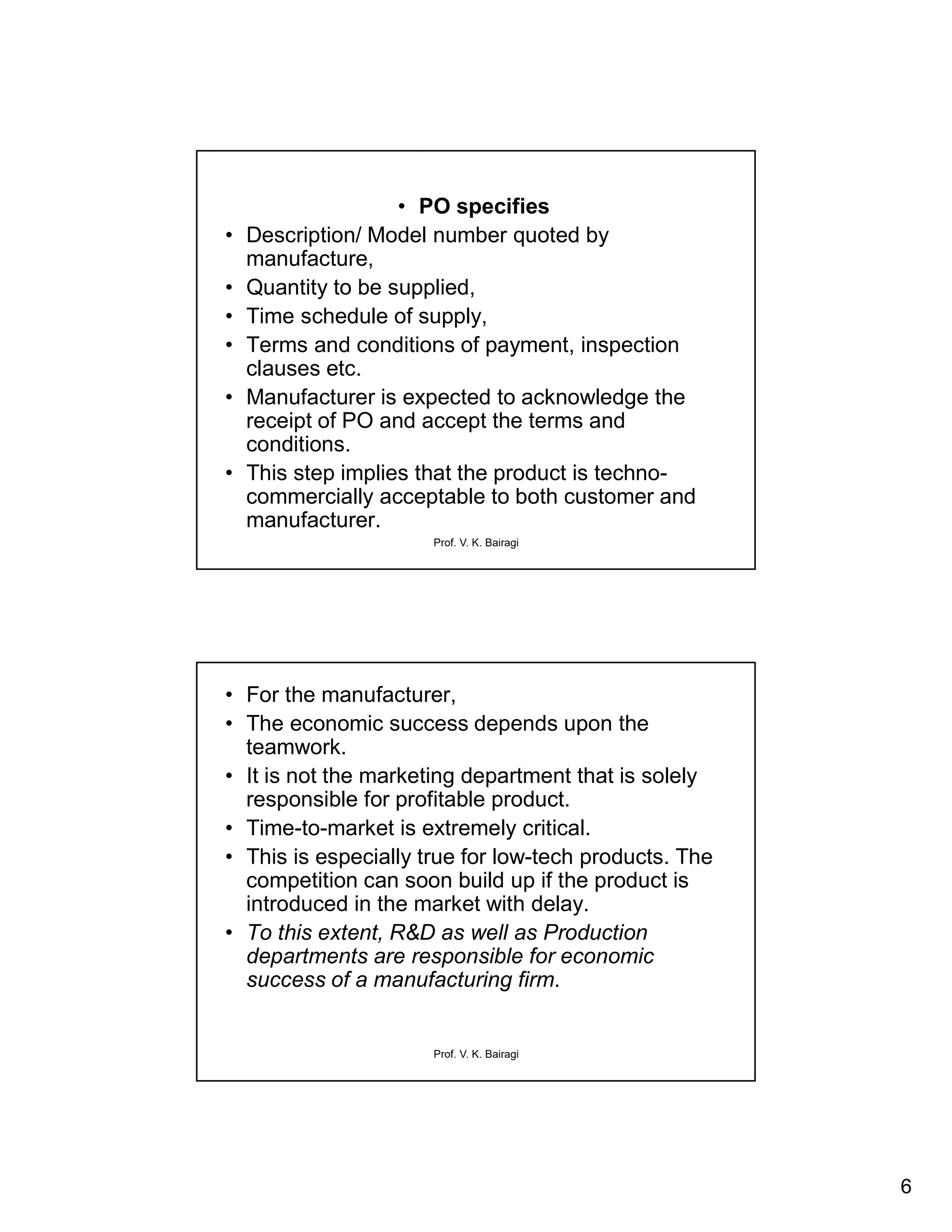
• PO specifies
• Description/ Model number quoted by
manufacture,
• Quantity to be supplied,
• Time schedule of supply,
• Terms and conditions of payment, inspection
clauses etc.
• Manufacturer is expected to acknowledge the
receipt of PO and accept the terms and
conditions.
• This step implies that the product is techno-
commercially acceptable to both customer and
manufacturer.
Prof. V. K. Bairagi
• For the manufacturer,
• The economic success depends upon the
teamwork.
• It is not the marketing department that is solely
responsible for profitable product.
• Time-to-market is extremely critical.
• This is especially true for low-tech products. The
competition can soon build up if the product is
introduced in the market with delay.
• To this extent, R&D as well as Production
departments are responsible for economic
success of a manufacturing firm.
7
Prof. V. K. Bairagi
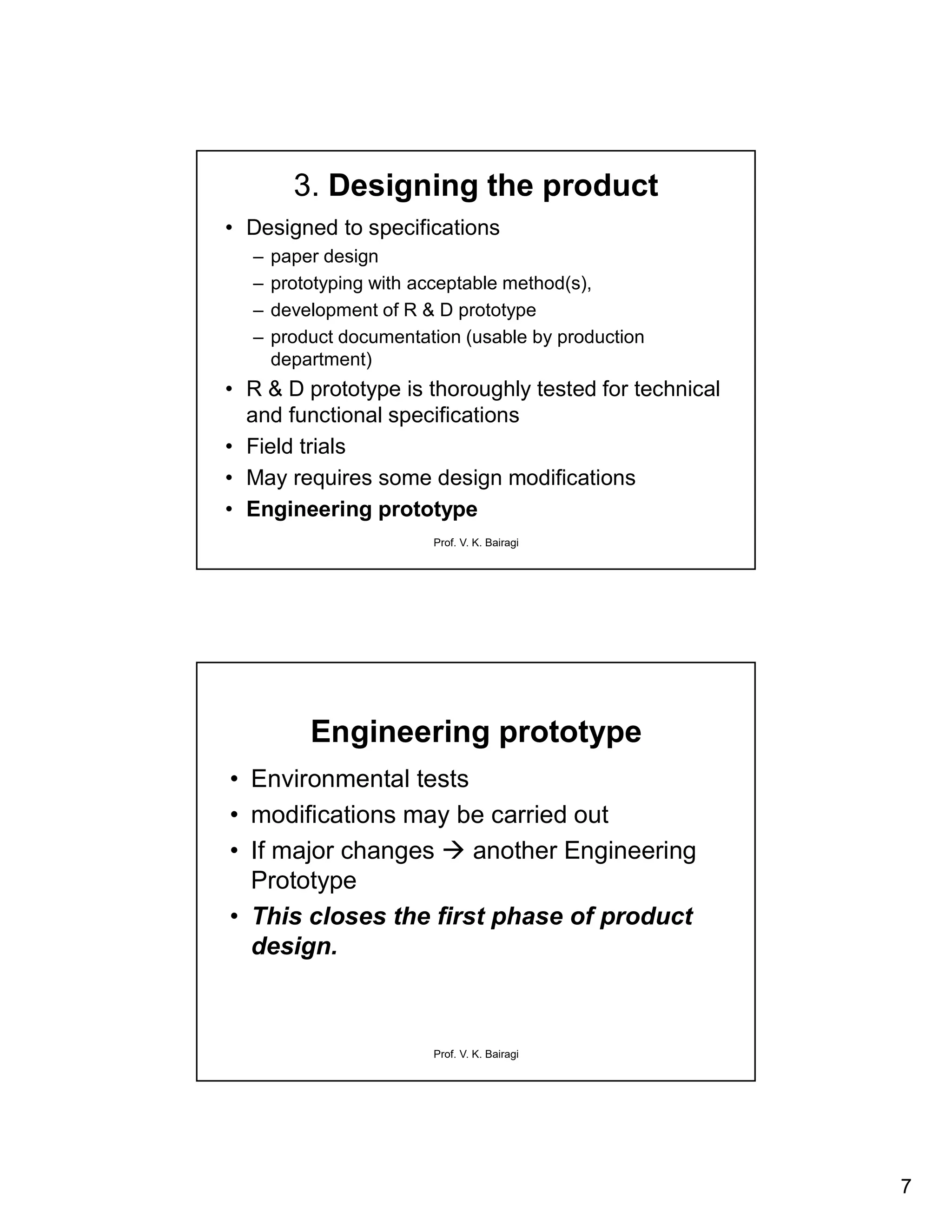
3. Designing the product
• Designed to specifications
– paper design
– prototyping with acceptable method(s),
– development of R & D prototype
– product documentation (usable by production
department)
• R & D prototype is thoroughly tested for technical
and functional specifications
• Field trials
• May requires some design modifications
• Engineering prototype
Prof. V. K. Bairagi
Engineering prototype
• Environmental tests
• modifications may be carried out
• If major changes  another Engineering
Prototype
• This closes the first phase of product
design.
8
Prof. V. K. Bairagi
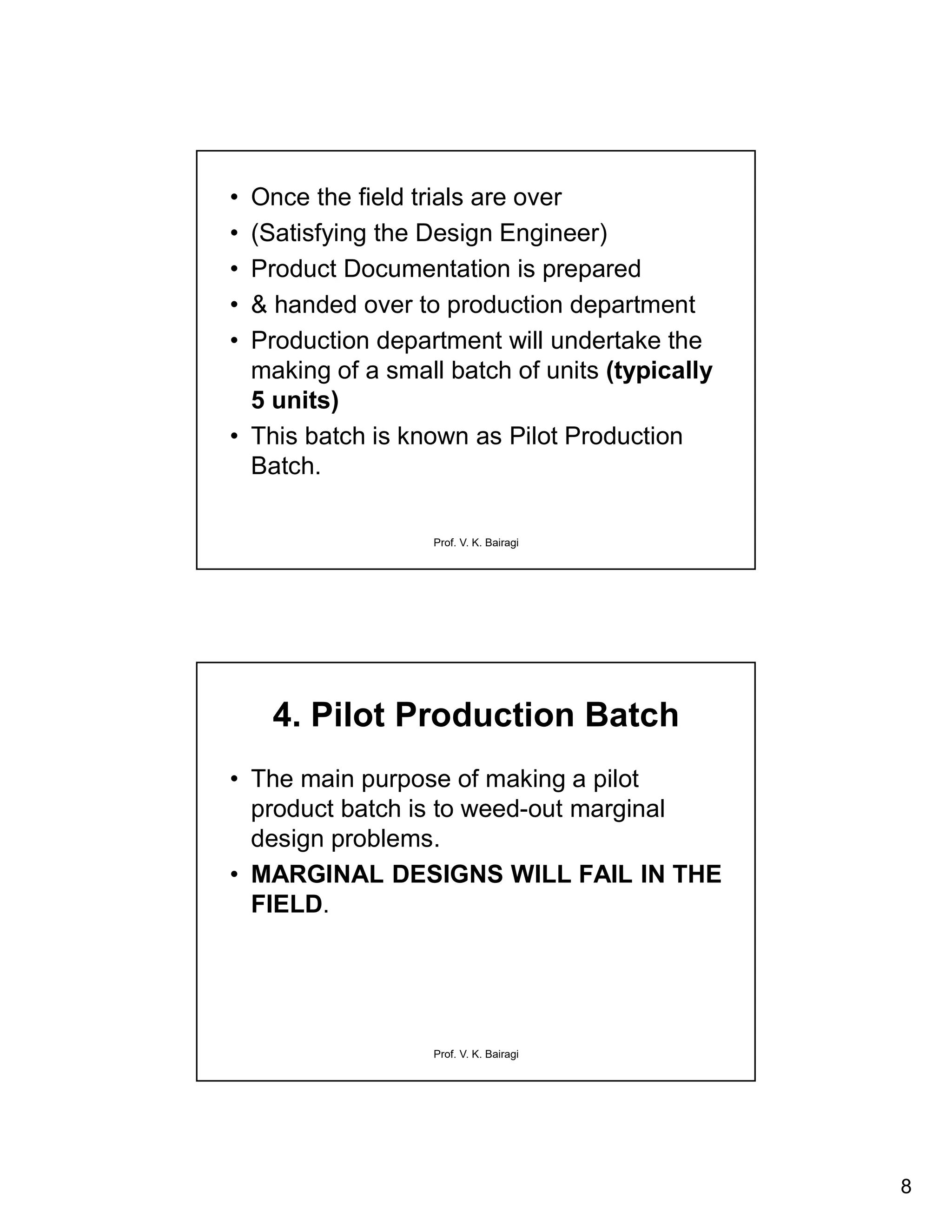
• Once the field trials are over
• (Satisfying the Design Engineer)
• Product Documentation is prepared
• & handed over to production department
• Production department will undertake the
making of a small batch of units (typically
5 units)
• This batch is known as Pilot Production
Batch.
Prof. V. K. Bairagi
4. Pilot Production Batch
• The main purpose of making a pilot
product batch is to weed-out marginal
design problems.
• MARGINAL DESIGNS WILL FAIL IN THE
FIELD.
9
Prof. V. K. Bairagi
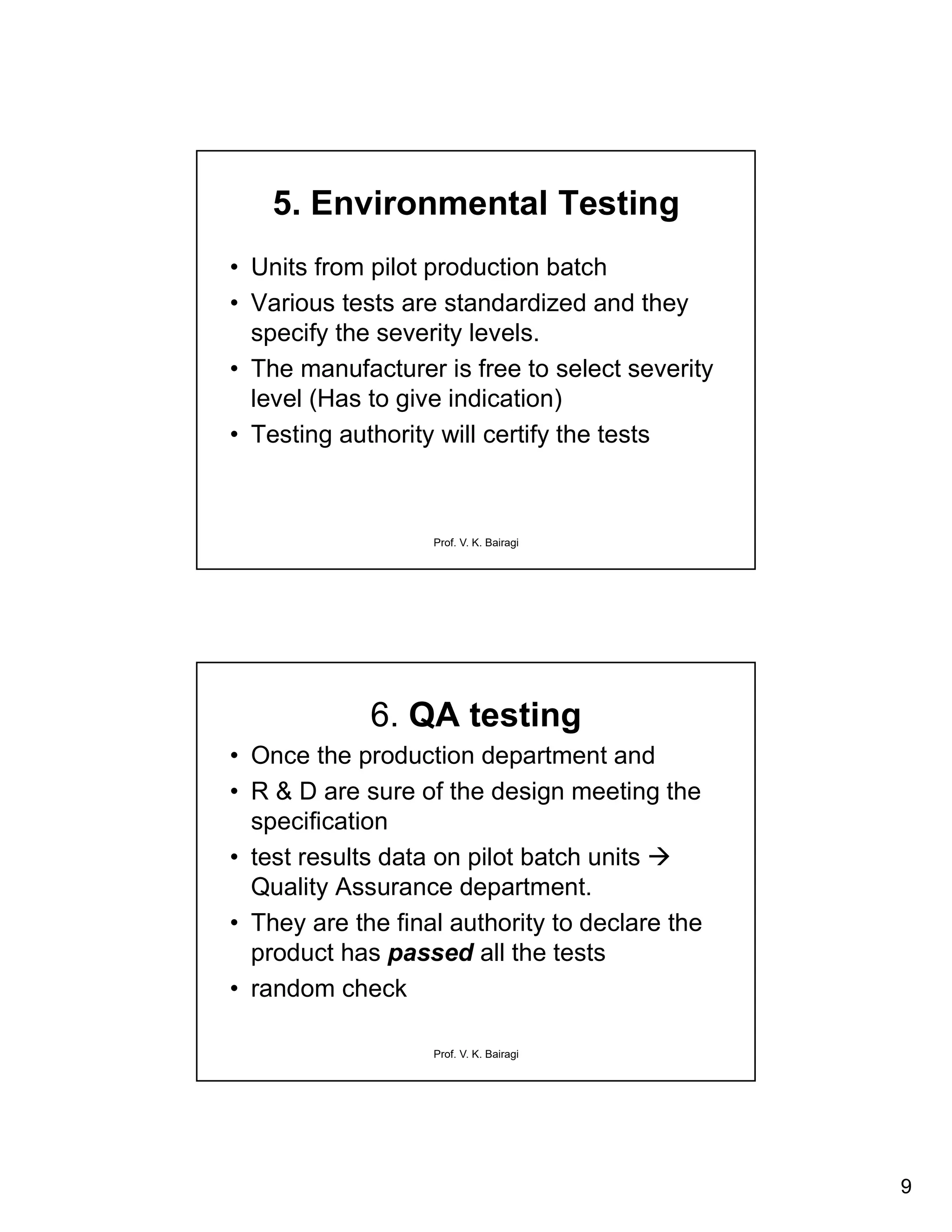
5. Environmental Testing
• Units from pilot production batch
• Various tests are standardized and they
specify the severity levels.
• The manufacturer is free to select severity
level (Has to give indication)
• Testing authority will certify the tests
Prof. V. K. Bairagi
6. QA testing
• Once the production department and
• R & D are sure of the design meeting the
specification
• test results data on pilot batch units 
Quality Assurance department.
• They are the final authority to declare the
product has passed all the tests
• random check
10
Prof. V. K. Bairagi
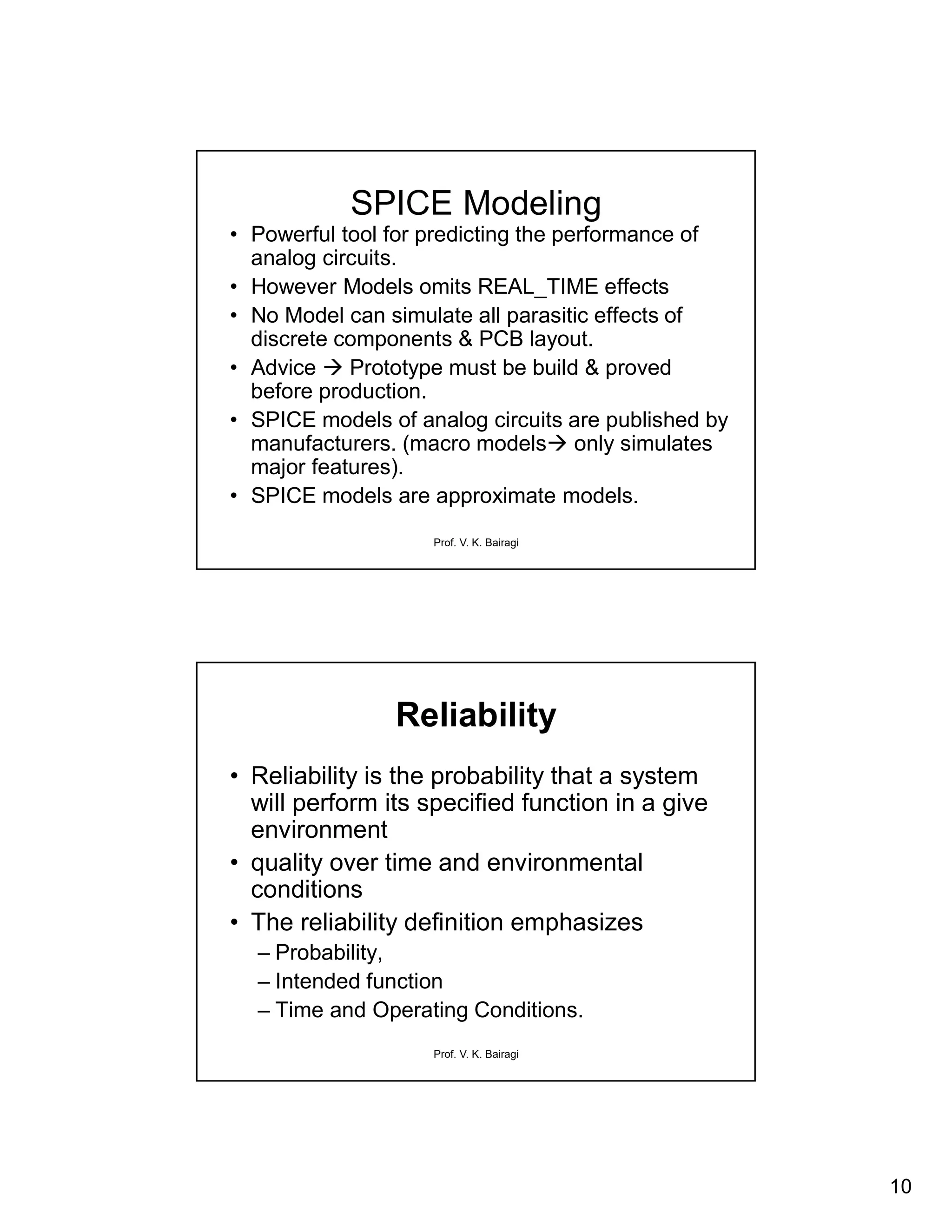
SPICE Modeling
• Powerful tool for predicting the performance of
analog circuits.
• However Models omits REAL_TIME effects
• No Model can simulate all parasitic effects of
discrete components & PCB layout.
• Advice  Prototype must be build & proved
before production.
• SPICE models of analog circuits are published by
manufacturers. (macro models only simulates
major features).
• SPICE models are approximate models.
Prof. V. K. Bairagi
Reliability
• Reliability is the probability that a system
will perform its specified function in a give
environment
• quality over time and environmental
conditions
• The reliability definition emphasizes
– Probability,
– Intended function
– Time and Operating Conditions.
11
Prof. V. K. Bairagi
Failures
• A failure is the partial or total loss or change in
those properties of a device or system in such a
way that its functioning is seriously impeded or
completely stopped.
• Failure mechanisms are physical processes by
which the stress can damage the material
included in the product.
• Investigating failure mechanisms helps in
increasing the reliability of the designed product.
Prof. V. K. Bairagi
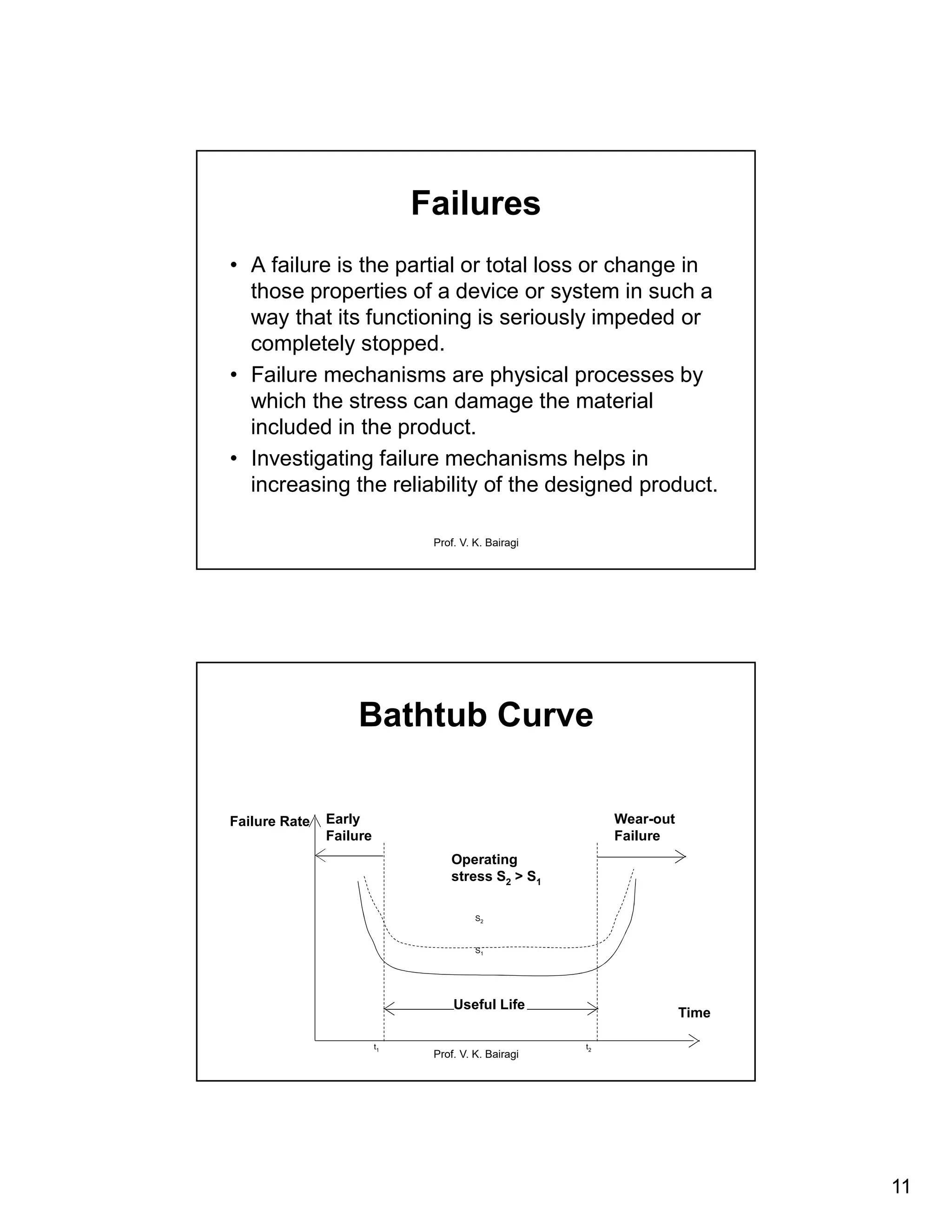
Bathtub Curve
t1 t2
S1
S2
Time
Failure Rate Wear-out
Failure
Early
Failure
Useful Life
Operating
stress S2 > S1
12
Prof. V. K. Bairagi
• There is a large number of failures initially
• Infant Mortality or Early life Failure
• The failure rate decreases with time
• These failures are primarily due to
manufacturing defects, weak parts, poor
insulation, bad assembly, poor fits etc
• Since defective units are eliminated during the
initial failure period, this period is known as-
Debugging Period or Burn-in period
• After this infant mortality period, for a long
interval of time, the failures are reported,
but it is difficult to determine their cause.
Prof. V. K. Bairagi
• They occur due to sharp change in the parameters
that determine the performance of the units,
•  Random failures or Catastrophic failures
• This is the period of normal operation
• As the time progresses, the units get outworn
• When the performance of the product goes beyond
the admissible limits, the product fails
• This region is called as Wear-out region
• ( To be identified by using highly accelerated test conditions)
• Modern ICs do not reach wear-out region when
operated under normal use conditions.
13
Prof. V. K. Bairagi
Causes of failure
• Components used have incorrect resistance,
impedance, voltage, current, capacitance, or
dielectric properties. These are called as-
Electrical Overstress (EOS) failures.
• Due to improper shielding for EMI or due to
Electrostatic Discharge (ESD).
• Improper Thermal Management causes thermal
failures
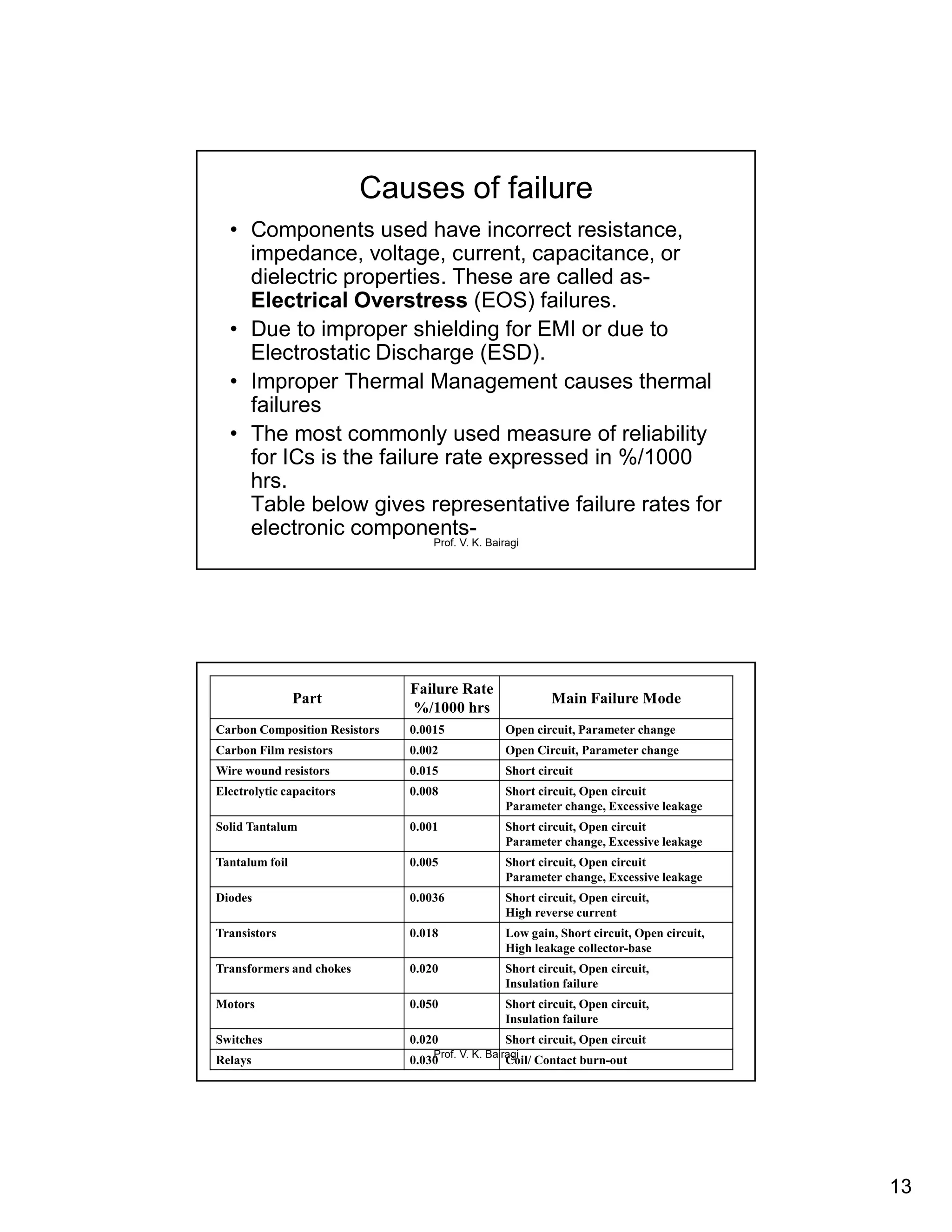
• The most commonly used measure of reliability
for ICs is the failure rate expressed in %/1000
hrs.
Table below gives representative failure rates for
electronic components-
Prof. V. K. Bairagi
Part
Failure Rate
%/1000 hrs
Main Failure Mode
Carbon Composition Resistors 0.0015 Open circuit, Parameter change
Carbon Film resistors 0.002 Open Circuit, Parameter change
Wire wound resistors 0.015 Short circuit
Electrolytic capacitors 0.008 Short circuit, Open circuit
Parameter change, Excessive leakage
Solid Tantalum 0.001 Short circuit, Open circuit
Parameter change, Excessive leakage
Tantalum foil 0.005 Short circuit, Open circuit
Parameter change, Excessive leakage
Diodes 0.0036 Short circuit, Open circuit,
High reverse current
Transistors 0.018 Low gain, Short circuit, Open circuit,
High leakage collector-base
Transformers and chokes 0.020 Short circuit, Open circuit,
Insulation failure
Motors 0.050 Short circuit, Open circuit,
Insulation failure
Switches 0.020 Short circuit, Open circuit
Relays 0.030 Coil/ Contact burn-out
14
Prof. V. K. Bairagi
• If the time interval is small, the failure rate is called-
Instantaneous Failure Rate. [F(t)] or “Hazard rate”. If
the time interval is long (such as total operational time)
the failure rate is called “Cumulative Failure Rate”.
• Mean Time Between Failures (MTBF)
– basic measure of reliability for repairable items.
– It can be described as the number of hours that
pass before a component, assembly, or system
fails.
– MTBF = (1,000,000 hours) / (2 failures) = 500,000
hours
Prof. V. K. Bairagi
Mean Time To Failure (MTTF)
• measure of reliability for non-repairable systems
• It is the mean time expected until the first failure of a
piece of equipment.
• Technically MTBF should be used only in
reference to repairable items, while MTTF should
be used for non-repairable items.
• However, MTBF is commonly used for both repairable
and non-repairable items.


n
1i
it
N
1
MTTF




ii
ii
n
1
MTTF
and
nrateFailureSystem


15
Prof. V. K. Bairagi
Example: A trigger circuit of single phase SCR consists of
following components with failure rates shown in table below.
Determine overall failure rate and MTTF of the trigger circuit.
Component Number used (ni) Failure rate for 106 hours (i)
Transistors 8 0.61
Diodes 10 0.20
Resistors 21 0.60
Capacitors 4 0.60
Pulse Transformers 1 0.15
Small Transformers 1 0.20
Solution: Failure rate of trigger circuit = Sum of failure rates of all components
= = (8 x 0.61) + (10 x 0.2) + (21 x 0.6) + (4 x 0.6) + (2 x 0.2) + ( 1 x 0.15) = 23.78 for
106 hours.
=


n
1i
it
N
1
MTTF
Prof. V. K. Bairagi
Reliability calculation
IC Failure rate doubles after every 10degree rise in Temp
(Internal temp of IC)
Suppose that We build a system with m component , each
with different
R Sys= R1(t). R2(t). R3(t). R4(t). R5(t).
R is the real number between 0 & 1
16
Prof. V. K. Bairagi
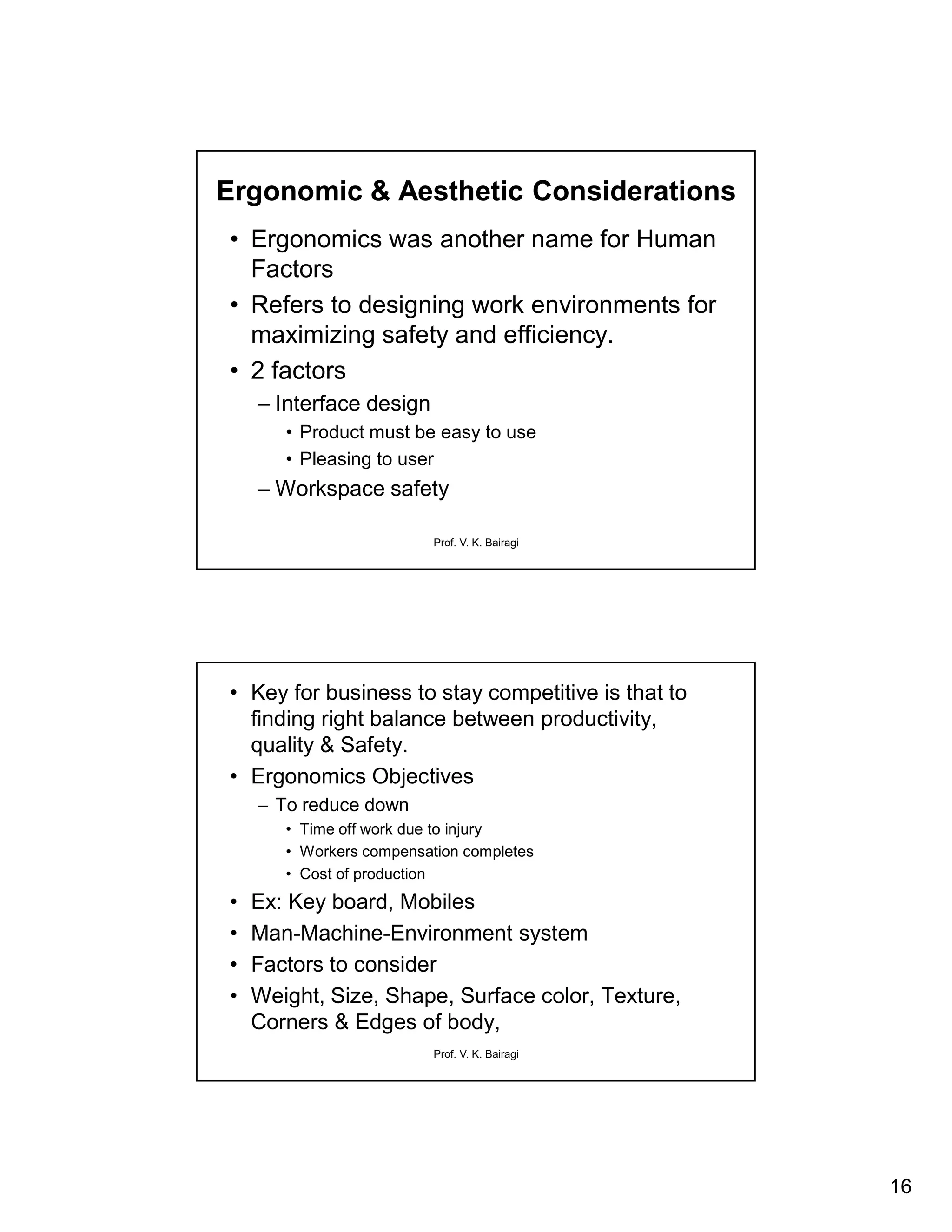
Ergonomic & Aesthetic Considerations
• Ergonomics was another name for Human
Factors
• Refers to designing work environments for
maximizing safety and efficiency.
• 2 factors
– Interface design
• Product must be easy to use
• Pleasing to user
– Workspace safety
Prof. V. K. Bairagi
• Key for business to stay competitive is that to
finding right balance between productivity,
quality & Safety.
• Ergonomics Objectives
– To reduce down
• Time off work due to injury
• Workers compensation completes
• Cost of production
• Ex: Key board, Mobiles
• Man-Machine-Environment system
• Factors to consider
• Weight, Size, Shape, Surface color, Texture,
Corners & Edges of body,
17
Prof. V. K. Bairagi
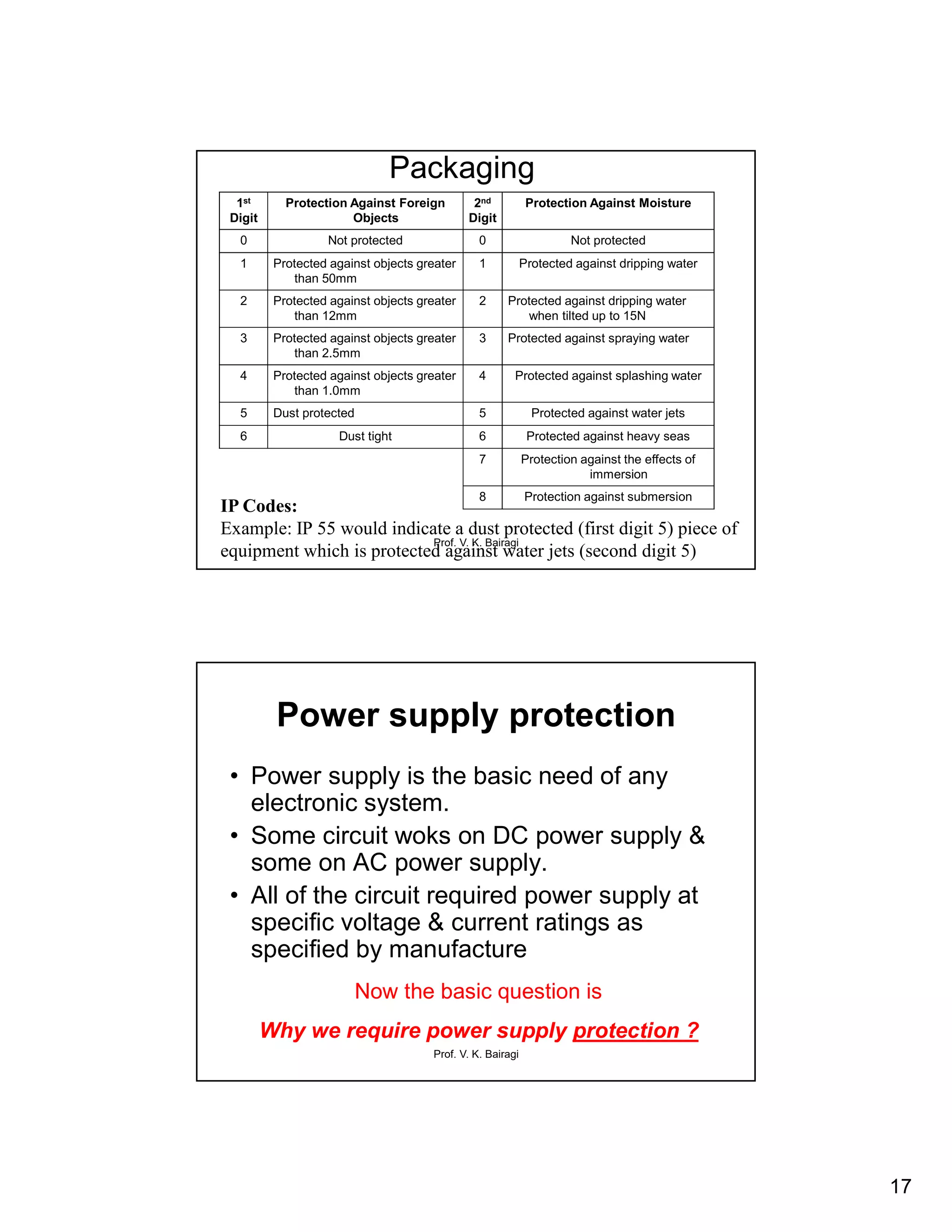
Packaging
1st
Digit
Protection Against Foreign
Objects
2nd
Digit
Protection Against Moisture
0 Not protected 0 Not protected
1 Protected against objects greater
than 50mm
1 Protected against dripping water
2 Protected against objects greater
than 12mm
2 Protected against dripping water
when tilted up to 15N
3 Protected against objects greater
than 2.5mm
3 Protected against spraying water
4 Protected against objects greater
than 1.0mm
4 Protected against splashing water
5 Dust protected 5 Protected against water jets
6 Dust tight 6 Protected against heavy seas
7 Protection against the effects of
immersion
8 Protection against submersion
IP Codes:
Example: IP 55 would indicate a dust protected (first digit 5) piece of
equipment which is protected against water jets (second digit 5)
Prof. V. K. Bairagi
Power supply protection
• Power supply is the basic need of any
electronic system.
• Some circuit woks on DC power supply &
some on AC power supply.
• All of the circuit required power supply at
specific voltage & current ratings as
specified by manufacture
Now the basic question is
Why we require power supply protection ?
18
Prof. V. K. Bairagi
What happen to the circuit under test if
we give excess of the voltage & current
than requirement ?
• Probably the circuit may sustain that
excess of Voltage & Current for some
time & After that the circuit may gates
heated up & finally starts malfunctioning or
completely dead.
• (But this is rear in day today life)
• Surge Voltage is major issue, when we are
taking about P.S. protection.
Prof. V. K. Bairagi
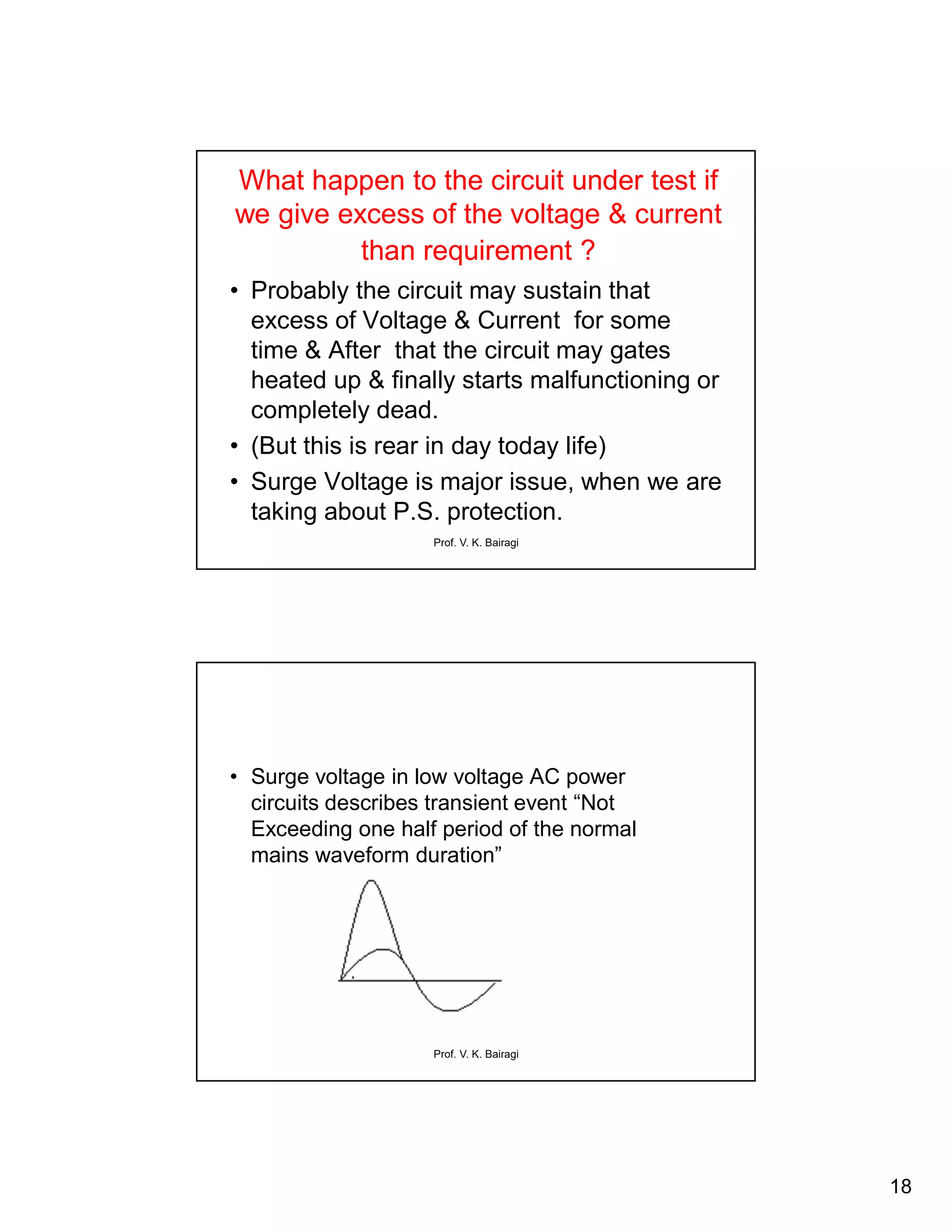
• Surge voltage in low voltage AC power
circuits describes transient event “Not
Exceeding one half period of the normal
mains waveform duration”
19
Prof. V. K. Bairagi
When we rub plastic scale on woolen cloth, it will
attract small piece of paper
• Transient may be periodic or random events.
• May appear in any mode (any combination of
line, Neutral or Ground conductors).
• Transient voltage & current occurs in
microseconds.
• Transient are of very short duration & Thus acts
as a high frequency signal of large voltage &
current magnitude.
Prof. V. K. Bairagi
• Lighting is the one of the cause for spicks.
• In day to day life operation, utilities will generate
significant Transient from power factor correction
or grid switching.
• Static charge on the overhead utilities
conductors resulting from wind can generate a
transient if static buildup is sufficient to produce
discharge.
• Transient are produces during switching.
• ( high voltage switches are to be operated at
lower speed.)
20
Prof. V. K. Bairagi
• High frequency electronic signal riding on
60 / 50 Hz sine wave can cause digital
equipment & sensitive load to malfunction.
• Types of high frequency Noise :
– Ring Waves ( Building distribution system)
– Other types of noise (within equipment itself)
• SMPS
• Personal computers
– Conducted Noise – Back propagation
Prof. V. K. Bairagi
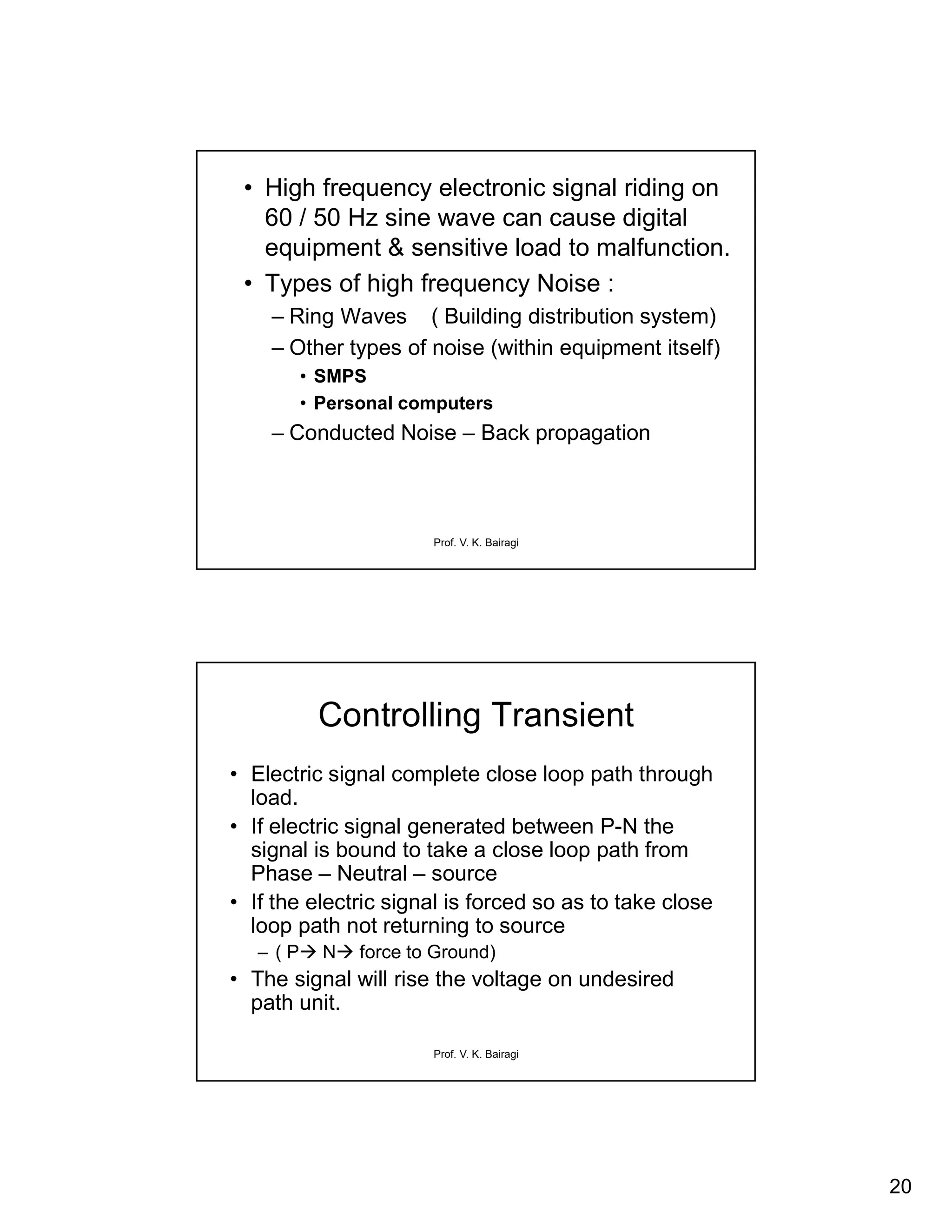
Controlling Transient
• Electric signal complete close loop path through
load.
• If electric signal generated between P-N the
signal is bound to take a close loop path from
Phase – Neutral – source
• If the electric signal is forced so as to take close
loop path not returning to source
– ( P N force to Ground)
• The signal will rise the voltage on undesired
path unit.
21
Prof. V. K. Bairagi
Fundamental characteristics of
electrical circuit
R1 R2 R3
L
N
R1 = low, I1= Highest
R3-High, I3=Lowest
Prof. V. K. Bairagi
Transient Solution
L
N
To load
R
Very
High
Transient
During Normal operation of circuit R is very high
For Transient duration of time R value is very less  provides path to current
22
Prof. V. K. Bairagi
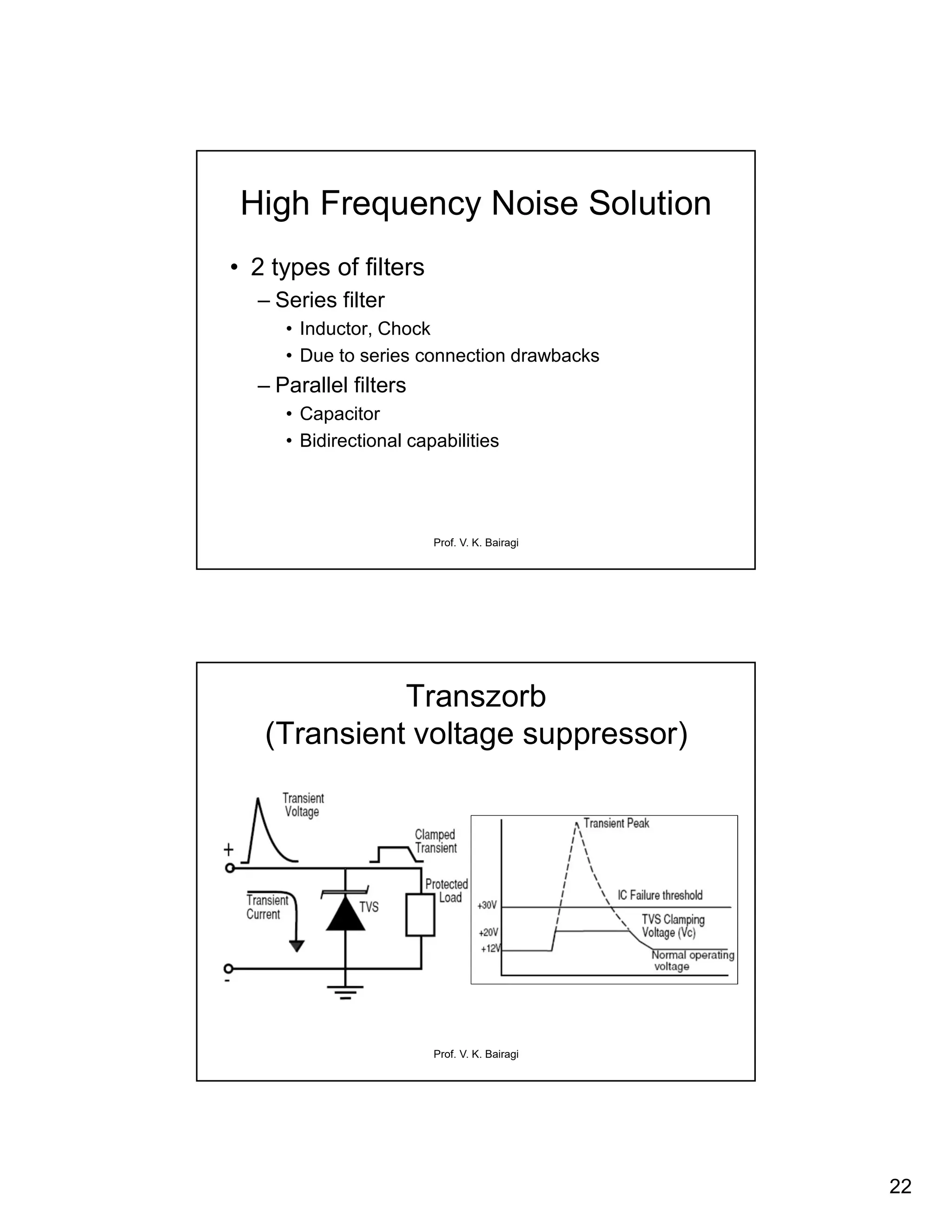
High Frequency Noise Solution
• 2 types of filters
– Series filter
• Inductor, Chock
• Due to series connection drawbacks
– Parallel filters
• Capacitor
• Bidirectional capabilities
Prof. V. K. Bairagi
Transzorb
(Transient voltage suppressor)
23
Prof. V. K. Bairagi
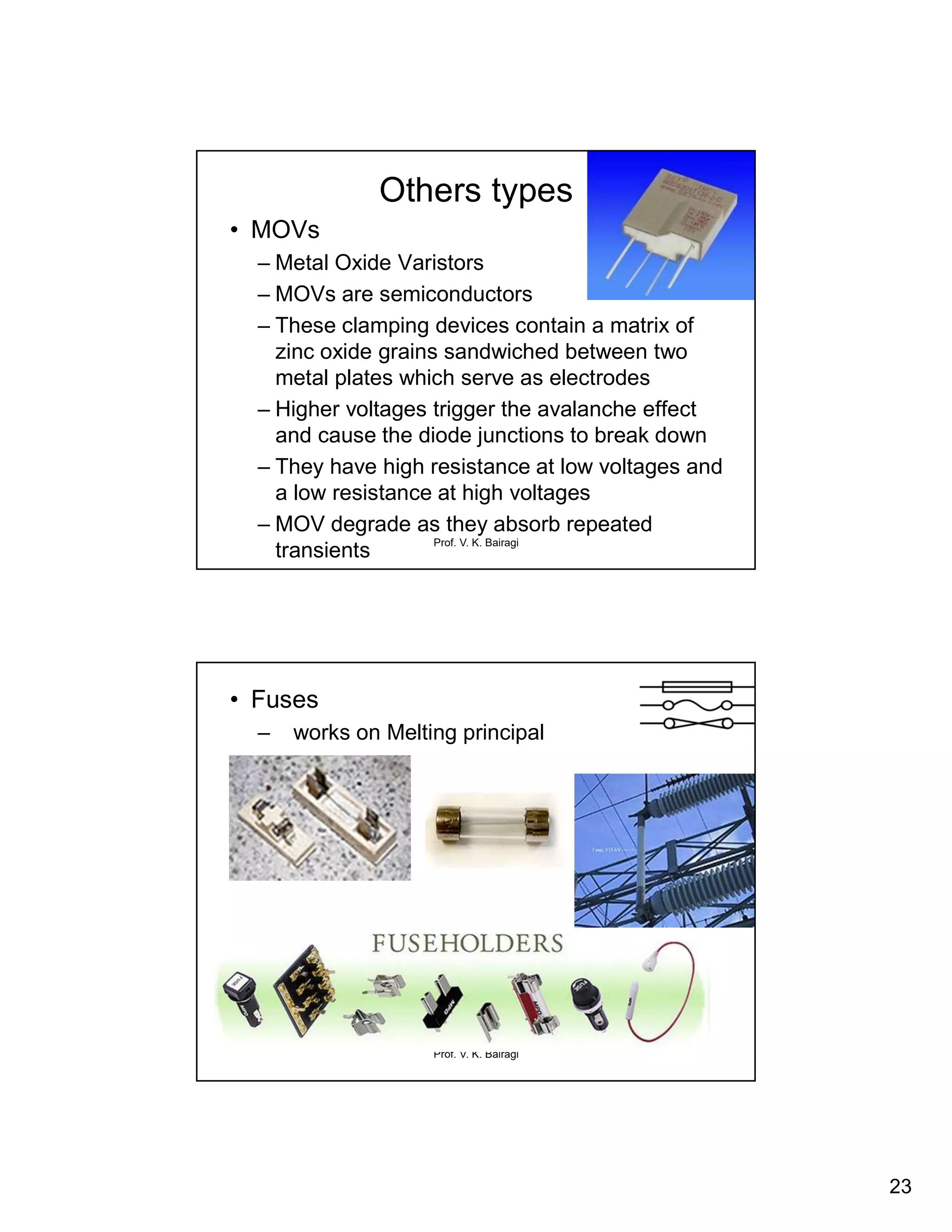
Others types
• MOVs
– Metal Oxide Varistors
– MOVs are semiconductors
– These clamping devices contain a matrix of
zinc oxide grains sandwiched between two
metal plates which serve as electrodes
– Higher voltages trigger the avalanche effect
and cause the diode junctions to break down
– They have high resistance at low voltages and
a low resistance at high voltages
– MOV degrade as they absorb repeated
transients
Prof. V. K. Bairagi
• Fuses
– works on Melting principal
24
Prof. V. K. Bairagi
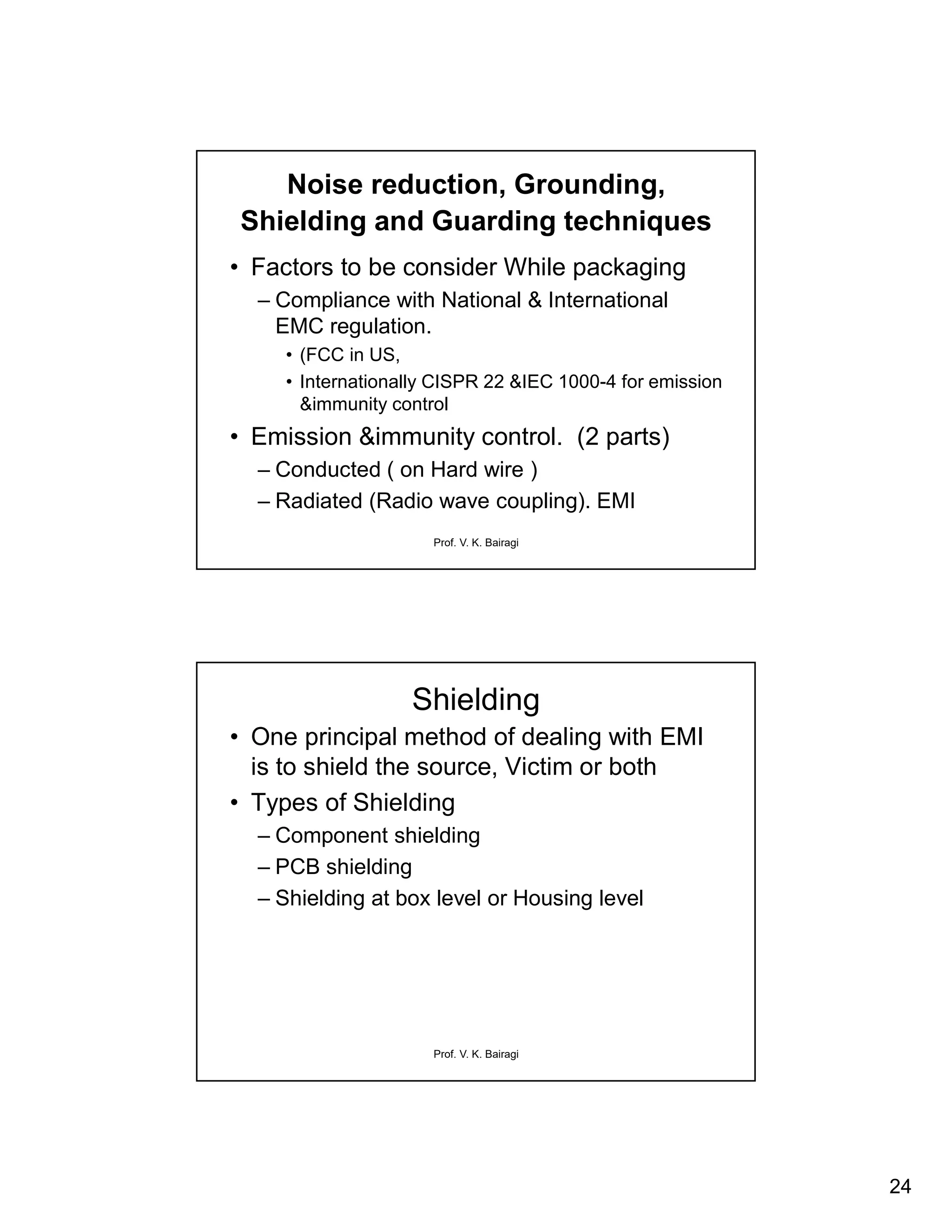
Noise reduction, Grounding,
Shielding and Guarding techniques
• Factors to be consider While packaging
– Compliance with National & International
EMC regulation.
• (FCC in US,
• Internationally CISPR 22 &IEC 1000-4 for emission
&immunity control
• Emission &immunity control. (2 parts)
– Conducted ( on Hard wire )
– Radiated (Radio wave coupling). EMI
Prof. V. K. Bairagi
Shielding
• One principal method of dealing with EMI
is to shield the source, Victim or both
• Types of Shielding
– Component shielding
– PCB shielding
– Shielding at box level or Housing level
25
Prof. V. K. Bairagi
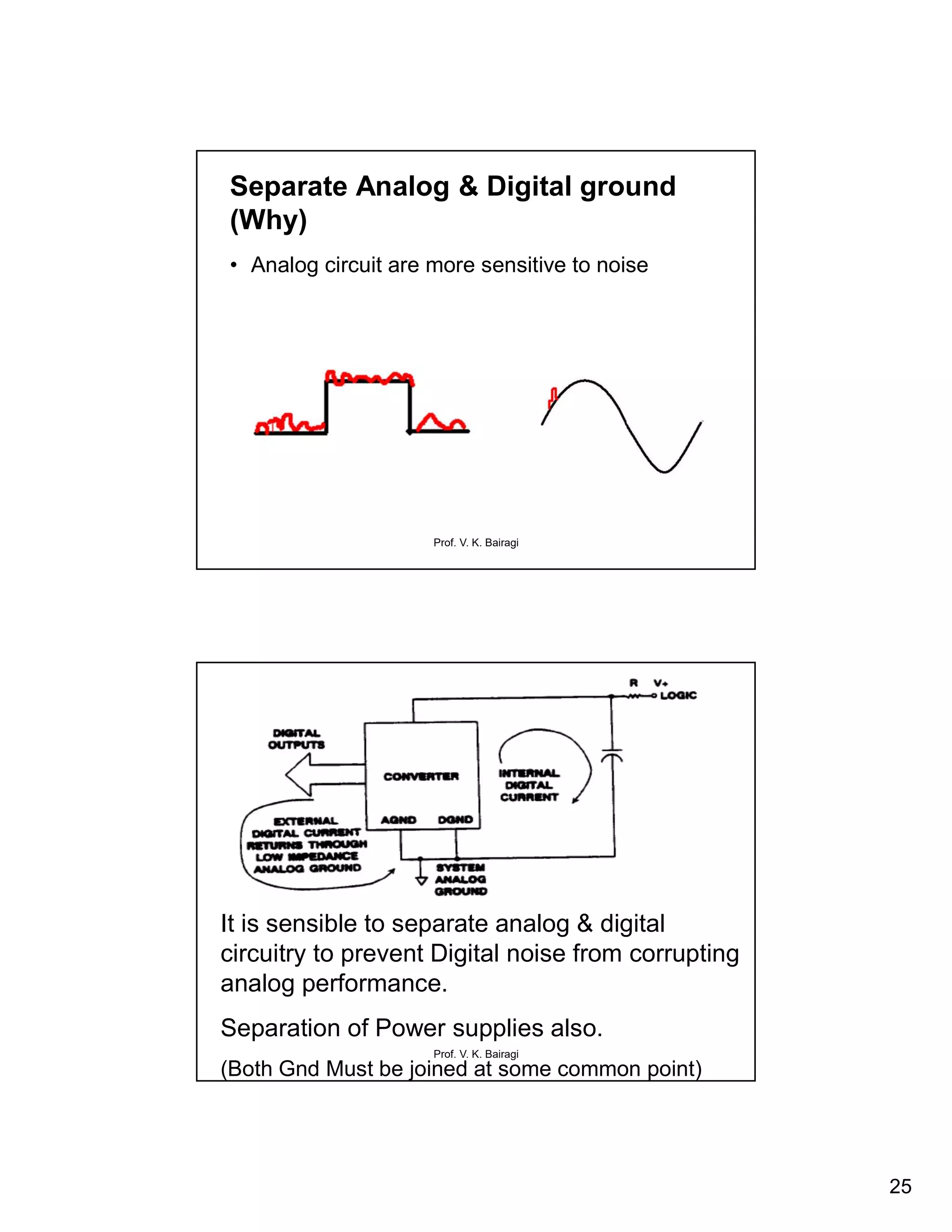
Separate Analog & Digital ground
(Why)
• Analog circuit are more sensitive to noise
Prof. V. K. Bairagi
It is sensible to separate analog & digital
circuitry to prevent Digital noise from corrupting
analog performance.
Separation of Power supplies also.
(Both Gnd Must be joined at some common point)
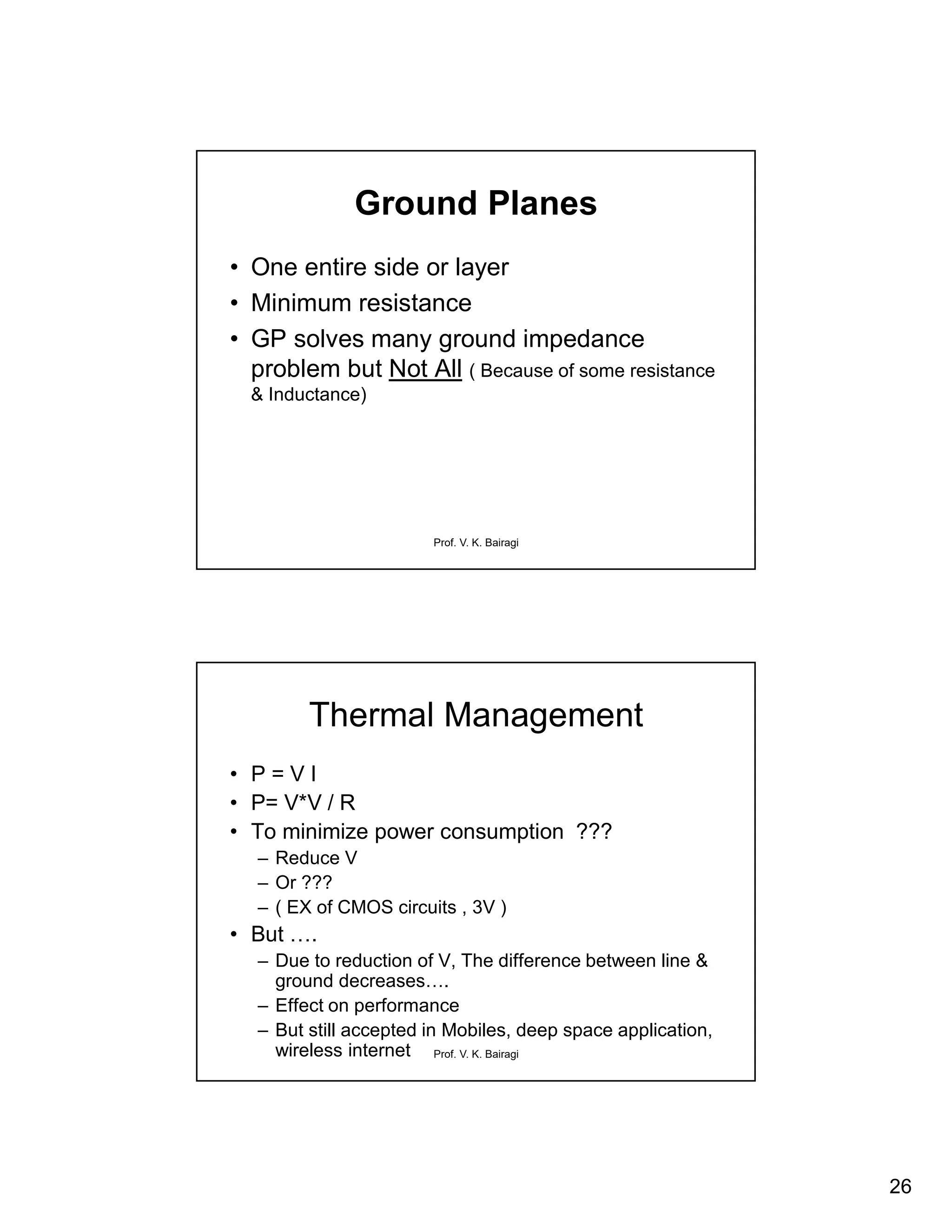
26
Prof. V. K. Bairagi
Ground Planes
• One entire side or layer
• Minimum resistance
• GP solves many ground impedance
problem but Not All ( Because of some resistance
& Inductance)
Prof. V. K. Bairagi
Thermal Management
• P = V I
• P= V*V / R
• To minimize power consumption ???
– Reduce V
– Or ???
– ( EX of CMOS circuits , 3V )
• But ….
– Due to reduction of V, The difference between line &
ground decreases….
– Effect on performance
– But still accepted in Mobiles, deep space application,
wireless internet
27
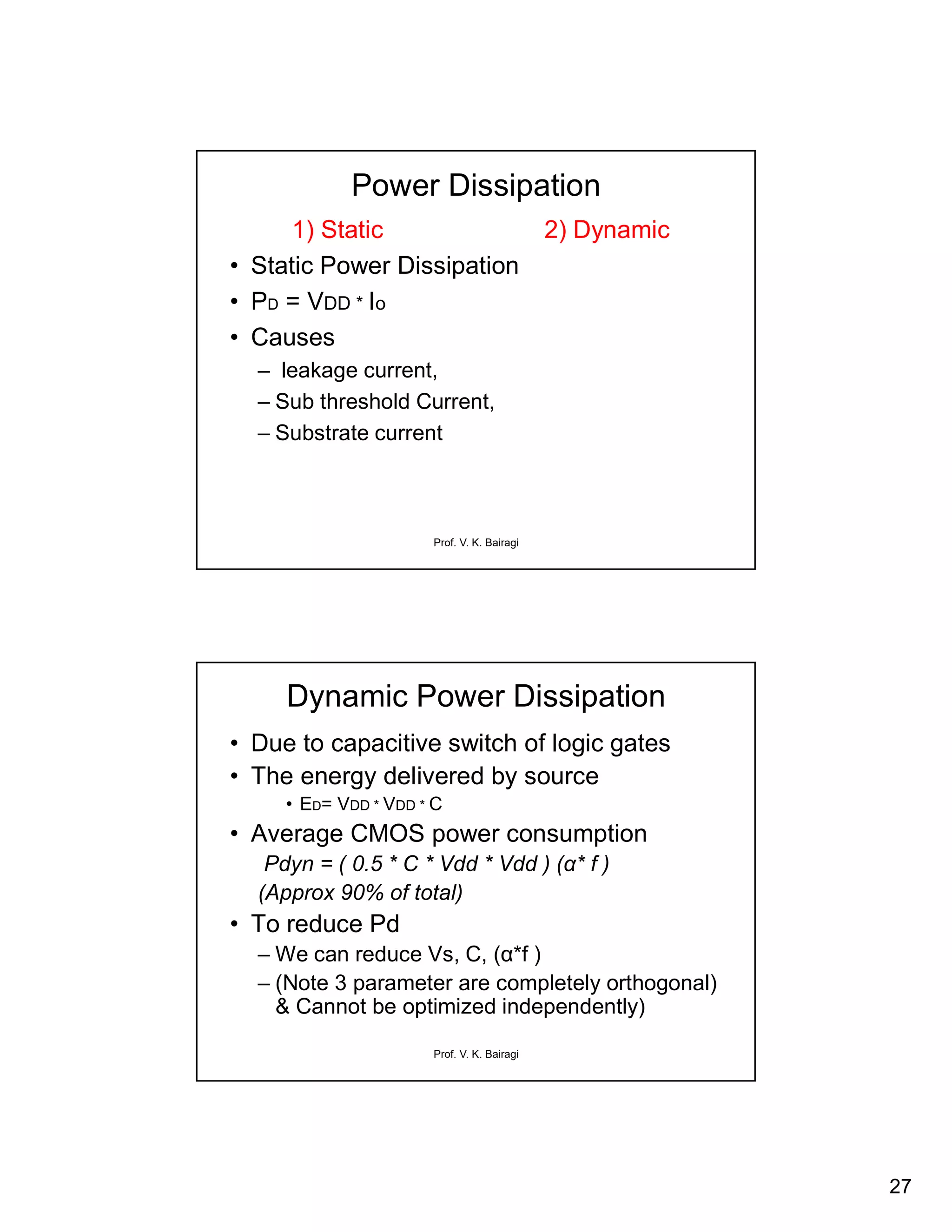
Prof. V. K. Bairagi
Power Dissipation
1) Static 2) Dynamic
• Static Power Dissipation
• PD = VDD * Io
• Causes
– leakage current,
– Sub threshold Current,
– Substrate current
Prof. V. K. Bairagi
Dynamic Power Dissipation
• Due to capacitive switch of logic gates
• The energy delivered by source
• ED= VDD * VDD * C
• Average CMOS power consumption
Pdyn = ( 0.5 * C * Vdd * Vdd ) (α* f )
(Approx 90% of total)
• To reduce Pd
– We can reduce Vs, C, (α*f )
– (Note 3 parameter are completely orthogonal)
& Cannot be optimized independently)
28
References
1. J. C. Whitaker, “The Electronics Handbook, CRC Press, IEEE
Press
2. Charles A. Harper, “Electronic Packaging and Interconnection
Handbook”, McGraw-Hill Handbooks, ISBN 0-07-143048-2
3. Norman Fuqua, “Reliability Engineering for Electronic
Design”, Marcel Dekker INC.
4. Electronic Instrument Design, Architecture for life cycle, Kim
R. Fowler, Oxford University Press Inc.
5. Handbook Of Analytical Instruments- R. S. Khandpur, Tata
McGraw Hill
Prof. V. K. Bairagi
Thank You…
Contact Details
Prof V K Bairagi, Pune, India
bairagi1@gmail.com
Prof. V. K. Bairagi

Electronic product design and development -2

  • 1.
    1 Prof. V. K.Bairagi UNIT I: Product Design and Development • An overview of product development stages • Electronic products can be classified in at least three categories – Consumer products – Industrial products – Military products • classification based on User ?? • Important differences in characteristics and specifications Prof. V. K. Bairagi • Consumer products – characterized by low cost – Specifications are almost fixed for a range of products – cheap and reliability is not very good – there are no user serviceable parts within it. • Industrial products – offer a higher performance level – designed for specific application or user’s requirements – Cost is high and reliability required is also high – user serviceable part @ site of installation
  • 2.
    2 Prof. V. K.Bairagi • Military products • demand highest level of reliability. • They are very expensive compared to other two categories. • For this grade of products, it is normally not desirable to service the parts at site. Type of product Operating temperature range Consumer 0 - + 70 0C Industrial -25 - +85 0C Military -55 - +125 0C Prof. V. K. Bairagi • The characteristics of three types of electronic products being different, • The product development stages are strategies are also different. • We will consider product development stages for a typical industrial grade product. • The reason for doing this is an industrial product represents a large portion of total electronic products.
  • 3.
    3 Prof. V. K.Bairagi 1. Identifying the customer requirements • Product development typically starts by identifying- – what the customer wants • User may be looking for – automating the existing industrial process – expanding his current manufacturing capabilities. Prof. V. K. Bairagi • Understand the requirement: Marketing or sales person, who are in contact with such potential customer, should understand the requirement thoroughly. • Proper solution A number of meetings are required to correctly understand the process and arrive at a proper solution. • A proper solution is the one that is techno-commercially acceptable to both buyer and supplier of the product
  • 4.
    4 Prof. V. K.Bairagi • Customer’s requirement must be correctly translated in to the technical specification of a product that can be profitably realized by the supplier of such a product (hence forth referred as Manufacturer). Prof. V. K. Bairagi 2. Judging the techno-commercial feasibility of the product • After finalizing Technical Specs. – (Acceptable to both User & Manufacture). • R&D team will do a paper design. • The paper design should be close to the final design. • R&D will then prepare a provisional Bill Of Material (BOM). • & Hand it over to costing department.
  • 5.
    5 Prof. V. K.Bairagi Selling price Costing department will work out the from available data Various factors to consider – Materials cost – Procurement costs – Labor cost – Manufacturing overheads – Marketing overheads – Warranty cost – Cost of service calls – Contingency – Profit margin – Taxes Prof. V. K. Bairagi • The proposed selling price, once approved by management  will be communicated to Consumer in the form of quotation. • There may be some quantity discounts. • There may be negotiations meeting. • Consumer will then place a firm Purchase Order (PO) with the manufacturer.
  • 6.
    6 Prof. V. K.Bairagi • PO specifies • Description/ Model number quoted by manufacture, • Quantity to be supplied, • Time schedule of supply, • Terms and conditions of payment, inspection clauses etc. • Manufacturer is expected to acknowledge the receipt of PO and accept the terms and conditions. • This step implies that the product is techno- commercially acceptable to both customer and manufacturer. Prof. V. K. Bairagi • For the manufacturer, • The economic success depends upon the teamwork. • It is not the marketing department that is solely responsible for profitable product. • Time-to-market is extremely critical. • This is especially true for low-tech products. The competition can soon build up if the product is introduced in the market with delay. • To this extent, R&D as well as Production departments are responsible for economic success of a manufacturing firm.
  • 7.
    7 Prof. V. K.Bairagi 3. Designing the product • Designed to specifications – paper design – prototyping with acceptable method(s), – development of R & D prototype – product documentation (usable by production department) • R & D prototype is thoroughly tested for technical and functional specifications • Field trials • May requires some design modifications • Engineering prototype Prof. V. K. Bairagi Engineering prototype • Environmental tests • modifications may be carried out • If major changes  another Engineering Prototype • This closes the first phase of product design.
  • 8.
    8 Prof. V. K.Bairagi • Once the field trials are over • (Satisfying the Design Engineer) • Product Documentation is prepared • & handed over to production department • Production department will undertake the making of a small batch of units (typically 5 units) • This batch is known as Pilot Production Batch. Prof. V. K. Bairagi 4. Pilot Production Batch • The main purpose of making a pilot product batch is to weed-out marginal design problems. • MARGINAL DESIGNS WILL FAIL IN THE FIELD.
  • 9.
    9 Prof. V. K.Bairagi 5. Environmental Testing • Units from pilot production batch • Various tests are standardized and they specify the severity levels. • The manufacturer is free to select severity level (Has to give indication) • Testing authority will certify the tests Prof. V. K. Bairagi 6. QA testing • Once the production department and • R & D are sure of the design meeting the specification • test results data on pilot batch units  Quality Assurance department. • They are the final authority to declare the product has passed all the tests • random check
  • 10.
    10 Prof. V. K.Bairagi SPICE Modeling • Powerful tool for predicting the performance of analog circuits. • However Models omits REAL_TIME effects • No Model can simulate all parasitic effects of discrete components & PCB layout. • Advice  Prototype must be build & proved before production. • SPICE models of analog circuits are published by manufacturers. (macro models only simulates major features). • SPICE models are approximate models. Prof. V. K. Bairagi Reliability • Reliability is the probability that a system will perform its specified function in a give environment • quality over time and environmental conditions • The reliability definition emphasizes – Probability, – Intended function – Time and Operating Conditions.
  • 11.
    11 Prof. V. K.Bairagi Failures • A failure is the partial or total loss or change in those properties of a device or system in such a way that its functioning is seriously impeded or completely stopped. • Failure mechanisms are physical processes by which the stress can damage the material included in the product. • Investigating failure mechanisms helps in increasing the reliability of the designed product. Prof. V. K. Bairagi Bathtub Curve t1 t2 S1 S2 Time Failure Rate Wear-out Failure Early Failure Useful Life Operating stress S2 > S1
  • 12.
    12 Prof. V. K.Bairagi • There is a large number of failures initially • Infant Mortality or Early life Failure • The failure rate decreases with time • These failures are primarily due to manufacturing defects, weak parts, poor insulation, bad assembly, poor fits etc • Since defective units are eliminated during the initial failure period, this period is known as- Debugging Period or Burn-in period • After this infant mortality period, for a long interval of time, the failures are reported, but it is difficult to determine their cause. Prof. V. K. Bairagi • They occur due to sharp change in the parameters that determine the performance of the units, •  Random failures or Catastrophic failures • This is the period of normal operation • As the time progresses, the units get outworn • When the performance of the product goes beyond the admissible limits, the product fails • This region is called as Wear-out region • ( To be identified by using highly accelerated test conditions) • Modern ICs do not reach wear-out region when operated under normal use conditions.
  • 13.
    13 Prof. V. K.Bairagi Causes of failure • Components used have incorrect resistance, impedance, voltage, current, capacitance, or dielectric properties. These are called as- Electrical Overstress (EOS) failures. • Due to improper shielding for EMI or due to Electrostatic Discharge (ESD). • Improper Thermal Management causes thermal failures • The most commonly used measure of reliability for ICs is the failure rate expressed in %/1000 hrs. Table below gives representative failure rates for electronic components- Prof. V. K. Bairagi Part Failure Rate %/1000 hrs Main Failure Mode Carbon Composition Resistors 0.0015 Open circuit, Parameter change Carbon Film resistors 0.002 Open Circuit, Parameter change Wire wound resistors 0.015 Short circuit Electrolytic capacitors 0.008 Short circuit, Open circuit Parameter change, Excessive leakage Solid Tantalum 0.001 Short circuit, Open circuit Parameter change, Excessive leakage Tantalum foil 0.005 Short circuit, Open circuit Parameter change, Excessive leakage Diodes 0.0036 Short circuit, Open circuit, High reverse current Transistors 0.018 Low gain, Short circuit, Open circuit, High leakage collector-base Transformers and chokes 0.020 Short circuit, Open circuit, Insulation failure Motors 0.050 Short circuit, Open circuit, Insulation failure Switches 0.020 Short circuit, Open circuit Relays 0.030 Coil/ Contact burn-out
  • 14.
    14 Prof. V. K.Bairagi • If the time interval is small, the failure rate is called- Instantaneous Failure Rate. [F(t)] or “Hazard rate”. If the time interval is long (such as total operational time) the failure rate is called “Cumulative Failure Rate”. • Mean Time Between Failures (MTBF) – basic measure of reliability for repairable items. – It can be described as the number of hours that pass before a component, assembly, or system fails. – MTBF = (1,000,000 hours) / (2 failures) = 500,000 hours Prof. V. K. Bairagi Mean Time To Failure (MTTF) • measure of reliability for non-repairable systems • It is the mean time expected until the first failure of a piece of equipment. • Technically MTBF should be used only in reference to repairable items, while MTTF should be used for non-repairable items. • However, MTBF is commonly used for both repairable and non-repairable items.   n 1i it N 1 MTTF     ii ii n 1 MTTF and nrateFailureSystem  
  • 15.
    15 Prof. V. K.Bairagi Example: A trigger circuit of single phase SCR consists of following components with failure rates shown in table below. Determine overall failure rate and MTTF of the trigger circuit. Component Number used (ni) Failure rate for 106 hours (i) Transistors 8 0.61 Diodes 10 0.20 Resistors 21 0.60 Capacitors 4 0.60 Pulse Transformers 1 0.15 Small Transformers 1 0.20 Solution: Failure rate of trigger circuit = Sum of failure rates of all components = = (8 x 0.61) + (10 x 0.2) + (21 x 0.6) + (4 x 0.6) + (2 x 0.2) + ( 1 x 0.15) = 23.78 for 106 hours. =   n 1i it N 1 MTTF Prof. V. K. Bairagi Reliability calculation IC Failure rate doubles after every 10degree rise in Temp (Internal temp of IC) Suppose that We build a system with m component , each with different R Sys= R1(t). R2(t). R3(t). R4(t). R5(t). R is the real number between 0 & 1
  • 16.
    16 Prof. V. K.Bairagi Ergonomic & Aesthetic Considerations • Ergonomics was another name for Human Factors • Refers to designing work environments for maximizing safety and efficiency. • 2 factors – Interface design • Product must be easy to use • Pleasing to user – Workspace safety Prof. V. K. Bairagi • Key for business to stay competitive is that to finding right balance between productivity, quality & Safety. • Ergonomics Objectives – To reduce down • Time off work due to injury • Workers compensation completes • Cost of production • Ex: Key board, Mobiles • Man-Machine-Environment system • Factors to consider • Weight, Size, Shape, Surface color, Texture, Corners & Edges of body,
  • 17.
    17 Prof. V. K.Bairagi Packaging 1st Digit Protection Against Foreign Objects 2nd Digit Protection Against Moisture 0 Not protected 0 Not protected 1 Protected against objects greater than 50mm 1 Protected against dripping water 2 Protected against objects greater than 12mm 2 Protected against dripping water when tilted up to 15N 3 Protected against objects greater than 2.5mm 3 Protected against spraying water 4 Protected against objects greater than 1.0mm 4 Protected against splashing water 5 Dust protected 5 Protected against water jets 6 Dust tight 6 Protected against heavy seas 7 Protection against the effects of immersion 8 Protection against submersion IP Codes: Example: IP 55 would indicate a dust protected (first digit 5) piece of equipment which is protected against water jets (second digit 5) Prof. V. K. Bairagi Power supply protection • Power supply is the basic need of any electronic system. • Some circuit woks on DC power supply & some on AC power supply. • All of the circuit required power supply at specific voltage & current ratings as specified by manufacture Now the basic question is Why we require power supply protection ?
  • 18.
    18 Prof. V. K.Bairagi What happen to the circuit under test if we give excess of the voltage & current than requirement ? • Probably the circuit may sustain that excess of Voltage & Current for some time & After that the circuit may gates heated up & finally starts malfunctioning or completely dead. • (But this is rear in day today life) • Surge Voltage is major issue, when we are taking about P.S. protection. Prof. V. K. Bairagi • Surge voltage in low voltage AC power circuits describes transient event “Not Exceeding one half period of the normal mains waveform duration”
  • 19.
    19 Prof. V. K.Bairagi When we rub plastic scale on woolen cloth, it will attract small piece of paper • Transient may be periodic or random events. • May appear in any mode (any combination of line, Neutral or Ground conductors). • Transient voltage & current occurs in microseconds. • Transient are of very short duration & Thus acts as a high frequency signal of large voltage & current magnitude. Prof. V. K. Bairagi • Lighting is the one of the cause for spicks. • In day to day life operation, utilities will generate significant Transient from power factor correction or grid switching. • Static charge on the overhead utilities conductors resulting from wind can generate a transient if static buildup is sufficient to produce discharge. • Transient are produces during switching. • ( high voltage switches are to be operated at lower speed.)
  • 20.
    20 Prof. V. K.Bairagi • High frequency electronic signal riding on 60 / 50 Hz sine wave can cause digital equipment & sensitive load to malfunction. • Types of high frequency Noise : – Ring Waves ( Building distribution system) – Other types of noise (within equipment itself) • SMPS • Personal computers – Conducted Noise – Back propagation Prof. V. K. Bairagi Controlling Transient • Electric signal complete close loop path through load. • If electric signal generated between P-N the signal is bound to take a close loop path from Phase – Neutral – source • If the electric signal is forced so as to take close loop path not returning to source – ( P N force to Ground) • The signal will rise the voltage on undesired path unit.
  • 21.
    21 Prof. V. K.Bairagi Fundamental characteristics of electrical circuit R1 R2 R3 L N R1 = low, I1= Highest R3-High, I3=Lowest Prof. V. K. Bairagi Transient Solution L N To load R Very High Transient During Normal operation of circuit R is very high For Transient duration of time R value is very less  provides path to current
  • 22.
    22 Prof. V. K.Bairagi High Frequency Noise Solution • 2 types of filters – Series filter • Inductor, Chock • Due to series connection drawbacks – Parallel filters • Capacitor • Bidirectional capabilities Prof. V. K. Bairagi Transzorb (Transient voltage suppressor)
  • 23.
    23 Prof. V. K.Bairagi Others types • MOVs – Metal Oxide Varistors – MOVs are semiconductors – These clamping devices contain a matrix of zinc oxide grains sandwiched between two metal plates which serve as electrodes – Higher voltages trigger the avalanche effect and cause the diode junctions to break down – They have high resistance at low voltages and a low resistance at high voltages – MOV degrade as they absorb repeated transients Prof. V. K. Bairagi • Fuses – works on Melting principal
  • 24.
    24 Prof. V. K.Bairagi Noise reduction, Grounding, Shielding and Guarding techniques • Factors to be consider While packaging – Compliance with National & International EMC regulation. • (FCC in US, • Internationally CISPR 22 &IEC 1000-4 for emission &immunity control • Emission &immunity control. (2 parts) – Conducted ( on Hard wire ) – Radiated (Radio wave coupling). EMI Prof. V. K. Bairagi Shielding • One principal method of dealing with EMI is to shield the source, Victim or both • Types of Shielding – Component shielding – PCB shielding – Shielding at box level or Housing level
  • 25.
    25 Prof. V. K.Bairagi Separate Analog & Digital ground (Why) • Analog circuit are more sensitive to noise Prof. V. K. Bairagi It is sensible to separate analog & digital circuitry to prevent Digital noise from corrupting analog performance. Separation of Power supplies also. (Both Gnd Must be joined at some common point)
  • 26.
    26 Prof. V. K.Bairagi Ground Planes • One entire side or layer • Minimum resistance • GP solves many ground impedance problem but Not All ( Because of some resistance & Inductance) Prof. V. K. Bairagi Thermal Management • P = V I • P= V*V / R • To minimize power consumption ??? – Reduce V – Or ??? – ( EX of CMOS circuits , 3V ) • But …. – Due to reduction of V, The difference between line & ground decreases…. – Effect on performance – But still accepted in Mobiles, deep space application, wireless internet
  • 27.
    27 Prof. V. K.Bairagi Power Dissipation 1) Static 2) Dynamic • Static Power Dissipation • PD = VDD * Io • Causes – leakage current, – Sub threshold Current, – Substrate current Prof. V. K. Bairagi Dynamic Power Dissipation • Due to capacitive switch of logic gates • The energy delivered by source • ED= VDD * VDD * C • Average CMOS power consumption Pdyn = ( 0.5 * C * Vdd * Vdd ) (α* f ) (Approx 90% of total) • To reduce Pd – We can reduce Vs, C, (α*f ) – (Note 3 parameter are completely orthogonal) & Cannot be optimized independently)
  • 28.
    28 References 1. J. C.Whitaker, “The Electronics Handbook, CRC Press, IEEE Press 2. Charles A. Harper, “Electronic Packaging and Interconnection Handbook”, McGraw-Hill Handbooks, ISBN 0-07-143048-2 3. Norman Fuqua, “Reliability Engineering for Electronic Design”, Marcel Dekker INC. 4. Electronic Instrument Design, Architecture for life cycle, Kim R. Fowler, Oxford University Press Inc. 5. Handbook Of Analytical Instruments- R. S. Khandpur, Tata McGraw Hill Prof. V. K. Bairagi Thank You… Contact Details Prof V K Bairagi, Pune, India bairagi1@gmail.com Prof. V. K. Bairagi