Electronic configurations of the
atoms.
Dr. Mithil Fal Desai
Shree Mallikarjun and Shri Chetan
Manju Desai College Canacona Goa
Rules for filling electrons in various
orbitals
• Pauli’s Exclusion principle
• Hund’s rule of maximum multiplicity
• Aufbau Principle
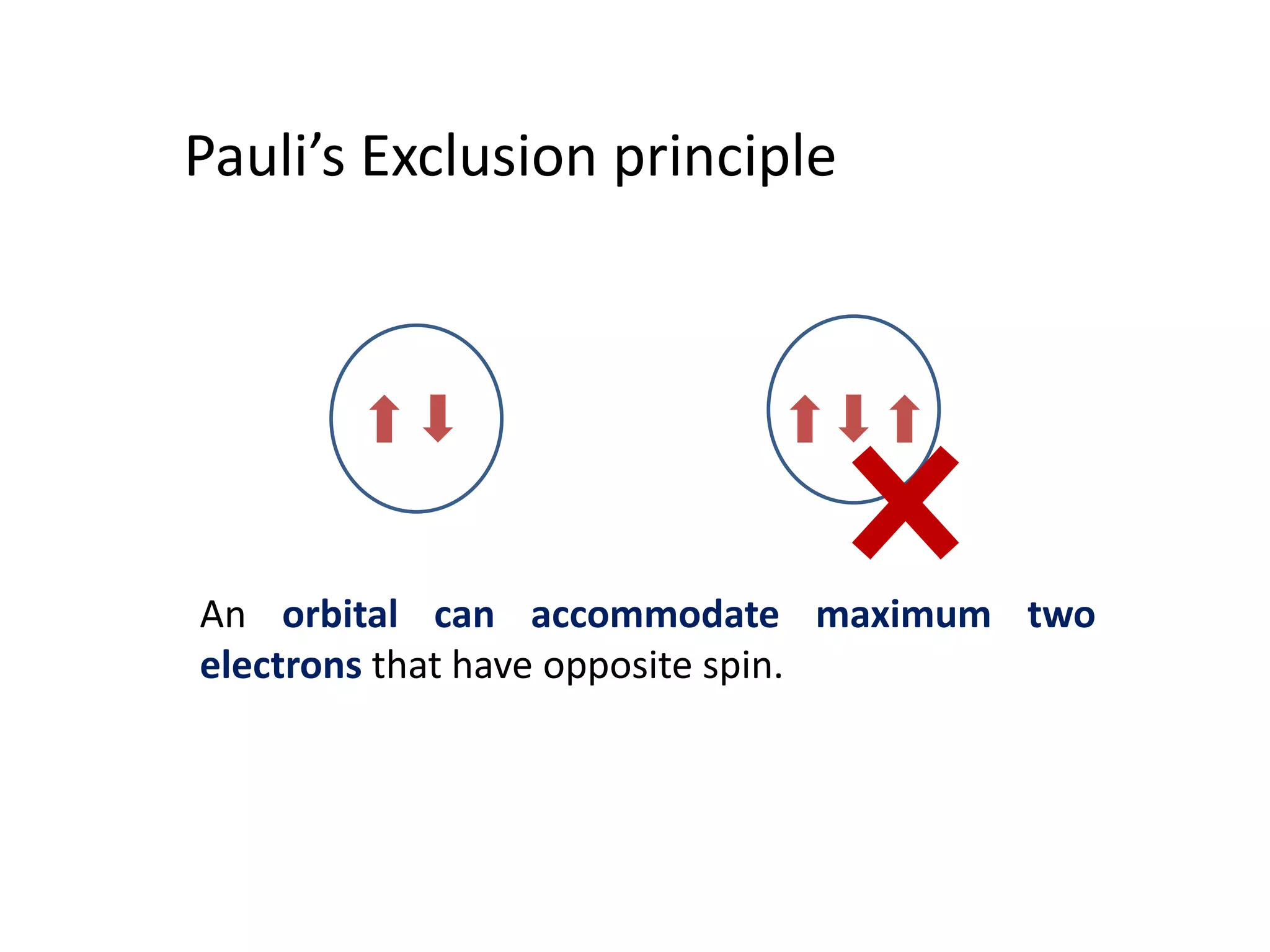
Pauli’s Exclusion principle
An orbital can accommodate maximum two
electrons that have opposite spin.
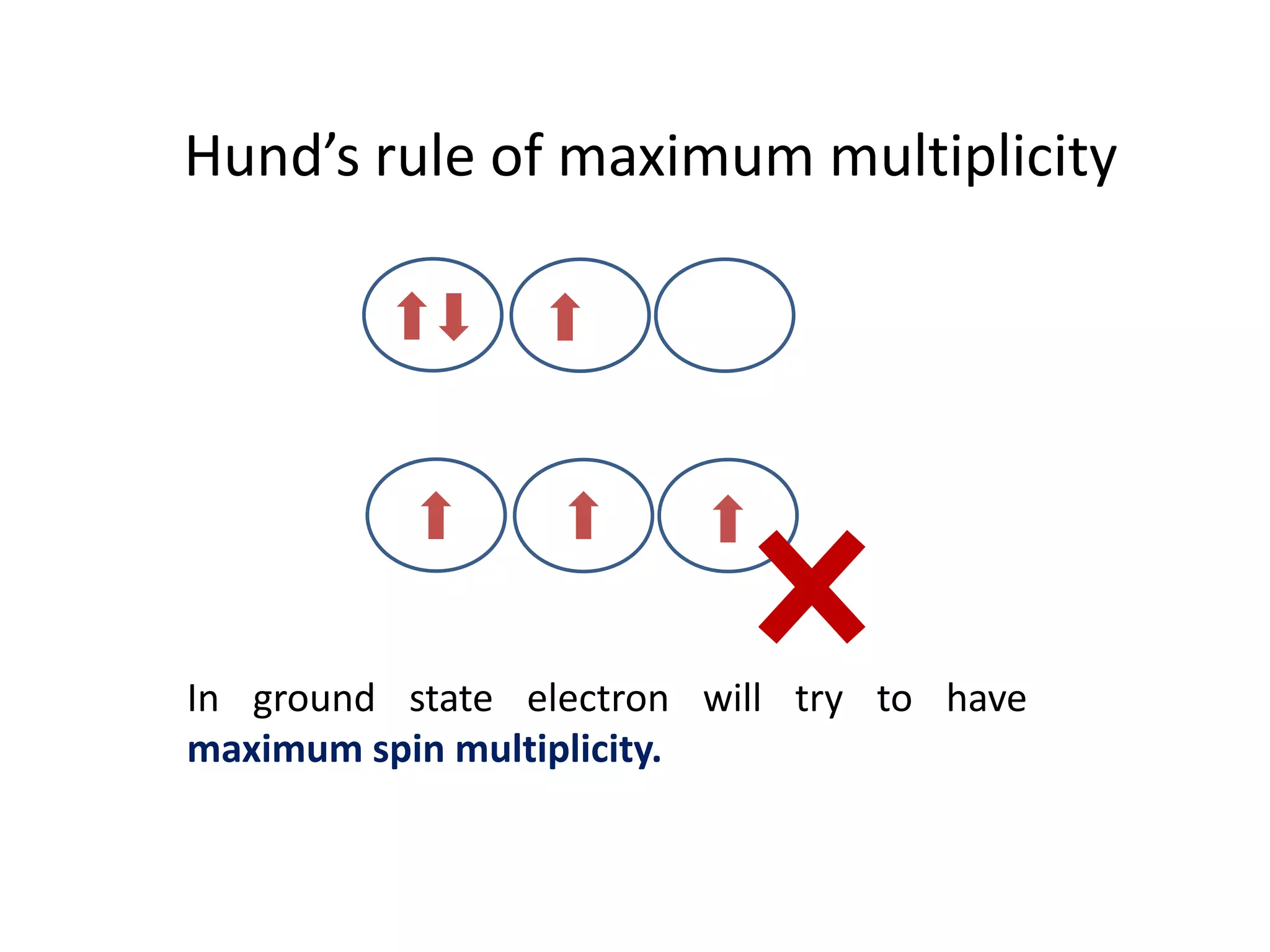
Hund’s rule of maximum multiplicity
In ground state electron will try to have
maximum spin multiplicity.
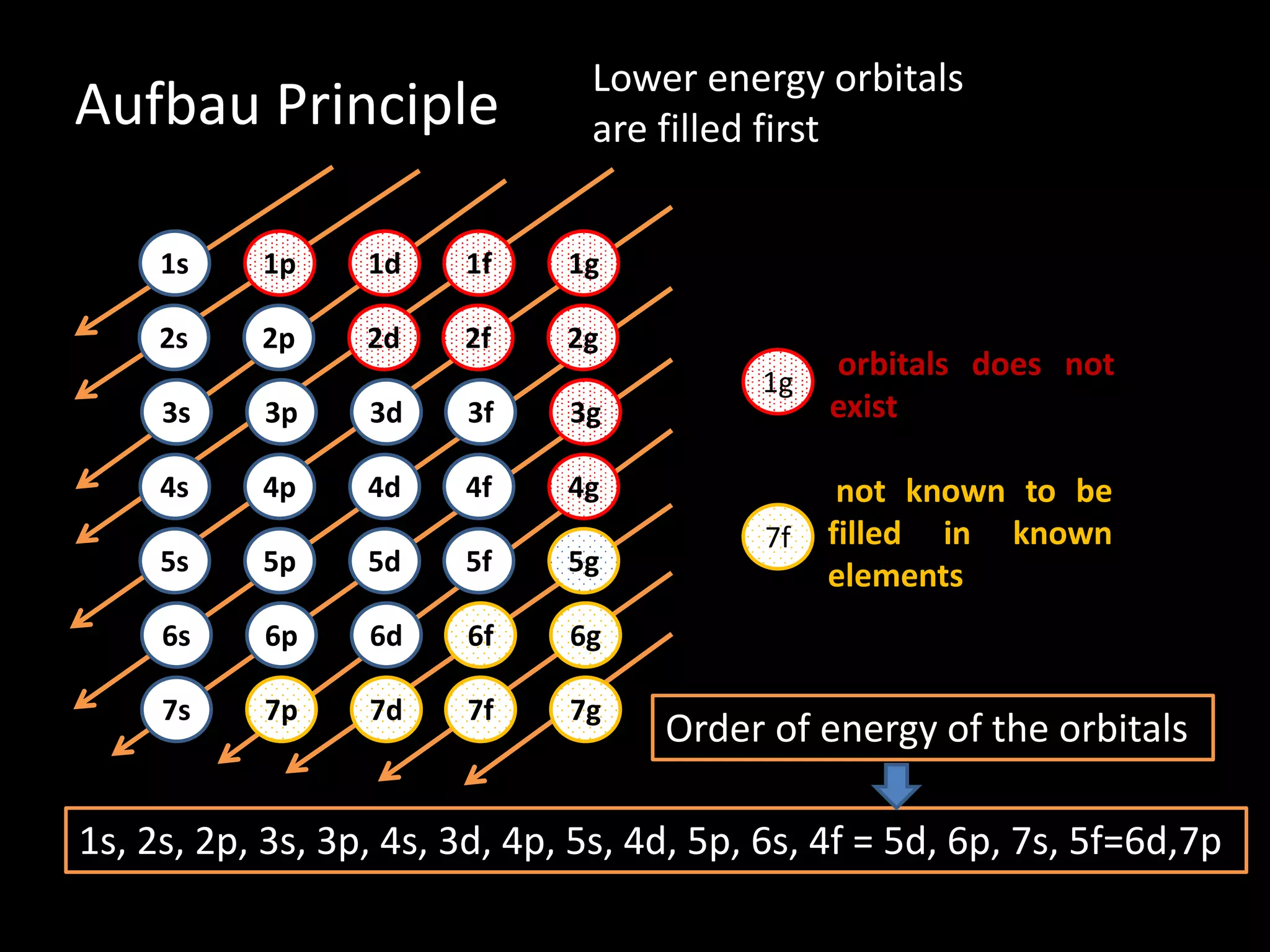
Aufbau Principle
1s
2s
3s
4s
5s
6s
7s
1p
2p
3p
4p
5p
6p
7p
1d
2d
3d
4d
5d
6d
7d
1f
2f
3f
4f
5f
6f
7f
1g
2g
3g
4g
5g
6g
7g
1g
7f
orbitals does not
exist
not known to be
filled in known
elements
Lower energy orbitals
are filled first
1s, 2s, 2p, 3s, 3p, 4s, 3d, 4p, 5s, 4d, 5p, 6s, 4f = 5d, 6p, 7s, 5f=6d,7p
Order of energy of the orbitals
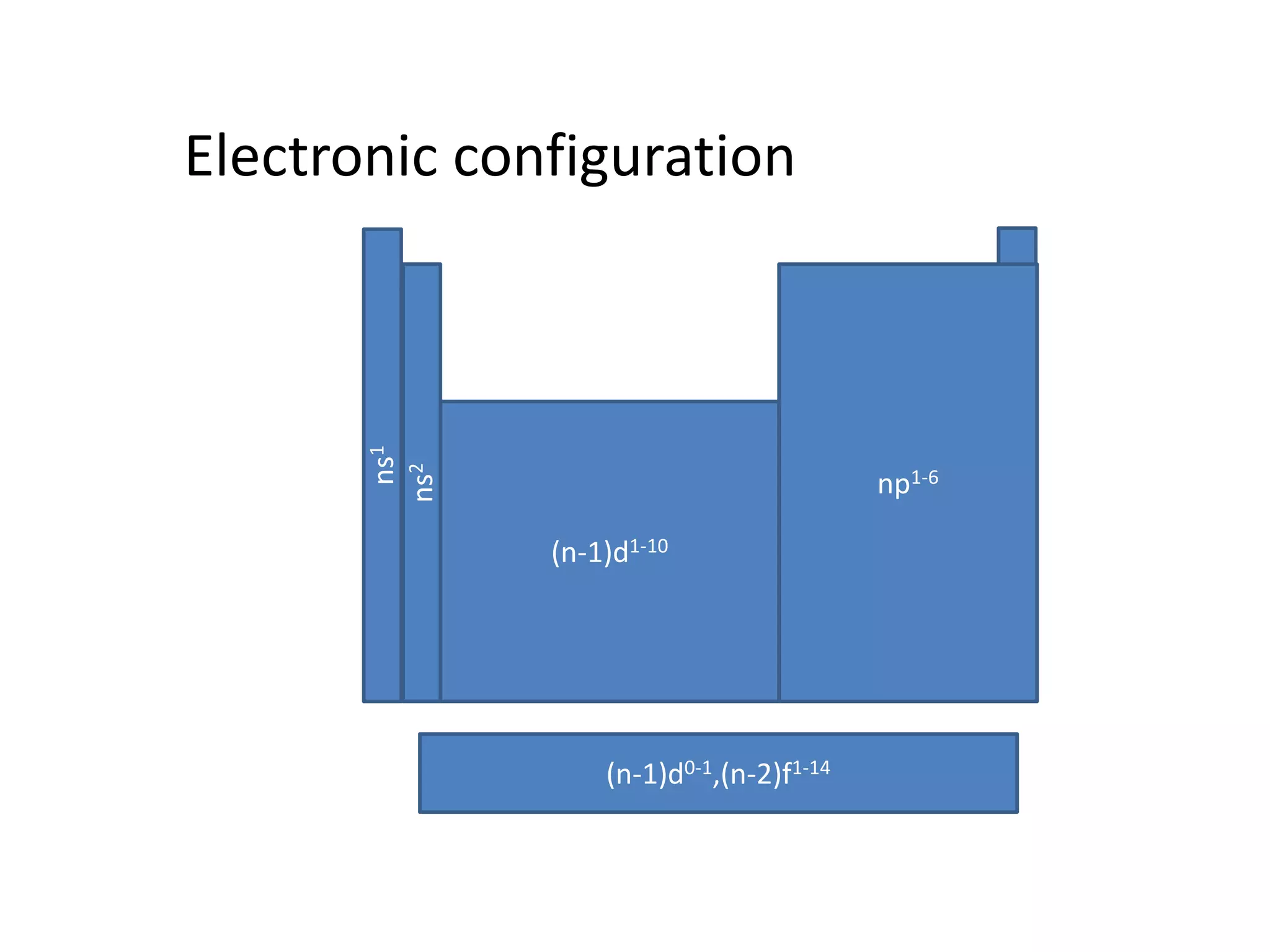
ns1
Electronic configuration
ns1
ns2
np1-6
(n-1)d1-10
(n-1)d0-1,(n-2)f1-14
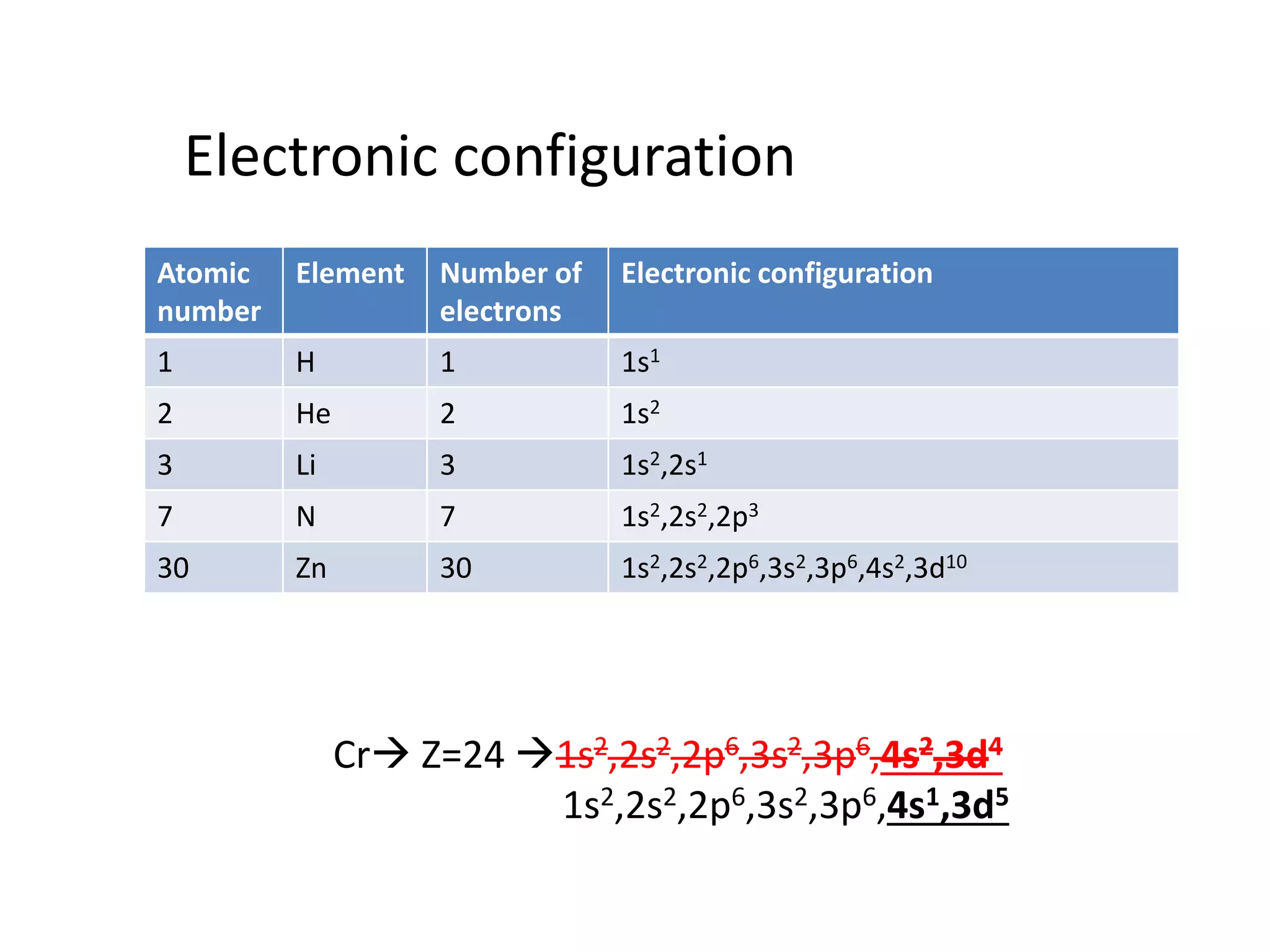
Electronic configuration
Atomic
number
Element Number of
electrons
Electronic configuration
1 H 1 1s1
2 He 2 1s2
3 Li 3 1s2,2s1
7 N 7 1s2,2s2,2p3
30 Zn 30 1s2,2s2,2p6,3s2,3p6,4s2,3d10
Cr Z=24 1s2,2s2,2p6,3s2,3p6,4s2,3d4
1s2,2s2,2p6,3s2,3p6,4s1,3d5
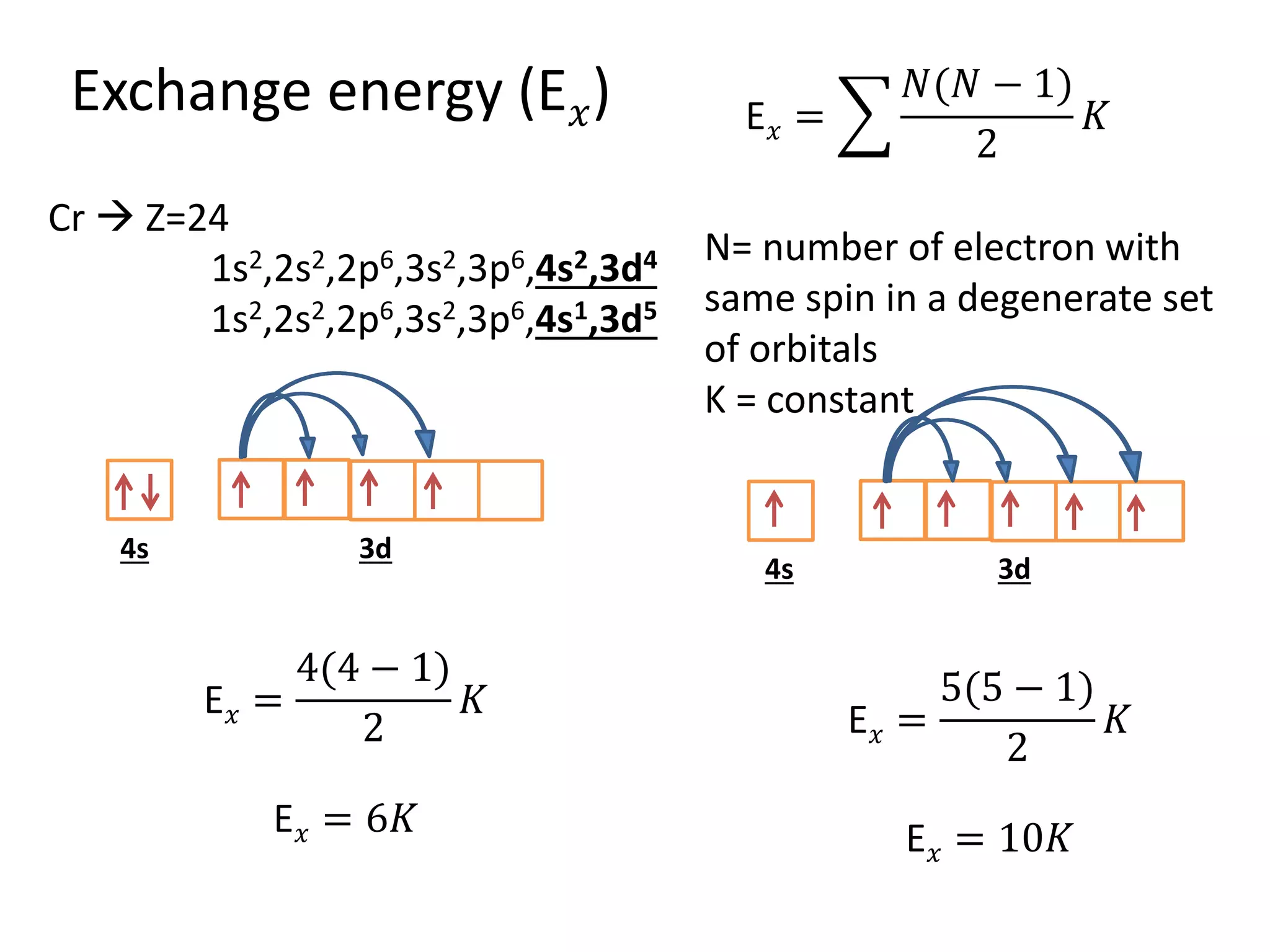
Exchange energy (E 𝑥)
Cr  Z=24
1s2,2s2,2p6,3s2,3p6,4s2,3d4
1s2,2s2,2p6,3s2,3p6,4s1,3d5
4s 3d
4s 3d
E 𝑥 =
𝑁(𝑁 − 1)
2
𝐾
N= number of electron with
same spin in a degenerate set
of orbitals
K = constant
E 𝑥 =
4(4 − 1)
2
𝐾
E 𝑥 = 6𝐾
E 𝑥 =
5(5 − 1)
2
𝐾
E 𝑥 = 10𝐾

Electronic configuration