Electronic circuit design and component selection
Nan-Wei Gong
MIT Media Lab
MAS.S63: Design for DIY Manufacturing
Goal for today’s lecture
• Pick up proper components for your project
• Rule of thumb for PCB design
• Suggestions for PCB layout and manufacturing
• Soldering and de-soldering basics
• Small - medium quantity electronics project production
• Homework :
Design a PCB for your project with a BOM (bill of
materials) and estimate the cost for making 100
(PCB manufacturing + assembly + components)
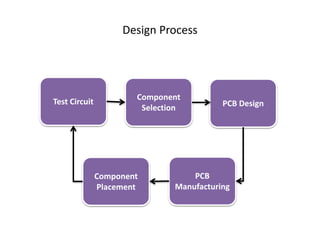
Design Process
Test Circuit
Component
Selection PCB Design
Component
Placement
PCB
Manufacturing
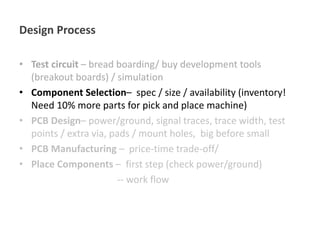
Design Process
• Test circuit – bread boarding/ buy development tools
(breakout boards) / simulation
• Component Selection– spec / size / availability (inventory!
Need 10% more parts for pick and place machine)
• PCB Design– power/ground, signal traces, trace width, test
points / extra via, pads / mount holes, big before small
• PCB Manufacturing – price-time trade-off/
• Place Components – first step (check power/ground)
-- work flow
http://www.beldynsys.com/cc521.htm
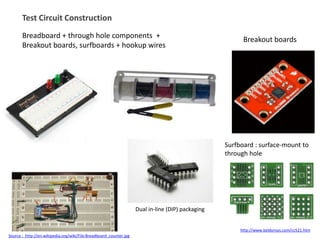
Test Circuit Construction
Breakout boards
Surfboard : surface-mount to
through hole
Breadboard + through hole components +
Breakout boards, surfboards + hookup wires
Source : http://en.wikipedia.org/wiki/File:Breadboard_counter.jpg
Dual in-line (DIP) packaging
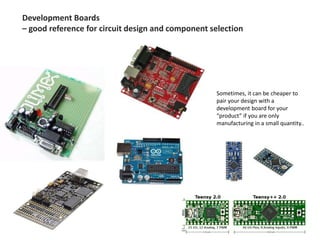
Development Boards
– good reference for circuit design and component selection
Sometimes, it can be cheaper to
pair your design with a
development board for your
“product” if you are only
manufacturing in a small quantity..
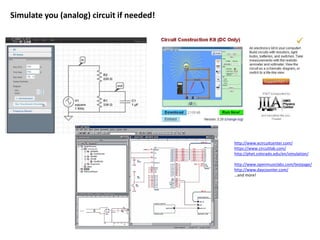
Simulate you (analog) circuit if needed!
http://www.ecircuitcenter.com/
https://www.circuitlab.com/
http://phet.colorado.edu/en/simulation/
http://www.openmusiclabs.com/testpage/
http://www.daycounter.com/
…and more!
Design Process
• Test circuit – bread boarding/ buy development tools
(breakout boards) / simulation
• Component Selection– spec / size / availability (inventory!
Need 10% more parts for pick and place machine)
• PCB Design– power/ground, signal traces, trace width, test
points / extra via, pads / mount holes, big before small
• PCB Manufacturing – price-time trade-off/
• Place Components – first step (check power/ground)
-- work flow
Electronic Components Distributor
Components
Wire Selection
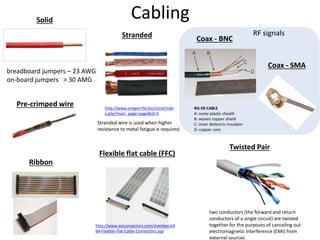
• WIRE GAUGE – AWG (American wire gauge)
– the diameters of round, solid, nonferrous, electrically conducting wire. The
cross-sectional area of each gauge is an important factor for determining its
current-carrying capacity.
• JACKET (Insulation)
– The jacket physically protects the internal components of a cable,
improves the cable’s appearance and provides flame retardancy –
Protects from the environment–Protects from the rigors of installation
http://www.belden.com/docs/upload/Insulations-Jackets.pdf
Cabling
Solid
Stranded
Ribbon
Flexible flat cable (FFC)
Twisted Pair
Coax - BNC
Coax - SMA
breadboard jumpers – 23 AWG
on-board jumpers > 30 AMG
http://www.oregonrfid.biz/store/inde
x.php?main_page=page&id=3
Pre-crimped wire RG-59 CABLE
A: outer plastic sheath
B: woven copper shield
C: inner dielectric insulator
D: copper core
Stranded wire is used when higher
resistance to metal fatigue is required.
http://www.asiconnectors.com/member/x9
64-Flexible-Flat-Cable-Connectors.asp
two conductors (the forward and return
conductors of a single circuit) are twisted
together for the purposes of canceling out
electromagnetic interference (EMI) from
external sources
RF signals
Jumpers between chips
30 AWG solid wire
Antenna for Zigbee Radio
¼ wavelength solid 23 AWG wire
Connector for flexible
flat cable (for
programmer)
http://search.digikey.com/scripts/DkSearch/dksus.dll?x=0&y=0&lang=
en&site=us&KeyWords=switch
Tactile button
DIP switch
SPST switch
SPDT switch
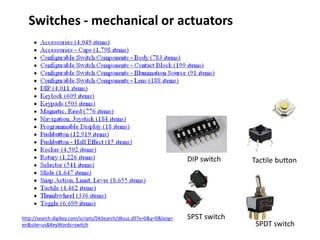
Switches - mechanical or actuators
Switches
Electronics
specification
Expansion Description Symbol
SPST Single pole, single throw
A simple on-off switch: The two terminals are either
connected together or disconnected from each other.
An example is a light switch.
SPDT Single pole, double throw
A simple changeover switch: C (COM, Common) is
connected to L1 or to L2.
SPCO
SPTT, c.o.
Single pole changeover
or
Single pole, centre off or
Single Pole, Triple Throw
Similar to SPDT. Some suppliers use SPCO/SPTT for
switches with a stable off position in the centre
and SPDT for those without.[citation needed]
DPST Double pole, single throw
Equivalent to two SPST switches controlled by a single
mechanism
DPDT Double pole, double throw
Equivalent to two SPDT switches controlled by a single
mechanism.
DPCO
Double pole changeover
or Double pole, centre off
Equivalent to DPDT. Some suppliers use DPCO for
switches with a stable off position in the centre
and DPDT for those without.
http://en.wikipedia.org/wiki/Switch
Battery
NiCad NiMH Lead Acid Li-Ion Li-Polymer
Rechargeable
Alkaline
Gravimetric Energy Density (Wh/kg) 45 - 80 60 - 120 30 - 50 110 - 160 100 - 150 80 (initial)
Internal Resistance (mΩ)
(includes peripheral circuits)
100 - 200
6V pack
200 - 300
6V pack
<100
12V pack
150 - 250
7.2V pack
200 - 300
7.2V pack
200 - 2000
6V pack
Cycle Life (to 80% of initial capacity) 1500 300 - 500 200 - 300 500 - 1000 300 - 500
50
(to 50%)
Self-discharge / Month (room temp) 20% 30% 5% 10% 10% 0.3%
Cell Voltage
(nominal)
1.25V 1.25V 2V 3.6V 3.6V 1.5V
Load Current*
- peak
- best result
20C
1C
5C
0.5C or less
5C
0.2C
>20C
5C or less
>20C
5C or less
0.5C
0.2C or less
Operating Temperature -40 - 60°C -20 - 60°C -20 - 60°C -20 - 60°C 0 - 60°C 0 - 65°C
Maintenance Requirement 30 - 60 days 60 - 90 days 3 - 6 months not req. not req. not req.
http://www.rfcafe.com/references/electrical/batteries.htm
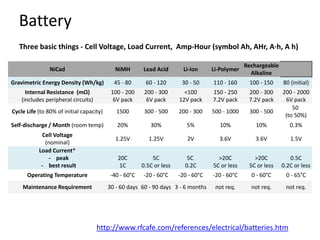
Three basic things - Cell Voltage, Load Current, Amp-Hour (symbol Ah, AHr, A·h, A h)
Footprint - same component / IC comes in different footprints
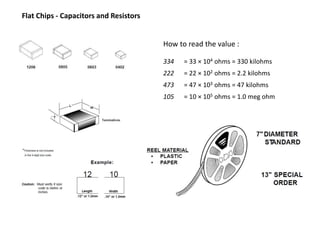
Flat Chips - Capacitors and Resistors
334 = 33 × 104 ohms = 330 kilohms
222 = 22 × 102 ohms = 2.2 kilohms
473 = 47 × 103 ohms = 47 kilohms
105 = 10 × 105 ohms = 1.0 meg ohm
How to read the value :
http://en.wikipedia.org/wiki/File:Cap-elko-smd-polarity.jpg
Capacitors Voltage rating for capacitors –
Really important for power circuits
http://www.bcae1.com/capacitr.htm
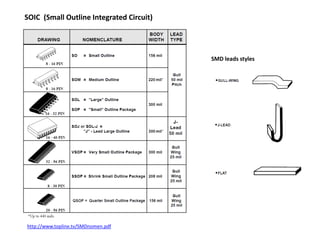
Footprint - same IC comes in different footprints
Courtesy of Analog Device’s poster
SMD (surface-mount device) ICs
http://www.topline.tv/SMDnomen.pdf
SMD leads styles
http://www.topline.tv/SMDnomen.pdf
SOIC (Small Outline Integrated Circuit)
PCB design software
Free software
EAGLE (Easily Applicable Graphical Layout Editor) http://www.cadsoftusa.com/
http://www.sparkfun.com/tutorials/109
Tutorials from Sparkfun ->
http://www.freepcb.com/
http://www.expresspcb.com/
http://www.4pcb.com/free-pcb-layout-software/
And more…
But it’s just another CAD software
Two major components
- Schematics
- PCB Layout
And sometimes.. 3D simulation
PCB design software
Things you need to know
1. Pick your software (we will have a tutorial on EAGLE)
2. Pick the parts  build “footprint” for the parts, or find them from a library
3. Draw circuit diagram  Schematics
4. Route the physical circuitry  PCB Layout
Things you need to know
1. Pick your software (we will have a tutorial on EAGLE)
2. Pick the parts  build “footprint” for the parts, or find them from a library
3. Draw circuit diagram  Schematics
4. Route the physical circuitry  PCB Layout
Create PCB file from schematics
Design schematics with components from a library
Things you need to know
1. Pick your software (we will have a tutorial on EAGLE)
2. Pick the parts  build “footprint” for the parts, or find them from a library
3. Draw circuit diagram  Schematics
4. Route the physical circuitry  PCB Layout
Tips - right click to switch through routing menu
middle click to switch between layers
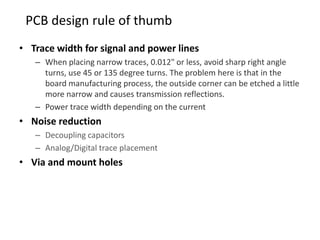
PCB design rule of thumb
• Trace width for signal and power lines
– When placing narrow traces, 0.012" or less, avoid sharp right angle
turns, use 45 or 135 degree turns. The problem here is that in the
board manufacturing process, the outside corner can be etched a little
more narrow and causes transmission reflections.
– Power trace width depending on the current
• Noise reduction
– Decoupling capacitors
– Analog/Digital trace placement
• Via and mount holes
http://circuitcalculator.com/wordpress/2006/01/31/pcb-trace-width-calculator/
Area[mils^2] = (I[Amps]/(k*(Temp_Rise[deg. C])^b))^(1/c)
Then, the Width is calculated:
Width[mils] = Area[mils^2]/(Thickness[oz]*1.378[mils/oz])
Trace width calculation – to avoid voltage drop
(trace resistance) and over heating
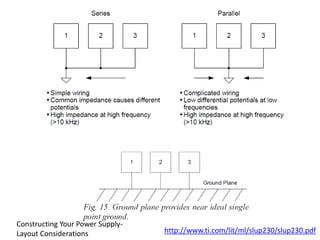
http://www.ti.com/lit/ml/slup230/slup230.pdf
Constructing Your Power Supply-
Layout Considerations
Analog ground Digital ground
Power Plane
Power Plane
(switching supply
/ Clock)
Ferrite Bead
A ferrite bead is a passive
electric component used to
suppress high frequency noise
in electronic circuits
It employ high dissipation of
high frequency currents in a
ferrite to build high frequency
noise suppression devices
http://en.wikipedia.org/wiki/F
errite_bead
0 Ohm resistor or simple connect them with trace
Split Ground Planes
Split Power Planes
Decoupling
• http://en.wikipedia.org/wiki/Decoupling_capa
citor
• Decoupling is the process of adding small LC
networks to ICs to provide a
• low impedance to ground at high frequencies
and surge current at
• switching frequencies.
• The basic layers are: copper, silk screen, solder mask, and NC Drill.
Copper layer stands for the conductive wires, silk screen is the marks and
names, solder mask(stop layer)is the top non-conductive layer,
and NC drill is the drill hole location.
For example, if you need a two layer PCB with top layer silk screen, you will
need to send
• Top Copper (GTL)
• Top Solder mask (GTS)
• Top Silkscreen (GTO)
• Bottom Copper (GBL)
• Bottom Solder mask (GBS)
• Bottom Silkscreen (GBO)
• Drill File
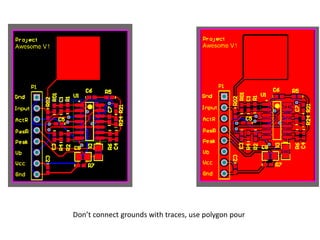
Don’t connect grounds with traces, use polygon pour
Top Copper
Top Solder mask
Top Silkscreen
Bottom Copper
Bottom Solder mask
Bottom Silkscreen
HOLD NOTICE / FreeDFM CHECK
PCB Assembly
• Things you need to know
– Soldering
– De-soldering
– Re-flow
– Pick and Place Machine
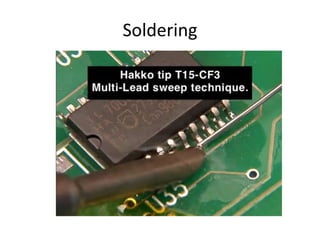
Soldering
Soldering
• Solder size
– Depending of size of the part
• Solder paste
– For SMD components
• Solder tips
http://store.curiousinventor.com/guides/
Surface_Mount_Soldering/Tools/
De-soldering and Re-flow
• Flux - chemical cleaning agent, flowing agent, or purifying agent
• Solder Sucker or Solder-wick
Before
After
Hot air station
for removing quad flat packages (where there are too many
leads to properly de-solder it without )
Infrared Rework Station
Same idea with the hot air station,
The only difference is it won’t blow away tiny parts
PCB manufacturing and assembly
http://www.custompcb.com/
starting at $18 each
http://www.advancedcircuits.com/
$33/board
http://www.streamlinecircuits.com/
Need to know
1. Board layers
2. Material (FR4)
3. Trace width
4. Solder mask and silkscreen color
5. Thickness
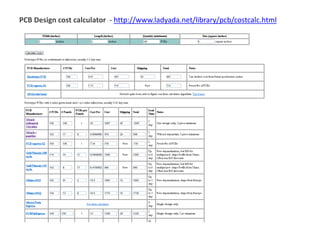
PCB Design cost calculator - http://www.ladyada.net/library/pcb/costcalc.html
Cheap way to get more boards made from the same order
Put via everywhere so you can separate different designs!
Break the board with a bender
Cheap way to test your circuit design – barebones PCB without solder mask
Board assembly
• http://www.protoexpress.com/
• http://www.advancedcircuits.com/
• http://www.spinpcb.com/
• http://www.leaflabs.com
• http://www.suntroncorp.com
• http://www.rapidboard.com/
• http://www.pcacorporation.com/
• http://www.pcbassemblydepot.com/
• http://www.flexone.com/
INFO needed for a quote -
- Board quantity
- Unique parts
- Both Sides?
- Lead-free?
- # of SMT parts
- # of through hole
- # of fine pitch / QFM items
- Jumper wire? (if you made mistakes)
How to order PCB assembly
• You can ask them to order the parts or you can send them the parts.
• Files needed -
– Bill of Materials(BOM)
– Centroid data
• Centroid data (aka Insertion or Pick-and-place or XY data) - This is the machine file, which should
include: X, Y, Theta, Side of Board (Top or Bottom), and Reference Designator.
• The BOM from Eagle is not the format that they like.
For generating Centroid data, see
http://www.screamingcircuits.com/services/how-it-works.aspx#eagle
Footprint Comment LibRef Designator Description Quantity Distributor Distributor part ID
1608[0603] 100nF Cap Semi
C11, C14, C17, C20,
C34, C35, C51, C62,
C63
Capacitor 9 Digi-key 490-1524-6-ND
Pick and Place

Electronic circuit design and component selection.pptx

  • 1.
    Electronic circuit designand component selection Nan-Wei Gong MIT Media Lab MAS.S63: Design for DIY Manufacturing
  • 2.
    Goal for today’slecture • Pick up proper components for your project • Rule of thumb for PCB design • Suggestions for PCB layout and manufacturing • Soldering and de-soldering basics • Small - medium quantity electronics project production • Homework : Design a PCB for your project with a BOM (bill of materials) and estimate the cost for making 100 (PCB manufacturing + assembly + components)
  • 3.
    Design Process Test Circuit Component SelectionPCB Design Component Placement PCB Manufacturing
  • 4.
    Design Process • Testcircuit – bread boarding/ buy development tools (breakout boards) / simulation • Component Selection– spec / size / availability (inventory! Need 10% more parts for pick and place machine) • PCB Design– power/ground, signal traces, trace width, test points / extra via, pads / mount holes, big before small • PCB Manufacturing – price-time trade-off/ • Place Components – first step (check power/ground) -- work flow
  • 5.
    http://www.beldynsys.com/cc521.htm Test Circuit Construction Breakoutboards Surfboard : surface-mount to through hole Breadboard + through hole components + Breakout boards, surfboards + hookup wires Source : http://en.wikipedia.org/wiki/File:Breadboard_counter.jpg Dual in-line (DIP) packaging
  • 6.
    Development Boards – goodreference for circuit design and component selection Sometimes, it can be cheaper to pair your design with a development board for your “product” if you are only manufacturing in a small quantity..
  • 7.
    Simulate you (analog)circuit if needed! http://www.ecircuitcenter.com/ https://www.circuitlab.com/ http://phet.colorado.edu/en/simulation/ http://www.openmusiclabs.com/testpage/ http://www.daycounter.com/ …and more!
  • 8.
    Design Process • Testcircuit – bread boarding/ buy development tools (breakout boards) / simulation • Component Selection– spec / size / availability (inventory! Need 10% more parts for pick and place machine) • PCB Design– power/ground, signal traces, trace width, test points / extra via, pads / mount holes, big before small • PCB Manufacturing – price-time trade-off/ • Place Components – first step (check power/ground) -- work flow
  • 9.
  • 10.
    Wire Selection • WIREGAUGE – AWG (American wire gauge) – the diameters of round, solid, nonferrous, electrically conducting wire. The cross-sectional area of each gauge is an important factor for determining its current-carrying capacity. • JACKET (Insulation) – The jacket physically protects the internal components of a cable, improves the cable’s appearance and provides flame retardancy – Protects from the environment–Protects from the rigors of installation http://www.belden.com/docs/upload/Insulations-Jackets.pdf
  • 11.
    Cabling Solid Stranded Ribbon Flexible flat cable(FFC) Twisted Pair Coax - BNC Coax - SMA breadboard jumpers – 23 AWG on-board jumpers > 30 AMG http://www.oregonrfid.biz/store/inde x.php?main_page=page&id=3 Pre-crimped wire RG-59 CABLE A: outer plastic sheath B: woven copper shield C: inner dielectric insulator D: copper core Stranded wire is used when higher resistance to metal fatigue is required. http://www.asiconnectors.com/member/x9 64-Flexible-Flat-Cable-Connectors.asp two conductors (the forward and return conductors of a single circuit) are twisted together for the purposes of canceling out electromagnetic interference (EMI) from external sources RF signals
  • 12.
    Jumpers between chips 30AWG solid wire Antenna for Zigbee Radio ¼ wavelength solid 23 AWG wire Connector for flexible flat cable (for programmer)
  • 13.
  • 14.
    Switches Electronics specification Expansion Description Symbol SPSTSingle pole, single throw A simple on-off switch: The two terminals are either connected together or disconnected from each other. An example is a light switch. SPDT Single pole, double throw A simple changeover switch: C (COM, Common) is connected to L1 or to L2. SPCO SPTT, c.o. Single pole changeover or Single pole, centre off or Single Pole, Triple Throw Similar to SPDT. Some suppliers use SPCO/SPTT for switches with a stable off position in the centre and SPDT for those without.[citation needed] DPST Double pole, single throw Equivalent to two SPST switches controlled by a single mechanism DPDT Double pole, double throw Equivalent to two SPDT switches controlled by a single mechanism. DPCO Double pole changeover or Double pole, centre off Equivalent to DPDT. Some suppliers use DPCO for switches with a stable off position in the centre and DPDT for those without. http://en.wikipedia.org/wiki/Switch
  • 15.
    Battery NiCad NiMH LeadAcid Li-Ion Li-Polymer Rechargeable Alkaline Gravimetric Energy Density (Wh/kg) 45 - 80 60 - 120 30 - 50 110 - 160 100 - 150 80 (initial) Internal Resistance (mΩ) (includes peripheral circuits) 100 - 200 6V pack 200 - 300 6V pack <100 12V pack 150 - 250 7.2V pack 200 - 300 7.2V pack 200 - 2000 6V pack Cycle Life (to 80% of initial capacity) 1500 300 - 500 200 - 300 500 - 1000 300 - 500 50 (to 50%) Self-discharge / Month (room temp) 20% 30% 5% 10% 10% 0.3% Cell Voltage (nominal) 1.25V 1.25V 2V 3.6V 3.6V 1.5V Load Current* - peak - best result 20C 1C 5C 0.5C or less 5C 0.2C >20C 5C or less >20C 5C or less 0.5C 0.2C or less Operating Temperature -40 - 60°C -20 - 60°C -20 - 60°C -20 - 60°C 0 - 60°C 0 - 65°C Maintenance Requirement 30 - 60 days 60 - 90 days 3 - 6 months not req. not req. not req. http://www.rfcafe.com/references/electrical/batteries.htm Three basic things - Cell Voltage, Load Current, Amp-Hour (symbol Ah, AHr, A·h, A h)
  • 16.
    Footprint - samecomponent / IC comes in different footprints
  • 17.
    Flat Chips -Capacitors and Resistors 334 = 33 × 104 ohms = 330 kilohms 222 = 22 × 102 ohms = 2.2 kilohms 473 = 47 × 103 ohms = 47 kilohms 105 = 10 × 105 ohms = 1.0 meg ohm How to read the value :
  • 18.
    http://en.wikipedia.org/wiki/File:Cap-elko-smd-polarity.jpg Capacitors Voltage ratingfor capacitors – Really important for power circuits http://www.bcae1.com/capacitr.htm
  • 19.
    Footprint - sameIC comes in different footprints Courtesy of Analog Device’s poster SMD (surface-mount device) ICs http://www.topline.tv/SMDnomen.pdf
  • 20.
  • 21.
    PCB design software Freesoftware EAGLE (Easily Applicable Graphical Layout Editor) http://www.cadsoftusa.com/ http://www.sparkfun.com/tutorials/109 Tutorials from Sparkfun -> http://www.freepcb.com/ http://www.expresspcb.com/ http://www.4pcb.com/free-pcb-layout-software/ And more… But it’s just another CAD software Two major components - Schematics - PCB Layout And sometimes.. 3D simulation
  • 22.
    PCB design software Thingsyou need to know 1. Pick your software (we will have a tutorial on EAGLE) 2. Pick the parts  build “footprint” for the parts, or find them from a library 3. Draw circuit diagram  Schematics 4. Route the physical circuitry  PCB Layout
  • 23.
    Things you needto know 1. Pick your software (we will have a tutorial on EAGLE) 2. Pick the parts  build “footprint” for the parts, or find them from a library 3. Draw circuit diagram  Schematics 4. Route the physical circuitry  PCB Layout Create PCB file from schematics Design schematics with components from a library
  • 24.
    Things you needto know 1. Pick your software (we will have a tutorial on EAGLE) 2. Pick the parts  build “footprint” for the parts, or find them from a library 3. Draw circuit diagram  Schematics 4. Route the physical circuitry  PCB Layout Tips - right click to switch through routing menu middle click to switch between layers
  • 25.
    PCB design ruleof thumb • Trace width for signal and power lines – When placing narrow traces, 0.012" or less, avoid sharp right angle turns, use 45 or 135 degree turns. The problem here is that in the board manufacturing process, the outside corner can be etched a little more narrow and causes transmission reflections. – Power trace width depending on the current • Noise reduction – Decoupling capacitors – Analog/Digital trace placement • Via and mount holes
  • 26.
    http://circuitcalculator.com/wordpress/2006/01/31/pcb-trace-width-calculator/ Area[mils^2] = (I[Amps]/(k*(Temp_Rise[deg.C])^b))^(1/c) Then, the Width is calculated: Width[mils] = Area[mils^2]/(Thickness[oz]*1.378[mils/oz]) Trace width calculation – to avoid voltage drop (trace resistance) and over heating
  • 28.
  • 29.
    Analog ground Digitalground Power Plane Power Plane (switching supply / Clock) Ferrite Bead A ferrite bead is a passive electric component used to suppress high frequency noise in electronic circuits It employ high dissipation of high frequency currents in a ferrite to build high frequency noise suppression devices http://en.wikipedia.org/wiki/F errite_bead 0 Ohm resistor or simple connect them with trace Split Ground Planes Split Power Planes
  • 30.
    Decoupling • http://en.wikipedia.org/wiki/Decoupling_capa citor • Decouplingis the process of adding small LC networks to ICs to provide a • low impedance to ground at high frequencies and surge current at • switching frequencies.
  • 31.
    • The basiclayers are: copper, silk screen, solder mask, and NC Drill. Copper layer stands for the conductive wires, silk screen is the marks and names, solder mask(stop layer)is the top non-conductive layer, and NC drill is the drill hole location. For example, if you need a two layer PCB with top layer silk screen, you will need to send • Top Copper (GTL) • Top Solder mask (GTS) • Top Silkscreen (GTO) • Bottom Copper (GBL) • Bottom Solder mask (GBS) • Bottom Silkscreen (GBO) • Drill File
  • 32.
    Don’t connect groundswith traces, use polygon pour
  • 33.
    Top Copper Top Soldermask Top Silkscreen Bottom Copper Bottom Solder mask Bottom Silkscreen
  • 34.
    HOLD NOTICE /FreeDFM CHECK
  • 35.
    PCB Assembly • Thingsyou need to know – Soldering – De-soldering – Re-flow – Pick and Place Machine
  • 36.
  • 37.
    Soldering • Solder size –Depending of size of the part • Solder paste – For SMD components • Solder tips http://store.curiousinventor.com/guides/ Surface_Mount_Soldering/Tools/
  • 38.
    De-soldering and Re-flow •Flux - chemical cleaning agent, flowing agent, or purifying agent • Solder Sucker or Solder-wick Before After Hot air station for removing quad flat packages (where there are too many leads to properly de-solder it without ) Infrared Rework Station Same idea with the hot air station, The only difference is it won’t blow away tiny parts
  • 39.
    PCB manufacturing andassembly http://www.custompcb.com/ starting at $18 each http://www.advancedcircuits.com/ $33/board http://www.streamlinecircuits.com/ Need to know 1. Board layers 2. Material (FR4) 3. Trace width 4. Solder mask and silkscreen color 5. Thickness
  • 40.
    PCB Design costcalculator - http://www.ladyada.net/library/pcb/costcalc.html
  • 41.
    Cheap way toget more boards made from the same order Put via everywhere so you can separate different designs! Break the board with a bender Cheap way to test your circuit design – barebones PCB without solder mask
  • 42.
    Board assembly • http://www.protoexpress.com/ •http://www.advancedcircuits.com/ • http://www.spinpcb.com/ • http://www.leaflabs.com • http://www.suntroncorp.com • http://www.rapidboard.com/ • http://www.pcacorporation.com/ • http://www.pcbassemblydepot.com/ • http://www.flexone.com/ INFO needed for a quote - - Board quantity - Unique parts - Both Sides? - Lead-free? - # of SMT parts - # of through hole - # of fine pitch / QFM items - Jumper wire? (if you made mistakes)
  • 43.
    How to orderPCB assembly • You can ask them to order the parts or you can send them the parts. • Files needed - – Bill of Materials(BOM) – Centroid data • Centroid data (aka Insertion or Pick-and-place or XY data) - This is the machine file, which should include: X, Y, Theta, Side of Board (Top or Bottom), and Reference Designator. • The BOM from Eagle is not the format that they like. For generating Centroid data, see http://www.screamingcircuits.com/services/how-it-works.aspx#eagle Footprint Comment LibRef Designator Description Quantity Distributor Distributor part ID 1608[0603] 100nF Cap Semi C11, C14, C17, C20, C34, C35, C51, C62, C63 Capacitor 9 Digi-key 490-1524-6-ND
  • 44.

Editor's Notes

  • #45 Reals of components instead of cut tape