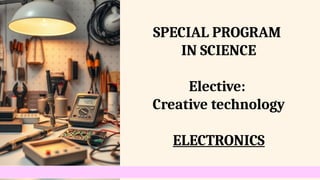
SPECIAL PROGRAM
IN SCIENCE
Elective:
Creative technology
ELECTRONICS
LESSON 1: INTRODUCTION TO ELECTRONIC TOOLS AND COMPONENTS
FIRST QUARTER
1. Hardware Tools
1.1. Electrostatic
Discharge
Tools
1.2. Hand Tools
1.3. Cleaning Tools
1.4. 1.4. Diagnostic Tools
2. Electronic Materials and
Component
3. Basic Electronic
Components in Relation to
Robotics Technology
3.1. Insulators
3.2. Resistors
3.3. Transistors
3.4. Diodes
3.5. Capacitors
3.6. Switches
Wires, cables, etc.
LESSON 2. OCCUPATIONAL HEALTH AND SAFETY PROCEDURES
FIRST QUARTER
1. OHS policies and standards.
1.1. Republic Act No.
11058 Occupational
Safety and Health
Standard of the
Philippines
1. OHS policies and standards.
1.2. Prepare the workplace
in accordance with the
OH&S policies,
procedure, and risk
control measures.
LESSON 3. PERFORMING MENSURATION AND EVALUATION OF
COMPONENTS (PMEC)
FIRST QUARTER
1.1. Electronic Measuring
instrument
a. Voltmeter
b. Ohmmeter
c. Ammeter
d. Multimeter
1. Instrumentation
1.2. Electronic
measurement
a. Voltage
b. Resistance
c. Current
LESSON 4. POWER SUPPLY FOR ROBOTICS AND INTELLIGENT MACHINES
FIRST QUARTER
1. Power Supply Basics
1.1. Transformers
1.2. Types of rectifier circuit
1.3. Capacitor
1.4. Voltage regulator
1.5. breadboard
Lesson 1: EVALUATING LOGIC GATES
SECOND QUARTER
Digital Logic
1.1. Logic gates
a. Boolean expression
b. Truth tables
1.2. Universal gates
1.3. Logic circuit
1.3. Logic circuit
1.4. Simulation software
1.5. Schematic diagram
a. Proteus
b. Eagle
c. Multisim
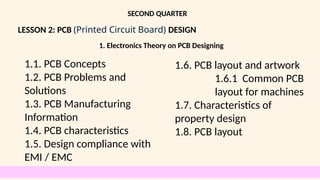
LESSON 2: PCB (Printed Circuit Board) DESIGN
SECOND QUARTER
1.1. PCB Concepts
1.2. PCB Problems and
Solutions
1.3. PCB Manufacturing
Information
1.4. PCB characteristics
1.5. Design compliance with
EMI / EMC
1.6. PCB layout and artwork
1.6.1 Common PCB
layout for machines
1.7. Characteristics of
property design
1.8. PCB layout
1. Electronics Theory on PCB Designing
LESSON 1: PCB FABRICATION
THIRD QUARTER
1. PCB Fabrication
1.1 Steps in PCB
Fabrication
a. Transferring layout
onto copper-clad board
b. Etching
c. Drilling
d. Cleaning
1.2 Transferring layout onto copper
clad board
a. Acceptable methods
1.Silk Screen
2.Photo Transfer
b. Alternative methods
3.Pen and tape method
1.3 Etching
a. Chemical
b. Electrochemical
c. Laser
d. Plasma
1.4Drill through-holes
1.5Proper techniques and tool
1.6 Proper Disposal of chemicals
1.7Standard procedures
1.8PCB functionality test
LESSON 1: PCB FABRICATION
THIRD QUARTER
1. PCB Fabrication
1.1 Steps in PCB
Fabrication
a. Transferring layout
onto copper-clad board
b. Etching
c. Drilling
d. Cleaning
1.2 Transferring layout onto copper
clad board
a. Acceptable methods
1.Silk Screen
2.Photo Transfer
b. Alternative methods
3.Pen and tape method
1.3 Etching
a. Chemical
b. Electrochemical
c. Laser
d. Plasma
1.4Drill through-holes
1.5Proper techniques and tool
1.6 Proper Disposal of chemicals
1.7Standard procedures
1.8PCB functionality test
LESSON 2: SOLDERING BASICS AND APPLICATION
THIRD QUARTER
1. Introduction to Soldering
2. Safety Precautions
3. Soldering Tools and
Equipment
4. Soldering Iron Operation
5. Solder Types and
Selection
6. Tinning and Cleaning
7. Component Preparation
8. Soldering Techniques
9. Desoldering
10. Quality Control
11. Soldering Safety Codes and
Standards
LESSON 3: PCB ASSEMBLY
THIRD QUARTER
1.PCB Population
1.1 common electrical components
1.2 electronics symbols and schematics diagram
1.3 soldering components on a fabricated PCB bare board.
1.4 inspection of defects
a. Soldering anomalies
b. Components misalignment
c. Issues with etched traces
LESSON 1: INTRODUCTION TO AUTOMATION TECHNOLOGY
FOURTH QUARTER
1. Basic Automation Technology concepts
. History
. definition
. Function
. Purpose
2. Robots and Machines
2.1 Types of robots
. Pre-programmed
. Remote sensing
. Augmenting
. Humanoid
. Etc.
2.2 Classification of robots
based on institutions such
as:
. JIRA
. INTEL-ISEF
. RIA
. etc.
The Foundation: Basic Hand Tools
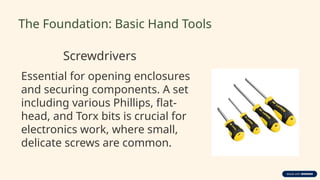
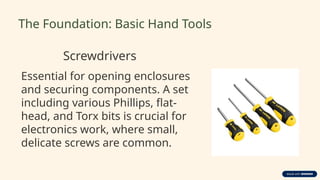
Screwdrivers
Essential for opening enclosures
and securing components. A set
including various Phillips, flat-
head, and Torx bits is crucial for
electronics work, where small,
delicate screws are common.
The Foundation: Basic Hand Tools
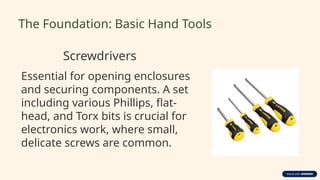
Screwdrivers
Essential for opening enclosures
and securing components. A set
including various Phillips, flat-
head, and Torx bits is crucial for
electronics work, where small,
delicate screws are common.
The Foundation: Basic Hand Tools
Screwdrivers
Essential for opening enclosures
and securing components. A set
including various Phillips, flat-
head, and Torx bits is crucial for
electronics work, where small,
delicate screws are common.
The Foundation: Basic Hand Tools
Screwdrivers
Essential for opening enclosures and securing components. A set including various Phillips, flat-head, and Torx bits is crucial for
electronics work, where small, delicate screws are common.
Pliers & Cutters
Needle-nose pliers are ideal for bending and manipulating wires in tight spaces. Diagonal cutters are indispensable for precise
wire trimming and component lead clipping, preventing shorts and ensuring neatness.
Wire Strippers
These specialized tools remove insulation without damaging the conductor, ensuring clean and reliable electrical connections.
Different gauges require specific stripper sizes for optimal results.
Before diving into complex circuits, a solid collection of basic hand tools is paramount. These tools are the foundation of any electronics
project, enabling precise manipulation and connection of components. Mastering their use ensures both efficiency and safety in your
work.
The Foundation: Basic Hand Tools
Screwdrivers
Essential for opening enclosures and securing components. A set including various Phillips, flat-head, and Torx bits is crucial for
electronics work, where small, delicate screws are common.
Pliers & Cutters
Needle-nose pliers are ideal for bending and manipulating wires in tight spaces. Diagonal cutters are indispensable for precise
wire trimming and component lead clipping, preventing shorts and ensuring neatness.
Wire Strippers
These specialized tools remove insulation without damaging the conductor, ensuring clean and reliable electrical connections.
Different gauges require specific stripper sizes for optimal results.
Before diving into complex circuits, a solid collection of basic hand tools is paramount. These tools are the foundation of any electronics
project, enabling precise manipulation and connection of components. Mastering their use ensures both efficiency and safety in your
work.
The Art of Connection: Soldering Equipment
Soldering Iron
The core tool for creating permanent electrical connections. Choose a temperature-controlled iron for versatility and to
prevent component damage. Different tips are available for various tasks.
Solder & Flux
Solder, typically a tin-lead or lead-free alloy, creates the conductive bond. Flux cleans the metal surfaces, allowing solder to
flow smoothly and create strong, reliable joints, crucial for signal integrity.
Solder Sucker/Braid
These tools are used for desoldering, removing excess solder or correcting mistakes. A solder sucker uses a vacuum, while
desoldering braid absorbs molten solder, preventing shorts and bridging.
Soldering is a fundamental skill in electronics, allowing for the creation of robust and lasting connections. Proper soldering techniques
are essential for circuit reliability and performance. Using the right tools ensures clean joints and minimizes the risk of component
damage.
Seeing the Unseen: Test & Measurement Devices
Multimeter
An indispensable tool for measuring voltage, current, and
resistance. It's crucial for debugging circuits, verifying component
values, and ensuring proper power delivery.
Oscilloscope
This device visualizes electrical signals over time, displaying
waveforms. It's vital for analyzing signal integrity, troubleshooting
timing issues, and understanding circuit behavior in dynamic
conditions.
Bench Power Supply
Provides a regulated and adjustable power source for testing
circuits. It allows engineers to simulate various voltage conditions
and protect sensitive components from overcurrent.
Test and measurement devices are the eyes and ears of an electronics engineer, providing critical insights into circuit operation. These tools
enable precise diagnostics, allowing for efficient troubleshooting and performance optimization.
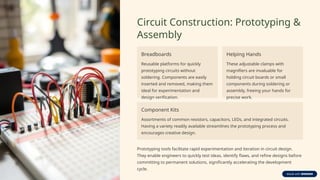
Circuit Construction: Prototyping &
Assembly
Breadboards
Reusable platforms for quickly
prototyping circuits without
soldering. Components are easily
inserted and removed, making them
ideal for experimentation and
design verification.
Helping Hands
These adjustable clamps with
magnifiers are invaluable for
holding circuit boards or small
components during soldering or
assembly, freeing your hands for
precise work.
Component Kits
Assortments of common resistors, capacitors, LEDs, and integrated circuits.
Having a variety readily available streamlines the prototyping process and
encourages creative design.
Prototyping tools facilitate rapid experimentation and iteration in circuit design.
They enable engineers to quickly test ideas, identify flaws, and refine designs before
committing to permanent solutions, significantly accelerating the development
cycle.
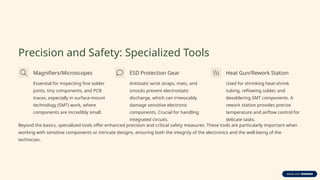
Precision and Safety: Specialized Tools
Magnifiers/Microscopes
Essential for inspecting fine solder
joints, tiny components, and PCB
traces, especially in surface-mount
technology (SMT) work, where
components are incredibly small.
ESD Protection Gear
Antistatic wrist straps, mats, and
smocks prevent electrostatic
discharge, which can irrevocably
damage sensitive electronic
components. Crucial for handling
integrated circuits.
Heat Gun/Rework Station
Used for shrinking heat-shrink
tubing, reflowing solder, and
desoldering SMT components. A
rework station provides precise
temperature and airflow control for
delicate tasks.
Beyond the basics, specialized tools offer enhanced precision and critical safety measures. These tools are particularly important when
working with sensitive components or intricate designs, ensuring both the integrity of the electronics and the well-being of the
technician.
Staying Organized: Storage and Workspace
Component Organizers
Small bins, drawers, or compartmentalized
boxes keep resistors, capacitors, and other
small parts neatly sorted and easily
accessible, preventing lost components and
saving time.
Toolbox/Bench Storage
A dedicated toolbox or well-designed bench
storage system ensures all tools have a
designated place, making them easy to find
and keeping the workspace tidy.
Dedicated Workbench
A clean, well-lit, and sturdy workbench
provides a stable platform for soldering,
assembly, and testing. Adequate space is
essential for spreading out components and
tools safely.
An organized workspace is not just aesthetically pleasing; it significantly boosts efficiency and reduces frustration. Knowing where every
tool and component is located streamlines the workflow, minimizes errors, and enhances the overall enjoyment of electronics work.
Key Takeaways & Next Steps
Invest in Quality Tools
Good tools are an investment that pays off in reliability,
precision, and longevity. Prioritize quality, especially for
frequently used items like multimeters and soldering irons.
Master the Basics
Proficiency with fundamental hand tools and soldering
techniques forms the bedrock of all electronics work.
Consistent practice will build confidence and skill.
Prioritize Safety
Always use ESD protection, proper ventilation for soldering,
and safety goggles when appropriate. A safe environment
protects both you and your delicate components.
Organize Your Space
A clean and organized workbench prevents lost parts, reduces
errors, and makes every project more enjoyable and efficient.
Develop a system and stick to it.
Equipped with the right tools and knowledge, you are now better prepared to tackle a wide range of electronics projects. Remember
that continuous learning and practice are key to mastering the art of electronics. Explore advanced techniques, experiment with new
components, and always prioritize safety in your endeavors.
ELECTRONIC SPECIAL CLASS SPS Electronics 8.pptx

  • 1.
  • 2.
    LESSON 1: INTRODUCTIONTO ELECTRONIC TOOLS AND COMPONENTS FIRST QUARTER 1. Hardware Tools 1.1. Electrostatic Discharge Tools 1.2. Hand Tools 1.3. Cleaning Tools 1.4. 1.4. Diagnostic Tools 2. Electronic Materials and Component 3. Basic Electronic Components in Relation to Robotics Technology 3.1. Insulators 3.2. Resistors 3.3. Transistors 3.4. Diodes 3.5. Capacitors 3.6. Switches Wires, cables, etc.
  • 3.
    LESSON 2. OCCUPATIONALHEALTH AND SAFETY PROCEDURES FIRST QUARTER 1. OHS policies and standards. 1.1. Republic Act No. 11058 Occupational Safety and Health Standard of the Philippines 1. OHS policies and standards. 1.2. Prepare the workplace in accordance with the OH&S policies, procedure, and risk control measures.
  • 4.
    LESSON 3. PERFORMINGMENSURATION AND EVALUATION OF COMPONENTS (PMEC) FIRST QUARTER 1.1. Electronic Measuring instrument a. Voltmeter b. Ohmmeter c. Ammeter d. Multimeter 1. Instrumentation 1.2. Electronic measurement a. Voltage b. Resistance c. Current
  • 5.
    LESSON 4. POWERSUPPLY FOR ROBOTICS AND INTELLIGENT MACHINES FIRST QUARTER 1. Power Supply Basics 1.1. Transformers 1.2. Types of rectifier circuit 1.3. Capacitor 1.4. Voltage regulator 1.5. breadboard
  • 6.
    Lesson 1: EVALUATINGLOGIC GATES SECOND QUARTER Digital Logic 1.1. Logic gates a. Boolean expression b. Truth tables 1.2. Universal gates 1.3. Logic circuit 1.3. Logic circuit 1.4. Simulation software 1.5. Schematic diagram a. Proteus b. Eagle c. Multisim
  • 7.
    LESSON 2: PCB(Printed Circuit Board) DESIGN SECOND QUARTER 1.1. PCB Concepts 1.2. PCB Problems and Solutions 1.3. PCB Manufacturing Information 1.4. PCB characteristics 1.5. Design compliance with EMI / EMC 1.6. PCB layout and artwork 1.6.1 Common PCB layout for machines 1.7. Characteristics of property design 1.8. PCB layout 1. Electronics Theory on PCB Designing
  • 8.
    LESSON 1: PCBFABRICATION THIRD QUARTER 1. PCB Fabrication 1.1 Steps in PCB Fabrication a. Transferring layout onto copper-clad board b. Etching c. Drilling d. Cleaning 1.2 Transferring layout onto copper clad board a. Acceptable methods 1.Silk Screen 2.Photo Transfer b. Alternative methods 3.Pen and tape method 1.3 Etching a. Chemical b. Electrochemical c. Laser d. Plasma 1.4Drill through-holes 1.5Proper techniques and tool 1.6 Proper Disposal of chemicals 1.7Standard procedures 1.8PCB functionality test
  • 9.
    LESSON 1: PCBFABRICATION THIRD QUARTER 1. PCB Fabrication 1.1 Steps in PCB Fabrication a. Transferring layout onto copper-clad board b. Etching c. Drilling d. Cleaning 1.2 Transferring layout onto copper clad board a. Acceptable methods 1.Silk Screen 2.Photo Transfer b. Alternative methods 3.Pen and tape method 1.3 Etching a. Chemical b. Electrochemical c. Laser d. Plasma 1.4Drill through-holes 1.5Proper techniques and tool 1.6 Proper Disposal of chemicals 1.7Standard procedures 1.8PCB functionality test
  • 10.
    LESSON 2: SOLDERINGBASICS AND APPLICATION THIRD QUARTER 1. Introduction to Soldering 2. Safety Precautions 3. Soldering Tools and Equipment 4. Soldering Iron Operation 5. Solder Types and Selection 6. Tinning and Cleaning 7. Component Preparation 8. Soldering Techniques 9. Desoldering 10. Quality Control 11. Soldering Safety Codes and Standards
  • 11.
    LESSON 3: PCBASSEMBLY THIRD QUARTER 1.PCB Population 1.1 common electrical components 1.2 electronics symbols and schematics diagram 1.3 soldering components on a fabricated PCB bare board. 1.4 inspection of defects a. Soldering anomalies b. Components misalignment c. Issues with etched traces
  • 12.
    LESSON 1: INTRODUCTIONTO AUTOMATION TECHNOLOGY FOURTH QUARTER 1. Basic Automation Technology concepts . History . definition . Function . Purpose 2. Robots and Machines 2.1 Types of robots . Pre-programmed . Remote sensing . Augmenting . Humanoid . Etc. 2.2 Classification of robots based on institutions such as: . JIRA . INTEL-ISEF . RIA . etc.
  • 13.
    The Foundation: BasicHand Tools Screwdrivers Essential for opening enclosures and securing components. A set including various Phillips, flat- head, and Torx bits is crucial for electronics work, where small, delicate screws are common.
  • 14.
    The Foundation: BasicHand Tools Screwdrivers Essential for opening enclosures and securing components. A set including various Phillips, flat- head, and Torx bits is crucial for electronics work, where small, delicate screws are common.
  • 15.
    The Foundation: BasicHand Tools Screwdrivers Essential for opening enclosures and securing components. A set including various Phillips, flat- head, and Torx bits is crucial for electronics work, where small, delicate screws are common.
  • 16.
    The Foundation: BasicHand Tools Screwdrivers Essential for opening enclosures and securing components. A set including various Phillips, flat-head, and Torx bits is crucial for electronics work, where small, delicate screws are common. Pliers & Cutters Needle-nose pliers are ideal for bending and manipulating wires in tight spaces. Diagonal cutters are indispensable for precise wire trimming and component lead clipping, preventing shorts and ensuring neatness. Wire Strippers These specialized tools remove insulation without damaging the conductor, ensuring clean and reliable electrical connections. Different gauges require specific stripper sizes for optimal results. Before diving into complex circuits, a solid collection of basic hand tools is paramount. These tools are the foundation of any electronics project, enabling precise manipulation and connection of components. Mastering their use ensures both efficiency and safety in your work.
  • 17.
    The Foundation: BasicHand Tools Screwdrivers Essential for opening enclosures and securing components. A set including various Phillips, flat-head, and Torx bits is crucial for electronics work, where small, delicate screws are common. Pliers & Cutters Needle-nose pliers are ideal for bending and manipulating wires in tight spaces. Diagonal cutters are indispensable for precise wire trimming and component lead clipping, preventing shorts and ensuring neatness. Wire Strippers These specialized tools remove insulation without damaging the conductor, ensuring clean and reliable electrical connections. Different gauges require specific stripper sizes for optimal results. Before diving into complex circuits, a solid collection of basic hand tools is paramount. These tools are the foundation of any electronics project, enabling precise manipulation and connection of components. Mastering their use ensures both efficiency and safety in your work.
  • 18.
    The Art ofConnection: Soldering Equipment Soldering Iron The core tool for creating permanent electrical connections. Choose a temperature-controlled iron for versatility and to prevent component damage. Different tips are available for various tasks. Solder & Flux Solder, typically a tin-lead or lead-free alloy, creates the conductive bond. Flux cleans the metal surfaces, allowing solder to flow smoothly and create strong, reliable joints, crucial for signal integrity. Solder Sucker/Braid These tools are used for desoldering, removing excess solder or correcting mistakes. A solder sucker uses a vacuum, while desoldering braid absorbs molten solder, preventing shorts and bridging. Soldering is a fundamental skill in electronics, allowing for the creation of robust and lasting connections. Proper soldering techniques are essential for circuit reliability and performance. Using the right tools ensures clean joints and minimizes the risk of component damage.
  • 19.
    Seeing the Unseen:Test & Measurement Devices Multimeter An indispensable tool for measuring voltage, current, and resistance. It's crucial for debugging circuits, verifying component values, and ensuring proper power delivery. Oscilloscope This device visualizes electrical signals over time, displaying waveforms. It's vital for analyzing signal integrity, troubleshooting timing issues, and understanding circuit behavior in dynamic conditions. Bench Power Supply Provides a regulated and adjustable power source for testing circuits. It allows engineers to simulate various voltage conditions and protect sensitive components from overcurrent. Test and measurement devices are the eyes and ears of an electronics engineer, providing critical insights into circuit operation. These tools enable precise diagnostics, allowing for efficient troubleshooting and performance optimization.
  • 20.
    Circuit Construction: Prototyping& Assembly Breadboards Reusable platforms for quickly prototyping circuits without soldering. Components are easily inserted and removed, making them ideal for experimentation and design verification. Helping Hands These adjustable clamps with magnifiers are invaluable for holding circuit boards or small components during soldering or assembly, freeing your hands for precise work. Component Kits Assortments of common resistors, capacitors, LEDs, and integrated circuits. Having a variety readily available streamlines the prototyping process and encourages creative design. Prototyping tools facilitate rapid experimentation and iteration in circuit design. They enable engineers to quickly test ideas, identify flaws, and refine designs before committing to permanent solutions, significantly accelerating the development cycle.
  • 21.
    Precision and Safety:Specialized Tools Magnifiers/Microscopes Essential for inspecting fine solder joints, tiny components, and PCB traces, especially in surface-mount technology (SMT) work, where components are incredibly small. ESD Protection Gear Antistatic wrist straps, mats, and smocks prevent electrostatic discharge, which can irrevocably damage sensitive electronic components. Crucial for handling integrated circuits. Heat Gun/Rework Station Used for shrinking heat-shrink tubing, reflowing solder, and desoldering SMT components. A rework station provides precise temperature and airflow control for delicate tasks. Beyond the basics, specialized tools offer enhanced precision and critical safety measures. These tools are particularly important when working with sensitive components or intricate designs, ensuring both the integrity of the electronics and the well-being of the technician.
  • 22.
    Staying Organized: Storageand Workspace Component Organizers Small bins, drawers, or compartmentalized boxes keep resistors, capacitors, and other small parts neatly sorted and easily accessible, preventing lost components and saving time. Toolbox/Bench Storage A dedicated toolbox or well-designed bench storage system ensures all tools have a designated place, making them easy to find and keeping the workspace tidy. Dedicated Workbench A clean, well-lit, and sturdy workbench provides a stable platform for soldering, assembly, and testing. Adequate space is essential for spreading out components and tools safely. An organized workspace is not just aesthetically pleasing; it significantly boosts efficiency and reduces frustration. Knowing where every tool and component is located streamlines the workflow, minimizes errors, and enhances the overall enjoyment of electronics work.
  • 23.
    Key Takeaways &Next Steps Invest in Quality Tools Good tools are an investment that pays off in reliability, precision, and longevity. Prioritize quality, especially for frequently used items like multimeters and soldering irons. Master the Basics Proficiency with fundamental hand tools and soldering techniques forms the bedrock of all electronics work. Consistent practice will build confidence and skill. Prioritize Safety Always use ESD protection, proper ventilation for soldering, and safety goggles when appropriate. A safe environment protects both you and your delicate components. Organize Your Space A clean and organized workbench prevents lost parts, reduces errors, and makes every project more enjoyable and efficient. Develop a system and stick to it. Equipped with the right tools and knowledge, you are now better prepared to tackle a wide range of electronics projects. Remember that continuous learning and practice are key to mastering the art of electronics. Explore advanced techniques, experiment with new components, and always prioritize safety in your endeavors.