ELECTROMECHANICAL
INSTRUMENTS
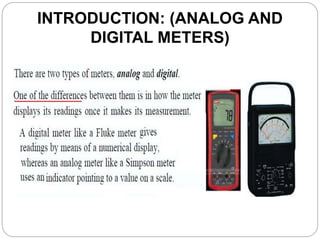
INTRODUCTION: (ANALOG AND
DIGITAL METERS)
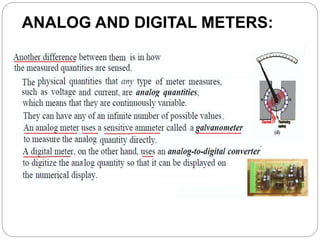
ANALOG AND DIGITAL METERS:
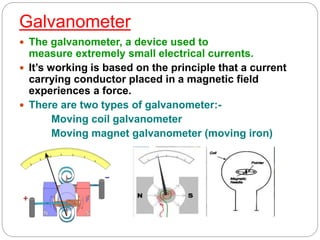
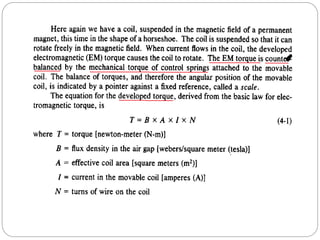
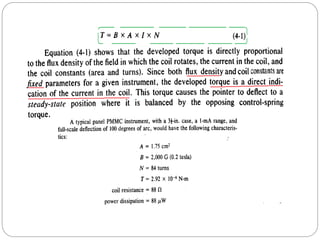
Galvanometer
 The galvanometer, a device used to
measure extremely small electrical currents.
 It’s working is based on the principle that a current
carrying conductor placed in a magnetic field
experiences a force.
 There are two types of galvanometer:-
Moving coil galvanometer
Moving magnet galvanometer (moving iron)
 Moving coil galvanometer is further
classified into:-
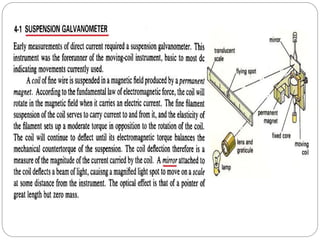
Suspended coil galvanometer and
Pivoted coil galvanometer.
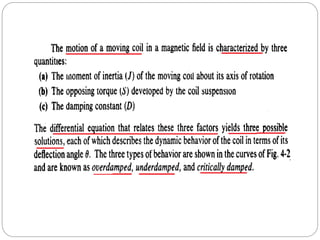
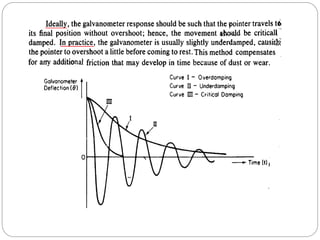
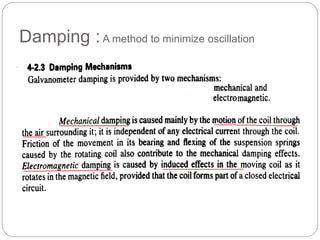
Damping :A method to minimize oscillation
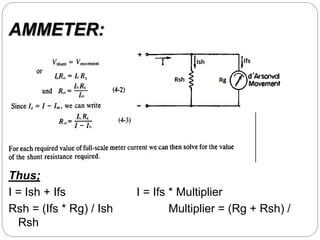
AMMETER:
 An ammeter is a measuring instrument used
to measure the electric current in a circuit.
Electric currents are measured in amperes
(A), hence the name. Instruments used to
measure smaller currents, in the milliampere
or microampere range, are designated as
milliammeters or microammeters.
 It is an instrument that is used to measure
current.
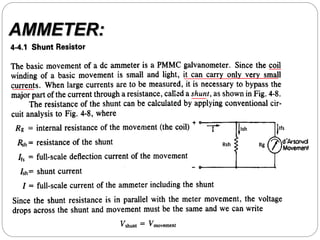
AMMETER:
AMMETER:
Thus;
I = Ish + Ifs I = Ifs * Multiplier
Rsh = (Ifs * Rg) / Ish Multiplier = (Rg + Rsh) /
Rsh
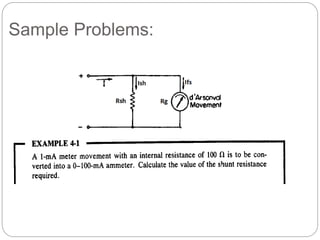
Sample Problems:
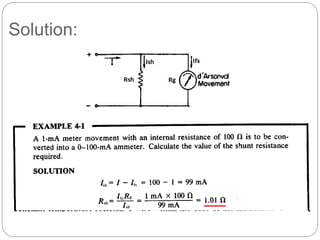
Solution:
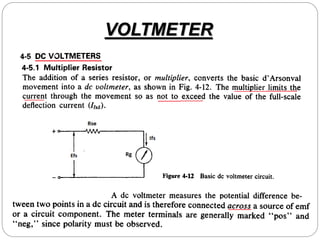
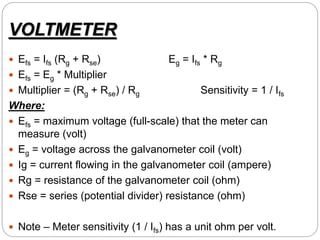
VOLTMETER
VOLTMETER
 Efs = Ifs (Rg + Rse) Eg = Ifs * Rg
 Efs = Eg * Multiplier
 Multiplier = (Rg + Rse) / Rg Sensitivity = 1 / Ifs
Where:
 Efs = maximum voltage (full-scale) that the meter can
measure (volt)
 Eg = voltage across the galvanometer coil (volt)
 Ig = current flowing in the galvanometer coil (ampere)
 Rg = resistance of the galvanometer coil (ohm)
 Rse = series (potential divider) resistance (ohm)
 Note – Meter sensitivity (1 / Ifs) has a unit ohm per volt.
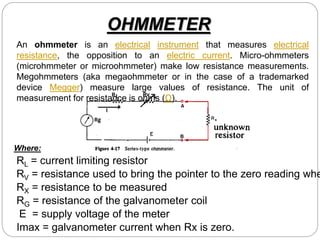
OHMMETER
Where:
RL = current limiting resistor
RX = resistance to be measured
RV = resistance used to bring the pointer to the zero reading whe
RG = resistance of the galvanometer coil
E = supply voltage of the meter
Imax = galvanometer current when Rx is zero.
An ohmmeter is an electrical instrument that measures electrical
resistance, the opposition to an electric current. Micro-ohmmeters
(microhmmeter or microohmmeter) make low resistance measurements.
Megohmmeters (aka megaohmmeter or in the case of a trademarked
device Megger) measure large values of resistance. The unit of
measurement for resistance is ohms (Ω).
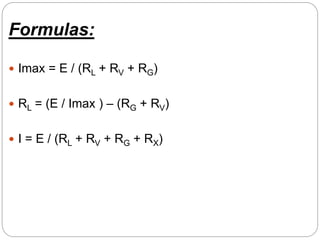
Formulas:
 Imax = E / (RL + RV + RG)
 RL = (E / Imax ) – (RG + RV)
 I = E / (RL + RV + RG + RX)
Sample Problems:
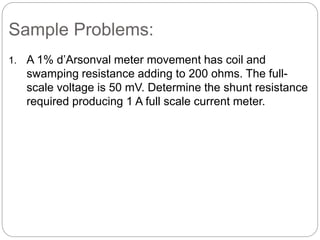
1. A 1% d’Arsonval meter movement has coil and
swamping resistance adding to 200 ohms. The full-
scale voltage is 50 mV. Determine the shunt resistance
required producing 1 A full scale current meter.
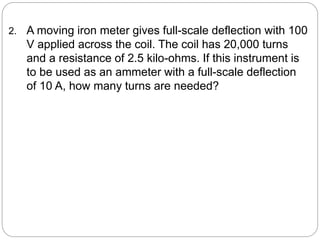
2. A moving iron meter gives full-scale deflection with 100
V applied across the coil. The coil has 20,000 turns
and a resistance of 2.5 kilo-ohms. If this instrument is
to be used as an ammeter with a full-scale deflection
of 10 A, how many turns are needed?
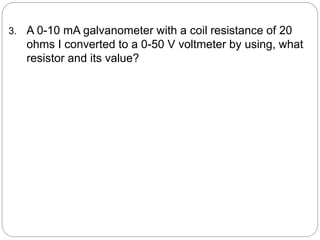
3. A 0-10 mA galvanometer with a coil resistance of 20
ohms I converted to a 0-50 V voltmeter by using, what
resistor and its value?
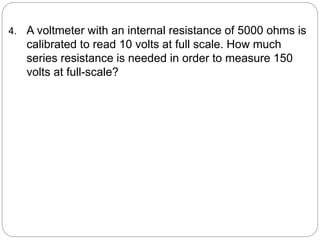
4. A voltmeter with an internal resistance of 5000 ohms is
calibrated to read 10 volts at full scale. How much
series resistance is needed in order to measure 150
volts at full-scale?
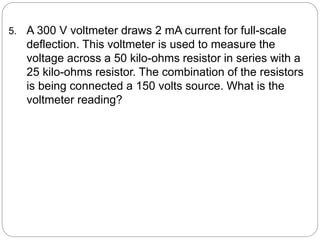
5. A 300 V voltmeter draws 2 mA current for full-scale
deflection. This voltmeter is used to measure the
voltage across a 50 kilo-ohms resistor in series with a
25 kilo-ohms resistor. The combination of the resistors
is being connected a 150 volts source. What is the
voltmeter reading?
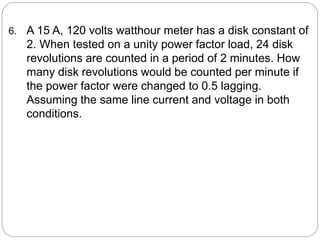
6. A 15 A, 120 volts watthour meter has a disk constant of
2. When tested on a unity power factor load, 24 disk
revolutions are counted in a period of 2 minutes. How
many disk revolutions would be counted per minute if
the power factor were changed to 0.5 lagging.
Assuming the same line current and voltage in both
conditions.
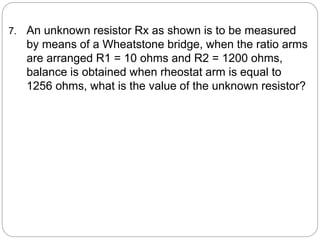
7. An unknown resistor Rx as shown is to be measured
by means of a Wheatstone bridge, when the ratio arms
are arranged R1 = 10 ohms and R2 = 1200 ohms,
balance is obtained when rheostat arm is equal to
1256 ohms, what is the value of the unknown resistor?

ELECTROMECHANICAL-INSTRUMENTATION INSTRUMENTS.pptx

  • 1.
  • 2.
  • 3.
  • 4.
    Galvanometer  The galvanometer,a device used to measure extremely small electrical currents.  It’s working is based on the principle that a current carrying conductor placed in a magnetic field experiences a force.  There are two types of galvanometer:- Moving coil galvanometer Moving magnet galvanometer (moving iron)
  • 5.
     Moving coilgalvanometer is further classified into:- Suspended coil galvanometer and Pivoted coil galvanometer.
  • 12.
    Damping :A methodto minimize oscillation
  • 14.
    AMMETER:  An ammeteris a measuring instrument used to measure the electric current in a circuit. Electric currents are measured in amperes (A), hence the name. Instruments used to measure smaller currents, in the milliampere or microampere range, are designated as milliammeters or microammeters.  It is an instrument that is used to measure current.
  • 15.
  • 16.
    AMMETER: Thus; I = Ish+ Ifs I = Ifs * Multiplier Rsh = (Ifs * Rg) / Ish Multiplier = (Rg + Rsh) / Rsh
  • 17.
  • 18.
  • 20.
  • 21.
    VOLTMETER  Efs =Ifs (Rg + Rse) Eg = Ifs * Rg  Efs = Eg * Multiplier  Multiplier = (Rg + Rse) / Rg Sensitivity = 1 / Ifs Where:  Efs = maximum voltage (full-scale) that the meter can measure (volt)  Eg = voltage across the galvanometer coil (volt)  Ig = current flowing in the galvanometer coil (ampere)  Rg = resistance of the galvanometer coil (ohm)  Rse = series (potential divider) resistance (ohm)  Note – Meter sensitivity (1 / Ifs) has a unit ohm per volt.
  • 22.
    OHMMETER Where: RL = currentlimiting resistor RX = resistance to be measured RV = resistance used to bring the pointer to the zero reading whe RG = resistance of the galvanometer coil E = supply voltage of the meter Imax = galvanometer current when Rx is zero. An ohmmeter is an electrical instrument that measures electrical resistance, the opposition to an electric current. Micro-ohmmeters (microhmmeter or microohmmeter) make low resistance measurements. Megohmmeters (aka megaohmmeter or in the case of a trademarked device Megger) measure large values of resistance. The unit of measurement for resistance is ohms (Ω).
  • 23.
    Formulas:  Imax =E / (RL + RV + RG)  RL = (E / Imax ) – (RG + RV)  I = E / (RL + RV + RG + RX)
  • 24.
    Sample Problems: 1. A1% d’Arsonval meter movement has coil and swamping resistance adding to 200 ohms. The full- scale voltage is 50 mV. Determine the shunt resistance required producing 1 A full scale current meter.
  • 25.
    2. A movingiron meter gives full-scale deflection with 100 V applied across the coil. The coil has 20,000 turns and a resistance of 2.5 kilo-ohms. If this instrument is to be used as an ammeter with a full-scale deflection of 10 A, how many turns are needed?
  • 26.
    3. A 0-10mA galvanometer with a coil resistance of 20 ohms I converted to a 0-50 V voltmeter by using, what resistor and its value?
  • 27.
    4. A voltmeterwith an internal resistance of 5000 ohms is calibrated to read 10 volts at full scale. How much series resistance is needed in order to measure 150 volts at full-scale?
  • 28.
    5. A 300V voltmeter draws 2 mA current for full-scale deflection. This voltmeter is used to measure the voltage across a 50 kilo-ohms resistor in series with a 25 kilo-ohms resistor. The combination of the resistors is being connected a 150 volts source. What is the voltmeter reading?
  • 29.
    6. A 15A, 120 volts watthour meter has a disk constant of 2. When tested on a unity power factor load, 24 disk revolutions are counted in a period of 2 minutes. How many disk revolutions would be counted per minute if the power factor were changed to 0.5 lagging. Assuming the same line current and voltage in both conditions.
  • 30.
    7. An unknownresistor Rx as shown is to be measured by means of a Wheatstone bridge, when the ratio arms are arranged R1 = 10 ohms and R2 = 1200 ohms, balance is obtained when rheostat arm is equal to 1256 ohms, what is the value of the unknown resistor?