





Electromagnetic
Frequency Spectrum
Global Challenges
Andile Ngcaba
July 2013
Background
• Electromagnetic frequency spectrum is a public resource, whose primary economic
benefit is to maximise the net benefits to society that can be generated off it
• African governments and regulatory authorities, as custodians of the spectrum required
for connectivity on the continent, play an integral role in creating the enabling
environment for broadband diffusion
• Access to spectrum is a key determinant of broadband availability for mass-market
adoption, as wireless technology offers a practical substitute to fixed broadband access
• The strategic management of the digital dividend (and digital dividend II) and currently
underutilised, but in high demand spectrum at 2.6GHz and 3.5GHz on the Continent,
are likely to advance broadband to a critical point where network effects and
economies of scale accelerate broadband adoption
• In order for Africa to take advantage of the network effects of broadband, clear policy
guidelines and thinking needs to be displayed and implemented to ensure it does not
create undue inefficiencies in the system
• The perceived spectrum scarcity on the Continent is as a result of a suboptimal
spectrum model that has led to excess demand for spectrum while there is an inelastic
supply thereof
Sector Overview
• Telecoms industry characterised by dominance in the upstream markets perpetuated
by vertically integrated incumbents
• Incumbents have no incentive to provide wholesale access to other service providers
on a non discrimination basis
• Their commercial imperative is to drive shareholder value by controlling retail markets
and eliminating competitors
• This results in bottlenecks in the market that lead to artificially high prices
• This then ensures that competition does not upset the telecoms order which leaves the
incumbents at the apex of the food chain
PAST
Old Licensing Model
• Traditionally radio frequency spectrum is regulated through static command and
control policies
• Over the years regulators have relied mainly on various methods to allocate spectrum:
• Administrative or Beauty contest process – government following a
predetermined criteria decides which entities will best serve public interest.
However where the is extreme demand for limited spectrum this process can
prove to be cumbersome and litigious
• Lottery Process - The lottery process’s strength is the quicker license
assignment. This process however can have the effect of attracting a large
number of applicants with no technical competence to build or operate a public
radio communication service
Old Licensing Model
• First come first serve – this process allows quicker allocation of spectrum but is
not equitable and results in over concentration of spectrum on those entities that
enter the market first
• Spectrum auctioning process - A good example of market-based regulation
because it employs a pricing mechanism to allocate spectrum efficiently whilst
increasing revenue maximisation for treasury. Its biggest weakness however is
that auction participants are trying to maximize their profits rather than serve
the public good
• General consensus that regulators need to begin to implement spectrum licensing
models that are efficient and flexible to address the prevailing market conditions
Digital Divide between rural and urban areas
• Current spectrum allocation models, even with Universal Service and Access
Obligations, have not achieved significant infrastructure deployments in rural areas
• Auctions (while an ideal pathway for the state to maximise revenue generation) lead to
market failures
– As they not only lead to highly concentrated market structures, favouring
incumbents with large financial resources;
– But also a widening digital divide between rural and urban areas, as operators
only deploy infrastructure in economically viable urban areas;
– Spectrum owners look to recover the cost of the spectrum by deploying networks
in higher income centres as opposed to rolling out services to rural communities
• It is increasingly evident that regulatory reform leading to increased flexibility is a
necessary condition for greater efficiency in spectrum markets
PRESENT
Need for creative licensing models
• Regulators have a statutory mandate to regulate the markets effectively in the
interests of competition and consumers
• This means that regulators must implement pro-competitive regulatory solutions that
are sustainable
• To be effective these solutions must harness the strengths and capabilities of all
players in the market
• They must still embrace the role of the incumbents and not unduly exclude them from
participation
• One such regulatory intervention that is breaking new ground is the wholesale
infrastructure sharing open access model
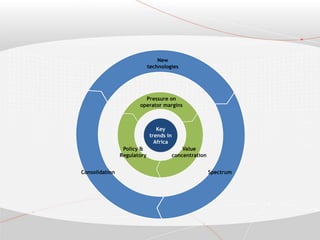
Consolidation Spectrum
New
technologies
Policy &
Regulatory
Value
concentration
Pressure on
operator margins
Key
trends in
Africa
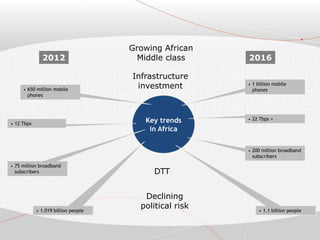
Key trends
in Africa
2012 2016
Infrastructure
investment
DTT
Growing African
Middle class
• 1 billion mobile
phones• 650 million mobile
phones
• 12 Tbps
• 75 million broadband
subscribers
• 1.019 billion people
• 22 Tbps +
• 200 million broadband
subscribers
• 1.1 billion people
Declining
political risk
• Open access network
models
• Even though there are
more than 2 operators
in most of the
markets (>150
operators)
• Most of the value (and
hence the demand) is
concentrated in the
first two operators
especially in the
urban areas
• Regional players
emerging
(Bharti, MTN…)
• Independent
wholesale operators
• Regulations to
encourage
infrastructure sharing
• LLU
• Rapid deployment
frameworks
• Cross sector
regulation (local
govt, transport, envir
onmental)
• From regulatory
restraint to regulatory
stimulation
• ICT sector policy
• Harmonisation
• MTR & roaming caps
• Slowing growth rates
in Africa (similar to
other emerging
markets) hence
putting pressure on
margins
• Next wave of
subscribers is mainly
rural
• Declining ARPUs
• Rise of OTT players
Policy &
Regulatory
Value
concentration
Pressure on
operator margins
Consolidation Spectrum
New
technologies
• Introduction of new
technologies such as
LTE will create
demand for additional
capex
• Cognitive
radio, femtocells and
white spaces
• Digital Broadcasting
and IPTV
• Smart antennas
• Wholesale networks
Allocation models
• High demand
frequency spectrum
(Digital Dividend
I, Digital Dividend
II, 2.6Ghz)
• Local and
international players
in the market
• TowerCo
consolidation
• ISPs (South
Africa, Zambia...)
• Fibre (Liquid
Telecoms and Altech
East
Africa, KDN, Rwandat
el)
• There is a significant opportunity
for ICT infrastructure
development
• Policy and regulatory
inefficiencies = restrictive vs
stimulatory environment
• Sub-optimal spectrum allocation
models
• Quality of Service considerations
Consolidation Spectrum
New
technologies
Policy &
Regulatory
Value
concentration
Pressure on
operator margins
Key
trends in
Africa
Wholesale Infrastructure Sharing Open Access
Model
• In terms of this model the regulator issues high demand spectrum to a single
wholesaler or consortium of independent players
• The wholesaler assumes its own identity, its own brand name and operates
independently of its consortium members
• Its primary mandate is to implement, run manage and sell network services on behalf
of its consortium members
• The wholesaler provides basic transport capacity to unaffiliated retail providers on a non
discriminatory basis
• The disassociation of transport from retail will promote competition and benefit
consumers
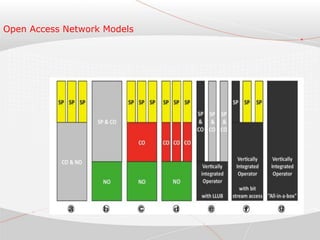
Open Access Network Models
Policy and Regulation
• The wholesale infrastructure sharing model is underpinned by functional separation
based on the principle of no locking and no blocking
• It however allows successful bidders to offer retail services to end users based on the
following:
• functional transparency between
• infrastructure and services based competition
• Transparent pricing between wholesale and retail units
• Code of conduct that clearly delineates between wholesale and retail arms
• Establishment of an Equality and Access Board an independent body to monitor and
enforce the functional separation
• The wholesale business has to a separate business unit that is independent of the retail
divisions of the successful bidders
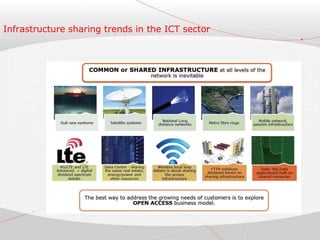
Infrastructure sharing trends in the ICT sector
FUTURE
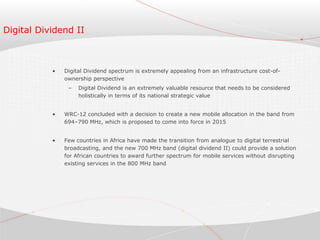
Digital Dividend II
• Digital Dividend spectrum is extremely appealing from an infrastructure cost-of-
ownership perspective
– Digital Dividend is an extremely valuable resource that needs to be considered
holistically in terms of its national strategic value
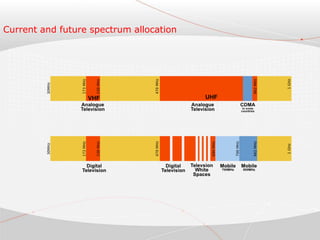
• WRC-12 concluded with a decision to create a new mobile allocation in the band from
694–790 MHz, which is proposed to come into force in 2015
• Few countries in Africa have made the transition from analogue to digital terrestrial
broadcasting, and the new 700 MHz band (digital dividend II) could provide a solution
for African countries to award further spectrum for mobile services without disrupting
existing services in the 800 MHz band
Current and future spectrum allocation
Spectrum allocation models
• Modern technology (cognitive radio, micro and femtocells), big data analytics and
increasing computational power ensures that we cannot approach, and manage
spectrum in the same manner we have historically
• Technological advancements ensure that we do not need contiguous chunks of
spectrum for network deployments in future
• This real estate model is outdated as it has very little dynamism, as once an allocation
is made it is unchangeable for a very long time
• We are in a period of transition, and should adopt new spectrum allocation and
management models now
• If regulators continue allocating spectrum in the piecemeal manner they have, there
will neither be sufficient incentive for incumbent operators to deploy infrastructure in
rural areas nor an enabling environment for new entrants to scale the high barriers to
entry
Conclusion
• Radio spectrum is not a scarce resource, but rather one that has been inefficiently
allocated on the Continent
• Perceived spectrum scarcity is due to administrative allocation and assignment
processes that are a major bottleneck for market entry and widespread broadband
diffusion
• Spectrum licences should allow for the dynamic usage of spectrum, including reuse and
reallocation
• Infrastructure sharing models are the most effective and efficient manner for
regulators to manage this public good
ANNEXURE
26
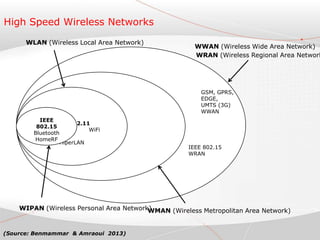
High Speed Wireless Networks
GSM
GPRS
EDGE
UMTS(3G)
WWAN
IEEE 802.15
WRAN
IEEE 802.16
WiMAX
IEEE 802.11
WiFi
HiperLAN
IEEE
802.15
Bluetooth
HomeRF
WIPAN (Wireless Personal Area Network)
WLAN (Wireless Local Area Network)
WMAN (Wireless Metropolitan Area Network)
(Source: Benmammar & Amraoui 2013)
GSM, GPRS,
EDGE,
UMTS (3G)
WWAN
IEEE 802.15
WRAN
WWAN (Wireless Wide Area Network)
WRAN (Wireless Regional Area Network
Key Benefits of Apache Hadoop
• Schema-on-Read (Hadoop) vs. Schema-on-Write (RDBMS)
• Innovation: Explore Original Raw Data
• Flexibility: Complex Data Processing (Structured, Semi-structured or
Unstructured)
• Scalability: Scalable Software Development (Freedom to Grow)
• Economies of scale: Keep All Data Alive Forever ( Storage on Demand)
• Self-healing high bandwidth clustered storage (Hadoop Distributed File System)
• distributed fault-tolerant resource management coupled with scalable data
processing (MapReduce)
(Source: Dr. Amr Awadallah, Stanford University| Founder, CTO, VP of Engineering, Cloudera )
Cloud Computing
• Cloud computing enables organisations to set up a cluster of systems in minutes and it is
relatively inexpensive:
– On-demand self-service, e.g. server time and network storage
 Broad network access, e.g. mobile phones, tablets, laptops, and workstations.
 Resource pooling, e.g. storage/disk, processing/CPU, memory, and
network/bandwidth
 Rapid elasticity- elastically provisioned and released automatically and on-demand.
 Measured service- resource usage monitored, controlled, and reported transparently
(Source: National Institute of Standards and Technology, USA.

Electromagnetic Frequency Spectrum Presentation

  • 1.
  • 2.
    Background • Electromagnetic frequencyspectrum is a public resource, whose primary economic benefit is to maximise the net benefits to society that can be generated off it • African governments and regulatory authorities, as custodians of the spectrum required for connectivity on the continent, play an integral role in creating the enabling environment for broadband diffusion • Access to spectrum is a key determinant of broadband availability for mass-market adoption, as wireless technology offers a practical substitute to fixed broadband access • The strategic management of the digital dividend (and digital dividend II) and currently underutilised, but in high demand spectrum at 2.6GHz and 3.5GHz on the Continent, are likely to advance broadband to a critical point where network effects and economies of scale accelerate broadband adoption • In order for Africa to take advantage of the network effects of broadband, clear policy guidelines and thinking needs to be displayed and implemented to ensure it does not create undue inefficiencies in the system • The perceived spectrum scarcity on the Continent is as a result of a suboptimal spectrum model that has led to excess demand for spectrum while there is an inelastic supply thereof
  • 3.
    Sector Overview • Telecomsindustry characterised by dominance in the upstream markets perpetuated by vertically integrated incumbents • Incumbents have no incentive to provide wholesale access to other service providers on a non discrimination basis • Their commercial imperative is to drive shareholder value by controlling retail markets and eliminating competitors • This results in bottlenecks in the market that lead to artificially high prices • This then ensures that competition does not upset the telecoms order which leaves the incumbents at the apex of the food chain
  • 4.
  • 5.
    Old Licensing Model •Traditionally radio frequency spectrum is regulated through static command and control policies • Over the years regulators have relied mainly on various methods to allocate spectrum: • Administrative or Beauty contest process – government following a predetermined criteria decides which entities will best serve public interest. However where the is extreme demand for limited spectrum this process can prove to be cumbersome and litigious • Lottery Process - The lottery process’s strength is the quicker license assignment. This process however can have the effect of attracting a large number of applicants with no technical competence to build or operate a public radio communication service
  • 6.
    Old Licensing Model •First come first serve – this process allows quicker allocation of spectrum but is not equitable and results in over concentration of spectrum on those entities that enter the market first • Spectrum auctioning process - A good example of market-based regulation because it employs a pricing mechanism to allocate spectrum efficiently whilst increasing revenue maximisation for treasury. Its biggest weakness however is that auction participants are trying to maximize their profits rather than serve the public good • General consensus that regulators need to begin to implement spectrum licensing models that are efficient and flexible to address the prevailing market conditions
  • 7.
    Digital Divide betweenrural and urban areas • Current spectrum allocation models, even with Universal Service and Access Obligations, have not achieved significant infrastructure deployments in rural areas • Auctions (while an ideal pathway for the state to maximise revenue generation) lead to market failures – As they not only lead to highly concentrated market structures, favouring incumbents with large financial resources; – But also a widening digital divide between rural and urban areas, as operators only deploy infrastructure in economically viable urban areas; – Spectrum owners look to recover the cost of the spectrum by deploying networks in higher income centres as opposed to rolling out services to rural communities • It is increasingly evident that regulatory reform leading to increased flexibility is a necessary condition for greater efficiency in spectrum markets
  • 8.
  • 9.
    Need for creativelicensing models • Regulators have a statutory mandate to regulate the markets effectively in the interests of competition and consumers • This means that regulators must implement pro-competitive regulatory solutions that are sustainable • To be effective these solutions must harness the strengths and capabilities of all players in the market • They must still embrace the role of the incumbents and not unduly exclude them from participation • One such regulatory intervention that is breaking new ground is the wholesale infrastructure sharing open access model
  • 10.
  • 11.
    Key trends in Africa 20122016 Infrastructure investment DTT Growing African Middle class • 1 billion mobile phones• 650 million mobile phones • 12 Tbps • 75 million broadband subscribers • 1.019 billion people • 22 Tbps + • 200 million broadband subscribers • 1.1 billion people Declining political risk
  • 12.
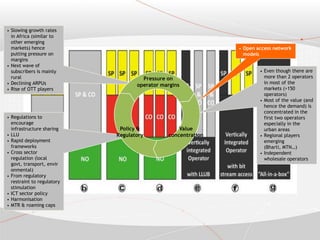
    • Open accessnetwork models • Even though there are more than 2 operators in most of the markets (>150 operators) • Most of the value (and hence the demand) is concentrated in the first two operators especially in the urban areas • Regional players emerging (Bharti, MTN…) • Independent wholesale operators • Regulations to encourage infrastructure sharing • LLU • Rapid deployment frameworks • Cross sector regulation (local govt, transport, envir onmental) • From regulatory restraint to regulatory stimulation • ICT sector policy • Harmonisation • MTR & roaming caps • Slowing growth rates in Africa (similar to other emerging markets) hence putting pressure on margins • Next wave of subscribers is mainly rural • Declining ARPUs • Rise of OTT players Policy & Regulatory Value concentration Pressure on operator margins
  • 13.
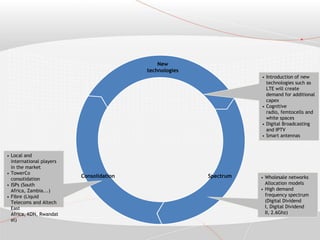
    Consolidation Spectrum New technologies • Introductionof new technologies such as LTE will create demand for additional capex • Cognitive radio, femtocells and white spaces • Digital Broadcasting and IPTV • Smart antennas • Wholesale networks Allocation models • High demand frequency spectrum (Digital Dividend I, Digital Dividend II, 2.6Ghz) • Local and international players in the market • TowerCo consolidation • ISPs (South Africa, Zambia...) • Fibre (Liquid Telecoms and Altech East Africa, KDN, Rwandat el)
  • 14.
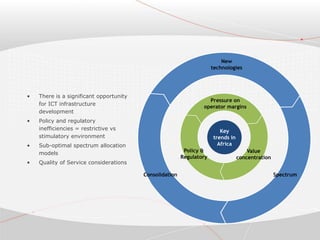
    • There isa significant opportunity for ICT infrastructure development • Policy and regulatory inefficiencies = restrictive vs stimulatory environment • Sub-optimal spectrum allocation models • Quality of Service considerations Consolidation Spectrum New technologies Policy & Regulatory Value concentration Pressure on operator margins Key trends in Africa
  • 15.
    Wholesale Infrastructure SharingOpen Access Model • In terms of this model the regulator issues high demand spectrum to a single wholesaler or consortium of independent players • The wholesaler assumes its own identity, its own brand name and operates independently of its consortium members • Its primary mandate is to implement, run manage and sell network services on behalf of its consortium members • The wholesaler provides basic transport capacity to unaffiliated retail providers on a non discriminatory basis • The disassociation of transport from retail will promote competition and benefit consumers
  • 16.
  • 17.
    Policy and Regulation •The wholesale infrastructure sharing model is underpinned by functional separation based on the principle of no locking and no blocking • It however allows successful bidders to offer retail services to end users based on the following: • functional transparency between • infrastructure and services based competition • Transparent pricing between wholesale and retail units • Code of conduct that clearly delineates between wholesale and retail arms • Establishment of an Equality and Access Board an independent body to monitor and enforce the functional separation • The wholesale business has to a separate business unit that is independent of the retail divisions of the successful bidders
  • 18.
  • 19.
  • 20.
    Digital Dividend II •Digital Dividend spectrum is extremely appealing from an infrastructure cost-of- ownership perspective – Digital Dividend is an extremely valuable resource that needs to be considered holistically in terms of its national strategic value • WRC-12 concluded with a decision to create a new mobile allocation in the band from 694–790 MHz, which is proposed to come into force in 2015 • Few countries in Africa have made the transition from analogue to digital terrestrial broadcasting, and the new 700 MHz band (digital dividend II) could provide a solution for African countries to award further spectrum for mobile services without disrupting existing services in the 800 MHz band
  • 21.
    Current and futurespectrum allocation
  • 23.
    Spectrum allocation models •Modern technology (cognitive radio, micro and femtocells), big data analytics and increasing computational power ensures that we cannot approach, and manage spectrum in the same manner we have historically • Technological advancements ensure that we do not need contiguous chunks of spectrum for network deployments in future • This real estate model is outdated as it has very little dynamism, as once an allocation is made it is unchangeable for a very long time • We are in a period of transition, and should adopt new spectrum allocation and management models now • If regulators continue allocating spectrum in the piecemeal manner they have, there will neither be sufficient incentive for incumbent operators to deploy infrastructure in rural areas nor an enabling environment for new entrants to scale the high barriers to entry
  • 24.
    Conclusion • Radio spectrumis not a scarce resource, but rather one that has been inefficiently allocated on the Continent • Perceived spectrum scarcity is due to administrative allocation and assignment processes that are a major bottleneck for market entry and widespread broadband diffusion • Spectrum licences should allow for the dynamic usage of spectrum, including reuse and reallocation • Infrastructure sharing models are the most effective and efficient manner for regulators to manage this public good
  • 26.
  • 27.
    High Speed WirelessNetworks GSM GPRS EDGE UMTS(3G) WWAN IEEE 802.15 WRAN IEEE 802.16 WiMAX IEEE 802.11 WiFi HiperLAN IEEE 802.15 Bluetooth HomeRF WIPAN (Wireless Personal Area Network) WLAN (Wireless Local Area Network) WMAN (Wireless Metropolitan Area Network) (Source: Benmammar & Amraoui 2013) GSM, GPRS, EDGE, UMTS (3G) WWAN IEEE 802.15 WRAN WWAN (Wireless Wide Area Network) WRAN (Wireless Regional Area Network
  • 28.
    Key Benefits ofApache Hadoop • Schema-on-Read (Hadoop) vs. Schema-on-Write (RDBMS) • Innovation: Explore Original Raw Data • Flexibility: Complex Data Processing (Structured, Semi-structured or Unstructured) • Scalability: Scalable Software Development (Freedom to Grow) • Economies of scale: Keep All Data Alive Forever ( Storage on Demand) • Self-healing high bandwidth clustered storage (Hadoop Distributed File System) • distributed fault-tolerant resource management coupled with scalable data processing (MapReduce) (Source: Dr. Amr Awadallah, Stanford University| Founder, CTO, VP of Engineering, Cloudera )
  • 29.
    Cloud Computing • Cloudcomputing enables organisations to set up a cluster of systems in minutes and it is relatively inexpensive: – On-demand self-service, e.g. server time and network storage  Broad network access, e.g. mobile phones, tablets, laptops, and workstations.  Resource pooling, e.g. storage/disk, processing/CPU, memory, and network/bandwidth  Rapid elasticity- elastically provisioned and released automatically and on-demand.  Measured service- resource usage monitored, controlled, and reported transparently (Source: National Institute of Standards and Technology, USA.

Editor's Notes

  • #12 *$93 billion per year infrastructure spend (World Bank 2010)
  • #14 Wide channel bands