Presented by:

VISHAL SATSANGI
CONTENTS
1) Introduction

2) Working Principle
3) Operation Cycle
4) Components

5) Speed Control
6) Advantages over Fossil fuel engines
 Technical terms
 Reference
1. INTRODUCTION
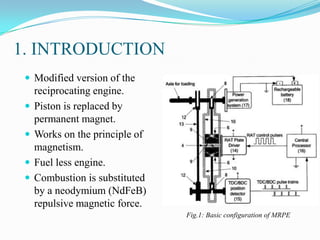
 Modified version of the





reciprocating engine.
Piston is replaced by
permanent magnet.
Works on the principle of
magnetism.
Fuel less engine.
Combustion is substituted
by a neodymium (NdFeB)
repulsive magnetic force.
Fig.1: Basic configuration of MRPE
2. WORKING PRINCIPLE
 Principle of Magnetism



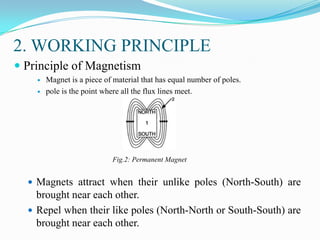
Magnet is a piece of material that has equal number of poles.
pole is the point where all the flux lines meet.

Fig.2: Permanent Magnet

 Magnets attract when their unlike poles (North-South) are

brought near each other.
 Repel when their like poles (North-North or South-South) are
brought near each other.
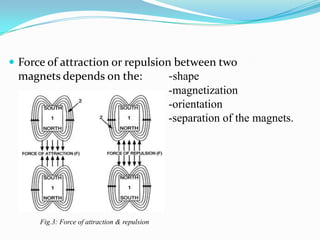
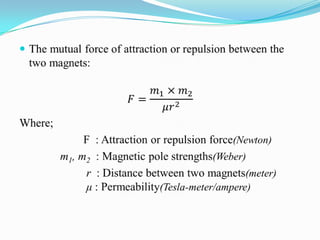
 Force of attraction or repulsion between two

magnets depends on the:

Fig.3: Force of attraction & repulsion

-shape
-magnetization
-orientation
-separation of the magnets.

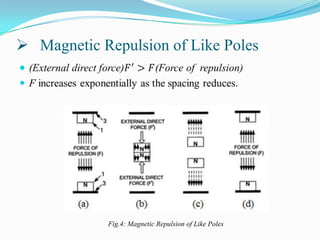
 Magnetic Repulsion of Like Poles


Fig.4: Magnetic Repulsion of Like Poles
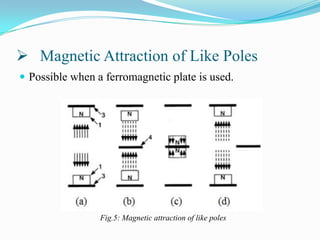
 Magnetic Attraction of Like Poles
 Possible when a ferromagnetic plate is used.

Fig.5: Magnetic attraction of like poles
3. OPERATION CYCLE
 RAT plate operation cycles:
 Pulled-out.
 Pushed-in.

 Piston's position:
 Farthest position of piston from the crankshaft is TDC or RPE.
 Closest position is BDC or CSE.

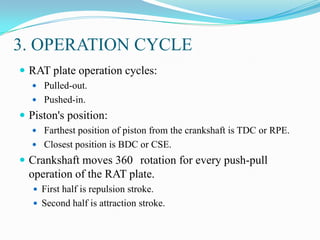
 Crankshaft moves 360 rotation for every push-pull

operation of the RAT plate.
 First half is repulsion stroke.
 Second half is attraction stroke.
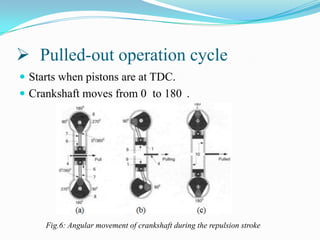
 Pulled-out operation cycle
 Starts when pistons are at TDC.
 Crankshaft moves from 0 to 180 .

Fig.6: Angular movement of crankshaft during the repulsion stroke
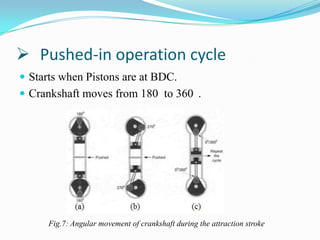
 Pushed-in operation cycle
 Starts when Pistons are at BDC.
 Crankshaft moves from 180 to 360 .

Fig.7: Angular movement of crankshaft during the attraction stroke
4. COMPONENTS
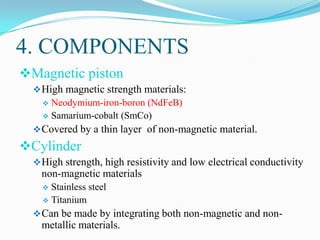
Magnetic piston
 High magnetic strength materials:

Neodymium-iron-boron (NdFeB)
 Samarium-cobalt (SmCo)


 Covered by a thin layer of non-magnetic material.

Cylinder
 High strength, high resistivity and low electrical conductivity

non-magnetic materials
Stainless steel
 Titanium


 Can be made by integrating both non-magnetic and non-

metallic materials.
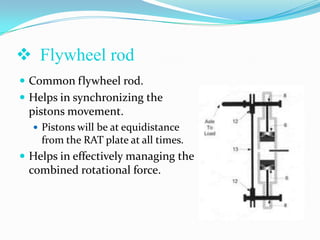
 Flywheel rod
 Common flywheel rod.
 Helps in synchronizing the

pistons movement.
 Pistons will be at equidistance

from the RAT plate at all times.

 Helps in effectively managing the

combined rotational force.
 RAT Plate
Repulsion-Attraction plate.

Assists in attracting and repelling the like poles of the

magnets.
Once attracted, very minimum force must be able to
separate the RAT plate from the magnets.
Moves back-and-forth in the direction perpendicular to
the pistons movement.
High permeability ferromagnetic materials:
 Iron
 Nickel
 Cobalt.
 Rat Plate Driver
 Meant to insert and remove the RAT plate.

 Sources for driving:
 Electrical
 Pneumatic
 Steam powered
 Driver types:
 Directly driven by a linear driver
 Indirectly driven by a reciprocating driver
 TDC/BDC Position Detector
 Detects pistons TDC/BDC positions and generates the

TDC/BDC pulses.
 Required for precise timing and synchronization of the RAT
plate movement.
 For pulse generation a notch is used.
 Operates a pair of switches one at a time when the

piston reaches dead centers.

 Piston reaches TDC/BDC
 TDC/BDC switch operates.


Central processor

 Converts TDC/BDC pulses into the synchronized RAT

plate control pulses.
 TDC is detected,
 Repulsion signal pulls-out the RAT plate.

 BDC is detected,
 Attraction signal pushes in the RAT plate.



Rechargeable battery

 Used to start the engine.
 Provide uninterrupted power supply to the control electronics

during the operation.
 Charged by the onboard electric power generation system.
5.Speed control
 Speed of the magnetic pistons is directly proportional to

RAT plate push pull operation speed.
 Methods:
 Vary the frequency.


Higher the frequency higher the speed and vice versa.

 Introduce skip pulses at a particular frequency.



Skip pulses put the RAT plate in idle state for the skip duration.
Causes the engine to slow down until the next valid RAT
control pulse.
6. Advantages over fossil fuel engines
 Fuel less engine.
 Easy to design.
 Less power consumption.
 No waste production.

 Less running cost & maintenance free.
 Environmental friendly, very high efficiency

engine.
 Can work as an automobile engine, aircraft
engine, locomotive engine, ship engine, etc.
• Technical terms
S.No. Technical terms

S.No.

Technical terms

1

Permanent magnet

10

Cylinder

2

Flux lines

11

Casing

3

Stoppers

12

Flywheel

4

RAT plate

13

Flywheel rod

5

Cylindrical enclosures

14

RAT plate driver

6

Piston

15

TDC/BDC position detector

7

Connecting rod

16

Central processor

8

Crank shaft

17

Power generation system

9

Magnetic heads

18

Rechargeable battery
• Reference
Togare,Radhakrishna Shesha Iyengar “Magnetic piston engine”,
US Patent, US 7,667,356 B2.
www.google.com/patents/US7667356
II. Mc Carthy, “Energy producing apparatus utilizing magnetic
pistons”,
US
Patent,
US
7,330,094
http://www.google.co.in/patents/US7330094
III. Takara “Electromagnet piston engine” ,US Patent, US 6,049,146
IV. Vishal Abasaheb Misal1, Umesh Dattatray Hajare2 & Arshad
Ashak Atar3 , ISSN : 2319 – 3182, Volume-2, Issue-4,
2013.http://www.irdindia.in/Journal_IJTARME/PDF/Vol2_Iss4/7.
pdf
V. Manoj Gattani, International Journal of Advances in Engineering
&
Technology,
May
2012.
http://www.eijaet.org/media/0001/87I8-IJAET0805863-DESIGN-ANDDEVELOPMENT.pdf
I.
Magnetic repulsion piston engine

Magnetic repulsion piston engine

  • 1.
  • 2.
    CONTENTS 1) Introduction 2) WorkingPrinciple 3) Operation Cycle 4) Components 5) Speed Control 6) Advantages over Fossil fuel engines  Technical terms  Reference
  • 3.
    1. INTRODUCTION  Modifiedversion of the     reciprocating engine. Piston is replaced by permanent magnet. Works on the principle of magnetism. Fuel less engine. Combustion is substituted by a neodymium (NdFeB) repulsive magnetic force. Fig.1: Basic configuration of MRPE
  • 4.
    2. WORKING PRINCIPLE Principle of Magnetism   Magnet is a piece of material that has equal number of poles. pole is the point where all the flux lines meet. Fig.2: Permanent Magnet  Magnets attract when their unlike poles (North-South) are brought near each other.  Repel when their like poles (North-North or South-South) are brought near each other.
  • 5.
     Force ofattraction or repulsion between two magnets depends on the: Fig.3: Force of attraction & repulsion -shape -magnetization -orientation -separation of the magnets.
  • 6.
  • 7.
     Magnetic Repulsionof Like Poles  Fig.4: Magnetic Repulsion of Like Poles
  • 8.
     Magnetic Attractionof Like Poles  Possible when a ferromagnetic plate is used. Fig.5: Magnetic attraction of like poles
  • 9.
    3. OPERATION CYCLE RAT plate operation cycles:  Pulled-out.  Pushed-in.  Piston's position:  Farthest position of piston from the crankshaft is TDC or RPE.  Closest position is BDC or CSE.  Crankshaft moves 360 rotation for every push-pull operation of the RAT plate.  First half is repulsion stroke.  Second half is attraction stroke.
  • 10.
     Pulled-out operationcycle  Starts when pistons are at TDC.  Crankshaft moves from 0 to 180 . Fig.6: Angular movement of crankshaft during the repulsion stroke
  • 11.
     Pushed-in operationcycle  Starts when Pistons are at BDC.  Crankshaft moves from 180 to 360 . Fig.7: Angular movement of crankshaft during the attraction stroke
  • 12.
    4. COMPONENTS Magnetic piston High magnetic strength materials: Neodymium-iron-boron (NdFeB)  Samarium-cobalt (SmCo)   Covered by a thin layer of non-magnetic material. Cylinder  High strength, high resistivity and low electrical conductivity non-magnetic materials Stainless steel  Titanium   Can be made by integrating both non-magnetic and non- metallic materials.
  • 13.
     Flywheel rod Common flywheel rod.  Helps in synchronizing the pistons movement.  Pistons will be at equidistance from the RAT plate at all times.  Helps in effectively managing the combined rotational force.
  • 14.
     RAT Plate Repulsion-Attractionplate. Assists in attracting and repelling the like poles of the magnets. Once attracted, very minimum force must be able to separate the RAT plate from the magnets. Moves back-and-forth in the direction perpendicular to the pistons movement. High permeability ferromagnetic materials:  Iron  Nickel  Cobalt.
  • 15.
     Rat PlateDriver  Meant to insert and remove the RAT plate.  Sources for driving:  Electrical  Pneumatic  Steam powered  Driver types:  Directly driven by a linear driver  Indirectly driven by a reciprocating driver
  • 16.
     TDC/BDC PositionDetector  Detects pistons TDC/BDC positions and generates the TDC/BDC pulses.  Required for precise timing and synchronization of the RAT plate movement.  For pulse generation a notch is used.  Operates a pair of switches one at a time when the piston reaches dead centers.  Piston reaches TDC/BDC  TDC/BDC switch operates.
  • 17.
     Central processor  ConvertsTDC/BDC pulses into the synchronized RAT plate control pulses.  TDC is detected,  Repulsion signal pulls-out the RAT plate.  BDC is detected,  Attraction signal pushes in the RAT plate.  Rechargeable battery  Used to start the engine.  Provide uninterrupted power supply to the control electronics during the operation.  Charged by the onboard electric power generation system.
  • 18.
    5.Speed control  Speedof the magnetic pistons is directly proportional to RAT plate push pull operation speed.  Methods:  Vary the frequency.  Higher the frequency higher the speed and vice versa.  Introduce skip pulses at a particular frequency.   Skip pulses put the RAT plate in idle state for the skip duration. Causes the engine to slow down until the next valid RAT control pulse.
  • 19.
    6. Advantages overfossil fuel engines  Fuel less engine.  Easy to design.  Less power consumption.  No waste production.  Less running cost & maintenance free.  Environmental friendly, very high efficiency engine.  Can work as an automobile engine, aircraft engine, locomotive engine, ship engine, etc.
  • 20.
    • Technical terms S.No.Technical terms S.No. Technical terms 1 Permanent magnet 10 Cylinder 2 Flux lines 11 Casing 3 Stoppers 12 Flywheel 4 RAT plate 13 Flywheel rod 5 Cylindrical enclosures 14 RAT plate driver 6 Piston 15 TDC/BDC position detector 7 Connecting rod 16 Central processor 8 Crank shaft 17 Power generation system 9 Magnetic heads 18 Rechargeable battery
  • 21.
    • Reference Togare,Radhakrishna SheshaIyengar “Magnetic piston engine”, US Patent, US 7,667,356 B2. www.google.com/patents/US7667356 II. Mc Carthy, “Energy producing apparatus utilizing magnetic pistons”, US Patent, US 7,330,094 http://www.google.co.in/patents/US7330094 III. Takara “Electromagnet piston engine” ,US Patent, US 6,049,146 IV. Vishal Abasaheb Misal1, Umesh Dattatray Hajare2 & Arshad Ashak Atar3 , ISSN : 2319 – 3182, Volume-2, Issue-4, 2013.http://www.irdindia.in/Journal_IJTARME/PDF/Vol2_Iss4/7. pdf V. Manoj Gattani, International Journal of Advances in Engineering & Technology, May 2012. http://www.eijaet.org/media/0001/87I8-IJAET0805863-DESIGN-ANDDEVELOPMENT.pdf I.