Electrochemistry Electrode Potentials
Electrochemistry 1. What are electrode potentials?
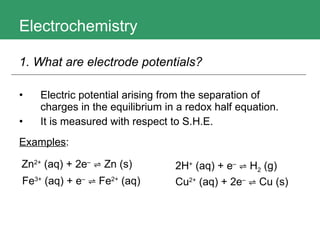
Electrochemistry Electric potential arising from the separation of charges in the equilibrium in a redox half equation. It is measured with respect to S.H.E. Examples : 1. What are electrode potentials?   Zn 2+  (aq) + 2e –   ⇌ Zn  (s) Fe 3+  (aq) + e –   ⇌ Fe 2+  (aq) 2H +  (aq) + e –   ⇌ H 2   (g) Cu 2+  (aq) + 2e –   ⇌ Cu (s)
Electrochemistry 2. What can we know from electrode potentials?
Electrochemistry 2. What can we know from electrode potentials?   [Sign]   + forward reaction ( reduction ) favoured  – backward reaction ( oxidation ) favoured [Magnitude]   –  the  extent  the reaction is favoured
Electrochemistry 3. How can we measure standard electrode potentials?
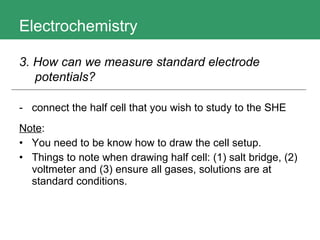
Electrochemistry connect the half cell that you wish to study to the SHE Note : You need to be know how to draw the cell setup. Things to note when drawing half cell: (1) salt bridge, (2) voltmeter and (3) ensure all gases, solutions are at standard conditions. 3. How can we measure standard electrode potentials?
Electrochemistry 4. How can we use standard electrode potentials?
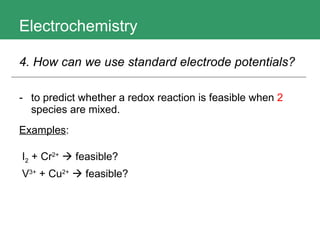
Electrochemistry to predict whether a redox reaction is feasible when  2  species are mixed.  Examples : 4. How can we use standard electrode potentials?   I 2   + Cr 2+     feasible? V 3+  + Cu 2+     feasible?
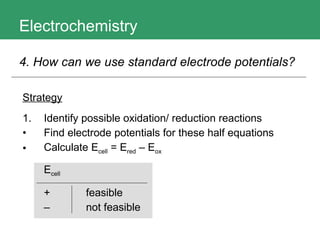
Electrochemistry 4. How can we use standard electrode potentials?   Strategy 1. Identify possible oxidation/ reduction reactions Find electrode potentials for these half equations Calculate E cell  = E red  – E ox   E cell +  feasible –   not feasible
Electrochemistry Galvanic Cells
Electrochemistry 5. How to distinguish anode and cathode?   Galvanic Cell
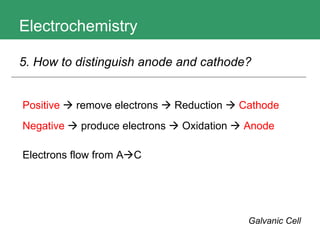
Electrochemistry 5. How to distinguish anode and cathode?   Positive     remove electrons    Reduction     Cathode Negative     produce electrons    Oxidation     Anode Electrons flow from A  C Galvanic Cell
Electrochemistry 6. How to draw cell diagram?
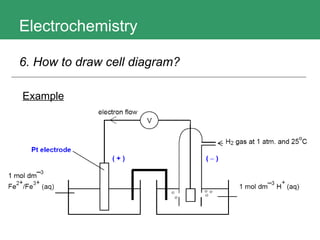
Electrochemistry 6. How to draw cell diagram?   Example
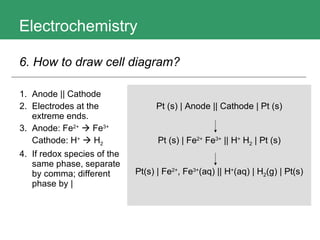
Electrochemistry 6. How to draw cell diagram?   Anode || Cathode 2. Electrodes at the extreme ends. 3.  Anode: Fe 2+     Fe 3+ Cathode: H +     H 2 4. If redox species of the same phase, separate by comma; different phase by | Pt (s) | Anode || Cathode | Pt (s) Pt (s) | Fe 2+  Fe 3+  || H +  H 2  | Pt (s) Pt(s) | Fe 2+ , Fe 3+ (aq) || H + (aq) | H 2 (g) | Pt(s)
Electrochemistry Electrolytic Cells
Electrochemistry 7. How to distinguish anode and cathode?   Electrolytic Cell
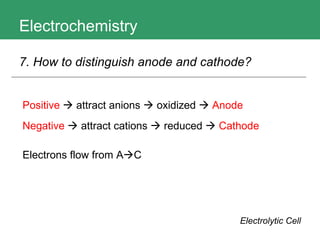
Electrochemistry 7. How to distinguish anode and cathode?   Positive     attract anions    oxidized     Anode Negative     attract cations    reduced     Cathode Electrons flow from A  C Electrolytic Cell
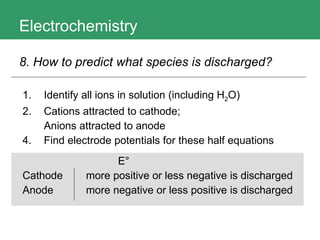
Electrochemistry 8. How to predict what species is discharged?   1. Identify all ions in solution (including H 2 O) Cations attracted to cathode;  Anions attracted to anode Find electrode potentials for these half equations E ° Cathode  more positive or less negative is discharged Anode  more negative or less positive is discharged
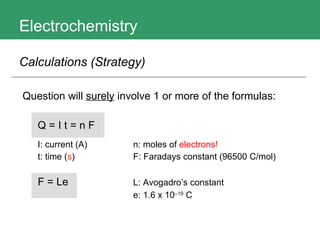
Electrochemistry Calculations (Strategy) Question will  surely  involve 1 or more of the formulas: Q = I  t = n F I: current (A) n: moles of  electrons! t: time ( s ) F: Faradays constant (96500 C/mol) F = Le L: Avogadro’s constant e: 1.6 x 10 –19  C

Electrochemistry

  • 1.
  • 2.
    Electrochemistry 1. Whatare electrode potentials?
  • 3.
    Electrochemistry Electric potentialarising from the separation of charges in the equilibrium in a redox half equation. It is measured with respect to S.H.E. Examples : 1. What are electrode potentials? Zn 2+ (aq) + 2e – ⇌ Zn (s) Fe 3+ (aq) + e – ⇌ Fe 2+ (aq) 2H + (aq) + e – ⇌ H 2 (g) Cu 2+ (aq) + 2e – ⇌ Cu (s)
  • 4.
    Electrochemistry 2. Whatcan we know from electrode potentials?
  • 5.
    Electrochemistry 2. Whatcan we know from electrode potentials? [Sign] + forward reaction ( reduction ) favoured – backward reaction ( oxidation ) favoured [Magnitude] – the extent the reaction is favoured
  • 6.
    Electrochemistry 3. Howcan we measure standard electrode potentials?
  • 7.
    Electrochemistry connect thehalf cell that you wish to study to the SHE Note : You need to be know how to draw the cell setup. Things to note when drawing half cell: (1) salt bridge, (2) voltmeter and (3) ensure all gases, solutions are at standard conditions. 3. How can we measure standard electrode potentials?
  • 8.
    Electrochemistry 4. Howcan we use standard electrode potentials?
  • 9.
    Electrochemistry to predictwhether a redox reaction is feasible when 2 species are mixed. Examples : 4. How can we use standard electrode potentials? I 2 + Cr 2+  feasible? V 3+ + Cu 2+  feasible?
  • 10.
    Electrochemistry 4. Howcan we use standard electrode potentials? Strategy 1. Identify possible oxidation/ reduction reactions Find electrode potentials for these half equations Calculate E cell = E red – E ox E cell + feasible – not feasible
  • 11.
  • 12.
    Electrochemistry 5. Howto distinguish anode and cathode? Galvanic Cell
  • 13.
    Electrochemistry 5. Howto distinguish anode and cathode? Positive  remove electrons  Reduction  Cathode Negative  produce electrons  Oxidation  Anode Electrons flow from A  C Galvanic Cell
  • 14.
    Electrochemistry 6. Howto draw cell diagram?
  • 15.
    Electrochemistry 6. Howto draw cell diagram? Example
  • 16.
    Electrochemistry 6. Howto draw cell diagram? Anode || Cathode 2. Electrodes at the extreme ends. 3. Anode: Fe 2+  Fe 3+ Cathode: H +  H 2 4. If redox species of the same phase, separate by comma; different phase by | Pt (s) | Anode || Cathode | Pt (s) Pt (s) | Fe 2+ Fe 3+ || H + H 2 | Pt (s) Pt(s) | Fe 2+ , Fe 3+ (aq) || H + (aq) | H 2 (g) | Pt(s)
  • 17.
  • 18.
    Electrochemistry 7. Howto distinguish anode and cathode? Electrolytic Cell
  • 19.
    Electrochemistry 7. Howto distinguish anode and cathode? Positive  attract anions  oxidized  Anode Negative  attract cations  reduced  Cathode Electrons flow from A  C Electrolytic Cell
  • 20.
    Electrochemistry 8. Howto predict what species is discharged? 1. Identify all ions in solution (including H 2 O) Cations attracted to cathode; Anions attracted to anode Find electrode potentials for these half equations E ° Cathode more positive or less negative is discharged Anode more negative or less positive is discharged
  • 21.
    Electrochemistry Calculations (Strategy)Question will surely involve 1 or more of the formulas: Q = I t = n F I: current (A) n: moles of electrons! t: time ( s ) F: Faradays constant (96500 C/mol) F = Le L: Avogadro’s constant e: 1.6 x 10 –19 C