Ionic Equilibria (I) Acids and bases
Ionic Equilibria (I) 1. How do we identify acids and bases?
Ionic Equilibria (I) Bronsted-Lowry Definition An  acid  is a  proton (H + ) donor . A  base  is proton  acceptor . In an acid-base reaction, the transfer of protons occurs from an acid to a base. 1. How do we identify acids and bases?   Tip :  It may be helpful for beginners to memorise some  common acids and bases.
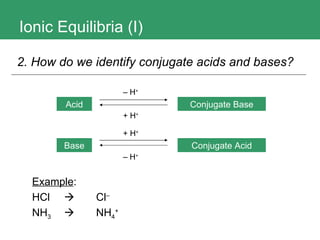
Ionic Equilibria (I) 2. How do we identify conjugate acids and bases?
Ionic Equilibria (I) Example : HCl  Cl – NH 3  NH 4 +   2. How do we identify conjugate acids and bases?   Acid Conjugate Base –  H + + H + Base Conjugate Acid + H + –  H +
Ionic Equilibria (I) 3. How do we know whether an acid/ base is strong or weak?
Ionic Equilibria (I) 3. How do we know whether an acid/ base is strong or weak?   Strong acids/ bases ionise  completely  in aqueous solution. Weak acids/ bases ionise  partially  in aqueous solution.  Tip : An acid/ base can be predicted to be  weak  when: It is stated so in the question K a  or K b  value is given Degree/ percent of ionisation is given [H 3 O + ] < [HA]; [OH – ] < [B]
Ionic Equilibria (I) 4. How do we calculate pH of an acid/ base?
Ionic Equilibria (I) 4. How do we calculate pH of an acid/ base? (I) Learn the important terms/ relations pH, pOH K a , pK a K b , pK b K w pH + pOH = 14 pK a  + pK b  = 14 [H + ][OH – ] = 10 -14 K a  . K b  = K w  = 10 -14
Ionic Equilibria (I) 4. How do we calculate pH of an acid/ base? (II) Determine strong or weak Strong acids ionise  completely  in aqueous solution.  [H 3 O + ] = [HA]   pH = - log [HA]  Strong bases ionise  completely  in aqueous solution.  [OH - ] = [B]  pOH = - log [B] Strong Acid Strong Base
Ionic Equilibria (I) 4. How do we calculate pH of an acid/ base? (II) Determine strong or weak Weak bases ionise  partially  in aqueous solution.  [OH - ] < [B]  pOH = - log [OH – ] Weak Acid Weak Base Weak acids ionise  partially  in aqueous solution.  [H 3 O + ]  <  [HA]   pH = - log [H 3 O + ] [H 3 O + ] =  K a  × [HA] [OH – ] =  K b  × [B]
Ionic Equilibria (II) Salts
Ionic Equilibria (II) 5.  How do we know if a salt is neutral, acidic or basic?
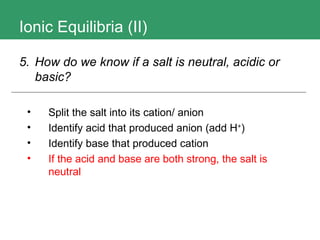
Ionic Equilibria (II) Split the salt into its cation/ anion Identify acid that produced anion (add H + ) Identify base that produced cation If the acid and base are both strong, the salt is neutral 5.  How do we know if a salt is neutral, acidic or basic?
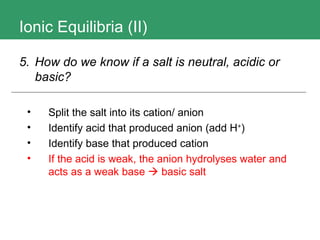
Ionic Equilibria (II) Split the salt into its cation/ anion Identify acid that produced anion (add H + ) Identify base that produced cation If the acid is weak, the anion hydrolyses water and acts as a weak base    basic salt 5.  How do we know if a salt is neutral, acidic or basic?
Ionic Equilibria (II) Split the salt into its cation/ anion Identify acid that produced anion (add H + ) Identify base that produced cation If the base is weak, the cation hydrolyses water and acts as a weak acid    acidic salt 5.  How do we know if a salt is neutral, acidic or basic?
Ionic Equilibria (II) 6.  How do we calculate the pH of a salt solution?
Ionic Equilibria (II) Identify  ion  that hydrolyses H 2 O Write equation of the  ion  with H 2 O Find pH by treating  ion  as  weak acid  or  weak base   Recall : 6.  How do we calculate the pH of a salt solution?   [H 3 O + ] =  K a  × [HA]   [OH – ] =  K b  × [B]
Ionic Equilibria (II) Find K a / K b  of the  ion  from K b / K a  of the parent acid/ base    use K w 2. Find [salt] =  6.  How do we calculate the pH of a salt solution?   [H 3 O + ] =  K a  × [HA]   [OH – ] =  K b  × [B] n (limiting reagent) V total V total  = V acid  + V base
Ionic Equilibria (III) Solubility Equilibria - sparingly soluble salts
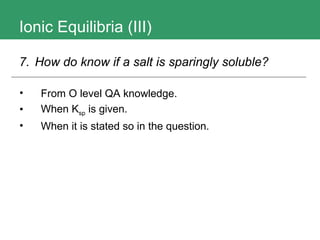
Ionic Equilibria (III) 7.  How do know if a salt is sparingly soluble?
Ionic Equilibria (III) From O level QA knowledge. When K sp  is given. When it is stated so in the question. 7.  How do know if a salt is sparingly soluble?
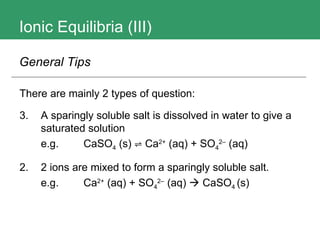
Ionic Equilibria (III) There are mainly 2 types of question: A sparingly soluble salt is dissolved in water to give a saturated solution e.g.  CaSO 4  (s)  ⇌ Ca 2+   (aq)  + SO 4 2 –  (aq)   2.  2 ions are mixed to form a sparingly soluble salt. e.g.  Ca 2+   (aq)  + SO 4 2 –  (aq)     CaSO 4  (s)  General Tips
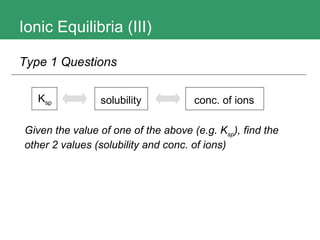
Ionic Equilibria (III) Type 1 Questions K sp solubility conc. of ions Given the value of one of the above (e.g. K sp ), find the other 2 values (solubility and conc. of ions)
Ionic Equilibria (III) CaF 2  (s)  ⇌ Ca 2+   (aq)  + 2F –  (aq) I ?   0  0 C   -x   +x  +2x E   ?   x  2x Type 1 Questions (Strategy) K sp solubility conc. of ions Expressing each term in x can help in the interconversion. solubility = x K sp  = 4x 3 [Ca 2+ ] = x [F – ] = 2x
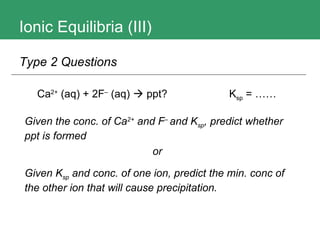
Ionic Equilibria (III) Ca 2+   (aq)  + 2F –  (aq)   ppt? K sp  = …… Type 2 Questions Given the conc. of Ca 2+  and F –  and K sp , predict whether ppt is formed or Given K sp  and conc. of one ion, predict the min. conc of the other ion that will cause precipitation.
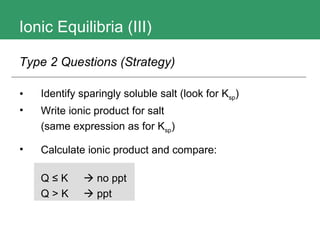
Ionic Equilibria (III) Identify sparingly soluble salt (look for K sp ) Write ionic product for salt (same expression as for K sp ) Calculate ionic product and compare: Q  ≤  K   no ppt Q > K   ppt Type 2 Questions (Strategy)
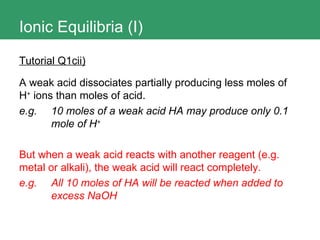
Ionic Equilibria (I) Tutorial Q1cii) A weak acid dissociates partially producing less moles of H +  ions than moles of acid. e.g.  10 moles of a weak acid HA may produce only 0.1  mole of H + But when a weak acid reacts with another reagent (e.g. metal or alkali), the weak acid will react completely. e.g. All 10 moles of HA will be reacted when added to  excess NaOH

Ionic Equilibria

  • 1.
    Ionic Equilibria (I)Acids and bases
  • 2.
    Ionic Equilibria (I)1. How do we identify acids and bases?
  • 3.
    Ionic Equilibria (I)Bronsted-Lowry Definition An acid is a proton (H + ) donor . A base is proton acceptor . In an acid-base reaction, the transfer of protons occurs from an acid to a base. 1. How do we identify acids and bases? Tip : It may be helpful for beginners to memorise some common acids and bases.
  • 4.
    Ionic Equilibria (I)2. How do we identify conjugate acids and bases?
  • 5.
    Ionic Equilibria (I)Example : HCl  Cl – NH 3  NH 4 + 2. How do we identify conjugate acids and bases? Acid Conjugate Base – H + + H + Base Conjugate Acid + H + – H +
  • 6.
    Ionic Equilibria (I)3. How do we know whether an acid/ base is strong or weak?
  • 7.
    Ionic Equilibria (I)3. How do we know whether an acid/ base is strong or weak? Strong acids/ bases ionise completely in aqueous solution. Weak acids/ bases ionise partially in aqueous solution. Tip : An acid/ base can be predicted to be weak when: It is stated so in the question K a or K b value is given Degree/ percent of ionisation is given [H 3 O + ] < [HA]; [OH – ] < [B]
  • 8.
    Ionic Equilibria (I)4. How do we calculate pH of an acid/ base?
  • 9.
    Ionic Equilibria (I)4. How do we calculate pH of an acid/ base? (I) Learn the important terms/ relations pH, pOH K a , pK a K b , pK b K w pH + pOH = 14 pK a + pK b = 14 [H + ][OH – ] = 10 -14 K a . K b = K w = 10 -14
  • 10.
    Ionic Equilibria (I)4. How do we calculate pH of an acid/ base? (II) Determine strong or weak Strong acids ionise completely in aqueous solution. [H 3 O + ] = [HA]  pH = - log [HA] Strong bases ionise completely in aqueous solution. [OH - ] = [B]  pOH = - log [B] Strong Acid Strong Base
  • 11.
    Ionic Equilibria (I)4. How do we calculate pH of an acid/ base? (II) Determine strong or weak Weak bases ionise partially in aqueous solution. [OH - ] < [B]  pOH = - log [OH – ] Weak Acid Weak Base Weak acids ionise partially in aqueous solution. [H 3 O + ] < [HA]  pH = - log [H 3 O + ] [H 3 O + ] = K a × [HA] [OH – ] = K b × [B]
  • 12.
  • 13.
    Ionic Equilibria (II)5. How do we know if a salt is neutral, acidic or basic?
  • 14.
    Ionic Equilibria (II)Split the salt into its cation/ anion Identify acid that produced anion (add H + ) Identify base that produced cation If the acid and base are both strong, the salt is neutral 5. How do we know if a salt is neutral, acidic or basic?
  • 15.
    Ionic Equilibria (II)Split the salt into its cation/ anion Identify acid that produced anion (add H + ) Identify base that produced cation If the acid is weak, the anion hydrolyses water and acts as a weak base  basic salt 5. How do we know if a salt is neutral, acidic or basic?
  • 16.
    Ionic Equilibria (II)Split the salt into its cation/ anion Identify acid that produced anion (add H + ) Identify base that produced cation If the base is weak, the cation hydrolyses water and acts as a weak acid  acidic salt 5. How do we know if a salt is neutral, acidic or basic?
  • 17.
    Ionic Equilibria (II)6. How do we calculate the pH of a salt solution?
  • 18.
    Ionic Equilibria (II)Identify ion that hydrolyses H 2 O Write equation of the ion with H 2 O Find pH by treating ion as weak acid or weak base Recall : 6. How do we calculate the pH of a salt solution? [H 3 O + ] = K a × [HA] [OH – ] = K b × [B]
  • 19.
    Ionic Equilibria (II)Find K a / K b of the ion from K b / K a of the parent acid/ base  use K w 2. Find [salt] = 6. How do we calculate the pH of a salt solution? [H 3 O + ] = K a × [HA] [OH – ] = K b × [B] n (limiting reagent) V total V total = V acid + V base
  • 20.
    Ionic Equilibria (III)Solubility Equilibria - sparingly soluble salts
  • 21.
    Ionic Equilibria (III)7. How do know if a salt is sparingly soluble?
  • 22.
    Ionic Equilibria (III)From O level QA knowledge. When K sp is given. When it is stated so in the question. 7. How do know if a salt is sparingly soluble?
  • 23.
    Ionic Equilibria (III)There are mainly 2 types of question: A sparingly soluble salt is dissolved in water to give a saturated solution e.g. CaSO 4 (s) ⇌ Ca 2+ (aq) + SO 4 2 – (aq) 2. 2 ions are mixed to form a sparingly soluble salt. e.g. Ca 2+ (aq) + SO 4 2 – (aq)  CaSO 4 (s) General Tips
  • 24.
    Ionic Equilibria (III)Type 1 Questions K sp solubility conc. of ions Given the value of one of the above (e.g. K sp ), find the other 2 values (solubility and conc. of ions)
  • 25.
    Ionic Equilibria (III)CaF 2 (s) ⇌ Ca 2+ (aq) + 2F – (aq) I ? 0 0 C -x +x +2x E ? x 2x Type 1 Questions (Strategy) K sp solubility conc. of ions Expressing each term in x can help in the interconversion. solubility = x K sp = 4x 3 [Ca 2+ ] = x [F – ] = 2x
  • 26.
    Ionic Equilibria (III)Ca 2+ (aq) + 2F – (aq)  ppt? K sp = …… Type 2 Questions Given the conc. of Ca 2+ and F – and K sp , predict whether ppt is formed or Given K sp and conc. of one ion, predict the min. conc of the other ion that will cause precipitation.
  • 27.
    Ionic Equilibria (III)Identify sparingly soluble salt (look for K sp ) Write ionic product for salt (same expression as for K sp ) Calculate ionic product and compare: Q ≤ K  no ppt Q > K  ppt Type 2 Questions (Strategy)
  • 28.
    Ionic Equilibria (I)Tutorial Q1cii) A weak acid dissociates partially producing less moles of H + ions than moles of acid. e.g. 10 moles of a weak acid HA may produce only 0.1 mole of H + But when a weak acid reacts with another reagent (e.g. metal or alkali), the weak acid will react completely. e.g. All 10 moles of HA will be reacted when added to excess NaOH