Redox


        FAQs
Redox

If given an unfamiliar species, e.g. [Co(NH3)6]2+,
how do I know what can it oxidise/ reduce to?

Look for the species in data booklet.
Redox

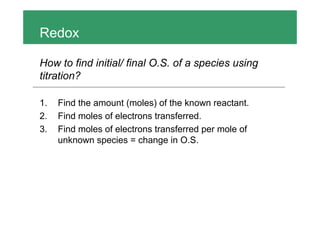
How to find initial/ final O.S. of a species using
titration?

1.   Find the amount (moles) of the known reactant.
2.   Find moles of electrons transferred.
3.   Find moles of electrons transferred per mole of
     unknown species = change in O.S.
Redox

How to find initial/ final O.S. of a species using
titration?

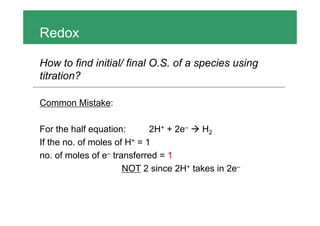
Common Mistake:

For the half equation:       2H+ + 2e–  H2
If the no. of moles of H+ = 1
no. of moles of e– transferred = 1
                      NOT 2 since 2H+ takes in 2e–
Redox

How to find initial/ final O.S. of a species using
titration?

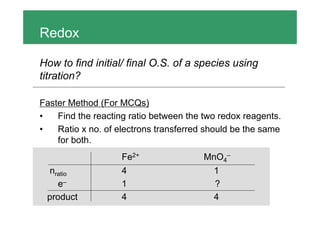
Faster Method (For MCQs)
•   Find the reacting ratio between the two redox reagents.
•   Ratio x no. of electrons transferred should be the same
    for both.
                    Fe2+                MnO4–
 nratio             4                     1
    e–              1                     ?
 product            4                     4

Redox

  • 1.
    Redox FAQs
  • 2.
    Redox If given anunfamiliar species, e.g. [Co(NH3)6]2+, how do I know what can it oxidise/ reduce to? Look for the species in data booklet.
  • 3.
    Redox How to findinitial/ final O.S. of a species using titration? 1. Find the amount (moles) of the known reactant. 2. Find moles of electrons transferred. 3. Find moles of electrons transferred per mole of unknown species = change in O.S.
  • 4.
    Redox How to findinitial/ final O.S. of a species using titration? Common Mistake: For the half equation: 2H+ + 2e– H2 If the no. of moles of H+ = 1 no. of moles of e– transferred = 1 NOT 2 since 2H+ takes in 2e–
  • 5.
    Redox How to findinitial/ final O.S. of a species using titration? Faster Method (For MCQs) • Find the reacting ratio between the two redox reagents. • Ratio x no. of electrons transferred should be the same for both. Fe2+ MnO4– nratio 4 1 e– 1 ? product 4 4