ELECTRICITY
MADE BY
SAIRAM,VIJAYRAKESH,ABHITEJ,RAVITEJA AND AKARSH
X-A
Types of charges
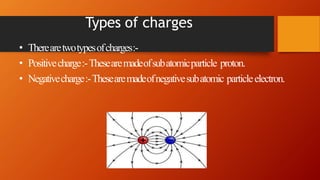
• Therearetwotypesofcharges:-
• Positivecharge:-Thesearemadeofsubatomicparticle proton.
• Negativecharge:-Thesearemadeofnegativesubatomic particleelectron.
S.I. unit of charge
• TheS.I.unitofchargeis coulomb.
• Anelectronpossesanegative chargeof 1.5x10⁻¹⁹.
• TheS.I.unitofonecoulombisequivalenttothecharge containing6.25x
10-18.
Conductors and Insulators
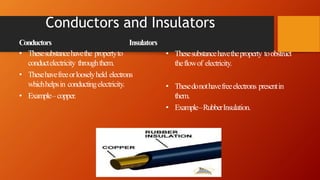
• Thesesubstancehavethe propertyto
conductelectricity throughthem.
• Thesehavefreeorlooselyheld electrons
whichhelpsin conductingelectricity.
• Example–copper.
Conductors Insulators
• Thesesubstancehavetheproperty toobstruct
theflowof electricity.
• Thesedonothavefreeelectrons presentin
them.
• Example–RubberInsulation.
Electric potential
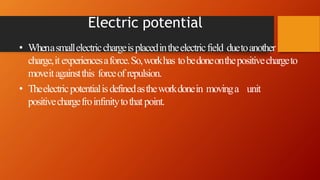
• Whenasmallelectricchargeisplacedintheelectricfield duetoanother
charge,itexperiencesaforce.So,workhas tobedoneonthepositivechargeto
moveitagainstthis forceof repulsion.
• Theelectricpotentialisdefinedastheworkdonein movinga unit
positivechargefroinfinitytothatpoint.
Potential Difference
• Theconceptofelectricpotentialiscloselylinkedtothatofthe electricfield.Asmall
chargeplacedwithinanelectricfield experiencesaforce,andtohavebroughtthat
chargetothat pointagainsttheforcerequireswork.Theelectricpotentialat any
pointisdefinedastheenergyrequiredtobringaunittest chargefromaninfinite
distanceslowlytothat point.
• Itisusuallymeasuredinvolts,andonevoltisthepotential forwhichonejouleof
workmustbeexpendedtobringa chargeofonecoulombfrominfinity.
𝑤𝑜𝑟𝑘 𝑑𝑜𝑛𝑒
Potentialdifference= 𝑄 𝑢 𝑎𝑛𝑡𝑖𝑡𝑦 𝑜𝑓 𝑐ℎ𝑎𝑟𝑔𝑒 𝑚 𝑜 𝑣 𝑒 𝑑
.
𝑊
or, V= 𝑄
.
whereW=workdone.
andQ =quantityofchargemoved.
1 𝑗𝑜𝑢𝑙 𝑒
S.I.unitofpotentialdifferenceisvolt. thus1volt=
1 𝑐𝑜𝑢𝑙𝑜𝑚𝑏
Voltmeter
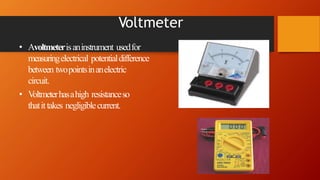
• Avoltmeterisaninstrument usedfor
measuringelectrical potentialdifference
between twopointsinanelectric
circuit.
• Voltmeterhasahigh resistanceso
thatittakes negligiblecurrent.
Electric Current
• Themovementofelectricchargeisknownasanelectric current,the
intensityofwhichisusually measured
inamperes.Currentcanconsistofanymovingcharged
particles;mostcommonlytheseareelectrons,butany chargeinmotion
constitutesacurrent.
1𝑆𝑒𝑐𝑜𝑛𝑑
• 1ampere= 1 𝐶𝑜𝑢𝑙𝑜𝑚𝑏
.
Ammeter
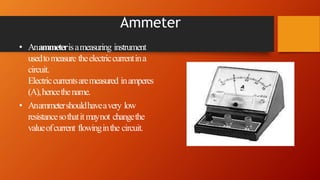
• Anammeterisameasuring instrument
usedtomeasure theelectriccurrentina
circuit.
Electriccurrentsaremeasured inamperes
(A),hencethename.
• Anammetershouldhaveavery low
resistancesothatitmaynot changethe
valueofcurrent flowinginthe circuit.
Circuit Diagram
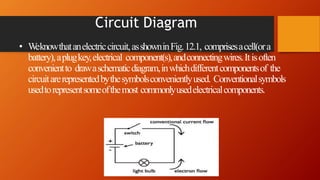
• Weknowthatanelectriccircuit,asshowninFig.12.1, comprisesacell(ora
battery),aplugkey,electrical component(s),andconnectingwires.Itisoften
convenientto drawaschematicdiagram,inwhichdifferentcomponentsof the
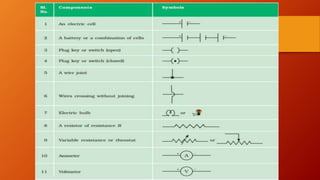
circuitarerepresentedbythesymbolsconvenientlyused. Conventionalsymbols
usedtorepresentsomeofthemost commonlyusedelectricalcomponents.
Georg Ohm
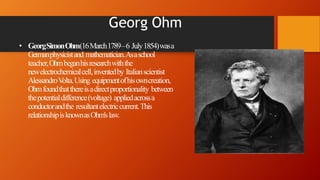
• GeorgSimonOhm(16March1789–6 July1854)wasa
Germanphysicistand mathematician.Asaschool
teacher,Ohmbeganhisresearchwiththe
newelectrochemicalcell,inventedby Italianscientist
AlessandroVolta.Using equipmentofhisowncreation,
Ohmfoundthatthereisadirectproportionality between
thepotentialdifference(voltage) appliedacrossa
conductorandthe resultantelectriccurrent.This
relationshipisknownasOhm'slaw.
Ohm’s Law
• Ohm’sLawexplainstherelationshipbetweenvoltage(V orE),current(I)and
resistance(R)
• Usedbyelectricians,automotivetechnicians,stereo installers.
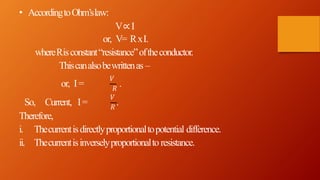
• AccordingtoOhm’slaw:Atconstanttemperature,the currentflowing
throughaconductorisdirectly proportionaltothepotentialdifference
acrossitsend.
𝑉
• AccordingtoOhm’slaw:
V∝I
or, V= RxI.
whereRisconstant“resistance”oftheconductor.
Thiscanalsobewrittenas –
or, I= 𝑅
.
𝑉
So, Current, I= 𝑅
.
Therefore,
i. Thecurrentisdirectlyproportionaltopotential difference.
ii. Thecurrentisinverselyproportionalto resistance.
Resistance
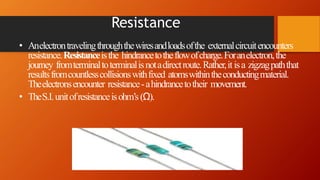
• Anelectrontravelingthroughthewiresandloadsofthe externalcircuitencounters
resistance.Resistanceisthe hindrancetotheflowofcharge.Foranelectron,the
journey fromterminaltoterminalisnotadirectroute.Rather,itisa zigzagpaththat
resultsfromcountlesscollisionswithfixed atomswithintheconductingmaterial.
Theelectronsencounter resistance-ahindrancetotheir movement.
• TheS.I.unitofresistanceisohm’s(Ω).
Factors affecting Resistance
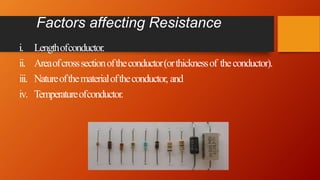
i. Lengthofconductor.
ii. Areaofcrosssectionoftheconductor(orthicknessof theconductor).
iii. Natureofthematerialoftheconductor, and
iv. Temperatureofconductor.
Resistivity
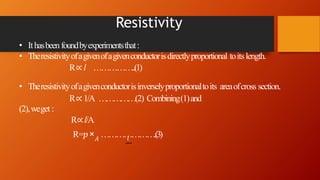
• Ithasbeenfoundbyexperimentsthat:
• Theresistivityofagivenofagivenconductorisdirectlyproportional toits length.
R∝ l ……………..(1)
𝑙
• Theresistivityofagivenconductorisinverselyproportionaltoits areaofcross section.
R∝ 1/A ……………(2) Combining(1)and
(2),weget :
R∝l/A
R=𝑝× 𝐴
………………….(3)
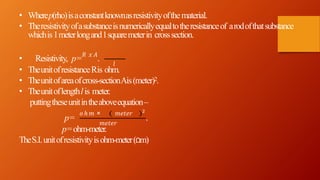
• Wherep(rho)isaconstantknownasresistivityofthematerial.
• Theresistivityofasubstanceisnumericallyequaltotheresistanceof arodofthatsubstance
whichis1meterlongand1squaremeterin crosssection.
𝑙
• Resistivity, p= 𝑅 𝑥 𝐴
.
• TheunitofresistanceRis ohm.
• Theunitofareaofcross-sectionAis(meter)2.
• Theunitoflengthlis meter.
puttingtheseunitintheaboveequation–
p=
𝑜 ℎ 𝑚 × 𝑚𝑒𝑡𝑒𝑟 2
𝑚𝑒𝑡𝑒𝑟
.
p=ohm-meter.
TheS.I.unitofresistivityisohm-meter(Ωm)
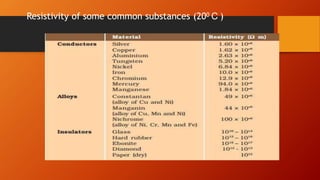
Resistivity of some common substances (200 C )
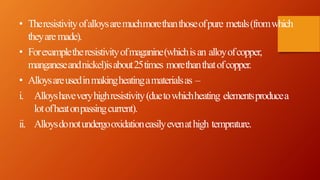
• Theresistivityofalloysaremuchmorethanthoseofpure metals(fromwhich
theyaremade).
• Forexampletheresistivityofmaganine(whichisan alloyofcopper,
manganeseandnickel)isabout25times morethanthatofcopper.
• Alloysareusedinmakingheatingamaterialsas –
i. Alloyshaveveryhighresistivity(duetowhichheating elementsproducea
lotofheatonpassingcurrent).
ii. Alloysdonotundergooxidationeasilyevenathigh temprature.
Combination of Resistors
• Resistorscanbecombinedintwoways –
i. Inseries.
ii.Inparallel.
Resistors in Series
• Whentwo(ormore)resistorsareconnectedendtoend consecutively,they
aresaidtobeconnectedinseries.
• Accordingtothelawofcombinationofresistancein series:Thecombined
resistanceofanynumberof resistancesconnectedinseriesisequalto
thesumof theindividual resistances.
R=R1+R2+R3+………..
I. Whenanumberofresistorsconnectedinseriesare joinedtotheterminalofa
battery,theneachresistance hasadifferentpotentialdifferenceacrossitsends
(whichdependsonthevalueofresistance).Butthetotal potentialdifference
acrossalltheendsofalltheresistors inseriesis equal.
II. Whenanumberofresistorsareconnectedinseries,then thesamecurrent
flowsthrougheach resistance.
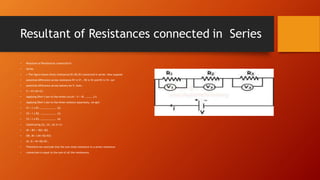
Resultant of Resistances connected in Series
• Resultant of Resistances connected in
• Series
• • The figure shows three resistances R1,R2,R3 connected in series. Now suppose
• potential difference across resistance R1 is V1 , R2 is V2 and R3 is V3. Let
• potential difference across battery be V, then :
• V = V1+V2+V3.
• Applying Ohm’s law to the whole circuit : V = IR. ………..(1)
• Applying Ohm’s law to the three resistors separately, we get:
• V1 = I x R1. ………………….. (2)
• V2 = I x R2. ………………….. (3)
• V3 = I x R3. ………………….. (4)
• Substituting (2), (3), (4) in (1)
• IR = IR1 + IR2+ IR3
• OR, IR= I (R1+R2+R3)
• Or, R = R1+R2+R3 .
• Therefore we conclude that the sum total resistance in a series resistance
• connection is equal to the sum of all the resistances.
Resistors in Parallel
• Whentwo(ormore)resistorsareconnectedbetweenthesame points,theyaresaidto
beconnectedin parallel.
• Accordingtothelawofcombinationofresistanceinparallel: Thereciprocalofthe
combinedresistanceofanynumber ofresistancesconnectedinparallelisequal
tothesumof thereciprocalsoftheindividualresistances.
1/R=1/R1+1/R2+1/R3+………..
• When a number of resistances are connected in parallel then their combined
resistanceislessthanthesmallestindividual resistance.
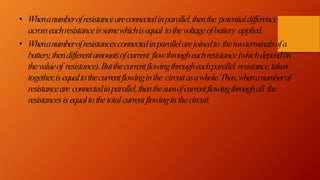
• Whenanumberofresistanceareconnectedinparallel,thenthe potentialdifference
acrosseachresistanceissamewhichisequal tothevoltageofbattery applied.
• Whenanumberofresistancesconnectedinparallelarejoinedto thetwoterminalsofa
battery,thendifferentamountsofcurrent flowthrougheachresistance(whichdependon
thevalueof resistance).Butthecurrentflowingthrougheachparallel resistance,taken
together,isequaltothecurrentflowinginthe circuitasawhole.Thus,whenanumberof
resistanceare connectedinparallel,thenthesumofcurrentflowingthroughall the
resistancesisequaltothetotalcurrentflowinginthecircuit.
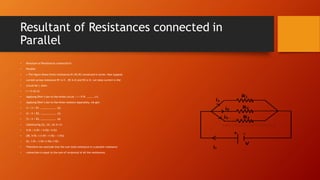
Resultant of Resistances connected in
Parallel
• Resultant of Resistances connected in
• Parallel
• • The figure shows three resistances R1,R2,R3 connected in series. Now suppose
• currant across resistance R1 is I1 , R2 is I2 and R3 is I3. Let total current in the
• circuit be I, then:
• I = I1+I2+I3.
• Applying Ohm’s law to the whole circuit : I = V/R. ………..(1)
• Applying Ohm’s law to the three resistors separately, we get:
• I1 = V / R1. ………………….. (2)
• I2 = V / R2. ………………….. (3)
• I3 = V / R3. ………………….. (4)
• Substituting (2), (3), (4) in (1)
• V/R = V/R1 + V/R2+ V/R3
• OR, V/R= I (1/R1 +1/R2 + 1/R3)
• Or, 1/R = 1/R1+1/R2+1/R3 .
• Therefore we conclude that the sum total resistance in a parallel resistance
• connection is equal to the sum of reciprocal of all the resistances.
Parallel and Series connection
• Ifoneelectricappliancestopsworkingdue tosomedefect,
thenallotherappliances keepworkingnormally.
• Inparallelcircuits,eachelectricappliance hasitsown
switchduetowhichitcanbe turnedonoroff
independently.
• Eachappliancegetssamevoltageasthat
ofpowersource.
• Overallresistanceofhouseholdcircuitis reduceddueto
whichthecurrentfrom powersupplyis high.
Parallelconnection Seriesconnection
• Ifoneelectricappliancestopworkingdue tosomedefect,
thenallotherappliances stopworking.
• Alltheelectricapplianceshaveonlyone switchdueto
whichtheycannotbeturned onoroff separately.
• In series circuit, the appliances do not get same voltage
(220V)asthatofthepower supplyline.
• Inseriescircuittheoverallresistanceof thecircuit
increasesduetowhichthe currentfromthepower
sourceis low.
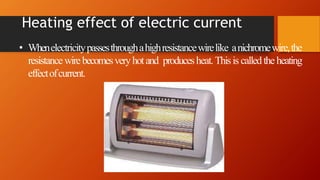
Heating effect of electric current
• Whenelectricitypassesthroughahighresistancewirelike anichromewire,the
resistancewirebecomesveryhotand producesheat.Thisis calledtheheating
effectofcurrent.
James Prescott Joule
JamesPrescottJoule(24December1818–11October 1889)wasanEnglish
physicistandbrewer,borninSalford, Lancashire.Joulestudiedthenatureof
heat,anddiscovered itsrelationshiptomechanicalwork.Thisledtothelawof
conservationofenergy,andthisledtothedevelopmentof thefirstlawof
thermodynamics.TheSIderivedunitof energy,thejoule,isnamedforJames
Joule.Heworked withLordKelvintodeveloptheabsolutescale
oftemperature.Joulealsomadeobservationsof magnetostriction,andhefound
therelationshipbetweenthe currentthrougharesistorandtheheatdissipated,
whichis nowcalledJoule'sfirstlaw.
Joule’s law of heating
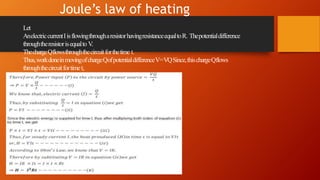
Let
AnelectriccurrentIisflowingthrougharesistorhavingresistanceequaltoR. Thepotentialdifference
throughtheresistorisequalto V.
ThechargeQflowsthroughthecircuitforthetime t.
Thus,workdoneinmovingofchargeQofpotentialdifferenceV=VQSince,thischargeQflows
throughthecircuitfortimet,
• Theheatproducedinwireisdirectlyproportionalto
i. Squareofcurrent.
ii. Resistanceof wire.
iii. Timeforwhichcurrentispassed.
Applications of heating effect of electric
current
Therearemanypracticalusesofheatingeffectofcurrent.Someofthemostcommonareas follows.
• Anincandescentlightbulbglowswhenthefilamentisheatedbyheatingeffectofcurrent,sohot
thatitglowswhitewiththermalradiation(alsocalledblackbodyradiation).
• Electricstovesandotherelectricheatersusuallyworkbyheatingeffectofcurrent.
• Solderingironsandcartridgeheatersareveryoftenheatedbyheatingeffectofcurrent.
• Electricfusesrelyonthefactthatifenoughcurrentflows,enoughheatwillbegeneratedtomelt thefusewire.
• Electroniccigarettesusuallyworkbyheatingeffectofcurrent,vaporizingpropyleneglycoland
vegetableglycerin.
• Thermistorsandresistancethermometersareresistorswhoseresistancechangeswhenthe temperaturechanges.Thesearesometimes
usedinconjunctionwithheatingeffectofcurrent(also calledself-heatinginthiscontext):Ifalargecurrentisrunningthroughthe
nonlinearresistor,the resistor'stemperaturerisesandthereforeitsresistancechanges.Therefore,thesecomponentscanbe usedina
circuit-protectionrolesimilartofuses,orforfeedbackincircuits,orformanyother purposes.Ingeneral,self-heatingcanturnaresistor
intoanonlinearandhystereticcircuitelement.
Electric Energy
• H=I2 Rtgivestherateatwhichelectricenergyisdissipatedorconsumedinanelectric
circuit.Thisisalsotermedaselectricpower.ThepowerPisgivenby
P=VI
OrP=I2R= V2/R
• TheSIunitofelectricpoweriswatt(W).Itisthepowerconsumedbyadevicethatcarries1 Aofcurrentwhenoperatedata
potentialdifferenceof1V. Thus,
1W=1volt×1ampere=1VA
• Theunit‘watt’isverysmall.Therefore,inactualpracticeweuseamuchlargerunitcalled ‘kilowatt’.Itisequalto1000watts.
Sinceelectricalenergyistheproductofpowerandtime, theunitofelectricenergyis,therefore,watthour(Wh).Onewatthour
istheenergy consumedwhen1wattofpowerisusedfor1hour.Thecommercialunitofelectricenergyis kilowatthour(kW
h),commonlyknownas‘unit’.
1kWh=1000watt×3600second
= 3.6× 10⁶wattsecond
= 3.6× 10⁶joule(J)
PPT MADE BY
BHADRACHALAM PUBLIC
SCHOOL
Ppt on ElectricIty

Ppt on ElectricIty

  • 1.
  • 2.
    Types of charges •Therearetwotypesofcharges:- • Positivecharge:-Thesearemadeofsubatomicparticle proton. • Negativecharge:-Thesearemadeofnegativesubatomic particleelectron.
  • 3.
    S.I. unit ofcharge • TheS.I.unitofchargeis coulomb. • Anelectronpossesanegative chargeof 1.5x10⁻¹⁹. • TheS.I.unitofonecoulombisequivalenttothecharge containing6.25x 10-18.
  • 4.
    Conductors and Insulators •Thesesubstancehavethe propertyto conductelectricity throughthem. • Thesehavefreeorlooselyheld electrons whichhelpsin conductingelectricity. • Example–copper. Conductors Insulators • Thesesubstancehavetheproperty toobstruct theflowof electricity. • Thesedonothavefreeelectrons presentin them. • Example–RubberInsulation.
  • 5.
    Electric potential • Whenasmallelectricchargeisplacedintheelectricfieldduetoanother charge,itexperiencesaforce.So,workhas tobedoneonthepositivechargeto moveitagainstthis forceof repulsion. • Theelectricpotentialisdefinedastheworkdonein movinga unit positivechargefroinfinitytothatpoint.

  • 6.
    Potential Difference • Theconceptofelectricpotentialiscloselylinkedtothatoftheelectricfield.Asmall chargeplacedwithinanelectricfield experiencesaforce,andtohavebroughtthat chargetothat pointagainsttheforcerequireswork.Theelectricpotentialat any pointisdefinedastheenergyrequiredtobringaunittest chargefromaninfinite distanceslowlytothat point. • Itisusuallymeasuredinvolts,andonevoltisthepotential forwhichonejouleof workmustbeexpendedtobringa chargeofonecoulombfrominfinity.
  • 7.
    𝑤𝑜𝑟𝑘 𝑑𝑜𝑛𝑒 Potentialdifference= 𝑄𝑢 𝑎𝑛𝑡𝑖𝑡𝑦 𝑜𝑓 𝑐ℎ𝑎𝑟𝑔𝑒 𝑚 𝑜 𝑣 𝑒 𝑑 . 𝑊 or, V= 𝑄 . whereW=workdone. andQ =quantityofchargemoved. 1 𝑗𝑜𝑢𝑙 𝑒 S.I.unitofpotentialdifferenceisvolt. thus1volt= 1 𝑐𝑜𝑢𝑙𝑜𝑚𝑏
  • 8.
    Voltmeter • Avoltmeterisaninstrument usedfor measuringelectricalpotentialdifference between twopointsinanelectric circuit. • Voltmeterhasahigh resistanceso thatittakes negligiblecurrent.
  • 9.
    Electric Current • Themovementofelectricchargeisknownasanelectriccurrent,the intensityofwhichisusually measured inamperes.Currentcanconsistofanymovingcharged particles;mostcommonlytheseareelectrons,butany chargeinmotion constitutesacurrent. 1𝑆𝑒𝑐𝑜𝑛𝑑 • 1ampere= 1 𝐶𝑜𝑢𝑙𝑜𝑚𝑏 .
  • 10.
    Ammeter • Anammeterisameasuring instrument usedtomeasuretheelectriccurrentina circuit. Electriccurrentsaremeasured inamperes (A),hencethename. • Anammetershouldhaveavery low resistancesothatitmaynot changethe valueofcurrent flowinginthe circuit.
  • 11.
    Circuit Diagram • Weknowthatanelectriccircuit,asshowninFig.12.1,comprisesacell(ora battery),aplugkey,electrical component(s),andconnectingwires.Itisoften convenientto drawaschematicdiagram,inwhichdifferentcomponentsof the circuitarerepresentedbythesymbolsconvenientlyused. Conventionalsymbols usedtorepresentsomeofthemost commonlyusedelectricalcomponents.
  • 13.
    Georg Ohm • GeorgSimonOhm(16March1789–6July1854)wasa Germanphysicistand mathematician.Asaschool teacher,Ohmbeganhisresearchwiththe newelectrochemicalcell,inventedby Italianscientist AlessandroVolta.Using equipmentofhisowncreation, Ohmfoundthatthereisadirectproportionality between thepotentialdifference(voltage) appliedacrossa conductorandthe resultantelectriccurrent.This relationshipisknownasOhm'slaw.
  • 14.
    Ohm’s Law • Ohm’sLawexplainstherelationshipbetweenvoltage(VorE),current(I)and resistance(R) • Usedbyelectricians,automotivetechnicians,stereo installers. • AccordingtoOhm’slaw:Atconstanttemperature,the currentflowing throughaconductorisdirectly proportionaltothepotentialdifference acrossitsend.
  • 15.
    𝑉 • AccordingtoOhm’slaw: V∝I or, V=RxI. whereRisconstant“resistance”oftheconductor. Thiscanalsobewrittenas – or, I= 𝑅 . 𝑉 So, Current, I= 𝑅 . Therefore, i. Thecurrentisdirectlyproportionaltopotential difference. ii. Thecurrentisinverselyproportionalto resistance.
  • 16.
    Resistance • Anelectrontravelingthroughthewiresandloadsofthe externalcircuitencounters resistance.Resistanceisthehindrancetotheflowofcharge.Foranelectron,the journey fromterminaltoterminalisnotadirectroute.Rather,itisa zigzagpaththat resultsfromcountlesscollisionswithfixed atomswithintheconductingmaterial. Theelectronsencounter resistance-ahindrancetotheir movement. • TheS.I.unitofresistanceisohm’s(Ω).
  • 17.
    Factors affecting Resistance i.Lengthofconductor. ii. Areaofcrosssectionoftheconductor(orthicknessof theconductor). iii. Natureofthematerialoftheconductor, and iv. Temperatureofconductor.
  • 18.
    Resistivity • Ithasbeenfoundbyexperimentsthat: • Theresistivityofagivenofagivenconductorisdirectlyproportionaltoits length. R∝ l ……………..(1) 𝑙 • Theresistivityofagivenconductorisinverselyproportionaltoits areaofcross section. R∝ 1/A ……………(2) Combining(1)and (2),weget : R∝l/A R=𝑝× 𝐴 ………………….(3)

  • 19.
    • Wherep(rho)isaconstantknownasresistivityofthematerial. • Theresistivityofasubstanceisnumericallyequaltotheresistanceofarodofthatsubstance whichis1meterlongand1squaremeterin crosssection. 𝑙 • Resistivity, p= 𝑅 𝑥 𝐴 . • TheunitofresistanceRis ohm. • Theunitofareaofcross-sectionAis(meter)2. • Theunitoflengthlis meter. puttingtheseunitintheaboveequation– p= 𝑜 ℎ 𝑚 × 𝑚𝑒𝑡𝑒𝑟 2 𝑚𝑒𝑡𝑒𝑟 . p=ohm-meter. TheS.I.unitofresistivityisohm-meter(Ωm)
  • 20.
    Resistivity of somecommon substances (200 C )
  • 21.
    • Theresistivityofalloysaremuchmorethanthoseofpure metals(fromwhich theyaremade). •Forexampletheresistivityofmaganine(whichisan alloyofcopper, manganeseandnickel)isabout25times morethanthatofcopper. • Alloysareusedinmakingheatingamaterialsas – i. Alloyshaveveryhighresistivity(duetowhichheating elementsproducea lotofheatonpassingcurrent). ii. Alloysdonotundergooxidationeasilyevenathigh temprature.
  • 22.
    Combination of Resistors •Resistorscanbecombinedintwoways – i. Inseries. ii.Inparallel.
  • 23.
    Resistors in Series •Whentwo(ormore)resistorsareconnectedendtoend consecutively,they aresaidtobeconnectedinseries. • Accordingtothelawofcombinationofresistancein series:Thecombined resistanceofanynumberof resistancesconnectedinseriesisequalto thesumof theindividual resistances. R=R1+R2+R3+………..
  • 24.
    I. Whenanumberofresistorsconnectedinseriesare joinedtotheterminalofa battery,theneachresistancehasadifferentpotentialdifferenceacrossitsends (whichdependsonthevalueofresistance).Butthetotal potentialdifference acrossalltheendsofalltheresistors inseriesis equal. II. Whenanumberofresistorsareconnectedinseries,then thesamecurrent flowsthrougheach resistance.
  • 25.
    Resultant of Resistancesconnected in Series • Resultant of Resistances connected in • Series • • The figure shows three resistances R1,R2,R3 connected in series. Now suppose • potential difference across resistance R1 is V1 , R2 is V2 and R3 is V3. Let • potential difference across battery be V, then : • V = V1+V2+V3. • Applying Ohm’s law to the whole circuit : V = IR. ………..(1) • Applying Ohm’s law to the three resistors separately, we get: • V1 = I x R1. ………………….. (2) • V2 = I x R2. ………………….. (3) • V3 = I x R3. ………………….. (4) • Substituting (2), (3), (4) in (1) • IR = IR1 + IR2+ IR3 • OR, IR= I (R1+R2+R3) • Or, R = R1+R2+R3 . • Therefore we conclude that the sum total resistance in a series resistance • connection is equal to the sum of all the resistances.
  • 26.
    Resistors in Parallel •Whentwo(ormore)resistorsareconnectedbetweenthesame points,theyaresaidto beconnectedin parallel. • Accordingtothelawofcombinationofresistanceinparallel: Thereciprocalofthe combinedresistanceofanynumber ofresistancesconnectedinparallelisequal tothesumof thereciprocalsoftheindividualresistances. 1/R=1/R1+1/R2+1/R3+……….. • When a number of resistances are connected in parallel then their combined resistanceislessthanthesmallestindividual resistance.
  • 27.
    • Whenanumberofresistanceareconnectedinparallel,thenthe potentialdifference acrosseachresistanceissamewhichisequaltothevoltageofbattery applied. • Whenanumberofresistancesconnectedinparallelarejoinedto thetwoterminalsofa battery,thendifferentamountsofcurrent flowthrougheachresistance(whichdependon thevalueof resistance).Butthecurrentflowingthrougheachparallel resistance,taken together,isequaltothecurrentflowinginthe circuitasawhole.Thus,whenanumberof resistanceare connectedinparallel,thenthesumofcurrentflowingthroughall the resistancesisequaltothetotalcurrentflowinginthecircuit.
  • 28.
    Resultant of Resistancesconnected in Parallel • Resultant of Resistances connected in • Parallel • • The figure shows three resistances R1,R2,R3 connected in series. Now suppose • currant across resistance R1 is I1 , R2 is I2 and R3 is I3. Let total current in the • circuit be I, then: • I = I1+I2+I3. • Applying Ohm’s law to the whole circuit : I = V/R. ………..(1) • Applying Ohm’s law to the three resistors separately, we get: • I1 = V / R1. ………………….. (2) • I2 = V / R2. ………………….. (3) • I3 = V / R3. ………………….. (4) • Substituting (2), (3), (4) in (1) • V/R = V/R1 + V/R2+ V/R3 • OR, V/R= I (1/R1 +1/R2 + 1/R3) • Or, 1/R = 1/R1+1/R2+1/R3 . • Therefore we conclude that the sum total resistance in a parallel resistance • connection is equal to the sum of reciprocal of all the resistances.
  • 29.
    Parallel and Seriesconnection • Ifoneelectricappliancestopsworkingdue tosomedefect, thenallotherappliances keepworkingnormally. • Inparallelcircuits,eachelectricappliance hasitsown switchduetowhichitcanbe turnedonoroff independently. • Eachappliancegetssamevoltageasthat ofpowersource. • Overallresistanceofhouseholdcircuitis reduceddueto whichthecurrentfrom powersupplyis high. Parallelconnection Seriesconnection • Ifoneelectricappliancestopworkingdue tosomedefect, thenallotherappliances stopworking. • Alltheelectricapplianceshaveonlyone switchdueto whichtheycannotbeturned onoroff separately. • In series circuit, the appliances do not get same voltage (220V)asthatofthepower supplyline. • Inseriescircuittheoverallresistanceof thecircuit increasesduetowhichthe currentfromthepower sourceis low.
  • 30.
    Heating effect ofelectric current • Whenelectricitypassesthroughahighresistancewirelike anichromewire,the resistancewirebecomesveryhotand producesheat.Thisis calledtheheating effectofcurrent.
  • 31.
    James Prescott Joule JamesPrescottJoule(24December1818–11October1889)wasanEnglish physicistandbrewer,borninSalford, Lancashire.Joulestudiedthenatureof heat,anddiscovered itsrelationshiptomechanicalwork.Thisledtothelawof conservationofenergy,andthisledtothedevelopmentof thefirstlawof thermodynamics.TheSIderivedunitof energy,thejoule,isnamedforJames Joule.Heworked withLordKelvintodeveloptheabsolutescale oftemperature.Joulealsomadeobservationsof magnetostriction,andhefound therelationshipbetweenthe currentthrougharesistorandtheheatdissipated, whichis nowcalledJoule'sfirstlaw.
  • 32.
    Joule’s law ofheating Let AnelectriccurrentIisflowingthrougharesistorhavingresistanceequaltoR. Thepotentialdifference throughtheresistorisequalto V. ThechargeQflowsthroughthecircuitforthetime t. Thus,workdoneinmovingofchargeQofpotentialdifferenceV=VQSince,thischargeQflows throughthecircuitfortimet,
  • 33.
    • Theheatproducedinwireisdirectlyproportionalto i. Squareofcurrent. ii.Resistanceof wire. iii. Timeforwhichcurrentispassed.
  • 34.
    Applications of heatingeffect of electric current Therearemanypracticalusesofheatingeffectofcurrent.Someofthemostcommonareas follows. • Anincandescentlightbulbglowswhenthefilamentisheatedbyheatingeffectofcurrent,sohot thatitglowswhitewiththermalradiation(alsocalledblackbodyradiation). • Electricstovesandotherelectricheatersusuallyworkbyheatingeffectofcurrent. • Solderingironsandcartridgeheatersareveryoftenheatedbyheatingeffectofcurrent. • Electricfusesrelyonthefactthatifenoughcurrentflows,enoughheatwillbegeneratedtomelt thefusewire. • Electroniccigarettesusuallyworkbyheatingeffectofcurrent,vaporizingpropyleneglycoland vegetableglycerin. • Thermistorsandresistancethermometersareresistorswhoseresistancechangeswhenthe temperaturechanges.Thesearesometimes usedinconjunctionwithheatingeffectofcurrent(also calledself-heatinginthiscontext):Ifalargecurrentisrunningthroughthe nonlinearresistor,the resistor'stemperaturerisesandthereforeitsresistancechanges.Therefore,thesecomponentscanbe usedina circuit-protectionrolesimilartofuses,orforfeedbackincircuits,orformanyother purposes.Ingeneral,self-heatingcanturnaresistor intoanonlinearandhystereticcircuitelement.
  • 35.
    Electric Energy • H=I2Rtgivestherateatwhichelectricenergyisdissipatedorconsumedinanelectric circuit.Thisisalsotermedaselectricpower.ThepowerPisgivenby P=VI OrP=I2R= V2/R • TheSIunitofelectricpoweriswatt(W).Itisthepowerconsumedbyadevicethatcarries1 Aofcurrentwhenoperatedata potentialdifferenceof1V. Thus, 1W=1volt×1ampere=1VA • Theunit‘watt’isverysmall.Therefore,inactualpracticeweuseamuchlargerunitcalled ‘kilowatt’.Itisequalto1000watts. Sinceelectricalenergyistheproductofpowerandtime, theunitofelectricenergyis,therefore,watthour(Wh).Onewatthour istheenergy consumedwhen1wattofpowerisusedfor1hour.Thecommercialunitofelectricenergyis kilowatthour(kW h),commonlyknownas‘unit’. 1kWh=1000watt×3600second = 3.6× 10⁶wattsecond = 3.6× 10⁶joule(J)
  • 36.